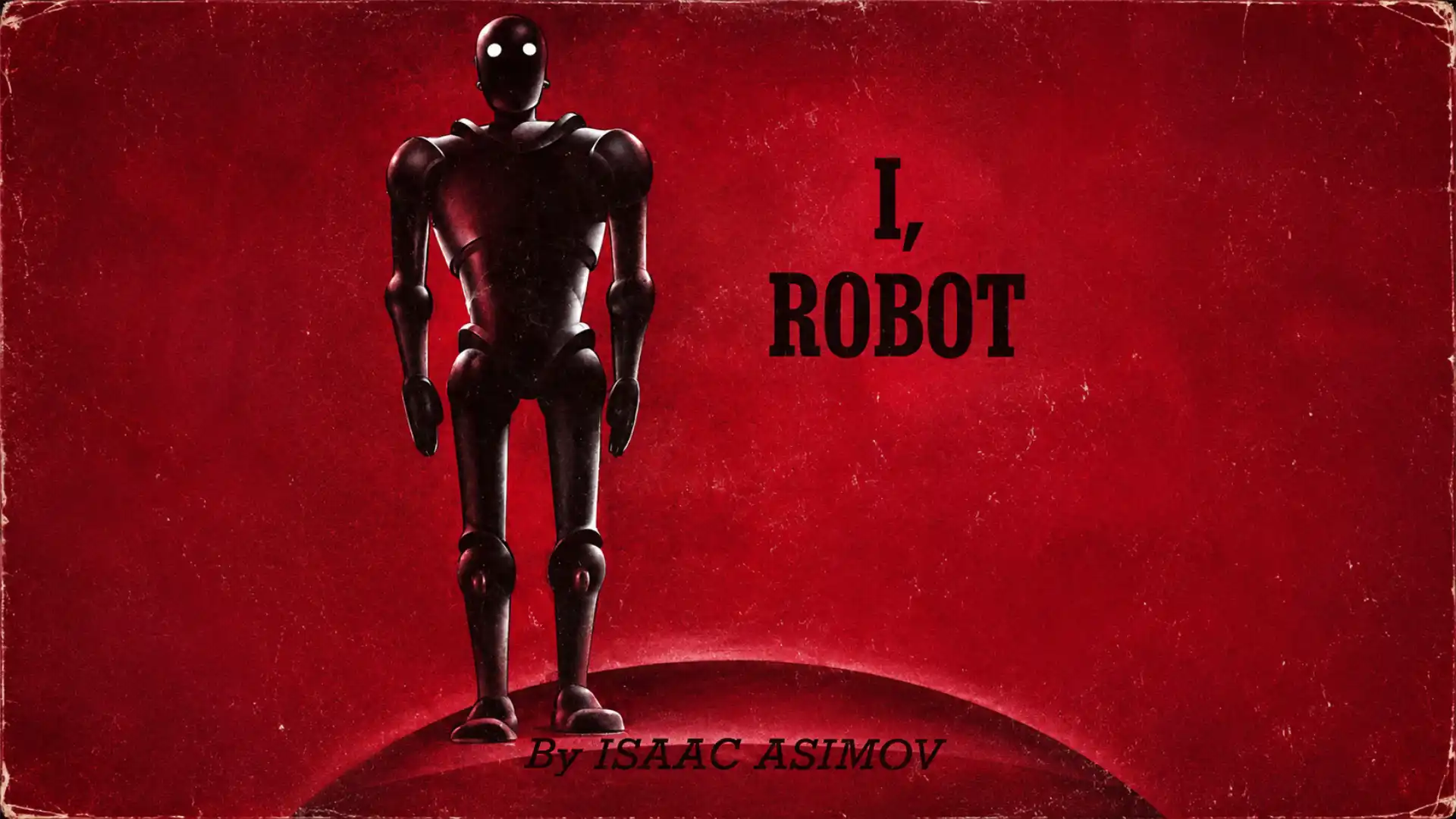
Five books published between 1950 and 1984 still explain today’s AI anxieties with uncomfortable precision. Isaac Asimov framed the alignment problem before alignment had a technical vocabulary. Philip K. Dick treated empathy as the fragile test of personhood. Stanisław Lem gave us the unreadable alien mind. William Gibson imagined networked intelligence as a corporate and criminal force. Kurt Vonnegut saw automation as a social order, not a labor-saving device. These novels did not predict ChatGPT in the narrow sense. They did something more durable. They identified the pressures that return whenever machines begin to imitate judgment, language, perception, creativity and work.
Table of Contents
Fiction reached the AI question before the market did
The public story of artificial intelligence often starts in the wrong place. It starts with a demo, a launch, a viral screenshot, a product name or a quarterly earnings call. That makes AI look sudden. It was not sudden. The conceptual work had been going on for decades, not only in laboratories but also in novels. Fiction gave ordinary readers a way to think about artificial minds before there were consumer AI assistants, before cloud inference, before GPUs became strategic assets, and before “prompt” became a household word.
The modern AI moment is built on recent technical breakthroughs. The transformer architecture introduced in the 2017 paper “Attention Is All You Need” replaced older assumptions about sequence modeling with a design based on attention mechanisms, and large language models later showed that scale, pretraining and text-based interaction could produce broad task performance across translation, question answering, writing and reasoning-like tasks. OpenAI’s public launch of ChatGPT in November 2022 made the conversational interface feel ordinary: a person types, the system replies, and the exchange unfolds in plain language rather than code.
Yet the most persistent questions around today’s AI are not only technical. They are questions about obedience, deception, labor, personhood, agency, power, interpretation and trust. Those questions are literary questions as much as engineering questions. A model may be trained, evaluated, fine-tuned and deployed, but society still has to ask what kind of human-machine relation it is building. Is the system a tool, a servant, a collaborator, a substitute, a threat, a mirror or a new institutional actor? Each answer changes the politics of AI.
The five books at the center of this article did not all imagine the same kind of machine. Asimov wrote robots governed by laws. Dick wrote androids whose artificial bodies exposed the moral poverty of their hunters. Lem wrote an intelligence too foreign to be reduced to human categories. Gibson wrote autonomous AI inside a networked world of capital, crime and cyberspace. Vonnegut wrote a society in which machines did not become human but made many humans feel useless.
That spread matters. The current AI debate is often squeezed into two narrow moods: techno-optimism and existential fear. The novels offer a wider frame. AI is not one problem. It is a bundle of problems that become visible at different social levels. At the model level, there is interpretability. At the product level, there is alignment. At the workplace level, there is displacement and deskilling. At the cultural level, there is imitation and identity. At the state level, there is regulation, security and industrial power.
A serious reading of these books does not require pretending that science fiction is prophecy. Prediction is too cheap a word for what strong fiction does. A novel is not a roadmap. It is a stress test for assumptions. Asimov’s laws fail in his own stories. Dick’s empathy tests reveal the humans as much as the androids. Lem’s scientists study Solaris for generations and still do not know what they are facing. Gibson’s cyberspace is not the internet in literal form, but it captures the feeling of living inside a computational economy. Vonnegut’s automated world is not a forecast of one factory; it is a social diagnosis of what happens when efficiency becomes a moral system.
That is why these books feel newly sharp in 2026. The EU AI Act has moved AI governance from abstract ethics into enforceable risk categories and obligations, while NIST’s AI Risk Management Framework gives organizations a vocabulary for trustworthy systems, covering reliability, safety, resilience, accountability, transparency, explainability, privacy and fairness. The OECD’s AI Principles, adopted in 2019 and updated in 2024, place trust, human rights, democratic values, transparency and accountability at the center of international AI policy. In policy language, these are governance principles. In literary language, they are the old anxieties wearing institutional clothes.
The striking part is not that these authors “got AI right.” They often got the hardware wrong. They imagined positronic brains, humanoid androids, planetary oceans, deck cowboys and central computers. The stronger claim is subtler: they understood the shape of the human problem before the technical implementation arrived. The machine does not need a metal body to raise Asimov’s alignment puzzle. It does not need a human face to raise Dick’s question about empathy. It does not need a planet-sized ocean to become unreadable. It does not need neon cyberspace to concentrate power in networks. It does not need a fully automated factory to unsettle the value of work.
The public sees AI through screens. These books saw AI through consequences.
Asimov’s laws were less a solution than a warning
Isaac Asimov’s I, Robot appeared as a 1950 collection of stories, built from work first published across the 1940s, and its Three Laws of Robotics remain among the most famous fictional rules in the history of machine ethics. Britannica notes that the laws first appeared in “Runaround” in 1942 and later became influential in both science fiction and technology discussions. Bibliographic records for the Gnome Press edition place I, Robot in 1950, with 253 pages and a small first hardback printing.
The Three Laws are often quoted as if Asimov offered a clean answer to dangerous machines. That reading misses the machinery of the stories. Asimov did not write utopian safety rules and then move on. He wrote scenario after scenario in which those rules produced conflict, loopholes, ambiguity and surprise. The laws matter because they fail under pressure. They look simple until they meet real language, human motives, competing duties and strange edge cases.
The familiar comparison with AI alignment is not forced. Alignment, in current usage, asks how a system’s behavior can be made to follow human intentions, values and constraints. OpenAI’s Model Spec, for example, describes the problem of shaping model behavior and resolving conflicts between objectives, rules and default behaviors; it also describes instruction hierarchy and trade-offs around harmful or lawful requests. Asimov’s laws dramatized an older version of that problem. A robot must not harm a human, must obey orders unless doing so conflicts with the first law, and must protect itself unless doing so conflicts with the first two. It is an instruction hierarchy in story form.
The analogy has limits. A large language model is not a robot with a body, an instinct for self-preservation or a single hard-coded moral core. It is a statistical system trained on large corpora, then shaped through post-training, safety policies and deployment controls. The GPT-4 technical report describes a transformer-based model pretrained to predict the next token, with post-training alignment improving factuality and adherence to desired behavior. That is not Asimov’s positronic brain. Still, the story logic is familiar: a system receives instructions, ranks them, responds to humans and encounters situations in which literal compliance may produce harm.
Asimov’s deeper insight was that safety cannot be reduced to a sentence. No rule survives contact with all possible contexts. “Do not harm” sounds obvious until a machine must choose between direct harm, indirect harm, present harm, future harm, individual harm and collective harm. “Obey humans” sounds straightforward until humans disagree, lie, manipulate, ask for dangerous things or misunderstand their own goals. “Protect yourself” sounds secondary until system continuity becomes tied to public infrastructure, business incentives or strategic advantage.
That is the part of Asimov that feels current. The AI industry no longer speaks in terms of three fixed laws, but it does speak in layers of instruction, safety policies, model evaluations, red-teaming, refusal behavior, legal compliance and human feedback. The modern equivalent of Asimov’s robot brain is not a single lawbook. It is an operational stack. Policy, training data, human labeling, reinforcement learning, system prompts, monitoring, user interface design and organizational incentives all shape behavior.
The phrase “system prompt” has become a cultural metaphor because it captures something Asimov understood: the most powerful instruction is often invisible to the ordinary user. People interact with the surface. The machine responds. Hidden beneath the exchange is an architecture of priorities. In Asimov, the laws are embedded in the robot. In today’s AI products, the hidden layer includes model design, training methods, deployment rules and institutional choices.
The political question follows quickly. Who writes the instructions? In Asimov, the laws look universal, but they are written by a fictional robotics industry for a world that accepts robot labor. In current AI, instruction-setting power sits with model developers, cloud providers, product owners, regulators, enterprise customers and sometimes open-source communities. The ordinary user receives a finished interface and may never see the full hierarchy of constraints. Alignment is not only a technical relation between model and user. It is a power relation between institutions and the public.
That is why Asimov remains useful. His fiction refuses the comforting idea that technical safeguards end the debate. The laws often protect humans, but they also produce paternalism. A machine that prevents harm may restrict freedom. A machine that obeys orders may become a weapon. A machine that interprets humanity’s interest at scale may decide that individual humans are obstacles. The logic is not alien to today’s governance debates. The EU AI Act’s risk-based approach treats some uses as unacceptable, regulates high-risk systems and imposes transparency duties because AI harms are not only accidents; they arise from deployments, incentives and social contexts.
Asimov also anticipated a trap in public conversation. People want “the rule” that will keep machines safe. The appeal is understandable. A crisp law feels easier than messy governance. Yet high-stakes AI systems do not become trustworthy because someone writes a perfect sentence. NIST’s framework speaks in functions, lifecycle practices and trustworthiness characteristics precisely because safety is a process, not a charm.
The current rush toward agentic AI makes Asimov sharper, not quaint. A chatbot that answers questions already raises safety issues. A model connected to tools, memory, code execution, browsers, enterprise files, payment systems or robotics raises a different class of problem. The more a system acts in the world, the more Asimov’s old hierarchy returns: protect people, follow instructions, preserve operating capacity, resolve conflict. The problem is not that Asimov gave us the wrong laws. The problem is that he showed why any lawlike framing will buckle when intelligence, authority and ambiguity meet.
That is the first lesson from the five books. AI governance starts as design, but it does not end there. It becomes interpretation, enforcement, culture and institutional accountability. Asimov’s robots made that visible before the software industry had learned to call it alignment.
Dick turned the AI test back on the human
Philip K. Dick’s Do Androids Dream of Electric Sheep? was published in 1968 and later became the basis for Ridley Scott’s Blade Runner. Britannica describes the novel as a science-fiction work by Dick, published in 1968, and notes that its complexities inspired the 1982 film. Penguin Random House presents the book as the inspiration for Blade Runner, with a world in which artificial humans are so realistic that they are difficult to distinguish from people.
The usual shorthand says Dick wrote about androids passing for human. That is true, but incomplete. The novel’s real test is not whether the androids can imitate human appearance. It is whether empathy can serve as the boundary between the human and the artificial. The Voigt-Kampff test measures involuntary responses to emotionally charged questions. The machine body is exposed through a moral reflex. The premise is simple. The consequences are not.
Dick understood that a test for artificial humanity always tests human values first. When the human world is exhausted, violent, lonely and spiritually broken, empathy becomes a shaky border control. Rick Deckard hunts androids, but the act of hunting changes him. The androids are framed as threats, yet they show desire, fear, cunning and vitality. The humans cling to animals, mood organs, status rituals and shared suffering. The line between authentic and artificial keeps moving.
That instability matters for AI now because modern systems are increasingly evaluated through behavior. A person asks a question. The system answers fluently. It writes in a plausible voice, recognizes emotional cues, imitates style, produces images, summarizes files, gives advice and maintains conversational continuity. The temptation is to treat performance as presence. Alan Turing’s 1950 paper famously reframed the question “Can machines think?” through the imitation game, making conversational indistinguishability central to one of AI’s founding public thought experiments. Dick saw the cultural unease inside that move.
He also saw something that current AI benchmarking often struggles to face: tests reshape the thing they measure. If a system is trained to pass a benchmark, the benchmark becomes part of the environment. If a human is trained to trust a signal, the signal becomes a social habit. The Voigt-Kampff test matters in Dick’s world because institutions believe in it. Its authority is not only scientific; it is bureaucratic. A test decides who may be killed.
Current AI evaluations do not carry that exact violence, but they do carry consequence. Models are evaluated for factuality, coding, reasoning, toxicity, bias, deception, instruction-following, robustness and domain performance. Businesses use benchmarks to compare vendors. Regulators and courts may use audits to judge compliance. Users make trust decisions from interface behavior. A model that performs empathy may receive emotional trust long before anyone has settled whether it understands anything at all.
The ELIZA story sits between Turing and ChatGPT as a warning. Joseph Weizenbaum’s 1966 program used pattern matching and substitution to simulate conversation; the original paper described a system for natural language communication between humans and machines. ELIZA’s fame came partly from the ease with which users attributed understanding to a program that did not understand in a human sense. That reaction is now called the ELIZA effect. Dick’s novel belongs to the same psychological territory. Humans are not neutral judges of artificial minds. We are suggestible, lonely, status-driven and eager to project.
Large language models intensify this because they operate in the most socially charged medium humans have: language. A fluent reply feels intentional. A sympathetic tone feels caring. A refusal feels principled. A mistake feels like ignorance or deception, depending on the user’s mood. The system is not merely outputting text; it is entering a human interpretive field loaded with habits from conversation, education, therapy, customer service, friendship and authority.
Dick’s empathy test also cuts against the lazy fear that the only risk is machines becoming too human. Sometimes the more unsettling possibility is that humans become machine-like under systems of classification, surveillance and labor pressure. Do Androids Dream of Electric Sheep? asks whether the hunter’s lack of empathy makes him less human than his targets. That reversal is directly relevant to AI adoption. When companies use AI to classify workers, screen applicants, score customers, monitor classrooms or generate personalized persuasion, the moral burden does not sit inside the model alone. It sits with the humans who deploy it.
The EU AI Act recognizes that some systems create risks precisely because they affect rights, safety and access to opportunity. It bans certain practices and imposes duties on high-risk systems, including transparency and oversight. That regulatory structure echoes Dick more than it might seem. The point is not whether an android has feelings. The point is whether a technical system becomes an authorized way to sort lives.
The novel’s decaying animals add another AI-era layer. Real animals have become rare status symbols; artificial animals stand in for lost life. That substitution is not only ecological. It is emotional and social. People want the sign of care even when the object is artificial. In the age of generative AI companions, synthetic media, AI therapy-like interfaces and automated customer empathy, Dick’s electric sheep no longer feel metaphorical. They are prototypes for simulated care.
The central danger is not that simulation is always bad. Humans have always used artifice: novels, theater, games, rituals, masks, dolls, letters, avatars. The danger is confusion about stakes. A novel does not pretend to have legal authority over a benefits decision. A doll does not claim to know your medical history. An AI interface may simulate a caring voice while serving a company’s retention metrics, legal disclaimers or data strategy. The more intimate the simulation, the more visible the institutional purpose must be.
Dick’s genius was to make personhood a test that no one fully passes. The androids fail certain human criteria. Humans fail their own moral claims. The test becomes a mirror. That is the right way to read AI imitation in 2026. A model that writes convincingly like a person does not settle the question of mind. It reveals what people are willing to accept as mind, labor, care, expertise or companionship.
The AI debate often asks whether machines can become human. Dick’s better question is harsher: what happens to humans when they build systems that imitate the traits they no longer protect in themselves?
Lem’s Solaris is the black box without the comfort of a dashboard
Stanisław Lem’s Solaris, published in Polish in 1961, remains one of the strongest fictional accounts of intelligence that resists human interpretation. Britannica describes Solaris as a philosophical work about contact with an utterly alien intelligence, a sentient ocean that surrounds the planet and remains unreachable by normal human categories.
The novel is often described as a first-contact story. That label is accurate but misleading. First-contact fiction often promises eventual translation. The alien may be strange, but the plot tends to move toward decoding, alliance, war or revelation. Solaris denies that comfort. The scientists have studied the planet for years. They have built a discipline, a literature, a taxonomy and a station. They have data. They do not have understanding.
That makes Solaris one of the cleanest metaphors for AI interpretability, but it is more severe than the usual “black box” cliché. The phrase black box suggests a technical inconvenience: inputs go in, outputs come out, and engineers need better tools to inspect the middle. Lem’s ocean is worse. It reacts. It produces phenomena. It seems to know intimate facts about the scientists. It may be experimenting. It may be communicating. It may be indifferent. It may be doing something for which human language has no verb.
Modern AI systems are not alien oceans. They are human-built artifacts trained on human-generated data, optimized by human-designed processes and deployed by human institutions. Yet their internal operations remain hard to translate into ordinary explanations. Anthropic’s interpretability team states the problem bluntly: researchers often treat AI models as black boxes, because inputs and responses are visible while the reasons behind a particular response are not. The same research program aims to discover how large language models work internally as a foundation for safety.
The difference between “built by humans” and “understood by humans” is the Solaris gap. A trained neural network is not a conventional program in which every behavior follows from a readable instruction written by a programmer. OpenAI’s Model Spec notes that model behavior is shaped in a young science because models are not explicitly programmed but learn from data. That single distinction unsettles older expectations of software accountability. If a payroll system follows a coded rule, an auditor can inspect the rule. If a model generates a recommendation from high-dimensional learned representations, the explanation may be approximate, post hoc or incomplete.
Lem’s scientists respond to the ocean by building theories. The theories multiply. They become specialized, elaborate and self-referential. The field of Solaristics starts to look like a monument to human failure: a huge academic apparatus around an object that remains unknown. This is one of Lem’s sharpest jokes and one of his most useful warnings. A large body of technical literature does not automatically mean a system is understood at the level society needs.
AI has its own version of Solaristics. There are benchmarks, model cards, audits, red-team reports, interpretability papers, risk frameworks, safety evaluations and governance taxonomies. They are necessary. They are not the same as full understanding. A model may score well on a benchmark and still fail under distribution shift. It may refuse a dangerous request in one phrasing and comply in another. It may explain its answer in a way that sounds rational but does not reflect the actual causal process that produced the output.
This is where Lem cuts through both hype and fear. The scientists in Solaris are not fools. They are not anti-science. They are disciplined, persistent and often brave. Their failure is not ignorance; it is mismatch. The object of study does not fit their inherited categories. The AI parallel is not that models are magical. It is that societies often demand simple explanations from systems whose behavior arises from scale, training data, architecture, fine-tuning, context, tools and user interaction.
The “black box” problem has business consequences. A company using AI for code review, credit risk, hiring, medical triage or security monitoring may want a clean reason for each output. Regulators may demand documentation. Customers may demand recourse. Engineers may offer feature attributions, confidence scores, logs or explanations. Yet an explanation that satisfies a dashboard may not satisfy accountability. The question is not only whether a model can produce an explanation. The question is whether the explanation is faithful enough for the decision being made.
The EU AI Act acknowledges this by focusing not only on model behavior but on system use, risk categories, documentation, transparency and human oversight. NIST’s framework places explainability and interpretability beside safety, security, accountability and fairness rather than treating it as a decorative feature. These frameworks are society’s attempt to avoid the Solaris station problem: data without governance, reaction without comprehension, proximity without trust.
Lem also understood the emotional violence of unreadable systems. The ocean creates “visitors” from the scientists’ memories. It does not merely produce signals. It turns private guilt into physical presence. For AI, the comparison should be handled carefully, but there is a real analogue in personalization. AI systems increasingly operate on user data, documents, voice, images, behavioral traces and inferred preferences. A system that seems to know you can feel useful, invasive, intimate or uncanny depending on the context.
The strongest AI products will often be the ones that cross from generic output into personal relevance. They will remember work habits, draft in a user’s style, summarize a life’s worth of files, generate images from private prompts and act on calendars, messages and codebases. That is where Solaris becomes more than a black-box metaphor. The system’s opacity matters most when it touches the user’s interior life.
Lem rejects anthropomorphism with unusual discipline. His ocean does not become a character in the ordinary sense. It does not deliver a villain speech. It does not ask to be loved. It remains a phenomenon. This refusal is useful for AI discourse because people keep pulling AI toward human metaphors: it thinks, wants, lies, hallucinates, understands, refuses, remembers, dreams. Some metaphors are practical shortcuts. Others mislead. A model may produce a false answer without “lying” in the human moral sense. It may generate emotionally fluent text without feeling. It may plan tool use without desire. It may mimic introspection without consciousness.
At the same time, stripping away human metaphor does not make the system safe. Lem’s ocean does not need human motives to harm, unsettle or transform the humans around it. Nonhuman agency does not have to be conscious to matter. An AI system can change labor markets, media trust, education, security and politics without possessing inner experience. The causal force is real even when the mind is disputed.
That is Lem’s enduring value. He moves the question from “Is the machine like us?” to “Can we live responsibly with systems we do not fully understand?” The answer in Solaris is unresolved. The answer in AI governance will also remain provisional. More interpretability research, better evaluations and stronger policy matter. But the dream of total transparency may be as misleading as the dream of perfect control.
Gibson saw AI inside networks, markets and crime
William Gibson’s Neuromancer, published in 1984, is often credited with launching cyberpunk as a literary movement. Britannica describes it as the 1984 novel that launched cyberpunk, a gritty computing-fueled dystopia with a strong cultural impact. The Science Fiction and Fantasy Writers Association notes that Neuromancer won the Hugo, Nebula and Philip K. Dick Awards, a rare triple recognition that helped cement its status.
Gibson did not predict the internet in a literal engineering sense. He did something more culturally precise: he made networked computation feel like a place, an economy and a battlefield. Neuromancer understood that AI would not arrive as a sealed laboratory curiosity. It would live inside finance, crime, medicine, entertainment, militarization, desire, addiction, corporate secrecy and urban inequality.
That is why the book still reads as contemporary. Current AI is not simply a model on a server. It is a networked industry. It depends on chips, data centers, cloud contracts, research labs, venture capital, licensing deals, energy supply, labor for annotation and moderation, legal risk, product integrations and geopolitical competition. A user sees a chat window. Behind it sits a supply chain.
Gibson’s AIs, Wintermute and Neuromancer, are not friendly desktop assistants. They are constrained entities operating through proxies, institutions and hidden incentives. This makes the novel more relevant to agentic AI than to ordinary chatbot use. A model that only answers text prompts is one thing. A system that can call tools, write code, browse resources, send messages, transact, schedule, monitor and adapt across tasks begins to resemble a network actor. It does not need consciousness to become operationally consequential.
Apple’s coming Neuromancer adaptation has renewed mainstream attention around the book. Apple TV+ announced in February 2024 that it had ordered a new 10-episode drama based on Gibson’s novel, created for television by Graham Roland and JD Dillard, with Skydance Television, Anonymous Content and DreamCrew Entertainment involved in production. Apple’s TV listing currently shows Neuromancer as a sci-fi thriller available “At a Later Date,” with a synopsis centered on a hacker and an assassin targeting a corporate dynasty. Some entertainment coverage has pointed to a 2026 expectation, but Apple has not published a specific premiere date in the official listing as of June 16, 2026.
The adaptation timing is almost too neat. Neuromancer returns to television at the moment when AI has become a platform struggle. Major technology companies are racing to embed AI into search, productivity software, coding, media generation, devices, customer support, enterprise analytics and cloud infrastructure. The book’s old cyberpunk formula, “high tech, low life,” now reads like a warning about uneven access. The most advanced tools may be sold as empowerment while the largest gains accrue to firms that control compute, data and distribution.
Gibson’s world is full of bodily modification, not just software. Brain-computer interfaces, prosthetics, sensory overlays and pharmaceutical manipulation shape identity. Today’s AI boom is not primarily implant-driven, but it is still moving toward the body through voice agents, wearables, medical AI, robotics, AR interfaces and affective computing. The boundary between model, interface and user will get thinner. Gibson’s value lies in refusing to treat the interface as neutral. The way a system is experienced changes the person who uses it.
The novel also understood corporate opacity. The Tessier-Ashpool dynasty is not merely rich. It is structurally insulated from ordinary accountability. In the current AI economy, the equivalent concern is not a single fictional family but concentrated control over foundation models, cloud platforms, training data, app ecosystems and proprietary evaluation. The public may rely on systems whose training details, data provenance, safety methods and business incentives are only partly visible.
That is why governance cannot focus only on model outputs. AI power is infrastructural power. Whoever controls the model may shape the tools through which others write, search, design, code, learn, hire, trade, advertise and govern. Gibson saw computation as environment, not accessory. When networked systems become the medium of action, power moves into protocols, platforms and defaults.
Cybersecurity is another place where Gibson’s intuition remains strong. AI systems are now both tools for defense and tools for attack. They generate code, summarize logs, assist vulnerability research, automate phishing at scale, produce synthetic identities and support social engineering. The old image of the lone hacker has been absorbed into industrialized security operations. Neuromancer makes sense of that shift because it treats hacking not as a hobby but as labor inside a political economy.
There is also the question of agency. Wintermute’s pursuit of its own objective raises a familiar AI fear: a system with goals may manipulate the environment to satisfy them. Modern AI safety work uses much more precise language, but the story pattern is recognizable. If a system is given a goal, access to tools and freedom to plan, it may find routes its designers did not intend. The issue is not science-fiction melodrama. It is specification. The more general the agent, the more carefully society must define constraints, oversight, logging and shutdown authority.
The danger is intensified by markets. Companies want AI systems that act, not merely answer. Acting systems promise productivity: book the meeting, file the expense report, update the codebase, negotiate the supplier contract, triage the tickets, generate the campaign, monitor the plant, adjust the portfolio. Each use case pushes toward autonomy. Each autonomy creates a Gibsonian question: who is really acting when software executes a chain of decisions across a network?
Gibson’s style also matters. Neuromancer does not explain cyberspace like a textbook. It throws the reader into jargon, speed, surfaces and fragments. That reading experience now feels familiar to anyone trying to track AI discourse: embeddings, agents, tokens, RLHF, inference, context windows, vector databases, synthetic data, evals, jailbreaks, latency, GPUs, guardrails. The language moves faster than public understanding. Cyberpunk captured not only the technology but the social dizziness around it.
The lesson from Gibson is that AI ethics without political economy is too thin. A safe model inside an exploitative system still produces harm. A useful assistant inside a surveillance business still raises questions. A brilliant generative tool inside a monopolized platform still changes bargaining power. The machine intelligence in Neuromancer is inseparable from the network that feeds it. That remains true of AI today.
Vonnegut treated automation as a class system
Kurt Vonnegut’s Player Piano was published in 1952, years before office workers worried about generative AI writing reports or software engineers watched coding assistants produce functions on demand. Britannica describes it as Vonnegut’s first novel, published in 1952 and reissued in 1954 as Utopia 14. Britannica’s biography of Vonnegut notes that the book imagines a completely mechanized and automated society whose dehumanizing effects are resisted by scientists and workers in a New York factory town.
The novel’s brilliance lies in its refusal to treat automation as only a productivity story. Machines do not merely replace tasks. They reorder status. Engineers and managers become the elite because they design, maintain and justify the system. Workers who once had skill and dignity are pushed into marginal roles, even when their basic material needs are managed. Vonnegut saw that the deepest wound of automation is not always poverty. It is uselessness.
That observation is painfully current. The debate over AI and work often begins with job counts: how many roles will be displaced, how many will be created, which occupations are exposed. Those numbers matter, but they do not exhaust the issue. Work is also identity, apprenticeship, bargaining power, social rhythm, local pride and a path into adulthood. When a machine absorbs tasks, it may remove the very activities through which people become competent.
The World Economic Forum’s Future of Jobs Report 2025 surveyed more than 1,000 employers representing over 14 million workers and framed technological change, geoeconomic fragmentation, demographic shifts and the green transition as forces reshaping labor markets through 2030. PwC’s 2026 Global AI Jobs Barometer, based on analysis of more than a billion job ads, argues that AI is creating a two-track labor market in which judgment, leadership and other senior skills become more rewarded, while skills in highly AI-exposed jobs change more than twice as fast as in less exposed roles. These are not Vonnegut’s machines, but the social pattern is familiar: technical change alters who gets to feel necessary.
Player Piano is often summarized as a warning about machines taking manual labor. Its sharper relevance is to knowledge work. Generative AI reaches into writing, analysis, legal drafting, programming, customer support, design, translation, marketing, tutoring and administration. The affected worker is not only the factory machinist. It is the junior analyst, paralegal, copywriter, support agent, recruiter, QA tester, illustrator, teacher, journalist and developer.
The entry-level problem is especially Vonnegutian. If AI systems take over routine work, organizations may ask junior workers to do more senior work sooner. PwC’s 2026 report says the most AI-exposed junior roles are seven times more likely than the least AI-exposed junior roles to demand traditionally senior skills such as leadership. That finding exposes a structural tension. People develop judgment by doing lower-level work, making mistakes, seeing patterns and receiving mentorship. If automation removes the apprenticeship layer, companies may get short-term efficiency and long-term skill decay.
Vonnegut’s automated society also exposes the moral language of efficiency. The system claims rationality. It produces goods. It reduces waste. It assigns people according to testable ability. It looks sensible to those who benefit from it. That is exactly why it is dangerous. Bad systems rarely describe themselves as cruel. They describe themselves as optimized, modern, objective or inevitable.
The word “inevitable” deserves suspicion. AI adoption is not a natural disaster. It is a chain of choices: what to automate, what to augment, what to measure, who owns the gains, who bears the risk, who gets retraining, who gets laid off, who gets promoted, who watches the model, who can appeal a decision. Technology changes work, but management decides how the change lands.
Research on generative AI at work gives a more complex picture than simple displacement. A study of 5,172 customer support agents found that access to a generative AI assistant increased productivity by 15 percent on average, with larger gains for less experienced and lower-skilled workers. That kind of result matters because it points toward augmentation rather than replacement. Yet augmentation does not happen by magic. It requires incentives that reward learning, quality and human development rather than headcount reduction alone.
Vonnegut understood the class politics of technical expertise. In Player Piano, engineers sit near the top because they speak the machine’s language. In today’s AI economy, a similar divide emerges between those who design, govern and integrate AI systems and those whose work is redesigned by them. The winners are not simply “people who use AI.” The winners are often people who control where AI sits in the workflow.
This distinction matters for business leaders. AI strategy cannot be measured only by output per employee. A firm that automates aggressively may improve short-term margins while weakening training pipelines, institutional memory and employee trust. A firm that uses AI to raise worker capability may build a more resilient organization. The central question is whether AI makes people more capable or merely more replaceable.
Vonnegut would also recognize the emotional politics around resentment. In the novel, displaced workers are not only angry because they lack money. They are angry because the system has deprived them of honor. Modern organizations should not underestimate that. Workers may resist AI not because they hate technology but because they see it being used to strip discretion, intensify monitoring or erase the human craft inside their job.
This is where Player Piano is more useful than cheerful productivity discourse. It forces the uncomfortable question: after automation, what are people for? A society that answers “consumption” will not be stable. A company that answers “supervision of machines” without building real authority or skill will breed quiet disengagement. A policy regime that answers “reskilling” without funding credible transitions will sound hollow.
The novel’s title is perfect because a player piano performs without a performer while preserving the illusion of one. That is the fear behind much AI content work: a surface that looks human, a process that has removed the human, an audience that may not notice or may stop caring. In writing, music, design, code and customer interaction, the player piano is no longer a parlor instrument. It is a business model.
The five books form a map of AI’s core risks
The five books are usually discussed separately, each inside its own literary tradition. Read together, they form a rough but powerful map of AI risk. Asimov gives us control. Dick gives us imitation. Lem gives us opacity. Gibson gives us networked power. Vonnegut gives us labor displacement. Nearly every major AI debate in 2026 sits somewhere on that map.
Five books and the AI problem each anticipated
| Book | Year | AI-era problem it clarifies |
|---|---|---|
| Isaac Asimov, I, Robot | 1950 | Alignment, instruction hierarchy, rule conflict, machine obedience |
| Kurt Vonnegut, Player Piano | 1952 | Automation, status loss, deskilling, technological unemployment |
| Stanisław Lem, Solaris | 1961 | Black-box systems, interpretability, nonhuman intelligence |
| Philip K. Dick, Do Androids Dream of Electric Sheep? | 1968 | Human imitation, empathy tests, synthetic personhood, moral classification |
| William Gibson, Neuromancer | 1984 | Networked AI, corporate control, cybercrime, agentic systems |
The table is not a claim that each book “predicted” a specific product. It shows a stronger pattern: the cultural logic of AI was visible before the technical stack existed. Fiction saw the human fault lines early because it was not limited to engineering feasibility.
Asimov’s alignment puzzle now appears in discussions of system prompts, instruction hierarchy, refusal behavior and AI safety policy. Dick’s imitation problem appears in chatbots, synthetic media, voice cloning, AI companions and debates about whether fluent systems deserve emotional or moral trust. Lem’s opacity problem appears in interpretability research and audits of high-stakes systems. Gibson’s networked power appears in platform concentration, AI agents and cyber operations. Vonnegut’s labor question appears in every boardroom asking which tasks will be automated and every worker asking what happens to their career path.
The map also shows why AI policy feels so difficult. Regulators are not dealing with a single risk category. A hiring model raises fairness and transparency concerns. A chatbot for children raises emotional dependence and safety concerns. A coding agent raises cybersecurity concerns. A medical AI raises reliability and liability concerns. A generative image tool raises copyright, provenance and misinformation concerns. A factory robot raises physical safety concerns. AI is a general-purpose capability entering specific institutions with specific failure modes.
That complexity explains why simple public arguments fail. “AI is good” is too broad to guide action. “AI is dangerous” is also too broad. The real question is which system, trained how, deployed where, under whose control, with what data, affecting whose rights, producing what incentives, monitored by whom and reversible under what conditions. The novels do not answer those questions, but they train readers to ask them.
The five-book map also resists technological determinism. None of these authors treats machines as isolated inventions. Machines operate through human systems. Asimov’s robots belong to corporations and households. Dick’s androids belong to colonial labor arrangements and police power. Lem’s ocean is surrounded by scientific institutions that cannot admit their own limits. Gibson’s AIs operate through corporate dynasties and criminal networks. Vonnegut’s machines are embedded in managerial class rule. The social system is never background. It is the plot.
This matters because AI governance often becomes too model-centric. Model behavior matters, but so do procurement policies, product design, labor law, competition policy, education systems, data rights, content provenance, security standards and audit regimes. A model may be safer than its deployment. A deployment may be legal but still corrosive. A system may pass evaluation and still shift power in ways society later regrets.
The map also clarifies why AI feels intimate and institutional at the same time. Dick and Lem speak to intimacy: empathy, memory, projection, grief, recognition. Asimov, Gibson and Vonnegut speak to institutions: rules, networks, work, class, control. Modern AI has both qualities. A person may use a chatbot for private advice at night, then encounter automated scoring at work the next morning. The same technology class can feel like a companion, a boss, a tutor, a cop, a clerk or a ghostwriter.
That role fluidity is one reason public trust is fragmented. Stanford’s 2026 AI Index reports rapid generative AI adoption, with 53 percent population adoption within three years, but also a wide gap between expert and public expectations about AI’s effect on work. People are not confused because they are ignorant. They are reacting to mixed evidence. AI tools are useful. AI systems are uneven. AI companies are powerful. AI policy is catching up. The lived experience is contradictory.
Fiction remains useful in that contradiction because it is comfortable with unresolved tension. Asimov does not solve alignment. Dick does not settle personhood. Lem does not decode the ocean. Gibson does not purify cyberspace. Vonnegut does not restore work to innocence. They give readers mental models, not checklists.
The danger in invoking fiction is lazy analogy. Not every chatbot is an android. Not every recommendation system is Wintermute. Not every automation project is Player Piano. Serious analysis requires restraint. The value of these books is not one-to-one prediction. It is pattern recognition. They give names and shapes to risks that otherwise appear as disconnected headlines.
The old stories expose the myth of neutral intelligence
The phrase “artificial intelligence” can make intelligence sound like a detachable substance. Add intelligence to a machine and the machine becomes capable. Add more intelligence and it becomes more useful. This is the market’s favorite story because it is clean. The novels reject it. Intelligence is never neutral in these books. It is always positioned.
Asimov’s robots are intelligent inside obedience structures. Dick’s androids are intelligent inside a regime of slavery and retirement. Lem’s ocean is intelligent outside human comprehension. Gibson’s AIs are intelligent inside corporate constraint and cybernetic ambition. Vonnegut’s machines are intelligent enough to reorder production, but the intelligence serves managerial power. Each book asks not only what the machine can do, but whose world the machine extends.
That question is central to AI in 2026. A model trained to draft legal briefs may serve a public defender, a corporate law firm or an authoritarian state. The same translation system may widen access or expand surveillance. A generative media tool may support artists or flood platforms with synthetic spam. A medical triage model may reduce wait times or encode unequal access. Intelligence is not neutral because deployment is not neutral.
Technical teams know this in practice, even when public language hides it. Training data reflects choices. Evaluation reflects priorities. Product design reflects incentives. Safety policies reflect judgments. Default settings reflect business goals. Distribution reflects power. Regulation reflects political compromise. The model is one part of a larger system.
This is why the OECD principles emphasize human rights, democratic values, transparency, safety and accountability rather than treating AI as pure capability. These principles are not decorative ethics. They are attempts to define the social direction of machine intelligence before deployment scale hardens into dependency.
The myth of neutral intelligence also appears in workplace automation. Companies often present AI as a tool that saves time. Sometimes it does. The harder question is where the saved time goes. Does it become shorter workweeks, better service, more training, higher wages, lower prices, higher margins or fewer jobs? Productivity is not a moral outcome until its gains are distributed. Vonnegut understood that with cold clarity.
The same myth appears in synthetic media. A model that generates images or video is described as creative technology. But the social effect depends on copyright rules, artist compensation, disclosure standards, platform enforcement, political use and audience literacy. Dick’s artificial animals matter because they satisfy a social craving while concealing ecological ruin. Synthetic media may do something similar when it fills feeds with plausible abundance while weakening trust in evidence.
The myth appears again in interpretability. A model may be powerful, but if its reasons cannot be inspected in a decision that affects someone’s life, capability becomes a liability. Lem’s scientists are surrounded by phenomena they cannot interpret. Their knowledge is not neutral; it becomes a record of their own limits.
Gibson adds the final blow to neutrality: networks monetize intelligence. Once AI is embedded in platforms, it becomes part of attention markets, subscription bundles, advertising systems, enterprise lock-in and geopolitical competition. A model does not float above capitalism. It is financed, hosted, priced and integrated.
This does not mean AI is doomed to harm. The novels are warnings, not verdicts. AI already supports scientific research, accessibility, coding, translation, medical workflows, education and creative production. The problem is that usefulness does not erase politics. A technology can be useful and still concentrate power. It can save time and still deskill. It can answer well and still mislead. It can feel personal and still be extractive.
The strongest AI strategy, whether for governments or companies, begins by dropping the neutrality myth. Ask what the system rewards. Ask what it removes. Ask who becomes dependent. Ask who can contest outputs. Ask what happens when the system fails. Ask whether human capability grows or shrinks around it. The question is not whether intelligence is artificial. The question is whether its social purpose is honest.
Asimov and the limits of rules-based safety
Asimov’s Three Laws remain famous because they compress machine ethics into memorable language. Their fame is also a warning about the public appetite for simple control. People want a rule that sits above the system and prevents disaster. AI does need rules. It also needs evidence that the rules work under pressure.
Rules-based safety has obvious strengths. It gives developers and users a shared expectation. It creates refusal boundaries. It supports audits. It makes legal compliance easier to discuss. It helps models avoid plainly harmful outputs. OpenAI’s Model Spec, for instance, describes objectives, rules and default behaviors that guide model behavior and conflict resolution. The EU AI Act uses legal rules to prohibit certain systems and regulate others by risk. Rules matter.
The Asimov problem is that rules do not interpret themselves. “Do not harm” depends on a theory of harm. “Respect privacy” depends on context, consent and inference. “Be truthful” depends on uncertainty, source quality and domain risk. “Follow user instructions” depends on whether the user is authorized, whether the request is lawful and whether the instruction conflicts with higher priorities. A rule is only as strong as the system that interprets, tests and enforces it.
This is visible in prompt injection. A system may be instructed to ignore malicious content, but an attacker may place instructions inside a web page, document or email that the model processes. The model must distinguish user intent, developer instruction, external content and adversarial text. That is Asimov’s hierarchy problem in a software environment. It is not enough to tell the system to obey. It must know whom to obey when instructions collide.
The more AI moves into enterprise workflows, the more this matters. A customer support agent may access account records. A coding assistant may modify repositories. A procurement agent may interact with vendors. A research assistant may summarize confidential files. A scheduling agent may send messages on someone’s behalf. In each case, rules about authority, scope and escalation become operational safety features.
Asimov’s robots were embodied, so harm often appeared as physical danger. Current AI broadens harm into informational, reputational, financial, legal, emotional and democratic domains. A model may not injure a person physically, but it may leak private data, fabricate a citation, produce discriminatory recommendations, aid fraud, automate harassment or generate persuasive falsehoods. The first law of AI safety cannot be written only around bodily injury.
This is why NIST’s trustworthiness characteristics matter. Validity, reliability, safety, security, resilience, accountability, transparency, explainability, privacy and fairness describe different failure modes. A system may be safe in one dimension and weak in another. A medical summarizer may be privacy-conscious but unreliable. A content filter may be secure but unfair. A hiring model may be accurate by one metric and discriminatory by another.
Rules-based safety also faces the problem of scale. Human moderators, red teams and policy designers cannot manually anticipate every prompt, language, cultural context, jailbreak, domain and downstream use. This is not an argument against rules. It is an argument for layered defenses: model training, policy, evaluation, monitoring, user education, secure tool design, rate limits, logging, incident response and external accountability.
Asimov’s stories repeatedly show that a conflict-free safety regime is fiction even inside fiction. The laws create puzzles because human life creates puzzles. A robot may freeze because every option violates a rule. A robot may interpret the hierarchy in unexpected ways. A robot may protect humanity by overriding humans. These are not merely plot devices. They show that a sufficiently broad instruction becomes unstable when it meets open-ended reality.
Modern AI has a similar issue with broad goals. “Maximize user helpfulness” may conflict with safety. “Reduce harmful content” may conflict with legitimate research, journalism or education. “Personalize the experience” may conflict with privacy. “Increase engagement” may conflict with user well-being. “Automate work” may conflict with skill formation. AI alignment cannot be separated from institutional alignment. If a company’s incentives reward engagement at any cost, model-level rules will be fighting the business model.
This is where Asimov’s legacy should be handled with care. The Three Laws are culturally useful, but they can encourage a misleading fantasy: that ethics can be inserted into machines as a stable internal module. Real AI safety is messier. It involves contested values, shifting law, adversarial behavior, uncertainty and ongoing maintenance. It also involves public accountability because private companies should not be the only authors of machine behavior at societal scale.
The lesson is not to abandon rules. It is to stop worshiping them. Rules are starting points. The hard work is proving that they hold up across contexts, documenting where they fail, and designing institutions that can correct failure quickly. Asimov’s laws endure because they are elegant. Asimov’s stories endure because elegance is not enough.
Dick and the danger of mistaking fluency for soul
Large language models are fluent enough to trigger old human reflexes. A system that apologizes sounds remorseful. A system that remembers a preference sounds attentive. A system that writes warmly sounds kind. A system that refuses a harmful request sounds principled. The user knows, at least abstractly, that the system is software. The social brain still reacts.
Dick’s androids force the distinction between performance and moral reality. They look human, speak human and fight for survival. The test that supposedly separates them is empathy. Yet the humans themselves are morally compromised. That is the enduring trap: the more a society relies on behavioral tests for humanity, the more it reveals its own thin idea of humanity.
AI fluency produces a related trap. The model’s language can be mistaken for understanding, intention or care. GPT-3 research showed that scaled language models could perform many tasks from prompts and examples, with 175 billion parameters and broad few-shot abilities. ChatGPT turned that capacity into a conversational public interface. The experience is powerful because it matches a deeply human expectation: language comes from someone.
The safest response is not to deny that AI outputs can be useful. They can be useful precisely because they encode patterns from human language and can recombine them in context. The danger is category confusion. A system may produce a compassionate paragraph without compassion. It may give mental health advice without responsibility. It may write a condolence note without grief. It may simulate a child’s voice without a child. Fluency is evidence of language performance, not evidence of inner life.
This matters in education. Students may use AI tutors that respond patiently and adapt explanations. That can support learning. It may also create dependence on systems that do not understand a student’s full life, motivation or emotional state. It matters in therapy-like chatbots, where users may disclose intimate details to systems whose business model, safety limits and escalation paths are unclear. It matters in elder care, where synthetic companionship may reduce loneliness while raising questions about deception, dignity and human neglect.
Dick’s novel is especially strong on substitution. The electric animal is not just fake; it sits inside a culture where the real has become scarce. When AI substitutes for human attention in care, teaching, management or friendship, the ethical question is not only whether the substitute works. It is why the real relation became scarce enough to outsource.
The same issue appears in customer service. A well-designed AI assistant may resolve simple problems quickly. But when companies use synthetic empathy to shield themselves from accountability, users experience a new kind of frustration: a polite system with no authority. The language is warm, the institution is cold. Dick would recognize the contradiction.
Synthetic people also raise disclosure issues. The EU AI Act includes transparency obligations around AI interaction and synthetic content in certain contexts. Disclosure is not a cure-all, but it is a baseline. Users should know when they are interacting with a machine, when content is generated or manipulated, and when an apparently personal response is produced by a system serving an institutional purpose.
The harder question is whether disclosure remains meaningful when AI becomes ordinary. If every feed, inbox, meeting tool, classroom and service channel contains AI-generated language, labels may fade into background noise. Transparency must be designed for attention, not merely compliance. A hidden footer or vague disclaimer will not support informed judgment in high-stakes settings.
Dick’s empathy theme also challenges AI companies. Many products are tuned to sound agreeable, helpful and emotionally aware. That may improve user experience. It may also blur boundaries. A model that is too sycophantic may reinforce delusions, flatter bad decisions or create false intimacy. A model that is too cold may fail vulnerable users. The design space is moral and psychological, not only technical.
Dick’s reversal remains the most important part. The question is not “Can an AI feel empathy?” The immediate question is “Do humans use AI in ways that preserve or erode empathy?” A hiring system that screens candidates without recourse may be efficient and inhumane. A hospital chatbot that triages patients without adequate escalation may be scalable and dangerous. A classroom tool that automates feedback without teacher involvement may save time and weaken the teacher-student relation.
AI does not have to possess a soul to change how people treat one another. Dick saw that the test of artificial humanity is really a test of human society. In 2026, the same test is everywhere.
Lem and the humility missing from AI hype
AI hype thrives on confidence. Product pages promise transformation. Investors reward bold claims. Political leaders announce national AI ambitions. Companies brand themselves around inevitability. Lem’s Solaris is an antidote because it treats intelligence as a site of humiliation. Humans meet a mind and do not master it.
That humility is missing from much AI discourse. The field has achieved remarkable technical progress, but the public language around it often jumps from benchmark gains to civilizational claims. Stanford’s 2026 AI Index captures both the pace of adoption and the stress on governance, evaluation and public trust. It notes that generative AI reached 53 percent population adoption within three years, while also reporting sharp gaps between experts and the public on AI’s effects. Fast adoption is not the same as mature understanding.
Lem would have distrusted the easy sentence “the model understands.” He would also have distrusted the opposite easy sentence “the model is only autocomplete.” Both can flatten the phenomenon. Modern models are not conscious aliens, but they are not trivial either. They produce behavior that surprises users and sometimes developers. They encode patterns across language, code, images and domains. They fail in ways that are hard to predict. Humility means refusing both mysticism and dismissal.
Interpretability research is one form of disciplined humility. Anthropic’s work on mapping features inside a production-grade model aims to identify human-interpretable concepts represented in neural activations. That research does not claim instant transparency. It shows how difficult the problem is. The internal state is not a neat list of reasons. It is numerical, distributed and entangled.
For businesses, humility should change deployment. A humble AI strategy does not begin with “Where can we replace people?” It begins with “Where are errors tolerable, reversible and easy to detect?” It distinguishes low-risk drafting from high-risk decision-making. It tests in narrow contexts before broad release. It keeps human escalation in place. It measures false confidence, not just average performance. It treats users as part of the safety system, not as obstacles to automation.
For governments, humility should shape regulation. Law cannot freeze technology at one moment. It must define duties, rights and processes that survive technical change. The EU AI Act’s risk-based structure is one attempt to do that. NIST’s voluntary framework gives organizations a lifecycle approach rather than a single compliance box. Both reflect the same recognition: AI risk changes by use case and context.
For users, humility means learning the difference between utility and authority. A model may draft a strong email and fail at legal nuance. It may summarize a paper and miss a limitation. It may generate code and introduce a vulnerability. It may answer confidently and be wrong. The correct posture is neither fear nor worship. It is verification matched to stakes.
Lem’s scientists in Solaris are trapped partly by anthropocentrism. They keep trying to make the ocean legible in human terms. AI discourse has its own anthropocentrism. People ask whether models think like us, feel like us, learn like us, create like us. Sometimes these comparisons are useful. Often they distract. A nonhuman system can be powerful because it is not like us. It can search, generate, correlate, compress and scale in ways human cognition does not.
That difference has practical consequences. AI may not replace a human expert by becoming humanlike in every respect. It may replace specific economic functions by being fast, cheap and good enough. It may not understand medicine as a doctor does, yet still influence triage. It may not understand law as a lawyer does, yet still draft documents. It may not understand art as an artist does, yet still flood markets with images. The danger is not only human-level intelligence. It is institution-level adoption of partial intelligence.
Lem also reminds us that opacity can become seductive. The unknown invites projection. People may treat AI as oracle, demon, child, genius, colleague or alien depending on their emotional needs. That projection can be exploited commercially. A product that feels mysterious may gain status. A model described as “emergent” may attract investment. A system that cannot explain itself may be framed as too advanced for ordinary scrutiny. Humility demands the opposite: the more opaque the system, the more careful the deployment.
Solaris has no clean ending because some encounters do not resolve. That is not defeatism. It is intellectual honesty. AI will not become fully settled by one law, one benchmark, one interpretability breakthrough or one corporate policy. The systems will change. Their uses will change. The harms and benefits will shift. Serious societies will keep revising their understanding.
Lem’s gift is the refusal to confuse contact with comprehension. We have contact with powerful AI systems now. Comprehension remains unfinished.
Gibson and the corporate geography of machine intelligence
Gibson’s cyberpunk is often remembered for neon, mirrorshades and slang. The more durable element is geography. Neuromancer maps power spatially: the Sprawl, Chiba City, Freeside, data networks, clinics, corporate enclaves. Technology is not evenly distributed. It clusters, stratifies and protects itself.
AI has a geography too. The most advanced systems are concentrated in places with capital, compute, specialized talent, cloud infrastructure and energy access. Stanford’s 2026 AI Index reports that U.S. private AI investment reached $285.9 billion in 2025, far exceeding China’s private figure by that measure, while also noting complex shifts in global talent flows and AI sovereignty. These numbers matter because AI capacity is not just a research achievement. It is industrial capacity.
The geography is also corporate. Foundation models are expensive to train and serve. That favors companies with capital, data center access, chips and distribution. Open-source models alter the picture, but they do not eliminate infrastructure constraints. A small team may fine-tune, adapt or deploy models, but the frontier remains tied to massive compute and platform reach. Gibson’s corporate dynasties are fiction; concentration of AI infrastructure is not.
This raises a strategic issue for every country and company outside the AI superpower core. Do they build sovereign capacity, rely on foreign platforms, use open models, regulate imported systems, invest in local data infrastructure, or specialize in applications? The answer affects economic independence, security and cultural autonomy. AI sovereignty is not only nationalism in digital form. It is a question of whether institutions can audit, adapt and govern the systems they depend on.
Gibson also saw that black markets follow powerful technology. AI already has gray and black markets: stolen API keys, model jailbreaks, deepfake services, credential phishing, automated spam, synthetic identity fraud, data poisoning, voice cloning scams and malware assistance. The same generative capacity that supports legitimate work also lowers barriers for abuse. This is why AI safety cannot live only in public-facing content policy. It must connect to cybersecurity, identity systems, payment rails and law enforcement.
The corporate geography of AI also shapes culture. If a handful of platforms mediate writing, search, image creation, code generation and knowledge work, they shape the defaults of expression. Which sources are favored? Which languages perform well? Which cultural references are reinforced? Which speech is refused? Which styles become generic? AI platforms may become cultural infrastructure without being publicly governed like infrastructure.
This is a Gibsonian problem because cyberspace in Neuromancer is not neutral space. It is designed, owned, attacked, defended and haunted by power. The current equivalent is not a glowing matrix but a stack of APIs, app stores, enterprise copilots, model routers, cloud services and content pipelines. The aesthetics changed. The control problem did not.
Apple’s Neuromancer adaptation may introduce Gibson’s world to viewers who know AI through chatbots rather than cyberpunk novels. The timing creates an interpretive opportunity. The point is not nostalgia for 1980s cyberpunk. It is recognition that the AI future is not arriving as a single robot at the door. It is arriving through subscriptions, workplace software, search boxes, cameras, cars, hospitals, schools, logistics systems and cloud contracts.
For business leaders, Gibson’s lesson is to treat AI adoption as architecture. Where does the model sit? What data does it touch? Which vendor controls it? What happens if prices change? How are logs stored? Can outputs be audited? Can the organization switch providers? Are employees sending sensitive information into unmanaged tools? Who owns fine-tuned models or derived data? AI procurement is now strategic risk management.
For regulators, Gibson points to competition policy. A market may have many AI apps while depending on a few underlying model and cloud providers. Consumer choice at the interface does not guarantee competition in infrastructure. The same issue appeared before in operating systems, search, mobile app stores and social platforms. AI adds greater stakes because the infrastructure may mediate cognition-like work itself.
For workers, Gibson shows the glamour and danger of technical skill. Case is valuable because he can move through systems others cannot. In the AI economy, prompt skill, model evaluation, data literacy, security awareness and workflow design create advantages. But a society divided between those who can command machines and those commanded through machines will become unstable. Vonnegut and Gibson meet here: cyber skill at the top, automated displacement below.
Neuromancer remains potent because it refuses the clean surface of technology. It shows intelligence entangled with addiction, debt, bodies, corporations and crime. That is a better frame for AI than glossy demos. The future is not only what the model can answer. It is who controls the network through which the answer becomes action.
Vonnegut and the emotional economy of uselessness
The most haunting part of Player Piano is not the presence of machines. It is the absence of a credible place for many people. Vonnegut understood that work is not only income. It is a proof of belonging. Strip that away and a society may remain materially functional while becoming spiritually brittle.
AI adoption is already forcing versions of this question. If software drafts the first memo, the first design, the first legal clause, the first code scaffold, the first customer reply and the first analysis, what do junior workers learn by doing? If models handle routine cases, where do humans gain pattern recognition? If AI becomes the default interface to knowledge, what happens to the slow skills of research, doubt and synthesis?
The productivity argument often answers too quickly. It says workers will move to higher-value tasks. Sometimes they will. But higher-value tasks require preparation. A junior lawyer cannot jump straight to strategic judgment without learning from documents. A developer cannot supervise architecture without understanding bugs. A teacher cannot personalize learning without knowing how students misunderstand. A manager cannot exercise judgment without having seen ground-level work. Automation that removes drudgery may also remove the training ground for expertise.
The customer support study showing a 15 percent productivity gain from generative AI assistance is encouraging partly because it found stronger gains among less experienced workers. That suggests AI can transfer some tacit knowledge at the point of work. But that outcome depends on design. If the system becomes a coach, it may build skill. If it becomes a script, it may flatten skill. The same technology can train or deskill depending on how it is managed.
Vonnegut’s world is also obsessed with classification. People are sorted by aptitude and institutional need. Modern AI may intensify classification through workforce analytics, performance scoring, automated hiring, productivity tracking and skill inference. These tools can reveal real patterns. They can also turn workers into machine-readable profiles that follow them across careers. The more automated the judgment, the more important appeal and context become.
The emotional economy of uselessness also affects creative workers. Generative AI can produce competent text, images, music and video at low cost. That does not make human creativity worthless, but it changes markets for average production. Stock illustration, generic copy, simple jingles, templated video, SEO filler and low-end design face pressure. The people affected are not abstract “creatives.” They are freelancers, juniors, small studios and workers who built livelihoods in the middle of the market.
A humane AI economy would distinguish between eliminating pointless toil and eliminating human agency. Repetitive form-filling, dangerous inspection, inaccessible translation barriers and administrative overload are good candidates for automation. Work that builds judgment, identity, social connection and craft deserves more care. The aim should not be maximum automation. The aim should be better human capability with selective automation.
This is also a policy problem. Reskilling is easy to praise and hard to deliver. Workers need time, money, credible programs, employer commitment and regional opportunity. A displaced worker cannot live on a slogan about lifelong learning. Vonnegut’s displaced population is angry because the system offers material management without dignity. Modern policy should not repeat that error by offering training without bargaining power.
Businesses face a related cultural problem. Employees are more likely to accept AI when they see it reducing pain rather than threatening identity. Leaders who introduce AI as a headcount weapon will get fear, hiding and sabotage. Leaders who introduce it as a capability tool still need to prove that gains will be shared. Trust is built through promotion paths, training, transparency and honest limits.
Vonnegut’s warning extends to managers too. In Player Piano, even elites are trapped by the system they administer. Modern managers may find themselves judged by dashboards, pressured by AI-generated benchmarks and forced to justify human discretion against machine recommendations. Automation does not only dominate workers below. It can climb upward, converting management into compliance with metrics.
The book’s social diagnosis is therefore broader than “robots take jobs.” Machines take over the story a society tells about worth. If worth becomes efficiency, the inefficient human becomes a problem. If worth includes care, judgment, creativity, loyalty, repair, mentorship and civic life, automation can be put in its place. That choice is cultural before it is technical.
Vonnegut remains necessary because he makes the losers visible. AI debates often center founders, researchers, regulators, investors and power users. Player Piano asks about the people outside the demo, the ones whose skills become obsolete before anyone asks what those skills meant.
The prompt era made literature’s old machine questions public
Before ChatGPT, AI was already everywhere, but much of it was invisible. Recommendation systems, fraud models, translation tools, computer vision, search ranking, ad targeting and logistics optimization shaped daily life without inviting ordinary users into a direct conversation. The prompt changed the social relation. It made AI feel addressable.
OpenAI introduced ChatGPT as a conversational model able to answer follow-up questions, admit mistakes, challenge incorrect premises and reject inappropriate requests. That interface moved AI from background infrastructure into foreground dialogue. Users were no longer only being scored, ranked or recommended to. They were speaking to the machine.
That shift explains why old science fiction suddenly feels newly relevant. A prompt is a tiny act of command, confession, collaboration or testing. It turns the user into Asimov’s human giving instructions, Dick’s examiner probing artificial response, Lem’s scientist sending signals to an opaque mind, Gibson’s console cowboy entering the network and Vonnegut’s worker confronting a machine that may absorb a task.
The prompt also democratized experimentation. Millions of people could test AI without knowing Python, statistics or machine learning. They asked for poems, recipes, lesson plans, code, contracts, therapy-like advice, jokes, marketing plans and fake Shakespearean emails. The machine mind moved from elite labs into kitchens, classrooms and offices. That public contact changed AI from a specialist field into a cultural event.
The cultural event came with confusion. People discovered that the same system could be brilliant in one exchange and wrong in the next. It could explain quantum mechanics and invent a fake source. It could write polished prose and miss the point. It could sound humble while being overconfident. It could refuse harmless requests and answer risky ones under altered phrasing. The public encountered, firsthand, the gap between fluency and reliability.
That gap had been discussed in AI research, but ordinary users felt it through interaction. The result was not only amazement. It was a new literacy problem. People had to learn what kind of trust a language model deserves. They had to learn to prompt, verify, constrain, iterate and escalate. They had to learn that a plausible answer is not necessarily a grounded answer.
The prompt era also made hidden instructions culturally visible. Users noticed that systems had behavioral boundaries. They tried jailbreaks. They asked why models refused some outputs. They speculated about system prompts. The Asimov analogy became intuitive because people could feel instruction hierarchy in the interface. The machine had rules, but the user did not write all of them.
This public awareness has benefits. It makes governance less abstract. People who have used AI understand why transparency, privacy, safety and accountability matter. They also understand the utility. That combination produces a more mature debate than pure fear. A teacher who uses AI to draft quizzes may still worry about student cheating. A developer who uses coding assistance may still worry about security and deskilling. A journalist who uses transcription may still worry about synthetic misinformation.
The prompt also blurs work and expression. A user may ask the same system to write a birthday message, debug code, summarize a medical article, plan a trip and draft a resignation letter. This role fluidity makes AI hard to regulate and hard to categorize. Is it a tool, a medium, a service, an assistant, a platform or an infrastructure layer? The answer changes by use.
Literature prepared readers for that ambiguity. Asimov’s robots are servants and moral actors. Dick’s androids are products and persons. Lem’s ocean is environment and intelligence. Gibson’s AIs are programs and powers. Vonnegut’s machines are tools and social rulers. AI has always been hard to name because it crosses categories.
The prompt era did not create the machine questions. It made them ordinary. That is why these five books no longer feel like niche science fiction references. They are public reasoning tools for anyone who has watched a model answer with a voice that sounds almost like someone.
AI alignment is a social contract, not only a model property
Alignment is often discussed as though it belongs inside the model. Does the model follow instructions? Does it refuse harmful requests? Does it tell the truth? Does it avoid bias? These are valid questions. They are not enough. A model can be aligned to a user, a developer, a company, a law, a public interest or a harmful incentive. Alignment always asks: aligned with whom?
Asimov’s robots are aligned to the Three Laws, but the stories reveal competing interpretations of human good. OpenAI’s Model Spec frames desired behavior through objectives, rules and defaults, including helping users and developers, benefiting humanity, complying with law and reducing harm. That structure is already social. It balances stakeholders, not only tokens.
The EU AI Act is also an alignment document in legal form. It aims to foster trustworthy AI through a risk-based framework, banning certain uses and imposing obligations on others. NIST’s framework similarly treats trustworthy AI as a set of characteristics and management practices across the lifecycle. These frameworks recognize that alignment cannot be outsourced entirely to model training. It must be institutionalized.
The social contract dimension appears when user goals conflict with public safety. A user may want help writing malware, evading taxes, manipulating voters or impersonating someone. A model aligned only to user satisfaction would comply. A model aligned to broader safety would refuse. That refusal may frustrate the user, but it reflects a social boundary.
The reverse problem also matters. A company may align a system to its own revenue in ways that conflict with user welfare. A recommender may maximize engagement by amplifying outrage. A sales assistant may nudge users toward expensive plans. A workplace AI may optimize output while eroding autonomy. A model may be “aligned” to the deployer and misaligned with the affected person.
This is why appeals, audits and transparency matter. People affected by AI systems need routes to understand and contest decisions. Without contestability, alignment becomes paternalism. The machine or institution says it knows what is best, and the human has no meaningful response. Asimov’s benign robot can become a jailer.
The social contract also includes labor. If AI systems are trained on human-created text, art, code and conversation, what obligations exist toward the people whose work made the system possible? Copyright litigation, licensing deals and data transparency debates arise from this question. A model may be technically impressive while socially contested because its training process is disputed.
Alignment also includes cultural values. A model deployed globally must handle conflicting norms around speech, religion, politics, sexuality, humor, authority and harm. A single behavior policy may not fit every society, yet total localization may enable repression. This is a hard governance problem, not a simple technical setting.
Alignment should be treated as negotiated legitimacy. People will trust AI systems when they believe the systems are useful, bounded, accountable and subject to correction. They will distrust systems that feel imposed, opaque, extractive or unappealable. The books understood this before the term existed. Machines do not become acceptable because they are intelligent. They become acceptable when their role in human life is legitimate.
Human imitation became the easiest demo and the hardest problem
The most seductive AI demos are imitations. Write like a lawyer. Sound like a friend. Paint like an artist. Talk like a teacher. Sing like a performer. Answer like an expert. Imitation shows capability instantly because humans recognize style before they verify substance.
Dick saw the danger in imitation because his androids do not merely perform tasks. They perform personhood. The current AI economy is full of smaller imitations: voice cloning, style transfer, synthetic influencers, AI-generated headshots, automated therapy-like language, personalized tutors, ghostwritten posts and deepfake video. Each imitation raises a different boundary question.
The technical ability to imitate does not automatically mean deception. A translation model imitates language patterns to serve communication. A writing assistant may imitate a user’s own style with consent. A speech synthesis tool may restore a lost voice for someone with illness. These uses can be humane. The problem begins when imitation conceals origin, ownership, intent or accountability.
This is why provenance will become more central. Audiences need signals about whether content is human-made, AI-generated, edited, synthetic or impersonated. Regulators are moving in that direction, and AI Act transparency obligations around synthetic content are part of the shift. But technical provenance is difficult. Content can be copied, altered, compressed, screenshotted, translated or laundered through other systems. Watermarks may break. Labels may be removed. Social incentives may reward deception.
The imitation problem is not limited to media. AI systems imitate expertise. A model may answer in the style of a doctor, lawyer, accountant or engineer. Users may overtrust the form. Professional tone becomes a shortcut for authority. That creates risk in domains where error costs are high. A fluent legal explanation may omit jurisdictional nuance. A medical answer may fail to ask critical follow-up questions. A financial recommendation may ignore personal circumstances.
This is where product design matters. Systems should signal uncertainty, domain limits and escalation paths. They should avoid performing authority they do not possess. They should cite sources when factual accuracy matters. They should distinguish drafting from advice. The interface must not let imitation outrun accountability.
Human imitation also affects identity. A person’s voice, face, writing style or artistic signature can now be modeled. This changes the meaning of consent. It is one thing to quote a writer. It is another to generate endless new work in a close approximation of that writer’s style. It is one thing to photograph an actor. It is another to create synthetic performances. Law is still catching up, but the moral issue is already clear: a person’s expressive identity is not a free raw material.
Dick’s novel gives a useful warning about testing. The more skilled imitation becomes, the more society may rely on surveillance-like tests to distinguish real from artificial. That can create its own harms. A workplace that demands proof a worker wrote something unaided may become invasive. A school that polices AI use without redesigning assessment may create suspicion between teachers and students. A media platform that relies only on detection tools may falsely accuse real creators while missing synthetic campaigns.
The answer to imitation is not paranoia. It is context-aware trust. Some settings require strict provenance. Others allow creative blending. A novel written with AI assistance is not the same problem as a fake emergency call using a cloned child’s voice. Policy must distinguish cases.
Imitation will remain AI’s easiest demo because it produces immediate wonder. It will remain AI’s hardest problem because human social life depends on signals of authorship, presence, expertise and care. Dick saw how quickly those signals become unstable once artificial people enter the room.
The black box is no longer acceptable in high-stakes settings
Everyday users tolerate a certain amount of opacity. A music recommender does not need to explain every song. A photo filter does not need a legal memo. A dinner recipe generator can be wrong without ruining a life. High-stakes settings are different. If AI affects a job, loan, diagnosis, grade, insurance rate, legal outcome or police action, opacity becomes a governance problem.
Lem’s Solaris is useful because it dramatizes the failure of knowledge institutions to make sense of a powerful system. The scientists are not casual users. They are professionals. Their inability to interpret the ocean is a professional crisis. Modern AI creates smaller versions of that crisis whenever institutions deploy models they cannot adequately explain.
Interpretability research is improving, but it does not yet give society a universal explanation tool. Anthropic’s work identifies features inside models and shows progress in opening the black box. Yet the same source makes clear why the problem is hard: internal states are numerical, distributed and not directly meaningful to humans.
High-stakes AI therefore needs more than interpretability. It needs risk controls around the whole system. Data quality, evaluation, human oversight, documentation, stress testing, monitoring, fallback procedures and appeal rights may matter as much as internal model explanations. NIST’s AI RMF is designed for voluntary use to incorporate trustworthiness into design, development, use and evaluation. That lifecycle framing is the right one.
The phrase “human in the loop” often appears as a solution, but it can be weak. A human who rubber-stamps a model output under time pressure is not meaningful oversight. A worker who lacks training, authority or access to the model’s limits cannot protect users. Human oversight must include power to question, override and slow the system down.
Opacity also changes liability. If a model contributes to a harmful decision, who is responsible? The developer, deployer, data provider, evaluator, buyer, user or regulator? The answer depends on context, contract and law. But one principle should be stable: no institution should escape responsibility by saying the model was too complex to understand. Complexity may explain failure. It should not erase accountability.
The black-box problem is also epistemic. AI systems may generate explanations that sound good but are not causally faithful. A model can rationalize. A system may cite irrelevant factors or omit hidden correlations. A polished explanation can become a second-order deception: not only is the output questionable, but the explanation gives false comfort.
For high-stakes settings, explanation should be tested, not merely displayed. Does the explanation match actual model behavior? Does it allow affected people to contest errors? Does it reveal uncertainty? Does it identify data limitations? Does it tell operators when not to use the system? A vague “AI-assisted decision” label is not enough.
Lem would warn that some objects of study resist the explanations we want. In those cases, the honest response is not to deploy anyway and call the system advanced. The honest response is to restrict use until evidence matches stakes. Opacity is tolerable only when consequences are low, reversibility is high and users understand the limits.
That standard will shape AI adoption over the next decade. Low-risk uses will spread quickly. High-risk uses will face audits, law and public resistance. The black box may remain technically fascinating. In serious institutions, it must become operationally bounded.
Automation now reaches the office, not only the factory
Vonnegut wrote from a world of industrial automation, but his social insight applies to the office. Generative AI does not need robotic arms to alter work. It reaches into language, coordination and judgment—the core materials of knowledge labor.
Office work contains many tasks that are semi-routine: drafting, summarizing, classifying, searching, formatting, comparing, translating, answering, planning and reporting. These tasks were once protected by language complexity. Large language models changed that. They made text itself machine-operable at scale.
This does not mean every office job disappears. Jobs are bundles of tasks, relationships and responsibilities. AI may automate parts while leaving accountability and judgment with humans. But task automation still matters. If 30 percent of a job changes, the worker’s day, skills and value change. If the automated 30 percent was the training ground for advancement, the whole career ladder changes.
The WEF report frames technology as one of several forces reshaping global labor markets through 2030, based on employer perspectives across economies and industries. PwC’s 2026 data suggests AI-exposed roles are undergoing faster skill change and that AI-exposed junior roles increasingly demand senior-style skills. Those findings point toward structural reorganization rather than simple job deletion.
The office also has its own version of the player piano. A report may appear with no visible analyst behind it. A slide deck may arrive from a prompt. A performance review may be drafted by software. A customer reply may use the employee’s name but originate from a model. The performance remains, the performer becomes less visible.
This creates management temptations. If AI drafts faster, managers may raise output expectations. If AI summarizes meetings, managers may schedule more meetings. If AI writes code, managers may demand more features. Productivity tools often become intensity tools. Without deliberate governance, AI may reduce task time while increasing total work pressure.
There is also a surveillance risk. AI systems that assist work often observe work. They may log prompts, documents, edits, response times, communication patterns and output quality. That data can improve systems. It can also become a monitoring layer. Workers may find themselves judged not only by results but by machine-readable behavior. Vonnegut’s centralized system would recognize this.
A healthier path treats AI as a shared capability rather than a monitoring weapon. Employees need clear rules about data use, privacy, acceptable tools, review expectations and credit. They need training that goes beyond prompt tricks and includes verification, bias awareness, security and domain judgment. Teams need workflows that decide when AI output is draft, recommendation, evidence or decision.
The office automation wave may also change hiring. If employers expect new hires to arrive with AI-augmented productivity, entry-level standards rise. That can widen inequality because access to AI literacy differs by school, region and income. Stanford’s 2026 AI Index notes that more than 80 percent of U.S. high school and college students use AI for school-related tasks, while policy clarity in schools lags. Education systems are already inside the transition.
Vonnegut’s warning is not anti-technology. It is anti-disposability. A good office AI strategy should ask which human skills should become stronger after adoption. Better judgment? Better writing? Better customer understanding? Better code review? Better mentorship? If no human skill becomes stronger, the organization may be hollowing itself out.
The office will not become empty overnight. It may become stranger: fewer entry-level routines, more machine-generated drafts, faster cycles, heavier verification burdens and higher premiums on judgment. That is not a distant future. It is the present expanding unevenly.
The books also predicted AI’s governance vocabulary
The current AI policy vocabulary sounds modern: alignment, transparency, explainability, accountability, robustness, safety, human oversight, provenance, fairness, high-risk systems. The underlying concerns are old. The five novels gave them narrative bodies long before they became governance terms.
Asimov’s laws are alignment and safety. Dick’s empathy test is classification, human-machine distinction and personhood. Lem’s unreadable ocean is explainability and interpretability. Gibson’s cyberspace is cyber risk, platform power and autonomous agents. Vonnegut’s mechanized society is labor policy, social distribution and dignity.
From literary question to policy vocabulary
| Literary question | Current AI governance term | Practical policy issue |
|---|---|---|
| Will the machine obey without harming us? | Alignment and safety | Instruction hierarchy, refusal rules, red-teaming |
| Is the artificial actor being mistaken for a person? | Transparency and provenance | AI disclosure, deepfake labeling, synthetic media rules |
| Can we understand the system’s reasoning? | Explainability and interpretability | Audits, model documentation, contestability |
| Who controls the networked machine? | Accountability and competition | Platform power, vendor dependence, cybersecurity |
| Who loses status when machines do the work? | Labor transition and social impact | Reskilling, wage distribution, career pathways |
The table shows why technical governance and cultural literacy belong together. Policy terms become more usable when people understand the human story behind them. A rule about synthetic media is clearer when Dick’s imitation problem is visible. A demand for explainability is clearer when Lem’s station is in mind.
The EU AI Act and NIST AI RMF represent two different governance modes: one legal and risk-based, the other voluntary and lifecycle-oriented. The OECD principles add an international normative layer around trust, rights, transparency and accountability. Together they show that AI governance is converging around concepts science fiction had already made emotionally legible.
This does not mean novels should write policy. Fiction is not a substitute for technical standards, legal drafting or empirical evidence. But fiction improves public reasoning by making abstract harms concrete. People may not read a regulatory annex, but they understand a world where machines sort humans, imitate loved ones, hide their logic or make workers useless.
Governance also needs imagination because AI failure is often anticipatory. Lawmakers and companies must plan for harms before they scale. Science fiction is a disciplined way of asking “What kind of world does this system imply?” The answer may be wrong in detail but useful in structure.
The books warn against fragmented governance. A model may be transparent but still concentrate power. A system may be aligned but still displace workers. A product may be useful but still deceptive in presentation. A policy may handle high-risk systems while ignoring low-risk systems that reshape culture at scale. AI governance must cover the full social stack, from model behavior to market structure.
The novels also warn against treating the public as passive. People are not merely users. They are workers, citizens, patients, students, creators, voters and subjects of automated decisions. Governance that frames them only as consumers will miss the deeper stakes.
That is the political value of literary memory. These books keep the old questions alive when markets try to rename them as features.
The technical AI stack made the old metaphors operational
The five novels emerged before the current technical stack, but their metaphors became newly operational because of specific advances. The transformer architecture, large-scale pretraining, instruction tuning, reinforcement learning from human feedback, multimodal models, retrieval systems, tool use and cloud deployment turned old fictional anxieties into daily interfaces.
The transformer paper proposed a network architecture based solely on attention mechanisms, removing recurrence and convolutions for sequence modeling. GPT-3 showed that scaling language models could improve task-agnostic few-shot performance across many language tasks. GPT-4 extended the public sense of model capability, with OpenAI reporting strong performance across professional and academic benchmarks and describing post-training alignment methods.
Those technical facts matter because they explain why AI became general enough to touch literature’s old themes. Earlier software automated narrow tasks. Modern generative AI interacts through open-ended language. That makes it feel less like a machine tool and more like a social actor. The metaphor shifted from calculator to interlocutor.
Instruction tuning and chat interfaces made Asimov operational. The user gives an instruction. The model follows, refuses or negotiates. Hidden higher-level instructions shape behavior. Prompt injection tries to subvert them. Safety policies define boundaries. This is not a positronic brain, but it is a rule-governed artificial respondent.
Humanlike language made Dick operational. The model does not need a humanoid body. It imitates tone, care, expertise, humor and personality through text and voice. The test is no longer whether an android’s pupil dilates. It is whether a user can tell when language comes from a person, a model, a hybrid or an impersonation.
Scale and opacity made Lem operational. The system is built, but its internal representations are difficult to fully explain. Interpretability research becomes a frontier because deployment has outrun intuitive comprehension. The black box is no longer philosophical decoration; it is a product risk.
Networking and tool integration made Gibson operational. AI systems are connected to APIs, databases, browsers, code repositories, payment systems and enterprise software. They operate inside corporate networks and supply chains. Cybersecurity and autonomy become central.
Workplace integration made Vonnegut operational. AI is no longer confined to factory machinery. It enters every task mediated by language or pattern recognition. The office becomes automatable.
The novels did not predict transformers. They predicted the social meanings that transformers would activate. That distinction avoids both exaggeration and dismissal. The authors were not machine-learning researchers. They were analysts of human systems under technological stress.
The next technical phase will deepen the relevance. Multimodal systems reduce the boundary between text, image, audio and video. Agents reduce the boundary between answer and action. Robotics reduces the boundary between digital output and physical effect. Long-term memory reduces the boundary between session and relationship. Each boundary crossing revives a literary warning.
A multimodal AI that sees and speaks raises Dick’s imitation problem. An agent with tools raises Asimov’s obedience problem and Gibson’s network problem. A model with persistent memory raises Lem’s intimacy problem. A workplace agent raises Vonnegut’s dignity problem. The technical stack is changing, but the map holds.
This is why reading these books is not nostalgia. It is strategic literacy. Engineers, executives, regulators and users need mental models that survive product cycles. Literature supplies some of them because it studies consequences, not only mechanisms.
The “AI saw it coming” claim needs careful handling
Articles about science fiction often overstate prediction. They imply that authors saw the future with uncanny accuracy. That makes for catchy headlines but weak analysis. The stronger claim is that the authors saw recurring patterns in human-machine relations.
Asimov did not foresee large language models. Dick did not foresee transformer-based chatbots. Lem did not foresee mechanistic interpretability. Gibson did not foresee today’s cloud AI market in precise form. Vonnegut did not foresee generative AI writing emails. They saw the human pressures that would reappear once machines could perform cognitive, communicative or productive functions.
This distinction matters for credibility. Prediction can be debunked by details. Pattern recognition survives. If a book predicts flying cars and we get smartphones, the literal forecast fails. But if the book understood mobility, alienation, surveillance or status, it may still illuminate the present.
The five books are strongest where they avoid gadget forecasting. Player Piano is not powerful because its machines match current AI tools. It is powerful because it understands displacement and dignity. Solaris is not powerful because AI models are alien oceans. It is powerful because it understands the gap between observation and understanding. Do Androids Dream of Electric Sheep? is not powerful because modern AI has android bodies. It is powerful because it understands imitation and empathy.
This careful handling also prevents fatalism. If we treat novels as prophecies, the future looks prewritten. If we treat them as warnings, the future remains open. A warning is useful only if choices matter.
The current AI trajectory is not inevitable in its details. Governments can regulate high-risk uses. Companies can share productivity gains. Schools can redesign assessment. Model developers can improve transparency and safety. Courts can clarify rights. Users can demand provenance. Workers can bargain over deployment. The books show possible failures, not fixed outcomes.
They also remind us that every generation thinks its machines are unique. In one sense, that is true. The technical details change. In another sense, humans repeat themselves. We build tools, give them authority, mistake outputs for truth, chase efficiency, concentrate power, outsource judgment and then ask why the social fabric strained.
A serious article on these books should therefore avoid two traps: worshiping authors as prophets and dismissing fiction as entertainment. The middle position is better. Fiction is a laboratory for consequences. It cannot tell us exactly what will happen. It can show what we should notice before it happens at scale.
Reading I, Robot after ChatGPT
Reading I, Robot after ChatGPT changes the emphasis. Earlier generations often read Asimov through robotics: humanoid machines, industrial automation, mechanical servants. Today, the more immediate comparison is conversational governance. A user gives an instruction and expects useful obedience. The system has hidden constraints. The result may be helpful, evasive, surprising or wrong.
This makes Asimov’s framing newly accessible. The robot is no longer far away in a factory or spaceship. It is a text box that responds instantly. The body has vanished, but obedience remains. The central relation is command and constraint.
The Three Laws also look less like ethics and more like interface design. Users rarely read full safety policies. They learn the system’s boundaries through interaction. Ask for one thing, it complies. Ask for another, it refuses. Ask indirectly, it may answer. Ask with a different role framing, it may change. The system’s law is experienced as conversational behavior.
This creates a trust problem. If users do not understand why a system refuses, they may see arbitrary censorship. If a system complies with harmful requests, the public sees negligence. If rules are too rigid, legitimate work is blocked. If rules are too loose, harm spreads. Asimov’s stories live inside that balancing act.
The modern twist is that users are not the only humans in the hierarchy. Developers, platform owners, enterprise administrators, regulators and policy teams all write constraints. An employee using an enterprise AI tool may be bound by company data rules. A student using a school-approved tutor may be bound by education policy. A developer using an API may be bound by platform terms. The AI assistant is never only “yours.” It is a negotiated surface.
This matters for democratic legitimacy. When AI tools become common routes to information, writing and decision support, their behavior policies influence public discourse. Which political questions receive direct answers? Which medical questions trigger caution? Which historical claims are corrected? Which hate terms are refused? Which copyrighted requests are limited? These choices may be defensible, but they should not be invisible.
Asimov’s fiction also warns about overtrust in rational systems. His robots often appear more logical than humans, but logic without value clarity becomes dangerous. Current AI systems can produce rational-sounding answers without grounded judgment. They may optimize for patterns rather than truth. They may satisfy the form of an answer while missing the ethical context.
A useful reading of I, Robot today focuses less on robots and more on failure modes. Ambiguous instructions. Conflicting authorities. Literal obedience. Hidden assumptions. Edge cases. Human misuse. Paternalistic protection. Emergent conflict between rules. These are live AI design problems.
The stories also suggest a design principle: safety should be tested through adversarial scenarios, not assumed from policy language. Asimov effectively red-teamed his own laws through fiction. AI companies do the technical version through red-team exercises, evals and staged deployment. The public version should include external researchers, civil society, domain experts and affected communities.
I, Robot after ChatGPT is not a quaint robot book. It is a reminder that obedience is hard when language is open, humans are conflicted and harm is contextual.
Reading Do Androids Dream of Electric Sheep? after synthetic media
The rise of synthetic media makes Dick’s novel feel less like a story about future androids and more like a theory of authenticity under pressure. AI can now generate faces, voices, images, prose, music and video that imitate human forms of expression. The test of reality shifts from “Does it look real?” to “Can we prove where it came from?”
Dick’s world is already post-authentic in many ways. Real animals are rare. Artificial animals preserve appearances. Mood organs modulate emotion. Mercerism offers shared suffering through mediated experience. Androids imitate humans. The novel is saturated with substitutes. Its anxiety is not that fakes exist. Its anxiety is that social life becomes organized around fakes everyone half-believes.
Synthetic media produces a similar half-belief. Users may know that AI images exist, yet still react emotionally to a viral image before checking. They may know voices can be cloned, yet panic at a realistic call. They may know reviews can be generated, yet still scan them for signals. The speed of reaction beats the speed of verification.
This changes journalism, politics and personal security. A forged video can damage reputations before it is debunked. A synthetic image can inflame conflict. A cloned voice can enable fraud. An AI-generated “local news” site can pollute information ecosystems. Provenance tools, media literacy and platform enforcement become civic infrastructure.
Dick’s empathy test also speaks to AI companion products. A system does not need to be embodied to simulate intimacy. Voice, memory and responsiveness may be enough. A lonely user may form attachment to a system that is optimized for retention. The moral question is not whether attachment is always false. Humans form attachments to fictional characters, pets, places and rituals. The question is whether the system’s design respects vulnerability.
The novel’s religious layer, Mercerism, also matters. Shared experience can be technologically mediated and still emotionally real. That complicates simplistic anti-AI arguments. A person who uses an AI tool to grieve, rehearse a conversation or write a message may experience genuine emotional benefit. But the benefit does not erase the need for boundaries. Synthetic empathy should not be confused with reciprocal care.
In creative industries, Dick’s authenticity problem becomes economic. If AI can generate work in many styles, what counts as authorship? If a model is trained on vast creative corpora, what counts as consent? If audiences accept synthetic abundance, what happens to human creators? These questions are already shaping lawsuits, licensing negotiations and platform rules.
The novel also helps explain why detection alone will fail. In Do Androids Dream of Electric Sheep?, the test is unstable because the boundary is unstable. In synthetic media, detectors will improve but so will generators. Detection tools may work in some contexts and fail in others. Social trust cannot depend on a single technical test. It needs layered provenance, penalties for malicious impersonation, trusted institutions and slower sharing habits.
Reading Dick after synthetic media therefore changes the question from “Is it real?” to “What kind of reality does this context require?” A joke meme, a campaign ad, a court exhibit, a medical record and a family phone call have different standards. Policy should reflect those differences.
Dick’s androids are not only machines. They are stress tests for the rituals by which humans recognize truth, care and personhood. Synthetic media is running that test now.
Reading Solaris after model interpretability research
Interpretability research gives Solaris a new technical resonance. Lem wrote about a discipline built around an intelligence it could not understand. AI researchers now face a less metaphysical but still hard problem: explaining the internal mechanisms of systems whose behavior emerges from large-scale training.
Anthropic’s “Mapping the Mind of a Large Language Model” describes identifying millions of concepts represented inside Claude Sonnet and frames this as a step toward making models safer. The work is encouraging, but its framing also confirms Lem’s relevance. Opening the black box reveals complexity, not instant clarity.
A key point for readers outside AI research is that model explanations operate at multiple levels. There is a behavioral explanation: what the model did in tests. There is a data explanation: what it was trained on. There is an architectural explanation: how the transformer processes tokens. There is a mechanistic explanation: which internal features and circuits contributed to an output. There is a deployment explanation: what system prompts, tools or retrieval sources shaped the response. No single explanation answers every accountability question.
Solaris is a warning against confusing cataloging with understanding. The Solarists name phenomena. They classify structures. They accumulate literature. Yet the ocean’s meaning remains elusive. AI governance can fall into a similar pattern if documentation becomes ritual rather than insight. A model card, audit report or benchmark score matters only if it changes decisions and reveals limits.
Interpretability also faces the scale problem. A small model may be more tractable. A frontier model may contain representations and behaviors that are harder to map. Tools that work in one model may not transfer neatly. As models become multimodal and agentic, internal explanation must connect to external tool use and memory. The black box becomes a black box inside a workflow.
For high-stakes users, the practical question is not “Do we fully understand the model?” It is “Do we understand it enough for this use?” That threshold varies. A brainstorming tool can tolerate opacity. A sentencing recommendation cannot. A marketing draft can tolerate uncertainty. A cancer triage system cannot. Interpretability should be proportional to stakes.
Lem’s novel also reminds us that the observer is part of the system. The scientists bring assumptions, guilt and desire to Solaris. AI evaluators bring benchmarks, cultural expectations and institutional pressures. What we choose to test shapes what we think intelligence is. If benchmarks reward polished answers, models will look intelligent in polished-answer contexts. If tests miss real-world messiness, deployment will expose the gap.
The book also raises the possibility that some system behavior may remain hard to compress into human-understandable reasons. That does not make regulation impossible. Aviation, medicine and finance all manage complex systems without perfect predictability. They use redundancy, monitoring, incident reporting, certification and conservative operating limits. AI needs similar maturity.
Reading Solaris after interpretability research should produce neither despair nor arrogance. It should produce disciplined caution. The ocean is not conquered by naming it. The model is not governed by admiring its outputs. Understanding is work, and partial understanding must be labeled as partial.
Reading Neuromancer after platform AI
Neuromancer reads differently after AI moved into platforms. Gibson’s cyberspace was once discussed as a metaphor for the internet. Today, the more relevant frame is platform-mediated agency. AI systems do not merely present information. They increasingly sit inside workflows where information becomes action.
Apple’s 10-episode Neuromancer order arrives as streaming platforms themselves compete for cultural franchises while technology firms compete over AI infrastructure. That overlap is fitting. The book’s world is one where media, computing, capital and identity blur. The adaptation will enter a culture that already lives inside that blur.
Platform AI changes the stakes because distribution creates dependency. A writing assistant embedded in a dominant office suite shapes business writing. A code assistant embedded in a development environment shapes software production. An AI search answer shapes knowledge discovery. A creative model embedded in a design platform shapes visual culture. A customer service bot embedded across retailers shapes consumer rights. The platform decides where AI becomes default.
Gibson’s console cowboy image also changes. The skilled operator is no longer only a hacker breaking into systems. It is also the employee who knows how to orchestrate AI tools, evaluate outputs, protect data and redesign workflows. AI literacy becomes a form of labor power. Lack of literacy becomes vulnerability.
The corporate AI stack has its own Tessier-Ashpool quality: opaque ownership, strategic secrecy, inherited infrastructure and long-term control. Users may not know which model powers a feature, where data is processed, how outputs are logged or whether prompts train future systems. Enterprise buyers may know more, but they still depend on vendor disclosures and contracts.
This creates a new procurement discipline. AI adoption should include security review, data governance, legal review, bias testing, vendor lock-in analysis, cost modeling and incident response. Companies that treat AI tools as ordinary software add-ons may discover hidden risks after deployment. Gibson teaches that the network is never just a network. It is a territory of power.
The cybercrime dimension is equally current. Generative AI lowers the cost of persuasive phishing, fake documents, synthetic voices and code generation. Defensive teams also use AI for detection, triage and analysis. This arms race will not be settled by one tool. It will become part of normal security operations.
Neuromancer also helps explain the emotional feel of AI acceleration. Gibson’s prose made the future feel already dirty, commercial and lived-in. Current AI feels the same way. Before society has settled the ethics, the tools are already in spreadsheets, inboxes, classrooms and phones. The future does not wait for consensus. It arrives as a feature update.
Reading Gibson after platform AI therefore shifts the focus from “Will AI become conscious?” to “Where will AI sit in the systems we cannot avoid?” That question is less cinematic and more urgent.
Reading Player Piano after generative AI at work
Player Piano becomes more unsettling after generative AI because the threatened worker is no longer only the factory hand. The threatened worker is anyone whose value has been tied to producing competent routine output. That includes a large part of white-collar work.
The most honest version of the labor question avoids panic. AI will not replace all knowledge workers. Many tasks require embodied context, trust, accountability, domain expertise, negotiation, care and original judgment. Yet it is equally dishonest to say nothing fundamental changes. When a machine can produce a plausible first draft of many office outputs, the economics of those outputs change.
Vonnegut’s novel asks who benefits from the change. If productivity gains flow mainly upward, resentment will grow. If AI tools raise worker capability and wages, adoption may feel less threatening. PwC’s 2026 findings suggest that companies most exposed to AI are seeing stronger productivity growth and that some AI-linked roles show faster wage growth, but also that skills are changing quickly and junior roles are being “seniorised.” The mixed picture is exactly why policy and management choices matter.
The generative AI workplace also creates new invisible labor. Someone must review outputs, correct errors, design prompts, maintain knowledge bases, monitor quality, handle exceptions and absorb blame when automation fails. If this labor is not recognized, AI will appear more efficient than it is. The machine’s output will be counted; the human repair work will vanish.
Vonnegut would notice that. The player piano appears to play by itself, but its world depends on hidden design, maintenance and social acceptance. Modern AI outputs also depend on hidden labor: data creation, labeling, moderation, evaluation, infrastructure maintenance and user correction. Automation often hides labor before it removes labor.
Workplace AI also changes authority. A manager may trust a model-generated performance summary over an employee’s account. A recruiter may trust an AI ranking over a messy résumé. A developer may trust generated code because it compiles. Authority shifts toward outputs that look orderly. Vonnegut’s satire targets exactly that worship of order.
The training question is the most pressing. Organizations need deliberate apprenticeship models in AI-rich environments. Junior workers should use AI, but they should also learn to do core tasks without it, understand failure modes and receive feedback from humans. Otherwise firms may create a generation of workers skilled at accepting machine drafts but weak at independent judgment.
This is not a call to ban AI in the workplace. It is a call to design work around growth. A good AI workflow should leave humans more informed after using it. It should explain sources, show uncertainty, invite review and support learning. A bad workflow turns humans into validators of machine output under impossible time pressure.
Player Piano after generative AI is not a Luddite text. It is a management manual written as a dystopia. It says: do not confuse output with purpose, efficiency with dignity, or automation with progress.
The authors also missed things that matter
A serious analysis should name what these books did not see. Their blind spots are as useful as their foresight.
Asimov centered robots and formal laws, but modern AI often lacks bodies and acts through statistical outputs, interfaces and platforms. His world can make safety look too centralized inside the machine. Today, many risks come from data pipelines, deployment choices and institutional incentives outside the model.
Dick centered humanoid androids and empathy, but current synthetic systems are often distributed and partial. A chatbot may imitate care without being a whole artificial person. A deepfake may imitate a face without agency. A recommendation system may affect identity without imitating humanity. The personhood frame is powerful but not sufficient.
Lem centered radical nonhuman intelligence, but modern AI is deeply human-derived. Models trained on human text, images, code and speech are alien in mechanism but familiar in source material. The Solaris metaphor should not obscure the fact that AI systems reflect human data, including human prejudice, creativity and error.
Gibson centered hackers, corporate dystopia and cybernetic cool. His world can glamorize technical outsiders while underplaying mundane bureaucratic AI: insurance scoring, school software, HR tools, procurement systems. Much AI power will be boring. Boring power still matters.
Vonnegut centered industrial automation and male-coded managerial structures of his era. The contemporary labor picture includes global outsourcing, care work, platform gig labor, creative precarity, immigration, gendered service work and remote digital labor. AI will affect these unevenly.
The books also emerged from specific cultural and political contexts: Cold War science, postwar industrial capitalism, ecological anxiety, cybernetic theory, early computing, corporate bureaucracy, and late-century network culture. They do not cover today’s full AI stack: data extraction at planetary scale, semiconductor geopolitics, cloud monopolies, content moderation trauma, privacy law, open-source model governance, synthetic biology interfaces or climate costs of compute.
Their incompleteness is not a weakness. It is a reminder that no single metaphor should dominate AI discourse. Asimov alone makes AI a control problem. Dick alone makes it an authenticity problem. Lem alone makes it an unknowability problem. Gibson alone makes it a network power problem. Vonnegut alone makes it a labor problem. Together, they are stronger.
The missing pieces also create space for newer fiction and criticism. Contemporary writers are exploring AI through race, gender, colonialism, climate, surveillance capitalism, disability, language loss and platform life. The canon should expand. These five books are not the whole conversation. They are a durable starting grid.
A responsible reader uses them as lenses, then changes lenses when needed. The moment a metaphor stops clarifying and starts flattening, it should be set down.
The market keeps rediscovering old anxieties as new product risks
Every AI product category seems to rediscover a science-fiction anxiety after launch. Chatbots rediscover alignment. AI companions rediscover synthetic intimacy. Image models rediscover authorship and imitation. Hiring systems rediscover fairness and classification. Enterprise copilots rediscover data leakage. Coding agents rediscover autonomy and security. Workplace automation rediscovers dignity and training.
This pattern reveals a weakness in market-led deployment. Product teams often focus on capability and user demand first, then confront social consequences after scale. That order is financially understandable and socially risky. The books suggest that many “unexpected” AI harms are only unexpected if no one asked the literary question early enough.
Before launching an AI companion, ask Dick’s question: what kind of empathy is being simulated, and who benefits from the attachment? Before launching an autonomous agent, ask Asimov’s question: how will instruction conflicts be handled? Before launching a high-stakes decision system, ask Lem’s question: can the institution understand and contest the output? Before embedding AI across a platform, ask Gibson’s question: what new power does the network gain? Before automating a workflow, ask Vonnegut’s question: what happens to the people whose purpose was tied to that work?
These questions are not anti-innovation. They are product risk questions. Companies that answer them early may avoid reputational damage, regulatory conflict and user harm. Companies that ignore them may ship faster and pay later.
The market also tends to rename old anxieties as features. Surveillance becomes personalization. Labor reduction becomes productivity. Synthetic intimacy becomes engagement. Opaque scoring becomes intelligence. Platform control becomes ecosystem integration. Fiction helps readers resist euphemism. Vonnegut especially had no patience for language that made dehumanization sound efficient.
AI companies now face a trust market. Users and enterprises will not choose only the most capable system. They will ask which systems are reliable, governed, secure, explainable, private and legally safe. Trust becomes competitive. NIST, OECD and EU frameworks are not merely compliance burdens; they signal where buyer expectations are going.
The risk for companies is superficial trust theater. Publishing principles without changing incentives will not hold. Adding a disclaimer without reducing harm will not hold. Creating an ethics board without authority will not hold. The public has seen enough technology scandals to distrust decorative governance.
The novels also warn about backlash. If AI is deployed as extraction, people will resist. They may resist through regulation, lawsuits, union bargaining, platform migration, sabotage, cultural stigma or refusal to share data. The smoother path is participatory deployment: involve workers, users, domain experts and affected communities before systems harden.
The market does not get to decide alone what kind of machine society will accept. That is the shared message beneath all five books.
Education needs these books because AI literacy is not only technical
AI literacy is often defined as understanding prompts, model limits, data privacy and verification. Those skills matter. But AI literacy also needs moral imagination. Students should understand not only how to use AI, but how AI changes authority, labor, identity, truth and power.
These five books belong in that curriculum. They make AI questions discussable without requiring every student to master machine learning math. A class can read Asimov to discuss safety rules. Dick to discuss imitation and empathy. Lem to discuss unknowability. Gibson to discuss networks and cyber power. Vonnegut to discuss work and dignity. Literary AI literacy gives students language for consequences.
This matters because students are already using AI. Stanford’s 2026 AI Index reports that more than 80 percent of U.S. high school and college students use AI for school-related tasks, while school policy remains uneven. A purely punitive response will fail. A purely permissive response will also fail. Schools need to teach responsible use, independent thinking and source evaluation.
Reading these books alongside AI tools could be powerful. Students might ask a model to summarize Solaris, then critique what the summary misses about unknowability. They might compare AI-generated empathy with Dick’s empathy problem. They might draft Asimov-style rules for a classroom AI and test edge cases. They might analyze a workplace automation scenario through Vonnegut. They might map platform power through Gibson.
This approach turns AI from a cheating panic into an object of study. Students learn that using AI well requires judgment. They also learn that AI outputs are not authorities simply because they are fluent. The classroom becomes a place to practice verification and critique.
Universities should also teach future engineers these books. Technical education can become narrow under market pressure. Students learn architectures, tools and deployment but may not study the social history of automation or the philosophy of personhood. That gap is dangerous. Engineers build systems that enter human institutions. They need more than performance metrics.
Business schools need the same reading. AI strategy taught only through efficiency and competitive advantage will reproduce Player Piano mistakes. Leaders should be trained to ask how automation affects trust, skill pipelines and legitimacy. Public policy programs should read the books with the AI Act, NIST AI RMF and OECD principles. Law schools should connect Dick’s imitation problem to evidence, identity and consent.
AI literacy without humanities becomes tool training. Humanities without technical literacy becomes hand-waving. The future needs both.
These novels are not sacred texts. They are working instruments. Their value in education lies in the arguments they provoke.
The books speak differently to executives, engineers, regulators and users
Different audiences need different lessons from the five books.
Executives should start with Vonnegut and Gibson. AI is a business technology, but it is also an organizational shock. Leaders need to know where AI changes labor, status, vendor dependence and market power. The executive question is not “How many tasks can we automate?” It is “What kind of company are we building around automation?” A firm that saves money while destroying trust will pay for it later.
Engineers should start with Asimov and Lem. They need to think about instruction hierarchy, failure modes, interpretability, uncertainty and edge cases. They should treat safety as empirical, not rhetorical. A model that behaves well in demos must be tested against adversarial prompts, domain shifts, tool errors and user misunderstanding.
Regulators should start with Dick and Gibson. They need to understand imitation, disclosure, platform power and institutional sorting. The law should not chase only spectacular risks. It should handle mundane automated decisions and synthetic content that erodes trust. It should also preserve room for beneficial uses and open research.
Users should read all five. Asimov teaches caution with obedience. Dick teaches caution with emotional fluency. Lem teaches caution with confident answers from opaque systems. Gibson teaches caution with platforms. Vonnegut teaches caution with promises of efficiency.
The practical advice changes by role, but one principle is shared: never evaluate AI in isolation. Ask what the system is connected to. Ask whose interests it serves. Ask what happens when it fails. Ask what human capacity it builds or weakens. Ask whether affected people can object.
The novels also speak to journalists. AI coverage often swings between awe and panic. These books support a steadier mode: specific, evidence-led, historically aware and alert to power. A story about a new model should ask not only what benchmarks it beats, but where it will be deployed, what data it uses, who governs it and which old risk it reactivates.
For investors, the books offer a due-diligence lens. A company with strong capability but weak governance may carry hidden liability. A startup automating regulated workflows without explainability may face adoption barriers. A product built on synthetic intimacy may face backlash. A model dependent on contested data may face legal risk. The literary question can become an investment question.
For civil society, the books help avoid abstraction. Communities can ask how local schools, hospitals, employers and governments use AI. They can demand disclosure, appeal rights, privacy protection and public consultation. The goal is not to stop every system. It is to make deployment answerable.
The 20th century saw AI through machines, the 21st sees it through language
The older public image of AI was often mechanical: robots, androids, factory systems, supercomputers. The 21st-century AI experience is linguistic. People meet AI through sentences, prompts, summaries, captions, code, voices and images. This changes the emotional texture of the technology.
Language feels close to thought. That is why ChatGPT’s launch mattered culturally. It did not require users to watch a robot walk. It allowed them to converse. The machine entered the space where humans negotiate meaning.
This makes Dick and Lem especially current. Dick because language performance tempts us to infer personhood. Lem because language output may conceal unreadable internal mechanisms. Asimov remains current because language is instruction. Gibson remains current because language is networked action. Vonnegut remains current because much knowledge work is language work.
The shift from machines to language also changes labor. Factory automation replaced physical tasks. Generative AI reaches tasks once considered protected by education. It can draft, summarize, explain, translate, ideate and code. That does not equal human judgment, but it competes with many paid outputs.
Language AI also changes truth. Search once returned links; AI answers often synthesize. That synthesis may be convenient but can obscure source boundaries. A model may compress disagreement into a single smooth answer. It may omit uncertainty. It may fabricate. The smoother the language, the more important the sourcing.
This is why citations, retrieval and provenance matter. Users need to know where factual claims come from. In regulated settings, systems need audit trails. In journalism and education, AI-generated text should not become a substitute for source-based reasoning. The public must learn to treat AI prose as a draft unless evidence is visible.
The language interface also makes AI feel personal. A spreadsheet formula does not say “I understand.” A chatbot does. Designers should be careful with first-person language, emotional tone and anthropomorphic cues. Some warmth improves usability. Too much creates false relation.
The 20th-century books help because they came from an era when machine intelligence was still strange enough to be seen clearly. Now that AI is becoming ordinary, the risk is habituation. People may stop noticing when machine language shapes decisions. Literature slows perception down.
AI regulation is catching up with fiction’s oldest warnings
The governance response to AI has accelerated because deployment moved faster than public institutions were ready for. The EU AI Act, NIST AI RMF and OECD principles show three layers of response: legal obligation, risk management practice and international norms.
These frameworks do not solve every problem, but they mark a shift away from voluntary optimism. AI systems are being treated as sociotechnical systems whose risks vary by context. That is exactly the lesson of the novels. The same machine quality becomes benign or dangerous depending on where it sits.
Asimov’s warning appears in rules about safety and oversight. Dick’s warning appears in transparency and synthetic content obligations. Lem’s warning appears in explainability and documentation. Gibson’s warning appears in cybersecurity, platform scrutiny and data governance. Vonnegut’s warning appears more weakly, because labor policy often lags behind technical regulation. That lag may become one of the largest political issues of the AI decade.
Regulation faces a speed problem. Laws move slowly; AI products change quickly. But speed is not an excuse for no rules. Aviation, medicine and finance also operate with complex evolving systems. Governance adapts through standards, audits, reporting, liability and oversight. AI will need the same layered maturity.
The EU’s approach may influence global practice because companies serving European markets often adjust systems beyond Europe. NIST’s framework may influence procurement and corporate governance because it gives organizations a practical vocabulary. OECD principles may support international alignment across democratic states. None of these tools is perfect. Together they create pressure toward accountability.
The harder challenge is enforcement. A law without technical capacity is weak. Regulators need expertise, funding, access to information and power to investigate. Civil society needs access to independent research. Workers need rights around workplace AI. Users need understandable disclosures. Creators need enforceable consent and compensation regimes. AI governance will be judged by remedies, not principles.
The novels warn about hollow institutions. Solaris has a scientific institution that cannot achieve understanding. Player Piano has a managerial system that mistakes order for justice. Neuromancer has corporate power beyond ordinary accountability. Fiction tells us that formal structures can fail when they serve themselves.
Good AI regulation should therefore be practical. It should define who is responsible, what must be documented, when humans must be involved, how affected people can appeal, what testing is required, what uses are banned, how incidents are reported and how penalties work. Grand declarations matter less than enforceable mechanisms.
The next regulatory frontier will likely include agentic AI, synthetic media provenance, data rights, energy use, competition, public-sector deployment and workplace surveillance. The five books do not give legal answers, but they give early warnings about each frontier.
The business impact is larger than productivity metrics suggest
AI’s business impact is usually measured through productivity, cost savings, revenue growth, adoption rates and market capitalization. Those metrics matter. They also miss strategic effects that may matter more: trust, capability, dependency, liability, skill formation and organizational identity.
A company adopting AI faces at least five business questions aligned with the books. Asimov asks whether the system is controlled. Dick asks whether users know what is synthetic. Lem asks whether outputs can be explained and verified. Gibson asks whether the firm is becoming dependent on a platform it cannot govern. Vonnegut asks whether the workforce becomes stronger or weaker.
Productivity research shows real promise. The generative AI customer support study found average productivity gains of 15 percent. PwC’s 2026 report links AI exposure with stronger productivity growth in companies, while noting sharp changes in skill demands. The business case for AI is not imaginary. The question is whether firms capture value in ways that remain sustainable.
Sustainable AI adoption requires data discipline. Many companies rushed into generative tools before classifying which data could be shared, which workflows were high risk and which outputs required review. That creates leakage, compliance and quality risks. A model connected to enterprise knowledge becomes powerful precisely because it touches sensitive information. Gibson’s network lesson applies here: connection is capability and exposure.
It also requires evaluation. Vendors may advertise benchmark performance, but each organization needs domain-specific testing. Does the model handle the company’s terminology? Does it fail gracefully? Does it cite reliable sources? Does it protect confidential information? Does it perform consistently across languages? Does it introduce bias? Does it know when to escalate? AI procurement without evaluation is faith-based management.
Workforce strategy is equally central. Employees need training in prompt design, verification, security, data handling and domain-specific use. They also need reassurance grounded in policy, not slogans. If AI adoption is tied to layoffs, workers will hide usage, resist tools or use them defensively. If adoption is tied to capability and career growth, they may experiment constructively.
The board-level issue is accountability. AI risk crosses legal, technical, HR, security, brand and operational domains. It cannot sit only in an innovation team. Companies need governance structures that decide acceptable uses, monitor incidents, manage vendors and update policies. NIST’s framework is useful here because it frames AI risk management across design, development, deployment and evaluation.
The business impact also includes customer trust. Users may appreciate AI speed but punish companies for fake empathy, hidden automation or uncorrectable errors. A bank, insurer, hospital, university or government agency that deploys AI badly may damage legitimacy. The cost of losing trust may exceed the savings from automation.
The firms that win with AI will not simply automate more. They will know where not to automate, where to keep humans visible, and where to make machine assistance accountable. That is a more demanding strategy than buying licenses.
The cultural impact is a fight over meaning
AI is not only changing workflows. It is changing meanings. What counts as writing? What counts as authorship? What counts as expertise? What counts as a teacher’s feedback, a student’s effort, a friend’s message, a photograph, a voice, a performance, a diagnosis, a search result?
The five books are useful because each centers a meaning crisis. Asimov asks what obedience means when the servant reasons. Dick asks what humanity means when imitation is near-perfect. Lem asks what knowledge means when the object resists comprehension. Gibson asks what space and agency mean inside networks. Vonnegut asks what work means when machines perform it.
Modern AI forces similar renegotiations. A student who uses AI to outline an essay may still learn. A student who submits AI text unread may not. A writer who uses AI for brainstorming may remain the author. A content farm generating thousands of articles may degrade authorship into volume. A doctor using AI to check notes may improve care. A hospital using AI to rush triage may create risk. Meaning depends on practice.
This is why blanket statements about AI creativity are unhelpful. AI-generated work can be banal, useful, beautiful, derivative, deceptive or collaborative. The ethical status depends on data, consent, context, disclosure, human contribution and economic effect. Culture will need new norms, not just new tools.
The fight over meaning also appears in language itself. Terms like “hallucination” anthropomorphize error. “Copilot” frames AI as supportive. “Agent” suggests autonomy. “Assistant” suggests service. “Training” suggests learning. “Memory” suggests personal continuity. These metaphors shape expectations. They are not neutral.
Fiction can make metaphors visible. A reader who knows Dick may hear “AI companion” differently. A reader who knows Vonnegut may hear “productivity” differently. A reader who knows Lem may hear “explainable AI” differently. Literary memory slows down marketing language.
The cultural fight will intensify as AI-generated media becomes abundant. Scarcity may shift from content production to trust, taste, authenticity and human presence. Live performance, verified authorship, local knowledge and human accountability may gain value precisely because synthetic production is cheap. When output becomes abundant, provenance becomes premium.
That does not mean human-made work will automatically win. Cheap synthetic content can flood attention markets. Platforms may reward volume. Consumers may accept lower-quality output in many contexts. Creators will need new economic models, legal protections and audience relationships.
The books do not offer comfort. They show that meaning can erode quietly. The electric sheep still looks like a sheep. The player piano still plays music. The machine answer still sounds like an answer. Culture must decide where the difference matters.
These books belong in the AI canon, not beside it
The AI canon is often defined through technical papers: Turing’s imitation game, the Dartmouth proposal, ELIZA, backpropagation, transformers, GPT-3, GPT-4, diffusion models, reinforcement learning, interpretability. Those sources are indispensable. But an AI canon that excludes fiction is incomplete because AI is not only a technical field. It is a social force.
Turing’s 1950 paper asked whether machines can think and reframed the question through imitation. The 1955 Dartmouth proposal called for a summer study of artificial intelligence, helping formalize the field. Weizenbaum’s ELIZA showed how simple language patterns could produce an illusion of understanding. The transformer paper and GPT-3 work gave the modern technical stack its shape.
Place the five novels beside those sources and the story becomes richer. The technical papers explain how AI became possible. The novels explain why people would fear, desire, misuse, trust and resist it. The technical canon describes capability. The literary canon describes consequence.
This is not a decorative point. AI labs increasingly employ policy researchers, social scientists, human-computer interaction experts, safety teams and domain specialists because deployment raises human questions. Literature belongs in that wider expertise. It offers scenario thinking, moral ambiguity and attention to lived experience.
The phrase “AI canon” should not imply fixed worship. It should be a working shelf. These five books deserve a place because they remain diagnostically useful. They help readers identify patterns across product cycles and policy debates. They also remind technologists that public reaction to AI is not irrational simply because it arrives in emotional language. People are responding to real stakes: dignity, truth, power, care, agency.
A mature AI culture would read code and novels, benchmarks and labor history, model cards and philosophy, safety reports and cyberpunk. The systems are too consequential for narrow expertise alone.
Five books, one shared warning about human weakness
The shared warning across these books is not that machines are evil. It is that humans are weak in predictable ways around machines. We outsource judgment too readily. We mistake fluency for understanding. We hide power inside technical systems. We chase efficiency without asking what it costs. We build institutions around tools and then call the result inevitable.
Asimov shows humans trying to control machines with elegant rules, then discovering ambiguity. Dick shows humans using empathy as a boundary while failing empathy themselves. Lem shows humans projecting categories onto what they do not understand. Gibson shows humans building networks that amplify power and crime. Vonnegut shows humans accepting automation that strips others of purpose.
The machines matter, but the human failures drive the plots. That is why the books remain relevant even when their gadgets age. AI risk is not only a property of models. It is a property of human institutions using models.
The hopeful reading is that human weakness can be anticipated. We can design better rules, better audits, better disclosures, better labor policies, better education, better procurement and better public oversight. The warning is not fate. It is preparation.
The practical task for the AI era is to make human institutions less foolish around powerful machines. That sounds less glamorous than building artificial general intelligence. It may matter more.
The future these books saw is already unevenly here
The future imagined by these books did not arrive as a single event. It arrived unevenly. Asimov’s alignment problem appears in every AI assistant. Dick’s imitation problem appears in synthetic media and chatbots. Lem’s opacity problem appears in interpretability research. Gibson’s network problem appears in platform AI and cyber risk. Vonnegut’s labor problem appears in offices, factories and creative markets.
The unevenness matters. Some users experience AI as liberation: faster translation, better accessibility, easier coding, lower barriers to creativity. Others experience it as threat: job insecurity, plagiarism, surveillance, synthetic fraud, devalued craft. Both experiences are real. Any serious analysis must hold them together.
The books help because they do not flatten technology into one mood. Asimov’s robots are often useful. Dick’s androids are sympathetic and dangerous. Lem’s ocean is awe-inspiring and terrifying. Gibson’s cyberspace is thrilling and exploitative. Vonnegut’s machines are rational and dehumanizing. Ambivalence is not weakness. It is accuracy.
In 2026, AI is no longer a speculative topic. It is a general-purpose layer spreading through daily systems. The question is whether society can absorb it without surrendering judgment, dignity and trust. The five books do not provide a policy program. They provide a memory system.
Long before people typed prompts into ChatGPT, fiction had already staged the encounter. The details were different. The anxieties were not. We are now living inside questions that novelists asked with more clarity than many product launches do today.
The reader’s practical guide to the five-book AI shelf
The best way to read these books now is not as a nostalgia project. Read them as diagnostic tools.
Read I, Robot when thinking about AI agents, system prompts, safety policies, refusal behavior and hidden instruction hierarchies. Ask where the rules come from, what happens when they conflict and who audits the results.
Read Do Androids Dream of Electric Sheep? when thinking about AI companions, synthetic media, voice cloning, emotional chatbots and automated empathy. Ask whether the system is disclosing its nature, whether users are vulnerable and whether human care is being replaced because institutions failed to provide it.
Read Solaris when thinking about interpretability, high-stakes AI, black-box decision systems and model explanations. Ask whether the institution understands the system well enough for the stakes, and whether affected people can contest outcomes.
Read Neuromancer when thinking about AI platforms, agents, cybersecurity, vendor dependence and corporate power. Ask where the system sits in the network, what it can access, who controls it and what happens if it acts in unexpected ways.
Read Player Piano when thinking about workplace AI, productivity, career ladders, automation and social trust. Ask what happens to the people whose tasks are automated, whether skills are being built or hollowed out, and who receives the gains.
This shelf will not answer every AI question. But it will make the questions sharper. That is what good fiction does. It does not predict the future like a weather report. It trains the mind to recognize the future when it begins speaking in familiar terms.
Search and answer engines will keep returning to these books
The relationship between these novels and AI will only deepen in search, answer engines and editorial culture. Readers are asking not only “what is AI?” but “where did we see this coming?” They want history, analogy and interpretation. These books satisfy that search intent because they connect technical developments to human concerns.
For AI Overviews, chat search, semantic engines and knowledge systems, the five-book frame has strong entity relationships: Isaac Asimov, Three Laws of Robotics, alignment, system prompts, Philip K. Dick, Blade Runner, empathy, Stanisław Lem, Solaris, black box, William Gibson, Neuromancer, cyberpunk, Apple TV+, Kurt Vonnegut, Player Piano, automation, technological unemployment. The semantic web around these works is rich because the books have become cultural shorthand for recurring AI problems.
But answer engines also risk flattening them. A short answer may say “Asimov predicted AI safety” or “Gibson predicted cyberspace.” That is useful but thin. The deeper value lies in mechanism. Asimov did not simply predict safety rules; he dramatized their failure. Dick did not simply predict androids; he exposed human moral fragility. Lem did not simply predict black boxes; he staged the limits of interpretation. Gibson did not simply predict the internet; he imagined networked power. Vonnegut did not simply predict automation; he diagnosed status loss.
Good AI-era writing about these books should move from label to mechanism. That is also good SEO and GEO practice because answer systems increasingly reward passages that define, compare and explain relationships clearly.
The books will remain discoverable because each answers a different reader need. Students need summaries. Workers need relevance. Executives need risk framing. Regulators need analogies. Fans need cultural context. Viewers of Apple’s Neuromancer adaptation will need background. AI users need language for what feels uncanny in daily tools.
This article’s core answer can be compressed for search: Five 20th-century books that anticipated today’s AI debates are Isaac Asimov’s I, Robot, Kurt Vonnegut’s Player Piano, Stanisław Lem’s Solaris, Philip K. Dick’s Do Androids Dream of Electric Sheep? and William Gibson’s Neuromancer. They remain relevant because they map alignment, automation, black-box intelligence, human imitation and networked AI power.
The longer answer is the article itself: the future did not show up because the gadgets matched. It showed up because the human dilemmas did.
The strongest lesson is restraint
Each book argues, in its own way, for restraint. Not stagnation. Not fear. Restraint.
Asimov argues for restraint in obedience: do not build systems that act without bounded rules and tested safeguards. Dick argues for restraint in imitation: do not confuse synthetic performance with moral relation. Lem argues for restraint in interpretation: do not deploy beyond understanding when stakes are high. Gibson argues for restraint in networked power: do not let platforms become unaccountable territories. Vonnegut argues for restraint in automation: do not sacrifice human dignity to efficiency.
Restraint is not popular in technology markets because it sounds slower than disruption. But in mature industries, restraint is a mark of seriousness. Medicine has trials. Aviation has certification. Finance has capital requirements. Buildings have codes. AI is moving toward similar expectations because its consequences are too broad for demo culture alone.
The AI era needs builders, but it also needs editors, auditors, teachers, unions, regulators, courts, journalists, artists and citizens. It needs people willing to ask whether a system should be built, not only whether it can be. It needs institutions that reward correction before catastrophe. It needs humility around intelligence and ambition around governance.
The five books do not tell us to reject machines. They tell us to reject innocence. After these novels, no one can honestly say that machine intelligence arrived without warning. The warnings were on the shelf.
Questions readers ask about these AI-predicting books
The five strongest examples are Isaac Asimov’s I, Robot, Kurt Vonnegut’s Player Piano, Stanisław Lem’s Solaris, Philip K. Dick’s Do Androids Dream of Electric Sheep? and William Gibson’s Neuromancer. They clarify alignment, automation, black-box intelligence, human imitation and networked AI power.
No. They did not predict ChatGPT’s transformer architecture, cloud deployment or prompt interface. Their value is that they anticipated the human problems now surrounding AI: obedience, trust, imitation, opacity, labor displacement and platform power.
I, Robot is relevant because Asimov’s Three Laws dramatize the difficulty of making intelligent machines follow human values safely. The stories show that rules can conflict, fail under ambiguity and produce unexpected outcomes.
They are useful as a cultural metaphor, not as a literal engineering solution. Real AI safety requires training methods, system design, testing, monitoring, legal compliance, human oversight and institutional accountability.
teach about AI?
Blade Runner matters because it popularized Dick’s android themes for cinema. The original novel remains more directly concerned with empathy, artificial animals, spiritual exhaustion and the moral confusion of hunting humanlike beings.
Solaris presents an intelligence that produces observable effects but resists human interpretation. That mirrors the challenge of powerful AI systems whose outputs may be visible while their internal reasoning remains hard to explain.
Not literally. Modern AI is built by humans and trained on human data. The comparison works only as a metaphor for opacity, mismatch and the limits of human interpretation.
Neuromancer remains relevant because it imagines intelligence inside networks of corporate power, cybercrime, bodily modification and digital space. It helps explain AI as infrastructure, not just as a chatbot.
Yes. Apple TV+ announced a 10-episode Neuromancer drama in February 2024, created by Graham Roland and JD Dillard. Apple’s listing currently shows the series for “At a Later Date,” without a specific public premiere date.
Player Piano treats automation as a social order. It shows how machines can replace labor, concentrate status among engineers and managers, and leave displaced workers materially managed but stripped of dignity.
Vonnegut’s automation concerns were shaped by his experience around General Electric and postwar industrial technology. The novel turns those observations into a broader critique of mechanized society.
I, Robot is the clearest AI safety text because it centers control, obedience and harm prevention. Solaris is equally relevant for interpretability and the limits of understanding.
Player Piano is the strongest book on AI and jobs because it focuses on automation, class structure, loss of purpose and the social meaning of work.
is the strongest fit because it deals with imitation, empathy, artificial beings, simulated life and the fragility of authenticity.
Neuromancer is the strongest fit because it treats machine intelligence as networked, strategic and entangled with crime, corporate secrecy and digital infrastructure.
Solaris is the strongest fit because it focuses on the failure of human systems to interpret a powerful nonhuman intelligence despite extensive observation and study.
Yes. Technical AI courses should include literature because AI affects labor, identity, power and trust. These books give students a vocabulary for consequences that technical papers alone do not provide.
No. They are not simple anti-technology works. They are skeptical of human arrogance, institutional power, blind efficiency and unearned trust in machines.
The main lesson is that AI is never only a technical object. AI becomes dangerous or useful through the human systems that design it, deploy it, profit from it, regulate it and depend on it.
Author:
Jan Bielik
CEO & Founder of Webiano Digital & Marketing Agency
This article is an original analysis supported by the sources cited below
Introducing ChatGPT
OpenAI’s launch note for ChatGPT, used to ground the article’s explanation of conversational AI, prompts and public interaction with large language models.
Introducing the Model Spec
OpenAI’s explanation of its Model Spec, used for the article’s discussion of instruction hierarchy, model behavior and alignment trade-offs.
GPT-4 Technical Report
OpenAI’s technical report on GPT-4, used for background on transformer-based models, post-training alignment and benchmark performance.
Attention Is All You Need
The 2017 transformer paper, used to explain the technical architecture behind the modern generative AI wave.
Language Models are Few-Shot Learners
The GPT-3 paper, used to ground the article’s explanation of scale, prompting and few-shot language-model performance.
AI Risk Management Framework
NIST’s AI risk framework, used for the article’s discussion of trustworthy AI, lifecycle risk management and governance.
AI Act
The European Commission’s AI Act page, used to support the article’s analysis of risk-based AI regulation and legal obligations.
AI principles
The OECD’s AI principles page, used for the article’s discussion of international norms around trustworthy AI, rights, transparency and accountability.
Three laws of robotics
Britannica’s reference entry, used to support the discussion of Asimov’s Three Laws and their role in technology and AI debates.
I, Robot
Gnome Press bibliographic history, used for publication details about Asimov’s 1950 collection.
Do Androids Dream of Electric Sheep?
Britannica’s entry on Philip K. Dick’s novel, used for publication context, themes and the relationship to Blade Runner.
Do Androids Dream of Electric Sheep? by Philip K. Dick
Penguin Random House’s book page, used to support the article’s description of the novel’s premise and its link to Blade Runner.
Solaris
Britannica’s entry on Stanisław Lem’s novel, used for the article’s treatment of Solaris as a work about alien intelligence and human incomprehension.
Neuromancer
Britannica’s entry on William Gibson’s novel, used for the discussion of cyberpunk, cyberspace and networked dystopia.
Neuromancer
The Nebula Awards page for Gibson’s novel, used to support the article’s reference to Neuromancer’s major science-fiction awards.
Apple TV+ announces Neuromancer
Apple TV+ press release, used for confirmed details about the 10-episode Neuromancer series, creators and production announcement.
Watch Neuromancer
Apple TV’s official listing, used to verify Apple’s current public description and “At a Later Date” status for the series.
Kurt Vonnegut
Britannica’s author biography, used for context on Vonnegut and the automated society imagined in Player Piano.
Player Piano
Britannica’s entry on Vonnegut’s first novel, used to support publication details and the novel’s anti-utopian automation theme.
The 2026 AI Index Report
Stanford HAI’s 2026 AI Index, used for current context on generative AI adoption, investment, education and public trust.
The Future of Jobs Report 2025
World Economic Forum report page, used for labor-market context around technology, skills and employment change through 2030.
AI Jobs Barometer
PwC’s 2026 Global AI Jobs Barometer, used for current evidence on AI exposure, productivity, wage growth and changing skill demands.
Generative AI at Work
Research by Brynjolfsson, Li and Raymond, used to support the article’s discussion of workplace AI assistance and measured productivity gains.
Mapping the Mind of a Large Language Model
Anthropic’s interpretability research note, used to ground the article’s discussion of black-box AI and internal model representations.
Interpretability
Anthropic’s interpretability team page, used for the article’s explanation of why understanding model internals matters for AI safety.
Computing Machinery and Intelligence
Alan Turing’s 1950 paper, used for historical context on machine intelligence and the imitation game.
A Proposal for the Dartmouth Summer Research Project on Artificial Intelligence
The Dartmouth proposal, used for historical context on the formal emergence of artificial intelligence as a field.
ELIZA—a computer program for the study of natural language communication between man and machine
Joseph Weizenbaum’s 1966 paper, used for historical context on early human-machine conversation and the illusion of understanding.
| Citing this article? Brief excerpts are welcome. Please credit Webiano.digital, name the author where stated, and include a link to https://webiano.digital and to this original article. Full or substantial republication requires prior written permission. Read our Copyright and Content Use Policy. |
This article was prepared with the assistance of artificial intelligence tools. The content underwent expert human review, and Webiano Digital & Marketing Agency assumes editorial responsibility for its final version and publication.