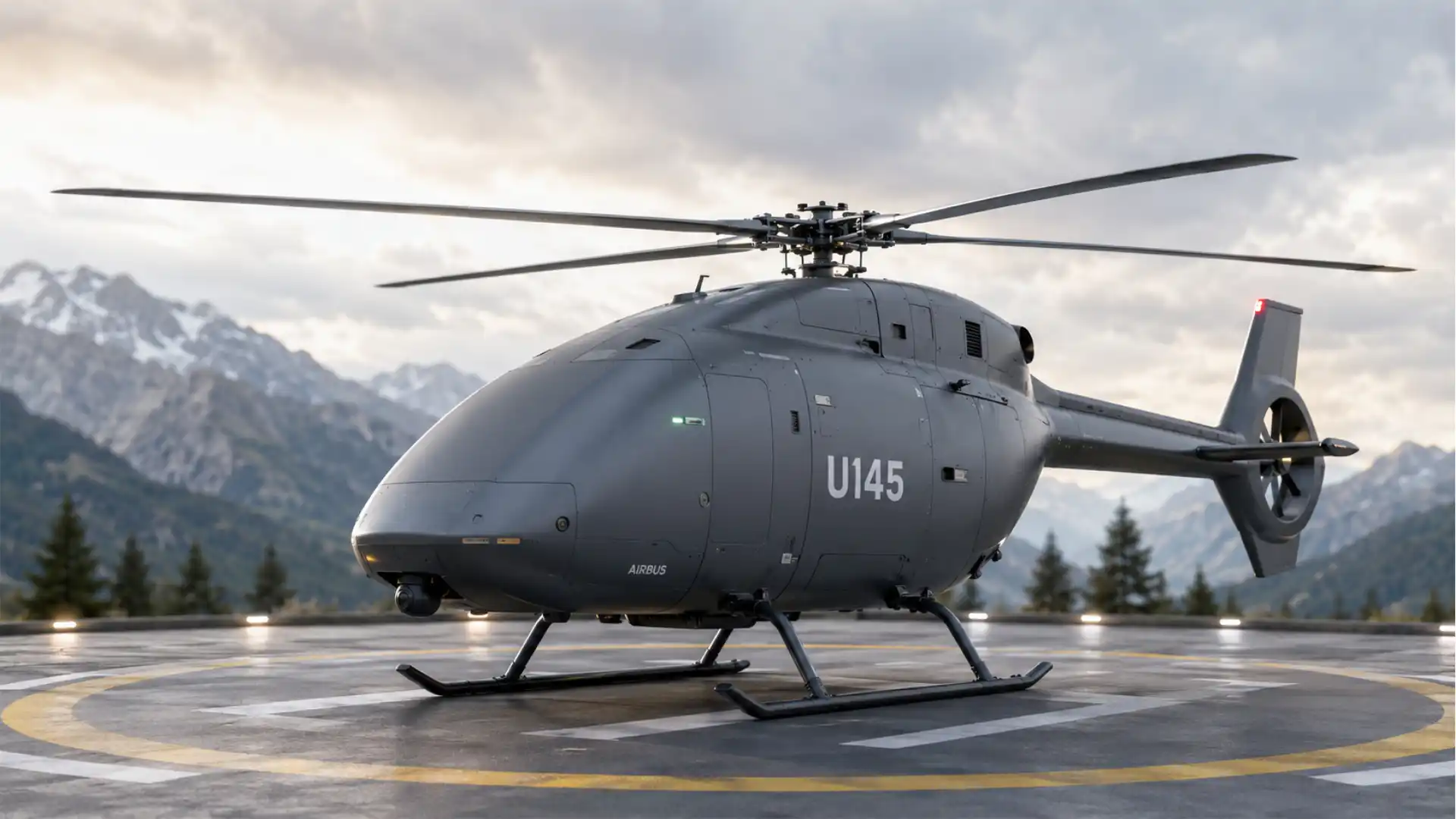
Airbus has presented the U145 as an uncrewed version of the H145, but the deeper story is not simply that a helicopter can fly without a crew. The sharper point is that Airbus is taking a proven light twin, removing the physical cockpit, reshaping the nose for cargo, and positioning the aircraft for the unglamorous missions that decide whether autonomous rotorcraft become real tools or remain air-show theatre. The company introduced the aircraft at ILA Berlin on 8 June 2026, displayed a full-scale mock-up, and said a first flight with a safety pilot onboard is planned for the end of 2026. Entry into service is aimed at the beginning of the next decade.
Table of Contents
The announcement matters because it starts from an aircraft operators already know
The U145 is not a clean-sheet fantasy aircraft dressed up for a trade show. Airbus is building it from the H145 family, a twin-engine light utility helicopter already used in civil, parapublic, emergency, military and law-enforcement roles. That choice matters more than the absence of a cockpit. Autonomy in aviation is not judged only by software. It is judged by whether the whole aircraft, its maintenance system, its supply chain, its training base, its airworthiness case and its operating economics can survive contact with daily work.
Airbus said the U145 combines the H145 airframe, power and useful load with the autonomy of a UAS. The company also said the H145 family has more than 1,800 aircraft in service and more than 8.5 million flight hours behind it, while Airbus’ current H145 civil product page gives a wider market figure of more than 2,150 delivered across more than 350 operators in roughly 70 countries. The exact count varies by product-family framing and update timing, but the direction is clear. Airbus is trying to move autonomy onto an installed, known platform rather than asking customers to trust a new aircraft, a new manufacturer, a new maintenance regime and a new operating concept all at once.
The U145’s first flight plan is also cautious. A safety pilot onboard for the maiden flight is not a contradiction of the uncrewed concept. It is how flight-test programmes de-risk aircraft that are expected to operate without a crew later. In this phase, the aircraft is a test article, not a commercial product. The real milestone will not be the first hover or first circuit. It will be the first certifiable operating case in which the aircraft performs useful work with an acceptable safety case, repeatable procedures and clear accountability.
The choice of ILA Berlin was not accidental. ILA 2026 took place from 10 to 14 June and drew around 110,000 participants, 765 exhibitors from 37 nations, more than 400 speakers and around 100 aircraft in the programme and display. The event sat at the intersection of civil aviation, space, defence, research and European industrial policy, which is exactly the intersection where the U145 will have to live.
Reuters described ILA 2026 as one of Europe’s premier aerospace showcases, opening amid defence-industry pressure, geopolitical strain and a push by manufacturers to offer governments new technologies while European defence spending rises. That context gives the U145 more weight. It is not only a helicopter product. It is part of a broader European effort to turn autonomy, software, drone teaming and dual-use aerospace into deployable capability.
Airbus is trying to make the U145 credible by anchoring it in a familiar machine. That strategy carries risk. Converting a crewed helicopter into an uncrewed aircraft means keeping many benefits of the original platform, but it also means proving that systems designed around human crew can be safely adapted to remote, supervised or autonomous operation. A cockpit is not just furniture. It is the physical centre of human perception, decision-making and emergency response. Removing it forces the aircraft to replace those human functions with sensors, computing, flight-control logic, communications links, health monitoring, contingency management and ground procedures.
The announcement also exposes a truth that often gets blurred in the phrase “autonomous helicopter.” The aircraft may be designed to fly without a crew onboard, but it will not fly outside an organisation. It will need remote supervision, dispatch rules, maintenance release, mission planning, airspace coordination, emergency procedures, cybersecurity controls and legal accountability. The U145 removes pilots from the aircraft, not from the aviation system.
The missing cockpit changes the aircraft more than the silhouette suggests
The most visually striking fact about the U145 is that it has no physical cockpit. For a helicopter, that is more radical than it sounds. A cockpit dictates the nose structure, glazing, access, instrument layout, crew protection, crashworthiness assumptions, visibility requirements, wiring, avionics interfaces and internal volume. Removing it is not like taking seats out of a van. It changes how the aircraft’s front end is used and how missions are loaded.
Airbus says the U145 will include a dedicated sensor suite and artificial intelligence for full autonomy. Compared with the crewed H145, it will have no physical cockpit and will include cargo adaptations such as an integrated nose door, a foldable loading table and a dedicated cargo floor. Those details show that Airbus is not merely adding an autonomy kit to a helicopter. It is reassigning the aircraft’s most prominent human space to logistics.
The integrated nose door is a particularly telling design choice. Helicopters often load cargo through side doors, rear doors or external slings, depending on the type. A nose-loading layout can make sense for rapid loading of packages, stretcher-like equipment, modular mission kits or compact pallets if the internal floor and centre-of-gravity management are engineered around it. A no-cockpit helicopter that loads through the nose tells customers that cargo is not a secondary use case. Cargo is the design centre.
The absence of a cockpit also raises hard questions. Where are the sensors placed to replace pilot vision? How is the aircraft protected from degraded visual environments such as dust, smoke, snow, glare and night operations? How does it detect wires, cranes, unlit obstacles, rotorwash hazards, nearby drones, birds and people? How does it decide to abort a landing if the zone becomes unsafe? How does a ground operator intervene if communications are weak or contested? Airbus has not published the full technical architecture of the U145, and it would be surprising if it had at this stage. Still, those are the questions that will decide whether the concept moves from mock-up to mission.
Removing the crew also changes the safety argument. A crewed aircraft must protect people onboard and people on the ground. An uncrewed aircraft removes onboard crew risk, which is a real advantage in dangerous missions such as wildfire support, disaster logistics, armed scouting or operations near contested areas. Yet it concentrates the safety case on ground risk, airspace risk, autonomy behaviour and mission containment. A crash no longer kills the pilot, but it can still injure people, damage property, start fires, disrupt airspace or expose sensitive payloads.
The U145’s physical form also hints at a new trade-off in rotorcraft design. Crewed helicopters usually balance human usability against payload, avionics, fuel, access and mission equipment. The U145 can trade some human factors for mission mass and volume. It does not need pilot seats, windscreen defogging, human displays, cyclic and collective controls in the cockpit, crew oxygen interfaces or the same crew-escape assumptions. It may still need maintenance access, emergency access, test interfaces and fail-safe mechanical provisions, but the aircraft’s internal logic changes.
That shift is why the U145 should not be treated as an ordinary drone. Many drones are designed around sensors and endurance. The U145 is being designed around helicopter-class payload movement in places where runways are absent, damaged or tactically useless. Its value will come from the boring mechanics of loading, securing, flying, unloading, returning and doing it again.
Cargo is the first mission because it is the easiest to value and the hardest to fake
Airbus says the U145 is being developed primarily for high-volume cargo supply. That is a sober choice. Passenger transport would attract more attention, but it would create a heavier certification, public-acceptance and liability burden. Pure surveillance would be easier to explain but would waste much of the H145’s lift and volume. Cargo sits in the middle: useful, risky enough to justify autonomy, and less politically charged than carrying people.
Cargo also gives customers a clear way to measure value. An operator can count kilograms moved, flight hours saved, crews kept out of danger, road convoys avoided, medical supplies delivered, missions completed in bad ground conditions and aircraft availability across a season. Autonomous aviation becomes persuasive when it solves a logistics problem that existing aircraft, trucks or small drones solve poorly.
The U145’s 3,800 kg maximum take-off weight puts it in a different class from small quadcopters and many tactical fixed-wing drones. Airbus lists the crewed H145 at 3,800 kg MTOW and 1,905 kg useful load, powered by two Safran Arriel 2E engines. The U145 inherits that broad class of aircraft performance, although its final useful load will depend on autonomy hardware, mission equipment, fuel, structural changes and certification configuration.
The cargo case is especially persuasive in disaster response. Floods, earthquakes, landslides, wildfires and storms can break roads, close bridges, isolate communities and overload crewed aviation units. A helicopter that can carry meaningful internal cargo without risking onboard crew would be useful if it can launch reliably, coordinate with emergency services and land in controlled zones. Yet disaster work is not just flying. It involves chain-of-custody for supplies, triage priorities, local airspace restrictions, weather decisions, refuelling, maintenance and coordination with ground teams.
Military logistics gives the U145 another route to relevance. Modern battlefields punish predictable supply lines. Trucks are visible, slow and vulnerable. Crewed helicopters are fast but scarce, expensive and exposed. Small drones are cheap but payload-limited. A middle-class autonomous helicopter could move ammunition, batteries, water, blood, communications gear or repair parts across broken terrain without placing aircrew onboard. In contested environments, the aircraft would still face air defence, electronic warfare, small arms, spoofing and weather. It would not be invulnerable. Its value would depend on whether losing an aircraft is more acceptable than losing a crew.
Cargo also fits the early 2030s entry target. By then, European regulators, militaries and civil operators may have more experience with certified UAS, U-space services, BVLOS operations and machine-learning assurance. Airbus is not promising routine U145 cargo flights next month. It is placing the product in a decade where drone logistics, autonomy certification and dual-use demand may be more mature.
Still, cargo does not remove the toughest engineering problems. A helicopter landing in a disaster zone or forward operating area must handle dust, slope, loose debris, people entering the landing zone, changing wind, rotorwash effects and uncertain surface conditions. A crewed pilot sees and feels many of these cues. An autonomous helicopter must sense, classify and act on them, while explaining enough of that behaviour to satisfy regulators or military safety authorities. The core challenge is not flying from point A to point B. The challenge is knowing when not to land.
The H145 base gives Airbus speed, but not a free pass
The H145 base gives Airbus a credible starting point. The aircraft is already a mature, twin-engine platform with a known support network. Airbus says the H145 has a fully separated fuel supply system, duplex hydraulic system, dual electrical system and redundant lubrication for the main transmission. Its Helionix avionics suite provides flight envelope protection, pilot assistance and self-monitoring, while the aircraft uses a four-axis autopilot designed for helicopter operations.
Those systems matter because autonomy needs a reliable aircraft underneath it. Autonomous software cannot compensate for a weak mechanical platform. If the base aircraft has strong flight-control foundations, health monitoring and operational history, the autonomy stack can focus on mission execution, perception, contingency management and supervisory control rather than proving every element of the airframe from scratch.
The Safran Arriel 2E engine is another part of the credibility case. Safran lists maximum continuous power of 828 shp, max take-off power of 894 shp and one-engine-inoperative rating of 1,072 shp for the Arriel 2E, and says the engine entered service in 2014 with the H145. Airbus also notes that the H145 is powered by two Arriel 2E engines with FADEC.
Twin engines help the safety case, but they do not solve it. An uncrewed helicopter must decide what to do after a partial failure. In a crewed helicopter, pilots interpret warnings, assess terrain, talk to air traffic control, declare emergencies, choose landing spots and improvise. In the U145 concept, those functions must be divided between onboard automation, remote supervision and pre-approved contingency logic. The aircraft may be able to return to base, land at a safe site, hold, divert or terminate the flight depending on the failure. Each option creates regulatory, operational and ethical questions.
The H145’s support history also cuts both ways. Operators trust mature aircraft because parts, procedures and mechanics are familiar. Yet maintainers will need new skills for autonomous systems, sensor calibration, data recording, mission computers, communication links and cybersecurity checks. The U145 will be maintained as both a helicopter and a flying computer network. That dual identity is where operational costs can creep in.
Airbus can reduce development risk by using a known airframe, but conversion is not cheap by default. Removing the cockpit and adding a nose door can affect structure, crashworthiness, aerodynamics, wiring, weight distribution, environmental sealing and maintenance access. A dedicated cargo floor must handle loads without compromising safety. Sensor placement must protect perception while surviving vibration, weather and maintenance realities. Autonomy computers must be cooled, powered, shielded and monitored. The aircraft’s software architecture must be certifiable or at least acceptable under the relevant military or civil approval pathway.
The U145 is therefore neither a simple derivative nor a pure new type. It sits in the middle, where much of the aircraft is inherited and much of the mission logic is new. That is a smart industrial strategy, but it leaves Airbus with a demanding integration job.
Airbus is building a family argument, not a single-aircraft argument
The U145 announcement sits inside a wider Airbus uncrewed portfolio. Airbus says the H145 is the second crewed helicopter it is converting into an uncrewed version, after the VSR700, which is derived from the Cabri G2. The VSR700 is a smaller uncrewed system designed for naval and other missions, and France ordered six VSR700 systems in January 2026 for the French Navy. Airbus said that naval version was developed and tested under the French Navy and DGA SDAM programme with Naval Group, and that the system had been tested over land and at sea.
That lineage matters. VSR700 gives Airbus experience in converting a crewed helicopter into an uncrewed system. The U145 takes the concept into a heavier, more cargo-oriented class. It is a step from maritime reconnaissance and tactical support toward high-volume rotary logistics and multi-mission use.
Airbus is also working on crewed-uncrewed teaming. The company defines crewed-uncrewed teaming as the operation of manned and unmanned assets together toward a shared mission objective, with connected and modular uncrewed systems acting with crewed aircraft.
For the U145, this matters in two ways. First, a U145 could operate as part of a mixed fleet rather than as a stand-alone drone. A crewed helicopter might scout, command or supervise while the U145 carries cargo or enters riskier areas. Second, the U145 itself could become a node in a wider network, especially for military missions. Airbus has named possible roles such as armed scouting, surveillance, drone mothership functionality for air-launched effects with MBDA, and crewed-uncrewed teaming.
The family argument is also visible in the United States. Airbus said its U.S. Space & Defense business, with Shield AI, L3Harris and Parry Labs, is offering the U.S. Marine Corps the MQ-72C, a fully autonomous variant of the UH-72B Lakota. Shield AI said Airbus U.S. Space & Defense and its partners completed a fourth autonomous flight test period on an H145 helicopter and integrated the four companies’ technologies into one aircraft for the first time in March 2026. L3Harris described the MQ-72C as an autonomous variant of the UH-72 Lakota platform using a proven airframe, autonomy and open architecture for unmanned logistics.
The U145 and MQ-72C are not the same product, but they reveal a shared logic. Airbus is probing whether mature light utility helicopters can become autonomous logistics aircraft for militaries that need vertical lift without exposing aircrew. Europe gets the U145; the U.S. Marine Corps offering is tied to the Lakota and U.S. industrial partners.
Airbus is not betting on one uncrewed helicopter. It is betting on conversion, modular autonomy, platform reuse and mixed fleets. That strategy is less glamorous than a radical new aircraft, but it may be more persuasive to defence ministries, emergency agencies and operators that already know the cost of keeping helicopters in service.
The U145 is a logistics aircraft before it is a robot
Autonomous aircraft are often discussed through sensors, AI and software. The U145 deserves a different starting point: logistics. A logistics aircraft is judged by what it moves, where it moves it, how often it moves it, how safely it does so, and how much the operation costs across a season or campaign. If the U145 succeeds, it will be because it behaves like a reliable logistics appliance in the sky.
The integrated nose door and cargo floor point to repeatable loading. A foldable loading table suggests operations where personnel may need to load the aircraft quickly without specialist ground equipment. This is relevant in disaster zones, small military sites and remote areas where forklifts or fixed infrastructure are unavailable. A vertical-lift cargo drone that requires perfect ground support loses much of its value.
Cargo-first design also affects mission planning. Operators need to know volume, mass limits, tie-down standards, hazardous goods rules, battery transport rules, medical supply temperature control, payload data links and unloading procedures. They need to know who is allowed near the aircraft during loading, whether rotors are turning, whether the aircraft is powered down, and how the system prevents a premature start or dispatch error. The autonomy problem begins before take-off and continues after landing.
Civil operators may see value in remote infrastructure work. Offshore energy sites, mountain installations, islands, telecom towers, border posts, scientific stations and isolated hospitals all produce logistics needs that are too heavy for small drones and too costly for routine crewed helicopter flights. The U145’s business case would depend on utilization. A high-cost autonomous helicopter that flies rarely is hard to justify. A platform that can fly predictable supply routes repeatedly, with lower crew risk and disciplined maintenance, has a clearer argument.
The military cargo case is sharper because risk tolerance differs. Defence operators may accept higher aircraft loss risk if missions protect personnel, sustain dispersed forces or reduce convoy exposure. The U145 could carry supplies into areas where sending a crewed helicopter is too dangerous or where commanders want to preserve scarce pilots for missions that require human judgment onboard.
Yet the U145 will not escape logistics physics. Fuel still matters. Maintenance still matters. Payload still trades against range and reserves. Weather still grounds helicopters. Rotorcraft still produce downwash, noise and maintenance hours. Autonomous does not mean effortless. It means the human labour and risk move to different parts of the system.
A good way to understand the U145 is to compare it with three alternatives. Trucks carry more, cost less per kilogram and need roads. Small drones are cheaper and easier to disperse but carry less. Crewed helicopters carry meaningful loads and adapt in real time, but they expose crews and are expensive to operate. The U145 aims at the gap: vertical logistics with enough payload to matter, no crew onboard, and a platform pedigree that customers can evaluate.
The military appeal is obvious, but the civil case may decide the platform’s reputation
Airbus is explicit that the U145 is being developed for both civil and military applications. The military use cases are more dramatic: armed scouting, surveillance, drone mothership roles, air-launched effects, crewed-uncrewed teaming and logistics under threat. Those missions fit the current defence mood in Europe, where governments are reassessing air power, autonomy and industrial capacity.
The civil case is quieter but no less revealing. Disaster management, firefighting and cargo supply are hard public missions. They involve limited budgets, political scrutiny and strict safety expectations. A civil U145 operation would need to satisfy airspace authorities, emergency agencies, insurers, local governments and the public. That pressure could make civil adoption slower, but it could also make it more durable once proven.
The firefighting role is especially complex. Airbus separately unveiled Wildfire Sentinel in 2026 as a digital approach to wildfire management connecting aerial and ground teams. The company has also discussed teaming helicopters and drones for life-saving missions, including search, rescue and wildfire scenarios. These projects show how Airbus sees uncrewed aircraft less as isolated drones and more as members of a coordinated emergency fleet.
Still, the U145 is unlikely to replace water-bombing aircraft or heavy helicopters. Its value in firefighting would more likely sit in logistics, reconnaissance support, sensor carriage, communications relay, transport of equipment, or missions too risky for crewed aircraft because of smoke, terrain or night operations. Carrying water at this size is less compelling than carrying information, tools, pumps, hoses, medical kits or spare parts.
Civil acceptance will depend on transparency. Communities will ask who controls the aircraft, how safe it is, what happens if it loses link, whether it records imagery, how loud it is, where it can land, and who pays for damage if something goes wrong. Emergency services will ask different questions: dispatch time, training, interoperability, mission reliability, weather limits, payload compatibility and maintenance turnaround.
The U145’s civil reputation will be built in the least glamorous missions. It will be built by delivering supplies to a flood-isolated village, moving equipment into a wildfire perimeter, supporting search teams in rough terrain or carrying urgent parts to infrastructure crews. A successful defence demonstration may win attention. A safe civil deployment may win trust.
The dual-use nature of the aircraft creates political tension. A platform that can carry relief supplies can also carry military payloads. A platform that can scout wildfires can also scout battlefields. A platform that can launch effects can raise public concern if shown alongside civil-rescue messaging. Airbus will need careful product positioning, and governments will need clear procurement and export frameworks.
Autonomy does not remove the need for human command
The phrase “fully autonomous” can mislead readers into imagining an aircraft that simply decides everything by itself. Aviation does not work that way. Even highly automated aircraft operate inside procedures, rules, approvals and human command structures. The U145 will likely have onboard autonomy for flight execution and contingency handling, but its missions will be authorised, monitored and bounded by people.
Airbus says the U145 will feature a specialised sensor suite and artificial intelligence for full autonomy. That statement should be read as a capability goal, not as proof that every legal and operational question has been answered.
There are several layers of autonomy. The aircraft may autonomously stabilise itself, follow a flight path, avoid obstacles, choose a landing point within an approved zone, detect faults, return home after a lost link, or execute emergency logic. A remote operator may supervise one aircraft or several. A mission commander may set objectives rather than directly fly. An airspace service may provide traffic data. A maintenance team may set aircraft readiness conditions. Each layer carries accountability.
The sharp question is not whether a human is “in the loop,” a phrase that often hides more than it reveals. The sharper question is which human has authority at each stage, what information that person receives, what time they have to act, and what the aircraft does if no human response arrives.
This matters in helicopter operations because events develop quickly near the ground. A landing zone can become unsafe in seconds. A person can approach the aircraft. A gust can change the approach. Dust can obscure sensors. A wire can appear late in the flight path. A radio channel can fail. If the aircraft waits for remote approval in every ambiguous case, it may be too slow. If it acts without enough human oversight, it may be unacceptable. The certification case must define that balance.
Remote supervision also creates human-factors challenges. A pilot onboard receives vestibular cues, peripheral vision, sound, vibration and direct context. A remote supervisor sees mediated data. That data may be richer in some ways, with sensor overlays and system health displays, but poorer in others, especially when links degrade or camera views are limited. Training for remote supervisors will not be identical to pilot training, yet it cannot be treated as simple console work.
The U145 may eventually be more autonomous than today’s remotely piloted aircraft, but it will still need human command. The operator’s organisation will decide where it flies, what it carries, which mission rules apply, and when it is grounded. Autonomy shifts piloting from continuous manual control toward supervision, exception management and system governance. That shift is hard, not easy.
European regulation is prepared in outline, but the U145 will test the edges
Europe already has a common drone framework. EASA says Regulation (EU) 2019/947 has applied since 31 December 2020 in EU Member States, Norway and Liechtenstein, and that it defines three civil drone operation categories: open, specific and certified. The associated rules include Commission Implementing Regulation (EU) 2019/947 and Delegated Regulation (EU) 2019/945, with EASA publishing Easy Access Rules to consolidate the material.
The U145 is too large and mission-heavy to be treated like a hobby drone or low-risk commercial quadcopter. EASA describes the certified category as requiring certification of the UAS, a licensed remote pilot and an operator approved by the competent authority when the risk level demands it. The specific category, by contrast, requires authorisation based on an operational risk assessment unless standard scenarios or a light UAS operator certificate apply.
For many U145 civil missions, especially beyond visual line of sight, cargo flights near infrastructure or disaster-zone operations near people, the regulatory route will be demanding. The aircraft’s mass, kinetic energy, operating environment and mission complexity will drive the safety case. The U145 is exactly the kind of aircraft that turns drone regulation from paperwork into engineering evidence.
EASA’s SORA methodology is relevant for specific-category operations. EASA describes SORA as a method for classifying the risk posed by a drone flight and identifying mitigations and safety objectives. It evaluates ground risk, air risk, operational limitations, personnel training, technical requirements and procedures.
Yet the U145 may also push into certified-category territory depending on mission type. Cargo alone does not always mean certified, but an aircraft of this size operating beyond visual line of sight, in mixed airspace, near people, or with high mission complexity may require a more aircraft-like certification approach. EASA’s July 2024 revision of Easy Access Rules incorporated regulatory changes addressing initial and continuing airworthiness of UAS operated in the specific category, reflecting how Europe is filling gaps between small-drone permissions and full aircraft certification.
The U145 will not live in one regulatory box forever. Military operations may use state aircraft frameworks. Civil emergency operations may use special authorisations. Commercial cargo may require repeatable approvals. Cross-border use may require harmonised acceptance. Each path will expose different friction points.
The regulatory issue is not whether Europe “allows drones.” Europe already does. The issue is whether Europe can approve large, autonomous, rotorcraft-class UAS operations at useful scale without diluting safety standards or trapping operators in one-off exemptions. The U145 will be a test of that capacity.
U-space will matter when autonomous aircraft stop being rare
A single U145 flying in a segregated test area is manageable. A fleet of autonomous helicopters, emergency drones, medical drones, inspection aircraft and crewed helicopters sharing busy low-altitude airspace is a different problem. Europe’s answer to that problem is U-space, a regulatory framework for services that support UAS operations in designated airspace.
EASA identifies Commission Implementing Regulation (EU) 2021/664 of 22 April 2021 as the regulatory framework for U-space. The framework sits alongside associated rules and guidance, with Easy Access Rules published for U-space.
For the U145, U-space is not a marketing accessory. It could become part of the operating environment for civil missions, especially in corridors, near emergency zones, near cities, around ports or close to critical infrastructure. U-space services can include identification, traffic information, authorisation, geo-awareness and other digital services depending on the defined airspace and national implementation.
The U145 will also share airspace with crewed helicopters. Emergency medical helicopters, police helicopters, news aircraft, firefighting aircraft and military aircraft already use low altitude. A cargo U145 cannot simply occupy that airspace because it is autonomous. It must be integrated. That means detect-and-avoid capability, flight-plan coordination, airspace restrictions, dynamic updates, and procedures for unusual events.
The more useful the U145 becomes, the more airspace integration matters. A rare aircraft can be handled as an exception. A normal logistics tool needs normal airspace access. That access requires rules, services and trust.
U-space also raises the question of uneven European implementation. EU regulations create a common foundation, but airspace is managed nationally and locally. Emergency operations differ by country. Military airspace coordination differs. Mountain rescue in Austria, wildfire response in Greece, flood logistics in Germany and island support in Croatia will not look the same. A U145 operator may need mission templates that fit national procedures while preserving a common aircraft safety case.
Airbus’ product strategy depends on Europe moving from demonstration to deployment. If U-space services remain fragmented, autonomous helicopter operations may be limited to special corridors, test areas or defence use. If U-space matures, civil cargo and emergency operations become easier to scale.
AI in aviation will be judged by evidence, not claims
Airbus says the U145 will use artificial intelligence for full autonomy. That phrase will attract attention, but aviation regulators will not accept “AI” as a magic word. They will ask what the AI does, how it was trained, how it is verified, how it behaves outside its design domain, how humans supervise it, and how failures are detected.
EASA’s AI Roadmap 2.0 outlines the agency’s vision for safety and ethical considerations of AI in aviation, and sets an action plan for conceptual guidance and future rulemaking. EASA’s AI Concept Paper Issue 2, published in 2024, gives guidance for Level 1 and Level 2 machine-learning applications, including learning assurance, explainability and ethics-based assessment. It also describes Level 2 AI as involving human-AI teaming, where AI systems automatically make decisions under human oversight.
The U145 could involve several AI-related functions: perception, landing-zone assessment, obstacle detection, mission replanning, route selection, fault interpretation or sensor fusion. Not all of those functions require machine learning. Some may use deterministic algorithms, model-based control, rule-based logic or traditional avionics methods. The public phrase “AI” may cover a mix of technologies.
The hard certification question is learning assurance. If a machine-learning model classifies terrain, obstacles or landing-zone safety, Airbus must show that the model performs within its intended domain and fails safely outside it. That requires representative training data, test data, scenario coverage, bias analysis, monitoring and clear operational boundaries. Aviation AI is not certified by being impressive. It is accepted by being bounded, traceable and testable.
This is especially demanding for helicopters because the environment is messy. Landing zones are not always marked pads. Disaster scenes contain debris, smoke, water, vehicles and people. Military landing zones may be unprepared or hostile. Firegrounds change minute by minute. Search-and-rescue scenes include trees, snow, cliffs, wires, animals and exhausted people who may behave unpredictably.
AI may be useful in those environments, but it cannot be allowed to hide uncertainty. A safe U145 should know when its perception is degraded, when weather exceeds limits, when a landing zone is uncertain, when a sensor is contaminated, and when a mission should be aborted. In practical terms, the aircraft needs confidence management as much as decision-making.
Public trust will also depend on language. If companies overstate autonomy, every mishap becomes a referendum on AI. If they understate it, customers may not understand what they are buying. Airbus will need to explain which functions are autonomous, which are supervised, which are remote-controlled, and which remain procedural.
The safety case starts near the ground
Helicopters spend much of their risk in take-off, landing, hover, low-speed manoeuvring and operations near obstacles. The U145’s safety case will therefore focus heavily on the part of flight that looks easiest to spectators: the final metres. Flying cruise legs between points is demanding, but landing a helicopter safely in a variable environment is harder.
For cargo missions, the aircraft may need to land near people who are not aviation specialists. Disaster responders, soldiers, firefighters or local workers may be loading supplies under pressure. The system must prevent unsafe approach to turning rotors, cargo imbalance, loose items, unauthorised loading, wrong-destination dispatch and accidental mission launch.
The ground-risk problem is central to drone regulation. EASA’s SORA guidance links ground risk to the risk of people, property or critical infrastructure being struck by a drone, and considers population density, type of operation, drone size and mitigations. For an aircraft with U145-class mass, those factors are not theoretical.
Air risk is also central. An autonomous helicopter must avoid other aircraft, including crewed helicopters that may be operating low, fast and under urgent conditions. In disaster zones, the airspace may be crowded with emergency helicopters, police aircraft, military aircraft, drones and temporary restrictions. Detect-and-avoid technology is necessary, but so are procedures and command discipline.
Lost-link behaviour deserves special attention. If the U145 loses communications during a cargo flight, it needs pre-approved logic. It might continue to a safe landing site, return, hold, climb, descend, or land immediately depending on location and mission phase. The wrong choice can create greater risk than the lost link itself. Autonomy is safest when contingency behaviour is boring, predictable and rehearsed.
Cybersecurity sits inside the safety case. An autonomous cargo helicopter must protect command links, navigation data, mission plans, software updates, payload information and maintenance data. Spoofing, jamming, intrusion or corrupted data can become flight-safety issues. Military operators will treat this as an operational threat. Civil regulators will increasingly treat it as part of airworthiness and organisational safety.
The U145 also needs a credible maintenance safety case for autonomy hardware. Sensors may be misaligned, cameras scratched, radomes damaged, antennas loosened, software versions mismatched, calibration expired or data recorders full. A crewed pilot may compensate for some equipment degradation. An autonomous aircraft may depend on it. Maintenance release procedures will need to reflect that dependence.
The business case turns on utilization, not novelty
An autonomous helicopter will not be cheap just because it has no cockpit. The U145 begins with a twin-engine aircraft platform, turbine engines, helicopter maintenance, autonomy hardware, sensors, communications, software, certification work and specialised training. The business case must therefore come from mission economics, not from the romance of replacing a pilot.
Civil operators will compare the U145 against crewed helicopter hours, ground transport, small drone fleets, fixed-wing cargo aircraft and doing nothing. The aircraft must earn its place by reducing risk, increasing availability, reaching places faster, operating in conditions where crewed flight is undesirable, or creating logistics patterns that were previously too costly.
The removal of onboard crew can reduce direct crew exposure and may alter staffing models, but it does not eliminate labour. Remote supervisors, dispatchers, maintainers, payload handlers, safety managers, data analysts and compliance staff remain. The U145 may reduce risk per flight without reducing organisational complexity.
Utilization is the core number. A U145 bought for disaster response but used only during rare emergencies will be hard to justify unless funded as strategic capability. A U145 used for routine infrastructure logistics, training, emergency readiness and seasonal missions has a stronger case. Militaries may accept lower peacetime utilization if the wartime need is compelling, but even they will watch sustainment costs.
Airbus’ choice of a known airframe may help here. Existing parts channels, trained technicians, engine support and helicopter maintenance culture reduce adoption friction. Operators that already fly H145s may see the U145 as a related asset rather than an alien system. Yet the uncrewed version will still require new procedures, insurance models, training and technical support.
The cargo floor and nose-loading design imply a desire for rapid turnarounds. That matters. If loading takes too long or requires special equipment, the aircraft loses value. If the aircraft can land, be loaded by trained responders, depart and repeat the route with predictable procedures, the economics improve.
Insurance and liability will shape the civil business case. Insurers will want data: flight-test history, failure rates, autonomy logs, maintenance quality, operating environments and incident response. Regulators will want safety cases. Customers will want availability guarantees. The manufacturer may need to provide more than an aircraft; it may need to provide operating concepts, training, digital support and mission assurance.
Europe’s defence context gives the U145 a larger audience
The U145 arrived at a moment when European defence debates are unusually intense. Reuters reported that ILA Berlin opened under pressure from wider geopolitical tensions, Europe’s defence industry struggles, and the collapse of the Franco-German FCAS fighter project, while manufacturers were pitching new technology to governments and military buyers.
The U145 is not a fighter programme, but it belongs to the same strategic conversation. Europe wants more sovereign defence capability, more autonomy, more resilient logistics, more drones, more software-defined systems and less dependence on single foreign supply chains. A European autonomous helicopter built from an Airbus platform speaks directly to that agenda.
Military logistics has become a central battlefield concern. The war in Ukraine has shown the destructive power of drones, precision fires, electronic warfare and persistent surveillance. A supply route that would have been merely difficult can become lethal if every movement is detected. Autonomous logistics aircraft are not a cure, but they give commanders another option.
The U145’s possible armed scouting and drone-mothership roles also show how cargo platforms can drift toward combat support. An aircraft with payload, power and vertical lift can carry sensors, communications relays, launched effects or mission kits. Airbus said the U145’s modular design supports drone mothership functionality for air-launched effects, where it is partnering with MBDA.
That makes the U145 part of Europe’s air-launched effects debate. Air-launched effects are smaller uncrewed systems deployed from aircraft to scout, decoy, jam, strike or extend sensor reach. Launching them from an uncrewed helicopter could keep crewed aircraft farther from danger and add vertical flexibility. The idea is attractive, but it raises mission-command and escalation questions.
The U145’s defence value may not come from flying alone. It may come from acting as a carrier, courier, scout, relay and expendable risk-taker inside a larger force. That is why the aircraft should be watched by defence planners even if the first public message stresses cargo.
European governments may also like the industrial logic. The H145 family is known, the manufacturer is European, the airframe base is mature, and the autonomy ecosystem can include European partners. That fits procurement language around sovereignty and dual-use industry. The challenge is turning that political attractiveness into funded programmes with clear requirements.
The U.S. MQ-72C effort shows Airbus is pursuing parallel routes
The U145 is a European product story, but Airbus’ American work with the MQ-72C provides useful context. Airbus said its U.S. Space & Defense business and partners Shield AI, L3Harris and Parry Labs are offering the MQ-72C to the U.S. Marine Corps as a fully autonomous variant of the UH-72B Lakota. Shield AI reported a fourth autonomous flight test period on an H145 helicopter in March 2026.
This matters because it gives Airbus operational and technical learning in a demanding defence logistics environment. The U.S. Marine Corps’ interest in autonomous logistics is linked to dispersed operations across islands, littorals and austere sites. Those missions resemble some European needs but with different geography, doctrine and procurement rules.
L3Harris described the MQ-72C as using a proven airframe with advanced autonomy and open architecture, not as a clean-sheet concept. That language mirrors the U145 logic.
The parallel programmes also suggest a broader market hypothesis. Airbus appears to believe that customers want autonomous rotary logistics but do not want to carry the full risk of a new rotorcraft manufacturer or experimental platform. Converting known helicopters allows Airbus to offer something familiar enough for procurement officers and maintainers to evaluate.
The U.S. route also shows the role of partners. Shield AI contributes autonomy expertise. L3Harris brings systems integration. Parry Labs brings digital architecture. In Europe, Airbus says it will team with leading autonomous mission partners to expand the UAS ecosystem. The U145 will not be only an Airbus airframe. It will be an integration product.
Autonomous helicopters are becoming systems-of-systems programmes. The aircraft is the visible object. The hidden value sits in autonomy software, open architecture, data links, payload standards, mission planning, health monitoring, cybersecurity and operator interfaces.
The risk is complexity. Every partner adds capability and integration burden. Open architecture can reduce lock-in, but it can also complicate certification and configuration control. Defence customers may want rapid upgrades. Civil regulators may prefer stable baselines. Airbus will need to manage both instincts.
The MQ-72C work also gives Airbus evidence that autonomous H145/Lakota-class flight is not a paper claim. Flight-test periods, integrated technology and partner demonstrations do not prove U145 readiness, but they reduce the impression that the European aircraft is an isolated mock-up. They show a company-wide campaign to make autonomous light utility helicopters credible.
The U145 will not replace pilots so much as move their work
The U145 will invite claims that helicopters no longer need pilots. That is a poor reading. A better reading is that pilot work is being redistributed. Some tasks move into software. Some move to remote supervisors. Some move to mission planners. Some move to maintenance and safety management. Some remain with crewed helicopters that coordinate with uncrewed systems.
Pilots onboard manage more than flight controls. They interpret ambiguous scenes, negotiate with air traffic control, understand crew needs, detect subtle aircraft behaviour, manage emergencies and make judgment calls that are hard to formalise. Autonomous systems can automate many flight tasks, but they must replace judgment with bounded decision logic, sensor evidence and escalation paths.
This creates a new profession rather than removing aviation expertise. Remote mission supervisors for U145-class aircraft may need helicopter knowledge, airspace knowledge, systems knowledge, emergency judgment and human-machine interface training. They may not need all the motor skills of manual helicopter flying, but they will need a disciplined understanding of rotorcraft risk.
The number of aircraft per supervisor will be a major operational question. One remote pilot supervising one U145 looks expensive but easier to certify. One supervisor managing several aircraft improves economics but increases human-factors risk. The right ratio may depend on mission phase. A supervisor might monitor several aircraft in cruise but focus on one during take-off and landing. The staffing model will be a safety decision disguised as a cost decision.
Training will also change. Crewed helicopter pilots train for autorotations, engine failures, instrument procedures, emergencies and mission-specific operations. U145 supervisors may train for lost-link events, sensor degradation, abnormal autonomy behaviour, emergency route clearance, cyber alerts, payload incidents and handover between control stations. They will need simulator time, scenario drills and recurrent checks.
For unions, pilot associations and operators, this shift will be sensitive. Autonomous cargo aircraft could reduce demand for some onboard pilot hours. Yet it may create roles for experienced pilots in supervision, testing, safety management, training and mission design. The transition will be uneven across countries and sectors.
The U145’s early use in cargo and risky missions may soften labour tension. Few pilots want to fly into avoidable danger when an uncrewed aircraft can carry the load. The political conflict grows if autonomous systems move into routine missions that pilots currently fly. Airbus has started with a mission set where the safety argument is stronger.
Disaster response could be the civil proving ground
Disaster response is an obvious U145 mission because it punishes ground logistics and rewards vertical mobility. Floods cut roads. Landslides isolate towns. Earthquakes damage bridges. Wildfires close access routes. Storms disrupt power and communications. A helicopter that can carry supplies without onboard crew fits these situations if the airspace and ground procedures are ready.
The aircraft could move medical kits, satellite terminals, portable generators, blood products, water purification equipment, food packages, batteries, search equipment, pumps or communications gear. It could support responders who are stretched thin and crewed helicopter fleets that are already committed to evacuations, hoist work or command tasks.
Yet disaster response is not a regulatory loophole. Emergency operations can receive special treatment, but safety still matters. Airspace can be chaotic. Weather may be poor. People may gather unpredictably. Landing zones may be improvised. Power lines may be down or hidden. Maps may be outdated. GPS interference may occur. Smoke and dust can degrade sensors.
The U145’s disaster value depends on prepared operating concepts before the disaster happens. Agencies would need pre-surveyed landing zones, standard cargo modules, training exercises, communications protocols, airspace coordination with national authorities, and data-sharing agreements. Buying the aircraft after a disaster has started is too late.
The aircraft could also be used in training and routine logistics between disasters. Emergency agencies often struggle to justify assets that sit idle. A U145 could support infrastructure inspections, remote supply runs, exercises and public-safety drills, building flight hours and confidence. That routine use would also expose maintenance issues before crisis operations.
There is a public trust opportunity here. Citizens may accept autonomous aircraft more readily when they see them delivering supplies, supporting firefighters or restoring communications. But that trust can be lost quickly if a system is perceived as unsafe, intrusive or militarised. Civil emergency branding and governance will matter.
The U145 could also support cross-border European disaster response. The EU Civil Protection Mechanism and national emergency services often coordinate across borders. An autonomous logistics helicopter could be deployed to regions with different languages, airspace procedures and emergency chains of command. That would test interoperability, but it could also demonstrate the value of European standards.
Firefighting is a tempting role, but not in the obvious way
Firefighting is one of the first missions people imagine for an autonomous helicopter. The image is simple: a drone helicopter flies through smoke and drops water without risking a crew. The reality is harsher. Water bombing requires payload, precision, aircraft coordination, weather judgment and integration with ground crews. A 3,800 kg-class helicopter is not a heavy water bomber.
The U145 may be more useful around the fire than above the flame front. It could carry equipment, sensors, communications relays, spare parts, food, water, medical supplies or small mission kits to crews in difficult terrain. It could help maintain a night logistics chain when crewed flight is restricted. It could scout routes, support prescribed drops with data, or reposition supplies between bases.
Airbus’ Wildfire Sentinel story shows that the company is thinking about connected wildfire operations, not only single aircraft. It describes linking aerial and ground teams to speed fire suppression and improve coordination. Airbus also published a 2026 story about teaming helicopters and drones for life-saving operations, including wildfire missions.
The U145 could fit into such a system as a cargo and sensor node. A crewed command helicopter might coordinate fireground aviation. Smaller drones might map hotspots. Fixed-wing aircraft might survey larger regions. The U145 might move equipment or act as a relay. The aircraft’s value in firefighting may be networked support, not heroic flame-front action.
Smoke and heat create perception challenges. Cameras, lidar, radar and infrared sensors all have strengths and weaknesses. Rotorcraft in smoke also face visibility, turbulence and obstacle risks. Autonomy needs clear limits: where the aircraft may fly, how close it may approach active fire, what sensor conditions are acceptable, and when the mission must stop.
Firefighting also involves temporary airspace restrictions and many aircraft types. Tankers, helicopters, drones and command aircraft may operate under intense coordination. An autonomous helicopter must integrate into that command structure, not add confusion. If incident commanders cannot trust where it is and what it will do, they will keep it away from the fire.
A realistic firefighting adoption path may start with exercises, logistics runs outside the hottest zone, night or early-morning support in controlled areas, and sensor missions. Only later would more aggressive missions be considered. That gradual path would be less dramatic but safer.
Search and rescue needs autonomy that admits uncertainty
Search and rescue is another attractive U145 use case, but it highlights the difference between finding and rescuing. Small drones are already useful for search because they can cover terrain with cameras and sensors. A U145-class platform adds payload and endurance, but rescue often requires human contact, medical judgment, hoist operations, landing-zone selection and coordination with ground teams.
The U145 could support search and rescue by carrying sensors, communications equipment, rescue kits, thermal cameras, medical supplies or survival packages. It could deliver a package to a stranded person before a crewed rescue helicopter arrives. It could relay communications in mountains or flood zones. It could scout landing zones for crewed aircraft.
The hardest part is interpreting ambiguous human scenes. A person may be under trees, in snow, near water, injured, waving, motionless or partly obscured. Animals, debris and heat sources can confuse sensors. Weather and terrain create false signals. An autonomous system must report uncertainty, not pretend confidence.
For search and rescue, a wrong negative can cost a life and a wrong positive can waste scarce rescue time. That does not make autonomy unusable; it makes human-machine workflow central. The aircraft should gather evidence, prioritise areas, deliver supplies and support crews, while rescue commanders make the final mission choices.
A cargo-first U145 could carry survival kits to people who cannot be reached immediately. In cold mountains, flood zones or remote forests, time matters. A package with a radio, thermal blanket, water, medication or locator could bridge the gap between detection and extraction.
The U145 could also support mass-casualty or wide-area events where crewed aircraft are scarce. It could shuttle supplies between command posts, hospitals and field teams. That role may be less visible than direct rescue but more useful across a long operation.
Search and rescue also creates privacy concerns. Aircraft carrying sensors over inhabited areas must follow data rules, retention limits and mission discipline. Public agencies will need policies on imagery, identification and data sharing. Autonomy does not remove those responsibilities.
The drone-mothership idea shows the platform’s military ceiling
Airbus lists drone mothership functionality for air-launched effects as a possible U145 role, with MBDA as partner. That phrase moves the aircraft from logistics into a more contested military space. An autonomous helicopter that carries or launches smaller effects could extend reconnaissance, jamming, decoying or strike reach without placing a crewed platform in the same risk envelope.
A mothership role uses the aircraft as a carrier and network node. The U145 could lift effects to a useful altitude or position, release them, relay data, or coordinate with crewed aircraft and ground systems. Vertical take-off gives it basing flexibility. The H145-derived payload class gives it room for modular kits.
The military appeal is clear. A crewed helicopter launching effects exposes crew. A fixed-wing aircraft may need runway access or higher-speed profiles. Ground launchers may lack reach or line-of-sight. A U145-like system could move from dispersed sites, fly low routes, and deploy smaller systems closer to the mission area.
The risk is escalation of complexity. Launching effects requires carriage safety, release mechanics, separation testing, mission planning, communications, rules of engagement, target identification, deconfliction and command authority. If the effects are armed, the legal and ethical burden rises sharply. If they are sensors or decoys, the burden is lower but still real.
A drone-mothership U145 would be less a cargo helicopter and more a tactical air node. That changes procurement, classification, export controls and public perception. A civil emergency agency may not want its logistics aircraft associated with armed effects, even if the platform is modular.
Airbus can manage this by keeping mission configurations distinct. Cargo U145, disaster U145 and military U145 may share an airframe base but differ in sensors, software, payload interfaces and approval pathways. The challenge is preserving modularity without blurring accountability.
The mothership idea also reveals why militaries are interested in payload volume, not just endurance. Small drones can scout, but they cannot always carry the systems commanders want. A helicopter-class uncrewed aircraft can carry more computing, antennas, fuel, payload and mission equipment. That makes it attractive as a platform for distributed operations.
The U145 competes against trucks, pilots, small drones and doing nothing
A new aircraft is usually compared with other aircraft. For the U145, that is too narrow. Its real competitors include trucks, boats, small drones, crewed helicopters, fixed-wing cargo aircraft, ground robots, stockpiling and the decision not to perform a mission. Customers choose among all of these based on cost, risk, speed and availability.
Trucks will beat the U145 when roads exist, payloads are heavy, risk is low and time pressure is moderate. Boats will beat it for islands or rivers when schedules are predictable. Small drones will beat it for light urgent payloads, inspection or mapping. Crewed helicopters will beat it when human judgment onboard, passenger movement, hoist rescue or flexible mission execution is central.
The U145’s niche appears where vertical lift is needed, payload exceeds small-drone capacity, risk makes crewed flight unattractive, and ground routes are slow, broken or dangerous. The aircraft is strongest where the alternatives are all bad.
That niche may sound small, but it is not. Militaries constantly move supplies under difficult conditions. Emergency services face broken infrastructure. Remote industries need spare parts. Firefighters need equipment in rough terrain. Border agencies need sensor and logistics support. Humanitarian organisations face access constraints after disasters.
The danger is mission creep. If buyers use the U145 for missions that ordinary trucks or crewed helicopters already handle well, the economics may disappoint. Autonomous aircraft should not be bought because they are autonomous. They should be bought because the mission has a specific pain point that autonomy and vertical lift address together.
A useful procurement question is simple: if the U145 were unavailable, what would the customer do instead? If the answer is “send a crewed helicopter into avoidable danger,” the U145 has a strong argument. If the answer is “send a van tomorrow,” the argument is weak.
The aircraft will also compete with future eVTOL cargo systems. Electric vertical-lift aircraft may offer lower noise and emissions for some routes, but payload, endurance, certification and infrastructure remain uncertain. The U145 uses turbine helicopter heritage, which gives it energy density and operational familiarity. That may matter for early heavy cargo missions.
Certification will move at the speed of evidence
Airbus has given a timeline: first flight with safety pilot at the end of 2026 and entry into service at the beginning of the next decade. That is plausible but not guaranteed. Aviation programmes move at the speed of test evidence, regulator confidence, customer funding and technical surprises.
The first flight will likely focus on basic aircraft behaviour, systems integration and safety-pilot-supervised autonomy functions. Later tests will expand the envelope: navigation, contingency handling, sensor performance, automated take-off and landing, cargo loading, lost-link procedures, degraded sensors, weather boundaries and mission profiles.
The certification or approval route will depend on use. Military customers may certify through national military airworthiness authorities. Civil customers in Europe may face EASA and national authority processes. Some operations may begin in restricted areas or under special authorisations before wider approval.
The early 2030s service target should be read as a programme ambition, not as a guaranteed fleet deployment date. Airbus is setting direction. The proof will be in flight testing, customer orders, regulatory engagement and mission demonstrations.
Software will shape the schedule. Mechanical changes can be inspected, tested and certified using mature methods. Autonomy software, perception systems and AI elements require assurance evidence that is still developing. EASA’s AI work shows regulators are preparing, but applicants must still provide concrete arguments for each function.
Data collection will be central. The U145 will need flight data, sensor data, maintenance data and autonomy decision logs. Those records will support safety analysis, regulator review, incident investigation and system improvement. They will also raise data governance questions, especially for civil missions involving imagery or critical infrastructure.
The timeline may also depend on whether Airbus pursues a tightly bounded first operating case. A narrow route between controlled sites with trained ground teams is easier than general disaster response. A military test corridor is easier than dense mixed airspace. A cargo-only mission is easier than multi-role autonomy. Smart programmes start narrow and expand.
A compact view of what Airbus has confirmed and what remains open
Confirmed U145 facts and unresolved programme questions
| Area | Airbus has confirmed | Still unresolved |
|---|---|---|
| Platform | U145 is an uncrewed version of the H145 | Final certified configuration and customer-specific variants |
| Cockpit | No physical cockpit | Full sensor layout and human-supervision model |
| Cargo design | Nose door, foldable loading table, dedicated cargo floor | Cargo volume, loading standards and payload-specific limits |
| Mass class | 3,800 kg MTOW | Final useful load after autonomy and mission equipment |
| Timeline | Safety-pilot first flight planned for late 2026 | Certification path and first operational customer |
| Missions | Cargo first, with civil and military roles | Which missions enter service first |
| Autonomy | Sensor suite and AI for full autonomy | Detailed assurance, fallback and approval evidence |
| Ecosystem | Airbus will work with autonomous mission partners | Partner list, software baselines and open-architecture rules |
This table shows the state of the programme as of June 2026. The confirmed items are enough to make the U145 credible as a strategic announcement, but not enough to judge final performance, operating cost or certification difficulty.
The payload number readers want is not yet the number that matters
The first question many readers ask is simple: how much can it carry? Airbus has confirmed the U145’s 3,800 kg maximum take-off weight and its H145-derived platform, while the crewed H145 technical page lists 1,905 kg useful load. But useful load is not identical to cargo payload, and the U145’s final payload will depend on fuel, mission equipment, autonomy hardware, sensors, structural changes and certified configuration.
That distinction matters. A helicopter can have a useful load figure that includes fuel, crew, passengers, cargo and equipment. Remove pilots and cockpit equipment, then add autonomy computers, sensors, antennas, power systems, cargo structures and mission kits. The final cargo number may look better in some configurations and worse in others.
The more useful question is mission payload at mission radius. A 200 kg payload across a long route may matter more than a high short-hop payload. A medical supply mission may be limited by volume or temperature control rather than mass. A military battery-resupply mission may be limited by packaging and handling rules. A firefighting support mission may need odd-shaped equipment.
For logistics operators, kilograms alone are not enough. They need payload, volume, range, turnaround time, landing-zone limits and dispatch reliability in one operating model.
The nose-loading door suggests Airbus is thinking about high-volume cargo, not only dense payloads. Volume can be a hidden constraint for helicopters. Medical kits, food boxes, communications gear and rescue equipment may fill cabin space before reaching mass limits. A dedicated cargo floor and loading table could be more useful than a headline payload figure.
External sling loads are another question. The crewed H145 technical data lists maximum take-off weight with external load at 3,800 kg, and H145M data includes sling capacity figures in Airbus materials, but Airbus has not publicly defined U145 external-load operations in the core announcement. Sling-load autonomy would add complexity: load swing, release safety, ground crew proximity and obstacle clearance.
The early mission set will likely favour internal cargo because it is easier to secure, monitor and protect. External loads may follow if customers require them and the safety case supports them.
The airframe is mature, but the mission system is the product
The U145’s airframe heritage will attract attention, but the mission system may decide market success. The mission system includes sensors, autonomy, communications, payload management, mission planning, operator interface, data links, health monitoring and integration with other aircraft or command systems.
In a crewed helicopter, the mission system supports the pilot. In the U145, it partly replaces the pilot. That changes its status. A sensor failure may become a flight-safety issue. A mission computer fault may trigger a landing. A degraded communication link may change the aircraft’s route. A software update may require new validation.
The operator interface will be especially important. Remote supervisors need to understand what the aircraft is doing and why. A display that shows only position and status may be too shallow for complex missions. A display that shows every internal variable may overload the user. The interface must present uncertainty, alerts, contingency options and mission priorities in a way that supports rapid judgment.
Airbus’ wider HTeaming work is relevant here because it deals with human control of uncrewed aircraft from crewed helicopters. The company’s crewed-uncrewed teaming concept frames uncrewed systems as connected assets in a shared mission.
For civil operators, integration with existing dispatch and emergency systems matters. A U145 that requires a separate, isolated control ecosystem may be harder to adopt. A U145 that feeds into emergency command software, airspace coordination systems and maintenance platforms becomes more useful. For military operators, integration with command-and-control networks, encrypted communications and tactical data systems will be decisive.
The aircraft body may be familiar. The product customers buy will be the aircraft plus a digital operating environment. That environment must be reliable, secure and usable by people under pressure.
Mission-system configuration control will also matter. Defence customers often want rapid updates to counter threats. Civil regulators want stable, documented baselines. Airbus may need separate update pipelines: one for military operational adaptation, another for civil-certified stability. That split can be expensive, but it may be unavoidable.
Cybersecurity is part of airworthiness now
An uncrewed helicopter is exposed to cyber risk in ways that a purely mechanical aircraft is not. The U145 will depend on command links, navigation inputs, sensors, mission data, software updates, maintenance systems and possibly cloud-connected support tools. Any of these can become attack surfaces.
Cybersecurity in aviation is not only about stealing data. It is about protecting safety. A corrupted navigation input, spoofed landing-zone marker, compromised update, false maintenance status or jammed command link can affect flight decisions. Military users will assume adversaries try to interfere. Civil users must assume accidental interference and malicious actors exist.
The U145’s autonomy may reduce some communication dependence by allowing onboard decision-making during link loss. But autonomy also increases the importance of onboard software integrity. If the aircraft makes decisions onboard, the software making those decisions must be protected, validated and monitored.
A safe autonomous helicopter needs a cyber safety case, not just encryption. That case includes secure development, supply-chain controls, update signing, access management, intrusion detection, logging, fallback modes, incident response and operator training.
Europe’s aviation regulators have already been moving toward information-security requirements with a safety impact. The U-space regulatory framework also includes digital services that depend on trusted information exchange. For an aircraft like the U145, cyber, safety and operations are inseparable.
Civil emergency missions add another layer. Disaster zones can include damaged communications, temporary networks, multiple agencies and improvised infrastructure. The aircraft must behave safely when networks are degraded. It should not require perfect connectivity to remain safe, even if mission efficiency suffers.
Military missions add electronic warfare. Jamming, spoofing and deception are expected. The U145 would need navigation resilience, communications resilience and mission logic that handles degraded signals. In some cases, autonomy must continue when external links are poor. In other cases, the safest action is to stop or retreat. The mission type determines the right answer.
Public acceptance will depend on noise, trust and visible benefit
Autonomous helicopters will not be accepted because engineers say they are safe. They will be accepted if people understand the purpose, see responsible use and experience manageable impacts. The U145’s civil path will therefore depend on noise, privacy, safety transparency and visible benefit.
Helicopters are loud compared with many small drones and fixed-wing aircraft. Airbus says the H145 is the quietest helicopter in its class and has low fuel consumption among direct competitors. That helps, but communities near repeated cargo routes will still care about noise.
Autonomous operation may create more public concern than crewed flight even if the measured risk is low. People often trust a visible pilot more than a remote system. That trust gap can be reduced through clear rules: where the aircraft flies, how it avoids people, who supervises it, what it records, how incidents are investigated and how complaints are handled.
Privacy will matter if the U145 carries cameras or other sensors. Even if sensors are used for navigation or landing safety, public agencies must explain data use. Emergency missions may justify temporary collection, but retention and access rules should be defined.
The strongest public argument for the U145 is not convenience. It is keeping people alive and supplied when ordinary routes fail or crews would face avoidable danger. That argument is strongest in disaster response, remote medical logistics and dangerous emergency work. It is weaker for routine commercial deliveries that look like noise without public value.
Public acceptance also depends on early incident handling. The first serious mishap involving a large autonomous helicopter will shape opinion. Transparent reporting, clear investigation processes and honest explanation will matter more than defensive messaging. Aviation has a safety culture built on learning from incidents. Autonomous aviation must adopt that culture, not hide behind software opacity.
The U145 could change helicopter procurement language
If Airbus can move the U145 toward service, helicopter procurement may start to change. Buyers will no longer ask only for aircraft performance, mission equipment and lifecycle cost. They will ask for autonomy levels, remote-operator models, software update rights, data ownership, cyber assurance, payload interfaces, U-space compatibility and multi-aircraft supervision.
That shift favours manufacturers that can integrate hardware and software, not only build airframes. Airbus has the advantage of scale and regulatory experience. Smaller autonomy companies may have faster software but lack airframe certification depth. The likely future is partnership, as seen in the MQ-72C effort and Airbus’ stated plan to team with autonomous mission partners.
Procurement officials will need new evaluation methods. A traditional helicopter tender can compare speed, range, payload, price, maintenance and mission equipment. An autonomous helicopter tender must compare safety cases, autonomy architecture, degraded-mode behaviour, data rights, cyber controls, training burden and regulatory pathway. That is harder.
The cheapest autonomous aircraft on paper may be the most expensive if it cannot win approval, integrate with airspace systems or maintain software safely.
Military buyers will also ask about survivability. An uncrewed helicopter does not need crew protection in the same way, but it still needs mission survivability: low observability if required, emissions control, navigation resilience, repairability, decoy compatibility, route planning, and acceptable loss cost. A platform derived from a civil helicopter may not survive high-threat airspace, but it may be useful in rear areas, dispersed logistics, lower-threat zones or missions where risk to crewed aircraft is unacceptable.
Civil buyers will ask about service models. They may not want to own all autonomy infrastructure. Airbus or partners could offer support packages, training, mission planning tools or managed services. That may turn the U145 from a product sale into a capability contract.
The U145 could also affect existing H145 customers. Some operators may see a future mixed fleet: crewed H145s for passenger, EMS and flexible missions; U145s for cargo, riskier routes or repetitive logistics. Shared maintenance knowledge could reduce friction. The aircraft would not replace the H145; it would extend the family into missions where onboard crew are not needed.
Europe’s industrial policy sits beneath the aircraft
The U145 is also an industrial-policy object. Europe wants aerospace sovereignty, defence readiness, dual-use technology, drone capability and high-value manufacturing. A European autonomous helicopter built on an Airbus platform speaks to all of those aims.
The European Commission’s Drone Strategy 2.0 set a vision for developing the European drone market and strengthening civil, security and defence capabilities. EASA’s rules and U-space framework provide the regulatory foundation. The U145 is the kind of product that tests whether that policy stack produces deployable systems or remains strategic language.
Industrial sovereignty does not mean every component must be European. It means Europe can design, approve, operate, maintain and adapt key capabilities without being fully dependent on outside decisions. For the U145, that includes airframe production, autonomy integration, mission software, sensors, communications, weapons partnerships if applicable, and support networks.
The U145 also supports workforce transformation. It creates demand for helicopter engineers, software assurance specialists, AI safety experts, cyber specialists, remote-operator trainers, systems integrators and regulatory experts. That matters for European aerospace competitiveness.
Yet industrial policy can also distort programmes. Governments may fund autonomy because it sounds strategic, not because requirements are clear. Companies may stretch dual-use claims to widen markets. Regulators may face pressure to speed approvals. The U145’s credibility will depend on resisting those temptations.
A sovereign autonomous helicopter is useful only if it is safe, maintainable and needed. Sovereignty cannot substitute for mission discipline.
The U145 may also influence export policy. Dual-use systems with military configurations require careful controls. Customers may want cargo versions, surveillance versions or armed-support versions. Europe will need to decide how such aircraft fit export-control regimes and political commitments.
The second table shows where U145 missions differ
Mission fit across civil and military use cases
| Mission | U145 fit | Main constraint |
|---|---|---|
| High-volume cargo | Strong fit if payload and turnaround meet needs | Certified payload, range and loading procedures |
| Disaster logistics | Strong fit in prepared operating concepts | Chaotic airspace and ground-zone safety |
| Firefighting support | Good fit for logistics, sensors and relay | Smoke, heat, aircraft coordination and payload limits |
| Search and rescue support | Good fit for supplies, sensors and communications | Human interpretation and rescue handoff |
| Armed scouting | Possible military fit | Rules of engagement, survivability and sensor quality |
| Surveillance | Possible but may underuse payload capacity | Cost compared with smaller drones |
| Drone mothership | High-end military fit | Integration, command authority and release safety |
| Routine parcel delivery | Weak fit | Cost, noise and public acceptance |
The U145 is not equally suited to every mission Airbus lists. Its strongest early cases are likely to be cargo and support missions where payload, vertical lift and reduced crew exposure matter more than low cost per small package.
The strongest early customers may be governments
The U145’s likely first customers are not casual commercial buyers. They are more likely to be defence ministries, public-safety agencies, border authorities, civil-protection organisations or government-backed operators. These customers can justify capability for rare, dangerous or strategic missions better than private companies can.
Governments also control airspace, emergency doctrine and public infrastructure. A civil-protection agency can create training zones, define landing sites, coordinate with national aviation authorities and integrate the aircraft into response plans. A private logistics company may struggle to build that ecosystem alone.
Defence ministries have the clearest near-term motivation. They need autonomous logistics, they accept dual-use risk, and they can use military airworthiness channels. They may also fund development before civil markets mature. The U145’s early service may therefore be military or government-led, even if Airbus keeps civil missions in the product story.
Government adoption can prove the aircraft, but it can also narrow the brand. If the U145 is seen mainly as a military system, civil agencies may face public concern. If it is seen mainly as a rescue tool, defence buyers may still value it but will configure it differently. Airbus needs both narratives without mixing them carelessly.
Public procurement will also demand cost evidence. Defence ministries may pay for capability, but they still need lifecycle estimates. Emergency agencies have tighter budgets. Airbus will need to show maintenance cost, operator staffing, training, spares, software support and upgrade paths.
Leasing or service-based models could appear. A civil-protection agency might not need a permanent fleet, but it might contract for availability during wildfire season. A defence customer may want surge capacity. A humanitarian organisation may partner with governments. These models would shift risk from buyer to provider, but they require mature operations.
The first named customers will matter. A respected launch customer can validate the programme. A poorly defined demonstration buyer can make it look speculative. Airbus has not announced a U145 customer in the core release, and that absence is normal at this stage. It also means market confidence will depend on the next announcements.
The aircraft’s environmental argument is mixed
Autonomy does not make a turbine helicopter green. The U145 inherits a helicopter energy profile, and helicopters burn more fuel per kilogram-kilometre than ground transport when roads are available. Its environmental argument is therefore mission-specific, not universal.
The H145’s efficient class position and lower acoustic footprint help, but a U145 cargo flight must still be justified against alternatives. If it replaces a long convoy over damaged terrain or a dangerous crewed helicopter mission, the environmental trade may be acceptable. If it replaces a short van trip, it probably is not.
Airbus says the H145 is 50 percent sustainable aviation fuel certified and aims for 100 percent by 2030, while also highlighting low fuel consumption and quiet operation among direct competitors.
For public agencies, the environmental case will depend on operational restraint. Use the U145 where vertical lift matters. Do not use it for tasks better done by ground vehicles or smaller electric drones. That discipline will shape public acceptance.
Noise may be the more immediate environmental issue. A large autonomous helicopter flying repeated routes will be noticed. Route design, altitude, flight frequency, time of day and community engagement will matter. The fact that the aircraft is uncrewed may increase annoyance because residents may perceive less human judgment behind the noise.
The U145 is not a climate solution. It is a risk and access solution that should be used where its mission value outweighs its footprint. That honest framing is stronger than overclaiming environmental benefits.
In disaster response, environmental concerns may be secondary to saving lives. In routine operations, they return. Regulators and local authorities may impose noise corridors, operating windows or community consultation requirements. These will affect economics.
Maintenance will decide availability
Helicopter availability is won in the hangar. The U145’s autonomy will not change that. Rotor systems, engines, transmissions, hydraulics, avionics and structures still need inspection and maintenance. Sensors and software add more tasks.
The crewed H145 has a strong availability story in Airbus materials, with the product page citing an average availability rate above 95 percent across operators. That reputation supports the U145, but the uncrewed version must prove its own reliability.
Autonomy hardware introduces calibration and cleanliness requirements. Cameras, lidar, radar, inertial systems, antennas and environmental sensors must be checked. A small sensor fault can reduce mission capability. A software version mismatch can ground the aircraft. A data-link issue can cancel a mission even if the airframe is mechanically ready.
Maintenance documentation must make these tasks practical. If every mission requires excessive autonomy checks, turnaround time suffers. If checks are too light, safety suffers. The right balance will be learned through testing and early operations.
The U145’s availability will depend on whether autonomy becomes maintainable by ordinary trained helicopter organisations, not only by specialist engineers from the factory.
Data-driven maintenance could help. The H145 already has connected-service elements and data exchange features in Airbus’ product language. For the U145, health monitoring may be even more useful because the aircraft’s decisions and systems need traceable logs.
But data systems create dependence. Operators need secure storage, analysis tools, update discipline and clear responsibility for acting on warnings. A health-monitoring system that produces too many nuisance alerts can reduce trust. One that misses faults is worse.
Maintenance also affects remote deployment. Disaster and military missions often occur away from main bases. The U145 must be serviceable in austere conditions if it is to serve those markets. That means spare parts, field diagnostics, modular replacement and trained technicians.
The U145’s autonomy stack must handle weather honestly
Weather is a stubborn constraint for helicopters. Wind, icing, thunderstorms, low visibility, turbulence, heat, density altitude and precipitation all affect safety. Autonomous aircraft do not negotiate with weather better by default. They need sensors, forecasts, operating limits and conservative decision logic.
The H145 base has hot-and-high performance credentials, and Airbus highlights the aircraft’s ability to operate in demanding conditions. But the U145’s autonomous mission system must make weather decisions without onboard pilots.
Weather affects perception. Rain can obscure cameras. Snow can confuse visual systems. Dust and smoke can degrade landing-zone assessment. Low sun can blind sensors. Icing can threaten airframe performance. High winds can make hover and landing difficult. The system must know its limits.
A trustworthy autonomous helicopter must cancel flights. That sounds obvious, but it is central. Operators under pressure may want the aircraft to fly because no crew is onboard. The system must resist unsafe mission pressure through hard limits and procedural discipline.
Disaster missions are especially prone to pressure. When people need supplies, decision-makers may push aircraft into marginal conditions. A crewed pilot can refuse. An autonomous system needs organisational equivalents: dispatch rules, automatic weather gates, remote-supervisor authority and safety management backing.
Weather data quality will matter. Local conditions in mountains, firegrounds and storm zones can differ from forecasts. The aircraft may need onboard sensing and networked weather inputs. It may also need fallback rules when data is stale or contradictory.
The safest early operations may be limited to defined weather envelopes. As evidence grows, those envelopes can expand. Overpromising all-weather autonomy would be a mistake.
The U145 will force new thinking about landing zones
Landing zones are the physical interface between autonomy and the human world. For a cargo U145, the landing zone must be safe for the aircraft, safe for people, suitable for cargo handling and compatible with mission flow. That is a lot to ask from a patch of ground.
Prepared landing zones are easier. They can have markings, obstacle surveys, geofenced boundaries, approach paths, communications, lighting and trained personnel. Unprepared zones are harder. Disaster and military missions often need unprepared zones.
The U145’s autonomy must recognise landing-zone suitability: slope, surface, obstacles, loose debris, people, animals, vehicles, wires, smoke, dust and rotor clearance. It must decide whether to land, hold, divert or return. If a ground team marks a zone, the aircraft must trust the marker without being fooled by incorrect placement or spoofing.
Landing-zone discipline may become the hidden cost of autonomous helicopter logistics. Operators will need site surveys, training, portable markers, digital maps, emergency procedures and exclusion zones. The aircraft cannot solve all ground chaos from the air.
Cargo handling adds more complexity. A landing zone for a crewed helicopter may be acceptable if trained crew remain onboard. A U145 may require ground personnel to approach, unload and reload. Procedures must prevent injury from rotors, hot surfaces, cargo doors, unexpected movement or automated departure.
The aircraft may support “rotors stopped” loading for safety, but that increases turnaround time. “Rotors turning” operations save time but require stricter training and safety controls. The choice will vary by mission.
Military landing zones may need low signature, rapid unloading and minimal infrastructure. Civil disaster zones may need visible safety barriers and public control. Industrial sites may need compliance with workplace safety rules. One aircraft may need several landing-zone concepts.
The H145 family gives brand trust, but autonomy needs its own proof
Airbus benefits from the H145 name. The H145 is known in emergency medical services, law enforcement, rescue, offshore and military support. Operators understand its class, maintenance needs and mission flexibility. That brand trust gives the U145 a head start.
But autonomy must earn its own trust. A strong airframe does not prove safe autonomous operation. The U145 must show that its sensors, software, controls and procedures meet the mission. Flight hours from crewed H145s support the mechanical base; they do not replace U145 test evidence.
This is why Airbus’ language around first flight and service in the next decade is careful. The company is not claiming the aircraft is ready for operational deployment today. It is introducing the platform, showing a mock-up and setting a test path.
The U145 will need two reputations: the inherited reputation of the H145 and the earned reputation of the autonomy system. If either fails, customers will hesitate.
Brand trust can also raise expectations. H145 operators may expect similar availability and support. If the U145 requires specialist support, has early software limitations or faces regulatory delays, buyers may be disappointed. Airbus must set realistic expectations.
The H145 family’s mission diversity helps. EMS, police, rescue and military operators already use H145s in demanding roles. This gives Airbus many mission communities to consult. But each community will ask whether autonomy improves their work or adds burden.
The strongest early messaging should stay specific: cargo supply, dangerous missions, disaster support, controlled operating concepts. Broad claims about replacing helicopters would undermine credibility.
The aircraft reveals a shift from drones as gadgets to drones as infrastructure
Small drones changed public imagination. They made aerial cameras cheap and inspection easier. The U145 belongs to a different phase: drones as infrastructure. It is not about a camera in the sky. It is about moving useful mass and acting inside aviation systems.
Infrastructure aircraft require boring maturity. They need maintenance schedules, spare parts, insurance, certified procedures, operator training, airspace integration, fleet management and predictable costs. The U145’s challenge is to bring autonomy into that world without losing the flexibility that makes drones attractive.
This is why the aircraft’s cargo floor may matter as much as its AI. Physical loading, safe handling and repeatable operations are infrastructure details. They determine whether emergency teams and soldiers can use the aircraft without turning every mission into an engineering project.
The U145 is a sign that uncrewed aviation is moving upward in mass and seriousness. As drones get heavier, the industry must adopt more of aviation’s safety culture. As helicopters become more autonomous, they must adopt more of software’s verification culture. The U145 sits at that merge point.
The move from gadget to infrastructure also changes public oversight. A toy drone crash is a nuisance. A U145 crash is an aviation incident. Regulators, investigators, insurers and communities will expect aircraft-grade accountability. That is appropriate.
The infrastructure phase may be slower than the hype cycle expects. It will involve limited corridors, test operations, early government customers and incremental approvals. But once established, it can create durable markets because the systems become part of emergency, industrial or defence logistics.
The biggest risk is not failure to fly, but failure to find a repeatable mission
The U145 will probably fly. Airbus has the engineering base to make a demonstrator fly, and partner work in the United States shows autonomous H145/Lakota-class testing is already underway. The harder question is whether the aircraft finds repeatable missions that justify cost and approval.
Aviation history is full of aircraft that worked technically but failed commercially because their mission was too narrow, costs were too high or operators were not ready. The U145 must avoid that trap by focusing on missions with real pain, repeatable demand and clear customer ownership.
Cargo supply is the right starting point, but cargo is diverse. Military resupply, disaster logistics, industrial support and medical cargo have different requirements. Airbus may need to define several mission packages rather than one broad cargo claim.
A mission-agnostic aircraft still needs mission-specific proof. Modularity helps sell the vision, but customers buy solutions to defined problems. A wildfire agency wants different evidence than a marine corps. A border agency wants different evidence than a hospital network.
The early 2030s target gives Airbus time to build those cases. The company can use demonstrations to show loading, route execution, landing-zone management, remote supervision, lost-link behaviour and maintenance turnaround. Each demonstration should answer a buyer question, not only impress spectators.
The risk of overextending is real. Armed scouting, surveillance, firefighting, disaster response, cargo, mothership roles and crewed-uncrewed teaming are too many missions for one early configuration. Airbus should let cargo prove the platform and let other roles mature through mission kits.
Market discipline will also come from budgets. Defence buyers may fund development. Civil agencies may wait for proven systems. Commercial operators may wait for regulations and insurance. The U145’s path will likely be staged, not explosive.
The early 2030s could be the right window
Airbus’ entry-into-service target at the beginning of the next decade may seem distant, but it may be well timed. By the early 2030s, Europe’s drone regulation, U-space deployment, AI assurance guidance and operator experience may be more mature. Defence demand for autonomous logistics may also be stronger.
Rushing such an aircraft into service would be risky. Large uncrewed rotorcraft need flight-test hours, regulator engagement, customer exercises and public trust. A late-2026 safety-pilot first flight leaves several years for expansion of the envelope.
The timeline also allows Airbus to learn from the MQ-72C campaign, VSR700 operations and HTeaming work. Lessons from one platform can inform another: autonomy behaviour, operator interface, maintenance, sensor performance and customer training.
The U145 is aimed at a market that is still forming. That can be an advantage. Airbus can shape requirements, standards and customer expectations. It can also be a risk if the market forms more slowly than planned or if smaller, cheaper systems satisfy enough missions.
By the early 2030s, eVTOL cargo aircraft may also be more mature. They may compete in shorter, quieter routes. The U145’s turbine helicopter base may remain stronger for payload, endurance, austere operations and established maintenance. The two categories may serve different needs.
The decade window also aligns with defence modernization. European militaries are trying to adapt procurement to faster software cycles and drone threats. An autonomous logistics helicopter entering service around the early 2030s could fit new doctrine, if requirements are ready.
The U145’s timing therefore looks deliberate. It is not ready now, but the problem set it addresses is getting more urgent.
The U145’s success depends on restraint
The most persuasive thing Airbus can do with the U145 is resist exaggeration. The aircraft does not need to be sold as the end of piloted helicopters, the future of all logistics or a universal rescue machine. Its strongest case is narrower and more credible: a proven helicopter family adapted into an uncrewed cargo-first system for missions where vertical lift matters and onboard crew risk is undesirable.
Restraint will also help regulators. If Airbus brings a bounded mission first, approval is easier. If it brings every mission at once, the safety case becomes unwieldy. A defined route, defined cargo, trained ground teams and clear weather limits may look modest, but it builds evidence.
Restraint will help public acceptance. People are more likely to accept an autonomous helicopter when it delivers supplies after a flood than when it is presented as a routine delivery gadget over neighbourhoods. They are more likely to trust it when operators explain limits than when companies promise too much.
The U145 is serious because it is not trying to look like science fiction. It is a helicopter stripped of its cockpit and rebuilt around work. That is the point. The absence of pilots onboard is dramatic, but the aircraft’s future rests on less dramatic things: cargo handling, maintenance, certification, airspace integration, contingency logic, operator training and public trust.
If Airbus gets those right, the U145 could become a benchmark for large autonomous rotorcraft. If it does not, the mock-up will still be remembered, but as another example of autonomy arriving faster in presentations than in operations.
The likely outcome is neither instant transformation nor failure. The likely outcome is staged adoption: military testing, controlled cargo routes, emergency-service exercises, limited operational deployments, then gradual expansion. That path is slower than hype but faster than ignoring the technology.
The U145 shows that the cockpit is no longer sacred
For a century, the cockpit has been the symbolic centre of aviation. It is where skill, authority and responsibility sit. The U145 challenges that symbolism. By removing the cockpit entirely, Airbus is saying that some helicopter missions no longer require people to be physically onboard.
That does not devalue pilots. It changes the boundary between human and machine. Pilots remain vital where passengers are carried, where rescue requires human judgment onboard, where complex improvisation is needed, and where regulations require direct crew presence. But cargo missions, dangerous scouting and repetitive logistics may not always need that arrangement.
The cockpit’s removal also changes design imagination. Once the nose is no longer reserved for pilots, it can become a cargo interface, sensor bay or mission module. That opens new configurations for rotorcraft that were previously constrained by human needs.
The U145 is not just an uncrewed H145. It is a statement that the helicopter’s internal architecture can be reorganised around mission rather than crew. That may influence future designs more than the U145 itself.
Future autonomous rotorcraft may be clean-sheet designs with no inherited cockpit compromises. The U145 is a bridge: familiar airframe, unfamiliar mission architecture. If it succeeds, it may prove demand for purpose-built autonomous helicopters. If it struggles, it may show the limits of conversion.
Either way, the cockpit is no longer untouchable. Once a major manufacturer displays a no-cockpit helicopter mock-up at a leading European air show, the idea moves from concept art to procurement discussion.
The strategic lesson is that autonomy is becoming a payload enabler
Autonomy is often described as a control technology. In the U145, it is also a payload enabler. Removing crew makes room for cargo. Removing crew risk opens missions. Autonomous control turns the aircraft into a tool that can be sent where humans should not go routinely.
This is a useful way to understand the aircraft. The U145 is not autonomous for its own sake. It uses autonomy to change the payload and risk equation. That is where the business and military value sits.
For civil operators, autonomy enables supply flights into dangerous or inaccessible areas without exposing pilots. For militaries, it enables logistics and sensing under threat. For emergency agencies, it enables support when crewed aircraft are overloaded or conditions are too risky.
The question is not whether the U145 can fly itself. The question is whether flying itself lets it carry something useful, somewhere difficult, with less human risk and acceptable cost. That is the standard by which it should be judged.
Autonomy also enables persistence in some missions, though helicopters remain fuel-limited and maintenance-intensive. A U145 could operate repetitive routes with remote supervision, but it still needs refuelling and maintenance. The value is not endless endurance; it is repeatable unmanned vertical lift.
The payload-enabler view also keeps expectations realistic. The U145 will not replace all crewed helicopters. It may replace specific missions or add capacity where crewed fleets are scarce. That is enough to be strategically relevant.
The European market needs proof of operations, not another prototype
Europe has no shortage of aviation prototypes, research projects and air-show concepts. The U145 will be judged by whether it becomes an operated system. That means customers, approvals, support contracts, training pipelines and mission data.
Airbus has advantages: scale, brand, engineering depth, helicopter support, defence relationships and regulatory experience. It also faces disadvantages: high cost, complex certification, public scrutiny and the inherent difficulty of autonomous rotorcraft.
The next meaningful milestones are clear. First flight with safety pilot. Expansion of autonomous functions. Public demonstration of cargo loading and unloading. Lost-link and contingency tests. Named partners. Customer agreements. Regulatory pathway clarity. Mission-specific trials with emergency or defence users. Availability and cost data.
The U145 will become real one operating procedure at a time. That is how aviation absorbs new technology.
Airbus should also publish enough information to build confidence without exposing sensitive details. Operators need performance, payload, range, supervision model, safety philosophy and maintenance implications. Regulators need far more. The public needs clear mission boundaries.
The market will watch whether Airbus separates confirmed facts from aspiration. The confirmed facts are already notable: no cockpit, cargo-focused modifications, 3,800 kg MTOW, H145 heritage, sensor suite and AI goal, late-2026 safety-pilot first flight, early-next-decade service target. The aspirational layer includes wider mission expansion. Keeping those layers separate protects trust.
The U145’s limits are part of its credibility
A credible analysis must say what the U145 is not. It is not a passenger air taxi. It is not a small parcel drone. It is not a heavy-lift helicopter. It is not a proven operational system today. It is not free from weather, maintenance, airspace or regulatory limits. It is not a replacement for rescue crews. It is not immune to electronic warfare. It is not automatically cheaper than crewed flight.
Those limits do not weaken the aircraft. They define its plausible market. The U145’s credibility grows when it is framed as a specialised autonomous logistics and mission platform, not as a universal helicopter replacement.
The aircraft’s size is both strength and weakness. It carries more than small drones, but that makes it more dangerous and harder to approve. It uses a mature helicopter base, but that brings helicopter maintenance costs. It removes pilots, but it adds remote supervision and autonomy support. It can serve civil and military missions, but that dual-use nature complicates branding and export controls.
The biggest technical unknown is not whether Airbus can automate flight. It is whether the system can handle enough real-world edge cases to satisfy users and authorities. Landing zones, degraded perception, lost links, weather, cyber threats and human interaction near the aircraft are the hard parts.
The biggest market unknown is not whether people find the concept interesting. They do. It is whether customers will pay for the full system and operate it often enough to justify the cost.
The biggest regulatory unknown is not whether Europe has drone rules. It does. It is whether approval pathways can support large autonomous rotorcraft in useful missions without endless bespoke exceptions.
The U145 turns a familiar helicopter into a test of Europe’s autonomy ambitions
The U145 is a product announcement, but it is also a test. It tests Airbus’ ability to integrate autonomy into a mature helicopter. It tests Europe’s regulatory capacity for large uncrewed aircraft. It tests defence demand for autonomous logistics. It tests civil agencies’ willingness to prepare for uncrewed emergency support. It tests public acceptance of aircraft that remove the pilot from sight.
Airbus has chosen a practical starting point. The H145 base gives the programme credibility. Cargo gives it a measurable mission. The no-cockpit design gives it a clear identity. The early 2030s service target gives it time. The wider Airbus UAS portfolio gives it ecosystem support.
The U145 matters because it moves the autonomous helicopter conversation away from spectacle and toward work. It is about supplies, risk, access, mission kits, operating procedures and airspace integration. Those are the topics that decide whether autonomous aircraft become useful.
The programme can still fail, stall or narrow. Certification could take longer. Payload economics could disappoint. Customers could prefer smaller drones or crewed helicopters. Public agencies could hesitate. Defence requirements could change. Those risks are real.
But the U145 is still a serious marker. A major European manufacturer has removed the cockpit from a known helicopter family and placed cargo-first autonomy at the centre of the aircraft. That is not a marginal experiment. It is a signal that the next stage of rotorcraft autonomy will be heavier, more regulated, more mission-driven and more closely tied to public and military logistics.
The first flight planned for late 2026 will be watched because it is visible. The more consequential test will come later, when the U145 must carry useful cargo in a real operating concept and prove that a helicopter without a cockpit can still fit into aviation’s oldest bargain: freedom to fly in exchange for disciplined safety.
Practical questions readers should ask as the programme develops
Readers tracking the U145 should watch a few concrete questions. Which customer signs first? What is the final mission payload at useful radius? How many people supervise each aircraft? Which missions enter service first? Which regulator or military authority approves the first operational use? How does the aircraft behave after lost link? What landing-zone standards are required? How much does the autonomy package add to maintenance? How does Airbus separate civil and military configurations?
These questions matter more than promotional videos. A cockpitless helicopter is visually powerful, but operations are where the truth appears. The U145’s future will be decided by procedures, approvals, costs and trust.
The programme should also be watched against the wider Airbus ecosystem. VSR700 shows one conversion path. MQ-72C shows an American logistics path. HTeaming shows crewed-uncrewed mission control. Wildfire Sentinel shows emergency-network thinking. U-space and EASA AI guidance show Europe’s regulatory direction. Each piece shapes the U145’s chances.
The public should also expect gradual language changes. Today, Airbus can call the U145 uncrewed and autonomous. As certification approaches, language may become more specific: supervised autonomy, remote operation, certified mission envelope, cargo configuration, military variant, civil emergency configuration. That specificity will be healthy.
The aircraft’s most useful early deployments may not look dramatic. A supply run between controlled sites. A disaster exercise. A military logistics demonstration. A night cargo mission in restricted airspace. Those are the stepping stones.
If those steps work, the U145 could become a normal part of mixed fleets. If they do not, the aircraft may remain a concept for harder missions that customers admire but do not buy.
The final measure is whether it earns trust without a person onboard
The U145 asks aviation to accept a helicopter with no cockpit, no pilot looking out of the nose, and no crew making immediate onboard judgments. That is a large cultural shift. Aviation can accept it, but only through evidence.
The evidence must cover the aircraft, the autonomy, the operators, the airspace, the maintenance, the cyber protections and the emergency procedures. It must show not only that the U145 can complete missions, but that it knows when to stop. It must show that humans remain accountable even when they are not onboard. It must show that the aircraft brings enough value to justify its noise, cost and risk.
Trust will not come from the phrase “fully autonomous.” Trust will come from repeated safe missions that solve problems people recognise.
The U145’s best chance is to start with missions where the moral argument is strong: moving supplies without risking crews, supporting responders, sustaining forces without exposing pilots, and reaching places that ground transport cannot reach. Those missions make autonomy understandable.
Airbus has introduced the aircraft at the right moment. Europe is thinking about drones, defence autonomy, emergency resilience and airspace modernization. The H145 family gives the platform credibility. The no-cockpit cargo design gives it a concrete identity. The late-2026 first-flight target gives the industry a near-term milestone.
The U145 is not proof that autonomous helicopters have arrived. It is proof that they have become serious enough for Airbus to redesign a known helicopter around them. That is the news.
Questions readers are asking about the Airbus U145
The Airbus U145 is an uncrewed, autonomous version of the Airbus H145 light twin-engine helicopter. Airbus has redesigned it without a physical cockpit and with cargo-focused features such as a nose door, foldable loading table and dedicated cargo floor.
Airbus Helicopters announced the U145 on 8 June 2026 in connection with ILA Berlin, where the company displayed a full-scale mock-up of the aircraft.
Yes. Airbus says the U145 will have no physical cockpit compared with the crewed H145. That space is being reworked around cargo and mission systems.
No operational U145 is flying yet. Airbus says a maiden flight with a safety pilot onboard is planned for the end of 2026.
Airbus is targeting entry into service at the beginning of the next decade, meaning the early 2030s if the programme, testing and approvals stay on track.
Airbus describes high-volume cargo supply as the primary mission. Exact mission payload figures will depend on configuration, fuel, autonomy hardware and approval limits.
Airbus says the U145 has a maximum take-off weight of 3,800 kg, matching the H145 class from which it is derived.
Yes. It is derived from the Airbus H145 family, a widely used light twin-engine helicopter with millions of flight hours across civil, parapublic and military operators.
The H145 uses two Safran Arriel 2E turboshaft engines with FADEC. Safran lists the Arriel 2E at 894 shp max take-off power and 1,072 shp one-engine-inoperative rating.
Airbus has presented the U145 as an uncrewed system focused on cargo and mission roles, not as a passenger aircraft. Passenger-carrying autonomy would require a much heavier public and regulatory case.
Yes, but likely as a support aircraft first. It could deliver supplies, carry sensors, relay communications or support rescue teams. Direct rescue of people would require more complex procedures and approvals.
Airbus lists firefighting as a possible mission area, but the most realistic early role is support: moving equipment, carrying sensors, relaying communications or supplying crews, rather than replacing large firefighting aircraft.
It is being developed for both civil and military applications. Airbus lists military-relevant roles such as armed scouting, surveillance, drone mothership functions and crewed-uncrewed teaming.
A drone mothership carries, launches or coordinates smaller uncrewed systems. Airbus says the U145’s modular design could support air-launched effects, with MBDA named as a partner.
Civil U145 operations would fall under Europe’s UAS regulatory system, with the exact route depending on mission risk. Many missions are likely to need specific or certified-category treatment, plus airworthiness and operational approvals.
U-space is Europe’s regulatory framework for digital services supporting drone traffic in designated airspace. It matters because larger autonomous aircraft will need safe integration with crewed aircraft and other drones.
No. The U145 removes crew from the aircraft, but humans remain involved in mission planning, supervision, maintenance, dispatch, airspace coordination and accountability.
Landing safely in real-world conditions is one of the hardest problems. The aircraft must manage obstacles, people, weather, dust, smoke, lost links, degraded sensors and emergency decisions.
The decisive factors will be certification, mission payload, operating cost, safety evidence, customer demand, airspace integration, maintenance burden and public trust.
Author:
Jan Bielik
CEO & Founder of Webiano Digital & Marketing Agency
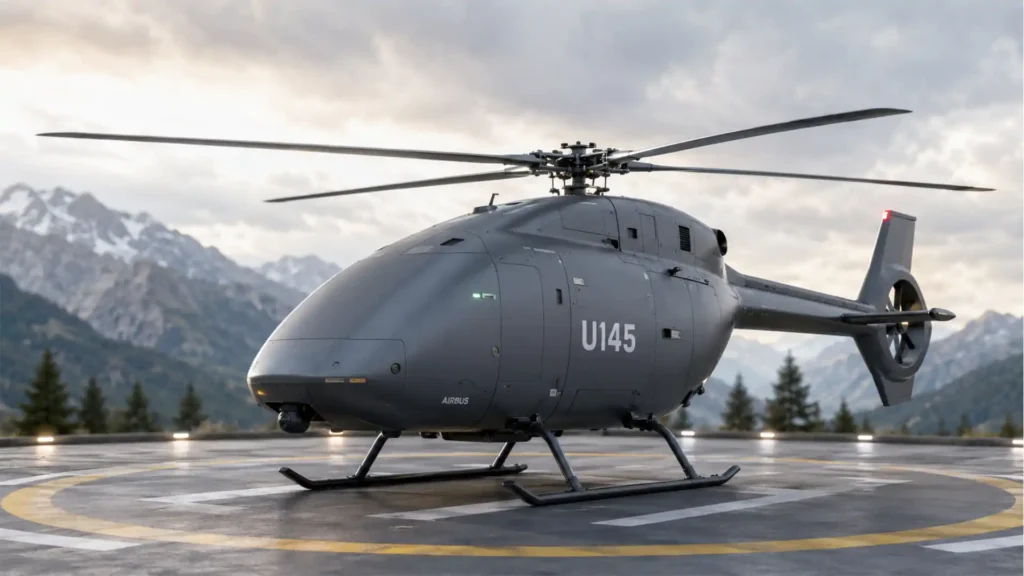
This article is an original analysis supported by the sources cited below
Airbus introduces uncrewed version of the H145, the U145
Airbus’ official 8 June 2026 announcement confirming the U145 reveal, no-cockpit design, cargo adaptations, 3,800 kg MTOW, mission scope, first-flight target and early-next-decade service ambition.
U145
Airbus’ product page describing the U145 as an uncrewed aerial logistics system for civil and military applications, with modular architecture and H145-derived design.
H145 technical information
Airbus technical data for the H145, including MTOW, useful load, fuel capacity, engine type and take-off power.
H145
Airbus’ H145 product page describing the aircraft’s missions, avionics, autopilot, support base, delivery figures, flight hours and operating characteristics.
H145M technical information
Airbus technical data for the military H145M variant, useful for understanding the platform family’s payload, MTOW and mission equipment baseline.
Arriel 2E, the Airbus H145 engine
Safran’s official engine page listing Arriel 2E power ratings, service history and relation to the Airbus H145.
France orders Airbus VSR700 uncrewed aerial system
Airbus announcement on the VSR700 order for France, documenting Airbus’ earlier crewed-to-uncrewed helicopter conversion path.
VSR700
Airbus product page for the VSR700 uncrewed aerial system, used as background for Airbus’ broader rotary-wing UAS portfolio.
Crewed-Uncrewed Teaming
Airbus explanation of crewed-uncrewed teaming and its role in future air operations.
Beyond the lone aircraft
Airbus story on teaming helicopters and drones for search, rescue and wildfire missions.
Wildfire Sentinel
Airbus article on connected wildfire management, used as context for emergency and firefighting applications.
Airbus and Lakota Connector partners successfully execute fourth autonomous flight test period
Shield AI release documenting Airbus U.S. Space & Defense and partner autonomous flight testing on an H145-class platform.
Autonomous logistics is the Marine Corps’ next combat advantage
L3Harris article describing the MQ-72C autonomous Lakota logistics concept and partner integration.
Rules and standards
EASA page explaining the EU drone regulatory framework, including the open, specific and certified categories.
Drones regulatory framework background
EASA background page defining the open, specific and certified UAS operation categories.
Certified category civil drones
EASA page explaining the certified category for the highest-risk civil drone operations.
Specific Operations Risk Assessment
EASA explanation of SORA methodology for assessing UAS operational risk and mitigations.
Easy Access Rules for Unmanned Aircraft Systems
EASA consolidated rules for Regulations (EU) 2019/947 and 2019/945, including later airworthiness-related amendments.
EASA publishes Easy Access Rules for Unmanned Aircraft Systems revision from July 2024
EASA news release noting incorporation of 2024 regulations addressing initial and continuing airworthiness for UAS.
Commission Implementing Regulation EU 2019/947
Official EUR-Lex text for EU operating rules and procedures for unmanned aircraft.
Commission Delegated Regulation EU 2019/945
Official consolidated EUR-Lex text covering unmanned aircraft systems and third-country UAS operators.
U-space
EASA page for the U-space regulatory framework, including Commission Implementing Regulation (EU) 2021/664.
Commission Implementing Regulation EU 2021/664
Official EUR-Lex text establishing the EU regulatory framework for U-space.
Artificial Intelligence Roadmap
EASA page outlining the agency’s AI Roadmap 2.0 and aviation AI safety direction.
EASA Artificial Intelligence Concept Paper Issue 2
EASA guidance for Level 1 and Level 2 machine-learning applications, including learning assurance and human-AI teaming.
Creating a large-scale European drone market
European Commission press release on Drone Strategy 2.0 and the EU vision for drone market development.
Drone Strategy 2.0
European Commission communication setting out a policy framework for a smart and sustainable unmanned aircraft ecosystem in Europe.
ILA Berlin
Official ILA Berlin page with 2026 event results, participant figures and exhibitor data.
German air show opens under shadow of Iran war, fighter project collapse
Reuters report providing current geopolitical and European defence-industry context for ILA Berlin 2026.
| Citing this article? Brief excerpts are welcome. Please credit Webiano.digital, name the author where stated, and include a link to https://webiano.digital and to this original article. Full or substantial republication requires prior written permission. Read our Copyright and Content Use Policy. |
This article was prepared with the assistance of artificial intelligence tools. The content underwent expert human review, and Webiano Digital & Marketing Agency assumes editorial responsibility for its final version and publication.