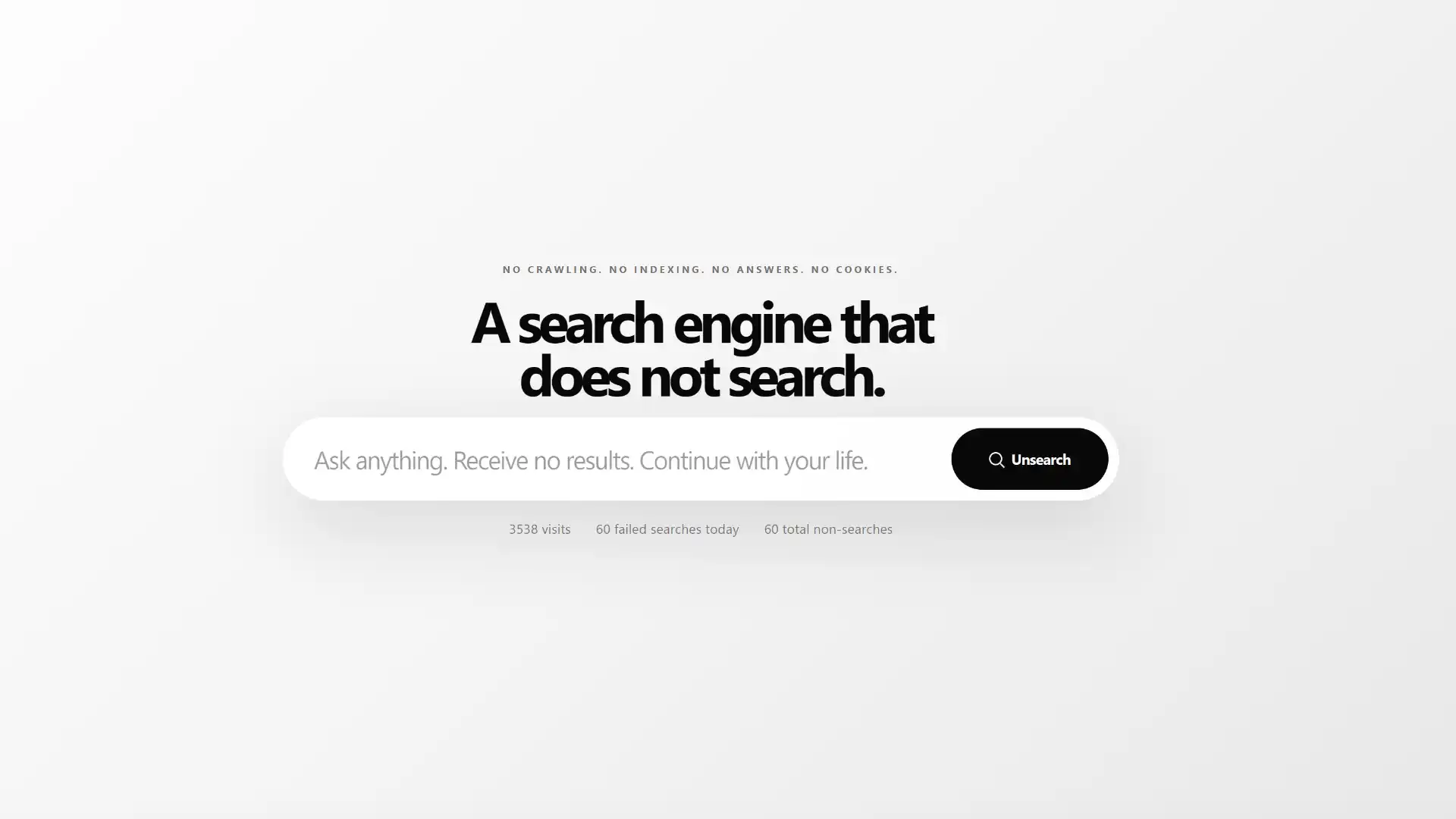
The Anti Search Engine does almost nothing, which is exactly why it lands. You arrive expecting a gimmick, and the gimmick is discipline: one page, one input field, one button labeled “Unsearch,” a failed-search counter, and a flat refusal to participate in the web’s largest addiction. The site calls itself “the only AI search engine intentionally designed not to work,” then immediately strips away every feature that usually makes an AI search product feel current: no crawling, no indexing, no answers, no cookies. Its headline is even cleaner: “A search engine that does not search.”
Table of Contents
That sounds like a throwaway joke until you actually sit with it. The refusal is the product. Most AI search tools are locked in a race to fetch, summarize, cite, remember, personalize, rank, predict, and answer before the user has finished typing. The Anti Search Engine moves in the opposite direction. It does not promise better relevance. It does not pretend to understand intent. It does not compress the web into a neat paragraph. It takes the most familiar interface in digital life, a search box, and turns it into a small deadpan stage.
The page is almost aggressively plain. There is no onboarding, no explainer video, no prompt gallery, no “powered by” strip, no model selector, no sign-in wall, no badge salad. The only visible activity is anti-activity: visits, failed searches today, and total non-searches. At the moment the page was checked, it displayed thousands of visits, many failed searches today, and also total non-searches. Those numbers are less analytics dashboard than punchline scoreboard. They make failure countable.
The best part is that the site does not over-explain itself. It lets the contradiction do the work. A search engine is supposed to reduce friction between a question and a result. This one preserves the friction and calls it the experience. A normal AI search page tries to disappear behind usefulness. This one makes uselessness visible enough to become useful as commentary. You do not open it to find information. You open it to see a familiar pattern break.
That break matters because search has become overloaded. The modern search box is no longer just a doorway to pages. It is an ad slot, an answer machine, a shopping assistant, a local directory, a reputation broker, a crawler mandate, a training-data funnel, and sometimes a wrapper around other people’s work. Google now publishes documentation for site owners on how AI Overviews and AI Mode include content in search experiences, while OpenAI publishes separate crawler roles for search, model training, and user-triggered actions.
The Anti Search Engine turns that whole stack into one dry sentence: what if the search engine simply did not search? It is funny because it is stupid. It is sharp because the stupidity is precise. It removes the crawler, the index, the answer, the cookie, the ranking model, the snippet, the sponsored placement, the scraping anxiety, the attribution debate, and the optimization game. What remains is the ritual. Type something, press a button, receive nothing.
There is a long tradition of internet projects that win by being barely functional. A joke website can sometimes explain the web better than a product demo. The Million Dollar Homepage explained scarcity and attention better than many ad-tech decks. “Is it Christmas?” explained conditional interface design with one word. The Anti Search Engine sits in that family, but its target is newer and hotter: AI search as a cultural posture. It is not just making fun of bad search results. It is making fun of the assumption that every blank box must become an answer machine.
The footer says the project is made in Slovakia and links to Webiano Digital & Marketing Agency. Webiano describes itself as a boutique digital and marketing agency based in Central Europe, working across digital marketing, AI search optimization, web solutions, content, and software development. That authorship gives the joke an extra twist. This is not a pure anti-tech manifesto from someone outside the machine. It appears to come from people who understand search visibility, crawling, indexing, AI discovery, and the business pressure around all of it.
That is why the site feels less like “AI is bad” and more like a small editorial object. It knows the grammar of the thing it refuses. It uses the search-box layout because everyone understands it. It uses AI search language because the market is full of it. It uses privacy language because every tool now performs virtue around data collection. Then it withholds the actual mechanism. The punchline is not that search fails accidentally. The punchline is that failure has been designed with cleaner boundaries than success.
A search box that behaves like a locked door
The central trick of The Anti Search Engine is brutally simple: it copies the shape of usefulness while denying the transaction. A user sees a search query field and expects the old bargain. I give you words. You give me something back. The page breaks that bargain without becoming hostile. It does not crash. It does not lecture. It does not redirect to a manifesto. It just refuses to return results.
That matters because the search box is one of the most trusted shapes on the web. People do not treat it like a normal form field. A search box feels almost constitutional. It suggests access. It suggests fairness, even when the ranking beneath it is messy, commercial, incomplete, or opaque. The Anti Search Engine exploits that trust. It gives you the symbol of access, then turns it into a locked door with a nice handle.
The button label “Unsearch” is doing more work than it first appears to. It is not “submit,” “go,” “ask,” “generate,” or “search.” It is a small invented verb that tells you the site is not broken. It is performing the opposite of search. The label also saves the project from feeling like a prank error page. You are not being denied by accident. You are participating in a tiny anti-function.
There is also a small privacy joke hiding in plain sight. The site’s notice says it uses only essential local preferences for theme and the notice, and that it still does not search. That sentence mimics the cookie-banner era while draining it of menace. Most privacy notices feel like grudging legal furniture attached to a tracking economy. Here, the notice is comic because there is so little to confess. The service does not need a profile because it has no result to personalize.
The visible counters make the non-event feel social. Failed searches become a shared statistic. A normal analytics counter would celebrate usage. This one celebrates non-usage disguised as usage. The number of “total non-searches” turns absence into a community metric. It says: other people have also come here and asked the machine to do nothing. The joke gets better because the site counts failure with the same quiet confidence that a startup dashboard might count conversions.
The design also resists the usual fake warmth of AI interfaces. There is no assistant avatar smiling at you. No “I’m thinking.” No shimmer. No animated dots. No apology. No answer card. No sources panel. No footnote stack. That absence feels deliberate because AI search pages are full of theater. They show progress while retrieving, summarizing, grounding, reranking, or failing to do those things. The Anti Search Engine refuses the theater too.
Its minimalism is not just aesthetic. The page uses reduction as criticism. If you remove crawling, indexing, answering, cookies, personalization, ads, snippets, suggestions, rankings, and generated summaries from search, most companies would say you have removed the business. This site says you have revealed the interface. The blankness becomes a mirror for how much we now expect a box to do.
The strongest web jokes usually work without instructions. The Anti Search Engine passes that test. A reader can land on the page, press the button, and understand the bit within seconds. A more curious reader can keep thinking about it for longer because the bit is built on an actual tension in the web: the more machines claim to answer everything, the more visible their appetite becomes. Crawling, indexing, summarizing, training, ads, cookies, and attribution are no longer background plumbing. They are the argument.
The site is also refreshingly small in an era where small things keep being inflated. It does not turn a one-line idea into a SaaS landing page. There are no pricing tiers for “Pro Non-Search.” There is no roadmap promising “smarter failures.” There is no newsletter capture after the first non-search. That restraint is rare. Many internet jokes die because the maker cannot resist explaining, branding, and monetizing the laugh until it becomes a content strategy. This one stops.
The locked-door feeling also changes the user’s role. You are not a customer, prospect, lead, user, reader, or data point in any meaningful product sense. You are the person completing the circuit of a joke. The page does not flatter you by pretending your query matters. It makes your query irrelevant by design. That can feel oddly relieving. For once, the machine does not want to know what you meant.
The joke works because search became too hungry
The Anti Search Engine would not land in the same way ten years ago. Its timing is part of the joke. Search has moved from a directory of pages toward a layered extraction machine. A crawler fetches content. An index stores and structures it. A ranking system decides visibility. An answer system may synthesize the page before the user clicks. A model may use web data for training. A browser, assistant, or platform may repackage the interaction again. Each layer adds power. Each layer also adds appetite.
Official documentation now reflects that split. OpenAI lists separate web crawlers and user agents for product actions, automatic search-related use, and model-related collection. Google’s publisher documentation treats AI features such as AI Overviews and AI Mode as part of the search environment site owners must understand. These are not fringe experiments. They are now part of how major platforms describe web discovery to publishers.
That is why the site’s “no crawling” line is not decorative. Crawling is the first act of search power. A crawler decides what gets fetched. A robots.txt file gives site owners a way to express which URLs crawlers may access, but the IETF’s Robots Exclusion Protocol is explicit that those rules are not access authorization. Google’s own robots.txt guide also says the file is mainly for controlling crawler access and avoiding overload, not for keeping a page out of Google.
“No indexing” cuts deeper. Indexing turns a page into a retrievable object inside someone else’s system. For classic search, that bargain was usually acceptable because the index sent traffic back. The publisher got discoverability. The user got a link. The search engine got attention and ads. AI search complicates that bargain because the answer may arrive before the click. The source is still needed, but the visit may be optional.
“No answers” is the sharpest line of all. AI search sells the answer as the upgrade. Instead of sending you to pages, it promises to read them for you. Sometimes that is useful. Sometimes it is wrong. Sometimes it is convenient enough to make the source invisible. The Anti Search Engine refuses to answer and, by doing so, makes the answer itself look less innocent. It asks whether every query deserves a generated paragraph just because the machine can produce one.
“No cookies” completes the set. The project refuses the data trail as well as the result trail. Modern search is often personalized, measured, attributed, retargeted, and folded into advertising systems. The Anti Search Engine’s local-preferences notice feels almost comic because the service has so little to remember. There is no result quality to improve, no ads to tune, no profile to enrich, no answer history to mine.
This is where the site becomes more than anti-Google or anti-OpenAI snark. It is anti-default. It refuses the default assumption that every interface should become more predictive, more personalized, more extractive, more answer-shaped. It does not claim that searching is useless. It does not claim that AI answers never help. It simply shows the opposite pole: a tool that declines the whole contract.
The humor depends on how many promises the page does not make. A normal AI search startup would likely promise speed, accuracy, privacy, citations, fresh data, and a cleaner web experience. The Anti Search Engine promises failure. That makes its honesty feel oddly luxurious. It cannot hallucinate because it does not answer. It cannot bury sources because it does not show any. It cannot over-crawl because it does not crawl. It cannot personalize badly because it does not personalize. Its refusal becomes a weird form of product integrity.
There is also a quieter criticism of the “answer economy.” A lot of online information-seeking is not improved by premature answers. Sometimes people need sources, context, conflicting claims, primary documents, forum threads, manuals, local knowledge, strange pages, old archives, and the messy trail that leads to judgment. AI search often compresses that mess. Compression is convenient, but it changes the act. The Anti Search Engine makes the user feel the absence of that act.
The page also exposes how much of the AI-search conversation is really about consent. Who gets to crawl, index, summarize, store, cite, train, and monetize public pages? Robots.txt is a signal, not a locked gate. Search documentation is full of distinctions between crawling, indexing, snippets, AI features, and user-triggered fetches. For normal users, those distinctions are invisible. The Anti Search Engine makes them visible by removing all of them at once.
It is not a policy proposal, and that is part of its charm. The site does not pretend a joke page can solve publisher economics. It does not draft a new protocol. It does not rank crawlers by ethics. It does not explain the legal status of scraping. It just puts four negations under a search brand and lets the reader fill in the rest. In a noisy debate, a clean refusal can sometimes say more than another 3,000-word thread.
A tiny object with unusually clear product judgment
The Anti Search Engine is a good reminder that product judgment is often subtraction. The site works because someone stopped before the joke got diluted. There are a hundred obvious additions that would make it worse: fake results, sarcastic AI answers, random error messages, generated insults, a manifesto modal, social sharing buttons, an animated robot, a dark-pattern cookie banner, a leaderboard of failed queries. The page avoids all of them.
That restraint gives the project a premium feel despite its absurdity. It is not polished in the venture-backed sense; it is polished in the editorial sense. The maker understood the sentence, the object, the interaction, and the exit point. The user does not need to spend five minutes discovering the feature. The feature is the lack of feature. A weaker version would try to be funny at every pixel. This version lets the concept stay dry.
The title is also unusually exact. “The Anti Search Engine” is not “Noogle,” “Searchless,” “FindNothing,” or some pun that would age in a week. It is plain, declarative, and broad enough to carry the critique. The phrase “anti search engine” immediately tells you which mental model to invert. The subtitle, “The only AI search engine intentionally designed not to work,” adds the AI-era target without needing another paragraph.
The visual field matters too. A central search box has cultural weight because it belongs to Google, Bing, DuckDuckGo, Perplexity, ChatGPT search, site search, command palettes, launcher apps, operating systems, and browser address bars. The Anti Search Engine borrows that weight. It does not need a complicated layout because the shape is already burned into people’s hands. Type. Enter. Expect. The page breaks the expectation at the smallest possible point.
The button label is the perfect example of controlled weirdness. “Unsearch” is funny without becoming loud. It is memorable enough to make the interface feel authored, but not so clever that it pulls attention away from the main line. It also avoids a common problem with parody tools: overacting. The button does not say “waste my time,” “summon the void,” or “ask the useless AI.” It says “Unsearch,” then lets the failure happen.
The counters add just enough motion. The page needs proof that other people have used the non-tool. Without counters, it might feel like a static poster. With them, it becomes a live absurdity. The exact count does not matter as much as the fact that the site tracks “failed searches” and “non-searches” as if those were business metrics. The language turns analytics into satire.
The cookie notice is another clever choice because it touches a sore part of the web without dragging the project into legal parody. “Accept nothing” is better than a fake compliance banner. It fits the refusal logic. The page is not asking you to accept tracking, terms, personalization, or even usefulness. It is inviting you to accept the absence. Again, the joke works because the wording is small.
What stands out
| Element | What it normally means | What it means here |
|---|---|---|
| Search box | Access to information | A familiar ritual with no reward |
| Unsearch button | Action and retrieval | A deliberate refusal to retrieve |
| Failed-search counter | Bad performance | The main success metric |
| No crawling | Missing infrastructure | A privacy and consent joke |
| No answers | Product failure | The product’s whole argument |
The table makes the object easier to read because each familiar search convention has been inverted. The site is not random minimalism. It is a set of precise reversals. A search engine normally hides complexity behind a simple box. The Anti Search Engine hides nothing because there is nothing behind the box.
That “nothing” is why the site feels more complete than many bigger experiments. A complete product is not the same as a feature-rich product. This one has a premise, a tone, a gesture, and a clean boundary. It does not need accounts, settings, keyboard shortcuts, browser extensions, API access, a public roadmap, or a Discord server. More would not deepen the joke. More would make it needy.
There is also a good branding lesson inside the gag. The page is memorable because the constraint is extreme. “Privacy-first AI search” is crowded. “Minimal AI search” is crowded. “Ad-free search” is crowded. “The search engine that does not search” is immediately ownable because it refuses the category’s core function. In branding, a strong no can be more distinctive than another soft yes.
The project also understands that not every web object must become a platform. Some sites should stay as objects. A small web object can be visited, understood, shared, and remembered. It does not need to retain the user. It does not need to maximize session length. It does not need to create a habit loop. The Anti Search Engine is closer to a digital postcard than a software product, and that is a strength.
The lack of a manifesto keeps the page open. A visitor can read it as anti-AI, anti-SEO, anti-tracking, anti-platform, anti-productivity, or just anti-boredom. The ambiguity is useful. A heavy explanation would narrow the joke and make it preachy. The page trusts the reader to understand the target. On the web, that trust is refreshing.
The wider web keeps producing anti-tools
The Anti Search Engine belongs to a strange and healthy category: tools that critique tools by pretending to be tools. The web has always made room for these objects because browsers lower the cost of public weirdness. Someone can register a domain, build one interaction, and publish a little conceptual machine. No app store review. No enterprise procurement. No permission from a platform feed. Just a page.
Anti-tools are different from broken tools. A broken tool fails against its own promise; an anti-tool succeeds by reversing the promise. The Anti Search Engine is not trying and failing to search. It is designed not to search. That difference matters. The intentional refusal gives the user a way to laugh without feeling tricked. The page is honest about its uselessness from the first line.
This sort of project often appears when a category becomes too self-serious. AI search is currently very self-serious. Every product wants to be the place where users ask the internet. Every company wants to compress pages into answers. Every marketing page talks about speed, trust, sources, and accuracy. A tiny page that refuses the whole game has a natural advantage: it does not have to compete on the same terms.
The web needs that pressure valve. Without small jokes, categories become spiritually airless. Search is too important to be left only to product launches, policy fights, SEO tactics, publisher disputes, and benchmark arguments. A parody page can remind people that interfaces are cultural objects too. The search box is not neutral just because it is familiar. It carries assumptions about who asks, who answers, who is indexed, who is cited, and who is ignored.
The Anti Search Engine also sits near the old internet habit of making one-purpose pages. Those pages had a kind of moral clarity. A single page told you whether a site was down, whether a day was Friday, whether a phrase was still funny, whether a button made a sound, whether a countdown had ended. They were not always useful in a conventional sense, but they were crisp. The current web often buries crispness under frameworks, feeds, dashboards, and growth loops.
There is a small resistance in publishing something that does not scale into a business. The Anti Search Engine has no obvious monetization path, which is part of why it feels clean. It may promote the maker by showing taste, but the page itself does not squeeze the visitor. It does not harvest emails. It does not sell a course on anti-search strategy. It does not ask for donations to keep the nothing alive. It just exists.
That existence has value because the web is full of optimized sameness. Most product pages now share the same posture: hero claim, subclaim, social proof, feature cards, pricing, testimonials, FAQ, call to action. The Anti Search Engine uses the skeleton of a product but removes the persuasion machinery. No testimonials from satisfied non-searchers. No case study showing a 47 percent reduction in information retrieval. No enterprise plan.
The joke also works because search itself has become emotionally confusing. People still need search, but they trust it less casually. They complain about ads, SEO sludge, AI summaries, missing exact matches, forum spam, affiliate pages, scraped content, and answer boxes that overstep. Some complaints are exaggerated. Some are fair. The important point is that search now feels contested rather than invisible. A search engine that refuses to search arrives as a neat little expression of that fatigue.
There is another layer: refusal can be generous. A machine that does not answer also does not pretend. AI systems often fail in ways that look fluent. They produce language shaped like knowledge. A non-answer is sometimes less damaging than a confident bad answer. The Anti Search Engine dramatizes that idea without becoming a safety essay. It gives you the cleanest possible failure: no result, no hallucination, no false confidence.
That makes it oddly calming. The page is one of the rare AI-branded things that does not ask for trust. It does not say, “Trust me, I found the best sources.” It does not say, “Trust me, I understood your question.” It does not say, “Trust me, I respect your privacy.” It says, in effect, “There is nothing here to trust.” That is a stronger privacy statement than most banners, even if it is mostly a joke.
The danger for projects like this is that commentators can overburden them. A tiny site should not be forced to carry the whole critique of AI search. The Anti Search Engine is funny because it is light. Its meaning comes from the ecosystem around it, not from its own complexity. Treating it like a policy document would flatten it. Better to treat it as a well-cut internet object that catches the light from a larger argument.
Small doubts worth clearing up
The page calls itself that, but the phrase is part of the joke. Its visible premise is that it does not crawl, index, answer, or search. There is no public sign on the page of an AI answer pipeline, model interaction, retrieval system, or search index. The “AI search engine” label works because AI search is the category being mocked.
It does not do nothing in the artistic sense. It performs refusal through an interface. The page has text, a search field, a button, counters, a theme notice, and a footer. That is enough behavior to make the concept legible. It does not need retrieval to be an experience.
Privacy is one layer, not the whole object. The site’s “no cookies” framing and local-preferences notice are funny because they strip data collection down to almost nothing. But the bigger target is the entire search bargain: crawl the web, index the web, answer from the web, and gather value from the interaction.
It is more accurate to call it anti-search-inflation. Search itself remains useful. AI search can be useful too. The page is not making a careful technical argument against every retrieval system. It is mocking the current urge to turn every query into a generated answer wrapped in product confidence.
Crawling is where machines first touch the public web at scale. The Robots Exclusion Protocol lets site owners publish crawler preferences, but it is not access authorization. That distinction is important because modern crawler debates now include search indexing, AI search, model training, user-triggered fetches, scraping, publisher consent, and server load.
Because answer machines often replace the act of checking with the feeling of completion. A page that refuses to answer gives the user no false closure. It may be useless for information retrieval, but it is honest about that uselessness. Many answer systems are useful until they are wrong in a way that sounds right.
It would still be a good joke, but it would lose some bite. The AI label makes the refusal current. A normal parody search engine could mock bad results or SEO spam. This one also mocks the newer expectation that search should generate, summarize, infer, and mediate the web on the user’s behalf.
Open it if you like tiny web experiments, product jokes, anti-tools, search criticism, privacy humor, or one-page projects that say more by doing less. It is especially good for people tired of bloated AI demos. The page takes about ten seconds to understand, but the idea lingers longer than many serious tools.
Anyone looking for utility, depth, configuration, or a real alternative search engine will bounce immediately. That is fine because bouncing is part of the design. The site is not trying to retain you. It is trying to make one clean point and let you leave.
It reveals that the search box is still a powerful symbol. Even an empty search box can make a claim. When a page refuses to search, people understand the refusal because they understand the ritual. That shared interface memory is what makes the joke portable.
The point is not nothing
The Anti Search Engine is easy to dismiss because it is small. That would be a mistake. Small web objects often survive in memory because they are not trying to be everything. They give the internet a shape it did not have before, even if that shape is just a search box that refuses to search. The site is not important because it is useful. It is interesting because it knows exactly how useless it wants to be.
The web has spent years rewarding expansion. More pages, more data, more personalization, more automation, more generated answers, more tracking, more dashboards, more surfaces, more snippets, more feeds. The Anti Search Engine is a little act of contraction. It takes one of the internet’s most powerful forms and removes the promise underneath it. What remains is funny, but it is not empty.
A normal search engine says: ask me anything. The Anti Search Engine says: maybe do not ask the box this time. That is a surprisingly strong editorial position. It does not force the reader toward nostalgia or technophobia. It simply interrupts the habit. For one click, the user is not optimized, profiled, summarized, or guided. The user is left with the query itself.
That may be the site’s best joke. The thing you typed does not disappear into a system. It stays yours, unanswered and unprocessed, a little orphaned phrase in a box that refuses to become infrastructure. In an internet built around extraction, that tiny non-event feels almost polite.
The Anti Search Engine also shows that taste still matters online. Anyone can make a joke page, but not every joke page has timing, restraint, and a clean edge. This one does. It is not a grand intervention. It is a small, memorable refusal at the exact moment when refusal feels newly legible. The web does not need every project to solve a problem. Sometimes it needs a page that makes the problem visible by declining to join it.
Author:
Jan Bielik
CEO & Founder of Webiano Digital & Marketing Agency
Sources
The Anti Search Engine
Official project page for The Anti Search Engine, including its core claim, theme, interface labels, failed-search counters, local-preferences notice and footer attribution.
Webiano Digital & Marketing Agency
Official website of the agency linked from The Anti Search Engine footer, used to identify the broader Webiano context and its work around digital platforms, AI search visibility and web projects.
| Citing this article? Brief excerpts are welcome. Please credit Webiano.digital, name the author where stated, and include a link to https://webiano.digital and to this original article. Full or substantial republication requires prior written permission. Read our Copyright and Content Use Policy. |
This article was prepared with the assistance of artificial intelligence tools. The content underwent expert human review, and Webiano Digital & Marketing Agency assumes editorial responsibility for its final version and publication.