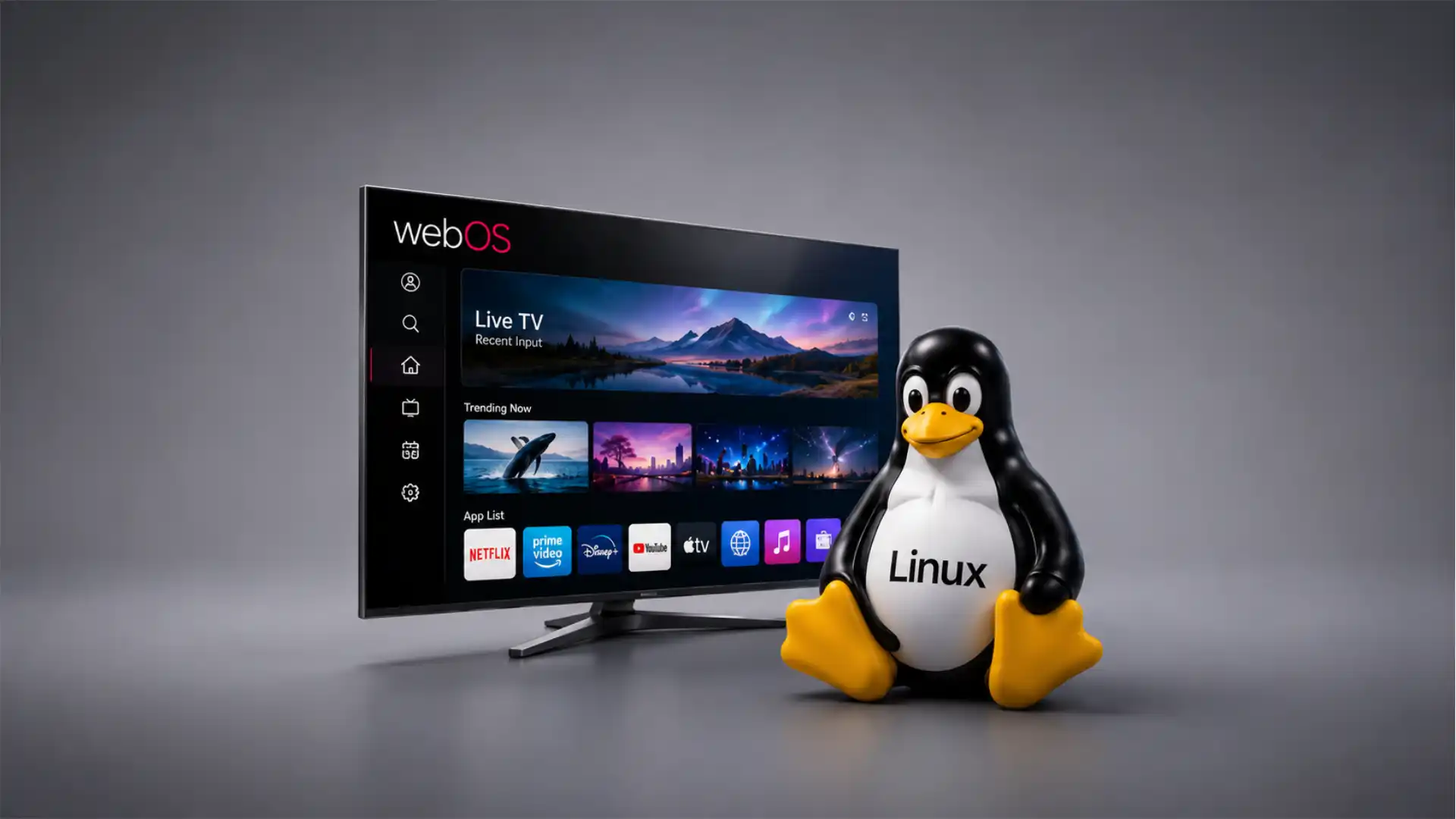
webOS is often treated as an LG design layer: the launcher, the app row, the remote-friendly menus, the recommendations, the smart home cards, the streaming buttons. That view is not wrong, but it is too small. Behind LG webOS sits a Linux kernel-based operating system that began life as Palm’s mobile comeback, survived HP’s failed hardware bet, moved through open source, and became one of the most visible smart TV platforms in the world.
Table of Contents
The TV interface hides a deeper software story
The user sees Netflix, YouTube, LG Channels, settings, voice search, sports alerts and AI suggestions. Developers see web apps, APIs, a simulator, TV-specific tools and services. Under that, webOS has a layered software stack with managers, services, a web engine, Node.js, Luna Bus, graphics composition, system apps, and a board-support/kernel layer. LG’s own webOS Open Source Edition documentation describes the platform as a layered system that includes Core Applications, Application Framework, Managers & Services, Base Components and BSP/Kernel.
That technical structure matters because smart TVs are no longer passive displays. They are streaming terminals, advertising surfaces, gaming portals, smart home dashboards, data collection points, cloud service clients and AI interfaces. The operating system is now part of the TV’s commercial identity. In LG’s case, that identity carries the webOS name, but the base belongs to the broader Linux story.
webOS also complicates a common consumer assumption. Many people still associate Linux with laptops, servers, developers, command lines or Android phones. Yet Linux often reaches households through devices that never display a penguin, a terminal or a package manager. Routers, cars, set-top boxes, TVs, appliances and embedded systems often use Linux because it is portable, mature, adaptable and already surrounded by a deep tooling culture. webOS is one of the clearest consumer examples of Linux winning without being advertised as Linux.
The timing is sharp. LG is not treating webOS as a static TV menu. The company has expanded it into a platform business, licensed it to other TV brands, added webOS Hub for third-party manufacturers, promoted a five-year Re:New upgrade program on many models, and placed AI features inside webOS 26 for its 2026 TV lineup. LG says webOS has powered more than 200 million LG TVs worldwide and has been extended to third-party TV brands, projectors, digital signage and in-vehicle infotainment systems.
The hidden Linux point, then, is not trivia. It explains why a mobile operating system from 2009 could be adapted into a TV platform, why LG could build a connected-device strategy around it, why webOS can host web technologies and native components together, and why the battle for smart TV operating systems now looks more like a platform war than a hardware spec race.
Palm built webOS for a phone market that had already changed
Palm introduced webOS in 2009 with the Palm Pre, a phone that tried to answer the iPhone and Android without simply copying either. The device had a physical keyboard, a gesture area, a multitasking card interface and a software concept built around web services. Wired’s CES 2009 coverage described Palm’s bet clearly: the Pre’s hardware attracted attention, but Palm saw WebOS as the “secret sauce” behind its comeback attempt.
The original webOS was ambitious because it treated the phone less like an isolated device and more like a live organizer of online identities. Palm Synergy linked contacts, calendars and messages from services such as Google, Facebook and Outlook into unified views. The card model let users move between live tasks with a spatial metaphor that felt natural on a touchscreen. Palm was trying to build a cloud-aware mobile OS before the phrase sounded ordinary.
That matters for today’s LG webOS because the TV version still carries some of the same ideas, although in a changed form. The TV is not a phone. It is shared, remote-controlled, lean-back, entertainment-centered and often slower to update than mobile hardware. Yet webOS remained a platform built around switching contexts: live TV, streaming apps, browser, external inputs, smart home, recommendations, games and settings.
Palm’s timing was brutal. The iPhone had already reset consumer expectations. Android was expanding across manufacturers. Carriers, developers and app ecosystems were shifting toward scale. Palm had strong software ideas but lacked the hardware momentum, distribution power and developer gravity needed to survive. The Pre became admired by many reviewers and remembered fondly by software people, but admiration did not become platform control.
This is the first lesson in the webOS story: good operating system design does not guarantee market survival. A platform must also win devices, developers, distribution, content, retail support, updates and long-term investment. Palm could show a better way to handle multitasking, contacts and gestures, but it could not bend the mobile market away from Apple and Google.
webOS did not disappear because its ideas were weak. It disappeared from phones because the phone market became a scale market. That distinction is central. When webOS later moved to smart TVs, it entered a category where the operating system did not need to defeat iOS or Android on a phone. It needed to make a TV easier to use, help LG differentiate hardware, support streaming partners and provide a platform for services. The same software lineage found a less crowded path by changing the device category.
HP turned webOS from a mobile bet into an open source handoff
HP acquired Palm in 2010 for webOS, patents, talent and a possible path into mobile devices. The plan looked bold at first. HP talked about using webOS beyond phones, including tablets and even printers. The HP TouchPad became the most visible product of that phase. Then the strategy collapsed. HP discontinued webOS hardware in 2011 after weak sales, leaving the software in limbo.
HP’s decision to open-source webOS in December 2011 looked generous on the surface and defensive beneath it. Wired reported that HP would make the platform open source after months of uncertainty, while noting that the decision also looked like an exit from a costly hardware failure.
The open source move matters because it kept the platform alive long enough for LG to acquire it. If HP had locked webOS away, killed the engineering team and left the code to decay, the story might have ended there. Instead, the platform entered a transitional state. Open webOS existed as a project, Enyo was released under an open source license, and webOS remained attractive enough for another hardware company to consider it.
The HP phase gave webOS two legacies that still shape its identity: failure as a mobile hardware business and survival as reusable platform technology. Those are not contradictions. Many technologies that fail in one market later matter in another. The commercial frame changes. The constraints change. The buyers change. A phone OS must satisfy app developers, carriers, app stores, mobile silicon partners, accessory makers and users who replace devices every few years. A TV platform must satisfy content owners, streaming providers, remote control behavior, picture and audio pipelines, device certification, regional services, advertising rules and hardware makers with longer replacement cycles.
HP also left behind a useful inheritance for LG: software talent, source code, documentation, websites and open source community traces. LG did not have to build a smart TV operating system from a blank page. It could take a mature user-interface concept, adapt it to the living room, and combine it with LG’s own TV hardware and content strategy.
The result is one of the stranger success stories in consumer operating systems. webOS did not beat iOS. It did not beat Android on phones. It did not become HP’s universal device platform. It became more durable after leaving the market it was designed to enter.
LG bought more than a name in 2013
LG’s 2013 acquisition of webOS from HP was not a branding purchase. LG announced that it had acquired the webOS operating system technology, including source code, documentation, engineering talent and related websites, to support next-generation Smart TV technology. LG also said it would assume stewardship of Open webOS and Enyo, while HP retained Palm cloud assets.
That detail is crucial. LG was not simply licensing an interface skin. It bought the platform assets needed to shape the system. For a TV manufacturer, that kind of control is strategic. A smart TV operating system defines the app model, boot flow, update path, remote interaction model, content integration, privacy choices, advertising inventory, user accounts, developer tools and partner relationships. A modern TV company that controls its OS controls the front door to the viewer.
At the time, LG needed a stronger software story. Hardware quality mattered, especially with OLED and high-end displays, but smart TV experiences were often clumsy across the industry. Menus were slow. Apps were inconsistent. Setup flows were awkward. Switching between HDMI, live TV and streaming services often felt like moving between separate machines. LG saw webOS as a way to make the TV feel less like a box of features and more like one coherent environment.
The acquisition also moved webOS into a company with a natural reason to keep investing in it. HP had struggled to connect webOS to a winning device business. LG already shipped TVs at scale. It needed the software to make those TVs more attractive, keep users inside LG’s interface and later build a service layer around the installed base.
This is where Linux becomes commercially powerful without being marketed to consumers. LG did not need to explain Linux to TV buyers. It needed a platform that could be adapted to embedded hardware, remote-control use, apps, streaming and long-term maintenance. Linux supplied the base; webOS supplied the product identity.
LG’s 2014 relaunch turned webOS into a TV language
LG brought webOS back to public attention at CES 2014, presenting it as a Smart TV platform focused on simple setup, easy switching and easier content discovery. LG said the platform would be implemented in more than 70 percent of its Smart TVs in 2014.
The early TV version is worth revisiting because it set the tone for webOS as a living-room system. The Launcher ran along the bottom of the screen, letting users move between broadcast TV, apps and external devices without constantly returning to a full home screen. The BeanBird setup character gave the platform a friendly identity. The Magic Remote added pointing and motion control. These details were not just decoration. They made webOS feel distinct from grid-based TV menus.
LG’s core insight was that a TV operating system must respect what people are already watching. A phone OS can make the home screen the center of everything because the user is holding the device and moving through apps. A TV OS interrupts a shared viewing experience. If the menu covers too much, moves too slowly or forces too many steps, the software feels hostile. webOS tried to reduce that friction by letting the current content remain present while the user searched, switched or opened another service.
The 2014 launch also showed why web technologies made sense for a TV platform. Streaming services already build web-based interfaces for many devices. TV apps need to be updated often, localized widely and certified across regions. A web-centric platform lowers some barriers for app developers, although TV performance constraints and platform APIs still matter.
LG’s webOS did not make every TV interaction perfect. No smart TV operating system has solved clutter, ads, app fragmentation and update fatigue cleanly. Yet LG gave webOS a recognizable interaction model. That recognition matters in a market where many buyers do not know or care which OS their TV uses until they dislike it. A TV platform becomes powerful when users remember it, developers target it, and content partners treat it as a distribution channel.
Linux sits below the brand, not beside it
Calling webOS a Linux-based operating system can confuse readers because LG does not sell its TVs as Linux TVs. The consumer-facing platform is webOS. The software base is Linux. Those two facts can coexist.
Linux is the kernel and part of the wider embedded software environment. webOS is the product platform built above it. LG’s open source site even lists Linux among the trademarks used in the webOS OSE documentation environment, and the architecture pages place BSP/Kernel at the base of the system.
The clean way to state it is this: webOS is not a traditional desktop Linux distribution, but it is a Linux kernel-based platform designed for smart devices. It does not behave like Ubuntu, Fedora or Debian on a laptop. It does not expose a normal desktop shell to TV viewers. It does not invite the user to install packages from a terminal. It uses Linux as a foundation for embedded hardware, process control, device support, networking and system services, then presents LG’s webOS interface and app model on top.
This pattern is common in embedded systems. The buyer sees a brand experience. The manufacturer sees a controlled product platform. Engineers see Linux, middleware, graphics stacks, media services, browser engines and application frameworks. The software is both open and closed in different layers. webOS OSE is open source, while LG’s commercial TV builds include proprietary components, licensing arrangements, app store rules, content integrations and device-specific code.
The distinction matters because it prevents two false claims. The first false claim is that webOS is “just Linux,” as if LG’s platform work, app ecosystem, TV APIs and interface design do not matter. The second false claim is that webOS is separate from Linux, as if the underlying kernel and embedded stack are irrelevant. The truth is layered: Linux gives webOS part of its technical base; LG turns that base into a controlled consumer platform.
The webOS OSE architecture shows the Linux stack in plain sight
LG’s webOS Open Source Edition documentation makes the underlying structure visible. The architecture overview describes a platform made of Core Applications, Application Framework, Managers & Services, Base Components and BSP/Kernel. It names components such as System and Application Manager, Web Application Manager, Activity Manager, Luna Surface Manager, uMediaServer, DB8, LS2, Chromium and Node.js.
That list tells us more than a marketing page can. webOS is not a single app launcher. It is a full device operating environment. The System and Application Manager handles app lifecycle tasks such as installation, launch, termination and removal. Web Application Manager launches and manages web apps, monitors status, handles recovery and works with access privileges. Luna Surface Manager handles graphics, composition and input. uMediaServer supports the media framework. DB8 provides embedded JSON storage.
At the base, LS2, also called Luna Bus, acts as an inter-process communication mechanism between webOS components. The web engine is Chromium, and the service framework includes Node.js. The BSP/Kernel layer supports hardware-specific needs.
That mix explains why webOS can support both web and native development. A streaming app may depend heavily on web technologies, but a TV operating system must also handle remote control events, graphics composition, audio/video pipelines, DRM, network state, storage, firmware updates and hardware quirks. The platform cannot be only a browser. It cannot be only a kernel. It needs a managed structure in between.
The webOS software layers in practice
| Layer | Role in the platform | Examples from webOS OSE |
|---|---|---|
| Core applications | Visible system interface | System UI, Settings, browser |
| Application framework | App and service development | Enact, SDK, web apps |
| Managers and services | Runtime control | SAM, WAM, Activity Manager, LSM, uMediaServer |
| Base components | Shared system foundations | LS2/Luna Bus, Chromium, Node.js, DB8 |
| BSP/Kernel | Hardware and Linux base | Board support, connectivity, graphics, kernel layer |
The table shows the simplest way to understand webOS: LG’s TV interface is the top layer of a deeper embedded platform. Linux is part of the base, but the user experience depends on everything above it, from application lifecycle control to media playback and graphics composition.
Luna Bus is the nervous system of webOS
Every operating system needs a way for components to talk to each other without becoming a tangled mess. In webOS, that role belongs to LS2, also known as Luna Bus. LG’s documentation describes LS2 API as a JSON-based API provided by webOS platform services and explains that service URIs use the luna://<service name> format.
For non-developers, the point is simple: webOS services expose capabilities through structured calls, and apps or services can request those capabilities through the bus. A service can offer methods for system preferences, time settings or other platform functions. A client calls a method, passes JSON parameters and receives a JSON response. Some methods allow subscriptions, so clients can receive updates when data changes.
This design matters for TVs because many interactions are event-driven. A user presses the remote. A content app asks for playback. A system service reports network state. A settings panel changes audio output. A voice service sends a request. A smart home tile needs device state. The platform needs clear boundaries, permissions and communication paths.
Luna Bus also reflects webOS’s history. The platform was designed around services from its mobile days, where contacts, messages, notifications and app state had to be coordinated. On a TV, the same general architecture can coordinate media, inputs, app lifecycle, device settings and UI services.
This is another place where Linux is present but not enough by itself. The Linux kernel handles low-level system functions, but a product platform needs higher-level service communication. The OS that consumers judge is often the middleware, not the kernel. A TV feels responsive or clumsy because of how services are designed, scheduled, recovered and exposed to apps.
Graphics and input explain the living-room feel
A smart TV operating system lives or dies partly on graphics and input. The user does not type much. The remote is limited. The screen is far away. Motion must feel predictable. Menus must not stutter. Video playback must not be broken by overlays. A TV OS cannot behave like a phone enlarged to 65 inches.
LG’s webOS OSE graphics documentation says Luna Surface Manager is responsible for composition of Wayland surfaces, System UI rendering and input event handling. It also says LSM uses the Wayland protocol and is developed using QML.
That is the technical root of a very human experience: the remote click, pointer movement, notification, app surface and video layer all need a compositor that decides what appears, where it appears and how input is routed. If that routing is wrong, the user feels it immediately. A menu opens behind a video. A pointer lags. A popup steals focus. An app fails to redraw. The problem may look like “bad design,” but it often comes from graphics and input coordination.
Wayland also places webOS within the wider Linux graphics story. Linux graphics has moved from older display-server assumptions toward Wayland-based models in many environments, especially where security, compositing and modern rendering pipelines matter. webOS uses that ecosystem in an embedded way, not as a general desktop.
The living-room constraint also explains why LG’s Magic Remote became part of the webOS identity. A pointer-style remote can make TV navigation faster when implemented well, but it demands accurate input handling and UI elements that suit distance viewing. The platform must bridge physical remote behavior, on-screen focus, app surfaces and system overlays.
The result is a Linux-based embedded system that most users experience as a remote-control personality. That is the quiet magic of consumer operating systems: the deeper architecture disappears when it works.
Chromium makes webOS a web-first TV platform
LG’s architecture documentation states that webOS OSE uses Chromium as its web engine and that each web app runs as a separate independent process under the Chromium multi-process model.
This matters because smart TV apps are often closer to specialized web apps than traditional native desktop apps. Streaming services need cross-platform interface code, frequent updates, DRM integration, adaptive streaming, localization and UI tuning across device families. A strong browser engine is not optional. For a TV platform, the web engine is part of the app ecosystem.
Chromium also gives webOS access to a huge body of browser engineering: rendering, JavaScript execution, networking, standards support, process isolation and media-related features. Yet TV use is not the same as desktop browsing. Memory is tighter. Input is different. Video playback has stricter requirements. Long sessions matter. Apps may run for hours on commodity hardware. Certification requirements from streaming providers can be demanding.
webOS therefore uses Chromium as one component in a TV-specific runtime, not as a generic browser shell. Web Application Manager still controls app launch and lifecycle. Platform services still expose device capabilities. Media pipelines still depend on hardware integration. The result is a hybrid: web technologies for app development, embedded Linux and platform services underneath, and LG’s own system UI around it.
This hybrid model helps explain why webOS survived a category change. A platform built around web services and web apps could leave phones and adapt to TVs more naturally than a platform tied only to native mobile app conventions. Palm’s original “web” orientation became more useful once the platform moved into streaming devices.
Yocto connects webOS to the embedded Linux world
webOS OSE uses Yocto Project’s OpenEmbedded build system as part of its development environment, according to LG’s introduction to webOS OSE. The 2018 initial webOS OSE release notes also describe the build system as based on Yocto 2.2.
Yocto is not a consumer brand. It is a build framework used to create custom Linux-based systems for embedded devices. That makes it a natural fit for a platform like webOS, where the target is not a general-purpose PC but hardware with a known chipset, display pipeline, remote input, memory budget and product lifecycle.
The use of Yocto helps explain why webOS is a platform, not a desktop distribution. LG or a partner can build images suited to specific hardware profiles. The platform can include required services, remove unnecessary pieces, apply board support and manage layered customizations. In embedded systems, the OS image is a product artifact. It is built, tested, certified and updated as part of the device.
This is also where the open source and proprietary boundaries become practical. Yocto-based systems often contain open source packages, vendor-specific board support, binary drivers, product services and commercial integrations. The resulting TV firmware is not the same thing as the public webOS OSE tree. It is a product build.
For developers, this layered build world matters because portability is never automatic. A webOS OSE image for a reference board is not the same as a commercial LG TV firmware image. APIs may overlap, concepts may transfer, and source code may reveal architecture, but retail TVs are controlled devices with certification and security restrictions.
The deeper point is that Linux’s strength in consumer electronics comes from its ability to become many products without changing its public identity. webOS is one of those products.
Open source does not mean every LG TV is open
The phrase “open source webOS” needs careful handling. HP opened webOS after its mobile hardware strategy failed. LG later released webOS Open Source Edition in 2018. webOS OSE is real and active, with release notes, documentation, tools and a public site. The initial webOS OSE 1.0.0 release was dated March 18, 2018, and webOS OSE 2.28.0 was released on March 27, 2025 with Qt 6.8.1 and Yocto 5.0 scarthgap updates.
Yet this does not mean a retail LG TV is an open box. LG’s commercial TV platform includes proprietary elements, licensed services, partner app arrangements, content deals, DRM, region-specific features, security controls and product-specific firmware. webOS OSE is an open source edition of the platform; LG webOS on TVs is a commercial implementation.
This distinction is normal in embedded technology. Android has an open source project and commercial Google-certified builds. Chromium is open source, while Chrome contains Google-specific pieces. Many router firmwares use Linux but ship with proprietary interfaces and vendor controls. The boundary between open source base and commercial product is where modern device platforms live.
For users, the practical meaning is limited. You cannot treat a living-room LG TV like a Linux PC just because Linux is underneath. You cannot assume full root access, package installation, custom kernel replacement or unlimited sideloading. For developers and researchers, though, webOS OSE offers a window into the system architecture and a way to understand the platform’s design language.
The open source edition also serves LG’s strategic goals. It gives developers, partners and hardware experimenters a reference point. It supports webOS as something broader than a closed TV menu. It signals that the platform has technical substance beyond LG’s retail devices. It also links webOS to robotics, automotive and connected-device experiments, even where commercial adoption varies.
webOS Re:New turns the OS into a support promise
LG’s webOS Re:New program is one of the clearest signs that TV operating systems now matter after purchase. LG says customers can receive four upgrades over five years, giving a total of five webOS versions including the version installed at purchase, though schedules and feature availability vary by model and region.
In January 2024, LG said the program would bring the latest webOS upgrade to every model in its 2022 OLED TV lineup, LG OLED Flex, LG OLED Objet Collection Posé and 2022 QNED Mini LED 8K models, with wider expansion planned. LG also said webOS powered more than 200 million LG Smart TVs worldwide.
This changes how buyers should think about TV software. A smart TV is no longer only a panel with apps at the time of purchase. It is a connected platform that may receive new interface behavior, app support, security updates, content portals, AI features and service integrations during the life of the hardware. A five-year OS promise gives the buyer more reason to care which platform ships on the TV.
It also gives LG a stronger installed base. If older TVs receive newer webOS versions, content partners and advertisers face less fragmentation. Developers can target a more current platform. LG can extend new services to people who are not buying a new panel that year. The OS becomes a retention channel.
There are limits. LG’s own notes say upgrade schedules and features can vary by model and region, and hardware performance is not changed by a platform upgrade. A budget TV with limited memory and a weaker processor will not behave like a new high-end OLED simply because the webOS version changes. Software support extends the device, but it does not erase hardware constraints.
That caveat is central. Smart TV users often complain about slow menus, app crashes or clutter as devices age. Long support promises are welcome, but the quality of implementation matters as much as the number of years.
webOS 26 shows the platform moving toward AI interfaces
LG’s 2026 TV announcements show webOS moving deeper into AI-driven personalization and assistant behavior. In April 2026, LG said its webOS 26 platform on 2026 QNED evo TVs adds Voice ID, personalized My Page loading, AI Concierge suggestions, and support from multi-AI capabilities powered by Google Gemini and Microsoft Copilot. LG also linked the platform to LG Shield for user data and personalized experience protection.
CES separately listed “Multi-AI architecture (LG webOS26)” as a 2026 Innovation Awards honoree in Artificial Intelligence, describing an architecture that matches voice commands to the AI engine most capable of understanding context and returning responses.
This is a major shift in what a TV operating system is expected to do. A classic TV menu helped users choose inputs and apps. A streaming-era TV OS recommended content and integrated subscriptions. An AI-era TV OS tries to interpret intent: find a movie without the exact title, answer a question while content is playing, suggest a function based on current viewing, or load a profile based on the speaker.
That raises both product and trust questions. AI features require data flows, account identity, voice recognition, search partnerships and clear permission models. They can reduce friction when they work, but they can also make the interface feel intrusive if they appear without user control. The TV is a shared device in a private room; mistakes feel more personal than they do on a phone.
This is where the hidden Linux story meets a newer platform story. Linux still provides the base. The OS still controls services, input, graphics and apps. But the competitive value shifts upward into personalization, search, content discovery, partner integrations and AI routing. The kernel is necessary; the platform layer is where the business fight happens.
LG Shield reveals the security stakes of a TV OS
CES lists “LG Shield-Applied TV OS Platform, webOS” as a 2026 Innovation Awards honoree in Cybersecurity, describing webOS with LG Shield as a platform focused on user data privacy and protection, with activity such as AI features, streaming, browsing and app navigation protected by a security system. The CES entry also connects the Re:New upgrade program to security updates and performance improvements for up to five years.
This security focus is not cosmetic. A smart TV now knows what apps are used, what content is watched, which accounts are logged in, what network it is on, which devices it can discover, and sometimes what voice commands are spoken. It may handle payments, subscriptions, smart home devices, advertising identifiers and browser sessions. A weak TV platform is not just annoying; it is a risk surface in the home.
Security on a Linux-based smart TV involves several layers. The kernel and drivers must be maintained. Services need permissions. Apps need sandboxing and review. Web engines need updates. Voice and AI integrations need consent controls. Firmware updates need integrity checks. Account systems need protection. Device manufacturers must patch vulnerabilities without breaking media certification or app compatibility.
The Re:New program matters here because unsupported smart TVs can linger in homes for many years. Consumers often replace TVs slower than phones. If the OS stops receiving platform or security updates while the TV remains connected, the device becomes stale while still sitting on the network.
LG’s challenge is to make long-term software support credible in a category where hardware lifespans can exceed software plans. A five-year upgrade window is better than a vague update promise, but TVs may remain in service for eight, ten or more years. The platform business must handle that gap honestly.
webOS Hub turns LG’s software into a B2B product
LG first opened the webOS TV platform ecosystem to other TV brand partners in 2021. The company said the move expanded LG from TV manufacturing into webOS TV software platform development and adoption by other brands.
That move changed the meaning of webOS. It was no longer only the OS inside LG TVs. It became a licensable platform. By 2022, LG said webOS Hub would be available to an expanded network of 200 partner brands, a ten-fold increase from early 2021, with support from partners such as Dolby, Realtek, Gracenote and CEVA. LG also said more than 120 million devices in 150 countries were powered by webOS at that point.
In June 2025, LG launched webOS Hub 3.0 for third-party brands, saying more than 600 brands had joined the ecosystem over the previous five years. The release included AI-powered features, mini-LED support for 120Hz models, Multiview, Always On Display, Wi-Fi 6, Auracast Bluetooth audio, gaming features and LG Channels access across 33 markets.
This is the platform business in plain form: LG wants webOS to appear on devices it did not manufacture. That gives LG more reach for services, content partnerships, advertising inventory, developer attention and platform influence. It also lets smaller TV brands ship a mature smart TV experience without building a complete OS ecosystem from scratch.
For partner brands, webOS Hub can reduce software burden. They gain a familiar interface, streaming app support, remote features, content access and a managed platform. For LG, each partner device strengthens webOS as a distribution layer.
The risk is dilution. If webOS appears across many partner devices with different chips, memory limits, remotes and price points, user experience consistency becomes harder. A platform is only as strong as its weakest visible implementation. LG must balance reach with quality control.
Content and advertising now shape the smart TV OS race
Smart TV operating systems have moved into the center of connected TV advertising and retail media strategy. Omdia’s July 2025 analysis said the U.S. smart TV OS market is being reshaped by connected TV advertising and retail media, with Roku leading U.S. TV OS unit share in 1Q25 at 34 percent, followed by Samsung Tizen at 22 percent and Amazon Fire TV and Vizio CastOS tied at 12 percent.
That market frame explains LG’s webOS push. The OS is not just a convenience layer for apps. It is the surface where users discover content, where free ad-supported streaming channels are promoted, where search and recommendations influence viewing, and where platform owners can build advertising businesses.
LG has been explicit about this shift. In 2023, it presented a vision to become a media and entertainment platform company, citing webOS as the base for that strategy, with more than 200 million LG TVs worldwide and plans to reach over 300 million webOS-powered devices within three years.
The business logic is direct: hardware margins can be thin, but the operating system creates recurring service opportunities after the TV is sold. Those opportunities include FAST channels, app placement, subscriptions, data-driven recommendations, advertising, sponsored content surfaces, gaming portals and commerce features.
For consumers, this creates tension. A better platform can make content easier to find and keep older TVs useful. It can also add clutter, promotional tiles and services the user did not ask for. The smart TV OS race is therefore not only a technical contest. It is a contest over the home screen.
LG’s challenge is to make webOS feel like a service platform without making the TV feel like a billboard. That balance will decide how users judge webOS as it grows.
LG Channels makes webOS a content distribution channel
LG Channels is central to webOS’s platform economics. It gives LG a free ad-supported streaming TV service integrated into the TV environment. In webOS Hub 3.0, LG said LG Channels offered 4,000 channels across 33 markets globally.
FAST services matter because they turn the TV operating system into a channel guide again, but without cable. Users can scroll into linear-style streams, themed channels, news, sports, movies or niche content. For platform owners, FAST gives a direct way to sell advertising and keep users inside the OS instead of immediately sending them to subscription apps.
The old TV business sold hardware and displayed broadcast channels. The new TV platform business sells hardware, displays apps, and runs its own content rails. webOS fits that shift because it controls the interface where those rails appear.
LG’s December 2025 webOS news update shows the same direction. The company said it was adding a News Portal and browser updates, partnering with Haystack News, and making Haystack accessible through the News Portal or browser on LG TVs running webOS 25 and above in select markets. Starting in 2026, compatible LG TVs sold in the U.S. and Canada would include a Magic Remote with a dedicated Haystack News button.
A dedicated remote button is not a small detail. It turns a content partner into hardware behavior. Once a service has a button, it is no longer just an app in a grid; it is part of the device’s physical interface.
For users, this can be convenient or intrusive. For LG, it is a sign that webOS is becoming a distribution platform with its own business gravity. Linux may sit underneath, but content placement sits on top of the money.
The smart TV app ecosystem is smaller but more controlled than mobile
The webOS TV developer site presents a platform with web APIs, the webOS.JS library, Luna Service API, webOS Studio, a simulator, app approval, LG Seller Lounge and LG Apps distribution. It also claims webOS TV ships annually on 28 million units across 180 countries with 300 partners.
Those numbers show scale, but TV app ecosystems differ sharply from mobile app ecosystems. A phone app store can host millions of apps because the phone is personal, input-rich and frequently used across tasks. A TV app ecosystem is narrower. Streaming, video, music, fitness, games, education, smart home and media utilities dominate. The remote limits app types. Certification matters heavily. Content rights vary by country.
For a TV developer, reach matters less than frictionless playback, certification, performance and regional availability. A streaming service does not need webOS to host a million random apps. It needs the platform to deliver reliable video, DRM support, account login, remote navigation, subtitle handling, recommendations and crash-free long sessions.
webOS’s web-centric model is useful here because many TV apps share web technology roots. Yet developers still need LG-specific APIs for TV features. That is why webOS.JS and Luna Service APIs matter. They bridge web app logic with TV platform capabilities.
The app approval process also reveals the controlled nature of smart TV platforms. A phone user may sideload in some ecosystems; a TV user usually expects apps to appear through a curated store. For content providers, platform certification is part technical, part commercial. The OS owner controls what enters the living room and how it is presented.
That gatekeeping power is why operating systems matter more as TVs become media platforms.
webOS is not Android TV, Tizen or Roku
webOS competes with other major smart TV operating systems, but its identity is different from each. Android TV and Google TV benefit from Google services, Play ecosystem familiarity, voice search and wide manufacturer adoption. Samsung’s Tizen is tied to the world’s largest TV brand and a deep device ecosystem. Roku OS is known for simplicity and strong U.S. connected TV distribution. Amazon Fire TV connects tightly to Amazon accounts, commerce and advertising.
webOS sits in a different position. It combines a manufacturer-owned TV platform, a licensed third-party hub strategy, a web-centric app model, LG Channels, AI personalization, and a Linux-based embedded architecture with roots outside the TV industry. It is not a Google ecosystem play. It is not just a hardware control layer. It is LG’s attempt to turn a TV OS into a media platform business.
Market comparisons can be tricky because rankings differ by region, measurement method and device category. TV OS unit share, CTV device share, ad inventory share and household installed base are not the same measurement. TV Technology reported Pixalate data showing Roku at 37 percent of global CTV device market share in Q2 2025, followed by Amazon at 17 percent, Samsung at 12 percent, Apple at 11 percent and LG at 7 percent. Omdia’s U.S. smart TV OS unit share data for 1Q25 had a different frame, with Roku first, Samsung second, and Amazon Fire TV and Vizio CastOS tied for third.
For readers, the lesson is not that one chart settles the market. The lesson is that smart TV operating systems are now measured like media platforms, not like firmware. They compete for viewing time, ad budgets, content partnerships, OEM deals and developer support.
webOS’s advantage is LG’s hardware installed base and growing licensing push. Its challenge is keeping the interface fast, trusted and less cluttered than users fear.
The Copilot shortcut controversy shows the trust problem
A recent smart TV platform issue illustrates the tension between feature expansion and user control. Reports in late 2025 said LG faced criticism after a Microsoft Copilot tile appeared on webOS TVs. Tom’s Hardware reported LG’s clarification that Copilot was not a native installed app but a shortcut opening Microsoft’s Copilot website through the TV browser; LG also said microphone access would require user permission and that users would be able to remove the tile in a future update.
This episode matters because it shows how sensitive the TV home screen has become. Users may accept new features when they ask for them; they resist them when they appear as non-removable promotions. A shortcut may be technically lighter than an installed app, but the perception problem is real if the user cannot remove it.
For LG, the controversy is a warning about AI integration. webOS 26 includes AI Search, AI Concierge, Voice ID and multi-AI features. Those services can make the TV feel smarter, but only if users believe they remain in control. The living room is not an app store demo. It is a family space, a shared screen and often a device used by people who never consented to the account settings chosen by the main buyer.
Linux does not solve this trust issue. Neither does a modern UI. Trust depends on permission design, removability, transparency, regional compliance and restraint. The best platform is not the one that can add the most integrations. It is the one that knows when to leave the user alone.
webOS makes the TV a smart home screen
LG’s current webOS pages promote features such as My Profile, AI Picture Wizard, AI Concierge, AI Chatbot, AI Magic Remote, Quick Card, Home Hub and game/sports cards. LG’s regional webOS page also describes creating up to 10 profiles and organizing quick access to categories such as sports, games, home office and smart home features.
This reveals a bigger ambition: the TV is becoming a dashboard for the connected home. It is large, always plugged in, centrally located and familiar to every household member. That makes it an attractive control point for cameras, lighting, appliances, calendars, weather, sports alerts and streaming services.
The Linux base helps because connected-device work requires networking, device drivers, permissions and long-running services. The webOS layer matters because the experience must remain TV-friendly. A smart home dashboard on a TV cannot assume mouse-and-keyboard input or private attention. It needs large targets, glanceable state, safe defaults and minimal interruption.
webOS Hub 3.0 includes Home Hub IoT features, which LG frames as part of personalized user environments. That positions webOS not only against TV platforms but against smart home control surfaces from Google, Amazon, Apple and Samsung.
The strategic issue is identity. Does the TV remain mainly a screen for entertainment, or does it become a home control center? LG seems to want both, but the balance is delicate. A TV packed with dashboards can feel powerful to some users and messy to others. The best smart home TV interface is one that appears when needed and disappears when not needed.
Gaming gives webOS another reason to matter
Gaming has become a major smart TV platform battleground. LG’s 2026 QNED evo announcement highlights VRR up to 165Hz on supported models, AMD FreeSync Premium, Auto Low Latency Mode and a Gaming Portal that provides access to cloud gaming services and native web games. webOS Hub 3.0 also includes Gaming Portal, Game Dashboard and Game Optimizer features for third-party brands.
This matters because cloud gaming changes the role of a TV OS. A console input still matters, but some games now arrive as streamed services or native TV apps. The operating system becomes part of game discovery, account login, controller support, latency expectations, picture presets and network behavior.
A Linux-based TV platform must therefore handle entertainment modes that look more like computing workloads. Video streaming can tolerate buffering; interactive games cannot. Menus can be slower than ideal; input lag in games is punished immediately. TV operating systems must coordinate display modes, refresh rates, audio latency, app performance and controller input with care.
webOS’s advantage is that LG already has strong gaming credentials in high-end TVs, especially OLED models. The OS can turn those hardware features into accessible settings and services. The risk is that gaming portals become another content shelf rather than a better experience.
For users, the practical question is simple: does webOS make it easier to launch a game, tune the display and return to video without confusion? If yes, it earns its place. If no, gamers will keep bypassing TV platforms with consoles, PCs or external streaming boxes.
The business value sits in the installed base
LG’s webOS strategy depends on scale. In 2023, LG said webOS powered more than 200 million LG TVs worldwide and supported third-party brands, with plans to reach more than 300 million webOS-powered devices within three years. The developer site says webOS TV ships annually on 28 million units across 180 countries.
An installed base that large turns software into recurring business infrastructure. Every active TV can become a surface for app engagement, free streaming channels, advertising, recommendations, subscriptions, gaming and service discovery. That is why smart TV software now matters to investors and media companies as much as it matters to engineers.
The economics are different from phone platforms. Consumers replace TVs less often. Many households have more than one TV. Older TVs may remain connected for years in bedrooms, kitchens or secondary rooms. A platform owner can keep earning from a device long after the hardware sale, but only if the OS remains usable and connected.
This is the core incentive behind longer webOS upgrades. A supported TV is a more useful user device and a more useful platform asset. If the interface becomes slow or apps stop working, the user may attach a Roku, Fire TV, Apple TV or game console and bypass webOS. Once that happens, LG loses the home screen even if its panel remains on the wall.
The battle is not only to sell the TV. It is to keep being the first interface after the TV turns on.
Linux won because manufacturers needed a base they could bend
The webOS story illustrates one reason Linux became dominant in embedded devices. Manufacturers need a reliable kernel, broad hardware support, mature networking, process isolation, toolchains, open source components and the freedom to adapt software to product needs. Linux offers that foundation without forcing every product to look like a Linux computer.
A smart TV manufacturer does not want to expose the complexity of Linux to users. It wants a controlled interface, certified apps, predictable updates and differentiated services. Linux allows that because it can sit below the brand. The same kernel family can power servers, routers, phones, cars, TVs and appliances while each product presents a different identity.
webOS also shows why open source matters in mixed commercial systems. LG can use open source technologies such as Qt, Chromium, Yocto and Linux while building commercial layers around them. webOS OSE can show architecture and invite experimentation while retail products remain controlled. This is not ideological purity; it is practical engineering.
The result is sometimes invisible to consumers, but it shapes the market. A TV buyer may never know that webOS uses a Linux kernel-based foundation. A developer may care deeply. A security researcher may care even more. A content partner cares indirectly because the platform’s architecture affects app stability and certification.
Linux’s consumer success often looks like someone else’s brand. webOS is LG’s brand now, but its technical story belongs to the wider Linux ecosystem.
The Palm DNA still matters
It would be easy to treat Palm as a historical footnote, but webOS still carries Palm’s design DNA. The card metaphor, service-driven thinking and web-centric orientation all came from a period when Palm tried to rethink mobile software around connected identities and multitasking.
LG’s TV version changed the interface, of course. Cards became TV panels, launchers, Quick Cards and app surfaces. Touch gestures gave way to remote control and pointer input. Palm Synergy did not become the same thing on a living-room screen. But the deeper idea survived: the operating system should organize services and tasks around a user’s flow, not force the user through rigid app silos.
That idea fits TVs better than it might seem. A viewer does not think in apps alone. They think in tasks: watch a match, resume a show, switch to a console, check a score, change sound mode, find a movie, show a camera feed, open music, return to live TV. webOS’s job is to reduce the distance between those tasks.
Palm failed commercially, but its software instincts were not wasted. LG gave those instincts a second life in a category where the interface had long been poor. The living room became the place where Palm’s ideas could survive at scale.
The limits of webOS are also the limits of smart TV platforms
A serious analysis should not romanticize webOS. Smart TV operating systems frustrate users for good reasons. They can become slow on low-cost hardware. They can add promotional tiles. They can bury settings. They can change layouts after updates. Apps can lose support. Regional differences can confuse buyers. AI integrations can appear before users trust them.
webOS is not exempt. The very strategy that makes it powerful also creates risk. If LG pushes too much content, too many recommendations, too many partner buttons or too many AI prompts, users may bypass the OS with external streaming devices. If updates arrive slowly or degrade performance on older models, the Re:New promise will feel thin. If webOS Hub spreads across too many low-end third-party TVs, the brand may suffer from weak hardware it did not manufacture.
A TV OS must be ambitious enough to matter and quiet enough not to annoy. That is a hard balance. The home screen is valuable because users see it often, but abusing that attention can destroy goodwill.
The Linux base does not solve these product trade-offs. It gives LG a mature foundation, but the user judges product decisions: layout, ads, speed, app support, privacy, search quality and removability. The success of webOS will depend less on whether it is technically elegant and more on whether it remains tolerable every night.
The source code story and the product story are different
webOS OSE gives developers and observers a view into the platform’s architecture, but the commercial TV platform is a different artifact. That difference matters for open source communities, security researchers, app developers and consumers trying to understand what “Linux-based” means.
Open source code can explain architecture without granting full control over a retail device. A user can learn about Luna Bus, WAM, LSM, Chromium, Node.js and Yocto. A developer can build experiments. A partner may work with LG under commercial terms. But a retail LG TV remains a managed consumer product.
This is not a flaw by itself. TVs involve licensed codecs, DRM, streaming app certification, content rights, tuner regulations, region rules and security requirements. A fully open consumer TV platform at mass scale would face hard commercial barriers. Yet openness still has value because it improves understanding, reuse and scrutiny.
The best reading of webOS is therefore layered. Palm built a mobile platform. HP open-sourced parts after a failed strategy. LG acquired and commercialized the platform for TVs. webOS OSE preserves an open technical branch. LG webOS on TVs is the controlled product. webOS Hub is the licensable B2B version. All of those are webOS, but they are not the same thing.
Developers should see webOS as a specialized web platform
For developers, webOS TV is attractive because it supports standard web APIs and provides webOS-specific libraries and services. LG’s developer site says webOS TV supports standard web APIs, the webOS.JS library for TV-specific features, and Luna Service API for webOS services.
That makes it familiar but not generic. A web developer can bring skills in HTML, CSS and JavaScript, but TV development demands special attention to focus navigation, remote input, performance, memory, video playback, text legibility, overscan-safe layouts, localization, login flows and platform certification.
The best webOS TV apps are not websites on a wall. They are remote-first TV experiences built with web technology. That means fewer small controls, clearer focus states, predictable back behavior, fast cold starts, safe pause/resume handling and careful media state management.
The simulator and webOS Studio help developers test, but real TVs still matter. Hardware performance varies. Remote behavior matters. Network conditions differ. Streaming services must handle long sessions and interruptions. App approval adds another layer.
From an SEO and platform-discovery perspective, webOS also matters because smart TV search is becoming part of content discovery. If AI Search and content portals grow, apps and media providers will need to think not only about app store listings but also about how content appears inside platform-level recommendations and search results.
Regulators will watch smart TV operating systems more closely
Smart TV operating systems sit at the intersection of privacy, advertising, competition and consumer protection. They can collect viewing data, influence which apps or channels are visible, steer users toward owned or partner services, and integrate voice or AI systems. That makes them natural targets for regulatory attention.
The question is not whether webOS is uniquely problematic. It is whether all connected TV platforms are becoming gatekeepers. A TV OS can decide what a viewer sees before opening Netflix, YouTube, Disney+, a broadcaster app or a FAST channel. That power affects media companies, advertisers and consumers.
The Copilot shortcut issue shows how quickly users react when a platform changes the home screen without clear control. Content placement, default apps, dedicated remote buttons and AI recommendations may all draw scrutiny when they look like steering rather than choice.
For LG, Samsung, Roku, Amazon, Google and others, the safest long-term strategy is clear user control: removable shortcuts, transparent recommendations, visible privacy settings, fair app access, clear update notes and regional compliance. Security promises such as LG Shield are part of the answer, but privacy and competition questions go beyond cybersecurity.
The more webOS becomes a media platform, the more it will be judged like a media gatekeeper.
Europe and regional markets complicate webOS strategy
Smart TV platforms do not operate in one global market. App availability, broadcaster requirements, advertising rules, privacy expectations, language support, sports rights and remote-control behavior vary by region. LG’s own webOS pages repeatedly note that menus, apps, features and services can vary by country or region.
That regional reality is one reason a Linux-based platform is useful: LG can build and adapt images for different hardware and markets. But the business layer remains difficult. A news portal that makes sense in the U.S. may need different partners in Germany, France, South Korea or Brazil. A FAST channel catalog may be large in one market and thinner in another. AI voice support depends on language, local services and legal constraints.
webOS must be global in architecture and local in behavior. That is not easy. Too much localization creates fragmentation for developers. Too little localization makes the platform feel foreign or incomplete.
The Re:New program also varies by model and region. Users may see global announcements and assume their own TV receives the same feature at the same time. When it does not, trust can suffer. LG needs clear communication because platform promises are only as strong as local delivery.
webOS in cars, signage and projectors shows the platform ambition
LG says webOS has been applied beyond TVs to categories such as projectors, digital signage and in-vehicle infotainment systems. webOS OSE materials also describe targets such as smart home, robotics and automotive.
The logic is clear. Once a company has a controlled embedded platform with a web engine, service bus, media framework, graphics stack and app model, it can consider other screen-based devices. Digital signage needs remote content, media playback and fleet management. Projectors need TV-like interfaces. Cars need media, apps, voice, navigation-related services and strict safety boundaries. Robots and smart home devices need UI plus services.
The same Linux-based structure can be adapted across device categories, but success depends on the use case. A TV interface cannot simply be pasted into a car. A signage display has different input needs from a living-room TV. A robot has sensors and real-time constraints that a TV does not. The platform must be flexible without becoming vague.
This is where webOS OSE serves as a showcase. It lets LG present webOS as a broader smart-device platform, even if LG’s strongest commercial proof remains TV. The more LG can extend webOS into adjacent categories, the more the platform becomes an ecosystem rather than a TV menu.
The two lives of webOS reveal a rare software turnaround
Few consumer operating systems get a second life. Most die with their first failed hardware cycle. webOS did not. Its first life was Palm’s attempt to return to mobile relevance. Its second life is LG’s attempt to turn the TV into a media and connected-device platform.
The major webOS turning points
| Year | Event | Strategic meaning |
|---|---|---|
| 2009 | Palm introduced webOS with the Palm Pre | A web-centric mobile OS entered the iPhone and Android era |
| 2010 | HP acquired Palm | webOS became a large-company mobile and device bet |
| 2011 | HP moved webOS toward open source | The failed hardware strategy left reusable platform code behind |
| 2013 | LG acquired webOS assets from HP | webOS shifted from mobile to Smart TV strategy |
| 2014 | LG launched webOS on Smart TVs | The platform became a living-room interface |
| 2018 | webOS OSE 1.0.0 arrived | LG opened a public technical edition for smart devices |
| 2021 | LG licensed webOS TV to other brands | webOS became a B2B platform product |
| 2025 | webOS Hub 3.0 launched | LG expanded third-party AI, gaming and content capabilities |
| 2026 | webOS 26 added deeper AI features | The TV OS moved toward assistant-like behavior |
The timeline shows why webOS is unusual. It did not survive by staying loyal to its original market. It survived by keeping enough of its architecture and design identity to fit a new one.
The practical meaning for LG TV owners
For LG TV owners, the hidden Linux story is not a reason to change daily behavior. It does not mean the TV becomes a PC. It does not mean every Linux app can run on the set. It does not mean the user has open control over the device.
The practical meaning is different. Your LG TV is a software platform with a long life after purchase. Updates matter. Account settings matter. Privacy settings matter. App support matters. The home screen matters. Performance matters. When LG announces webOS upgrades, AI features or new portals, those changes are not cosmetic; they alter the device’s behavior.
Owners should watch four things. First, whether their model is covered by Re:New and which webOS versions it is scheduled to receive. Second, whether new features can be disabled or removed if unwanted. Third, whether app performance remains good after updates. Fourth, whether privacy settings are clear enough for a shared household.
The hidden Linux base is a sign of engineering depth, but the owner’s experience depends on LG’s product decisions. A well-maintained webOS TV can age better than an unsupported one; a cluttered webOS update can make even good hardware feel worse.
The practical meaning for Linux users
For Linux users, webOS is a reminder that Linux’s largest wins often arrive without desktop adoption headlines. The same person who says Linux failed on the consumer desktop may watch Netflix on a Linux-based TV OS, use an Android phone, connect through a Linux-based router and drive a car with Linux-derived systems inside.
Linux did not need to look like a desktop to become part of daily life. It became infrastructure inside other products. webOS is a clean example because the branding is far removed from the kernel. LG sells webOS, not Linux. Yet the system architecture still depends on Linux and open source components.
This should also temper expectations. Linux presence inside a device does not equal user freedom. Embedded Linux often serves manufacturers first. The device may be locked down, signed, app-controlled and commercially curated. Open source components can coexist with closed product policy.
The honest view is stronger than the romantic one. Linux won deep technical adoption because it is useful to builders. User control depends on product policy, not only kernel choice.
The practical meaning for TV buyers
For TV buyers, webOS should be part of the purchase decision, but not the only part. Picture quality, panel type, processing, ports, gaming support, audio, size and price still matter. Yet the OS increasingly shapes daily use, especially for people who stream through built-in apps rather than external boxes.
A buyer comparing LG webOS, Samsung Tizen, Google TV, Roku, Fire TV or Apple TV should ask practical questions. Does the interface feel fast on the specific model, not only on the flagship in a store demo? Are the apps you use available in your country? Does the platform receive meaningful updates? Can promoted tiles be hidden? Does the remote suit you? Are profiles useful in your household? Does the OS support the smart home services you care about?
The best TV platform is the one you do not feel forced to escape. Many people attach an Apple TV, Roku or console because the built-in OS becomes slow or cluttered. LG’s Re:New strategy is partly an answer to that risk. Long support makes webOS more credible, but buyers should still test the interface before trusting a promise.
The future of webOS depends on restraint
webOS has reached a rare position. It is old enough to carry Palm history, mature enough to run a global TV platform, open enough to have a public OSE branch, commercial enough to support content and advertising ambitions, and current enough to host AI features in 2026 TVs.
The danger is overreach. LG wants webOS to be a content platform, ad surface, AI assistant, gaming hub, smart home dashboard, partner OS and long-term update vehicle. Each goal makes sense alone. Together, they can overwhelm the interface.
webOS will be strongest if LG treats user attention as a scarce resource. Recommendations should be useful. AI should be optional and clear. Shortcuts should be removable. Updates should improve speed as much as add features. Partner integrations should not crowd out the apps people already use. Security should be visible without becoming marketing noise.
The hidden Linux base gives webOS durability and flexibility. The Palm heritage gives it design credibility. LG’s installed base gives it scale. The next test is judgment.
Linux’s living-room victory is quiet, but it is real
The webOS story is not only about LG. It is about how operating systems survive by changing shape. Palm built webOS for phones. HP failed to turn it into a hardware ecosystem. Open source kept enough of the platform alive. LG recognized that the living room needed better software and turned webOS into a TV identity. Linux sat underneath, doing what Linux often does: making a specialized device platform possible without asking for credit.
webOS proves that Linux can be both invisible and influential. It can power a product without defining the product’s brand. It can support a closed consumer experience while still drawing from open source foundations. It can appear in a TV interface, a partner platform, a signage system or a connected-device experiment without becoming a desktop distribution.
For users, the lesson is simple but useful. The software inside a TV now matters almost as much as the panel on the wall. For developers, webOS is a specialized web-and-service platform with a Linux base. For LG, it is a long-term media and platform business. For Linux, it is another quiet victory in a place where ordinary people actually live.
Reader questions about Linux, LG webOS and smart TV platforms
Yes. webOS is a Linux kernel-based operating system, but LG presents it to consumers as webOS rather than as Linux. The Linux layer sits underneath LG’s smart TV interface, services, apps and commercial platform features.
No. webOS is not like Ubuntu, Fedora or Debian on a PC. It uses Linux as an embedded foundation, but the user sees a controlled TV interface, app platform and LG services rather than a general desktop environment.
Palm created webOS for the Palm Pre, announced in 2009. The platform later moved to HP when HP acquired Palm, and LG acquired the webOS operating system technology from HP in 2013.
LG bought webOS to improve its Smart TV platform. The acquisition included source code, documentation, engineering talent and related webOS assets, giving LG a stronger software base for connected TVs.
Yes, but with limits. webOS Open Source Edition is a public open source edition, while LG’s retail TV version includes commercial, proprietary and licensed parts.
Not in the normal consumer sense. A webOS TV is not an open Linux PC. Retail LG TVs are controlled devices with curated app distribution and security restrictions.
webOS Open Source Edition, or webOS OSE, is LG’s open source version of the platform for smart and connected devices. It exposes architecture, documentation, release notes and development tools.
Luna Bus, also called LS2, is webOS’s system bus for communication between apps and platform services. It uses JSON-based service calls and luna:// service URIs.
Luna Surface Manager handles graphics composition, system UI rendering and input event behavior in webOS OSE. It uses Wayland concepts and is part of the platform’s display and interaction stack.
Yes. webOS OSE documentation states that Chromium is used as the web engine. That helps webOS run web apps and render web-based interfaces on TV devices.
webOS supports web technologies and native technologies. webOS OSE documentation references web apps, QML apps, native apps, JavaScript services and native services.
webOS Hub is LG’s version of the webOS platform for third-party TV brands. It lets other manufacturers ship TVs using LG’s smart TV platform and service ecosystem.
No. LG webOS is best known on LG Smart TVs, but LG has expanded webOS through webOS Hub for third-party TV brands and has also applied the platform to categories such as projectors, signage and in-vehicle infotainment.
webOS Re:New is LG’s upgrade program that offers four webOS upgrades over five years on supported models, giving a total of five webOS versions including the installed version at purchase. Model and region limits apply.
Yes. LG’s 2026 TV announcements describe webOS 26 features such as Voice ID, AI Concierge, personalized My Page behavior and multi-AI capabilities involving Google Gemini and Microsoft Copilot support.
Not automatically. Linux can provide a strong technical base, but privacy depends on LG’s data practices, settings, app permissions, advertising systems, voice controls and regional compliance.
Linux is widely used in embedded devices because it is mature, portable, adaptable and supported by many open source tools. Manufacturers can build specialized products on top of it without exposing a desktop Linux experience.
webOS should be part of the decision, especially if you use built-in streaming apps. Picture quality, ports, gaming features, update policy, app availability, speed and privacy controls should all be weighed together.
Yes, but the competition depends on region and measurement. webOS has LG’s hardware base, webOS Hub licensing, LG Channels and a growing AI/content strategy, while rivals have their own strengths in search, ads, commerce, simplicity or device scale.
webOS shows how Linux can become a mass consumer platform without being marketed as Linux. The user sees LG’s TV experience; the technical base sits below it.
Author:
Jan Bielik
CEO & Founder of Webiano Digital & Marketing Agency
This article is an original analysis supported by the sources cited below
LG Electronics acquires webOS from HP to enhance Smart TV
LG’s 2013 newsroom announcement confirming the acquisition of webOS source code, documentation, engineering talent and related assets from HP.
LG makes Smart TV simple with new webOS Smart TV platform
LG’s CES 2014 announcement describing the first LG Smart TV implementation of webOS and the platform’s early living-room design goals.
webOS Open Source Edition introduction
Official webOS OSE overview explaining webOS as a web-centric platform for smart devices and describing its open source edition.
webOS OSE architecture overview
Official architecture documentation covering webOS OSE layers, managers, services, base components and BSP/Kernel structure.
Introduction to LS2 API
Official webOS OSE documentation explaining Luna Bus, service URIs, JSON-based calls and service communication.
webOS OSE graphics and input
Official documentation describing Luna Surface Manager, Wayland use, graphics composition and input handling.
webOS OSE 1.0.0 release notes
Initial webOS Open Source Edition release notes from March 2018, including system components and Yocto-based build information.
webOS OSE 2.28.0 release
Official webOS OSE release announcement from March 2025 noting Qt 6.8.1 and Yocto 5.0 scarthgap updates.
webOS TV developer home
LG’s developer portal for webOS TV tools, APIs, libraries, app distribution and platform claims.
webOS TV simulator release notes
LG developer documentation showing webOS TV simulator updates, including the March 2026 webOS TV 26 simulator release.
LG Smart webOS overview
LG’s regional consumer webOS page describing Re:New, profiles, AI features, Quick Card and supported feature notes.
More LG Smart TV owners set to enjoy the latest webOS upgrade
LG’s January 2024 newsroom announcement detailing the webOS Re:New expansion to earlier LG Smart TV models.
LG expands webOS Smart TV platform to TV brand partners
LG’s 2021 announcement opening the webOS TV ecosystem to third-party TV manufacturers.
LG advances its Smart TV platform business with webOS Hub
LG’s 2022 newsroom release describing webOS Hub, partner brands, broadcaster certification and device reach.
LG launches upgraded webOS Hub with advanced AI solutions for third-party brands
LG’s June 2025 announcement of webOS Hub 3.0, including AI, gaming, mini-LED support, LG Channels and B2B platform details.
LG presents its vision to become media and entertainment platform company
LG’s 2023 strategy announcement covering webOS installed base, third-party expansion and platform business direction.
LG Electronics launches 2026 QNED evo Mini LED TV lineup
LG’s April 2026 newsroom release describing webOS 26 features, AI personalization, Sports Portal, Gaming Portal and LG Shield.
LG streamlines webOS with smarter, faster access to news content
LG’s December 2025 newsroom release covering News Portal, Haystack News integration and webOS 25 availability notes.
LG Shield-applied TV OS platform webOS
CES 2026 Innovation Awards entry describing webOS with LG Shield and its cybersecurity positioning.
Multi-AI architecture LG webOS26
CES 2026 Innovation Awards entry describing LG webOS26 multi-AI architecture and voice interaction features.
The smart TV OS shake-up
Omdia analysis on the U.S. smart TV OS market, connected TV advertising, retail media and platform power shifts.
Study: Roku continues to lead CTV device market
TV Technology report summarizing Pixalate Q2 2025 connected TV device platform share data.
HP to open-source its webOS mobile platform
Wired’s 2011 report on HP’s decision to make webOS open source after its mobile hardware strategy failed.
New WebOS is Palm’s secret sauce
Wired’s 2009 coverage of Palm’s webOS launch with the Palm Pre, including Synergy, cards and early platform positioning.
LG announces webOS Open-Source Edition
Phoronix’s 2018 coverage of LG’s webOS Open Source Edition release and developer-facing source availability.
| Citing this article? Brief excerpts are welcome. Please credit Webiano.digital, name the author where stated, and include a link to https://webiano.digital and to this original article. Full or substantial republication requires prior written permission. Read our Copyright and Content Use Policy. |
This article was prepared with the assistance of artificial intelligence tools. The content underwent expert human review, and Webiano Digital & Marketing Agency assumes editorial responsibility for its final version and publication.