YouTube’s latest AI-labeling update is not a cosmetic adjustment. It changes where trust information appears, who supplies it, and how much of the burden sits with creators alone. On May 27, 2026, YouTube said it would make AI labels more visible across long-form videos and Shorts, while also starting to apply labels automatically when its systems detect substantial photorealistic AI use and the creator has not disclosed it.
Table of Contents
YouTube moves AI disclosure from buried metadata to visible viewing context
That matters because the previous system asked too much of the viewer. A disclosure hidden inside an expanded description only works for users who pause, open the description, and know where to look. Most people do not watch YouTube that way. They watch on phones, in feeds, in autoplay sessions, on TVs, inside Shorts, and in moments where the first visual impression often settles before any metadata is inspected. A label that arrives after the viewer has already accepted the scene as real is a weak form of transparency.
YouTube is now treating AI disclosure as part of the video interface rather than a side note. That is the editorial shift. The platform is not saying every AI-assisted workflow is suspicious. It is saying that viewers deserve early context when content looks like reality but was generated, altered, or staged by artificial intelligence. In a video environment built on speed and scale, placement is policy.
The decision also shows the limits of a purely voluntary model. Since 2024, YouTube has required creators to disclose realistic altered or synthetic content, but disclosure systems depend on creator judgment, creator honesty, and consistent interpretation of difficult rules. YouTube’s new automatic detection layer gives the platform a second route. When the creator does not identify AI use and YouTube’s systems detect substantial photorealistic AI generation, the platform may add the label itself.
The change is not a ban on AI-generated video. It is not a blanket demotion system. YouTube says an AI disclosure label alone does not change recommendation treatment or monetization eligibility. Yet a label still carries meaning. It tells the viewer that the video should be read through a different lens. It tells creators that synthetic realism is no longer a private production choice. It tells advertisers and publishers that provenance is becoming part of the visible content experience.
That is the larger story. YouTube is not only labeling synthetic video. It is drawing a line between AI as a creative tool and AI as a realism engine capable of confusing viewers about people, places, events, or evidence. The company now has to enforce that line at the scale of one of the largest media platforms in the world.
The new label system
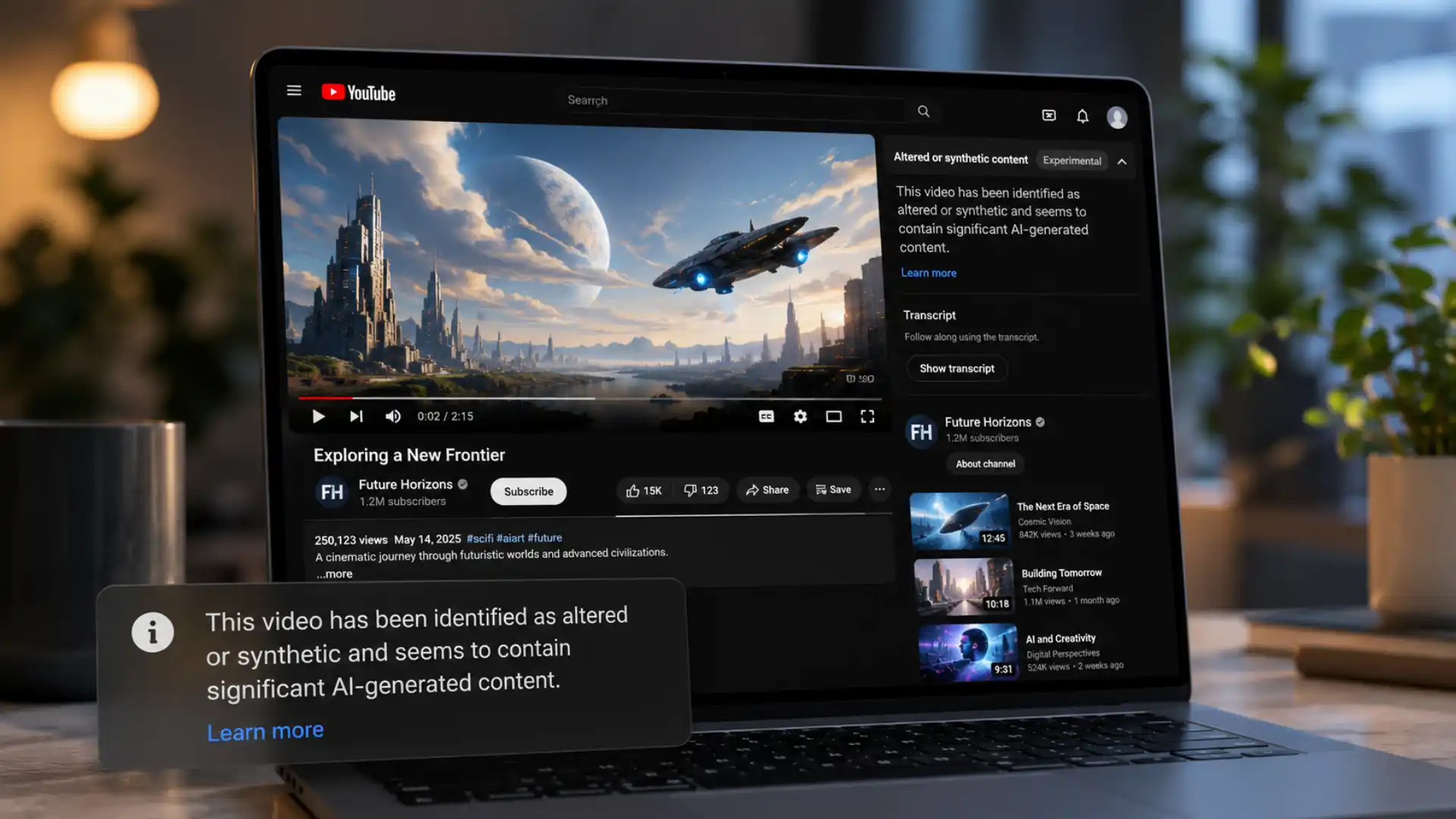
The update creates a simpler public-facing label structure. YouTube says the prominent label is now the single label format for photorealistic and meaningfully AI-altered or AI-generated content on the platform. Long-form videos get the label directly below the player, above the description. Shorts get the label inside the video frame as an overlay. Unrealistic, animated, or lightly altered content may still disclose AI use in the expanded description rather than in the main viewing area.
That distinction matters. YouTube is not trying to label every use of generative AI with equal force. A creator using AI to draft an outline, clean audio, repair footage, generate captions, brainstorm titles, or create an infographic is not in the same policy category as a creator showing a realistic public figure doing something they never did. YouTube’s Help documentation states that creators must disclose AI-generated or meaningfully AI-altered content when it appears realistic and could mislead viewers about whether something actually happened.
The visible label is focused on photorealistic content because realism is the risk multiplier. A cartoon dragon, a surreal animation, or a fantasy world created with AI may still be synthetic, but it does not ask the viewer to confuse fabrication with footage. A realistic tornado over a real city, a fabricated arrest, an AI-generated speech by a public figure, or extra footage of a real location can create a different problem. The issue is not the presence of AI. The issue is whether the video borrows the authority of recorded reality.
YouTube’s examples show the policy boundary. Creators need to disclose content that makes a real person appear to say or do something they did not do, alters footage of a real event or place, or generates a realistic scene that did not happen. The Help Center lists examples such as making someone appear to give advice they never gave, showing hospital workers turning away patients when that did not happen, or depicting a public figure stealing something they did not steal.
The new placement is also tailored to format. Long-form video has space below the player, where viewers already expect title, channel, engagement controls, and context. Shorts does not. Shorts is built around full-screen vertical consumption, fast swipes, overlays, captions, sounds, and minimal description reading. A disclosure locked inside a description is especially weak in that format. For Shorts, the label has to live inside the viewing surface or it may as well not exist for many users.
That is why the update is more than a new badge. It is a recognition that disclosure design must match user behavior. A label cannot protect trust if it sits in a part of the interface most viewers never open.
YouTube’s AI label placement at a glance
| Video type | New visible label placement | Lower-visibility disclosure remains for | Core policy purpose |
|---|---|---|---|
| Long-form video | Directly below the player, above the description | Unrealistic, animated, or slightly altered content | Give context before viewers rely on the video as realistic evidence |
| Shorts | Overlay on the video itself | Lower-risk disclosures in expanded details | Make disclosure visible in fast, full-screen viewing |
| Content made with YouTube AI tools | Automatic and permanent label in relevant cases | Not removable by creator | Carry provenance from platform tools into the viewing experience |
| Fully AI-generated content with C2PA metadata | Automatic and permanent label in relevant cases | Not adjustable by creator | Preserve machine-readable provenance through publication |
This table condenses the policy mechanics. The bigger point is that YouTube is separating where a disclosure appears from why it exists: high-realism synthetic media moves into the main viewer interface, while lower-risk uses can remain in supporting context.
Automatic detection changes the power balance
The most consequential part of the update is not the label’s design. It is YouTube’s decision to apply labels automatically in some cases. The company says it is rolling out new internal signals in May 2026 to help identify AI-generated content. If a creator does not say whether AI was used and YouTube detects substantial photorealistic AI use, it will apply a label.
That changes the power balance between creators and the platform. Under a purely self-disclosure system, the creator is the first and often only witness to the production process. YouTube can enforce after reports, review, or obvious evidence, but the upload workflow starts from what the creator says. Automatic detection makes disclosure partly platform-driven. The creator’s answer still matters, but it is no longer the whole record.
For honest creators, this may be useful. Many AI workflows are mixed. A creator may shoot original footage, use AI to extend a background, generate a single establishing shot, clone their own voice for a correction, or use image-to-video tools for a reenactment. Not every case is obvious. If YouTube’s detection can catch clear cases where creators forgot or misunderstood the rule, it may reduce uncertainty. The platform also says creators can update the disclosure status in YouTube Studio if they think their content was incorrectly identified, except in specific permanent-label cases.
For evasive creators, the update is a warning. A channel that relies on undisclosed synthetic realism can no longer assume the upload form is the only gate. YouTube is signaling that it will use internal systems, Content Credentials, and other markers to decide when the viewer needs notice. The exact detection method is not fully public, and it would be risky for YouTube to publish too much detail, because adversarial uploaders would test around it.
The danger is overreach. Synthetic media detection is probabilistic, not magic. A polished CGI scene, heavy color grading, smartphone computational photography, beauty filters, video denoising, frame interpolation, AI upscaling, virtual production, and camera-generated provenance all complicate the boundary. A false label can damage a creator’s reputation, especially for documentary, journalism, legal, educational, or professional footage. An automatic label can feel like a public accusation even when YouTube frames it as context.
That is why the correction process matters. YouTube says creators can update the disclosure status in most error cases, but not when content was made with YouTube’s own AI tools, includes C2PA metadata indicating full AI generation, or was labeled after manual review. The platform is dividing labels into two types: labels that may be disputed because they came from detection, and labels that are treated as provenance-backed or reviewed.
The result is a hybrid governance model. Self-disclosure remains the first layer. Automated detection adds a second. Metadata and platform-native AI tools add a third. Manual review remains a backstop. That layered model is not perfect, but it reflects the reality of synthetic media: no single method is reliable enough alone.
Creator disclosure remains the first layer
YouTube still requires creators to disclose realistic AI use. The automatic label system does not replace the upload responsibility. The Help Center says creators must disclose GenAI content that makes a real person appear to say or do something they did not do, alters footage of a real event or place, or generates a realistic scene that did not occur.
That is an important policy choice. If YouTube had moved straight to detection-only labeling, creators could treat transparency as the platform’s problem. Instead, YouTube is preserving the principle that the person publishing the video has a duty to describe the production honestly. The platform can detect some things, but it cannot know intent, context, source material, consent, or editorial method in every case.
Disclosure also works better at the point of upload than after publication. A creator who answers the AI-use question while uploading is closer to the production facts. They know whether a public figure’s voice was cloned, whether a real location was generated, whether an event scene was simulated, whether archival footage was altered, or whether a video segment was created from a prompt. That knowledge is often not visible to an outside detector.
The problem is that creators do not share one definition of “realistic.” A travel creator may think an AI-generated aerial shot of a real coastline is harmless because the place exists. A commentary channel may think an AI voiceover is obvious because its audience knows the format. A true-crime channel may generate reenactments and assume the word “reenactment” in the script is enough. A finance channel may use an AI avatar and claim the information, not the presenter, is the substance. YouTube’s policy has to turn those messy practices into yes-or-no upload decisions.
The Help Center gives examples of what does not need disclosure: beauty filters, color adjustment, special effects filters, idea generation, caption creation, video sharpening, repair, and production assistance such as scripts or thumbnails. It also states that cloning one’s own voice to create voiceovers or dubs does not need disclosure under that list. That carveout will matter for creators who use AI as a production assistant rather than a synthetic evidence generator.
Still, the presence of exceptions can create confusion. If a creator uses AI to generate a script, no disclosure. If AI generates a realistic video of a real tennis match that never happened, disclosure. If AI repairs audio, no disclosure. If AI makes a real person appear to give advice they never gave, disclosure. The rule is not “AI equals label.” The rule is closer to realistic synthetic media that changes the viewer’s understanding of who, where, or what happened equals disclosure.
That sentence may be clearer than many platform help pages. It is also hard to apply at scale. YouTube’s automatic system is partly a response to that difficulty.
The label is not a penalty, but it is a signal
YouTube says a disclosure label alone does not change whether a video is recommended or eligible to earn money. That sentence is doing a lot of work. Creators worry that any visible platform label can reduce reach, harm click-through, or scare advertisers. YouTube is trying to separate transparency from punishment.
The distinction is necessary. If every AI disclosure were treated as a penalty, creators would have a strong incentive to hide AI use. That would defeat the policy. A disclosure system needs honest creators to feel safe using it. If the label becomes an automatic economic downgrade, self-disclosure becomes self-harm.
Yet the label still affects the social meaning of a video. A cooking tutorial made with an AI-generated host may feel different to viewers once labeled. A political clip may lose credibility if viewers learn the scene was fabricated. An educational channel may face questions about what was researched, what was generated, and what was checked. A brand campaign may have to defend its use of synthetic people or places. Platform-neutral does not mean audience-neutral.
This is why the language of the label matters. YouTube’s updated label is simpler and more visible, and reports indicate it uses a clear “AI” marker next to an information symbol. The Verge described the new labels as more prominent and noted that they now explicitly say “AI.” That may sound small, but label language shapes interpretation. “Altered or synthetic content” is accurate but abstract. “AI” is shorter and more quickly understood, though it can also carry stigma.
Research on AI labels suggests that labels do not always change behavior in predictable ways. A 2025 PNAS Nexus study found that labels on AI-generated media decreased belief in presented claims, but a simple “AI-generated” label had little impact on stated willingness to engage with posts. Another study on warning label designs found that labels affected whether users believed content was AI-generated, but trust varied depending on design, and engagement behavior did not change uniformly.
For YouTube, that means the label is not a complete answer. It gives viewers context. It may reduce some false beliefs. It may not stop people from watching, sharing, liking, or arguing. In some genres, the label may become part of the entertainment. In political or health content, it may become a credibility warning. In art and education, it may become a production credit.
The real effect will depend on repeated exposure. If users start seeing labels on low-risk creative work, the marker may become normal. If they mostly see it on manipulative clips, the marker may become a warning sign. YouTube’s challenge is to make the label informative without turning it into a blunt scarlet letter for any creator who uses AI responsibly.
Photorealism becomes the policy boundary
The word doing the hardest work in YouTube’s policy is “photorealistic.” YouTube’s update applies the most prominent label to photorealistic and meaningfully AI-altered or AI-generated content. That makes sense because the main risk is not synthetic media itself. It is synthetic media that passes as camera evidence.
Video has long carried a presumption of witness. Viewers know movies are staged, commercials are crafted, and animations are invented. But a realistic phone video, street scene, interview clip, news-style package, courtroom-like clip, surveillance-style shot, or first-person Short can feel evidentiary even when it is generated. AI video tools attack that assumption. They make fabricated scenes look less like fiction and more like captured reality.
Photorealism is still a fuzzy boundary. A video can be realistic in one part and artificial in another. A creator may use real footage with AI-generated cutaways. A synthetic person may appear in a clearly fictional skit. A real person’s voice may be cloned for translation with consent. A documentary may recreate a historical event with labeled AI visuals. A scammer may use a low-quality fake that is not fully photorealistic but still persuasive to many viewers. The policy cannot escape judgment calls.
YouTube’s examples help by focusing on effect. Does the content make a real person appear to say or do something they did not do? Does it alter footage of a real event or place? Does it generate a realistic scene that never occurred? Those questions connect technical production to viewer interpretation.
The challenge is that synthetic realism is moving fast. Google’s own AI video work, including Veo, sits inside the same company ecosystem as YouTube. YouTube CEO Neal Mohan said in his 2026 letter that more than 1 million channels used YouTube’s AI creation tools daily in December, while also acknowledging that it is becoming harder to detect what is real and what is AI-generated. The platform is both encouraging AI creation and building guardrails around synthetic realism.
That tension is not hypocrisy by itself. Media platforms have always supported editing tools while policing deception. Photoshop did not make every image fraudulent, but it forced institutions to develop standards around manipulation. CGI did not make every film misleading, but it changed audience expectations. AI video is different because the cost of realistic fabrication drops and the speed of distribution rises. The easier it becomes to create plausible reality, the more visible provenance has to become.
Photorealism is the best boundary YouTube has, but it will not be stable. The next policy fights will come from the edge cases: synthetic reenactments, AI hosts, cloned voices, altered archival footage, historical education, parody, satire, virtual influencers, translation dubbing, and computational camera output that alters reality at capture.
Shorts needed a different disclosure design
Shorts are not just shorter YouTube videos. They are a different interface, a different attention pattern, and a different disclosure problem. A long-form viewer may read a title, glance at a description, check comments, or notice channel context. A Shorts viewer often swipes through a sequence of full-screen clips, making judgments in seconds. That environment rewards immediacy, not inspection.
YouTube’s decision to put the AI label as an overlay on Shorts recognizes that format reality. A disclosure in the expanded description would be nearly invisible to many Shorts viewers. The label has to appear where the claim is made: on the video surface.
This is especially relevant because short-form video is a natural home for synthetic media. A realistic fake does not need to hold up for ten minutes. It only needs to trigger attention, anger, amazement, fear, attraction, or curiosity for a few seconds. A fake celebrity encounter, a fictional disaster clip, an AI animal rescue, a synthetic historical scene, or a bogus “caught on camera” moment can perform well precisely because it is brief. The shorter the clip, the less time viewers have to notice inconsistencies.
The Kapwing AI Slop Report offers one snapshot of the problem. Kapwing created a new YouTube account and reviewed the first 500 Shorts it encountered, reporting that 104, or 21%, were AI-generated and 165, or 33%, were “brainrot” videos by its classification. Kapwing’s method is not a platform audit, but it captures a real concern: synthetic and low-effort content can be highly visible in feeds built for rapid consumption.
Shorts also compress context. In long-form, a creator can explain that a scene is a reenactment. They can include sources, chapter labels, disclaimers, or behind-the-scenes footage. In Shorts, a caption may be the only context, and captions are often used for hooks rather than clarification. A visible AI overlay is one of the few signals that travels with the video as the viewer swipes.
The risk is clutter. Shorts already carry captions, stickers, sound labels, channel badges, engagement buttons, shopping links, and interface controls. A label must be visible without blocking the video or becoming visual noise. If it is too subtle, it fails. If it is too intrusive, creators will complain that it harms the viewing experience. That design tension is unavoidable.
Still, YouTube had little choice. A disclosure regime built for desktop descriptions cannot govern a full-screen swipe feed. The label had to move into the frame because the frame is the product.
The limits of voluntary disclosure
Voluntary disclosure works when creators understand the rule, accept the rule, and face enough reputational pressure to follow it. It fails when creators are confused, indifferent, financially motivated to hide AI use, or operating at automated scale. YouTube’s move toward automatic labels is an admission that self-reporting alone cannot handle synthetic media at platform scale.
The original 2024 disclosure tool was a necessary first step. YouTube introduced a Creator Studio workflow requiring creators to disclose realistic altered or synthetic content, including AI-generated media. At the time, the platform said it would not require disclosure for clearly unrealistic content, animation, special effects, or AI used for production assistance. That was a sensible starting point: define the category, give creators a workflow, and begin labeling.
But two years later, the economics of synthetic video have become more aggressive. AI tools can support research, scripting, editing, thumbnails, translation, voice work, music, image generation, and video generation. A creator can now produce large volumes of content without filming much, hiring actors, licensing footage, or building sets. Many of those uses are legitimate. Some are spam-like. Some are deceptive. Some sit in the middle.
A platform cannot rely on creator ethics when the incentives reward speed, volume, and emotional manipulation. Cheap synthetic content can be produced faster than human review can inspect it. A channel can test formats, duplicate scripts, localize voiceovers, generate fictional scenes, and publish across languages. The label system has to account for creators who treat disclosure as a conversion-rate problem.
YouTube’s Help Center warns that creators who consistently choose not to disclose required information may face manual labels or penalties, including content removal or suspension from the YouTube Partner Program. That enforcement language gives the disclosure rule teeth. Automatic labels add detection pressure. Together, they reduce the gap between policy and practice.
Still, enforcement will be uneven. Many AI uses leave no durable watermark. Some generators will not use Content Credentials. Uploaders can screen-record, transcode, crop, overlay, re-edit, or route content through tools that strip metadata. Detection systems may catch some patterns and miss others. Human reviewers may see context that automated systems miss, but they cannot review every upload before viewers see it.
That means YouTube’s policy should be judged as risk reduction, not perfect verification. It will catch some undisclosed synthetic realism. It will normalize disclosure. It will make some scams less frictionless. It will not make every video trustworthy. A label is a warning light, not a truth certificate.
C2PA and SynthID move provenance into the upload chain
YouTube’s policy sits inside a larger shift toward media provenance. Two technologies matter here: C2PA Content Credentials and Google’s SynthID. They solve different parts of the problem.
C2PA, the Coalition for Content Provenance and Authenticity, develops technical standards for certifying the source and history of digital media. The C2PA specification is meant to record provenance data such as creation, edits, assertions, and signatures in a form that software can inspect. Content Credentials, built around the C2PA standard, give viewers and platforms a way to see information about how content was made and edited.
SynthID is Google DeepMind’s watermarking system for identifying AI-generated content. Google says SynthID embeds digital watermarks directly into AI-generated images, audio, text, or video; those watermarks are imperceptible to humans but detectable by SynthID technology. Google has also been expanding verification through products such as Gemini, Search, Chrome, Lens, AI Mode, and Circle to Search, while adding C2PA verification and broader detection capabilities.
The difference is useful. C2PA is provenance metadata: it can say something about the content’s origin and editing history, if preserved. SynthID is an embedded watermark: it can survive some transformations and help identify content generated by supported AI tools. Neither is enough alone. Metadata can be stripped. Watermarks can be degraded. Detection can produce uncertainty. But together, they give platforms more signals than visual inspection alone.
YouTube’s Help Center says it may automatically apply an AI label for content made using YouTube’s GenAI tools, content containing C2PA metadata, or content that internal systems detect as AI-generated or altered. It also says creators generally can correct errors, except for content made with YouTube’s AI tools, content containing C2PA metadata, or content labeled after manual review.
That creates a hierarchy of confidence. A detected pattern may be disputable. A tool-native signal or provenance credential may be treated as stronger evidence. A manual review may be treated as a final platform decision. The upload chain is becoming part of the evidence chain.
For creators, this means the tools they use can determine the labels their videos carry. A video generated inside YouTube’s own AI tools may bring its label with it. A file exported with C2PA metadata showing full AI generation may be labeled even if the creator does not answer the upload question. A video assembled from multiple tools may carry partial signals or none at all.
For platforms, provenance also creates coordination pressure. YouTube cannot solve synthetic media alone because videos travel across apps, downloaders, editors, messaging services, and repost networks. A C2PA credential or watermark is more useful when many tools preserve and read it. That is why industry standards matter. Without interoperable provenance, each platform becomes an island with its own labels and blind spots.
Detection systems will face the messy middle
Automatic AI detection works best at the extremes. A fully generated video from a known tool, with intact metadata or watermarking, is a cleaner case. A human-shot vlog with no synthetic realism is also a cleaner case. The messy middle is where the hardest disputes will happen.
Consider a documentary creator who uses AI to colorize archival footage. Does that require a prominent label? YouTube’s rules suggest minor aesthetic edits do not require disclosure, but meaningful alterations to real events or places may. The answer depends on whether the edit changes the viewer’s understanding of the event. A colorized clip that does not add false action may be low risk. A fabricated crowd or altered battlefield scene is different.
Consider a travel channel that uses AI to generate “extra footage” of a real place. YouTube specifically lists AI-generated extra footage of a real place, such as a surfer in Maui for a promotional travel video, as content creators need to disclose. The reason is clear: the viewer may treat the scene as real evidence of the destination.
Consider a creator who clones their own voice to fix narration. YouTube’s Help Center lists cloning one’s own voice to create voiceovers or dubs among examples that do not need disclosure. Yet cloned voice becomes riskier when the voice belongs to someone else, when consent is unclear, or when the audio makes a person appear to say something they did not say.
Consider a virtual influencer channel. The persona is synthetic, but the audience may know the format. If the content is clearly fictional, the risk is lower. If the same techniques are used to impersonate a real creator, journalist, politician, doctor, or celebrity, the risk rises sharply. The same tool can produce entertainment or deception depending on context.
Automatic systems struggle with context. They can inspect pixels, audio patterns, metadata, watermarks, upload histories, creator behavior, and tool traces. They cannot always know whether viewers are likely to be misled, whether a scene is parody, whether consent exists, whether a video is educational, or whether a disclosure appears verbally in the video. That is why creator correction and manual review are not optional details. They are the pressure valves in the system.
NIST’s synthetic content report cautions that digital content transparency can support trust but does not guarantee it. It can even create false trust when technical measures appear legitimate while content is manipulated through non-technical means, such as taking real footage out of context. That warning applies directly to YouTube. A video can be real and misleading. A video can be AI-generated and honest. A label can help without resolving the whole credibility question.
The messy middle will define whether creators trust the policy. If YouTube labels obvious deepfakes and clear synthetic realism, the system will feel justified. If it labels legitimate edits inconsistently or misses viral fakes, the label may become another source of conflict between creators and the platform.
False positives and appeals matter for creator trust
A false positive is not a minor inconvenience when the label appears in the viewing interface. It can shape audience perception, advertiser confidence, and creator reputation. If a channel publishes original footage from a protest, disaster, trial, war zone, medical setting, or financial event and receives an incorrect AI label, the damage may be immediate. Viewers may assume deception before reading any correction.
YouTube says creators can update the disclosure status in YouTube Studio in most cases when systems make an error. The exceptions are important: content made with YouTube’s AI tools, content containing C2PA metadata, and content labeled after manual review cannot be adjusted in the same way.
The platform will need a clear creator experience around this process. A hidden toggle is not enough. Creators need to know why a label appeared, whether it came from detection, metadata, platform-native AI tools, or review. They need an audit trail: what content segment was flagged, what signal category triggered the label, and what evidence can be submitted. The more visible the public label, the more transparent the private dispute system needs to be.
The correction timeline matters too. A false label corrected after a week may not undo the harm to a news video whose relevance peaked within hours. Shorts move even faster. A mislabeled Short can collect most of its views before a creator has time to challenge the decision. Speed is not an administrative detail; it is part of fairness.
YouTube also has to guard against abuse of the appeal pathway. If every creator can remove a detection-based label with a single click, bad actors will do exactly that. If the platform makes appeals too difficult, honest creators will feel trapped. The policy must distinguish between good-faith correction and systematic evasion.
Creators should prepare for this environment by keeping production records. That may sound tedious, but it is becoming practical risk management. Save source files, project files, prompts, tool exports, licenses, consent records, behind-the-scenes footage, camera originals, and editing notes when publishing realistic content on sensitive topics. A creator who can prove what was filmed, generated, licensed, or reconstructed is in a stronger position if an AI label appears incorrectly.
This is especially true for journalists, documentary producers, educators, and brands. As labels become more visible, provenance documentation becomes part of publishing discipline. The old standard was “keep your receipts” for copyright and claims. The new standard is also “keep your production trail.”
Permanent labels carry a different kind of weight
YouTube’s permanent-label categories deserve close attention. The company says disclosures will remain permanent for content created using YouTube’s own AI tools, such as Veo or Dream Screen, and content containing C2PA metadata indicating it was fully generative AI.
Permanent labels are not just labels. They are provenance commitments. YouTube is saying that when a strong production signal exists, the creator cannot later recast the content as non-AI for viewer-facing purposes. That is defensible. If the content was created by a YouTube AI tool, YouTube knows the production origin. If the file contains Content Credentials indicating full AI generation, the platform can carry that disclosure forward.
But permanent labels also raise practical questions. What happens when a video includes a fully AI-generated segment inside a mostly human-shot work? What if a creator exports from a tool that marks the entire file as AI-generated even though only a minor part was synthetic? What if C2PA metadata is wrong, stale, or inherited through a stock asset? What if a tool adds broad metadata to be safe? The policy language points to content indicating it was fully generative AI, but real editing pipelines can be messy.
Permanent labeling will also shape tool choice. Some creators may avoid tools that preserve provenance if they fear labels. Others may prefer provenance-preserving tools because they want credibility and clear disclosure. Brands may require vendors to preserve C2PA credentials for compliance. Newsrooms may preserve capture credentials for authenticity but label generated segments separately.
There is an uncomfortable incentive problem here. A platform that respects provenance may appear to label more AI content than a platform that cannot read the signals. A creator using responsible tools may be more visibly labeled than a creator using tools that strip metadata. That is a known problem in content authenticity: the honest actors are easier to identify than the deceptive ones.
The answer cannot be to abandon provenance. It has to be to make provenance normal, interoperable, and precise. A label that says “AI” may be too blunt for some use cases. Viewers may eventually need richer explanations: AI-generated scene, AI-altered audio, AI-assisted translation, synthetic reenactment, camera-captured original, edited with named tools, or full AI generation. YouTube’s simplified public label is useful now, but the future may require layered detail.
Permanent labels are strongest when they are both accurate and explainable. If they feel arbitrary, creators will route around them. If they feel credible, they can become part of professional publishing norms.
Monetization is separate, but commercial incentives are not
YouTube says an AI disclosure label alone does not affect recommendations or monetization eligibility. That reassurance is necessary, but it does not mean AI labeling is commercially neutral. Viewer trust, advertiser comfort, sponsor contracts, affiliate conversions, and audience loyalty can all be affected by the visible presence of an AI marker.
A creator using AI for fiction, music visuals, satire, animation, or educational reenactments may find the label acceptable or even beneficial. The audience may appreciate disclosure. A creator using synthetic realism to imply real access, real events, or real testimony may see the label undercut the hook. The same label that protects viewers can reduce the commercial value of deception.
YouTube’s monetization rules already separate originality from mere production method. In July 2025, YouTube updated its channel monetization policies to clarify that repetitive or mass-produced content falls under “inauthentic content” and remains ineligible for monetization under existing rules that reward original and authentic content. That policy is not a ban on AI, but it targets a production pattern that AI makes easier: high-volume, low-originality publishing.
The platform therefore has two overlapping systems. The AI label system tells viewers that realistic content was generated or altered with AI. The monetization policy asks whether the channel’s content is original and authentic enough to earn revenue. A labeled AI video can still be monetized. An unlabeled human-made video can still be ineligible if it is repetitive, reused, or spam-like. But in practice, AI-generated mass production often sits near both systems.
This is the creator economy problem underneath the policy. Generative tools reduce production costs. Platform incentives reward attention. Channels that can manufacture emotionally charged synthetic content at scale may crowd feeds, dilute trust, and compete with human creators who invest in reporting, filming, editing, research, or performance. Labels address transparency, not supply.
Advertisers will watch the distinction carefully. A brand may be comfortable advertising next to AI-assisted animation but not next to synthetic political rage bait. A sponsor may ask a creator whether AI-generated footage appears in a brand integration. Agencies may need disclosure clauses in contracts. Media buyers may ask YouTube for controls around synthetic content categories. The label may not change monetization by policy, but it will feed commercial judgment.
For creators, the safe strategy is not “avoid AI.” It is to build content that remains valuable even when AI use is visible. If the video depends on viewers being fooled, the label is a threat. If the video depends on story, expertise, artistry, reporting, instruction, performance, or analysis, the label is just context.
AI slop pushed platforms toward operational rules
The phrase “AI slop” is crude, but the problem it names is real: low-quality, high-volume synthetic content built to harvest attention. YouTube’s CEO addressed the concern directly in his 2026 letter, saying the rise of AI had raised concerns about low-quality content while positioning YouTube as an open platform that still tries to keep the service a place people feel good spending time.
AI slop is not defined only by whether AI was used. A thoughtful AI-assisted documentary is not slop. A human-made spam compilation can be slop. The pattern is volume without care, novelty without substance, and emotional manipulation without accountability. AI makes that pattern cheaper and faster.
Kapwing’s research gives one view of scale. Its report said 21% of the first 500 Shorts in a new-user feed were AI-generated and 33% were “brainrot” by its classification. It also identified trending AI slop channels in many countries and reported large view and subscriber totals for some channels. The methodology is not the same as an independent academic audit, but the findings line up with what many users and creators have noticed: AI-generated feed filler has become visible enough to affect the platform’s culture.
TechCrunch reported in July 2025 that YouTube was preparing to update monetization guidance around mass-produced and repetitive videos as concern about AI slop grew, while YouTube framed the change as a clarification of long-standing Partner Program rules. That context matters for the 2026 label update. YouTube is not making one isolated move. It is building a set of operational responses: monetization rules for inauthentic volume, disclosure rules for realistic synthetic media, automatic labels for undisclosed AI, and likeness tools for impersonation risk.
The labels will not remove AI slop from the platform. Many low-quality AI videos are not photorealistic in the policy sense. Some are surreal animations, fake animal rescues, recycled story formats, AI voiceover explainers, or templated history clips. They may be annoying or low-value without needing a prominent AI realism label. That is where monetization, recommendations, spam enforcement, and quality signals matter more than disclosure alone.
Still, visible labels can make one class of slop less effective: fake reality. A fabricated celebrity confrontation, fake disaster clip, synthetic news-style report, or AI-generated public figure scene loses some power when the viewer sees “AI” before believing the moment. The label does not solve low-quality automation, but it weakens synthetic realism as a deception strategy.
News, elections, health, and finance remain higher stakes
YouTube’s 2024 rollout treated sensitive topics differently. For most disclosed videos, labels appeared in the expanded description, but YouTube said videos touching on health, news, elections, or finance could receive a more prominent label on the video itself. The 2026 update broadens prominent labeling for photorealistic and meaningfully AI-altered or generated content, but the sensitive-topic logic still matters.
Some subjects carry higher social risk because viewers may act on them. A synthetic video about a fictional dragon is unlikely to change medical decisions, voting behavior, financial choices, or public safety responses. A synthetic video of a candidate admitting to a crime, a hospital refusing patients, a bank executive announcing insolvency, or a fabricated war scene can cause harm quickly.
YouTube’s elections misinformation policy already prohibits certain misleading or deceptive content with serious risk of egregious harm, including some technically manipulated content and content that interferes with democratic processes. That policy is separate from AI disclosure. A video can be labeled and still violate policy. A video can be unlabeled and still violate policy. Labels inform; moderation removes or restricts.
This distinction is crucial for public-interest content. A newsroom may use AI-generated reenactments to explain events, but it needs clear labeling, editorial review, and source transparency. A health educator may use synthetic visuals to illustrate anatomy, but should not fabricate clinical scenes that imply real patients or doctors did something they did not do. A finance creator may use AI visuals for education, but synthetic claims about market events can move audiences into risky decisions.
The sensitive-topic problem is also temporal. A synthetic election clip released days before voting is different from a clearly labeled historical reenactment months later. A fake bank run clip during market stress is different from a satire video after the fact. Platform rules need to account for timing, context, likelihood of confusion, and potential harm.
YouTube cannot rely on labels alone in these areas. When synthetic media crosses into impersonation, fraud, voter suppression, medical misinformation, market manipulation, or incitement, a visible marker may be too weak. Removal, reduced distribution, demonetization, age restriction, source panels, fact-checking, or law enforcement referrals may be needed depending on the case.
Still, the label is a first line of defense. It helps viewers pause before treating a realistic scene as evidence. On high-stakes topics, that pause can matter.
Labels are not the same as moderation
A common misunderstanding is that labels are a softer form of removal. They are not. A label says, “This content was made or altered in a way you should know about.” Moderation says, “This content breaks a rule.” Confusing the two creates bad policy and bad expectations.
YouTube’s Help materials state that Community Guidelines apply to all content, including AI-generated or AI-altered content. That means AI does not create a separate permission zone. A scam is still a scam. Harassment is still harassment. Election misinformation is still election misinformation. Non-consensual intimate imagery is still prohibited. A disclosure label does not sanitize harmful content.
The value of labeling is greatest for lawful or allowed content that still needs context. Synthetic reenactments, fictionalized visuals, AI-generated music, virtual production, creative experiments, educational simulations, and altered scenes may all be allowed. The viewer still deserves to know when realism is manufactured. Labeling supports informed interpretation without banning expression.
This is especially important for satire and art. A synthetic parody of a public figure may be protected or allowed depending on context, but viewers may still benefit from knowing it is AI-generated. A dramatic reconstruction in a documentary may be responsible if labeled and sourced. A historical visualization may be useful if it does not pretend to be archival footage. The label creates room for creative synthetic media without giving deception a free pass.
Moderation has a different burden. It asks whether the content violates a rule, creates harm, infringes rights, deceives users, or abuses the platform. That process requires more context and can have stronger consequences. Labels are lower-friction and broader. They can appear on content that remains fully available.
The risk is label laundering. A bad actor may disclose AI use and assume the video becomes acceptable. That should not happen. A fabricated video of a politician giving false emergency instructions is not made safe by an AI label. A synthetic celebrity investment scam is not made acceptable by a disclosure. A fake doctor recommending dangerous treatment remains dangerous even if labeled.
YouTube has to communicate that hierarchy clearly. Disclosure is required when realistic AI is used. Compliance with disclosure does not guarantee compliance with all policies. Creators need both checks: “Do I need to disclose?” and “Is this content allowed at all?”
Viewers need a signal at the point of belief
The phrase “point of belief” is a useful way to understand the update. A viewer forms an impression when the video first appears credible. In visual media, that happens quickly. The eye sees a person, a place, a disaster, a speech, a confrontation, a chart, a police scene, a hospital, a street protest, or a studio set and starts assigning reality. If the disclosure arrives only after expansion, search, or skepticism, it arrives late.
YouTube’s new placement moves the signal closer to that first belief moment. For long-form videos, the label below the player appears in the main context area. For Shorts, the overlay appears inside the viewing surface. This is not perfect. A viewer can still miss it. Some viewers will ignore it. Some will misunderstand it. But it is a stronger design than asking viewers to inspect metadata.
Research on labeling suggests placement, wording, and detail affect trust. The PNAS Nexus study distinguished process-based labels that explain how content was made from harm-based labels that warn about potential deception, finding that different label language can shape audience inferences. A separate user-perception study found that trust in AI labels varies with design choices.
YouTube’s simplified “AI” marker prioritizes speed. That fits the platform. The tradeoff is precision. “AI” can mean many things: generated video, altered face, cloned voice, synthetic background, AI music, AI translation, AI-assisted edit, or full synthetic production. The expanded “How this content was made” section can hold more detail, but the visible label itself is broad.
For viewers, the right interpretation is not “AI means false.” It is “AI means check context.” The label should prompt questions: Is this a fictional scene? Is it a reenactment? Is a real person being simulated? Is the channel transparent? Are sources provided? Is the content making a factual claim? Is the video asking me to believe, buy, vote, donate, panic, or shame someone?
The label’s best use is as a friction point. It slows automatic acceptance. That is especially valuable in short-form video, where the feed is designed to remove friction. A small visible interruption can restore a bit of judgment.
The danger is fatigue. If AI labels become common across harmless content, viewers may stop noticing them. If labels are too rare, viewers may overtrust unlabeled content. That is a hard balance. YouTube’s move toward automatic detection is partly a way to reduce the second problem, but the first will remain.
Creators need a disclosure workflow, not guesswork
Creators should treat the update as a production workflow issue, not just an upload checkbox. The question is no longer “Will YouTube catch this?” The better question is “Would a reasonable viewer need to know that this realistic element was generated or meaningfully altered by AI?”
A practical creator workflow should start before publishing. Identify every part of the video that uses AI: script assistance, voice, music, images, video clips, scene extension, face alteration, background generation, translation, captions, thumbnails, and repair. Then separate low-risk production assistance from realistic synthetic media. YouTube’s Help Center gives examples of both categories.
If AI changes the evidence value of the video, disclose. If AI makes a real person appear to say or do something they did not, disclose and consider whether the content is allowed at all. If AI creates a realistic scene of a real place or event, disclose. If AI is used for captions, idea generation, audio cleanup, sharpening, or a thumbnail concept, disclosure may not be required under YouTube’s examples, though creators may still disclose voluntarily for audience trust.
Creators working in sensitive subjects should be stricter than the minimum. News, elections, health, finance, crime, disasters, war, public safety, legal matters, and allegations against real people deserve extra caution. A channel that publishes synthetic reenactments in these areas should label within the video, not only rely on YouTube’s UI. The more serious the subject, the more the creator should explain production methods.
A good workflow also includes documentation. Keep original footage. Keep tool names. Keep export files. Keep licenses for AI-generated music or stock. Keep consent records for voice or likeness. Keep prompts when they matter to factual claims. Keep notes explaining which scenes are generated. This is not only for YouTube disputes. It protects creators when audiences, sponsors, platforms, regulators, or subjects ask questions.
For teams, create a review step before upload. Ask: Does this appear real? Could viewers mistake it for a real person, place, scene, or event? Does the AI element affect a factual claim? Does it involve likeness, voice, minors, medical advice, financial advice, public figures, or elections? Does it need on-screen disclosure beyond YouTube’s label?
The creators who adapt best will not be the ones who avoid AI entirely. They will be the ones who build clear production ethics around AI and can explain them without defensiveness.
Brands and agencies now inherit platform risk
Brands often think of AI video as a cost and speed tool. YouTube’s update adds another dimension: visible disclosure risk. If a brand publishes or sponsors realistic AI-generated content, the label may appear directly under the video or on the Short. That can be fine, but it should not be a surprise after launch.
Agencies need to brief clients on platform labeling before production. A campaign that uses AI-generated people, realistic product scenarios, synthetic locations, fake testimonials, virtual spokespeople, or AI-generated event footage may require disclosure. A campaign that uses AI for storyboards, editing assistance, captions, or background cleanup may not. The distinction must be made during concept approval, not after upload.
This is also a contracts issue. Creator sponsorship agreements should address AI use. Brands may require creators to disclose synthetic elements, avoid simulating real endorsements without permission, preserve provenance, and comply with YouTube’s AI disclosure rules. Creators may require brands to state whether supplied assets were generated or altered with AI. Agencies may require production vendors to pass through C2PA metadata or provide tool records.
A visible AI label can affect ad performance. In some categories, it may signal modern production. In others, it may reduce trust. A synthetic “customer testimonial” is risky because viewers may wonder whether the customer exists. A synthetic product demonstration is risky if it exaggerates performance. A synthetic travel scene is risky if it misrepresents a location. A synthetic financial or health scenario is riskier still.
Regulators may also care. The FTC has already warned about AI-enabled impersonation and proposed protections around impersonation of individuals, noting that AI-generated deepfakes can expand fraud. Even when a YouTube label satisfies platform expectations, advertising law, consumer protection rules, right-of-publicity law, and sector rules may impose separate obligations.
For brands, the safest principle is simple: do not use AI realism to fake evidence. Use AI to visualize, dramatize, prototype, or entertain, but disclose when the content could be read as a real event, real person, real testimonial, real product result, or real location. The more a campaign depends on borrowed reality, the more dangerous synthetic production becomes.
The update also creates an opportunity. Brands that disclose clearly can position themselves as more trustworthy than competitors using synthetic realism quietly. In a market where audiences are growing skeptical of polished video, honesty may become a creative advantage.
Educational and documentary channels face practical choices
Educational and documentary creators will feel the policy in a specific way. AI video can make invisible or historical subjects easier to show: ancient cities, extinct animals, scientific processes, crime timelines, courtroom reconstructions, medical mechanisms, space phenomena, weather events, or inaccessible locations. Used well, synthetic visuals can teach. Used carelessly, they can blur evidence and imagination.
YouTube’s policy does not block this work. It asks creators to disclose when realistic AI-generated or AI-altered content could be mistaken for real people, places, scenes, or events. A historical channel can use AI-generated reenactments, but should make clear they are reconstructions. A science channel can use synthetic visuals, but should distinguish visualization from observation. A true-crime channel can use AI reenactments, but must avoid fabricating evidence or putting words into real people’s mouths without clear context.
The best documentary practice is layered disclosure. Use YouTube’s upload disclosure when required. Add on-screen text for generated scenes. Use narration to explain reconstructions. Provide sources in the description. Keep archival footage visually distinct from synthetic reenactments. Avoid using AI visuals as if they were found footage. This is not only about platform compliance; it is about preserving audience trust.
Educational channels should also consider age and audience. Children and teens may have less ability to distinguish generated scenes from recorded footage, especially in short videos. AI-generated history, science, or news-like content should be labeled plainly. A label in YouTube’s interface helps, but creators teaching younger audiences should not rely only on platform UI.
There is also an accuracy issue. AI-generated visuals can invent details. A model asked to show a medieval street may produce plausible but historically wrong clothing, architecture, tools, or social scenes. A generated medical animation may simplify or misrepresent anatomy. A science visualization may imply a mechanism that is not established. Disclosure tells viewers the scene is synthetic, but it does not verify the content.
That is why educational creators need subject review. AI can visualize, but it cannot be trusted as an evidence source. The creator remains responsible for factual accuracy. A labeled AI reenactment can still be misinformation if the reconstruction is wrong.
The strongest channels will use AI as illustration, not proof. They will state what is known, what is reconstructed, and what is uncertain. That standard is familiar from documentary practice. AI just makes the discipline more urgent.
Music, voice, and likeness rights add another layer
AI video disclosure overlaps with rights issues, especially voice and likeness. YouTube has been building separate tools for this problem. Its likeness detection feature helps eligible creators find videos where their face appears to be altered or generated by AI, review matches, and request removal through the privacy complaint process. The feature requires creators to be over 18 and to complete verification with a government-issued ID and selfie video.
This is different from labeling. A label tells viewers content is AI-generated or altered. Likeness detection gives individuals a way to find and challenge uses of their face. A synthetic video can be labeled and still violate someone’s privacy, publicity, copyright, or consent rights. A deepfake of a real person does not become acceptable just because the interface says “AI.”
Voice is equally sensitive. YouTube’s Help Center says cloning one’s own voice for voiceovers or dubs is listed among examples that do not need disclosure, but using AI to make someone appear to say something they did not say does require disclosure. The consent boundary is central. A creator can use their own voice clone as a workflow tool. Using another person’s voice to fabricate endorsement, advice, confession, or performance raises a different issue.
Music complicates the label story. YouTube’s disclosure examples include AI-generated music among content creators need to disclose. Yet music rights involve composition, recording, voice, style imitation, training data, royalties, and platform licensing. A simple AI label does not answer whether a track infringes rights, imitates an artist, or is eligible for monetization. It only informs viewers that AI generation was part of the content.
The likeness issue is also political. YouTube said in March 2026 that it was expanding a likeness detection pilot to journalists, government officials, and political candidates. That makes sense because impersonation of public figures can create public harm, especially around elections, breaking news, and crises. The same technology that lets a creator experiment with their own image can let a bad actor fabricate a candidate or journalist.
For creators, the rule should be conservative: do not simulate identifiable people without consent unless the use is clearly lawful, clearly contextualized, and carefully labeled. Satire and commentary may have protections, but platform enforcement and audience reaction can still be harsh. For brands, the rule is stricter: do not use synthetic likeness or voice as a shortcut around talent rights.
AI labels are only one part of identity governance. The harder question is control over one’s face, voice, and public presence in a world where synthetic media is cheap.
The policy sits inside Google’s bigger provenance push
YouTube’s update arrived shortly after Google announced broader tools to help users understand how digital content was created and edited. Google said it uses C2PA Content Credentials across a growing number of generative media tools and is adding verification for C2PA Content Credentials to help users check whether content is an unaltered original from a camera or has been modified and by what tools. It also said SynthID verification for image, video, and audio had been used 50 million times globally and was expanding into Search and Chrome.
That timing is not accidental. Google is building a cross-product provenance stack. YouTube labels are the viewer-facing piece inside the video platform. SynthID is the watermarking layer. C2PA is the provenance standard layer. Search, Lens, Gemini, Chrome, and AI Mode become verification surfaces. Cloud detection APIs may serve enterprise workflows. The aim is not one badge. The aim is an ecosystem in which content origin can travel.
The ecosystem approach is necessary because media does not stay where it was created. A video can be generated in one tool, edited in another, posted to YouTube, clipped into Shorts, downloaded, re-uploaded to another platform, embedded in a website, shared in a messaging app, and screenshotted into a meme. Provenance breaks when tools strip metadata or platforms ignore it. Watermarks degrade when content is transformed. Labels disappear when videos are reposted without metadata.
Google’s advantage is scale. It controls major creation tools, distribution surfaces, search products, browser surfaces, and AI models. That allows integration. It also creates trust questions. The same company pushing AI generation is supplying detection, labeling, and verification. Users and regulators may ask whether the system is transparent enough, whether independent researchers can audit it, and whether competitors’ media is treated fairly.
C2PA helps address some of that concern because it is an industry standard rather than a purely Google-owned signal. Content Credentials involve a broad coalition, including major technology, media, and camera companies. SynthID remains Google’s watermarking system, though Google has been expanding partnerships and tools around it.
YouTube’s labels will work best if they do not become a closed black box. Viewers do not need every forensic detail, but creators, journalists, researchers, and regulators need enough information to evaluate reliability. Trust infrastructure only earns trust when it can itself be questioned.
Europe’s AI Act gives the update a regulatory backdrop
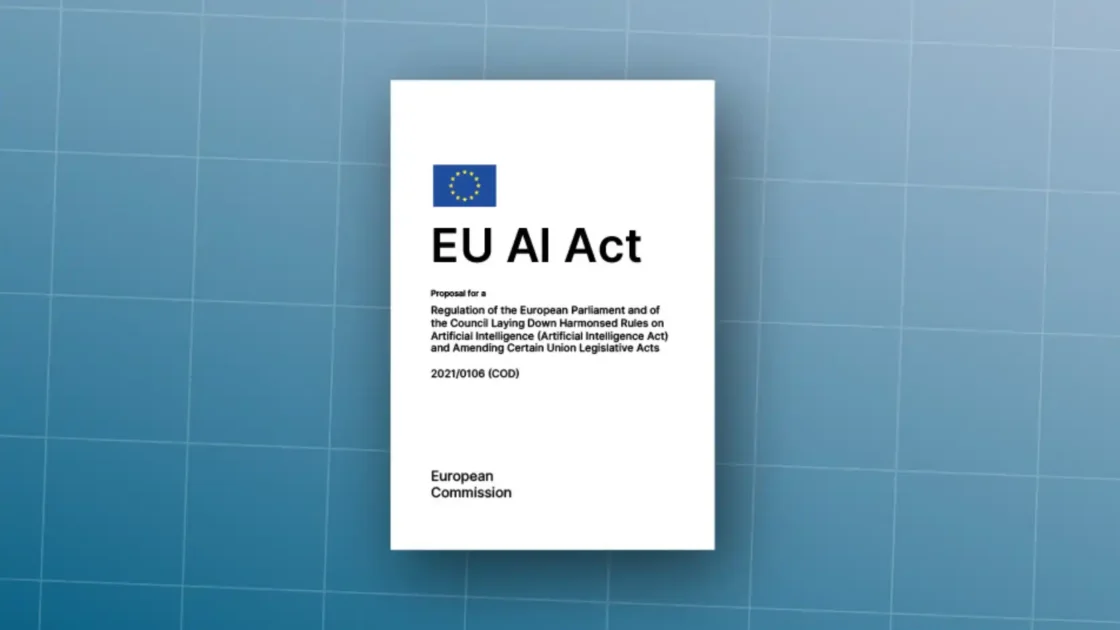
YouTube’s update is global product policy, but it lands in a regulatory environment where AI labeling is becoming law. The European Commission’s work on marking and labeling AI-generated content under the AI Act focuses on transparency obligations for providers and deployers of generative AI systems. The Commission says these obligations address risks of deception and manipulation and cover marking, detection, and labeling of AI-generated content, deepfakes, and certain AI-generated publications.
The EU approach is not identical to YouTube’s platform policy, but the direction is aligned: machine-readable marking, detectable synthetic output, human-facing disclosure, and special concern around deepfakes and public-interest content. The Commission’s code of practice process specifically addresses provider obligations to mark AI outputs in machine-readable form and deployer obligations to disclose deepfakes and certain AI-generated text publications unless editorial review and responsibility apply.
YouTube is also a very large platform under the EU Digital Services Act framework through Google Ireland Ltd.’s designated services. The Commission’s VLOP and VLOSE supervision page, updated May 22, 2026, lists designated large platforms and search engines under the DSA framework. For a platform at YouTube’s scale, synthetic media labeling is not only a user trust issue. It sits near systemic risk management, transparency, advertising, elections, minors, and researcher scrutiny.
The AI Act matters because it pushes transparency upstream. If AI systems generate media, providers may need to mark outputs. If deployers publish deepfakes, they may need to disclose. Platforms like YouTube then become distribution points where those markings and disclosures are surfaced, preserved, or ignored. A platform label is not a substitute for every legal obligation, but it can become part of compliance architecture.
The EU’s timeline adds pressure. The Commission says the code process is intended to give providers and deployers time to prepare before Article 50 transparency rules take effect in August 2026. YouTube’s May 2026 update arrives before that deadline, giving the platform a visible system for synthetic media disclosure as the legal environment tightens.
The United States has a more fragmented picture, with consumer protection, impersonation, state laws, election rules, copyright, publicity rights, and platform policies all playing roles. The FTC’s AI impersonation work shows the fraud angle. Europe is moving more directly through AI transparency obligations.
For creators and brands publishing globally, the practical lesson is simple: do not treat YouTube’s upload checkbox as the whole legal question. Platform disclosure, AI Act obligations, advertising law, rights clearance, and sector rules may all apply.
The design question becomes trust, not decoration
A label is a design element, but the real question is trust. Does the label appear at the right moment? Does it use language viewers understand? Does it distinguish AI assistance from AI fabrication? Does it avoid stigma for legitimate creative use? Does it give enough detail for high-stakes content? Does it survive sharing? Does it invite overtrust in unlabeled content?
YouTube’s simplified label prioritizes visibility and speed. That is the right first move for a mass platform. A complex provenance panel under every video would fail if users never opened it. A short “AI” marker can do what a paragraph in a description cannot: interrupt a snap judgment.
But simplicity has costs. “AI” does not tell viewers whether the whole video was generated, a background was extended, a voice was cloned, a reenactment was created, or a scene was modified. YouTube’s expanded “How this content was made” section can carry more context, and the Help page explains that viewers may see disclosures in the player or description indicating meaningfully altered or synthetically generated content. Yet the more prominent the simplified label becomes, the more viewers may rely on it as the whole story.
Label fatigue is a second problem. If every polished video starts to carry an AI label, users may stop caring. If only some AI videos carry labels, users may infer unlabeled content is authentic. That inference is dangerous. YouTube should avoid implying that absence of a label guarantees human-shot reality. No platform can promise that.
A third design issue is stigma. Artists using AI openly may not want their work treated like a deception risk. Documentary creators using synthetic reenactments may need more precise language than “AI.” A viewer seeing an AI label on a clearly fictional music video may interpret it differently from a label on a public figure clip. One label has to cover many social meanings.
Research supports caution. Labels can reduce belief in claims, but they do not necessarily reduce engagement. Users may also over-rely on labels, treating labeled AI content as suspect and unlabeled human-made content as more credible than it deserves. NIST warns that transparency can support trust but also create false trust if users misunderstand what technical measures prove.
The design goal should be calibrated skepticism. The label should help viewers ask better questions, not outsource judgment to the platform.
Detection gaps will invite adversarial behavior
Any automatic labeling system becomes a target. If labels reduce deception value, bad actors will test ways to avoid them. They may strip metadata, re-encode files, crop watermarks, screen-record generated content, add noise, blend AI segments with real footage, use lesser-known models, alter frame rates, or publish through accounts with varied behavior. Detection systems will need to keep adapting.
This is not new. Spam, copyright evasion, ad fraud, election manipulation, and scam operations all evolve in response to enforcement. Synthetic media detection will follow the same pattern. YouTube’s advantage is scale and signal diversity. It can combine upload metadata, model watermarks, content credentials, visual and audio classifiers, channel history, user reports, manual review, and tool-native signals. Its disadvantage is that adversaries only need enough misses to profit.
Watermarking helps, but it is not universal. SynthID is designed to survive common modifications such as cropping, filters, frame-rate changes, and lossy compression for images and video segments, according to Google DeepMind. But not every AI generator uses SynthID. Not every transformation preserves signals. Not every platform will cooperate. The open internet is full of laundering paths.
C2PA helps, but metadata can be removed. Content Credentials are stronger when capture devices, editing tools, and platforms preserve them. They are weaker when workflows strip them or when audiences do not know how to inspect them. That is why C2PA and watermarking are complements, not substitutes.
A harder adversarial tactic is context manipulation. A bad actor can use real footage out of context, avoiding AI labels entirely. They can combine authentic video with false captions. They can use old footage during a current crisis. They can edit real clips deceptively without generative AI. AI labels do not address those tactics unless the content is meaningfully AI-altered. YouTube still needs misinformation, spam, harassment, impersonation, and scam policies for non-AI deception.
The platform also has to consider coordinated abuse of labels. Users may report videos as AI-generated to undermine opponents. Competitors may try to trigger review queues. Political groups may challenge authentic footage as synthetic, a tactic often called the “liar’s dividend,” where the existence of deepfakes lets people dismiss real evidence as fake. A strong labeling system must reduce confusion without giving bad actors a new weapon.
The long-term fight is not AI detection alone. It is evidence integrity. Platforms must combine provenance, detection, moderation, source context, creator accountability, user education, and legal cooperation. The more realistic synthetic media becomes, the less any single signal can carry the burden of truth.
Smaller creators may feel the burden most
Large media companies, agencies, and established creators can absorb policy complexity more easily. They have production teams, legal advice, rights managers, editors, and account representatives. Smaller creators often work alone. They may use AI tools because they lack budgets for actors, designers, translators, music, editors, or motion graphics. They may also misunderstand the disclosure boundary.
This creates a fairness challenge. A solo creator using AI responsibly should not be punished for lacking a compliance department. YouTube’s Help Center examples are useful, but creators need plain, scenario-based guidance inside the upload flow. The question should not feel like a legal trap. It should help them classify their content accurately.
Small creators may also be more vulnerable to false labels. A large publisher can appeal through partner channels. A smaller channel may rely on standard support paths. If a label appears incorrectly, the creator may lose audience trust without clear recourse. YouTube’s correction process must work for everyone, not only for channels with contacts.
There is also a language issue. YouTube is global. Creators may use AI tools in markets where English policy language does not map neatly to local terms. “Photorealistic,” “meaningfully altered,” “synthetic,” and “disclosure” can be hard to interpret even for fluent English speakers. Localization must be careful. Examples should reflect regional content formats, not only U.S.-centric cases.
The burden is not only administrative. Some small creators rely on templated AI content because it appears to be a viable path to income. YouTube’s monetization rules around inauthentic, repetitive, or mass-produced content directly affect them. The platform needs to distinguish between low-budget originality and automated spam. A small creator using AI to produce a unique educational series is different from a channel farm generating hundreds of near-duplicate videos.
For smaller creators, the best defense is clarity. State when a scene is AI-generated. Avoid presenting synthetic scenes as captured evidence. Use pinned comments or descriptions for extra detail when the video topic is serious. Keep production records. Do not use other people’s likeness or voice without consent. Avoid formats that depend on fooling viewers.
YouTube should make that behavior easy. Good policy is not only enforcement; it is usability.
The next fight will be over definitions
The label update will not end debate. It will shift debate to definitions. What counts as “substantial” AI use? What is “photorealistic”? What is “meaningfully altered”? When is a scene “realistic” enough to require disclosure? When does AI assistance become AI generation? When does a label belong in the player rather than the description? When is a label permanent?
These terms are difficult because AI is entering every layer of production. Cameras use computational processing. Phones repair images. Editing tools remove noise. Translation tools generate synthetic speech. Video tools interpolate frames. Design tools extend backgrounds. Generative models create footage from prompts. AI can be invisible, minor, structural, or central.
A rigid definition could be unfair. A vague definition can be inconsistently enforced. YouTube has chosen examples rather than a purely technical threshold. That is wise, but examples cannot cover every workflow. Creator practice will keep moving faster than policy pages.
The legal world is struggling with the same boundary. EU transparency work distinguishes provider marking from deployer disclosure and focuses on deepfakes that resemble existing persons, objects, places, entities, or events and falsely appear authentic or truthful. Academic work has also argued that defining deepfakes and substantial manipulation is difficult because ordinary digital processing and synthetic alteration can overlap.
YouTube’s enforcement will create its own common law of examples. Creators will learn from labels applied, labels removed, videos penalized, and edge cases discussed publicly. The platform should publish clearer case studies over time: AI reenactments, synthetic anchors, voice dubs, historical scenes, music videos, satire, news packages, product demos, and educational simulations.
The worst outcome would be uncertainty that pushes creators into either over-disclosure or evasion. Over-disclosure can make labels noisy and less useful. Evasion can damage trust. The best outcome is a shared norm: disclose realistic synthetic content when it affects what viewers think happened, who appeared, where it happened, or whether a scene is evidence.
That norm is not mathematically precise. But media ethics often works through judgment, not formulas. YouTube’s job is to make the judgment consistent enough to be trusted.
A more honest video platform will still be messy
YouTube’s update is a move toward honesty, not certainty. It gives viewers earlier notice. It reduces reliance on creator self-reporting. It connects platform labels to internal detection, YouTube AI tools, and C2PA metadata. It aligns with broader provenance work by Google and with regulatory pressure around synthetic media. It also opens new disputes over false positives, definitions, creator burden, label fatigue, and commercial impact.
The platform deserves credit for moving labels out of a place where many viewers would never see them. A disclosure hidden in a description is not enough for realistic AI video. The new placement respects how people actually watch. It also recognizes that Shorts need a different design from long-form content.
The automatic labeling layer is the bigger leap. It says YouTube no longer trusts self-disclosure alone. That is reasonable. Synthetic realism can be used responsibly, but the incentives for undisclosed fabrication are too strong. A platform at YouTube’s scale needs detection, provenance, and enforcement.
Still, YouTube should avoid overstating what labels can do. They do not prove a video is false. They do not prove unlabeled videos are real. They do not settle rights questions. They do not replace moderation. They do not stop AI slop by themselves. They do not solve the social problem of people believing what they want to believe.
The better standard is narrower and more realistic: labels help viewers understand when the appearance of reality has been manufactured or meaningfully changed by AI. That is valuable. It is also only one part of a healthier information system.
The next year will test whether YouTube can make the system accurate, understandable, and fair. Viewers will judge whether the label gives useful context. Creators will judge whether the rules are predictable. Regulators will judge whether the platform is managing risk. Advertisers will judge whether synthetic content can sit beside their brands. Bad actors will test the gaps.
YouTube’s update does not end the synthetic video era. It marks the moment when AI realism becomes something the platform has to disclose in the main room, not in the fine print.
Reader questions about YouTube’s new AI labels
Yes. Starting in May 2026, YouTube says it is rolling out internal signals to identify AI-generated content. If a creator does not specify AI use and YouTube detects substantial photorealistic AI use, it may automatically apply an AI label.
For long-form videos, the label appears directly below the video player, above the description. For Shorts, the label appears as an overlay on the video itself.
No. YouTube focuses on realistic AI-generated or meaningfully AI-altered content. AI used for production assistance, captions, idea generation, minor edits, color adjustment, sharpening, or similar low-risk tasks may not require disclosure under YouTube’s examples.
Creators must disclose AI content that makes a real person appear to say or do something they did not do, alters footage of a real event or place, or generates a realistic scene that did not occur.
YouTube says a disclosure label alone does not change whether a video is recommended or whether it is eligible to earn money. Monetization can still be affected by other policies, such as inauthentic or mass-produced content rules.
In most detection-error cases, creators can update the disclosure status in YouTube Studio. YouTube says labels cannot be adjusted in certain cases, including content made with YouTube’s AI tools, content with C2PA metadata, or content labeled after manual review.
The old description-based system required viewers to open extra details. YouTube is moving labels into the main viewing interface so viewers see context earlier, especially when content looks realistic.
It refers to AI-generated or AI-altered content that looks like real footage of people, places, scenes, or events. The policy concern is that viewers may mistake synthetic realism for recorded reality.
YouTube says unrealistic, animated, or slightly altered content can still have disclosure information in the expanded description rather than the prominent player or Shorts overlay.
No. YouTube allows many uses of AI, but requires disclosure for realistic altered or synthetic content and applies Community Guidelines to AI-generated content the same way it applies them to other content.
YouTube says creators who consistently fail to disclose required information may face manual labels or penalties, including content removal or suspension from the YouTube Partner Program.
YouTube may use C2PA metadata to carry forward disclosures about how content was made. Content Credentials can indicate whether an entire video was made with AI and may trigger labels.
SynthID is Google DeepMind’s watermarking system for identifying AI-generated content. It embeds imperceptible digital watermarks into AI-generated images, audio, text, or video that can be detected by SynthID technology.
No. The label indicates AI generation or meaningful AI alteration. A labeled video may be fictional, educational, artistic, or accurate. It tells viewers to consider how the content was made.
No. A missing label does not guarantee authenticity. Detection systems can miss content, metadata can be stripped, and non-AI deception can still occur.
No single label system can stop low-quality automated content. The update mainly addresses transparency for realistic AI-generated or AI-altered content. Monetization, spam, recommendation, and quality policies still matter.
For sensitive or realistic content, yes. YouTube’s UI label helps, but creators can build more trust by adding on-screen or spoken context, especially for reenactments, public-interest topics, and synthetic scenes.
Brands should disclose realistic synthetic media, avoid fake testimonials or fake product evidence, keep production records, secure voice and likeness rights, and make sure agency contracts address AI use.
The EU AI Act includes transparency obligations around marking and labeling AI-generated content and deepfakes. YouTube’s update fits the broader move toward visible and machine-readable AI disclosure, though platform compliance and legal compliance are not the same thing.
Viewers will see AI context sooner. Long-form videos get a label near the player, while Shorts get an overlay, reducing reliance on hidden description details.
Author:
Jan Bielik
CEO & Founder of Webiano Digital & Marketing Agency
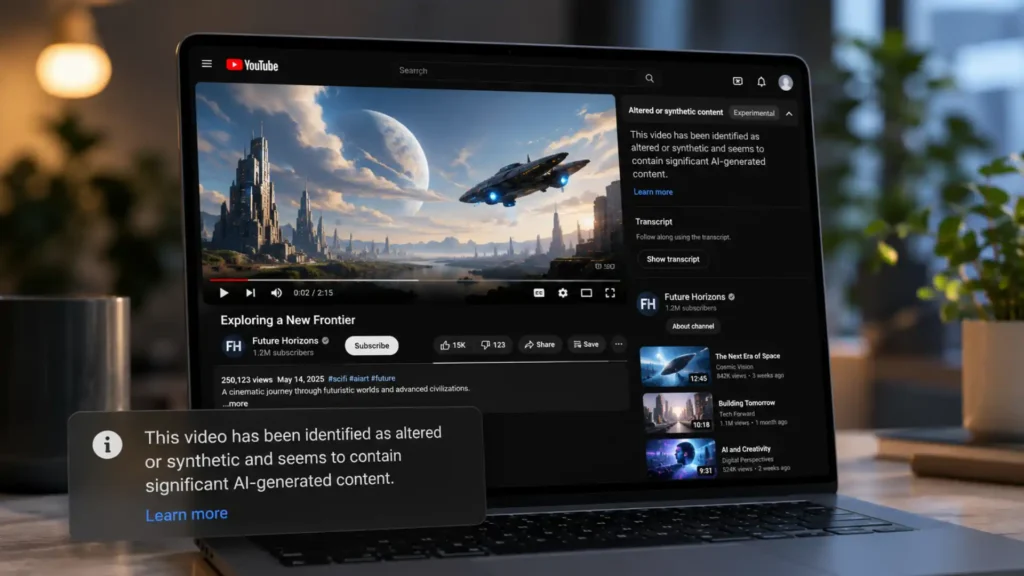
This article is an original analysis supported by the sources cited below
Improving AI labels for viewers and creators
YouTube’s official May 27, 2026 announcement detailing more prominent AI labels, automatic detection, creator controls, and permanent-label cases.
Disclosing use of GenAI content
YouTube Help documentation explaining when creators must disclose realistic AI-generated or meaningfully AI-altered content.
Understanding how this content was made disclosures on YouTube
YouTube Help documentation describing disclosure types, Content Credentials, and the “How this content was made” information shown to viewers.
How we’re helping creators disclose altered or synthetic content
YouTube’s March 2024 announcement introducing Creator Studio disclosure tools for realistic altered or synthetic media.
How creators use AI for content creation
YouTube’s public explainer on AI tools, disclosure requirements, labels, moderation, privacy requests, and responsible AI commitments.
Our approach to responsible AI innovation
YouTube’s November 2023 policy framing for generative AI, disclosure requirements, labels, privacy requests, and synthetic media risks.
YouTube CEO Neal Mohan’s 2026 letter
YouTube CEO Neal Mohan’s 2026 platform outlook discussing AI creation tools, transparency, likeness protections, and AI slop concerns.
Likeness detection on YouTube
YouTube Help documentation explaining its experimental likeness detection feature, eligibility, verification, and privacy complaint process.
YouTube channel monetization policies
YouTube Help documentation covering Partner Program monetization rules, including the 2025 clarification around inauthentic, repetitive, or mass-produced content.
Elections misinformation policies
YouTube Help documentation describing rules for elections-related misinformation, including some technically manipulated content.
Tools to understand how content was created and edited
Google’s May 2026 announcement on SynthID verification, C2PA Content Credentials, Search and Chrome verification, and broader provenance tools.
SynthID
Google DeepMind’s explainer for SynthID, its AI watermarking approach, and supported media types including images, audio, text, and video.
SynthID Detector
Google’s announcement of a detector portal for identifying content generated with Google AI tools and watermarked through SynthID.
Content Credentials
Official Content Credentials site describing provenance information, editing history, and the C2PA-based authenticity ecosystem.
C2PA specifications
Official C2PA technical specifications page describing standards for certifying the source and provenance history of media content.
Code of Practice on marking and labelling of AI-generated content
European Commission page explaining AI Act transparency obligations around marking, detection, and labeling of AI-generated content and deepfakes.
Supervision of designated very large online platforms and search engines under the DSA
European Commission page listing designated VLOPs and VLOSEs and outlining Digital Services Act supervision context.
AI Risk Management Framework
NIST’s official AI Risk Management Framework page, including the Generative AI Profile and related risk management resources.
Reducing risks posed by synthetic content
NIST report on technical approaches to digital content transparency, provenance, labeling, synthetic media detection, and related risks.
Responsible practices for synthetic media
Partnership on AI framework addressing responsible creation, disclosure, and distribution of synthetic media.
Labeling synthetic content
Research paper on user perceptions of warning label designs for AI-generated content on social media.
Labeling AI-generated media online
PNAS Nexus research paper testing process-based and harm-based labels for AI-generated media and their effects on belief and engagement.
AI Slop Report
Kapwing research report on low-quality AI-generated YouTube videos, Shorts feed exposure, channel patterns, and estimated reach.
FTC proposes new protections to combat AI impersonation of individuals
Federal Trade Commission announcement on proposed protections addressing AI-enabled impersonation and deepfake-related fraud.
YouTube is putting AI labels where you’ll actually see them
The Verge report summarizing YouTube’s 2026 AI-label placement changes, automatic detection, and creator correction details.
| Citing this article? Brief excerpts are welcome. Please credit Webiano.digital, name the author where stated, and include a link to https://webiano.digital and to this original article. Full or substantial republication requires prior written permission. Read our Copyright and Content Use Policy. |
This article was prepared with the assistance of artificial intelligence tools. The content underwent expert human review, and Webiano Digital & Marketing Agency assumes editorial responsibility for its final version and publication.