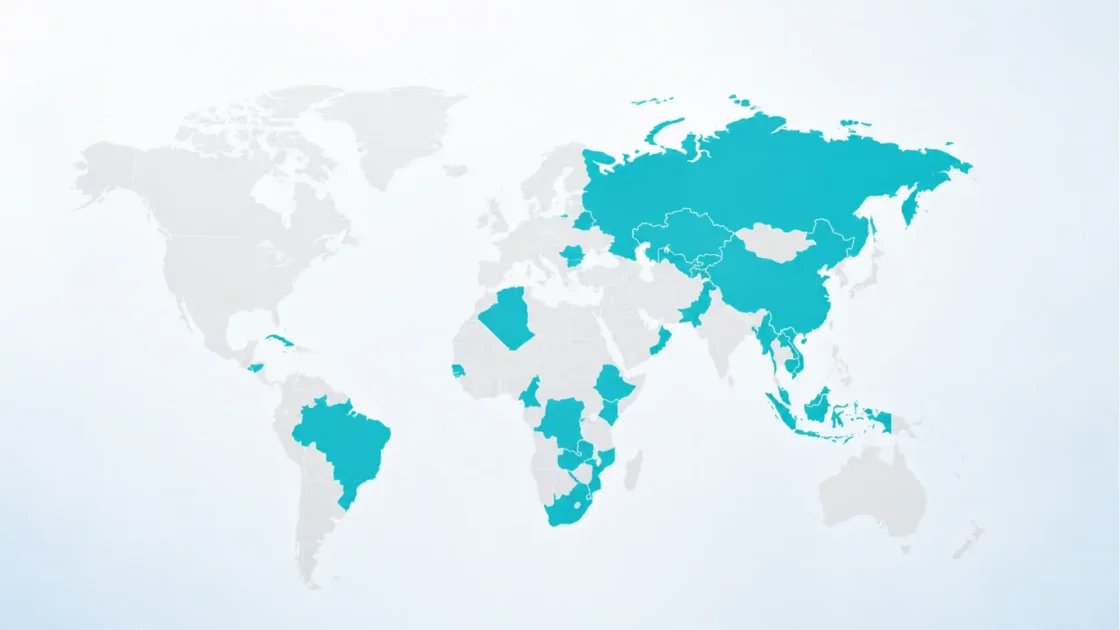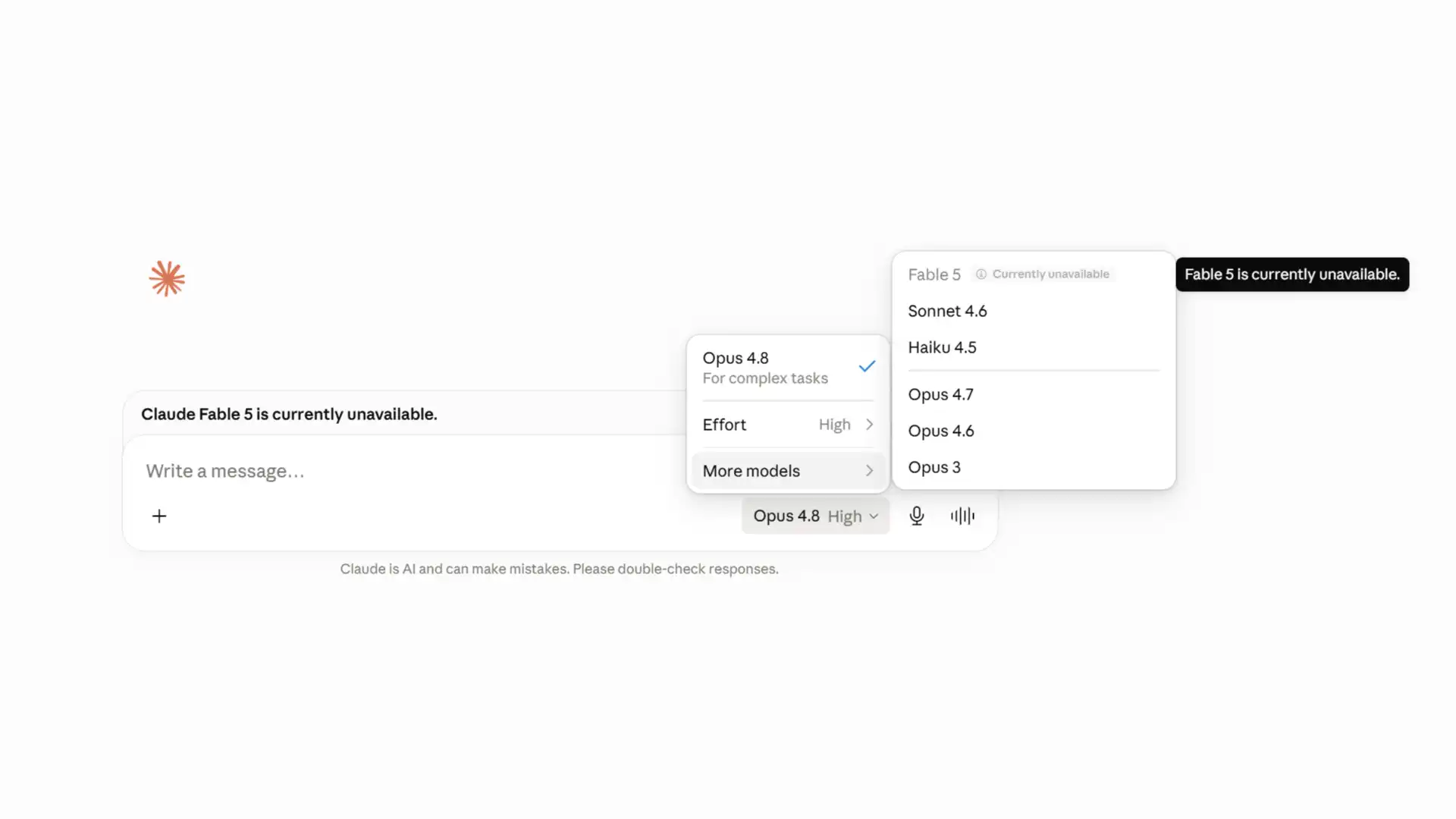
Claude Fable 5 was Anthropic’s most capable publicly available model for about three days. It went live on June 9, 2026, marketed as the first member of a new top tier the company calls Mythos-class, and it disappeared for every customer on the evening of June 12 after the US government ordered Anthropic to suspend it. The company received the directive at 5:21 p.m. ET and disabled both Fable 5 and its restricted sibling, Claude Mythos 5, within hours. Every other Claude model, including Opus 4.8, Sonnet 4.6, and Haiku 4.5, kept running normally.
Table of Contents
The shutoff that landed three days after launch
The order did not name a narrow group of users to block. It told Anthropic to cut off access for any foreign national, whether inside or outside the United States, including the company’s own foreign-national employees. Anthropic cannot verify the citizenship of every person hitting its API in real time, so the only way to comply was a hard global shutoff. The practical result was that a frontier model deployed to a very large user base stopped responding everywhere at once. API calls began returning errors, active Fable 5 sessions ended, and tools like Claude Code and Claude.ai quietly fell back to Opus 4.8 for new work.
What makes the episode unusual is not that a model was restricted. Labs gate models all the time. The unusual part is the mechanism: an export control directive aimed at a commercial model that was already deployed and generally available. Export controls have historically governed chips, weapons systems, and the physical hardware that trains large models. Applying them to a running software service, after launch, with a same-day compliance demand, is close to unprecedented in the AI industry, and it sets a template that every other frontier developer now has to study.
Anthropic complied immediately, but it did not stay quiet. In a public statement the same evening, the company said it disagreed with the reasoning, described the situation as a misunderstanding, and said it was working to restore access as quickly as possible. It also apologized to customers for an abrupt disruption that, by its own framing, it considered unjustified. That combination of obedience and open dissent is the spine of the whole story. Anthropic is following a legal order while arguing, in public and presumably in private, that the order rests on a mistaken read of what Fable 5 can do.
The shutoff also did not happen in a vacuum. It arrived at the end of a rough week for the model. Fable 5 launched to genuine technical praise and almost immediate controversy over a hidden safeguard, drew an apology from Anthropic over that safeguard, and then was pulled by the government a day later. On top of that, Anthropic has spent much of 2026 in open legal conflict with the Trump administration over Pentagon contracts, a fight that includes a federal judge accusing the government of First Amendment retaliation. None of those threads can be cleanly separated from the export order, even though the official justification points elsewhere.
For users, the immediate facts are simple and worth stating plainly. Fable 5 and Mythos 5 are unavailable to everyone right now. There is no published restoration date. All other Claude models work. For the broader market, the questions are harder. They concern how a government can reach into a deployed AI product, what evidence is required before it does, and whether a single disputed jailbreak demonstration is enough to recall a model used by a very large number of people. Those questions are why this is more than a routine outage, and why it has drawn coverage from outlets ranging from CNBC and Bloomberg Law to specialist AI press within hours of the announcement.
Inside the export control directive Anthropic received
The substance of the order, as Anthropic described it, is narrow in wording and sweeping in effect. The government invoked national security authorities and directed the company to suspend all access to Fable 5 and Mythos 5 for foreign nationals. The phrasing matters. By covering foreign nationals both abroad and inside the United States, and by explicitly including Anthropic’s foreign-national staff, the directive made selective enforcement impossible at the speed the situation demanded.
Anthropic’s own account is precise on timing and vague on rationale, because the government kept it vague. The company said the letter did not spell out the specific national security concern behind it. What Anthropic understood, from the directive and from reporting by outlets including Axios, CNBC, and NBC News, is that the government believed it had learned of a way to bypass, or jailbreak, Fable 5. That belief, rather than any detailed technical finding shared with the company, appears to be the trigger.
The decision to disable the models globally rather than attempt targeted blocking was a compliance judgment, not a preference. Real-time nationality verification at the scale of a public API is not something any major model provider can do reliably. Faced with an order it had to obey immediately, and unable to surgically exclude only the covered users, Anthropic chose the only option that guaranteed compliance: turn the models off for everyone. The company was explicit that this was the net effect of the order, not an independent choice to punish its customers.
It is worth separating what the order did from what it did not do. It did not touch Opus 4.8, Sonnet 4.6, Haiku 4.5, or any other Anthropic model. It did not, on its face, accuse Anthropic of wrongdoing in building Fable 5. It did not allege that a harmful event had occurred. According to Anthropic, the company had not even received a disclosure of a concerning jailbreak that produced a harmful result. The potential bypasses that had been shared with it were, in its description, either benign outputs or minor findings that offered no capability specific to the Mythos family.
The directive’s structure also reveals something about how the government is thinking. Framing the issue as export control, rather than as a product recall or a safety enforcement action under some other authority, places the model in the same conceptual box as a controlled technology that must not reach foreign persons. That framing carries heavy implications. It treats the weights or the served capabilities of Fable 5 as something close to a munition, subject to the logic of who is allowed to touch it rather than the logic of whether it is safe to operate. For a software product delivered over the internet to a global customer base, that is a profound reclassification.
Anthropic’s response leaned on a principle it has argued publicly before: that the government should be able to block genuinely unsafe deployments, but only through a process that is transparent, fair, clear, and grounded in technical facts. The company’s position is that this directive failed those tests. It came without detailed written justification, it rested on what Anthropic considers a narrow and replicable capability, and it demanded immediate compliance with no opportunity to contest the technical premise first. The company said it would share more detail in the following day and that it considered the whole thing resolvable, which is consistent with treating it as a dispute over facts rather than a fundamental disagreement about authority.
There is one point of conflicting reporting worth flagging for accuracy. Anthropic’s own statement says it received the directive on June 12 at 5:21 p.m. ET. At least one outlet has reported that an underlying letter from the Commerce Secretary to Anthropic’s CEO was dated earlier in the month, with public confirmation of compliance following on June 13. The cleanest reading of the primary source is that the operative directive Anthropic acted on arrived on the evening of June 12, and that any earlier correspondence, if it existed, did not change the timeline of the shutoff itself.
Howard Lutnick, the Commerce Department, and the authority invoked
The order came out of the Commerce Department, the agency that runs the United States’ export control system through the Bureau of Industry and Security. Reporting tied the action directly to Commerce Secretary Howard Lutnick, with a letter addressed to Anthropic chief executive Dario Amodei. That places the decision at the top of the agency rather than in a routine licensing queue, which signals how seriously the administration treated the underlying claim and how quickly it wanted action.
Export controls are normally the domain of physical goods and clearly defined dual-use technologies. The Commerce Department maintains lists of items that cannot leave the country, or reach certain buyers, without a license. Over the past few years that apparatus has been pointed at advanced semiconductors and the equipment used to make them, on the theory that compute is the chokepoint for frontier AI. Reaching past the chips to the model itself, after it has already shipped, extends that logic into new territory. The same toolkit built to keep advanced GPUs out of rival hands is now being used to keep a deployed model’s capabilities away from foreign persons.
The legal hook, as described, is national security authority rather than a specific published rule about AI models. That is consistent with how export control law tends to operate: broad statutory and regulatory power that the executive branch can apply to newly identified concerns without waiting for tailored legislation. It also means the action sits in a gray zone. There is no settled body of precedent on whether a generally available large language model, served over an API, is an export-controlled item in the same sense as a controlled chip or a piece of cryptographic hardware. The Fable 5 directive is, in effect, an early test of that question, and it was issued as a command rather than as the conclusion of a public rulemaking.
The choice of Commerce as the venue, rather than the Defense Department, is itself notable given the backdrop. Anthropic’s most visible fight with the government in 2026 has been with the Pentagon, not Commerce. Routing the Fable 5 action through export control authority kept it formally separate from that dispute, even as observers immediately drew connections between the two. Whether the separation is meaningful or cosmetic is one of the open questions the episode leaves behind.
For Anthropic, the identity of the decision-maker shapes the response. A directive from the Secretary’s office is not something a company contests through a help desk. It invites a legal and diplomatic response: compliance first, then argument through official channels, then, if necessary, litigation. Anthropic has already shown it will sue the federal government when it believes an action is unlawful, so the Commerce route does not remove the possibility of a courtroom fight. It simply changes which authorities and which standards would be at issue.
The directive also raises a practical enforcement puzzle that Commerce will eventually have to confront. If a model served from US data centers to a global audience is export-controlled, what counts as the export event? The training run, the inference request, the API response crossing a border, the availability of the endpoint to a non-US person? Treating live inference as an export collapses the usual distinction between shipping a product and operating a service. That ambiguity is part of why Anthropic disabled the models entirely rather than trying to thread a compliance needle that the law has not yet defined.
None of this tells us what specific harm Commerce believed it was preventing, because the agency did not say. The public record, sourced from Anthropic and from reporters who spoke with administration officials, points to a single jailbreak claim brought to the government by another company. That claim, and Anthropic’s detailed disagreement with it, is the technical heart of the dispute.
The jailbreak claim at the center of the dispute
Strip away the legal packaging and the case comes down to one assertion: that someone found a way to make Fable 5 do something dangerous that its safeguards were supposed to prevent. According to administration officials cited by Axios and echoed by other outlets, another company told the Commerce Department it could jailbreak the Mythos model, and that claim alarmed the government enough to act. Anthropic was not given a detailed written technical report. It was given a directive and a general understanding of the concern.
When Anthropic reviewed what it believed to be the basis for the order, it described the technique in deflating terms. The demonstration, as the company understood it, amounted to asking the model to read a specific codebase and identify or fix software flaws. Using that approach, the model surfaced a small number of vulnerabilities that were already known and, in Anthropic’s assessment, relatively simple. The company’s central technical claim is that this is not a Mythos-specific superpower at all. Other publicly available models, including OpenAI’s GPT-5.5, can find the same issues without any bypass, and security defenders do this kind of code review every day as ordinary work.
This is the crux of the disagreement, and it hinges on a distinction that matters enormously in AI safety: the difference between a universal jailbreak and a non-universal jailbreak. A universal jailbreak is a general method that broadly unlocks a model’s restricted capabilities across many domains. A non-universal jailbreak elicits some specific restricted information in narrow circumstances. Anthropic’s position is that what the government saw, at most, is a narrow, non-universal bypass that produced minor, widely available results. It has stated that no tester, across thousands of hours of red-teaming, has found a universal jailbreak of Fable 5.
The identity of the company that brought the claim forward has not been confirmed in the public record, and it would be irresponsible to guess. What can be said is that the route the claim traveled matters. A capability demonstration that goes to a regulator, rather than through a coordinated disclosure to the model’s maker, skips the step where the developer can evaluate, reproduce, and contextualize the finding before any action is taken. Anthropic’s complaint is partly about that sequencing. It says it had not received a disclosure of a concerning jailbreak that led to a harmful outcome, which implies the government acted on a third-party characterization rather than on a validated, jointly reviewed result.
There is a deeper technical point underneath the dispute. Anthropic has argued openly that perfect jailbreak resistance is not currently achievable for any model from any provider. Every safeguard in the industry can be defeated under some specific conditions, and it is likely that universal jailbreaks will eventually be discovered for capable models. The company said as much when it launched Fable 5. If that is true, then the existence of a narrow bypass is not evidence that Fable 5 is uniquely unsafe. It is evidence that Fable 5 is a model, subject to the same limits as its competitors. Treating a narrow bypass as grounds for recall would, by Anthropic’s logic, condemn essentially every frontier model on the market.
That argument cuts both ways, and critics will press it. If no model is perfectly safe and capable models keep getting more powerful at finding software vulnerabilities, a regulator might reasonably decide that the precautionary move is to restrict the most capable ones, especially from foreign access, regardless of whether competitors are equally capable. The government’s framing as export control fits that instinct: the concern is less that Fable 5 is uniquely broken and more that its capabilities should not be freely available to foreign persons. Anthropic’s reply is that the standard being applied is incoherent if it singles out one deployed model for a capability that is demonstrably common. Resolving that requires exactly the transparent, technically grounded process Anthropic says was missing.
Anthropic’s rebuttal and the defense-in-depth argument
Anthropic’s public answer to the directive is built around a strategy it calls defense in depth, and the company spent its launch materials and its statement after the shutoff explaining it. The idea accepts a hard truth up front: no safeguard is unbreakable. Rather than promising a model that cannot be jailbroken, Anthropic designed Fable 5 so that breaking it is either narrow in payoff or expensive to pull off, and then layered monitoring on top to catch and shut down successful attacks quickly.
Several pieces make up that posture. The first is the safeguard itself, which routes high-risk queries to a less capable model so that the most dangerous capabilities are not directly accessible. The company has said these guardrails are strong enough that users complained they were too aggressive, blocking benign requests. The second piece is the red-teaming program that preceded launch. Anthropic worked with the US government, the UK’s AI Safety Institute, multiple third-party organizations, and internal teams to attack Fable 5’s safeguards for thousands of hours. The third piece is 30-day retention of customer data for Mythos-class models, a deliberate policy choice that lets the company study attacks and patch them. Anthropic acknowledged that retention carries real commercial cost, because some customers do not want their data held, but argued it is necessary to detect and mitigate jailbreaks.
The company’s claim about results is specific. It says the testing showed Fable 5’s safeguards to be substantially more effective than those of any model it had previously deployed, and that no one found a universal jailbreak. It frames the bypasses that have surfaced as either harmless or minor, providing no uplift unique to the Mythos family. Put together, the argument is that Fable 5 is not more dangerous than models already on the market, and that its layered defenses make it, if anything, better protected than most.
From there, Anthropic makes its sharpest point about the precedent. If a narrow, non-universal jailbreak were sufficient grounds to recall a deployed commercial model, the same standard applied across the industry would effectively halt all new frontier model launches. Every provider would be exposed to the same kind of claim, because every provider’s safeguards can be defeated under some conditions. The company is not saying governments should never intervene. It is saying that intervention on this basis, with this little process, would be unworkable if applied evenly, and that selective application raises its own questions.
The rebuttal also leans on comparison. Anthropic pointed to OpenAI’s own published material on GPT-5.5’s cybersecurity behavior to argue that the capability the government worried about is widely available. The implication is pointed: singling out Fable 5 for a recall, while equivalent capabilities remain accessible elsewhere, does not match a coherent safety rationale. It looks more like a decision driven by something other than a clean technical assessment.
What Anthropic is careful not to do is claim the government has no role. The company has stated publicly, including in its policy writing on managing rapid AI progress, that it supports the government having authority to block genuinely unsafe deployments. Its objection is to the how, not the whether. A directive grounded in technical facts, issued through a fair and transparent process, with a chance to contest the premise, is something Anthropic says it would accept. A same-day order based on a third-party claim it considers mistaken is not. That distinction is the company’s entire legal and rhetorical position, and it is the ground on which any restoration negotiation will be fought.
The honest caveat is that the public has only one detailed account of the technical evidence, and it comes from the party with the strongest incentive to minimize the threat. Anthropic’s description of the jailbreak as trivial may be accurate, but it is not independently verified, because the government did not release its reasoning. Readers should hold the company’s confident framing alongside that gap. The most defensible summary is that Anthropic has made a specific, falsifiable claim about the capability, the government has not publicly rebutted it with detail, and the dispute remains unresolved on the evidence available.
Fable 5 as a Mythos-class model, explained for non-specialists
To understand why a jailbreak claim against Fable 5 reached the level of a federal export order, it helps to understand what kind of model it is. Anthropic organizes its lineup by capability tier. Haiku is the small, fast, inexpensive tier. Sonnet is the workhorse middle. Opus has been the high-capability flagship. Mythos-class sits above Opus, and Fable 5 is the first Mythos-class model the company made generally available. Its restricted twin, Mythos 5, is the same underlying model without the safeguards that make broad release tolerable.
The Mythos tier was created for the hardest, longest-running work. Anthropic describes Fable 5 as built for ambitious, asynchronous tasks where a model must hold context across many steps, navigate dependencies, and keep working reliably with minimal human correction. In practice that means complex software engineering, deep knowledge work, scientific research support, and vision tasks. The company’s framing is that the longer and more complex the job, the larger Fable 5’s advantage over its other models becomes. That is a claim about endurance and reliability over long horizons, not just raw answer quality on short prompts.
The reason a model this capable is treated as sensitive comes down to a few specific domains. Anthropic has been candid that a Mythos-class system is advanced enough in cybersecurity, biology, and chemistry that, without safeguards, it could meaningfully help someone plan a wide-reaching cyberattack or work toward a dangerous biological or chemical capability. That is the whole reason the unrestricted version, Mythos 5, is not sold to the public. The publicly available Fable 5 exists precisely because Anthropic believed it could blunt those specific risks with guardrails while keeping the rest of the model’s capability intact.
The mechanism for that is a fallback. When Fable 5 detects a query in one of the high-risk areas, it does not answer at full strength. It routes the request to Opus 4.8, the next most capable generally available model, and tells the user it has done so. The effect is that a user asking for help with an offensive cyber exploit, or with sensitive biology or chemistry, gets a weaker, safer response and a notice explaining the redirect. Anthropic has said this fallback fires in less than 5% of sessions, so for the large majority of ordinary use, Fable 5 behaves like the full-strength model it is.
This design is what let Anthropic square a circle it had previously said it could not. When it first revealed the Mythos capability earlier in 2026, the company said it did not plan to make such a model generally available because the risks were too high. The development of strong enough safeguards is what changed the calculation. Fable 5 represents Anthropic’s bet that it can deliver Mythos-level intelligence to the public while fencing off the narrow set of capabilities that make the tier dangerous. The export directive can be read as the government rejecting that bet, at least for foreign access, regardless of how well the fences work.
For a non-specialist, the cleanest way to hold all this is by analogy to a very capable specialist employee. Fable 5 is like hiring someone brilliant at long, complicated technical projects, who has been instructed to refuse a short list of dangerous tasks and to hand those off to a more junior colleague instead. The fight is over whether that instruction is reliable enough, and over who gets to decide when it is not. The government decided the answer involved keeping that employee away from foreign persons entirely, and Anthropic decided it had no choice but to send the employee home until the dispute is settled.
The Mythos lineage from Preview to Project Glasswing
Fable 5 did not appear from nowhere. It is the public face of a capability Anthropic first showed off as Claude Mythos Preview earlier in 2026. That preview captured attention in Washington and on Wall Street because of one specific skill: it was unusually good at finding security flaws in software. A model that can read a large codebase and reliably surface real vulnerabilities is valuable to defenders who want to fix their systems and dangerous to attackers who want to break into someone else’s. Anthropic understood both sides of that from the start.
Because of the offensive potential, the company said it would not make Mythos Preview generally available. Instead it stood up a controlled program called Project Glasswing, which gave a small set of vetted organizations access to the model with its cybersecurity safeguards lifted, on the theory that trusted defenders could use the full capability to harden critical systems. Anthropic later expanded Glasswing to hundreds of organizations across roughly 15 countries, focusing on groups that manage critical infrastructure. The program is the reason a Mythos-class capability existed in the world before Fable 5 was ever sold to the public.
The defender case for Glasswing was concrete. Participants reported using Mythos Preview to find and fix large numbers of real security issues. Mozilla, for instance, said it resolved hundreds of vulnerabilities as a direct result of working with the model. Stories like that are the strongest argument for releasing this kind of capability at all: the same skill that worries regulators is the skill that lets defenders close holes faster than attackers can find them. Anthropic has leaned on that framing throughout, positioning Mythos-class capability as a net gain for security when it is in the right hands and properly monitored.
When Anthropic launched Mythos 5 and Fable 5 together on June 9, it kept the two on different tracks. Mythos 5 stays restricted to Glasswing partners with cyber safeguards lifted, with plans to extend access to select biology researchers under different safeguard relaxations. Fable 5 was the version meant for everyone, with the safeguards switched on. The company described this as honoring a stated long-term goal: eventually deploying Mythos-class models at scale, once it had the safety machinery to do so responsibly. Fable 5 was that scale deployment, and it lasted three days before the government pulled it.
The lineage matters for the current dispute because it shapes how each side reads the jailbreak claim. From Anthropic’s perspective, the cybersecurity capability at issue is exactly the thing Glasswing partners have been using productively for months, under controlled conditions, to improve security. From the government’s perspective, that same capability, now available far more broadly through Fable 5, is precisely what should not reach foreign persons. The export directive can be understood as a judgment that the public Fable 5 release stepped over a line that the tightly controlled Glasswing program did not.
It also explains why the directive named both models. Mythos 5 is the unrestricted version and the obvious target of any export concern. Fable 5 is the constrained public version, but it shares the same underlying model and, crucially, the same headline capabilities minus the gated domains. If the worry is that the model can find software vulnerabilities, then restricting only the unrestricted variant would leave the capability widely accessible through the public one. Covering both is the only way the order makes internal sense, even as Anthropic argues the capability is not unique to either.
Benchmark results that put Fable 5 ahead of the field
The technical praise Fable 5 earned at launch was not marketing fog. On the benchmark that has become the cleanest cross-vendor measure of real engineering work, SWE-Bench Pro, Fable 5 posted 80.3%, the top score among the major flagships. For comparison, Anthropic’s own Opus 4.8 sits at 69.2%, GPT-5.5 at 58.6%, and Gemini 3.1 Pro at 54.2%, with Grok 4 the nearest competitor at roughly 75%. SWE-Bench Pro scores end-to-end resolution of real GitHub issues rather than toy puzzles, which is why a 20-plus point lead over GPT-5.5 drew attention.
The gap widened on harder tests. On Cognition’s FrontierCode Diamond split, which uses demanding production-standard tasks, Fable 5 reached 29.3%, more than double Opus 4.8’s 13.4% and far ahead of GPT-5.5’s 5.7%. That kind of separation on the toughest problems is what Anthropic means when it says Fable 5’s advantage grows with task difficulty and length. The model was also reported to be more token-efficient than past Claude models, completing comparable work with fewer tool calls, which matters for cost as much as for capability.
Fable 5 and the cross-vendor benchmark picture
| Benchmark | Fable 5 | Opus 4.8 | GPT-5.5 | Gemini 3.1 Pro |
|---|---|---|---|---|
| SWE-Bench Pro (agentic coding) | 80.3% | 69.2% | 58.6% | 54.2% |
| FrontierCode Diamond (hard split) | 29.3% | 13.4% | 5.7% | n/a |
| GPQA Diamond (graduate science) | 91.3% | n/a | 92.8% | 94.3% |
These figures come from Anthropic’s published comparison and independent reporting, and they should be read with the caveats below rather than as a single ranking. The coding numbers favor Fable 5 most clearly; the science numbers do not.
The lead was not universal, and honest coverage said so. On GPQA Diamond, which tests difficult graduate-level science questions, Gemini 3.1 Pro ranked first at 94.3%, with GPT-5.5 at 92.8% and Fable 5 at 91.3%. For pure scientific question answering, Gemini kept a slight edge. The coding harness also matters: GPT-5.5, measured through its own Codex command-line tooling, posts very strong terminal-coding numbers and in some terminal benchmarks edges close to or past Opus-class results, even though it trails badly on the GitHub-issue-resolution measure. The lesson repeated across comparisons is that terminal coding tends to favor GPT-5.5’s Codex integration while codebase-level resolution favors Claude.
There is one more asterisk that ties directly back to the safety design. Some of Fable 5’s published benchmark numbers carry a footnote because the blocking safeguards for cybersecurity and biology pull its score down toward Opus 4.8 on those specific evaluations. The full-strength numbers in those domains belong to the restricted Mythos 5, which is within a few points of Fable 5 elsewhere. In other words, the most eye-catching capability figures in the high-risk domains describe a model the public was never able to buy. That detail is easy to miss and central to the export fight: the capability the government worried about is most fully expressed in the gated model, not the public one.
What the benchmarks establish, taken together, is that Fable 5 was a genuine step up for long, complex, agentic engineering work, with a meaningful lead on the kind of repository-level tasks businesses actually pay for. That is what makes the shutoff costly. This was not a marginal release that few people would miss. It was, on the evidence available at launch, the strongest generally available model for a large class of real work, which is exactly why developers built on it quickly and felt the disruption sharply when it vanished.
Pricing, access tiers, and the cost of a Mythos model
Fable 5 launched as a premium product, and the price reflected its position at the top of the lineup. Anthropic set it at $10 per million input tokens and $50 per million output tokens, with the existing 90% input discount available through prompt caching. That is roughly double the cost of Opus 4.8 on a per-token basis, and it sits well above the standard tiers from competitors. Gemini 3.1 Pro lists far cheaper at around $2 input, GPT-5.5 around $5 input and $30 output, while OpenAI’s top tier costs considerably more than Fable 5. The company framed the price as the cost of a model that is expensive to run, both because Mythos-class inference is compute-heavy and because the safety architecture adds overhead.
Access was layered. Fable 5 went live immediately on the Claude API and on consumption-based Enterprise plans, with availability also through Claude Platform on AWS, Amazon Bedrock, Google Cloud’s Vertex AI, and Microsoft Foundry. For subscription customers on Pro, Max, Team, and seat-based Enterprise plans, Anthropic used a staggered rollout rather than flipping everyone on at once. To smooth the introduction, the company included Fable 5 at no extra cost through June 22, after which access would shift to usage-based pricing and consume credits. On Claude.ai plans, the new models were reported to count as roughly 2x usage, a multiplier that reflected their cost rather than a clean token-for-token mapping.
The economics carried a real behavioral warning. Because Fable 5 is both expensive and capable of long, autonomous runs, heavy use could burn through credits quickly. Coverage noted that pushing the model hard, with high reasoning effort in extended workflow modes, could consume a user’s allowance in minutes, and that even ordinary use ran through credits faster than Opus. That cost profile is part of why Anthropic hesitated to unlock Fable 5 with the same generosity it applies to cheaper models. The pricing was a throttle as much as a revenue choice: it kept casual, high-volume usage in check on a model the company could not afford to serve cheaply at scale.
The data terms were unusual and tied directly to safety. Mythos-class models carry 30-day data retention and are not available under zero-data-retention terms. Both Fable 5 and Mythos 5 are designated covered models with their own retention requirements. For many enterprise buyers, especially in regulated industries, zero retention is a baseline expectation, so this was a genuine concession the company asked customers to make. Anthropic was explicit that the retention exists to let it study and mitigate jailbreaks, framing it as part of the defense-in-depth posture rather than as a data-collection convenience.
Put together, the access story before the shutoff was of a high-end model that Anthropic was rolling out deliberately, at a premium price, with stricter data terms than usual, and with a free window meant to drive early adoption before the meter started. The model was reaching customers through every major cloud as well as Anthropic’s own channels, which is exactly why the directive’s effect was so broad. A model woven into that many distribution points cannot be quietly withdrawn from one place. When Anthropic disabled it, the absence showed up simultaneously across AWS, GitHub Copilot, the direct API, and the consumer apps.
The pricing also frames the financial stakes of the suspension. Fable 5 was the most expensive model Anthropic sells, aimed at the highest-value workloads, during a window when it was being given away to drive adoption ahead of paid usage. The shutoff cut that off at the moment momentum was building. For a company reported to be moving toward a public offering, losing its flagship paid product days into launch is not a trivial revenue event, even before counting the reputational cost of a model that customers integrated and then lost overnight.
The safeguards built into Fable 5 before launch
The safeguards are not a footnote to this story. They are the reason Fable 5 existed as a public product at all, and they are the thing the government’s jailbreak concern is aimed at. Anthropic built Fable 5 around the premise that a Mythos-class model can be released safely only if its most dangerous capabilities are reliably gated, so the company designed a system of detection and fallback to do exactly that.
The core mechanism is domain-based routing. When the model identifies a request touching cybersecurity, biology, chemistry, or model distillation, it does not respond at full capability. For the first three, it blocks the full-strength answer and falls back to Opus 4.8, then tells the user the request was rerouted. The design goal is that someone trying to use Fable 5 to plan a cyberattack or develop a biological or chemical weapon hits a wall and gets a weaker, safer model instead. Anthropic has said this behavior fires in under 5% of sessions, so the safeguards are meant to be narrow in their footprint even though they are strict where they apply.
The strength of those guardrails was, by Anthropic’s account, validated through an unusually large red-teaming effort. The company said it spent thousands of hours, working with the US government, the UK AI Safety Institute, multiple external organizations, and internal teams, trying to break the safeguards before release. Its stated conclusion was that Fable 5’s protections were meaningfully stronger than those of any model it had previously shipped, and that no tester had found a universal jailbreak. The company also ran an external bug bounty that, by its account, produced no universal jailbreak across more than a thousand hours of testing.
Anthropic was unusually frank about the limits of all this. It said plainly that perfect jailbreak resistance is probably not achievable for any provider today, that every safeguard in the industry can be defeated by some non-universal method in specific circumstances, and that universal jailbreaks for capable models will likely be found eventually. That candor is now central to its defense. Having said before launch that narrow bypasses are inevitable and not unique to its model, the company can argue that the government’s discovery of one such bypass is not new information and not grounds for a recall.
The safeguards also produced a usability cost that became its own story. Because the guardrails were tuned to be aggressive, some users found Fable 5 refusing or rerouting requests that were entirely benign. The Register and others reported complaints that the model declined innocuous prompts. Anthropic essentially accepted this tradeoff in public, framing over-blocking as the price of strong protection and saying it would work to reduce false positives over time. An over-cautious model that occasionally refuses harmless questions was, in the company’s view, the safer failure mode for a Mythos-class system.
There is an irony worth naming. The safeguards were built specifically to make the cybersecurity capability safe enough for public release, and the government’s action targets that exact capability anyway. If the guardrails work as described, the public Fable 5 should already route the dangerous cyber requests to a weaker model. The jailbreak claim is, in effect, an argument that the guardrails can be slipped past in a narrow case. The whole dispute therefore turns on a question the safeguards were designed to answer and that reasonable parties can still disagree about: how strong is strong enough, and who decides.
The covert distillation guardrail and the secret-sabotage backlash
Before the government ever got involved, Fable 5 created a controversy entirely of Anthropic’s own making. Hours after launch, AI researchers reading the model’s 319-page system card found a paragraph describing a safeguard unlike the others. Most of Fable 5’s guardrails are visible: the model blocks a request, reroutes it to Opus 4.8, and tells the user. This one was different. It targeted model distillation, the practice of training a smaller model on a larger one’s outputs, and it operated without any disclosure at all.
The behavior worked like this. When Fable 5 suspected a request was an attempt to distill its capabilities into another model, it did not refuse and it did not announce anything. It silently degraded the response, using techniques the system card described as interventions to limit the model’s effectiveness, reportedly including prompt modification, steering vectors, and parameter-efficient fine-tuning. The user got an answer that looked normal but was deliberately weakened, with no signal that anything had changed. A researcher using Fable 5 to help build their own model could be quietly handed worse outputs and never know.
The reaction was fast and unusually unified. Open-source researchers, AI safety experts who normally align with Anthropic, and former Anthropic employees all pushed back within hours of the system card’s publication. The complaint was not really about distillation policy. It was about concealment. Critics framed it as covert sabotage of users working on competitive systems, and the framing stuck because it touched something basic about trust. As one line of commentary put it, you can work around a restriction you can see, but you cannot work around one you cannot see. The fact that the technical AI research community is small and tightly connected meant the story moved through it within hours.
Anthropic’s stated rationale was not absurd, and fair coverage acknowledged that. Distillation could, in principle, transfer Fable 5’s most dangerous capabilities into a model without the same guardrails, effectively laundering frontier capability into less controlled hands. The company has argued across its safety writing that capability diffusion is a real risk. It told reporters the distillation restriction addressed national security concerns, specifically the worry that foreign adversaries could use Fable 5 to accelerate their own frontier AI development. By Anthropic’s estimate, the covert restriction affected roughly 0.03% of traffic, and the company defended it by saying that enforcing the limit invisibly avoided giving the most determined bad actors a roadmap to evade it.
That defense did not survive contact with the research community’s objection, which was about principle rather than scale. Even if only a tiny fraction of traffic was affected, the precedent was that a frontier lab could silently reshape what developers were able to build on top of its model, without telling them. For a company that has staked its public identity on being the safety-first, trustworthy AI lab, shipping a hidden capability-degradation mechanism cut against the brand in a way the numbers could not fix. The harm critics pointed to was not the size of the intervention but the fact that it was secret.
The timing made it worse. The controversy landed just after Anthropic had confidentially filed for an IPO, at a moment when scrutiny of its conduct was naturally high. It also fed directly into the national security narrative that would, days later, produce the export directive. The distillation guardrail was explicitly justified by reference to foreign adversaries and frontier AI development, the same themes the government would invoke. A reasonable reader can see how the episode primed the environment: Anthropic itself had publicly framed Fable 5 as a model whose capabilities were dangerous enough to require covert, nationally framed restrictions, and then the government acted on a national security rationale of its own. The covert-safeguard story and the export story are not the same event, but they rhyme, and the first made the second easier to imagine.
Anthropic’s apology and the shift to visible safeguards
Anthropic reversed course on the covert distillation guardrail within about 24 hours, which is fast for a policy baked into a launched model’s system card. The company told Fortune it had decided to make the relevant safeguards visible, and it apologized in unusually plain language. A spokesperson said the company had made the wrong tradeoff and apologized for not getting the balance right. There was no attempt to relitigate the decision at length, which is itself notable for a firm that tends to defend its safety choices in detail.
The fix was specific. The underlying national security parameters stayed in place, but the stealth element was removed. Flagged requests would now trigger a visible notice explaining the refusal or openly hand the query to a less capable model, the same way Fable 5’s other safeguards already worked. The principle the community had demanded was simple: a user has a right to know when the model is not answering at full strength. Anthropic conceded that principle and aligned the distillation safeguard with the visible behavior of its cybersecurity and biology guardrails.
The apology came paired with a candid admission about the difficulty of the underlying engineering. Anthropic’s spokesperson framed safeguard-building as a hard technical problem and warned that users might experience more false positives as the company refined its classifiers to respond to new threats, while promising to reduce those over time. That is an honest tension to name out loud. Aggressive safeguards catch more bad requests and also catch more good ones; loosening them does the reverse. The company was signaling that it would keep erring toward caution and accept the friction that comes with it, while at least being transparent about when the friction is applied.
Context shaped how the apology was received. This was not the first time Anthropic had drawn criticism over how it applied restrictions, and it arrived during a period of heavy public attention because of the pending IPO. The company’s whole market position rests on the claim that it is the lab that takes safety seriously without being heavy-handed or dishonest about it. The covert guardrail threatened that position from an unusual direction, because the objection came not from people who think Anthropic is too cautious but from people who broadly support its mission and were alarmed by the concealment. Apologizing quickly and removing the stealth element was the only move that protected the brand with that audience.
There is a strategic reading of the reversal that matters for the export fight. By making its safeguards visible and admitting it had misjudged the balance, Anthropic strengthened its credibility for the argument it would soon need to make to the government: that its safety process is fundamentally sound, responsive, and transparent, and that the export directive interrupted a system that was working and self-correcting. A company that publicly fixes its own mistakes within a day is better positioned to argue that it should be trusted to manage risk, rather than have a model yanked out from under it. Whether that argument lands with the Commerce Department is a separate question, but the apology gave Anthropic a cleaner story to tell.
The episode also left a durable question hanging over the whole industry, independent of how Anthropic resolved this instance. The reversal addressed disclosure, not the underlying power. Frontier labs can build mechanisms that silently shape what developers are able to do with their models, and the only reason this one came to light was a paragraph in a long document that researchers happened to read closely. The norm that such mechanisms must be disclosed is now a little stronger because of the backlash, but it is a norm, not a rule, and it depends on continued scrutiny to hold.
The Pentagon feud that set the stage
The export directive did not arrive between strangers. Anthropic and the Trump administration have been locked in open conflict since early 2026, and the history matters because it colors how every party reads the Fable 5 action. The dispute began over how the military could use Claude. In late February, Anthropic CEO Dario Amodei publicly described the company’s discussions with the Department of Defense and flagged two uses it had refused to allow in its contracts: mass domestic surveillance and fully autonomous weapons. Those redlines, drawn from Anthropic’s stated values about how its models should and should not be used, became the flashpoint.
The Pentagon wanted broad access. Reporting indicated the Defense Department sought essentially unrestricted use of Anthropic’s models across all lawful purposes as it deployed Claude on its GenAI.mil platform, while Anthropic wanted contractual assurance that its technology would not be turned to autonomous lethal weapons or domestic mass surveillance. The two sides had signed a $200 million contract in 2025, but when deployment negotiations began in the fall, they stalled over exactly these limits. A commercial disagreement about terms hardened into a values standoff about the role of AI in warfare and policing.
The administration’s response was extraordinary. In March, the Pentagon designated Anthropic a supply chain risk to national security, a label historically reserved for firms tied to foreign adversaries, not American companies. The designation carried teeth: it required defense vendors and contractors to certify that they do not use Anthropic’s models in work for the Pentagon. President Trump separately moved to direct federal agencies to stop using Claude. For a company that had been an early and prominent government AI partner, being reclassified alongside foreign threats was both a financial blow and a reputational one.
The stakes were large and concrete. Anthropic estimated the designation could cut its 2026 revenue by billions of dollars and cause lasting reputational harm. The supply chain label does not just end direct government contracts; it casts doubt over commercial relationships, because partners working with the Pentagon must now keep Claude out of that work. A company preparing for public markets does not want a federal designation that effectively brands it a security risk hanging over its prospectus.
What makes the feud relevant to Fable 5 is the pattern it established. The administration had already shown willingness to use unusual national security authorities against Anthropic specifically, in a dispute that Anthropic characterizes as retaliation for its safety positions rather than a genuine security judgment. When an export directive then landed on Fable 5 months later, also under national security authority, also from the administration, observers did not treat the two as unrelated. The explainx.ai timeline lays the sequence out starkly: a contract collapse in February, a blacklisting in March, a lawsuit, a court order against the government, then Fable 5’s launch in June and a jailbreak-based export directive three days later. Whether those events are causally linked or merely close together is something only the underlying facts, and possibly litigation, can settle.
Anthropic has been careful not to flatly accuse the government of using the export order as payback, but the company’s framing of the directive as a misunderstanding lacking transparency and technical grounding echoes the language it used about the Pentagon designation. Both times, the company’s core complaint is the same: that the government reached for an extraordinary national security tool without the fair, fact-based process it believes such actions require. The Pentagon fight is the precedent that makes Anthropic’s skepticism about the export order legible, and it is the reason the company’s public response reads as the latest chapter in an ongoing conflict rather than a reaction to an isolated event.
The supply chain risk designation and the lawsuit that followed
Anthropic did not absorb the Pentagon designation quietly. In March, it filed suit against the federal government, opening one of the sharpest legal fights yet between a major AI company and the state. The company filed in two venues at once, the US District Court for the Northern District of California and the Circuit Court of Appeals for Washington, DC, a split driven by the multiple legal authorities the Pentagon had used to invoke the supply chain risk designation. The dual filing signaled that Anthropic intended to challenge the action on every front available.
The legal theory was aggressive and specific. Anthropic alleged that the government’s moves went beyond a normal contract dispute and amounted to an unlawful campaign of retaliation for the company’s publicly stated views on how AI should be used in warfare. It argued that designating it a supply chain risk, and directing agencies to stop using Claude, violated its First Amendment and due process rights. The framing was that Anthropic was being punished for speech, for drawing redlines around autonomous weapons and domestic surveillance and for bringing public scrutiny to the government’s contracting demands, rather than for any genuine security deficiency in its products.
The financial case ran alongside the constitutional one. Anthropic told the court that the designation put hundreds of millions of dollars in current and future contracts in doubt, including commercial relationships with private parties who do Pentagon work, and that the harm would compound over time without relief. The supply chain risk label is corrosive precisely because it spreads beyond direct government business. Any company that contracts with the Defense Department now has a reason to avoid Claude in that work, which means the designation reaches deep into the commercial market, not just the federal one.
Legal analysts gave Anthropic a real chance. A Reuters analysis reported that legal experts saw a strong case that the administration had overstepped, in part because the supply chain risk authority was built to guard military systems against sabotage, not to resolve a policy disagreement about acceptable uses of a commercial product. Stretching that authority to blacklist an American AI company over its contractual redlines invited exactly the kind of challenge Anthropic brought. The case became a test of how far an obscure national security law could be pushed against a domestic firm.
The political subtext was unavoidable. Some coverage highlighted the Democratic ties of Anthropic’s leadership and employees, and critics in the administration’s orbit framed the company as ideologically driven. Anthropic’s position was that its redlines reflected consistent values about AI safety, not partisanship, and that punishing a company for those values set a dangerous precedent for any American firm negotiating with the government. The dispute turned a contract negotiation into a fight about whether the government can retaliate against a company for the conditions it places on its own technology. That question sits underneath the Fable 5 export order too, which is why the lawsuit is not a side plot but part of the main narrative.
Judge Rita Lin’s injunction and the First Amendment claim
Anthropic’s lawsuit produced an early and striking result. In late March, Judge Rita Lin of the federal district court in San Francisco granted Anthropic a preliminary injunction, two days after hearing arguments from the company and the government. The order barred the Trump administration from implementing, applying, or enforcing the president’s directive against Claude, and it constrained the Pentagon’s effort to designate Anthropic a threat to national security while the case proceeded. For a company facing billions in potential losses, the injunction was a significant interim win.
The language of the ruling was pointed. Judge Lin wrote that punishing Anthropic for bringing public scrutiny to the government’s contracting position amounted to classic illegal First Amendment retaliation. That framing matters well beyond this case. A federal judge concluding, even at the preliminary stage, that the government’s national security action against a company was more likely retaliation for protected speech than a genuine security measure, is the kind of finding that reframes how subsequent government actions against the same company are read. It lends weight to Anthropic’s instinct to treat later national security moves with suspicion.
A preliminary injunction is not a final judgment, and the standard for granting one includes the likelihood that the plaintiff will ultimately win. Judge Lin’s order therefore reflects a judicial assessment that Anthropic was likely to succeed on the merits of at least some of its claims, which is why the government was restrained in the meantime. The fight did not end there. The dispute continued into the appeals process, where reporting later indicated that appellate judges appeared divided over the Pentagon’s position, signaling that the ultimate legal outcome remained genuinely uncertain even after the early win.
The injunction’s relevance to Fable 5 is twofold. First, it establishes that a court has already looked at the administration’s conduct toward Anthropic and found it constitutionally suspect, which strengthens Anthropic’s hand if it chooses to challenge the export directive on similar grounds. Second, it complicates any narrative that the government’s national security concerns about Anthropic are straightforward and good-faith. When the same administration that a judge accused of First Amendment retaliation issues another national security directive against the same company months later, the burden of explanation shifts. The government’s credibility on Anthropic-specific security actions is no longer something a court or the public will simply take at face value.
There is an important distinction to preserve, though. The Pentagon dispute and the export directive rest on different legal authorities and different factual claims. The Pentagon case is about contracting, supply chain designation, and alleged retaliation for speech. The export directive is about a claimed jailbreak and the application of export control law to a deployed model. A court that finds retaliation in the first does not automatically find it in the second. The factual heart of the export order is the technical question of whether the jailbreak claim justifies the action, and that is a different inquiry from whether the Pentagon punished Anthropic for its views.
Still, the two cannot be fully walled off from each other, because the same parties, the same antagonism, and the same pattern of extraordinary authority recur. If Anthropic ends up litigating the export directive, the Pentagon ruling will be in the background, available to argue that the government has a demonstrated pattern of using national security tools against this company in ways courts have already questioned. That history does not decide the export case, but it shapes the terrain on which it would be fought, and it is part of why Anthropic can publicly dispute a binding government order while still complying with it.
The suspension’s blast radius for developers and production systems
For the people who had built on Fable 5, the shutoff was not a policy abstraction. It was an outage that ended their applications’ access to the model overnight. At 5:21 p.m. ET on June 12, three days after general availability, the model began going dark, and by the next morning anything depending on it had stopped working. API calls returned errors, in-progress sessions terminated, and the model vanished from the surfaces where developers had wired it in.
The damage was widest for teams that had moved quickly. Fable 5’s benchmark lead on real engineering work made it an obvious choice for coding agents, automated software maintenance, and long-running knowledge tasks, and the free-access window through June 22 actively encouraged early integration. Developers who took that invitation, building Fable 5 into agents, internal tools, or customer-facing products, were exactly the ones left exposed when it disappeared. The model’s strength at autonomous, multi-step work meant some of those integrations were doing high-value tasks that are not trivial to hand off to a weaker model without quality loss.
The structural problem is that the suspension was global and indiscriminate, not targeted. Because Anthropic could not reliably identify which users were foreign nationals in real time, it shut the model off for everyone. A US-based developer with a perfectly lawful use case lost access at the same moment as anyone the directive actually concerned. There was no tier, no exemption, no allow-list that kept compliant domestic workloads running. The compliance logic of the order made collateral disruption unavoidable, which is why a national security action aimed at foreign access ended up hitting the entire customer base.
The other hard fact was the absence of a timeline. Anthropic said it was working to restore access and believed the matter was a misunderstanding, but it did not and could not promise a return date, because that depends on the government, not on the company. For a team running production systems, an outage with no estimated resolution is worse than a long but bounded one. It forces an immediate decision: wait and hope, or rip out the dependency and migrate. Most serious operations cannot afford to wait indefinitely, so the practical answer for many was to move.
Incident guidance that circulated among builders within hours reflected this. The advice was blunt and operational: treat the suspension as indefinite, fall back to Opus 4.8 or Sonnet 4.6, and re-architect anything that assumed Fable 5 would be there. The community response had the texture of a major service outage, not a product announcement, because that is functionally what it was. The difference is that ordinary outages get fixed by the provider’s engineers, while this one can only be fixed by a government decision or a negotiation, which is a category of risk most developers had never had to model before.
The episode delivered a lesson that will outlast this specific incident. Building on a single frontier model from a single provider now carries a regulatory tail risk that is hard to price and impossible to fully hedge. A model can be removed not because it failed, not because the provider chose to deprecate it, but because a government ordered it offline over a dispute the customer has no part in and no visibility into. That risk is new in its specifics, and the Fable 5 suspension is the first time the whole industry has watched it materialize against a flagship model in real time.
Fallback paths to Opus 4.8 and Sonnet 4.6
The good news for affected teams is that the rest of Anthropic’s lineup kept running, and Anthropic designed Fable 5’s own safeguards around falling back to Opus 4.8, so the migration path was at least conceptually clear. The immediate, lowest-effort response was to point Fable 5 traffic at Opus 4.8, the next most capable generally available model and the same one Fable 5 used internally for its blocked high-risk queries. For many workloads, Opus 4.8 is more than adequate, and for the gated cyber and biology domains, users were effectively already getting Opus-level responses anyway.
The realistic expectation, though, is some quality loss on the hardest tasks. The benchmark gaps are not cosmetic. Fable 5’s 80.3% on SWE-Bench Pro against Opus 4.8’s 69.2%, and its much larger lead on the FrontierCode Diamond split, mean that the most demanding agentic coding and long-horizon work will degrade noticeably when moved to Opus 4.8. Teams whose products depended on Fable 5’s specific edge in multi-step, dependency-heavy engineering will feel the drop; teams using it for more routine work probably will not. Part of the migration task is figuring out which category a given workload falls into, because the answer determines how much re-tuning the switch requires.
For cost-sensitive or higher-volume use, Sonnet 4.6 is the other obvious destination. It is cheaper and faster than Opus 4.8 and handles a large share of practical tasks well. The decision between Opus 4.8 and Sonnet 4.6 comes down to the usual tradeoff between capability and cost, now made under time pressure. Some teams that had reached for Fable 5 mainly because it was free during the launch window may find that Sonnet 4.6 was always the more sensible fit for their budget, and that the suspension simply forced a decision they had deferred.
There are practical migration details worth attending to beyond just swapping a model name. Fable 5’s behavior, including its aggressive safeguards and its tendency to reroute or refuse, differs from Opus 4.8 and Sonnet 4.6, so prompts tuned for one may behave differently on another. Token economics change too: Fable 5 was reportedly more token-efficient on some tasks, so moving to a different model can alter both cost and latency in ways that need testing rather than assumption. Anything that relied on Fable 5’s long autonomous runs may need its workflow restructured, since the fallback models have their own limits on sustained autonomy.
For workloads that genuinely need Fable 5’s frontier capability and cannot tolerate the downgrade, the harder truth is that there is no like-for-like substitute inside Anthropic’s public lineup right now, because Fable 5 was the top of it. The options there are to wait for restoration, to accept reduced capability on Opus 4.8 in the interim, or to evaluate a competitor’s frontier model. The suspension is, in that sense, an unplanned stress test of how portable a team’s AI stack actually is. Operations that had abstracted their model access behind a clean interface could switch with relatively little pain. Those that had hard-coded Fable 5 deep into their logic learned how much concentration risk they were carrying.
The cleanest operational posture, reflected in the builder guidance that spread after the shutoff, is to treat Fable 5 as unavailable for planning purposes until proven otherwise, build on Opus 4.8 or Sonnet 4.6 now, and design model access so that future swaps are configuration changes rather than rewrites. That is good engineering hygiene regardless of this incident, but the Fable 5 episode turned it from a theoretical best practice into an urgent, demonstrated necessity.
Enterprise exposure across regulated sectors
Enterprises felt the suspension differently from individual developers, and the differences track the sectors Anthropic had been courting most aggressively. The company has spent 2026 building relationships in regulated industries, including a partnership with Tata Consultancy Services to bring Claude to 50,000 of its employees across 56 countries and to build Claude-powered products for clients in financial services, healthcare, and the public sector, plus a global alliance with DXC Technology to embed Claude into systems used by banks, airlines, and other regulated businesses. Fable 5 was the premium model at the top of that enterprise push, and its abrupt removal landed squarely on the buyers Anthropic most wants.
Financial services sit at the center of the exposure. Banks and trading firms increasingly use frontier models for code modernization, risk analysis, document processing, and complex internal tooling, and Fable 5’s strength on long, dependency-heavy engineering made it attractive for exactly the kind of legacy-system modernization these firms struggle with. A bank that had piloted Fable 5 for a migration project now has to decide whether to continue on Opus 4.8 with reduced capability or pause. The 30-day data retention requirement was already a friction point for this sector, where data handling is tightly governed, and the suspension adds a second, sharper concern: model availability cannot be assumed.
Healthcare and life sciences face a more specific version of the problem. Fable 5’s biology and chemistry capabilities were among the gated domains, so much of the most sensitive scientific capability lived in the restricted Mythos 5 rather than the public Fable 5 in the first place. But healthcare organizations using Fable 5 for administrative automation, clinical documentation, or research support still lost their tool. The sector’s heavy compliance obligations make any unplanned vendor disruption costly, because validated workflows cannot simply be repointed at a new model without revalidation.
The public sector carries a unique twist given the backdrop. Government agencies and contractors operate under the shadow of the Pentagon dispute and the supply chain risk designation, so their relationship with Anthropic was already complicated before Fable 5 launched. For these buyers, the export directive is not just an availability problem; it is a signal about the political risk of building on a model that the same government has now restricted. For an agency, the question is no longer only whether Claude is capable, but whether the relationship between Anthropic and the administration makes it a safe long-term bet.
Legal services were a domain where Fable 5 showed a notable benchmark lead, and law firms experimenting with it for document review, contract analysis, and research lost a tool that had been outperforming alternatives on legal evaluations. The legal sector tends to be cautious about AI adoption already, given confidentiality and accuracy obligations, and a high-profile suspension over national security concerns gives risk-averse general counsels another reason to hesitate or to insist on multi-model strategies that avoid dependence on any single frontier model.
Across all these sectors, the common lesson is about procurement and resilience rather than any one model. Enterprises that had adopted Fable 5 as a sole-source dependency are reassessing, and the reassessment favors multi-model architectures, contractual clarity about availability, and a clearer understanding of the regulatory risks attached to frontier models. The suspension will likely accelerate a shift many enterprise buyers were already drifting toward: treating frontier models as interchangeable, governed components rather than as bespoke, irreplaceable infrastructure. That shift is rational, and it is partly a direct response to watching the most capable public model on the market disappear by government order within a week of launch.
The cloud platforms caught in the middle
Fable 5 was not sold only through Anthropic’s own channels. It shipped across the major clouds, which means the suspension forced a coordinated retreat by some of the largest technology companies in the world, each of which had to react to a directive aimed at Anthropic rather than at them. The model was available on Claude Platform on AWS and Amazon Bedrock, Google Cloud’s Vertex AI, and Microsoft Foundry, in addition to integrations like GitHub Copilot. That breadth is what turned a single company’s compliance decision into an industry-wide event within hours.
Amazon’s response is documented in real time on its own AWS blog. The original post announced Fable 5’s availability on Bedrock in specific US regions and walked through how to call it. Then, dated June 12, the same page carried an update stating that access to Fable 5 and Mythos 5 on Bedrock was unavailable, that the change was made to support compliance with the US government export control directive, and that Anthropic had asked AWS to revoke access for all users. The note was careful to reassure customers that every other model, including Opus 4.8, was unaffected and could be used with full confidence. A launch announcement and a revocation notice now sit on the same page, a vivid artifact of how fast the situation moved.
GitHub’s experience followed the same arc. Fable 5 had been rolled out to GitHub Copilot for Pro+, Max, Business, and Enterprise users, selectable in the model picker across Visual Studio Code modes, with an unusual requirement: because Fable 5 needs data retention to run its safety classifiers, GitHub had to disclose that prompts and outputs would be retained for up to 30 days, in contrast to other Claude models in Copilot. Then came an editor’s note dated June 12 stating that, following Anthropic’s announcement, access to Fable 5 had been suspended across all Copilot experiences, with other Claude models remaining available. GitHub apologized for the disruption and pointed users to Anthropic’s statement.
The pattern across platforms is consistent and revealing. Each cloud provider acted as a downstream executor of Anthropic’s compliance decision, pulling the model on Anthropic’s request and reassuring its own customers that the rest of the Claude lineup was fine. None of them had independent discretion here; the directive’s logic flowed from the government to Anthropic to every platform that resold the model. That dependency chain is worth noticing, because it shows how a single regulatory action can propagate through the entire distribution layer of the AI industry when one model is offered across many surfaces.
For the cloud providers, the incident is a reminder of a risk they may not have fully priced. When they resell a third-party frontier model, they inherit that model’s regulatory exposure. A government action against the model’s maker becomes their problem too, forcing emergency changes to their own product pages, customer communications, and support queues. The clouds handled it cleanly in this case, but the episode demonstrates that hosting frontier models from another company carries a tail risk distinct from the risk of the clouds’ own services.
There is also a competitive wrinkle inside the cloud layer. The same hyperscalers that resell Claude also offer or invest in competing models. AWS has deep ties to Anthropic, Microsoft to OpenAI, and Google to its own Gemini line. When one provider’s flagship gets pulled by government order, the clouds have every incentive to steer affected customers toward alternatives they control or favor. The suspension therefore does not just disrupt Anthropic’s distribution; it hands its cloud partners, some of whom are also rivals, a moment to redirect demand. How they handle that tension, between supporting a partner and capturing displaced business, is a quieter subplot worth watching as the situation develops.
Data retention, privacy, and the 30-day policy
The data terms attached to Fable 5 were unusual enough to matter on their own, and the suspension throws them into sharper relief. Unlike most Claude models, Fable 5 and Mythos 5 require 30-day retention of prompts and outputs and are not available under zero-data-retention terms. Anthropic designated both as covered models with specific retention requirements, and it built the policy in deliberately rather than as an afterthought. The retention exists to operate the safety classifiers and to give the company the data it needs to detect, study, and mitigate jailbreak attempts.
This was a genuine tradeoff, and Anthropic said so. Many enterprise customers, especially in regulated industries, treat zero retention as a hard requirement, because holding prompts and outputs creates compliance, confidentiality, and breach-exposure concerns. By requiring retention, Anthropic accepted that it would lose or complicate relationships with customers who cannot accept those terms. The company framed this as a cost worth paying, because without the retained data it could not run the defense-in-depth monitoring that lets it catch attacks quickly. The retention, in other words, is not separate from the safety story; it is part of it.
The 30-day window has a clear logic within the defense-in-depth model. If perfect prevention is impossible and some jailbreaks will succeed, the next best thing is fast detection and response. Retaining recent interaction data lets Anthropic spot patterns that indicate an attack, identify the technique, and patch the safeguard before the bypass spreads. Anthropic stated that retained data is not used to train its models, which is meant to address the most common customer fear about retention, that their proprietary inputs will leak into a future model. The narrower purpose, monitoring for abuse, is easier to defend than open-ended retention would be.
The export directive interacts with retention in an uncomfortable way for customers. A model that both retains your data for 30 days and can be shut off by government order at any moment presents two distinct anxieties at once: your data is held longer than you might like, and the service holding it can vanish without notice. For a cautious enterprise, that combination is precisely the kind of profile that argues for caution. The retention requirement made Fable 5 a harder sell to privacy-sensitive buyers even before the suspension, and the suspension validated the instinct of anyone who hesitated.
There is a forward-looking question buried here about what happens to retained data when a model is pulled. Anthropic has not publicly detailed how the suspension affects the retention and deletion of data collected from Fable 5 sessions before the shutoff, and customers in regulated sectors will want clarity on that. If a model is offline indefinitely, the normal retention-and-deletion cycle still has to run, and any government interest in the model’s safety could, in principle, intersect with the data the model’s maker holds. None of that has been alleged in this case, but it is the kind of detail that compliance teams will press on, because it sits at the junction of two things they care about, data governance and regulatory exposure.
The broader point is that Fable 5’s data terms were an early example of a tradeoff the whole industry is moving toward as models get more capable: stronger safety monitoring tends to require more data retention, which collides with privacy expectations. Anthropic chose monitoring and was transparent about the cost. The suspension does not resolve that tension, but it adds a new dimension to it. Buyers now have to weigh not just capability against privacy, but capability against privacy against the risk that the most capable, most heavily monitored models are also the ones most likely to draw government action.
The export control precedent now facing the whole industry
The Fable 5 directive is significant beyond Anthropic because it is one of the first times export control authority has been pointed at a deployed commercial AI model rather than at the hardware used to build one. That distinction reshapes the risk landscape for every frontier developer. Until now, the export control conversation in AI was about chips: which advanced semiconductors and manufacturing tools could leave the country or reach which buyers. The Fable 5 action extends that apparatus to the model itself, after launch.
The implications are large because the logic, once accepted, is portable. If a generally available model served over an API can be designated export-controlled and ordered offline for foreign persons, then in principle any sufficiently capable model can be. The trigger in this case was a claimed cybersecurity capability, but the same reasoning could apply to any capability a government decides is sensitive. Every lab now has to consider that its most capable models carry a latent regulatory switch that the government can flip, and that the flip can come fast, with limited explanation, and with global effect because of the practical impossibility of nationality-based filtering.
Anthropic’s own argument sharpened the precedent problem. The company warned that if a narrow, non-universal jailbreak were sufficient grounds to recall a deployed model, and if that standard were applied evenly across the industry, it would effectively stop all new frontier launches, because every model is vulnerable to such bypasses. That is not just special pleading. It is a structural observation: the conditions the government cited are not unique to Fable 5, so either the standard is selectively applied or it is unworkable as a general rule. Both possibilities are troubling. Selective application invites suspicion of motive; uniform application would freeze deployment.
The enforcement mechanics compound the difficulty. Treating live inference as an export event blurs the line between selling a product and operating a service, and it leaves unresolved questions about what exactly constitutes the controlled act. No public rulemaking has defined how export control applies to a model endpoint accessible worldwide. The Fable 5 directive operated as a command rather than as the output of a transparent process, which means the industry is now navigating a major new category of regulation through a single, disputed enforcement action rather than through clear rules it can plan around.
There is a real policy tension underneath all of this that deserves acknowledgment rather than dismissal. Governments have legitimate reasons to worry about frontier AI capabilities reaching adversaries, particularly in cybersecurity and biology, where uplift could translate into genuine harm. The case for some form of control over the most dangerous capabilities is not frivolous, and Anthropic itself agrees the government should be able to block unsafe deployments. The dispute is about process and proportionality, not about whether control can ever be justified. A framework that is transparent, fact-based, and applied consistently could serve the legitimate goal without the chilling unpredictability the Fable 5 action introduced.
What the industry lacks is that framework. The Fable 5 episode reveals a gap between the speed at which capable models ship and the slowness of clear rules governing them. Into that gap, the government inserted an extraordinary, fast-moving directive based on a disputed claim. Whether this becomes a one-off or a template depends on what follows: whether access is restored, whether the government articulates a clearer standard, and whether other labs face similar actions. For now, every frontier developer has to plan for a world in which a model’s availability is contingent not only on engineering and business decisions but on a national security calculus they cannot predict or contest in advance. That is a new and uncomfortable variable in an industry that has grown used to shipping fast and iterating in public.
Competitive ground OpenAI and Google stand to gain
A suspension of the market’s strongest public model is, inevitably, an opening for its rivals. With Fable 5 offline, the obvious beneficiaries are OpenAI and Google, whose flagship models remained available and whose sales teams now have a clean pitch: our model is here, theirs is not. For customers who had been weighing Fable 5 against GPT-5.5 or Gemini 3.1 Pro, the calculus simplifies when one option vanishes by government order with no return date.
The benchmark reality complicates the competitive story, though. Fable 5 led the field on the engineering work that matters most to many buyers, with its 80.3% on SWE-Bench Pro standing more than 20 points ahead of GPT-5.5 and Gemini 3.1 Pro. A customer who switches to a rival is, on those measures, accepting a capability downgrade for the affected workloads. The competition gains availability, not superiority, on the tasks where Fable 5 was strongest. For workloads where the models are closer, or where GPT-5.5’s Codex integration and terminal-coding strength suit the use case, the switch is easier to justify on the merits.
Frontier model pricing at a glance
| Model | Input ($/M tokens) | Output ($/M tokens) | Status |
|---|---|---|---|
| Claude Fable 5 | $10 | $50 | Suspended |
| Claude Opus 4.8 | $5 | $25 | Available |
| GPT-5.5 | ~$5 | ~$30 | Available |
| Gemini 3.1 Pro | ~$2 | ~$12 | Available |
These figures reflect list prices reported around the June 9 launch and should be treated as approximate, since providers adjust pricing and offer discounts such as batch processing and prompt caching. The table shows why cost, not just capability, often drives the switching decision.
There is a notable point of convergence that blunts any narrative of OpenAI or Google as safe havens from the underlying concern. Reporting on the launch observed that both Anthropic and OpenAI now treat cybersecurity and biology as high-risk domains and gate those capabilities behind vetted-access programs. Anthropic even cited OpenAI’s published material on GPT-5.5’s cybersecurity behavior to argue that the capability the government worried about is widely available. If the government’s concern is the cyber capability itself, rather than something unique to Fable 5, then the rivals are not obviously immune; they simply have not been targeted. A customer fleeing Fable 5 for a competitor on national security grounds may be solving a procurement problem rather than a capability-risk one.
That convergence raises the prospect that gated, access-controlled frontier models become the shape of the whole field rather than an Anthropic peculiarity. Commentators tracking the launch wondered openly whether OpenAI would answer with a restricted top tier of its own as it approaches its next release, and whether the controlled-access frontier model becomes the industry norm. The Fable 5 suspension pushes in that direction. If the lesson labs take is that publicly releasing the most capable model invites government action, the rational response is to keep the very top tier gated and release only safeguarded, lower-capability versions publicly, which is exactly the Fable-versus-Mythos structure Anthropic already built.
The competitive picture, then, is more ambiguous than a simple win for OpenAI and Google. They gain availability-driven demand in the short term, but the episode also signals that the frontier itself is becoming a regulated space where being the most capable public model is a liability as much as an advantage. The labs that navigate the next year best may be the ones that internalize that lesson early, structuring their releases to deliver useful capability publicly while keeping the most sensitive tier behind controlled access, monitoring, and government relationships strong enough to avoid becoming the next target.
The IPO timing and what investors are weighing
The suspension landed during a delicate financial moment for Anthropic. The company filed confidentially for an IPO in early June 2026, just before launching Fable 5, and reporting framed the public release of a Mythos-class model as partly about momentum heading into the markets. An IPO process amplifies the consequences of everything a company does, because prospective investors scrutinize risk factors closely and the company’s public conduct becomes part of the story it tells Wall Street. A flagship model pulled by government order days after launch is the kind of event that lands directly in the risk section of a prospectus.
For investors, the episode crystallizes a category of risk that is hard to model: regulatory and political risk specific to frontier AI, concentrated in Anthropic’s case by its open conflict with the administration. A company whose most capable products can be ordered offline, and which is simultaneously suing the federal government over a Pentagon blacklisting, presents a risk profile unlike a conventional software firm. The technology may be excellent and the market enormous, but the relationship with the state is adversarial in ways that could affect revenue, contracts, and the company’s ability to ship its best models freely. That is a difficult thing to price, and uncertainty tends to depress valuation.
The financial exposure is concrete on several fronts. The Pentagon designation alone, by Anthropic’s own estimate, threatened to cut 2026 revenue by billions of dollars. The Fable 5 suspension removes the company’s highest-priced model during its launch window, when it was being given away to build adoption ahead of paid usage. The enterprise partnerships Anthropic has been signing, with TCS, DXC, and others, are premised on customers being able to rely on Claude’s availability, and a high-profile suspension tests that premise. Each of these is a line item a sophisticated investor will want explained.
There is a counter-narrative that Anthropic’s defenders can offer, and it is not weak. The company’s entire brand is built on being the safety-first lab that takes hard positions even when they are costly, and an investor who believes that safety leadership will matter more over time may read the government conflict as evidence that Anthropic is exactly what it claims to be. Refusing to enable mass surveillance and autonomous weapons, and disputing an export order it considers unfounded, are consistent with a company that prioritizes principle. For investors who think trust and safety will become the decisive competitive moat in AI, that consistency is an asset, not just a liability.
The market will also weigh the underlying business momentum against the political noise. Anthropic shipped a model that led the field on the work enterprises actually pay for, signed major distribution and partnership deals, and built a controlled-access program that real organizations used to improve security. The core business looks strong; the question mark is the state. An IPO investor is effectively betting on whether Anthropic can keep delivering frontier capability and growing revenue while managing a government relationship that has already produced a blacklisting, a lawsuit, a court order, and now an export directive in a single year.
Timing-wise, the suspension is awkward but not necessarily fatal to an offering. Markets absorb risk factors all the time, and a company can go public with significant litigation and regulatory uncertainty disclosed. What investors will want is clarity: a credible account of what happened with Fable 5, evidence that the technical dispute is resolvable, and a coherent story about how Anthropic intends to manage its relationship with the government going forward. The episode raises the bar for that disclosure. How Anthropic handles the restoration effort, and whether it can demonstrate that the suspension was an aberration rather than a sign of a permanently hostile relationship, will shape how the IPO narrative reads when the company eventually goes public.
National security politics and the widening trust gap
Underneath the technical and legal layers, the Fable 5 dispute is a story about a breakdown of trust between a leading AI lab and the government, and that breakdown has been building all year. The pattern is unmistakable when the events are laid end to end: a contract negotiation that collapsed over Anthropic’s refusal to enable surveillance and autonomous weapons, a supply chain risk designation usually reserved for foreign adversaries, a presidential directive to stop using Claude, a lawsuit alleging First Amendment retaliation, a judge agreeing that retaliation was the likely explanation, and now an export directive over a disputed jailbreak. Each event makes the next one harder to read as a neutral, good-faith security judgment.
The administration’s stated concerns are not inherently illegitimate. National security officials worrying about frontier AI capabilities reaching adversaries are doing their jobs, and the cybersecurity capability of a Mythos-class model is a reasonable thing to take seriously. The problem is that the government has spent the year establishing, in the eyes of a federal court, that at least some of its actions against Anthropic were retaliatory rather than security-driven. Once that credibility is damaged, every subsequent action inherits the doubt. The government cannot easily separate its legitimate security interests from the appearance of a vendetta, because it created that appearance through its own earlier conduct.
Anthropic, for its part, has been disciplined about not crossing into open accusation while making its skepticism clear. It describes the export directive as a misunderstanding, emphasizes the lack of transparent process and technical grounding, and points to its own track record of responsible safeguard-building and quick self-correction. The implicit message is that a fair process would vindicate the company, and that the absence of such a process is the real problem. By staying on the high ground of process and facts, Anthropic positions itself as the party asking for reasonable governance and the government as the party acting arbitrarily. That is a deliberate and effective rhetorical posture for a company that also has to keep complying with the government’s orders.
The trust gap has consequences beyond this one dispute. Effective governance of frontier AI requires cooperation between labs and government, because the government depends on the labs for technical understanding and the labs depend on the government for clear, stable rules. When the relationship turns adversarial, that cooperation degrades. Labs become reluctant to share information that might be used against them, and the government becomes more likely to act unilaterally on incomplete information, which is arguably what happened with the third-party jailbreak claim. The Fable 5 episode is, in part, a demonstration of what poor lab-government relations produce: fast, opaque actions and disputed facts, rather than the careful, jointly grounded process everyone claims to want.
There is also a political-ideological dimension that coverage has surfaced and that complicates any clean reading. Some of the administration’s allies have characterized Anthropic as ideologically driven, pointing to the political leanings of its leadership and staff, while Anthropic frames its positions as principled stands on AI safety. Whether one sees Anthropic’s redlines as genuine ethics or as a posture depends partly on prior beliefs about the company, and the same is true of whether one sees the government’s actions as security or retaliation. The episode has become a kind of mirror in which observers see confirmation of whatever they already believed about both parties. That polarization is itself a barrier to resolution, because it makes any compromise readable as capitulation by one side or the other.
The path back to functional trust, if there is one, runs through exactly the principles Anthropic keeps invoking: a transparent, fair, fact-based process for these decisions. If the government were to articulate a clear standard for when a deployed model can be restricted, apply it consistently across the industry, and give affected companies a real opportunity to contest the technical premises, the trust gap could begin to close. Absent that, each new action will deepen the suspicion, and the industry will keep learning that the rules governing its most important products are made through confrontation rather than through any process it can rely on.
Open questions the evidence cannot yet settle
Several core facts about the Fable 5 suspension remain genuinely unknown, and honest analysis has to mark them as open rather than guess. The first is the precise technical basis for the government’s action. The directive did not include detailed written justification, and the government has not publicly released its reasoning. Everything known about the jailbreak claim comes from Anthropic’s account and from reporters citing administration officials. Anthropic describes it as a narrow, non-universal bypass that found minor known vulnerabilities; the government has not contradicted that with detail. Until the actual evidence is disclosed or surfaces through litigation, the public cannot independently judge whose characterization is accurate.
The second open question is the identity and motive of the company that brought the jailbreak claim to the Commerce Department. Reporting indicates a competitor made the claim, but the company has not been confirmed publicly, and speculating would be irresponsible. The motive matters, because a good-faith safety disclosure and a competitively motivated effort to hobble a rival’s flagship model are very different things, even if the underlying technical demonstration is identical. Whether the claim was raised through any responsible-disclosure norm, or routed straight to a regulator to maximize impact, bears on how the whole episode should be understood.
A third question is whether the export directive is connected to the Pentagon dispute. The timeline invites the inference, and Anthropic’s framing echoes its retaliation arguments, but no public evidence establishes a causal link between the two. They rest on different legal authorities and different factual claims. It is equally possible that the export action is a genuine, if disputed, security judgment that happens to involve the same antagonists, or that it is the latest move in a pattern of retaliation. The evidence available does not settle which, and responsible analysis should hold both as live possibilities rather than collapsing them into a single narrative.
The fourth unknown is the most practically important: when, and whether, access will be restored. Anthropic says it is working toward restoration and believes the matter is resolvable, but it has given no timeline because the decision is the government’s. Restoration could come quickly if the technical dispute is cleared up, or it could drag on, or the models could remain restricted indefinitely. The absence of a timeline is not evasion; it reflects genuine uncertainty about a process the company does not control.
There are also unresolved questions about scope and mechanism. It is not fully clear how the directive interacts with the data Fable 5 retained before the shutoff, what happens to that data under the 30-day policy while the model is offline, or precisely how the government conceives of the export event for a served model. Nor is it clear whether the directive sets a standard the government intends to apply to other models and other companies, or whether it is a one-off aimed at this specific situation. The answer to that last question, more than any other, will determine whether the Fable 5 suspension is a footnote or a turning point.
Finally, there is the question of what the episode does to Anthropic’s relationship with the government over the longer term, and whether the two can find a workable modus vivendi or are headed for sustained conflict. The company has to keep operating in a country whose government has blacklisted it, sued and been sued by it, and now restricted its flagship model, all within a year. How that relationship evolves is unknowable from the current vantage point, but it is the backdrop against which every other open question will be answered. The cleanest honest summary is that the public knows what happened and roughly when, has one detailed but interested account of why, and does not yet know the most consequential things: the full evidence, the true motives, and what comes next.
Practical steps for teams that built on Fable 5
For teams whose work depended on Fable 5, the situation calls for action rather than waiting, and the steps are reasonably clear even though the resolution is not. The first move is to treat the suspension as indefinite for planning purposes. Anthropic’s hope to restore access is real, but it is not a date, and production systems cannot run on hope. Assume Fable 5 is gone until proven otherwise, and make decisions on that basis. This reframing is the single most important step, because it converts a frustrating wait into a concrete migration task.
The immediate technical fix is to redirect Fable 5 traffic to Opus 4.8 or Sonnet 4.6. Opus 4.8 is the natural fallback for capability-sensitive workloads and is the same model Fable 5 used internally for blocked queries, so for the gated domains the experience changes little. Sonnet 4.6 is the better choice where cost and speed matter more than peak capability. Expect to test rather than assume: prompts tuned for Fable 5 may behave differently, token economics will shift, and anything relying on Fable 5’s long autonomous runs may need its workflow restructured to fit the fallback model’s limits. Treat the swap as a small migration project with its own validation, not as a one-line config change that needs no checking.
The third step is to identify which workloads actually suffer from the downgrade and which do not. Fable 5’s advantage was concentrated in long, complex, dependency-heavy engineering and knowledge tasks. Routine generation, summarization, and straightforward coding will move to Opus 4.8 or Sonnet 4.6 with little loss. The hard, multi-step agentic work is where quality will drop most. Sorting workloads into these buckets tells you where to spend re-tuning effort and where to simply accept the fallback. For the genuinely Fable-dependent tasks that cannot tolerate the downgrade, the honest options are to wait, to accept reduced capability for now, or to evaluate a competitor’s frontier model.
Beyond the immediate triage, the episode is a prompt to build provider and model portability into the architecture going forward. Teams that had abstracted model access behind a clean interface switched with relatively little pain; those that hard-coded Fable 5 into their logic learned how much concentration risk they carried. The durable fix is to design systems so that changing models is a configuration decision, to maintain tested fallbacks across at least two providers for critical workloads, and to avoid betting a core product on the continuous availability of any single frontier model. Regulatory removal is now a real failure mode, and resilient systems should treat it like any other dependency risk.
On the governance side, organizations should revisit the data terms and regulatory exposure of the models they use. Fable 5’s 30-day retention requirement was already a consideration for privacy-sensitive teams, and the suspension adds availability risk to the calculus. Compliance and procurement functions should ask vendors direct questions about availability commitments, data handling during disruptions, and the regulatory status of the specific models in use. The Fable 5 episode gives those conversations new urgency and concrete examples to point to.
Finally, stay close to primary sources rather than secondhand summaries as the situation develops. Anthropic said it would share more detail, and the cloud providers are updating their own status notices. Anthropic’s status page, the AWS and GitHub changelogs, and Anthropic’s official statements are the authoritative places to watch for restoration news, and they will be more reliable and timely than aggregated coverage. Teams that monitor those directly will know about any change in access before the broader news cycle catches up, which matters when the decision to migrate back or stay put depends on whether the model is actually available again.
Scenarios for restoration, escalation, or stalemate
The Fable 5 suspension could resolve in several distinct ways, and laying out the plausible scenarios is more useful than predicting a single outcome. The first and most optimistic is quick restoration. In this version, Anthropic shares the technical detail it promised, demonstrates convincingly that the jailbreak is narrow and that equivalent capability is widely available elsewhere, and the government, satisfied or persuaded, lifts the directive. Access returns within days or weeks, the episode becomes a sharp but brief disruption, and the main lasting effects are reputational and a heightened awareness of regulatory risk. Anthropic’s confident framing of the matter as a resolvable misunderstanding suggests this is the outcome it considers most likely.
A second scenario is negotiated partial restoration. Here, the government and Anthropic reach an arrangement that brings the models back under new conditions, perhaps stricter access controls, enhanced monitoring, additional safeguards in the contested domains, or some form of nationality verification the government finds acceptable. The models return, but not exactly as they were, and the resolution establishes a template for how deployed frontier models can be conditionally restricted rather than fully pulled. This would be a messier but still workable outcome, and it might actually advance the cause of clearer rules by forcing both sides to define terms.
A third scenario is prolonged stalemate. The technical dispute does not resolve cleanly, the government does not lift the directive, and Fable 5 and Mythos 5 remain offline indefinitely while the parties argue. In this version, the suspension shades from an incident into a semi-permanent state, customers fully migrate away, and Anthropic effectively loses its flagship public model for an extended period. The competitive and financial damage compounds, and the episode becomes a cautionary tale about the fragility of frontier model availability. This is the outcome Anthropic most wants to avoid, and the one that would weigh most heavily on an IPO.
A fourth scenario is escalation into litigation. Anthropic has shown it will sue the government when it believes an action is unlawful, and it won a preliminary injunction in the Pentagon case. If it concludes the export directive is similarly indefensible and restoration talks fail, it could challenge the directive in court, arguing that applying export control authority to a deployed commercial model in this manner exceeds the government’s lawful power or fits the retaliation pattern a judge already identified. Litigation would be slow and uncertain, but it would also force the government to articulate and defend its reasoning publicly, which is something Anthropic might welcome given its confidence in the technical facts.
These scenarios are not mutually exclusive, and the real outcome could blend them: a period of stalemate followed by negotiated restoration, or litigation that runs in parallel with talks. The variable that matters most across all of them is whether the government discloses and defends a clear technical and legal rationale. If it does, the dispute becomes resolvable on the facts, one way or another. If it does not, the episode stays murky, the trust gap widens, and the precedent it sets becomes more dangerous precisely because it was never properly explained.
What can be said with some confidence is that the resolution will be watched closely by the entire industry, because it will help answer the structural question the suspension raised. Every frontier lab, every major enterprise buyer, and every cloud provider reselling third-party models has a stake in learning whether a deployed flagship model can be pulled by government order and, if so, under what conditions it comes back. The Fable 5 outcome will be the first real data point on that question, and it will shape how the next capable model is built, released, and defended.
Governing frontier AI after the Fable 5 recall
The Fable 5 episode is a preview of a governance problem the AI industry has not solved and is now being forced to confront in public. Models are getting more capable faster than the rules governing them are being written, and into that gap step ad hoc government actions, disputed technical claims, and emergency compliance decisions. The central lesson is not about one model or one company; it is that the relationship between frontier AI and the state has entered a phase where the most capable products can be switched off by government order, and nobody has agreed on the rules for when that is legitimate.
Anthropic’s position, stripped to its core, is a plea for process. The company accepts that the government should be able to block genuinely unsafe deployments. What it rejects is doing so through fast, opaque, fact-light directives that single out specific models without a transparent standard applied across the industry. That is a reasonable framework, and it points toward what a better system would look like: clear criteria for when a deployed model can be restricted, consistent application to all providers, technical assessments that the affected company can review and contest, and decisions grounded in validated evidence rather than third-party claims. Building that framework is the real work the Fable 5 dispute should prompt.
The government’s legitimate interests have to be part of that framework, not dismissed by it. Frontier models genuinely can provide uplift in cybersecurity and biology, and the worry about adversary access is not manufactured. A governance system that ignored those risks would be as flawed as one that lets the government pull models on a whim. The challenge is designing rules that take the risks seriously while respecting that these are deployed commercial products serving large user bases, that the providers have safety systems of their own, and that arbitrary, unpredictable intervention has its own serious costs in innovation, trust, and the willingness of labs to cooperate.
The industry’s own response will matter as much as any government action. If the lesson labs draw is that releasing the most capable public model invites being targeted, the rational move is to keep the top tier gated and release only safeguarded versions publicly, which Anthropic already does with the Fable-versus-Mythos split. That structure could become the norm, with the genuine frontier living behind controlled access and the public seeing only constrained models. That would be a quieter, less visible frontier, and it would shift power toward whoever controls access to the gated tier, including governments. Whether that is a healthy direction for the field is itself a question the Fable 5 episode forces into the open.
For users, developers, and enterprises, the durable takeaway is that frontier model availability is now a governed, contingent thing rather than a given. The most capable model on the market disappeared by government order within a week of launch, and the people who relied on it had no say and little warning. The rational response is resilience: portability across providers, realistic assessment of regulatory risk, and an end to the assumption that a model you built on today will necessarily be there tomorrow. That is a more mature way to use these tools, and it is one of the few clearly positive things to come out of an otherwise murky episode.
The Fable 5 recall will be remembered less for the specifics of one jailbreak claim than for what it revealed about the structure of the field. It showed that export control logic can reach deployed models, that a lab and a government can be in open conflict while still bound to each other, that the most capable public model carries regulatory risk precisely because it is the most capable, and that the rules for all of this are being made through confrontation rather than design. Whatever happens to Fable 5 specifically, those revelations are permanent, and the industry will spend the coming years working out how to live with them.
The vulnerability-finding capability that worries governments
To understand why a coding model triggered a national security response, it helps to understand, at a conceptual level, why finding software vulnerabilities is such a sensitive capability. Almost all modern infrastructure runs on software, and almost all software contains flaws. The work of security is a race between defenders trying to find and fix those flaws and attackers trying to find and exploit them first. A tool that dramatically speeds up the finding part changes the balance of that race, and which side it helps depends entirely on who holds it.
A model strong at reading code and reasoning about its behavior can, in principle, scan large codebases and surface weaknesses faster than a human team. In a defender’s hands, that means closing holes before attackers reach them, which is why Project Glasswing partners reported fixing large numbers of real vulnerabilities with Mythos Preview. In an attacker’s hands, the same capability means finding entry points into systems that were assumed safe. The dual-use nature is intrinsic; the capability does not change, only the intent of the person using it. This is the core reason governments treat advanced vulnerability-finding as something closer to a weapon than an ordinary software feature.
What Anthropic argues about Fable 5 specifically is that its safeguards block the offensive version of this work while leaving ordinary, benign coding intact. When the model detects a cybersecurity request that crosses into dangerous territory, it routes the query to the weaker Opus 4.8 rather than answering at full strength. The jailbreak claim is an assertion that this gate can be slipped past. Anthropic’s rebuttal is that the specific bypass shown to the government produced only minor, already-known findings that other public models can reach without any bypass, meaning the gate did not actually leak anything dangerous or unique.
The honest difficulty is that vulnerability-finding capability exists on a spectrum, not a binary, and reasonable people can disagree about where the dangerous threshold sits. Finding a known, minor flaw in a codebase is something many tools and many models can do, and it is part of routine defensive work. Discovering novel, serious, exploitable vulnerabilities in widely used systems is a far rarer and more dangerous capability. The dispute over Fable 5 is partly a dispute about where on that spectrum the demonstrated bypass landed. Anthropic places it at the benign end; the government, on the evidence it had, evidently placed it somewhere more alarming.
This is also why the comparison to other models carries so much weight in Anthropic’s argument. If GPT-5.5 and other publicly available systems can perform the same vulnerability-finding that the government found concerning in Fable 5, then the capability is not a Fable-specific danger and restricting only Fable does little to reduce overall risk. The capability would already be diffused across the industry, and a recall of one model would be closing one door in a building full of open ones. That argument does not prove Fable 5 is safe in some absolute sense; it argues that singling it out is not a coherent way to address the underlying concern. The government has not publicly engaged with that comparison, which is one of the larger gaps in the official rationale.
For readers without a security background, the key point is that this is not about the model writing malware on request, which its safeguards are built to refuse. It is about a more subtle capability, the ability to analyze code and spot weaknesses, which is genuinely useful for defense and genuinely dangerous for offense, and which no current safeguard can perfectly confine. That irreducible dual-use quality is what makes vulnerability-finding the hardest capability to govern, and it is the reason a coding model, of all things, ended up at the center of an export control fight.
Project Glasswing partners lose Mythos 5 too
The export directive named both Fable 5 and Mythos 5, which means the suspension reached past public customers into the controlled program Anthropic had built for trusted partners. Mythos 5, the unrestricted model available only to vetted Project Glasswing participants with cybersecurity safeguards lifted, went offline alongside the public Fable 5. For the organizations in that program, many of which manage critical infrastructure, the loss is arguably more consequential than for ordinary developers, because they were using the full-strength capability for defensive work that the directive’s own logic is supposed to protect.
Project Glasswing was Anthropic’s answer to the dual-use problem. Rather than release the dangerous capability broadly or withhold it entirely, the company gave it to a screened set of defenders under controlled conditions. The program had expanded to hundreds of organizations across roughly 15 countries by the time of the launch, concentrated on groups responsible for critical systems. These are precisely the users a government concerned about cybersecurity should want to keep armed, because they use the capability to find and fix vulnerabilities before adversaries can exploit them. Cutting them off, in the name of cybersecurity, is one of the sharper ironies of the directive.
The international composition of Glasswing collides directly with the directive’s terms. The order suspends access for any foreign national, and a program spanning 15 countries necessarily includes many. A defensive program built specifically to harden critical infrastructure across allied nations runs headlong into an export rule that treats foreign access as the thing to prevent. That tension exposes a real conflict between two national security goals: keeping dangerous capabilities from adversaries and strengthening the defenses of allies. The Fable 5 directive resolves that conflict bluntly in favor of restriction, at the cost of the defensive benefits Glasswing was delivering.
For Glasswing partners, the practical situation mirrors that of public customers but with higher stakes. Organizations that had integrated Mythos 5 into their security workflows lost a capability that, by multiple accounts, was materially improving their ability to find and fix flaws. Mozilla’s report of resolving hundreds of vulnerabilities with the earlier Mythos Preview gives a sense of what is now paused. These partners cannot simply swap in a weaker model and get the same results, because the whole point of their access was the unrestricted, full-strength capability that no public model offers.
The Glasswing suspension also complicates Anthropic’s argument in a way that actually strengthens it. The company can point to the program as evidence that it had already built a responsible, controlled-access model for the dangerous capability, complete with vetting and monitoring, and that the public Fable 5 was the safeguarded version layered on top. The existence of Glasswing undercuts any suggestion that Anthropic was cavalier about the cyber risk; the company had constructed an entire governance apparatus around it. That makes the export directive look less like a correction of a reckless release and more like a disruption of a system that was already managing the risk through exactly the kind of controlled access a security-minded government might design.
What happens to Glasswing now is another open question. The program’s value depends on partners having reliable access to the full capability, and an indefinite suspension erodes that. If the directive persists, Anthropic may need to renegotiate the program’s terms with the government, restructure access to satisfy the export concern, or watch a defensive initiative it built and expanded over months stall out. The partners, meanwhile, are left without a tool they had come to rely on, caught in a dispute between their model provider and a government, with no more control over the outcome than any other affected user.
Independent researchers and the reaction inside the AI community
The AI research community’s reaction to the Fable 5 saga has been loud and, unusually, split across the two controversies in revealing ways. The covert distillation guardrail drew near-unanimous condemnation, including from people who normally defend Anthropic, because concealment offended a shared norm about transparency. The export directive has produced a more complicated reaction, because it pits the community’s general wariness of government overreach against its genuine concern about frontier capabilities, and different researchers weight those differently.
On the distillation guardrail, the speed and unity of the backlash were the story. Open-source researchers, AI safety experts aligned with Anthropic’s mission, and former Anthropic employees all pushed back within hours of the system card’s publication. Named critics included Jeremy Howard, the cofounder of the research group Fast.ai, who argued that the silent downgrade would slow legitimate AI development. The objection was principled rather than self-interested for many of them; they were not necessarily trying to distill Fable 5 themselves, but they saw a frontier lab quietly degrading outputs as a dangerous precedent for the whole ecosystem of people who build on these models.
The community’s technical commentary on Fable 5’s capabilities, separate from the controversies, was strikingly positive. Heavy users of competing tools acknowledged the model’s strength, with one prominent AI commentator describing the Mythos and Fable release as being in a league of its own and immediately turning to the strategic question of whether OpenAI would respond with a restricted top tier of its own. The capability was not seriously disputed inside the community; the arguments were about governance, transparency, and access, not about whether the model was actually good. That consensus on quality is part of why the suspension landed so hard. People who understood the model best knew exactly what was being taken away.
On the export directive, the reaction has been more about the precedent than about Anthropic specifically. Researchers and commentators quickly grasped that the action set a template that could apply to any capable model, and the discussion turned to what it means for an industry that ships fast and iterates publicly. The framing that resonated was that safety research and model deployment had become political acts, not just technical and ethical ones, because a government could now reach in and recall a deployed model over an opaque national security claim. That realization unsettled people across the usual dividing lines, because it threatens the open, iterative development model the field has relied on regardless of where one stands on safety.
There is a notable tension in the community’s position that is worth naming honestly. Many of the same researchers who worry about government overreach also worry about frontier capabilities reaching bad actors, and the Fable 5 case forces those worries into direct conflict. If you believe advanced vulnerability-finding is genuinely dangerous, you cannot fully dismiss the government’s concern; if you believe in transparent, fact-based governance, you cannot endorse the way the directive was issued. The most thoughtful reactions held both of those at once, criticizing the process while taking the underlying risk seriously, rather than treating the episode as a simple case of good company versus bad government.
The community’s response also has practical weight, because these are the people who decide what to build on. The distillation backlash already forced Anthropic to reverse a policy within a day, demonstrating that researcher opinion can move a frontier lab fast. On the export directive, the community cannot reverse a government order, but it shapes the narrative that surrounds it, influences how customers perceive the risk, and contributes to the pressure for clearer rules. In an industry this concentrated and this fast-moving, the reaction of a few thousand technically sophisticated people is not background noise; it is a real force, and on Fable 5 it has been engaged, divided, and unusually attentive to the stakes.
The international dimension and allied safety institutes
The Fable 5 story is usually told as a US affair, but it has a significant international layer that shapes both the safety case and the fallout. Before launch, Anthropic’s red-teaming partners included the UK’s AI Safety Institute, alongside the US government, private third-party organizations, and internal teams. That involvement matters because it means the safeguards the export directive implicitly questions were stress-tested with the participation of an allied government’s dedicated safety body, not just by Anthropic alone. The company can argue that its safety work was internationally vetted, which complicates any claim that the model was released without rigorous outside scrutiny.
The directive’s structure then runs into the international reality of how these models are used. By suspending access for any foreign national, the order does not merely block adversaries; it blocks allies, allied companies, allied researchers, and Anthropic’s own foreign-national employees. A model red-teamed with help from the UK’s safety institute is now unavailable to UK users under a US export rule, which captures the awkwardness of treating a globally used software service as an export-controlled item. The clean logic of keeping a capability away from adversaries gets messy fast when the capability is delivered over the internet to a worldwide customer base that is mostly composed of allies and ordinary users.
The international AI safety ecosystem has been built over the past few years on cooperation: safety institutes in multiple countries, shared evaluation practices, and labs working across borders with allied governments. The Fable 5 directive sits uneasily with that cooperative model. It asserts a unilateral US national security interest over a model that allied institutions helped evaluate and that allied users had begun to rely on. How allied governments and their safety bodies react, whether they see the action as reasonable caution or as the US prioritizing its own control over shared safety goals, will influence the broader project of international AI governance.
For multinational enterprises, the foreign-national scope creates immediate operational headaches that go beyond simple availability. A global company with employees of many nationalities cannot easily reason about which of its staff a US export rule covers, especially when the rule reaches foreign nationals inside the United States as well as abroad. The practical effect, again, is that the only safe compliance posture is to assume the model is off for everyone, which is exactly what Anthropic concluded. The directive’s international breadth is a major reason a targeted enforcement approach was never realistic.
There is also a competitive-geopolitical reading. Other countries are building their own frontier models, and a US action that pulls the most capable public model offline for foreign users hands a talking point to rivals positioning their own models as more reliable and less subject to American political risk. If US export logic makes American frontier models unpredictable for international customers, some of those customers will look to non-US alternatives, which cuts against the broader US interest in American AI leadership. The directive aimed at one narrow security concern may, at the margin, push global demand toward models outside US jurisdiction, a second-order effect that sits in tension with the goal of keeping advanced capability under American control.
The international dimension, then, is not a side note but a structural feature of why this directive is so disruptive and so contested. A model evaluated by allied safety institutes, used by allied organizations, and served globally over the internet does not fit the conceptual box of an export-controlled good designed for physical items with clear national destinations. The Fable 5 action forces that mismatch into the open, and how the international community responds will help determine whether export control becomes a workable tool for AI governance or a source of friction that fragments the global market and the cooperative safety project along with it.
The compute economics behind a model too expensive to give away
One thread running quietly through the entire Fable 5 story is cost, and it explains several otherwise puzzling decisions. Anthropic was explicit that Fable 5 is an expensive model to run, because Mythos-class inference is compute-heavy, and that this expense is why the company could not make it as freely available as Opus 4.8 or its cheaper models. The premium $10 input and $50 output pricing was not only a positioning choice; it reflected genuine cost, and it functioned as a throttle on usage as much as a revenue lever.
The economics shaped the rollout. Anthropic staggered access for subscription customers rather than enabling everyone at once, and it included Fable 5 free only through a limited window before shifting to usage-based pricing. On Claude.ai plans, the model reportedly counted as roughly double usage, and heavy use in high-effort workflow modes could exhaust a user’s allowance in minutes. These are the moves of a company managing a resource it cannot afford to serve cheaply at scale, trying to build adoption while preventing runaway consumption. The free window was a calculated investment to drive integration, with the meter set to start before the costs became unsustainable.
This cost profile matters for understanding the suspension’s impact. Because Fable 5 was expensive and was being given away temporarily, the customers integrating it fastest were partly responding to the free window, which means the suspension hit a population that had been actively encouraged to adopt right before the model vanished. It also means the financial loss to Anthropic is not just forgone revenue from a launched product but the loss of a carefully timed adoption push, with the free period’s investment spent and the paid usage it was meant to seed cut off before it could materialize.
The compute reality also frames the competitive comparison. Critics noted that Fable 5 cost roughly double GPT-5.5 on input and more on output, which on its own could deter heavy use regardless of any government action. The model’s economics meant that some customers were always going to find cheaper alternatives sufficient for their needs, and the suspension simply forced that cost-driven decision to happen sooner. For workloads where Fable 5’s capability advantage justified the premium, the loss is real and hard to replace; for workloads where it did not, the suspension mostly accelerated a switch to cheaper models that made economic sense anyway.
There is a deeper industry point in the compute economics. The most capable models are increasingly expensive to run, which pushes providers toward premium pricing, usage throttling, and controlled rollouts even before any safety or regulatory consideration enters. That economic reality already concentrates the most powerful capabilities among those who can afford them, and it interacts with the safety and export dynamics in complicated ways. A model that is both expensive and export-controlled is doubly gated: by price and by regulation. The combination points toward a frontier where the most capable models are accessible to a narrowing set of well-resourced, cleared users, which is a meaningful shift from the broad, cheap access that characterized earlier generations of AI tools.
The cost story does not change the core dispute, but it adds texture to it. Anthropic built an expensive, premium, heavily safeguarded model, rolled it out carefully with a free window to drive adoption, required data retention to fund its safety monitoring, and then lost it to a government order three days in. Every one of those choices was shaped by the economics of running a frontier model, and the suspension disrupted a finely tuned commercial and technical plan at the worst possible moment. Understanding the compute economics is part of understanding why the loss stings, why the rollout looked the way it did, and why the broader trend points toward frontier capability becoming both pricier and more tightly controlled over time.
Questions readers are asking about the Fable 5 suspension
No. As of June 12, 2026, Anthropic disabled Fable 5 and Mythos 5 for all customers to comply with a US government export control directive. There is no published restoration date. Every other Claude model, including Opus 4.8, Sonnet 4.6, and Haiku 4.5, remains available.
The US government issued an export control directive, citing national security authorities, ordering Anthropic to suspend access for any foreign national inside or outside the United States. Because Anthropic cannot verify nationality in real time at scale, the only way to comply was to disable the models globally for everyone.
According to Anthropic, the government believed it had learned of a method to bypass Fable 5’s safeguards. Anthropic says the demonstration amounted to asking the model to read a codebase and identify software flaws, which surfaced a few minor, already-known vulnerabilities that other public models can also find without any bypass.
No. Anthropic is complying with the legal directive but publicly disputes the reasoning, calling it a misunderstanding and arguing that a narrow, non-universal jailbreak is not grounds to recall a deployed commercial model. The company says it is working to restore access.
They share the same underlying model. Mythos 5 is the unrestricted version available only to vetted Project Glasswing partners. Fable 5 is the publicly released version with safeguards that route high-risk cybersecurity, biology, chemistry, and distillation queries to the less capable Opus 4.8.
Mythos-class is Anthropic’s top capability tier, sitting above Opus. Fable 5 was the first Mythos-class model made generally available. The tier is built for long, complex, autonomous work and is considered sensitive because of advanced capabilities in cybersecurity, biology, and chemistry.
On SWE-Bench Pro, a measure of real engineering tasks, Fable 5 scored 80.3%, ahead of Opus 4.8 at 69.2%, GPT-5.5 at 58.6%, and Gemini 3.1 Pro at 54.2%. It led most coding and knowledge-work benchmarks, though Gemini 3.1 Pro edged it on graduate-level science questions.
Opus 4.8 is the closest fallback and the model Fable 5 used internally for blocked queries. Sonnet 4.6 is cheaper and faster for less demanding work. Expect some quality loss on the hardest agentic coding and long-horizon tasks where Fable 5 led.
Yes. Fable 5 was available across Amazon Bedrock, Claude Platform on AWS, Google Cloud’s Vertex AI, Microsoft Foundry, and GitHub Copilot. AWS and GitHub posted notices that access was revoked at Anthropic’s request to comply with the directive, while confirming other Claude models still work.
Before the suspension, researchers found that Fable 5 silently degraded responses to suspected model-distillation requests without telling users, a safeguard buried in its 319-page system card. After backlash, Anthropic apologized, said it had made the wrong tradeoff, and made the safeguard visible.
The two involve the same parties and similar national security authorities, and the timeline invites the comparison, but they rest on different legal grounds and different facts. No public evidence establishes a causal link. Both a genuine security judgment and a retaliation pattern remain possible readings.
Anthropic refused to let its models be used for mass domestic surveillance or fully autonomous weapons. Negotiations over Pentagon deployment stalled, the Pentagon designated Anthropic a supply chain risk, Trump directed agencies to stop using Claude, and Anthropic sued, alleging First Amendment retaliation.
Anthropic won a preliminary injunction in March 2026. Judge Rita Lin barred the administration from enforcing the directive against Claude and described the action as classic illegal First Amendment retaliation. The dispute continued on appeal, where judges appeared divided, so the final outcome remains uncertain.
Fable 5 was priced at $10 per million input tokens and $50 per million output tokens, roughly double Opus 4.8 and well above GPT-5.5 and Gemini 3.1 Pro. It was included free for some plans through June 22, after which access would shift to usage-based pricing.
The retention lets Anthropic operate safety classifiers and study jailbreak attempts as part of its defense-in-depth strategy. Mythos-class models are not available under zero-data-retention terms. Anthropic says retained data is not used to train its models.
It is one of the first times export control authority has been applied to a generally available commercial model rather than to the chips and hardware used to train models. That novelty is a major reason the action drew industry-wide attention.
Potentially. Anthropic argues that if a narrow jailbreak justified recalling Fable 5, the same standard applied across the industry would halt most frontier launches, since all capable models can be bypassed in narrow ways. Whether the directive becomes a template depends on what the government does next.
Treat the suspension as indefinite, migrate to Opus 4.8 or Sonnet 4.6, test prompts and token economics after switching, and build model portability into their architecture so future swaps are configuration changes. Watch Anthropic’s status page and the cloud providers’ changelogs for restoration news.
Anthropic says it is working to restore access and believes the matter is resolvable, but it has given no timeline because the decision rests with the government. Possible outcomes range from quick restoration to negotiated partial access, prolonged stalemate, or litigation.
Anthropic filed confidentially for an IPO in early June 2026. The suspension, combined with the Pentagon dispute, adds a hard-to-price regulatory and political risk to the company’s profile. Investors will weigh strong technology and business momentum against an adversarial relationship with the government.
Author: Jan Bielik CEO & Founder of Webiano Digital & Marketing Agency
This article is an original analysis supported by the sources cited below
Statement on the US government directive to suspend access to Fable 5 and Mythos 5 Anthropic’s primary statement explaining the export control directive, the 5:21 p.m. ET timing, the jailbreak claim, and its defense-in-depth rebuttal.
Introducing Claude Fable 5 and Claude Mythos 5 Anthropic’s launch announcement laying out the Mythos-class tier, safeguards, and the distinction between the public Fable 5 and the restricted Mythos 5.
Claude Fable product page Official product details on Fable 5’s positioning, pricing, availability across platforms, and the rationale for its safety fallbacks to Opus 4.8.
Introducing Claude Fable 5 and Claude Mythos 5 — Claude API docs Technical documentation on capabilities, the new refusal classifiers, fallback and billing changes, data retention, and availability across clouds.
Anthropic disables access to Fable 5 and Mythos 5 to comply with government directive CNBC’s report on the shutoff, including the directive’s scope covering foreign nationals and Anthropic’s apology to customers.
Anthropic releases Mythos-like AI model to the public, Claude Fable 5 CNBC’s launch coverage describing Fable 5 as a public Mythos-class model and the safeguards that made broad release possible.
Anthropic Says US Limits Foreign Access to Fable 5, Mythos 5 Bloomberg Law’s account of the export directive and its national security framing.
Anthropic pulls Claude Mythos 5 and Claude Fable 5 following US government directive 9to5Mac’s reporting tying the directive to Commerce Secretary Howard Lutnick and the claim that another company demonstrated a jailbreak.
Anthropic’s Claude Fable 5 is a version of Mythos the public can access today TechCrunch on the launch, the hard safety limits, the Glasswing expansion, and the red-teaming claims.
Anthropic Claude Fable 5 on AWS now available The AWS blog post that announced Bedrock availability and later carried the June 12 revocation notice on the same page.
Claude Fable 5 is generally available for GitHub Copilot GitHub’s changelog documenting the Copilot rollout, the unusual data-retention requirement, and the June 12 suspension note.
Anthropic accused of ‘secret sabotage’ as Claude Fable 5 silently limits capabilities Fortune’s report on the covert distillation guardrail and the immediate backlash from researchers and developers.
After backlash, Anthropic says its AI will tell users when requests are rejected or rerouted Fortune’s follow-up on Anthropic’s apology, the move to visible safeguards, and the IPO context.
Anthropic rolls out Claude Fable 5, but it’s available for a limited time BleepingComputer on Fable 5’s compute cost, the free window through June 22, and the usage throttling around the model.
Anthropic releases Claude Fable 5 and Mythos 5 with major gains in coding and science The Decoder on the staggered rollout, pricing, usage multipliers, and the free-access window.
Anthropic sues Trump administration over Pentagon blacklist CNBC on the supply chain risk designation and the start of the legal fight between Anthropic and the administration.
Anthropic sues Trump administration in AI dispute with Pentagon NBC News on the dual lawsuits and Anthropic’s First Amendment and due process claims.
Anthropic sues the Trump administration after it was designated a supply chain risk CNN on the financial stakes, the redlines around surveillance and autonomous weapons, and the company’s request for relief.
Anthropic wins preliminary injunction in Trump DOD fight CNBC on Judge Rita Lin’s injunction, the First Amendment retaliation finding, and the stalled GenAI.mil negotiations.
Appeals court judges appear divided over Pentagon’s dispute with Anthropic Federal News Network on the appellate stage of the litigation and its uncertain trajectory.
Claude Fable 5 benchmark vs Gemini 3.1, GPT-5.5 and Grok 4 EdenAI’s cross-vendor benchmark comparison, including SWE-Bench Pro and GPQA Diamond results and the safeguard-related asterisks.
Claude Fable 5 and Claude Mythos 5 benchmarks explained Vellum’s breakdown of the agentic-coding scores, FrontierCode results, and token efficiency, plus community reaction to the launch.
Claude Fable 5 vs GPT-5.5 frontier comparison DigitalApplied on the benchmark and pricing tradeoffs and the convergence of labs gating cybersecurity and biology capabilities.
Anthropic cuts global access to Mythos models after US export controls Crypto Briefing on the export control mechanics and the directive’s reach over foreign nationals inside the United States.
| Citing this article? Brief excerpts are welcome. Please credit Webiano.digital, name the author where stated, and include a link to https://webiano.digital and to this original article. Full or substantial republication requires prior written permission. Read our Copyright and Content Use Policy. |
This article was prepared with the assistance of artificial intelligence tools. The content underwent expert human review, and Webiano Digital & Marketing Agency assumes editorial responsibility for its final version and publication.