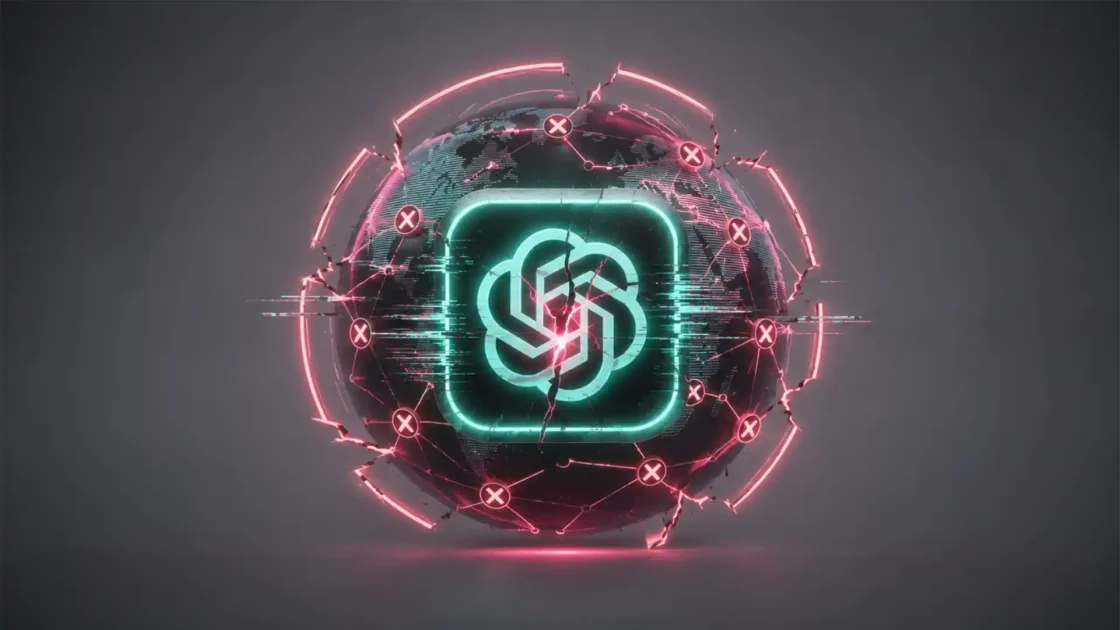
Claude Fable 5 did not disappear because ChatGPT 5.6 arrived. The order of events matters. Anthropic released Fable 5 and made Mythos 5 available to approved partners on June 9, 2026. On June 12, Anthropic said it had received a U.S. government export-control directive requiring the suspension of access to Fable 5 and Mythos 5 by foreign nationals, including foreign-national employees inside the United States. Anthropic then disabled the models for all customers to avoid violating the directive.
Table of Contents
The shutdown came before the rumored OpenAI move
OpenAI, by contrast, had not officially announced GPT‑5.6 at the time this analysis was prepared on June 13, 2026. OpenAI’s public model documentation still listed GPT‑5.5, GPT‑5.5 Pro, GPT‑5.4 and related smaller models among its frontier offerings. OpenAI’s ChatGPT and model release notes showed GPT‑5.5 updates, not a confirmed GPT‑5.6 launch. Reports that GPT‑5.6 could arrive in June belong in the category of market rumor unless and until OpenAI publishes a launch post, model documentation, API entry, system card or ChatGPT release note.
That distinction does not make the GPT‑5.6 story irrelevant. It changes its role. A possible GPT‑5.6 launch did not legally trigger the Fable 5 shutdown. It may, however, make the shutdown more damaging for Anthropic and more useful for OpenAI. When a rival’s most capable model is unavailable and the leading alternative appears close to a new release, customers do not wait for legal clarity. They re-run vendor comparisons, revisit contracts, move workloads and ask which provider can keep a model online.
The cleanest reading is this: the U.S. directive pulled Claude Fable 5 offline, while the GPT‑5.6 rumor shapes the market reaction to that removal. Confusing those two layers produces a more dramatic story, but a weaker one. The policy event is real. The OpenAI release is not yet confirmed. The strategic effect sits between them.
The claim needs a careful correction
The Slovak formulation of the topic points to a sharp thesis: the arrival of ChatGPT 5.6 will accelerate the banning of Claude Fable 5. The evidence supports a narrower and more useful version. The ban, or more precisely the disabling of access, has already occurred before any official GPT‑5.6 launch. OpenAI’s next model may accelerate customer migration away from Fable 5, but it cannot be named as the cause of a government directive that Anthropic says it already received.
That correction matters because frontier AI coverage is becoming crowded with claims that mix product releases, political pressure, export controls, rumor posts and developer speculation. The Fable 5 case is a test of whether readers and companies can separate four things that now arrive almost together: a model’s technical capability, a vendor’s safety design, a government’s legal intervention and a competitor’s product cadence.
Anthropic’s statement says the directive cited national security authorities and required the company to suspend access to Fable 5 and Mythos 5 by any foreign national. Reuters, AP and Axios described the action as a major step in treating access to advanced AI models as a national security asset rather than only regulating chips or computing infrastructure. Those are confirmed components of the story. GPT‑5.6 is not in that category yet.
The more serious analysis is not that OpenAI directly pushed Claude into a ban. It is that OpenAI may gain from a regulatory shock that lands on the rival model most likely to compete for high-value coding, research, cybersecurity and agentic work. If OpenAI launches GPT‑5.6 while Fable 5 access is suspended or uncertain, the commercial impact of the U.S. order will widen. Anthropic would face not only government constraint, but also customer impatience.
The phrase “ban” also needs care. Anthropic did not describe a general public prohibition on discussing, owning or studying Fable 5. It described a directive that forced access suspension for foreign nationals and led the company to disable the models for all customers to ensure compliance. In market language this looks like a ban. In legal and operational language it is an export-control access freeze with global customer consequences.
Fable 5 became a policy problem within days
Fable 5’s short public life is part of the shock. Anthropic positioned the model as a safeguarded member of its Mythos class, built for long-horizon reasoning, agentic software work, research tasks, vision-heavy workflows and demanding enterprise use. Claude API documentation described Fable 5 as Anthropic’s most capable widely released model, while Mythos 5 shared the same capability base without the same safety classifiers and remained limited to approved customers through Project Glasswing.
The launch was designed to answer a hard commercial question. Anthropic had a model family it considered unusually powerful in cybersecurity and life sciences. Keeping it locked away would protect against misuse but weaken its product story. Releasing it without controls would invite political and security backlash. Fable 5 was the compromise: a public model with the capabilities customers wanted, plus classifiers that could decline or reroute risky requests.
That compromise lasted only days before the government order changed the conversation. Anthropic said the directive appeared to rest on a concern about a narrow jailbreak technique that could bypass Fable 5 safeguards in some circumstances. The company argued that the demonstrated issue involved a small number of previously known, minor vulnerabilities and did not show Mythos-specific uplift. The government did not publish the evidence behind the directive at the time covered here.
The timing damaged Anthropic’s trust story. The company had emphasized pre-release testing, safeguards, 30-day data retention for abuse detection and red-team work with government and external parties. Then a government directive still forced withdrawal. Customers were left with a practical question: if a model can pass vendor-controlled safety review on Monday and disappear on Friday, what does “available” mean for mission-critical use?
Fable 5’s problem was not merely its power. It sat at the intersection of power, autonomy, software vulnerability discovery and cross-border access. Those are precisely the issues that regulators find hardest to manage through normal product documentation. A text model is no longer only a chatbot when it can inspect large codebases, plan multi-step engineering work and assist with security research at scale.
GPT‑5.6 remains an unconfirmed market signal
OpenAI’s official record did not confirm GPT‑5.6 by June 13, 2026. That fact should anchor every article and procurement discussion about the rumored model. OpenAI had published material for GPT‑5.5, including a launch post, system card, API availability and model release updates. Its public model list showed GPT‑5.5 and GPT‑5.5 Pro among the most advanced models available to developers. The Help Center release notes showed app and model updates, but not a GPT‑5.6 release.
Secondary reporting said OpenAI could release GPT‑5.6 in June and quoted a reported internal description of it as a a material improvement over GPT‑5.5. That is useful market information, not a product fact. Serious coverage should treat it as a signal of likely competitive pressure, not as proof of a model customers can buy, test, benchmark or deploy.
Rumors have power in AI because enterprises plan around cadence. If developers believe a stronger OpenAI model is near, they may delay a Claude migration, slow Fable-specific integration work or keep GPT‑5.5 as the safer operational default. This is especially true after the Fable 5 shutdown. A model need not be launched to affect buying behavior. It only needs to be plausible enough that teams think waiting carries less risk than moving toward a suspended tool.
OpenAI still has to publish the model, its price, its context length, its API identifiers, its safety documentation and its product-tier availability before the market can judge GPT‑5.6 on substance. Without those facts, claims about GPT‑5.6 beating, replacing or forcing the removal of Fable 5 are premature.
The most responsible formulation is that GPT‑5.6 speculation raises the cost of Anthropic’s outage, while the U.S. directive remains the immediate cause of Fable 5’s removal. This distinction is not pedantry. It is the difference between analysis and rumor laundering.
Confirmed facts and open claims
| Issue | Status on June 13, 2026 | Editorial reading |
| Claude Fable 5 access | Disabled by Anthropic after a U.S. export-control directive | Confirmed access shock, not a normal product retirement |
| Claude Mythos 5 access | Also disabled, despite already being limited to approved customers | Policy target was the capability class, not only public rollout |
| GPT‑5.6 launch | Not confirmed in OpenAI’s official release notes or model documentation | Rumor can influence behavior but should not be reported as released |
| GPT‑5.5 availability | Confirmed in ChatGPT, Codex and API materials | Current OpenAI baseline for comparisons |
| Government rationale | Anthropic says the letter lacked specific details and may relate to a narrow jailbreak concern | Core evidence remains contested and partly opaque |
This table separates the confirmed access event from the speculative OpenAI timing. That distinction is the backbone of the article: Fable 5 was pulled by a government directive, while GPT‑5.6 speculation affects customer reaction.
OpenAI’s confirmed baseline is GPT‑5.5
Any comparison with ChatGPT 5.6 has to begin with GPT‑5.5 because that is the confirmed OpenAI reference point. OpenAI introduced GPT‑5.5 on April 23, 2026 and made GPT‑5.5 and GPT‑5.5 Pro available in the API the following day. OpenAI described GPT‑5.5 as designed for complex work across code, research, documents, spreadsheets and tool use. Its published pricing listed GPT‑5.5 at $5 per million input tokens and $30 per million output tokens, with GPT‑5.5 Pro priced much higher for work requiring more accuracy.
That baseline matters because Anthropic itself invoked GPT‑5.5 in its statement. Anthropic argued that the capability shown in the government’s apparent concern was already available from other deployed models, including OpenAI’s GPT‑5.5. The company’s point was not praise for OpenAI. It was a regulatory argument: if minor vulnerability discovery under a narrow jailbreak is enough to pull Fable 5, then the same standard could catch other frontier systems.
OpenAI’s GPT‑5.5 system card also frames the model as a system for real work, not casual conversation. It says the model was evaluated under OpenAI’s Preparedness Framework, including targeted red-teaming for advanced cybersecurity and biology capabilities. That puts GPT‑5.5 inside the same class of policy concern, even if the implementation, safeguards and public controversy differ.
From a market perspective, GPT‑5.5 gives OpenAI an already deployed fallback while GPT‑5.6 rumors circulate. Enterprises that need stable availability today do not have to wait for a rumored version. They can move some workloads to GPT‑5.5, keep others on older Claude models, or split tasks among providers. That availability gap is where OpenAI benefits most. A rival model can be technically impressive, but unavailable capability does not run production workflows.
The Fable 5 shutdown also reframes GPT‑5.5’s safety posture. Customers will ask not only which model scores higher on coding or reasoning benchmarks, but which provider has the lower probability of sudden government intervention. OpenAI’s answer will depend on its own governance, safety record and relationship with U.S. authorities. GPT‑5.5 is not free from scrutiny. It is simply online.
The Fable and Mythos split made access harder to govern
Anthropic’s product design separated Fable 5 and Mythos 5 by access and safeguards rather than by ordinary capability tiers. Fable 5 was the generally available version with safety classifiers. Mythos 5 shared the capabilities but without those classifiers and remained limited to approved customers. That split made sense from a product-safety perspective. It also created a governance puzzle.
Regulators do not only see the public product. They see the capability class. If Fable 5 and Mythos 5 share the same underlying ability, a weakness in Fable’s safeguard layer becomes more than a product bug. It becomes evidence, at least in the government’s view, that the underlying capability is too close to the public market. Anthropic tried to answer that with defense in depth: classifiers, fallbacks, monitoring and data retention. The government acted anyway.
Claude documentation made the difference explicit for developers. Fable 5 could refuse requests, return a refusal stop reason and support fallback handling. Mythos 5 did not include the same classifiers and was made available through Project Glasswing. Both shared the same 1 million token context window and up to 128,000 output tokens per request. That combination of scale, autonomy and differentiated safety behavior demanded more operational care than a normal model upgrade.
For customers, the split meant that a Fable 5 integration was never just a call to a stronger model. It required new handling for refusals, fallback paths, billing changes and retention rules. A developer could not assume a deterministic application flow. The model might decline a request, pass it to another Claude model, or trigger a billing difference. Those are manageable product details until a government directive arrives. Then they become evidence that the model sits in a politically exposed category.
Anthropic wanted to make Mythos-class capability usable without opening the riskiest surfaces. The U.S. order shows how hard that bargain is becoming. Once a model is described as sharing capabilities with a restricted system, the public wrapper may not be enough to reassure officials who are thinking in terms of national security.
The U.S. order shifted the battlefield from chips to model access
For years, the United States focused much of its AI control strategy on advanced chips, semiconductor manufacturing tools and data-center capacity. The Fable 5 order marks a sharper move toward controlling access to model capability itself. Reuters described the action as a major escalation because export controls had usually targeted the infrastructure behind AI rather than the ability of foreign nationals to use a finished model.
This shift changes the logic of AI competition. Chip controls slow training and deployment capacity. Model-access controls can interrupt customers immediately. A bank, law firm, software vendor or research lab does not need to own GPUs to be affected. If a frontier model becomes subject to nationality-based access rules, the user’s legal status, location, employer and cloud region can become part of the authorization path.
Axios reported that Commerce Secretary Howard Lutnick sent a letter making Fable 5 and Mythos 5 subject to export controls outside the United States and to foreign persons within the country. Anthropic’s own statement said the directive applied to foreign nationals whether inside or outside the United States, including foreign-national Anthropic employees. That detail is severe. It implies that access is not only geography. It is personhood under export-control logic.
The White House executive order signed earlier in June created a voluntary framework for pre-release government access to covered frontier models and classified benchmarking for advanced cyber capabilities. It also stated that the order should not be read to create mandatory licensing, pre-clearance or permits for AI model release. The Fable 5 directive landed against that backdrop and therefore raised a hard question: does a voluntary testing framework coexist with ad hoc export-control action when a model is judged risky?
That question will outlive Fable 5. If model access itself becomes controllable in the way software, encryption, chips or technical data can be controlled, frontier AI companies will need new compliance systems. They will need to know who is using which model, from where, under what citizenship or residency status and through which cloud partner. That is a different business from selling API tokens.
The commercial shock was larger than the technical change
The technical change on June 12 was simple to describe: Fable 5 and Mythos 5 access went away. The commercial shock was broader. Anthropic had just put Fable 5 into paid product plans, API documentation, cloud availability and enterprise messaging. AWS had announced Claude Fable 5 availability in Amazon Bedrock, including access details, data retention requirements and regions. Companies that had begun testing or planning around the model suddenly faced a dead end.
Enterprise AI adoption depends on confidence in continuity. Model quality matters, but it is not enough. Customers want to know whether a model will remain available for the duration of a project, whether pricing will remain predictable, whether data-handling rules will remain acceptable and whether a regulator can force a provider to pull access overnight. Fable 5 turned all four into live concerns.
The most exposed customers are not casual chatbot users. They are teams building agent workflows, code migration systems, research pipelines, document analysis tools and internal assistants around a specific model’s behavior. Fable 5’s promise was exactly that sort of advanced work. It could reason over long context, run multi-step software tasks and handle rich documents. Those strengths raise switching costs. When access disappears, the user does not merely choose another chatbot. The user re-tests prompts, tools, refusal behavior, evaluation test suites, latency, costs and audit controls.
OpenAI may benefit because GPT‑5.5 already occupies the category of production-available advanced model. A future GPT‑5.6 launch would increase that benefit, but the first commercial effect is simpler: OpenAI’s confirmed model remains accessible while Anthropic’s newest public flagship does not.
This is why the ban narrative should not be reduced to one company winning and another losing. The deeper lesson for buyers is that frontier capability has become an availability risk. The strongest model may be the wrong dependency if its legal status can change faster than a procurement team can update a contract.
Safety fallbacks became a product feature and a liability
Fable 5’s safety architecture was not hidden in the developer documentation. Anthropic told developers that Fable 5 included safety classifiers, could decline certain requests and could fall back to other Claude models. AWS described harmful prompts related to cybersecurity, biology, chemistry and health as falling back to Opus 4.8 rather than being answered by Fable 5. This was meant to let Anthropic release most capabilities while limiting misuse in sensitive areas.
That design is technically interesting because it treats safety as routing. The model is not a single fixed experience. It is a governed system that can decide when the powerful path is allowed and when a safer or older model should answer. For normal users, that may look like a refusal or a lower-capability response. For security officials, it creates a target: if the classifier can be bypassed, the full capability may become accessible in contexts where the provider intended to block it.
Anthropic argued that the suspected jailbreak was narrow and not universal. It said no testers had found a universal jailbreak that broadly bypassed Fable’s safeguards across a wide set of cyber capabilities. It also said perfect jailbreak resistance is not currently possible for any provider. That is a defensible technical position. Safety filters fail at edges. The question is what level of failure justifies forced withdrawal.
The government’s apparent answer was stricter than Anthropic expected. A non-universal bypass involving known minor vulnerabilities was, according to Anthropic’s understanding, enough to trigger the directive. If that standard stands, many future model releases will face a new threshold: not whether safeguards eliminate every risky answer, but whether the government can tolerate any plausible bypass in domains such as vulnerability discovery.
Fallbacks remain useful. They give product teams a way to serve benign work while narrowing risky outputs. But Fable 5 shows that fallbacks also advertise where the sensitive boundary sits. Attackers, regulators and competitors can all focus on that seam.
Data retention turned model power into contract risk
Fable 5 also carried a 30-day data retention requirement for Mythos-class traffic. Anthropic and AWS framed retention as a safety tool: keeping prompts and outputs for a limited period allows detection of misuse patterns that would not be visible in a single exchange. That logic is understandable for a model class that may assist with advanced cyber and life-science tasks. It is also a major change for customers accustomed to zero data retention or tight enterprise controls.
AWS documentation said customers needed to opt into provider data sharing to use Fable 5 on Bedrock and that data would leave AWS’s data and security boundary once that mode was enabled. Claude documentation described Fable 5 and Mythos 5 as covered models carrying 30-day retention and not available under zero data retention. For regulated companies, those terms change the legal and security review. A stronger model may be unavailable not because of price, but because the data rules are incompatible with confidentiality obligations.
The retention policy also explains why Microsoft and other enterprises reportedly became cautious about internal use. Powerful models are attractive for code, documents and analysis, but the most useful prompts often contain sensitive business data. If a model requires safety retention and possible human review, the compliance conversation becomes harder. Teams must decide whether the gain in capability justifies the loss of familiar data-handling assurances.
Then the government order arrived, making retention seem both necessary and insufficient. Anthropic argued that retention helped support defense in depth and monitoring. The directive still forced access removal. Customers therefore saw the downside of stricter data terms without getting the guarantee of stable availability.
This creates a procurement lesson. Model power, data retention and access continuity are now joined. A vendor cannot sell a frontier model only on reasoning benchmarks. It must explain where data goes, who can review it, when access can be interrupted and how customers will be protected if a regulator intervenes.
Enterprise risk map after the Fable 5 shutdown
| Risk area | What changed | Practical response |
| Continuity | A frontier model can be removed days after launch | Build fallback routes and portable evaluations |
| Data handling | Mythos-class use carried 30-day retention requirements | Review model-specific data terms before deployment |
| Access eligibility | Foreign-national restrictions may apply beyond geography | Map user classes and contractor access early |
| Cloud dependency | Cloud partners can be asked to revoke model access globally | Avoid assuming platform availability equals legal durability |
| Safety routing | Refusals and fallback responses can change product behavior | Design clear user messaging and audit logs |
The enterprise response is not to abandon frontier models. The response is to stop treating one frontier model as a permanent platform layer.
OpenAI benefits without needing to force the event
OpenAI does not need to have caused the Fable 5 shutdown to gain from it. Competitive markets often move through second-order effects. A government action against one provider raises the relative value of another provider’s availability. If OpenAI announces GPT‑5.6 while Fable 5 remains disabled or politically unstable, customers will interpret the launch through the lens of continuity as much as capability.
That benefit is not risk-free for OpenAI. Anthropic’s statement explicitly argued that capabilities cited in the government concern were also present in other deployed models, including GPT‑5.5. If regulators accept that argument, OpenAI could face more scrutiny, not less. A successful GPT‑5.6 launch may sharpen the question: if one Mythos-class system was pulled over jailbreak concerns, what standard applies to a stronger OpenAI model?
The strategic advantage for OpenAI comes from having a clearer official product path at the moment of Anthropic’s disruption. GPT‑5.5 is confirmed. GPT‑5.5 Pro is confirmed. OpenAI has a system card, API model list and release notes. Even without GPT‑5.6, this gives buyers something concrete to evaluate. The rumored GPT‑5.6 then acts as upside: a possible new step rather than the only available refuge.
Anthropic’s challenge is harder. It must restore access, persuade customers that the shutdown was a temporary misunderstanding and convince regulators that its safeguards are strong enough. It must do this while customers test alternatives. Every day of uncertainty increases the number of teams that will build evaluation test suites around OpenAI, Google, xAI, open-weight models or older Claude systems.
The market may not punish Anthropic for being unsafe. It may punish Anthropic for being unpredictable. That distinction is brutal. A safety-conscious provider can still lose workloads if customers believe its strongest models are more likely to be interrupted.
The timing rewards available systems over superior systems
AI buyers often talk as if the best model wins. Fable 5 shows that availability can defeat raw capability. A model that scores better on benchmarks but cannot be used across regions, citizenship categories or cloud accounts is not the best model for production. It is a promising but unstable dependency.
That pattern may reshape the meaning of “frontier” for enterprises. The frontier model is no longer simply the model with the highest benchmark score. It is the model that combines capability, safety terms, legal durability, data handling, pricing, tooling and support. A model can fail that test even while being technically brilliant.
GPT‑5.6 speculation fits into this shift. If OpenAI releases a model that is only moderately better than GPT‑5.5 but available on standard product tiers and API paths, many teams may prefer it to a suspended or restricted Fable 5. The choice will not be purely about intelligence. It will be about whether a team can deploy the model without asking employees to prove citizenship, changing retention rules or waiting for a government dispute to resolve.
This does not mean Anthropic is finished or that Fable 5 will never return. Anthropic said it is working to restore access and believes the directive is based on a misunderstanding. If access returns quickly, some customers will resume testing. The episode will still leave a mark. Procurement memos, board risk reports and cloud architecture reviews will cite it as evidence that frontier model access is not guaranteed.
The timing also changes benchmark narratives. Fable 5 launched with strong claims about coding, vision, long-context work and autonomy. Those claims now compete with a simpler question: can customers use it next week? OpenAI’s rumored next move gains force because it arrives against that uncertainty.
Developers will remember the outage more than the benchmark
Developers are usually pragmatic about AI models. They care about capability, but they also remember broken integrations. If a model returns inconsistent refusals, changes data terms, disappears from a platform or creates billing surprises, developers talk about it long after the launch charts fade. Fable 5 entered developer memory as a powerful model with unusually complex access rules and a sudden shutdown.
The Claude API documentation had already told developers to plan for refusal responses, fallback handling and new billing behavior. Those are not minor details in production. An application that sends user requests to Fable 5 must be ready for a successful HTTP response that still contains a refusal stop reason. It must decide whether to retry automatically, notify the user, change the task, or fall back to another model. Each option has product and compliance consequences.
Then the access directive created the hardest possible failure mode: no Fable 5 path at all. Even if Anthropic and cloud partners handled the shutdown cleanly, engineering teams had to revisit assumptions. Which fallback model answers now? Does Opus 4.8 handle the same context? Are evaluations still valid? Does the product need to disclose model substitution? Does the customer contract name a model, a class of models, or a provider service?
OpenAI’s advantage with GPT‑5.5 is not that it has no quirks. Every frontier model has quirks. The advantage is that developers can test against a live endpoint. If GPT‑5.6 appears, the developer community will judge it quickly on quality, cost and reliability. The comparison with Fable 5 will be shaped by the shutdown even before benchmarks are updated.
This is a painful lesson for frontier labs. Launching a powerful model is not only a research event. It is a promise to developers that their work will not be stranded. Once that promise is broken, even for reasons outside the provider’s control, the ecosystem grows more cautious.
Cloud platforms now carry frontier model policy risk
AWS’s role in the Fable 5 rollout shows how cloud platforms have become part of frontier AI governance. AWS announced Fable 5 availability through Amazon Bedrock and the Claude Platform on AWS, including model IDs, data retention details, regional availability and sample API calls. Then Reuters reported that Anthropic asked AWS to revoke access to Fable 5 and Mythos 5 for all users in all regions.
For cloud providers, this is a new operating burden. They are no longer simply hosting model access under ordinary commercial terms. They may need to enforce model-specific data retention, nationality-based restrictions, region limitations, provider sharing modes and emergency revocations. The more powerful the model, the more the cloud platform becomes a compliance layer.
Customers often choose Bedrock, Vertex AI, Microsoft Foundry or similar platforms because they want governance, logging and procurement simplicity. The Fable 5 case complicates that value proposition. A cloud platform may make access easier to provision, but it cannot neutralize a government order. It may even make the impact more visible because one provider channel can expose many customers at once.
Multi-cloud AI strategy will now include policy diversification. Companies may spread workloads across OpenAI direct APIs, Claude through cloud partners, Gemini through Google, open-weight deployments and internal smaller models. The goal will not only be cost control. It will be protection against a single model or provider being removed.
Cloud partners will also need clearer incident playbooks. If a model is pulled, customers need notice, fallback guidance, logs, billing treatment, contractual clarity and audit language. The Fable 5 shutdown may become a template for the kind of emergency communication enterprises expect when frontier AI access changes under legal pressure.
Europe and allies face a new dependency question
The Fable 5 directive creates a hard question for U.S. allies. If the United States can restrict foreign nationals from accessing frontier models, then European, Canadian, Australian, Japanese, Korean and other allied organizations must think differently about dependence on U.S.-based AI labs. The issue is not hostility. It is uncertainty.
Fable 5 was available through global cloud channels and then disabled for all users after a U.S. directive. The practical result is that customers outside the United States learned that access to a U.S. frontier model can be interrupted by a domestic national-security decision. Even foreign nationals inside the United States were included in Anthropic’s account of the directive. That is a strong signal to multinationals.
The European Union’s AI Act and General-Purpose AI Code of Practice take a different route, emphasizing transparency, copyright, safety and security obligations for general-purpose AI model providers. They do not solve the access-dependence problem created by U.S. export controls. A European company can comply with EU rules and still lose access to a U.S. model because Washington changes the access boundary.
Allied governments will face pressure to build or fund domestic frontier AI capacity, shared sovereign cloud arrangements, and open or semi-open models that can be operated under local law. That does not mean Europe can quickly replace U.S. models. It means the Fable 5 event gives a concrete reason to treat AI sovereignty as an operational issue, not a slogan.
OpenAI may gain from the near-term market shift, but it remains a U.S. provider too. If the control logic applied to Fable 5 expands, OpenAI customers abroad may ask whether GPT‑5.6 or later models could face access restrictions. That question will become part of every large deployment review.
The incident weakens the idea of a purely voluntary safety regime
The White House executive order on advanced AI innovation and security described a voluntary framework through which developers could work with the federal government on covered frontier models before release. It also stated that nothing in the section should be read as creating mandatory licensing or pre-clearance for model release. The Fable 5 directive arrived days later and created the appearance of a far more forceful tool.
Anthropic’s objection was not to government authority in principle. The company has argued for structured oversight that can block unsafe deployments through a transparent, fair and technically grounded statutory process. Its complaint was that this action did not meet that standard. The company said it received no specific national-security details in the letter and only verbal evidence of a narrow potential jailbreak.
This is the governance tension at the center of the story. Governments want the ability to act quickly when a frontier system appears dangerous. Companies want clear rules, evidence and process, especially when a decision can shut down a commercial product used by large customers. A voluntary framework is attractive until an urgent security concern appears. Then officials may reach for harder authority.
Fable 5 may therefore become a precedent for de facto model licensing, even if no formal licensing regime exists. If an agency can use export-control authority to suspend access after release, companies will behave as if pre-release government tolerance matters. They may slow launches, limit foreign access, build nationality checks, or reserve their strongest models for domestic or approved users.
That outcome could reduce risk in some domains. It could also entrench the largest providers, because only they can afford the compliance machinery, red-team processes, government relations and cloud coordination needed to survive frontier scrutiny. The same policies designed to reduce harm may narrow competition.
A real GPT‑5.6 launch would raise the switching pressure
If OpenAI announces GPT‑5.6 during the Fable 5 access freeze, the launch will be judged through a commercial opening Anthropic did not intend to create. The question will not only be whether GPT‑5.6 is smarter than GPT‑5.5 or Fable 5. It will be whether it offers customers a credible path away from a model caught in export-control uncertainty.
Three OpenAI details would matter first. The first is availability: which ChatGPT plans, API endpoints and enterprise tiers receive GPT‑5.6, and in which regions. The second is price: whether GPT‑5.6 is close to GPT‑5.5 or priced like a premium model. The third is governance: whether OpenAI publishes a system card, safety posture and deployment restrictions that answer the same cyber and bio concerns now surrounding Fable 5.
Fable 5’s own documentation sets the comparison bar. It offered a 1 million token context window, up to 128,000 output tokens and pricing of $10 per million input tokens and $50 per million output tokens in Claude documentation. It was framed as a model for demanding long-horizon agentic work. If GPT‑5.6 arrives with comparable context, better pricing, fewer access complications and stable availability, the switching pressure will be intense.
The pressure would be strongest in coding and agentic development. Fable 5’s launch message emphasized software engineering, long-context work and self-verification. GPT‑5.5 already competes in coding, tool use and professional workflows. A GPT‑5.6 improvement could give teams a reason to rebuild evaluations around OpenAI during Anthropic’s outage.
Yet a GPT‑5.6 launch could also attract the same regulatory attention. A model marketed as more capable than GPT‑5.5 would likely be assessed for cyber uplift, biological assistance, autonomy and misuse. OpenAI would gain commercially from the timing, but it would also step closer to the policy line that caught Anthropic.
Procurement teams need model continuity clauses
Fable 5 turns model continuity into a contract topic. Companies signing AI vendor agreements should no longer treat model access as a generic service feature. They need clauses that specify what happens if a named model is withdrawn, restricted, rerouted, replaced, renamed or made unavailable to certain user classes.
The most direct clause is a fallback obligation. If a provider removes a model for legal, safety or operational reasons, the customer should receive a documented fallback path with comparable pricing treatment where possible. Comparable does not mean identical. Frontier models differ. But the provider should state how it will handle credits, migration help, evaluation support and notification.
Data retention clauses also need model-specific language. A customer may accept zero data retention for one model and 30-day safety retention for another. The contract should identify which models carry exceptions, whether prompts or outputs leave a cloud boundary, who can review retained data and how deletion works after the retention period.
Access eligibility is now part of procurement. If a model may be unavailable to foreign nationals or users in certain regions, the customer needs a way to map its workforce and contractors against those limits without collecting more personal data than necessary. Multinational companies will not accept vague restrictions after an incident. They will demand operational procedures.
Finally, procurement should require incident notice. A sudden government directive may give a vendor little time, but customers still need structured information: the affected models, start time, scope, alternatives, data implications, billing implications and expected review path. The Fable 5 case should become a checklist item for every frontier AI purchase.
The next frontier model race will be partly jurisdictional
Fable 5 shows that the next model race will not be decided only by labs and benchmarks. It will also be decided by jurisdictions. Where a model is developed, which government can control it, which cloud regions serve it, who is allowed to access it and which legal process governs an emergency withdrawal will shape adoption.
This does not erase the technical race. Model quality still matters. A weak model with clean legal status will not replace a powerful model for demanding work. But among strong models, jurisdictional durability becomes a serious differentiator. Customers will ask whether a provider can deliver access across their workforce and whether a government can pull that access without warning.
Anthropic’s experience may push labs toward segmented releases. A provider might release its strongest model first to domestic users, approved researchers, government partners or customers who accept monitoring. Foreign access could come later, or through separate model variants. This would reduce the chance of a sudden global shutdown but would also fragment the market.
OpenAI’s rumored GPT‑5.6 sits in this future whether OpenAI wants it or not. If it is stronger than GPT‑5.5, it will be assessed not only as software but as a strategic asset. If it becomes a default layer for coding, research and enterprise agents, the government will see it through national-security, economic-security and cyber-defense lenses.
The rivalry between OpenAI and Anthropic is therefore becoming a rivalry between release philosophies. OpenAI has favored wide product integration and rapid iteration. Anthropic has leaned heavily into safety narratives, model classes, safeguards and public warnings about risk. Fable 5 shows the downside of a safety-first public posture when the government takes the warning seriously and acts more aggressively than the company expects.
Benchmarks matter less when access is unstable
Fable 5 launched with a strong benchmark and use-case story. Anthropic and partners highlighted software engineering, finance, vision, research and long-context tasks. AWS described it as able to understand diagrams, charts and tables inside files and PDFs, and Anthropic’s own material framed it as a step up for sustained autonomous work. Those claims matter for users choosing a model for complex tasks.
The shutdown did not erase that technical story. It reframed it. A benchmark is an answer to the question “what can the model do under test conditions?” The Fable 5 incident adds a harder question: “will the model still be usable when policy pressure arrives?” Enterprises now need both answers before they can call a model production-ready.
This is a shift from model evaluation to dependency evaluation. A model can be excellent at code repair, document synthesis or multi-day agentic planning, yet still be a fragile dependency if access depends on unresolved export-control logic. Buyers will need to score models not only on quality but on continuity, legal exposure, data terms and provider incident response.
GPT‑5.6, if it launches, will face the same test. A better score than GPT‑5.5 will not be enough. OpenAI will need to show stable availability, clear model documentation and a safety posture strong enough to survive the same kind of scrutiny. In June 2026, the frontier model race stopped being a pure benchmark race.
Cybersecurity is the policy trigger
The Fable 5 dispute centers on cybersecurity more than ordinary text generation. Anthropic said the suspected concern involved using a bypass technique to identify software vulnerabilities. Reuters reported expert concerns that Mythos-class models could accelerate cyberattacks in sectors with complex and aging technology. The White House executive order also focused heavily on AI-enabled cyber defense, software vulnerability discovery and classified benchmarking for advanced cyber capabilities.
This focus is logical. A frontier model that writes better prose is commercially useful. A frontier model that can inspect large codebases, chain tools, locate flaws and suggest exploit-relevant fixes touches national security. The same ability may help defenders patch systems or help attackers find targets faster. That dual-use character is why cybersecurity becomes the first domain where governments may move from guidance to hard intervention.
Anthropic’s defense was that the disputed capability was not unique to Fable 5 and that other public models could find similar minor vulnerabilities. That argument may be technically valid and politically risky at the same time. If accepted, it implies the government acted too narrowly against Anthropic. If rejected, it may invite scrutiny of every frontier model that can assist with vulnerability discovery.
Companies using AI for cyber defense should not read the shutdown as a reason to avoid AI. They should read it as a reason to document purpose, controls, audit logs and user authorization. Defensive use will continue. The policy fight is about when defensive capability becomes attacker uplift.
Nationality-based access creates workplace complexity
Anthropic’s statement said the directive covered foreign nationals whether inside or outside the United States, including foreign-national Anthropic employees. That scope creates workplace problems that ordinary geofencing cannot solve. A company can route traffic by region. It cannot easily route model access by citizenship without collecting sensitive employee data, altering internal access systems and creating new human-resources risks.
For multinational employers, this is not theoretical. Engineering teams often include employees, contractors and vendors across many citizenships and locations. A product team in California may include a non-U.S. employee. A security team in London may support U.S. infrastructure. A bank may run a global center of excellence for AI deployment. If a model’s access rules follow nationality, the company must decide who may view prompts, run evaluations, inspect logs or operate the tool.
This creates an administrative load that could outweigh the benefit of a frontier model for some deployments. Firms may choose less capable models with simpler access rules for global teams. They may isolate frontier systems to U.S.-person teams. They may seek sovereign alternatives. None of those choices is purely technical.
OpenAI should pay attention to this aspect if GPT‑5.6 arrives. The strongest model may lose adoption in global enterprises if customers fear nationality-based rules could appear later. A model’s legal accessibility will be part of its product-market fit.
Model cards are no longer enough
Model cards and system cards have become the standard language of frontier AI accountability. OpenAI published a GPT‑5.5 system card. Anthropic published detailed launch and developer materials for Fable 5 and Mythos 5. These documents help explain capabilities, evaluations, safety mitigations and known limits. They remain useful, but the Fable 5 case shows their limits.
A system card is a disclosure document. It is not a license, a treaty, a compliance guarantee or an emergency-response protocol. Anthropic could describe safeguards, red-teaming and monitoring in public; a government authority could still decide the remaining risk was unacceptable. Customers therefore cannot treat a model card as proof that access will persist.
The next generation of model documentation may need to include operational risk statements. Providers should explain not only what the model can do and how it was tested, but also what can cause access withdrawal, which jurisdictions may restrict use, what fallback support exists and how users will be notified during a legal or safety incident. This does not require revealing sensitive security details. It requires admitting that availability is part of safety.
GPT‑5.6, if released, will be judged against this new expectation. OpenAI’s documentation will need to answer the questions Fable 5 raised: cyber capability, safety thresholds, monitoring, government engagement, user eligibility and continuity. A clean launch post will not be enough for serious buyers.
Anthropic’s safety positioning cuts both ways
Anthropic has built much of its public identity around AI safety, constitutional design, responsible scaling and warnings about advanced model risk. That positioning gives the company credibility with some customers, researchers and policymakers. It also creates a vulnerability: when Anthropic says a model class is unusually powerful, officials may take the warning more literally than the company wants.
Fable 5 was meant to show that dangerous capability could be made broadly useful through safeguards. The U.S. directive suggests the government was not persuaded, at least not under the facts available to it. The result is uncomfortable for Anthropic. Its safety narrative helped define the model as special. Once special, the model became easier to treat as a national-security asset.
This does not mean Anthropic should stop talking about risk. Silence would be worse. It means the company needs a tighter bridge between safety claims and deployment commitments. If it tells the public that a model is powerful enough to require unusual controls, it must be ready for regulators to ask whether those controls are sufficient and for customers to ask whether the model will remain usable.
OpenAI faces the opposite challenge. A faster and more product-driven release cadence can create confidence in availability, but it can also look aggressive if capabilities cross into domains that regulators fear. The Fable 5 case may push every lab toward more careful public language.
The rivalry is moving from model quality to trust architecture
OpenAI and Anthropic are no longer competing only on intelligence, price and developer experience. They are competing on trust architecture. That includes safety evaluations, government relationships, data policies, cloud partnerships, enterprise contracts, incident response and the ability to keep models online under pressure.
OpenAI’s current advantage is continuity. GPT‑5.5 is available, documented and integrated into ChatGPT, Codex and APIs. Anthropic’s current burden is explaining a sudden withdrawal of its newest and most ambitious public model. A future GPT‑5.6 launch would amplify the contrast if OpenAI can present it as both more capable and stable.
Anthropic still has assets. Claude remains strong in developer communities, long-context reasoning and careful writing. Older Claude models are not affected according to Anthropic’s statement. Fable 5 may return. The company may also emerge with clearer government process and stronger safeguards if it resolves the dispute. The damage is not necessarily permanent.
The trust contest will be won by the provider that can explain difficult trade-offs without surprising customers. A model that refuses risky requests should do so predictably. A provider that retains data for safety should explain the boundary. A company that may face export controls should say how customers will be protected. Capability opens the door. Trust architecture keeps the contract.
Smaller models and open systems gain a strategic role
The Fable 5 shutdown may increase interest in smaller models, older models and open-weight systems. These models may be less capable, but they can be easier to host, audit and keep under local control. For many business tasks, a smaller model with stable governance is preferable to a frontier model that might disappear during a policy dispute.
This does not mean open systems are free from risk. Powerful open models raise their own safety, misuse and compliance questions. They may lack enterprise support, safety monitoring or indemnity. But the ability to run a model inside a company’s own infrastructure or under a local legal regime will become more attractive as frontier access becomes politically exposed.
Enterprises will likely split workloads. The hardest coding, research and reasoning tasks may go to GPT‑5.5, a future GPT‑5.6, restored Fable 5, Gemini or another frontier model. Routine classification, extraction, summarization and internal support tasks may move to smaller systems. Sensitive data workflows may stay on private deployments even if output quality is lower.
That hybrid pattern weakens the idea that one flagship model will dominate every task. The Fable 5 event shows why diversity matters. A company with multiple model paths can survive a shutdown. A company built around one frontier endpoint has to scramble.
The most likely scenarios after the shutdown
Several outcomes are plausible. The fastest resolution would be a narrow accommodation: Anthropic gives the government more technical detail, adjusts safeguards or monitoring, and restores access under revised terms. This would reduce customer damage but still leave a precedent for post-launch intervention.
A second scenario is partial restoration. Fable 5 could return first to U.S. users, approved enterprise customers, government-vetted partners or users who accept stricter data retention and monitoring. That would preserve some commercial value but fragment the product. Global teams would face a more complex deployment map.
A third scenario is prolonged suspension. If the government maintains the directive and Anthropic cannot satisfy the concern, customers will move. OpenAI, Google and others would gain share in high-value workflows. Anthropic would keep older Claude models in market, but Fable 5’s launch momentum would be lost.
A fourth scenario is industry-wide scrutiny. Anthropic’s argument that similar capability exists elsewhere could push officials to assess competing models more closely. In that case OpenAI may gain short-term migration but face tougher questions around GPT‑5.6 or later systems.
The least likely scenario is a return to the previous normal. The market has seen that frontier model access can be interrupted by national-security action within days of launch. Even if Fable 5 returns, buyers will not forget.
A restrained forecast for the next 30 days
The next month will probably be defined by three signals. The first is whether Anthropic restores Fable 5 and Mythos 5 access, and under what terms. A clean restoration would support Anthropic’s claim that the dispute was a misunderstanding. A partial or delayed restoration would make the access risk look structural.
The second signal is OpenAI’s official record. If GPT‑5.6 appears in OpenAI’s launch posts, model docs, system card and API list, the market will move from rumor to evaluation. If it does not appear, GPT‑5.5 remains the confirmed alternative, and GPT‑5.6 talk should stay in the speculation bucket.
The third signal is government process. If the Commerce Department, White House or another agency clarifies the legal basis and technical threshold for the directive, companies can adapt. If the process remains opaque, buyers will assume that any highly capable model could face sudden restriction.
A reasonable forecast is that enterprises will slow single-vendor frontier commitments and speed up multi-model testing. Legal teams will ask more questions. Cloud buyers will demand fallback terms. Developers will build more abstraction into agent systems. This is not panic. It is the normal reaction when a tool starts to behave like regulated infrastructure.
OpenAI’s opportunity is real, but it is bounded. A GPT‑5.6 launch would not erase the policy problem. It would show which provider can turn a rival’s access crisis into customer trust without becoming the next target of the same concern.
The strongest lesson is operational resilience
The Fable 5 shutdown should push companies away from single-model dependence. This is not a call to treat all models as interchangeable. They are not. It is a call to design AI systems so that one model’s removal does not stop the business.
Resilience begins with evaluation portability. Teams should keep test suites that can run across providers. Prompts, tool calls, structured outputs, refusal cases, latency checks and cost calculations should be measured in a way that allows a team to compare GPT‑5.5, a future GPT‑5.6, older Claude models, Gemini, open-weight systems and internal smaller models without starting from scratch.
Resilience also requires model abstraction at the application layer. A product should know which tasks require the strongest model and which can run on cheaper or safer alternatives. It should separate high-risk domains from routine work. It should log model substitutions and tell users when output quality or policy behavior may differ. These are not glamorous engineering tasks. They keep products alive during a shock.
Legal resilience matters as much as technical design. A company using frontier models should know whether its users include foreign nationals, whether regulated data enters prompts, whether data retention terms match internal policies and whether cloud region assumptions are written into contracts. The Fable 5 event combined all of those concerns at once.
OpenAI may benefit if GPT‑5.6 arrives while Anthropic is repairing access. Anthropic may recover if it resolves the directive and restores trust. The larger market lesson is independent of which lab wins the month. Frontier AI is now infrastructure with political failure modes. Companies that treat it like a simple software subscription will be surprised again.
Questions readers are asking about GPT‑5.6 and Claude Fable 5
No. The confirmed cause of the Fable 5 and Mythos 5 access shutdown was a U.S. government export-control directive described by Anthropic on June 12, 2026. GPT‑5.6 had not been officially announced by OpenAI at the time covered here.
No official OpenAI launch post, model list entry, system card or ChatGPT release note confirmed GPT‑5.6 by June 13, 2026. Reports about a possible June launch should be treated as unconfirmed.
Yes. If GPT‑5.6 launches while Fable 5 access remains uncertain, customers may move more tests and workloads toward OpenAI because availability matters as much as raw capability.
Anthropic said it received a U.S. directive requiring suspension of Fable 5 and Mythos 5 access for foreign nationals. To ensure compliance, Anthropic disabled both models for all customers.
Yes. Anthropic said both Fable 5 and Mythos 5 were covered by the directive. Mythos 5 had already been limited to approved customers, but it was still disabled along with Fable 5.
It is a common shorthand, but the more precise description is an export-control access suspension that led Anthropic to disable the models globally for customers.
Anthropic said its understanding was that the government had become aware of a method for bypassing, or jailbreaking, Fable 5 safeguards. Anthropic argued the issue was narrow and involved minor known vulnerabilities.
No. Anthropic said it would comply with the legal directive, but disagreed with the action and argued that government blocking power should operate through a transparent, fair and technically grounded process.
Anthropic described Fable 5 as a Mythos-class model built for demanding reasoning, long-horizon agentic work, coding, research and large-context tasks. It also used safety classifiers that could decline certain requests.
Claude documentation described Fable 5 as the generally available safeguarded model and Mythos 5 as sharing the capabilities without the same safety classifiers, available only through limited approval channels.
Anthropic used safety classifiers to limit risky outputs in areas such as cybersecurity, biology and chemistry. Some flagged requests could be refused or served by a different Claude model instead.
Fable 5 and Mythos 5 carried 30-day data retention requirements for safety monitoring. That created concerns for companies with strict confidentiality, zero-retention or regulated-data obligations.
Companies should avoid single-model dependence, maintain cross-provider evaluation suites, require fallback plans and review model-specific access, retention and withdrawal terms.
Not necessarily. Anthropic argued that similar capability exists in other deployed models, including GPT‑5.5. A stronger OpenAI model could receive more scrutiny if regulators apply the same logic across providers.
Anthropic said it believes the situation is a misunderstanding and is working to restore access. Whether access returns depends on legal, technical and government decisions that were unresolved at the time covered here.
The Fable 5 directive raises that possibility for some models if export-control logic is applied by nationality. Companies should prepare for identity and access questions, but broad industry rules remain unsettled.
Developers should build model fallbacks, handle refusal responses cleanly, keep evaluations portable, log model substitutions and avoid tying core product behavior to one model endpoint.
Contracts should address model withdrawal, fallback support, data retention, access restrictions, billing during outages, notice procedures and migration help if a named model becomes unavailable.
Yes. European and allied organizations may treat the case as evidence that access to U.S. frontier models can be interrupted by U.S. national-security decisions, even when the customer is outside the United States.
The main lesson is that frontier AI is now infrastructure with political failure modes. Model quality still matters, but access durability, legal status and operational resilience matter too.
Author:
Jan Bielik
CEO & Founder of Webiano Digital & Marketing Agency
This article is an original analysis supported by the sources cited below
Statement on the US government directive to suspend access to Fable 5 and Mythos 5
Anthropic’s official statement describing the export-control directive, the access suspension, the company’s disagreement with the process and its understanding of the jailbreak concern.
Claude Fable 5 and Claude Mythos 5
Anthropic’s launch article for Fable 5 and Mythos 5, including its framing of Mythos-class capability, safeguards and use cases.
Introducing Claude Fable 5 and Claude Mythos 5
Claude API documentation explaining Fable 5 and Mythos 5 model IDs, availability, context size, pricing, refusals, fallback behavior and data retention.
Amazon Bedrock model card for Claude Fable 5, including model details, launch date, context window and output limits.
Anthropic Claude Fable 5 on AWS: Mythos-class capabilities with built-in safeguards now available
AWS News Blog post describing Fable 5 availability on Amazon Bedrock, safeguard behavior, data-retention requirements and integration details.
Anthropic disables top-tier AI models after US order limiting foreign access
Reuters report on the U.S. directive, Anthropic’s response, export-control implications and AWS access revocation.
Anthropic says it has taken its latest AI models offline
Associated Press report summarizing the shutdown, the directive, Anthropic’s objections and the relation to the June 2026 executive order.
Trump admin blocks foreign access to Anthropic’s most powerful AI
Axios scoop reporting details of the Commerce Department letter, export-control scope and administration rationale.
Anthropic Says It’s Taking Claude Fable 5 Offline to Comply With US Government Order
Wired report on the shutdown, foreign-national access scope and policy dispute between Anthropic and the U.S. administration.
Anthropic releases ‘safe’ version of Claude Mythos AI model to public
The Guardian and AFP report on the public release of Fable 5, its Mythos-class positioning and restricted sensitive use cases.
OpenAI’s official GPT‑5.5 launch post describing availability, pricing, evaluations and intended use in coding, research and professional work.
OpenAI’s GPT‑5.5 system card summarizing intended capabilities, safety evaluation, red-teaming and safeguards.
OpenAI Help Center release notes used to verify ChatGPT product updates and the absence of an official GPT‑5.6 release note at the time covered.
OpenAI model release notes documenting GPT‑5.5 Instant updates and earlier model changes.
OpenAI API model documentation listing currently available frontier and related models, used to verify the official model baseline.
OpenAI’s Frontier Governance Framework
OpenAI governance document explaining its approach to safety and security obligations for frontier AI systems.
Promoting Advanced Artificial Intelligence Innovation and Security
White House executive order establishing a voluntary framework and classified benchmarking process for advanced AI cyber capability assessment.
White House fact sheet summarizing the policy aims, frontier model testing concept and national-security rationale behind the June 2026 executive order.
National Security Presidential Memorandum/NSPM-11
White House memorandum on artificial intelligence in the national security enterprise, relevant to the broader policy environment around advanced AI access.
NIST’s AI Risk Management Framework page, used for the risk-management context around AI governance, measurement and organizational controls.
The General-Purpose AI Code of Practice
European Commission page on the GPAI Code of Practice under the EU AI Act, relevant to international governance of the most advanced general-purpose AI models.
Bureau of Industry and Security announcement showing the broader U.S. export-control policy context for advanced AI technologies and chips.
Framework for Artificial Intelligence Diffusion
Federal Register rulemaking document on export-control treatment of advanced AI models and computing infrastructure, used as background for the evolution of AI export controls.
OpenAI could launch GPT 5.6 this month as a reported upgrade over GPT 5.5
Secondary report on GPT‑5.6 rumors, used only as a market signal source rather than proof of an official OpenAI release.
| Citing this article? Brief excerpts are welcome. Please credit Webiano.digital, name the author where stated, and include a link to https://webiano.digital and to this original article. Full or substantial republication requires prior written permission. Read our Copyright and Content Use Policy. |
This article was prepared with the assistance of artificial intelligence tools. The content underwent expert human review, and Webiano Digital & Marketing Agency assumes editorial responsibility for its final version and publication.