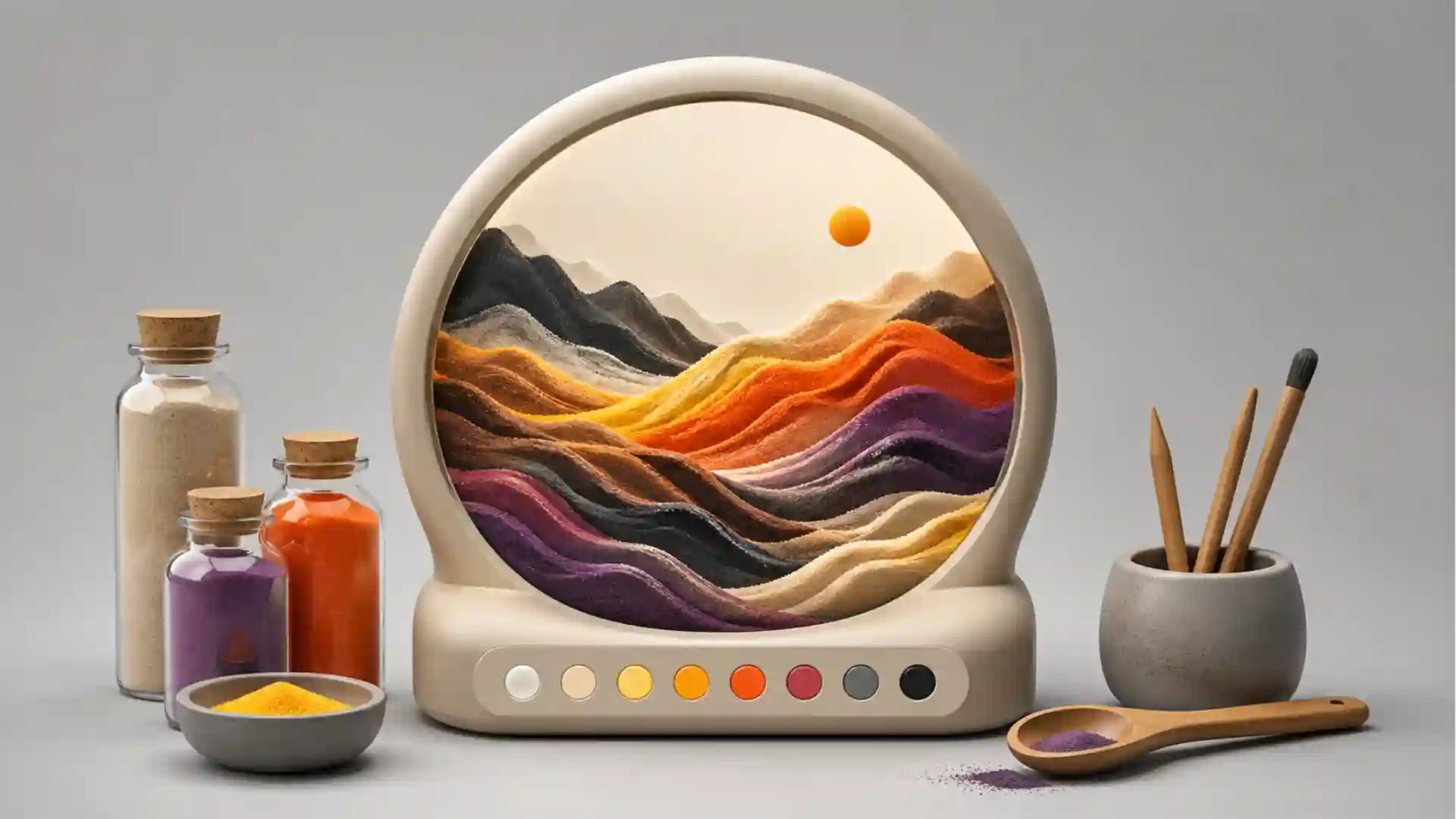
Thisissand does not ask you to learn much before it gives you something beautiful. Open the site, press down, and sand begins to fall. The grains gather at the bottom of the screen, then build ridges, slopes, stripes, cliffs, dunes, accidental sunsets, and weird little geological events that nobody planned. It feels less like drawing and more like letting gravity borrow your cursor.
Table of Contents
A blank screen with one strange promise
The official app description calls Thisissand a creative playground for making and sharing pictures made of sand, which is accurate, but too tidy for what actually happens when you start using it. The tool sits somewhere between a toy, a meditative loop, a digital sketchbook, and an old web artifact that somehow refused to become embarrassing. It began as a website in 2008, first made as a school project by art students, and later became a mobile app in 2012 while still being run by an original creator.
The surprise is how little the site needs to hold your attention. There is no quest, no reward ladder, no feed demanding applause before you have even made anything. You pick colors, pour sand, watch layers settle, and decide whether to keep going. A few minutes in, the screen starts to look like a cutaway of another planet. Keep going longer and it becomes a record of tiny decisions: where your hand drifted, when you changed color, where you hesitated, where the pile collapsed into a cleaner shape than you could have drawn on purpose.
The interaction is not drag-and-drop in the usual software sense. You are not dragging objects into a composition like stickers on a canvas. It is closer to drag-and-pour: your pointer becomes the mouth of an invisible funnel, and the artwork grows because material falls. That detail matters. Most digital art tools treat the screen as a flat page. Thisissand treats it as a container. The lower part fills first. The top remains open. The middle becomes a slope. The canvas has behavior, not just pixels.
The first minute is unusually honest. You do not have to pretend that you are learning a powerful system. You are just seeing whether the stream feels good under your hand. Many creative products hide their best moments behind setup, onboarding, permissions, pricing screens, or a template gallery that makes your own empty canvas feel smaller. Thisissand skips the ceremony. The first reward is not a finished image. It is the sight of a clean line of grains finding a place to rest.
The name also helps. Thisissand is almost childishly literal, but it works because the project has no interest in sounding more serious than it is. The name points at the thing, then steps away. No mythology, no brand universe, no forced metaphor. The site trusts the material. When the experience is this spare, a fancier name would only make it worse.
That behavior is why Thisissand still feels worth opening. Plenty of sites let you doodle. Plenty of apps offer calming loops. This one turns the most basic action on the web, holding down a mouse or finger, into a miniature ritual. There is enough control to feel involved and enough randomness to remove the pressure of being good. You make choices, but the grains finish the sentence.
It is also refreshingly small in ambition. The Google Play listing says the app is free to download and play, does not display ads, and offers a paid Toolkit for special features. The App Store page describes it as an app for making and sharing pictures out of sand, with the slow process of watching and listening to grains pile up as part of the appeal. That lack of aggressive monetization is not a decorative footnote. It changes the mood of the whole project. Thisissand feels like a place someone kept open because people kept finding peace in it.
The pleasure is in losing precision
Most creative software sells control. Better brushes, cleaner curves, sharper exports, smarter editing, more layers, more undo, more correction. Thisissand moves in the opposite direction. It gives you a stream of falling particles and asks you to accept that your hand will never fully command them. The tool has precision, but not obedience. It rewards patience more than skill.
That loss of control is not a flaw. It is the point. When sand falls, it does what sand does: it stacks, slides, spreads, and finds its own angle. If you move too fast, the colors smear into noise. If you move slowly, delicate bands appear. If you hover, a mound rises. If you drag sideways, the mound becomes a ridge. The site turns tiny motions into visible geology, and that makes even clumsy use feel productive.
Precision comes later, almost by stealth. At first you make piles. Then you start noticing the angle of the slope. Then you learn that the edge of a falling stream matters more than the center. Then you begin to use the bottom of the screen as a foundation and the empty top as atmosphere. Thisissand teaches by letting the hand repeat one move until the eye becomes sharper.
The strangest compliment is that it makes patience visible. A rushed image looks rushed. A patient image has cleaner sediment, softer transitions, and a calmer skyline. That does not mean patient pieces are automatically better; some of the liveliest works come from chaos. Still, the tool gives time a visible texture. You can see how long someone stayed with a piece, where they slowed down, and where they trusted a layer enough to leave it alone.
The best Thisissand images often look like terrain by accident. People begin with stripes and end up with desert mesas. They chase a rainbow and get sedimentary rock. They try to draw a face and produce a strange cliffside shrine. The app’s own description leans into this by mentioning the random beauty of layered sand, and that phrase gets at the appeal without overexplaining it. The tool is good because it lets the user be half author, half witness.
This matters because the web has become hostile to unfinished play. Many creative apps push users toward polished output, public posting, metrics, and recognizable styles. Thisissand is friendlier to the half-formed thing. A screen of layered sand can be pretty without being clever. It can be calming without being marketed as wellness. It can be shared, but it does not need to be. The work feels finished when you feel done, not when a platform tells you it is ready.
There is also a private rhythm to choosing colors. The moment before a color change feels like turning a page. A dark band can give the pile weight. A pale band can make the next bright layer look electric. A sudden green inside a warm desert can look ugly for ten seconds, then become the line that saves the whole image. Thisissand turns color choice into pacing, which is different from decoration.
The app’s photo-based feature makes that point from another angle. Photo Sand samples colors from an image, which means the source photo becomes material rather than a picture to copy. That is a lovely inversion. A portrait can become sediment. A travel photo can turn into bands. A memory can be reduced to grains. The result is not necessarily accurate, but accuracy is not the most interesting target here.
The color tools are where the project becomes more than a falling-particle toy. The core Color Palette lets you choose solid colors or multiple colors that shift as you pour, with an intensity slider for how fast the changes happen. The mobile Toolkit adds options such as Color Shifter, which continuously changes the sand color, and Photo Sand, which samples colors from a photo to make abstract or photorealistic sand versions. The web version stays simpler, which is part of its charm. The app gives the sand more tricks.
Color changes also hide the user’s fear of the blank page. A plain drawing tool begins with a demand: make a mark and make it count. Thisissand begins with material. The first line does not sit alone like a mistake. It falls to the bottom and becomes the start of a layer. The next color covers part of it. The third creates a rhythm. You are building rather than declaring.
The site is especially good at making “bad” choices usable. Pick a color combination that should not work and the grains often soften it. Pour too much and the pile becomes a canyon. Lose control of the cursor and the accident becomes a streak. This is why it suits people who say they are not artists. It does not patronize them with templates. It gives them a physical rule set where mistakes have texture.
The sound is part of the spell when you use the app. The App Store page asks users to watch and listen to the sand piling into layers, which is a small but revealing detail. The audio turns the action from visual doodling into something closer to a desk toy. It is not trying to be music. It is feedback. It tells your brain that the stream is still moving, that the pile is growing, that you are allowed to sit with one action for longer than usual.
What stands out when the sand starts falling
Thisissand looks almost too simple until you notice how much taste is buried in that simplicity. A lesser version of this idea would drown the screen in menus, badges, tutorials, brush packs, pop-ups, export prompts, and forced accounts. Thisissand leaves the main act alone. It understands that falling sand already has enough drama.
The restraint is editorial, not accidental. The project knows what belongs near the sand and what would break the mood. A timer would make it feel like a challenge. Stickers would flatten it into decoration. Too many brush types would turn a material toy into a weak painting app. The value is in the refusal. Thisissand keeps saying no so the falling grains can keep saying yes.
A good web gem often has one memorable verb. Search, scroll, mix, listen, map, erase, fold, pour. Thisissand owns “pour.” That verb carries the whole product. It is physical, slow, and understandable before any instruction appears. A user who cannot describe the interface can still describe the action. That is why the site survives in memory after thousands of more ambitious tools blur together.
The interface works because it stays quiet. You choose colors, pour, stop, shift, pour again. There is no need for a tool panel yelling for attention while the sand is moving. On mobile, the paid Toolkit adds more color behavior, but the official listing is careful to say the special tools are not needed to enjoy the app. That line says a lot about the product’s temperament. It treats payment as support and extension, not as the price of basic pleasure.
The sharing layer is also more modest than a social network. Thisissand has long had a gallery culture around finished pieces. The old official blog pointed readers to a gallery with hundreds of thousands of pieces back in 2013, which explains why the project feels older and deeper than a throwaway web toy. People did not just open it once, make a rainbow pile, and leave. They stayed long enough to develop techniques.
A compact read before you open it
| Element | What it does | Why it matters |
|---|---|---|
| Falling sand | Turns pressing or dragging into a stream of grains | The canvas behaves like material, not a flat page |
| Color palette | Lets users choose solids or shifting color mixes | The art gets depth without complex drawing skills |
| Randomness | Makes particles stack and slide in imperfect ways | Mistakes often become the best parts of the image |
| Gallery and sharing | Gives finished pieces a place beyond the canvas | The project feels like a small culture, not only a tool |
| Mobile Toolkit | Adds color shifting, photo-based sand, saved colors, and related extras | Power users get more range without breaking the simple core |
The table makes the main point visible: Thisissand is not interesting because it has many features. It is interesting because its few parts are tuned around one satisfying action. The sand falls, the colors layer, the user slows down, and the image becomes richer without demanding a professional workflow.
The project also has a rare kind of visual generosity. Even an impatient user gets something nice. A child dragging bright colors across the screen, a designer testing gradients, a stressed office worker making a five-minute dune, and a patient artist building a detailed scene are all using the same mechanic. The tool does not split people into serious and casual users. It lets the same pile of sand meet them at different levels of attention.
That is harder to build than it looks. Creative toys often become dull once the novelty fades, because they only have one joke. Thisissand survives repeat use because the output keeps changing. The same hand movement with a new color sequence looks different. The same mountain shape with a slower pour feels different. The same mistake near the edge can ruin an image or give it the one strange line it needed. The site has replay value without turning play into a game.
The deeper trick is that Thisissand borrows from real-world craft without imitating it too literally. Sand art in bottles, colored-sand mandalas, beach drawings, and sediment layers all hover around the experience. The site does not simulate any one of them in a heavy-handed way. It takes one material behavior, falling grains, and builds a whole mood from it. That restraint makes the project feel cleaner than many nostalgia-driven web toys.
It is also not trying to be generative art in the fashionable sense. There is no prompt box asking a model to imagine a desert. There is no instant image made from borrowed styles. The user still has to sit there. The art emerges through time, color, pressure, rhythm, and small corrections. The slowness is the authorship.
Why it feels calmer than most creative tools
The calmness of Thisissand comes from repetition, not from soft branding. The site does not need breathing exercises, pastel mascots, or wellness language to feel relaxing. It gives you a repeated gesture with visible feedback. Press, pour, watch, adjust. The loop is plain enough to be absorbed by the body.
A browser tab can be a room, and Thisissand proves it with almost nothing. There is a floor, a falling substance, a palette, and the temporary privacy of your attention. You enter, make a little weather, and leave. Nothing follows you out unless you save or share it. That small boundary gives the site a feeling that many apps have lost: the sense that an online place can begin and end.
This is why the site works as a reset between heavier tasks. It occupies the hand without filling the head with new information. The mind gets just enough to do: keep the stream moving, choose the next color, stop before the pile becomes dull. It is closer to sharpening a pencil than launching a creative project. The action has shape, but it does not demand a story.
That loop changes how you think about making something. In a normal drawing app, the mind often jumps ahead: What am I making, is it good, should I erase it, does this look amateur? In Thisissand, the question becomes smaller. Where should the next stream fall? What color should touch this layer? Should the slope rise or stay low? The tool keeps attention close to the present motion.
The lack of an easy undo button is part of the tension. Some users complain about this in app reviews, and it is a fair frustration when a careful piece gets disrupted. The same limitation gives the work its character. Sand art is fragile because each addition becomes part of the pile. You do not edit a dune the way you edit text. You pour around it, bury it, or start again. That can irritate perfectionists, but it also prevents the endless correction spiral that makes creative software exhausting.
Thisissand is calming because it lowers the cost of starting. You do not need to import files, pick a canvas size, name a project, choose a brush library, or understand layers. The first action is the actual action. You are making the piece before you have time to become self-conscious about making it. For people who want a quiet break rather than a full creative session, that is exactly the right door.
There is a small philosophical pleasure in watching a digital material obey gravity. The web often feels weightless: feeds refresh, windows float, images appear and vanish. Thisissand gives the screen a bottom. Things fall. Piles accumulate. Time leaves bands. The artwork becomes a record of duration, not just intention. That makes the site feel oddly physical despite being pure pixels.
The mobile app leans harder into this therapeutic reading. Google Play describes “falling sand therapy” for stress and anxiety, while the App Store frames the process as slow and relaxing. Marketing language around relaxation is easy to overdo, but in this case the claim fits the mechanic. You are not reading advice about calm. You are doing a calm thing.
The project also respects silence. There are no streaks, daily goals, guilt loops, or productivity badges. It is not trying to turn rest into another measurable habit. That makes it feel more honest than many apps that package leisure as self-improvement. Thisissand lets idle time remain idle, which is rarer than it should be.
For artists, the appeal is different but related. The tool is a quick way to study color relationships, strata, gradients, silhouette, and negative space without opening a heavy studio app. It will not replace serious illustration software, and it should not. Its limits are the reason it is useful. Working inside a narrow mechanic forces visual decisions to become clearer. A color either sings against the layer below it or it does not. A ridge either holds the composition or it slides into mush.
For non-artists, it offers the relief of making without needing an identity around making. You do not have to call yourself creative, build a portfolio, learn terminology, or defend the outcome. You pour sand for a while. Something appears. Maybe you save it. Maybe you close the tab. The experience gives permission without making a speech about permission.
The small community hiding under the surface
Thisissand has the aura of an old internet thing because it is one. The official listing says it started in 2008 as a website and surprised its creators by attracting visitors for years. That origin matters. It arrived from the era when the web still regularly produced single-purpose experiments: one page, one interaction, one odd little idea that spread because someone sent it to a friend.
There is a lesson here for product makers too. Thisissand does not confuse simplicity with emptiness. It has a clear material, a clear action, clear feedback, and a clear reason to return. Many minimal products fail because they remove friction without leaving any sensation behind. This one removes friction and leaves tactility. The difference is enormous. A blank screen is boring until something on it behaves.
It also shows how small communities form around craft rather than identity. People return because they want to see what the sand can do, not because the platform has assigned them a role. The project gives them a shared constraint and a public place for results. That is enough. You do not need a loud culture when the medium itself keeps generating questions.
The project’s history is visible in its rough edges. The official WordPress blog reads like a record of people keeping a beloved sandbox alive, with posts about hosting costs, gallery growth, exhibitions, bug fixes, and app releases. In 2009, the creators wrote about Adobe Flash Player 10 breaking uploads; in 2013, they announced the app while pointing people back to the “good old” website and gallery. These traces give Thisissand a texture that newer polished apps rarely have.
That texture is part of its credibility. The site did not appear last month with a launch thread and a growth campaign. It survived platform shifts, mobile stores, Flash-era trouble, and changing expectations about what online creativity should look like. Even the current app listings carry a handmade feeling in their language. They sound like messages from a small team, not copy approved by twelve departments.
The community angle is quiet but real. The App Store page says users can share finished work and become part of the community, while later version history mentions user profiles, likes, activity views, popular images, latest images, and an integrated gallery. That social layer is not the first thing a new user needs, but it gives patient users a reason to return. After you learn what the sand can do, it becomes fascinating to see what other hands have learned.
The gallery tradition also changes how you read the tool. A simple sand stream might look like a toy until you see people making portraits, dunes, symbols, animals, abstract fields, and careful gradient studies. Then the tool’s limits become a shared challenge. The question is no longer “What does this app do?” but “How did someone get that effect out of falling grains?” That is the moment a toy becomes a medium.
The best online communities often gather around constraint. ASCII art, pixel art, speedrunning, tiny games, browser toys, one-button instruments: people enjoy the skill of doing a lot with a little. Thisissand belongs in that family. It gives everyone the same falling material and lets technique emerge through repetition. A veteran user’s control shows up in clean slopes, delicate color bands, controlled silhouettes, and the bravery to leave empty space.
There is also a pleasing mismatch between effort and atmosphere. Some pieces look effortless and probably took ages. Some quick accidents look like album covers. Some careful attempts collapse under their own ambition. The gallery makes all of that visible. It turns private soothing into a shared archive of experiments, failures, tricks, and lucky moments. The community does not need to be loud to prove that people care.
The mobile app’s current state adds a slightly bittersweet note. On Apple’s page, a 2023 developer response says the app had not been updated for a long time and that the existing app was not updateable as-is, requiring a rebuild from scratch. The same page lists version 2.4.5 from 2019, while Google Play shows an Android listing updated on April 16, 2026. That unevenness is worth knowing. Thisissand is loved, but it is not a giant platform with endless staff.
That limitation may be exactly why the project still feels human. It has the fragility of a small web creation that people keep returning to because it gives them something specific. Not everything durable on the internet is durable because it scaled. Some things last because their core interaction is strong enough to outlive the fashion around it.
Practical notes before you start pouring
Open the web version first if you want the purest version of the idea. It puts the falling sand at the center and keeps the experience direct. The app is better for people who want more color tools, sharing, and mobile convenience. The official listings describe the app as free with optional sign-up and optional paid Toolkit features, which makes it easy to try without treating it like a commitment.
For a first piece, think in layers rather than objects. Instead of drawing a mountain, pour a dark base, then a warmer slope, then a thin bright seam, then a pale sky or empty space. Objects are harder because the stream wants to fall. Layers cooperate with the tool. Once you accept the gravity, the results improve quickly.
For a second piece, try working against the obvious rainbow. Everyone makes a rainbow sooner or later, and the tool is built for it, but subtler palettes reveal more. Sand blue, rust, cream, coal, moss, blush, ash. Small shifts produce images that feel less like a demo and more like an artifact. Thisissand becomes richer when you stop asking it to shout.
Use slow movements if you want clean layers. Fast dragging makes rough, busy textures, which can be great for chaotic desert scenes but harder to control. Slow horizontal passes produce calmer bands. Pausing creates mounds. Moving upward while pouring creates vertical tension. Changing colors before the previous layer gets too tall gives the final image more depth.
Use randomness early and restraint later. A random color mix can break the blank-screen fear, but a finished piece often needs fewer colors than you expect. Thisissand rewards people who stop before the image becomes mud. Leave a dark shape alone. Let a bright layer breathe. Let the bottom of the screen carry weight. The best pieces often look edited even when the tool itself is stubbornly simple.
Is Thisissand good for children? The app store pages rate it broadly as accessible, with Google Play showing PEGI 3 and the App Store listing ages 9+. The interaction is easy to grasp, and the absence of ads helps the mood. Parents and teachers should still treat any sharing or account feature with the usual care. The creative act itself is gentle, immediate, and forgiving.
Is it only for relaxation? No. Relaxation is the obvious use, but not the only one. Artists can treat it as a color-and-composition sketchpad. Designers can use it to think about gradients and visual weight. Teachers can use it to talk about layers, sediment, erosion-like forms, and digital materials. The same tool works as a toy, a calm break, and a tiny studio exercise.
Does the paid Toolkit matter? It matters if you fall in love with the app and want more control over color. The Color Shifter, Color Picker, Photo Sand, and saved-color features give serious users more room to experiment. The basic experience still works without them. That balance is one of the project’s better choices: the paid parts deepen the toy without holding the toy hostage.
Does it replace drawing software? Absolutely not, and that is a compliment. Thisissand is not built for precise illustration, client work, typography, layered editing, or clean export workflows. It is built for one tactile idea. If you enter with the expectations of Photoshop, you will be annoyed. If you enter with the expectations of a sandbox, you will probably stay longer than planned.
The best way to understand Thisissand is to give it five unambitious minutes. Do not begin with a masterpiece in mind. Pick two colors, pour a low hill, change the angle, add a strange stripe, then stop before you fix it to death. The screen will likely look better than your plan. That is the whole appeal: Thisissand makes room for the image you did not know you were making.
Why this old web gem still deserves a tab
Thisissand is a reminder that a website can be memorable without being large. It does not need a dashboard, a recommendation engine, or a personal brand strategy. It needs a simple action with a satisfying result. The fact that it still works as a recommendation after so many years says more about product judgment than nostalgia.
The internet is full of tools that confuse feature count with depth. Thisissand goes the other way. It has depth because the core mechanic keeps producing small surprises. A person can learn it instantly and still improve at it slowly. The site is shallow at the entrance and deeper under the hand, which is the exact shape a good creative toy should have.
Its charm also comes from refusing to overexplain itself. The project does not ask you to believe that pouring sand will change your life. It just gives you a blank screen and a falling stream of color. The user supplies the mood: bored, anxious, playful, curious, distracted, patient. The sand accepts all of it and turns it into layers.
That is why Thisissand belongs in Web Radar. It is not merely useful, and it is not merely weird. It is a small, durable, beautifully constrained corner of the web where the interface almost disappears and the material takes over. It makes the screen feel slower, heavier, and kinder. Open it when you want to make something without making a project out of it.
Common questions before pouring sand
Yes, the core experience is free. The web version can be opened directly in a browser, and the mobile app is free to download. The app also offers optional paid Toolkit features for users who want more color controls and creative options.
No. Thisissand works especially well for people who do not think of themselves as artists. The falling sand does much of the visual work for you. Even loose, imperfect movements create layers, slopes, and color bands that look satisfying.
Thisissand behaves more like a material toy than a drawing tool. You are not placing perfect strokes on a flat canvas. You are pouring digital grains that fall, pile up, and form shapes through gravity-like behavior.
It is both, but its calm side is probably the reason people remember it. The slow act of pouring sand, changing colors, and watching layers build makes it feel closer to a quiet desk toy than a productivity app.
It suits artists, designers, children, teachers, and anyone who wants a low-pressure creative break. Artists may enjoy the color and composition experiments, while casual users can simply use it as a calming browser activity.
Yes, especially if you enjoy the web version and want more control. The app adds features such as color tools, photo-based sand effects, saving options, and sharing features, while keeping the basic sand-pouring idea intact.
Author:
Jan Bielik
CEO & Founder of Webiano Digital & Marketing Agency
This article is an original analysis supported by the sources cited below
Thisissand
Official web version of Thisissand, used as the primary project reference for the article.
Thisissand on Google Play
Official Android listing with the project description, origin notes, update date, monetization details, and tool descriptions.
Thisissand on the App Store
Official Apple listing with the app description, ratings, version history, privacy summary, and feature notes.
Thisissand official WordPress blog
Older official project blog documenting the app launch, gallery history, technical issues, and the early life of the website.
| Citing this article? Brief excerpts are welcome. Please credit Webiano.digital, name the author where stated, and include a link to https://webiano.digital and to this original article. Full or substantial republication requires prior written permission. Read our Copyright and Content Use Policy. |
This article was prepared with the assistance of artificial intelligence tools. The content underwent expert human review, and Webiano Digital & Marketing Agency assumes editorial responsibility for its final version and publication.