Google does not promise to index every page it crawls. Uneven indexing often reflects a chain of choices about crawl demand, canonicalization, rendering, server health and content value rather than one broken setting. The consequence for site owners is practical: faster indexing comes less from repeated submission and more from making important URLs easy to discover, cheap to process and clearly worth keeping.
Table of Contents
Google’s indexing can look random from the outside: one new page appears in Search within hours, another remains absent for days, and a third is crawled repeatedly without being indexed. That unevenness is often a consequence of prioritization rather than a single technical failure. Google explicitly says indexing is not guaranteed, even after a page has been crawled, and its systems choose canonical versions, evaluate content and metadata, and decide what to store in the index.
That distinction matters because “Google did not index this page” can describe several different situations. The crawler may know a URL but not have fetched it. It may have fetched the URL but decided not to index it. It may have grouped the URL with a duplicate and selected another canonical. Or it may be unable to reliably render or access the content. Treating all four as the same problem produces the familiar cycle of sitemap resubmissions and repeated “Request indexing” clicks without addressing the cause.
The practical thesis is simpler: irregular indexing is usually a resource-allocation and selection problem expressed through a website’s technical architecture, content distinctiveness and crawl signals. Diagnosis has to begin with the stage where the page dropped out.
Indexing is a selection process, not a publishing queue
A common mental model treats Google like a feed reader: publish a URL, make it crawlable, submit it in a sitemap and wait for the index to catch up. Google’s own documentation describes a more selective system. Discovery, crawling, rendering and indexing are separate stages, and a page that successfully reaches one stage is not promised passage to the next. Google says plainly that not every page it processes will be indexed. During indexing it also clusters similar pages and chooses a canonical version that may be the one shown in Search.
That makes timing inherently uneven. Two URLs published together can send different signals about importance, duplication, freshness and usefulness. One may be linked from a prominent category page and receive external links; another may sit several clicks deep. One may be a clearly differentiated article; another may substantially overlap an existing page. Google’s crawl-demand guidance says popular URLs tend to be crawled more often and its systems try to keep pages from becoming stale. The crawler is therefore not following a neutral first-in, first-out queue.
This is also why the presence of a URL in an XML sitemap is not an indexing guarantee. Google calls sitemap submission a hint. Sitemaps are valuable because they expose canonical URLs and help Google discover pages, particularly on larger sites, but they do not override the later selection process.
For publishers and businesses, the useful question is not “Why is Google inconsistent?” but “Which signal caused this URL to receive a different treatment?” That reframing turns an apparently random outcome into a diagnostic problem. It also prevents teams from mistaking a normal selection decision for an outage, or from trying to repair a crawl problem by rewriting content before confirming whether Googlebot ever fetched the page.
Search Console statuses reveal where the process stopped
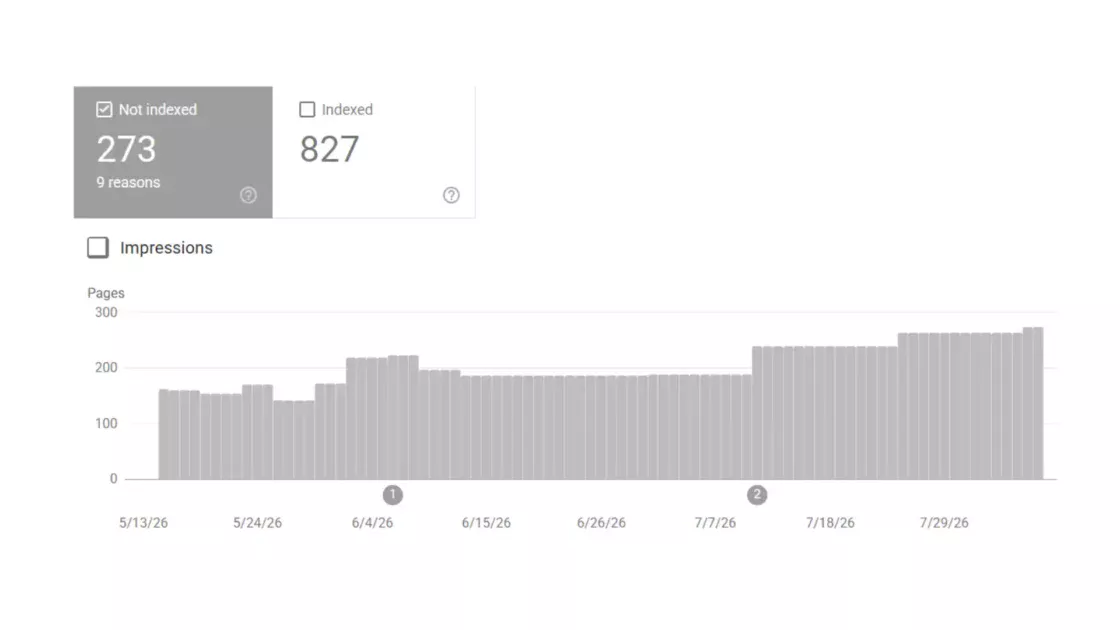
The Page indexing report in Google Search Console is most useful when its labels are read as stages rather than verdicts. “Discovered – currently not indexed” means Google knows the URL exists but has not yet crawled it. “Crawled – currently not indexed” means Googlebot fetched the page but Google did not add it to the index at that point. Those situations look identical in a site: search, but they point to different classes of causes.
A discovered-but-not-crawled URL pushes the investigation toward crawl demand, server capacity, internal linking, URL proliferation and the overall amount of work Googlebot sees on the host. Google defines crawl budget as the number of URLs Googlebot can and wants to crawl, combining crawl-rate limits with crawl demand. Its documentation also says many low-value-add URLs, including faceted navigation, session identifiers, duplicate content and soft errors, can affect crawling and indexing.
A crawled-but-not-indexed URL moves the investigation downstream. Google has already spent the request, so basic discovery was not the barrier. The next questions concern what Google received, whether the content rendered correctly, whether a noindex directive was present, whether Google treated the page as a duplicate, and whether the page added enough value to merit storage. Google’s Search documentation lists low-quality content, robots meta rules and site design as common indexing issues.
Independent technical SEO practitioners report the same distinction in audits. Search Engine Land recommends grouping affected URLs by patterns such as parameters, language folders and canonical tags rather than treating each URL as an isolated error. Ahrefs likewise separates content quality, technical setup and internal linking in its troubleshooting.
The operational rule is classify first, intervene second. A site with 20 URLs in one status and 20,000 in another may have two different problems. Aggregating them into a single “indexing rate” can hide the mechanism that actually needs repair.
Crawl demand decides which URLs get fetched first
Googlebot has to allocate finite crawling capacity across an effectively unbounded web. Google’s crawl-budget explanation says crawl activity depends on both what a site can reliably serve and what Google wants to refresh. Popularity and staleness influence crawl demand, while server responsiveness and errors influence how aggressively Google can fetch. A URL can therefore be perfectly valid yet still lose the scheduling contest.
This becomes visible on large or fast-growing sites. An ecommerce platform may create product variants, filters, sorting parameters, internal search pages and tracking URLs alongside genuinely new product pages. A publisher may generate tag archives, paginated collections and calendar URLs around its articles. If Googlebot spends requests revisiting duplicates or low-value URL spaces, fewer requests remain for new or recently changed pages. Google specifically identifies faceted navigation, session identifiers, duplicate content and soft error pages as sources of crawl inefficiency.
Server behavior adds another layer. Google says faster, healthy servers can support a higher crawl rate, while significant numbers of 5xx errors or connection timeouts cause crawling to slow. Its more recent crawling guidance also notes that JavaScript, CSS and media resources used in rendering consume crawl resources on the hostname. Changing resource URLs unnecessarily through cache-busting can force Google to fetch files again.
None of this means every small website needs a “crawl budget project.” Google’s guidance has historically emphasized that crawl-budget management matters most for very large or rapidly changing sites. For smaller sites, a persistent discovered-not-indexed pattern is still a reason to inspect architecture and availability, but the first goal is eliminating waste and ambiguity, not trying to force a higher crawl rate.
The useful evidence comes from Search Console’s Crawl stats, server logs and URL samples. A decline in crawl requests combined with rising server errors tells a different story from stable crawling that repeatedly ignores a particular directory. Scheduling is irregular by design; the diagnostic task is finding why a site’s important URLs are being assigned too little demand.
Duplicate URLs turn site architecture into internal competition
Canonicalization is one of the least dramatic explanations for apparently erratic indexing, yet it accounts for many cases in which site owners expect every accessible URL to appear in Search. Google groups duplicate or very similar pages and selects a canonical representative. The canonical is crawled more regularly, while duplicates are generally crawled less often. If several URLs compete to represent the same content, Google does not need to index them all.
The problem is often created by the site itself. Tracking parameters, print versions, filter combinations, HTTP and HTTPS variants, alternate hostnames and inconsistent trailing-slash rules can create multiple addresses for equivalent content. A CMS can then compound the ambiguity by linking internally to one version, listing another in the sitemap and declaring a third with rel="canonical". Google recommends consistent canonical signals and warns against declaring different preferred URLs through different methods.
Canonical tags are signals, not commands. Google may choose a different canonical if its broader signals point elsewhere. That is why the fix is not merely “add a canonical tag.” Internal links should point to the preferred URL, sitemaps should list the URLs intended for Search, permanent redirects should remove obsolete duplicate routes when appropriate, and self-referential canonicals should be technically correct. Google says combining consistent signals increases the chance that the preferred URL is selected.
JavaScript can also muddy the picture. Google recommends placing canonical information clearly in the HTML source when client-side rendering is used and avoiding scripts that change the canonical link unpredictably. A canonical that appears only after rendering is not automatically wrong, but it creates another dependency in a process that already includes crawling and rendering.
The strategic consequence is URL discipline. A site that creates ten crawlable addresses for one commercial or editorial asset is asking Google to resolve a conflict the site could have resolved itself. The resulting crawl pattern can look irregular because Google is behaving differently across members of a duplicate cluster, when the underlying system is doing exactly what it is designed to do.
Content distinctiveness can stop a page after crawling
Technical accessibility does not create an entitlement to indexation. Google’s own explanation of Search says indexing depends on page content and metadata and explicitly lists low-quality content among common indexing problems. That matters most for URLs in “Crawled – currently not indexed”: Googlebot reached the page, but the system did not retain it in the searchable index at that time. The remaining question is often whether the page contributes enough distinct value.
“Quality” is easy to misuse as a catch-all, so it should not become the first diagnosis for every excluded URL. A page can fail because of canonicalization, a robots directive, rendering, a soft 404 or another technical condition. But once those are excluded, overlap and commodity content become credible explanations. In July 2026, SEO consultant Marie Haynes reported from a Google Search Central event that presenters discussed the difficulty of indexing content that adds little beyond what already exists. Her account is secondary reporting, not formal Google documentation, but it is consistent with Google’s published statement that indexing is selective.
Independent audit guidance reaches a similar practical conclusion. Ahrefs says “Crawled – currently not indexed” commonly points to quality issues after technical checks are cleared. Search Engine Land recommends manually reviewing flagged URLs, identifying duplicate patterns and strengthening internal link hierarchy before requesting another crawl. Those sources do not establish a universal threshold, and Google does not publish a score that site owners can optimize.
The actionable test is comparative. Does the page contain original reporting, proprietary data, first-hand experience, a materially better tool, a unique product or service detail, or a synthesis that serves a search need more completely than existing indexed pages? Rewording a page without increasing its information value is unlikely to solve a selection problem. The last sentence is an editorial inference from Google’s selective-indexing guidance and the independent audit evidence, not a published Google rule.
This is especially important for sites producing many near-template pages. If the differentiating text is a city name, product attribute or lightly rewritten introduction, the scale of publication can outpace the scale of genuine information. Google can still discover and crawl those URLs unevenly while deciding that only a subset deserves separate representation. This is an analytical inference from Google’s duplicate, canonical and quality guidance rather than a guarantee about any particular template.
Rendering and server failures create hidden indexing friction
A page can look correct in a browser and still present Googlebot with a materially different result. Modern sites frequently depend on JavaScript to assemble primary content, metadata, navigation and internal links. Google can render JavaScript, but rendering is a separate stage with its own scheduling and resource requirements. Its documentation notes that the time between crawling and rendering may be longer because of scheduling constraints and server load. A successful browser session is not proof that Google received the same page at the same moment.
Status codes are another source of silent confusion. Google recommends meaningful HTTP responses: a missing page should return a proper 404, a protected resource can return 401, and moves should use appropriate redirects. A “soft 404” occurs when a nonexistent or effectively empty page returns 200 OK. Google has long warned that soft 404s can consume crawler attention that would otherwise go to unique content.
Robots controls can also interact in counterintuitive ways. A noindex directive tells Google not to keep a page in Search, but Google has to crawl the page to see that directive. If robots.txt blocks the URL, Google cannot read the page-level noindex. Likewise, blocking rendering-critical JavaScript or CSS can prevent Google from extracting content correctly. Google cautions that disallowing critical resources can create problems for rendering and ranking.
For JavaScript-heavy sites, the URL Inspection live test and rendered HTML are more informative than the source seen by a human browser alone. Server logs can show whether verified Googlebot reached the route, which status code it received and whether repeated failures cluster around particular templates or times. Search Console’s crawl statistics add the aggregate view: response-time changes, 5xx spikes and shifts in crawl volume.
The distinction matters because a content rewrite cannot repair a page Googlebot receives as an empty shell. Before blaming editorial quality, confirm that Google can fetch, render and interpret the version of the page that the business believes it published.
Indexing delays do not prove a penalty
Irregular indexing often triggers the most alarming explanation first: a penalty, an algorithmic demotion or a domain-wide loss of trust. The available evidence does not justify that leap. Google’s documentation treats indexing as selective and explicitly says it is not guaranteed. It also documents ordinary causes ranging from duplication and crawl scheduling to noindex, site design and content quality. A delayed or excluded URL is evidence of an indexing outcome, not evidence by itself of a penalty.
Time complicates the diagnosis. Google says recrawling can take from days to weeks, and its canonicalization troubleshooting documentation says pages may remain in a duplicate cluster for up to two weeks after content issues are fixed. On pages carrying noindex, Google notes that revisits can take much longer depending on the page’s importance. A fix can therefore be correct without producing an immediate visible change.
Search Console itself can encourage overreaction because statuses are snapshots of a large, asynchronous system. A URL that was indexed can later move to “Crawled – currently not indexed,” and a previously excluded page can return. Search Engine Land’s practical guidance emphasizes monitoring trends and URL patterns instead of assuming every listed URL represents an active defect. That is a useful discipline: if affected URLs are feed pages, parameters or duplicates, exclusion may be the desired state.
There are also limits to what public tools can tell a site owner. Google does not expose a per-URL “quality score,” a precise crawl-demand formula or the complete reason a particular document lost an index-selection decision in the documentation reviewed for this article. Diagnosis therefore has to remain probabilistic once direct technical causes are ruled out. A strong audit can identify conflicting signals and weak patterns; it cannot read an undocumented internal verdict.
The counterevidence test is simple. If important, unique pages across multiple templates become unindexed at the same time as crawl failures, server errors or a migration, investigate a technical incident. If only repetitive or low-value clusters are affected while strong pages remain stable, a broad penalty becomes a weaker explanation. This is an analytical diagnostic framework, not an official Google classification.
Site owners should diagnose patterns instead of chasing buttons
Google provides a “Request indexing” function in URL Inspection, but its own guidance frames it as a way to ask for recrawling after a page is added or changed. It does not promise inclusion, and Google’s canonicalization documentation says the feature is subject to quotas and should be reserved for important URLs. Repeated submission is not a substitute for fixing the signal that caused exclusion.
A better workflow starts with a representative sample. Export affected URLs from the Page indexing report and group them by template, directory, publication date, canonical target, status code and internal-link depth. Then compare a small set of excluded pages with similar pages that are indexed. Search Engine Land recommends looking for structural patterns in parameters, language folders and canonicals; Search Console’s Crawl stats and server logs can then test whether Googlebot actually reached those groups.
For “Discovered – currently not indexed,” inspect whether the pages are linked through crawlable HTML links, whether they appear in clean sitemaps, whether the host is returning timeouts or 5xx errors, and whether faceted or parameter URLs are consuming requests. Google says links are a major discovery mechanism and recommends crawlable links so it can find pages. Sitemap entries should represent URLs the site actually wants in Search, not every URL the CMS can generate.
For “Crawled – currently not indexed,” inspect the rendered page, robots directives, canonical selection, response status and content overlap. Compare the page with the canonical Google selected and with competing pages on the same site. If the technical signals are clean, evaluate whether the document adds information that is not already represented by existing pages.
The decision rule is fix classes of URLs, not individual symptoms. If 8,000 filter combinations create the same crawl waste, adjusting one URL proves little. If an article template omits body content during rendering, requesting ten articles for reindexing only creates ten new tests of the same broken template. Pattern-level diagnosis is slower at the start and faster everywhere else. This is an editorial recommendation derived from Google’s crawl-efficiency guidance and independent audit practice.
The durable fix is making every crawl worth more
The evidence supports a conditional judgment: Google’s uneven indexing should usually be treated as selective scheduling and index selection interacting with site quality and architecture, not as a mysterious random process. Google decides what to discover, what to crawl, what to render, which URL is canonical and which documents are worth storing. Each decision uses signals that differ from page to page, so perfectly synchronized indexation would be the surprising outcome.
For site owners, the highest-leverage improvement is to make important URLs unmistakable and inexpensive to process. That means crawlable internal links, coherent canonical signals, sitemaps limited to intended indexable URLs, stable server responses, accessible rendering resources and pages with a reason to exist independently. It also means reducing URL spaces that create duplicates without serving a distinct search need. Google’s documentation consistently connects duplicate control and crawl efficiency.
The economic implication is easy to miss. Publishing more URLs is cheap for a CMS and increasingly cheap for content teams, but crawling, rendering and indexing are not free for a search engine. Google’s systems therefore have incentives to prioritize freshness, popularity, canonical representatives and useful content rather than mirror every page a site can generate. The burden is on the publisher to signal which pages deserve scarce attention. The first two sentences are an editorial inference from Google’s documented crawl-resource and indexing-selection systems; Google does not describe this as a publisher “burden.”
A change in this judgment would require evidence that clean, unique, strongly linked pages on healthy servers are being systematically excluded across large numbers of otherwise unrelated sites for reasons not explained by Google’s documented pipeline. Short-lived fluctuations would not be enough. Until then, teams should resist rituals built around submission frequency. This is a forward editorial judgment rather than a Google forecast.
The practical standard is measurable: fewer duplicate crawl paths, fewer server failures, clearer canonical clusters, stronger internal links and a rising share of important URLs moving from discovery to crawl to index. Google may still index pages at different times. Success is not making indexing perfectly regular; it is making the irregularity concentrate on URLs that do not matter. That conclusion is an editorial interpretation of the documented mechanisms rather than a metric defined by Google.
Questions site owners ask about uneven Google indexing
Google schedules crawling according to factors that include crawl demand, server capacity, freshness and popularity, then separately decides whether a crawled page belongs in the index. Two URLs published at the same time can therefore move through the system at different speeds.
It means Google knows the URL exists but has not yet crawled it. The status points toward the discovery and crawl-scheduling side of the process rather than proving a content-quality or indexing defect.
Googlebot has fetched the URL, but Google has not retained it in the index at that point. Relevant checks include rendering, status codes, robots directives, canonicalization, duplication and content distinctiveness.
No. Google explicitly describes sitemap submission as a hint. A sitemap can help discovery and communicate preferred canonical URLs, but it does not guarantee crawling or inclusion in the index.
Google lets site owners request recrawling through URL Inspection, but a request does not guarantee indexing. Google also says the feature is quota-limited and recommends reserving it for important URLs.
Yes. Google clusters duplicate or very similar pages and chooses a canonical representative. Duplicate versions may consequently be crawled less frequently or excluded as separate index entries.
Not automatically. Google can render JavaScript, but rendering requires additional processing and access to critical resources. Problems arise when essential content or metadata fails to render, resources are blocked, or the rendered result differs materially from what the publisher expects.
No. A delay or exclusion alone does not establish a penalty. Google documents many ordinary explanations, including crawl scheduling, duplicate handling, noindex, rendering problems and content-quality considerations.
First identify whether the URL is discovered but not crawled, or crawled but not indexed. Then inspect patterns across affected URLs, including server responses, internal links, rendering, canonical signals, robots directives, sitemap inclusion and duplication before changing individual pages.
Author:
Jan Bielik
CEO & Founder of Webiano Digital & Marketing Agency
This article is an original analysis supported by the sources cited below
In-Depth Guide to How Google Search Works
Google’s primary explanation of discovery, crawling, indexing, canonical selection and the fact that indexing is not guaranteed.
Ask Google to Recrawl Your Website
Google’s documentation on requesting recrawling and re-indexing after adding or changing pages.
Google’s rules for sitemap construction, canonical URL inclusion, sitemap limits and its statement that submission is a hint rather than a guarantee.
What Crawl Budget Means for Googlebot
Google’s definition of crawl budget and explanation of crawl demand, popularity, staleness, server errors and low-value URL spaces.
Troubleshoot Google Search Crawling Errors
Google’s current troubleshooting guidance covering duplicate URLs, faceted navigation, session identifiers, soft 404s and crawl efficiency.
How to Specify a Canonical with rel=”canonical” and Other Methods
Google’s primary documentation on canonical signals, redirects, sitemap canonicals, internal linking and conflicts between canonicalization methods.
SEO Link Best Practices for Google
Google’s explanation of crawlable links as a mechanism for discovering pages and understanding their relevance.
Crawling December: The how and why of Googlebot crawling
Google’s explanation of rendering resources, resource caching, JavaScript and CSS fetching, and their relationship to crawling capacity.
Google’s troubleshooting guidance on duplicate clusters, re-evaluation delays and the quota-limited Request Indexing feature.
Understand JavaScript SEO Basics
Google’s technical documentation on JavaScript processing and the importance of meaningful HTTP status codes.
Block Search Indexing with noindex
Google’s documentation explaining how noindex works, why Googlebot must crawl a URL to see the directive and how robots.txt can interfere.
How to fix GSC ‘Crawled – Currently not indexed’ error
Search Engine Land’s independent audit workflow for grouping affected URLs, checking internal links, canonical tags, hreflang and sitemap patterns.
What “Crawled – Currently Not Indexed” Means In Google Search Console
Ahrefs’ independent technical SEO guidance separating content-quality, technical-setup, architecture and re-indexing checks.
Crawl budget: What you need to know in 2025
Search Engine Land’s practical guidance on Crawl stats, log-file analysis, server performance and distinguishing crawling problems from indexing problems.
Why your pages are stuck in crawled-currently not indexed. And what to do about it.
Marie Haynes’ July 2026 reporting and field observations on technical failures, commodity content and the distinction between discovered and crawled-but-not-indexed URLs.
| Citing this article? Brief excerpts are welcome. Please credit Webiano.digital, name the author where stated, and include a link to https://webiano.digital and to this original article. Full or substantial republication requires prior written permission. Read our Copyright and Content Use Policy. |
This article was prepared with the assistance of artificial intelligence tools. The content underwent expert human review, and Webiano Digital & Marketing Agency assumes editorial responsibility for its final version and publication.