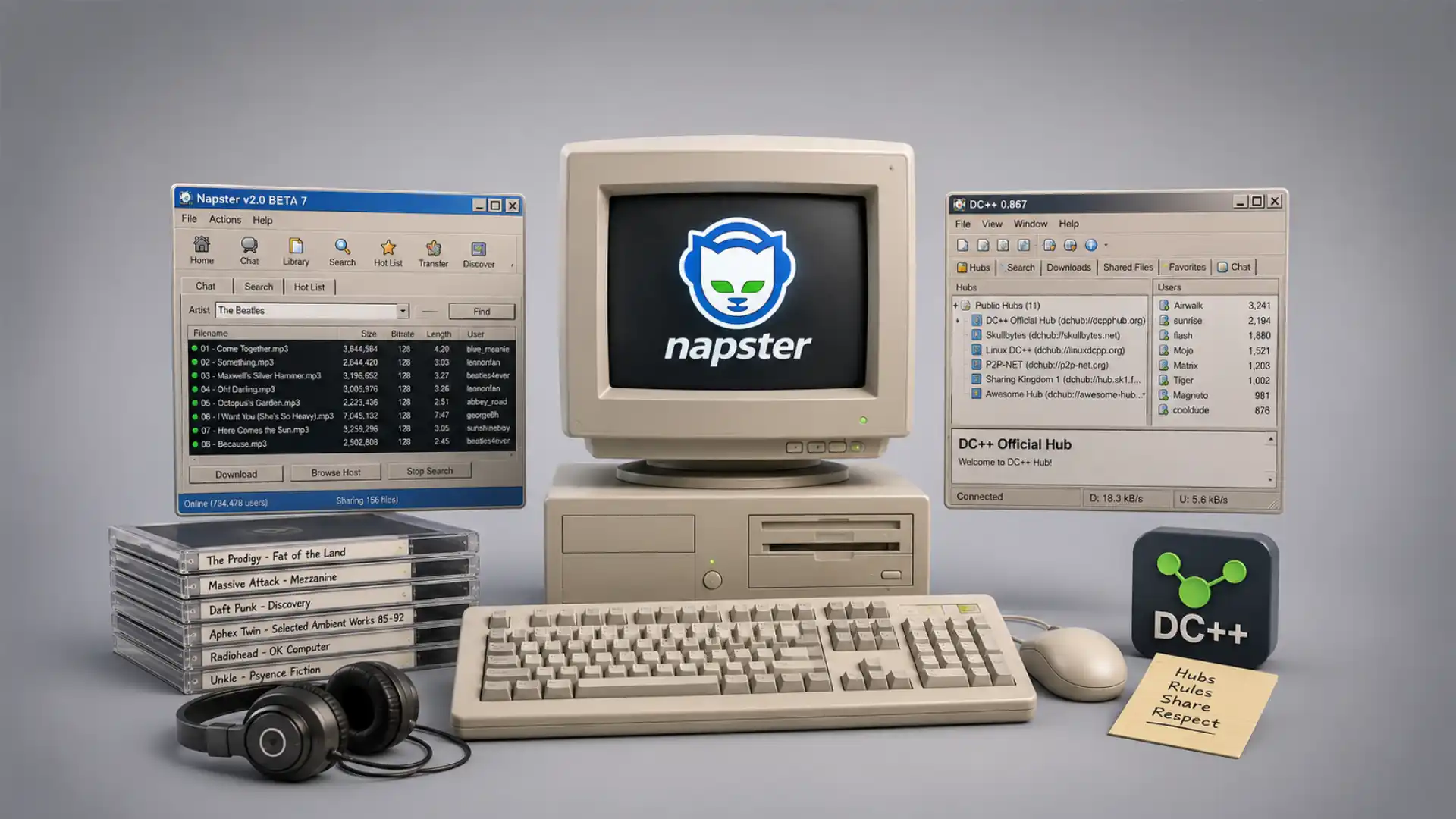
The first shock for anyone raised on TikTok is not that Napster and DC++ were used for piracy. The real shock is that people once went online to search inside other people’s computers. Not profiles. Not playlists prepared by an algorithm. Not clips trimmed into a frictionless feed. Actual folders, badly named files, suspicious audio rips, rare live recordings, anime episodes with broken subtitles, bootleg software, mislabeled MP3s, private obsessions turned into public directories. The old file sharing internet was messy because humans were messy, and for a brief, strange period, that mess became searchable.
Table of Contents
Napster and DC++ belonged to a version of the web that now feels almost rude. You did not ask a platform to entertain you. You went looking. You typed a band name, a movie title, a codec, a file extension, a half-remembered lyric, then waited. You read search results like clues. You judged strangers by upload speed, shared folder size, naming habits, and whether their files looked fake. Every download carried a little social weather: impatience, trust, luck, suspicion, greed, generosity.
For TikTok-era users, discovery often starts with surrender. The feed decides the first move. It watches what you pause on, what you replay, what you skip, then tightens the loop. Napster and DC++ came from the opposite instinct. They were clumsy, risky, legally explosive, often ugly to use, and sometimes technically hostile. But they also asked something from the user. Curiosity was not passive. Search was an activity. Owning a collection mattered. Sharing that collection said something about you.
Napster is easier to explain because it became a myth. It was the moment music felt detached from the shelf. A song no longer had to live inside a CD case, a radio schedule, a record store, or a friend’s copied cassette. Napster made music feel like a liquid that could pass from one dorm room to another through a glowing beige desktop. WIRED described Napster as having 80 million registered users at its peak, and its rise came fast enough that the music industry treated it less like a product than an emergency.
DC++ is harder to explain because it was not just one big famous service. It felt more like a network of rooms. You joined hubs. Some hubs had themes. Some hubs had rules. Some demanded that you share a minimum amount before you could enter. Some felt like private clubs with file lists attached. The official SourceForge page still describes the Direct Connect network as a set of individually run hubs where users join, share files, and follow whatever rules the hub owner sets.
That difference matters. Napster was the pop-cultural lightning strike. DC++ was the back-room culture. Napster made MP3 search feel mainstream enough to panic labels, parents, universities, lawyers, and bands. DC++ made file sharing feel local, tribal, and weirdly social. It was less like opening Spotify and more like walking into a basement market where everyone brought a hard drive and a nickname.
The lost ritual of searching, waiting and entering a room
Old file sharing was not elegant. It was ritual. You installed a client, chose a username, configured folders, opened ports if you were unlucky, argued with a firewall, joined a hub, refreshed a list, searched, queued, waited, failed, tried again. A download did not arrive as a clean act of consumption. It had stages. It had moods. Sometimes a file crawled down at 3 KB/s for hours, then died at 97 percent because the user went offline. That kind of pain teaches memory.
The TikTok feed has almost no visible plumbing. It hides the machine so well that friction feels like a defect. Swipe, watch, swipe, watch, repeat. Napster and DC++ showed too much plumbing. You saw users. You saw filenames. You saw queues. You saw available slots. You saw partial files. You saw the shape of someone else’s archive. You learned that the internet was not a magic cloud but a huge pile of machines, habits, folders, and people leaving their computers on overnight.
That visible structure created a different type of attention. You could not be completely passive because the tools were not built to carry you. A bad query gave bad results. A rare file required patience. A wrong hub meant nothing useful. A poor share folder made you look cheap. A slow upload made you unpopular. Even the basic act of searching demanded taste: knowing which release group mattered, which bitrate was acceptable, which filename pattern looked trustworthy, which file size looked wrong.
Napster simplified this world for music. It made MP3 discovery feel shockingly direct. Before it, finding a specific song online could mean digging through unreliable websites, broken links, FTP directories, IRC channels, or college networks. Napster put a search box in front of ordinary people and turned other people’s MP3 folders into an enormous, searchable music shelf. That sounds obvious now because every app has a search box. In 1999, it was a cultural detonation.
DC++ kept more of the older internet’s room-like feeling. A hub was not only an index. It was a place. People chatted. Operators enforced rules. Local communities gathered around language, country, university, interest, or file type. Some hubs were friendly. Some were paranoid. Some were full of silence and download traffic. Some had active chat that looked closer to IRC than to any media app. The important point is that files and conversation lived in the same room.
The official DC++ homepage still carries a sentence that sounds almost like a fossil from another web: Direct Connect lets users share files “without restrictions or limits,” with a client free of ads and features like multi-hub connections and resumed downloads. That promise now feels both liberating and dangerous because the modern web has trained people to expect a gatekeeper everywhere.
The old ritual also changed what a “library” meant. A library was not a subscription catalog. It was a person’s stash. Someone with 40 gigabytes of carefully tagged electronic music looked different from someone with a chaotic folder named “new stuff.” A user sharing rare Slovak punk demos, Japanese game soundtracks, Czech-dubbed films, or cracked design software was not just another anonymous node. Their collection had personality, even when the username was a joke and the avatar was absent.
TikTok’s culture is built around performance, remix, and immediate circulation. Napster and DC++ were built around possession. You wanted the file because having it mattered. You could play it offline. Burn it. Rename it. Move it. Put it into Winamp. Share it again. Delete the bad copy. Keep the rare version forever. Digital culture had not yet fully moved from “my files” to “my account.”
That phrase, “my files,” now sounds older than it should. A generation that grew up inside streaming apps often owns access, not media. Their photos live in cloud galleries, their music in subscriptions, their videos inside platforms, their conversations inside apps that decide what survives and what disappears. Napster and DC++ came from a desktop mentality. Your computer was not a thin window into services. It was a machine with territory.
Territory makes people behave differently. When you manage folders, you develop taste through maintenance. You decide what belongs together. You clean names. You replace low-quality versions. You keep duplicates because one has a better intro. You create subfolders that only make sense to you. The TikTok feed trains taste through reaction. File sharing trained taste through collecting, sorting, and keeping.
That is why old users can sound sentimental about objectively terrible software. They are not only remembering the downloads. They are remembering agency. Not moral purity. Not legal innocence. Not better design. Agency. The feeling that you could type something obscure, enter the right corner of the network, and pull a cultural object out of the dark because another stranger cared enough to keep it available.
Napster made the internet feel like a jukebox with strangers inside
Napster’s genius was not that it invented file sharing. Its genius was that it made file sharing feel normal. The interface took a messy internet behavior and gave it a simple consumer shape. Search for a song. See who has it. Download. Play. Repeat. The fact that the file came from another user’s machine was important, but Napster made that fact feel less intimidating than it should have been.
That friendly surface made it explosive. Napster turned MP3s from a geek habit into a mainstream expectation. The old music economy depended on scarcity, packaging, distribution, and format control. Napster trained users to think in tracks, not albums; search, not shopping; availability, not release schedules. The cultural damage to the old model did not come only from free copying. It came from a new expectation: if a song exists, the internet should find it.
The courts saw a different story. The legal case against Napster became one of the defining copyright battles of the early consumer internet. In A&M Records v. Napster, the Ninth Circuit dealt with claims that Napster was liable for contributory and vicarious copyright infringement, and the court record describes the district court’s injunction against Napster facilitating unauthorized copying, downloading, uploading, transmitting, or distributing copyrighted works.
The court language is dry. The user experience was not. Napster felt like discovering that every music fan in the world had left a bedroom window open. A teenager could search for Metallica, Madonna, Aphex Twin, 2Pac, Slovak pop, obscure bootlegs, TV themes, unreleased demos, or a song heard once on late-night radio. The thrill was not only getting music without paying. It was seeing music escape its official map.
That is why Napster scared artists and labels in different ways. It broke price, but it also broke control. Songs leaked. Rare tracks traveled. Albums split into individual files. Listeners sampled before buying, copied instead of borrowing, collected without asking, and treated the internet as a shared attic. Some artists saw discovery. Others saw theft. Both were right about part of it. The system was thrilling because it ignored boundaries that did, in fact, exist.
The name still carries that electricity, even though the current Napster is almost unrecognizable. Open Napster today and the old file sharing ghost has been replaced by AI agents, video presence, persistent memory, music creation tools, business products, and an API. The official site presents Napster as an AI platform with specialists, digital assistants, music production features, learning tools, and other agent-like products.
That pivot is weird in the most internet way possible. Napster began as a symbol of users routing around the music industry and now sells the language of AI companions, creation systems, and enterprise agents. The brand survived the original company, the lawsuits, the bankruptcy, the subscription-service years, the streaming era, and then another turn toward immersive and AI products. Few names from the first file sharing panic have been stretched this far.
In March 2025, Infinite Reality announced a $207 million deal to acquire Napster and described plans to expand it beyond streaming into social, interactive music experiences tied to immersive technology and AI-powered tools. The brand that once made record labels fear uncontrolled copying is now being sold as a controlled platform for AI-shaped creation and fan engagement.
There is something almost comic about that arc. Napster once made the internet feel like a wild, unpaid jukebox. Now it sounds like a polished demo room for AI specialists. The old Napster asked, “Who has this song?” The new Napster asks, “Which specialist do you want to talk to?” Same name, different dream. One was about finding files in public chaos. The other is about packaging intelligence into branded interfaces.
The old service’s influence, though, does not depend on the current brand. Napster changed the user’s mental model before the legal system could fully catch it. Once people had experienced instant music search across other people’s collections, the old retail rhythm felt slow. The legal Napster died, but the expectation survived. iTunes, YouTube, Spotify, SoundCloud, Bandcamp, and streaming culture all arrived in a world Napster had already trained.
The irony is sharp. The service that could not legally become the future still taught users what the future should feel like. Searchable, immediate, track-based, portable, abundant. The business model was broken. The behavior was not. That is the part the TikTok generation inherits without knowing the ancestor. When a clip makes a forgotten song explode, when a track becomes detached from its album, when discovery outruns official marketing, a little Napster logic is still humming underneath.
Napster also introduced a kind of ambient social proof before social feeds made it normal. A song looked alive because many strangers had it. You could see copies, speeds, usernames, versions. Popularity was not a like count; it was replication. A file spread because people kept it, shared it, renamed it, and left it available. The network showed desire through duplication.
That desire could be ugly, careless, and exploitative. The romance of Napster should not erase the damage. Musicians lost control over recordings. Labels responded brutally because their business was threatened. Users took without thinking too hard about who made the work. A lot of people wrapped self-interest in the language of freedom. But even the selfishness reveals something: users had discovered a distribution method that felt more natural to them than the legal one.
That is the uncomfortable historical truth. Napster did not win in court, but it won inside user behavior. People wanted music to be searchable. They wanted songs separated from physical media. They wanted instant sampling. They wanted portability. They wanted abundance. The legal market had to rebuild around those desires because suing the behavior out of existence did not work.
DC++ was rougher, stranger and more social than Napster
DC++ never became the same kind of household myth, which is exactly why it belongs in Web Radar. It was the more underground memory, the tool that old internet people mention with a grin because explaining it properly takes too long. It was not a single giant catalog. It was a client for Direct Connect networks, and Direct Connect culture lived through hubs, rules, chat, shared folders, and community enforcement.
The official SourceForge description gives the clean version: DC++ is an open source Windows client for Direct Connect, a network made from individual hubs where users share files with other members, and hub owners set the rules. That one paragraph contains the whole lost architecture: users, hubs, rules, themes, and self-run rooms.
The dirty version was more interesting. A DC++ hub could feel like a club, a warehouse, a local LAN party, and a suspicious border checkpoint at once. Some hubs required a minimum share size. Some checked whether you were sharing forbidden junk. Some banned fake files. Some cared about language. Some had operators who behaved like nightclub bouncers with command-line powers. Some were tiny and familiar. Some were giant and anonymous.
Unlike Napster’s clean music focus, DC++ was broad. People used it for music, films, software, games, TV episodes, e-books, archives, local content, and whatever else a community decided to trade. The “++” in the name made it sound technical, and the experience matched that. You had to understand enough to configure your connection, share folders, choose hubs, search well, manage queues, and read the mood of the room.
The social pressure was built into the design. Leeching was frowned upon because the network depended on visible contribution. If you wanted access, you often had to share. That changed the psychology. A streaming user consumes from a central catalog. A DC++ user entered a peer economy where everyone’s folder was part of the attraction. You were not only a customer. You were inventory.
That inventory could become identity. Your shared folder was a profile before profiles swallowed the web. Not a flattering profile with selfies and captions, but a brutally revealing one. What you kept. How you named it. How much you shared. Whether your archive was generous or lazy. Whether you had rare material. Whether your files were organized or dumped into chaos. On DC++, a person’s taste appeared through directory structure.
The DC++ project itself also reflects a different software culture. It was open source, ad-free, and shaped by contributors rather than a growth team. The official page emphasizes no ads, no spyware, GPL code, multi-hub joining, file integrity through Tiger Tree Hashes, and search across selected hubs by type, size, name, or hash.
That list reads like a product spec, but it points to a moral atmosphere. Old file sharing clients often had reputations for bundled junk, adware, spyware, fake buttons, and sketchy installers. DC++ mattered partly because it felt cleaner than some of the alternatives. It was still tied to legally risky behavior, and users still shared plenty they should not have shared. But the client itself carried the old open-source promise: the tool should not trick you.
The DC++ dev blog describes the client as an open source replacement for the original Neo-Modus client, born in 2001 from a young user’s desire to make a better, ad-free client for the Direct Connect network. That origin story is pure early internet: a teenager sees an annoying tool, writes a better one, and accidentally gives a whole network its default interface.
There was also a technical charm in the hub model. A hub was central enough to create community but not central enough to own the files. Users connected to a hub to find and chat with others, but actual transfers happened between clients. The NMDC protocol documentation describes Neo-Modus Direct Connect as a text protocol used for client-hub and client-client communication, which captures the split between coordination and exchange.
That split made Direct Connect feel different from a website. The hub was a meeting point, not a warehouse. It routed presence, search, chat, and connection negotiation. The files stayed with users. A modern platform wants to centralize the content, measure every interaction, standardize the interface, and turn behavior into a business dashboard. DC++ culture was rougher. It depended on users leaving machines online and accepting the inconvenience of being part of the system.
The inconvenience was not a bug in the cultural sense. It made participation feel earned. A person who configured active mode, maintained a serious share, joined good hubs, and stayed online had done work. That work produced belonging. It is difficult to imagine TikTok asking users to open ports, prove their share size, and wait in a queue before the algorithm gives them a video. The friction would kill the product. For DC++, friction was part of the gate.
This is where nostalgia can become dishonest if left unchecked. DC++ was not a paradise of noble digital citizens. There were fake files, malware risks, copyright infringement, arrogance, hoarding, bad moderation, dead hubs, technical confusion, and the strange macho culture that often grew around access. Some users treated share ratios like moral superiority. Some hub rules were petty. Some communities were hostile to newcomers. The old internet was freer, but it was not kinder by default.
Still, the design preserved one thing modern feeds often erase. You knew you were dealing with other people. Not in the polished social-network sense, where personality is packaged for engagement, but in the infrastructural sense. Someone had the file. Someone’s computer was online. Someone’s upload slots were full. Someone kicked you from a hub. Someone’s folder structure made you curious. Someone’s archive rescued a thing you thought had disappeared.
That human trace is what makes DC++ worth remembering. It showed the internet as a system of mutual exposure. You exposed part of your storage, and in exchange you saw part of someone else’s. The experience was technically primitive compared with today’s cloud services, yet socially legible in a way many polished platforms are not. You could feel the network.
What made the old file sharing web feel different
| Layer | Napster and DC++ logic | TikTok-era logic |
|---|---|---|
| Discovery | Search, hubs, filenames, user collections | Algorithmic feed, signals, retention loops |
| Identity | Shared folders and nicknames | Profiles, posts, metrics, recommendation history |
| Value | Possession of files and rare archives | Attention, velocity, remix potential |
| Friction | Queues, ports, speeds, broken downloads | Instant playback and hidden infrastructure |
| Social feeling | Strangers as sources and gatekeepers | Creators as performers inside a platform |
This table is not a purity contest. The old model gave users more visible control, while the new model gives them less friction and far better legal access. The trade is cultural. Napster and DC++ made the internet feel like a place you entered with tools. TikTok makes it feel like a current you step into and let carry you.
The design was primitive, but the behavior was advanced
A lot of old software looked terrible because it was built before today’s design language became mandatory. Napster and DC++ were visually plain, but the behavior around them was sophisticated. Users learned to evaluate sources, identify patterns, manage bandwidth, maintain archives, and read weak signals. A clean modern app reduces those demands. That is convenient, but it also changes what users learn.
File naming was its own literacy. A filename could tell you whether a download was promising or cursed. The bitrate, release group, codec, year, language tag, cam-rip warning, subtitle hint, or strange bracketed label all mattered. A misspelled artist name might still lead to a treasure. A file that was too small could be fake. A huge executable pretending to be a song was trouble. Users developed suspicion because the network gave them no parental layer.
Today’s platforms turn suspicion into policy. The app decides what is allowed, what is ranked, what is hidden, what is removed, what is recommended, and what is monetized. Users still need media literacy, but the battlefield moved. Instead of judging file integrity, they judge authenticity, sponsorship, deepfakes, manipulated context, and algorithmic bait. The old skills did not disappear. They mutated.
The advanced part of old file sharing was not technical excellence. It was user participation in distribution. Every participant with files became part of the network’s supply. Every user with a rare album or obscure local recording increased the collective archive. The network did not need one company to license everything before the shelf appeared. That was legally disastrous and culturally powerful.
The behavior also predicted later internet habits. Track-based listening, playlist thinking, global niche discovery, leaked media culture, fan archives, remix circulation, and the expectation of immediate access all grew in the same soil. Napster was not Spotify, but it trained people to want Spotify-like convenience without the legal wreckage. DC++ was not Discord, but its hub chat plus shared-interest rooms anticipated the way communities now gather around private servers and niche spaces.
The difference is that modern platforms usually separate the archive from the user’s machine. Your contribution is content, not infrastructure. You upload a video, comment, save, repost, or stream. The platform hosts, ranks, and monetizes. On DC++, your computer did real work. Your upload speed mattered. Your storage mattered. Your uptime mattered. The network’s usefulness depended on millions of private machines behaving like small public shelves.
That made the desktop feel important. The computer was not only a consumption device. It was a node. Many people now use phones as primary windows into the internet, and phones are brilliant for capture, communication, and playback. But they are poor symbols of shared infrastructure. A phone app rarely makes you feel that your device is part of a larger exchange system. It makes you feel connected to a service.
Napster and DC++ were products of the personal-computer web. They assumed folders, local files, configurable clients, visible storage, and a user willing to tinker. The TikTok generation inherited a mobile web that assumes cameras, accounts, feeds, cloud sync, notifications, and recommendation engines. Neither environment is neutral. Each one produces a different internet citizen.
The old citizen was often impatient but skilled at scavenging. They knew where to look because looking was the point. The new citizen is often faster at reading social signals. They know which sound is peaking, which format is tired, which comment pattern is bait, which creator is about to break, which meme has already turned stale. That is not less intelligent. It is intelligence trained by a different machine.
What Napster and DC++ reveal is that interface design changes memory. People remember old file sharing through verbs: search, share, queue, resume, burn, rename, seed, leech, ban, browse. TikTok memory uses other verbs: scroll, like, follow, stitch, duet, repost, save, skip. The verbs tell you what kind of internet you are living in.
There is a reason people who used DC++ can still remember hub names decades later. A good hub felt like a location. Not a URL in the normal sense, not a branded community with a content calendar, but a social room with a door. You could be allowed in, kicked out, recognized, ignored, watched, helped, or judged. The files were the reason to enter. The room was what gave it texture.
Napster did this on a bigger, simpler scale. The “room” was the entire music-search experience. It did not need complex community features to feel social because every result implied another person. Even without a rich profile, the presence of users mattered. The network made strangers useful to each other. That usefulness had no influencer layer. You did not need to be famous. You only needed to have the file.
That is almost alien now. Modern platforms reward being watched. Old file sharing rewarded being available. A user with no public persona could be incredibly useful because their archive was good. A quiet person sharing rare live jazz recordings or local TV captures could matter more than a loud personality. The social value lived in the collection, not in performance.
Performance did exist, of course. People bragged with share sizes, rare folders, curated archives, operator status, private hub access, and technical knowledge. The old internet had status games too. But the display was more infrastructural. You showed power through what you had, what you knew, and where you could enter. TikTok shows power through attention capture and replication.
That difference is why Napster and DC++ feel worth revisiting now. They remind us that the internet could have centered different forms of social value. Not necessarily better ones. Different ones. Archival taste. Technical competence. Patience. Generosity. Hoarding. Gatekeeping. Local knowledge. Search craft. The feed did not erase these values completely, but it pushed them to the edges.
What TikTok changed about discovery
TikTok did not invent algorithmic culture, but it made the feed feel almost environmental. For many younger users, discovery is no longer a search task. It is something that happens to them. A song appears inside a clip. A creator uses a sample. A trend carries a sound. A remix circulates. The user may search later, but the first contact is often passive, visual, and socially framed.
Napster discovery began with intent. You had to know enough to type something. Even vague searching required a starting point. DC++ added another layer: you had to know where to search. Which hub? Which room? Which community? Which rules? Which share minimum? The old internet rewarded the person who knew paths. TikTok rewards the system that predicts desire before the user names it.
This is a huge psychological shift. Search makes desire visible to the user. Recommendation often hides it until after the fact. When you search for a forgotten track, you know what you want. When a feed gives you a song you did not know you wanted, the platform gets to feel magical. That magic is powerful. It is also addictive because it removes the burden of articulation.
Napster’s magic was cruder but more empowering. It gave users the feeling that the internet would respond to a typed wish. The search result was a little miracle. A rare song appeared because strangers had kept copies. If one version failed, another might work. If the title was wrong, a different query might unlock it. You were not being entertained by a prediction system. You were interrogating a living archive.
DC++ made discovery even more spatial. You did not only ask for a file. You entered a neighborhood where certain files were likely to exist. That neighborhood could be national, linguistic, musical, technical, cinematic, or just random. The hub structure gave discovery a sense of place that the global feed deliberately dissolves. TikTok’s strength is that everything can travel anywhere. DC++’s strength was that some things belonged somewhere.
That locality mattered across Europe in particular. For users outside the American center of the web, file sharing often became a way to find media that official markets ignored, delayed, overpriced, dubbed badly, or never released. People searched for local music, regional TV, subtitles, obscure software, language-specific materials, and imported culture that stores did not carry. The legal problems were real, but so was the access gap.
TikTok collapses local and global differently. A village joke, Korean dance, Brazilian funk track, Slovak meme, American political clip, and Japanese cooking trick can sit in the same feed within minutes. That is remarkable. But the feed’s globalism is not the same as an archive. It is a stream. Things surface intensely, mutate, then vanish from everyday attention. The file sharing web was slower, but it often preserved.
Preservation was accidental. Nobody designed Napster or DC++ as cultural memory institutions. Yet users kept copies of things that later became hard to find: live recordings, local scenes, fan edits, early digital releases, language packs, small software builds, subtitles, rare scans, television captures. The archive was illegal or semi-legal in many cases, unreliable in all cases, but it had one strength: redundancy through obsession.
The TikTok generation also experiences music through fragments. A chorus, a sped-up hook, a meme sound, a transition cue, a punchline, a dance section. Napster helped detach tracks from albums; TikTok often detaches moments from tracks. That is not a moral complaint. It is a media format doing what media formats do. The clip changes the unit of attention just as the MP3 changed the unit of ownership.
Napster’s unit was the song file. That changed listening culture because a person could collect one track without buying the album. DC++ widened the unit to anything a folder could contain. TikTok narrows and accelerates the unit to a reusable audiovisual moment. Each shift changes what people notice. Album art matters less. Hooks matter more. File metadata gives way to audio IDs. Collections give way to saves.
There is another difference: embarrassment. Old file sharing was full of private taste made semi-public. You might not want everyone to see your folders, but the network often exposed them. TikTok turns taste into performance and signal. Saving, liking, reposting, and creating with a sound all feed identity systems. DC++ made taste visible through possession. TikTok makes taste visible through participation.
Both can be intimate. A person’s For You page can feel as revealing as a shared folder once did. The difference is that the shared folder was built by the user over time, while the feed is co-authored by the platform’s interpretation of the user. One shows what someone kept. The other shows what a system thinks someone will keep watching.
This distinction matters because it affects cultural memory. A folder is slow memory. A feed is fast memory. Slow memory requires maintenance. Fast memory requires refresh. A folder embarrasses you years later because you kept it. A feed embarrasses you five minutes later because it caught you watching something too long. Napster and DC++ made digital culture feel like accumulation. TikTok makes it feel like weather.
The weather is seductive. Nobody should pretend the old way was easier or more pleasant. Legal streaming solved real problems. Mobile feeds made discovery effortless. Modern search is faster. Malware filtering is better. Payment systems give artists routes that did not exist in the same form. The old file sharing world was thrilling partly because it was broken. Broken systems are not automatically worth restoring.
But broken systems sometimes reveal needs before clean systems absorb them. Napster revealed the demand for searchable digital music. DC++ revealed the appeal of self-run sharing communities around archives and access. TikTok reveals the force of algorithmic cultural acceleration. Each one exposes a hunger. The interesting question is not which era was pure. None was. The interesting question is what each era trained people to expect.
Why these old networks still matter
Napster and DC++ matter because they show a web before total platform domestication. They came from a time when ordinary users still felt close to the wires. You could sense the machine, the network, the stranger, the folder, the risk. Today’s platforms often work hard to remove that sensation. The result is smoother, safer in many ways, and far easier to monetize. It is also less weird.
Weirdness is not decoration. Weirdness is where users learn what a medium can do before companies decide what it is for. Napster was not supposed to be the legal future of music, but it showed what users wanted from music online. DC++ was not supposed to be a polished social platform, but it showed how files, chat, rules, and identity could merge inside user-run rooms. Both were crude prototypes of desires that later businesses repackaged.
They also expose the cost of convenience. The modern user gained instant access and lost visible ownership. That trade is not always bad. Most people would rather open Spotify than hunt through sketchy MP3 results. Most people would rather watch a clean stream than decode filenames. Most people do not want to configure ports. But when everything becomes access, users forget what it felt like to hold the media object itself.
Holding the file changed your relationship to culture. A downloaded song could be moved, renamed, backed up, burned, shared, lost, corrupted, recovered. It entered your personal system. A streamed song enters your habits, but it remains elsewhere. You can love it deeply and still lose access because of licensing, region changes, account loss, service shutdown, or catalog changes. Napster and DC++ users understood availability as something peers created. Streaming users often experience availability as a promise from a company.
The current Napster brand is a perfect symbol of that reversal. The name once stood for users copying music from each other; now the official site sells AI specialists, memory, video presence, music creation tools, and business-facing agent products. That does not make the new Napster fake. Brands mutate. But the distance between the old meaning and the new one is enormous. A name born in uncontrolled sharing now lives in controlled interface design.
DC++ has aged differently. It did not become a glossy consumer brand. It stayed closer to software history. The SourceForge page still lists updates, downloads, features, and project details. The official homepage still looks modest compared with modern SaaS marketing. That modesty is part of the charm. DC++ does not need to pretend it is the future. It is a surviving doorway into an older network logic.
A reader discovering DC++ today should not treat it as a casual recommendation to jump into old file sharing culture. The legal, security, and practical risks are real. Many public hubs are not what they once were. Some communities disappeared. Some remaining spaces may be unsafe, empty, or full of material users should avoid. The point of opening the site is not necessarily to use it like it is 2003. The point is to see a web artifact that still explains something modern apps hide.
That is what Web Radar is good for. Some sites are worth opening because they are useful. Others are worth opening because they reveal a buried design assumption. Napster’s current site reveals how aggressively internet brands can be reanimated. DC++ reveals a pre-feed network built around folders, hubs, and user-run rules. Together they form an accidental museum of internet desire: access, discovery, identity, sharing, control, and escape.
There is also a lesson for product people. Users will do difficult things when the reward is culturally strong enough. They will configure software, learn jargon, wait in queues, tolerate ugliness, and take risks if the system gives them access they cannot get elsewhere. Modern product design often assumes friction must be killed everywhere. Napster and DC++ suggest a more specific truth: friction is hated when the reward is weak; it is tolerated when the reward feels rare.
The reward was not only free media. It was discovery with agency. A person could chase a rumor, find a rare version, enter a niche room, browse a stranger’s archive, and leave with something that felt personally found. That emotional structure is still powerful. It survives in private Discord servers, invite-only trackers, fan archives, niche forums, modding communities, ROM preservation spaces, and obsessive spreadsheet culture. The web keeps producing corners where search, knowledge, and access matter.
TikTok is brilliant at surfacing what people did not know they wanted. Napster and DC++ were brilliant at rewarding people who knew they wanted something badly enough to hunt. Those are different pleasures. The first is surprise. The second is pursuit. A healthy internet probably needs both. Too much pursuit becomes gatekeeping and exhaustion. Too much surprise becomes dependence on invisible ranking.
The saddest loss is not the death of piracy as a mainstream ritual. The loss is the shrinking of visible user infrastructure. People still share, archive, remix, and preserve, but the dominant interfaces make them look like content producers or consumers, not network participants. Napster and DC++ made participation literal. Your machine mattered. Your folders mattered. Your uptime mattered. Your willingness to share mattered.
That visibility created responsibility, even when users ignored it. If you were taking from others while sharing nothing, the system made that moral imbalance obvious. Modern platforms hide different imbalances behind terms of service, monetization policies, creator funds, licensing deals, moderation queues, and data collection. The old imbalance was crude: are you sharing or only taking? The new imbalance is harder to see: who captures the value of everyone’s behavior?
Napster and DC++ also complicate the lazy idea that young users are uniquely impatient. Users have always wanted speed when speed was available. Napster exploded because it made music search faster. DC++ users loved resumed downloads and multi-hub connections because waiting was painful. The difference is that older systems made impatience visible. A slow download gave impatience a progress bar. A feed hides impatience inside the next swipe.
The memory of waiting matters. Waiting made digital objects feel heavier. A file that took hours to download was not disposable in the same way. You inspected it, played it, stored it, maybe shared it further. A TikTok clip arrives instantly and disappears instantly unless the system or the user gives it another life. Speed changes value. Abundance changes attention. Friction changes memory.
Nobody needs to romanticize scratched CD-Rs, mislabeled files, malware scares, or 2 a.m. downloads to see the point. Napster and DC++ were crude instruments that taught millions of users a new grammar of digital culture. Search across strangers. Copy without asking. Share to gain access. Treat media as data. Build identity through collections. Enter rooms for files and stay for people. Expect the internet to contain what official channels withhold.
That grammar never fully disappeared. It was cleaned, licensed, redesigned, monetized, and hidden under friendlier surfaces. Streaming made abundance legal. Social platforms made discovery automatic. Cloud storage made local folders less central. AI tools now promise creation without traditional skill. Yet the old questions remain. Who controls access? Who owns the archive? What disappears when the platform changes? What does the user actually keep?
The answer used to sit in a folder. That was the beauty and the trouble. A folder could hold culture in a form a person controlled. It could also hold stolen work, dangerous files, or private material shared without care. The folder was powerful because it did not know morality. Platforms add rules, but they add control. The entire history of the consumer internet can be read as a fight between folders and platforms.
Napster and DC++ sit on the folder side of that fight. They belong to the era when the web still felt like people connecting machines rather than audiences feeding platforms. That does not make them innocent. It makes them revealing. To a TikTok-raised user, they may look slow, ugly, and legally radioactive. To anyone interested in internet culture, they look like x-rays of desires that still shape the web.
Reader doubts, answered without nostalgia
Legally and historically, Napster is inseparable from unauthorized music sharing and the court battles that followed. But describing it only as piracy misses why it mattered. It changed expectations around search, access, track-based listening, and the idea that music could move through the internet faster than the industry could package it. The illegal behavior was central, but so was the product insight.
No. Napster was a famous music-focused service with a centralized index, while DC++ was a client for Direct Connect networks built around hubs, user-run rules, chat, and broader file sharing. The feel was different. Napster was closer to an enormous music search engine with strangers behind it. DC++ felt more like entering rooms where people brought archives.
Curiosity is safer than blind nostalgia. Opening the official DC++ page or reading about Direct Connect is one thing; joining random hubs and downloading unknown files is another. Copyright law, malware risk, and unsafe content did not vanish because the software is old. Treat these projects as internet history unless you know exactly what you are doing and what rules apply where you live.
Because these services explain parts of their digital life that now feel natural. Algorithmic music trends, instant access, remix culture, searchable catalogs, fan archives, and platform battles over rights all have roots in earlier fights over files. The TikTok generation may not know Napster or DC++, but it lives in the world their behaviors helped pressure into existence.
The DC++ SourceForge page is the stronger time capsule because it still describes hubs, open source code, searches across connected hubs, no ads, and file integrity features in plain project language. The current Napster site is stranger in another way because the old outlaw music name now leads to AI agents and creation products. One feels like preserved infrastructure. The other feels like a brand reincarnation.
It had visible mechanics. You could see more of the exchange: who had a file, how fast it moved, what folder it came from, which hub allowed it, which rule blocked you. The new web is smoother because those mechanics are hidden. That smoothness is useful. It also makes users forget that every “instant” experience is built on systems they rarely get to inspect.
It made access easier, safer, cleaner, and more legal for ordinary users. Streaming services, app stores, cloud backups, and recommendation feeds solved frustrations that old file sharing users simply endured. The point is not that Napster and DC++ were better. The point is that they exposed a more participatory, more chaotic model of the internet before platforms learned how to absorb the desire and hide the machinery.
Napster and DC++ are worth revisiting because they make the current internet feel less inevitable. The feed did not have to become the default shape of discovery. Before the feed, people searched through strangers. Before streaming, people kept files. Before creators became distribution channels, folders were social signals. Before the platform knew what you wanted, you had to type it badly, wait too long, and hope some stranger on the other side of the network had left their computer on.
That old world was legally messy, technically annoying, and often unsafe. It was also alive in a way that polished platforms rarely are. Not alive because it was moral. Alive because users could feel one another inside the system. A hub was not content. It was a room. A shared folder was not a profile. It was a confession. A search result was not a recommendation. It was proof that somewhere, someone had the thing.
For the TikTok generation, that may be the strangest part. The old internet did not always try to know you. Sometimes it simply let you go looking.
Author:
Jan Bielik
CEO & Founder of Webiano Digital & Marketing Agency
This article is an original analysis supported by the sources cited below
The Day the Napster Died
WIRED’s 2002 account of Napster’s collapse, its registered-user scale, and the service’s role in turning online file trading into a mainstream cultural shock.
A&M Records, Inc. v. Napster, Inc.
Justia’s text of the Ninth Circuit decision covering the copyright claims, injunction history, and legal framing around Napster’s peer-to-peer service.
DC++
The official DC++ homepage, useful for understanding how the project presents Direct Connect sharing, multi-hub use, resumed downloads, and its ad-free client.
DC++ download
The SourceForge project page for DC++, including its description of Direct Connect hubs, open source status, hub rules, search features, and file-sharing design.
NMDC Protocol
The protocol documentation for Neo-Modus Direct Connect, used to verify the client-hub and client-client structure behind the Direct Connect network.
DC++ is 20 years old today
A DC++ project-history post describing the client’s 2001 origin as an open source, ad-free replacement for the original Neo-Modus Direct Connect client.
Napster
The current official Napster site, used to verify the brand’s present-day AI platform positioning, agent products, music-creation features, and business tools.
Infinite Reality acquires iconic music service Napster
Napster’s official 2025 press release on the Infinite Reality acquisition and the company’s stated plan to expand the brand beyond streaming into social, immersive, and AI-powered music experiences.
| Citing this article? Brief excerpts are welcome. Please credit Webiano.digital, name the author where stated, and include a link to https://webiano.digital and to this original article. Full or substantial republication requires prior written permission. Read our Copyright and Content Use Policy. |
This article was prepared with the assistance of artificial intelligence tools. The content underwent expert human review, and Webiano Digital & Marketing Agency assumes editorial responsibility for its final version and publication.