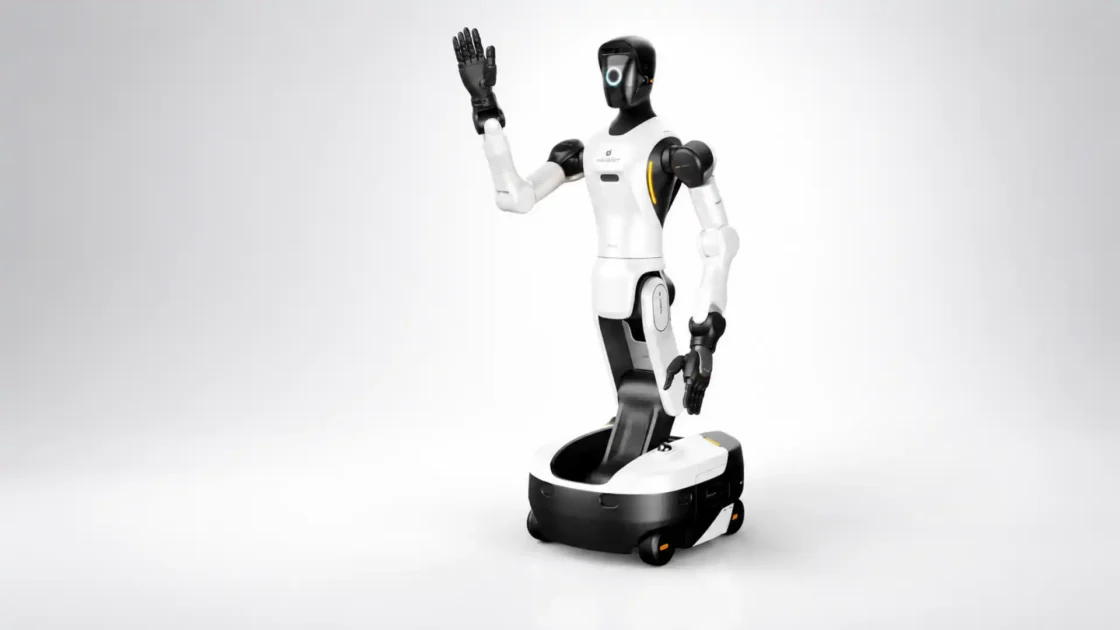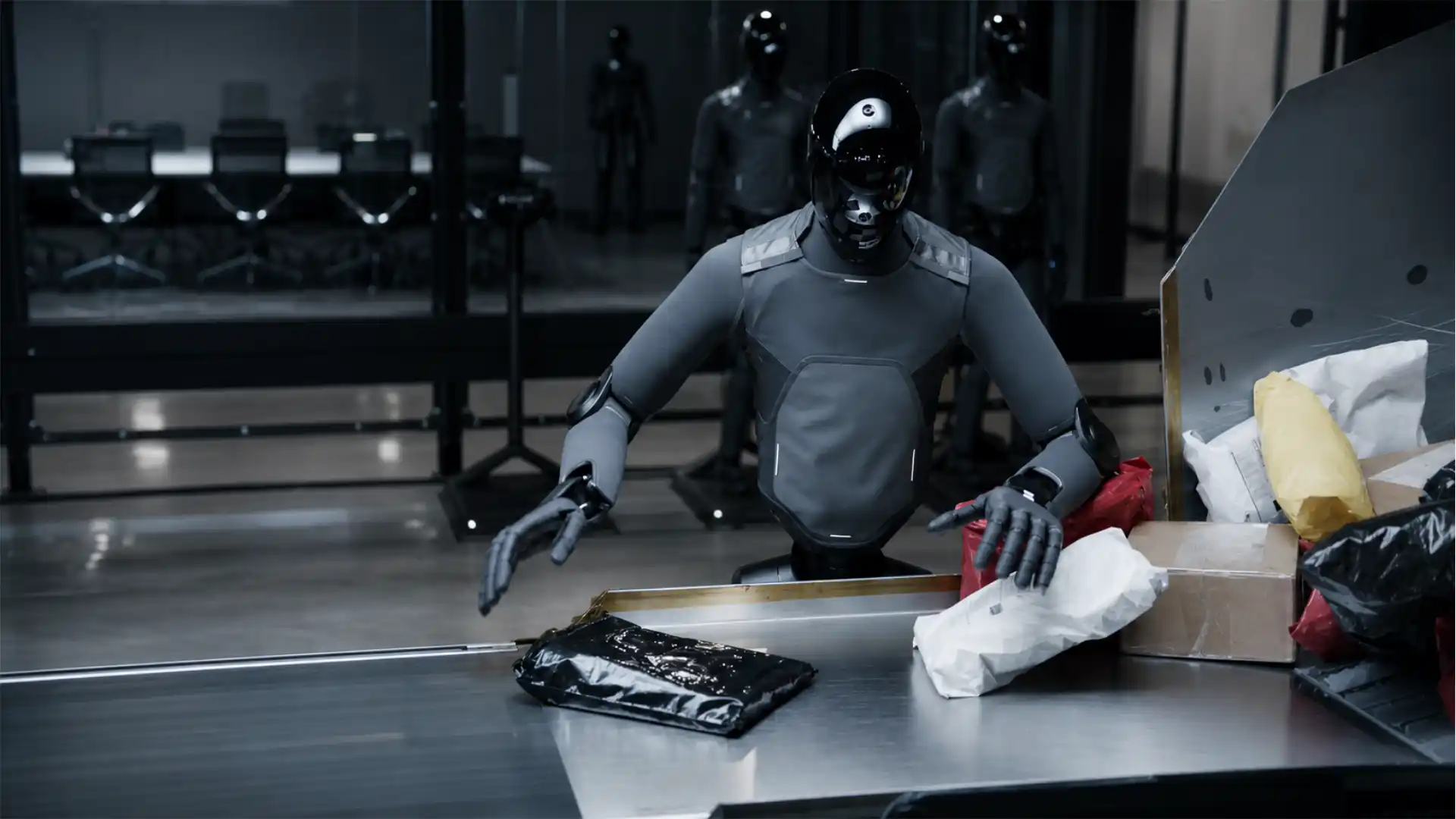
The package was small. The movement was plain. A Figure 03 humanoid reached, grasped, turned, placed and repeated the same warehouse motion in front of a live audience. Figure AI framed the broadcast as an eight-hour autonomous shift running on Helix-02, its full-body robotics model. The point was not spectacle in the old robotics sense. It was work: a repetitive package-handling task performed in public, at a pace close enough to human sorting speed that the comparison became impossible to avoid. Reporting from TechRadar and Business Insider described F.03 robots sorting parcels in a livestream from Figure’s San Jose headquarters, with CEO Brett Adcock saying the machines were operating autonomously rather than through teleoperation.
Table of Contents
The dull task was the message
The most revealing part of Figure AI’s livestream was how ordinary it looked. A humanoid robot did not need to dance, carry on a witty conversation or complete a cinematic rescue mission. It had to handle a box, orient it correctly and send it down a conveyor. Then it had to do the same thing again, and again, and again, long enough for viewers to stop watching for novelty and start watching for failure.
That made the broadcast stronger than a short promotional clip. A polished 30-second robotics video can hide dropped objects, resets, off-camera help and careful scene staging. A live shift is harder to flatter. It exposes hesitation, odd gestures, pauses, charging needs, package errors and the strange boredom of physical labor. Figure AI turned monotony into evidence. The robot’s credibility did not come from one successful pick. It came from the claim that the machine could keep repeating the task through a workday-sized window.
The livestream also showed why warehouse work is a natural test for humanoids. Parcel handling looks simple to humans because our bodies hide the difficulty. We infer weight, surface friction, label position, box stiffness and safe contact points before we can describe the process. A robot has to build that loop from cameras, tactile feedback, joint control, learned policies and balance. Even a narrow package task asks the machine to connect perception and action under timing pressure.
The task was narrow, and that matters. The robots were not unloading a chaotic trailer, resolving inventory exceptions, dodging forklifts, reading damaged labels or making supervisor-level decisions. They were working in a prepared package-sorting setup. Still, the event had force because it looked less like a lab trick and more like a station job. A humanoid standing at a conveyor is an image that managers, workers and investors understand immediately.
The setting also sharpened the economic question. A fixed industrial robot or a custom sorter can outperform a humanoid on many narrow tasks. That is not the humanoid argument. The argument is that a human-shaped robot may fit into places designed around human reach, human tools, human aisles, human bins and human workstations. Humanoids are not trying to beat every warehouse machine at its own job. They are trying to automate the awkward manual gaps that existing machinery leaves behind.
Figure’s stream should therefore be read as a public test of a thesis: if a humanoid can sustain near-human tempo on a repetitive station task, the next debate shifts from basic possibility to reliability, safety, cost and deployment design. That is a harder debate for the company, but also a more serious one.
The public understood the image faster than any technical explanation could. The robot was not abstract automation hidden inside a machine. It had a body. It appeared to be doing a shift. That is why the broadcast drew attention outside robotics circles. A machine performing a familiar manual task for hours forces people to ask whether they are watching a product demo, a labor forecast or both.
The eight-hour claim made the story larger than a demo
Figure AI’s first public claim was not merely that F.03 could sort packages. It was that the robots could work through an eight-hour autonomous shift at human performance levels. TechRadar reported that the F.03 robots were shown detecting package barcodes, picking up parcels and placing them barcode-side down, with Adcock describing the task speed as close to human pace at roughly three seconds per package. Business Insider reported that the original eight-hour run drew more than 1.5 million X views and that Figure continued the livestream after hitting the initial target.
The phrase “eight-hour shift” changed the emotional and industrial meaning of the event. A minute-long robot behavior is a demonstration. An eight-hour run borrows the time structure of human labor. It sounds like scheduling, staffing, breaks, coverage, throughput and fatigue. It moves the robot from the showroom into the calendar of work.
That framing was deliberate. Industrial buyers do not buy a robot because it succeeds once. They buy because it can run through enough hours, errors and variations to lower cost or raise output. A robot that works beautifully for 10 minutes and then needs a technician is not a worker. A robot that moves more slowly but keeps the station productive, charges predictably and recovers safely may be more valuable.
The eight-hour format also made the human comparison unavoidable. A human shift is measured in time, not only in motion. People tire, lose focus, take meal breaks, use bathrooms, adjust posture and go home. Machines have their own limits: batteries, heat, maintenance, calibration drift, software faults and mechanical wear. The economics depend on the whole system, not the body alone.
Business Insider later reported a 10-hour package-sorting contest between a Figure robot and intern Aimé Gérard. Gérard sorted 12,924 packages, 192 more than the humanoid, averaging 2.79 seconds per item compared with the robot’s 2.83 seconds. The human won, but the narrow margin made the robot look serious rather than laughable.
That result has two readings. The first is that a motivated human still beat the robot on a controlled task. The second is that a humanoid robot came close enough over 10 hours to make the comparison operationally meaningful. A robot does not need to humiliate a person to change a business case. It only needs to come close, especially if a fleet can cover nights, weekends or hard-to-staff stations.
The contest also showed why speed alone is a weak measure. Business Insider reported roboticist Ayanna Howard’s view that the demo was impressive but not deployment-ready, citing issues such as barcode orientation errors and packages knocked off the belt. A robot can sort quickly and still fail the warehouse if its error-adjusted throughput is too low.
That is the core industrial distinction. A livestream can show pace. A customer site measures completed work. Wrongly oriented packages, dropped items, resets and downstream corrections all count against output. The useful metric is not packages touched per hour. It is correctly handled packages per hour after errors, interventions and downtime are included.
Figure’s eight-hour claim widened the conversation because it was work-shaped. It invited scrutiny from buyers, workers, investors, engineers and safety specialists. That is progress for a field too often judged by edited clips.
Figure 03 was designed for this kind of public endurance test
Figure introduced Figure 03 on October 9, 2025, calling it the company’s third-generation humanoid robot and describing a ground-up redesign for Helix, home use, mass manufacturing and commercial work. The official announcement says Figure 03 has a redesigned sensory suite and hand system, soft goods, wireless charging, battery safety changes and a production design aimed at high-volume manufacturing through BotQ.
Those details matter because a package livestream tests more than one skill. It tests hands, cameras, body control, charging, heat, mechanical repeatability and software recovery. A humanoid that can pose with a box for a product image is one thing. A humanoid that can handle thousands of package interactions over a public run is a different engineering problem.
Figure says the Figure 03 camera architecture delivers twice the frame rate, one-quarter the latency and a 60 percent wider field of view per camera compared with its prior approach. For a conveyor task, those changes have practical value. The robot sees moving objects, tracks its own hands, adjusts to package position and decides when to place. Lower latency reduces the gap between perception and action. A wider field of view helps when the robot’s body and hands create self-occlusion.
The hand is even more important. A package can be light, stiff, taped, glossy, dented, shifted inside or slightly crushed. The robot must use enough force to control it without overgripping or misplacing it. Figure has described Figure 03’s hand system as built around tactile sensing and palm cameras that help with close-range manipulation. Helix-02’s official announcement connects those palm cameras and tactile sensors with manipulation tasks that were previously out of reach for the system.
That is the quiet layer of the event. Viewers see a box move. Engineers see contact mechanics. The robot must decide where to place fingers, how to keep the object stable, when to rotate, whether the barcode side is down, whether the object is slipping and when to release. The hard part of package handling is not lifting a box once. It is making the contact loop reliable enough that small errors do not pile up over a shift.
Wireless charging was also part of the industrial image. Figure says Figure 03 can charge through coils in its feet by stepping onto a wireless stand at 2 kW, and Business Insider reported that two humanoids stood on chargers behind the working robot during the livestream, ready to take over.
That turns endurance into a fleet problem. One robot does not have to work forever if the station remains productive while robots rotate between work, charging and service. Human labor is scheduled around people. Robot labor will be scheduled around batteries, hardware health and task availability. The package stream hinted at that model by showing backup machines in view.
Figure 03’s manufacturing design is also tied to the broadcast. Figure says the robot moved away from prototype-heavy CNC machining toward die-casting, injection molding and stamping, while reducing part count and assembly steps. The company also says it is vertically integrating key modules such as actuators, batteries, sensors, structures and electronics.
A humanoid robot that performs one public shift is interesting. A humanoid robot that can be produced, repaired and improved across thousands of units is an industrial product. Figure used the livestream to show the first part. Its Figure 03 and BotQ announcements try to answer the second.
Helix-02 moved the claim from motion to embodied autonomy
Figure’s autonomy story rests on Helix-02, announced on January 27, 2026. Figure describes Helix-02 as a full-body autonomy system that extends earlier Helix work from upper-body control to walking, manipulation and balance as one continuous system. The company says Helix-02 connects onboard sensors, including vision, touch and proprioception, directly to actuators through a unified visuomotor neural network.
That architecture matters because humanoid work is not a set of isolated motions. A package-sorting robot must stand, reach, balance, perceive, grasp, rotate and place as one body. A person does this without thinking about each joint. A robot either needs hand-engineered layers that coordinate those actions or learned systems that connect perception and motion more directly. Figure is claiming the latter direction.
The phrase “fully autonomous” drew attention because robotics demos have a trust problem. The public has seen remote operation, scripted motions, staged environments and edited footage. Figure and Adcock said the livestream was not teleoperated. Interesting Engineering reported Figure’s claim that the robots were sorting small packages around the clock without human control, using Helix-02 running onboard.
The useful question is not only whether someone held a joystick. Autonomy has layers. A robot may choose grasps and motions while humans prepare the station. It may operate without teleoperation while still being monitored remotely for safety. It may recover from common failures but rely on a person for rare faults. It may be autonomous in a warehouse station and helpless in a less structured environment.
That does not make the claim meaningless. It makes precision necessary. For industrial robotics, autonomy should be described by task, environment, intervention boundary and recovery procedure. “Autonomous package sorting in a prepared conveyor setup” is a stronger and more useful phrase than “a fully autonomous warehouse worker.”
Figure’s earlier Helix announcement described a generalist Vision-Language-Action model that unifies perception, language understanding and learned control, with the company claiming full-upper-body control and multi-robot collaboration. Helix-02 extends that ambition to the whole body.
This places Figure inside a wider robotics shift. NVIDIA’s Isaac GR00T N1 announcement framed humanoid development around foundation models, simulation tools and synthetic data, while the GR00T N1 research paper describes a vision-language-action model trained from real-robot trajectories, human videos and synthetic datasets.
The industrial meaning is clear. Old robot automation worked best when the environment was rigid and engineers could program expected states. Humanoids are being built for environments that are human-shaped but not fully predictable. They need systems that can map pixels, touch and body state into useful motion without a new custom program for every small variation.
The risk is that model language hides hardware reality. A learned policy cannot rescue a poor hand, weak actuator, overheating compute module, blind camera angle or unsafe recovery routine. Embodied autonomy is not only AI. It is AI fused to sensors, mechanics, batteries, thermal design, manufacturing quality and safety layers.
Figure’s livestream made Helix-02 visible through a repetitive task. That is a fair way to show progress. The next proof must explain which parts of the task the model handled, which parts were made easy by station design, and how often the system needed resets or correction.
The livestream was convincing because failure was possible
The event worked because it allowed viewers to wait for something to go wrong. That is unusual in robotics marketing. Most product clips are cut to remove awkward moments. Figure invited the awkward moments to happen in public. Pauses, odd movements and speculation about remote control became part of the viewing experience.
Business Insider reported that the livestream did not show major glitches, but did include prolonged pauses and eccentric gestures, including arm-to-head movements that fueled speculation about hidden assistance. Adcock said the robots were deciding what to do from what they saw through cameras, and that when a robot got stuck, its AI model could trigger an automatic reset.
That recovery claim is more interesting than a flawless clip. A useful robot is not one that never encounters confusion. It is one that detects trouble, stops safely, resets or retries, and returns the station to output. Human workers recover constantly from minor mistakes. Robots need their own recovery vocabulary.
The livestream also changed the public burden of proof. A viewer could not audit code, but could watch duration. A buyer could not see private logs, but could see pace and continuity. A skeptic could question autonomy, but not dismiss the whole event as a 10-second edit. Public duration does not prove readiness, but it raises the evidence level.
That evidence level still has limits. Viewers could not see the exact package mix, hidden monitoring tools, intervention logs, reset counts, safety boundaries, error categories or downstream correction rates. They could not know whether the environment was easier than a customer site. They could not test the robot with damaged boxes, odd labels, polybags or mixed weights.
Those gaps are not small. A warehouse buyer would ask for them before procurement. But the livestream still gave the public something rare: a long, visible robotics run in which the task was obvious and failure would have been noticeable. That is healthier than a field built on cinematic snippets.
The public format also made the robot socially legible. People read humanoid movements as intentions. A head touch, pause or strange arm motion invites interpretation. In a workplace, that matters. Workers need to know whether a robot is working normally, resetting, yielding, faulting or preparing to move. A machine with human form cannot rely only on hidden status logs. It must be understandable to people nearby.
The naming of the robots by viewers — Bob, Frank, Gary and later Rose in media reports — shows how quickly people assign identity to humanoid machines. That may help adoption by making robots familiar, but it also risks overtrust. A robot with a nickname is still industrial equipment. It needs risk assessment, training and stop procedures.
Figure’s livestream became a public stress test because the company allowed imperfections to be visible. The stronger test now is not whether viewers were entertained. It is whether the same transparency continues when robots enter customer sites.
Near-human pace is not the same as warehouse readiness
Figure’s most attention-grabbing performance claim was speed. The company and its CEO framed F.03 as near human pace on the package task, around three seconds per package. TechRadar and Business Insider both reported that framing, while Business Insider’s human-versus-robot contest later put a human at 2.79 seconds per package and the robot at 2.83 seconds.
Near-human pace is a threshold. A robot that is dramatically slower than a person must justify itself through lower cost, safer work or longer availability. A robot that sits near human tempo can compete on consistency, coverage and fleet management. That is why the package stream felt uncomfortable. It put humanoid work close enough to human work that the old assumption of obvious machine inferiority no longer felt safe.
Still, human pace is not human capability. A warehouse worker does more than one motion. Workers notice damaged labels, unusual package weights, jams, unsafe spills, supervisor instructions, coworker signals and process exceptions. They improvise. They ask questions. They change strategy. A robot matching one timed motion does not equal a human worker.
This distinction matters for labor policy and customer buying. Automation usually removes tasks before it removes jobs. A humanoid may take over a repetitive station motion while people handle exceptions, supervision, maintenance and quality checks. If enough task fragments are automated, the job changes. It may shrink, become more technical or disappear in some facilities. But the path is gradual and uneven.
Accuracy remains the counterweight to speed. Howard’s critique in Business Insider, pointing to barcode orientation errors and package mishandling, gets to the issue that a factory or warehouse cares about: not motion, but completed work.
A robot can appear fast in a video while creating hidden downstream cost. A package placed with the barcode wrong-side up might need rescanning or manual correction. A dropped package might damage goods or stop the belt. A five-second reset might not matter in a demonstration, but could matter in a high-volume line. Industrial throughput is speed minus errors, interventions and recovery time.
The task setup also matters. The livestream reportedly used a looped conveyor with the same packages cycling through, according to Business Insider’s account of a Figure investor’s explanation. That does not invalidate the test; repetition is useful for endurance. But it limits what can be inferred about object diversity.
A stronger readiness claim would require mixed package types, higher variation, real inbound flow, damaged labels, changing lighting, worker presence, real warehouse management integration and transparent error logs. The current evidence supports a narrower conclusion: Figure showed a credible long-duration package-handling capability under a controlled public setup. That is meaningful, but it is not a full logistics deployment.
The difference is not academic. Buyers will not ask whether the stream looked impressive. They will ask whether a robot station lowers cost per correctly processed parcel under their facility’s conditions.
The package loop showed a narrow task with wide implications
A repetitive package loop is both modest and revealing. It is modest because the work is constrained. It is revealing because it combines perception, grasping, orientation, placement, timing and endurance. For a humanoid robot, those skills sit at the center of many physical jobs.
The robot must detect the object, infer where the barcode is, choose a grasp, avoid blocking its own view, lift without dropping, rotate in the right direction, place at the right time and release. A human worker treats this as a single routine motion. The robot’s system has to bind visual recognition, tactile contact, balance and hand control into one cycle.
The controlled nature of the loop makes it a useful benchmark seed. The public can understand the task. Counts can be estimated. Failure is visible. It is much easier to judge than a vague home demo where the robot slowly tidies a room. Package orientation is not everything, but it is measurable.
The loop also exposes why humanoids are attractive to warehouse operators. Many warehouses already use conveyors, scanners, sorters, AMRs and robotic arms. Yet there are still manual fragments around these systems: orienting objects, clearing small exceptions, moving totes, feeding stations, handling odd packages, staging carts and doing short-run processes that do not justify custom machines.
Humanoid robots aim at those fragments. They may not be the fastest way to sort parcels at scale. A high-speed sorter will beat them. But a humanoid could become useful if it can move between several manual fragments without a full facility rebuild. The economic case for a humanoid is task breadth plus enough reliability, not raw speed on one loop.
This is where Figure’s livestream becomes strategic. If F.03 can do only this one package loop, the event is a high-profile narrow demo. If the same hardware and Helix-02 model can be trained or prompted into adjacent warehouse tasks with limited engineering, it becomes a platform signal. The difference will decide whether Figure is selling a flexible labor machine or an expensive station tool.
The package loop also makes the data question visible. Every pick, grip, rotation and placement can feed model improvement. Repetition generates examples of successes and failures. If the robot handles tens of thousands of cycles, Figure collects contact and perception data that may improve future policies. But data quality depends on variation. A loop with similar boxes teaches less than a messy flow with many object types.
For public interpretation, the right reading is calibrated. The demo was not trivial. It was not full warehouse automation either. It showed that Figure’s machines are crossing from laboratory action into work-shaped repetition. That is enough to justify attention and scrutiny.
Public evidence still needs private logs
The livestream gave viewers a rare open window, but not the full record. Figure’s strongest evidence was visible duration. Its weakest public evidence was measurement depth.
A customer would ask questions that the stream could not answer alone. How many packages were mishandled? What counted as a failure? Were resets counted separately? Did remote monitors have any live control authority? How often did robots leave the station? How long did charging take? What was the mean time between manual interventions? Were dropped packages included in the success count? Were all boxes identical? How did the robot perform after dust, heat and lighting changed?
Those questions are not hostile. They are procurement basics. A warehouse or factory does not buy a robot because a livestream entertained millions. It buys because the system produces predictable output under known cost and risk.
Figure could strengthen trust with a structured public run report. Such a report could define the task, list robot count, describe package classes, state autonomy boundaries, publish total packages, give success and error rates, count resets, define failures, show charging cycles and separate hardware faults from task mistakes. Proprietary code can stay private. Operational claims can still be clearer.
The need for logs grows when a company uses phrases such as “zero failures.” Interesting Engineering reported Figure’s claim that the robots crossed 24 hours of continuous autonomous work without failures, while Business Insider reported expert observations of package-handling accuracy issues. Those may both be true if “failure” refers to robot autonomy or hardware stopping rather than every package-handling mistake. The public needs those definitions.
A package placed the wrong way may not be a robot failure in the company’s internal language. It may be a task error. A reset may not be a failure if the system recovers automatically. A dropped package may not count if the robot continues. Those distinctions matter because buyers care about operational effects, not wording.
Public evidence from the livestream
| Evidence area | Strong public signal | Missing operational detail |
|---|---|---|
| Duration | Eight-hour run, later extended beyond 24 hours | Full uptime, reset and intervention logs |
| Pace | Around human package-sorting tempo was claimed | Error-adjusted throughput under real site conditions |
| Autonomy | Figure said Helix-02 operated without teleoperation | Audit boundary between autonomy, monitoring and recovery |
| Fleet use | Backup robots charged in view | Robot-to-station ratio and charging utilization |
| Work relevance | Task resembled a warehouse station | Transfer to messy package mixes and exceptions |
The table shows the central split. The stream was better evidence than an edited clip, but not the same thing as a production audit. Humanoid robot companies should welcome that distinction because clearer evidence protects real progress from being dismissed as showmanship.
BotQ is the industrial subplot behind the livestream
The package-sorting robot was the visible story. BotQ is the industrial subplot. Figure says BotQ is its dedicated high-volume manufacturing facility and that Figure 03’s first-generation line is initially capable of producing up to 12,000 humanoid robots per year, with a goal of 100,000 robots over four years.
Those numbers matter because humanoid robotics cannot become a labor technology through hand-built prototypes. It needs repeatable manufacturing, consistent actuators, reliable batteries, calibrated sensors, durable hands, serviceable parts and quality control across many units. A one-off robot can be tuned by experts. A fleet must be built like an industrial product.
Figure’s BotQ announcement says the company chose in-house manufacturing to control build process and quality, and that it has been building software infrastructure such as MES, PLM, ERP and WMS systems to support volume manufacturing. The company also said its own humanoid robots would be used in manufacturing other humanoid robots.
This manufacturing language is less viral than a robot sorting packages, but it may matter more. Humanoid robotics is not only a software race. It is a race in motors, gears, batteries, wiring, assembly, test equipment, suppliers, calibration and repair. The company that builds the best demo may lose to the company that can build the same robot 10,000 times without quality drift.
Manufacturing scale also changes the autonomy story. Robot learning improves with field data. Field data requires deployed robots. Deployed robots require manufacturing volume. Manufacturing volume requires capital before the market is fully proven. That is the flywheel Figure is trying to spin: build robots, deploy robots, collect data, improve Helix, expand tasks, build more robots.
The flywheel can fail if the product is not ready. Producing large numbers of expensive humanoids before customers can use them reliably would turn scale into inventory risk. Hardware startups can burn capital quickly when manufacturing races ahead of validated use cases. The package stream helps de-risk the story, but it does not complete it.
Figure’s September 2025 Series C announcement said the company had exceeded $1 billion in committed capital at a $39 billion post-money valuation, with funding intended for Helix, BotQ, GPU infrastructure and data collection. That valuation turns every public demo into a pressure point. A company valued near $40 billion must prove more than clever robotics. It must prove a path to a large market.
BotQ is therefore central. If Figure can reduce unit cost and raise build consistency, the warehouse use case becomes more plausible. If robots remain expensive and labor-heavy to assemble, the economic case weakens. The package livestream asked whether the robot can work. BotQ asks whether the robot can be made, maintained and sold at industrial volume.
Figure’s BMW pilot gave the stream a deeper backdrop
Figure’s package livestream landed differently because the company already had a production-site story. In November 2025, Figure said its Figure 02 robots had completed an 11-month deployment at BMW Group Plant Spartanburg. The company reported 10-hour weekday shifts, more than 90,000 parts loaded, more than 1,250 runtime hours and contribution to production of more than 30,000 BMW X3 vehicles.
That BMW claim matters because it places Figure’s robots in an industrial setting before the package stream. Automotive manufacturing is a stricter environment than a viral demo. Cycle time, line integration, tolerances, safety and uptime are unforgiving. A robot that slows production or damages parts does not stay useful for long.
The BMW deployment also shows the likely route for early humanoids: defined tasks inside controlled environments. Figure’s report described loading sheet-metal parts, not a general humanoid roaming freely across a factory. That is realistic. Early humanoid work will probably look like assigned station tasks, mapped areas, known objects and measured cycle times.
The lesson for the package stream is that Figure is not only chasing social media attention. It is trying to connect public proof with industrial learning. BMW provided a customer-like manufacturing challenge. The livestream provided a public endurance challenge. BotQ provides a scale challenge. Helix-02 provides the software story. The company’s strategy is to make these pieces look like one platform rather than separate demos.
That integration is not guaranteed. A robot that loads sheet metal, sorts packages and makes beds may still need heavy task-specific work for each behavior. The true platform test is transfer: whether new tasks require less data, less manual programming and less site-specific engineering over time. If every task remains bespoke, Figure becomes a high-cost automation integrator. If the same model and hardware adapt across tasks, the platform thesis becomes stronger.
The BMW story also raises expectations. Once a company says its robots ran 10-hour shifts in an active assembly line, buyers and journalists should ask for rigorous deployment metrics. How many interventions? What was the error rate? How did the robot recover from failures? What changed in Figure 03 because of the pilot? Figure said Figure 02 retirement and lessons from the BMW deployment would feed Figure 03 operational readiness. That kind of feedback loop is credible, but it should be documented.
The package stream should therefore be seen as part of a longer industrial test path. It was not proof by itself. It was a public chapter in a sequence that Figure wants customers and investors to read as progress toward deployable humanoid labor.
The global robotics market already knows automation
Humanoids are entering a world where industrial automation is mature. The International Federation of Robotics reported that 542,000 industrial robots were installed in 2024, more than double the figure from 10 years earlier, with annual installations above 500,000 units for the fourth straight year. IFR also reported that Asia accounted for 74 percent of new deployments in 2024, Europe for 16 percent and the Americas for 9 percent.
That context prevents overreaction. Figure AI did not introduce robotics to warehouses and factories. Robot arms, conveyors, sorters, gantries, AMRs, automated storage systems and inspection machines already shape industrial work. A humanoid is a new layer, not the first layer.
The existing automation market is a harsh benchmark. A humanoid must compete with machines that are cheaper, faster or more reliable for narrow tasks. A fixed robot arm may beat a humanoid at machine tending. A conveyor and sortation system may beat it at parcel volume. An AMR may beat it at tote transport. A humanoid only wins where its flexible body and task breadth are worth the cost.
That points to a likely adoption pattern. Humanoids will not replace the automation stack. They will attach to it. They may handle the manual fragments around conveyors, feed parts into machines, move irregular objects, clear exceptions, restock carts or serve as adaptable station workers in places that are still built for people.
Amazon’s robotics program illustrates the scale of existing alternatives. Amazon said in 2023 that it had more than 750,000 robots working with employees, and described Sequoia as combining mobile robots, gantry systems, robotic arms and ergonomic workstations. It also said Sequoia could identify and store received inventory up to 75 percent faster and reduce order-processing time through a fulfillment center by up to 25 percent.
That is the bar. Humanoids must be judged against integrated systems, not only human hands. A robot at a package station may be impressive, but if a redesigned workflow solves the same problem with less risk and higher throughput, the humanoid loses that use case.
The counterargument is flexibility. Not every facility can install a major system. Not every manual task has enough volume for custom hardware. Many warehouses contain awkward work that changes with product mix, season or customer demands. A humanoid that can move between these tasks may offer value even if it is never the fastest machine at any single one.
The industrial robot market’s maturity makes Figure’s challenge harder and more credible at the same time. Harder, because buyers have alternatives. More credible, because companies already know how to measure automation and pay for systems that work.
Rivals are pushing the same work-shaped future
Figure AI’s livestream arrived during a crowded humanoid race. Tesla, Agility Robotics, Boston Dynamics, Apptronik, 1X, Sanctuary AI, Unitree, UBTech, Fourier, Agibot and others are trying to turn AI-driven bodies into useful machines. The approaches differ, but the market is converging around work: logistics, factories, backrooms, homes and service environments.
Agility Robotics has already emphasized logistics deployment. GXO announced in June 2024 that it had signed a multi-year agreement with Agility to deploy Digit in GXO logistics operations, calling it the industry’s first formal commercial deployment of humanoid robots and the first humanoid Robots-as-a-Service deployment.
Agility also said Digit stepped into commercial operations at a GXO facility near Atlanta on June 5, 2024. Amazon had earlier said it would test Digit for tote recycling, describing the robot’s size and shape as suited for buildings designed around people.
That matters because Figure’s public endurance stream and Agility’s customer deployment story pressure each other. Figure showed a vivid public run. Agility points to commercial logistics deployment. A mature market will require both: visible performance and paid operational use.
Tesla’s Optimus sits in a different position. Tesla’s official AI and robotics page describes Optimus as a general-purpose bipedal autonomous humanoid intended for unsafe, repetitive or boring tasks, requiring balance, navigation, perception and physical-world interaction.
Tesla’s advantage is manufacturing ambition and AI infrastructure. Its burden is proof. Investors and the public have seen many bold timelines around Tesla products, so Optimus must eventually move from stage demonstrations into measurable work. Figure’s package stream raises the pressure on Tesla and others to show long-duration, countable tasks.
NVIDIA’s role is more horizontal. By releasing GR00T N1 and related simulation frameworks, it is trying to supply part of the software and data infrastructure for humanoid developers. NVIDIA’s announcement framed the system as a foundation model for generalized humanoid reasoning and skills, with synthetic data and simulation tools to speed development.
This creates two possible market shapes. Some companies will build vertically integrated humanoid stacks, owning hardware, models, data and deployment. Others may use shared foundation models, third-party simulation and more standardized hardware platforms. Figure is clearly positioning itself as a vertically integrated company through Figure 03, Helix and BotQ.
The competitive danger is a demo race. Companies may chase the most viral task rather than the most useful one. Package sorting, bed-making, laundry folding and factory loading all generate attention, but the market will eventually rank companies by customer value. The winners will be those that turn robot videos into repeatable operations with measured uptime and clear economics.
Labor anxiety is rational, but the first impact may be subtler
The livestream triggered job anxiety because the robot looked like a worker. It stood at a station and did repetitive manual labor through a shift-sized window. For many viewers, that image felt more direct than a conveyor or scanner. It was not hidden machinery. It was a humanoid body performing a task many people recognize as work.
The labor market exposed to this kind of automation is large. The U.S. Bureau of Labor Statistics says hand laborers and material movers usually have no formal education requirement, often learn through on-the-job training of one month or less, and had a median annual wage of $37,680 in May 2024. BLS projects about 1,008,300 openings per year in that occupational group over the 2024–2034 decade, much of it from replacement needs.
Those numbers explain both employer interest and worker concern. The work is plentiful, physically demanding and often low-wage. For employers, automation promises staffing relief, reduced repetitive strain and shift coverage. For workers, it threatens hours, bargaining power and entry-level roles.
The first impact may not be mass layoffs. It may be reduced hiring growth, fewer overtime hours, more task monitoring and changed job design. A warehouse facing turnover may use robots to avoid adding headcount. A factory may use humanoids for night work or hard-to-staff stations. Workers may remain, but their roles may shift toward supervision, exceptions and maintenance support.
That shift can be positive if companies train workers into better-paid roles. It can be damaging if workers lose accessible jobs without credible pathways. A package sorter does not automatically become a robot technician because management bought a humanoid. Training, pay, scheduling and internal mobility have to be built.
The safety case and labor case also overlap. Repetitive package handling can be physically punishing. Business Insider reported that Gérard’s 10-hour contest left him with blisters, and BLS lists physical stamina, strength, coordination and attention to detail among qualities for material-moving work.
A robot that removes the most repetitive or injury-prone tasks could improve working conditions. But automation can also intensify remaining work. If robots handle routine flow and humans handle only exceptions under tighter monitoring, jobs may become more stressful. If companies cut staffing too aggressively, workers may face more pressure, not less.
The labor question is not whether robots can do warehouse tasks. It is who captures the gains when they do. Productivity can raise profits, reduce injuries, improve service and create technical jobs. It can also weaken workers if deployment is treated only as labor cost reduction. Figure’s livestream makes that choice more urgent.
Warehouse safety will become a central test of humanoid deployment
A humanoid robot in a warehouse is not just another tool. It is a moving machine with limbs, batteries, sensors, software and learned control. It may work near people, conveyors, carts, forklifts and other robots. That makes safety a gating issue for commercial adoption.
OSHA’s robotics overview states that there are currently no specific OSHA standards for the robotics industry. The same page points to hazards in non-routine conditions such as programming, maintenance, testing, setup and adjustment, when workers may enter a robot’s working envelope.
This does not mean humanoids enter an unregulated vacuum. Employers still have workplace safety duties, and standards from ISO, ANSI/RIA, UL and other bodies shape risk assessment and procurement. ISO lists ISO 10218-1 and ISO 10218-2 as 2025 robotics safety standards for industrial robots and industrial robot applications, and ISO/TS 15066 specifies safety requirements for collaborative industrial robot systems and work environments.
Mobile robot safety adds another layer. ANSI/RIA R15.08-1 specifies safety requirements for industrial mobile robots and describes hazards associated with IMRs in industrial environments. A humanoid that walks or moves through a facility while manipulating objects may touch several safety categories at once.
Commercial and public-facing robot standards may also matter. UL Solutions says it certifies robots to UL 3300, and says OSHA added UL 3300 to its Nationally Recognized Testing Laboratory Program’s List of Appropriate Test Standards on December 31, 2025, for SCIEE robots in commercial and enterprise environments.
The difficulty is classification. A Figure 03 in a warehouse may behave like a mobile robot, a collaborative manipulator, an industrial machine and a service robot at different moments. It may walk to a station, work near a conveyor, charge itself and interact with workers. A single standard may not cover the whole risk profile.
Safety must also address learned behavior. Traditional safety engineering prefers predictable control paths. AI-driven motion policies can be harder to reason about. Vendors may use safety-rated layers around learned policies, but the integration must be conservative and auditable. A neural policy can choose motion; a safety system must prevent harm.
The hazards are physical and procedural: moving arms, pinch points, dropped packages, falls, unexpected turns, battery faults, blocked exits, maintenance lockout, sensor blind spots, software updates and confusion about robot intent. Figure 03’s soft goods and battery safety design are relevant, but they are not enough by themselves.
The first serious humanoid deployments should be treated as safety programs, not gadget launches. Workers need training, visible stop mechanisms, clear zones, fault procedures and a voice in deployment planning. A robot that is impressive on video but unpredictable on the floor will not earn trust.
The economics are tougher than a viral clip
A livestream can win attention. A warehouse deployment has to win a spreadsheet. Figure’s robot must eventually justify itself against human labor, fixed automation, AMRs, sorters, robot arms, outsourcing, process redesign and doing nothing.
The cost case is not only wages. A buyer must count robot purchase or lease cost, integration, chargers, floor changes, software, support contracts, spare parts, maintenance labor, supervision, network infrastructure, insurance, training, safety review and downtime. A robot that matches a person’s cycle time on one task may still fail the economics if it is expensive, fragile or requires too much support.
The wage baseline is real. BLS reported a May 2024 median annual wage of $37,680 for hand laborers and material movers, with transportation and warehousing at $42,880 among top industries. Those figures do not include all employer costs, but they show the labor market Figure must compete with in many settings.
A humanoid can justify itself through several channels: fewer hard-to-fill shifts, lower injury exposure, more continuous operation, reduced turnover, better consistency, task flexibility and redeployment across workflows. But if the robot performs only one narrow station task, the payback hurdle rises. Task breadth matters.
Robot utilization may decide the economics. A $100,000 machine working three hours a day is different from a fleet covering a station around the clock. Figure’s visible charger rotation hints at fleet utilization. A buyer will ask how many robots are needed to keep one station productive, including charging and maintenance. The answer may not be one.
Robots-as-a-Service may lower adoption friction. GXO’s agreement with Agility described a RaaS model for Digit, which shifts some upfront cost and risk away from the customer. Figure may pursue direct sales, leases, service contracts or mixed models. Each model changes who carries reliability risk.
If a vendor sells robots outright, the customer worries about support. If the vendor leases output or robot time, the vendor worries about uptime, repairs and capital recovery. A RaaS model can accelerate adoption if customers pay for productive capacity rather than hardware ownership, but it forces the vendor to operate fleets well.
The viral package stream improves Figure’s sales conversation. It does not close the business case. Customers will ask whether the robot lowers cost per correctly handled package after all support costs, errors and downtime are included.
Data is the hidden product of every package picked
Every package handled by F.03 is also a data point. Cameras see the object. Tactile sensors feel contact. Joints record motion. Software logs decisions, errors, resets and timing. The public saw a warehouse task. Figure likely saw training material.
Figure’s Series C announcement said the funding would support GPU infrastructure for training and simulation and advanced data collection from human video and multimodal sensory inputs. Figure 03’s announcement also describes wireless data offload, which is relevant for fleet learning.
Physical AI needs physical data. Language models can learn from huge text corpora. Robots need examples of contact, force, object variation, failed grasps, recovery, balance and timing. That data is expensive because it requires bodies in environments. A livestreamed package loop may generate thousands of repeated manipulation samples.
The value depends on diversity. A looped set of similar boxes is useful for endurance and a specific task family. It teaches less about polybags, broken cartons, unusual labels, heavy objects, soft goods or chaotic inbound flow. For robot learning, repetition is not enough. Variation is the teacher.
NVIDIA’s GR00T N1 work points to a wider answer: mix real-robot trajectories, human videos and synthetic data. Simulation can generate many scenarios, but real contact still matters because friction, deformation, lighting and object wear are hard to model perfectly.
Figure’s advantage, if it materializes, would come from connecting fleet data to model improvement. More robots produce more data. More data improves Helix. Better Helix expands tasks. More tasks justify more robots. That is the company’s likely compounding story.
Data also raises privacy and security issues. Warehouse robots may capture labels, inventory, worker movements, facility layouts and proprietary processes. Home robots would capture far more sensitive information. Customers will need clear rules about what data leaves the site, what is retained, how it is anonymized and how it is used for model training.
The autonomy race is therefore also a data governance race. A company that uploads everything may improve faster but lose customer trust. A company that keeps data tightly controlled may move slower but win sensitive deployments. The robot’s eyes are part of the product, and so is the contract governing what those eyes record.
The word autonomous needs a sharper public standard
The Figure stream shows why robotics needs better public language around autonomy. “Autonomous” can mean no joystick control. It can mean no live human correction. It can mean the robot chooses grasps from camera input. It can mean the station runs without anyone present. Those are different claims.
For the livestream, Figure and Adcock said the robots were fully autonomous and running Helix-02. Interesting Engineering reported that Figure stressed there was no teleoperation. Business Insider reported Adcock’s explanation that the robots decided from camera input and could automatically reset when stuck.
That is useful, but not enough for a mature market. A public autonomy disclosure could state: no teleoperation; no human selection of grasps; task command issued at the station level; remote monitoring for safety; automatic resets allowed; environment prepared; package set described; all interventions counted; all task errors categorized.
Such a disclosure would not weaken Figure’s claim. It would make the claim harder to misread. It would also prevent critics from reducing real progress to suspicion about hidden operators.
Autonomy should also be tied to environment. A robot may be autonomous in a prepared conveyor cell and not autonomous in an open warehouse aisle. It may be autonomous with known package sizes and not with mixed freight. It may be autonomous for 24 hours under one flow and fail after a facility layout change. The phrase must travel with its boundaries.
Driving automation has levels, however imperfect. Humanoid work may need its own categories: teleoperated, supervised autonomous, task-autonomous in a prepared cell, autonomous across mapped facility zones and open-environment autonomous. Each category should include intervention rights and failure handling.
The industry may resist precise labels because vague autonomy sells better. That is short-sighted. Ambiguity creates backlash when viewers discover assistance, staging or resets. Precision lets companies claim what they have actually achieved.
Figure has an opening to lead here. The company already took a public risk by streaming for hours. Publishing a post-run autonomy report would put pressure on competitors and raise trust in the category. Humanoid robotics needs fewer magical claims and more run sheets.
Existing warehouse automation gives humanoids a hard benchmark
A humanoid robot does not enter a warehouse against a blank slate. It enters against systems already optimized for specific flows. Conveyor networks, barcode tunnels, sorters, automated storage, AMRs, robotic arms and warehouse software have years of operational history. Their forms are ugly because they are functional.
This is why humanoids must be judged carefully. They may look more impressive than a conveyor, but a conveyor may move goods faster, cheaper and with less uncertainty. A robot arm may be safer and more precise inside a cell. An AMR may move totes with less mechanical complexity. The humanoid must win on adaptability.
Amazon’s Sequoia example is instructive because it did not rely on a humanoid. It redesigned inventory flow through mobile robots, gantry systems, robotic arms and ergonomic workstations. Amazon said the system helps identify and store inbound inventory up to 75 percent faster and reduces order processing time through a fulfillment center by up to 25 percent.
That kind of integrated system shows why humanoids will not dominate every warehouse task. For high-volume predictable processes, system redesign often beats human-shaped flexibility. The humanoid opportunity lies where processes are too variable, too awkward, too low-volume or too human-shaped for custom automation to pay off.
Those areas can still be large. Warehouses are full of edge work: damaged items, odd packages, empty totes, temporary staging, short-run kitting, replenishment, machine feeding, clearing jams and handling exceptions. A humanoid that can cover many such tasks could be valuable even if it never touches the main high-speed sortation lane.
The comparison also affects buyer psychology. Operations teams are experienced with automation. They will not be impressed by humanoid form alone. They will ask for uptime, safety, integration and payback. They will compare with incumbent vendors and internal engineering projects. A robot that looks futuristic but complicates operations will not last.
Humanoids must earn their place beside existing automation, not above it. The Figure stream was most convincing when read as evidence for adaptable manual-station work, not as proof that a human-shaped robot is the best tool for all logistics.
Warehouse injury data gives automation a humane argument and a warning
Warehousing is physically demanding work. BLS data for warehousing and storage show a 2024 total recordable injury and illness rate of 4.8 cases per 100 full-time workers, with 4.1 cases involving days away from work, job restriction or transfer.
That gives robotics companies a humane argument: robots can take on repetitive, strenuous or risky tasks. If a humanoid reduces bending, lifting, twisting or monotonous high-speed handling, it may lower injury exposure. Amazon has made similar safety arguments around robotics, saying Sequoia brings work into an ergonomic power zone and reduces overhead reaching or squatting.
But the safety argument is not automatic. Automation can reduce one risk while increasing another. A humanoid might reduce repetitive package handling but introduce moving limbs, dropped objects, falls, unexpected stops and new maintenance hazards. It may also increase pace pressure on the remaining human workers if managers raise targets.
The best safety case would compare before-and-after outcomes: injury rates, near misses, ergonomic strain, worker-reported fatigue, task pace, maintenance incidents and emergency stop events. Without that data, safety claims remain plausible but incomplete.
Workers should be involved in deployment planning because they know the site’s real hazards. They know where packages jam, where lighting fails, where carts block aisles, where supervisors rush the process and where procedures differ from official maps. A humanoid robot trained or deployed without worker input may fail in ways designers did not anticipate.
The injury context also affects public acceptance. Replacing punishing tasks can be framed as progress. Replacing wages without support can be framed as abandonment. The same robot can be seen as protection or threat depending on how the company deploys it.
A serious humanoid deployment should measure safety gains and job-quality effects together. Safer work that leaves workers poorer is not a clean win. Lower injury exposure paired with training, better roles and wage stability is a stronger model.
Figure’s valuation raises the bar for proof
Figure’s $39 billion post-money valuation, announced with more than $1 billion in Series C committed capital, creates pressure to turn public demos into a large business. The company said the funding would support commercial and home deployments, BotQ manufacturing, GPU infrastructure and data collection for Helix.
A package livestream helps explain the story to investors. It compresses the thesis into a visual: humanoid robots working a shift. But valuation changes the burden. At that scale, the market is not betting on one task. It is betting on a platform that can reach many tasks, many sites and eventually many homes.
The platform thesis needs several pieces to work together. Figure 03 must be reliable enough. BotQ must lower cost and raise volume. Helix-02 must adapt across tasks. Real deployments must generate data. Customers must see return on investment. Safety standards and insurance must be satisfied. Support operations must keep fleets running.
Any weak link can slow adoption. A brilliant model with fragile hands will fail. Strong hardware with poor task learning will stall. Low-cost manufacturing without customer demand will waste capital. Viral attention without service infrastructure will disappoint buyers.
Investors understand optionality. Warehouses, factories and homes are all large markets. But humanoids must cross from general promise to specific paid work. Early revenues may come from narrow commercial tasks, not home robots. That is normal, but it means the company’s public story must not outrun deployment reality.
The valuation also affects public skepticism. A small lab demo might be treated with curiosity. A near-$40 billion company’s demo is scrutinized as market evidence. Every phrase — “fully autonomous,” “zero failures,” “human parity” — carries financial weight.
Figure’s livestream is more than a robot video because the company has raised money as if humanoid labor can become a major industry. That makes the event worth covering and worth questioning.
A humanoid fleet is different from one robot
The livestream showed more than one robot. Business Insider reported that two humanoids stood on chargers behind the working robot, ready to substitute when needed. That image may be more important than a single grasp. It points to fleet operations.
A warehouse will not manage humanoids as individual curiosities. It will manage them as assets: assigned to tasks, monitored for uptime, rotated through charging, removed for service, updated, inspected and scheduled. The station’s output matters more than which robot performs it at a given moment.
Fleet operations change the economics. If one robot works for three or four hours before charging, a company may need multiple robots per station for continuous coverage. If charging is fast and task handoff is smooth, utilization improves. If charging or service disrupts the line, the system underperforms.
Fleet operations also change safety. Robots must move between workstations and chargers without interfering with people or equipment. Workers need to know which robot is active, which is charging, which is faulted and which may move next. Figure 03’s side screens and identifying features may seem cosmetic, but fleet identity matters in a shared environment.
Maintenance becomes a workflow. A robot that reports a failing actuator early can be pulled before a breakdown. A robot that fails silently can stop output or create hazards. Predictive maintenance may become part of the product. So will spare parts and field service.
Fleet data also feeds learning. If many robots perform the same task, the company can identify failure patterns and improve policies. But updates must be controlled. A software change that improves one behavior could create another risk. Industrial customers will need version logs, validation and rollback procedures.
The warehouse robot of the future is not only a body. It is a managed fleet with charging, diagnostics, software, safety and service built around it. Figure’s livestream hinted at this by making the backup robots visible.
Human form creates trust and confusion at the same time
The humanoid shape gives Figure’s robots their public power. A robot arm sorting boxes would not have drawn the same reaction. A human-shaped machine at a station turns automation into a social image. Viewers compare it with workers. They name it. They wonder whether it is being remote-controlled. They imagine it in their workplace.
That power is useful commercially. A humanoid is easy to explain: it can stand where people stand and use spaces built for people. The shape also suggests generality. Even if the robot is performing one narrow task, the body implies it might do others.
The same shape creates confusion. People overread humanoid behavior. A pause looks like thought. A head movement looks like attention. A hand gesture looks like communication. A robot may not mean any of that. It may be balancing, recalibrating, resetting or following a learned motion that only resembles human intent.
In workplaces, that ambiguity must be reduced. Workers need clear robot signals. Does a light mean the robot has seen a person? Does a posture mean it is about to move? Does a pause mean a fault? Can a worker safely pass behind it? How does it yield? How is it stopped?
Figure’s Figure 03 design includes soft goods and other human-adjacent features. That may help with acceptance, especially if the company wants robots in homes. But friendliness cannot substitute for legibility. Industrial robots need predictable behavior more than charm.
There is also a dignity issue. Watching a robot do monotonous package work can become entertainment. That should not erase the people who do such work every day. The stream made repetitive labor visible precisely because the robot was doing it. The same visibility should create respect for human workers, not only excitement about replacing them.
Humanoid robots are technical systems with social bodies. Their form affects trust, fear, interpretation and labor politics. Figure’s livestream succeeded partly because it looked like work done by a body. That is also why it deserves careful coverage.
The path to deployment runs through boring metrics
The robotics industry loves breakthroughs. Customers prefer boring metrics. If Figure wants F.03 to move into warehouses at scale, the next proof points will be dull: uptime, intervention rate, error rate, service hours, safety stops, charging cycles and cost per completed task.
The most useful metric is not average cycle time. It is the distribution of cycle times and failures. A robot averaging 2.83 seconds may still create trouble if it has long pauses that block flow. A slower robot with low variance may be easier to plan around. Operations teams hate surprises more than they hate modest speed.
Intervention rate may be the most revealing number. If a person must rescue the robot every few minutes, the robot is not replacing labor. It is moving labor into supervision. If interventions are rare and clearly handled, the case improves. Resets should be counted, even when automatic, because they affect output.
Error taxonomy matters. A wrong barcode orientation, dropped package, missed pick, double pick, unsafe reach, conveyor obstruction and robot fault are different errors with different costs. A credible deployment report should separate them.
Maintenance hours must be included. A humanoid has many wear points. Hands, actuators, cables, soft coverings, batteries and sensors will degrade. If a robot is easy to service, occasional faults may be acceptable. If every issue requires a specialist, cost rises quickly.
Safety events must be treated separately from task performance. A robot can sort packages well and still be unsafe near workers. Conversely, a safety stop that prevents harm may reduce output but prove the system is behaving properly. Customers need both numbers.
The next serious Figure AI evidence should look less like a viral feed and more like an operations report. That is not a downgrade. It is what commercial maturity looks like.
Public benchmarks could raise the whole category
Figure’s livestream could become a model for better humanoid benchmarks if the industry builds on it. A public task with duration, countable output and visible failures is valuable. It is not a full standard, but it is a better starting point than cinematic edits.
A strong benchmark would define object set, environment, task rules, failure categories, allowed assistance, safety conditions, package count, cycle time, intervention rate and recovery rules. It would report both average and tail performance. It would include a human baseline only when the comparison is fair and not just theatrical.
The human-versus-robot contest was compelling, but a formal benchmark would need clearer rules. Were breaks equalized? Were errors penalized? Did the human and robot process identical package flows? How were misoriented boxes counted? The contest generated attention. A benchmark should generate knowledge.
Benchmarks should also test transfer. A robot that performs one task after heavy preparation is useful but limited. A stronger test asks the robot to learn a related task with limited added data or setup. That would measure the general-purpose claim more directly.
The industry also needs customer benchmarks. A vendor-run livestream is useful, but third-party customer data carries more weight. GXO’s Agility deployment and Amazon’s robotics reporting show how operational claims can enter public discussion, though companies still publish selectively.
Independent labs may eventually test humanoids, but the market may move faster than formal standards. In the meantime, journalists, buyers and analysts can demand consistent disclosures.
Figure’s livestream did not create a benchmark standard. It created a benchmark appetite. That may be one of its best effects.
The environmental case needs evidence, not assumptions
Humanoid robots are often framed as clean, precise and modern. Their environmental case is not automatic. They require metals, electronics, batteries, sensors, motors, plastics, textiles, chargers, compute and eventual recycling. Their net impact depends on lifetime, repairability, utilization and what work they replace.
A robot that lasts for years, works many hours and reduces waste or injury may justify its material footprint. A robot that becomes obsolete quickly, breaks often or sits underused may not. Early hardware generations tend to move fast, and Figure has already shifted from Figure 02 to Figure 03 while retiring Figure 02 fleet-wide after the newer model’s release.
Manufacturing scale magnifies the question. BotQ’s stated path toward thousands and then 100,000 robots implies a supply chain for batteries, actuators, electronics and service parts. Figure’s vertical integration may support repair and quality, but lifecycle planning still matters.
Compute also matters. Figure’s Series C announcement names GPU infrastructure for training and simulation. NVIDIA’s GR00T ecosystem similarly depends on simulation and synthetic data. Training robots may be less energy-intensive than manufacturing fleets over time, but it is part of the footprint.
There may be environmental benefits. Robots could reduce product damage, improve inventory flow, help use existing buildings and reduce waste from injuries or errors. But those benefits should be measured, not assumed.
A credible robotics sustainability report would include robot lifetime, repair rates, battery replacement cycles, material recovery, energy use per task, packaging damage rates and facility-level efficiency changes. Without those numbers, the environmental argument remains aspirational.
Automation is not greener because it is automated. It is greener only if the full system uses fewer resources for the same or better output.
Homes and warehouses are connected, but not the same market
Figure 03 was introduced as a robot for Helix, the home and commercial work. That dual positioning is ambitious. A warehouse station and a family home demand different things from a robot.
Warehouses value output, uptime, serviceability, safety certification and integration. Homes value trust, quiet movement, privacy, affordability, broad usefulness and emotional comfort. A warehouse may tolerate a robot that works only one job well. A home user expects many small tasks and a much higher degree of social acceptability.
The technical overlap is real. Both settings require perception, manipulation, navigation, charging, recovery and safe movement near people. A robot that learns to handle varied household objects may improve its grasping in logistics. A robot hardened through industrial repetition may become more reliable at home.
The business overlap is weaker. Industrial customers can pay for measurable productivity. Consumers are price-sensitive and unforgiving when products fail. A home robot that drops a package-like object is not a minor task error; it is a trust problem.
Figure’s package livestream therefore strengthens the commercial side of the story more than the home side. It shows work, not domestic usefulness. Figure’s home ambitions will need separate evidence: cleaning, tidying, laundry, kitchen support, privacy controls, child and pet safety, quiet operation and daily reliability.
The design choices may still reinforce each other. Figure 03’s soft goods, wireless charging, audio improvements and battery safety features are useful in human-adjacent spaces of both kinds. The company is trying to avoid building a harsh industrial-only machine.
The risk is trying to satisfy two markets too early. A robot optimized for warehouses may be too expensive or limited for homes. A robot optimized for homes may lack ruggedness or throughput for industrial work. Figure’s path likely depends on commercial deployments paying for the long march toward domestic generality.
The warehouse stream made the home robot dream feel closer, but it did not prove it. It proved that one family of physical skills is improving under work-like conditions.
Industrial scale changes the political meaning of robots
A single humanoid in a lab is a technology story. Tens of thousands of humanoids in warehouses and factories become an industrial policy story. Figure’s BotQ targets, funding and public work claims place it in that second frame.
The United States has strong AI companies and deep venture capital, but industrial robotics manufacturing is globally contested. IFR data show Asia dominating new industrial robot deployments, while China, Japan, South Korea and Germany all have deep manufacturing and robotics capabilities.
Figure’s American manufacturing strategy is therefore politically relevant. If BotQ succeeds, it becomes an example of U.S.-based physical AI production. If the U.S. cannot build reliable humanoid supply chains, it may depend on overseas components or competitors in a technology tied to labor, logistics and manufacturing resilience.
Humanoids also intersect with aging populations, reshoring, labor shortages and wage politics. A country that can deploy flexible robots safely may change where manufacturing can happen. But automation can also concentrate gains among large firms and capital owners. The national benefit depends on diffusion, workforce training and industrial policy.
Supply chain risk is real. Humanoids need motors, drives, batteries, chips, cameras, tactile sensors, wiring, castings, plastics and precision assembly. Building final robots in California does not mean full supply-chain independence. Components, materials and tooling may still be global.
The geopolitical story should not obscure the practical one. A robot only matters if it works. But once it does, the location of design, manufacturing, data and deployment will matter to governments and industries.
Figure’s package stream was a warehouse image. Its scale claims place it in a global manufacturing race.
Worker training must arrive before displacement pressure
Humanoid deployment will create new work, but not automatically for the same people whose tasks are automated. Robot operations require technicians, fleet monitors, safety leads, process engineers, trainers and maintenance staff. Manual package workers may be able to move into some of these roles, but only with training and opportunity.
BLS notes that hand laborers and material movers often learn through short on-the-job training. That accessibility is part of the job’s labor-market role. If automation reduces entry-level manual work, companies and policymakers need replacement pathways that do not demand unrealistic credentials.
A responsible deployment plan should include job mapping before robots arrive. Which tasks will be automated? Which roles will change? Which workers can be trained? What pay bands apply? How will workers be selected? What happens to people who do not want technical roles? How are schedules affected?
Training should also include robot literacy for all nearby workers, not only technicians. Employees should know the robot’s sensing limits, stop mechanisms, expected motions, escalation channels and safe approach procedures. A humanoid’s human-like shape may create false assumptions. Training must correct them.
Unions, worker committees or safety teams can help. Workers are more likely to trust robots if they have a voice in deployment and if productivity gains do not simply become job cuts. Companies that treat workers as partners may deploy more smoothly than those that spring robots on the floor as a cost-cutting surprise.
The labor debate often gets stuck between “robots destroy jobs” and “robots create better jobs.” Reality is managed. The outcome depends on planning, bargaining power, training budgets, wage policy and management choices.
The right time to train workers is before the robot is good enough to replace their task. Waiting until after deployment turns transition into damage control.
The future of logistics will be hybrid, not human-free
Even aggressive humanoid adoption will not make warehouses human-free. People will remain in supervision, maintenance, exception handling, process design, safety, quality and management. The question is how many people, in which roles and under what conditions.
Hybrid sites may become more complex than either human-only or machine-only sites. Humans will work with conveyors, AMRs, robot arms, software systems and humanoids. Each system has its own failure modes. Human workers may become coordinators across machines, resolving the exceptions automation cannot handle.
That can make work better if it reduces repetitive strain and raises skill. It can make work worse if employees are left with only stressful exceptions, constant monitoring and higher pace expectations. Hybrid work quality depends on design.
Humanoids may be useful precisely because hybrid warehouses are messy. A fixed automation system cannot cover every gap. A human can. A humanoid that covers some gaps while people handle judgment could improve flow. But companies must resist the fantasy of removing people from systems that still depend on human judgment.
Customer service and inventory quality also depend on human decisions. A damaged product, mislabeled item or unusual order often needs judgment beyond physical manipulation. Robots can flag issues, but someone must decide policy.
The strongest near-term model is not replacement but layered automation: fixed systems for high-volume flow, mobile robots for transport, humanoids for adaptable manual tasks and people for oversight, exceptions and improvement. The question is not human or robot. It is which tasks belong to which layer.
Figure’s livestream made one layer visible. It did not map the whole warehouse.
The strongest case for Figure is practical, not futuristic
Figure AI’s best argument is not that humanoids look like science fiction. It is that many physical tasks are still hard to automate because the world was built around human bodies. If a robot can use those spaces without massive reconstruction, it may unlock work that custom automation has left untouched.
The package stream supports that practical argument. The robot worked at a human-scale station on a familiar object flow. It did not require the viewer to imagine an exotic new facility. That makes it commercially interesting. A buyer can picture the robot at a station.
The practical case has four parts. First, the robot must perform a task well enough. Second, it must run long enough. Third, it must fit safely into the site. Fourth, it must be cheaper or more useful than alternatives. Figure’s livestream addressed parts of the first two. It did not fully address the last two.
Figure 03’s hardware and BotQ manufacturing claims address cost and volume, at least at the company narrative level. Helix-02 addresses adaptability. BMW addresses industrial experience. The livestream addresses endurance. The open question is whether these threads produce repeatable customer value.
A serious customer will not care whether the robot feels futuristic. They will care whether it solves a staffing, throughput, safety or flexibility problem. That is good for Figure if the technology is real, because practical value lasts longer than hype.
The closer humanoid robotics gets to ordinary work, the less it should talk like the future and the more it should talk like operations. Figure’s package stream was compelling because it was ordinary enough to be judged.
The weakest case is overgeneralization
The danger for Figure and the broader humanoid industry is not that the livestream was meaningless. It was not. The danger is turning a controlled task into claims about general labor too quickly.
A humanoid sorting packages in a loop has not solved warehousing. It has not solved home robotics. It has not proved safe operation near workers at scale. It has not shown cost per task. It has not proved that the same robot can handle wide object diversity. It has not shown how many support staff are needed per fleet. It has not passed every relevant safety and insurance hurdle.
Overgeneralization invites backlash. When companies imply that general-purpose humanoid labor is nearly here, critics look for any flaw and treat it as proof of deception. More precise claims would serve the industry better.
The credible claim is strong enough: Figure showed a public long-duration humanoid package-handling run at near human pace under prepared conditions, with the company saying it was powered by Helix-02 without teleoperation. That is worth attention. It does not need exaggeration.
The same precision should apply to “human parity.” Human parity on one package task is not human parity as a warehouse worker. Human parity in seconds per item is not parity in accuracy, judgment, flexibility or safety awareness. It is a meaningful metric within a narrow task.
Investors may prefer broad claims, but customers reward precision. A company that tells a buyer exactly what the robot can do, what it cannot do and what support it needs will win trust faster than a company that sells a fantasy.
The Figure livestream is strongest when described narrowly and analyzed deeply. It becomes weaker when stretched into proof that humanoids have arrived as general workers.
Safety standards will follow use cases, not marketing categories
A humanoid robot may not fit neatly into old safety categories, but its deployment still has to be assessed. The relevant standards and rules will depend on what the robot does, where it moves, who shares the space and what hazards it creates.
An F.03 at a fixed station may raise industrial robot application questions. An F.03 walking between stations may raise industrial mobile robot questions. A robot working in a public commercial space may raise service robot questions. A home robot may raise personal care and consumer product questions. The same hardware can enter several regulatory frames.
ISO 10218, ISO/TS 15066, ANSI/RIA R15.08 and UL 3300 may all become part of the conversation, along with OSHA obligations and customer-specific safety requirements.
The hardest issue may be software updates. A robot’s behavior can change after deployment. A new model version may improve one task and alter motion elsewhere. Customers need update controls, validation procedures and audit logs. Safety certification cannot be treated as a one-time event if learned behavior changes.
Incident reporting will also matter. If a humanoid drops a package, bumps a cart or triggers a safety stop, the event should be logged in a way that supports learning and accountability. Minor incidents are valuable warnings. Hiding them is dangerous.
Insurers may become practical gatekeepers. They will ask whether deployments follow recognized standards, whether employees are trained, whether safety systems are tested and whether vendors can document reliability. If insurers price risk high, adoption slows.
The market will not wait for a single humanoid rulebook. It will assemble safety practice from existing standards, insurance demands, customer requirements and early incidents. Vendors that prepare for that world will move faster.
The next Figure tests should be less theatrical and more useful
The most useful next test would not be another human-versus-robot race. It would be a third-party deployment report. A customer site, defined task, mixed object set and published metrics would carry more weight than another viral stream.
A strong report would include total scheduled hours, productive hours, packages or parts completed, success rate, error categories, intervention rate, reset count, charging time, maintenance events, safety stops and human labor required for supervision. It would define “failure” clearly. It would separate company claims from customer-verified numbers.
Another valuable test would be task switching. The robot could sort packages, move totes, clear a staged exception and return to the station. That would test whether humanoid form adds value beyond one loop. The transition between tasks may reveal more than the task itself.
A safety demonstration would also be powerful. Show worker approach, emergency stop, blocked path behavior, object drop response, lockout procedure, software update validation and maintenance mode. This might not go viral, but it would matter to buyers.
A transfer test would address the platform claim. Train or adapt the robot to a new package type or related station with limited extra data, then report how long adaptation took and how performance changed. If Figure can reduce the cost of adding tasks, the humanoid case becomes much stronger.
The next race should be robot claim versus operational evidence. Figure has earned attention. Deployment trust requires a different kind of proof.
Figure’s livestream changed the media format for robotics
The package stream was also a media experiment. It turned robot work into a watchable live event. Viewers followed the machine through boring repetition, named the robots, watched for mistakes and debated autonomy. The format merged industrial testing with livestream culture.
This could change robotics marketing. Public endurance streams may become more common because they are harder to dismiss than edited clips. They let viewers see pace, pauses and fatigue-like machine limits. They also produce social moments: nicknames, memes, contests and skepticism.
That can be good if it raises evidence standards. It can be bad if companies design demos for views rather than customer value. A task that is visually legible is not always the task that matters most. Robotics companies may be tempted to chase viral boredom instead of operational truth.
Journalists need to cover these events as industrial evidence, not only as tech spectacle. The right questions concern autonomy, task boundaries, uptime, error rates, safety, cost, customer transfer and labor impact. A livestream is a starting point for reporting, not a final answer.
The Figure stream did one valuable thing for public understanding: it made repetitive labor visible. Watching a robot sort packages for hours gives people a sense of the monotony many workers experience. The event should increase respect for human workers, not only fascination with machines.
The best robotics media will become closer to factory reporting than gadget writing. Figure’s livestream shows why.
The true breakthrough would be repeatability across sites
A single successful run is not the end. The breakthrough is repeatability. Can Figure reproduce the performance in another building, under different lighting, with different package flow, with different floor conditions, with local workers nearby, with a customer’s software systems and with lower engineering support?
Repeatability is where robotics often struggles. Lab performance does not always transfer. Slight changes in object position, surface glare, network reliability, floor flatness, battery temperature or human traffic can cause failures. Humanoids are especially exposed because they combine mobility and manipulation.
A strong deployment process should make repeatability easier. Site survey, task definition, safety assessment, environment preparation, model adaptation, worker training, trial run, metric review and gradual ramp should become standardized. If every site requires heroic engineering, scale slows.
Figure’s BotQ and Helix stories both point toward repeatability. BotQ aims to make hardware consistent. Helix aims to reduce task-specific programming. The livestream gives one performance example. The hard part is making that example portable.
Customer diversity will expose hidden assumptions. A parcel operator, auto plant, retailer, hospital supply room and home all present different constraints. Even within warehousing, package profiles and workflows vary widely. The robot must either handle that variation or the company must narrow its use cases.
Repeatability across sites is the line between a compelling demo and a durable business. Figure has shown a public run. The market will ask whether it can be repeated without a film crew and an army of engineers.
The near-term adoption path will be station-first
The most realistic early humanoid deployments will be station-first. Robots will work in defined areas, on defined tasks, with defined objects, under defined safety rules. They will not roam entire warehouses as general workers.
This is not a weakness. It is how automation becomes useful. Narrow tasks create measurable outcomes. Controlled stations lower risk. Repetition generates data. Workers learn how the robot behaves. Managers can compare costs and outputs.
Figure’s package stream fits the station-first path. The robot handled a repeated flow at a conveyor. The environment was understandable. The performance could be counted. That is exactly the kind of setting where early humanoids can prove themselves.
Over time, station-first deployments may widen. A robot may move between two nearby stations. It may handle several object classes. It may work with mobile carts. It may clear simple exceptions. It may eventually cover a zone. The path from station to generality should be incremental.
The alternative — sending a humanoid into a full warehouse and expecting broad autonomous work — would create safety and reliability problems. It would also make poor use of early robots. The body may be general-purpose, but deployment should be disciplined.
The smart path for humanoids is not to pretend they are already general workers. It is to build islands of useful autonomy and connect them over time.
Industrial buyers will ask for accountability
When a robot makes a mistake, accountability matters. If a package is damaged, a worker is injured, a line stops or a software update changes behavior, who is responsible? The vendor, the integrator, the employer, the supervisor, the remote support team or the model developer?
Humanoid deployments will force clearer contracts. Vendors will need to define support obligations, update responsibilities, safety boundaries, data ownership and performance guarantees. Customers will need to define worker procedures, site preparation and escalation rules.
AI complicates accountability because learned systems can fail in ways that are difficult to trace. A robot may choose a bad grasp because of lighting, camera occlusion, model uncertainty or sensor drift. The root cause may span hardware, software and environment.
That does not make accountability impossible. It requires logs, incident review, version control, maintenance records and clear governance. Industrial customers already manage complex systems. Humanoids add a new layer of physical AI risk.
Workers also need accountability. If a robot behaves unpredictably, employees need a way to report it without being ignored. Near misses should matter. A safety program that depends only on vendor assurances will fail.
A humanoid robot is not a magic worker. It is a machine inside an accountable workplace system. Figure and its customers will need to define that system before broad deployment.
The strongest public interpretation is serious but cautious
The Figure AI livestream deserves attention because it moved humanoid robotics closer to a work-like test. The robots handled packages in public, through an eight-hour autonomous shift claim, at near human pace, with the run extended beyond the original target. That is stronger evidence than a short edited video.
It does not prove that humanoids are ready to replace warehouse workers at scale. The task was controlled. The environment was prepared. The package set appears limited. Public viewers could not audit autonomy or error logs. Expert observers still saw readiness gaps. Commercial deployment requires safety validation, integration, cost proof, service capacity and worker procedures.
Both statements can be true. The demo was meaningful. The demo was incomplete. That balance is where serious analysis belongs.
Figure AI has connected several pieces that make the company worth watching: Figure 03 hardware, Helix-02 autonomy, BotQ manufacturing, BMW industrial learning, large funding and public endurance tests. The open question is whether these pieces add up to repeatable customer deployments.
For workers, the livestream is a warning and an opportunity. Some repetitive tasks may be automated sooner than expected. The gains could reduce injury and improve work if managed well. They could also weaken job security if handled badly.
For buyers, the livestream is a prompt to ask sharper questions. Do not ask whether humanoids are cool. Ask what task they complete, at what error rate, with how much support, under which safety standard and at what cost.
Figure AI’s package-sorting stream changed the question from whether humanoid robots can perform impressive motions to whether they can sustain useful work under industrial rules. That is the right question.
The signal from Figure’s warehouse stream
The image will linger because it was simple: a humanoid robot doing repetitive warehouse work in public. The scene felt futuristic because the body was human-shaped. It felt credible because the task was boring. It felt unsettling because the pace was close enough to compare with a person.
Figure AI did not settle the future of work. It made the next stage of the debate concrete. A warehouse manager can ask for logs. A worker can ask about training and job design. A safety engineer can ask which standards apply. An investor can ask whether BotQ can manufacture reliably. A roboticist can ask whether Helix-02 transfers beyond the loop. A policymaker can ask how productivity gains will be shared.
That is the real effect of the livestream. It pulled humanoid robotics out of vague imagination and into operational scrutiny. The machines looked less like toys and more like early industrial tools. Early tools fail, improve, disappoint, surprise and reshape work through specific use cases, not grand declarations.
Figure’s next challenge is not to make the robots more viral. It is to make them more accountable. The company has shown enough to earn attention. Now the harder proof begins: safe deployment, transparent metrics, repeatable customer value and a labor story that does not treat people as an afterthought.
Humanoid robots will not be judged by how human they look. They will be judged by whether they do useful work safely, repeatedly, transparently and economically in the places where work already happens.
Practical questions around Figure AI, humanoid robots and warehouse work
Figure AI and CEO Brett Adcock presented the livestream as a full eight-hour autonomous shift using Helix-02. TechRadar and Business Insider reported that F.03 robots sorted packages live in a warehouse-style setup, with the run later extended beyond the original target.
The robots were Figure 03, also written as F.03. Figure introduced Figure 03 on October 9, 2025, as its third-generation humanoid robot built for Helix, home use, commercial work and high-volume manufacturing.
They were picking up small packages, detecting barcode orientation and placing the parcels on a conveyor with the barcode facing down. The task was repetitive and warehouse-like, but controlled.
Figure and Adcock said the robots were fully autonomous and not teleoperated. Public viewers could not independently audit the autonomy stack, so the strongest careful wording is that Figure claimed autonomous operation under a prepared package-sorting setup.
Helix-02 is Figure’s full-body autonomy system. Figure says it connects onboard sensors, including vision, touch and proprioception, to full-body control for walking, manipulation and balance.
Figure and Adcock described the robots as near human pace, around three seconds per package. In a later 10-hour contest reported by Business Insider, the human averaged 2.79 seconds per item while the humanoid averaged 2.83 seconds.
No. Business Insider reported that intern Aimé Gérard sorted 12,924 packages over 10 hours, beating the humanoid by 192 packages.
No. The demo showed progress on one controlled repetitive task. Real warehouse replacement would require broader task ability, safety approval, low error rates, integration with operations software, maintenance support and economic proof.
It made humanoid automation visible in a work-like format. A robot doing a repetitive eight-hour task is easier for the public to understand than a technical paper or a short edited robotics clip.
Business Insider reported Ayanna Howard’s view that the robots were impressive but not deployment-ready, citing issues such as incorrect barcode orientation and package mishandling.
BotQ is Figure AI’s dedicated humanoid robot manufacturing facility. Figure says its first-generation line is initially capable of producing up to 12,000 humanoid robots per year, with a goal of 100,000 robots over four years.
Yes. Figure said Figure 02 completed an 11-month deployment at BMW Group Plant Spartanburg, running 10-hour weekday shifts and loading more than 90,000 parts.
Figure has emphasized Figure 03, Helix-02, BotQ and public endurance demos. Agility has emphasized logistics deployments with Digit, including a multi-year GXO agreement and Amazon testing for tote recycling.
Tesla describes Optimus as a general-purpose bipedal autonomous humanoid for unsafe, repetitive or boring tasks. Figure’s recent public evidence is more focused on package-sorting endurance, while Tesla’s strength is its broader manufacturing and AI ecosystem.
OSHA says there are currently no specific OSHA standards for the robotics industry. Employers still have to manage hazards under existing workplace safety duties and relevant standards.
Relevant standards may include ISO 10218 for industrial robots, ISO/TS 15066 for collaborative industrial robot systems, ANSI/RIA R15.08 for industrial mobile robots and UL 3300 for some commercial or service robot contexts.
They could reduce exposure to repetitive or physically stressful tasks, but only if deployed safely. They can also introduce new hazards, such as moving limbs, dropped objects, falls and maintenance risks.
Buyers should ask for success rates, intervention logs, safety documentation, charging requirements, maintenance plans, total cost of ownership, integration needs, worker training plans and customer deployment evidence.
The biggest unanswered question is whether Figure can transfer this performance from a controlled livestream to real customer environments with low errors, safe operation and clear economics.
It was a meaningful public endurance milestone, not a final commercial breakthrough. It showed that humanoid robots are moving toward work-shaped tests, while also exposing the need for better transparency and deployment data.
Author:
Jan Bielik
CEO & Founder of Webiano Digital & Marketing Agency
This article is an original analysis supported by the sources cited below
Watch a team of humanoid robots running a full 8-hr shift at human performance levels
Primary post from Figure AI CEO Brett Adcock presenting the eight-hour humanoid package-sorting run as fully autonomous and powered by Helix-02.
F.03 livestream Day 7 over 144 consecutive hours and packages
Figure AI’s public YouTube livestream page for the continuing F.03 package-sorting run.
Introducing Figure 03
Figure AI’s official product announcement for Figure 03, including hardware redesign, sensing, hand system, wireless charging and manufacturing goals.
Introducing Helix 02 full-body autonomy
Figure AI’s official explanation of Helix-02 and its full-body autonomy architecture for humanoid control.
Helix a vision-language-action model for generalist humanoid control
Figure AI’s official Helix announcement describing its vision-language-action model approach for humanoid control.
F.02 contributed to the production of 30,000 cars at BMW
Figure AI’s official report on its Figure 02 deployment at BMW Group Plant Spartanburg.
BotQ a high-volume manufacturing facility for humanoid robots
Figure AI’s official description of BotQ, in-house manufacturing, production systems and robot-building-robot plans.
Figure exceeds $1B in Series C funding at $39B post-money valuation
Figure AI’s official funding announcement covering Series C capital, valuation, investors and planned use of funds.
Figure
Figure AI’s official homepage for current company positioning around Figure 03 and Helix.
Figure AI streamed humanoid robots sorting packages for 8 hours straight and not everyone is convinced it was fully real
TechRadar report on the eight-hour livestream, task description, autonomy claims, viewer response and skepticism.
Silicon Valley’s latest binge-watch is a humanoid warehouse worker
Business Insider report on the viral livestream, 24-hour extension, viewer numbers, expert critique and competitive context.
Figure AI had one of its robots race an intern to sort packages
Business Insider report on the 10-hour human-versus-robot package-sorting contest and comparative pace.
Figure AI humanoids sort 28,000 packages in 24-hour autonomous test
Interesting Engineering report on Figure AI’s claimed 24-hour autonomous package-sorting milestone.
Figure AI humanoids demonstrate 24-hour sorting in livestream
Humanoid Guide article summarizing the extended package-sorting livestream and its industry implications.
World Robotics 2025 report industrial robots released by IFR
International Federation of Robotics report on 2024 global industrial robot installations and regional deployment shares.
Warehousing and storage NAICS 493
U.S. Bureau of Labor Statistics industry page used for warehousing and storage injury and illness data.
Hand laborers and material movers
U.S. Bureau of Labor Statistics occupational profile for manual material-moving work, wages, training and job outlook.
Robotics overview
OSHA robotics overview covering robot hazards and OSHA’s current position on robotics-specific standards.
ISO robotics sector overview
ISO page listing major robotics standards, including ISO 10218 and ISO/TS 15066.
ISO/TS 15066:2016 robots and robotic devices collaborative robots
International Organization for Standardization page for collaborative industrial robot safety requirements.
ANSI/RIA R15.08-1-2020 industrial mobile robots safety requirements
ANSI listing for industrial mobile robot safety requirements relevant to mobile robot deployments.
Consumer and commercial robots
UL Solutions page covering robot testing and certification, including UL 3300 and its OSHA NRTL context.
Amazon announces 2 new ways it is using robots to assist employees and deliver for customers
Amazon article on Sequoia, Digit testing and integrated robotics systems in fulfillment operations.
GXO signs industry-first multi-year agreement with Agility Robotics
GXO announcement on commercial Digit deployment and Robots-as-a-Service use in logistics operations.
Digit deployed at GXO in historic humanoid RaaS agreement
Agility Robotics article on Digit’s commercial deployment in a GXO facility.
AI and robotics
Tesla’s official AI and robotics page describing Optimus as a general-purpose bipedal autonomous humanoid robot.
NVIDIA announces Isaac GR00T N1
NVIDIA newsroom announcement for the GR00T N1 humanoid robot foundation model and related simulation frameworks.
GR00T N1 an open foundation model for generalist humanoid robots
Research paper describing NVIDIA’s GR00T N1 vision-language-action foundation model for humanoid robots.
Cover image: Reprophoto YouTube, upscaled
| Citing this article? Brief excerpts are welcome. Please credit Webiano.digital, name the author where stated, and include a link to https://webiano.digital and to this original article. Full or substantial republication requires prior written permission. Read our Copyright and Content Use Policy. |
This article was prepared with the assistance of artificial intelligence tools. The content underwent expert human review, and Webiano Digital & Marketing Agency assumes editorial responsibility for its final version and publication.