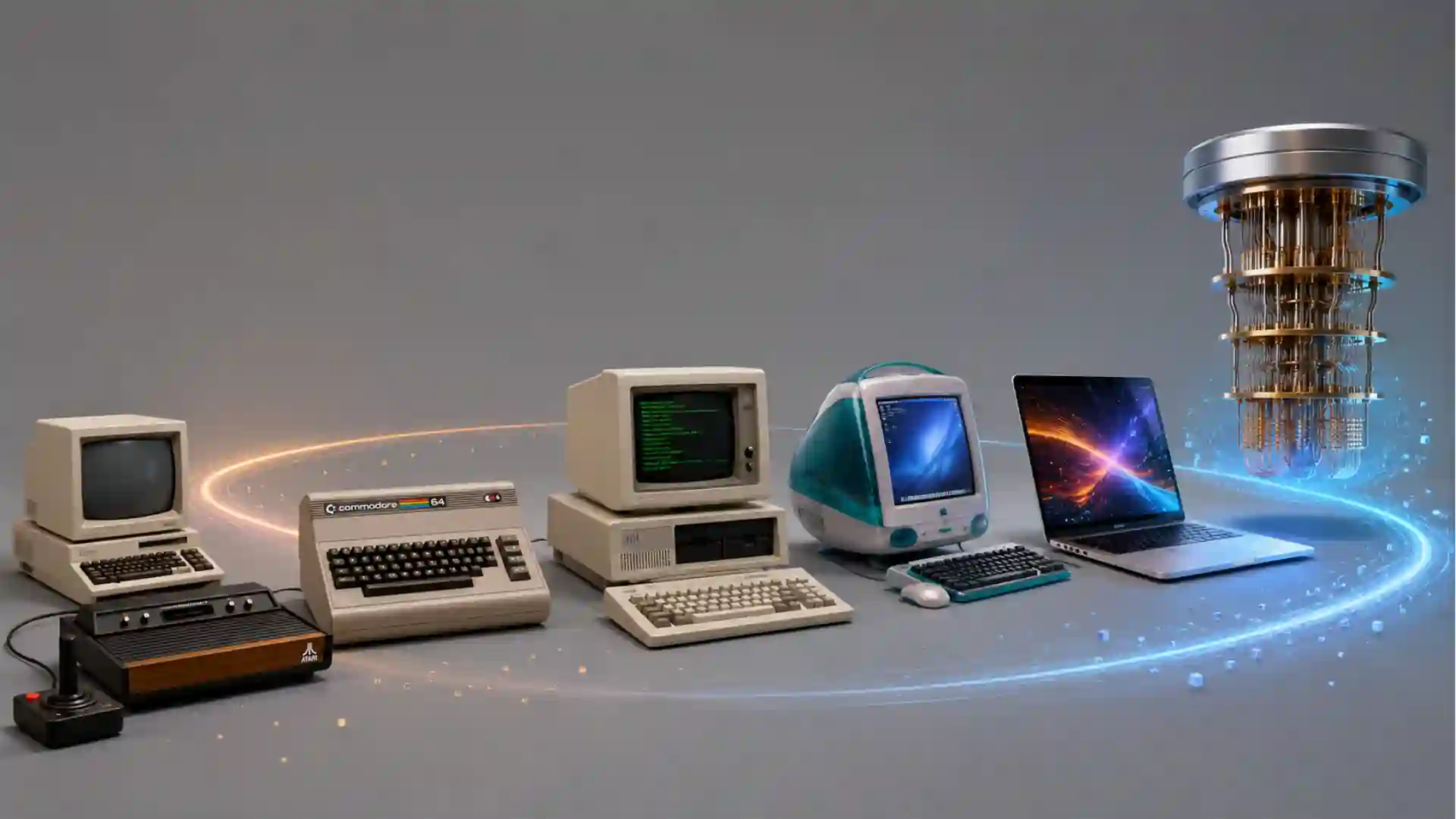
Quantum Bits feels like the kind of website the web used to make room for: one person, one obsession, no committee, no product funnel. The official subtitle says it plainly enough: “Quantum physics, Retro computing and Geeky stuff.” That description sounds casual, almost throwaway, until you start clicking. Then the site turns into a workshop bench. On one side there are old machines, plastics gone yellow, screws removed, disk drives cleaned, serial cables made by hand. On the other side there are quantum circuits, cryptography, superdense coding, topological quantum computers and explanations of how cloud-based quantum computing actually gets from source code to measured results. It is not a retro site with a science tab. It is a personal map of computing as lived experience, from machines you can smell to machines most of us will only reach through an API.
Table of Contents
The pleasure of Quantum Bits is that it refuses the fake cleanliness of tech nostalgia. A Commodore 64 is not treated as a logo on a T-shirt. It arrives dirty. It has a suspect power supply. It needs a case opened, a board inspected, a solder joint refreshed, a video cable made, a floppy drive persuaded back into use. The Atari 1040STF is not a museum plaque either. It becomes a problem of disk geometry, TOS versions, FAT compatibility, Linux mounting, Hatari, GEMDOS and the strange compromises of moving files between dead media and living networks. The old computer is not “iconic” here because somebody said so. It earns attention because getting it to work is still a small negotiation with matter.
That makes the site a surprisingly good answer to a bigger question: how did personal computing feel before it became invisible? A PMD 85 in a Slovak classroom, an Atari ST on a desk, a Commodore 64 attached to a 1541 drive, a modern browser tab explaining qubits: these are not random stops. They mark a shift in what a computer is. First it was a rare physical object, shared in schools, heavy with local politics and scarcity. Then it became a family machine, a game machine, a creative machine, a machine that made people argue about which platform had the better graphics, sound, BASIC, keyboard or disk system. Then it became an always-connected layer. Now, with quantum computing, it is becoming something even stranger: a remote physical system you describe with code and query through cloud tools. Quantum Bits is interesting because it does not flatten that journey into a timeline. It lets the reader feel the different textures of the machines.
A web cabinet with solder dust under its nails
The site’s retro-computing section is the main hook for most readers. It has the familiar names: Sinclair ZX81, ZX Spectrum, Amstrad CPC 464, Macintosh Plus, Atari 1040STF, Apple IIc, Commodore 64. It also has the kind of smaller details that make the page feel less like an index and more like a record of actual contact. The “Re-Collection” page lists machines with acquisition dates, processors, RAM, ROM, accessories, repair notes and status updates. The Atari 1040STF entry, for example, records a June 2022 acquisition, an MC 68000 processor, 1024Kb RAM, mouse, SCART cable, VGA cable, joystick, null modem cable and floppy disks. The Commodore 64 entry records its MOS 6510, 64Kb RAM, 1541 floppy drive, replacement PSU, Strikelink null modem cable, XUM1541 and preservation work through OpenCBM. The page has the charm of a collector’s notebook, but it is more useful than a collector’s flex.
This is where the PMD 85 belongs in the frame, even when Quantum Bits is not a dedicated PMD archive. In Slovakia and the former Czechoslovakia, the PMD 85 carried a different emotional charge from the Commodore 64 or Atari ST. It was not simply a Western home computer dream; it was a local school machine, produced by Tesla Piešťany and later Tesla Bratislava, used for programming lessons and experimental control. The PMD 85 Infoserver describes it as an 8-bit personal computer made in the former Czechoslovakia, with the prototype and first production tied to Roman Kišš and Tesla Piešťany, and later versions made in Bratislava. The Slovak Academy of Sciences exhibition page says PMD-85 machines were made by TESLA Piešťany and TESLA Bratislava and used for BASIC teaching and for controlling measuring and experimental equipment. That background matters because it reminds us that the personal-computer story was never only Apple, IBM, Commodore and Atari.
A reader who grew up near PMD 85 machines may arrive at Quantum Bits with a different muscle memory. The Western retro web often centers the machines that were sold with glossy magazine ads, game catalogs and bedroom-computing mythology. PMD 85 nostalgia comes with classrooms, television displays, tough keys, local manufacturing and scarcity. That difference does not make the Atari or Commodore material less appealing. It sharpens it. Quantum Bits becomes a bridge between local memory and wider machine culture: the PMD teaches you to notice school computing; the Atari teaches you disk formats and desktop systems; the Commodore teaches you how a mass-market home machine became a social world.
The Commodore 64 article is a good example of why the site works. It begins with the machine’s broader history, including the VIC-40 code name, 64K of RAM, the “bread bin” case and the designers behind its hardware. It notes the machine’s huge sales, its variations, its place in European market fights and its long afterlife through emulation, FPGA hardware and recreations. Then it drops into the real story: sourcing a machine, receiving a filthy unit, opening the case, checking for damage, removing PROCEP modifications, inspecting the board, cleaning the motherboard, dealing with a 1541 drive, making disks and connecting the thing back to the networked world. The article has enough historical framing to orient you, but the real momentum comes from watching the machine become usable again.
The Atari 1040STF post has a different rhythm, more surgical and more file-system obsessed. It starts with the old 8-bit and 16-bit platform “wars,” then shifts into the machine itself: hardware inspection, shields, ROMs, RAM, ports, floppy work, disk image handling and the oddly satisfying business of making old disks from image files. The most telling part is the workflow using GNU/Linux to mount ST-formatted diskettes and disk images, with all the small caveats that appear when a 1980s desktop meets a modern system. The post is not just about Atari. It is about translation between eras, and translation is where retro-computing becomes interesting.
That physical stubbornness gives Quantum Bits its editorial character. Many retro sites show collections. Many technical blogs explain repairs. Many physics sites explain qubits. Few keep all three modes close enough that the reader starts seeing old computers and quantum computers as part of one long argument about what counts as computation. The site does not need to make that argument loudly. The structure does it quietly: a navigation menu can send you from a Commodore repair to superdense coding in one click.
The retro web works better when it refuses polish
Quantum Bits is not frictionless, and that is a compliment. It looks like a personal WordPress site rather than a media property. The pages are long. The posts wander through procurement, mistakes, photos, code snippets, links, test results, digressions and small victories. The writing is not trying to convert visitors into subscribers. It assumes the reader is willing to spend time. That assumption feels almost radical now, because so much of the web treats attention as something to trap rather than something to deserve.
The site’s design also keeps the work visible. You see images embedded in the flow, not hidden behind a polished gallery. You see lists of components. You see failed approaches. You see tools named because they were actually used: XUM1541, OpenCBM, Hatari, RecalBox, null modem cables, Raspberry Pi, MacTCP, PPP, Linux mounts. On the Commodore page, the 1541 drive is described as an independent device with its own CPU, ROM and RAM, communicating through IEC serial. That detail changes the reader’s sense of a floppy drive. It stops being a beige accessory and becomes a computer talking to a computer. The site keeps showing that old hardware is not simple just because it is old.
This is also why the site avoids the museum problem. A museum label freezes an object. Quantum Bits keeps objects in motion. The Atari diskette is not only an artifact; it is a storage format to be recreated. The C64 is not only a collectible; it is a terminal that can reach BBSes. The Macintosh Plus is not only a compact Mac; it has MacTCP, MacPPP and communication software in its restoration history. The machines are treated as living systems with bad joints, brittle plastic, weird ports and unfinished conversations.
There is a lovely web-culture moment inside the Commodore 64 piece. The author connects the C64 to old BBS dreams, “Halt and Catch Fire,” PlayNet, Quantum Link and America Online. The chain is almost too perfect for this site: a Commodore online service, a company called Quantum Computer Services, a later mass internet brand, and a modern blog named Quantum Bits bringing a real C64 back online through contemporary workarounds. The article notes that PlayNet operated for C64 users in the 1980s and was licensed to Quantum Computer Services as Quantum Link, which later became America Online. It is the kind of historical loop that makes the web feel haunted in the best way.
The strongest Web Radar finds usually have that quality: they make the reader want to click because the object is specific, not because the headline begs. Quantum Bits is specific at every layer. Specific machines. Specific cables. Specific chips. Specific disk geometries. Specific quantum ideas. The site does not say “old technology is fascinating.” It shows a disk drive, a bad cable, a board under inspection and a path to a working system. Specificity is the difference between nostalgia and discovery.
PMD 85 culture benefits from this same kind of treatment. The PMD 85 is often remembered through a small set of facts: 8-bit, Czechoslovak, Tesla, school use, BASIC, TV display, hard keys, scarcity. The more interesting reading is to see it as one example of a larger condition: people learned computing through whatever machine was reachable. In one place that was PMD 85. In another it was ZX Spectrum. In another it was Commodore 64. In another it was Atari ST. The web becomes richer when it preserves those routes instead of forcing every memory through the same Anglo-American canon.
Quantum Bits does not perform global completeness, and that is part of its appeal. It is not a catalog of every machine. It is a trail left by one person’s purchases, repairs, interests, tools, knowledge and patience. That limitation gives the site a point of view. A complete database is useful when you already know what you want. A personal site is better when you want to stumble into a machine, follow a problem and leave with a sense of why someone cared enough to fix it. The taste is in the path.
The collection turns machines into stories
The “Re-Collection” page is the quiet center of Quantum Bits. It could have been a brag shelf: here are the machines, here are the specs, here are some photos. Instead, it reads like a service history. The Sinclair ZX Spectrum entry lists a December 2021 acquisition, a Zilog Z80A, 48Kb RAM, 16Kb ROM, SCART expansion, cassette tapes, box and power brick. The Amstrad CPC 464 entry records a January 2022 acquisition, a Zilog Z80A, 64Kb RAM, 32Kb ROM, a repaired tape deck and replacement belt. The Atari and Commodore entries carry longer repair and communication histories. A good collection page does not only say what exists. It says what happened to it after it came home.
That repair-history format changes the emotional tone. A clean spec sheet can make old computers look quaint. A repair log makes them feel demanding. You start noticing the hidden labor behind every “working” label on a vintage listing: the brittle tabs, the suspect PSU, the dead capacitors, the oxidized connectors, the missing cable, the rare disk format, the monitor problem, the key that sometimes fails, the aftermarket modification nobody documented well enough. Retro-computing is half affection and half detective work.
There is also a useful honesty in the status notes. The Atari 1040STF entry does not end in perfection; it says the mouse’s left button may need checking. The Oric Atmos entry says the keyboard is still flaky. The Macintosh Plus entry mentions a sometimes unresponsive space bar and future checks. That is not a weakness. It is one of the reasons the page feels credible. Old hardware is rarely finished. It is only stable for now.
For readers who mostly know computers through sealed phones and cloud services, the site is a reminder that computing used to expose its seams. You could open the case. You could see the board. You could identify chips. You could route a cable badly and fix it. You could make a disk that failed because the geometry was wrong. You could ruin a plastic tab. The machine had a body, and the body talked back. Quantum Bits keeps that bodily sense of computing alive without turning it into costume nostalgia.
What makes Quantum Bits click
| Site element | What you find | Why it sticks |
|---|---|---|
| Retro repair logs | Atari, Commodore, Apple, Sinclair and other machines handled in detail | The posts show work, not just affection |
| Re-Collection page | Specs, accessories, acquisition dates and repair status | The collection reads like a living bench record |
| Quantum explainers | Qubits, cryptography, cloud quantum computing, superdense coding | The physics sits near the hardware instead of floating above it |
| Web-culture links | BBSes, Quantum Link, emulation, disk images, old online habits | The site connects machines to behavior |
| Personal tone | Mistakes, detours, preferences and small wins | The voice makes the technical parts easier to trust |
The table also shows the site’s main trick: it turns computation into a continuum of practices. A disk image workflow and a quantum circuit workflow are not the same thing, but both depend on a chain of representation, execution and interpretation. You write, encode, move, run, measure, debug and repeat. The scale changes. The weirdness changes. The habit of mind stays more recognizable than expected.
Why PMD, Atari and Commodore belong in the same frame
Putting PMD 85, Atari and Commodore in one headline is not just a nostalgic roll call. Each name points to a different version of how computers entered ordinary life. PMD 85 tells the story of local production under political and economic limits. Commodore 64 tells the story of mass household adoption, games, BASIC, peripherals, magazines and early online services. Atari ST tells the story of a more graphical 16-bit personal machine, disk-based workflows, desktop metaphors and a user culture that sat between home, music, graphics and productivity. Together they make computing feel plural again.
The PMD 85 is the least globally famous of the three, which makes it the most useful correction. The PMD 85 Infoserver describes the machine as a Czechoslovak 8-bit personal computer from the 1980s, first produced by Tesla Piešťany under Roman Kišš and later moved to Tesla Bratislava for newer versions. The Slovak Academy of Sciences exhibition page frames it through education and experimental control. Those details put the machine in a social setting: a classroom, a lab, a local industry, a country making do with constrained access to Western hardware.
Commodore 64 carries a different myth because it reached households at scale. Quantum Bits notes the C64’s 64K identity, its “bread bin” form factor, its many variants and its enormous sales estimates. The post also spends real time on accessories and storage, including the 1530 Datasette and 1541 floppy drive. Then it enters preservation: XUM1541, OpenCBM, D64 images, fresh disks and testing on the real machine. The C64 becomes a complete ecosystem, not a single object.
Atari 1040STF brings in the desktop era without losing the tactile fight. The Atari post talks about the ST/Amiga war, the 68000 board, TOS, the disk system and the awkward bridge between ST media and modern machines. The GNU/Linux section is especially good because it shows that compatibility is not a slogan. FAT-like formats still have traps. Disk images do not always map neatly back to physical disks. USB floppy drives have limits. Boot sectors and nonstandard geometry matter. A modern computer can read the past, but only if the past agrees to be read.
What Quantum Bits gets right is that old computers were never only about specifications. Specs matter, but they do not explain why people remember the feel of a key, the sound of a drive, the frustration of loading from tape, the pride of seeing a BASIC program work, the strange trust placed in a CRT image or the ritual of labeling disks. PMD, Atari and Commodore all carried social scenes with them. The machine was the entrance, but the real subject was the behavior around it.
That is why the site’s repair posts are better than a clean retro timeline. A timeline can say “1982, 1985, 1986.” A repair post shows that the past is uneven. A 1982 Commodore 64 can still enter a 2024 networked workflow through a Raspberry Pi, a serial adapter, a BBS and a pile of compromises. A 1986 Atari can still exchange files with Linux if the disk format and tool chain cooperate. The past is not gone; it is badly cabled.
This same idea changes how we read PMD 85 material online. A PMD 85 archive is not merely preserving a local computer. It is preserving a route into computing for people whose first machine was not advertised in American magazines. It shows how programming was taught, how hardware was shared, how limited machines still produced culture and how regional systems shaped mental models. Once you understand that, Quantum Bits becomes part of a larger web of memory: not the whole story, but a very alive shelf inside it.
The connection to quantum computing may seem like a jump, yet it is less strange than it first appears. A person who cares about old machines often cares about the moment when abstraction becomes physical. A bit is not only a concept; it is voltage, memory, timing, signal, storage, screen. A qubit is not only a concept either; it is a physical system that must be prepared, controlled and measured under harsh constraints. The distance between a PMD 85 classroom and a quantum processor is huge, but both remind us that computation is never purely imaginary.
The quantum half keeps the nostalgia honest
The physics side of Quantum Bits stops the retro material from becoming a closed loop. Without it, the site would still be a strong retro-computing blog. With it, the site asks a sharper question: what happens when the familiar mental model of computing breaks? In the quantum-computing primer, the site explains the shift from bits as definite 0 or 1 states to qubits as quantum states involving superposition. It also notes that classical computers can in principle simulate quantum algorithms with exponential resources, while quantum computers may handle some tasks that are not practically feasible classically. That is a direct challenge to the comfortable 8-bit imagination.
The old machines teach control because their constraints are visible. You know how much RAM you have. You know the tape is slow. You know the disk has two sides, fixed geometry and bad sectors waiting to embarrass you. You know the display mode. You know the CPU is not going to save you. Quantum computing teaches a stranger version of control, where the machine’s useful behavior depends on measurement, probability, interference and physical fragility. The retro half says computation is concrete; the quantum half says concreteness can be deeply weird.
The cloud-based quantum computing post is especially useful because it refuses the fantasy of a magic remote brain. It lays out a workflow: compilation on a classical computer, circuit generation, execution on a quantum computer and post-processing back on a classical computer. That sequence matters. It shows quantum computing as a hybrid practice, not a glowing box that replaces ordinary computers. The quantum processor becomes one part of a pipeline, surrounded by classical machinery and human-readable code.
That hybrid pipeline echoes the retro posts in a funny way. To make an Atari disk, you might use Hatari on a Mac, a GEMDOS folder, a Linux box, a USB floppy drive, a physical disk and the actual Atari. To run a cloud quantum job, you might write source code, compile it classically, generate circuits, send instructions to specialized hardware and interpret the measurement results afterward. The stakes and science are different, but the shape is familiar: computation often happens through chains, and the chain is where trouble hides.
The cryptography post adds another useful bridge. Quantum Bits explains that a quantum search can reduce the security level of symmetric keys in a square-root-like way, giving the example of AES-256 retaining a very large search space even under that kind of quantum speedup. The table on the site lists AES-128 and AES-256 with classical and quantum security levels. This is not retro romance; it is the hard edge of future computing pressing against infrastructure we already use.
That matters for a Web Radar recommendation because the site is not merely charming. Charm would be enough for an evening of clicking through old machines. Quantum Bits offers something better: a way to hold two instincts at once. One instinct says, “Look at this old machine, learn its ports, respect its limits, make it run.” The other says, “Look at this future machine, do not turn it into magic, understand the pipeline, respect its limits too.” The site’s taste lies in treating both with patience rather than awe.
The physics pages also give the reader permission to be curious without pretending to be an expert. They are technical enough to avoid baby talk, but personal enough to feel like notes from someone working through hard ideas rather than a committee-approved explainer. The quantum-computing primer moves from bits to qubits, Hilbert-space notation and algorithms. The cloud post moves into OpenQASM-like syntax and execution phases. A casual reader may not follow every step, but the site rewards partial understanding instead of punishing it.
The best part is the adjacency. If you land on a quantum post from a search engine, you may notice the retro links in the sidebar. If you land on the Commodore page, you may notice quantum cryptography nearby. That adjacency creates a small editorial spark. It tells the reader that computing history and computing theory are not separate tribes. The same mind can care about a filthy C64 case and a qubit state vector. The web is better when it lets such combinations survive.
Small doubts before you open it
No. A reader who wants short posts, neat summaries and fast answers may find the pages too long and too bench-level. A reader who wants a pure PMD 85 archive will need to use dedicated PMD sources as well. A reader who wants a full academic treatment of quantum computing should go to textbooks, papers or official course material. Quantum Bits is a personal site, and personal sites are best when you accept their limits as part of the deal.
It depends which door you use. The retro posts are friendly because they follow visible actions: buy the machine, open it, clean it, inspect it, repair it, test it, connect it. Even when the details get technical, the narrative gives you something to hold. The quantum posts demand more mathematical comfort. They are readable, but they do not pretend that qubits are just a cute metaphor. The site is friendly in tone, not simplified in substance.
Not really. Nostalgia is present, and the author clearly enjoys old machines, old games, old online rituals and the aesthetic of period-correct labels. Yet the site keeps returning to use. Can this disk be recreated? Can this drive be read? Can this machine communicate? Can this old system reach a BBS? Can a quantum algorithm be described through a circuit? Use keeps the sentiment from going soft.
Yes, and that is a good thing. Quantum Bits gives the larger frame: retro-computing as repair, preservation and personal memory next to quantum theory. PMD 85 sources give the Slovak and Czechoslovak context: Tesla production, school use, BASIC teaching, local variants and regional constraints. The two paths strengthen each other. Read together, they make the computing past less provincial and less generic at the same time.
Because the web keeps losing this kind of room. Personal technical sites still exist, but they are easier to miss under platforms, search clutter, short video, affiliate pages and AI-polished summaries. Quantum Bits has the slower shape of an older web: a person documents what they did, leaves links, shows failures, keeps an archive and lets separate interests touch. That is exactly the sort of page Web Radar exists to surface.
The strange comfort of old machines next to impossible ones
Quantum Bits leaves the reader with a useful discomfort. The old machines seem understandable because you can open them, yet they become complicated the moment you try to preserve them honestly. The quantum machines seem impossible because they sit behind physics and cloud interfaces, yet the site breaks them into workflows, circuits, registers, compilation and measurement. The near thing becomes stranger; the distant thing becomes more graspable.
That is why the site earns a place in a discovery format. It does not merely show you something you did not know existed. It changes the relation between things you may have kept separate. PMD 85, Atari, Commodore and quantum computing can sound like a strange list. On Quantum Bits, the list starts to feel coherent. They are all ways of asking what a computer is when you stop treating “computer” as a finished word. Sometimes it is a school machine. Sometimes it is a home computer. Sometimes it is a disk drive with its own CPU. Sometimes it is a quantum device reached through a classical pipeline.
The most memorable pages on the web often feel slightly too personal to have been planned by a company. Quantum Bits has that quality. It is the opposite of the generic tech explainer. You can feel the chosen detours: Atari instead of Amiga for personal reasons, a Commodore repair because a machine arrived in terrible shape, a retro gaming setup because RecalBox made old systems approachable, a quantum circuit discussion because the author’s other curiosity lives there too. The site is not trying to cover computing. It is tracing a life through computing.
For readers in Slovakia or Czechia, the PMD 85 reference adds a sharper local resonance. It reminds us that computing did not arrive everywhere through the same commercial script. Some people met it through Tesla hardware, shared classrooms and BASIC lessons. Others met it through Commodore magazines, Atari disks, Amstrad tapes or Apple school labs. Quantum Bits is French in voice and collection path, but its deeper appeal travels well because the act is recognizable: recover the machine, understand its constraints, connect it to the larger story.
That larger story now includes quantum computing, whether or not ordinary users ever touch a quantum processor directly. The phrase can be abused, especially by marketers who turn hard science into a shiny future haze. Quantum Bits is useful because it does not treat quantum as decoration. It puts quantum computing beside old hardware, where claims have to survive contact with cables, code, constraints and working habits. The result is less glamorous and more convincing.
Open the site for the Commodore 64 repair if you want a satisfying bench story. Open it for the Atari 1040STF post if you like old disks, Linux bridges and desktop-era problem solving. Open the Re-Collection page if you like the quiet poetry of acquisition dates and status notes. Open the quantum posts if you want the future of computing explained by someone who also understands why a null modem cable matters. The best route is to click without trying to be efficient. Let the site behave like a shelf.
A web shelf like this is not only useful because of what it stores. It is useful because of what it refuses to separate. Hardware from theory. Memory from measurement. Games from cryptography. PMD classrooms from C64 BBS culture. Atari disk images from quantum circuits. Quantum Bits makes those separations feel less natural, and that is exactly why it is worth opening.
Author:
Jan Bielik
CEO & Founder of Webiano Digital & Marketing Agency
This article is an original analysis supported by the sources cited below
Quantum Bits
Official home page of the personal site, used for the site identity, navigation and editorial frame.
Quantum Bits retro-computing category
Category archive showing the retro-computing posts and the way the site places old machines beside quantum-computing material.
Quantum Bits Re-Collection
Inventory-style page used for machine lists, acquisition notes, specifications, accessories and repair-status details.
On retro-computing Commodore 64
Long Commodore 64 repair and restoration post used for the C64 history, hardware work, disk preservation, XUM1541, OpenCBM and BBS material.
On retro-computing Atari 1040STF
Atari 1040STF post used for the Atari hardware notes, disk-image workflows, GNU/Linux bridge and file-transfer details.
PMD 85 Infoserver
Dedicated PMD 85 information page used for the Czechoslovak origin, Tesla Piešťany and Tesla Bratislava production background, and model context.
Slovak home computers exhibition
Slovak Academy of Sciences exhibition page used for the PMD-85’s role in BASIC teaching and experimental or measuring-device control.
On quantum computing
Quantum Bits explainer used for the article’s discussion of bits, qubits, superposition and the relation between classical and quantum computation.
| Citing this article? Brief excerpts are welcome. Please credit Webiano.digital, name the author where stated, and include a link to https://webiano.digital and to this original article. Full or substantial republication requires prior written permission. Read our Copyright and Content Use Policy. |
This article was prepared with the assistance of artificial intelligence tools. The content underwent expert human review, and Webiano Digital & Marketing Agency assumes editorial responsibility for its final version and publication.