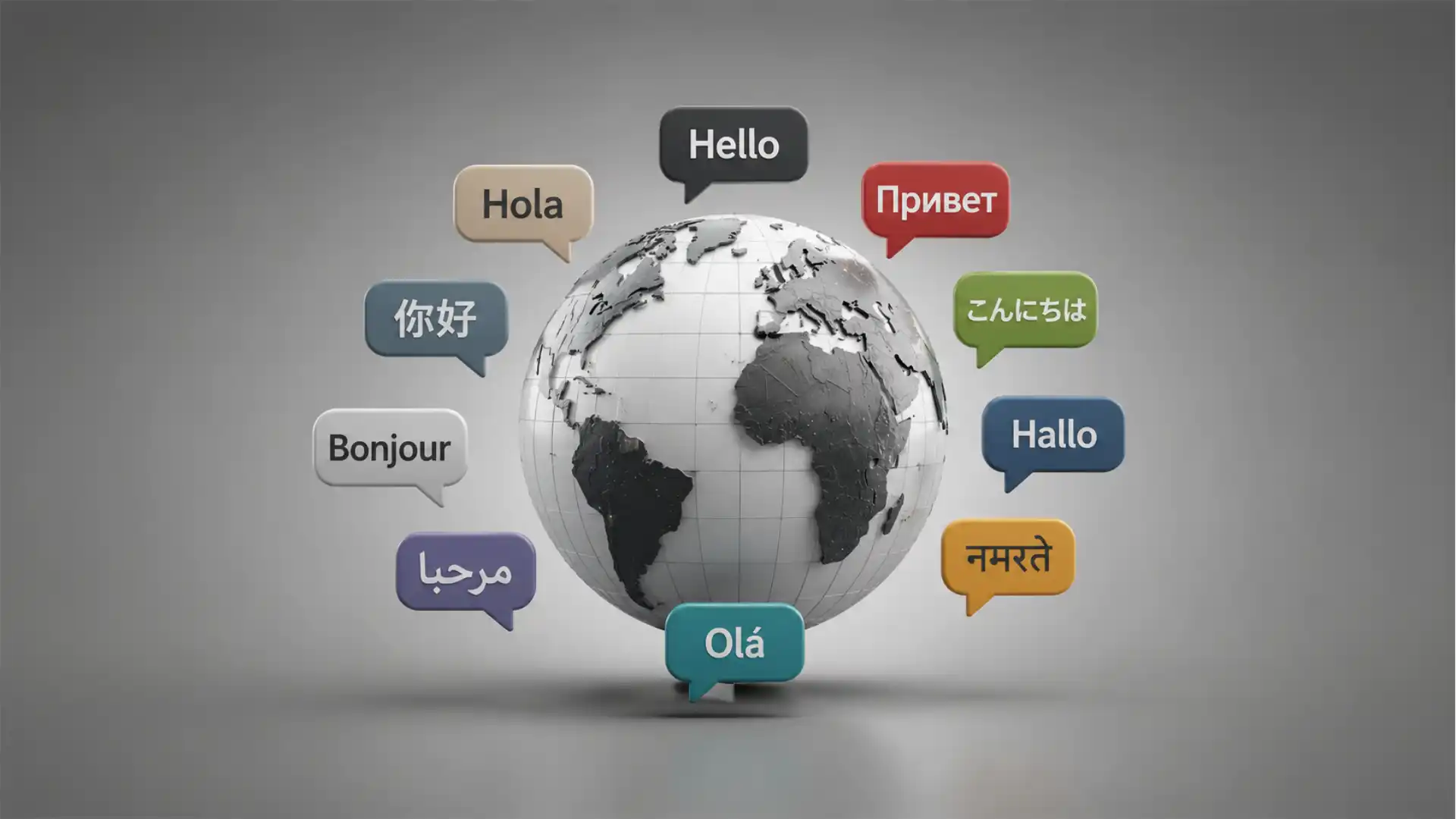
English is still the strongest language in online communication, but its dominance now depends on where the measurement starts. On published websites, English is far ahead of every other language. In private messaging, social feeds, video comments, search behavior, local marketplaces and AI-assisted translation, the picture is more crowded. Chinese, Spanish, Hindi, Arabic, Portuguese, Indonesian, French, Japanese, German and Russian all matter, but not in the same way, not on the same platforms, and not for the same commercial reasons.
Table of Contents
English remains the internet’s default operating language
The latest web-content data makes the first part of the story blunt. W3Techs, which tracks content languages across websites, reported on 5 June 2026 that English was used by 49.7 percent of websites whose content language it could identify. Spanish and German followed at 6.0 percent each, then Japanese at 5.0 percent, French at 4.6 percent, Portuguese at 4.1 percent and Russian at 3.5 percent. Chinese was listed at 1.2 percent and Arabic at 0.6 percent, while Hindi appeared among languages used by less than 0.1 percent of websites in the W3Techs sample.
That table is often quoted as if it answers the whole question. It does not. It measures websites, not people. It favors indexed, identifiable, public web pages. It says less about WhatsApp messages, WeChat groups, TikTok comments, voice notes, livestream chat, search queries, creator captions, closed forums, mobile apps, local marketplaces or AI prompts. The internet is no longer just a web of pages. It is a web of conversations, apps, feeds, commerce, code, translation and machine-readable text.
The user side of the internet is much more multilingual. DataReportal’s Digital 2026 Mid-Year Global Update said global internet users reached 6.12 billion at the start of April 2026, equal to 73.8 percent of the world’s population. It also reported 5.79 billion social media user identities, while warning that such identities do not necessarily represent unique people. The International Telecommunication Union’s 2025 edition of Facts and Figures placed the global online population at roughly three quarters of humanity and said 2.2 billion people remained offline, mostly in low- and middle-income countries.
Those numbers matter because the next billion users are not likely to behave like the early web. They will arrive through cheap smartphones, mobile video, messaging apps, voice search, short-form commerce, local language entertainment, payment rails and AI translation. Their language habits will be shaped by family, school, region, platform defaults and keyboard support, not by the language mix of traditional websites.
The most accurate answer is not a single ordered list. English is the top language for published web content and cross-border online exchange. Chinese has massive scale through China’s domestic internet and social platforms. Spanish is the strongest global challenger across public web content, social media and search. Hindi, Indonesian, Arabic, Portuguese, Bengali and other languages gain weight when mobile users and local content are counted. German, Japanese, French and Russian remain stronger in website publishing than their share of world population might suggest.
That is the central tension: the web still looks heavily English, but online communication is becoming more multilingual from below.
The ranking changes when the metric changes
A language can be “most used online” in several different senses. Published websites produce one ranking. Internet users by language produce another. Social media behavior produces another. Search and AI training data produce yet another. That is not a technical footnote; it is the whole story.
English dominates the visible, indexable web because it inherited the early web, international business, academic publishing, software development, technical documentation, global media and cross-border search. The web’s early growth was concentrated in the United States, Canada, the United Kingdom, Western Europe and other English-heavy or English-literate markets. Once enough content existed in English, English became the practical bridge language for people who did not share a native language.
Chinese tells a different story. China has one of the largest internet populations in the world, but much of its communication happens inside platforms and ecosystems that are less visible to global web-content measurement. China’s official government portal, citing CNNIC, said the country had 1.125 billion internet users by the end of 2025, with penetration at 80.1 percent. The same report said China had 602 million generative AI users by December 2025. A language can be enormous online even if its share of globally indexed website pages appears modest.
India sharpens the point. DataReportal estimated 1.03 billion internet users in India in October 2025, with internet penetration at 70.0 percent, and said user numbers increased by 223 million between October 2024 and October 2025. Yet the W3Techs website-language table placed Hindi under 0.1 percent of identified website content. The gap does not mean Hindi speakers are absent online. It means much of the activity is happening through apps, video, audio, messaging, mixed-language posts, English-Hindi code-switching, and content formats that are harder to count as classic “Hindi websites.”
Spanish is the cleaner bridge between both worlds. It ranks second in W3Techs’ website-content view, tied with German at 6.0 percent in June 2026. It also has large native-speaking populations across Latin America, Spain and the United States, plus strong social media and search demand. Spanish has scale, geographic spread, publishing depth and commercial relevance. It is not merely a regional language online; it is one of the few languages that works across continents without relying mainly on one country.
Portuguese is more concentrated but still powerful because Brazil is a huge online market. DataReportal estimated 185 million internet users in Brazil in October 2025, with penetration at 86.9 percent. W3Techs placed Portuguese at 4.1 percent of websites with identifiable language. Portuguese therefore has both a large user base and a solid published-content base, even if much of its global weight comes from one country.
Indonesian is another case where user scale is larger than website share. DataReportal reported 230 million internet users in Indonesia at the end of 2025 and 180 million social media user identities. W3Techs listed Indonesian at 1.0 percent of website content. Indonesian is strong in mobile social behavior, short video, ecommerce, comments and creator culture, even if it is not near English in indexed web publishing.
A ranking that ignores these differences misleads readers. The top online languages depend on whether the question is about pages, people, posts, platforms, purchasing, search or software.
A practical ranking depends on the metric
| Metric | Languages that look strongest | Practical meaning |
|---|---|---|
| Published websites | English, Spanish, German, Japanese, French, Portuguese, Russian | Best signal for classic SEO, documentation and indexed pages |
| Internet users by market scale | English, Chinese, Hindi, Spanish, Arabic, Indonesian, Portuguese | Best signal for audience potential and app growth |
| Social and messaging behavior | Chinese, English, Spanish, Hindi, Portuguese, Indonesian, Arabic | Best signal for daily communication and creator reach |
| Knowledge platforms | English, German, French, Spanish, Russian, Japanese | Best signal for encyclopedic and reference depth |
| AI and web training data | English first, then a small group of high-resource languages | Best signal for model quality, retrieval and automation |
| Cross-border business | English, Spanish, French, Chinese, Arabic, German, Portuguese | Best signal for international sales and support |
This table is not a universal league table. It shows why a company, newsroom, public agency or platform will reach different conclusions depending on what it needs to measure.
Website data still gives English a huge lead
The W3Techs figures remain the clearest public measure of website language share. Their value lies in consistency: they are updated daily and focus on identifiable content languages across websites. For publishers, ecommerce sites, SaaS companies, universities and documentation teams, the data is still highly relevant because search engines and answer engines often rely on public, crawlable text.
English’s 49.7 percent share in June 2026 is smaller than the web’s earlier English share, but it remains enormous. The closest languages are clustered near 6 percent or lower. That means English is not merely first; it is in a different class for public web publishing. A company that publishes only in English can still enter many global conversations, especially in B2B, software, science, finance, education, aviation, travel, marketing and policy.
The second tier is more interesting than the headline. Spanish, German, Japanese, French, Portuguese and Russian make up the visible middle of the published web. These languages reflect a mix of population, wealth, institutional publishing, ecommerce maturity, media production and long-standing internet adoption. German and Japanese do not have the global speaker base of Hindi or Bengali, but they have high purchasing power, strong publishing institutions, mature ecommerce markets and long digital histories.
Chinese’s low website-content share compared with China’s internet population shows the limits of public web measures. Mandarin Chinese and other Chinese varieties are huge in online life, but the structure of China’s internet, the role of super apps, the Great Firewall, domestic search behavior, and platform-based communication make the global crawlable web a weak proxy for Chinese digital communication.
Arabic faces another kind of mismatch. It is a major world language across many countries, but website publishing is fragmented by dialects, Modern Standard Arabic, local speech, English/French bilingualism, and uneven digital investment. A Gulf government portal, an Egyptian YouTube channel, a Moroccan ecommerce page and a Lebanese WhatsApp group do not necessarily show up in one neat Arabic web-content bucket.
Hindi’s position is the sharpest reminder that web pages are not the same as online life. India’s internet growth is led by mobile access, video, voice, regional-language consumption and social platforms. IAMAI and Kantar’s Internet in India work has repeatedly pointed to the role of Indic languages in internet adoption; reporting on the 2024 study said 98 percent of Indian internet users accessed content in Indic languages, with Tamil, Telugu and Malayalam among the most popular. In 2026, reports on the 2025 edition said India had crossed 950 million active internet users.
The web-content ranking therefore remains useful, but it must be read with discipline. It answers: “What languages appear most often on identifiable websites?” It does not answer: “What languages do people use to talk online every day?”
Online communication has moved from pages to feeds and chats
The early internet was easier to count because it was page-heavy. Websites, blogs, forums, email lists and public directories formed the visible layer. Online language analysis could look at web pages and get a decent picture of digital communication.
That era is gone. A growing share of communication happens in private or semi-private spaces, including WhatsApp groups, WeChat chats, Telegram channels, Discord servers, Instagram DMs, TikTok comments, Facebook groups, Snapchat messages, Slack workspaces, Microsoft Teams channels and in-app customer support. Many of these spaces are not crawlable. Many are ephemeral. Many mix languages within a sentence.
A Spanish-speaking user in Mexico might search in Spanish, watch English-language YouTube videos, message family in Spanish, use English product names, comment with slang and emojis, and speak into a voice assistant in accented Spanish. A young user in Delhi may switch between Hindi, English and Hinglish across the same app session. A Brazilian creator may publish Portuguese captions with English hashtags to reach global audiences. A Moroccan user may mix Moroccan Arabic, French, Modern Standard Arabic and English depending on the platform and social circle.
These behaviors challenge neat language measurement. Online communication is increasingly code-switched, multimodal and platform-specific. Text is only one layer. Voice notes, captions, subtitles, stickers, memes, emojis, livestream speech, automatic translation and AI summaries all carry language signals. Counting only the language of a page misses much of that traffic.
The shift also changes commercial value. A brand can rank well in English but still fail in Indonesia if it cannot answer customer questions in Indonesian. A health agency can publish an Arabic page but still miss people who rely on dialect video explainers. A university can translate admissions pages into Spanish but lose applicants if WhatsApp support operates only in English. A marketplace can use machine translation for product titles but still confuse users if reviews, sizing, returns and chat support are poorly localized.
Social platforms make language more personal and less formal. People do not always communicate online in the standard language taught in schools. They use dialects, hybrid registers, abbreviations, phonetic spellings and local humor. That is why the future of online language cannot be read only from website-language tables. It must be read from everyday digital behavior.
Chinese is enormous online but less visible on the open web
Chinese is one of the clearest cases where online communication scale and open-web visibility diverge. China has the world’s largest national internet population by many measures. CNNIC figures cited by China’s government put the country at 1.125 billion internet users by the end of 2025, while DataReportal estimated 1.28 billion active social media user identities in China in October 2025.
Yet W3Techs placed Chinese at only 1.2 percent of websites whose content language it could identify in June 2026. That mismatch looks strange only if the internet is imagined as one open, uniform space. China’s internet is not arranged that way. Communication is concentrated in domestic platforms, app ecosystems, state-regulated networks, mini-programs, social commerce, video platforms and local search environments. Much of that activity is not part of the global open web in the same way as an English blog, a German ecommerce site or a Spanish news page.
Chinese online communication also includes several varieties and scripts. Mandarin dominates formal written Chinese in mainland China, but Cantonese, Taiwanese Mandarin usage, regional vocabulary, simplified and traditional characters, diaspora Chinese communities and mixed English-Chinese digital speech all complicate the category. A raw “Chinese” count hides many internal differences.
For global companies, the implication is direct. Chinese cannot be judged by global website share. It requires China-specific platform, search, payment, regulatory and content strategy. Ranking on Google in Chinese is not the same task as reaching users through Baidu, WeChat, Douyin, Xiaohongshu, Bilibili or Chinese ecommerce platforms. The language issue is tied to infrastructure and governance.
Chinese also matters in AI. The China government report citing CNNIC said China had 602 million generative AI users by December 2025 and a 42.8 percent nationwide generative AI adoption rate. That figure points to a future where Chinese-language interaction with AI systems becomes a major source of online communication. AI prompts, outputs, summaries and translations are becoming part of how people talk, search and shop.
The Chinese case warns against a Western open-web bias. A language can be digitally dominant inside a platform ecosystem while looking modest in public website statistics. Any serious ranking of online languages needs to make that distinction explicit.
Spanish is the most balanced non-English global language online
Spanish has a rare combination: large native-speaker scale, cross-continental reach, strong public web presence, social media intensity, cultural exports, search demand and commercial relevance. It does not rely on one country. It connects Spain, Latin America, the United States, diaspora communities and global learners.
On the website side, Spanish ranked at 6.0 percent in W3Techs’ June 2026 content-language table, tied with German and ahead of Japanese, French, Portuguese and Russian. Unlike German and Japanese, Spanish also has a very large global user base across countries with growing digital consumption. That makes Spanish one of the clearest second-language priorities for international publishers and brands.
Spanish also benefits from regional search diversity. Mexican Spanish, Colombian Spanish, Argentine Spanish, Chilean Spanish, Peruvian Spanish, U.S. Spanish and Spanish from Spain differ in vocabulary, tone, legal terms, product phrasing and local intent. Yet mutual intelligibility allows regional content to travel more easily than in Arabic, where dialect distance can be much greater. A Spanish article can rank across multiple markets, but the highest-converting content usually needs regional vocabulary and examples.
The United States adds another layer. Spanish is not only a foreign-market language for U.S. companies; it is domestic audience language. A site that treats Spanish only as a Latin America expansion issue misses U.S. healthcare, education, legal services, banking, ecommerce, media and local government needs. The same applies to political communication and emergency information.
Spanish is also strong in entertainment and creator culture. Music, football, streaming, gaming, podcasts, influencer commerce and short-form video carry Spanish across borders. A user in Colombia may follow a creator from Spain; a Mexican creator may have viewers in Argentina; a U.S. Spanish-speaking audience may consume both Latin American and English-language media.
For SEO and answer engines, Spanish has another advantage: enough public content exists for search systems and AI models to understand many topics well, but there are still gaps in specialized, local, high-trust content. Spanish is no longer an optional translation tier for global communication. It is a full publishing market with its own search intent, regional vocabulary and authority networks.
Hindi and Indian languages are rising through mobile behavior
India’s online language story is not simply “Hindi is rising.” Hindi matters, but India is too linguistically diverse for a single-language frame. Hindi, Bengali, Telugu, Marathi, Tamil, Urdu, Gujarati, Kannada, Malayalam, Odia, Punjabi, Assamese and other languages all play major roles. English also remains powerful in professional, educational, administrative and technical settings.
DataReportal’s India report estimated 1.03 billion internet users in October 2025, a huge figure even after accounting for methodology changes. Reports based on IAMAI-Kantar research said India crossed 950 million active internet users in 2025, led by rural growth, short video and AI adoption. Earlier reporting on the 2024 IAMAI-Kantar study said 98 percent of Indian internet users accessed Indic-language content, and rural users already made up a majority of active users.
Those figures explain why Indian languages are strategically important even when web-page language shares look small. India’s language growth online is app-first, mobile-first, video-first and often voice-first. A large share of new users do not begin with desktop search and long-form websites. They begin with YouTube, WhatsApp, Instagram, short video apps, payment apps, ecommerce apps, government apps, voice queries and entertainment feeds.
Code-switching is central. Hinglish is not a marginal pattern; it is everyday digital speech for millions of users. Similar hybrids exist across Indian language communities, where English product names, Hindi verbs, local slang and Romanized scripts mix freely. Users may type Hindi in Latin script because their keyboard habits developed that way. Others may speak a query in one language and read results in another. Creators often choose language based on audience, monetization and platform reach, not linguistic purity.
This creates measurement problems. A video title may be in English, the speech in Hindi, the comments in Hinglish, the captions auto-generated, and the audience spread across states. Search systems may classify it one way; users experience it another. The language of communication is not always the language of metadata.
For businesses, India demands more than Hindi localization. Hindi alone may reach many users, but it will miss high-value regional audiences and fail in states where other languages dominate identity and daily life. A digital product that wants trust in Tamil Nadu, West Bengal, Maharashtra, Karnataka, Telangana, Kerala or Punjab cannot assume Hindi is enough.
The Indian market also shows why voice and AI matter to online language. When typing is hard, literacy varies, or scripts are inconvenient on low-cost phones, voice interfaces reduce friction. AI translation, speech recognition, image-based search and chatbots may push Indian-language communication into more visible digital systems. That shift could make the next decade’s internet much less English-heavy at the user layer.
Arabic is large, fragmented and undercounted
Arabic has hundreds of millions of speakers, a vast geographic span and deep cultural authority, yet it remains underrepresented in many online metrics. W3Techs placed Arabic at 0.6 percent of websites in June 2026. That figure is not a good proxy for Arabic-speaking online life.
The Arabic internet is shaped by a structural split between Modern Standard Arabic and dialects. Modern Standard Arabic is used in news, religion, official communication, education and formal writing. Daily speech differs across Egyptian, Levantine, Gulf, Iraqi, Sudanese and Maghrebi varieties, among others. On social platforms, users often write dialects in Arabic script or Latin transliteration, sometimes mixed with English or French. That variety makes language detection, search matching and content planning harder.
The region also has uneven digital economies. Gulf markets have high connectivity, high spending power and strong digital services. Egypt has population scale and media influence. North African markets often mix Arabic with French. Conflict-affected countries face infrastructure and economic barriers. A single “Arabic online” category hides major differences in purchasing power, platform choice, dialect, regulation and content supply.
Arabic also faces technical issues that many product teams still underestimate. Right-to-left layout is not just a translation setting. It affects interface design, forms, punctuation, mixed English-Arabic strings, numbers, alignment, icons, navigation and QA. Search intent differs between Modern Standard Arabic and dialect. Voice search may capture spoken dialects better than typed search, but transcription and retrieval remain uneven.
The State of the Internet’s Languages report found that major languages such as Arabic and Malay were less well-supported than the dominant platform-interface languages, despite being spoken by large populations. That matters because interface support determines whether users can operate a platform naturally, not just whether they can read a page.
Arabic should be treated as a major online communication language whose public-web footprint understates its real conversational weight. The opportunity is not only translation from English into Arabic. It is dialect-aware content, right-to-left design, Arabic search intent research, video-first information, local trust markers and support flows that respect regional differences.
Portuguese is powered by Brazil and strengthened by community behavior
Portuguese is one of the strongest online languages because Brazil is one of the world’s major digital markets. DataReportal estimated 185 million internet users in Brazil in October 2025, with an 86.9 percent penetration rate. It also reported that Instagram had 147 million users in Brazil in late 2025, equal to 79.5 percent of the local internet user base by ad reach.
W3Techs placed Portuguese at 4.1 percent of identifiable website content in June 2026. That is a strong public-web showing, especially given that Portuguese is less geographically dispersed than Spanish. Brazil’s media, ecommerce, creator culture, fintech adoption, gaming communities and social platforms give Portuguese a large daily communication base.
Portuguese also crosses the Atlantic through Portugal, Angola, Mozambique and other Lusophone communities, but Brazil’s weight is decisive. For global companies, Brazilian Portuguese usually deserves its own strategy, not a generic Portuguese translation. Vocabulary, tone, payment habits, legal language, customer-service expectations and cultural references differ sharply from European Portuguese.
Brazil’s online communication style is also highly social. Messaging apps, social commerce, creator recommendations, influencer trust, video platforms and community groups play a large role in discovery. A formal Portuguese website may be necessary, but it is not enough. Users often expect fast chat support, local payment options, regional delivery information and social proof in Brazilian Portuguese.
Portuguese is a reminder that one large, socially active, digitally mature country can give a language global online importance. Its status is not just about population. It is about mobile behavior, entertainment output, ecommerce maturity, and the density of public and private communication.
Indonesian shows the power of mobile-first national scale
Indonesian has become one of the most important online communication languages because Indonesia combines population scale, high mobile use, strong social media behavior and a national lingua franca. DataReportal reported 230 million internet users in Indonesia at the end of 2025, with penetration at 80.5 percent, and 180 million social media user identities.
W3Techs listed Indonesian at 1.0 percent of website content in June 2026. That figure is modest compared with English, Spanish or German, but it understates how central Indonesian is in mobile communication. Indonesia’s online life is heavily shaped by social apps, short video, messaging, marketplaces, creator commerce, gaming and livestreaming.
Indonesian has a structural advantage: Bahasa Indonesia functions as a national bridge across a country with many local languages. That makes it useful for platforms, national campaigns, education, ecommerce and media. Local languages such as Javanese, Sundanese and others still matter socially and culturally, but Indonesian is the practical digital default for broad national reach.
TikTok, Instagram, YouTube, WhatsApp and local ecommerce platforms have turned Indonesian into a high-volume language of comments, captions, product discovery and creator marketing. DataReportal’s Indonesia report said TikTok’s ad tools showed 180 million users aged 18 and above in Indonesia in late 2025, with ad reach equal to 88.9 percent of adults. That kind of social-video scale is a language signal even if it does not appear in website counts.
For brands and publishers, Indonesian is often one of the best opportunities outside the usual European language set. Competition can be less dense than in English, the audience is large, and mobile-native formats matter. Indonesian belongs in any serious list of the world’s online communication languages, even though it is not among the top five website-content languages.
French and German remain strong because institutions still publish
French and German occupy a different place in the online language map. They do not have the user scale of Chinese, Hindi or Spanish, but they have unusually strong public-web footprints. W3Techs placed German at 6.0 percent and French at 4.6 percent of website content in June 2026.
German’s strength comes from high internet penetration, mature ecommerce, technical documentation, industrial B2B content, academic output, public institutions, media and strong publishing traditions across Germany, Austria, Switzerland and German-speaking communities. German often matters in high-value commercial niches: manufacturing, engineering, automotive, chemicals, finance, insurance, medical technology, enterprise software and compliance.
French has a broader geographic and diplomatic reach. France, Belgium, Switzerland, Canada, parts of Africa, the Caribbean and international institutions all contribute to French online presence. French is also important in education, diplomacy, culture, development, public policy and legal communication. Its future growth may depend heavily on Africa, where many French-speaking countries still have large offline populations and uneven digital infrastructure.
These languages show that online importance is not measured by population alone. Institutional publishing power still matters. Governments, universities, media groups, standards bodies, courts, regulators, museums, companies and professional associations create large volumes of crawlable content. That content feeds search engines, Wikipedia references, AI training data and answer systems.
For SEO and AI retrieval, German and French remain high-value languages because they often have better-quality public documents than many larger spoken languages. A technical buyer searching in German may find more serious local documentation than a much larger audience searching in a lower-resource language. A French-language policy query may return institutional sources with authority and depth.
The business mistake is to assume growth markets alone should drive localization. Mature language markets still produce revenue, trust and citations. German and French are not the fastest-growing online languages, but they remain among the most structurally important.
Japanese, Korean and Russian have durable digital depth
Japanese, Korean and Russian are not just national languages online. They are deep digital cultures with their own platforms, communities, content norms and search behaviors.
W3Techs listed Japanese at 5.0 percent of website content in June 2026, putting it ahead of French and Portuguese in that snapshot. Korean appeared at 0.9 percent, while Russian stood at 3.5 percent. These numbers reflect different histories and market structures.
Japanese has a strong public-web base, long internet history, high purchasing power, deep gaming and entertainment culture, technical content, ecommerce and local search behavior. Japan’s digital culture also includes format conventions that are not always obvious to Western teams: different landing-page styles, mobile-first expectations, trust cues, customer-service norms and a higher sensitivity to tone.
Korean’s website share is smaller, but Korean cultural exports make the language more visible globally than raw website counts imply. K-pop, Korean drama, beauty, gaming, esports, webtoons, food culture and fandom communities carry Korean terms across languages. Much of that communication happens through platforms, subtitles, fan translation, comments and social media rather than classic websites.
Russian remains important because of its regional spread, technical communities, media ecosystem, software culture, forums, science education and diaspora networks. Its online position has also been shaped by politics, sanctions, platform restrictions, domestic services and the fragmentation of the Russian-language information space after the full-scale invasion of Ukraine in 2022. Russian-language communication still reaches audiences across Russia, Ukraine, Belarus, Central Asia, the Caucasus, Israel, Germany and diaspora communities, but the political and platform environment is more complicated than it was a decade ago.
These languages show that digital depth often comes from culture, media, industry and platform habits, not only from speaker counts. A language with fewer speakers can have more searchable content, stronger fandom networks, better monetization and more technical resources than a larger language with lower public-web investment.
English is the bridge language of software, science and cross-border work
English has a special online role because it is not only a native language. It is the default second language of much international digital work. Developers file issues in English. Researchers publish abstracts in English. Startups write documentation in English. Standards bodies draft specifications in English. Aviation, finance, medicine, cybersecurity, open-source software and AI research all rely heavily on English.
That bridge role gives English an advantage beyond population. A Spanish engineer, a Polish designer and an Indian product manager may all use English in the same GitHub issue or Slack thread. A Japanese company may publish English investor materials to reach global markets. A German manufacturer may produce English datasheets because distributors need them. A Brazilian researcher may write in English because journals and citations reward it.
The open-source software world shows both the strength and the strain of this norm. A 2026 arXiv study of 9.14 billion GitHub issues, pull requests and discussions across 2015–2025 found that multilingual participation had increased, especially in Korean, Chinese and Russian, while English remained the historical norm for code, documentation and developer interaction. The authors also found that non-English or multilingual projects tended to receive less visibility and participation.
That is the English paradox. English lowers coordination costs across borders, but it also decides who is heard. Users and contributors who are fluent in English gain visibility. Those who are not may participate less, rely on translation, or remain inside local-language communities. The web becomes global, but not equally comfortable for everyone.
English also dominates search and AI because high-quality English data is abundant. Public documents, Wikipedia pages, Stack Overflow answers, academic papers, manuals, product documentation, reviews and forums create a rich knowledge base. That data improves retrieval and model behavior, which then reinforces English as a high-performance online language.
A world with better translation will not automatically end English’s bridge role. Translation reduces barriers, but international teams still need shared terms, legal precision, domain-specific vocabulary and trust. English is likely to remain the central relay language for cross-border digital work even as more daily communication shifts into local languages.
AI is changing the language map, but not evenly
AI translation, speech recognition and generative tools are beginning to alter online language behavior. Users can write in one language and read in another. Platforms can translate comments automatically. Search systems can return answers across languages. AI assistants can summarize foreign-language pages. A small business can publish rough multilingual content with far less cost than before.
Google said in June 2024 that it was adding 110 new languages to Google Translate, its largest expansion to date, covering languages spoken by more than 614 million people. The company said the expansion used PaLM 2 and included languages such as Cantonese, NKo, Tamazight, Afar, Manx and Punjabi in Shahmukhi script. Meta’s NLLB-200 project translated across 200 languages, open-sourced models and datasets, and said the work would support more than 25 billion translations served daily across Facebook News Feed, Instagram and other platforms.
These systems matter because they reduce friction at the edge of communication. A user can understand a foreign post. A merchant can answer a buyer. A creator can subtitle a video. A traveler can read a menu. A government can translate public guidance. A student can access study material that once required English.
But AI translation does not erase language inequality. High-resource languages still get better models because they have more training data, cleaner parallel corpora, more evaluation sets, more human feedback and more commercial demand. Low-resource languages may be added to tools, but quality can vary sharply. Dialects, oral languages, mixed-language speech, minority scripts and culturally specific expressions remain hard.
AI also changes the economics of web publishing. A company may be tempted to generate hundreds of translated pages cheaply. Search engines and users will not reward weak pages just because they exist. Poor translation can damage trust in healthcare, law, finance, government, education and technical support. AI makes multilingual publishing easier to start, but quality, local knowledge and review still decide whether it works.
There is another risk: English-heavy AI systems may translate the world through English concepts. A user asks in Arabic, the system retrieves English sources, then answers in Arabic. That may be useful, but it can import English-language assumptions, sources and framing. Similar issues arise in Spanish, Hindi, Indonesian and African languages when local source material is thin.
AI will make the internet more multilingual in surface experience. It will not by itself make the internet linguistically equal.
The open web is also the training ground for machines
The language mix of the open web now matters for more than search rankings. It shapes AI systems. Common Crawl, one of the largest open repositories of web crawl data, says it has collected over 300 billion pages and adds 3–5 billion new pages each month. Its language statistics identify the primary language of HTML documents using Compact Language Detector 2 and track many languages across crawls.
Common Crawl has openly acknowledged that its data has been biased toward English content. In December 2024, it launched the Web Languages Project, inviting speakers of languages other than English to contribute URLs so crawls could discover more non-English web content. The organization said its goal was to make crawl data better reflect the web’s cultural and linguistic diversity. Its About page also said early 2026 brought CommonLID, a language identification benchmark for web data covering 109 languages, developed with partners including MLCommons, EleutherAI and Johns Hopkins University.
This matters because web data does not merely describe the internet; it feeds tools that then shape the internet. Search indexes, translation systems, AI assistants, summarizers, content classifiers, moderation filters and recommendation systems all learn from available data. If a language is poorly represented in crawl data, it is more likely to be poorly served by the systems trained on that data.
The problem is not only volume. Quality matters. A language may have enough pages, but if many are boilerplate, spam, machine translation, scraped content or duplicated templates, models may learn weak patterns. Some languages have rich oral traditions but limited written web data. Some have writing systems that are poorly handled by older software. Some communities use closed social platforms, which means their language data is not visible in open crawls.
The AI era makes public-language investment more consequential. Publishing high-quality content in Arabic, Hindi, Bengali, Swahili, Yoruba, Tamil, Vietnamese, Thai, Ukrainian or any other underrepresented language does more than reach human readers. It helps create a better digital record for search, retrieval and language technology.
Wikipedia shows knowledge depth is not evenly distributed
Wikipedia is one of the most important multilingual knowledge systems online. It is not a perfect proxy for the internet, but it reveals where structured public knowledge is strongest. Pew Research Center reported that as of December 2025 Wikipedia had over 66 million articles across all languages, with roughly 7 million articles in English, making English the largest edition by article count. Pew also noted that Wikipedia had articles in 342 languages in late 2025.
Wikimedia’s Meta-Wiki list said official Wikipedias had been created for 361 languages, with 345 active Wikipedias after excluding closed editions and projects moved to Incubator. This is impressive, but it still covers only a small share of the roughly 7,000 spoken languages often cited in global language discussions.
Wikipedia also shows why raw article count can mislead. Pew noted that bots boosted content in some large editions, such as Cebuano and Swedish. Article count does not always equal depth, reliability, active editing community or search value. A smaller edition with active human editors may be more useful than a larger edition filled with short bot-created entries.
English Wikipedia has a self-reinforcing advantage. It has more editors, more citations, more internal links, more media attention, more reuse by search engines and more retrieval by AI systems. A topic may exist in English with full sourcing, while the same topic in another language is short, outdated or missing. That means users in other languages may still rely on English sources, even when they prefer local-language information.
This gap affects answer engines. If AI systems retrieve from Wikipedia or similar sources, languages with deeper knowledge bases receive better answers. Users in lower-resource languages may get translated English answers rather than locally grounded ones. That may be better than no answer, but it is not the same as having strong knowledge in the user’s own language.
The future of online language is not only about conversation volume. It is about knowledge depth. A language can be widely spoken online and still lack high-quality public reference material in medicine, law, science, finance, technology and public services.
Interface language support decides who feels at home online
Content language is one layer. Interface language is another. A user may find local-language videos and posts, but if the app settings, error messages, privacy controls, payment flows or safety tools are in another language, the platform is still not fully accessible.
The State of the Internet’s Languages report found that platform support is concentrated in a small set of widely used languages. It said Google Search supported 150 languages, Facebook 70–100, and Signal nearly 70 on Android and 50 on iOS, while most platforms focused on a small number of languages. The report also said English, Spanish, Portuguese, French, Mandarin Chinese, Indonesian, Japanese and Korean were among the languages most often supported across surveyed platforms, while Arabic, Malay and other major languages were less consistently represented.
Interface support is often invisible to people who use English, Spanish, French or other high-resource languages. They expect their language to be present. For speakers of unsupported languages, every online action carries extra effort. They must understand menus, security warnings, permissions, reporting tools, payment labels, delivery fields and customer-service flows in a second language.
The same report described serious gaps for African and South Asian language speakers. It estimated that more than 90 percent of Africans needed to switch to a second language to use surveyed platforms, and that almost half of surveyed platforms offered no South Asian regional-language interface support. Those gaps shape who participates, who trusts platforms, who reports abuse, who buys online and who avoids digital services.
Interface language also affects safety. A user who cannot read privacy settings may expose personal data. A worker who cannot understand platform rules may lose income. A patient who cannot understand a medical portal may avoid care. A parent who cannot read child-safety controls may be left dependent on guesswork.
The languages most used in online communication are not only the languages people write. They are the languages platforms bother to support.
Domain names, scripts and email still shape access
The internet’s language problem is not limited to content. It reaches into the technical foundations of online identity: domain names, email addresses, forms, validation systems, keyboards and scripts.
UNESCO and ICANN announced a February 2025 agreement to improve linguistic diversity online by supporting more scripts and languages in the Domain Name System and promoting Universal Acceptance of domain names and email addresses. UNESCO said only about 400 languages were fully accessible online, a small fraction of the world’s roughly 7,000 spoken languages.
Universal Acceptance sounds technical, but it has human consequences. If a user has an email address or domain name in a local script and a website rejects it as invalid, the user is effectively told that their language does not belong. Old validation rules often assume Latin characters, short domain endings and older email patterns. Those rules break for internationalized domain names, newer top-level domains and scripts such as Arabic, Chinese, Devanagari, Cyrillic, Hebrew, Thai, Georgian and others.
This affects businesses as well. A company expanding into multilingual markets may translate content but still fail to accept local-script names, addresses or email formats. A public agency may launch local-language pages but require Latin-script form entries. A bank may advertise inclusion while its systems reject valid names or domains.
Scripts also affect search and sharing. A language may be written in multiple scripts, as Serbian can be written in Cyrillic and Latin, Punjabi in Gurmukhi and Shahmukhi, or Uzbek in Latin and Cyrillic. Arabic script languages raise right-to-left and bidirectional text issues. Chinese has simplified and traditional characters. These are not cosmetic differences; they shape indexing, user trust and conversion.
Online language inclusion requires technical acceptance, not just translated copy. The language must work in domains, email, forms, metadata, screen readers, search, payment systems and customer records.
Accessibility turns language into a usability requirement
Language markup is a basic accessibility issue. The W3C’s WCAG guidance on “Language of Page” says the predominant language of a page should be indicated so assistive technologies can present information correctly. Screen readers can load the right pronunciation rules; browsers can display scripts properly; media players can show captions correctly. W3C’s internationalization guidance says pages should use a language attribute on the html tag, such as <html lang="en">, and mark passages in other languages when needed.
This matters more as online content becomes more multilingual. A page may include English navigation, Spanish body text, Arabic names, French quotations, Chinese product labels and user reviews in mixed languages. Without correct language tagging, assistive technology may mispronounce content or process it poorly. Users who rely on screen readers face needless friction.
Accessibility is not limited to disabilities. Language markup also affects translation tools, browser behavior, search interpretation and content processing. It helps systems know what they are reading. A multilingual web without accurate language metadata becomes harder for humans and machines.
Recent research has highlighted this gap. A 2025 arXiv paper on multilingual web accessibility introduced LangCrUX, a dataset of 120,000 popular websites across 12 languages using non-Latin scripts. The authors found widespread neglect of accessibility hints and warned that language-inconsistent hints reduce screen reader usefulness.
The lesson for publishers is clear. Localization is not finished when the translated text is uploaded. Pages need language tags, direction attributes, captions, alt text, form labels, glossary decisions, typography, local date formats, accessible error messages and QA by people who understand the language. Multilingual communication fails when it looks translated but works badly.
Search engines need separate language URLs and clear signals
For websites, multilingual communication has a technical SEO layer. Google recommends using different URLs for different language versions rather than changing content only through cookies or browser settings. It also recommends hreflang annotations when different URLs exist, so Google Search can link users to the right language version.
Google’s documentation on localized versions says hreflang can be supplied through HTML, HTTP headers or sitemaps. It also says Google does not use hreflang or the HTML lang attribute to detect page language; instead, it uses algorithms, while hreflang helps Google understand localized versions of the same content.
That distinction matters. A site cannot simply add tags to weak translations and expect global visibility. The visible content must clearly be in the target language. Navigation, headings, body text, metadata, structured data and internal links should not send mixed signals unless the page is deliberately multilingual. Google warns that translating only boilerplate while leaving the main content in another language creates poor user experience.
Language SEO also requires local keyword research. A literal translation often misses how people search. A British English keyword may not match U.S. wording. A Spanish query in Mexico may differ from Spain. A Portuguese query in Brazil may not work in Portugal. Arabic users may search in Modern Standard Arabic or dialect. Indian users may search in English, Hindi, Hinglish or regional languages depending on topic.
AI search adds another layer. Answer engines look for clear, authoritative, extractable content. If a language version is thin, stale, machine-translated or missing structured detail, it is less likely to be cited or summarized. Multilingual SEO now means making each language version good enough to stand on its own as a source.
Social media makes language both local and global
Social media has changed the language hierarchy by making distribution less dependent on websites. A creator can build a huge audience in Hindi, Indonesian, Portuguese, Arabic, Turkish, Vietnamese, Thai or Korean without owning a site. A local-language account can reach millions through short video, livestreaming and algorithmic recommendation.
DataReportal’s mid-year 2026 report said global social media user identities reached 5.79 billion, equal to 69.9 percent of the world’s population, while WhatsApp self-reported use among online adults rose to 54.4 percent in Q4 2025 according to GWI data cited in the report. These platforms carry daily language use at a scale that website counts cannot capture.
Social media also rewards emotionally precise language. Users respond to humor, dialect, slang, timing and cultural references. Translation may communicate meaning, but it often misses social belonging. A brand can publish correct Spanish and still sound distant in Mexico. It can publish formal Arabic and still miss young audiences speaking dialect. It can use English subtitles on Korean content and still rely on fans to carry nuance.
Algorithms complicate language further. Platforms may recommend content across borders when visuals, music or topic signals are strong. A Korean song, Brazilian meme, Japanese game clip or Spanish football video can spread globally even when viewers do not fully understand the language. Subtitles, fan captions and comments create layered multilingual communication.
Social media also makes minority languages visible in ways the old web rarely did. A community can post TikTok videos, Instagram reels or YouTube shorts in a language with few websites. Visibility, though, is platform-dependent. If moderation, captions, search and monetization do not support the language, growth remains fragile.
The languages most used in online communication are increasingly shaped by creators, not just publishers. That favors languages with active youth populations, entertainment ecosystems, mobile-first behavior and strong community identity.
Messaging apps hide the biggest language volumes
The largest volume of human online communication may sit in messaging apps, but it is also the hardest to measure. WhatsApp, WeChat, Messenger, Telegram, iMessage, Signal, LINE, KakaoTalk, Viber and regional apps carry billions of personal, family, business and community exchanges. Most of that language use is private.
This changes the ranking problem. A language can be massive in daily communication yet undercounted by public data. Family groups in Spanish, Arabic, Hindi, Indonesian or Portuguese may produce far more daily words than public websites. Small-business commerce in WhatsApp chats may matter more than formal ecommerce pages in many markets. WeChat messages may carry Chinese online communication at a scale invisible to global web crawls.
Messaging also encourages informal language. People use dialect, voice notes, emojis, stickers, images, abbreviations and mixed scripts. Voice notes are especially important in markets where typing is slow, literacy is uneven, or scripts are inconvenient on mobile keyboards. A “language” in a messaging app may be spoken more than written.
For public institutions, messaging has become an information channel. Health notices, school updates, political messages, customer support, delivery coordination and community alerts often move through groups. That creates risks: misinformation spreads in the same language channels as trusted updates. If official communication is only in English or a formal national language, it may lose to dialect-based voice notes and local influencers.
Messaging apps also blur the line between online and offline commerce. A customer discovers a product on Instagram, asks questions on WhatsApp, pays through a local wallet, and shares feedback in a group. The language that closes the sale may never appear on a website.
Any claim about the internet’s most used languages is incomplete without admitting that much of the real conversation is encrypted, private and uncounted.
Local language is becoming a trust signal in commerce
Language affects whether people buy, subscribe, apply, donate, book or trust. A user may understand English well enough to browse, but switch to a local-language competitor when money, health, law or family decisions are involved.
Commerce exposes the limits of simple translation. Product names, size charts, warranties, return rules, delivery estimates, payment instructions, tax terms and customer support need local clarity. In many markets, users tolerate English for discovery but demand local language for risk. The closer a page gets to payment, personal data or legal commitment, the more language trust matters.
Brazilian Portuguese, Mexican Spanish, Gulf Arabic, Indonesian, Thai, Vietnamese, Turkish and Indian regional languages all carry commercial expectations that generic English pages cannot satisfy. Users want local payment methods, local delivery terms, local reviews, local customer-service tone and local examples. Language is part of that trust package.
B2B markets behave similarly. A German buyer may read English technical documentation but expect German compliance documents or contracts. A Japanese client may read English product pages but expect Japanese support and sales materials. A French public-sector buyer may require French documentation. A Middle Eastern enterprise customer may need Arabic contracts, but English technical materials.
AI translation reduces cost, but it does not remove accountability. Bad localization can create legal exposure, wrong product use, safety issues and customer churn. A mistranslated dosage, warranty clause, financial fee or safety warning is not a minor content defect.
For global digital teams, the language priority should follow revenue and risk. Which languages produce traffic? Which produce leads? Which produce support tickets? Which markets abandon at checkout? Which users rely on chat? Which regulatory documents require local language? The best language strategy is built from behavior and consequences, not from a generic global ranking.
Commercial language signals for digital teams
| Signal | Question to ask | Language implication |
|---|---|---|
| Search demand | Do users search in English, local language or mixed terms? | Build keyword research by market, not by translation |
| Checkout behavior | Do users abandon when payment or returns are not localized? | Localize high-risk conversion pages first |
| Support tickets | Which languages appear in chat, email and reviews? | Staff or train support around actual customer language |
| Social comments | Which dialects and slang appear in audience replies? | Adapt tone for community trust |
| Legal exposure | Which terms affect safety, health, money or compliance? | Use professional review, not raw machine translation |
| AI visibility | Which language pages are cited by answer engines? | Strengthen source-quality content in each language |
The commercial lesson is plain: language work should start where misunderstanding costs the most. For many companies, that means product, support, checkout, safety and legal pages before brand storytelling.
News, public information and crisis communication need more languages
Language gaps become dangerous during crises. Weather warnings, public-health advice, election information, evacuation notices, war updates, scam alerts and safety instructions must reach people in languages they use under stress. English-only or formal-language-only communication often fails the communities that most need clarity.
The pandemic years made this obvious, but the issue did not end there. Migrant communities, rural populations, minority-language speakers, refugees, older adults and low-literacy users often depend on trusted intermediaries. If official sources do not speak in their language, misinformation fills the gap.
Online communication adds speed and distortion. A rumor in a messaging group can outrun a government page. A mistranslated policy can trigger panic. A platform moderation system may miss harmful claims in under-supported languages. A search engine may surface weak sources because no authoritative local-language page exists.
For newsrooms, multilingual publishing is not just audience expansion. It is civic infrastructure. Local-language explainers, dialect-aware video, clear captions, WhatsApp-ready summaries, accessible graphics and community partnerships all matter. The same applies to health agencies, city governments, schools, NGOs and election bodies.
The ITU’s connectivity data shows that the remaining offline population is concentrated in lower-income settings, where language support and digital literacy gaps often overlap. As more people come online, crisis communication must be designed for multilingual, mobile-first environments.
Public-interest information should not treat English as the default and other languages as optional extras. In many communities, the “other language” is the language that determines whether the message is understood at all.
The digital language divide is also a data divide
The phrase “digital divide” often refers to connectivity, devices and affordability. Language is part of the same divide. A person can have a phone, data plan and app access but still be excluded if their language is missing from search, interfaces, safety tools, education, health information or AI systems.
UNESCO and ICANN’s 2025 announcement framed linguistic diversity as an access issue, noting that only about 400 languages were fully accessible online. The State of the Internet’s Languages report described platform-interface gaps that force many African and South Asian users into second languages.
The data divide compounds the problem. Low-resource languages have less text data, fewer annotated datasets, fewer speech corpora, fewer spellcheckers, fewer translation pairs, fewer keyboards, fewer fonts, fewer local AI benchmarks and fewer content moderation resources. Each missing layer weakens the next.
A language with little public web text is harder to train translation systems for. Poor translation makes users less likely to publish. Low publishing volume makes the language less visible to search. Weak search visibility reduces incentives for publishers. The cycle continues.
Breaking that cycle takes more than commercial translation. It needs community data projects, public-interest publishing, open language resources, school and university involvement, local media funding, script support, accessible keyboards, speech datasets, dictionaries, terminology work and platform accountability.
Common Crawl’s Web Languages Project is one example of infrastructure trying to correct bias by asking speakers of languages other than English to contribute URLs. Google’s and Meta’s translation expansions show that large technology companies see the issue. Yet low-resource language work cannot be left only to large platforms. Communities need control over how their languages are represented.
Online language equality is not just translation into more languages. It is the ability of speakers to create, find, own, moderate and preserve knowledge in their own language.
English is shrinking as a share, not disappearing
English’s relative share of online communication will likely fall, but its absolute importance will remain high. That may sound contradictory, but it is the most plausible direction. The internet is growing fastest among users whose first language is not English. AI tools are making non-English communication easier. Mobile platforms reward local language. Public institutions are under pressure to serve multilingual populations. Yet English still anchors cross-border work, technical knowledge and much high-authority web content.
The W3Techs trend already shows English below the levels often cited a decade ago. In June 2026 it stood just under half of identifiable website content. That is still huge, but not absolute. The open web is slowly becoming more linguistically distributed.
The decline in share should not be confused with decline in use. More people may use English online in 2026 than did ten years earlier, even if English’s percentage of web content is lower. The global internet is bigger. A smaller slice of a much larger pie can still be enormous.
English also benefits from second-language use. Many users who prefer local language for social life still use English for coding, research, entertainment, work, gaming, travel and global culture. English is often the language of subtitles, documentation, memes, brand names and technical terms. In many digital communities, English words are embedded inside local-language speech.
What changes is default expectation. A user in 2010 might have accepted that serious online information was in English. A user in 2026 is more likely to expect local-language service, especially on mobile. Younger users may discover through video and social platforms before search. They may use AI translation without thinking of English as the destination language.
English will remain the internet’s main bridge language, but the bridge will carry more traffic between non-English worlds.
The next billion users will make the internet less English-centered
The next phase of internet growth will come heavily from regions where English is not the main home language. South Asia, parts of Africa, Southeast Asia and lower-income markets still contain large offline or underconnected populations. ITU data says 2.2 billion people remained offline in 2025. DataReportal’s October 2025 analysis likewise said 2.21 billion people did not yet use the internet, with much of the offline population in Southern Asia and Central Africa.
When these users come online, they will not necessarily add more English web pages. Many will enter through cheap Android phones, prepaid data, shared devices, voice notes, local video, community groups, school apps, payment systems, government portals and AI tools. Their first online needs may be entertainment, messaging, education, remittances, farming information, health advice, job search, shopping and public services.
This will strengthen languages such as Hindi, Bengali, Urdu, Tamil, Telugu, Marathi, Indonesian, Vietnamese, Thai, Arabic, Swahili, Hausa, Yoruba, Amharic and many others. It will also increase multilingual behavior, because many regions already operate with several languages in daily life.
Africa is especially important, but it cannot be reduced to “African languages” as one category. English, French, Arabic and Portuguese play major roles because of colonial history, education and government. Indigenous and regional languages carry daily life and identity. Many are under-supported in interfaces, translation and speech technology. Google’s 2024 Translate expansion included its largest African-language expansion to date and added languages such as Fon, Kikongo, Luo, Ga, Swati, Venda and Wolof. That is progress, but far from full parity.
The next billion users will also change format. Voice and video may matter more than long written pages. That favors languages with strong oral use but creates data challenges for writing-heavy systems. Speech recognition and captioning quality will become central to language inclusion.
The internet’s future language map will be decided less by who has websites and more by who gets usable mobile services in the language they trust.
Multilingual AI search will reward source depth, not raw translation
AI search and answer engines are changing how language visibility works. Users can ask in one language and receive an answer based on sources in another. A Spanish user may receive a Spanish answer built from English sources. A Hindi user may receive a Hindi explanation from a mix of English and local sources. A German user may get a concise AI answer instead of clicking several pages.
This makes source depth more important. If high-quality local-language sources exist, AI systems have something to retrieve, cite and summarize. If they do not, systems fall back to English or other high-resource languages. The result may look multilingual to the user while remaining English-centered underneath.
For publishers, this creates both risk and opportunity. Weak translated pages may be ignored. Strong local-language pages with clear structure, definitions, dates, expert sourcing and practical detail may win visibility in answer engines. The best multilingual content will not merely translate English articles; it will answer local questions with local examples, regulations, prices, terms and institutions.
Search engines still need crawlable, indexable pages. Closed social content may shape culture but may not feed AI answers unless platforms expose it. That means public websites remain important even in a chat-first internet. The difference is that pages now serve both human readers and machine retrieval systems.
Language metadata, schema, author clarity, source citations, updated dates, accessible structure, and correct local terminology all help. So does avoiding thin machine translation. If every language page is a shallow clone, the site will not build authority. If each page is genuinely useful in its market, it can become a source for search, AI and social sharing.
AI does not make multilingual SEO obsolete. It raises the standard for each language version.
The language priorities for global publishers are changing
For years, many global publishers followed a predictable language order: English first, then Spanish, French, German, perhaps Portuguese, Italian, Japanese and Chinese depending on market. That order still makes sense for many organizations, but it is no longer enough.
A current language strategy should separate three goals: public visibility, user growth and trust-critical service. Public visibility may prioritize English, Spanish, German, French, Japanese and Portuguese because they have strong web ecosystems and search demand. User growth may push Hindi, Indonesian, Arabic, Vietnamese, Turkish, Bengali, Thai and other mobile-first markets higher. Trust-critical service may prioritize languages based on customer support, legal requirements, health risk, public safety or local revenue.
A SaaS company selling to enterprises may still prioritize English, German, French and Japanese. A consumer app may need Indonesian, Portuguese, Spanish, Hindi and Arabic. A public-health organization may need local languages ignored by standard commercial rankings. A travel brand may need Spanish, French, German, Japanese, Korean, Chinese and Arabic. A fintech company may need Portuguese for Brazil, Spanish for Mexico and Colombia, Indonesian, Hindi, Arabic and local compliance language.
The worst strategy is to translate “everything” badly. The better strategy is staged depth. Start with the pages where language matters most: home, product, pricing, support, legal, safety, checkout, onboarding, top search pages and help-center content. Then build topic depth around market-specific questions.
Localization should be measured. Look at organic traffic by language, conversion rate, support volume, refund reasons, search terms, social comments, AI citations, bounce rate, form errors and customer satisfaction. Language work should improve outcomes, not just expand page count.
The question is no longer “Which languages are most used online?” The business question is “Which languages decide whether our audience can find, trust and use us?”
The most used online languages by practical influence
A cautious 2026 practical ranking would place English first across the full internet because it leads public web content, cross-border communication, software, science, business and AI data. Chinese belongs in the top tier because of user scale, domestic platforms and AI adoption, even if open-web share is modest. Spanish is the most balanced global non-English language because it combines public web share, geographic spread and social use.
Hindi and the broader Indian-language group are rising fast through mobile adoption, video, voice and rural internet growth. Arabic is a major communication language whose public-web footprint understates its role. Portuguese is powered by Brazil and has strong social commerce and website presence. Indonesian is a large mobile-first language with major social-video weight. French and German remain high-authority web languages with institutional and commercial depth. Japanese, Russian and Korean retain durable digital cultures with strong niches and global influence.
Bengali, Urdu, Turkish, Vietnamese, Thai, Italian, Dutch, Polish, Persian, Ukrainian, Tamil, Telugu, Marathi, Swahili, Hausa and many others deserve attention depending on region and purpose. Some are more important in population terms; others in commerce, policy, media, technical content or cultural production.
A single list hides too much. The best general answer is that English, Chinese and Spanish form the top strategic tier, followed by a shifting group led by Hindi/Indian languages, Arabic, Portuguese, Indonesian, French, German, Japanese and Russian. But the ranking changes sharply when the metric changes.
For public web publishing, English leads by a wide margin, followed by Spanish, German, Japanese, French, Portuguese and Russian in the W3Techs data. For national user scale, China and India dominate. For mobile social communication, India, China, Indonesia, Brazil, the United States and other large platform markets matter.
The internet is not becoming language-neutral. It is becoming language-layered.
Brands should stop treating translation as a final step
Many organizations still build in English, approve in English, design in English, then translate at the end. That process produces weak multilingual communication because language affects structure from the beginning.
A Spanish page may need different headings because search intent differs. An Arabic page may need right-to-left design and dialect decisions. A Japanese landing page may need different trust cues. A German legal page may need precise compound terms. An Indian help article may need screenshots and voice-friendly wording. A Brazilian checkout flow may need local payment language. These are not afterthoughts.
Translation at the end also creates operational debt. CMS fields may not handle long German words. Design components may break in Arabic. Search filters may not accept diacritics. Support macros may be English-only. Analytics may group all Spanish markets together. The legal team may approve English claims that do not map cleanly into other languages. Product teams may ship features with strings that cannot be localized.
The better model is language-aware design. Build systems that accept different scripts, text lengths, plurals, date formats, currencies, name formats, addresses, phone numbers and reading directions. Plan URL structures and hreflang early. Give local teams room to adapt, not only translate. Use machine translation for speed where risk is low, but require human review where trust, law, safety or brand voice matters.
A multilingual internet punishes organizations that treat language as decoration. It rewards those that treat language as infrastructure.
Newsrooms need language strategy for Google News and Discover
Newsrooms face a special challenge because news is time-sensitive, source-sensitive and local. A breaking story in English may travel globally, but local-language explainers often decide whether audiences understand its practical meaning. Google News, Discover, search and AI summaries all reward clear, timely, original and well-sourced reporting. Language quality affects whether a newsroom appears credible in each market.
For global news publishers, English remains necessary, but it is not enough. Spanish, Arabic, French, Portuguese, Hindi, Indonesian and other languages can bring large audiences when coverage matches local search intent. Yet translation of an English article may not satisfy readers. A climate-policy story needs local data. A technology regulation story needs market-specific legal details. A health story needs local authority and terminology. A finance story needs local currency, inflation, taxes and consumer risk.
Newsrooms also need to avoid generic multilingual duplication. Search systems may struggle when multiple pages are near-identical except for boilerplate. Google recommends distinct URLs for language versions and clear language signals, but it also expects visible content to make the language obvious.
Discover and social distribution add another dimension. Headlines must sound natural, not translated. Images must work culturally. Explainers should answer questions users actually ask in that language. FAQ sections can help answer engines, but only when the questions are real and the answers are specific.
For news publishers, the strongest multilingual strategy combines translation speed with local editorial judgment. The first gets the story out. The second earns trust.
Governments and platforms face pressure to support more languages
Governments and platforms are now under growing pressure to treat language access as a public-interest issue. This pressure comes from digital inclusion, migration, minority rights, consumer protection, accessibility law, election integrity, disaster response and AI governance.
A government service that works only in a national majority language may exclude migrants, Indigenous communities and linguistic minorities. A platform that moderates harmful content well in English but poorly in Burmese, Amharic, Sinhala, Tigrinya, Hausa or other languages creates unequal safety. A school app that lacks local-language support burdens parents. A medical portal that fails in translation can endanger patients.
The challenge is cost and complexity. Supporting a language properly means interface translation, help centers, moderation, speech and text tools, legal review, support staff, content policies, community reporting and regular updates. It also means understanding dialects and scripts. Platforms often add major commercial languages first, leaving smaller communities behind.
UNESCO and ICANN’s work on domain names and Universal Acceptance shows one part of the policy agenda. W3C accessibility guidance shows another. AI translation projects show a third. The hard part is making these layers work together for real users.
Language access will increasingly be judged as part of digital rights, not only customer experience. That shift will affect public procurement, platform regulation, accessibility lawsuits, AI policy and international development funding.
The most under-served languages may be the biggest missed opportunity
The most commercially obvious languages are already crowded. English, Spanish, French, German, Japanese and Portuguese have dense content ecosystems. Competing in them requires quality and authority. Under-served languages are harder but may offer more impact.
A language can be under-served even with tens of millions of speakers. Bengali, Urdu, Punjabi, Marathi, Telugu, Tamil, Hausa, Yoruba, Swahili, Amharic, Tagalog, Burmese, Nepali and many others often have gaps in specialized online content. Some have strong entertainment or social use but thin public knowledge in health, finance, law, science or software. Others have fragmented scripts, limited keyboards or weak speech tools.
The opportunity depends on mission. For a public-health NGO, under-served languages may be the highest priority because information gaps harm people. For a consumer app, they may unlock user growth. For a publisher, they may build authority in less competitive search spaces. For an AI company, they may improve model fairness and market reach.
But under-served language work requires humility. Communities should not be treated as data sources only. Language resources need consent, credit, cultural care and local benefit. Translation quality should be reviewed by speakers. Terminology should respect community choices. Some languages have political sensitivities around naming, script and standardization.
The biggest language opportunity online is not always the language with the most traffic. It may be the language where useful content is scarce and user need is high.
A realistic 2026 answer to the main question
The languages most used in online communications in 2026 are best grouped by role.
English is the leading language of the open web, global business, software, science, AI training data and cross-border communication. It remains the safest single language for international reach, but it no longer represents the full internet.
Chinese is one of the largest online communication languages by users and platform activity, especially inside China’s domestic internet. Its open-web share understates its real scale.
Spanish is the strongest global non-English language across public content and user communication, with broad reach across Latin America, Spain and the United States.
Hindi and other Indian languages are among the fastest-growing communication forces, driven by India’s enormous mobile internet population, regional-language video, voice and rural adoption.
Arabic is a major but fragmented online language, with dialect complexity and undercounting in public web data.
Portuguese, led by Brazil, is a major social, ecommerce and content language. Indonesian is a major mobile-first and social-video language. French, German and Japanese remain unusually strong in published web content and institutional knowledge. Russian and Korean retain large digital cultures and specialized influence.
The old ranking of online languages was about pages. The new ranking is about layers: public pages, private messages, platform ecosystems, video speech, social comments, search, AI prompts, knowledge bases, commerce and support.
The internet is still anchored in English, but its daily human voice is increasingly multilingual. The organizations that understand that difference will communicate better, rank better, serve better and build more trust.
Questions readers ask about the internet’s languages
English is the most used language for public website content and remains the main bridge language for cross-border digital communication. W3Techs reported English on 49.7 percent of websites whose content language it could identify in June 2026.
Yes. English still dominates published web content, software documentation, global business communication, scientific publishing, search visibility and much AI training data. Its share is shrinking compared with the early web, but its influence remains unmatched.
It depends on the metric. Spanish is the strongest second language for public website content in W3Techs’ June 2026 data, tied with German at 6.0 percent. Chinese is much larger by user scale because China has more than one billion internet users.
Yes. Chinese has massive online use, especially inside China’s domestic platform ecosystem, but it appears much smaller in open-web content rankings. China had 1.125 billion internet users by the end of 2025, while W3Techs listed Chinese at 1.2 percent of identifiable website content in June 2026.
A large share of Indian online activity happens through mobile apps, video, messaging, voice, social platforms and mixed-language communication. Hindi and other Indian languages are widely used by people, but that use does not always appear as classic indexed Hindi websites.
For many global sites, English, Spanish, German, French, Portuguese, Japanese and Chinese matter most at the first stage. The right list changes by market, product and audience. Hindi, Arabic, Indonesian, Vietnamese, Korean, Turkish and other languages may be higher priorities for user growth.
Chinese, English, Spanish, Hindi, Portuguese, Indonesian, Arabic and other large mobile-first languages are central to social communication. Social media rankings are hard to measure because much communication happens in comments, captions, video speech, private messages and mixed-language posts.
Spanish has broader global user reach and cross-market social value. German has a very strong public-web and commercial content base. For classic website content, W3Techs placed both at 6.0 percent in June 2026.
Yes. Arabic is a major online language by speaker population, regional importance, media, religion, commerce and social communication. It is underrepresented in website-content data because of dialect diversity, mixed-language use, uneven publishing and platform-based communication.
Yes. Brazil gives Portuguese much of its online scale. DataReportal estimated 185 million internet users in Brazil in October 2025, making Brazilian Portuguese a major language for social media, ecommerce, entertainment and search.
Indonesia has a huge mobile internet population and intense social media use. DataReportal reported 230 million internet users and 180 million social media user identities in Indonesia at the end of 2025.
No. Website-language rankings do not capture private messages, encrypted chats, voice notes, closed groups or most in-app communication. This is one reason English looks even stronger in website data than it may be in daily human communication.
AI translation will reduce some barriers, but it will not remove English’s bridge role soon. English still has the deepest public content, technical vocabulary, business use and AI training data. Translation will make non-English communication easier, not make language strategy unnecessary.
Platform support tends to favor English, Spanish, Portuguese, French, Mandarin Chinese, Indonesian, Japanese and Korean. The State of the Internet’s Languages report found that many other major languages, including Arabic and Malay, were less consistently supported across surveyed platforms.
They often lack public web content, interface support, keyboards, speech data, translation pairs, moderation tools, local media investment and AI training data. This creates a cycle where weak digital support leads to less content creation, which then leads to weaker technology.
Not at first. A company should start with the languages tied to revenue, audience need, support volume, legal risk and search demand. High-risk pages such as checkout, safety, legal, support and product information deserve priority over low-impact marketing pages.
Machine translation is useful for drafts, low-risk content and internal workflows. It is not enough for legal, medical, financial, safety, brand, technical or high-conversion pages without human review. Poor translation can damage trust and create real risk.
Hreflang helps Google understand localized versions of pages, while language tags help browsers and assistive technologies process text correctly. Google recommends separate URLs for language versions and hreflang annotations when appropriate.
Growth is likely to come from Indian languages, Indonesian, Arabic, African languages, Southeast Asian languages and other mobile-first markets where internet adoption is still rising. The exact ranking will depend on connectivity, platform support, local content creation and AI language tools.
The biggest mistake is treating language as translation after the real work is done. Language affects product design, search, trust, support, accessibility, legal risk and user behavior. It needs to be part of digital strategy from the start.
Author:
Jan Bielik
CEO & Founder of Webiano Digital & Marketing Agency
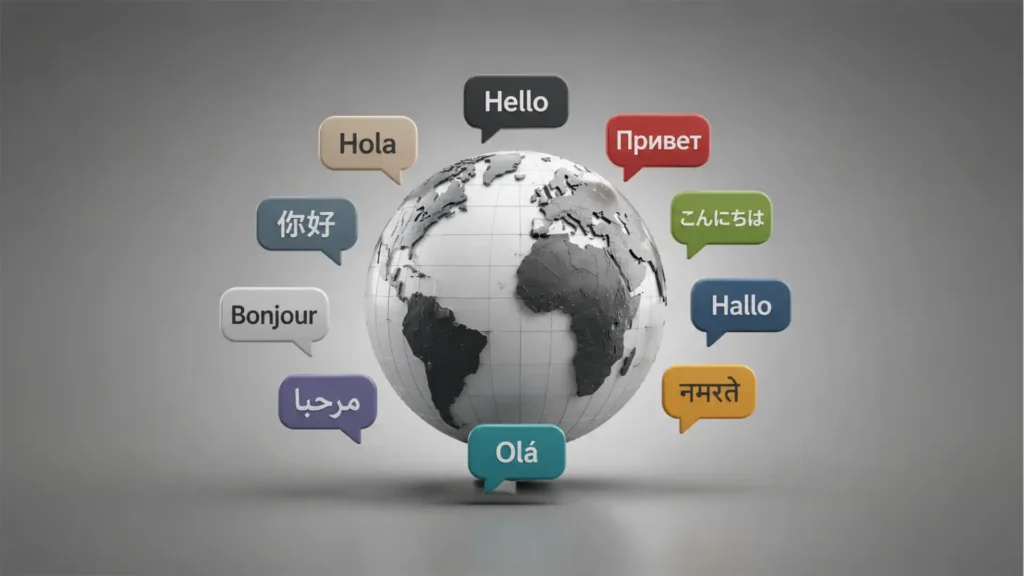
This article is an original analysis supported by the sources cited below
Usage statistics of content languages for websites
W3Techs’ daily survey of website content languages, used for the article’s public-web language ranking.
Digital 2026 Mid-Year Global Update Report
DataReportal’s April 2026 global update, used for global internet, social media, messaging and AI adoption figures.
Digital 2026 Global Overview Report
DataReportal’s global overview report, used for broad internet adoption, offline population and AI-use context.
Facts and Figures 2025
International Telecommunication Union report page used for global internet-use, offline population and connectivity-gap context.
China’s internet user base hits 1.125 billion as AI adoption surges
China government and Xinhua report citing CNNIC data on China’s internet users, penetration and generative AI adoption.
Digital 2026: China
DataReportal country report used for China’s social media user identity figures and digital market context.
Digital 2026: India
DataReportal country report used for India’s internet user scale, growth and platform reach.
India’s internet users to exceed 900 million in 2025, driven by Indic languages
IBEF summary of IAMAI-Kantar findings on India’s active internet users and Indic-language content consumption.
India’s internet user base crosses 950 million in 2025
Business Standard report on the IAMAI-Kantar Internet in India 2025 findings, used for India’s active internet-user milestone.
Digital 2026: Brazil
DataReportal country report used for Brazil’s internet users, penetration and platform reach.
Digital 2026: Indonesia
DataReportal country report used for Indonesia’s internet users, social media identities and TikTok audience context.
Digital 2026: The United States of America
DataReportal country report used for U.S. social media user identity context.
What is the most spoken language?
Ethnologue overview used for global language-speaker context and the distinction between spoken scale and online representation.
List of Wikipedias
Wikimedia Meta page used for the number of Wikipedia language editions and multilingual knowledge infrastructure.
Wikipedia at 25: What the data tells us
Pew Research Center analysis used for Wikipedia article counts, English Wikipedia scale and multilingual knowledge context.
Statistics of Common Crawl Monthly Archives: Distribution of Languages
Common Crawl language-statistics page used for web-crawl language detection and AI data context.
Common Crawl About
Common Crawl organizational page used for dataset scale, multilingual initiatives and CommonLID context.
Expanding the Language and Cultural Coverage of Common Crawl
Common Crawl blog post used for the Web Languages Project and efforts to reduce English overrepresentation in crawl data.
Google Translate adds 110 languages in its biggest expansion yet
Google announcement used for AI-assisted translation expansion and language-access analysis.
200 languages within a single AI model
Meta AI announcement used for NLLB-200, multilingual translation coverage and translation volume context.
Summary Report: State of the Internet’s Languages
Report summary used for platform-interface language support and gaps affecting African, South Asian and other language communities.
Internet Access: UNESCO and ICANN join forces to improve linguistic diversity online
UNESCO article used for Universal Acceptance, internationalized domain names and the estimate of languages fully accessible online.
Localized versions of your pages
Google Search Central documentation used for hreflang, localized page signals and multilingual SEO guidance.
Managing multi-regional and multilingual sites
Google Search Central documentation used for separate language URLs, crawling behavior and language-version guidance.
Understanding Success Criterion 3.1.1: Language of Page
W3C accessibility guidance used for language markup, screen readers and assistive-technology implications.
Declaring language in HTML
W3C internationalization guidance used for HTML language attributes and multilingual markup best practices.
| Citing this article? Brief excerpts are welcome. Please credit Webiano.digital, name the author where stated, and include a link to https://webiano.digital and to this original article. Full or substantial republication requires prior written permission. Read our Copyright and Content Use Policy. |
This article was prepared with the assistance of artificial intelligence tools. The content underwent expert human review, and Webiano Digital & Marketing Agency assumes editorial responsibility for its final version and publication.