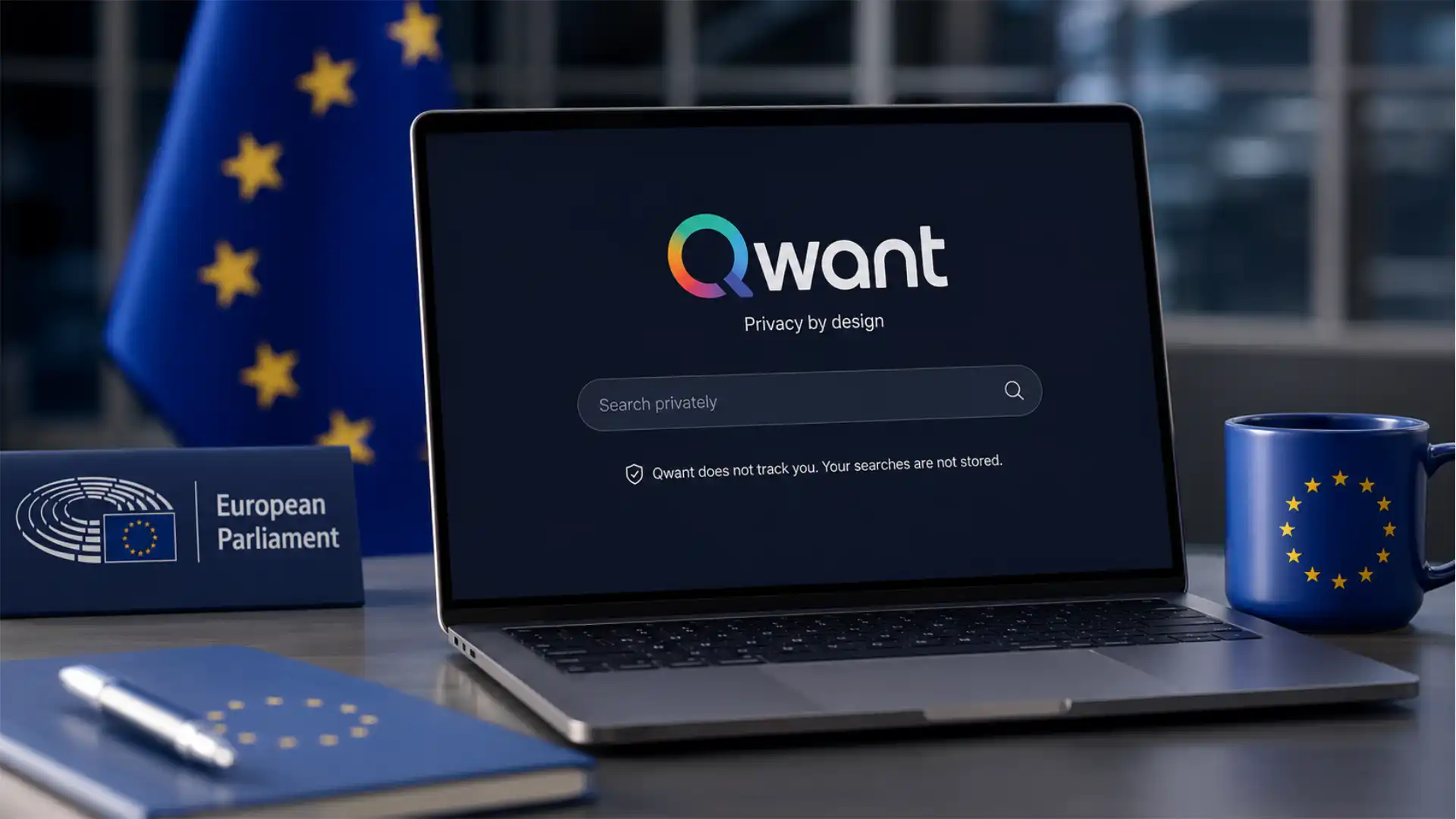
The European Parliament has not banned Google. It has done something narrower and, in Brussels terms, more revealing. From 4 June 2026, Qwant becomes the default search engine on the European Parliament’s Microsoft Edge and Mozilla Firefox browsers, replacing Google on internal computers used across the institution. Staff and lawmakers may still choose another search engine, but the default has changed. Reuters confirmed the start date, the browsers affected, the automatic nature of the change, and the Parliament’s stated rationale: reducing reliance on non-European digital tools and promoting European, privacy-focused services.
Table of Contents
The switch that turned a browser setting into a political signal
That distinction matters. A ban would be coercive. A default switch is softer, but it is not trivial. Defaults shape routine behaviour because most users accept the setting placed in front of them. The Parliament is using a technical setting as an institutional statement: European public bodies should not treat American platforms as the permanent operating layer of their daily work.
The move arrives at a politically charged moment. On 3 June 2026, the European Commission presented a broader technology sovereignty package covering semiconductors, artificial intelligence, cloud infrastructure, open source and energy for data centres. The package frames European dependence on foreign digital infrastructure as an economic, security and governance risk, not only as a market issue.
Seen on its own, the Qwant change is small. Seen alongside cloud, chips, AI, data protection, digital markets regulation and public procurement, it is a signal of a deeper shift. Europe is no longer talking about digital sovereignty only through legal enforcement against large platforms. It is starting to apply sovereignty through the ordinary machinery of institutions: browsers, defaults, contracts, procurement rules, cloud criteria, software choices and data handling policies.
A modest technical change with institutional weight
The European Parliament’s browser change affects a controlled environment: the institution’s internal computers and the browsers managed by its administration. It does not change search settings for citizens. It does not remove Google from the internet. It does not mean every member of the European Parliament will use Qwant for every search. Reuters reported that the change applies automatically, while users may still select other alternatives.
The point is institutional posture. The Parliament is one of the core bodies of the European Union. Its workplace tools carry symbolic value because they express what the institution considers normal, trusted and aligned with its own policy direction. A European institution that writes and votes on laws covering digital markets, data protection, cybersecurity, AI and platform accountability now has a harder time explaining why its own digital defaults should remain anchored in non-European infrastructure by habit.
The switch is a policy gesture embedded in IT administration. That makes it easy to underestimate. It is not a treaty, regulation or formal sanction. Yet public institutions often move markets through thousands of small administrative decisions. Procurement specifications, default applications, security standards and approved vendor lists create demand that private companies notice.
The Parliament default-search change at a glance
| Item | Confirmed detail | Strategic meaning |
|---|---|---|
| Start date | 4 June 2026 | The change is immediate, not a distant pledge |
| Browsers | Microsoft Edge and Mozilla Firefox | The setting targets managed institutional browsing |
| New default | Qwant | A French privacy-focused search provider gains official visibility |
| Replaced default | The decision challenges habitual dependence on the dominant search engine | |
| Scope | Internal European Parliament computers | The effect is institutional, not consumer-wide |
| User choice | Alternatives remain available | This is a default change, not a search ban |
| Stated rationale | Reduced dependence on non-European digital tools | The search setting is part of a sovereignty argument |
The table shows why the decision should be read carefully. The Parliament is not claiming that Qwant can replace Google across Europe. It is saying that the default inside a European institution should reflect European policy priorities.
Qwant’s promise and the limits behind the promise
Qwant presents itself as a French search engine built around privacy. Its public messaging says it does not sell personal data and does not retain search data. It also describes itself as hosted in Europe and governed by European values.
That promise explains why Qwant fits the Parliament’s message. Search is not a neutral technical utility. Every query carries context. A person’s searches may reveal work priorities, political interests, health concerns, travel plans, contacts, anxieties, research topics and institutional questions. In a parliament, the sensitivity increases. Searches may relate to legislation, sanctions, defence, trade, lobbying, internal procedures, constituency matters, intelligence reports, investigations or diplomatic issues.
Qwant’s privacy policy gives the claim more texture. Qwant says it does not provide targeted advertising or stored search history by default. Yet its policy also discloses technical processing, optional account-related data, cookie-based consent flows and data exchanges with partners, including Microsoft, for certain search, advertising and feature functions.
That does not invalidate the privacy argument. It narrows it. A privacy-focused search engine is not a magic box that processes no data. It is a service that tries to reduce tracking, profiling and personal-data exploitation compared with dominant advertising-driven search models. For a public institution, the relevant question is not whether Qwant is data-free. It is whether Qwant’s default model, contractual posture, jurisdiction and data practices align better with institutional risk tolerance than Google’s.
Search privacy begins with query history
Search queries are among the most revealing digital records a person produces. Unlike a social profile, a query often captures intent at the moment it is formed. It may be raw, unfinished, urgent or private. A user may search for symptoms before telling a doctor, a legal risk before telling a lawyer, a political question before forming a view, or a work matter before discussing it with colleagues.
Academic work on search privacy has long treated query logs as sensitive because search engines can infer preferences and interests from query histories. That is the core reason institutional search policy matters. The issue is not only advertising annoyance. It is the creation, retention, use and possible exposure of intent data.
For the European Parliament, the risk has two layers. The first is personal: staff, assistants and lawmakers have privacy rights like anyone else. The second is institutional: aggregate searches across a parliamentary network may reveal operational priorities. A burst of searches about a sanctions package, a cyber incident, a trade dispute or a legal challenge could be meaningful even without naming individual users.
Search privacy is about the metadata of attention. Which questions are asked, when they are asked, from which network, in which language, and how they cluster across an institution can disclose more than the content of a single email.
The Microsoft question behind the European alternative
The cleanest version of the story is easy to tell: Europe drops Google and chooses a French search engine. The technical reality is less neat. Qwant’s own ranking-methods page says it uses its own indexing robots and third-party services, including Microsoft Bing, as part of its search results infrastructure. It also discloses commercial relationships for some shopping and advertising-related services.
Reuters has reported that Qwant has historically relied on Bing search results and that Microsoft provides search results to smaller search rivals including Qwant, Ecosia, DuckDuckGo and Lilo. Qwant’s privacy materials also describe data transfers involving Microsoft for search, contextual advertising and certain feature functions.
This is the main tension in the Parliament’s decision. Qwant is European at the user-facing, corporate and policy level, but European search sovereignty is still constrained by dependence on non-European search infrastructure. The Parliament can change its default search engine more easily than Europe can build a full-stack competitor to Google Search, Microsoft Bing, Apple’s distribution power, Amazon’s cloud scale or Nvidia’s AI hardware position.
That tension does not make the switch fake. It makes it realistic. European digital sovereignty is not a switch from dependence to independence in one move. It is a series of substitutions, bargaining positions and infrastructure bets. Some are symbolic. Some are technical. Some are regulatory. Some are procurement-led. The Qwant decision sits at the symbolic and behavioural end of that spectrum.
Defaults matter because search habits are sticky
A default setting is powerful because it turns an institutional preference into daily friction. Users do not need persuasion every morning. The browser simply opens with the approved option. Many users will accept it if the results are good enough for routine work. Some will change it if they prefer Google, Bing, DuckDuckGo, Ecosia or another provider. The institution still gains something: it makes the European option the starting point.
The technology industry understands this well. Search defaults have been among the most contested distribution points in the digital economy because they influence query volume, advertising revenue, market share and habit formation. When a search engine becomes the default on a browser or device, it gains the first chance to answer. In search, the first chance is often the whole contest.
The Parliament’s move is less about forcing every user to adopt Qwant than about forcing the institution to stop treating Google as the automatic answer. That matters because automatic answers become invisible. They escape scrutiny because no one has to choose them.
For a public institution, the act of choosing a default creates accountability. Someone has to ask: Which provider? Under which law? With which data practices? With which partners? With which audit rights? With which exit option? Those questions are healthier than inherited dependence.
Google’s scale makes the symbolism sharper
The switch would not be news if Google were one search engine among many with similar market power. It is news because Google is the search market’s dominant actor. StatCounter measured Google’s share of the European search-engine market at 88.33 percent in May 2026, with Bing at 5.69 percent and much smaller shares for Yandex, Yahoo, DuckDuckGo and Ecosia. Worldwide, StatCounter placed Google at 90.39 percent in May 2026.
Google’s dominance is not only a matter of user preference. It is reinforced by distribution agreements, browser integration, mobile operating systems, advertising tools, publisher relationships, local business data, maps, YouTube, Android and the habit of using “Google” as a verb. Google Search is also part of Alphabet’s revenue engine. Alphabet’s 2024 annual report showed $198.084 billion in revenue from “Google Search & other” and $264.590 billion from Google advertising overall.
That scale explains why a Parliament default change is symbolically loaded. No single European institution can dent Google’s business by itself. Yet the decision challenges the assumption that dominance should translate into institutional default status. A public body may accept that citizens choose Google while still deciding that its own managed environment should prefer a European, privacy-oriented provider.
Alphabet’s own filings show how heavily its business depends on advertising. The company said it generated more than 75 percent of total revenues from online advertising in 2024. That business model is not unlawful by itself. It is also not neutral for public institutions concerned about data minimisation, profiling, behavioural advertising and strategic dependence.
Digital sovereignty has moved from slogan to procurement
Digital sovereignty can sound vague until it enters a procurement form. Then it becomes concrete: Where is the data stored? Which law applies? Who controls the software? Which foreign legal demands may reach the provider? Can the institution audit the system? Can it move away without disruption? Which dependencies are acceptable? Which are dangerous?
The European Commission defines technology sovereignty as Europe’s ability to act independently in the digital sphere while cooperating with partners where interests align. Its 2026 technology sovereignty package covers chips, cloud and AI infrastructure, open source and data-centre energy.
The Parliament’s Qwant switch belongs to this procurement logic. It is not a grand industrial policy by itself. It is a demand signal. Public demand matters because European alternatives often face a distribution problem before they face a quality problem. A private user may like the values behind a European service but stay with the dominant product because it is familiar, faster, better integrated or already installed. A public institution can give the alternative usage, feedback and legitimacy.
Procurement is where digital sovereignty stops being a press release. If European institutions keep buying or defaulting to the same non-European stack while calling for autonomy, the rhetoric collapses. If they shift defaults, tenders and internal standards, the market receives a different message.
Search sits inside the same debate as cloud, chips and AI
The Qwant decision came one day after the Commission announced a package aimed at reducing structural technology dependencies. That package included a Cloud and AI Development Act proposal, a Chips Act 2.0 proposal, a new EU Open Source Strategy and an energy roadmap for data centres.
The Cloud and AI Development Act proposal is meant to strengthen Europe’s cloud and AI ecosystem, increase investment and improve infrastructure availability. The Commission linked it to AI factories, AI gigafactories, data-centre and cloud capacity, and a framework for assessing sovereignty in cloud and AI services.
The Chips Act 2.0 proposal targets semiconductor dependence. The Commission says it seeks to reduce strategic dependencies, support advanced chip production and improve supply-chain resilience. The Chips Act 2.0 policy page says the global chip market is expected to reach €1.37 trillion by 2030 and links the new proposal to investment, demand, supply-side incentives and resilience.
Search, cloud, chips and AI are not interchangeable issues. They do, however, share a common strategic pattern. Europe has strong rules, strong public institutions and strong consumer protection traditions, but it depends on external firms for many layers of the digital stack. Search is the public-facing layer. Cloud is the operational layer. Chips are the hardware layer. AI increasingly sits across all of them.
Europe’s regulatory theory meets its infrastructure gap
Europe has spent years building rules for digital markets, privacy, platforms, data governance and AI. The Digital Markets Act aims to make large digital markets fairer and more contestable by imposing obligations on designated gatekeepers. The Commission lists online search engines among the core platform services covered by the law.
Alphabet is one of the designated gatekeepers under the DMA. The Commission’s gatekeeper portal lists Google Search, Google Chrome, Google Ads, Android, YouTube, Google Maps, Google Shopping and other Alphabet services among designated core platform services.
Regulation can restrain conduct, force access, require transparency and open distribution channels. It cannot instantly create a European search index, cloud hyperscaler, AI chip champion or developer ecosystem. That is the infrastructure gap. The Reuters analysis of the Commission’s 2026 package captured the same tension: Europe may restrict sensitive cloud tenders and set sovereignty criteria, but real independence takes longer because the EU trails the United States and Asia in critical layers.
The Qwant switch is a useful test because it exposes the difference between market regulation and market capacity. Europe can decide that it wants a European default. It still has to prove that the European default is good enough, secure enough and independent enough for real institutional use.
The Parliament move is not an antitrust ruling
The decision should not be confused with a competition-law finding against Google. The Parliament is not declaring Google illegal, unsafe or unsuitable for every context. It is making an internal administrative choice based on dependence, privacy and institutional alignment.
That matters for accuracy. Europe’s competition and digital-market rules are handled through specific legal processes. The Commission enforces the DMA against designated gatekeepers. National authorities enforce other competition and consumer rules. Courts review decisions. The Parliament’s search default change is not part of that enforcement chain.
The move is political and operational, not judicial. It reflects a preference for a European privacy-focused default inside an EU institution. It does not settle the legal status of Google Search, nor does it prove that Qwant is legally or technically superior in every respect.
This distinction also protects the credibility of the sovereignty argument. If every European substitution is framed as a punishment of an American company, the debate becomes defensive and theatrical. The stronger argument is more practical: public institutions should examine their digital defaults in light of privacy, jurisdiction, resilience, competition and strategic dependence.
The DMA background changes the meaning of search competition
The Digital Markets Act changes the policy environment around search because it treats large platform operators as structural gatekeepers. Under the DMA, the question is not only whether a product is popular. It is whether a company controls access points that shape the market for others. Google Search sits directly within that debate.
The Commission has used the DMA to examine how gatekeepers rank services, share data, allow choice, treat rivals and combine information across services. The logic is that digital markets may look open while being constrained by defaults, pre-installation, self-preferencing, data advantages and bundled ecosystems. Search engines are especially sensitive because they direct traffic to the rest of the web.
The Qwant switch does not flow automatically from the DMA. No provision of the DMA requires the European Parliament to use Qwant. Yet the intellectual connection is clear. If Europe argues that defaults and gatekeeping power matter in the private market, it cannot pretend defaults are irrelevant inside its own institutions.
A European institution choosing a European search default is not the same as a regulator forcing a private gatekeeper to change business practices. But both acts share an assumption: market power is shaped by architecture, not only by consumer preference.
The DSA background changes the meaning of search accountability
The Digital Services Act also matters because it places large online platforms and very large online search engines under systemic-risk obligations. The Commission describes the DSA as a framework for online services designed to protect users’ fundamental rights, create transparency over advertising and impose extra duties on the largest platforms and search engines.
Search engines increasingly mediate access to news, political information, public services, health guidance, commercial offers and legal information. Their ranking choices influence what users see first, which sources gain visibility and which narratives spread. For a parliament, this is not abstract. Lawmakers and staff use search while researching policy, checking claims, monitoring news, reading expert material and comparing legal positions.
Qwant’s ranking page says it ranks results according to relevance criteria and says commercial agreements do not influence organic ranking, while also disclosing advertising and partner integrations. That transparency is helpful, but it is not a substitute for scrutiny. Any search provider used by a public institution should be examined for result quality, source diversity, ranking accountability, language coverage, security and bias.
A privacy-focused search engine still needs accountability as a search engine. Data minimisation is not enough if results are weak, biased, stale or dependent on opaque partner pipelines. Public institutions need both privacy and reliability.
Qwant is a European choice, not a European Google
The phrase “Google alternative” can mislead. Qwant is not a European Google. It does not have Google’s global query volume, ad infrastructure, maps ecosystem, browser distribution, AI resources, cloud capacity, Android integration or commercial reach. Its role is different.
Qwant is better understood as a European privacy-oriented search interface and search company operating in a market dominated by global infrastructure providers. Its value is not that it instantly matches Google’s whole ecosystem. Its value is that it gives institutions and users a different default bargain: less emphasis on personal-data exploitation, a European corporate base, a privacy-first brand and a route toward more European search infrastructure.
Qwant’s public materials say privacy is its priority and that by default it does not store search history or personal data, while optional advanced features may involve data sharing with partners. This is a narrower claim than “Qwant never processes data.” It is also a stronger institutional claim than “use Google but adjust privacy settings.”
The Parliament’s choice makes most sense when Qwant is judged as a governance alternative, not as a one-for-one feature clone of Google. The question is not whether Qwant can reproduce every Google feature tomorrow. The question is whether a European public body should place a privacy-first European provider at the default layer for ordinary search.
European Search Perspective gives the switch a longer arc
Qwant’s strategic importance has increased because it is part of European Search Perspective, a joint venture with Ecosia to build a European search index. Qwant announced in November 2024 that the joint venture would be based in Paris, owned 50-50 by Ecosia and Qwant, and designed to build European search and AI infrastructure.
Ecosia later said the European search index went live in August 2025, after the two companies launched the project. European Search Perspective says the project is meant to reduce dependence on external infrastructure, develop European search technology, support privacy and create a base for AI use cases.
This matters because sovereignty is not only a front-end issue. A search homepage with European branding is useful, but the deeper strategic prize is the index: the crawler, ranking infrastructure, data pipeline and query feedback loop that decide how the web is mapped. Without an index, a search engine may remain dependent on another company’s view of the web.
The long-term European search question is whether Qwant and Ecosia can move from privacy-friendly interfaces toward more independent discovery infrastructure. The Parliament’s default switch gives Qwant visibility, but infrastructure progress will decide whether the sovereignty claim deepens or remains mostly symbolic.
Public institutions are testing default-power without banning user choice
The European Parliament’s approach is politically careful. It changes the default while leaving user choice intact. That matters for internal acceptance. A hard block on Google would invite immediate resistance from users who rely on Google for certain work tasks, languages, operators, maps, translations, news discovery or specialised queries. A default change gives Qwant the first chance without pretending no one will need another tool.
This is the better model for institutional experimentation. Public bodies can shift defaults, measure usage, collect feedback, audit privacy, compare result quality and refine policy without making a symbolic gesture brittle. A rigid ban would turn every poor result into a political complaint. A default switch turns the policy into a test.
The Parliament’s decision also avoids a false dilemma. European sovereignty does not have to mean forbidding staff from using every non-European service. It can mean preferring European services where they meet the need, limiting dependence where risk is high, reserving exceptions for specific work cases, and building exit options before crises force them.
A mature sovereignty strategy needs this kind of gradient. Some systems are mission-critical and need strict controls. Some are routine and can be shifted through defaults. Some require foreign providers because no European alternative is ready. A search default belongs in the middle: visible, meaningful, but still reversible.
Default choice and staff choice can coexist
Critics may say the change is cosmetic because users can still switch back to Google. That criticism misses how defaults work. A default does not need to capture every user to change behaviour. It only needs to change the starting point for enough routine use.
Many institutional searches are not highly specialised. Staff search for EU documents, public pages, news articles, definitions, organisations, names, schedules, statistics, legal acts, national authorities and policy background. If Qwant works well enough for these tasks, it may keep a meaningful portion of daily use. Where it fails, users will switch. That feedback has value because it reveals where European alternatives need improvement.
The ability to switch is not a weakness of the policy. It is what makes the policy credible. A public institution should not force lower-quality tools onto staff when better tools are needed for the job. It should set defaults that reflect policy goals while preserving operational competence.
This distinction also matters for democratic culture. The European Parliament should not be seen as restricting access to information. The default change does not stop users from reaching Google Search or any other search provider. It expresses preference without closing the web.
The privacy claim needs careful wording
The claim that Qwant does not track users is attractive, but it should be written with care. Qwant says it does not store search history by default and does not sell personal data. Its policy, though, describes technical data, query processing, pseudonymous identifiers, aggregated statistics, optional user accounts, cookie consent, advertising functions and Microsoft partnership flows.
A fair description is this: Qwant is a privacy-focused search engine that aims to limit tracking, profiling and personal-data use compared with dominant advertising-based search engines, but it still processes some technical and partner-related data to deliver search and related services.
That wording is less dramatic. It is also more trustworthy. Public institutions should not replace one oversimplified narrative with another. Google’s scale and business model raise real privacy and dependence questions. Qwant’s European identity and privacy positioning answer some of those questions. They do not remove every technical, commercial or governance issue.
Academic research on privacy-focused search advertising has also found that privacy-oriented search engines can still expose data through advertising redirection and tracking mechanisms around ad clicks. A 2023 measurement paper examined advertising systems across privacy-focused search engines and found privacy risks tied to redirectors and identifiers. The point is not that Qwant equals Google. The point is that privacy claims must be verified at the system level, not accepted as branding.
Qwant’s privacy model in practice
| Layer | Qwant’s stated or disclosed position | Institutional reading |
|---|---|---|
| Search history | No stored search history by default | Strong fit for data-minimisation goals |
| Personal data | No sale of personal data in public messaging | Useful, but policy and partner flows still need review |
| Optional accounts | Advanced features may involve extra data | Institutions should limit or govern optional features |
| Microsoft partnership | Some search, ad and feature functions involve Microsoft | European front end does not mean full infrastructure independence |
| Advertising | Contextual and partner advertising may appear | Privacy depends on ad-click and consent mechanics |
| Ranking | Uses Qwant systems and third-party services | Result quality and transparency require monitoring |
The table shows the central trade-off. Qwant’s model appears more aligned with privacy-first institutional use than a dominant ad-driven search default, but it is not a zero-data or fully sovereign search stack.
A public-sector search policy has operational risks
A search engine inside a public institution must do boring work well. It must return official documents, legislative references, court pages, regulatory notices, news sources, public procurement pages, national ministry pages and technical materials across many languages. It must handle spelling errors, multilingual entities, local names, acronyms, PDFs and recent news. It must not over-filter. It must not bury official sources behind weak pages. It must not fail under load.
The European Parliament has 720 elected members and thousands of assistants and administrative staff, according to Reuters. That scale is not hyperscale by internet standards, but it is large enough to create real support needs. If users complain that results are weaker, IT teams will face pressure. If Qwant performs well for routine queries but poorly for specialist searches, usage will fragment.
Operational risk also includes security. Browser defaults interact with extensions, bookmarks, managed policies, single sign-on, telemetry, network logging and incident response. A public institution should evaluate not only the search provider’s public policy but also the technical behaviour of the service in managed environments.
A sovereignty default succeeds only if staff do not experience it as punishment. Public-sector technology policy fails when it asks users to accept worse tools for noble reasons and then ignores the workaround culture that follows. The Parliament will need evidence that Qwant works for institutional search, not only that Qwant sounds aligned with European values.
The browser layer matters more than it looks
The Parliament’s change applies to Microsoft Edge and Mozilla Firefox. That detail is easy to skip, but it shows how digital dependence is layered. Edge is Microsoft’s browser. Firefox is developed by Mozilla, a US-based non-profit and company structure with global funding ties. The operating systems behind the machines may include Microsoft software. The search provider may rely partly on Microsoft infrastructure. The web pages found may be hosted by American cloud firms. The documents may be opened through other non-European tools.
This is the reality of digital sovereignty in 2026. Changing the search default is one layer in a stack where Europe still depends on foreign operating systems, cloud providers, chip suppliers, browsers, development frameworks, cybersecurity tools and AI infrastructure.
That does not make the change pointless. It makes it one piece of a layered strategy. A government rarely removes systemic dependence in one step. It identifies points of control and shifts them where the cost is acceptable. Search defaults are an accessible point of control. Cloud infrastructure, AI accelerators and semiconductor supply chains are much harder.
The browser layer also has psychological force. Search is the first digital act for many work tasks. Changing the default at that moment reminds users that the institution has made a choice. The message is visible every day.
Procurement is becoming Europe’s quiet tech instrument
The Commission’s 2026 technology sovereignty package points toward public procurement as a strategic tool. Reuters reported that the Commission proposed favouring EU-made software and hardware in critical public contracts as part of the broader made-in-Europe drive. The same report said American cloud providers hold more than 60 percent of the EU market and that the proposed measures include sovereignty requirements for some sensitive cloud uses.
This is where the Qwant switch becomes part of a bigger policy method. Laws tell companies what they must not do. Procurement tells markets what public buyers will reward. Standards tell vendors what they must prove. Defaults tell users what institutions prefer. Together, these tools shape demand.
Europe has often been stronger at regulation than at creating digital champions. Procurement can narrow that gap, but only if it is disciplined. Buying European for symbolic reasons alone risks waste. Buying European where European providers meet clear performance, privacy, security and resilience criteria builds markets without lowering standards.
The best version of European tech sovereignty is not automatic preference for any European vendor. It is disciplined preference for European-controlled options that meet public-interest requirements and improve with institutional demand.
The market will not change because one institution changes a setting
The European Parliament is visible, but it is not big enough to change the search market by itself. Google’s European search share remains overwhelming. Qwant’s challenge is not only winning an official default inside one institution. It is convincing users that its results are reliable enough to keep using when switching is easy.
The search market is difficult because scale feeds quality. More queries create more feedback. More feedback improves ranking, spam detection, local relevance and freshness. Better quality keeps users. More users attract advertisers and partners. More revenue funds infrastructure. This loop is not impossible to challenge, but it is hard.
Research on Google’s market position has found that Google begins a large share of search sessions across many vertical categories, reinforcing its role as an entry point to the web. That market structure is exactly why defaults matter, but it is also why a single default change is not enough.
The Parliament’s move should be judged as a signal and a pilot, not as a market revolution. The question is whether it becomes part of a pattern: other institutions, national ministries, municipalities, schools, public broadcasters, agencies and regulated public contractors reviewing their own defaults and procurement choices.
News, politics and search neutrality still need scrutiny
Search engines are political infrastructure even when they are not partisan actors. They decide which pages appear first, which sources are clustered as authoritative, which local results appear, which news articles surface, which autocomplete suggestions appear and which snippets frame the answer. For a parliament, those choices affect research and attention.
The DSA creates risk-management duties for very large online platforms and search engines, but smaller search engines should not be exempt from scrutiny in sensitive public contexts. A European provider may be more aligned with European law and values, yet it still needs transparent ranking principles, clear correction channels, quality controls and resilience against manipulation.
Qwant’s ranking page says news ranking uses relevance criteria and a restrictive list of media sources, with no commercial agreement influencing organic ranking. That is useful information, but public institutions should press for more operational detail: auditability, source treatment, spam handling, election-period safeguards, state-media policies, language parity and recourse for errors.
Privacy is not the only public value in search. Search quality, pluralism, freshness, source integrity and resistance to manipulation matter as well. A sovereignty policy that ignores these values would be incomplete.
A European alternative must prove quality, not only values
There is a temptation in sovereignty debates to treat European origin as a substitute for product quality. That would be a mistake. European institutions should not adopt inferior tools simply because they are European. They should create conditions for European tools to improve while holding them to high standards.
Qwant will be judged by mundane experiences: whether it finds the right EU regulation, whether it surfaces official Parliament pages, whether it handles French, German, Slovak, Polish, Spanish, Italian and other languages well, whether it indexes recent documents quickly, whether it returns relevant news, whether it respects privacy claims and whether it behaves reliably under managed-browser policies.
A European search default needs strong performance in Europe’s own information environment. That includes EU law portals, national government sites, court decisions, public tenders, multilingual acronyms and local news sources. Google has invested deeply in this environment because its business depends on it. Qwant and its partners must match enough of that utility to keep users from reflexively switching back.
Values win adoption only when the tool is good enough for real work. The Parliament’s decision gives Qwant a higher-profile test. It does not give Qwant immunity from user judgment.
AI search makes the index question more urgent
Search is changing because AI answer systems are becoming part of how users find information. Chatbots, AI Overviews, AI assistants, summarisation engines and enterprise copilots all depend on access to indexed web content, ranking signals, retrieval systems and trusted sources. A search index is no longer only a list of blue links. It is training material, retrieval material, grounding infrastructure and distribution power.
That makes European Search Perspective more relevant. Qwant and Ecosia have framed their joint index partly as AI infrastructure. Their argument is that Europe needs its own search index to avoid relying almost entirely on external infrastructure for search and AI discovery.
The Commission’s 2026 Cloud and AI Development Act proposal also connects AI ambition to infrastructure capacity. It discusses AI factories, AI gigafactories and cloud and data-centre capacity. Search sovereignty and AI sovereignty are therefore linked. If European AI systems depend on foreign indexes, foreign cloud, foreign chips and foreign model ecosystems, Europe’s policy autonomy remains limited.
The Parliament’s Qwant default is about search today, but the strategic question is AI-mediated access to knowledge tomorrow. The provider that controls retrieval controls much of what an AI system can cite, summarise and prioritise.
Smaller search engines need distribution, data and patience
Independent search engines face three linked problems: distribution, data and economics. Distribution is the default problem. A search engine needs placement in browsers, phones and institutional settings. Data is the feedback problem. A search engine needs enough real queries to improve. Economics is the funding problem. Crawling, indexing, ranking, security, anti-spam work and ad infrastructure are expensive.
Qwant’s Parliament default helps with distribution and usage feedback, but only at a limited scale. The European Search Perspective project may help with infrastructure. Public procurement may help with institutional demand. Regulation may help reduce gatekeeper barriers. None of these alone solves the full problem.
Reuters reported in 2025 that demand for European digital sovereignty services had grown as political and privacy concerns rose, but the same report noted that US firms still dwarf European alternatives and that complete separation is difficult because some European alternatives still depend on Google, Bing, Amazon or other external infrastructure.
The honest version of the Qwant story is not that Europe has solved search dependence. It is that Europe has started to use its own institutions to create room for alternatives. That is less dramatic, but more credible.
The transatlantic context is not just economic
European concern about dependence on US technology has intensified because digital infrastructure can become geopolitical leverage. Cloud contracts, payment systems, sanctions compliance, data-access laws, export controls, cybersecurity rules, app stores and platform moderation all sit at the intersection of commerce and state power.
The Associated Press reported that EU leaders are worried about reliance on American companies for AI and cloud services and on Asia for microchips. It also linked the sovereignty push to fears that technology services can be weaponised, citing concern after the International Criminal Court’s chief prosecutor lost access to a Microsoft email account after being placed under US sanctions.
That case does not mean every American technology provider is a political weapon. It does show why public institutions now think differently about dependence. If a legal, technical or sanctions decision outside Europe can affect the digital operations of a European or international institution, sovereignty becomes operational.
The Parliament’s search default is a low-risk expression of a high-stakes concern: Europe wants fewer critical functions sitting entirely under foreign commercial and legal control.
A realistic reading of digital sovereignty
Digital sovereignty is often caricatured as either necessary independence or naïve protectionism. The Parliament’s Qwant switch shows a more practical middle ground. Europe cannot detach from American and Asian technology stacks in one political cycle. It also cannot ignore dependence because the dominant tools are convenient.
A realistic policy has several layers. Europe should regulate gatekeepers where market power harms contestability. It should invest in infrastructure where dependence creates strategic risk. It should use public procurement to create demand for credible European providers. It should keep interoperability and user choice so institutions do not trap themselves in weaker systems. It should be honest about residual dependencies.
The Commission’s open source strategy fits this wider logic. It aims to increase the use of open source in public administrations, strengthen critical technology building blocks, support maintenance and security, and build skills. Open source will not solve every sovereignty problem, but it can reduce lock-in, improve auditability and give public bodies more control over software layers.
Sovereignty does not mean autarky. It means Europe can choose, exit, audit, substitute and negotiate from a stronger position. The Qwant default is a small act of choice.
The test will be measured in daily use
The success of the Parliament’s switch will not be measured by the announcement. It will be measured by behaviour after the announcement. Do users keep Qwant as their default? Do they switch back to Google? Which types of searches fail? Which work well? Do support tickets rise? Does Qwant receive institutional feedback and improve? Does the Parliament publish any follow-up? Do other EU bodies adopt similar defaults?
A serious evaluation should compare search quality across ordinary institutional tasks. It should include multilingual queries, legal references, official documents, recent news, national authority pages, security-sensitive searches and accessibility. It should also examine privacy logs, partner data flows, contractual terms, incident reporting and user education.
A default change without measurement becomes theatre. A default change with measurement becomes policy learning. The Parliament should treat this as a live operational experiment, not a completed act of sovereignty.
Qwant also has an incentive to perform well. Public visibility inside the Parliament gives it a chance to demonstrate relevance to other institutions. Poor performance would feed the argument that European alternatives are symbolic but weak. Strong performance would make it easier for other public bodies to consider similar changes.
The stronger lesson for Europe
The European Parliament’s Qwant switch is small enough to dismiss and meaningful enough to study. It will not break Google’s dominance. It will not make Europe digitally independent. It will not remove Microsoft from search infrastructure. It will not settle the debate over privacy, public procurement or platform power.
It does something more limited and perhaps more useful: it turns European digital sovereignty from an abstract slogan into a default setting that staff will encounter every working day. The move asks whether European institutions are willing to align their own tools with the policy direction they demand from the market.
The strongest reading is neither celebratory nor cynical. The switch is a symbolic act with operational consequences. It is a privacy gesture with technical caveats. It is a European preference inside a still-global stack. It is a challenge to Google’s default status, not to Google’s existence. It is a test of whether institutional demand can give European alternatives more room to improve.
Europe’s search sovereignty will not be decided on 4 June 2026. It will be decided by the dull work that follows: procurement rules, browser policies, cloud contracts, index investment, open source maintenance, user feedback, legal enforcement, funding choices and the willingness to accept that sovereignty is built layer by layer. The Qwant switch is one layer. Its importance is that Europe has chosen to start where users actually work.
Questions readers are asking about the European Parliament and Qwant
No. The Parliament changed the default search engine on its internal Microsoft Edge and Mozilla Firefox browsers from Google to Qwant. Users may still choose another search engine.
The change took effect on 4 June 2026, according to the Parliament spokesperson quoted by Reuters.
The confirmed browsers are Microsoft Edge and Mozilla Firefox on European Parliament internal computers.
No. The change applies to the European Parliament’s internal managed computers. It does not change search settings on citizens’ personal devices.
The official rationale is to reduce dependence on non-European digital tools and promote European, privacy-focused services. Qwant fits that message because it is French and markets itself around privacy.
Qwant is a French search engine that presents itself as privacy-focused. It says it does not sell personal data and does not retain search data by default.
Qwant is better described as privacy-focused, not data-free. Its policies disclose technical processing, optional account-related data, cookie consent flows and some partner data exchanges.
Yes, Qwant’s own materials disclose use of third-party services including Microsoft Bing, and Reuters has reported that Qwant has historically relied on Bing results.
It complicates it. Qwant is European at the company and user-facing level, but parts of the search infrastructure still involve Microsoft. That means the change is a partial sovereignty step, not full independence.
Not in any material way by itself. Google’s search share in Europe remains very high, and one institution’s default change is too small to affect Alphabet’s revenue meaningfully.
Not directly as a legal requirement. The link is conceptual: the DMA treats gatekeeper power and defaults as market-shaping forces, and the Parliament is applying similar thinking to its own browser settings.
Yes. The DSA creates obligations for online services and extra duties for very large online platforms and very large online search engines, including risk-management and transparency duties.
Search queries can reveal political interests, legislative work, legal research, sanctions questions, security concerns and institutional priorities. Even aggregated query patterns may be sensitive.
European Search Perspective is a joint venture between Qwant and Ecosia intended to build a European search index and reduce dependence on external search infrastructure.
Qwant uses a mixture of its own indexing work and third-party services. The European Search Perspective project is meant to expand European-controlled search infrastructure.
Yes, but adoption will depend on procurement rules, IT policy, user feedback, search quality, privacy assessment and institutional willingness to change defaults.
It can be framed that way by critics, but the stronger reading is risk management. Public institutions are allowed to weigh privacy, jurisdiction, resilience and strategic dependence when choosing defaults.
The main risks are weak result quality, staff switching back, unclear partner data flows, poor multilingual performance, support burden and the possibility that the change remains symbolic without measurement.
Watch whether users keep Qwant, whether the Parliament evaluates performance, whether other EU bodies change defaults, whether Qwant reduces infrastructure dependence and whether European Search Perspective improves search quality.
The decision shows Europe applying digital sovereignty through daily institutional settings, not only through laws and speeches. It is a small change that tests whether European alternatives can earn routine use.
Author:
Jan Bielik
CEO & Founder of Webiano Digital & Marketing Agency
This article is an original analysis supported by the sources cited below
EU Parliament to switch to French search engine from Google in tech sovereignty push
Reuters report confirming the European Parliament’s switch from Google to Qwant as the default search engine on internal Microsoft Edge and Mozilla Firefox browsers from 4 June 2026.
Commission proposes tech sovereignty package to strengthen Europe’s digital autonomy and resilience
European Commission announcement of the 2026 technology sovereignty package covering semiconductors, cloud, AI, open source and data-centre energy.
Proposal for the Cloud and AI Development Act
European Commission proposal explaining the planned framework for EU cloud and AI infrastructure, including AI factories, AI gigafactories and sovereignty assessment.
Communication on European tech sovereignty accompanied by the EU open source strategy
European Commission communication setting out the wider policy frame for European technology sovereignty and open source.
Proposal for the Chips Act 2.0
European Commission proposal describing new measures to strengthen Europe’s semiconductor industry and reduce strategic dependencies.
Chips Act 2.0
European Commission policy page on the Chips Act 2.0, including market context, investment aims and supply-chain resilience.
Open Source Strategy
European Commission policy page explaining the EU Open Source Strategy, including procurement, public-sector use, critical software building blocks and maintenance.
EU wants to catch up with US, China in AI, cloud and chips with new technology rules
Associated Press report on the EU’s technology sovereignty package and concerns about dependence on American cloud and AI services and Asian semiconductor supply.
EU targets Big Tech dependence with made-in-Europe drive
Reuters report on the Commission’s made-in-Europe technology proposals, including cloud sovereignty, public contracts and semiconductor targets.
Europe’s tech liberation day? Computer says not yet
Reuters analysis explaining why Europe’s technology sovereignty push faces deep infrastructure, funding and market constraints.
Qwant
Qwant’s public search homepage describing its privacy positioning, European hosting and claims about personal data and search data.
About Qwant
Qwant’s corporate information page explaining its privacy-first positioning and default approach to search history and personal data.
Privacy policy
Qwant legal page describing data processing, search privacy, optional features, cookies, Microsoft-related flows and retention practices.
Classification, reference and ranking of offers
Qwant transparency page explaining ranking criteria, indexing, third-party services, advertising and partner integrations.
Search engine market share Europe
StatCounter data page used for European search-engine market share figures, including Google’s May 2026 share.
Search engine market share worldwide
StatCounter global data page used for worldwide search-engine market share context.
Digital Markets Act
European Commission portal explaining the Digital Markets Act, gatekeeper obligations and the role of core platform services including online search engines.
Gatekeepers
European Commission gatekeeper portal listing designated gatekeepers and core platform services under the Digital Markets Act, including Alphabet and Google Search.
The Digital Services Act package
European Commission policy page explaining the Digital Services Act, platform duties, search-engine obligations, transparency and systemic-risk supervision.
Data protection
European Commission page explaining EU data-protection rules, GDPR, fundamental rights and international transfer safeguards.
Ecosia and Qwant join forces to develop European search index
Qwant announcement of the European Search Perspective joint venture with Ecosia to build a European search index.
Launching our European search index
Ecosia blog post announcing the launch of the European search index built through European Search Perspective.
European Search Perspective
Official website of the Qwant and Ecosia joint venture describing its mission, index plans and European search infrastructure goals.
French antitrust watchdog dismisses complaint filed by Qwant against Microsoft
Reuters report on Qwant’s Microsoft-related dependence and the French competition authority’s dismissal of Qwant’s complaint.
Europeans seek digital sovereignty as US tech firms embrace Trump
Reuters report on growing European demand for local digital services and the continuing scale advantage of US technology companies.
Alphabet 2024 annual report
Alphabet’s annual filing used for Google Search revenue, Google advertising revenue and the company’s dependence on online advertising.
Uncovering privacy risks in search engine ad systems
Academic measurement paper examining privacy risks in advertising systems used by privacy-focused search engines.
TrackMeNot
Academic paper used for background on search-query privacy and the ability to infer user interests from query histories.
We’re not searching the same
Academic paper used for background on Google Search’s gatekeeping position and search-session concentration across vertical markets.
| Citing this article? Brief excerpts are welcome. Please credit Webiano.digital, name the author where stated, and include a link to https://webiano.digital and to this original article. Full or substantial republication requires prior written permission. Read our Copyright and Content Use Policy. |
This article was prepared with the assistance of artificial intelligence tools. The content underwent expert human review, and Webiano Digital & Marketing Agency assumes editorial responsibility for its final version and publication.