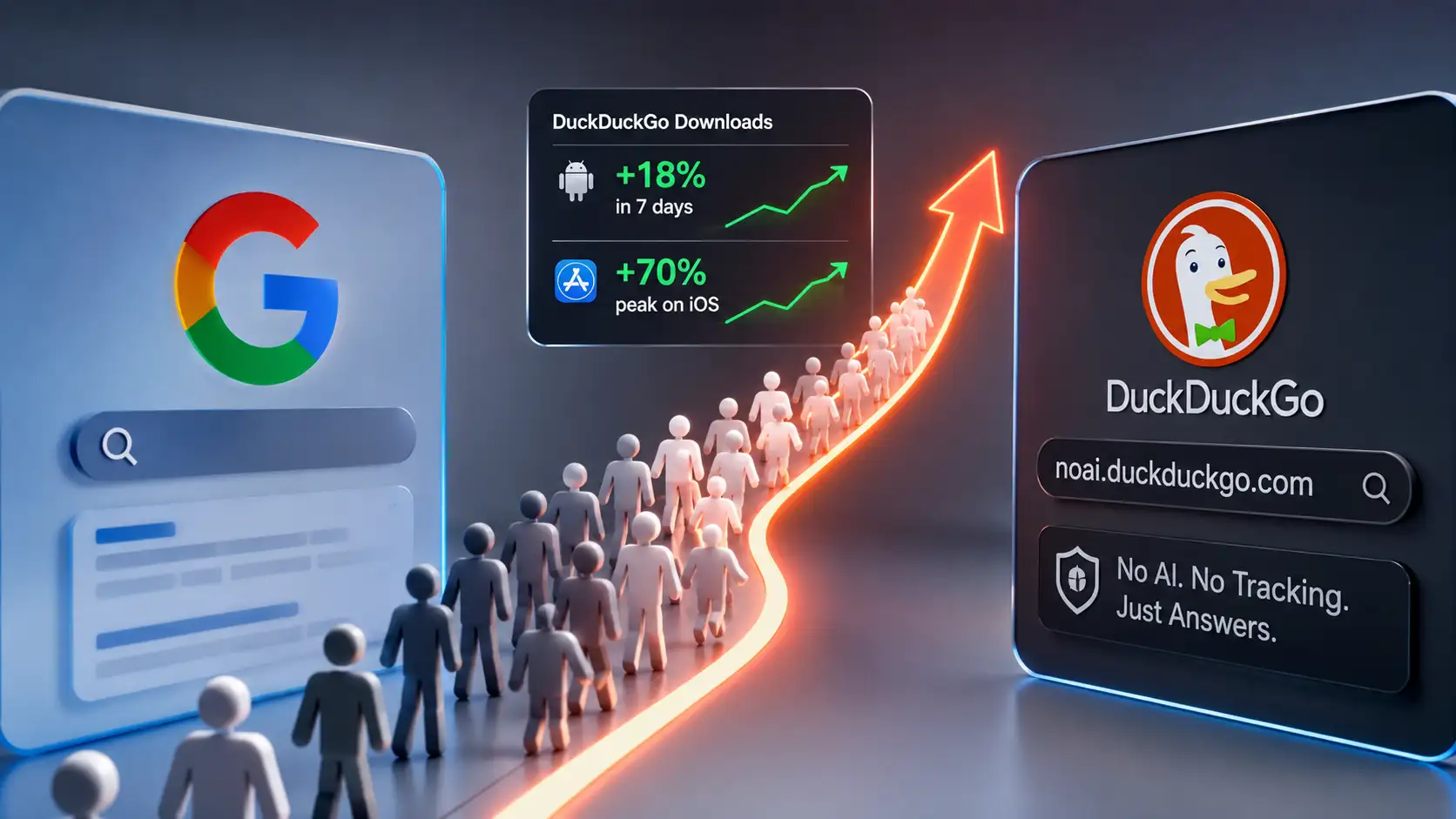
Google’s post-I/O search story has a second plot now. The first is the one Google wanted to tell: Search is becoming more conversational, more agentic, more personalized and more tied to Gemini. The second is less comfortable: a measurable group of users appears to be looking for the exit, or at least for a search box with less AI in the way. DuckDuckGo says U.S. app installs rose after Google I/O 2026, with iOS installs peaking near 70% week over week, while visits to its AI-free search page also climbed. That is not proof of a mass collapse in Google usage. It is proof that AI search has moved from a publisher argument into a user-control argument.
Table of Contents
The backlash arrived faster than the market shift
DuckDuckGo’s reported jump came right after Google used I/O 2026 to describe Search as something much closer to an AI command layer than a ranked list of links. Google said it was introducing the biggest upgrade to the Search box in more than 25 years, with AI Mode, multimodal inputs, AI agents, generative interfaces and deeper personalization moving into the center of the experience. In Google’s framing, this is progress: users can ask longer questions, upload files or videos, create information agents and receive synthesized updates instead of manually checking pages.
The user reaction is messier. TechCrunch reported that DuckDuckGo said U.S. app installs were up 18.1% week over week on average from May 20 to May 25 compared with May 13 to May 18, peaking at 30.5% on May 25. On iOS, DuckDuckGo said installs averaged 33% growth and peaked at 69.9%. Visits to noai.duckduckgo.com, the version of DuckDuckGo where AI features are turned off by default, averaged 22.7% growth and peaked at 27.7% on May 24.
Business Insider later cited a seven-day DuckDuckGo window after Google’s May 19 announcements, with U.S. installs up 20.8% on average and peaking at 37.6% on May 26. It also repeated the same iOS pattern: average growth of 33%, with a near-70% peak. The two reports do not contradict the core story, but they do use slightly different timeframes. The cautious reading is that DuckDuckGo saw a real short-term spike, strongest in the United States and especially visible on iOS, but the available figures are still mostly DuckDuckGo-reported rather than independent app-store totals.
TechCrunch added one third-party signal: Apptopia found a 29% increase in average daily DuckDuckGo downloads in the United States and a 12% increase globally over the same period. That outside check matters because platform self-reporting can turn a short promotional bump into a bigger narrative. Still, a download spike is not the same thing as a durable change in default search behavior. People can install a browser and barely use it. People can test an alternative and return to Google. People can search with DuckDuckGo for some queries while still using Google Maps, YouTube, Gmail and Chrome every day.
The sharper point is not that Google is suddenly losing the search war. Google remains enormous. StatCounter’s April 2026 U.S. search engine market share showed Google at 85.16%, Bing at 9.82%, Yahoo at 2.67% and DuckDuckGo at 1.74%. Worldwide search host data for April 2026 put google.com at 88.22% and duckduckgo.com at 0.71%. A spike of downloads can be culturally meaningful long before it becomes market-share damage.
That distinction is the heart of the story. Google is not being abandoned at scale, at least not by the public data available now. But the old assumption that users will accept whatever Search becomes is weaker than it looked before I/O. Search is a habit, not just a product. Habits break slowly, then sometimes quickly. If Google trains users to think of Search as an AI layer they cannot fully control, it invites competitors to sell something simpler: a query box that behaves the way users remember.
Google did not just announce features, it changed the contract
The most sensitive part of Google’s I/O 2026 Search announcement was not any single feature. It was the combined message. Google said Search would gain a reimagined AI-powered box that accepts text, images, files, videos and Chrome tabs. It said AI Overviews and AI Mode would connect into a more continuous experience. It said users would be able to create information agents that monitor the web in the background and send synthesized updates. It said Search could generate custom layouts, components, dashboards and mini-app-like experiences for specific tasks.
A traditional search engine makes a relatively plain promise: type a query, receive links, judge sources, click what looks useful. Google has not been that simple for years. It has had ads, snippets, knowledge panels, shopping modules, local packs, videos, “People also ask” panels and answer boxes. Still, the basic mental model survived. Search pointed outward. The user remained the judge.
AI search changes the contract. It does not only rank pages; it synthesizes a response. It does not only suggest sources; it decides which claims deserve to be folded into an answer. It does not only send users outward; it tries to finish more tasks inside Google’s own interface. When Google adds agents and personal data connections, the search box becomes less like an index of the web and more like a control surface for Google’s services and models.
Google’s official language makes the direction plain. Its I/O 2026 announcement said it was bringing advanced model capabilities to Search and letting users “use agents just by asking a question.” The company also said AI Mode had surpassed one billion monthly users a year after launch and that queries in AI Mode had more than doubled every quarter since launch. Sundar Pichai’s keynote text said AI Overviews had more than 2.5 billion monthly active users and that AI Mode had crossed one billion monthly active users.
From Google’s perspective, those numbers answer the critics. People are using the AI tools. They are asking more. Search queries reached an all-time high in the quarter before I/O, according to Google’s own post. Alphabet’s Q1 2026 earnings release reported $109.9 billion in revenue, up 22% year over year, and said Google Services revenue rose 16% to $89.6 billion, led by 19% growth in Google Search and other advertising. The business case for AI search looks strong inside Alphabet’s numbers.
The user-control case is different. Usage can grow while trust declines. A person may use AI Overviews because they are there, not because they asked for them. A person may click through less often because the answer sits above the links. A person may try AI Mode for complex questions and still dislike seeing generated summaries for simple searches. The presence of usage does not settle the question of consent.
Google’s own support page gives critics their strongest wording. Under “Show only web links in Google Search,” Google says AI Overviews are a core Search feature, like knowledge panels, and “Features cannot be turned off.” Users can select the Web filter after searching to show only text-based links without features such as AI Overviews. That is not the same as a permanent off switch. It is a post-search route around the default experience.
That gap explains why DuckDuckGo’s noai page found such an easy message. Google can say users have a Web filter. DuckDuckGo can say users have an AI-free search page. Those are not equivalent products in the mind of a frustrated user. One asks the user to work around a default; the other presents itself as the default the user wanted.
DuckDuckGo found the right word before Google did
DuckDuckGo’s advantage in this news cycle was not technical superiority. It was vocabulary. The company had already built a simple public distinction between “AI available” and “AI forced.” Its help page for noai.duckduckgo.com says searching there works the same as on duckduckgo.com except that all AI features are turned off and AI-generated images are filtered out by default. The blocked features include Search Assist, Duck.ai and AI-generated images.
That message fits the mood. It does not require users to reject every use of machine learning. It does not demand that they become privacy absolutists or anti-AI activists. It gives them a cleaner preference: some people want search results without generated answers, generated images or AI chat entry points in the way. DuckDuckGo’s noai page turns that preference into a URL.
DuckDuckGo is not an AI-free company. It offers Duck.ai, a private AI chat interface, and Search Assist, an AI-assisted answer feature. Its public line is not “no AI ever.” Its line is “private, useful and optional.” DuckDuckGo’s AI opt-out help page says all AI features are optional and can be turned off or tuned down. Its optional AI page says the company’s AI features do not track usage or train on user data, and that every feature can be turned off or reduced.
That position is more commercially flexible than a hard anti-AI stance. DuckDuckGo can appeal to users who want private access to ChatGPT, Claude or other models through Duck.ai, while also giving AI-skeptical users a place to search without AI-generated summaries. Duck.ai’s public page describes it as private AI chat, free and with no account required. DuckDuckGo’s privacy help page says Duck.ai does not record or store chats and does not use conversations to train models by DuckDuckGo or the underlying model providers.
The strongest product idea here is not privacy alone. It is permission. Users can accept AI features when they choose them and reject them when they do not. That is a clean emotional contrast with Google’s “core feature” language around AI Overviews. Google can argue that its Web filter gives users a classic-link option. DuckDuckGo can argue that the option should be the default for people who pick it once.
The funny part of the story, as the original social post noted, is that DuckDuckGo had an almost perfect meme-ready page for the moment: noai.duckduckgo.com. It reads like a protest sign and works like a product page. In a news cycle shaped by irritation, that is rare marketing luck. But it was not accidental. DuckDuckGo had already been preparing the user-choice argument around AI images, AI chat and search answers before Google I/O gave the argument more attention.
DuckDuckGo’s filter for AI-generated images shows the same pattern. The company’s help page says users can hide AI-generated images directly from DuckDuckGo’s Images tab or through settings. The noai page also filters AI-generated images by default. For users angry not only about AI summaries but also about synthetic images polluting visual search, that matters.
Google’s challenge is that it is trying to prove AI belongs in Search by making it central. DuckDuckGo is trying to prove AI belongs under user control by making it optional. The fight is less about whether AI is useful and more about who gets to decide when AI appears.
The numbers point to protest, not yet migration
The temptation is to call the DuckDuckGo spike a user exodus from Google. That would be too strong. The available evidence points to a protest surge, a sampling wave and perhaps a habit test. It does not prove that millions of users changed their default search provider, stopped using Google Search or moved their daily information behavior to DuckDuckGo.
The difference matters because app-install figures are easy to overread. A user can download DuckDuckGo, run three searches, then return to Safari’s or Chrome’s default. A user can install it because a viral post mentioned it, then forget the app exists. A user can use DuckDuckGo for privacy-sensitive queries and Google for local, shopping, maps or video-heavy queries. A download is an opening; it is not retention.
StatCounter’s April 2026 figures show why the threshold for true migration is high. Google held 85.16% of the U.S. search engine market, while DuckDuckGo held 1.74%. In global host-share terms, google.com held 88.22%, while duckduckgo.com held 0.71%. On mobile search host share worldwide, google.com held 93.79%, while duckduckgo.com held 0.69%. DuckDuckGo can grow downloads quickly and still remain tiny beside Google’s distribution machine.
The iOS spike is still worth watching. Apple users are a valuable audience for search providers because Safari’s default search setting has been one of the most important choke points in the search market. The U.S. search antitrust case against Google focused heavily on default distribution contracts. The Department of Justice said in September 2025 that court-ordered remedies barred Google from exclusive contracts related to Google Search, Chrome, Google Assistant and Gemini, and required certain search index and user-interaction data to be made available to rivals and potential rivals.
Default settings create a huge distance between “I dislike this feature” and “I changed my behavior.” If the default is Google, many users keep using Google because it is already in the browser, the phone, the address bar and the habit loop. DuckDuckGo’s post-I/O spike suggests that AI search irritation was strong enough to push some users into action. The harder question is whether those users will change defaults, not only install apps.
Google knows this. Its search business is built not only on quality but also on placement. The DOJ remedies announcement said Google’s exclusionary agreements locked up key avenues through which users access search, requiring Google as the preset default on billions of devices and computers and sometimes blocking competitor preinstallation. Google disagreed with the court’s approach, saying its popularity came from quality, innovation and business decisions, and arguing that remedies should stay tied to distribution contracts rather than broader AI or product design.
The post-I/O DuckDuckGo spike sits at the crossing of those two stories. Users may be more willing to test alternatives when they dislike AI defaults. Regulators are already trying to loosen default distribution arrangements. Rival search providers are looking for moments when the cost of switching feels worth paying. If those forces line up, small spikes may become more than social-media noise.
But the public data does not support a claim that users are “massively abandoning Google” in the market-share sense. A better headline is sharper and more accurate: Google’s AI-first Search push has created a visible opening for AI-light and AI-optional search competitors.
Reported DuckDuckGo growth after Google I/O 2026
| Signal | Reported movement | Window or detail | Best interpretation |
|---|---|---|---|
| U.S. DuckDuckGo app installs | Up 18.1% on average | May 20–25 versus May 13–18 | Short-term post-I/O lift |
| U.S. iOS installs | Up 33% on average | Same TechCrunch window | Strongest visible platform reaction |
| U.S. iOS install peak | Up 69.9% | May 25 | Viral or event-driven spike |
| noai.duckduckgo.com visits | Up 22.7% on average | May 20–25 versus prior period | Clear interest in AI-free search |
| Apptopia U.S. daily downloads | Up 29% | Same broad period | Partial third-party support |
| Apptopia global downloads | Up 12% | Same broad period | U.S. reaction stronger than global reaction |
The figures are strong enough to show real user curiosity and weak enough to require restraint. They show a search preference signal, not a confirmed search-market transfer.
Google’s strongest argument is convenience
Google’s AI search case begins with convenience. Users often do not want ten links. They want an answer, a comparison, a plan, a diagnosis of a broken device, a quick explanation, a set of options or a way to continue asking follow-up questions. Google’s 2024 AI Overviews launch post argued that people could ask more complex questions in one go and that Search could take on more of the work involved in searching, planning and brainstorming.
At I/O 2026, Google pushed that argument further. A new Search box can handle text, images, files, videos and Chrome tabs. Information agents can monitor changing topics. Generative UI can assemble tables, charts, simulations and custom layouts. Personal Intelligence can connect AI Mode with Gmail and Google Photos, with Calendar planned later, if the user chooses to connect those apps.
For many search tasks, that will be useful. A user comparing mortgage options, planning a trip, researching a medical appointment, choosing a laptop, studying a legal process or troubleshooting a complex error may benefit from a conversational interface that remembers the thread. A user trying to monitor a fast-moving topic may prefer an agent that reports changes. A user working across files and browser tabs may prefer a multimodal search box.
The reason Google is willing to risk anger is that this convenience layer could keep Search central as users move toward chatbots. ChatGPT, Perplexity, Gemini, Claude, Copilot and other AI interfaces all trained users to ask full questions and expect direct answers. If Google remained only a link engine, it risked losing high-intent informational behavior to answer engines. AI Mode is Google’s answer to that risk.
The business numbers support Google’s confidence. Alphabet said Q1 2026 consolidated revenue rose 22% to $109.9 billion and Google Services revenue rose 16% to $89.6 billion. Sundar Pichai’s Q1 remarks said Search and other advertising revenue grew 19%, and that users were returning to AI experiences such as AI Mode and AI Overviews.
That does not make user frustration irrelevant. It means Google can afford to absorb some frustration if the larger engagement curve moves upward. The conflict is between the average user behavior Google sees in aggregate and the control demand voiced by users who dislike forced AI surfaces. Companies often favor aggregate behavior because it is measurable and monetizable. Users often experience the product at the level of annoyance.
Google can also point to the fact that AI Mode is not the same as AI Overviews. TechCrunch reported that a Google spokesperson noted AI Mode is not the default and AI Overviews had existed for two years. This distinction matters, but it does not fully answer the criticism. Users are not only reacting to AI Mode as a separate product; they are reacting to the gradual feeling that Google Search itself is being rebuilt around AI.
Convenience is powerful. It can change habits even when people complain. But convenience without user control can become resentment. The more Google turns Search into an AI assistant, the more it needs to decide whether “Search should do more for you” also includes “Search should get out of your way when you ask.”
Google’s weakest argument is the missing off switch
The off-switch issue cuts through every technical explanation. Google can argue that AI Overviews are high quality, that they link to the web, that they help with complex tasks and that many users like them. The user who wants old-style results asks a simpler question: can I turn them off?
Google’s support page says no. AI Overviews are described as a core Search feature, and core features cannot be turned off. Google does offer the Web filter after a search, which displays only text-based links without features such as AI Overviews. The problem is that a filter is not the same as a setting. It is a repeated user action unless the user relies on browser-level workarounds or extensions.
This product choice matters because Search is not a niche app. It is a gateway to public information, commerce, health questions, political facts, local services, jobs, education and news. When a gateway adds generated answers, the burden of control becomes heavier. A user may not care whether an entertainment app pushes AI recommendations. They may care much more when search results for health, law, finance, elections or product safety put generated text above sources.
Pew Research Center found in March 2025 browsing data that Google users who encountered an AI summary clicked a traditional search result link in 8% of visits, while users who did not encounter an AI summary clicked a search result nearly twice as often, 15% of visits. Pew also found users clicked a link inside the AI summary in only 1% of visits with a summary.
That click behavior explains why some users feel the interface has changed even if Google says links remain. A page can contain links and still discourage clicking. A generated answer at the top can satisfy the immediate query, absorb attention and reduce the need to inspect sources. For some users, that is a benefit. For others, it feels like Search has inserted an uninvited middleman.
Pew’s later survey work found Americans who had seen AI summaries in search were lukewarm about their usefulness: one-in-five said they were extremely or very useful, 52% said somewhat useful and 28% said not too or not at all useful. That is not a rejection of AI summaries, but it is not love either. It suggests a broad middle group that may tolerate AI summaries while still wanting control.
The noai DuckDuckGo page takes advantage of that middle. Users do not have to make an ideological decision. They can search one way when they want AI, another way when they do not. Google’s current stance makes the same preference harder to express. It says AI Overviews are part of Search, and users can select a link-only filter afterward. For a product as habitual as search, the default is the message.
AI search turns ranking into editorial synthesis
Search ranking was never neutral. Google always made decisions about crawling, indexing, spam, authority, freshness, localization, personalization, ads and interface modules. Still, the traditional result page exposed disagreement through multiple links. Users could compare sources, choose publishers they trusted and notice when results came from government sites, forums, commercial pages or news organizations.
AI summaries compress that process. They take many possible pages and turn them into one answer-shaped block. This is useful when the answer is stable and well-sourced. It is more risky when the query is subjective, time-sensitive, politically charged, medical, legal, financial or shaped by conflicting evidence. AI search makes the search engine not only a ranking system but a visible narrator.
A May 2026 arXiv study, “Measuring Google AI Overviews,” issued 55,393 trending queries from March 13 to April 21, 2026. The researchers reported that AI Overviews appeared on 13.7% of queries overall and 64.7% of question-form queries. They found that nearly 30% of AI Overview-cited domains did not appear in co-displayed first-page results, suggesting source selection is not simply the old ranking system in summary form. They also decomposed responses into 98,020 atomic claims and reported that 11.0% were unsupported by cited pages.
Another 2026 arXiv paper compared Google Search, AI Overviews and Gemini across 11,500 user queries. It found AI Overviews generated for 51.5% of representative real-user queries and displayed above organic results. It also found source sets differed substantially across systems and that AI Overviews were less consistent across repeated runs and less stable under small query edits.
These findings do not prove Google AI Overviews are generally bad. They do show that AI search is a different information system. A link ranking error can be corrected by the user clicking another result. A summary error may be absorbed before the user reaches the source list. A source omission may never be noticed. A slightly different wording of the same question may produce a different summary and source set. The user sees a confident answer, not the uncertainty inside the retrieval and generation pipeline.
The shift matters for publishers, brands and public agencies. For publishers, being ranked may no longer be enough; being cited or summarized becomes its own visibility layer. For brands, AI-generated wording can shape perception before users reach owned websites. For public agencies, source selection and summarization can affect whether authoritative local information appears in high-stakes contexts.
Google’s Search Central documentation now treats AI features as part of site owners’ visibility environment. Its guide on AI features and websites covers AI Overviews and AI Mode from the perspective of content inclusion. That is a sign of institutional permanence. Google is not treating AI summaries as a temporary experiment; it is building documentation for how websites should understand them.
DuckDuckGo’s surge should be read inside this broader shift. Some users are not simply annoyed by a new widget. They sense that search is becoming less inspectable. When a search engine answers, selects, summarizes and acts, users start asking who controls the answer layer. DuckDuckGo’s answer is choice. Google’s answer is quality plus links. The public argument is now testing which answer users believe.
Publishers saw the problem before users did
Before the DuckDuckGo spike, the loudest objections to AI search came from publishers, SEO professionals, journalists, artists, researchers and site owners. Their concern was clear: AI summaries can answer user questions without sending traffic to the pages that supplied the information. Search used to be a distribution bargain. Publishers allowed crawling because Google sent readers. If Google absorbs more of the reader’s attention on the results page, the bargain weakens.
Pew’s click data made that concern concrete. Users who encountered an AI summary were less likely to click search result links, and they rarely clicked links inside the summary itself. For publishers dependent on search referrals, that behavior can reduce traffic even if their content appears as a source.
A 2026 arXiv paper on AI Overviews and Wikipedia used staggered geographic rollout and multilingual comparisons to estimate the effect on Wikipedia traffic. The authors reported that AI Overview exposure reduced daily traffic to exposed English Wikipedia articles by about 15%, with larger relative declines for Culture articles and smaller effects for STEM. The result matters because Wikipedia is not a sensational publisher claiming injury; it is a widely used informational source whose traffic can be studied at scale.
The May 2026 arXiv measurement study added another layer. It found that more than half of AI Overview-cited pages carried display advertising, meaning publishers may lose revenue when the summary reduces clicks while Google’s own ads can still appear on the search page. The study framed this as a publisher-impact problem inside the broader information ecosystem.
For a long time, users could dismiss publisher concerns as industry self-interest. Readers liked quick answers. Many were tired of recipe pages, pop-ups, affiliate spam, autoplay video and low-quality SEO content. Google’s AI summaries seemed to offer relief from a degraded web. The post-I/O reaction shows a new twist: some users now see themselves, not publishers, as the ones losing control.
This matters because user anger is more dangerous for Google than publisher anger. Publishers may complain but still need Google traffic. Users can switch search boxes, install browsers, use AI chatbots directly, or divide queries across tools. Switching is not frictionless, but it is easier than building a new publishing business.
The publisher problem and user-control problem are connected. If AI search reduces source visits, fewer users inspect original context. If fewer users inspect original context, the generated answer gains more influence. If users cannot turn that layer off, they may feel trapped in a system that is both less transparent and harder to avoid. DuckDuckGo’s spike suggests that this feeling is spreading beyond professional circles.
Google’s answer is that AI Overviews include links and can expose users to a greater variety of websites. In its 2024 launch post, Google said links included in AI Overviews got more clicks than if the page had appeared as a traditional web listing for that query. That claim may be true for cited pages while total clicking still falls. Both can happen at once: cited sources may win relative to uncited links, while the web as a whole receives fewer visits.
That is why the debate is so difficult. AI summaries can be useful, can cite good sources and can still weaken the old traffic loop. Users can appreciate faster answers and still resent the absence of an off switch. Publishers can complain about traffic loss while readers complain about publisher quality. Google has to solve all three problems at once.
The open web is becoming a supply chain
AI search turns the open web into something closer to a supply chain for answers. Web pages become raw material. The search engine becomes the processor. The user sees a finished response. Links remain, but they are no longer always the main product. This is a structural change in who captures attention.
In the old search economy, a user’s click moved attention from Google to a publisher, merchant, forum, government page, tool or local site. Google captured the query and the ad opportunity, but the web captured much of the reading time. In the AI search economy, Google can capture the query, the answer, the follow-up question, the task flow and the ad opportunity. That does not kill the web, but it changes the web’s bargaining position.
Google’s I/O 2026 announcements push deeper into task completion. Universal Cart, planned across Search, Gemini, YouTube and Gmail, is meant to track products, price drops, compatibility and checkout options. Search agents can monitor topics and send synthesized updates. Generative UI can build custom dashboards and mini apps. These features reduce the need to visit separate sites for some tasks.
For users, this may be convenient. For brands and publishers, it means visibility must be won inside Google’s generated interfaces, not only on a results page. For regulators, it raises questions about self-preferencing and market power. For competitors, it creates a wedge: if Google becomes a task-completion layer, alternatives can market themselves as web-navigation tools rather than answer machines.
The European Union’s Digital Markets Act enforcement context already shows the sensitivity around Google’s role as a gateway. Reuters reported on May 25, 2026, that the EU was planning a high triple-digit million euro fine against Google over an antitrust investigation related to concerns that Google favors its own services in search results. The investigation was tied to DMA compliance and Google’s role as the world’s most popular search engine.
AI search can make self-preferencing concerns harder to see. Traditional ranking can be audited by positions: which link ranks first, which module appears, which comparison unit gets placed above organic results. Generated answers require auditing source selection, wording, omissions, follow-up prompts, personalization and action buttons. When the interface becomes an answer, preference can hide inside phrasing.
This is one reason the DuckDuckGo story should not be treated as a small browser anecdote. The user backlash is attached to a much larger platform transition. Google is blending search, AI, commerce, personal data and agents. DuckDuckGo is presenting itself as a place where search remains narrower and more user-directed. The narrowness is the product.
The open web does not disappear in this model. Google still needs web content to answer questions. AI models and search indexes still need fresh pages, product data, reviews, local listings, news, forums, documentation and expert writing. The risk is not disappearance. The risk is dependency without equal attention. A supply chain can be vital and poorly paid.
Search quality now includes restraint
Search quality used to mean relevance, speed, coverage, spam resistance and freshness. AI search adds a new measure: restraint. A search engine must know when not to answer, when to show sources first, when to avoid synthesis, when to preserve uncertainty and when to let the user inspect competing claims. This is not a minor product detail. It is part of the trust model.
Google has made progress in some areas of source display and quality control since AI Overviews first launched. It has also faced public criticism over strange or wrong AI-generated answers. The serious question is not whether any AI system will make mistakes. All search systems make mistakes. The serious question is whether an answer-first interface creates too much confidence around claims that should remain source-first.
The May 2026 AI Overview measurement study found that 11.0% of atomic claims in sampled AI Overview responses were unsupported by cited pages. The researchers also found source quality and claim fidelity were largely independent, meaning credible-looking sources do not automatically guarantee every generated claim is supported.
The baby care and pregnancy audit published in 2025 offers a useful warning from a high-stakes domain. It found inconsistencies between AI Overviews and featured snippets in 33% of cases and reported that medical safeguards appeared in only 11% of AI Overview responses and 7% of featured snippet responses in the studied query set. That does not mean AI search is unusable for health information. It means generated summaries need domain-specific caution.
Google has strong incentives to improve these systems. It has engineering talent, user feedback, search logs, quality raters, publisher signals and years of ranking infrastructure. But search quality is now partly political and ethical. Users are not only asking “is this result relevant?” They are asking “why did Google answer this way?” and “can I choose not to receive this answer?”
DuckDuckGo benefits because it does not need to prove it can outperform Google across all AI tasks. It only needs to be credible as a place where the user can avoid AI search layers. That is a narrower promise and therefore easier to understand. In a market where the dominant player is making Search more ambitious, a smaller player can win attention by making search feel bounded.
Restraint also matters for simple queries. Many users do not want generated paragraphs for a word definition, a website lookup, a navigational query or a quick fact they already know how to verify. An AI answer that is useful for complex planning can feel absurd for basic lookup. The product needs to distinguish between “this query needs reasoning” and “this query needs a link.”
Google’s AI strategy leans toward doing more. User trust may depend on Google proving that it can also do less.
Privacy is part of the appeal, but control is the sharper trigger
DuckDuckGo has spent years positioning itself as the private search alternative. Its homepage says it is an independent Google alternative that does not track search or browsing history, and that its browsers and extensions block other companies from trying to track users by default.
Privacy remains central, but the post-I/O spike was not only about tracking. The timing points to AI control. Users reacted after Google announced deeper AI integration in Search. DuckDuckGo’s noai page rose at the same time. Reports repeatedly connected the surge to users looking for an AI-free or less AI-heavy search experience.
That distinction matters for DuckDuckGo’s growth path. Privacy has always appealed to a meaningful but limited audience. Many users say they care about privacy, but convenience, defaults and ecosystem lock-in often win. AI control may reach a different group: people who are not privacy specialists but who dislike generated summaries, synthetic images or a search box that tries to anticipate intent.
DuckDuckGo’s AI positioning blends both. Duck.ai offers private access to AI chat, with no account requirement, and DuckDuckGo says chats are not used to train models. Its optional AI pages stress that features can be turned off. This lets the company avoid sounding outdated. It can say: we are not anti-AI; we are anti-forced-AI.
That line is commercially stronger than pure nostalgia. Users may still want AI for writing help, coding, research assistance, image understanding or summaries. They may not want AI inserted into every search result. A search provider that separates those experiences can feel more respectful.
Google also talks about choice and control, especially around Personal Intelligence. Its I/O 2026 announcement said users choose whether to connect apps like Gmail and Google Photos to AI Mode, with Calendar planned later. That is important. Personal data connections require explicit trust.
But the AI Overview issue is different. It is not about whether to connect Gmail. It is about whether generated answer layers appear in core Search. Google’s strongest control story applies to connected personal data. DuckDuckGo’s strongest control story applies to the search results page itself. The user irritation is mostly about the latter.
Privacy can bring users to DuckDuckGo. AI restraint may give them a new reason to try it now. The post-I/O spike suggests the next search competition may be less about hiding trackers and more about hiding unwanted machine-generated layers.
The iOS signal has strategic weight
The iOS spike stands out because Apple users sit at the center of search distribution economics. Safari is a default gateway for hundreds of millions of users, and the Google-Apple search default deal has long been a central issue in antitrust debates. When DuckDuckGo says its U.S. iOS installs averaged 33% growth and peaked near 70%, the platform detail matters.
iPhone users may be more sensitive to defaults because Apple has trained them to think in terms of settings, privacy labels, app permissions and ecosystem control. They may also be more likely to install a separate search or browser app when a product story breaks through. None of that proves permanent behavior. It does make iOS a useful early-warning channel for search preference changes.
Apple’s role in search has also been unusually visible because of the U.S. antitrust case. Reuters reported in February 2026 that the U.S. government and a majority of states would appeal the outcome of the landmark Google search case, after a federal judge ruled in 2024 that Google had a monopoly in online search but rejected the toughest remedies. Reuters noted that the challenge would likely focus on the judge’s refusal to make Google sell Chrome or end its arrangement with Apple to provide the default search engine on new devices.
The DOJ’s September 2025 remedies announcement said Google could not maintain certain exclusive contracts and could not condition revenue-share payments on keeping Google Search, Chrome, Google Assistant or Gemini on a device, browser or search access point for more than one year. These remedies, while under appeal and subject to legal process, show regulators trying to loosen the grip of defaults.
If regulators make defaults more contestable, user dissatisfaction becomes more valuable. A rival search engine does not need every user to wake up and manually change settings. It needs moments when users become open to a choice prompt, browser install, default-change screen or privacy pitch. Google I/O 2026 may have created one such moment for AI-skeptical users.
Google’s counterargument is that browser makers and device makers choose Google because it is better. In its remedies proposal, Google said people use Google because they want to, not because they are forced to, and argued that the market has become more competitive as AI creates new ways to find information.
Both claims can contain truth. Google can be the best general search engine for many queries and still benefit from defaults that make switching rare. AI search can create competition from chatbots and still make Google’s own distribution power more important. Users can prefer Google on average and still dislike specific AI features.
The iOS DuckDuckGo spike does not settle those debates. It gives regulators, competitors and Google one concrete sign: when Search changes too aggressively, some users do move.
Google’s AI search strategy protects the core business
Google’s Search changes should not be read only as product enthusiasm. They are defensive. Generative AI threatens the old search habit by teaching users to ask questions somewhere else. If users ask ChatGPT for explanations, Perplexity for research, Amazon for product discovery, TikTok for recommendations and Reddit for lived experience, Google loses high-value query intent. AI Mode and AI Overviews keep that intent inside Google.
The economic stakes are enormous. Alphabet’s Q1 2026 earnings release showed Google Services revenue of $89.6 billion in one quarter, with Search and other advertising growth leading the segment. Search is not a side product that can be redesigned gently without business consequences. It is one of the most profitable attention systems ever built.
This explains the urgency around AI. A traditional search results page monetizes through ads around links. A conversational search session may create new ad formats, shopping flows, recommendations, subscriptions and agentic transactions. Universal Cart and Google Pay tie-ins point toward a search product that does not only answer but helps complete purchases.
The risk is that Google moves faster than users want because the business needs to defend itself against AI-native challengers. In that case, AI features are not merely added when users ask for them; they become the new default because Google cannot afford to let answer behavior migrate elsewhere. That is the strategic tension behind the off-switch argument.
For Google, an AI-light Search may look like surrendering the future. For some users, an AI-heavy Search looks like losing the product they trusted. The company has to bridge those views without letting competitors define the story as “Google no longer lets you search the web.”
Search and other advertising revenue growth suggests the backlash has not harmed Google financially yet. Sundar Pichai’s I/O remarks said people use Search more when they use AI-powered features. If engagement and revenue rise, Google will be reluctant to retreat.
But strong revenue can hide early trust loss. The first users to leave are often a small, vocal, high-awareness group. They may not move market share immediately, but they shape the language of criticism. If “force-fed AI” becomes the phrase attached to Google Search, Google has a brand problem even while earnings look strong.
DuckDuckGo’s CEO Gabriel Weinberg used that exact framing in statements to reporters, accusing Google of forcing AI without an opt-out and positioning DuckDuckGo as a place where users decide how much AI they want. That line is simple enough to travel. Google’s response requires more explanation: AI Mode is not the default, AI Overviews are core features, Web filter exists, links remain, usage is high. Explanations can be true and still lose to a simpler grievance.
The Web filter is useful but too hidden for the moment
Google’s Web filter is a real feature. It shows only text-based links and removes features such as AI Overviews. For users who know it exists, it can restore a classic search feel after a query.
The problem is discoverability and persistence. The Web filter usually appears as one filter among others, not as a permanent preference that says “make this my default Search experience.” Users who are angry about AI Overviews do not want to click a filter every time. They want a setting. DuckDuckGo’s noai page functions like that setting because users can bookmark it or use it directly.
This is not a small UX dispute. In search, friction defines behavior. Most users do not change defaults, open settings, install extensions or build custom workflows. The easiest path becomes the product. If AI Overviews are core and Web is a secondary filter, then AI remains the felt default.
Google could reduce backlash by adding a persistent “classic web results” preference. It may resist because that would slow AI adoption, complicate product metrics, split the interface and weaken the message that AI Search is the future. It could also create regulatory or public-pressure questions: if a permanent off switch exists, why was it not there earlier?
The company faces a difficult balance. Too much control may fragment Search and reduce the data flywheel for AI features. Too little control may push a small but influential group to competitors. The DuckDuckGo spike shows the cost of not offering a clearer opt-out.
A strong user-control design would not require Google to abandon AI. It could offer modes: standard Search, AI-first Search, web-only Search, private or non-personalized Search, shopping Search and research Search. The key is memory. Users should not have to reassert their preference on every query.
Google already understands mode-based search. It has Images, News, Videos, Shopping and Web. The difference is that AI is not only a vertical. It sits over the main results. That is why users read it as a takeover rather than a tab.
DuckDuckGo’s noai page is powerful because it turns a mode into a destination. Google’s Web filter is weaker because it turns a destination into a post-query adjustment. The next round of search competition may be won by whoever lets users set a durable search temperament, not only a query type.
AI-free search is not the same as better search
A fair analysis has to say something that anti-Google critics often skip: AI-free search is not automatically better search. Traditional link results can be spammy, repetitive, outdated, commercialized, manipulated and full of pages written to rank rather than inform. Many users welcomed AI summaries because the link web had become exhausting.
DuckDuckGo also has limits. Its market share is small. Its index and result quality differ from Google’s. Some users find Google stronger for local queries, fresh news, complex research, maps-adjacent needs, product searches or niche technical questions. A privacy-first search engine can be more respectful and still not always more useful.
Academic comparisons of search engines show that alternatives can surface different source sets, which can be good for diversity but also variable in quality. A 2022 study comparing Google, Bing, DuckDuckGo and Metager found overlap differences and concluded that using another search engine in addition to Google can provide source variety and new perspectives. It did not establish that any one alternative is universally superior.
This matters because user frustration with AI may lead to trial, but retention depends on results. If DuckDuckGo gives users enough quality for daily needs and a calmer interface, the spike can become habit. If users miss Google’s coverage, speed or integrations, the spike becomes a temporary protest.
The better framing is not “DuckDuckGo beats Google.” It is DuckDuckGo is positioned to catch users who now value control over maximum AI capability. That is a real segment. It may grow. It may also remain a minority.
Google’s scale lets it serve many intents inside one product. DuckDuckGo’s smaller scale lets it stand for a clearer promise. In markets shaped by trust, the smaller promise can sometimes be stronger. A user who searches DuckDuckGo may not expect the most powerful AI agent on the internet. They expect a private search box that does not surprise them.
The noai page makes that promise sharper. It does not have to solve every search problem. It simply has to be the place where AI does not appear by default. For people irritated by Google’s direction, that is enough reason to test it.
The phrase “mass abandonment” needs evidence it does not yet have
The Russian-language framing of the story says users are “massively refusing” Google. That is emotionally understandable but empirically too broad. The data supports a surge in DuckDuckGo installs and visits to its noai page after Google I/O 2026. It does not show that Google’s user base is shrinking in a significant way.
Google’s own public statements say AI Search usage is rising. AI Overviews had over 2.5 billion monthly active users, and AI Mode had more than one billion monthly active users by I/O 2026, according to Sundar Pichai’s keynote text. Google also said Search queries reached an all-time high in the prior quarter.
Those numbers come from Google, so they deserve the same caution as DuckDuckGo’s numbers. But they do show that the dominant public evidence is not one-directional. DuckDuckGo can be gaining installs while Google Search use continues rising. AI critics can be louder while AI features gain mainstream usage. User annoyance can coexist with business growth.
This is normal in platform transitions. A product can become more powerful and less loved by a subset of users. A dominant platform can lose cultural goodwill before it loses market share. A rival can gain attention without becoming a real threat to revenue. All of those can be true at once.
The accurate story is more interesting than the exaggerated one. Google is not facing a mass user exodus today; it is facing a visible trust fracture around AI defaults. That fracture gives DuckDuckGo, Brave, Kagi, Bing, Perplexity and other search or answer tools a chance to define themselves against Google’s AI-heavy direction.
The risk for Google is not that DuckDuckGo’s May 2026 install spike immediately dents its search revenue. The risk is that users learn a new mental shortcut: if you want less AI, do not use Google. Once that shortcut spreads, Google’s future AI improvements may not fully repair the brand association.
Search brands are sticky because users do not think about them every day. But when users do think about them, the story matters. For years, Google meant “find it fast.” DuckDuckGo meant “private.” After I/O 2026, Google risks meaning “AI whether you asked or not,” while DuckDuckGo gets to mean “choice.”
Search habits break through repeated small irritations
Most people do not switch search engines because of one conference. They switch after repeated friction. The I/O 2026 announcements gave users a public reason to act, but the irritation likely built over time: AI Overviews appearing above links, generated answers for simple queries, uncertainty about sources, synthetic images in results, and a sense that Google Search feels less direct.
Habit products are vulnerable to this pattern. A single irritation is tolerated. A second one is noticed. A third one becomes a story. Then a friend shares a link to noai.duckduckgo.com, and the user tries it. The switch may still be temporary, but the habit has been interrupted.
This is why DuckDuckGo’s timing matters. The company did not need to persuade users from zero. It needed to catch them when the default felt broken. Google I/O 2026 created a high-salience moment. Users saw headlines about AI Search, agents and a redesigned search box, then connected those announcements to their own annoyance.
Google’s challenge is that AI features can be both impressive and irritating. A user may enjoy AI Mode for a complex itinerary and dislike AI Overviews for a simple navigational query. Product teams often measure feature engagement, but user sentiment attaches to context. The same feature can feel helpful in one query and invasive in another.
The more Google pushes AI into the core search path, the more context-sensitive this becomes. A generated answer for “best treatment options for a rare condition” requires caution and sourcing. A generated answer for “weather Bratislava Saturday” may be unnecessary because weather modules already exist. A generated answer for “disregard meaning” can feel absurd if the user wanted a dictionary-like result. TechCrunch’s coverage even used the example of searching the word “disregard” to show how simple tasks can feel overcomplicated.
DuckDuckGo does not have to win every context. It can win the moments when users want the machine to stop interpreting and start listing. That is a narrower job, but it is a real job.
The future of search may split by intent. Users may choose AI-first tools for reasoning, Google for broad integrated services, DuckDuckGo or Brave for calmer search, Reddit or forums for lived experience, Amazon or TikTok for shopping inspiration, and specialized sites for high-stakes information. Google’s dominance came from collapsing many intents into one box. AI may reopen some of those intents by making the one box feel too ambitious.
The antitrust backdrop gives the spike extra meaning
The DuckDuckGo surge would matter less if search distribution were a free and open contest. It matters more because regulators in the United States and Europe have spent years examining Google’s gatekeeper position. User frustration with AI defaults lands inside an active legal debate about search access, defaults and competition.
The DOJ’s September 2025 remedies statement said the court prohibited Google from exclusive contracts related to Search, Chrome, Google Assistant and Gemini, ordered Google to make certain search index and user-interaction data available to rivals and potential rivals, and ordered search and search text ads syndication services to help rivals compete. The remedies also covered GenAI products and companies, reflecting concern that old search tactics could shape the AI era.
Google strongly disagreed with the ruling and remedies approach. In its own remedies proposal, Google argued the case was about distribution contracts, not Chrome, AI or crawling, and warned that broader remedies could harm privacy, security and U.S. technology leadership. It said browser companies should retain freedom to choose the search engine they think is best and that its proposal would allow more flexibility in defaults across platforms and browsing modes.
Reuters reported in February 2026 that the U.S. government and many states would appeal the case outcome, while Google was also appealing the ruling that it broke the law to maintain dominance in online search and related advertising. Reuters noted that the judge rejected the toughest remedies, such as forcing Google to sell Chrome or Android or banning payments to Apple for default status.
This legal context matters because AI search is becoming part of the same distribution question. If Google Search is the default on devices and browsers, and Google Search now includes core AI answer features that cannot be turned off, then AI answers inherit the power of search defaults. Users are not merely choosing an AI product. They are encountering AI through a default gateway.
The DOJ remedies explicitly mentioned Gemini alongside Google Search, Chrome and Google Assistant. That reflects the new competitive concern: search defaults and AI defaults may converge. A future default choice may not be “which search engine?” but “which answer engine, assistant, browser and agent system gets first access to user intent?”
DuckDuckGo’s post-I/O gains show why this matters. When users do have a reason to seek alternatives, the distribution system determines how hard it is to act. A user who can easily select DuckDuckGo as a default may stay. A user who must fight browser settings and ecosystem prompts may drift back to Google.
Regulators tend to move slowly. User sentiment moves quickly. The May 2026 spike is a small but vivid example of how product design, competition law and AI adoption are now linked.
Europe’s Google cases add pressure from another direction
Europe’s concerns about Google search have often focused on self-preferencing, fair competition and gatekeeper obligations. The Digital Markets Act makes those concerns more explicit. Reuters reported on May 25, 2026, that the EU was preparing a high triple-digit million euro fine against Google tied to an investigation over whether Google favors its own services in search results. The case relates to DMA compliance and follows broader scrutiny of Google’s role in search.
The European Commission opened DMA non-compliance investigations in March 2024 into several large platforms, including Alphabet’s self-preferencing in Google Search. The Commission said at the time that it suspected the companies’ proposed solutions did not fully comply with the DMA.
AI search does not fit neatly into older self-preferencing categories. A shopping box that favors Google Shopping can be compared with rival comparison services. A map pack can be compared with competing local services. An AI answer is harder. It may mention a Google-owned service, omit a rival, recommend a product, summarize a publisher, or route the user into a Google transaction flow. The preference may occur inside the generated output rather than in a ranked block.
That makes transparency more important. If AI search becomes the main interface, regulators may ask how sources are selected, whether Google-owned content receives favorable treatment, how ads are integrated, whether publishers can opt out without disappearing from search, and whether users can choose non-AI results. These questions are not theoretical. Academic audits have already reported differences between AI Overview source selection and traditional rankings.
Google can argue that AI search improves user experience and helps users ask more complex questions. That may be true. Regulators will still ask whether a gatekeeper can use that improvement to deepen its control over adjacent markets. Universal Cart, Gmail connections, Gemini, YouTube, Shopping and Search agents make the question broader than ten blue links.
DuckDuckGo’s role in Europe may differ from its role in the United States, partly because Google’s product rollouts, regulations and user defaults vary by market. Still, the user-choice argument travels well. European regulators already use the language of contestability and fairness. A visible user appetite for AI-free search gives that language a consumer-facing hook.
The key regulatory issue is not whether AI summaries should exist. It is whether a dominant search provider must give users, publishers and competitors workable ways to avoid or contest them. AI search will test whether digital competition rules can handle interfaces that answer instead of merely rank.
AI search will force brands to rethink visibility
For businesses, the DuckDuckGo spike is not only a search-engine story. It is a warning about brand visibility in AI-mediated discovery. Google’s I/O 2026 Search announcements point toward a future where users ask broad, conversational questions and receive synthesized answers, product suggestions, agent updates and generated interfaces. That changes how brands are found.
Traditional SEO focused on ranking pages. AI search requires being understood, cited, summarized and trusted by systems that assemble answers from multiple sources. Google’s Search Central guide for AI features now addresses AI Overviews and AI Mode from a site-owner perspective, signaling that these features are part of mainstream search visibility.
This does not mean SEO is dead. It means page ranking is no longer the only surface that matters. A brand can rank and not be cited. It can be cited and not clicked. It can be summarized in a way it dislikes. It can be compared with competitors inside an AI answer before a user visits any site. It can be affected by source freshness, structured data, reviews, news coverage, user-generated content and third-party documentation.
The May 2026 AI Overview study found that nearly 30% of cited domains did not appear in co-displayed first-page results. That finding, if it holds across further research, means AI citation visibility may not map cleanly onto old ranking visibility.
The 2026 generative search comparison study found low source overlap among Google Search, AI Overviews and Gemini, and observed that generative search systems retrieved different source sets from traditional search. This points toward a fragmented visibility world: the source that wins the blue link may not win the AI answer, and the answer shown in one AI system may differ from another.
The DuckDuckGo angle adds another layer. If users split behavior across Google, DuckDuckGo, AI chat tools and no-AI search pages, brands cannot assume one discovery path. Some users will seek AI answers. Others will avoid them. Some will trust Google’s synthesis. Others will prefer source lists. Some will ask Duck.ai privately. Others will use noai.duckduckgo.com to avoid AI features entirely.
For brands, the practical answer is not to chase every interface with gimmicks. It is to make source material clearer, more verifiable, more consistent across owned and third-party pages, and easier for both humans and machines to interpret. That includes strong documentation, updated product pages, author expertise, clear policies, comparison pages, structured information, credible citations and fewer vague marketing claims.
AI search rewards clarity because unclear source material is easier to misstate. AI-free search rewards clarity because users scanning links need to understand why a result deserves a click. The same discipline helps in both worlds: write and publish information that can survive extraction, comparison and direct inspection.
News publishers face a sharper version of the same problem
News publishers are exposed to AI search in a more fragile way than many brands. A retailer can still sell through marketplaces, paid channels, email, apps and repeat customers. A news publisher often relies heavily on search, social, direct visits, newsletters and subscriptions. If search pages answer more news-adjacent questions without clicks, referral economics weaken.
Google has often argued that it wants to support the web and send valuable traffic to publishers. Its 2024 AI Overviews launch post said links in AI Overviews receive more clicks than if the page had appeared as a traditional web listing for that query.
Publishers remain skeptical because the total click pool may shrink. Pew’s browsing data suggests users click links less often when AI summaries appear. The Wikipedia traffic study suggests AI Overview exposure reduced traffic to exposed English Wikipedia articles by about 15%. Those findings do not capture every publisher category, but they support the concern that answer-first search can substitute for source visits.
AI search also changes how news authority is displayed. A generated answer may cite a news source, but the source’s headline, framing, context and editorial judgment may be compressed into a sentence. Original reporting can become an ingredient. That may be acceptable when the user clicks through. It is more troubling when the click never comes.
Google’s AI search credibility efforts, such as source panels and links, try to address this problem. The question is whether they are prominent enough to change user behavior. Pew’s finding that users clicked links inside AI summaries in only 1% of visits with summaries shows the challenge.
DuckDuckGo’s noai page may appeal to news readers who want to compare reporting rather than read a synthesized answer. But DuckDuckGo’s small market share means it cannot replace Google referral traffic for publishers. It can only serve as a partial outlet for users who prefer source-first browsing.
The deeper publisher strategy is to reduce dependence on any single platform. That means direct relationships, newsletters, apps, memberships, syndication, events, licensing and brand trust. Search will still matter, but the search relationship is changing. AI search makes the source less visible; no-AI search may become a niche preference among more active readers.
For Google, the publisher issue is not only legal or moral. It is supply security. If publishers lose revenue and produce less original reporting, AI search has less fresh high-quality material to summarize. The open web cannot be treated as an infinite input. It has costs.
The social media narrative is crude but useful
The social post behind this article says users are leaving Google en masse after I/O because of new AI features, with DuckDuckGo downloads rising 18% and iOS peaking near 70%. The crude version is overstated, but it captures something real. Viral shorthand often does.
The accurate version has four parts. Google announced major AI search changes at I/O 2026. DuckDuckGo reported a notable U.S. install spike and a rise in visits to its no-AI page soon after. iOS showed the strongest reported growth. Google remains overwhelmingly dominant by market share.
Social media tends to compress those facts into a morality play: Google forced AI, users fled, DuckDuckGo won. That framing travels because it has a villain, a protest and a punchline URL. It also fits existing frustrations about search quality, ads, AI mistakes, privacy and platform control.
Google should not dismiss the narrative just because it is simplified. The simplified story is often what shapes user memory. A user does not need to understand AI Mode architecture or antitrust remedies to remember “DuckDuckGo has a no-AI search page.” Product battles often turn on such memory hooks.
DuckDuckGo’s challenge is converting a meme into retained behavior. A spike driven by outrage fades unless the product satisfies daily needs. If noai.duckduckgo.com becomes only a novelty link, Google loses little. If it becomes a bookmark and then a default, the signal grows.
For publishers and marketers, the social narrative is also a warning about reader language. People are not necessarily saying “I object to multimodal agentic retrieval interfaces.” They are saying “I want search without AI.” The simpler language should guide product communication. Users want a switch, not a white paper.
Google’s communication often emphasizes capability. DuckDuckGo’s emphasizes choice. In an AI-fatigued moment, choice is easier to sell.
Search engines are becoming identity products
Search used to be a nearly invisible utility. Google became a verb because it worked so well that users stopped thinking about it. AI search changes that. The choice of search engine now says something about the user’s relationship to automation, privacy, trust, source inspection and platform power.
A user who chooses Google AI Mode may be saying: I want the fastest synthesized path through complexity. A user who chooses Perplexity may be saying: I want answer-first research with citations. A user who chooses DuckDuckGo may be saying: I want privacy and less tracking. A user who chooses noai.duckduckgo.com may be saying: I want the web without generated layers.
This identity shift matters because identity products can grow through cultural moments. DuckDuckGo has long had an identity around privacy. The post-I/O reaction gives it a second identity around AI restraint. Those identities reinforce each other: the user who dislikes tracking may also dislike forced synthesis, and the user who dislikes forced synthesis may become more receptive to privacy arguments.
Google’s identity is more complicated. It is still the default, the best-known search engine, the gateway to the web, the owner of Android, Chrome, YouTube, Gmail, Maps and Gemini. It is also increasingly the company asking users to let AI mediate more of their information life. For many people, that is exciting. For others, it feels like too much power in one place.
Trust in AI search will not be built only through accuracy. It will be built through boundaries. Users need to know when AI is answering, where claims come from, what is sponsored, what is personalized, how to get source-first results, and how to turn features off. Without boundaries, even good answers can feel intrusive.
DuckDuckGo’s noai page gives users a boundary. Google’s Web filter gives users a route. The difference is emotional. A boundary feels like respect. A route feels like work.
The identity layer is where Google faces the most subtle risk. It can win on features and lose on feeling. It can deliver better answers and still make users miss the old search box. A search engine is not only judged by what it can do; it is judged by what it refuses to do unless asked.
The AI fatigue factor is bigger than search
The DuckDuckGo spike sits inside a wider AI fatigue cycle. Users have seen AI summaries in search, AI writing prompts in documents, AI features in email, AI assistants in operating systems, AI images in visual platforms, AI support bots, AI shopping tools and AI-generated posts in social feeds. Some of these tools are useful. The accumulation can feel exhausting.
Search is especially sensitive because it is where users go when they are already trying to reduce uncertainty. Adding a probabilistic answer layer can reduce uncertainty when it works. When it feels unnecessary or questionable, it adds a new burden: users must now decide whether to trust the answer, inspect sources or bypass the feature.
DuckDuckGo’s noai page is a fatigue valve. It says users can search without AI features, without having to make a broader statement about technology. That makes it different from anti-AI activism. It is an interface preference with a cultural charge.
Google’s challenge is that AI is now central to its corporate story. I/O 2026 was framed around an agentic Gemini era. Google announced new models, AI product integrations and AI-powered Search experiences. Sundar Pichai’s keynote emphasized AI across Search, Gemini and other products.
A company this invested in AI may struggle to hear fatigue as a product requirement rather than resistance to progress. But users can be pro-AI in some contexts and anti-AI in others. A developer may use AI coding tools all day and still want search results without summaries. A writer may use AI for drafts and still want source-first research. A shopper may like price alerts and hate generated product advice.
The next phase of AI product design will need to respect that split. “AI everywhere” is a company strategy. It is not always a user need. Search, because it touches so many intents, will expose the gap first.
DuckDuckGo is not immune to AI fatigue either. If it pushes Duck.ai too aggressively, it could dilute its own message. Its advantage depends on keeping AI optional in a way users believe. The noai page is a public promise that users will use to judge future product choices.
The market opening is real but narrow
DuckDuckGo’s opportunity is real. It has a timely message, a working product hook, a known privacy brand and fresh attention from Google’s AI-heavy I/O. But the opening is narrow because Google’s advantages remain deep: default placement, habit, index quality, local and commercial integrations, speed, ecosystem reach, advertiser relationships and user familiarity.
The search market is not a normal app market. Users do not compare search engines every week. They use the default until pain exceeds friction. For DuckDuckGo, the goal is to make AI annoyance painful enough and switching easy enough. The noai URL reduces conceptual friction. Default settings remain the harder problem.
DuckDuckGo can also benefit from public policy shifts. If Google’s default contracts become shorter, less exclusive or more contested, DuckDuckGo may get more chances to appear in choice screens, browser settings or device negotiations. The DOJ remedies and appeals process is therefore strategically relevant, even if it does not directly cause user switching.
The company’s small share may be a weakness and a strength. It means it cannot threaten Google revenue soon. It also means growth rates can look dramatic from a small base. A 30% install spike is easier for DuckDuckGo than for Google. The real metric will be sustained daily searches, default changes and retention over months.
Public data on those deeper metrics is limited. DuckDuckGo reported installs and visits. Apptopia offered download support. StatCounter market share data lags and may not capture short-term behavior. Without retention data, claims about lasting migration remain speculative.
Still, narrow openings can matter in mature markets. Search has been so stable for so long that even a small behavioral crack is newsworthy. Google’s AI changes may create more such cracks, especially among users who prefer source lists, privacy, less personalization or direct control.
The question for DuckDuckGo is whether it can make no-AI search feel not only calmer but good enough. The question for Google is whether it can make AI search feel not only powerful but optional enough.
The next competitive line is default AI, not default search
The classic search competition question was: which engine is the default? The new question is: which AI behavior is the default inside the engine? Google can remain the default search provider while losing some user trust if AI answers feel imposed. DuckDuckGo can remain a small provider while gaining cultural weight by making no-AI the default at a dedicated endpoint.
This shifts competition from distribution alone to interface philosophy. A search engine can compete by being more AI-powered, more private, more source-first, more customizable, more paid and ad-free, more local, more social, more expert-led or more transparent. Users may choose different tools for different search moods.
Google’s I/O 2026 announcements show one philosophy: Search should become a capable AI system that reasons across inputs, maintains conversations, monitors the web and builds interfaces. DuckDuckGo’s noai page shows another: Search should remain available without AI features, and AI should be a separate or optional layer.
The market may not pick one philosophy. It may segment. Power users may build stacks: Google for maps and commercial intent, DuckDuckGo noai for simple web search, Perplexity for cited research, ChatGPT for brainstorming, Reddit for human experience, specialized databases for professional queries. This would not destroy Google, but it would reduce the assumption that one box owns all intent.
For advertisers and publishers, segmentation means measurement gets harder. Rankings in Google are only part of visibility. AI citation, no-AI search placement, answer-engine mentions, social search and community references all matter. The user journey becomes less linear.
For regulators, segmentation complicates market-definition arguments. Google can say AI tools create new competition. Critics can say Google’s default position still gives its AI features privileged access to billions of search sessions. Both points can be relevant. The 2024 academic paper on search market definitions observed that Google’s market power looks different depending on horizontal versus vertical search segmentation, which is exactly the kind of issue AI search intensifies.
For users, segmentation may be healthy if switching is easy. It may be frustrating if every tool tries to become the default assistant for everything. The DuckDuckGo spike suggests some users are actively looking for narrower tools. That is a signal against the “one AI box for all intents” future.
Google’s answer layer has to earn more trust than its link layer
Google’s link layer earned trust over decades. Users learned that typing a query usually led to a useful page. They also learned how to scan results, skip ads, recognize known domains and compare snippets. The system had flaws, but it gave users visible choices.
The answer layer does not inherit all that trust automatically. It asks users to accept a generated synthesis as the first visible response. Even with citations, the answer is shaped by a model and retrieval system the user cannot inspect in full. This requires a higher trust standard.
The May 2026 measurement study’s unsupported-claim finding is important because it shows why citations alone do not solve the problem. A generated answer may cite credible pages while containing claims those pages do not support. Users rarely have time to check each claim.
Consistency is another trust issue. The generative search comparison study found AI Overviews less consistent across repeated runs and less stable under minor query edits. Traditional search rankings also fluctuate, but generated answers carry a stronger sense of finality. A slightly different phrasing producing a different answer can undermine confidence.
Google has to solve these problems while keeping AI search fast and useful. It cannot turn every answer into a legal memo. But it can give clearer controls, stronger source visibility, better domain-specific caution, more obvious uncertainty and easier ways to switch to web-only results.
DuckDuckGo can exploit any trust gap because its promise is simpler. It does not claim to generate the best answer for every query on noai. It claims to show search without AI features. In a trust crisis, lower ambition can be a benefit.
The answer layer also raises questions about ads. If AI answers reduce clicks to publisher pages while ads remain on Google’s results page, publishers and regulators will ask who captures value. The May 2026 AI Overview study pointed directly to this issue by noting that many cited pages carry display ads and may lose revenue when click-through falls.
Trust therefore has three parts: user trust in answer accuracy, publisher trust in traffic fairness and regulator trust in competition. Google’s AI search strategy has to address all three. The DuckDuckGo spike shows that user trust can become the visible pressure point.
The role of AI images should not be ignored
Much of the coverage focuses on AI summaries, but DuckDuckGo’s noai page also blocks AI-generated images by default. That detail matters because visual search has become a separate source of AI fatigue. Users searching for product inspiration, historical photos, art references, travel ideas, hairstyles, home design or educational visuals increasingly encounter synthetic images mixed with real ones.
DuckDuckGo’s help page says noai.duckduckgo.com filters AI-generated images out of results by default and turns off all AI features. Its separate help page on AI image filtering explains that users can hide AI-generated images from the Images tab or through settings.
This gives DuckDuckGo a second user-control story beyond AI answers. Some users object less to text summaries and more to synthetic images crowding out real references. For creative professionals, journalists, teachers and researchers, the difference between real and generated images can matter. For shoppers, synthetic product-like images can mislead. For news and history queries, synthetic images can pollute memory.
Google has powerful image search, Lens and multimodal AI tools. Those tools are useful, but they also make provenance questions more serious. When images, videos, files and browser tabs become inputs to Search, the output must make clear what is real, generated, inferred or sourced. Users who do not want that complexity may prefer an image search mode that filters AI content.
The AI image issue also broadens DuckDuckGo’s appeal beyond text-search purists. A user might discover noai because of AI summaries, then stay because visual results feel cleaner. This is especially plausible for users in fields where reference quality matters: design, education, journalism, research, law, medicine, restoration, architecture and e-commerce.
No AI image filter will be perfect. Detection is hard, and synthetic images can be mislabeled or unlabeled. DuckDuckGo’s promise should be read as a reduction tool, not a guarantee. Still, a visible filter gives users agency. That may be enough.
Google may need stronger AI image controls inside Search as synthetic media grows. A future search results page that mixes real and AI-generated visuals without clear defaults will deepen the same control problem now visible in text summaries.
AI search changes the meaning of “source”
In traditional search, a source is a page the user visits. In AI search, a source may be an ingredient in a generated answer, a citation in a panel, a background document, a page not shown in first-page results, a linked card, or an entity used by a model. This makes source evaluation harder.
The May 2026 AI Overview study found that nearly 30% of AI Overview-cited domains did not appear in co-displayed first-page results. That means users may see sources in AI answers that are not the same sources they would have encountered through classic ranking.
This can be good or bad. It can surface high-quality sources that rank lower in the traditional list. It can also make visibility less predictable and harder to audit. Site owners who understood ranking signals may not understand AI source selection. Users who trust top links may not know how to judge generated-answer citations.
Google’s AI features documentation for site owners shows that inclusion in AI experiences is now part of search visibility. But documentation does not fully solve the source problem. A publisher wants to know not only whether it can be included but how it is represented, whether its claims are accurately summarized, whether it receives traffic and whether users see enough context.
DuckDuckGo’s AI-free page avoids this complexity by returning to a more familiar source model. Results are still ranked algorithmically, but the user clicks sources directly rather than consuming a generated synthesis first. That does not guarantee truth. It does preserve a clearer separation between search engine and source.
For expert users, that separation matters. Researchers often want to inspect original documents. Journalists want primary sources. Lawyers want statutes, opinions and filings. Doctors and patients need carefully sourced medical information. Investors need filings and official statements. AI summaries may help with orientation, but they should not replace source inspection in high-stakes work.
This is where Google may need more prominent source-first modes. The Web filter is one. But a broader design could allow users to choose “sources first” or “answer first” by default. That would turn source preference into a respected setting.
The source question is also a media-literacy question. Users need to understand that an AI-cited source is not necessarily the same thing as a source they would have chosen. Search engines should make that distinction clearer, not hide it behind convenience.
Search agents raise a new level of concern
AI Overviews answer a query. Search agents monitor tasks and report back. That is a larger shift. Google’s I/O 2026 announcement said users would be able to create information agents in Search that look across the web, blogs, news sites, social posts and fresh data such as finance, shopping and sports to monitor changes and send synthesized updates. The feature was set to roll out first to Google AI Pro and Ultra subscribers in the summer.
Agents change the user relationship to search. Instead of asking and clicking, the user delegates monitoring. The agent decides what changed, what matters and how to summarize it. This could be useful for tracking prices, regulations, competitors, travel conditions, research topics or local events. It also creates new dependency on Google’s interpretation of change.
If a user asks an agent to monitor “changes in Google AI search backlash,” what sources does it prioritize? Does it include DuckDuckGo’s claims, Google’s responses, academic research, publisher complaints, Reddit threads, regulatory filings, app data, or only major news? Does it send a neutral digest, a ranked alert, a recommendation, or an action prompt? These design choices matter.
The more agents mediate information, the stronger the case for user controls. Users may want to define source lists, exclude AI-generated content, prefer primary sources, require citations, avoid personalization, or receive link-only alerts. Without such controls, agents risk repeating the AI Overview trust problem in a more persistent form.
DuckDuckGo does not currently have the same agentic search ambition as Google. That may limit its feature appeal, but it also lets the company stand apart from delegation-heavy search. For users who already feel overwhelmed by AI, agents may sound like another layer of automation they did not ask for.
Google’s agentic strategy is rational because the market is moving there. AI assistants are competing to handle tasks, not only answer questions. But agents demand more trust than summaries. A wrong summary wastes time. A wrong agent may miss a change, recommend a bad action or steer a purchase.
The post-I/O backlash should be read as early feedback on this trust threshold. If some users already object to AI answers in Search, Google will need to be especially careful with agents that act or monitor on their behalf.
Personal Intelligence may deepen both value and discomfort
Google’s I/O 2026 announcements included Personal Intelligence expansion in AI Mode across nearly 200 countries and territories and 98 languages, without requiring a subscription. Google said users could connect apps such as Gmail and Google Photos, with Calendar planned later, and stressed that users choose if and when to connect those apps.
Personal data makes AI search more useful. A search assistant that knows your emails, photos, calendar and preferences can answer questions a general search engine cannot. It can find a receipt, plan around appointments, recall a trip, compare past purchases or understand personal context. For many users, that is the real promise of AI assistants.
It also raises the discomfort level. Search queries already reveal intent. Combining search intent with personal data and AI-generated answers creates a much deeper trust relationship. Google says users control app connections, which is crucial. But the broader public mood around AI search may affect whether users believe those controls are enough.
DuckDuckGo cannot match Google’s personal-data integration because it does not own Gmail, Photos, Calendar, Android, YouTube and Maps. That is a strategic disadvantage for advanced assistant features. It is also a brand advantage for users who do not want a search engine tied to their personal archive.
The market may split around this tradeoff. Some users will choose Google because personal AI is useful enough to justify the trust. Others will choose DuckDuckGo because they want search without that intimacy. Many will use both depending on the query.
The danger for Google is bundling the emotions together. If users dislike AI Overviews in public Search, they may become less willing to trust Personal Intelligence. A product that feels pushy in one place can reduce trust in another. This is why the missing off switch matters beyond AI summaries. It affects the trust climate for the whole AI ecosystem.
Google’s best path is to make control visible before users demand it. Consent should not feel like a legal checkbox hidden behind product momentum. It should feel like a design principle. DuckDuckGo is already claiming that territory. Google has to decide how much of it it wants to concede.
DuckDuckGo’s AI strategy is more subtle than anti-AI branding
DuckDuckGo is not trying to become a museum of old search. Its AI product line is broader than casual coverage sometimes suggests. Duck.ai gives users access to major AI models privately. Search Assist can provide AI-assisted answers. AI image filters give users control over synthetic visuals. The difference is packaging: these features are presented as optional, privacy-protective and avoidable.
That strategy lets DuckDuckGo ride two trends at once. It can serve users curious about AI without requiring accounts or training use. It can also serve users who want no-AI search. This is clever because the public is not divided into fixed camps. Many people are AI-selective. They want AI for some tasks and not for others.
The noai page is therefore not a rejection of Duck.ai. It is a boundary around it. The company can say: we offer AI, but you choose. That is a stronger claim than “we do not have AI,” because it remains credible as AI demand grows.
DuckDuckGo’s privacy claims around Duck.ai are central to this positioning. Its help page says chats are not recorded or stored by DuckDuckGo and are not used to train chat models by DuckDuckGo or underlying model providers. Its earlier AI feature page said providers may temporarily store chats to respond and keep systems working, but metadata is removed and provider agreements require saved chats to be deleted within 30 days.
Users will still need to evaluate those claims carefully, especially for sensitive information. Private AI chat is not the same as never sending data to a model provider. But DuckDuckGo has at least built its AI story around minimizing linkage and preserving choice. In the current backlash, that is enough to draw contrast.
The company’s challenge is scale and quality. Optional AI is a good story, but users will judge whether Duck.ai is useful, whether noai results are good, whether the browser feels fast and whether default switching is easy. A values-based spike can become a product-based habit only if the product performs.
Still, DuckDuckGo has done something many larger companies have not: it has made AI refusal a first-class product path. That may become more important as AI features spread through every app.
Bing and other rivals may benefit, but DuckDuckGo owns the clearest contrast
Microsoft Bing also competes in AI search and has its own Copilot integration. It may benefit from dissatisfaction with Google, especially among users open to AI but willing to try a different provider. But Bing is not the cleanest anti-forced-AI alternative because Microsoft itself has pushed AI deeply into search, Windows, Edge and productivity software.
DuckDuckGo owns the sharper contrast because it can frame itself around optional AI and privacy. Brave Search has a similar opportunity with privacy and AI controls. Kagi can appeal to paid-search users who want less advertising and more control. Perplexity can appeal to answer-first users who want citations. ChatGPT Search and other AI systems can take complex research queries. The competitive field is not only DuckDuckGo versus Google.
Google’s own argument that AI has made the market more competitive has merit. Users now have many ways to find information that are not classic web search. Google made that point in its remedies proposal, arguing that AI had reshaped the industry with new entrants and new ways of finding information.
But competition in AI search does not erase Google’s default power. It changes the type of power at issue. Google can use its existing search box to introduce AI features to billions of users. Rivals must persuade users to go somewhere else. That is a high bar.
DuckDuckGo’s spike shows the bar can be crossed when the emotional trigger is strong enough. The strongest trigger right now is not “Bing has better AI.” It is “DuckDuckGo lets you avoid AI.” That is why DuckDuckGo, not Bing, received the most attention in this specific story.
The broader winner may be user choice itself. If enough users test alternatives, Google may add clearer controls. Rivals may improve result quality. Browsers may expose more default options. Regulators may treat AI defaults as part of search competition. Even if Google keeps most users, the market can become less complacent.
The search market has needed that pressure. AI search may finally provide it, though not in the way Google intended.
The publisher and user interests are starting to converge
For years, publishers and users often seemed to want opposite things from search. Publishers wanted clicks, attribution and traffic. Users wanted quick answers, fewer paywalls, less spam and less friction. AI Overviews intensified that conflict by giving users more answers on Google’s page while threatening publisher visits.
The forced-AI backlash creates a partial convergence. Publishers want users to inspect sources. AI-skeptical users also want source-first results. Publishers want transparent citations. Users want to know where claims come from. Publishers want options around AI use of content. Users want options around AI display.
This convergence is not complete. Users still dislike bad publisher experiences. Publishers still need to improve page quality, reduce intrusive ads and stop producing low-value SEO content. But both sides now have a shared concern about a dominant answer layer absorbing too much control.
DuckDuckGo’s noai page is one small expression of that convergence. It gives users source-first search and may send more direct traffic to websites than an answer-first page, though public comparative click data would be needed to verify that. It also signals that some readers still value links.
Google can respond by making AI Overviews more source-forward and giving users clearer modes. If it does, publishers may still complain about traffic, but users will have less reason to leave. If it does not, publishers and users may increasingly share the same criticism: Google is keeping too much of the web inside Google.
The web’s health depends partly on users valuing sources enough to visit them. AI search can weaken that habit by satisfying more queries on the results page. No-AI search can preserve it for users who choose it. The market may need both, but the source-first option has to remain easy to find.
The open web does not need every search to end in a click. It does need enough clicks, attention and trust to keep original information production alive.
Google’s AI Mode growth does not erase opt-out demand
Google’s AI Mode user numbers are large. The company said AI Mode passed one billion monthly users within a year, and Sundar Pichai said AI Overviews had more than 2.5 billion monthly active users. Those figures show mainstream exposure and likely satisfaction among many users.
But opt-out demand is not measured only by how many people use a feature. Many users use default features they would still prefer to turn off. People use algorithmic feeds while wanting chronological feeds. They use autoplay while disliking autoplay. They use default search while wanting less AI. Usage is behavior under constraints, not pure preference.
This is why DuckDuckGo’s spike matters even against Google’s huge usage numbers. It reveals a preference strong enough to overcome some friction. The users installing DuckDuckGo after I/O are not representative of everyone, but they are representative of a motivated segment.
Product teams often underestimate motivated minorities because aggregate metrics look healthy. But motivated minorities influence media coverage, regulatory complaints, browser extensions, workplace recommendations and early adopter behavior. They can also foreshadow larger shifts if mainstream frustration grows.
Google does not need to satisfy every critic. It does need to avoid making critics sound more reasonable each time a user searches for something simple and sees an unwanted AI block. The best way to do that is not only improving AI quality. It is giving users a clear, persistent choice.
AI Mode’s growth can coexist with a Web-first mode. Users who want AI can use it. Users who do not can avoid it. The company may fear that too many users would turn AI off if given the chance. If so, that is exactly the kind of information users and regulators will care about.
The strongest version of Google Search would not force a false binary. It would let AI-first and source-first users both feel at home. Right now, DuckDuckGo has the simpler source-first pitch.
The metrics to watch after the spike
The next phase depends on retention. The first metric is whether DuckDuckGo’s install growth remains elevated after the I/O news cycle fades. A six-day or seven-day spike shows attention. A multi-month increase in active users would show changed behavior.
The second metric is default changes. Installs matter less than users making DuckDuckGo their default search engine or default browser. Default changes are harder to measure publicly, but they are the real sign of migration.
The third metric is noai usage. Visits to noai.duckduckgo.com rose 22.7% on average in the reported window. If that page keeps gaining, it means AI-free search is not just a stunt but a repeat use case.
The fourth metric is Google’s response. If Google adds a persistent AI Overview off switch, a default Web mode or stronger AI controls, the DuckDuckGo spike will have had product impact even without large market-share changes. If Google does not, rivals will keep using the off-switch gap in marketing.
The fifth metric is publisher traffic. Pew and academic work already show lower click behavior or traffic declines tied to AI summaries in specific contexts. If more independent studies confirm those effects across news, commerce, health and reference categories, pressure will grow.
The sixth metric is regulatory language. Watch whether U.S. and EU regulators begin treating AI answer defaults, source selection, publisher traffic and opt-out mechanisms as part of search competition. The DOJ remedies already reached GenAI products and companies, and EU scrutiny of Google Search under the DMA is active.
The seventh metric is search quality sentiment. If users keep sharing examples of AI summaries that over-answer simple queries, miss context or feel intrusive, the brand problem will persist. If Google improves relevance and restraint, irritation may ease.
The final metric is competitor quality. DuckDuckGo’s moment will fade if users do not like the results. The anti-AI message opens the door; search quality keeps users inside.
The business impact reaches beyond search engines
The Google-DuckDuckGo story is a signal for every company adding AI to a mature product. The lesson is not “users hate AI.” The lesson is users dislike losing control over familiar workflows. Search is only the loudest example because it is so widely used.
Software companies are adding AI assistants to email, documents, design tools, customer support, browsers, operating systems, CRMs, analytics products and shopping apps. Many are doing so as default features because they want adoption, data and investor confidence. But mature products have established user expectations. AI that appears without a clear off switch can feel like a product tax.
The better pattern is user-selective AI. Make AI available, useful and clear. Do not make it unavoidable where users expect direct control. Offer persistent settings. Explain data use plainly. Separate “assist me” from “replace the interface.” Respect simple tasks.
Google can still set the standard here. If it adds excellent controls without weakening AI capability, other companies will follow. If it insists that AI belongs everywhere by default, competitors will use restraint as a differentiator.
For marketers and publishers, the business impact is also direct. Content must now serve two audiences: users who consume AI summaries and users who deliberately avoid them. The first group needs content that can be accurately cited and summarized. The second group needs strong titles, snippets, source trust and page experience. Both groups punish fluff.
For app developers, the DuckDuckGo spike shows that naming matters. “noai” is blunt, memorable and useful. A feature called “Web filter” is descriptive but less emotionally satisfying. Product language can turn a setting into a movement.
For regulators, the story shows that AI defaults are becoming consumer issues, not only technical issues. The question is not merely whether AI search harms rivals. It is whether users can meaningfully choose the kind of search they receive.
The technical challenge behind “just turn it off”
A permanent AI off switch sounds simple from the outside. Inside a search product, it can be complicated. AI features may affect ranking, snippets, query interpretation, ads, layout, personalization, shopping modules and follow-up flows. Turning them off may require parallel systems, extra testing and separate quality metrics.
Google also has to prevent spam and low-quality results. Some AI-driven systems may help interpret long queries, detect intent or organize results even when no visible AI answer appears. Users asking for “no AI” may mean no generated summaries, not no machine learning anywhere. Modern search has used machine learning for years. The term “AI” is now doing too much work.
DuckDuckGo’s noai page defines the practical version clearly: Search Assist, Duck.ai and AI-generated images are turned off or filtered. It does not claim that every ranking signal is free of machine learning. This is a useful distinction.
Google could define a similar boundary: no AI Overview, no AI Mode prompts, no generative UI, no AI-organized results, no synthetic answer block, no AI-generated images unless requested. Ranking can still use machine learning. Spam systems can still use AI. The user-facing promise would be about generated features, not every algorithmic process.
The technical burden is real, but the product need is also real. Search engines already maintain many surfaces by country, language, device, query type, regulation and user setting. A persistent AI-light setting is not impossible. It is a strategic choice.
The harder issue is business incentive. If AI features increase engagement, Google may not want to give users an easy way to avoid them. That is where competitive pressure matters. DuckDuckGo’s spike makes the cost of no off switch more visible.
The phrase “turn it off” is technically imprecise but strategically clear. Users want durable control over generated search layers. A company that answers only with technical nuance will look evasive. A company that answers with a visible setting will gain trust.
The quality debate has no clean winner
Google critics sometimes imply that AI has ruined Search. Google defenders sometimes imply that AI Search is plainly better because usage is high. The evidence supports neither extreme. AI search improves some tasks and worsens others. Traditional search remains better for some intents and worse for others. User preference varies by query, trust level and context.
AI Overviews can help with multi-step questions, broad explanations and synthesis. They can save time when sources agree. They can expose users to links they might not have clicked. Google has the resources to keep improving them.
AI Overviews can also reduce clicks, contain unsupported claims, vary between runs, compress source context and appear when users wanted links. Pew and academic studies raise serious concerns about click behavior, traffic effects and source fidelity.
DuckDuckGo can give users privacy and AI control. It can also produce results that some users find less complete than Google’s for certain queries. Smaller engines often depend on partnerships, indexes and ranking tradeoffs. Privacy and control do not automatically solve relevance.
The best user behavior may be plural. Use AI search when synthesis helps. Use web-only search when sources matter. Use primary sources for high-stakes claims. Use specialized databases when the domain demands it. Use private search when queries are sensitive. No single search interface should pretend to be the right answer for every intent.
The market problem is defaults. Users need plural choices to be easy, not buried. Google’s dominance made one search box feel sufficient. AI search may make one box feel less trustworthy precisely because it tries to do too much.
DuckDuckGo’s post-I/O growth is a vote for pluralism. It says some users want a different default search temperament. Google can either fight that preference or absorb it into its own controls.
The likely Google response will be incremental
Google is unlikely to reverse its AI Search strategy. The company has too much invested in Gemini, AI Mode, AI Overviews, agents and personal intelligence. Its leadership is publicly tying Search growth and future product direction to AI. Alphabet’s revenue numbers also reduce pressure for a dramatic retreat.
The more likely response is incremental: improve AI Overview quality, show sources more clearly, refine when AI appears, strengthen Web filter visibility, adjust wording, add publisher-facing tools and emphasize that AI Mode is not the default. Google may also lean on usage metrics to show that most people like or accept the features.
That may be enough for the mainstream. Many users will not change search engines. Many will appreciate AI answers. Many will never hear of noai.duckduckgo.com. Google’s scale gives it room to iterate.
But incrementalism may not satisfy the motivated segment. For them, the central demand is not better AI. It is the ability to make AI disappear from core Search. Unless Google offers that, DuckDuckGo and others will keep the cleanest argument.
The strongest move for Google would be to make Web mode persistent and easy. This would not stop AI adoption among users who want it. It would reduce the feeling of coercion. It would also blunt DuckDuckGo’s noai message. If Google refuses, it leaves competitors with a durable opening.
Google may worry that an off switch signals weakness. It should see the opposite. Mature products earn trust by letting users choose less. Power is more acceptable when it is bounded.
The I/O backlash is still early. Google can absorb it. But the longer the company treats control as a secondary filter rather than a primary setting, the more it trains users to look elsewhere.
The likely DuckDuckGo playbook is retention through simplicity
DuckDuckGo’s immediate playbook is clear: keep emphasizing that AI is optional, promote noai.duckduckgo.com, make default switching easier, improve iOS onboarding, and connect AI-free search to the company’s privacy brand. The company should avoid overclaiming that users are abandoning Google at scale because that claim is easy to challenge.
The better message is grounded: Google is making AI central; DuckDuckGo lets users choose. That is both accurate and defensible. It also avoids making DuckDuckGo look like it is exploiting backlash with inflated numbers.
Retention will depend on product details. The noai page should remain fast, clean and obvious. The browser should make AI settings easy to find. Duck.ai should not intrude on noai users. AI image filtering should be clear but honest about limits. Search results should be good enough for daily use.
DuckDuckGo can also build educational content around search choice. Users need to know how to change default search on iOS, Safari, Chrome, Firefox and Android. They need to understand the difference between DuckDuckGo search, DuckDuckGo browser, Duck.ai and noai. Confusion will reduce conversion.
The company should also prepare for scrutiny. As it gains attention, critics will examine its AI privacy claims, advertising model, search result sourcing and partnerships. Privacy-focused brands face a higher trust standard. Any ambiguity can be damaging.
DuckDuckGo’s best advantage is restraint. It should not copy Google’s ambition too quickly. If noai becomes popular, users will treat it as a promise. Breaking that promise would be worse than never making it.
The post-I/O spike gives DuckDuckGo a rare chance to speak to mainstream users, not only privacy enthusiasts. The product line should stay simple enough for that audience: private search, optional AI, AI-free page, fewer surprises.
The user choice model should become the standard
The healthiest outcome is not a world where all users reject AI search. Nor is it a world where every search engine turns into an AI agent by default. The healthiest outcome is a choice model that treats user intent seriously.
A search interface should let users set durable preferences for AI answers, source-first results, personalization, private mode, image filters and follow-up behavior. Those settings should be easy to find, easy to change and honored across sessions where technically possible. They should not require extensions, hidden URLs or repeated post-query filters.
Google has the talent to build this. DuckDuckGo has the incentive to model it. Regulators have the reason to demand it from gatekeepers. Users have the growing awareness to ask for it.
AI search will keep improving. Some of today’s irritation may fade as answers get better, source displays improve and users learn which queries benefit from AI. But control will not become less important. Better AI may make control more important because users will delegate more tasks to it.
The search box is becoming a decision point about autonomy. Do users want an answer, a list, a monitor, an agent, a shopping assistant, a private chat, a source comparison or a classic web path? A single default cannot serve all of those well.
DuckDuckGo’s spike is a small market event but a large product lesson. The future of search will not be decided only by who has the best model. It will be decided by who gives users the clearest control over when the model speaks.
Search is entering its consent era
The web search era was built on relevance. The mobile search era was built on defaults. The AI search era will be built, or damaged, by consent. Users are being asked to let search engines synthesize, personalize, monitor and act. That requires more than speed. It requires boundaries users can see.
Google I/O 2026 showed where Google wants to take Search: AI Mode, agents, multimodal inputs, generative layouts, personal connections and commerce flows. That vision may work for many people and many tasks. It also changes the emotional contract of Search.
DuckDuckGo’s post-I/O growth shows that a portion of users felt the change immediately. They did not wait for an academic paper or antitrust ruling. They downloaded an alternative, visited an AI-free page and shared the story. The numbers are not yet a market revolt. They are a consent signal.
Google can still turn that signal into product improvement. It can make AI controls clearer. It can make Web mode persistent. It can show sources better. It can reduce unnecessary AI answers. It can separate AI-first search from classic search without treating classic search as a grudging fallback.
DuckDuckGo can turn the signal into growth only if it keeps the promise simple and the results good. A no-AI page is a start, not a full migration strategy. The company must prove that search with less AI can still feel useful enough for daily life.
For users, the practical lesson is to treat search engines as choices again. Google is not the only way to search. DuckDuckGo is not the only alternative. AI search is not always wrong. AI-free search is not always better. The right tool depends on the query and the level of control the user wants.
For the industry, the lesson is sharper: AI adoption without a real opt-out creates a market for refusal. Google may remain dominant, but it has given competitors a message they did not have before I/O. In a mature market, that is not a small gift.
Questions readers are asking about Google, DuckDuckGo and AI search
The public evidence shows a short-term DuckDuckGo spike after Google I/O 2026, not a confirmed mass abandonment of Google. DuckDuckGo reported higher U.S. app installs, especially on iOS, and higher visits to its no-AI search page. Google still holds a dominant share of search usage.
DuckDuckGo said U.S. app installs rose 18.1% week over week on average from May 20 to May 25 versus May 13 to May 18, with a peak of 30.5%. Business Insider later cited a seven-day average of 20.8% with a 37.6% peak.
Yes, DuckDuckGo told reporters that U.S. iOS installs peaked at 69.9% week over week in the reported post-I/O window. Average U.S. iOS growth was reported at 33%.
noai.duckduckgo.com is DuckDuckGo’s AI-free search page. DuckDuckGo says it works like regular DuckDuckGo Search, except AI features are turned off and AI-generated images are filtered out by default.
DuckDuckGo says the noai page blocks Search Assist, Duck.ai and AI-generated images by default.
No. DuckDuckGo offers AI features, including Duck.ai and Search Assist. Its position is that AI should be private and optional, not forced into every search experience.
Google’s support page says AI Overviews are a core Search feature and cannot be turned off. Users can select the Web filter after a search to show only text-based links without AI Overviews.
Google has said AI Mode is not the default in the same way AI Overviews appear in standard Search. The criticism is broader: users feel Google is moving core Search toward AI-first design.
The main complaints are lack of a permanent off switch, generated answers appearing above links, possible inaccuracies, reduced source inspection, synthetic images and a feeling that Google Search is becoming less direct.
Yes. Google says AI Overviews and AI Mode have very large monthly user bases and that users search more when they use AI-powered features.
Not necessarily. Usage shows exposure and engagement, but it does not prove every user wants AI answers as the default for ordinary searches.
DuckDuckGo can grow from this moment, but it remains much smaller than Google. The realistic near-term threat is not market-share collapse for Google; it is a trust and control narrative that helps alternatives gain attention.
iOS matters because Apple devices and Safari defaults are central to search distribution. A strong iOS reaction suggests some valuable users were motivated enough to test alternatives.
Evidence points to real risk. Pew found users clicked links less often when AI summaries appeared, and academic work has found traffic declines for exposed Wikipedia pages and concerns about publisher revenue.
No. AI Overviews can be useful and often cite credible sources. The concern is that generated answers can contain unsupported claims, omit context or discourage users from checking sources.
No. Traditional search can still surface spam, outdated pages or poor results. AI-free search is better for users who want direct source inspection, but AI summaries may help with some complex tasks.
A persistent AI Overview off switch or default Web mode would answer the clearest user complaint. Better source display, query-level restraint and clearer personalization controls would also help.
DuckDuckGo needs to convert attention into retention. That means good results, easy default switching, clear AI controls and keeping noai.duckduckgo.com free from feature creep.
AI search will become a major mode of search, but classic source-first search still has strong value. The likely future is split behavior: users will choose different tools for different query types.
The lesson is that users may accept AI when they choose it but resist it when it becomes unavoidable. AI search needs consent, not only capability.
Author:
Jan Bielik
CEO & Founder of Webiano Digital & Marketing Agency
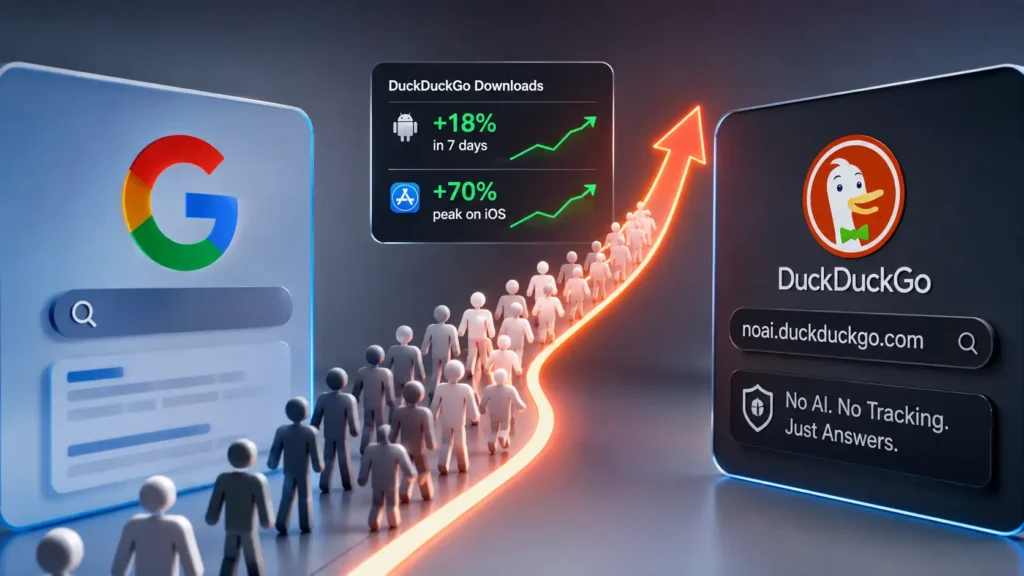
This article is an original analysis supported by the sources cited below
A new era for AI Search
Google’s official May 19, 2026 announcement detailing the I/O Search updates, AI Mode changes, agents and the redesigned AI-powered Search box.
100 things we announced at Google I/O 2026
Google’s official I/O 2026 roundup, including AI Search, information agents, generative UI, Personal Intelligence and Universal Cart.
I/O 2026 welcome to the agentic Gemini era
Sundar Pichai’s I/O 2026 keynote text with Google’s stated AI Overviews and AI Mode usage figures.
Find information in faster and easier ways with AI Overviews in Google Search
Google Search support page explaining AI Overviews, the Web filter and Google’s statement that AI Overviews cannot be turned off as a core Search feature.
AI features and your website
Google Search Central documentation for site owners about AI Overviews, AI Mode and website inclusion in AI search features.
Generative AI in Search let Google do the searching for you
Google’s May 2024 post introducing AI Overviews more broadly in the United States and explaining the company’s early positioning on links and publisher traffic.
DuckDuckGo installs are up 30 percent as users reject being force-fed Google’s AI Search
TechCrunch report on DuckDuckGo’s reported post-I/O install spike, iOS growth, noai traffic and Apptopia download figures.
DuckDuckGo sees iPhone installs spike in the US following AI announcements at Google I/O
9to5Mac coverage focused on the iOS install surge and DuckDuckGo’s AI-free search positioning.
DuckDuckGo sees surge as some users quack back at Google’s AI changes
Business Insider report with DuckDuckGo’s seven-day U.S. install growth figures and comments about the limits of the available data.
About noai.duckduckgo.com
DuckDuckGo help page explaining its AI-free search page and which AI features are disabled by default.
Opting out of DuckDuckGo AI features
DuckDuckGo help page describing how users can turn off or tune down AI features.
How to filter out AI images in DuckDuckGo search results
DuckDuckGo help page explaining its AI-generated image filter and related settings.
Optional AI
DuckDuckGo page describing its “private, useful and optional” AI approach.
How does Duck.ai protect my privacy
DuckDuckGo help page explaining its privacy claims for Duck.ai chat.
Duck.ai by DuckDuckGo
DuckDuckGo’s public Duck.ai page describing its private AI chat product.
Search engine market share in the United States of America
StatCounter market share data used to contextualize Google’s and DuckDuckGo’s U.S. search positions.
Search engine host market share worldwide
StatCounter worldwide host-share data used to show Google’s global scale compared with DuckDuckGo.
Mobile search engine host market share worldwide
StatCounter mobile host-share data used to contextualize Google’s mobile search dominance.
Google users are less likely to click on links when an AI summary appears in the results
Pew Research Center analysis of user click behavior when Google AI summaries appear.
Americans have mixed feelings about AI summaries in search results
Pew Research Center survey data on perceived usefulness of AI summaries in search results.
Measuring Google AI Overviews activation source quality claim fidelity and publisher impact
May 2026 arXiv study analyzing AI Overview activation, cited domains, unsupported claims and publisher impact.
Impact of AI Search Summaries on Website Traffic evidence from Google AI Overviews and Wikipedia
2026 arXiv paper estimating AI Overview traffic effects on Wikipedia pages.
How Generative AI Disrupts Search an empirical study of Google Search Gemini and AI Overviews
2026 arXiv study comparing Google Search, Gemini and AI Overviews across real-user queries.
The Rise of AI Search implications for information markets and human judgement at scale
2026 arXiv paper examining the expansion of AI search and its implications for information exposure and judgment.
Department of Justice wins significant remedies against Google
U.S. Department of Justice announcement on search remedies involving Google Search, Chrome, Google Assistant, Gemini and search data access.
Our remedies proposal in DOJ’s search distribution case
Google’s public response to the DOJ search distribution remedies process and its argument that remedies should focus on contracts.
US files appeal in Google search antitrust case
Reuters report on the U.S. government and states appealing the outcome of the Google search antitrust case.
EU plans to fine Google high triple-digit million euro sum Handelsblatt reports
Reuters report on EU Digital Markets Act scrutiny of Google Search and potential penalties.
Commission opens non-compliance investigations against Alphabet Apple and Meta under the Digital Markets Act
European Commission announcement on DMA investigations, including Alphabet’s self-preferencing in Google Search.
Alphabet announces first quarter 2026 results
Alphabet’s official SEC filing for Q1 2026 financial results, used for revenue and Google Services context.
| Citing this article? Brief excerpts are welcome. Please credit Webiano.digital, name the author where stated, and include a link to https://webiano.digital and to this original article. Full or substantial republication requires prior written permission. Read our Copyright and Content Use Policy. |
This article was prepared with the assistance of artificial intelligence tools. The content underwent expert human review, and Webiano Digital & Marketing Agency assumes editorial responsibility for its final version and publication.