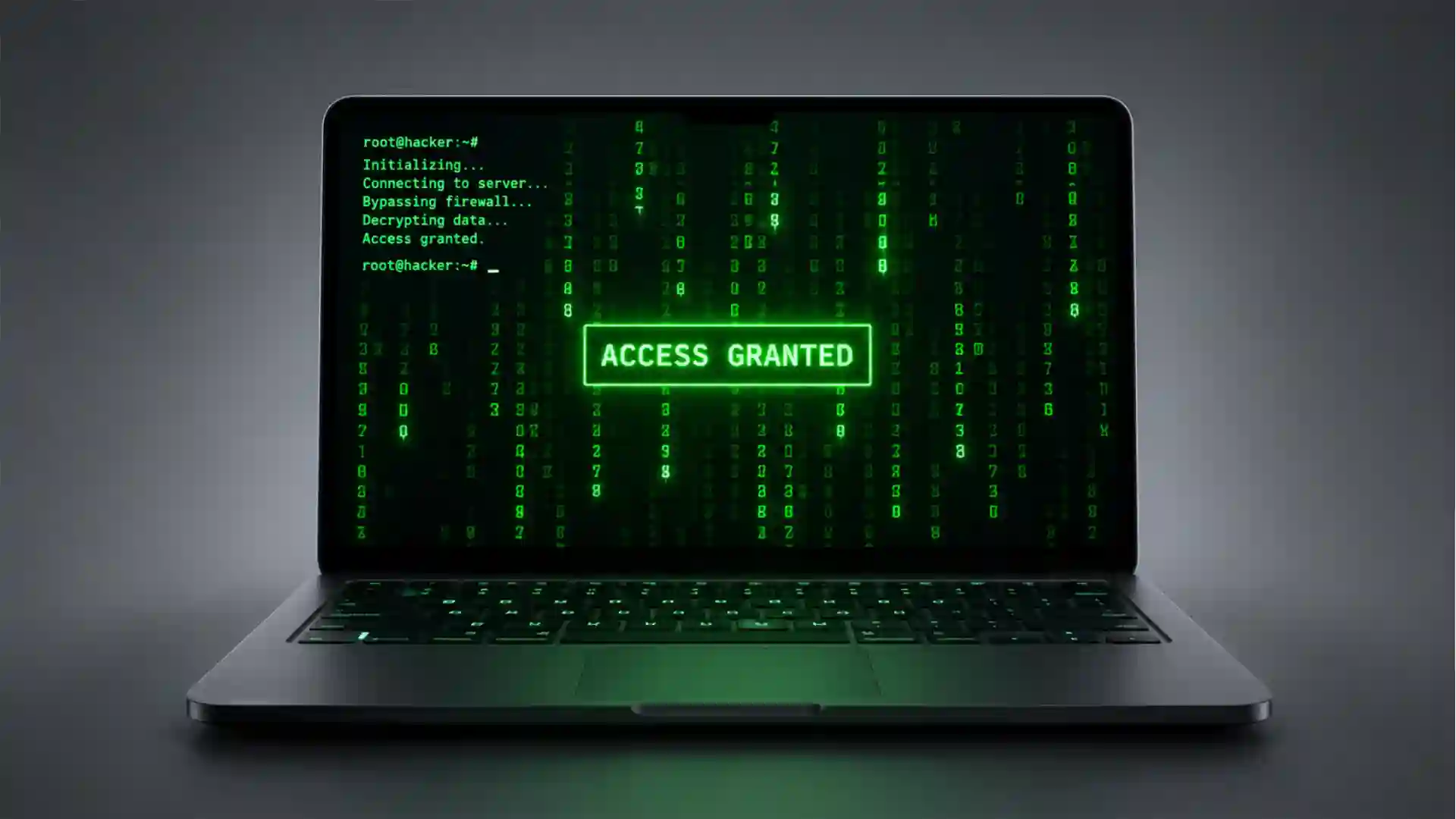
Hacker Typer does not ask for your name, your account, your skill level, or your patience. It opens into a dark screen, waits for your fingers, and immediately rewards every random keypress with streams of intimidating code. Type nonsense and it looks intentional. Mash the keyboard and it looks like a breakthrough. For a few seconds, your laptop becomes the prop department’s idea of cybercrime, complete with the strange satisfaction of watching a machine appear to obey you too quickly.
Table of Contents
The fastest way to feel like you breached a mainframe
The joke works because it removes the hard part of programming and keeps only the theatrical part. Real code is slow, picky, and often boring to watch. It punishes missing commas. It breaks because of invisible spaces. Hacker Typer cuts all of that away. It gives you the sensation of speed without the responsibility of accuracy. The site’s own Help panel says the basic action is almost comically direct: start typing and “hacker code” appears right away, with browser full screen available for a stronger effect.
That tiny interaction is the whole spell. The site does not need a tutorial carousel or a charming onboarding flow. It understands that the first three seconds matter. Press a key, see code. Press more keys, see more code. The screen moves, the cursor blinks, the illusion builds. A person who has never written a line of JavaScript gets the same immediate payoff as someone who has spent years inside terminal windows. It is not teaching anyone to hack. It is giving them access to the fantasy of looking like they already can.
The official site is openly in on the bit. Its About section says Hacker Typer was created in 2011 from the wish to look like the stereotypical hacker seen in movies and pop culture, and says it has made millions of people smile since then. That origin matters because the project is not pretending to be a cyber range, a coding lesson, or a security product. It is a little internet stage where the keyboard becomes a prop.
The page is funny because it knows exactly how little it needs to do. Many novelty websites make the mistake of stretching one gag into a product. They add profiles, badges, leaderboards, share cards, mascot copy, and side quests until the original spark is buried under decoration. Hacker Typer is almost rude in its simplicity. The browser asks for nothing. The screen gives you everything. The drama is not explained. It is performed.
There is also something oddly generous about the design. You do not need to understand programming to enjoy the effect, but if you do understand programming, the joke lands from another angle. You know that real work does not look like this. You know that the scrolling text is not proof of genius. You know that “access granted” is not how serious systems behave. Still, your brain enjoys the rhythm. The hands move, the code pours out, and a completely false sense of control feels real enough to be entertaining.
Hacker Typer sits in a sweet spot between toy, prank, and cultural artifact. It is the kind of website someone opens during a boring office moment, a classroom joke, a livestream gag, a party trick, or a quick video shoot. It does not demand commitment. It does not become a hobby. It is a pocket-sized performance. Open it, type, laugh, close it. The whole experience is clean enough to survive repeated use because the joke is physical, not just verbal.
The best part is how fast it turns the user into the subject of the scene. Plenty of websites show you something amusing. Hacker Typer makes you do the amusing thing. Your hands create the fake expertise. Your keyboard supplies the tempo. The faster you type, the more convincing the illusion feels. The page does not entertain you from a distance; it recruits your body into the joke.
That is why it still feels worth opening years after its first release. Many internet novelties age badly because their references expire or their interface turns heavy. Hacker Typer’s core reference is stubbornly durable. Movies still show hacking as green text, impossible speed, and sudden breakthroughs. People still enjoy pretending to be smarter, more dangerous, or more in command than they are. A fake terminal remains one of the web’s cleanest forms of instant costume.
The design is barely there, which is the point
Hacker Typer’s interface is not minimal in the tasteful startup sense. It is minimal in the stagehand sense. Everything visible either supports the performance or gets out of the way. The dark background, monospaced text, blinking cursor, and plain settings panel all point back to the same fantasy: you are facing a serious machine, and the machine is responding. The site does not look expensive. It looks useful for pretending.
The settings are small but clever because they adjust the mood rather than the purpose. The official page exposes controls for color, speed, font size, font, and file, with font choices such as Courier, Anonymous Pro, Major Mono Display, Nova Mono, Share Tech Mono, Space Mono, and VT323. Those options do not turn the site into a full editor. They let you tune the costume. A chunky retro font feels different from a cleaner code font. A faster speed feels less like typing and more like a cinematic montage.
The font list is a quiet admission that fake hacking is mostly typography. Put the same text in a friendly rounded font and the spell collapses. Put it in a strict monospace face and the brain accepts the scene. Hacker Typer understands that code on screen is not just content; it is texture. The letters are props. The spacing is a cue. The terminal mood is carried by shape before meaning.
The menu bar also knows when to disappear. The Help text says the menu bar can be dismissed with the small “x” in the bottom right corner, and a refresh brings it back. That little feature is more important than it sounds. If you are using the site for a joke, a photo, or a quick full-screen performance, visible controls break the scene. The site gives you the controls, then lets you hide the evidence.
The full-screen instruction is just as telling. Browser full screen turns a harmless web page into an environment. Suddenly there is no address bar, no tabs, no reminder that this is a toy running in a normal browser window. The fake terminal fills the display. The person watching from across the room sees only scrolling code and frantic hands. Hacker Typer’s magic depends on that distance. Up close, it is a gag. From across the room, for half a second, it looks like something is happening.
The interaction has almost no friction because friction would ruin the joke. There is no account creation, no explanation wall, no “choose your path” prompt. The site respects the impulse that brought you there. You want to type random keys and watch code appear. It lets you do exactly that. Many larger products could learn from this refusal to interrupt the first useful action.
It also has a neat relationship with embarrassment. Real coding in public can feel exposed because mistakes are visible and the pace is uneven. Hacker Typer gives you the public image of competence without the private mess. This is why it works so well as a joke among programmers. It turns a job that often involves confusion, searching, testing, and fixing into a frictionless fantasy of certainty. The fun comes from the gap between the image and the truth.
The “Access Granted” and “Access Denied” overlays push the site from fake editor into movie scene. The official page includes both messages as part of the interface, and the Help panel notes that pressing Shift or Alt, or Option on Mac, three times triggers a more dramatic experience while Escape closes dialogs. Those small keyboard rituals feel like cheat codes, which is exactly the right flavor for a toy built around false mastery.
The site is not beautiful in a portfolio way, and that helps it. A glossy interface would feel suspicious. A heavily animated cyberpunk skin would feel try-hard. Hacker Typer’s roughness gives it credibility as an old web object. It feels discovered rather than launched. It belongs to the part of the internet where a single idea could become famous because it was instantly legible, instantly shareable, and slightly stupid in the best possible way.
This is also why the experience stays funny after the first use. The joke is not hidden behind surprise alone. It is tied to action. Every time you type, the page responds with exaggerated obedience. You are not watching the punchline repeat; you are performing it again. That physical loop gives the site more life than a static meme or a single-use prank page.
The code behind the fake code makes the gag sharper
Hacker Typer would be weaker if the screen filled with meaningless green gibberish. The fun comes partly from the fact that the output looks plausible enough to fool the eye. The official GitHub repository makes that plain. It describes hackertyper.net as the original Hacker Typer, created in 2011 as a fun little project, and calls it a joke for people who want to look like a cool hacker. It is open about the gag while still caring about the texture of the illusion.
The repository is also refreshingly small. GitHub lists the project files as a basic web bundle: an HTML file, a stylesheet, a JavaScript file, and a kernel.txt file, with the language breakdown dominated by JavaScript and supported by HTML and CSS. That compactness is part of the charm. The project does not need a heavy stack to create the feeling. It uses ordinary web ingredients to imitate extraordinary control.
The old script reveals the trick without spoiling the pleasure. The JavaScript listens for keydown events, advances through a loaded text file, appends more text to the console, keeps the cursor blinking, and prevents normal browser behavior for most keys. It also handles popups such as “ACCESS GRANTED” and “ACCESS DENIED.” Once you see the mechanism, the illusion becomes more elegant rather than less funny. The site is not generating intelligence. It is pacing a prewritten performance at the speed of your fingers.
That pacing is the clever part. The keyboard does not need to match the text. Your “asdfjkl” can produce clean-looking C code because the site separates input from output. It treats your typing as a metronome. Each keypress means “show the next slice.” This is a tiny design trick, but it explains the whole experience. The user feels productive because action and reward are tightly coupled, even though the action carries no semantic weight.
The kernel.txt file gives the performance a better costume than random characters ever could. It contains C-style system code, including structures, memory allocation, group handling, exported symbols, and syscall definitions. To most viewers, it reads as dense technical material. To people who recognize C and kernel-style naming, it reads as a plausible chunk of low-level operating-system code. Either way, it looks more serious than nonsense.
That choice is a quiet editorial decision. Fake hacking does not need true meaning, but it needs believable texture. The screen must look like something that could matter. A prewritten kernel-like file gives the output indentation, punctuation, function names, comments, and unfamiliar identifiers. The eye catches fragments such as groups_alloc, copy_to_user, and SYSCALL_DEFINE2, then decides not to ask too many questions. The effect is not accuracy. It is authority by typography, density, and speed.
The old code comments also show how direct the original engineering was. The script describes itself as capturing the keydown event, adding text, loading a text file, updating the blinking cursor, and scrolling the window so the bottom stays visible. There is no grand architecture hiding behind the curtain. The trick is small, legible, and durable. A simple mechanism, matched to a strong cultural joke, can outlive many heavier projects.
For programmers, the source is part of the fun because it reverses the magic trick. On the front end, Hacker Typer pretends your hands are producing advanced code. In the source, you see a neat little machine that pretends along with you. It is theatrical software in the literal sense: a script, a stage, an actor, and props. The user’s keystrokes are not commands. They are cues.
The repository’s maintenance note makes the project feel even more like an internet relic worth preserving. The README says contributions are welcome but frames the project more as something maintained as a token than aggressively improved. That restraint feels right. Hacker Typer does not need to become a platform. Too many improvements would sand off the exact old-web shape that makes it memorable.
The project is a useful reminder that small tools can have clear authorship. You can feel the original thought in it: “I want to look like a movie hacker.” Not “I want to build a creator ecosystem around simulated cybersecurity aesthetics.” Not “I want a configurable terminal-performance framework.” Just a funny desire, executed cleanly. The internet has always been good at this kind of object: narrow, odd, instantly understood, and generous enough to let strangers use it for their own scenes.
The compact read
| Part of Hacker Typer | What it does | Why it works |
|---|---|---|
| Random typing input | Converts any keypress into code output | It makes effort feel instantly rewarded |
| Monospaced terminal look | Frames the page as a serious machine | It borrows the visual authority of real code |
| Prewritten code file | Supplies plausible technical texture | It looks denser than fake gibberish |
| Access overlays | Adds cinematic payoff moments | It turns typing into a mini scene |
| Small settings panel | Adjusts speed, font, color, and scale | It lets the user tune the performance |
The table shows why the site feels larger than it is. Hacker Typer is not packed with features, but every visible part supports the same fantasy. The input, output, typography, overlays, and settings all point toward one feeling: for a moment, the keyboard seems more powerful than it really is.
Why movie hacking still has such a grip
Hacker Typer works because movie hacking has trained audiences to read speed as intelligence. The real work of security research, software engineering, and systems administration rarely looks good on screen. It involves waiting, reading documentation, checking logs, reproducing errors, writing careful notes, and failing in small ways. Cinema prefers visible certainty. A person types quickly. A screen fills with code. A locked system gives way. The visual grammar is ridiculous, but it is extremely readable.
The site compresses that grammar into one interaction. You do not need plot, villains, surveillance vans, a glowing city map, or a panicked voice saying the firewall is almost down. The keyboard and the scrolling code are enough. Hacker Typer strips the trope to its most recognizable unit. It is a hacking scene without a film around it.
The pleasure is not only about pretending to be dangerous. It is also about pretending the computer is finally simple. Real computers are fussy machines. They ignore you, misunderstand you, update at bad times, hide files, reject passwords, and fail silently. Hacker Typer gives you a fantasy computer that reacts beautifully to every touch. Every key produces progress. Every motion produces visible consequence. That is a deeper satisfaction than the hacker costume itself.
There is a reason the gag appeals to coding enthusiasts and non-coders at once. Non-coders get instant access to the look of forbidden expertise. Coders get a parody of how their work is misrepresented. Movie fans get a familiar scene they can perform with their own hands. Each group is laughing at something slightly different, which makes the site easy to share across social circles.
The page also plays with the social side of technical knowledge. A lot of programming culture is invisible to outsiders. The difference between real skill and staged skill is hard to judge from a distance. Hacker Typer turns that ambiguity into a joke. Someone across the room might see fast typing and dense code and briefly assume competence. The joke lands because the visual signs of expertise are easy to fake when the audience cannot inspect the process.
This is not an insult to real technical work. If anything, the joke depends on respect for it. The fake version is funny because the real version is hard. Hacker Typer borrows the prestige of difficult work and turns it into costume jewelry. It shines for a moment, everyone knows it is not real, and that shared knowledge is part of the pleasure.
The site also belongs to a family of web objects that understand the browser as a toy box. Before every online experience was pushed toward accounts, feeds, subscriptions, and retention loops, the web was full of small pages that existed for one delightful behavior. Click something and it squeaks. Type something and it mutates. Move the mouse and the page follows you. Hacker Typer comes from that lineage. It is not trying to trap you. It wants to give you a fast little experience and then let you leave.
That modesty makes it more memorable, not less. A small site with a perfect gesture can stick in the mind longer than a polished app with many modes. Hacker Typer’s gesture is “press anything and look brilliant.” It is easy to describe, easy to demonstrate, and easy to remember years later. The name itself is almost a complete instruction.
There is also an honest absurdity in the official note asking people not to request real hacks. The About panel says the developer will not hack into anyone’s personal property and asks people to skip those requests. It is funny, but it also points to the strange way some users interact with anything that looks technical. A toy can be obviously fake and still attract real expectations from people who want the fantasy to cross into reality.
That line gives the project a human edge. Behind the page is someone who made a joke so convincing, or so popular, that strangers apparently confused the prop for a service. That is pure internet. Make a fake hacking screen for fun, and eventually someone will ask whether you can use it to break into something. The web is full of people taking jokes literally because the interface looks just official enough.
Who should open it and what to do with it
Hacker Typer is best for people who enjoy the performance layer of technology. Coding enthusiasts will appreciate the source, the typography, and the knowing parody. Movie fans will recognize the scene immediately. Teachers and presenters might use it as a light opening gag before talking about what coding or cybersecurity actually looks like. Streamers and video makers can use it as an instant visual joke. Anyone with a keyboard can understand it within seconds.
It is also a good reminder for beginners that code aesthetics and code understanding are not the same thing. A screen can look intimidating without doing anything meaningful. A person can look busy without solving a problem. Hacker Typer makes that distinction funny rather than preachy. It shows how easy it is to fake the surface of technical expertise, which is a useful lesson in a world full of screenshots, demos, and performative productivity.
The safest way to enjoy it is to treat it as a prop, not a claim. Use it for a laugh, a skit, a classroom icebreaker, a fake “I’m in” moment, or a private five-minute escape into Hollywood nonsense. Do not use it to frighten someone, impersonate a real breach, or create confusion in a serious workplace. The site is harmless when everyone understands the joke. It gets less funny when someone believes something real is being attacked.
The official controls make that prop use easy. You can enter full screen, hide the menu, change the visual style, and use the little dramatic triggers. You can also hit Escape to close dialogs. This means the site can go from casual browser toy to clean visual backdrop quickly. The less visible the browser chrome, the stronger the fake terminal illusion becomes.
The site is especially good as a contrast tool. Show Hacker Typer, let people laugh, then show what real debugging, real incident response, or real secure coding looks like. The distance between the fake scene and the real work becomes obvious. Real technical practice is slower, more careful, and less visually dramatic. Hacker Typer gives you an easy doorway into that discussion because everyone already understands the fake version.
It also works as a tiny lesson in interaction design. The site proves that a strong input-output loop can carry an entire experience. No one needs to read documentation to understand what to do. The first keypress teaches the product. That is rare. Many serious tools hide their first reward behind setup. Hacker Typer puts the reward under the user’s fingers.
Designers can learn from its lack of nervousness. The page does not keep explaining itself. It does not apologize for being simple. It does not chase every possible user type. It chooses one behavior and nails it. That confidence is harder than it looks. A project this narrow can feel disposable if the core interaction is weak. Here, the core interaction is strong enough to support the entire page.
Developers can learn from the way it separates meaning from sensation. The site is not useful as code, but it is precise as theater. It understands which parts of coding are visually legible to outsiders: speed, density, monospace type, scrolling, alarming messages, and mysterious names. It does not need a real compiler because the user is not looking for a real result. The desired result is a feeling.
There is a small caution inside that feeling. The interface is a joke, but the ease of the joke reveals how much people rely on surface cues to judge technical ability. This matters beyond entertainment. In demos, pitches, tutorials, and security theater, technical-looking screens can create trust before substance has been checked. Hacker Typer makes the trick obvious enough to laugh at. The same trick in a less honest context would be less charming.
The site’s limits are part of its appeal. It will not teach syntax. It will not test your skills. It will not simulate real intrusion steps. It will not make you better at programming. The moment it tried to do those things, it would become a worse version of itself. Hacker Typer is not a ladder. It is a mask. A mask does not need a curriculum.
Small doubts before pressing the keys
No. It is a fake visual simulator built for fun. The official site frames it around looking like the stereotypical hacker from movies and pop culture, not around performing real security work. That clarity is part of why the project still feels clean rather than shady.
Not in the meaningful sense. Your keystrokes control the pace of preloaded code appearing on screen. The old JavaScript shows a simple mechanism: keyboard events call a function that advances through loaded text and updates the console display. The user supplies rhythm, not program logic.
Because it uses plausible technical material instead of pure nonsense. The project’s kernel.txt file contains dense C-style system code, with functions and syscall definitions that look serious at a glance. Most people will not parse it, but they will recognize the visual texture as “code.”
Yes, within the limits of the gag. The current site exposes settings for color, speed, font size, font, and file. Those controls are enough to change the mood without turning the toy into an editor.
Because it gives one clean internet pleasure with no ceremony. You press keys and the machine performs a fantasy back at you. It is funny, immediate, and strangely satisfying, especially if you have ever watched a film treat typing speed as proof of genius.
Anyone who enjoys code as culture, not only code as work. Programmers, movie fans, students, teachers, streamers, pranksters, and people who just want a thirty-second browser toy will all understand the appeal. The site’s strength is that it does not ask the user to belong to a technical tribe before the joke starts.
The rare internet toy that still knows its job
Hacker Typer has survived because it does not confuse attention with depth. It earns attention quickly, spends it well, and does not ask for more than the joke deserves. That restraint feels almost radical now. The site is not trying to become your daily destination. It is not nudging you into a community. It is not asking you to install anything. It just gives you the fastest route from ordinary keyboard to fake cyber-thriller.
The experience is memorable because it turns a familiar object into a theatrical instrument. Your keyboard is usually a practical tool. On Hacker Typer, it becomes a soundless prop that produces visual drama. Every keypress says, “Yes, keep going.” The site rewards speed, not sense. That makes the act feel closer to playing an instrument than using a software tool.
There is also a tiny design lesson in how it handles competence. Most software asks users to become good at something before it rewards them. Hacker Typer rewards them first. It gives the appearance of competence instantly, then lets the absurdity catch up. This is why the laugh arrives so quickly. You see yourself looking capable before you have done anything capable.
That false competence is not empty. It reveals the emotional side of computing: the desire to command the machine, to look fluent, to move faster than doubt, to make the screen obey. Real technical skill takes time because machines are literal and unforgiving. Hacker Typer gives you the dream version, where every touch is accepted and every result looks impressive.
The site’s old-web flavor also protects it from becoming too slick. It feels like something passed around by link, not packaged by campaign. The GitHub repository reinforces that feeling: a small public project, a handful of files, a README that calls it a fun joke, and a note that maintenance is more about preserving the token than expanding it.
That preservation matters because internet culture loses small things easily. Novelty sites vanish, domains expire, browser APIs change, and little gags become screenshots in someone’s memory. Hacker Typer still being there gives the web one more durable toy. Not a necessary tool. Not a deep archive. Just a page that still performs its trick with confidence.
The best recommendation is simple: open it full screen, hide the menu, and type badly with conviction. The worse your actual input, the better the joke. You do not need to know what the code means. You only need to understand the scene. The cursor blinks, the text rushes forward, and for a brief, harmless moment, the machine lets you look like you are inside the movie.
Hacker Typer is worth saving in your mental drawer of strange websites because it captures a very specific internet joy. It is silly without being empty, technical without being demanding, nostalgic without needing a history lecture, and useful only as a prop. That sounds small until you open it. Then the keys start moving, the code starts falling into place, and the oldest fake promise of the computer returns: type fast enough, and maybe you are in.
Author:
Jan Bielik
CEO & Founder of Webiano Digital & Marketing Agency
This article is an original analysis supported by the sources cited below
Hacker Typer
Official Hacker Typer website, used for the live interface details, Help instructions, settings, About text, and the project’s own description of its 2011 origin.
duiker101/Hacker-Typer
Official GitHub repository for Hacker Typer, used for the project description, repository structure, public maintenance note, and source context.
Hacker-Typer script.js
Project JavaScript file, used to verify the original keyboard event behavior, preloaded text pacing, cursor behavior, and access overlay logic.
Hacker-Typer kernel.txt
Project text file, used to confirm the code-like material displayed by the simulator and its low-level C-style texture.
| Citing this article? Brief excerpts are welcome. Please credit Webiano.digital, name the author where stated, and include a link to https://webiano.digital and to this original article. Full or substantial republication requires prior written permission. Read our Copyright and Content Use Policy. |
This article was prepared with the assistance of artificial intelligence tools. The content underwent expert human review, and Webiano Digital & Marketing Agency assumes editorial responsibility for its final version and publication.