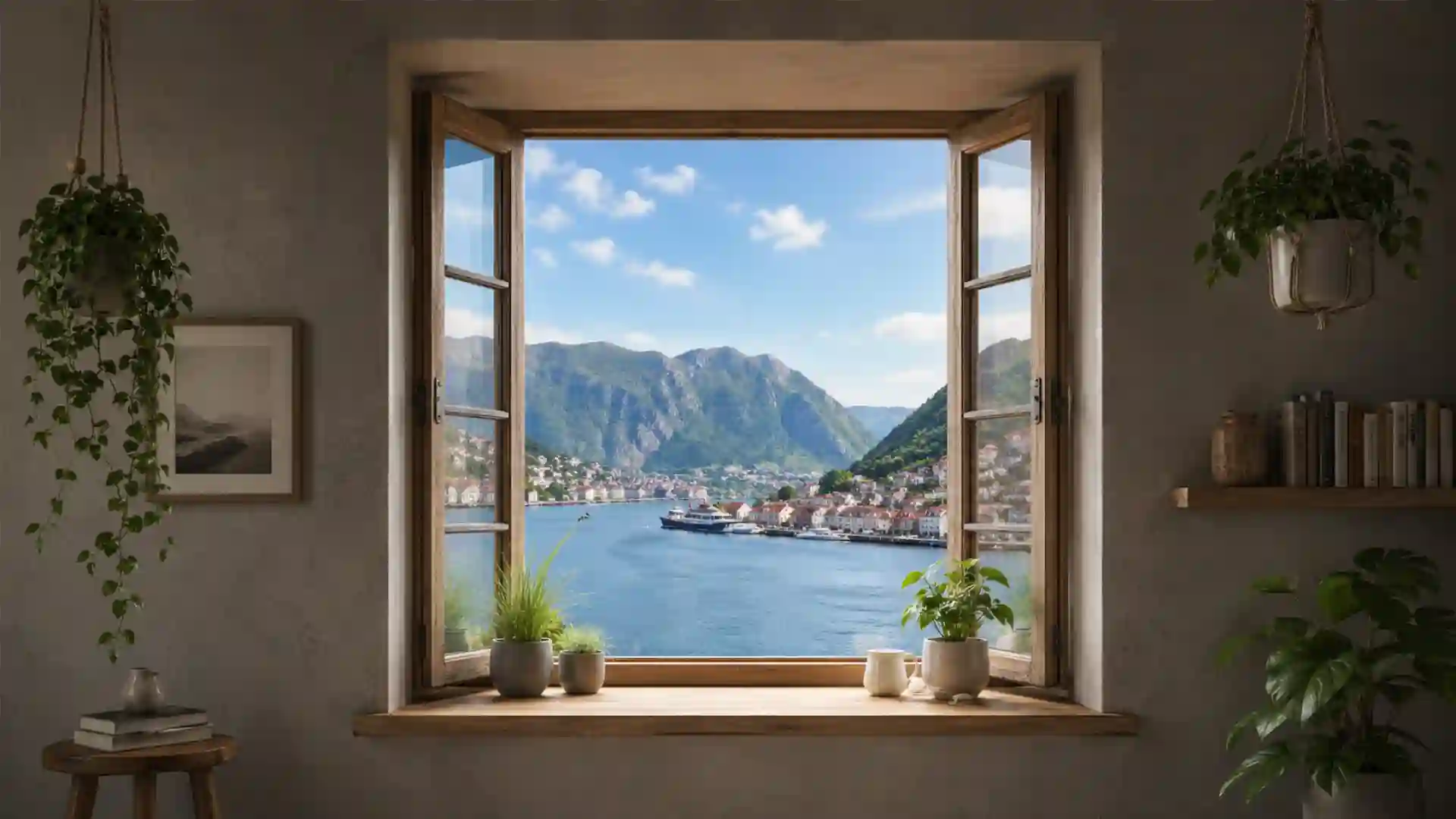
WindowSwap works because it does almost nothing. You open the site, press a button, and suddenly you are looking through a stranger’s window somewhere else on Earth. No itinerary. No influencer voiceover. No map stuffed with pins. Just a window frame, a view, ambient sound, and the odd feeling that your room has briefly grown a second life.
Table of Contents
The official site describes the action plainly: open a new window somewhere in the world, look through windows shared by real people, and share your own to join the community. That small promise is the whole product, and it is stronger because it stays small. WindowSwap does not try to turn travel into content. It turns stillness into a portal.
The internet at window speed
Most travel sites make the world feel busy. WindowSwap makes it feel present.
One click might place you in front of a rainy street. Another might give you a balcony with plants, a skyline in the distance, a cat crossing the bottom of the frame, or a tree moving in a wind you cannot feel. Some views look postcard-ready. Many do not. That is the charm. A perfect mountain view is pleasant, but the site becomes more interesting when the camera catches a desk, a radiator, a curtain, a mug, a row of cacti, or the plain backside of another apartment block.
The project began during the locked-down phase of the pandemic, when travel had become a memory and people were spending too much time with the same walls. Reuters reported that Sonali Ranjit and Vaishnav Balasubramaniam started WindowSwap after noticing how much people were looking out of their own windows and wishing they could trade places with friends. Smithsonian also describes it as a quarantine project among friends that opened up to public submissions in June 2020.
That origin matters, but WindowSwap does not feel frozen in 2020. The pandemic explains why it arrived at exactly the right time. It does not explain why it still feels worth opening. The lasting appeal is simpler: there is a particular comfort in seeing ordinary life continue somewhere else.
A travel video usually says, “look at this place.” WindowSwap says, “sit here for a while.” That difference changes the mood. The site is not selling a destination. It is lending you a point of view.
The trick is ordinary life
WindowSwap’s best trick is that it trusts ordinary scenes.
The internet has trained us to expect compression. The cleanest image. The fastest cut. The clearest payoff. A platform asks for attention and then keeps poking the user so they do not leave. WindowSwap goes in the other direction. It asks you to tolerate softness, repetition, background noise, weather, traffic, still rooms, and views where nothing dramatic happens.
The official about page says people share views from their windows to help someone else relax, focus, meditate, and travel without moving. It also asks submitters to record a 10-minute horizontal HD video with part of the window frame in the shot, and to hold the camera steady. Those details explain why the experience feels slower than most web video. The window frame matters. The still camera matters. The duration matters. Without them, the site would become another clip feed. With them, it feels closer to borrowing a chair.
The window is doing more than framing scenery. It gives the video a human scale. You are not flying over a city by drone. You are not being dragged through a museum by a cursor. You are standing where another person stood. The room is mostly hidden, but not fully. That small trace of someone else’s home gives each clip a private edge without making it feel invasive.
The Verge noticed the same quality when it described the site in 2020: the clips include not just views but personal clues, from pets to household objects, and that makes the experience feel like a positive reminder of how strangers share small pieces of their worlds online.
There is a temptation to call this voyeurism, and the site plays with that feeling. You are looking through someone else’s window. Yet the setup is consensual, slow, and almost shy. People submit their own views. The camera points outward. The inside of the room is only partly present. The result sits in a strange middle zone between travel, ambient video, and a gentle kind of social media where the person is absent but their life is still there.
That absence is refreshing. No one performs for you. No one asks you to subscribe. No one tells you what to think about the place. A window opens, and you decide how long to stay.
Randomness makes the site feel alive
The random button is not a small interface detail. It is the emotional engine of WindowSwap.
A search box would turn the site into a tool. A map would make it more practical. Categories would make it cleaner. Favorites would make return visits easier. All of that might be useful, but it would also weaken the odd magic of arriving somewhere without choosing it.
Part of the pleasure comes from not knowing what kind of view you will get. A green mountain. A city street. A balcony wall. A soft blue coast. A cramped alley. A room with plants taking up half the frame. The randomness gives every click the feeling of a tiny door opening.
Reuters reported early examples that included a New York cityscape, a green Indian balcony, and a Belarus suburb; it also noted that the site had drawn thousands of submissions and more than a million views by July 2020. Smithsonian listed places such as Switzerland, Mexico City, Glasgow, Long Island, Bangalore, Istanbul, Singapore, Argentina, Okinawa, San Francisco, and São Paulo. The point is not that the site covers the globe like an atlas. The point is that it makes the globe feel domestic.
The best WindowSwap session has a rhythm. Click. Land. Adjust. Notice. Stay. Leave. Repeat.
At first, you look for the obvious attraction. Mountains, sea, skyline, snow, bright sky. After a few minutes, your attention shifts. You notice sound. A motorbike passing. Wind against a microphone. A bird. A dog barking somewhere out of frame. A television in another room. Rain. The hum of a city that does not know you are watching.
Then you notice what the submitter chose to include. Did they keep the window frame visible? Did they leave plants in the shot? Did they capture a busy street or a quiet yard? Did they record at sunrise, noon, dusk, or during a storm? These choices are small, but they make the site feel authored without turning it into performance.
The site is at its best when the view is not spectacular. Spectacle is easy to understand. The stranger’s normal Tuesday is harder to fake.
The quiet design choice that saves it
WindowSwap could have gone wrong in several obvious ways.
It could have become a live webcam directory, which would make it busier and creepier. It could have filled the page with profiles, comments, likes, and rankings. It could have encouraged users to chase the most beautiful view. It could have made the whole thing social in the usual noisy sense.
Instead, the project uses prerecorded user-submitted videos. The Verge pointed out that this choice likely keeps the site away from the chaos associated with live stranger-video platforms. It is a smart restraint. Prerecorded clips give WindowSwap just enough distance. The viewer gets presence without surveillance. The submitter gives a view, not a live feed into their life.
The One Club’s award page for WindowSwap calls it a site displaying 10-minute HD videos of user-generated window views from around the globe. It also lists Sonali Ranjit and Vaishnav Balasubramaniam as co-founders, Maryam Touimi Benjelloun as developer, and TechPearl Software as part of the software development team.
That same page describes the project as a “slow, calm and warm place on the internet,” and calls it “the opposite of TikTok.” The phrase is a little tidy, but the observation is right. WindowSwap succeeds because it refuses the feed logic that dominates so much of the web.
There is no visible race for status. No creator economy framing. No reason to perform outrage, beauty, wealth, expertise, or taste. The submission itself is humble: point a camera out of a window and hold still. That instruction produces a different internet behavior. People do not need to become personalities. They only need to share what they see.
This is why the site feels oddly generous. A person in one place records their view so a person in another place may feel less boxed in. Nothing more grand than that. Nothing more complicated.
What makes it worth opening
WindowSwap belongs to a small class of websites that do not need much explanation once you use them. The concept is graspable in seconds, but the mood takes longer to unfold. It rewards a kind of attention that many sites punish.
Why WindowSwap stands out
| What you notice | Why it matters |
|---|---|
| Real user-submitted windows | The views feel personal without turning into profiles |
| Ten-minute clips | The site has room to breathe instead of rushing you |
| Ambient sound | Places feel lived in, not just photographed |
| Random navigation | Discovery feels accidental and slightly magical |
| Visible window frames | The world arrives through someone’s actual room |
| No heavy social layer | The experience stays calm and uncompetitive |
The table makes the site sound more designed than it feels. When you are using WindowSwap, those parts disappear into one simple sensation: you are here, but also briefly there.
The strongest use case is not “planning a trip.” It is not research. It is not even entertainment in the usual sense. WindowSwap is best for the kinds of moments when your brain wants a new view but not a new task. A lunch break. A writing block. A quiet evening. A hotel room where you cannot sleep. A workday where every tab feels too sharp.
It also works as a low-pressure cultural experience. You see how people frame their windows. What plants they keep. How close buildings sit to each other. Whether streets are loud or soft. Whether the sky takes up most of the frame or barely appears. No single clip teaches you much about a country, and that is fine. The site is not pretending to be anthropology. It gives you fragments, and fragments are often more honest than slogans.
There is a lesson here for product design too. WindowSwap proves that a web project can be memorable without being feature-rich. The idea is clear. The interaction is minimal. The emotional result is immediate. Plenty of bigger products would be stronger if they had this kind of discipline.
A button that gives you a new window is enough because the content already contains the surprise. The interface does not need to shout.
The calm is not accidental
WindowSwap’s calmness comes from a few decisions working together.
The video length slows the viewer down. The lack of commentary keeps interpretation open. The window frame gives each clip a human boundary. The randomness removes the pressure to choose correctly. The absence of visible metrics keeps the space from becoming a contest.
That last point is easy to miss. Metrics change behavior. Add public likes and people start uploading for approval. Add ranking and the most dramatic views rise. Add comments and the mood shifts toward reaction. WindowSwap avoids that. It treats each window as a gift, not a post trying to win.
The site also understands that online intimacy does not always need direct contact. Many platforms assume connection means messaging, following, replying, and staying linked. WindowSwap offers a softer kind of contact. You do not know the person behind the window. You may never see the same view again. The encounter is temporary, and that is part of its appeal.
There is privacy in that distance. There is also tenderness. Someone recorded a view from their life, and you received it without needing to intrude further.
The site’s weakness is tied to the same restraint. If you want control, WindowSwap may feel thin. You may want to choose a country, save a favorite, browse by weather, or return to a clip you loved. The Verge wished for a way to save favorites back in 2020. That desire makes sense. A great window feels like a place you want to revisit.
Still, too much control would turn the site into something else. The better compromise would be light, almost hidden tools: a gentle favorite button, maybe a way to copy a window link, perhaps a “surprise me again” interaction that remains central. The danger is not new features by themselves. The danger is making WindowSwap behave like every other platform.
For now, the sparseness is part of the editorial taste of the site. It knows what it is.
Small answers before you open it
No. The experience is built around submitted videos rather than live one-to-one webcam sessions. That choice makes it calmer and safer than a random live video platform.
No. The official about page asks for a steady 10-minute horizontal HD video with part of the window frame in shot. It does not demand a postcard view. Some of the most memorable windows are plain, quiet, or slightly strange.
It is for people who miss travel, but also for people who like ambient websites, slow media, soft internet experiments, background focus tools, and small glimpses of ordinary life elsewhere.
Open the site without a plan. Let the first window run longer than your reflex wants. Then click again. The site gets better after the first minute because your attention adjusts to its pace.
Yes. The lockdown origin gave WindowSwap its first audience, but the site’s stronger idea is not pandemic-specific. People still get tired of their own view. People still want proof that ordinary life is happening somewhere else.
Why it still feels like a small internet gem
WindowSwap is not a huge technical achievement, and that is not an insult. The web has enough huge technical achievements that feel dead inside. This one feels alive because the premise is exact.
A window is one of the oldest interfaces humans have. It frames the outside while reminding you that you are inside. It is private and public at once. It gives you weather, neighborhood, distance, light, routine. WindowSwap turns that familiar object into a shared web format, then gets out of the way.
That is why the site has outlasted its moment. It began as a response to confinement, but it now reads as a correction to online excess. So much of the web asks us to announce ourselves. WindowSwap asks us to look outward.
The best hidden internet gems usually have this quality. They do not try to become infrastructure. They do not need to dominate a habit. They create a specific feeling, deliver it cleanly, and leave a small mark on memory. Radio Garden makes global radio feel spatial. Drive & Listen makes cities feel like soundtracks. WindowSwap makes the world feel reachable through a quiet rectangle of glass.
The comparison to travel is useful, but not complete. Travel is often about movement, planning, consumption, and proof. WindowSwap is about receiving a view without owning it. You arrive, but you do not possess the place. You leave, but nothing is taken. The window belongs to someone else, and that boundary keeps the experience gentle.
The site also carries a quiet argument about what “global” can mean online. Global does not have to mean scale, virality, or a giant network with a growth team behind it. It can mean a person in one country letting a person in another country borrow ten minutes of sky. It can mean a balcony in India, a street in Thailand, a cat in Qatar, a skyline in Singapore, a mountain view in Switzerland, or an ordinary backyard that someone thought might be enough.
And often, it is enough.
WindowSwap is worth opening because it gives the internet one of its rare soft rooms. Not everything on a screen needs to accelerate the nervous system. Not every digital project needs to chase utility, status, or addiction. Sometimes a website earns its place by giving you a stranger’s window, a little weather, and the reminder that the world is still carrying on outside your own frame.
Author:
Jan Bielik
CEO & Founder of Webiano Digital & Marketing Agency
This article is an original analysis supported by the sources cited below
WindowSwap
Official WindowSwap website, used to verify the core product promise and current public positioning.
WindowSwap about page
Official project information, used for the site’s purpose, submission guidance, team details, and the 10-minute window video format.
Reuters on WindowSwap
News report used for the project’s lockdown origin, early usage, founders’ comments, and examples of submitted windows.
Smithsonian Magazine on WindowSwap
Feature article used for the project’s early public spread, examples of global locations, and context around virtual travel during lockdown.
The Verge on WindowSwap
Early review used for product observations, the prerecorded video format, and the site’s intimate everyday details.
The One Club award page for WindowSwap
Awards listing used for project credits, team names, and the description of WindowSwap as a slow, calm web experience.
| Citing this article? Brief excerpts are welcome. Please credit Webiano.digital, name the author where stated, and include a link to https://webiano.digital and to this original article. Full or substantial republication requires prior written permission. Read our Copyright and Content Use Policy. |
This article was prepared with the assistance of artificial intelligence tools. The content underwent expert human review, and Webiano Digital & Marketing Agency assumes editorial responsibility for its final version and publication.