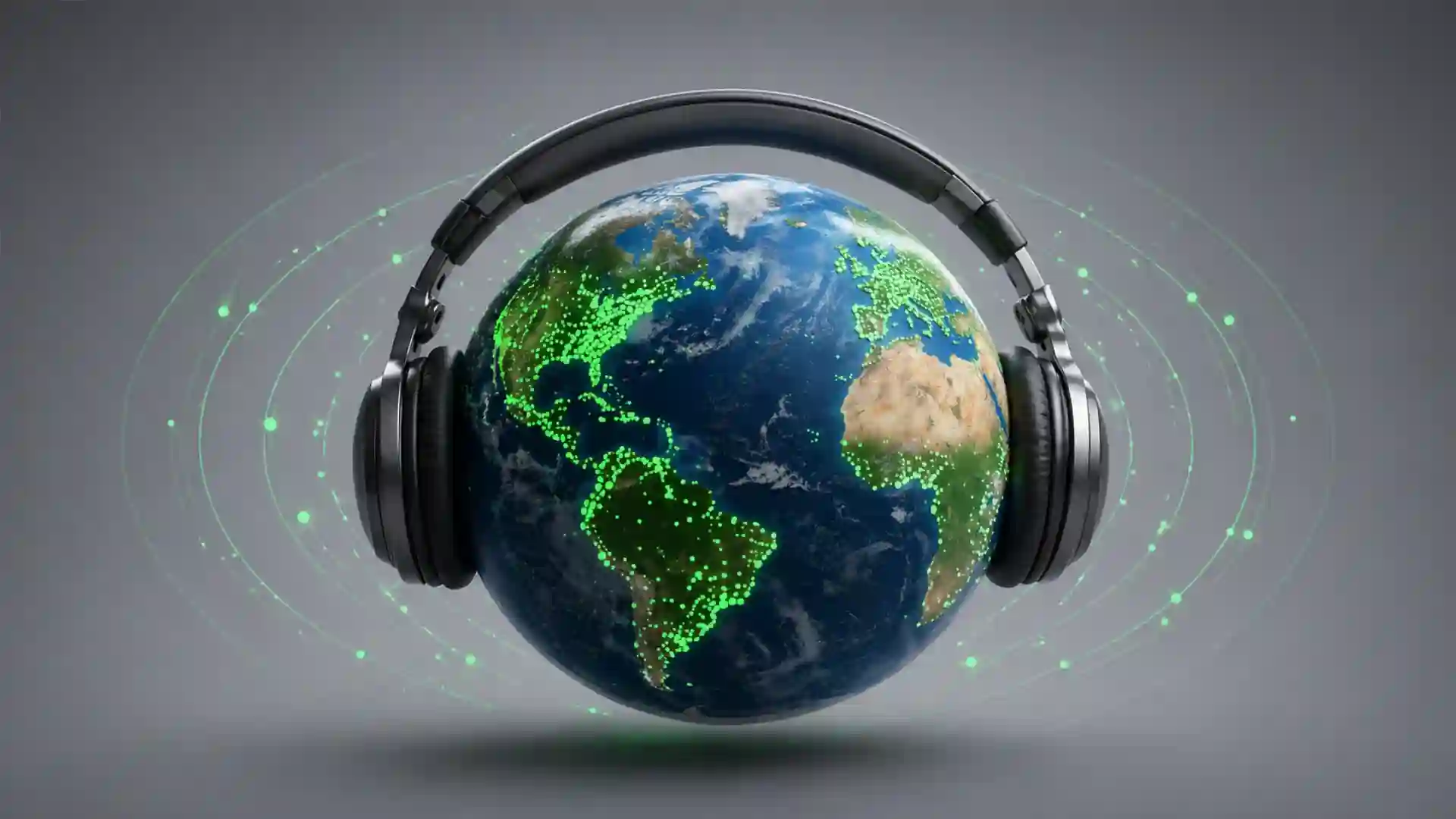
Radio Garden feels almost too obvious once you open it. There is the Earth, dark and floating. There are green dots scattered across it. You spin the globe, stop somewhere you barely know, and a live radio station starts playing from that place. Not a playlist “inspired by” Brazil, not an algorithmic travel mood, not a polished audio tour. Actual radio, from actual cities, playing right now.
Table of Contents
The trick is that Radio Garden turns geography back into a listening interface. Most audio apps erase place. They care about genre, artist, language, mood, and retention. Radio Garden cares first about where sound is coming from. Every green dot represents a city or town, and tapping one tunes you into stations broadcasting from there, according to the official app description. That one decision changes the whole experience.
You do not search for “world music” on Radio Garden. You land in Accra and hear talk radio. You drift into Reykjavík and catch a station that sounds like it is meant for someone driving through winter. You nudge the globe toward Montevideo, Lisbon, Nairobi, Osaka, or Tbilisi, and suddenly the web is not a feed. It is a planet with local noise still attached.
Radio Garden began in 2016 as an exhibition project, commissioned by the Netherlands Institute for Sound and Vision in the context of the research project Transnational Radio Encounters, and was created by Studio Puckey and Moniker. That origin matters. It explains why the site does not feel like another audio product chasing subscriptions first. It feels like a public experiment that accidentally became useful enough to stay alive.
The project later became a small independent company under Jonathan Puckey in 2019, after mobile apps and search had joined the experience. The web version still carries some of its exhibition DNA: a simple premise, a direct gesture, a sense that the interface itself is the argument. Radio Garden is not just a directory of streams. It is a way to remember that listening can be spatial.
A map that behaves like an instrument
The first few seconds are the whole pitch. You drag the globe. The Earth rotates. The green dots move under your cursor like stars seen from orbit. When you settle on one, a station loads. The interface gives you the soft satisfaction of tuning something in, even though the technology underneath is streaming, servers, metadata, and broadcast links. It borrows the romance of old radio without pretending to be old.
That is why the site feels different from typing a station name into Google. The content may be technically similar, but the path changes the mood. A search box asks you to know what you want. Radio Garden asks you to wander. The web has plenty of search tools; it has fewer places where not knowing is the point.
The green dots are small but loaded with meaning. A city with one dot feels quiet. A dense cluster over Europe or the eastern United States looks almost noisy before you hear anything. Zoom in and the abstraction becomes human. A continent turns into a region, a region into a city, a city into stations. The map compresses infrastructure, culture, migration, language, and taste into little glowing seeds.
The project’s original framing was about distant voices and crossed borders. Moniker’s project page describes Radio Garden as a way for listeners to explore broadcasting and hearing identities across the globe, rooted in the fact that radio signals have crossed borders from the beginning. That sounds grand on paper, but the site works because the interaction is humble. Move, click, listen.
The globe also avoids the flatness of most streaming directories. A list of “stations by country” feels administrative. Radio Garden feels physical. You overshoot the city. You spin too far. You discover a station because your finger slipped. The interface makes accidental listening feel natural rather than inefficient.
That accident is part of the pleasure. A normal music service works hard to reduce friction. Radio Garden keeps a little friction because the friction is the fun. You hear static-like loading moments, unfamiliar station IDs, local commercials, weather updates, sports chatter, religious broadcasts, old pop songs, regional news, and songs you would never find through your own listening history. The site is not trying to flatter your taste. It is trying to expose its limits.
There is a quiet design confidence in using the whole planet as the menu. It sounds like a novelty until you use it for more than five minutes. Then the globe starts acting like a memory machine. You remember cities you visited. You check places where friends live. You listen near where your grandparents were born. You compare border towns. You follow coastlines. The world becomes browsable without becoming flattened into content.
Radio Garden also resists the fake intimacy of many digital products. It does not greet you with a personality. It does not insist on learning your taste before it gives you anything. It does not turn curiosity into onboarding. It simply starts with the Earth and trusts that the Earth is interesting enough.
The small miracle is the interface
The most impressive thing about Radio Garden is not that internet radio exists. Thousands of stations already stream online. The clever part is the translation. Radio Garden takes a scattered set of live streams and gives them a shared spatial logic. It makes internet radio feel like something you can touch.
Cesium described the platform as using a globe where visitors navigate by location, with physical imagery rather than political boundaries and labels. In 2019, Cesium also noted that the site used CesiumJS and featured a growing collection of more than 17,000 stations at that time. The no-borders feeling is not decorative. It pushes attention away from flags and toward sound.
The absence of hard borders gives the experience a strange softness. You do not enter “France” as a category. You drift across a region and hear what is available nearby. The map does not pretend politics vanish, but it makes the listening gesture less bureaucratic. You are not choosing a nation so much as placing your ear somewhere on Earth.
That design choice matters because radio is local in messy ways. A station can speak to commuters, immigrants, students, worshippers, taxi drivers, club kids, retirees, sports fans, or a tiny community that knows exactly why the morning host is funny. A station may carry national news one minute and a village event announcement the next. Radio Garden lets that mess stay messy.
The mobile apps keep the same promise in a smaller shape. The official Google Play listing says Radio Garden lets listeners rotate the globe, tap green dots representing cities or towns, save favorite stations, and keep listening when the phone sleeps. The App Store description repeats the same core idea for iPhone and iPad. The product did not need a new metaphor for mobile; the globe was already strong enough.
Search exists, but it is not the soul of the thing. Search is useful when you want FIP, WWOZ, Worldwide FM, or a station you already know. The magic sits elsewhere. It sits in turning a globe until a city name appears and letting the next sound be decided by geography. Radio Garden is better when you arrive without a shopping list.
That is rare on the web now. Discovery has been trained to mean recommendation engines, trending modules, and “because you watched” logic. Radio Garden’s discovery is older and weirder. It resembles walking through a neighborhood with open windows. You are not being targeted; you are passing through.
The interface also gives live audio a visible body. Streaming usually feels placeless because the player is just a bar, a thumbnail, and a title. Radio Garden says the stream comes from somewhere. Even when the station itself is a polished internet brand, its dot makes you think about location. The dot anchors the sound before the sound explains itself.
There is a lovely contradiction here. Radio Garden uses global internet infrastructure to restore some feeling of locality. It proves that the web does not have to erase place; it can also make place more available. The same network that flattens culture into feeds can also let you hear breakfast radio in a city you have never visited.
Why live radio still feels different
Live radio has a stubborn texture that playlists rarely carry. It includes timing, interruptions, bad jokes, weather reports, ad breaks, local obsessions, traffic, call-ins, and presenters who assume you know the streets they mention. Those details are not always beautiful, but they are alive. Radio Garden’s charm comes from exposing you to that liveness without asking you to travel.
A playlist is usually clean. Radio is porous. A station leaks the place around it. You might hear a song you recognize followed by a commercial in a language you do not speak. You might hear a local election segment, then a birthday shout-out, then a football argument, then a jingle that sounds like it has survived three decades. The interruptions are not bugs in the experience; they are proof of context.
Music discovery through Radio Garden feels different because it arrives attached to daily life. A track does not appear as a recommendation tile. It comes out of a station’s schedule, surrounded by voices, station branding, and local pacing. The same song heard from a station in Bogotá or Marseille lands differently than the same song served inside a personal algorithm. The frame changes the listening.
Language learners will understand the appeal quickly. Radio Garden gives you real speech in real broadcast rhythm, not classroom dialogue polished into neat scenes. You hear speed, slang, repetition, pauses, regional pronunciation, and the way presenters jump between topics. It is not a lesson, which is exactly why it sounds useful.
Cultural explorers get something less staged than tourism content. Travel media often selects the picturesque. Radio Garden selects whatever is on air. Some of it is dull. Some of it is brilliant. Some of it is incomprehensible. Some of it is aggressively ordinary. That ordinary quality is the point because ordinary sound is what places are made of most days.
Music lovers get a different reward. They can escape the global middle of taste, where the same hits and aesthetics keep resurfacing. Local stations still repeat popular tracks, but they also carry regional scenes, old formats, devotional music, talk formats, pirate-ish energy, college weirdness, community programming, and hyperlocal favorites. Radio Garden is one of the easiest ways to fall sideways into music.
Diaspora listeners may feel the site in a more personal way. The project’s own history talks about listeners reconnecting with people from “home” thousands of miles away, and MIT Docubase describes the platform as one built around radio’s ability to connect distant voices and places. For someone living away from where they grew up, a familiar station is not a novelty. It is an audio shortcut to memory.
The same is true for people who miss places rather than people. A city you once lived in has a sound even when you cannot describe it. Local radio brings back tiny fragments: accents, weather patterns, public concerns, music rotations, names of neighborhoods, ad voices, sports teams, the rhythm of the day. Radio Garden turns nostalgia into something clickable without making it sentimental.
The site also reveals how uneven global media is. Some regions are dense with stations. Others are sparse. Some cities offer dozens of streams. Others have none, or streams that fail. That unevenness tells its own story about infrastructure, licensing, language, money, and the habits of broadcasters. The blank spaces are part of the map too.
The Wall Street Journal reported in 2025 that Radio Garden hosted over 37,000 radio stations and had around 3 million monthly active users. Even without treating those numbers as the main appeal, they explain why the experience can feel so full. A huge directory becomes memorable because the interface gives it shape.
The pleasure is partly the lack of control
Radio Garden is not always the fastest way to hear exactly what you want. That is good. The site is more interesting when it slows down the urge to choose perfectly. You spin, land, listen for a minute, move again. It rewards drift, not efficiency.
Modern audio apps often treat discovery as a path toward personalization. The service watches what you skip, what you save, what you replay, and then tightens the loop. Radio Garden does let you save favorites, but its emotional center remains wider than your taste profile. It keeps inviting you away from yourself.
That invitation is gentle rather than moral. The site does not scold you for listening to familiar cities. You can stay in New York, London, Paris, Lagos, Tokyo, São Paulo, or Seoul as long as you like. But the globe is always sitting there, asking what is happening a little farther out. Curiosity is built into the shape of the menu.
The lack of algorithmic pressure makes the experience feel oddly calm. There are no endless rows shouting for attention. There is no thumbnail economy. There is no fake urgency. The map waits. The audio plays. You decide when to move. Radio Garden gives you room to listen badly, casually, and without a productivity goal.
That casualness is underrated. The web often turns every activity into performance: watch this, save that, rank this, subscribe there, build your library, train the system. Radio Garden works well as something you open for ten minutes while cooking, working, drawing, or avoiding the same playlist again. It is useful because it does not demand to become your main platform.
The “live” part also restores a sense of simultaneity. When you tune into a station in another time zone, you are hearing a place at its own hour. Morning somewhere, late night somewhere else, rush hour here, quiet Sunday there. The globe becomes a clock without looking like one.
That time-zone feeling gives Radio Garden an almost literary quality. You hear a voice in a place where people are waking up while your own day is ending. You hear night music from a coastal city while sitting under office lights. You hear traffic reports for roads you will never drive. The site makes distance feel specific rather than abstract.
The rougher moments add to that feeling. Some stations fail. Some take time to load. Some are mislabeled or unavailable. Some content is not what you hoped for. Some app reviews mention irritation with ads or playback behavior, especially on mobile. Radio Garden is not a flawless listening machine, but its imperfections belong to the real web.
That is part of why it remains memorable. A polished global audio platform would probably hide the unevenness, normalize the catalog, and surface only streams with reliable metadata. Radio Garden keeps enough looseness to feel alive. It behaves more like a public garden than a luxury mall.
Who should open Radio Garden first
Radio Garden is for people who still like finding things the hard way. Not difficult-hard, but wandering-hard. The kind of hard where you look at a map, pick a place for no reason, and let the result surprise you. It suits curious listeners better than completionists.
It also suits people who miss the older internet. Not the broken parts, not the nostalgia costume, but the sense that a website could be a singular object with one good idea. Radio Garden has that feeling. It is not trying to be every media format at once. It knows its trick and keeps the trick sharp.
Music lovers should use it when their recommendations start sounding too familiar. The best move is to avoid the obvious capitals at first. Try smaller coastal towns, border regions, university cities, islands, places with languages you do not know, and places where you have no cultural reference. The less you arrive expecting, the better Radio Garden gets.
News followers may use it differently. They can listen near the places making headlines and hear local broadcast tone rather than international summary. Of course, language and editorial framing matter, and radio is not automatically more truthful because it is local. Still, it gives texture that outside coverage often lacks. A local station can reveal what a place sounds worried, bored, proud, or irritated about.
Designers and product people should study the site for a different reason. Radio Garden shows what happens when a strong interface metaphor is allowed to carry the product. The globe is not a decorative layer placed on top of a directory. It is the directory. The navigation model is the editorial point.
Teachers, language learners, and cultural researchers can treat it as a listening prompt. Pick a region, compare stations, note formats, track languages, collect jingles, or follow how music moves between neighboring countries. MIT Docubase documented the project’s original sections around Live, History, Stories, and Jingles, which shows how naturally the idea connects to media education. Even the live-only version carries that classroom energy without feeling like homework.
Where Radio Garden shines
| Listener type | Best way to use it | What stands out |
|---|---|---|
| Music explorer | Jump between small cities | Regional scenes and unexpected formats |
| Language learner | Leave talk radio on in the background | Natural speech and local pacing |
| Homesick listener | Search for a familiar city or station | Instant emotional geography |
| Designer | Study the globe as navigation | A clear metaphor doing real work |
| News follower | Listen near a current event | Local tone rather than distant summary |
The table misses one group: people who are simply bored with polished feeds. Radio Garden is strongest when used without a task. Open it, spin once, stop somewhere, and give the station a real minute before moving. The site rewards patience in small doses.
The best Radio Garden sessions often begin with a personal rule. Only islands for ten minutes. Only places along the Danube. Only cities you cannot pronounce. Only stations near deserts. Only the southern hemisphere. Only towns with one dot. A tiny constraint turns the globe into a game without the site needing to gamify anything.
There is also pleasure in comparing formats. Public radio in one country may sound formal and restrained. Commercial radio elsewhere may be chaotic and bright. Community stations may move from local announcements into deeply specific music. Religious stations may dominate one region and barely appear in another. Radio Garden makes format differences audible without requiring a media studies lecture.
It also makes you notice how much global sound is shared. You may travel across continents and still hear the same pop structures, the same English hooks, the same production polish, the same ad rhythms. Then you hit a station that breaks the pattern completely. The site is good at showing both globalization and stubborn local difference in the same sitting.
The few rough edges are part of the deal
Radio Garden depends on streams it does not fully control. If a station changes its stream, blocks outside listeners, shuts down, adds region restrictions, or breaks its metadata, the experience suffers. The official Android listing says the team adds new stations and updates ones that no longer work, which hints at the daily maintenance behind the calm interface. A global radio garden needs weeding.
Licensing can also complicate the fantasy of open listening. The site may feel borderless, but rights, regulations, and station policies still exist. Radio has always crossed borders technically; institutions have always tried to manage that crossing. Radio Garden turns the border into an interface question, not a solved problem.
The app experience may differ from the web experience. The Google Play listing currently shows ads and in-app purchases, and some user reviews complain about ad interruptions or playback frustrations. The App Store listing presents it as free with in-app purchases. The core idea remains strong, but the cleanest first impression is still often the website.
Station availability also shapes the map’s bias. Places with more streaming infrastructure appear richer. Places with less digital radio presence may seem quieter than they are. A green dot is not a pure measure of culture; it is a measure of what Radio Garden can access and display. The map is magical, but it is not neutral.
That limitation is worth remembering because the interface is seductive. A beautiful globe makes coverage feel complete even when it is patchy. The site invites exploration, not certainty. It gives you a way into local sound, not a total archive of it. Radio Garden is best treated as a doorway, not as a definitive map of world radio.
The other rough edge is attention. It is easy to hop too fast. The globe encourages movement, and movement can become its own distraction. You may spend twenty minutes grazing without hearing anything deeply. The fix is simple: stop more often. Let one station be boring long enough to become specific.
That advice sounds strange because the web teaches impatience. If something does not grab you in three seconds, skip it. Radio Garden works against that reflex. A station needs time to reveal whether it is music, talk, news, ads, a show transition, or a temporary dead patch. The reward comes when the place starts to sound less like a sample and more like a room.
The site also raises a quiet question about what we expect from discovery. Do we want only the best thing, or do we want contact with things that were not chosen for us? Radio Garden is full of not-the-best moments, and that is why it works. The world is not curated to your taste, and neither is good radio wandering.
A web object worth keeping around
Radio Garden belongs to a category of websites that feel smaller than platforms and larger than tools. It is a place to visit. It has a mood, a gesture, a memory. You can explain it in one sentence, but the sentence does not exhaust it. A globe of live radio stations sounds simple; using it feels richer than the pitch.
Its staying power comes from the match between idea and interface. The site could have been a searchable database with a map view. Instead, it is a map that happens to contain a database. That difference is everything. Radio Garden makes the form carry the meaning.
It also reminds us that the internet is at its best when it gives access to something specific rather than simulating everything. Radio Garden does not need virtual reality, avatars, AI hosts, or a social layer to feel transportive. It uses live audio, location, and a globe. The result is more convincing than many heavier digital experiences.
The project’s exhibition roots still show in the best way. It asks a cultural question through interaction: what happens when distant local radio becomes instantly reachable? The answer changes depending on who is listening. A tourist hears novelty. A migrant hears home. A designer sees a navigation model. A musician hears scenes crossing borders. The same green dot holds different meanings for different ears.
For Web Radar, that makes Radio Garden an easy recommendation. It is not obscure in the strict sense; many people have seen it shared before. Yet it still feels underused, partly because people treat it as a quick novelty and leave before it gets good. The site deserves more than a thirty-second “wow.”
Open it when your listening habits feel too polished. Open it when you want to remember that cities have soundtracks you did not choose. Open it when you are curious about a language, a place, a region, or the weather of someone else’s morning. Radio Garden turns the web into a receiver, and the receiver is still worth tuning.
The finest thing about it is how little explanation it needs once it starts playing. A voice appears from somewhere on Earth. A song follows. The dot glows. The globe waits for your next move. For a moment, the internet feels less like a machine for prediction and more like a window left open.
Questions before you tune in
Radio Garden is an interactive globe for live radio. You spin the Earth, click a green dot, and hear a real station broadcasting from that location.
Yes, the web version is free to use. The mobile apps may include ads or in-app purchases, depending on platform and region.
Yes, Radio Garden focuses on live radio streams. What you hear is usually what that local station is broadcasting at that moment.
It is best for music lovers, language learners, cultural explorers, homesick listeners, designers, and anyone bored with algorithmic playlists. The site works especially well when you want surprise rather than perfect recommendations.
Yes, Radio Garden includes search. You can look for a station, city, or country, although the strongest experience is still spinning the globe and discovering stations by location.
Radio Garden depends on external radio streams. If a station changes its stream, blocks access, goes offline, or stops broadcasting online, it may disappear or fail to play.
Yes, Radio Garden has mobile apps for iOS and Android. The core experience remains the same: rotate the globe, tap a place, and listen.
Because it makes the internet feel local again. Instead of asking an algorithm for more of what you already like, you can hear what another city is hearing right now.
Author:
Jan Bielik
CEO & Founder of Webiano Digital & Marketing Agency
This article is an original analysis supported by the sources cited below
Radio Garden
Official Radio Garden website, used to verify the live globe experience and the current web product.
About Radio Garden
Official Radio Garden information page, used for the project’s origin, Amsterdam base, mobile app timeline, search launch, redesign, and company history.
Moniker Radio Garden project page
Project page from Moniker, used for the original concept, Studio Puckey collaboration, Transnational Radio Encounters context, and early design framing.
Radio Garden on Google Play
Official Android app listing, used for current app features, mobile behavior, developer information, ratings context, ads, and update details.
Radio Garden Live on the App Store
Official iOS app listing, used to confirm the iPhone and iPad version, core app description, category, and in-app purchase model.
Radio Garden on MIT Docubase
MIT Open Documentary Lab project record, used for historical context, project credits, original sections, and the platform’s documentary-media framing.
Cesium Radio Garden case article
Cesium article about Radio Garden, used for details about the globe interface, CesiumJS, borderless map design, station scale in 2019, and company transition.
The Wall Street Journal article on Radio Garden
Wall Street Journal feature, used for reported 2025 figures on Radio Garden’s station count, monthly active users, and broader travel-listening appeal.
| Citing this article? Brief excerpts are welcome. Please credit Webiano.digital, name the author where stated, and include a link to https://webiano.digital and to this original article. Full or substantial republication requires prior written permission. Read our Copyright and Content Use Policy. |
This article was prepared with the assistance of artificial intelligence tools. The content underwent expert human review, and Webiano Digital & Marketing Agency assumes editorial responsibility for its final version and publication.