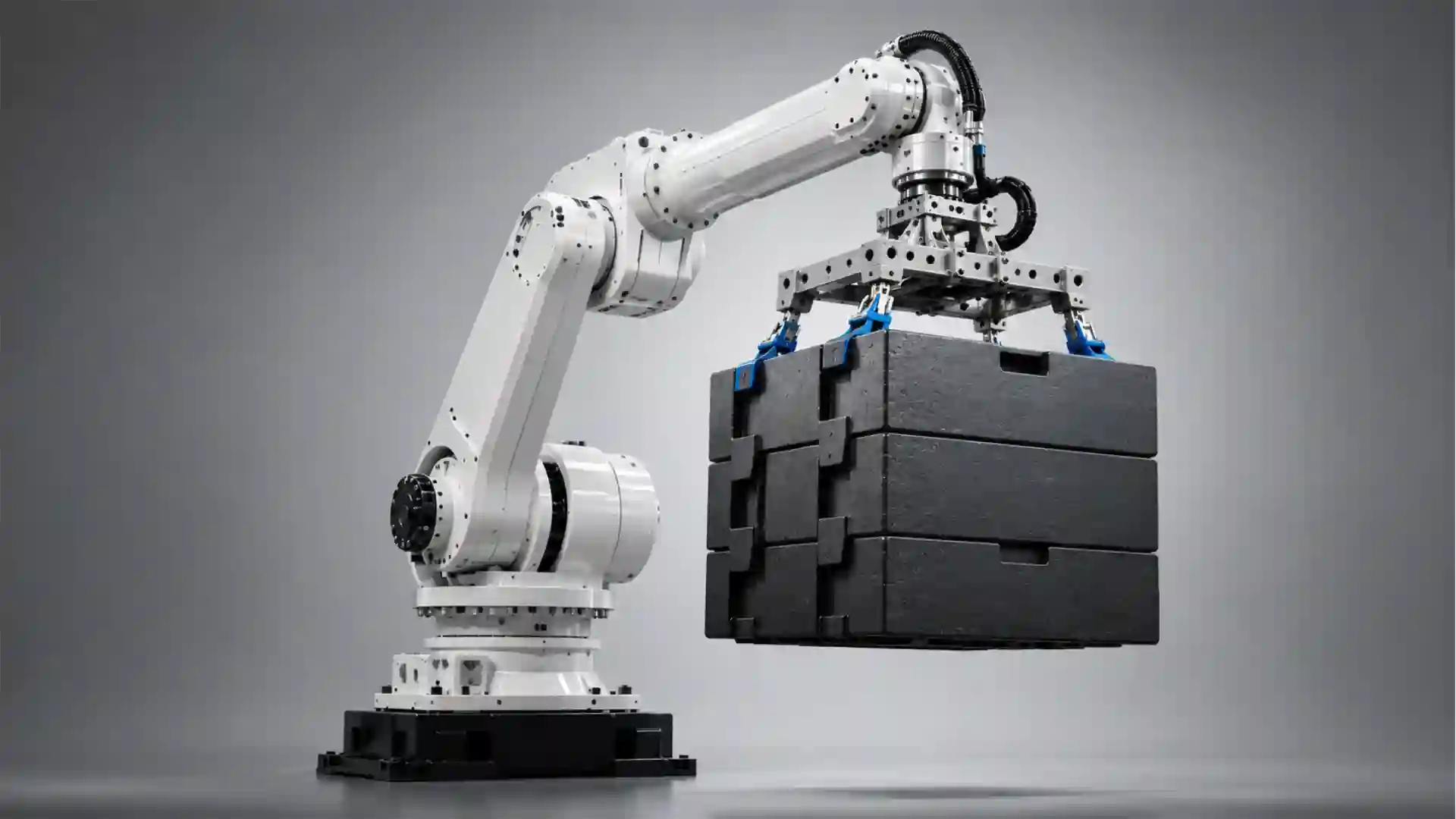
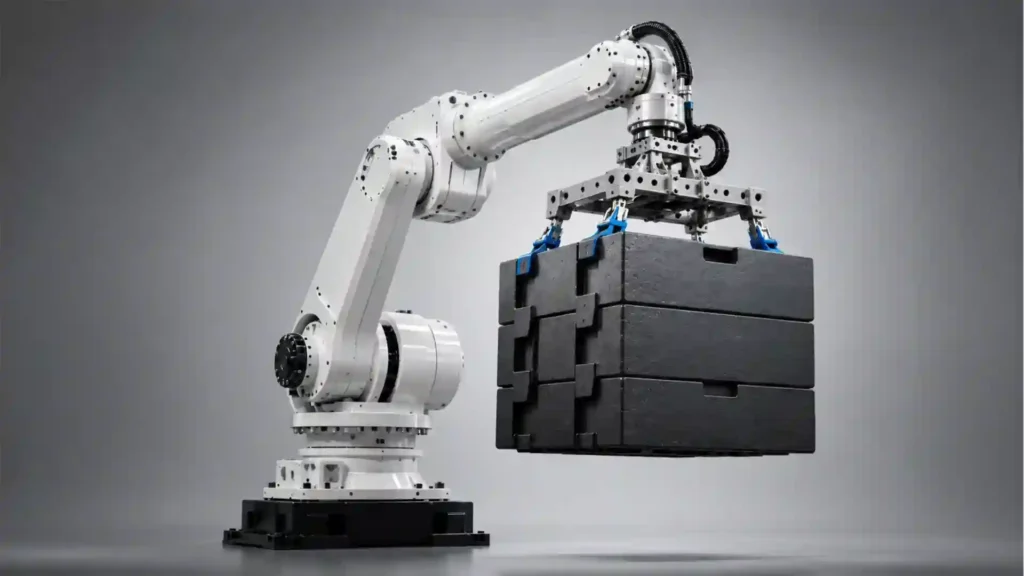
Shanghai’s CR5000-3700 did not break the Guinness World Record by a narrow technical margin. It pushed the certified payload mark for an industrial robot to 5,000.36 kilograms, more than double the 2,300-kilogram benchmark associated with FANUC’s M-2000iA/2300. Guinness World Records lists Shanghai Chaifu Robot Co., Ltd. as the holder of the “strongest industrial robot” record, with the result verified in Shanghai on April 23, 2026. The public certification event followed in Shanghai’s Jinshan district on May 15.
Table of Contents
The record matters because it lands at the meeting point of three forces: China’s fast-rising factory automation base, the localization of core robot components, and the push to automate work that has long depended on cranes, fixtures, custom machines and people standing too close to dangerous loads. A five-ton robotic arm is not just a bigger manipulator. It is a test of whether industrial robotics can move deeper into the heaviest layers of manufacturing, construction equipment, rail systems, energy infrastructure and large metal processing.
The record that changed the payload conversation
Guinness World Records records the Chaifu CR5000-3700 as an industrial robot with a payload capacity of 5,000.36 kilograms, equal to 11,023 pounds 14 ounces. The official entry names Shanghai Chaifu Robot Co., Ltd. as the maker, identifies Shanghai as the location, and gives April 23, 2026 as the verification date. That record is precise enough to separate the marketing claim from the measured result. It is not “about five tons” in the loose way factories often describe equipment. It is a certified figure attached to a named machine and a named record category.
The public moment came on May 15 at Shanghai Chaifu Robot’s smart factory in Zhangyan town, Jinshan district. The Paper reported that Guinness World Records adjudicator Hu Xiaowen announced the result at the event, saying the CR5000-3700 had refreshed the record for the “strongest industrial robot” by load capacity. Shanghai-based local reporting also described the robot as 3.66 meters tall, weighing 19 tons, and able to move a five-ton load along a preset path with repeat positioning accuracy within 0.3 millimeter.
Those numbers explain why the announcement travelled beyond a routine local technology story. Industrial robots are usually discussed through speed, repeatability, uptime, workcell integration, welding quality or labor substitution. Payload is only one metric, but in the heavy-lift class it becomes a proxy for structure, transmission, control, safety and manufacturing capability. A robot that can handle five tons has to solve many problems at once: torque, rigidity, braking, backlash, vibration, foundation loads, servo response, path accuracy and risk control.
The old comparison point was the FANUC M-2000iA/2300, a six-axis ultra-heavy-payload robot listed by FANUC America with a 2,300-kilogram payload and 3,734-millimeter reach. Local Chinese coverage of the Chaifu announcement said the previous Guinness benchmark, set by FANUC Corporation in 2016, stood at 2,300 kilograms. Even without treating the comparison as a full product-by-product contest, the jump is clear: the certified payload ceiling moved from the two-ton range to the five-ton range.
The useful reading is not that every factory suddenly needs a five-ton arm. Most factories do not. The useful reading is that the heavy end of the automation market is being pulled into the same competitive logic that transformed lighter industrial robotics. When a supplier demonstrates a new payload class, systems integrators, heavy manufacturers and rival robot makers start asking different questions. They ask whether crane-assisted workflows can be redesigned. They ask whether specialized fixtures can be replaced. They ask whether huge workpieces can be positioned more repeatably in confined cells. A Guinness certificate does not answer those questions by itself, but it gives the conversation a hard reference point.
A five-ton robot is not a crane with joints
A crane lifts. A robot manipulates. That difference is the heart of this story. A crane is normally judged by safe working load, lift height, span, duty cycle and operator control. An industrial robot is judged by its ability to move a payload through programmed paths while maintaining repeatable position, orientation and timing inside a production process. Calling the CR5000-3700 “strong” is accurate, but incomplete. The harder claim is controlled strength.
The International Federation of Robotics uses ISO vocabulary that defines an industrial robot as an “automatically controlled, reprogrammable, multipurpose manipulator” programmable in three or more axes and used in an industrial environment. That definition matters here because the Shanghai machine is not just a lifting appliance. It sits inside the industrial robot family: programmable, repeatable, multipurpose, and meant to be integrated into automated work.
A five-ton payload changes the mechanical problem. The robot’s joints are not merely carrying the mass; they are carrying torque created by the mass at a distance from the axis. The longer the reach and the farther the load center, the greater the bending moment. The robot must resist static deflection while also controlling motion. Stopping a five-ton object at the wrong point, or with the wrong jerk profile, is not a small positioning error. It can damage fixtures, overload a reducer, deform tooling or create a safety incident.
The engineering work sits inside the phrase “payload capacity,” which can sound simpler than it is. Payload depends on the robot’s structure, load center, axis configuration, acceleration limits, end-effector weight, duty cycle and application. A robot that can lift a payload at one pose may not be able to move it through every possible path at full speed. That is why serious buyers do not stop at the headline number. They demand payload diagrams, duty cycle data, floor-loading requirements, end-effector specifications, safety-rated stopping performance, maintenance schedules and integration limits.
Guinness confirms the capacity record, not the full production envelope for every conceivable task. That distinction protects the analysis from hype. A record lift is a powerful proof point; it is not a universal application guarantee. The market value of the CR5000-3700 will depend less on the record alone than on whether it can deliver controlled, repeatable, maintainable motion in real heavy-industry cells. Guinness is the headline. Integration is the test.
Shanghai Chaifu’s claim sits inside a wider automation race
Shanghai Chaifu presents itself as an industrial automation company with in-house development and manufacturing capacity across the industrial robot and automation chain. Its English company page says the Shanghai Super Factory covers nearly 35,000 square meters for manufacturing, development, commissioning, installation and inspection of industrial gearboxes, systems and controllers. That matters because the record story is partly about the robot, partly about the supply chain behind the robot.
Local coverage placed heavy emphasis on core components. Jiefang Daily’s Shanghai Jinshan report said the CR5000-3700’s core components were independently developed by the company and cited the firm’s work on RV reducer systems, servo drive technology and intelligent control systems. The same report quoted Chaifu chairman Chen Youli saying heavy-load robot technology had long been held by overseas companies and that Chaifu had worked for nearly a decade on the relevant technology.
The wording reflects a familiar theme in China’s industrial policy: robots are not only machines but supply-chain assets. Reducers, servo motors and controllers sit close to the center of that argument. A robot builder that assembles arms from imported reducers, foreign servo systems and external controllers can still build a useful robot, but its bargaining power, repair cycle, cost base and strategic resilience differ from a firm that controls more of the stack. Heavy-load robotics raises the stakes because the reducer, motor and controller must tolerate far higher stress than lighter factory arms.
Shanghai is also a natural stage for such an announcement. The city has been building its identity as a manufacturing, artificial intelligence, robotics and embodied-intelligence hub. Shanghai government materials in 2026 described a plan to support advanced manufacturing and raise the city’s robot density to 600 robots per 10,000 employees by 2028. Separate policy reporting from Shanghai in 2025 said the city’s embodied-intelligence plan targeted 100 leading enterprises, 100 application scenarios and 100 globally competitive products by 2027, with core output beyond 50 billion yuan.
The Chaifu record should be read inside that municipal ambition. It gives Shanghai a tangible, heavy-industry robotics story at a time when many robotics headlines are dominated by humanoid demonstrations. Humanoid robots attract public attention because they look familiar, walk, wave, sort boxes or appear on stage. A 19-ton industrial arm has no such theatrical advantage. Its relevance is quieter and more commercial: it speaks to factories, rail contractors, tunneling equipment makers, nuclear component handlers, metallurgy plants and large construction-machinery producers.
Payload records matter because heavy industry resists easy automation
Much of modern factory robotics scaled first in sectors where parts are relatively light, repeated in high volume, and moved through structured workstations. Welding car bodies, placing electronics, palletizing cartons, tending machine tools and spraying coatings fit that pattern. Heavy industry is less forgiving. Parts can be oversized, irregular, dirty, hot, fragile in unexpected ways, or too expensive to risk during early automation trials.
A five-ton robot attacks a stubborn segment of work: the point where a human operator cannot physically handle the load, but a crane alone cannot give the repeatable, programmable movement required by a production cell. Heavy work often relies on layered equipment. A crane lifts. A person guides. A fixture locates. A hydraulic tool clamps. A jig rotates. A machine processes. The process can be slow, dangerous and hard to repeat exactly. The automation target is not the lifting alone; it is the entire choreography around lifting.
This is why the reported application list matters. Chinese reporting said the CR5000-3700 is aimed at heavy manufacturing, port machinery, rail transit, tunneling, large equipment manufacturing, aerospace, new energy, nuclear power, metallurgy and chemicals. ECNS and Yicai both reported that the robot has already been commercially deployed in sectors including subway construction, new energy vehicles and heavy manufacturing, while local reports also cited rail transit, nuclear power, metallurgy, chemicals and tunneling scenarios.
Those sectors share a common feature: downtime is expensive and mistakes are costly. If a workpiece weighs several tons, damage is not a scrap-bin problem. It may mean a delayed project, a cracked casting, a rejected weldment, a lost fixture, or a safety investigation. Heavy components also tend to have long upstream lead times. A small positioning mistake can destroy value accumulated over weeks of machining, welding, casting or assembly.
The question for heavy automation is therefore stricter than “Can the robot lift it?” The real question is whether the robot can lift it, hold it, rotate it, align it, pause it, correct it, coordinate with other equipment and repeat the same motion under plant conditions. A record payload opens the door, but the production case depends on engineering discipline around the workcell.
The shift from lifting capacity to process control
A high-capacity robot becomes commercially meaningful only when it improves the process around the load. If a five-ton arm merely copies what a crane does at higher equipment cost, buyers will hesitate. If it shortens a sequence, reduces human exposure to danger, improves weld or machining alignment, or lets a plant use floor space better, the equation changes. Industrial automation is bought for process control, not spectacle.
Local reports cited measured gains: labor intensity reduced by 80 percent, human participation in high-risk processes reduced by 80 percent, overall work efficiency improved by more than three times, and construction continuity lifted by 300 percent. These figures come from Chinese media reporting around the announcement and should be treated as reported application data rather than independently audited universal performance. Still, they signal the kind of business case Chaifu wants buyers to consider.
For a heavy-industry buyer, the strongest case may not be labor cost. It may be control of variability. Human-guided heavy lifting often depends on operators who understand the sound, feel and timing of a process. That experience is valuable, but it is hard to scale and hard to preserve when experienced workers retire. A programmed robot cell can capture certain motion sequences and repeat them. It also generates logs that can support quality control, incident analysis and maintenance planning.
The cost case can also include tooling. Heavy factories spend money on turntables, fixtures, transfer cars, manipulators, lifting beams, custom hoists and manual alignment aids. A robot with enough payload and reach may replace some of that equipment or reduce the number of handling steps. It may also let engineers reposition a workpiece through a path that a crane cannot easily provide, especially when orientation control matters as much as lifting.
Still, the robot does not erase the need for tooling. It shifts the tooling problem. The end-effector for a five-ton payload is itself a serious engineering project. Grippers, clamps, hooks, suction systems, magnetic tools, adapter plates and sensors have to be rated for the load and matched to the workpiece. The fixture must handle forces from both the payload and the robot’s motion. Safety-rated tooling becomes part of the payload story, not an accessory.
A new payload class changes factory layout thinking
Factory layout decisions often harden into concrete. Heavy-work cells have foundations, pits, overhead cranes, machine beds, large doors, transfer rails and safety zones. Once installed, these choices shape production for years. A five-ton industrial robot asks planners to reconsider where precise heavy movement should happen: overhead, on a rail, on a turntable, on a gantry, or from a fixed articulated arm.
An articulated robot has a different spatial logic from a crane. It can approach from angles, rotate a part, coordinate several axes and move through programmed curves. That ability can reduce some staging operations, but it also introduces a swept volume that must be guarded. A crane usually occupies overhead space; a floor-mounted heavy robot claims floor space and a three-dimensional envelope around itself. The robot’s footprint is not only its base. It is every point the payload and arm can reach.
For new factories, this could be useful. Engineers can design cells around a heavy arm from the beginning, placing machine tools, weld stations, inspection equipment and buffer zones within its reachable envelope. For existing plants, the case is harder. Retrofitting a 19-ton robot with a five-ton payload into a legacy plant may require foundation work, guarding changes, crane coordination, controller integration, new procedures and updated training. The purchase price is only one line in the cost model.
The same payload record may therefore mean different things in different industries. In a new rail-equipment plant, a heavy robot could become a central cell asset. In an older foundry, it may be limited by building structure, heat, dust, floor loading or maintenance access. In tunnel-construction supply chains, it may be used in controlled production of large components rather than inside the tunnel itself. In nuclear power manufacturing, the controlled factory cell may be more relevant than field deployment.
This is why buyers will look past the record and ask for reference projects. A machine that has already been deployed in subway construction, new energy vehicles and heavy manufacturing is more persuasive than a machine that only lifted a test mass. Reported deployment does not remove integration risk, but it gives potential customers a place to begin their due diligence.
Core components explain the strategic weight of the announcement
The CR5000-3700 record is being treated in China as a high-end manufacturing story because heavy-duty robots depend on components that are hard to localize. Three sit at the center: reducers, servo motors and controllers. The reducer converts motor speed into torque while preserving precision. The servo motor provides controlled force and motion. The controller coordinates axes, motion profiles, safety logic and communication with the rest of the cell.
RV reducers matter especially in industrial robot joints because they must transmit high torque with low backlash and long life. At lighter payloads, imperfections can be managed through control tuning, lower loads or maintenance. At five tons, small problems become visible quickly. Backlash, elastic deflection, thermal drift and wear can degrade precision. A heavy arm moving a huge workpiece also creates changing loads across the robot’s axes, so stiffness and predictable behavior matter.
Local reporting said Chaifu’s CR5000-3700 uses the company’s own RV reducer system, servo drive technology and intelligent control system, and that its core components were independently developed. Guinness’s official entry also describes Chaifu as having fully in-house research and development across reducers, servo motors and controllers. These claims are part of the record’s industrial message.
The strategic point is not national pride alone. A factory that buys a heavy robot wants spare parts, service, application support and predictable delivery. If the core components sit behind overseas lead times or export controls, the buyer carries more risk. If local suppliers can support repair and redesign faster, the robot becomes easier to adopt in domestic heavy industries. Payload strength becomes a supply-chain argument when the critical parts are controlled close to the customer base.
That does not mean imported components are automatically weak or domestic components automatically strong. The global industrial robot market has been built by Japanese, European and American technology across decades. FANUC, ABB, KUKA, Yaskawa, Kawasaki, Nachi and others have deep installed bases, service networks and engineering knowledge. Chaifu’s record gives the company credibility in one demanding category; sustained credibility will require field performance, documentation, service response and product consistency.
The record is also a message to incumbent robot makers
FANUC’s M-2000iA/2300 remains a landmark machine in heavy industrial robotics. FANUC America lists it as a six-axis robot with a 2,300-kilogram payload and 3,734-millimeter reach, able to lift and position entire cars or bulky castings. KUKA’s KR 1000 titan is described by KUKA as a six-axis robot with payload capacity up to 1,300 kilograms and work over long distances. ABB’s IRB 8700 family handles high payloads up to 1,000 kilograms with the wrist down, according to ABB.
The Chaifu record does not make those machines obsolete. It changes the top-end reference. Robot buyers rarely choose solely by maximum payload. They compare reach, accuracy, stiffness, controller features, programming tools, safety options, field service, application libraries, offline simulation support, spare parts, price and integration cost. A machine with lower payload but stronger support may still win in many cells. The Shanghai robot’s record is a challenge to incumbents, not a final verdict on the market.
Heavy-payload robot comparison points
| Robot model | Reported or listed payload | Notable context |
|---|---|---|
| Chaifu CR5000-3700 | 5,000.36 kg | Guinness-certified “strongest industrial robot” record, verified in Shanghai |
| FANUC M-2000iA/2300 | 2,300 kg | Previous heavy-payload reference point and widely cited ultra-heavy robot |
| KUKA KR 1000 titan | Up to 1,300 kg | Heavy-load six-axis robot for large industrial components |
| ABB IRB 8700 | Up to 1,000 kg with wrist down | ABB heavy-payload family for demanding production cells |
The table shows why the record drew attention. It does not rank full product suitability because payload is only one buying criterion. It does show that the CR5000-3700 sits in a different certified load class from the heavy-payload industrial arms commonly cited in global comparisons.
Incumbent suppliers may respond in several ways. They may build higher-payload machines if customers prove there is enough demand. They may emphasize their installed base and reliability data. They may focus on specialized heavy cells using gantries, positioners and coordinated robot systems rather than a single very large arm. They may also compete on software, service and application engineering, where long experience can matter more than peak load.
For Chaifu, the next phase is harder than the announcement. The company now needs to show that it can turn a record machine into repeatable commercial projects. In heavy manufacturing, a single failure can become expensive. Buyers will want references, uptime figures, maintenance intervals, tool-change systems, safety validation methods and proof that the machine’s control quality remains stable under real loads. The record gets meetings. Production performance wins contracts.
China’s robot market gives the record extra force
The CR5000-3700 record would matter in any country. It matters more because it comes from China, the world’s largest industrial robot market. The International Federation of Robotics reported that 542,000 industrial robots were installed globally in 2024, with Asia accounting for 74 percent of new deployments. China represented 54 percent of global deployments, with 295,000 industrial robots installed in 2024, and China’s operational robot stock exceeded two million units.
Those numbers provide the commercial background. A heavy robot supplier in China is not trying to create a market from scratch. It is operating in a country where factories already install more robots than any other market and where domestic suppliers have been gaining share. IFR reported that Chinese manufacturers sold more than foreign suppliers in their home market for the first time in 2024, with domestic market share reaching 57 percent, up from about 28 percent over the previous decade.
This matters for the record because heavy-load robots are not mass-market products. A company needs enough nearby industrial demand to justify engineering, testing, production, service and application teams. China’s rail, automotive, energy, shipbuilding, machinery, metallurgy, construction equipment and infrastructure supply chains give domestic robot makers a broad pool of potential use cases. A five-ton robot needs an economy that regularly handles five-ton workpieces. China has that economy.
IFR’s 2025 report also shows how concentrated the world robot market remains. China, Japan, the United States, South Korea and Germany accounted for 80 percent of global robot installations in 2024. A company that rises in China’s market therefore does not only serve local demand; it competes inside the largest part of the global automation map.
The record also fits the direction of China’s policy. China’s “Robot+” action plan, reported by the State Council in 2023, aimed to double manufacturing robot density by 2025 compared with 2020 and expand robotics use across sectors. The 14th Five-Year robotics plan, reported by the National Development and Reform Commission, focused on innovation, stronger industrial foundations, high-end product supply, wider applications and industrial organization.
Automation density changes the meaning of one machine
Robot density is not the same as robot capability, but it shows how deeply automation has entered production. IFR reported that China reached 470 robots per 10,000 manufacturing employees in 2023, surpassing Germany and Japan in that ranking and doubling its density within four years. South Korea remained far higher, but China’s movement was unusually fast for an economy of its size.
A high-payload record means more when it appears in a market already installing robots at scale. If a country has low robot use, a record machine can look isolated. If a country has broad deployment, the record can sit on top of an expanding base of integrators, programmers, parts suppliers, inspection firms and trained operators. That ecosystem is what turns a robot from a machine into a production method.
The IFR executive summary shows global installations stayed above 500,000 units for the fourth straight year in 2024, with the operational stock of industrial robots at 4,663,698 units. Those figures show that industrial robotics is not a speculative sector. It is already embedded in manufacturing. The question is where the next layers of automation will appear. Heavy manufacturing is one of the harder layers.
For China, the record supports a narrative that domestic firms are moving from deployment to capability. Installing imported robots is one stage. Building low- and medium-payload robots is another. Competing in core components and high-end segments is harder. A five-ton certified industrial robot is useful because it signals that Chinese suppliers want to compete at the difficult end, not only in lower-cost categories.
The record should still be read carefully. One machine does not prove broad leadership across all robot classes. China remains strong in deployment and increasingly strong in production, but the highest-value segments of robotics still involve control software, precision reducers, safety systems, reliability, process know-how and global service. The CR5000-3700 is evidence of a serious move up the capability ladder, not proof that every rung has already been climbed.
Guinness certification is a media event, but the test rules matter
Guinness World Records is not an industrial certification body in the same sense as ISO, CE, UL, TÜV or a plant safety authority. It certifies a record claim under its own rules. That distinction matters because a Guinness title is powerful in public communication, but factory buyers will still require safety and performance validation for their specific use. The record helps establish a top-line claim; it does not replace industrial qualification.
The Paper reported that Hu Xiaowen said the record had been fully verified on April 23, 2026 by an internationally recognized third-party testing organization and had followed Guinness’s “single-product testing + market research” audit rules. The report also said the core metric exceeded measurement error by more than two times. Those details are relevant because they show the record was not simply announced at a press conference; it had a verification process before the event.
For industrial buyers, the next certification questions are different. ISO 10218-1:2025 sets safety requirements for industrial robots as machines, while ISO 10218-2:2025 addresses the integration of industrial robot applications and robot cells, including design, integration, commissioning, operation, maintenance and decommissioning. A record payload does not exempt any robot cell from risk assessment. If anything, the higher load raises the safety burden.
The distinction between record verification and plant validation should not weaken the news. It strengthens the analysis. The CR5000-3700 has a certified payload achievement. To become a widely trusted production asset, it must also live inside the discipline of industrial safety standards, maintenance procedures, operator training, safeguarding, emergency stops, protective devices, software validation and tooling design. The record is the beginning of scrutiny, not the end of it.
The safety challenge grows with every kilogram
Five tons of moving payload changes safety mathematics. A light collaborative robot may be designed around limited forces, safe speeds and close human proximity. A five-ton heavy industrial arm is a different category. People should not be casually near the moving load. Safeguarding, restricted zones, interlocks, safety-rated monitored stops, emergency procedures and commissioning discipline become central to the cell.
ISO 10218 is the main safety reference family for industrial robots. ISO 10218-1:2025 covers the robot itself; ISO 10218-2:2025 covers industrial robot applications and cells. The 2025 versions reinforce that modern robot safety is not only about the manipulator. It is about the application, the cell, the machines around it, the people who enter it, and the lifecycle of operation and maintenance.
For a heavy robot, risk assessment must consider not just crushing and impact but also dropped loads, end-effector failure, fixture failure, floor loading, unexpected restart, energy isolation, brake wear, hydraulic or pneumatic auxiliary systems, tool-change mistakes and coordination with cranes or vehicles. A gripped five-ton part can become unstable if the center of gravity is miscalculated. A rotating workpiece can sweep through space far beyond the robot arm itself. The hazard envelope is therefore the robot, the load, the tool, the fixture and the path.
This is where the headline number can mislead casual readers. A five-ton payload does not mean a human worker can stand near the robot and admire its strength. It means the workcell must be treated with the respect given to heavy lifting, machine guarding and automated motion combined. The commercial promise is safer production through removal of people from dangerous tasks, not safe proximity to the moving machine.
The reported reductions in human participation in high-risk tasks are therefore plausible as an adoption argument, but they depend on correct implementation. A poorly designed heavy robot cell can create new hazards. A well-designed one can move workers from direct handling to programming, supervision, inspection and maintenance. The safety gain is not automatic. It is engineered.
Precision under load is the harder claim
The reported repeat positioning accuracy within 0.3 millimeter is one of the more interesting details from local coverage, because it connects strength to control. Moving five tons is one achievement. Moving it repeatedly along a path with tight positioning is a different one. Heavy loads expose compliance in the structure and drivetrain. They also test the controller’s ability to manage acceleration, deceleration and compensation.
Industrial robot specifications often distinguish repeatability from absolute accuracy. Repeatability means the robot can return to the same position under the same conditions. Absolute accuracy means it can hit the intended coordinates without calibration error. Heavy cells may need both, depending on the task. For welding or machining support, repeatability may be enough if the cell is taught and calibrated. For offline programming and large-part assembly, absolute accuracy becomes more important.
Guinness’s entry says the robot is built for ultra-heavy workpieces, large work envelopes and strict requirements on rigidity, stability and absolute accuracy. That language points to the real industrial challenge. A robot handling five tons may be asked not merely to place a block on a fixture, but to align a rail component, rotate a large assembly, support a machining operation, position a casting, or feed a process that has narrow tolerance limits.
Precision also depends on the environment. Heavy industries are not clean laboratories. Temperature changes, dust, weld spatter, vibration from nearby equipment and uneven foundations can affect performance. A robot in a showroom may behave differently from a robot in a foundry, tunnel-segment plant or steel fabrication line. Buyers will want to know how accuracy is maintained after months of load cycles.
That is why field data will matter more than ceremonial demonstrations. The CR5000-3700’s strongest long-term claim will be not that it lifted five tons once, but that it can keep heavy work repeatable across shifts, tools, operators and plant conditions. For buyers, repeatability over time is worth more than a record photo.
Commercial deployment is the bridge from record to revenue
The record becomes more meaningful because reports say the CR5000-3700 has already been used commercially. ECNS reported that it had been deployed in subway construction, new energy vehicles and heavy manufacturing. The Paper and other Chinese outlets reported regular use in Shanghai rail transit, new energy vehicles, nuclear power, metallurgy, chemicals and tunnel construction. Those claims suggest Chaifu is trying to present the robot as a working industrial asset rather than a one-off record machine.
Commercial deployment in heavy industry tends to be slow because the first projects are application-heavy. The robot maker must work with the customer’s process engineers, safety engineers, maintenance teams and equipment suppliers. It must build or adapt end-effectors, set up simulations, test abnormal conditions, write operating procedures and train staff. The robot arm is the visible part. The invisible part is the engineering package around it.
The adoption curve may begin with tasks that are dangerous but not process-critical, then move into more demanding cells after trust builds. For example, a heavy robot could first handle simple large-part transfer, then rotate components for inspection, then feed a processing station, then become part of a coordinated multi-machine operation. Each step adds integration complexity. The record creates interest, but the application ladder still has to be climbed.
For customers, the most persuasive proof will be uptime and total cost. Heavy equipment buyers care about whether the robot reduces bottlenecks, whether it fails safely, whether service arrives quickly, whether spare parts are available, whether programming changes are manageable, and whether the system can be modified when the product mix changes. A five-ton robot is capital equipment, not a gadget. Its commercial value will be judged over years, not during the record ceremony.
The revenue opportunity, if the machine performs, is clear. Heavy industries often face labor shortages, safety pressure and quality demands. They also handle expensive parts that benefit from repeatable movement. But the market will not be as broad as for smaller robots. A five-ton arm is a specialized machine. The best opportunities will be in sectors where huge parts move often enough to justify automation and where process control creates measurable value.
Rail, tunneling and infrastructure explain the Shanghai fit
Shanghai’s rail and infrastructure ecosystem gives the robot a natural domestic stage. Subway construction, tunneling and rail-transit manufacturing involve large components, repetitive handling and strict safety needs. Tunnel segments, rail assemblies, bogie-related components, construction machinery parts and heavy fixtures can all demand controlled movement beyond human capability and beyond simple hoisting.
The link to subway construction is especially telling. Urban rail construction runs on schedules, safety discipline and repeated production of heavy components. If a robot can reduce manual involvement in dangerous handling and improve continuity, it may support not only factory productivity but project reliability. The reported improvement in construction continuity speaks to that kind of use, although the figure should be treated as reported case data rather than a universal guarantee.
Rail manufacturing also requires alignment. Heavy parts have to be positioned for welding, inspection, machining, assembly and coating. Manual guidance during crane handling can be slow and risky. A heavy robot can hold orientation while another process occurs. It can also repeat the same movement for identical parts, which matters when factories produce batches of large components.
The wider infrastructure context is relevant because China continues to operate large domestic project pipelines and large manufacturing bases for transport equipment. A robot such as the CR5000-3700 may find early demand where government-linked or large enterprise customers want safer, more automated heavy production. That does not mean adoption is guaranteed. Public-sector or infrastructure-linked buyers still require reliability and cost justification. But the use case is clearer than it would be in a smaller economy with fewer large industrial projects.
The Shanghai record is not only a technology announcement. It is a local industrial ecosystem showing what kind of machine its infrastructure economy can absorb. That is why the place matters as much as the payload.
New energy vehicles and battery supply chains create heavy automation demand
The reported deployment in new energy vehicles is also important. EV factories are often associated with lighter automation: welding, painting, battery module handling, inspection, logistics and final assembly. Yet the supply chain also includes die casting, stamping, large battery packs, body structures, molds, fixtures, machine tools and heavy manufacturing equipment. The move toward large castings and integrated vehicle structures increases the need for controlled handling of heavy parts.
A five-ton robot will not be used for every EV task. Many automotive robots operate far below that payload. But the EV manufacturing shift has created new heavy-handling problems around large tooling, structural castings and battery-related equipment. A robot that can lift and position very large workpieces could support fixture loading, casting handling, mold movement or assembly processes where cranes are too slow or insufficiently precise.
The automotive sector has long been the leading home of industrial robotics. IFR’s 2025 executive summary reported that global automotive robot installations were 126,088 units in 2024, just behind electrical and electronics at 128,899. The automotive sector was down 7 percent from 2023, but it remains one of the largest robot-using industries.
For Chaifu, an EV-related reference matters because automotive buyers are demanding. They care about cycle time, quality, documentation, safety and supplier service. A heavy robot accepted into automotive-related production gains a credibility signal that can travel into other sectors. It still must prove itself project by project, but automotive deployment gives the story a harder industrial edge than a lab-only demonstration.
The EV supply chain also has strong cost pressure. If a heavy robot can replace several custom handling stations or reduce rework, it may be easier to justify. If it is merely stronger than needed, it may be too expensive. The best EV use cases will be those where payload, orientation control and repeatability combine into a shorter or safer process.
Nuclear, metallurgy and chemicals raise the value of distance
The reported application areas of nuclear power, metallurgy and chemicals highlight a different value: keeping people away from risk. In nuclear manufacturing, the risk may involve heavy components, contamination controls, quality assurance and traceability. In metallurgy, it may involve heat, dust, sharp edges, suspended loads or harsh plant conditions. In chemical production, it may involve hazardous materials, corrosive environments or explosive atmospheres, depending on the specific process.
Robots have long been used to separate people from dangerous tasks. A heavy robot extends that separation into tasks previously served by cranes, manipulators or custom equipment. If workers can move from direct load handling to remote supervision, programming and inspection, the safety profile can improve. That is the meaning behind reports that the CR5000-3700 can reduce human involvement in high-risk processes by 80 percent.
Yet hazardous industries are also conservative, for good reason. A robot entering nuclear or chemical contexts must satisfy the site’s own risk controls. Materials, seals, cables, sensors, emergency stops, communications, grounding, explosion protection and contamination procedures may all matter. The robot’s payload rating is only one part of a wider qualification process.
A five-ton robot may also assist with non-process operations: handling large valves, fixtures, molds, shielding components, vessel parts or maintenance equipment. In such contexts, the benefit may be fewer workers near a suspended load, fewer manual adjustments and better traceability of movement. The robot’s logs can become part of the quality and safety record.
Heavy robotics becomes most persuasive when the cost of human exposure is high. If a task is merely heavy, a crane may be enough. If it is heavy, precise, repetitive and dangerous, a programmable heavy robot becomes a stronger candidate.
The economics of heavy robots are different from light robots
Light industrial robots often compete on cost, speed, ease of deployment and flexibility. A small robot can be purchased, installed and repurposed with less disruption. Heavy robots sit in a different economic category. They require foundations, guarding, tooling, engineering work, commissioning and maintenance planning. Their cost is tied to the cell, not the arm alone.
A buyer evaluating a five-ton robot will likely calculate savings across several lines. Direct labor reduction may be one. Reduced injuries and safety exposure may be another. Faster cycle time, fewer handling steps, less rework, better repeatability, improved uptime and reduced need for custom fixtures may matter more. In some cases, the robot may make a process possible inside a smaller footprint or with fewer cranes.
The return calculation is also shaped by utilization. A specialized heavy robot that runs only occasionally may be hard to justify. A robot that handles repeated work across multiple shifts can justify higher capital spending. Plants may therefore seek flexible heavy cells able to handle multiple workpieces through tool changes or modular fixtures. That flexibility is harder with huge payloads, but it is often where the business case improves.
Maintenance must be included from the start. Heavy loads accelerate wear if the application is not well matched. Gearboxes, brakes, bearings, cables and tooling all face stress. Predictive maintenance and spare-parts planning may become part of the sales package. A heavy robot that fails unexpectedly can stop a large part of a plant. The financial risk of downtime is high.
The CR5000-3700’s record creates market attention, but its economic success will depend on the total cost of the automated cell. Buyers will pay for strength when strength removes a bottleneck or risk that cheaper equipment cannot solve.
China’s robotics policy makes component localization a commercial argument
China’s 14th Five-Year robotics plan and “Robot+” application push show that the state wants robotics to move from showcase technology into production infrastructure. The NDRC summary of the robotics plan said it sought to improve industrial innovation, strengthen the industrial foundation, increase high-end product supply, expand applications and improve industrial organization. The State Council’s 2023 report on “Robot+” said China aimed to double manufacturing robot density by 2025 compared with 2020.
Those policies do not create a five-ton robot by themselves. They create demand, financing channels, procurement expectations and local-government incentives that make such projects more plausible. When factories are encouraged to automate and domestic robot suppliers are encouraged to move upmarket, high-end demonstrations become commercially and politically useful.
Component localization is central to this model. A domestic robot industry that relies heavily on imported reducers and controllers can grow in unit terms while still depending on foreign value capture. A domestic robot industry with local reducers, servo systems and controllers captures more value, develops deeper engineering skills and becomes less vulnerable to external supply disruption. That is why local coverage emphasized Chaifu’s in-house components so heavily.
The risk is that policy enthusiasm can produce overcapacity or duplication. China’s robotics sector has many companies, and not all will survive. Some will build real capability; others may follow subsidies or hype. The CR5000-3700 record stands out because it is attached to a hard mechanical achievement rather than a vague future promise. Still, long-term evaluation should focus on delivered systems, customer retention and field performance.
The policy lesson is clear: high-end robotics is no longer only about robot makers. It is about industrial strategy, component supply, factory adoption, safety standards, local service networks and the ability to absorb automation into real production. A record lift is just the most visible edge of that system.
Humanoid hype should not distract from industrial machines that already work
The robotics conversation in 2025 and 2026 has been crowded with humanoid robots. China has produced major humanoid announcements, including walking records, factory pilots and government-backed embodied-intelligence plans. Reuters reported in January 2026 that Chinese robotics company UBTech had agreed with Airbus to expand robot use in aviation manufacturing, while noting that humanoid robots were gaining strategic importance in China amid trade tensions, demographic decline and economic slowdown.
Humanoids attract attention because they promise general-purpose machines that can operate in spaces built for people. Yet much factory automation does not need a human-shaped machine. It needs stronger, safer, more repeatable tools built around a clear task. A five-ton articulated arm may look less futuristic than a humanoid, but it is closer to established industrial demand.
The heavy robot also avoids one weakness of many humanoid demonstrations: unclear productivity. A humanoid carrying a box can be compared unfavorably with a conveyor, forklift, AMR or conventional robot. A five-ton industrial robot has a narrower but clearer claim. If it can move huge parts safely and repeatably, the use case is direct. The future of robotics will not be only humanoid. It will also be specialized machines that remove dangerous, repetitive and heavy work from industrial processes.
Shanghai’s own strategy covers both sides. The city is investing in embodied intelligence and advanced manufacturing, but the Chaifu record shows that conventional industrial robotics still has room for technical leaps. The record is a reminder that the most economically relevant robots may not resemble people at all. They may be large, fenced, bolted to the floor and judged by whether they keep a production line moving.
This distinction matters for investors and policymakers. Humanoids may become important, especially where human-shaped mobility is useful. But the industrial robot base already has standards, buyers, integrators, applications and measurable productivity. Heavy robotics is less glamorous, but it may deliver faster returns in the right factories.
The global robot market is growing, but not evenly
IFR reported 542,000 industrial robot installations worldwide in 2024, more than double the level of a decade earlier. Annual installations stayed above 500,000 units for the fourth straight year. Asia accounted for nearly three-quarters of new deployments, while Europe accounted for 16 percent and the Americas 9 percent. That regional split shows why Asian manufacturing is central to the next phase of robotics.
The same report showed that Europe’s industrial robot installations fell 8 percent to 85,006 units in 2024, while installations in the Americas fell 10 percent to 50,077 units. The United States accounted for 34,164 installations, down 9 percent. China rose 7 percent to 295,045 installations. Those differences do not mean Western manufacturing is abandoning robotics; they show that China’s scale is in a different category.
For heavy-payload robots, uneven deployment matters because suppliers need nearby customers and integrators. A country installing hundreds of thousands of robots annually creates a larger talent base. Engineers learn to program, simulate, guard and maintain robot cells. Schools and vendors adapt. Component suppliers develop. Service companies emerge. This makes advanced machines easier to sell and support.
It also increases competitive pressure. When domestic robot suppliers gain share in China, foreign firms face a harder home-market battle there. They may still dominate high-value applications or multinational accounts, but local alternatives can pressure prices and response times. A Chinese supplier that proves itself in heavy robotics could eventually compete in export markets, especially in countries buying Chinese industrial equipment or infrastructure systems.
The CR5000-3700 should therefore be read as both a product story and a market-structure story. China’s robot market is large enough to fund ambitious domestic machines, and domestic machines are becoming strong enough to change how that market is divided.
The previous 2.3-ton benchmark still matters
It would be a mistake to treat the FANUC M-2000iA/2300 as old news merely because a higher record exists. The FANUC machine helped define what an ultra-heavy-payload robot could do in global manufacturing. FANUC’s product materials describe it as a six-axis robot with a 2,300-kilogram payload and 3,734-millimeter reach, suited to heavy material handling such as positioning entire cars or bulky castings.
The reason the FANUC benchmark matters is that it established credibility for very heavy articulated arms. It showed that buyers could use robots in tasks that once belonged almost entirely to cranes, fixtures and custom machinery. The Chaifu record extends that category upward. It does not erase the engineering achievement that made the category visible.
Heavy robots also compete with system-level alternatives. A FANUC 2.3-ton arm with mature integration support may be more attractive for some jobs than a five-ton arm if the payload need is lower. A KUKA, ABB or FANUC system may come with established simulation tools, safety options and global service coverage that reduce project risk for multinationals. Payload headroom is valuable only when the rest of the system fits.
For Chaifu, the incumbent comparison creates both opportunity and pressure. The company can point to a world record. Incumbents can point to decades of installations. Customers will ask whether the new payload class comes with the same depth of documentation, spare parts, application support and reliability evidence. The real competition will be between complete industrial systems, not isolated payload claims.
The previous benchmark also gives the Chaifu record its narrative power. Moving from 2,300 kilograms to 5,000.36 kilograms is not incremental. It changes the perceived boundary. That kind of jump is rare enough to force attention even from buyers who do not yet need five tons.
A record lift does not solve every heavy manufacturing problem
Heavy manufacturing problems often resist single-machine solutions. Parts may be too large, too irregular or too variable. Processes may involve heat, dust, cutting fluids, welding distortion or tight inspection requirements. A five-ton robot can address one part of the handling chain, but it may not solve upstream or downstream constraints.
For example, a robot may position a casting accurately, but the casting itself may vary after cooling. It may move a rail component, but the welding process may still create distortion. It may load a machine tool, but the machine tool’s cycle time may remain the bottleneck. It may reduce crane use, but material flow into and out of the cell may still depend on forklifts or AGVs. Heavy automation must be designed around the whole process, not just the strongest arm in the room.
There is also the question of flexibility. Heavy parts often come in variants. Each variant may require different gripping points, different centers of gravity, different clearances and different paths. Flexible end-effectors for five-ton workpieces are hard to design. Tool changes may be slow or expensive. A plant with high product variety may need a modular handling system rather than one fixed robot process.
Software matters here. Offline programming, digital twins, collision checking, payload modeling and path planning become more important as payload grows. A collision involving a lightweight gripper may be recoverable. A collision involving five tons can damage expensive infrastructure. The robot’s control system must be paired with careful simulation and validation.
The lesson for readers is to keep the record in proportion. It is a serious achievement. It is not a magic answer to heavy industry. The plants that benefit most will be those with repeatable heavy-handling tasks, enough volume, good process engineering and willingness to redesign cells around automation.
The labor story is safety and skill, not simple replacement
Reports around the CR5000-3700 emphasize reduced labor intensity and lower human involvement in high-risk processes. That is a credible theme for heavy industry. Five-ton work is not work a person performs by hand; it is work people guide, rig, align, inspect and supervise around powerful equipment. The robot may reduce direct exposure rather than simply replace manual lifting.
Research on robots and labor is mixed across contexts. Daron Acemoglu and Pascual Restrepo’s widely cited work on U.S. labor markets found negative effects of robot exposure on employment and wages in commuting zones. Other firm-level research, such as Statistics Canada’s study of robot adoption, found robot investment associated with higher firm employment but shifts in the type of work and managerial structure. The lesson is that robot adoption changes labor demand in uneven ways.
For heavy industrial robots, the clearest immediate labor shift is from direct handling to technical work: programming, tooling setup, maintenance, safety monitoring, inspection, process engineering and troubleshooting. The workforce risk is not only job loss. It is skills mismatch. Plants adopting heavy robotics need people who understand both the old physical process and the new automated system. Losing experienced riggers and operators without capturing their knowledge can weaken automation projects.
Safety gains are easier to defend when robots remove workers from suspended loads, pinch points, hazardous atmospheres or repetitive strain. Yet safety must be proven through cell design. Workers may face new risks during maintenance, teaching, troubleshooting and abnormal recovery. Training has to cover those moments, not only normal operation.
The best labor outcome is not fewer people standing idle. It is fewer people standing under or beside dangerous loads, with more people trained to control, maintain and improve the process. Whether companies deliver that outcome depends on management choices, training investment and the quality of implementation.
A five-ton payload asks more from data, sensors and controls
Industrial robots used to be judged mostly by mechanical and electrical performance. That still matters, but modern robotics is increasingly tied to sensing, data and software. Heavy robots make this shift more important because errors are expensive and forces are high. A five-ton robot benefits from monitoring load, torque, temperature, vibration, position, brake status and cycle history.
Predictive maintenance is especially relevant. Reducers, bearings and brakes under heavy load do not fail conveniently. If sensors can detect rising vibration, temperature drift or torque anomalies, maintenance can be planned before a failure. For factories with large bottleneck cells, avoiding unplanned downtime may justify the cost of deeper monitoring.
Controls also shape safety. Motion profiles must avoid unnecessary jerk. The robot must manage acceleration based on load and path. Collision detection at five tons is not the same as in a light arm; the goal is to prevent dangerous conditions before contact, not merely react after contact. Integration with safety PLCs, scanners, interlocks, access gates and emergency-stop systems becomes part of the machine’s real value.
Data can also support quality. If a robot records how a heavy component was moved, clamped and positioned, that data can become part of traceability. For nuclear, aerospace, rail and heavy equipment, traceability has value. It can help prove that a process stayed within limits, or help diagnose a defect after the fact.
In heavy robotics, software is not a decorative layer. It is part of how strength becomes usable. Chaifu’s claim of in-house controller capability should therefore be watched closely. The controller is where mechanical capacity becomes controlled industrial motion.
The record could influence system integrators as much as robot makers
System integrators sit between robot manufacturers and factory buyers. They design the workcell, select tooling, build guarding, connect controls, program sequences, validate safety and often support the customer after installation. A five-ton robot creates new possibilities for integrators, but also new liability and engineering burden.
Many integrators are comfortable with welding cells, palletizing, machine tending and medium-payload handling. Ultra-heavy robotic cells require deeper mechanical engineering. The integrator must understand load paths, foundations, custom end-effectors, abnormal recovery, rigging principles and safety zones. It may need to coordinate with civil engineers and plant infrastructure teams. Not every integrator will be ready.
For strong integrators, the record is an opportunity. They can build specialized expertise around heavy robotic handling, especially in rail, energy, metallurgy and large equipment. They can package repeatable cell designs around common tasks. They can develop tool libraries, simulation methods and safety templates. The robot maker may supply the arm, but the integrator turns it into a working line.
The integrator’s role also protects buyers from overbuying. A plant may believe it needs a five-ton robot when a 1,000-kilogram robot plus a positioner would be better. Another plant may underestimate the benefit of replacing several custom handling devices with one high-payload arm. Good integrators can compare these options honestly.
The CR5000-3700’s market will grow only as fast as the application ecosystem around it. Heavy robots need not only builders, but people who know how to apply them safely and profitably.
The record exposes the difference between reach, payload and real work
The CR5000-3700 name suggests a payload class and reach class, but buyers will still need full technical documentation. Payload is only meaningful with load center, reach, pose, speed and motion constraints. A robot’s maximum payload may apply under defined conditions. If a workpiece has an offset center of gravity or a long end-effector, the usable payload can change.
This is not a criticism of Chaifu; it is standard industrial robotics practice. Every robot maker uses payload diagrams and application checks. A listed maximum payload is the start of engineering, not the end. Heavy robots make this more visible because the numbers are large. A small error in load assumptions can become a major joint load when the payload weighs several tons.
Reach can be just as important. A robot that lifts more but cannot access the required positions may be less useful than a lower-payload machine with a better work envelope. Heavy workpieces also need clearance. A five-ton component may be physically large, so the swept envelope includes not only the robot arm but the part itself. Collision avoidance and cell layout become harder.
Speed is another trade-off. A very heavy robot may not move as fast as smaller machines, and it may not need to. Heavy manufacturing often values controlled motion over speed. A slower robot that reduces setup time, improves safety and prevents rework can still pay for itself. But cycle-time analysis must be honest. The strongest robot is not always the most productive robot for a given task.
The headline payload is real, but the buyer’s question is application payload. That is the load, path, tool, speed, accuracy and duty cycle inside the actual production process.
Two tables that define the business context
A five-ton robot sits between technical achievement and business use. The record is easy to state; the implications are more layered. The following table captures the main industrial questions that buyers, integrators and competitors will ask after the Guinness certificate.
Industrial meaning of the CR5000-3700 record
| Area | What the record proves | What still needs field proof |
|---|---|---|
| Payload | A certified 5,000.36 kg industrial robot load capacity | Usable payload across varied poses, paths and tools |
| Components | Claimed in-house reducers, servos and controllers | Long-term durability, spare-parts supply and service quality |
| Applications | Relevance to heavy manufacturing and infrastructure work | Repeatable gains in customer plants across sectors |
| Safety | Potential to reduce direct human exposure to dangerous loads | Full cell validation under industrial safety standards |
| Market position | A new top-end benchmark from a Chinese supplier | Ability to compete on reliability, software and integration |
The table keeps the record grounded. It shows why the announcement matters without treating a payload certificate as the same thing as broad market dominance. The strongest interpretation is that Chaifu has moved the visible boundary of heavy industrial robotics while entering a longer test of industrial trust.
The commercial question is how much of heavy industry is ready to redesign processes around an articulated robot. Some tasks will remain better suited to cranes, gantries, AGVs, fixed manipulators or custom machines. Others may shift toward heavy robots because the robot can combine lifting, orientation and repeatability in one cell.
For suppliers, the record may expand customer imagination. Engineers who once dismissed robotic handling above a certain mass may revisit old bottlenecks. Rival makers may update road maps. Integrators may develop new heavy-cell offerings. Buyers may ask whether future plants should be designed with large robot envelopes rather than only overhead cranes.
The business impact will be gradual. Industrial habits change when a machine proves itself through uptime, safety and payback. A Guinness record creates momentum, but industrial adoption still moves through trials, pilot lines, reference projects and purchasing committees.
China’s domestic suppliers are moving from price pressure to capability claims
For much of the global robotics market, Chinese suppliers were often discussed through price. Lower-cost robots could compete in simpler applications, while high-end work stayed with established Japanese and European brands. That picture is now too simple. Chinese firms have improved across mechanical design, controllers, software, supply chains and application support, although quality varies widely by company and segment.
IFR’s finding that domestic suppliers sold more than foreign suppliers in China for the first time in 2024 is a marker of that shift. Domestic share reaching 57 percent does not mean Chinese suppliers dominate every high-end application, but it means the home market has changed. Local robot makers now have more installations, more feedback and more cash flow to improve products.
The CR5000-3700 fits the next stage: capability claims. Instead of saying “we are cheaper,” the claim becomes “we can do something at the top end.” That is more valuable for brand positioning. Heavy-payload leadership can spill over into perceptions of medium-payload reliability, reducer quality and controller competence. The halo effect is real, even if buyers still demand evidence for each product line.
Foreign suppliers should not be underestimated. Their strengths are deep application knowledge, trusted reliability, global service and mature software. Many Chinese factories still use foreign robots in demanding applications. The market is not switching overnight. But the record shows that the competitive conversation has become less one-sided.
When a domestic supplier sets a world record in a hard category, the market stops treating local robotics as only a low-cost alternative. That may be the most important strategic effect of the CR5000-3700.
Export potential depends on service, standards and trust
A world record can support export marketing, but heavy industrial robots are not sold like consumer electronics. Export buyers will ask about standards compliance, service coverage, spare parts, documentation, training, cybersecurity, controller language support, simulation tools, integration partners and warranty response. Payload strength will attract attention; trust will close deals.
Chaifu’s first export opportunities may come in countries already buying Chinese heavy equipment, rail systems, construction machinery or industrial plant packages. If a Chinese EPC contractor, equipment maker or infrastructure supplier includes a heavy robot in a broader project, Chaifu could enter markets through existing industrial channels. Direct sales to conservative multinational manufacturers may take longer.
Compliance will be central. European buyers will look at CE-related requirements and machine safety integration. North American buyers will examine local standards, insurance expectations and service capability. Many countries will demand documentation in local languages and evidence of safe integration. A Guinness record is not a substitute for that work.
Geopolitics may also shape adoption. Robots are production infrastructure. Some buyers may welcome Chinese equipment for cost and availability. Others may worry about cybersecurity, data access, spare-parts dependence or political risk. The heavier and more central the robot cell, the more such concerns matter. A five-ton robot is not easily swapped out if relations sour or parts become hard to obtain.
Export success will depend on whether Chaifu can look less like a record-setter and more like a dependable global industrial supplier. That requires boring things: manuals, service vans, spare parts, training, software updates, integrator networks and consistent product quality.
The record has limits as a measure of robotics leadership
Payload is visible and dramatic, but robotics leadership is broader. A country or company can lead in one category and lag in another. Industrial robotics includes small precision arms, SCARA robots, delta robots, welding systems, palletizers, collaborative robots, mobile manipulators, cleanroom robots, painting robots, controllers, vision systems, software and safety architectures. No single record captures the whole field.
A five-ton record also does not answer questions about accuracy under all conditions, mean time between failures, repair time, programming ease, energy use, total cost, or how the robot performs after years of operation. Those details determine whether industrial buyers reorder. The record is necessary for attention, not sufficient for leadership.
This caution matters because technology news often turns one achievement into a sweeping claim. The better reading is more precise. The CR5000-3700 is strong evidence that Chinese industrial robot makers can now compete at the extreme heavy-load boundary. It does not prove universal superiority across robotics. It does change the burden of proof for anyone who assumes Chinese firms are confined to low-end automation.
The market will sort the claim through reference projects. If the robot performs in heavy manufacturing, competitors will respond. If it struggles in the field, the record will remain a milestone but not a market shift. If Chaifu builds a product family and service network around it, the record could become a foundation for a larger heavy-robot business.
The most honest position is neither skepticism for its own sake nor uncritical celebration. The certified number is real. The industrial implications are plausible. The long-term outcome is still open.
The factory floor will decide whether the record becomes a category
A record can create a category only when customers begin designing around it. The CR5000-3700 has moved the boundary of certified industrial robot payload, but the factory floor will decide whether five-ton articulated handling becomes a meaningful market segment. The answer will vary by sector.
In rail and infrastructure manufacturing, the fit looks promising because large, repeated components are common. In metallurgy, foundry work and heavy machinery, the fit depends on environment and process variation. In aerospace, precision and documentation may make adoption slower but potentially valuable. In nuclear, qualification and safety procedures may lengthen the path. In EV supply chains, the robot may serve selected heavy tasks rather than mainstream assembly.
The best early customers will likely have clear bottlenecks. They will know which handling step is slow, dangerous or imprecise. They will have enough repeated volume. They will be ready to redesign the cell rather than drop the robot into an old workflow. They will also have management willing to support training and process change.
A useful analogy is the spread of large machine tools. The machine itself matters, but the surrounding ecosystem matters just as much: fixtures, tools, operators, maintenance, programming, measurement and workflow. A five-ton robot needs the same completeness. Without it, the arm may be impressive but underused.
The CR5000-3700 becomes a category if customers stop asking “Can a robot lift five tons?” and start asking “Which five-ton processes should we automate first?” That shift is the real prize.
A practical reading for manufacturers considering heavy robotics
Manufacturers looking at the Chaifu record should resist two bad reactions: dismissing it as a publicity stunt or treating it as a ready-made answer. The practical response is to map heavy-handling pain points. Which tasks expose workers to suspended loads? Which tasks cause quality variation? Which tasks depend on scarce operator skill? Which tasks slow a line because positioning is hard? Which tasks use several pieces of equipment where one programmable cell might work?
The next step is to separate payload from process need. A plant may not need five tons. It may need 800 kilograms with better reach, or a gantry, or a positioner, or a safer rigging method. The record is useful because it expands the option set, not because it should push every buyer toward the largest arm. Right-sizing automation is better than buying the biggest machine.
Manufacturers should also involve safety and maintenance teams early. Heavy robot projects fail when they are treated as automation purchases alone. Safety engineers must shape the cell from the start. Maintenance teams must understand service access, spare parts, lubrication, inspection intervals and recovery procedures. Operators must help capture process knowledge before the old method is removed.
Financial analysis should include avoided injuries, reduced rework, better use of cranes, shorter setup times, lower fixture complexity, improved traceability and higher continuity. These benefits may matter more than direct labor savings. In heavy industry, the biggest costs are often delays, defects and incidents.
Finally, buyers should ask for evidence. Reference sites, payload diagrams, duty-cycle limits, accuracy data, safety documentation, controller features, service agreements and spare-parts commitments matter. A world record earns attention. A purchase order should require a full engineering case.
The strongest signal is not strength alone
The Shanghai record is easy to describe because the number is large. Five thousand kilograms is the weight-class headline. Yet the deeper signal is about where robotics is going. Industrial automation is moving outward from structured, medium-duty tasks into domains that require more force, more environmental tolerance, more integration and more supply-chain control.
China’s role in that movement is central. It installs the largest share of the world’s industrial robots, has the largest operational stock, and is pushing domestic suppliers into more demanding segments. Shanghai adds local policy support, advanced manufacturing ambition and a cluster of robotics and AI companies. Chaifu’s record gives that ecosystem a heavy-duty proof point.
The announcement should also remind readers that the most important robotics advances are not always the most human-like. A five-ton industrial robot has no face, no hands, no public personality and no consumer charm. It is a machine for factories that need to move dangerous loads with repeatability. That may make it less viral than a dancing humanoid, but more relevant to industrial productivity.
The record does not settle the future of heavy manufacturing. It does change the conversation. A Chinese-made industrial robot has now set the certified global payload mark at 5,000.36 kilograms. From here, the question is no longer whether the heavy-lift ceiling can move. It is whether factories will move their processes with it.
Questions readers are asking about Shanghai’s record-setting industrial robot
The record was set by the Chaifu CR5000-3700, a heavy-duty industrial robot made by Shanghai Chaifu Robot Co., Ltd.
Guinness World Records lists the payload capacity at 5,000.36 kilograms, equal to 11,023 pounds 14 ounces.
Guinness lists the verification date as April 23, 2026, in Shanghai, China.
Chinese media reported the public Guinness World Records certification event on May 15, 2026, at Chaifu’s smart factory in Zhangyan town, Jinshan district, Shanghai.
The robot was made by Shanghai Chaifu Robot Co., Ltd., also known as Chaifu Robot.
It broke the Guinness World Record for the strongest industrial robot by load capacity.
Chinese reports identified the previous benchmark as 2,300 kilograms, associated with FANUC Corporation’s heavy-payload industrial robot record.
Not in every case. It may replace or reduce crane-assisted handling in some cells, but cranes, gantries and fixtures will still be better for many heavy-lift tasks.
The robot must control torque, stiffness, braking, vibration, repeatability, tooling and safety while moving a huge mass through programmed motion.
Reported target sectors include heavy manufacturing, port machinery, rail transit, tunneling, aerospace, new energy, nuclear power, metallurgy and chemicals.
Chinese media reported that it has been used in sectors such as subway construction, new energy vehicles and heavy manufacturing.
A crane mainly lifts and moves loads. A robot can lift, orient, position and repeat programmed motion inside an automated production process.
No. Guinness confirms the record claim. Factory readiness still depends on safety validation, integration, tooling, maintenance, documentation and real production performance.
ISO 10218-1:2025 covers industrial robot safety requirements, while ISO 10218-2:2025 covers industrial robot applications and robot cells.
They determine how the robot converts power into controlled motion. At five-ton payloads, component strength, precision and durability become critical.
No. It shows a major achievement in ultra-heavy industrial robot payload capacity. Robotics leadership still depends on many categories, including software, safety, reliability, service and application depth.
China wants to expand robotics use and strengthen domestic high-end manufacturing. A world-record heavy robot supports that goal by showing progress in a difficult industrial category.
Possibly, but export success will depend on standards compliance, service networks, spare parts, documentation, integrator support and customer trust.
They may reduce direct human involvement in dangerous handling tasks. The labor impact depends on whether companies invest in training workers for programming, maintenance, inspection and supervision roles.
The main test is whether the CR5000-3700 can deliver safe, repeatable, cost-justified performance in real heavy-industry production cells over time.
Author:
Jan Bielik
CEO & Founder of Webiano Digital & Marketing Agency
This article is an original analysis supported by the sources cited below
Strongest industrial robot
Official Guinness World Records entry confirming the Chaifu CR5000-3700 record, payload figure, location and verification date.
5000.36公斤!上海工业机器人负载能力破吉尼斯世界纪录
The Paper’s report on the Shanghai certification event, including the public announcement, verification process and record details.
吉尼斯世界纪录破了!金山企业牛!
Jiefang Daily and Shanghai Jinshan coverage with details on the robot’s size, weight, repeatability, previous benchmark and core components.
Chinese heavy-duty robot sets Guinness World Record for payload capacity
ECNS report summarizing the Guinness certification and reported industrial deployment areas.
China’s Caifu Robot More Than Doubles World Record for Industrial Robot Payload
Yicai Global report on the CR5000-3700 record, previous FANUC benchmark and reported productivity and safety gains.
Home
Chaifu Robot’s English company site describing its industrial automation business, Shanghai Super Factory and manufacturing capacity.
World Robotics 2025 report – Industrial Robots
International Federation of Robotics press release with 2024 global installation figures, China’s share and domestic supplier data.
Executive Summary World Robotics 2025 Industrial Robots
IFR executive summary used for global installation, regional, industry and robot stock figures.
China Tops World Record of 2 Million Factory Robots
IFR China-focused press release on China’s operational robot stock and annual installations.
Robot definitions at ISO
IFR page explaining ISO-based definitions for robots and industrial robots.
ISO 8373:2021 Robotics — Vocabulary
ISO vocabulary standard for robotics terms, including the industrial robot definition.
ISO 10218-1:2025 Robotics — Safety requirements — Part 1
ISO standard page covering safety requirements for industrial robots.
ISO 10218-2:2025 Robotics — Safety requirements — Part 2
ISO standard page covering safety requirements for industrial robot applications and robot cells.
M-2000iA/2300 Ultra Heavy Payload Robot
FANUC America product page listing the M-2000iA/2300’s 2,300-kilogram payload and reach.
M-2000iA/2300 The biggest lifter by far
FANUC Europe product page describing the heavy-payload robot and its industrial use cases.
KR 1000 titan
KUKA product page for the KR 1000 titan heavy-load industrial robot.
IRB 8700
ABB product page for the IRB 8700 heavy-payload industrial robot family.
多部门联合印发《“十四五”机器人产业发展规划》
National Development and Reform Commission summary of China’s 14th Five-Year robotics industry development plan.
China to boost density of manufacturing robots
State Council report on China’s “Robot+” action plan and robot-density target.
Global Robot Density in Factories Doubled in Seven Years
IFR report on robot density, including China’s 2023 robot-density position.
Shanghai to further boost advanced manufacturing
Shanghai government policy insight on advanced manufacturing goals and robot-density target for 2028.
Shanghai maps out plan for embodied AI
Shanghai government policy insight on embodied-intelligence industry targets.
Robots and Jobs Evidence from US Labor Markets
Academic article by Daron Acemoglu and Pascual Restrepo on industrial robots, employment and wages.
The Employment Consequences of Robots Firm-level Evidence
Statistics Canada study on robot adoption, firm employment, productivity and organizational change.
| Citing this article? Brief excerpts are welcome. Please credit Webiano.digital, name the author where stated, and include a link to https://webiano.digital and to this original article. Full or substantial republication requires prior written permission. Read our Copyright and Content Use Policy. |
This article was prepared with the assistance of artificial intelligence tools. The content underwent expert human review, and Webiano Digital & Marketing Agency assumes editorial responsibility for its final version and publication.