Type a word into Forvo and something quietly disarming happens. There is no cheerful synthetic narrator trying to sound universal, no dense phonetic notation asking you to decode it first, and no lesson plan pretending that pronunciation is tidy. A person says the word. Sometimes that is all you needed. The name in a book. The restaurant you are about to walk into. The software term you keep hearing on calls. The place you will probably mispronounce in front of the one person who knows better.
Table of Contents
Forvo is built around a plain idea that still feels strangely under-served online: written language is incomplete until you hear it. Search for a word or phrase, choose a language, press play, and you get an uploaded recording from somebody who says it as part of their own linguistic life. That small exchange turns a dictionary lookup into a moment of contact. You are not studying a pronunciation in the abstract. You are borrowing somebody’s mouth for two seconds. oing this since 2008, long before voice interfaces became a standard layer of the web. It describes itself as a native-speaker pronunciation reference, and its current product pages point to an archive of more than seven million pronunciations across more than 450 languages. Those totals matter less than the structure beneath them: the archive is made of individual recordings, not a single model’s guess at what speech ought to sound like.
That difference is easy to miss until a word becomes socially expensive. “Worcestershire” is an old favourite. “Nguyen” is a more important one. So are neighbourhood names, surnames, medical terms, regional foods, religious words, political figures, band names, gaming jargon, names of colleagues, and the thousands of ordinary words that look manageable right up to the moment they have to leave your mouth. Forvo lives in that last, nervous metre between reading and speaking.
A dictionary that refuses to stay silent
The written word has always been a slight fraud. It presents itself as stable, but it leaves out the thing people actually use when they speak: breath, timing, stress, rhythm, local history, and the tiny decisions a voice makes without announcing them. Dictionaries compensate with symbols, respellings, examples, audio buttons, and regional labels. Those tools are useful. None of them feels as immediate as hearing somebody say the thing.
Forvo’s appeal begins with that blunt fact. The site does not need to persuade you that pronunciation matters. It waits for the moment when you already know. You may have met the word in a novel, in a client deck, in a museum label, in a football commentary, in a recipe, in a medical appointment, or in a message from someone whose name deserves more care than a best guess. The need arrives before the search. Forvo is there when spelling has stopped being enough.
A conventional dictionary often treats pronunciation as a property of a word. Forvo treats it as a property of people saying a word. That may sound like a minor distinction, but it changes the atmosphere of the whole site. A word page is not a declaration from above. It is a pile of evidence. You hear a voice, then another voice, then a different accent, then a user name, a country marker, a rating, a phrase, a request for another version. Pronunciation becomes public, situated, and slightly untidy.
That untidiness is part of the point. Language learners are often taught to look for the correct answer as though every sound has one official shape. Real speech does not obey that fantasy. The same word shifts between countries, cities, generations, social groups, and contexts. Even a person’s own pronunciation can change with speed, mood, family background, or who they are speaking to. A living word has more than one valid life.
Forvo explicitly accommodates that. Its own guidance says it supports multiple pronunciations for the same word and encourages users to add a recording when their local accent is not represented. Contributors register with country and region information so listeners have a clue about where an accent comes from. That is not a complete linguistic map, and it should not be treated like one, but it pushes the site in the right direction. Accent is not a defect to be filtered out. It is part of the answer.
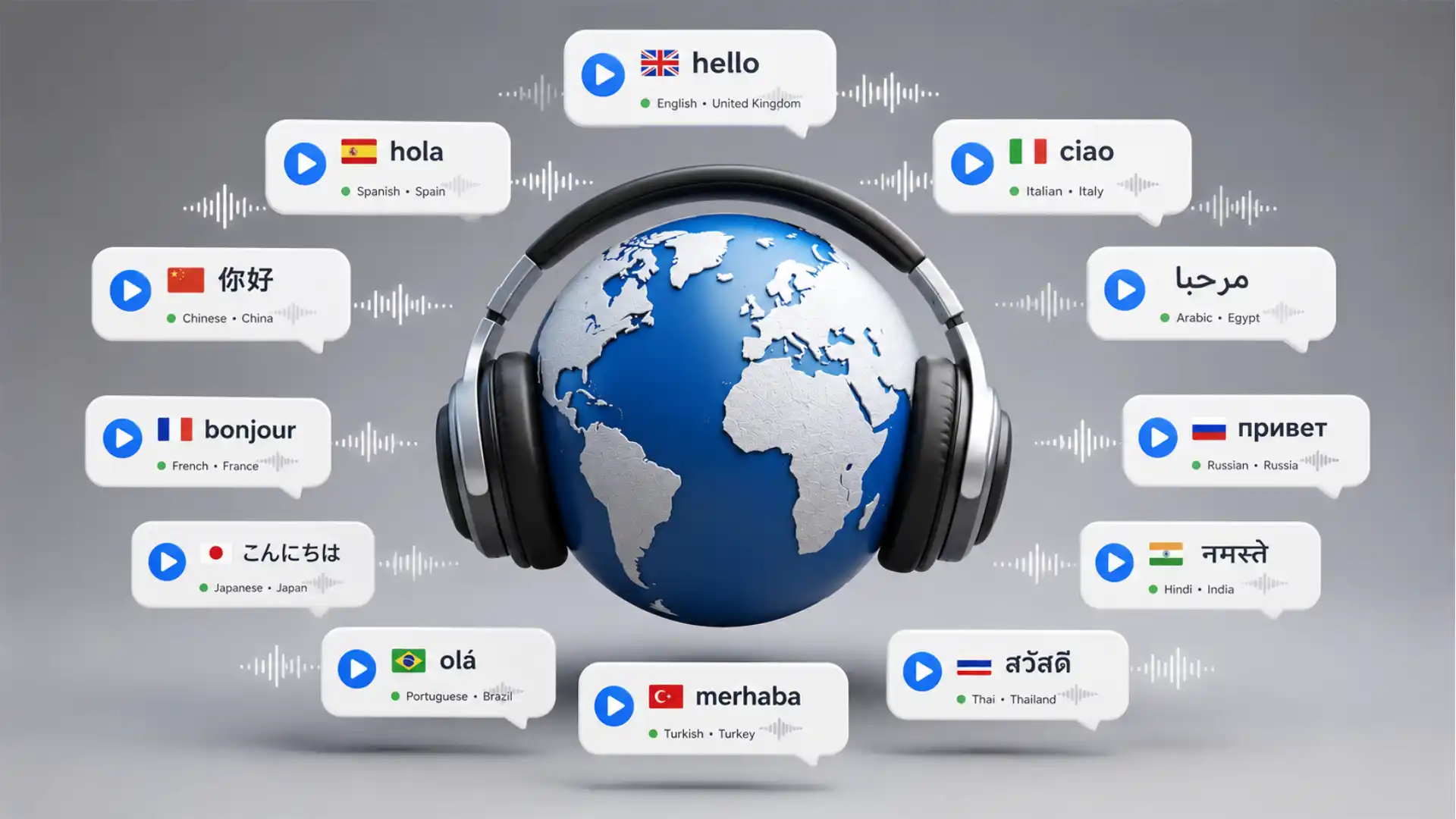
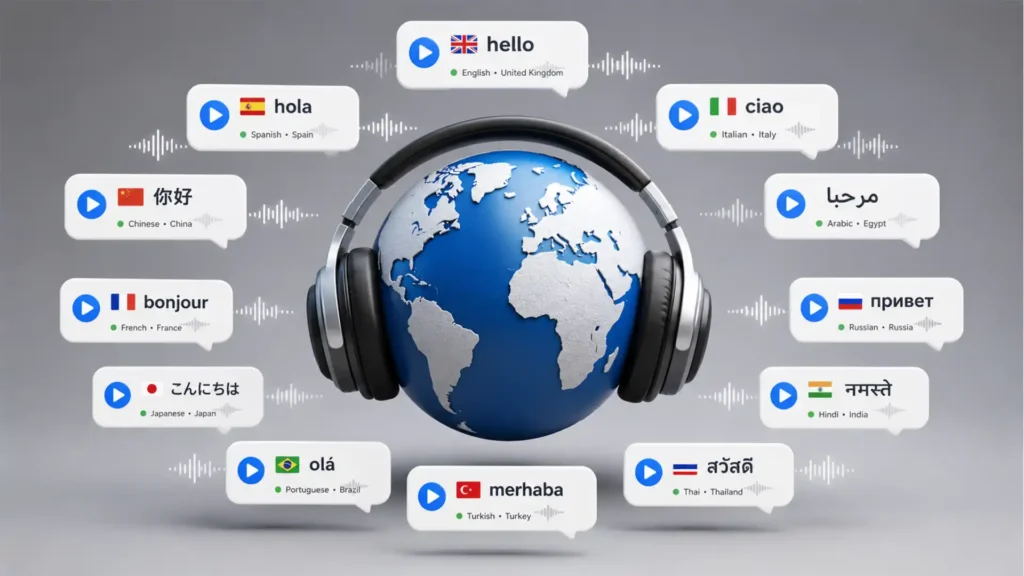
This is why Forvo feels more generous than a pronunciation button embedded in a translation app. The button usually gives you one sound and asks you to accept it as the sound. Forvo lets you hear a field of possibilities. A Spanish word may carry a Spain label. An English word may arrive from Australia, the United States, the United Kingdom, Canada, or somewhere more specific. A proper noun may have several recordings because it belongs to several languages at once. The site gives the listener room to notice difference instead of hiding it.
That room matters beyond language study. People who work across borders learn this quickly. The hardest words are rarely textbook nouns. They are the names people care about, the place names that signal whether you have done your homework, the product names that get repeated badly in meetings, the borrowed words that have been naturalised differently in different places. A polished slide deck can still fall apart on one surname. Forvo is a small insurance policy against that kind of needless awkwardness.
It also has a very old-web quality that is becoming rarer: it takes an unglamorous problem seriously. The internet has endless appetite for products that promise to save time, increase output, interpret your personality, organise your second brain, or generate a branded paragraph. Forvo asks a smaller question. How does this word sound when a real person says it? The answer is humble, but it has more practical force than many grander ideas.
That humility gives the site a strange durability. You can imagine the first version of Forvo sitting comfortably in the late-2000s web, surrounded by forums, community reference sites, and small services built because their creators noticed a gap. You can also imagine it surviving whatever comes next, because the gap remains. Search engines become more polished. Voice models become more persuasive. Dictionaries become richer. People still need to hear things.
Forvo’s history page says the project began with a mission to improve spoken communication across cultures by letting users share native-language pronunciations and listen to others do the same. The wording is modest, but the design choice has aged well. It places the human contributor at the centre of the system rather than treating the contributor as background data for a machine. That is the entire personality of the site.
The phrase “native speaker” deserves care, of course. It is useful shorthand, but it does not settle every question of authority. People have mixed backgrounds. They move. They grow up bilingual. They speak a language differently from their parents. They may be perfectly intelligible without matching a listener’s expectation of “native” speech. Forvo’s own moderation rules try to keep non-native or incorrect submissions out, yet no public archive can turn a complex social reality into a perfect badge. Use the label as context, not as a crown.
That is also why the site works better when you approach it as an archive than as an oracle. One recording is a clue. Three recordings may show a pattern. Ten recordings from different places can teach you more than a neat rule. You start to hear what is stable and what moves. You hear which syllable holds the stress. You notice whether the vowel is broad or clipped. You discover that the pronunciation you thought was wildly wrong is actually normal in another place. The listening teaches judgment, not obedience.
Forvo’s word pages invite this mode of use. They do not merely hand you sound. They attach recordings to contributors, surface origin details where available, provide ratings, support favourites, and make it possible to report a problem. The FAQ states that misspelled, mispronounced, or inappropriate content can be reported and that the service removes material that violates its rules. The site is community-made, but it is not supposed to be community-abandoned.
That balance matters because pronunciation has a nasty habit of looking simpler from a distance than it feels up close. A word may be rare but meaningful. A name may have a spelling that moved between alphabets. A phrase may be ordinary in one dialect and not exist in another. A recording can be technically accurate yet useless for your exact situation. Forvo is most interesting where certainty starts to fray.
It is easy to use the site for famous traps. “Quinoa.” “Siobhan.” “Cthulhu.” “Charcuterie.” “Açaí.” “Worcestershire.” The Forvo interface itself surfaces this kind of word because the web’s collective embarrassment has become a category. There is pleasure in it, and a little relief. You were not the only person who stared at “Saoirse” and decided silence was safer. The site turns a private hesitation into a shared public lookup.
Yet the deeper use sits outside those crowd-pleasers. Search for the name of a village before a trip. Search for a scientist before a presentation. Search for the term you have only read in subtitles. Search for a family name before you say it on a podcast. Search for the word your child brought home from another language. Forvo becomes better the moment you stop treating it as a trivia machine.
The voice is the missing part of the word
A pronunciation guide is easy to underestimate because the interaction is so short. You search, listen, leave. The transaction may take five seconds. But speech is full of information that text refuses to carry cleanly. The difference between “I have seen this word” and “I have heard this word” is often the difference between passive recognition and usable language. The ear turns a symbol into an event.
Think about names. A name is not an exam question, and it is not a puzzle placed there for the amusement of people who did not grow up with it. It belongs to someone. Saying it with care is a small act, but small acts accumulate. A listener does not need perfection. People usually recognise effort, and they recognise indifference too. Forvo gives you a chance to make the better first attempt.
That use becomes sharper when the name travels across languages. A surname may have a pronunciation in its original language, a local version in the country where the person lives, and an English approximation used by colleagues. All three can be real. The trick is not to hunt for a mythical final form. It is to understand what you are saying, whom you are speaking to, and which version is appropriate in the room. Forvo is a starting point for that attention.
The same is true of place names. A map makes them look fixed. Voices make them local. “Reykjavík,” “Łódź,” “Kraków,” “Curaçao,” “Bologna,” “Gdańsk,” “Leicester,” “Wrocław,” “Worcester,” and “Versailles” are not hard because they are exotic. They are hard because spelling habits travel badly. Each word is carrying the leftovers of a language’s history, its sound system, and its relationship to borrowed forms. A recording cuts through the historical clutter without pretending it never existed.
Food is another useful territory because it reveals how quickly pronunciation turns into performance. People feel pressure around menus. They worry about sounding foolish. They overcorrect. They imitate an accent badly. They avoid ordering the thing they want. Forvo is not going to solve class anxiety, but it can remove one thin layer of uncertainty. Listen once. Say it plainly. You do not need a theatrical accent to pronounce a dish respectfully.
The site quietly discourages a common mistake in language learning: treating written resemblance as sound evidence. English is the obvious culprit, but no language is innocent. Letters lie differently in different systems. “Colonel” looks one way and behaves another. “Queue” has a sense of humour that only English could maintain. French leaves letters behind. Irish makes historical agreements with spelling that outsiders cannot see. Mandarin’s romanisation is not a set of English instructions. The page is not the voice.
Phonetic notation gives trained readers a more precise route through that gap. The International Phonetic Alphabet is a serious tool, and a good dictionary entry with audio plus IPA can be superb. But many people do not read IPA quickly, and even people who do may still want to hear pace, stress, and texture. A slash and a symbol tell you a lot. A voice tells you what the symbol feels like in motion. Forvo makes the audio primary rather than supplementary.
This is especially useful with words that have no obvious equivalent in the listener’s first language. You can explain a sound. You can compare it with another sound. You can draw a mouth diagram. Then a native speaker says it and the entire explanation becomes more concrete. The recording does not replace teaching. It gives teaching somewhere to land.
There is also a social advantage to hearing more than one voice. Textbook recordings often sound impeccably measured, almost disinfected. They are good for clarity, but daily speech is not a studio. It has small differences in tempo and attack. It has individual tone. It has warmth, fatigue, softness, confidence, regional colour, and occasionally a microphone that suggests the speaker recorded the word in a kitchen twelve years ago. Those imperfections are evidence of a real speaking world.
Forvo does not make those variations into an aesthetic object. It does not package them as authenticity theatre. The site is too functional for that. You hear them because people are different, and the interface gives them room to exist. This makes the archive feel more like the actual internet at its best: a place where many people contribute small pieces of knowledge that no central institution could gather in the same way. The value comes from accumulation.
A single word page can become unexpectedly rich. Look up “API,” for example, and the page separates pronunciations by language, displays contributor information, includes country markers, and allows you to compare recordings rather than taking one answer on faith. The page becomes a tiny cross-language museum for a short technical abbreviation. Even a three-letter string gets a biography.
That matters in workplaces full of international English. Acronyms travel. Brand names get repurposed. Technical terms leave the country where they first appeared and take on local forms. A software team in Berlin, Nairobi, São Paulo, Seoul, Manila, and Austin may all use the same abbreviations with slightly different rhythms. The variation is not a failure of language. It is what language looks like when it is being used.
Forvo can be a sensible companion for writers and presenters because it forces a good habit: check the word before you perform certainty around it. This is not a plea for anxiety. Nobody needs to research every syllable before speaking. It is a reminder that the words with the highest social weight often deserve the few seconds it takes to listen. Confidence feels better when it is informed.
The site is also useful for people who do not think of themselves as language learners. A journalist preparing to interview someone, a teacher reading a class list, a wedding host practising names, a museum guide, a recruiter, a sales lead, a conference moderator, a podcaster, a doctor, and a public servant all face pronunciation moments that cannot be brushed away by intelligence or good intentions. The problem is ordinary, which makes the solution easy to overlook.
Forvo’s simplicity lets it fit into those moments without demanding a new workflow. You do not need to build a curriculum. You do not need to commit to a streak. You do not need a subscription pitch before you can press play. The site is there as a lookup layer. That is a form of product restraint that software often forgets. A good utility respects the fact that you came for one thing.
The mobile app extends that utility with requests, recording, saved pronunciations, and language-based favourites. Its current description also says that users can request a pronunciation of a word or phrase, follow contributors, and download favourites. That makes Forvo less like a sealed reference work and more like a living queue of missing sounds. A gap in the archive is an invitation, not a dead end.
There is something satisfying about a service that admits the archive will never be complete. Its own FAQ says words can be added by registered users, while certain content such as made-up words, onomatopoeia, and entries longer than forty characters are excluded. The rules are practical rather than philosophical. They keep the project from becoming a dump while leaving room for names, phrases, and ordinary language that formal dictionaries may ignore. Forvo is broad because its borders are deliberately porous.
That breadth produces the site’s particular pleasure. You arrive looking for one word and find yourself wandering. A person’s name leads to a language page. A language page leads to a cluster of words you never knew people searched for. A technical term appears in five languages. A local phrase has two recordings with different accents. A page lists a missing pronunciation and suddenly you feel the absence. The web becomes audible in small fragments.
Where accents stop being a footnote
Most language products flatten accent because flattening is easier to explain. One voice is easier to brand. One pronunciation is easier to test. One standard is easier to sell. Yet users know, often painfully, that there is no such thing as hearing a language without hearing an accent. Accent is not decoration placed on top of speech. It is part of speech.
Forvo makes that visible in a practical way. When a word has multiple recordings, the listener is asked to choose, compare, and notice. A country tag may sit beside a voice. A regional distinction may separate two entries. A different contributor may have a different timing or vowel. The interface does not always give enough sociolinguistic detail to explain every difference, but it does something that many language tools avoid: it admits that one word can have more than one home.
That admission is important for English, where pronunciation advice is constantly presented as a choice between caricatures. “British” and “American” are usually treated as two big boxes. Real English does not fit into either. There are many regional accents within the United Kingdom, many within the United States, and many in places where English has been shaped by other languages and histories. The same simplification happens with Spanish, Arabic, Portuguese, French, German, Chinese, and nearly every language with a large geographic reach. A country flag is useful context, not a full map.
Forvo’s best use is therefore comparative. Do not listen to one recording and assume you have discovered the universal version. Listen for agreement. Listen for the syllable that remains stressed across recordings. Listen for the sound that changes when the origin marker changes. Listen for a difference that is so small you would not have noticed it without the side-by-side view. Patterns matter more than isolated performances.
This is a better learning habit than chasing a perfect accent. “Perfect” usually means “familiar to the person judging you.” A clear learner may speak with an accent for life, and that is not a linguistic failure. The goal in most real situations is recognition, respect, and comfort. Forvo is useful because it trains the ear toward variation without turning variation into a scorecard. You learn to hear difference without treating difference as wrong.
The archive also exposes the odd status of “standard pronunciation.” Standards exist for reasons. Broadcasting, education, dictionaries, and public communication need reference points. They can be helpful. Trouble starts when a standard is treated as the only speech that counts. Forvo does not erase standards, but it makes them share space with actual contributors. The centre is no longer silent about the edges.
That has consequences for smaller languages. Large commercial language products tend to focus on languages with big markets, polished datasets, and predictable demand. Forvo’s language list includes major world languages alongside entries such as Old English, Old Norse, Kabyle, Māori, Tibetan, Turkmen, Volapük, and many others. Coverage will vary wildly, and some languages will have thin archives, but the presence matters. A language does not need a huge market to deserve a voice online.
The FAQ makes this even clearer. Forvo says it is open to adding languages when there is an ISO code and enough contribution to support them. That is a modest policy, but it contains a useful idea: the archive grows when speakers show up. It does not wait for a corporation to decide a language is commercially attractive enough to deserve infrastructure. Community contribution becomes a form of cultural persistence.
There are limits to that promise. A language can be listed and still be poorly represented. A language may have many speakers but few users with the time, confidence, equipment, or internet access to contribute. Dialects within a listed language may be invisible. Recordings may skew toward enthusiasts, diaspora speakers, educators, or people who happen to enjoy adding words. An archive is never the same thing as a population.
Forvo does not solve this. It gives the problem a surface. When you search a word and find no recording, you see the absence. When a page has only one voice for a language spoken across a huge area, you see the imbalance. When an entry is pending, you see where the internet’s memory has not yet been filled in. The blank spaces are part of the story.
Those blanks make the site more interesting than an apparently complete synthetic system. A synthetic voice rarely tells you what it does not know. It will produce an answer with the smooth confidence of a machine trained to keep talking. Forvo’s missing entries are more honest. A request sitting without a response is a small sign that speech still comes from people, and people have limits. Silence is sometimes better information than fake fluency.
This does not make synthetic speech useless. Text-to-speech has become excellent for accessibility, reading support, and quick orientation. It can give you an immediate approximation. It can help you hear a sentence or follow a page. It can be preferable when no human recording exists. But synthetic speech is usually trying to sound broadly acceptable. Forvo is trying to preserve a particular person’s version of a sound. Those are different jobs.
The contrast is especially clear with names. A text-to-speech voice has no personal stake in a surname. A human contributor might. Even when the person recording is not the named individual, the recording arrives from a linguistic community rather than a generic voice bank. That does not guarantee perfect accuracy for every name, but it changes the relationship. The sound comes from somewhere.
You can hear this in borrowed words too. A word borrowed from French into English may have an English pronunciation, a French pronunciation, and an in-between form used by people who want to signal refinement or correctness. None of those choices can be judged without context. Forvo lets you locate the versions rather than pretending the choice is automatic. It gives you options before etiquette turns into theatre.
The site’s ability to hold several languages under one spelling is another small but important feature. A word like “API” may be read as an abbreviation with one sound in English, another in French, another in Spanish, another in German, and another in languages where the same letters are not even conceptually tied to the same technical culture. The page does not tell a story in prose, but the rows tell one anyway. The same written form can belong to several spoken worlds.
This is one reason Forvo has appeal beyond people trying to “sound native.” It is a miniature listening exercise in how words travel. The site lets you encounter technical language, tourism language, religious language, slang, food, historical names, and ordinary vocabulary as items that have crossed borders without becoming identical. The archive makes global language feel less abstract.
For language teachers, the presence of variation creates a useful teaching moment. Instead of presenting audio as proof of a single answer, a teacher can ask students what they notice. Which sounds are consistent? Which vary? Which recording is closest to the class target, and why? What information does the country label give you, and what does it leave out? Forvo works best when it prompts listening rather than imitation.
For translators, it offers another kind of check. Translation is often treated as a written task, but translated text has to be said aloud sooner or later: in video, in meetings, in product demos, in classrooms, on calls, in public notices. A translator working with proper names, brands, or cultural references may not need a full phonological lesson. They may just need to hear the word. That practical moment is exactly Forvo’s territory.
For creators, the same logic applies. A YouTube host, a documentary narrator, a streamer, a game master, a radio producer, or a writer recording an audiobook may find themselves dealing with a trail of unfamiliar names. Researching every item through search results can be slow and unreliable. Forvo does not remove the need for editorial judgment, especially with living people, but it provides a clean first pass. It is a tool for reducing avoidable errors before they become public.
The archive’s constraints are part of what keeps it credible. Forvo tells users that it may remove content that is non-native, misspelled, inappropriate, or mispronounced, and it provides reporting tools for words or recordings that are wrong. Moderation cannot eliminate every mistake. Nothing at this scale can. Still, the presence of a correction path separates a community reference from a pile of ungoverned uploads. The site understands that openness without maintenance turns into noise.
There is a more subtle value here too. Hearing multiple accents makes you less likely to mistake your own familiarity for correctness. That is a useful correction, especially online, where confident pronunciation advice spreads faster than careful pronunciation advice. A person may say “this is how it is pronounced” when they mean “this is how I say it.” Forvo does not make everybody cautious by magic. It gives caution a practical shape.
A better way to use an imperfect archive
Forvo is simple enough that most people will never read a guide to using it. They will search, press play, and leave. That is fine. The site works at that level. But the archive becomes much more useful when you bring a few habits to it, especially when the word matters. Treat the first recording as an opening, not a verdict.
Start with the language. This sounds obvious until you search a word that exists in several places. A spelling may show up in English, French, Spanish, German, Italian, Dutch, Turkish, or languages you had not expected. A name may be pronounced differently by its original-language community and by people who use it in another language. A place name may have an official local pronunciation and a long-established English version. Choosing the language is often half the work.
Then look at the contributor metadata. It is not a guarantee of anything, but it gives you orientation. Country and regional information may tell you why two recordings differ. A user profile can sometimes suggest experience with a language. Ratings can help you find versions other listeners have found useful. The site’s API documentation reflects the same underlying logic, allowing results to be filtered by language, country, user, sex, rating, and order. Forvo’s data model knows that a voice is not just an audio file.
Listen more than once, but do not listen mechanically. Your first pass should answer one question: where does the stress fall? Your second should catch the vowel or consonant that looks unfamiliar in writing. Your third should focus on the whole word’s rhythm. Long words often fail because the speaker gets individual sounds right while making the shape of the word feel wrong. Rhythm is often the missing ingredient.
Use the recording in a phrase when possible. A word in isolation is useful, but language changes slightly in motion. Stress may reduce. Sounds may link. The first syllable may become less prominent. A name may sound different when placed inside a sentence than when read like a catalogue entry. Forvo frequently includes phrases related to a word, and its app supports requests for words or phrases. A word is not always the same object once it joins company.
Do not over-perform the recording. This is where pronunciation resources can become socially dangerous. You hear a native speaker and decide you must reproduce every detail exactly, including a degree of accent that is unnatural in your own speech. That can sound worse than a clear, respectful approximation. Listen for the structure, not a costume. You are trying to say the word well, not audition for somebody else’s biography.
For proper names, search beyond the bare name when needed. A person may have a recording under a full name rather than a surname. A local place may appear under a native spelling. A brand may have a different official styling. A phrase may be more useful than the isolated word. If you cannot find it, look for a comparable word that contains the same difficult sound. A missing answer does not always mean a dead end.
There is also an etiquette rule worth keeping. If the person whose name you are about to say is available, ask them. Forvo is good preparation. The person is better authority. People may use a local pronunciation, an adapted pronunciation, a family pronunciation, or a version that differs from what a reference site records. An archive is useful; direct respect is better. The fastest source is not always the closest source.
What Forvo is best for
| Moment | What to listen for | Why it works |
|---|---|---|
| A person’s name | Stress, vowels, the full name in context | You avoid turning spelling into a guess |
| A place before travel | Local rhythm and consonants | Maps rarely teach the sound of a place |
| A foreign word in a presentation | The version used in the relevant language | You can prepare without turning it into a performance |
| A technical term | Repeated patterns across speakers | Abbreviations and brand terms often travel badly |
| A language-learning problem | Several recordings, not one | Variation becomes part of the lesson |
The table is not a checklist for sounding flawless. It is a reminder that different moments demand different kinds of listening. A name calls for care. A technical word calls for context. A language-learning task calls for comparison. Trying to extract one universal method from all of them is how pronunciation turns into unnecessary stress.
Forvo also rewards small acts of contribution. Its FAQ says registered users can add words, record pronunciations, vote, create favourites, and download MP3s. That is a familiar community-site pattern, but the effect is unusually direct. You can fill a hole that somebody else will encounter months later. A ten-second recording can save a stranger an awkward minute.
The contribution model is not purely altruistic either. Recording words forces you to notice your own speech. You have to decide how you pronounce a term. You have to say it clearly enough for a listener without flattening it into an unnatural performance. You may discover that you have never consciously thought about the stress in a familiar word. Teaching a sound is a quick way to hear yourself.
For language communities with limited digital representation, contribution carries even more weight. A recording might be one of the few easily discoverable audio examples of a word in a smaller language or dialect. That does not make Forvo a preservation institution in the full archival sense. Serious preservation work needs consent, metadata, community control, long-term storage, and many other safeguards. Still, a public pronunciation page can be a small doorway into a language people might otherwise never hear.
The site’s language list makes this contrast visible. Big languages have thick, crowded collections. Some smaller ones have sparse pages. The imbalance is real. It can be disappointing. It also shows why public contribution matters. Corporate products tend to solve the rich-language problem first because it is cheap and profitable. Community archives can move differently. They grow where people decide the words are worth recording.
A useful way to browse Forvo is to follow your own curiosity instead of treating every search as homework. Look up a word you have avoided saying. Then click the language. Look up a word that exists in your own language and another language. Compare the shape of a shared name. Search an old term, a local food, a film title, a mountain, a musician, a historical figure, a phrase you heard in a game. The best sessions often begin with one small embarrassment.
That wandering reveals an underappreciated fact about online reference work: a site becomes more memorable when it has texture. Texture is not decoration. It is the sensation that the database has been touched by people. Forvo has it in user names, uneven microphone quality, unexpected languages, pending requests, local accents, and oddly specific entries. The rough edges make the archive legible as human work.
The archive is imperfect in ways that should change how you use it. A recording can be old. A contributor may be a native speaker but not represent the variant you need. A rating can reflect popularity rather than linguistic suitability. A word may have been added in the wrong language. A name may be missing, or the available recording may not match how its current bearer says it. Listening critically is not cynicism. It is basic care.
Forvo itself acknowledges that errors can appear before an editor reaches them. Its FAQ asks users to report problems and says incorrect forms may be removed when found. That is a refreshingly candid admission for a web reference service. It is not claiming a pristine database. It is describing a process. Trust should come from transparent correction, not a performance of perfection.
A smart workflow is to use Forvo alongside other evidence when the stakes are high. For a public speech, check the person’s own interviews, official videos, institutional recordings, or direct confirmation. For medical, legal, or scientific terms, consult subject-specific sources as well as pronunciation audio. For a place, see how local broadcasters or residents say it. Forvo is a strong first listen, not the final court of appeal.
That advice does not diminish the site. It defines its proper role. Plenty of tools become worse when users ask them to do everything. Forvo becomes better when you ask it to do the thing it was made for: give you real examples of how words sound in real linguistic contexts. Use it with proportion, and it is unusually good.
The site also has a quieter technical life. Forvo offers an API that lets developers request pronunciation data, with options to filter by language, location, gender, user, rating, and sort order. The company says the API is used by thousands of developers and offers plans for individual, nonprofit, and commercial use. This matters because it turns the archive into infrastructure rather than keeping it trapped inside one website. The sound library can travel into other tools.
That infrastructure layer is easy to ignore until you imagine where it belongs. A dictionary app could surface a real recording next to its definition. A flashcard system could attach audio to vocabulary. An accessibility tool could offer alternate pronunciation references. A newsroom system could build a pronunciation note into a person profile. A school platform could let students compare accents around a word. Forvo’s quiet ambition is bigger than its homepage suggests.
The licence and commercial terms deserve attention here. Forvo distinguishes personal or academic use from commercial arrangements, and its published terms set rules around requests, attribution, and usage. That may sound dry, but it is part of taking contributors seriously. A recording is not free-floating ambience simply because it is easy to play. Human voices are content, labour, and context at once.
The odd pleasure of looking up anything at all
A good web discovery does not only solve a problem. It makes you want to keep clicking after the problem is solved. Forvo has that quality because it turns the word lookup into a tiny form of travel. You arrive to find out how to say something. You leave having heard a language you do not know, an accent you had never encountered, or a word that suddenly sounds more beautiful than it looked. The site makes curiosity audible.
This is not because the interface is luxurious. Forvo’s visual personality is functional, even a little stubborn. The web has spent years teaching users that serious services must be spacious, glossy, heavily illustrated, and smoothed into one cheerful brand voice. Forvo remains closer to a reference tool. It has lists. It has pages that reveal the database. It has user-facing controls that do not disappear behind an aesthetic gesture. You can feel the utility before you can admire the design.
That matters because reference sites should not become too coy about being references. A person in a pronunciation panic does not need an experience. They need a search field, a speaker icon, and enough context to decide whether they found the right sound. Forvo respects that need. The site may not seduce you with motion design, but it gets to the audio quickly. Speed and legibility are their own form of taste.
The most delightful part is the way random entries reveal the internet’s shared list of oral hazards. The popular-word areas contain the usual suspects: “gyro,” “GIF,” “Nguyen,” “açaí,” “quinoa,” “Pho,” “Worcestershire,” “gnocchi,” “Siobhan,” “cache,” “Nietzsche,” “charcuterie,” “tinnitus,” “Curaçao,” “Samhain,” “chipotle,” and many others. It is a strange cultural inventory, half useful and half comic. The page reads like a museum of words people have been afraid to say out loud.
The list also tells you something about the web. Search behaviour is full of small admissions. People do not only search for facts; they search for permission. “How do I pronounce this?” often means “I care about getting this right.” It can also mean “I do not want to be embarrassed.” Those motives are not identical, but they share a human vulnerability. Forvo exists where curiosity and self-protection overlap.
A lot of modern software tries to hide vulnerability behind confidence. It gives you one answer, a smooth voice, a friendly animation, and the suggestion that uncertainty has been solved. Forvo keeps uncertainty visible. Multiple recordings are allowed to coexist. A pending request stays pending. A missing language page remains thin until people add to it. The site does not pretend the web has finished collecting speech.
That incompleteness becomes a feature when you let yourself notice it. You may find a language page where a word you expected to be common has no entry. You may discover that a local term is only represented by a few contributors. You may hear a recording whose audio quality makes the year of upload almost tangible. The record is not just linguistic; it is temporal. Every clip is a small timestamp from somebody’s life.
This is why Forvo has more character than many polished language platforms. It is not built to give you a feeling of mastery after three taps. It is built from thousands of imperfect acts of contribution. You can sense the contributors even when you know nothing about them. A username, an origin label, a recording, a vote: that is enough to make the page feel inhabited. The archive has people in it without turning those people into content.
There is a familiar internet pattern here. The services people remember tend to preserve a little eccentricity. They do not sand every corner down until they become interchangeable. Wikipedia has edit histories and talk pages. Discogs has cataloguing quirks. Letterboxd has lists and logged arguments. OpenStreetMap has layers of volunteer attention. Forvo has pronunciations recorded by people who cared enough to hit a microphone button. The irregularity is the source of the trust.
The site is also a good antidote to the idea that the world needs one voice. Voice assistants, navigation systems, automated customer service, audiobook platforms, and social video all train us to expect speech in polished packages. The same few styles dominate: friendly, calm, clear, vaguely international, almost frictionless. Forvo gives you another proposition. Speech is not a product surface. Speech is a population.
You hear that population when you compare two recordings of the same word. The difference may be obvious or almost invisible. One speaker opens a vowel more. Another clips the ending. One has a softer “r.” Another puts pressure on a syllable you barely noticed. The record becomes a reminder that language is not simply transmitted from a central source to passive listeners. It is kept alive through use.
For travellers, this can turn into a more respectful form of preparation. Learn the name of the station you need. Learn the local greeting. Learn the dish you plan to order. Learn the name of the town you are visiting rather than relying on an English approximation that no one there uses. You will still make mistakes. Everyone does. But you arrive listening rather than assuming.
For people with heritage languages, Forvo may have a different emotional pull. A word can be familiar from grandparents, relatives, childhood, songs, or food, but uncertain in spelling or formal pronunciation. Hearing it said by another speaker can be comforting, surprising, or slightly wrong in a way that still teaches you something. Heritage language is rarely neat. The archive can meet that complexity without demanding a perfect label.
Forvo is not sentimental about any of this. It does not frame every word as a cultural journey. It gives you a button. That restraint leaves room for the listener to bring their own reason. You might be practising for a job interview or trying to pronounce a novelist’s name before a book club. You might be researching a sports team. You might be teaching a child. The site stays useful because it does not over-narrate the moment.
The web needs more services like that: specific, lightly opinionated, community-built, and happy to be a dependable reference rather than a total environment. Forvo does not want to become your language platform, your social graph, your learning dashboard, or your personal brand. It wants to be where you go when you need to hear a word. That narrow promise is a strength.
Why this old-fashioned web idea still matters
Forvo looks almost quaint beside the current race to make every interaction conversational. Ask a chatbot. Talk to an assistant. Generate a voice. Clone a voice. Translate a call live. Turn text into speech. Turn speech into text. The spectacle is understandable. Voice technology has advanced quickly, and much of it is genuinely useful. Yet this progress creates a strange risk: we may start to confuse fluent output with lived speech.
Fluency is not the same as provenance. A synthetic voice can pronounce a word clearly while telling you very little about who says it that way, where that form is common, or what alternatives exist. It may approximate variation, but it does not contain a community’s own choice to contribute a recording. Forvo’s clips are imperfect, but their imperfection carries information. They have lineage.
That lineage is not mystical. It is practical. The recording comes with a language, often a place, a contributor, a date-like position in an evolving archive, and a path for correction. You can compare it with another recording. You can rate it, report it, request a missing one, or add your own. The sound is not merely generated in front of you. It has a place in a shared system.
This makes Forvo a useful counterweight to the current tendency to centralise language around a few massive models. Large systems are good at coverage. They can produce speech for almost any string. They can read a paragraph in seconds. They can adapt speed, gender presentation, tone, and apparent accent. But they are not automatically good at preserving local forms, minority-language nuance, shifting social norms, or the ordinary diversity of human pronunciation. Scale can erase difference as easily as it can distribute it.
Forvo’s archive has the opposite weakness. It is uneven. It depends on contribution. It may have remarkable depth for one language and almost nothing for another. It can be missing the exact word you need. It requires moderation and maintenance. But that unevenness is also a more honest reflection of the world’s digital power map. The gaps tell you where participation has been possible and where it has not.
A mature internet should be able to hold both models of value. Use synthetic speech when you need speed, access, coverage, or a quick approximation. Use human-recorded reference audio when the person, language, place, or social context deserves extra care. The argument is not that one category should erase the other. The argument is that they should not be mistaken for the same thing.
Forvo’s staying power comes from understanding this without turning it into a manifesto. The service began as a fairly direct attempt to collect pronunciations from people. Eighteen years later, that still sounds like a good idea. Its official history says that it has reached hundreds of thousands of registered users and tens of millions of annual visits, which is a reminder that this supposedly narrow problem has a large, steady audience. People keep needing words to become sounds.
The project also shows what a useful public archive can look like when it is allowed to be simple. It does not require a grand social mission statement every time a person contributes. It does not need to make users perform their identity. It offers a small, concrete action: pronounce something in the language you know. The contribution is modest enough to happen.
That is an underappreciated design principle. Many participation systems fail because the request is too large. Write an essay. Make a video. Build a community. Donate expertise. Moderate a whole category. Forvo asks for a word, sometimes a phrase. A contributor can add something real without becoming a content creator in the modern sense. The barrier is low, but the result is durable.
It is easy to romanticise volunteer archives, and that would be a mistake. Contributors need fair rules. Moderators need support. Platforms need sustainable funding. Language communities should not be treated as free inputs for a company’s commercial ambitions. Forvo operates both a public service and a commercial API business, and its terms distinguish personal or academic use from commercial licensing. The ethics of an archive are not solved by calling it a community.
Still, Forvo’s model deserves credit for preserving a certain kind of web compact. You give something because it is useful to someone else. The platform gives you a place to put it. Other people use it when they need it. The contribution may be anonymous in practice, but it is not invisible. A username remains. A voice remains. The web remembers the act without demanding a performance around it.
This is particularly powerful for words that have no obvious home in mainstream media. A family name may never appear in a major dictionary. A local food may not get a polished explainer video. A regional phrase may not justify a commercial voice pack. A small-language word may sit outside every big platform’s priorities. Yet each can be worth recording. Importance is not measured by search volume alone.
Forvo also invites a better relationship with error. Everyone mispronounces things. The shame around it often makes people either avoid unfamiliar words or overcompensate with certainty. Neither response is great. A pronunciation archive gives you a third option: look it up, listen, try. If you are corrected, listen again. The site normalises preparation without turning language into a test.
That attitude is especially useful in public life. Meeting hosts, journalists, teachers, public officials, and commentators often speak many names they have not had the chance to learn through personal conversation. Their mistakes can be understandable, but avoidable mistakes carry a message too. Taking thirty seconds to check is not a grand moral act. It is a basic sign that other people’s words are worth your time.
Forvo gives that thirty seconds a home. You do not need to browse through long debates or hunt through a dozen unreliable clips. You search, hear, compare, and decide. The action is almost trivial. The habit is not. Over time, it makes a person more alert to the fact that language lives in voices before it gets flattened into spellings, captions, tags, and search boxes. The web becomes a little less text-blind.
The same applies to businesses. Companies spend absurd amounts of time naming products, planning launches, buying domains, checking trademarks, and designing identity systems. Then a name enters markets where it will be pronounced in ways nobody on the naming team predicted. Forvo will not solve international naming strategy, but it is a useful early reality check. Search the proposed name. Hear neighbouring words. See what it resembles across languages. A brand is not finished when it looks good on a slide.
Forvo’s API makes that possibility more concrete. A product team building language features can request pronunciations by word, filter them by language or country, and integrate human-recorded audio into a wider interface. The documentation even shows different output formats for applications that need structured data or a playable audio element. A tiny pronunciation page can become a building block inside a much larger product.
That technical possibility should not obscure the human core. The best thing about Forvo is not that it can be integrated. It is that it remains worth visiting directly. The site has the rare quality of a good public reference: you trust it enough to use it, but it still has enough texture to make you linger. You do not just consume a result. You hear the record being made.
The project’s long life also rebukes the idea that every good web product must expand into a platform. Forvo has apps, an API, language pages, requests, user profiles, favourites, and other features. Yet its identity remains legible. It is still about pronunciation. That clarity is hard to preserve once a service starts chasing engagement metrics, social features, subscriptions, and generic productivity claims. Forvo stays memorable because it knows what it is for.
The site will not be perfect for every word. It will not offer equal coverage for every language, region, or community. It will sometimes present a recording that requires a second opinion. It can feel visually more functional than refined. Some listeners will prefer a dictionary’s IPA, a local news clip, a teacher, a corpus, or direct confirmation from the person involved. Those are not failures of the site. They are reminders to use the right source for the right task.
But the next time you encounter a word that exists only as a shape on a page, open Forvo before you guess. Listen to it once. Listen to another version. Notice the difference. Say it quietly. You may still get it wrong. You may find that there is no single answer. You may discover that the word has a history you never suspected. That is the pleasure of the site: it turns a minor uncertainty into a small act of attention.
Forvo does not make the world’s languages neat. It makes them present. The archive is a reminder that every word has had to pass through a human voice somewhere, and that no amount of polished text can fully replace the sound of somebody saying it. In an internet increasingly eager to generate speech on demand, Forvo remains useful because it lets speech remain human.
Author:
Jan Bielik
CEO & Founder of Webiano Digital & Marketing Agency
This article is an original analysis supported by the sources cited below
About Forvo
Forvo’s official history, scale figures, ownership information, and description of its native-speaker pronunciation model.
Forvo frequently asked questions
Official explanation of word rules, moderation, regional pronunciation differences, contributor permissions, downloads, and language inclusion.
Forvo language directory
Official overview of supported languages, language diversity, and the site’s current pronunciation counts by major language.
Forvo app for iOS and Android
Official product page describing current app features, pronunciation requests, saved recordings, and stated archive scale.
Forvo API
Official API overview covering developer access, filtering options, usage plans, and integrations.
Forvo API documentation for word pronunciations
Technical documentation on retrieving pronunciation records and filtering results by language, country, contributor, rating, and order.
Forvo terms and conditions
Official terms covering the collaborative service, non-commercial use, request limits, and commercial arrangements.
| Citing this article? Brief excerpts are welcome. Please credit Webiano.digital, name the author where stated, and include a link to https://webiano.digital and to this original article. Full or substantial republication requires prior written permission. Read our Copyright and Content Use Policy. |
This article was prepared with the assistance of artificial intelligence tools. The content underwent expert human review, and Webiano Digital & Marketing Agency assumes editorial responsibility for its final version and publication.