A photograph shot for a Windows launch a decade ago is now pulling record crowds to Wharariki Beach, a wind-scoured stretch of New Zealand coastline with one gravel car park, a seal colony and no lifeguard. The number that matters is not the view count but the precedent: Trolltunga and Maya Bay both absorbed identical virality, then spent years paying for infrastructure nobody had planned.
Table of Contents
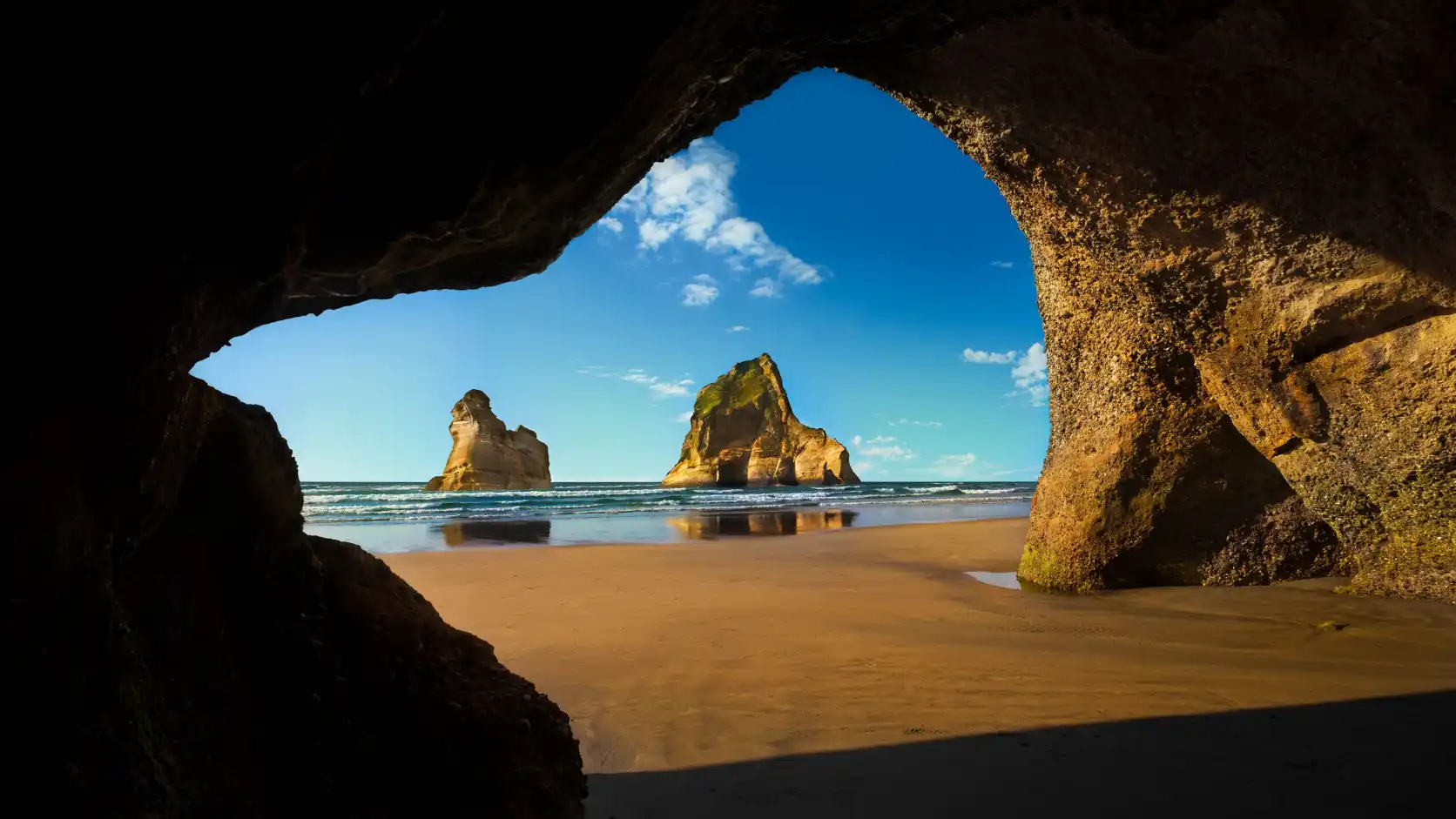
A one-week-old Instagram reel of a beach in New Zealand has racked up 142 million views and 8.5 million likes, and Microsoft’s own account showed up in the comments to confirm the location is “even better in person.” The beach is Wharariki, a remote arc of sand dunes and sea arches at the northern tip of the South Island, and the reason a decade-old stretch of coastline is suddenly the most-watched thing on the internet has nothing to do with a new attraction. It is the setting of the default lock screen photograph that shipped with Windows 10 in 2015, a photograph most of the roughly one billion people who once used that operating system clicked past without a second glance. Windows 10 itself reached the end of standard support in October 2025. Its successor has spent the past year fielding complaints about bloat, telemetry and a Bing wallpaper app that opens a browser tab when clicked. Against that backdrop, a single human-shot photograph of a real place is doing something no feature update has managed: making people want to go somewhere. The pull is real. So is the mismatch between a viral clip’s reach and a beach with one car park, tidal access and no lifeguard.
Wharariki Beach draws a viral crowd it never asked for
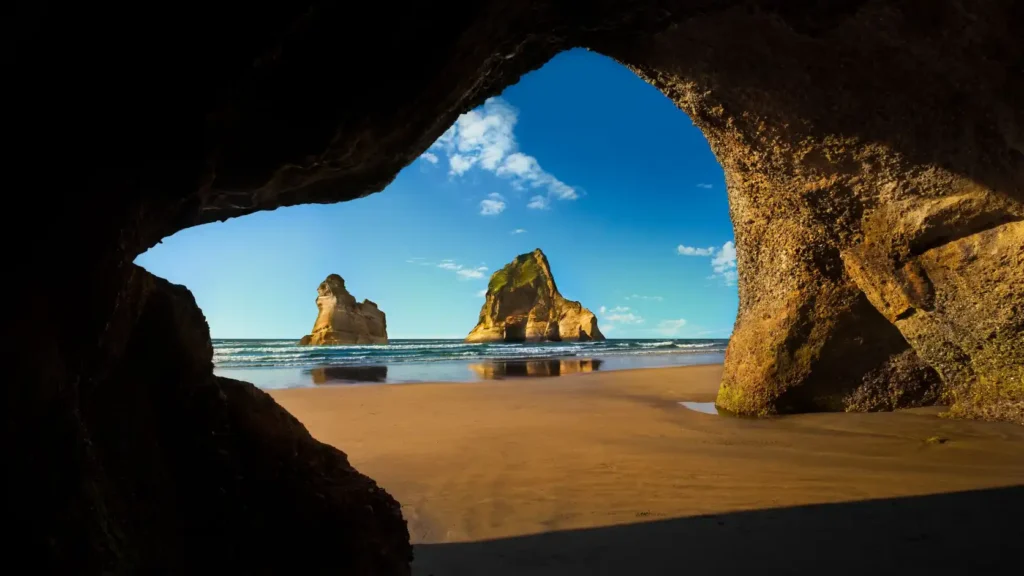
Travel creators Sagar and Ami posted the clip that set off this latest wave, filming their reaction as they matched the view through a sea cave to the image that had greeted them on a laptop screen for years. “We thought the photos of Wharariki Beach were edited,” the caption reads, “until we saw it in person.” The video is not the first to make this discovery. A year earlier, travel account @getlostwithliam posted a reel built around the same punchline, framing the clip as finally standing inside the Windows screensaver in person, and it has since passed 746,000 likes. Before that, the image had already circulated as a joke: an X post in September 2020 claiming the beach as an ordinary morning walk drew more than 75,000 likes, and a Threads repost in mid-2025 pulled in over 13,000 more. Each wave treats the discovery as new, which is itself revealing. The photograph has been public property since July 2015, sitting on thousands of desktops well before any tourist arrived to test its accuracy against reality.
What is different this time is scale. A single reel reaching 142 million views in seven days outstrips the combined lifetime engagement of every earlier meme cycle built on the same image, and it arrives at a moment when Windows 10 itself is being phased out rather than actively marketed. Neither of the two most recent viral clips was filmed with a Windows device; both used MacBooks to hold up the picture for comparison, and neither caption uses the phrase “lock screen.” One calls it a wallpaper, the other a screensaver. The confusion is small but telling: the artifact people are chasing has outlived the accurate vocabulary for describing it. Local tourism listings have started attaching an unofficial label to the site, calling it the Windows wallpaper beach alongside its official Māori and English names, which suggests the nickname is settling into place faster than any agency is tracking the traffic behind it.
A photojournalist’s New Zealand assignment became Windows’ most-seen picture
Microsoft commissioned photojournalist Steve McCurry, best known for National Geographic’s 1984 Afghan Girl portrait, alongside photographer Chad Copeland to shoot New Zealand locations ahead of the Windows 10 launch. Ekaterina Savtsova retouched the resulting images and creative director Chris Raykovich did additional editing before one of McCurry’s frames of Wharariki’s Archway Islands, shot from inside a sea cave, became the operating system’s default lock screen. The four rock stacks that anchor the composition are young by geological standards, cut from roughly 55-to-65-million-year-old sandstone of the Farewell Formation, and they were not formally named until November 2013, when the New Zealand Geographic Board gazetted “Archway Islands” alongside 132 other place names. The photograph predates the name most people now use to search for it.
Windows had form here. The default Windows XP wallpaper, Bliss, a shot of rolling hills in Sonoma County by Charles O’Rear, is frequently cited as the most-viewed photograph in history, seen by an estimated billion-plus people since 2002. Windows 10’s own desktop background carried a similarly elaborate backstory: creative director Bradley G. Munkowitz built the operating system’s four-pane logo out of physical light using lasers, haze machines and a custom camera rig in a San Francisco studio, rather than generating it on a screen. Both precedents point to the same pattern the lock screen photo now extends: Microsoft’s most memorable visual assets tend to be the ones with a real, verifiable point of origin, not the ones assembled fastest.
One billion logins turned an image into shared visual memory
Microsoft announced in March 2020 that Windows 10 had surpassed one billion active devices across 200 countries, a milestone the company had originally hoped to hit by 2018 before delayed adoption and the collapse of its phone business pushed the target back nearly two years. Every one of those devices displayed the same lock screen image by default unless a user actively changed it, which means the Wharariki photograph was not marketed to a billion people so much as installed in front of them, repeated at every login and wake-from-sleep for the better part of a decade. No streaming platform, publisher or advertiser reaches that kind of unbroken, involuntary repetition; a login screen is closer to wallpaper in a room a person cannot leave than to an advertisement they can scroll past.
That repetition built something closer to shared muscle memory than shared taste. People did not choose the image the way they choose a screensaver from a gallery; they absorbed it by default, the same way an office worker absorbs the pattern on a carpet nobody there ever picked out. When Reddit’s r/pcmasterrace later filled with attempts to recreate the shot, and when travel creators staged their own version of finally seeing it in person, the joke worked precisely because so many strangers, on unrelated devices in unrelated countries, recognized the same unchosen picture instantly. That is a different kind of fame than a landmark earns through guidebooks or a single viral post: it is fame built on unavoidable, repeated, unpaid exposure, which is also why no institution currently tracks who is coming to see it or why.
The two exposure curves look almost nothing alike, which is part of why this moment is disorienting to measure. A billion devices logging in daily built familiarity slowly, in tiny increments spread across roughly a decade, with no single day standing out from any other. A 142-million-view reel delivers a comparable order of total impressions inside seven days, concentrated on a platform built to reward exactly that kind of spike. The lock screen taught people the image without teaching them where it was. The reel is closing that gap in a single week, for an audience with no memory of ever having used Windows 10 at all.
The default hero image gave way to an automated Bing slideshow
The Wharariki photograph was a fixed, out-of-the-box image, not part of Windows Spotlight, the rotating slideshow feature Microsoft introduced separately with the Windows 10 1511 update in November 2015. Spotlight pulls a new photograph every one to two days from Bing’s licensed image library, adds a “Like what you see?” prompt, and personalizes future selections based on that feedback; since 2017 it has also attached location captions to many of the images it shows. The distinction matters because it marks a shift in how Microsoft treats its own lock screen: a single, expensively commissioned photograph with a named photographer gave way to an automated, high-volume feed with no equivalent authorship story attached to any individual frame.
That shift continued into Windows 11, where the desktop version of the same Bing-sourced system picked up a reputation of its own kind. Users discovered that Microsoft’s Bing Wallpaper app, turned on by default, opened a browser tab to Bing.com whenever a person clicked anywhere on their own desktop. Coverage of the setting described it plainly as a dark pattern, the kind of default that benefits the company shipping it rather than the person who owns the machine, and Microsoft only adjusted the behavior after the backlash became public. The contrast is not subtle: the asset people are currently traveling to New Zealand for is the one Microsoft stopped actively producing, while the system that replaced it has drawn complaints for treating the lock screen as a funnel back to its own search engine. A commissioned photograph earns a decade of nostalgia; an automated feed earns a support-forum thread about how to turn it off.
Pūponga Farm Park was built for a trickle, not a flood
Wharariki Beach sits inside Pūponga Farm Park, land managed by the Department of Conservation on New Zealand’s Cape Farewell, and every route in runs through the same bottleneck: a gravel car park at the end of Wharariki Road, followed by a 20-minute walk across farmland and coastal scrub. There is no café at the beach and no ranger station on site, and DOC’s own visitor guidance asks people to stay at least 20 metres from the fur seals that breed on the sand and warns that strong currents make swimming unsafe. Camping is banned across both the beach and the neighbouring Farewell Spit Nature Reserve, and dogs are prohibited to protect nesting shorebirds. None of that infrastructure was sized for a beach whose defining image now reaches tens of millions of screens in days rather than years.
How past viral moments compare to Wharariki’s current spike
| Year | Moment | Reported engagement |
|---|---|---|
| 2020 | X post joking the photo was an ordinary beach day | 75,000+ likes |
| 2024 | @getlostwithliam Instagram reel showing the screensaver location in person | 746,000+ likes |
| 2025 | X post captioned “currently on vacation” | 483,000+ likes in two days |
| 2026 | Sagar and Ami Instagram reel showing the location in person | 142 million views, 8.5 million likes in one week |
Each row draws on the same source image, but the 2026 spike is roughly two orders of magnitude larger than anything the meme produced before it, which is the scale problem the rest of this section addresses.
The jump between the 2025 and 2026 rows is the detail worth sitting with. Earlier spikes topped out in the hundreds of thousands of likes, numbers a remote New Zealand beach could absorb as a slow trickle of extra visitors spread across a season. A 142-million-view reel compresses that same curiosity into a single week, funneled through a platform that surfaces the clip to viewers with no prior interest in New Zealand travel at all. Pūponga Farm Park’s management only changed hands in March 2025, when the Department of Conservation split responsibility between a private conservation trust and a local grazing operation, partly to fund a ranger position through cost-sharing rather than public budget alone. That arrangement was built around steady, predictable visitor patterns. It was not built around the possibility that a search-engine giant’s decommissioned lock screen would become the most-watched travel content on the internet in the same year.
Some of the ground behind that car park carries its own weight independent of any wallpaper. DOC’s management notes flag Triangle Flat, part of the same farm park, as an archaeological site old enough that any expansion of tracks, parking or facilities has to be weighed against cultural and historical values predating both the photograph and the operating system it decorated by many centuries. A visitor spike measured in the tens of millions does not pause for that kind of review; the review has to happen either well ahead of the spike or well after the damage, and nothing in the public record suggests the former has started.
Trolltunga’s decade is the clearest warning available
Trolltunga, a narrow rock ledge in Norway, received roughly 800 to 1,000 visitors a year before Instagram discovered it; a decade later, annual visitor numbers had passed 100,000, according to tourism researcher Dr Lauren Siegel, who studies the link between geotagging and visitor surges. The rock itself did not change. What changed was the volume of people willing to queue for hours to stand alone in a photograph that implied they had the place to themselves. Thailand’s Maya Bay offers a harder version of the same lesson: after the film “The Beach” made the cove famous, daily visitor numbers climbed toward 5,000 people, coral cover collapsed under the pressure, and authorities closed the bay outright in 2018 to let the reef recover, reopening it later under strict caps on boats and swimmers.
Wharariki is not Trolltunga or Maya Bay yet, and the comparison has limits: Wharariki’s Archway Islands are exposed sandstone stacks rather than living coral, and its access route runs across privately grazed farmland rather than a marine park with a gate that can simply be locked. But the mechanism that produced both precedents is present here in the same form. A single widely shared image converts an unmanaged, low-infrastructure site into a bucket-list stop faster than any conservation agency’s planning cycle can respond, and the interval between quietly beautiful and visibly strained has historically run in single-digit years, not decades. Trolltunga’s growth took roughly ten years to fully play out. A viral clip now reaches ten times Trolltunga’s entire decade-one engagement in under seven days.
The authenticity that draws visitors sits on shakier ground than it looks
Every version of this story repeats the same claim: the photograph is real, unedited, exactly what a traveler will find in person. Ami’s caption insists as much, and the appeal clearly depends on that claim being true. McCurry’s own record complicates it. In 2016, an Italian photographer spotted an obvious cloning error in one of McCurry’s prints, which led to a wider investigation that turned up multiple altered images across his catalogue, including removed pedestrians and shifted objects. McCurry initially described his work as visual storytelling rather than photojournalism and said he would rein in his use of Photoshop; in a later interview he grew visibly irritated when a reporter raised the episode again. No reporting on the scandal names the Wharariki image specifically, and there is no evidence it was altered beyond the standard retouching credited to Ekaterina Savtsova at the time of the Windows 10 launch. But the wider claim that this photograph is trustworthy precisely because a human, not an algorithm, made it rests on the credibility of a photographer whose most famous controversy is about exactly that kind of trust. National Geographic’s own director of photography has said the magazine does not condone manipulation in editorial work and reviews every raw frame from an assignment in house, a standard McCurry’s defenders and critics both invoke when arguing about which of his images should be judged as journalism and which as personal art. Windows never labeled its lock screen photograph as journalism, but it also never told the billion people who saw it that the honesty of the scene was in question.
A second complication sits in plain sight in both viral clips: each was filmed on a MacBook, and neither caption correctly names the image as a Windows 10 lock screen. If the draw were really nostalgia for a specific Microsoft product, the creators demonstrating that nostalgia would not need a rival company’s laptop to do it, and they would not confuse a lock screen with a screensaver or a desktop wallpaper. What is actually driving the engagement looks less like brand loyalty to Windows and more like a generic hunger for proof that a beautiful image on a screen corresponds to an actual, physical place, a reassurance that has gotten scarcer as more of the internet’s imagery is generated rather than photographed.
Travelers and park managers are working from different clocks
For anyone planning the trip after watching the clip, the practical guidance is straightforward and mostly ignored by both viral videos: check the tide before committing to the drive, since the sea caves and rock pools that make the photograph work are only accessible around low tide, and budget the full round trip of a scenic but winding drive from Tākaka plus the 20-minute walk each way. DOC’s posted rules, including no dogs, no camping, no fires, and a 20-metre buffer from seals, are not suggestions; they exist because the same farmland and dune system supports breeding wildlife that has no say in how many people arrive on a given weekend.
For destination managers, the harder decision sits upstream of any individual visitor. Golden Bay’s tourism operators have already adopted the Windows wallpaper beach nickname in their own listings, which means the market is responding to demand faster than any conservation body is measuring it. The Trolltunga and Maya Bay precedents suggest two different playbooks: Norway largely let visitation grow and then built infrastructure, including shuttle buses, marshalled queuing and paid parking, to absorb it, while Thailand chose to close access outright and rebuild capacity limits before reopening. Pūponga Farm Park’s newly split management, in place only since March 2025, has not yet had to choose between those models in public, and nothing in the available record indicates it is tracking the current spike at all. That gap between viral reach and institutional awareness is the condition a responsible visitor should assume, not the exception.
Nobody is collecting the data that would settle this
What the evidence supports right now is narrower than the headlines suggest: a decade-old, publicly funded piece of Microsoft marketing has produced an enormous, well-documented spike in online attention, and history from Trolltunga and Maya Bay says that kind of attention has previously converted into sustained visitor growth on a lag of months to years. What the evidence does not yet show is whether this particular spike will convert the same way. Three earlier viral moments around the same photograph, in 2020, 2024 and 2025, generated real engagement and no confirmed, documented change in visitor numbers at Wharariki Beach; they may simply have faded, the way most memes do, without moving anyone’s actual travel plans.
The condition that would change this judgment is straightforward: a documented rise in vehicle counts on Wharariki Road, published DOC visitor figures for Pūponga Farm Park, or a public statement from the Department of Conservation or Golden Bay’s tourism operators acknowledging the reel by name. Absent that, the more defensible reading is that Wharariki is currently experiencing attention, not yet overtourism, and the distance between the two is exactly the gap that swallowed Trolltunga between 2009 and 2019. A photograph that Microsoft stopped actively distributing when it ended Windows 10’s support is, for now, doing more to shape one beach’s future than any tourism board decision made about it. Whether that remains true past this news cycle depends on numbers nobody currently appears to be collecting.
Visiting the real Windows 10 wallpaper, answered
It shows Wharariki Beach and the Archway Islands on New Zealand’s South Island near Cape Farewell, inside Pūponga Farm Park at the western edge of Golden Bay.
Photojournalist Steve McCurry shot it on a 2015 assignment for Microsoft alongside photographer Chad Copeland, with retouching by Ekaterina Savtsova and additional editing by creative director Chris Raykovich.
No. It was the fixed, out-of-the-box default image shipped with Windows 10 in 2015, separate from Windows Spotlight, the rotating Bing-sourced slideshow Microsoft introduced later that year.
Drive to the end of Wharariki Road, near Collingwood in Golden Bay, then walk about 20 minutes across farmland and coastal scrub from the car park to the beach.
Low tide is essential for reaching the sea caves and rock pools that frame the classic photograph, so check tide tables before planning the drive.
No. The Department of Conservation warns that strong currents and rips make the beach unsafe for swimming.
No. Windows 10’s default desktop wallpaper was a separate image of a glowing four-pane logo built from physical light installations, distinct from the Wharariki Beach lock screen photograph.
A travel-creator reel filmed at the real location passed 142 million views within a week, reviving a meme that had already circulated in smaller waves since 2020.
Standard support ended on October 14, 2025, though Microsoft has extended free Extended Security Updates for consumer devices through October 12, 2027.
There is no evidence of a formal arrangement; the exposure is an unplanned byproduct of a decade-old default image rather than an active marketing campaign.
Author:
Jan Bielik
CEO & Founder of Webiano Digital & Marketing Agency
This article is an original analysis supported by the sources cited below
The Windows 10 Lock Screen Photo is Becoming a Travel Destination
Reports the original viral discovery, including Ami and Sagar’s on-camera reaction filming the real Wharariki Beach location.
The Windows 10 lock screen photo is becoming a travel destination, and it’s a real New Zealand beach
Documents the 142 million-view Instagram reel, Microsoft’s comment on it, and the McCurry and Copeland commissioning details behind the original photograph.
Windows 10 Wharariki Beach Cave Wallpaper
Compiles the meme’s earlier viral moments, including the 2020 X post and the 2025 Threads and X reposts with their engagement figures.
Wharariki Beach
Confirms Wharariki Beach’s location, access route, and its position bordering Pūponga Farm Park and Kahurangi National Park.
Archway Islands
Establishes the Archway Islands’ formal 2013 naming, their size, and the sandstone geology behind their arches.
Windows Spotlight
Explains how Windows Spotlight sources and rotates Bing images separately from a device’s fixed default lock screen picture.
Farewell Spit and Pūponga Farm Park
Details visitor rules for Farewell Spit and Pūponga Farm Park, including the ban on camping, dogs and fires.
Wharariki Beach Track
States the 20-minute walking distance from the Wharariki Road car park to the beach and its low-tide access notes.
New management for Pūponga Farm Park
Reports the March 2025 change in Pūponga Farm Park’s management and the cost-shared Department of Conservation ranger position.
Wharariki Ecosanctuary
Describes the 2020 creation and scope of the Wharariki Ecosanctuary predator-fencing project on conservation land.
Windows 10 Extended Security Updates
Confirms the October 12, 2027 end date for Windows 10’s consumer Extended Security Updates program.
End of support for Windows 10, Windows 8.1, and Windows 7
States that standard Windows 10 support ended on October 14, 2025.
Microsoft quietly extends free Windows 10 ESU support to October 2027
Reports Microsoft’s quiet extension of free consumer ESU coverage by an additional year to October 2027.
Windows 10 hits one billion active devices
Documents Microsoft’s March 2020 announcement that Windows 10 passed one billion active devices across 200 countries.
Steve McCurry: I’m Not a Photojournalist
Covers the 2016 Photoshop manipulation findings in Steve McCurry’s photography and his response at the time.
Is Social Media-Induced Tourism Ruining Travel?
Provides the Trolltunga visitor-growth figures cited by tourism researcher Dr Lauren Siegel.
Overcoming over-tourism: the closure of Maya Bay
Establishes the visitor-pressure mechanism and 2018 closure that followed Maya Bay’s post-film tourism surge.
| Citing this article? Brief excerpts are welcome. Please credit Webiano.digital, name the author where stated, and include a link to https://webiano.digital and to this original article. Full or substantial republication requires prior written permission. Read our Copyright and Content Use Policy. |
This article was prepared with the assistance of artificial intelligence tools. The content underwent expert human review, and Webiano Digital & Marketing Agency assumes editorial responsibility for its final version and publication.