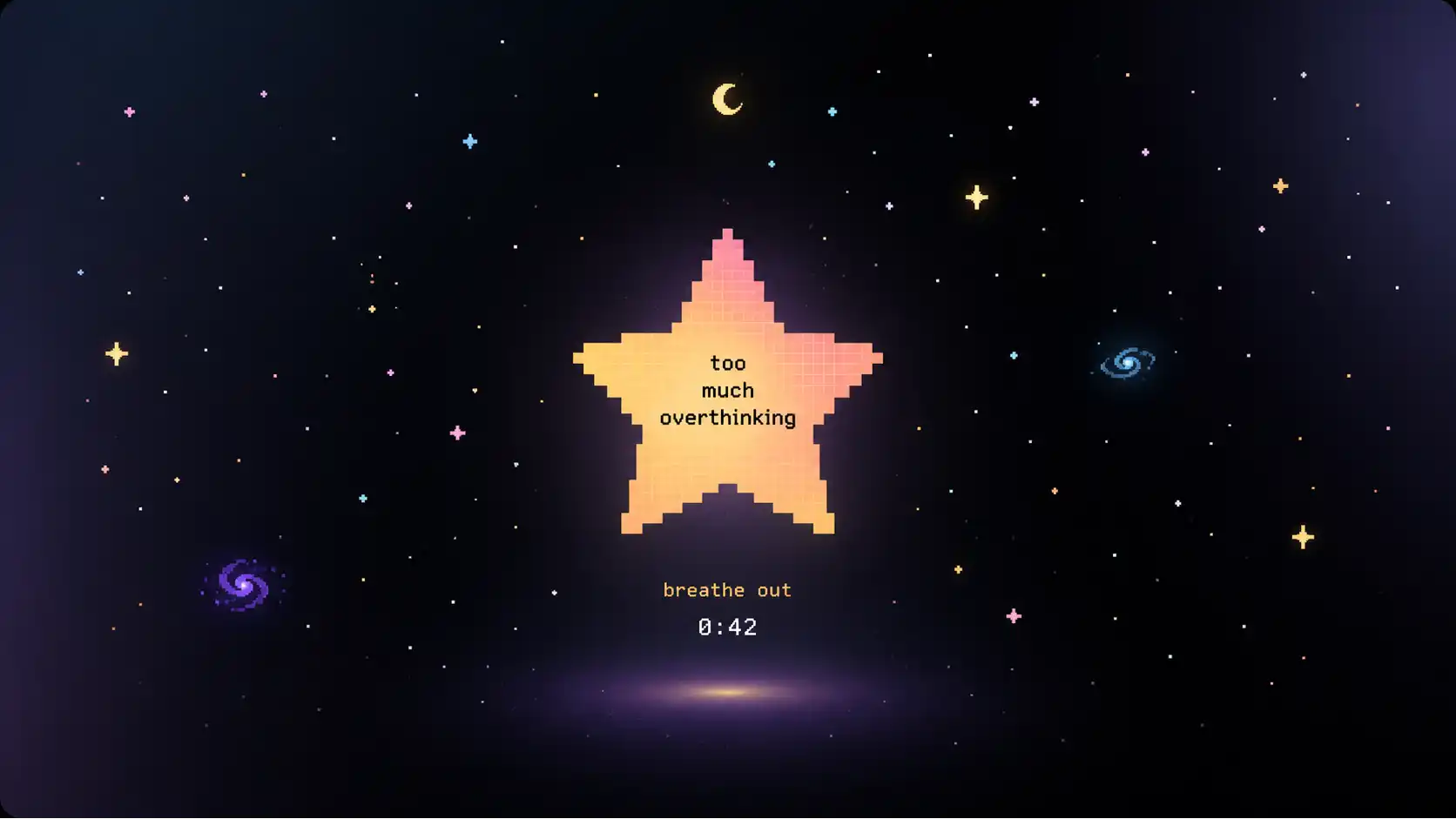
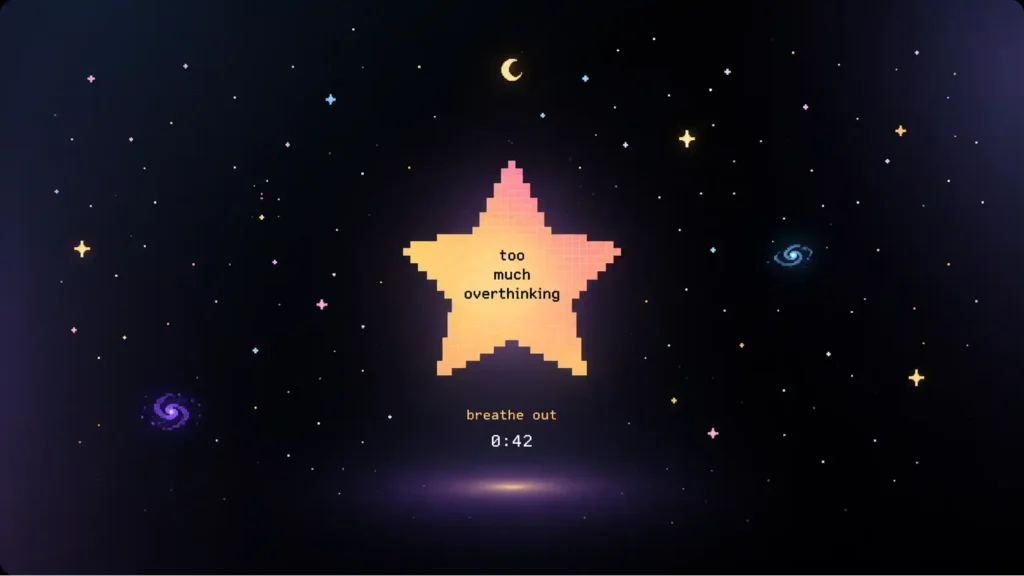
Pixel Thoughts begins with a request that feels almost too small to count as an intervention. Type the thought that is bothering you into a bright star. There is no intake form, no mood score, no account, no onboarding carousel, and no demand that you commit to a seven-day streak. The star sits against a dark field. Your sentence enters it. Then the page takes over for one minute, slowly carrying that sentence away from you until it is no longer the largest thing on the screen.
Table of Contents
That is the entire premise, and its refusal to become more complicated is exactly why the site sticks in the memory. Plenty of meditation products ask you to adopt a practice, choose a teacher, browse a library, set a reminder, select a goal, and learn a vocabulary. Pixel Thoughts behaves more like a small object someone left on the web for the moment when your brain will not stop pressing on the same bruise. Open it, name the worry, watch the worry shrink, close the tab.
The experience is easy to dismiss as a calming animation. That description is accurate but incomplete. Pixel Thoughts is a piece of interaction design that turns perspective into a visible event. Instead of telling you that a thought will pass, it gives the thought a shape and makes it pass. Instead of explaining that your current problem is only one object inside a much larger life, it places the object inside a field of stars and steadily reduces its scale. The site does not win an argument with your anxiety. It changes the stage on which the argument is happening.
Its creator, Marc Balaban, built the original version during a 48-hour hackathon in 2015. He later posted it to Reddit, where it reached the front page and drew a huge wave of visitors. The current official site says Pixel Thoughts has been used by more than 10 million people and remains free, with no account, ads, or paywall. A weekend experiment became one of those rare internet objects that people keep passing to one another for years.
The curious part is not that a meditation site went viral. The curious part is that the thing people remembered was not a lesson, a guru, a quote, or a productivity promise. They remembered the star. They remembered typing something private into it. They remembered watching their own words drift away. Pixel Thoughts survives because the central image is simple enough to retell in one sentence, but personal enough that each visit feels like a private performance.
A worry becomes a piece of scenery
The first smart decision is the input. Pixel Thoughts does not ask, “How are you feeling?” It asks for one thought with enough weight that you want to place it somewhere else. That distinction matters. Feelings are broad, slippery, and difficult to compress. A thought can be typed. “I am going to fail the presentation.” “I said the wrong thing.” “I cannot afford this.” “They have not replied.” The page gives the worry edges, punctuation, and a location.
Typing is a minor physical action, yet it changes the status of the worry. The sentence stops being the atmosphere and becomes an object. A worry inside the head feels borderless because the person experiencing it cannot see where it begins or ends. Once written, it occupies a finite line. It has a length. It can be looked at rather than merely inhabited. Pixel Thoughts uses that change without pausing to explain it. The act of entering the text is already the first movement of the meditation.
The star is not a neutral container. A form field would make the interaction feel clinical or administrative. A speech bubble would imply conversation. A notebook would suggest journaling. A star gives the thought a destination that feels ceremonial without becoming solemn. The object glows, floats, and belongs to a visual world larger than the sentence inside it. The site gently shifts the worry from “the thing happening to me” toward “one small thing currently visible in a much larger scene.”
Then the scale begins to change. The star recedes. The sentence becomes harder to read. The surrounding darkness occupies more of the field. The page makes distance literal. Many calming exercises depend on verbal instructions such as “observe the thought” or “let it go.” Those phrases are clear when a person is calm and strangely useless when the mind is racing. Pixel Thoughts replaces the instruction with choreography. You do not have to imagine distance. You watch it increase.
The one-minute duration is equally precise. Ten seconds would feel like a visual gag. Five minutes would invite impatience, tab switching, and self-consciousness about meditating correctly. Sixty seconds is long enough for a noticeable transition and short enough to begin without negotiation. You can give a website one minute even when you are convinced you have no time. The duration also creates an ending that the user does not need to manage. The worry goes. The exercise stops. There is no decision about when to return.
The background matters because Pixel Thoughts is built around awe in miniature. In a 2016 interview with Mindful, Balaban described turning toward things larger than himself, such as the ocean or a clear night sky, when stressed. He wanted to simulate some of that shift with technology when those views were not available. The stars are not decoration pasted onto a breathing timer; they are the argument of the whole piece. Your worry is present, but it is not the whole sky.
That idea could easily become insulting. Telling someone that their problem is tiny may sound like dismissal, especially when the problem is grief, illness, debt, abuse, or fear with a real basis. Pixel Thoughts walks close to that edge because cosmic perspective can feel freeing to one person and flattening to another. The site works best when the user wants temporary distance from a looping thought, not when they need their circumstances recognized, investigated, or acted upon. Its emotional move is reduction, and reduction is not always the right move.
Still, the animation avoids the harsher version of the message. It does not delete the thought the moment it is entered. It lets the thought remain visible while its relationship to the scene changes. The worry is acknowledged before it is diminished. That sequence gives the user a beat of recognition: yes, this is the sentence; yes, this is what has been circling; yes, it is here. Only then does the star begin its retreat. The page does not require denial. It stages a departure.
What Pixel Thoughts asks from you
| Moment | What happens | Why it lands |
|---|---|---|
| Arrival | A star waits in a dark field | The task is instantly legible |
| Naming | You type one stressful thought | The worry gains edges and a location |
| Release | The star begins to recede | Distance becomes visible rather than abstract |
| Reframing | The sky takes over the frame | The thought is placed inside a larger scale |
| Ending | The star fades after about a minute | The exercise closes without another choice |
The table looks almost comically sparse because the product itself is sparse. There is no hidden maze behind these steps. Pixel Thoughts earns its effect through the order, timing, and visual weight of a few elements, not through breadth. The design lesson is easy to state and hard to follow: when the central action is strong enough, adding features may weaken rather than strengthen the experience.
The site also understands that a person under stress has very little patience for interface interpretation. Its central action does not need a tutorial video or a tooltip. You see the star, understand that words go inside it, and begin. This is not merely “easy to use” in the bland product-review sense. The absence of friction preserves the emotional state that brought you there. Every extra question would risk turning a vulnerable moment into setup work.
There is a strange intimacy in typing the worry into a browser rather than saying it aloud. Speaking can feel too exposed, even when no one is present. Writing in a journal leaves a record that some users may not want. The star feels private because it is temporary. The user is not composing a document for later reflection. The sentence exists to disappear. That temporary quality changes what people may be willing to enter: awkward fears, petty resentments, embarrassing loops, thoughts that would sound disproportionate outside the moment.
The result is closer to a ritual than a conventional app flow. Rituals make inner changes easier to grasp by attaching them to outer actions: light the candle, fold the paper, wash the hands, close the door. Pixel Thoughts gives digital worry a tiny ritual of disposal. Type, watch, release. The page has no sacred claims, yet it borrows the useful structure of a ritual: a threshold, a symbolic object, a timed passage, and a clear return.
Calling it a toy is not an insult. Toys teach through handling. A person understands a spinning top by spinning it, not by reading a description of angular momentum. Pixel Thoughts lets you handle perspective. You place language into an object and watch the object behave differently from the way the thought behaves in your head. The interaction is playful enough to lower resistance and serious enough to hold a real worry for one minute.
That balance explains why screenshots do not fully communicate the site. A still image shows a glowing star and a dark sky. The point lives in the change between frames. The star must contain your words, then become smaller while you are still looking. The page is not a poster with a calming message; it is a timed relationship between your sentence and the available space. The visitor supplies the emotional material. The website supplies the motion.
The interface is the meditation
Most digital meditation follows the media model. You press play and receive a recording. A voice tells you where to place attention, how to breathe, what to notice, and when to return. Pixel Thoughts takes another route. The interface does not deliver the meditation; the interface is the meditation. The text field, the star, the movement, the changing scale, and the minute of enforced watching are not packaging around a lesson. They are the lesson.
This difference changes the user’s role. A guided recording places the listener in a receptive position. Pixel Thoughts begins with an act of authorship. The user provides the only sentence that truly matters. The page may offer calming lines during the animation, but the experience turns on the fact that the central object contains language drawn from the user’s present mind. The meditation is not personalized through a profile or recommendation system. It becomes personal because you insert the thing you cannot stop thinking about.
That is a cleaner form of personalization than much of the web now offers. Modern products often treat personalization as prediction: the system studies behavior, stores preferences, segments the user, and decides what to show next. Pixel Thoughts personalizes without needing to know you. It asks for one piece of context and uses it immediately. No history is needed. No identity is built. The page responds to what you bring, then lets the session end.
The official site now describes a broader idea called “interactive mindfulness,” built around experiences that respond to a person’s thought, attention, or breath rather than reading from a fixed script. Balaban presents Pixel Thoughts as the original example and has begun placing it beside another project, Connected Breath. The phrase fits because interaction is not added to keep the user busy; it is used to make the inner material visible.
This gives Pixel Thoughts an unusual place in web design. It is not a game, though it has a game-like loop. It is not a journal, though it begins with writing. It is not a visualizer, though motion carries much of the effect. It is not therapy, and it should not be confused with therapy. It is a single-purpose emotional interface. The browser makes one small change to one sentence and then gets out of the way.
The timing is part of that interface. Once the star moves, the user cannot speed-read the experience. There is no obvious productivity trick for finishing faster. The site borrows one minute from the user and refuses to compress it further. That mild loss of control is useful. A racing mind often treats every second as evidence that something urgent must be solved. Pixel Thoughts turns the second hand into a container. Nothing is required until the minute ends.
The star’s retreat also creates a visual form of defusion, the practice of seeing a thought as a thought rather than as a command or literal truth. The site does not use clinical terminology, which is part of its charm. It lets the visual metaphor do the work without naming the mechanism. “I am going to fail” becomes a sentence inside a moving object. The sentence may still be frightening, but it is now something the user is observing. The grammar remains; the authority changes.
There is no score for calmness at the end. That omission protects the experience from a common problem in wellness software: turning self-regulation into performance. Pixel Thoughts does not ask whether you meditated well. It does not reward a complete streak, award a badge, or display minutes accumulated. You cannot fail the exercise by having another thought. You can only watch the one you entered become smaller.
This matters because measurement changes attention. A score makes the user watch themselves. A streak makes tomorrow part of today’s session. A progress chart converts a private pause into a project. Pixel Thoughts keeps the unit of success local: you stayed with the animation for one minute. Whether the worry vanished, softened, or remained stubborn is not graded. The site offers a gesture, not a contract.
The lack of navigation inside the core experience creates another useful constraint. A large library asks the stressed user to choose the correct content while stressed. Should the session address sleep, panic, confidence, anger, grief, focus, or relationships? Pixel Thoughts avoids the category problem by letting the sentence carry the category. The same star can hold a deadline, a breakup, a medical appointment, or a conversation replayed at 2 a.m. The interface stays the same while the emotional content changes.
This is where the site’s smallness becomes unusually sophisticated. Many products grow by adding paths. Pixel Thoughts gains range by keeping one path open to many inputs. Its flexibility comes from the blank space inside the star, not from a menu. The user does the classification in ordinary language. The system does not need to understand the sentence in order to stage its disappearance.
The sound and visual atmosphere support this narrow task. Calm products often pile on rain tracks, nature loops, gradients, illustrated mountains, and slow-moving particles until the result feels like a category template. Pixel Thoughts uses the night sky as a working part of the metaphor. The background is not there merely to soothe; it is there to establish scale. A star can recede into a cosmos. The user’s thought can move from center to speck.
The page’s language also benefits from restraint. It does not attempt to solve the worry with advice. A generic response to a specific fear often feels absurd: the system does not know whether the fear is realistic, whether action is needed, or whether the user is safe. Pixel Thoughts mainly changes proportion rather than offering counsel. This keeps it from pretending to know more than it knows.
There is a product lesson here for anyone building tools around emotion. When users arrive with personal material, the instinct is to generate more content: analysis, recommendations, plans, affirmations, summaries. Sometimes the respectful response is a well-shaped silence. Pixel Thoughts lets the user’s own sentence remain central, then uses motion and space instead of a stream of machine-made interpretation.
The web toy quality also protects it from the burden of authority. A clinical-looking dashboard would invite clinical expectations. A chatbot would invite disclosure and demand safe, accurate replies. A course would imply a program. A glowing star makes a modest promise. Give it a thought for a minute and see whether the thought feels different afterward. The promise is narrow enough to be believable.
That modesty does not mean the design is emotionally neutral. The site has a point of view: a thought can be acknowledged without being obeyed; perspective can reduce its grip; the user may be larger than the sentence currently filling their mind. Pixel Thoughts expresses this point of view through interaction rather than doctrine. You learn what the site believes by watching what it does to your words.
Why the tiny format works
The best explanation for Pixel Thoughts begins with friction. People rarely seek a calming tool when they are calmly comparing options. They arrive while distracted, restless, embarrassed, tense, or stuck. The product meets a low-capacity moment with a low-capacity demand. One sentence. One minute. One moving object. That is enough structure to begin and not enough structure to become another burden.
A ten-minute practice may be better for building attention over time, but it loses every time the user refuses to start. Pixel Thoughts chooses a different battle. It competes with the impulse to refresh, pace, message someone, reopen an argument, or replay the same thought. Sixty seconds is small enough to insert between those impulses. The site is not trying to replace a meditation habit. It is trying to interrupt a loop.
The user’s own wording sharpens that interruption. A vague state such as “stress” can expand endlessly. A sentence forces selection. Which part of the stress is loudest? What prediction keeps repeating? What image or memory is holding the mind? Naming one thought cuts a hole in the fog. Even before the animation begins, the user has moved from an undefined mass toward a specific claim.
Specificity also creates a subtle test. Once the worry is written, the person can see whether it is a fact, a forecast, a judgment, or a replay. “The meeting is tomorrow” is a fact. “Everyone will think I am incompetent” is a forecast. “I always ruin things” is a judgment. Pixel Thoughts does not label these forms, but the screen makes their form easier to notice. A thought that felt like reality may reveal itself as a sentence making a claim.
The shrinking motion then adds a bodily cue. The eyes track a retreating object. The user waits for the object to become small enough that reading is no longer easy. Attention is given a simple job that is neither solving nor suppressing. That matters because telling a person not to think about something often keeps the subject active. Pixel Thoughts permits attention while changing what attention is doing.
The cosmic setting introduces awe, but in a controlled dose. Awe often involves encountering something larger than the self, which can reduce the felt dominance of immediate concerns. Pixel Thoughts cannot reproduce an ocean cliff or a clear rural sky on a laptop, yet it borrows the visual grammar of vastness: darkness, depth, distant points of light, a central object moving away. Balaban has said this was part of the original impulse behind the project.
The site also takes advantage of a familiar animation convention. Objects that shrink and move away are understood as leaving. No explanation is needed. The interface speaks in spatial verbs. The worry recedes, fades, drifts, and disappears. These actions are easier to feel than a paragraph about cognitive distance. The user’s visual system receives the message before the analytical mind has a chance to debate it.
Repetition is possible without becoming a regimen. A user may return with another thought, but the site does not insist. Pixel Thoughts remains available without chasing the person. No push notification announces that calmness is overdue. No email asks whether the user has maintained a streak. This quiet availability suits the nature of worry: the tool waits until the person decides the loop has become too loud.
The official site’s current positioning leans into that low-friction identity. It says the browser version is free, requires no installation, and asks for no account. It also points to official mobile apps, but the web version remains the cleanest expression of the idea. The browser tab is part of the magic because it feels disposable. You do not need to install calmness as a lifestyle. You can borrow it for a minute.
There is a privacy-shaped comfort in not creating a profile, though users should always judge sensitive input carefully and check current policies. The emotional appeal is clear: a worry can enter the interaction without becoming part of an ongoing identity inside the product. The site does not need a name, age, diagnosis, goal, or history to run the classic exercise. That is rare in a web culture built around persistent accounts.
The research associated with Pixel Thoughts adds an unexpected layer, but it needs to be read with care. A 2018 randomized controlled trial involving 125 orthopedic patients compared a 60-second interactive mindfulness exercise using Pixel Thoughts with a time-matched educational pamphlet. The researchers reported statistically detectable improvements in pain, anxiety, depression, and anger immediately after the exercise. The study supports the idea of brief in-the-moment relief, not a claim that one minute treats a psychiatric disorder.
The official research page summarizes relative reductions of 29 percent in anxiety symptoms, 30 percent in depression, 44 percent in anger, 8 percent in state anxiety, and 13 percent in pain intensity. Those figures sound dramatic without context. The responsible reading is narrower: a short exercise produced measurable immediate shifts in a specific clinical sample with low baseline distress. The researchers themselves framed the tool as feasible and acceptable in a busy orthopedic setting and called for more work on dose and durability.
That narrow result is still interesting because Pixel Thoughts was not born as a formal medical product. It was a hackathon project that escaped into public use, then was selected independently by researchers. The direction of travel ran from web experiment to clinical study, not from laboratory protocol to consumer interface. Balaban says he learned about the research years after it had been conducted. The story makes the site feel like a small piece of internet folklore that wandered into an academic paper.
The research also points toward one reason the format fits busy settings: the intervention finishes before resistance has time to build. A waiting room, office corridor, train platform, or pre-meeting pause may not support a long session. Pixel Thoughts fits inside the cracks of ordinary time. The site does not ask the environment to become peaceful before the user begins. Headphones and privacy may improve the experience, but the core interaction remains small enough to use almost anywhere.
Its usefulness is strongest when the problem is one loud cognitive loop. If the distress is chiefly physical—a racing heart, shaking, breathlessness—another grounding or breathing exercise may fit better. If the mind is crowded with twenty tasks, a written list may be more direct. Pixel Thoughts has a specific target: the sentence that keeps returning with too much authority. Its narrowness is a strength only when the user matches the tool to that target.
The minute also works because it does not demand belief. A person can arrive skeptical, type the worry, and watch. No spiritual commitment is required. The user does not need to agree with a theory of consciousness or adopt a meditation identity. The exercise is closer to trying a visual experiment: this thought feels enormous now; let us see how it feels after watching it become a speck.
That testable quality gives the site a refreshing honesty. The outcome is immediate and subjective. Either the thought feels lighter, or it does not. Pixel Thoughts does not hide failure behind a long program. It cannot say the user needs three weeks of consistency before judging the result. The one-minute promise is exposed to one-minute evaluation, which is risky but clean.
A small web project with a long afterlife
Pixel Thoughts belongs to a beloved class of websites: the page made by one person that does one strange, memorable thing extremely well. These sites do not feel like destinations planned by a content department. They feel discovered. Their links travel through group chats, old bookmarks, classroom resource pages, Reddit threads, Tumblr posts, newsletters, and messages sent at midnight with no introduction beyond “try this.”
Balaban’s account of the launch captures an older internet rhythm. He built the project in a 48-hour hackathon, shelved it briefly, fixed a few bugs, registered the domain, and posted it to r/InternetIsBeautiful. At first the submission appeared to stall. Then it climbed, reached Reddit’s front page, and sent thousands of concurrent visitors toward the site. A private experiment became a public object in a matter of hours.
His later write-up says the site saw more than a million visitors, with over 7,700 concurrent connections during the surge and 58 percent of the early traffic arriving within the first 48 hours. Those numbers belong to the creator’s own analytics account, not an independent audit, but they match the shape of a classic Reddit wave: enormous exposure, immediate infrastructure pressure, press interest, and a narrow window in which attention peaks. Pixel Thoughts was built for sixty seconds and discovered at internet speed.
The launch story is funny because the product had almost none of the machinery that startup advice would demand. No carefully staged waitlist. No founder story on the first version. No monetization plan. Balaban wrote that he had not even placed his name on the project before the traffic arrived. The thing spreading was the interaction itself, stripped of a business narrative. People shared what the site did, not what company it represented.
That distinction remains central to its appeal. The official about page says Pixel Thoughts is not a company, has no investors, and has stayed free. It also says Balaban eventually left his job to work on the project and a wider set of interactive mindfulness experiences full time. The site now has a future without pretending it was always a startup waiting to happen. Its history retains the texture of a side project that proved too useful to abandon.
Longevity is especially striking because the web has changed around it. The 2015 internet was already commercial, but it still produced many small experiments that expected nothing more from the visitor than a click. The 2026 web asks for accounts, consent banners, notifications, subscriptions, personalization, and repeated engagement. Pixel Thoughts still feels like a link, not a funnel. That difference is increasingly rare.
The site’s durability also comes from technological modesty. Its central idea does not depend on a fashionable platform or a novelty that dates quickly. A star, a sentence, and a timed animation remain legible across devices and eras. The experience survives because the metaphor is older than the software. People have written worries on paper and burned, buried, folded, floated, or discarded them for generations. Pixel Thoughts gives that gesture a browser-native form.
Its visual age may even help. Highly polished wellness products often arrive with interchangeable gradients, rounded cards, soft illustrations, and identical promises. Pixel Thoughts feels more like a crafted web scene than a corporate design system. The slight toy-like quality makes the moment feel found rather than prescribed. A user is less likely to wonder what plan is being sold because the page behaves like a small gift.
Press coverage in the years after launch helped keep the link moving. Mindful featured the project and interviewed Balaban in 2016. The official press page also lists coverage from outlets including The New York Times, HuffPost UK, BuzzFeed, Metro, and several design and wellness publications. The site crossed categories because it could be framed as meditation, web design, stress relief, internet curiosity, or visual storytelling.
That category ambiguity is useful for discovery. A meditation app competes with other meditation apps. A web toy competes with boredom. A design experiment competes for curiosity. Pixel Thoughts can enter through any of those doors. Its audience includes people who would never search for a formal mindfulness course. Someone may click because the premise sounds clever and discover, halfway through, that they have become quiet.
The project’s spread also shows the strength of explainable interaction. A person can recommend Pixel Thoughts without summarizing an article or endorsing a philosophy. “Type a worry into a star and watch it shrink.” The recommendation contains the product. This makes the link unusually portable. It works in a tweet, a classroom slide, a therapist’s resource list, a friend’s message, or a footnote in a newsletter about strange websites.
A good discovery site creates a small before-and-after in the reader’s mind. Before clicking, the person knows the premise but not the feeling. After clicking, the person understands why the star matters. Pixel Thoughts preserves a gap between description and experience. You can explain every mechanic and still not reproduce the minute in which your own sentence becomes unreadable against the stars.
The creator’s current “universe” page suggests a wider ambition: a collection of short mindfulness experiences that respond to what the user brings. Connected Breath, the second project listed there, uses real-time shared breathing as its central interaction. The expansion is interesting because it grows the idea sideways rather than stuffing more features into the original star. Pixel Thoughts remains one clear object while related experiments occupy their own spaces.
That is a wiser path than turning the original page into a dashboard. A dashboard would make Pixel Thoughts feel like the first module in a course. A feed would make it feel social. A chatbot would shift attention from symbolic release toward conversation. Keeping the classic exercise intact protects the reason anyone cared. New products can explore other forms of interaction without asking the star to become everything.
The mobile apps complicate that purity slightly. The official listings now add custom meditations created from the thought a user enters, while retaining the classic exercise. This may suit people who want more guidance, but the web version remains the sharper artifact because it stops before interpretation begins. A generated meditation can respond to the content of the worry. The shrinking star responds to its presence. That difference is small on paper and large in tone.
The continued existence of Pixel Thoughts says something generous about the web. Not every enduring product needs endless surface area. Not every viral moment must become a platform. A single interaction can remain worth visiting a decade later when its shape is clear and its emotional timing is right. The internet often remembers the pages that gave it a distinct gesture: draw here, listen there, watch this, send that, place your worry inside the star.
Where the spell holds and where it breaks
Pixel Thoughts is easy to love, but its best use is narrower than its broadest fans may suggest. It is well suited to rumination, anticipatory worry, embarrassment, irritation, and the repetitive sentence that has grown larger through rehearsal. It is less suited to situations requiring planning, protection, medical care, legal help, or direct conversation. A thought may feel smaller after one minute while the underlying problem remains exactly the same.
That distinction does not weaken the site. It makes the promise more credible. Relief and resolution are different outcomes. Pixel Thoughts aims at relief: a shift in felt scale, a pause in repetition, a little room around the sentence. Resolution may involve sending the email, making the appointment, changing the budget, leaving the room, asking for help, or accepting that grief will not be animated away.
The site can also land poorly when the message of cosmic smallness collides with a need for recognition. A person facing loss may not want to feel that the loss does not matter. Someone living through trauma may not benefit from a visual suggestion that the thought should disappear. Perspective is not universally comforting. The same stars that create freedom for one visitor may create alienation for another.
User reviews on the App Store have reflected this tension, with at least one reviewer praising the calming effect while warning that some wording could make people feel as though they do not matter. The developer replied that the wording would be corrected. That response reveals how delicate the copy is inside an experience built on scale. The design must make the worry smaller without making the person smaller.
The strongest reading of the site is not “your problem is meaningless.” It is “your thought is present, but it is not the total field.” The person remains the observer after the star has gone. That distinction should guide how the experience is written and maintained. Cosmic perspective works when it widens identity, not when it erases pain.
There is also the risk of emotional avoidance. Releasing a repetitive thought may be healthy; repeatedly dissolving every uncomfortable thought may become a way of refusing useful information. Anger can point toward a boundary. Fear can point toward danger. Guilt can point toward repair. Not every unpleasant sentence is noise. Some thoughts need to be examined after the nervous system has settled.
Pixel Thoughts works best as a first move rather than a final answer. Use the minute to reduce heat, then decide whether the issue needs action. The star can clear enough space for judgment. It should not replace judgment. This is particularly true when a worry concerns personal safety, self-harm, abuse, severe symptoms, or a crisis. A browser animation is not crisis support, diagnosis, or treatment.
The clinical study needs the same discipline. The randomized design is noteworthy, and the immediate shifts are encouraging, but the sample consisted of patients in an orthopedic setting, the baseline distress was low, and the researchers measured outcomes immediately after a brief session. The evidence supports a momentary intervention in that context, not sweeping claims about curing anxiety or depression.
The official site states this limitation clearly on its research pages, which is good practice. It describes the exercise as a quick tool for in-the-moment relief and directs people with diagnosed conditions toward licensed professionals. The restraint around the evidence matters because the product’s simplicity makes overclaiming tempting. A dramatic percentage attached to a sixty-second tool can travel faster than the caveats.
Accessibility deserves attention too. A visual exercise based on shrinking text may not translate equally well for visitors with low vision, motion sensitivity, cognitive differences, or screen-reader use. Sound may be unavailable or unwelcome in a public setting. The core metaphor depends heavily on sight and motion. A thoughtful evolution of the project would preserve the original while offering alternate modes that carry the same arc through sound, touch, or clear accessible text.
The typed input raises a practical privacy question because worries may contain names, health details, workplace information, or other sensitive material. The classic site’s account-free design is reassuring, but users should still avoid entering identifying details they would not want transmitted or logged by any web service. A worry does not need a full name, address, employer, diagnosis, or case number to feel specific. “I am afraid about tomorrow’s appointment” is enough for the ritual.
There is a subtler limitation in the forced singular. Some distress does not arrive as one sentence. It arrives as noise, bodily agitation, grief without language, or a pile of competing tasks. Pixel Thoughts asks the user to choose one star when the mind may feel like a meteor shower. That can be clarifying, but it can also feel impossible. On those days, a blank page, a breathing exercise, movement, or human contact may fit better.
The site’s calm messages may also feel too certain for some worries. Reassurance works when the threat is inflated; it can grate when the threat is real. The animation is strongest when it trusts the visual metaphor and weakest when copy tells the user what their life means. The more specific the site becomes about the emotional conclusion, the more chances it has to miss.
Even with those limits, Pixel Thoughts earns recommendation because it is unusually easy to test. There is no purchase, account, or long commitment. The cost of discovering that it is not for you is one minute. That low cost supports honest editorial advice: open it with a real but manageable worry, watch the whole sequence once, and notice whether the sentence has changed size in your mind.
The ideal first thought is concrete, current, and repetitive. “I keep thinking I embarrassed myself in that meeting” is better than “my whole life.” “I am afraid they will reject the proposal” is better than “everything is bad.” A sentence with edges gives the star something it can carry. The site is not built to hold an entire biography.
It also helps to avoid treating the exercise as a test of emotional competence. If the worry remains, that does not mean the user failed. Some thoughts do not shrink on command. The minute may still reveal that the thought needs a different response: more time, a plan, a conversation, rest, professional care, or simple patience. A good tool can clarify its own insufficiency.
The spell holds when the site creates just enough distance for the person to breathe and choose. It breaks when distance becomes dismissal, when relief is mistaken for treatment, or when a real problem is reduced to a visual effect. Pixel Thoughts is at its best as a small act of proportion. It gives the mind a wider frame and then returns responsibility to the person using it.
What Pixel Thoughts reveals about good web products
Pixel Thoughts makes a strong case for designing around a verb. Not a category, not a demographic, not a feature bundle—a verb. You release. Every piece of the page supports that action. The input captures the object to be released. The star holds it. The motion performs the release. The sky receives it. The timer closes the action.
Products become muddy when they carry too many verbs. Track, learn, share, compare, customize, earn, message, discover, subscribe. Each verb pulls attention in another direction. Pixel Thoughts stays coherent because the user always knows what is happening to the thought. The interface has one dramatic line, and every visual decision serves it.
The site also shows that constraints can create emotional safety. The user cannot write a novel, browse strangers’ worries, or receive public reactions. The worry is contained by format. That containment reduces the chance that the page becomes a feed of pain or a stage for performance. The experience remains private in feeling even though it happens on a public website.
This is a useful contrast with social wellness products. Community can reduce isolation, but public sharing adds comparison, moderation, and the pressure to present distress in a legible way. Pixel Thoughts offers no audience. The absence of witnesses lets the sentence be unpolished. It does not need to be brave, wise, relatable, or complete. It only needs to be the thought currently occupying too much space.
The project also respects the difference between attention and engagement. Product teams often treat more time on site as success. Pixel Thoughts is built to finish. Its ideal session ends with the user leaving. That is almost rebellious by current web standards. The product is not trying to become the place where you spend the evening. It wants to return the evening to you.
A short session also makes quality more visible. In a large app, an average feature can hide inside a big library. In Pixel Thoughts, every second belongs to the main idea. There is nowhere for weak pacing to hide. The star must move at the right speed. The messages must arrive without crowding the thought. The ending must feel complete rather than abrupt. Small products demand precision because the whole product is always on stage.
The star is a lesson in memorable product identity. Logos are often treated as identity while the interaction remains generic. Pixel Thoughts reverses that. The interaction itself is the brand. Even without remembering the name, people remember “the website where you put a worry in a star.” That is stronger than recognition built only from a color palette or wordmark.
The project also demonstrates the value of a premise that survives retelling. Good web discoveries often travel through imperfect descriptions. A friend does not paste a pitch deck; they send a sentence. Pixel Thoughts loses almost nothing in oral transmission. Type a worry. Watch it shrink into the universe. One minute. The premise is concrete, visual, and complete.
Its creator story adds warmth but does not rescue a weak product. That order matters. People first encounter the experience, then become curious about who made it. The human story deepens the object instead of replacing it. A weekend hackathon, an unexpected Reddit surge, years of quiet use, an independent clinical study, and a later return to full-time work all feel compelling because the star already works.
Pixel Thoughts also shows how a website can age well by leaving room around itself. It does not depend on a dense topical feed that must be refreshed daily. It does not lean on current slang or platform jokes. The core concern—one thought becoming too large—is not dated. The page meets a recurring human pattern with a stable visual metaphor.
There is restraint in the current expansion too. The official universe page does not present a giant ecosystem. It presents a small set of interactive mindfulness experiences and an intention to build more. The collection remains credible because it is still visibly made by a person. The scale of the promise matches the scale of the work.
For designers, the most useful lesson may be that emotional products do not always need emotional language. A product can create calm through pacing, focus, contrast, and completion. Pixel Thoughts makes a feeling through behavior. The words matter, but the movement carries the central claim.
For founders, the lesson is less comfortable. The site’s charm comes partly from what it does not monetize. Add an interstitial ad before the star, and the entire mood collapses. Put the final moment behind a subscription prompt, and the release becomes a conversion event. Some products lose their moral and aesthetic center when every visit is asked to pay rent.
That does not mean independent creators should work for free. Pixel Thoughts now includes official apps and a wider project around interactive mindfulness, and its creator has chosen to work on it full time. The harder question is how to fund work without corrupting the moment that made it worth funding. The classic page sets a high bar because its trust comes from asking almost nothing in return.
For editors and internet curators, Pixel Thoughts is the kind of find that justifies the whole habit of looking. It is useful without being dreary, strange without being pointless, and emotionally direct without demanding a personal brand. It reminds readers that the web still contains small doors into carefully made experiences. You do not need a platform account to enter. You need a thought and sixty seconds.
The site also resists the current assumption that artificial intelligence should sit between every person and every problem. The classic experience does not interpret the worry, classify it, or generate advice. Its intelligence is in the shape of the interaction. The page knows what to do without needing to know what the sentence means.
That is perhaps the sharpest product choice of all. By not understanding the content, Pixel Thoughts avoids pretending it can solve the content. It can still change the user’s relationship to it through scale and time. The tool acts on attention rather than information. This keeps the original experience small, honest, and broadly reusable.
A future version could add endless sophistication: sentiment detection, adaptive scripts, personalized visuals, biometric pacing, progress histories. Some of those ideas might produce good separate products. They would not necessarily produce a better star. The original’s power comes from the fact that a worry can remain private, partly unknown, and still be carried away.
Things readers tend to ask
The classic browser experience is free and the official site says it has no account, ads, or paywall. The creator also offers official iOS and Android apps. Listings and policies can change, so the official website is the safest place to confirm the current versions rather than downloading apps that share the name but come from unrelated developers. The absence of signup is more than a pricing detail. It preserves the speed of the ritual. A stressed visitor does not need to hand over an email address, choose a password, verify a message, and accept a tour before reaching the star. The browser version begins close to the emotional need that brought the person there.
Yes, the core exercise is built around a one-minute sequence. You enter one stressful thought and watch the star carrying it recede while the page guides the moment. The official description consistently presents Pixel Thoughts as a 60-second tool, and the clinical study tested a brief session of that length. The duration is not a teaser for a longer locked session. The minute is the product. You may repeat it with another thought, but the classic interaction reaches its intended end without asking you to continue into a course.
No. Pixel Thoughts is a brief mindfulness exercise, not therapy, diagnosis, crisis care, or medical treatment. The official site states that its research concerns immediate symptom relief and does not establish treatment for diagnosed anxiety or depressive disorders. People dealing with persistent or severe distress need support suited to that level of need. Its best role is modest: create a pause, reduce the felt size of one thought, and give the user enough room to decide what comes next. A minute of distance may support a better next step, but it is not the next step itself.
A 2018 randomized controlled trial with 125 orthopedic patients compared the Pixel Thoughts exercise with a time-matched educational pamphlet. Researchers reported immediate improvements across measures including pain, anxiety, depression, and anger. The study found a measurable short-term shift after one session in that sample. The caveats deserve equal weight. The patients began with low distress, the outcomes were measured right after the exercise, and the study did not show long-term treatment effects. It is fair to call the result encouraging and unfair to turn it into a cure claim.
Marc Balaban, a software engineer and independent creator, built Pixel Thoughts during a 48-hour hackathon in 2015. He posted it to Reddit, where it reached the front page and drew a rapid burst of traffic. The official about page says he later chose to work on Pixel Thoughts and related interactive mindfulness projects full time. The creator story matches the product: a compact experiment made quickly, released without a grand campaign, and kept alive because strangers continued to use it. Its path feels more like internet folklore than a conventional wellness launch.
Choose one concrete sentence that keeps repeating. A prediction, replay, fear, or self-criticism works better than a broad label. “I think I ruined that conversation” gives the animation a clear object. “My life” asks one minute to carry too much. Avoid including private identifiers. The emotional truth of the thought does not require full names, addresses, medical record numbers, employer details, or other sensitive information. The star needs the shape of the worry, not your paperwork.
Nothing compulsory, which is part of the pleasure. The experience does not turn the release into a task list. You can close the tab, repeat the exercise, sit quietly, write down an action, or return to what you were doing. The page has already completed its promise. A useful follow-through is to ask whether the thought now needs action or rest. If action is needed, choose one small concrete move. If no action is available, the minute may have done enough by loosening the loop. The site creates space; you decide how to use it.
No single calming exercise does. Pixel Thoughts depends on a visual metaphor of distance and smallness, and people respond differently to that metaphor. Some feel immediate relief. Others may find the cosmic framing dismissive, the messages too reassuring, the motion uncomfortable, or the whole experience may do nothing. Its low barrier makes an honest trial easy. Use a manageable worry, complete one session, and notice the result without grading yourself. A neutral reaction is useful information too. It tells you to choose another form of grounding rather than forcing this one.
Because the interaction is direct, visual, and a little magical. Toy-like design lets the user understand by doing. There is no need to master meditation terminology before the star starts moving. The experience has rules, motion, anticipation, and an ending, but no score. That playfulness lowers the emotional temperature. A formal mental-health interface may make a small worry feel like a case file. Pixel Thoughts makes it something you can place, watch, and release. The toy quality is not a disguise placed over the meditation; it is the route into it.
For the purest version of the idea, the browser remains the strongest first visit. It preserves the accidental-discovery feeling: open a link, meet the star, leave a minute later. No installation turns the exercise into a commitment. The official mobile apps may suit repeat users and include more personalized meditation options. Yet the classic page has a sharper editorial identity because it does one thing and stops. Start with the website before deciding whether you need more. Pixel Thoughts is worth opening precisely because the description sounds almost too neat: type a worry into a star and watch it shrink into the universe. Then the site makes that sentence feel less like a pitch and more like a physical fact. Your worry occupies the center, loses scale, becomes unreadable, and leaves the frame. The web is full of products that promise to understand us. Pixel Thoughts offers something quieter. It gives one thought a shape, one minute of movement, and somewhere to go. That is not enough for every problem. For the right looping sentence at the right moment, it is enough to make the browser feel briefly larger than the worry inside it.
Author:
Jan Bielik
CEO & Founder of Webiano Digital & Marketing Agency
This article is an original analysis supported by the sources cited below
Pixel Thoughts
The official site for the classic 60-second exercise, its current free and account-free positioning, app links, usage claim, and summary of the research.
About Pixel Thoughts
Marc Balaban’s official account of building the project during a 2015 hackathon, its Reddit launch, its later clinical use, and his decision to work on interactive mindfulness full time.
The Pixel Thoughts universe
The official description of interactive mindfulness and the relationship between Pixel Thoughts, Connected Breath, and future projects.
The research behind Pixel Thoughts
The project’s own detailed summary of the randomized trial, reported outcomes, supporting papers, and limits of the evidence.
Does a brief mindfulness exercise improve outcomes in upper extremity patients
The full 2018 randomized controlled trial that tested the 60-second Pixel Thoughts exercise against a time-matched educational control.
What happens when your app hits the frontpage of Reddit
Balaban’s first-person account of the project’s viral launch, traffic surge, technical pressure, and early lessons.
Mindfulness website animates letting go of your anxiety
Mindful’s 2016 feature and interview with Balaban about the use of cosmic scale and awe in the project’s design.
| Citing this article? Brief excerpts are welcome. Please credit Webiano.digital, name the author where stated, and include a link to https://webiano.digital and to this original article. Full or substantial republication requires prior written permission. Read our Copyright and Content Use Policy. |
This article was prepared with the assistance of artificial intelligence tools. The content underwent expert human review, and Webiano Digital & Marketing Agency assumes editorial responsibility for its final version and publication.