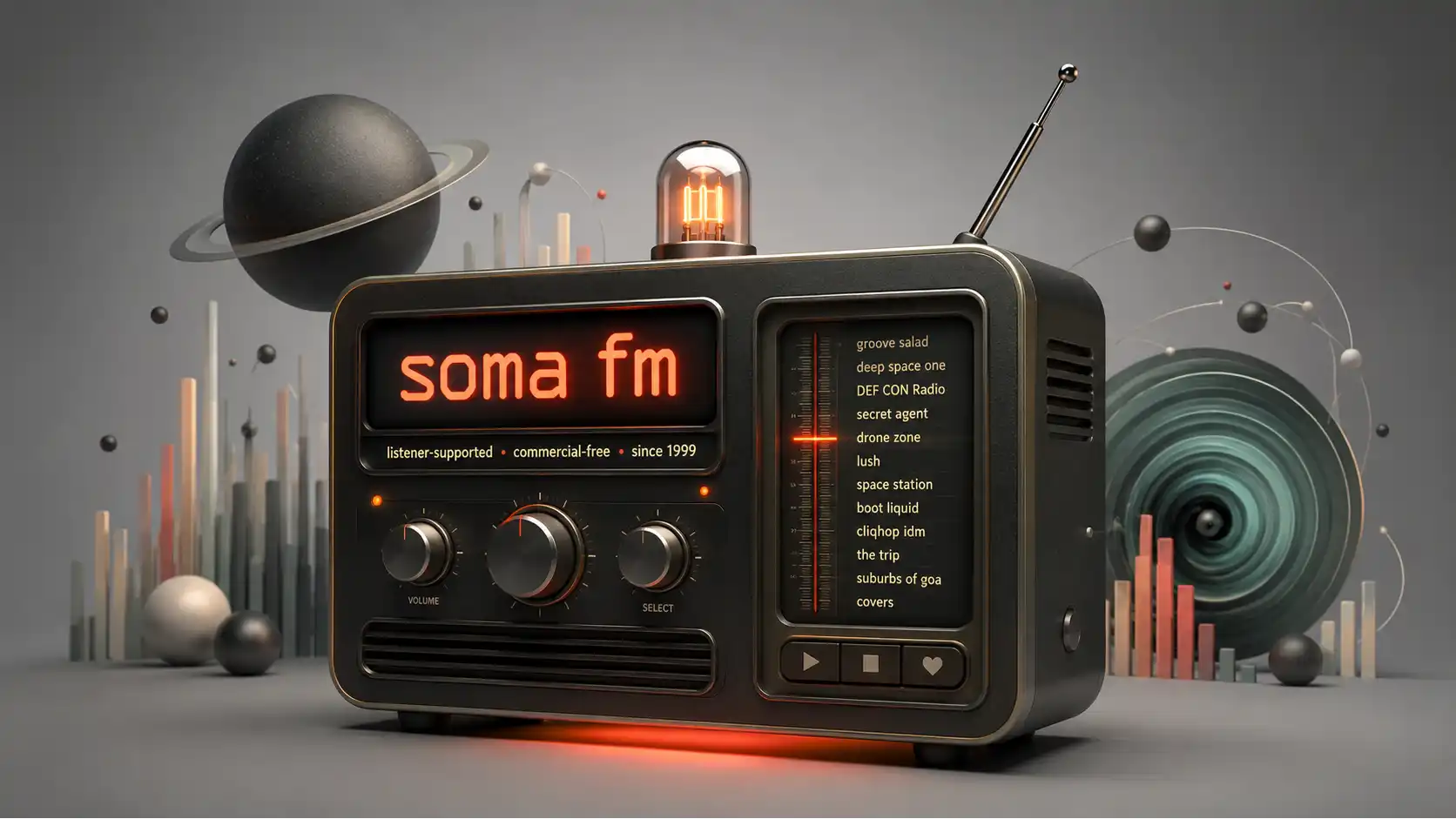
SomaFM feels less like a music service than a frequency you discover by accident and keep for years. Open the site and you do not meet a glossy onboarding sequence, a demand for your date of birth, or a cheerful robot asking which five artists define your soul. You meet a grid of station names: Drone Zone, Groove Salad, Secret Agent, Illinois Street Lounge, Seven Inch Soul, Metal Detector, Suburbs of Goa, Deep Space One. Each name suggests a room, a time of night, a dubious piece of furniture, perhaps a drink with too much garnish. Press play and the room appears. No commercial interrupts it. No host tries to manufacture urgency. No recommendation engine announces that it has decoded you. Music simply continues, selected by people who have spent years deciding what belongs next to what.
Table of Contents
The surprise is not that this works; the surprise is that it still exists. SomaFM officially launched in February 2000 after founder Rusty Hodge concluded that nobody else was going to make the internet radio station he wanted to hear. Its first three channels were Drone Zone, Groove Salad, and Secret Agent, a founding sequence that already contained the whole personality of the project: calm, strange, cinematic, specific. More than a quarter-century later, the homepage presents over 30 listener-supported, commercial-free channels, still centred on underground and alternative music, still hand-programmed rather than built around an infinite personalised feed.
Calling SomaFM “internet radio” is accurate but incomplete. The phrase now covers everything from corporate streaming apps with radio-shaped buttons to automated artist stations that are playlists wearing a fake broadcast moustache. SomaFM belongs to an older, more interesting idea. A station should have a point of view. Someone should decide what it is for, which edges it will keep, and which obvious records it will refuse. The listener should be able to arrive without paperwork and leave without a retention campaign. The music should have enough internal logic to change the atmosphere of a room, yet enough surprise to keep the ear awake.
What SomaFM sells, although it does not charge admission, is relief from choosing. Modern music platforms give listeners nearly every recorded possibility and then make them responsible for turning abundance into a satisfying hour. SomaFM does the opposite. It limits the field. You choose a world, not a sequence of tracks, and then surrender the small decisions. The station carries the burden of continuity. That makes it useful while working, cooking, reading, driving, recovering from a night out, or staring at a ceiling at 2:17 a.m. It also makes it quietly radical. In an online culture devoted to giving the user more control, SomaFM makes a persuasive case for being competently guided.
The site’s taste is weird, but not random. Weirdness on the internet is often a costume: purple gradients, ironic copy, a spinning skull, a product underneath that behaves exactly like every other product. SomaFM’s strangeness reaches into the programming. An entire channel combines ambient music with San Francisco public-safety radio traffic. Another treats NASA communications as part of the listening environment. One is devoted to vintage soul from original seven-inch singles. Another imagines the soundtrack to a stylish spy film that never existed. These are not demographic categories. They are editorial premises. They give the station a stronger identity than any amount of brand strategy could manufacture.
You can hear the labour behind the calm. SomaFM says its main library contains more than 9,500 CDs and 250,000 digital tracks, with additional personal collections held by individual music directors; its FAQ also reports tens of thousands of distinct artists played across a two-year period. Those figures matter less as proof of scale than as evidence of selection. A huge library does not automatically create good radio. The important part is the repeated, unglamorous act of rejecting tracks that technically fit a genre but weaken a station’s mood.
SomaFM is a web discovery because it becomes more interesting after the first click. The obvious appeal is clean: free streams, no ads, music with character. The deeper appeal appears over time. You begin to notice how each channel holds its shape. You learn that “ambient” can mean a soft electronic glide, an abyssal drone, a spacecraft interior, or a background haunted by emergency dispatch. You realise that a radio station can be useful without flattening itself into neutral productivity paste. You start recognising artists you would never have searched for because you did not know their names. The station does not simply play obscure music. It creates the conditions in which obscurity becomes familiar.
The station that refuses to become a feed
Most digital music products begin with the listener as a problem to solve. Who are you? What do you like? What did you skip? What might keep you inside the app for six more minutes? The service gathers signals, turns them into a profile, and reorganises the catalogue around that profile. This can be convenient. It can also become claustrophobic. The more accurately a platform learns your habits, the more often it hands those habits back to you. Discovery becomes a loop with excellent memory.
SomaFM begins somewhere else entirely: with a station worth making. Groove Salad exists because a certain mixture of ambient and downtempo music produces a sustained, lightly rhythmic state. Drone Zone exists because beatless and near-beatless sound deserves a home that does not rush it toward a chorus. Secret Agent exists because lounge, jazz, electronic music, soundtrack fragments, and retro-futurist cool can form a coherent fantasy when selected with discipline. The listener enters after the premise is already alive. You are not the raw material. You are the guest.
That difference changes the emotional temperature of the product. A personalised platform watches closely because watching is how it improves its guesses and its business. SomaFM does not need to know that you played Drone Zone during a difficult spreadsheet, moved to Boot Liquor after dinner, and ended the evening with a suspicious amount of Tiki Time. The station’s job is not to convert those choices into a marketable identity. Its job is to keep each stream sounding like itself. SomaFM’s own mobile page connects the rejection of advertising with the rejection of privacy-invasive tracking, a pairing that makes the business model feel unusually legible.
Legibility is one of SomaFM’s underrated pleasures. The arrangement is almost primitive. A human makes a channel. The channel plays music. Listeners who value it donate. Royalties, bandwidth, staff, equipment, and operations cost money. The station periodically asks for that money in plain language. There is no premium maze in which “free” secretly means “we will make the free version unbearable until you upgrade.” There is no ad load calibrated to discover your breaking point. The free listener hears the same station as the donor. The donor is supporting continued existence, not purchasing escape from punishment.
The absence of on-demand control is equally important. You cannot drag a SomaFM stream toward your favourite track or command it to replay the last perfect transition. The music passes. This restores a small amount of consequence to listening. A song can catch you, disappear, and leave only a title in the recent-play history. The experience resembles radio because time matters. You share the sequence with other people tuned to the same channel, even though they are dispersed around the world and never speak to one another.
Shared sequence creates a thin but real form of public space. Streaming platforms often treat music as private accompaniment built for a single account. Broadcast radio treats the same sound as something many people inhabit at once. SomaFM keeps that communal property without bringing back the worst habits of commercial FM. There are no shouty sweepers, no sponsor mentions, no fake caller drama, no clockwork pressure to insert familiar hits before the listener escapes. The station can be intimate and collective at the same time.
The word “radio” also gives the programmers permission to be patient. A playlist assembled to win immediate approval tends to lead with recognisable material and maintain a measurable rate of reward. A station can take longer routes. It can play a track whose value appears only after four minutes. It can let texture replace melody for a while. It can place a rough, obscure recording after something polished because the emotional transition is right. It can trust that a listener who selected Deep Space One does not need a dopamine pellet every thirty seconds.
This trust is visible in the channels that would make no sense in a conventional pitch meeting. SF 10-33 combines ambient music with the voices and codes of San Francisco emergency radio. Mission Control places space-themed electronic music alongside material connected to NASA and space exploration. Illinois Street Lounge preserves bachelor-pad exotica and yesterday’s idea of tomorrow. DEF CON Radio treats hacking culture as a musical setting rather than a merchandise category. These formats are too narrow for mass-market radio and too authored for a generic “chill” button. They survive because the internet can gather a scattered audience around a precise idea.
The precision matters more than the size. SomaFM’s history page says the station has drawn millions of listener hours in a month, with a large international share, but it also states that growth will not be pursued by moving toward mainstream programming. That is the rare institutional sentence that explains nearly everything. The project wants enough listeners to remain alive, not so many that it must erase the reasons they arrived.
A platform shaped around growth eventually asks every feature to justify itself at scale. Why maintain a tiny channel? Why spend days finding lost synth-pop records when a broader decade station would attract more casual listeners? Why keep direct stream links for people using strange hardware players? Why preserve seasonal stations, literary readings, or a police scanner feed? SomaFM’s answer is implicit: because those things make the place worth visiting. The web once contained many projects built on that logic. Enough people cared, so the thing continued. It did not need to become the default choice for everyone.
The station’s stubbornness is not nostalgia for weak technology. SomaFM uses modern streaming formats, offers multiple bitrates, works through a web player, and provides routes into phones, smart speakers, Sonos, Roku, Apple TV, Xbox, and conventional media players. The old-web quality lives in the relationship, not the codec. The site assumes that users may have their own preferred player, device, or setup, so it exposes direct streams rather than trapping listening inside one official interface.
Direct streams are a tiny declaration of respect. They say the audio matters more than the container. You can open a PLS or M3U file, feed a URL into compatible hardware, place a station on a home system, or use the web player and forget the plumbing. A modern platform often treats interoperability as leakage. SomaFM treats it as listening. The distinction is technical on the surface and philosophical underneath.
There is a cost to this refusal. SomaFM does not offer the frictionless omnipresence of the largest music services. Voice assistants can mishear channel names. Device integrations change. Third-party aggregators insert their own pre-rolls or regional restrictions. Some listeners will bounce off the dated pages or want a cleaner queue, stronger search, saved favourites across devices, or richer artist context. The station’s independence does not magically remove inconvenience.
Yet the inconvenience is honest. It usually comes from keeping a small independent broadcast operation available across a chaotic device ecosystem, not from deliberately degrading the experience to push a subscription. That difference earns patience. A broken smart-speaker command is annoying. An app engineered to interrupt the music because a payment model requires irritation feels adversarial. SomaFM can be awkward without feeling hostile.
After an hour, the strongest impression is how little the station asks from you. No account. No streak. No social layer. No annual personality report. No prompt to follow a friend, build a public playlist, or turn listening into content. You press a station name and receive a well-shaped current of music. The product is the current. Everything else stays out of its way.
Taste is the real product
SomaFM’s homepage looks like a catalogue of genres, but the best channels are closer to miniature magazines. Each has a title, an editorial mood, a vocabulary, recurring obsessions, and an implied reader. Groove Salad is not merely “downtempo.” It carries a particular idea of late-night electronic ease: rhythmic enough to move, restrained enough to leave mental space. Secret Agent is not merely “lounge.” It is a continuous act of scene-setting, full of polished danger, sly percussion, cinematic brass, and music that seems to know where the hidden door is.
Good curation becomes visible at the borders. Anyone can fill a station with obvious examples of a genre. The harder task is deciding what may enter from outside without breaking the room. A strong ambient channel can admit a pulse but reject a beat that insists on becoming the centre. A vintage-soul station can play a familiar voice if the specific single still feels alive, while refusing a cleaner hit that would turn the stream into oldies radio. A channel devoted to early British synth-pop must distinguish between period atmosphere and the same ten songs used by every nostalgia playlist.
The programmers’ biographies explain why these borders feel personal. Rusty Hodge’s profile describes decades of record collecting and a long interest in ambient and electronic music, including recordings that are now difficult to find. Jason Dryg, associated with Underground 80s, is described as searching music blogs and collector forums for artists misplaced by time. Sonic Universe draws heavily from music director Nitya’s own jazz collection and relationships that have yielded rare live recordings. Boot Liquor grew from Roy Batchelor’s frustration with repetitive classic-rock programming and his route into roots music. These are not anonymous content operations. They are collections, grudges, friendships, scenes, and years of accumulated ears turned into channels.
That personal origin does not mean the stations sound self-indulgent. Private taste becomes public radio only when it is edited for continuity. A collector may love a record for its scarcity, story, or sentimental value; a programmer has to decide whether it belongs at 11:40 on a stream heard by strangers. SomaFM’s best channels convert private knowledge into a stable listening experience. You can feel the depth without being forced to admire the collection.
The names perform serious editorial work. “Metal Detector” promises range inside metal and a willingness to dig. “Seven Inch Soul” tells you the physical format matters, which hints at surface texture, forgotten sides, and a collector’s relation to the music. “Suburbs of Goa” is knowingly playful, but it also signals a hybrid zone rather than a purist world-music shelf. “Cliqhop idm” sounds like a file found on a scratched silver laptop in 2003, which is exactly part of its charm. The language establishes permission for the selection to be specific and a little odd.
A bland station name pushes all responsibility onto the track list. A vivid name gives the listener a mental set before the first sound arrives. “Drone Zone” prepares you for slowness. “The Dark Zone” tells you the slowness has acquired a basement. “Space Station Soma” promises motion and atmosphere rather than pure stillness. “Mission Control” introduces documentary reality into the cosmic fantasy. The channels become easier to remember because they are places, not filters.
A first-night route through SomaFM
| Channel | The room it creates | Best moment to try it | What could surprise you |
|---|---|---|---|
| Groove Salad | Cool, rhythmic, low-lit | Focused work after dark | How rarely it becomes anonymous |
| Drone Zone | Weightless, slow, nearly beatless | Reading or decompression | Patience that feels active |
| Secret Agent | Cinematic, sly, immaculate | Cooking, cocktails, covert paperwork | Genre borders vanish inside the mood |
| Seven Inch Soul | Warm, physical, collector-led | A weekend morning | Deep cuts without museum dust |
| Underground 80s | Neon, obscure, slightly bruised | Late-night nostalgia without the hits | How much of the decade radio forgot |
| SF 10-33 | Ambient calm crossed with civic unease | When you want the strangest stream | Real dispatch voices alter the music |
| Sonic Universe | Adventurous, spacious jazz | Work that tolerates sharper turns | Rare and live material can surface |
| Boot Liquor | Road-worn roots and consequences | A long drive or a bad decision | Humour and hurt share the same bar |
The table is not a ranking; it is a route away from the safest doorway. Groove Salad and Drone Zone are natural entry points because they reveal SomaFM’s control of atmosphere. Secret Agent shows how confidently a station can build a fictional world. The later stops reveal the larger truth: SomaFM is most memorable when the programming premise is specific enough to sound slightly unwise.
Groove Salad deserves its status as the familiar front door. Countless services offer “chill” music, a category now so heavily used that it often means little more than smooth production and no alarming tempo changes. Groove Salad has a firmer identity. Its selections tend to retain bass, texture, and compositional shape. The music can sit behind work, but it is not ashamed to become foreground. A small rhythmic detail may pull the ear in; a dubby low end may alter the room; an unfamiliar artist may send you toward an album later. The station avoids the dead feeling of music produced solely to occupy a productivity playlist.
Drone Zone is a test of whether you can hear programming in near-stillness. To an impatient ear, one ambient piece can resemble the next: long tones, soft harmonic movement, little percussion. Stay longer and the differences widen. Some tracks are glacial and clean. Some contain human traces, distant voices, field recordings, or granular damage. Some make a room feel larger; others shrink it to the width of a headphone cup. Sequencing matters because a badly placed piece can puncture the state. Drone Zone’s skill lies in making hours of minimal motion feel inhabited rather than vacant.
Secret Agent may be the purest expression of SomaFM’s wit. The channel works because it never explains the joke. It does not interrupt with sketches about martinis and microfilm. It simply keeps selecting music that belongs in an imagined life of sharply cut coats, night trains, hotel bars, surveillance equipment, and morally complicated percussion. The fantasy is affectionate but musically serious. A novelty station would exhaust the premise in twenty minutes. Secret Agent has lasted because the mood is broad enough to contain jazz, electronic music, global sounds, soundtracks, lounge, and pop without becoming a random costume party.
Illinois Street Lounge goes further into the archaeology of manufactured cool. Exotica, bachelor-pad records, hi-fi demonstration culture, cocktail music, and retro visions of futurity can be camp, beautiful, embarrassing, inventive, or all four at once. The station keeps these tensions intact. It does not clean the material into tasteful background jazz. It lets yesterday’s synthetic jungles, space-age arrangements, and immaculate nonsense remain strange. Listening becomes a tour through obsolete modernity: the future as imagined by people standing beside a teak console.
Seven Inch Soul makes format part of the sound. A station built from original 45 RPM singles carries more than a genre label. It carries the social and physical history of records made to be held, flipped, stacked, carried to clubs, played on radio, and worn by repetition. The appeal is not surface noise for its own sake. It is the sense that the programmer is choosing particular objects, not merely calling up canonical tracks from a universal catalogue. The channel can play joy, ache, polish, grit, and dance-floor urgency without turning soul into a greatest-hits corridor.
Underground 80s performs rescue work on a decade flattened by nostalgia. Commercial eighties formats often reduce ten years of music to giant choruses, gated drums, movie montages, and a small royal family of stars. SomaFM’s channel looks toward early British synth-pop, new wave, and artists left outside the standard retrospective. The result feels less like a school reunion and more like opening a box of cassettes from a parallel city. Familiar production choices appear, but the songs do not arrive preloaded with supermarket memories.
Sonic Universe shows that curation can make difficult music hospitable without making it easier. Avant-garde jazz, live improvisation, modern composition, electronics, and music at the edges of tradition can be intimidating when presented as a syllabus. A radio stream removes the obligation to select the correct entry point. You arrive inside the motion. A track may be angular or spacious, abrasive or lyrical. If it loses you, the station keeps going. If it catches you, the artist name is there. The channel turns expertise into invitation rather than a gate.
Boot Liquor has the rare confidence to let songs be funny and ruined at once. Americana and roots programming often splits into polished heritage radio or self-serious authenticity theatre. Boot Liquor prefers broken bones, broken hearts, bad luck, country wit, and the strange dignity of people making another mistake. Its music director’s biography openly frames the channel as a refuge from classic-rock repetition and a path toward country music’s wider family. The channel sounds lived-in rather than curated for a rustic café.
SF 10-33 is where SomaFM crosses from excellent station to genuine web artefact. Ambient music plays beneath live or recorded public-safety radio traffic from San Francisco. Dispatch language enters as incomplete narrative: addresses, codes, clipped instructions, fragments of urgency. The calm music does not turn the calls into entertainment exactly, nor do the calls leave the music untouched. The combination produces unease, civic intimacy, distance, and accidental poetry. It is not a format most listeners knew they wanted. Once heard, it becomes hard to forget.
Mission Control uses a related trick with spaceflight. The channel’s premise joins electronic and ambient music with the cultural imagination of NASA and exploration. Space music can easily collapse into a generic wash of synthesizers. Documentary voices and mission material give it stakes and scale. Human speech makes the emptiness feel inhabited; technical language becomes unexpectedly emotional when surrounded by sound built for distance. The station does not merely represent outer space. It represents people trying to speak clearly while entering it.
Not every channel will feel equally distinctive to every listener. Some formats sit closer to recognisable genre radio. Some periods of listening land in a run that feels merely competent. Human curation does not guarantee revelation every three songs, and the absence of an algorithm does not sanctify every transition. SomaFM’s achievement is larger and steadier: across dozens of channels, it maintains enough character that choosing between them feels like choosing a place, not requesting a mood adjective.
The station also understands that discovery needs repetition. A track heard once can vanish into the stream. Heard again two weeks later, it gains shape. The artist name becomes familiar. A sound that first seemed peculiar begins to belong to the channel. Algorithmic systems often frame repeated exposure as evidence of personal preference. Radio uses repetition more socially: this is part of our world, the programmer seems to say, and you may come to recognise it.
This slow recognition is one reason SomaFM can create stronger musical memories than an endless personalised queue. A queue built around you often feels immediately agreeable and later indistinct. A station has recurring choices that belong to someone else’s judgement. You encounter resistance, then context, then affection. The music acquires a location. Years later, a track may not remind you of a playlist title; it reminds you of Drone Zone in a dark office, Groove Salad in a first apartment, or Secret Agent during a dinner that ran two bottles too long.
Taste here is not an adjective applied to the brand. It is the operational core: the files acquired, the artists remembered, the submissions rejected, the transitions tested, the channel boundaries defended, the familiar track withheld because it would make the hour cheaper. SomaFM’s immaculate reputation comes from thousands of decisions too small to advertise. You hear the standard before you know the names of the people maintaining it.
The interface is old in all the right ways
SomaFM’s website will not be mistaken for the launch page of a venture-funded music app. It is dense, practical, text-heavy, and visibly descended from a period when websites expected people to click links rather than admire a product narrative. Channel art appears beside descriptions. Listener counts and now-playing information sit close to stream options. Genre groupings share space with direct technical choices. The pages sometimes feel like rooms that have accumulated useful cables, labels, adapters, and notes over many years. The design is not pristine. It is legible in the way a workshop is legible to the person who uses it.
The aged surface becomes a kind of credibility. Plenty of old websites are simply neglected, and age should not be confused with virtue. SomaFM feels different because the machinery still works and the content keeps changing. A dated wrapper surrounds a living broadcast. The homepage lists active channels, current tracks, and listener counts. Device instructions have been revised for newer integrations, including an official Sonos service launched in October 2023. The site has not been frozen as a museum piece; it has been repaired without being rebuilt into the same glassy interface as everything else.
Modern product design often treats personality as a layer applied after the user flow has been standardised. SomaFM’s personality is inseparable from the flow. The channel names are navigation. The short descriptions are jokes, promises, and filters at once. A listener who sees “The darker side of deep ambient” knows more about The Dark Zone than a row of abstract mood icons would convey. A person who reads “Yacht not required” beside Left Coast 70s understands the station’s relationship to mellow album rock: affectionate, aware of the stereotype, unwilling to make the stereotype the whole point.
The homepage also permits browsing without turning browsing into labour. You can sort channels by popularity, genre, or alphabet, yet the default encounter still feels editorial. A station card gives enough information to provoke a click, and the names themselves generate curiosity. The site does not demand that you build a library before it becomes useful. It does not place an empty dashboard in front of a new visitor. The catalogue arrives already populated with decisions.
There is almost no onboarding because the object needs little explanation. Pick a station. Press play. Read the track title if it catches you. Move elsewhere if the room is wrong. The simplicity feels luxurious after years of apps that convert every first visit into a questionnaire, permission request, feature tour, notification negotiation, and account-creation funnel. SomaFM trusts the stream to introduce the service.
The web player is modest enough to become invisible. This is a harder design achievement than it appears. Music software can easily turn listening into constant management: queue inspection, artwork swiping, lyric following, recommendation browsing, playlist maintenance. SomaFM leaves the screen free to become something else. The player is a control panel, not a destination demanding visual loyalty. Once the sound starts, the tab can disappear behind work.
The technical openness deepens that invisibility. SomaFM publishes AAC and MP3 options at several bitrates for many channels, along with playlist files and direct stream links. People on limited connections can choose a smaller stream. People with hi-fi setups can choose a higher bitrate. People who prefer VLC, a hardware radio, a home server, or an odd network player are not forced back into the official page. The official listening documentation covers smart speakers, home audio systems, television devices, and custom stream routes.
This is what user freedom looks like when nobody puts it in a keynote. There is no dramatic “open ecosystem” slogan. There are links. The station accepts that a listener may know more about their own equipment than the station does. It exposes the useful layer and lets people assemble a listening setup that fits their lives. Such generosity once felt normal on the web. It now feels almost illicit.
Direct access also protects the station’s character from intermediaries. Radio aggregators and smart-device platforms may insert pre-roll advertising, alter discovery, mislabel stations, or limit availability by region. SomaFM’s own Sonos instructions emphasise access without the unwanted pre-rolls associated with some third-party routes. The detail reveals how difficult “no ads” becomes when a clean stream must pass through companies with their own business models.
The site’s roughness has limits, and romanticising every flaw would be dishonest. New listeners can face too many format choices before understanding why AAC 64k and MP3 128k exist. Some pages carry repeated donation modules and inherited layouts. Mobile guidance has grown across eras of devices, which can make the documentation feel archaeological. A sharper information architecture could preserve the openness while reducing confusion.
A full redesign would still be dangerous. The standard redesign process tends to remove exactly the things that make SomaFM useful: visible direct links, dense channel descriptions, odd little pages, recent-track records, specific device notes, and the sense that a person might have added a line because listeners kept emailing about one stubborn receiver. “Cleaning up” often means hiding real options behind a simplified interface. The result photographs better and serves experienced users worse.
SomaFM’s design lesson is not that every website should look old. It is that a service with a strong core does not need to perform modernity every eighteen months. The station’s value lives in programming, access, and continuity. Visual fashion may change around those things without requiring them to be repackaged as a lifestyle platform. A site can be imperfect, maintained, and deeply loved.
The lack of behavioural theatre may be the most modern feature of all. SomaFM does not greet you by name. It does not celebrate your hundredth hour. It does not produce a share card ranking your most nocturnal channels. It does not turn a private habit into a public identity asset. For listeners exhausted by products that narrate every interaction back to them, this silence feels considerate.
Even the live listener count has a different emotional effect from a social metric. It does not ask you to compete or perform. It quietly confirms that hundreds or thousands of other people have entered the same stream. You are alone with the music and not alone at all. The number belongs to the station, not to your profile.
SomaFM leaves enough evidence of human maintenance to make the web feel inhabited. Team pages contain eccentric biographies. Contact pages route music questions toward specific directors. Old news archives preserve server failures, fundraising pleas, technical experiments, Burning Man broadcasts, royalty fights, and notes about newly added music. The accumulation makes the site feel less like a product shell and more like a place with weather and memory.
That memory gives every stream a longer shadow. Groove Salad is not a newly generated mood label; it has an early-2000s version preserved as Groove Salad Classic. Channels have histories, audiences, former technologies, and associations built across years. The interface does not foreground this heritage with anniversary badges. It simply lets the present station sit on top of the older layers.
A good independent website often has this quality: the seams remain visible. You can see how the operator thinks, what users have asked, which devices caused trouble, and where the project had to improvise. Corporate platforms work hard to erase seams because seams imply contingency. SomaFM’s seams imply care. Someone has kept the thing broadcasting through browser changes, codec shifts, mobile revolutions, smart-speaker fashions, licensing fights, and the slow disappearance of many peers.
The result is not frictionless. It is trustworthy. Those qualities are frequently treated as synonyms in product design, but they are not. Frictionlessness means an action requires little effort. Trust means the relationship makes sense. SomaFM may ask you to choose a stream format or follow a device-specific instruction, yet the underlying exchange remains clear. Press play, hear music, donate when you can. No hidden conversion waits behind the button.
The economics of saying no to advertising
Commercial-free radio sounds like an aesthetic choice until the invoice arrives. Music royalties, bandwidth, servers, equipment, administration, software, and the work of programming do not vanish because a station refuses commercials. SomaFM’s funding pages state the bargain plainly: independence and uninterrupted music are possible because listeners cover the operating budget. The station does not hide the awkwardness of asking. It asks often because recurring costs arrive often.
The donation model changes what the station is free to value. An advertiser-supported broadcaster must deliver audiences that can be sold in predictable packages. A subscription platform must persuade enough people that the paid tier is indispensable. A venture-backed company must present a path toward growth large enough to satisfy investors. SomaFM’s model is narrower. It needs a sufficient portion of listeners to decide that the station should continue. This is difficult, fragile, and unusually aligned with the actual service.
Alignment is the word business models usually claim and rarely earn. SomaFM benefits when listeners enjoy the programming enough to support it. It does not benefit when they become irritated enough to pay for relief. It does not need to keep them staring at a screen where ads can be viewed. It does not need to inflate listening time through autoplay tricks unrelated to musical quality. The healthiest behaviour for the station is close to the healthiest behaviour for the listener: make radio people would miss.
Voluntary support also preserves open access. SomaFM’s donation language says it does not want to exclude people who cannot afford to contribute. The same streams remain available without a paid gate. This creates a public-radio style social contract across borders: some listeners give more, some give occasionally, some cannot give, and everyone hears the result. The system depends on generosity rather than enforcement.
There is no reason to sentimentalise the pressure this creates. Donation-funded projects spend time asking for money that could be spent elsewhere. Revenue may swing with the economy, season, audience mood, or the persuasiveness of a fundraising message. Listeners can become accustomed to receiving a service and mentally classify it as free infrastructure. A station that refuses outside investors and advertising has fewer cushions when royalties rise or equipment fails.
SomaFM’s current fundraising page makes those pressures concrete. It reports a daily amount needed to meet the monthly budget and says annual music royalties are around $100,000, with a further SoundExchange rate increase anticipated for 2026. The exact fundraising numbers move, but the underlying exposure is permanent: the more people listen and the more rates rise, the more expensive a successful independent webcaster can become.
This is one of internet radio’s cruel structural jokes. Audience growth looks like success, yet royalties for non-interactive webcasting are tied in part to listening. A small station can become more costly precisely because more people value it. Advertising platforms convert attention into revenue. Listener-supported radio must repeatedly convert affection into voluntary payment, a far less automatic process.
SomaFM has already lived through the extreme version of this problem. In June 2002, the station suspended broadcasting after new webcasting royalty obligations threatened costs it could not sustain. Its archived news records the shutdown, the campaign around internet-radio legislation, and the eventual return. Later royalty battles brought new warnings and political action. The history matters because SomaFM’s continued existence is not merely the result of an unbroken hobby. It has survived moments when the legal economics of webcasting could have erased it.
The 2002 interruption also reveals the difference between files and institutions. A music collection can sit on a drive. A station must keep performing the legal, technical, financial, and editorial work required to turn those files into a continuous public stream. Listeners often encounter only the effortless surface. The silence during a shutdown exposes the machinery underneath.
Royalties are not an argument against paying artists and rights holders. The conflict lies in designing rates that compensate music creators while allowing small, non-interactive broadcasters to operate. SomaFM uses statutory webcasting licences and states that it pays SoundExchange. The station’s long history of advocacy sits inside a wider dispute about how internet radio should fund recorded music without making independent programming economically impossible.
The absence of commercials protects more than uninterrupted mood. Advertising introduces another customer with its own demands. Sponsors may avoid channels that sound too dark, political, abrasive, sensual, obscure, or difficult to categorise. Measurement systems reward formats with broad, stable demographics. Privacy tracking enters because targeted advertising pays more when the listener can be described. Refusing ads prevents these incentives from gradually redrawing the programme schedule.
SomaFM says this directly: without sponsors or advertisers, it remains free to play the best music it finds. The claim is easy to dismiss as idealistic until you compare the channel list with commercial programming. A service dependent on mass reach would be unlikely to maintain separate homes for deep ambient, obscure early synth-pop, vintage exotica, avant-garde jazz, hacker music, seven-inch soul, and ambient scanner traffic. Independence becomes audible as format diversity.
The station’s fundraising tone is appealing because it is slightly unvarnished. SomaFM does not pretend donations are a frictionless act of community magic. It says, in effect, that the station needs money and has to keep asking. The copy can be repetitive, earnest, even a little weary. That emotional texture fits the reality better than polished nonprofit language about journeys and impact.
Merchandise gives the exchange a physical edge without disguising its purpose. Shirts, mugs, hoodies, CDs, and other premiums let listeners receive an object, yet the support pages repeatedly distinguish buying a premium from making a donation that goes toward operations. The objects are signals of belonging, but they are not the core product. The stream remains available to everyone.
A listener deciding whether to donate should think in terms of replacement cost and disappearance. How much would another service charge for ad-free listening? How many hours has this station improved? More sharply, what would replace it if it vanished? The largest platforms could reproduce the genre labels within days. They could not instantly reproduce the years of accumulated selection, channel identity, rare material, programmer memory, and trust.
Independent web projects are often judged as though survival proves sustainability. A site that has existed for twenty-six years can look permanent, which makes support feel less urgent. Longevity can mean the opposite: decades of repeated fundraising, adaptation, and personal commitment have prevented collapse so far. SomaFM is not protected by age. Age is evidence of how long people have chosen to protect it.
The model works because the station creates gratitude without constantly interrupting to demand it. During ordinary listening, the music remains unbroken. The fundraising plea lives around the stream, not inside every quarter-hour. This separation respects the state the programming is trying to build. A calm channel does not suddenly become a sales funnel. The listener can decide when to respond.
There is also an ethical clarity in paying for a commons you use. The web trained people to expect free media while concealing payment inside surveillance, advertising, investor subsidy, precarious labour, or future monopoly pricing. SomaFM brings the cost back into view. The station is free at the point of listening because other listeners are carrying part of it. A donation acknowledges that invisible company.
This may be SomaFM’s most unfashionable belief: people will support something because it is good and should remain available. No exclusive tier is required. No digital badge. No artificial scarcity. The belief does not always produce enough money, which is why the fundraising thermometer keeps returning. Yet the station has outlived whole generations of better-funded music startups. Fragile is not the same as unserious.
A broadcast culture built from actual people
Human-curated is now a marketing phrase, but SomaFM makes the human part traceable. The team page names music directors and describes how their tastes formed. The contact structure points listeners and artists toward people associated with particular channels. The programming has biographies behind it. Even when the stream runs without a speaking DJ, somebody’s history is shaping the hour.
This differs from adding a celebrity playlist to an algorithmic platform. Celebrity curation often arrives as a temporary content package surrounded by the platform’s larger recommendation machinery. SomaFM’s directors maintain ongoing worlds. They listen to submissions, draw from private libraries, follow scenes, remember forgotten artists, and protect the channel’s continuity across years. The work is closer to editing a publication than assembling a weekend mixtape.
A channel acquires character through repeated decisions by the same ears. Listeners may never know why one record was included and another rejected, but they learn the pattern. They begin to trust the station beyond their own knowledge. This is the central gift of a good critic, bookseller, record-store clerk, film programmer, or radio DJ: not agreement on every choice, but confidence that the choices come from attention.
Attention leaves audible fingerprints. Underground 80s does not merely retrieve low-popularity tracks tagged with a decade. Its programmer seeks artists through collector spaces and music blogs, which produces a different map of the period. Sonic Universe benefits from a director whose collection includes rare live recordings and whose listening life includes jazz festivals. Boot Liquor carries the sensibility of someone who fled repetitive classic rock and followed roots music through bands, influences, and hard-luck songs.
The programming therefore contains paths that metadata would miss. Genre tags can tell a system that two tracks are ambient. A person may hear that one belongs before dawn and the other belongs beneath a planetarium voice-over. Metadata can identify vintage soul. A collector can distinguish a single that opens the room from one that merely proves historical knowledge. The difference is not mystical. It comes from context, memory, and close listening.
Algorithms can model parts of this judgement and sometimes make excellent discoveries. The point is not to stage a false war between pure humans and soulless machines. SomaFM itself depends on software to schedule, stream, log, and deliver music. The important distinction is where editorial responsibility sits. A SomaFM channel has accountable taste. It does not present each sequence as the inevitable output of your behaviour.
Accountable taste includes the right to be wrong in an interesting way. A human programmer may place a track that irritates you, breaks the mood, or reveals a blind spot. That failure can still teach you what the station is attempting. Automated recommendations tend to interpret rejection as a signal to reduce future friction. Human radio can let disagreement remain part of the relationship.
The best station programmers also understand that listeners do not always know what they want at the moment they want it. A request-driven system overweights declared preference. Curated radio creates encounters with music that initially feels too slow, too old, too abrasive, too sentimental, too foreign, or too ridiculous. Time and context can convert resistance into attachment. SomaFM’s mission, stated on its about page, is to find and expose music people might not otherwise encounter. The verb “expose” is right: discovery sometimes requires contact before desire.
This is why the stations feel generous rather than elitist despite their obscurity. Obscure music can be presented as proof of the curator’s superiority. SomaFM usually avoids that posture. There are no lectures insisting that the listener appreciate a rare pressing correctly. Track information is available, but the stream does not halt for a credential check. The expertise appears as a good next song.
Humour keeps the expertise from hardening into reverence. Channel descriptions contain puns, warnings, and knowingly excessive premises. Boot Liquor’s world of cowhands and bad outcomes, Drone Zone’s medication joke, Left Coast 70s dismissing the yacht requirement, and Secret Agent’s invitation to spies and investigators all signal that the station takes music seriously without requiring solemnity. The jokes are short enough to survive repetition because the programming carries the weight.
San Francisco remains present even when the audience is global. SomaFM began in the city, emerged from its club and technology culture, and has broadcast from warehouse space. SF 10-33 and the public-safety scanner make the location audible. Black Rock FM connects the station with Burning Man and the Black Rock Desert. DEF CON Radio links it to hacker culture. The project belongs to an internet that was global in reach but often strongly local in origin.
That local grain matters because placeless platforms tend to smooth culture into universal categories. “Electronic,” “focus,” “retro,” and “world” can be served anywhere with the same artwork. SomaFM’s channels carry traces of warehouses, record rooms, clubs, festivals, scanners, technical communities, and individual obsessions. The station travels well because it comes from somewhere.
The archives reveal a culture of improvisation. Old posts mention added server capacity, crashed drives, new low-bitrate feeds, experiments with mobile streaming, live broadcasts from the desert, music additions, political campaigns, and apologetic notes when a channel broke. Reading them is like finding the maintenance log of a beloved spacecraft. The station’s history was built through ordinary fixes as much as dramatic milestones.
Those posts also show how intimate early internet broadcasting could be. A capacity increase was news because popular streams filled up. A hard-drive failure could take a station down. Listeners learned enough about the infrastructure to understand why the sound stopped. Today’s giant platforms hide operational detail behind status pages and public-relations language. SomaFM’s archive preserves the voice of people running a service close enough to the machinery to smell the hot server.
There is a productive contradiction at the centre of the project. SomaFM creates passive listening through active obsession. The listener receives ease because programmers have done difficult work: collecting, sorting, evaluating, sequencing, licensing, maintaining, and paying. The smoother the stream feels, the easier it is to overlook the labour. The team pages and fundraising notes briefly turn the station around so you can see the hands.
This form of cultural labour is hard to scale without changing its nature. One programmer can know a channel deeply. A growing platform may need taxonomies, moderation systems, standardised workflows, and performance targets across thousands of playlists. SomaFM has expanded to many channels, yet it still presents them as authored formats with identifiable directors. Its scale remains human enough for taste to have an address.
The station is also a reminder that curation is maintenance, not a launch feature. A clever playlist can be assembled once. A radio channel must keep breathing. New music enters. Old tracks wear out. Scenes change. Rights and file formats shift. Listeners develop expectations. A programmer must preserve the identity without embalming it. Groove Salad Classic makes this tension visible by preserving an earlier version while newer related channels continue elsewhere.
Long-running curation produces a kind of institution that technology writing often overlooks. We celebrate inventions, interfaces, and growth curves, yet cultural continuity may be the rarer achievement. SomaFM has given listeners a stable place to hear unstable, marginal, changing music. Its value is not that it froze the internet of 2000. Its value is that it carried a certain ethic of that internet into the present without becoming a nostalgia act.
That ethic prizes specificity, access, curiosity, and the intelligence of the audience. It assumes people can appreciate music outside the mainstream. It assumes a station may be worth making even when its format sounds too peculiar for mass media. It assumes listeners can understand a donation request. It assumes links should work in other players. It assumes the web is capable of hosting places, not merely distributing content.
Open SomaFM for the music, then keep it because the station models a better relationship with attention. It does not flatter you with a mirror of your past behaviour. It offers a door into somebody else’s well-kept room. You may dislike the room. You may stay for six hours. Either response is more alive than receiving another playlist calculated to be impossible to reject.
What listeners usually want to know
The SomaFM streams are presented as commercial-free and funded by listeners rather than advertisers. The station’s support pages connect this choice directly to independence and uninterrupted programming. Third-party platforms can complicate the experience: an aggregator may insert its own pre-roll before handing off the stream. Using SomaFM’s web player, official integrations, or direct stream links is the clearest route to the station as intended.
No account is required for ordinary listening through the site’s available streams. You can choose a channel and start playback without building a profile, importing a library, or training a recommendation system. Donations and store purchases naturally require payment details, but the radio itself is open. That lack of registration is a large part of the pleasure: the station meets you as a listener, not as a record to enrich.
Start with Groove Salad if you want the clearest demonstration of SomaFM’s everyday usefulness. Choose Drone Zone when you want minimal rhythm and a slower state. Secret Agent is the fastest route to the station’s humour and cinematic taste. After those three, pick one premise that sounds too specific to work: SF 10-33, Seven Inch Soul, Illinois Street Lounge, Underground 80s, or Mission Control. The strange choice is often the one that explains the site.
SomaFM documents routes for Sonos, Alexa, HomePod, Google Home, several home-audio brands, Apple TV, Roku, Xbox, and external media players. Support varies by device and region, and voice assistants may require exact phrasing. The official Sonos service offers direct access to SomaFM channels, while direct stream URLs remain useful for compatible radios and software.
The station broadcasts over the internet to an international audience. Its history page has described a majority of monthly listener hours as coming from outside the United States. Device platforms and radio aggregators may impose regional restrictions of their own, so the direct website or compatible direct streams are often the cleaner approach when a third-party service refuses to cooperate.
Music directors programme individual channels from SomaFM’s main library, their own collections, submissions, label relationships, scene knowledge, and long listening histories. The station says its primary library holds thousands of CDs and hundreds of thousands of digital tracks, from which a much smaller selection is played. The team biographies show how strongly personal collections and specialist knowledge shape particular stations.
Yes, SomaFM publishes submission guidance and routes material toward relevant channels, although it warns that some queues are heavily backlogged. A submission still has to fit a station’s programming identity; sending a track is not a shortcut to automatic rotation. That friction is part of why the channels retain their shape.
There is no mandatory amount, so use your actual listening rather than a guilt formula. A person who keeps a station running through the workday receives something closer to a daily utility than an occasional novelty. SomaFM’s support pages suggest monthly and one-time options, and they explicitly welcome support from people who can afford it without excluding those who cannot. A modest recurring donation is more useful than years of affectionate intention.
SomaFM offers multiple AAC and MP3 bitrates, with higher-quality options available on many channels. The right choice depends on connection, device, and hearing environment. A lower bitrate works well for mobile data or background listening; a higher stream makes more sense on a home system. The existence of direct format choices is useful because the station does not pretend one setting fits every listener.
You do not get a complete on-demand catalogue, instant replay, personalised mixes, synchronised libraries, social features, or the same level of device polish. Artist exploration often requires copying a name into another service or shop. Some listeners will miss skip buttons. SomaFM is strongest when you want a station, not when you already know the exact album you intend to hear.
It proves that a small, opinionated web service can remain useful without converting every relationship into advertising, surveillance, or compulsory subscription. The station is not pure, effortless, or guaranteed to survive. It is maintained by people, constrained by royalties, dependent on donations, and occasionally awkward across modern devices. Those limits make the achievement more convincing. SomaFM has kept a corner of the internet open where the central act is still beautifully simple: someone with excellent, peculiar taste chooses what plays next. The best moment to visit is not when you need a specific song. Visit when the room needs a new climate and you are tired of telling software who you are. Pick a name that makes you curious, press play, and let the station know more about the next hour than you do. SomaFM’s real luxury is not endless choice. It is the presence of judgement you can trust.
Author:
Jan Bielik
CEO & Founder of Webiano Digital & Marketing Agency
This article is an original analysis supported by the sources cited below
SomaFM
The official channel directory and listening hub, used for the current station lineup, channel descriptions, genre groupings, stream formats, listener information, and the service’s listener-supported positioning.
About SomaFM
The station’s concise statement of purpose, including its commercial-free model, music-discovery mission, San Francisco roots, and explanation of the SomaFM name.
SomaFM history
The official origin and growth account, covering Rusty Hodge’s early streaming experiments, the February 2000 launch, the first channels, international listening, and the refusal to chase a mainstream audience.
SomaFM team
Profiles of the people behind the programming, including their collections, scenes, research habits, rare recordings, and the personal routes that shaped individual stations.
SomaFM frequently asked questions
Library and programming details from the station itself, including the scale of its CD and digital holdings, artist variety, and the role of listener donations.
How to listen to SomaFM
Official device and platform guidance, covering Sonos, smart speakers, home audio equipment, television devices, and routes that avoid third-party pre-roll advertising.
SomaFM fundraising update
A direct view of the station’s operating pressure, including monthly fundraising needs, music-royalty costs, and the financial reality of commercial-free broadcasting.
SomaFM old news archive
The station’s long-running operational memory, documenting shutdowns, royalty disputes, server problems, capacity changes, technical experiments, live broadcasts, and returns to air.
| Citing this article? Brief excerpts are welcome. Please credit Webiano.digital, name the author where stated, and include a link to https://webiano.digital and to this original article. Full or substantial republication requires prior written permission. Read our Copyright and Content Use Policy. |
This article was prepared with the assistance of artificial intelligence tools. The content underwent expert human review, and Webiano Digital & Marketing Agency assumes editorial responsibility for its final version and publication.