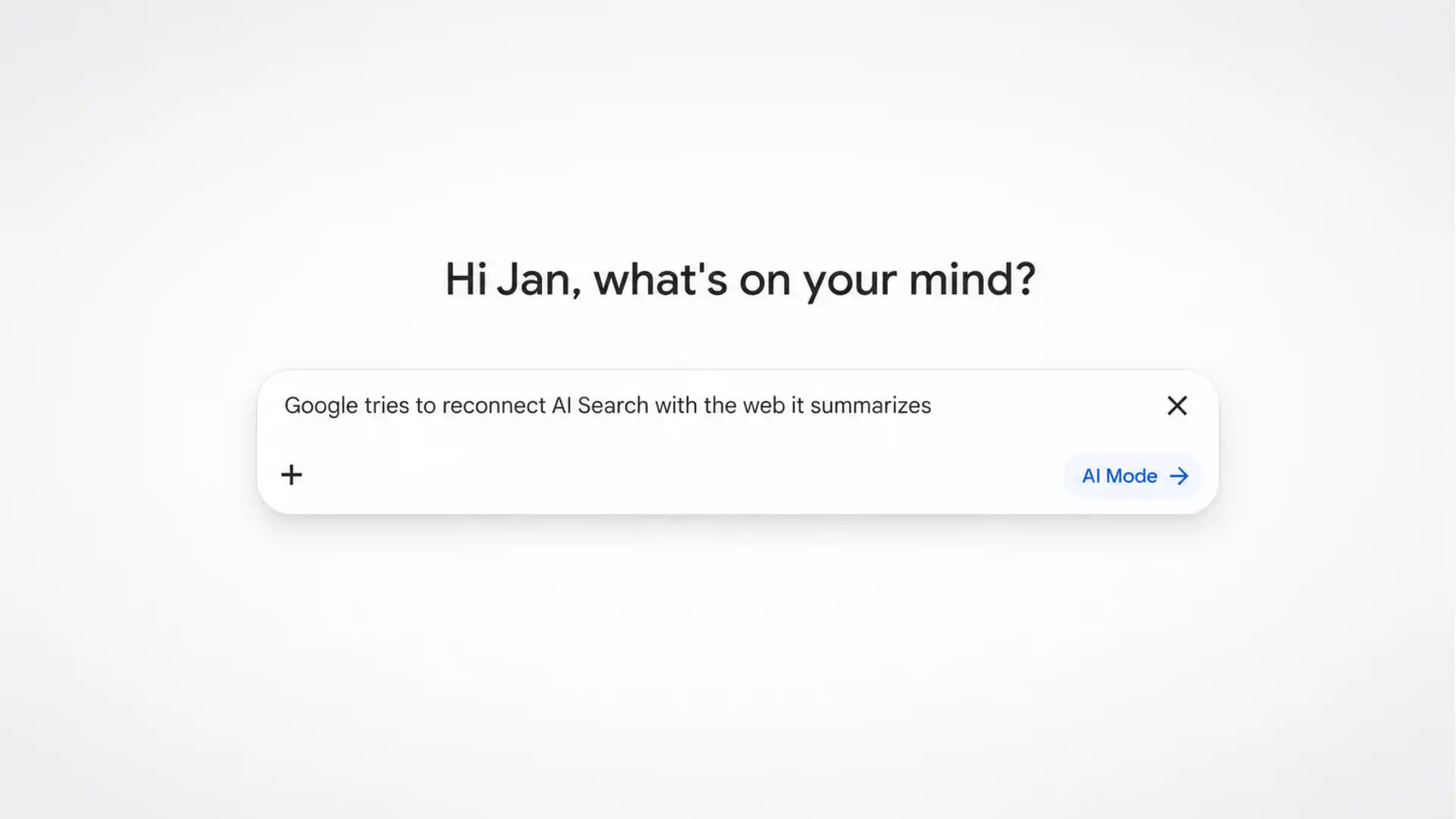
Google’s May 27 update is not a cosmetic change to Search. It is a small but revealing redesign of power. Preferred Sources now appear inside AI Overviews and AI Mode, giving users a visible way to bring favored publishers, sites and creators into Google’s answer-first interface. The same update adds prominent carousels for timely articles and firsthand perspectives, and expands “Highly Cited” labels meant to make original reporting easier to spot. Google presents the move as a way to help people find trusted sources and original content; publishers will read it as another attempt to repair the traffic bargain that AI summaries have strained.
Table of Contents
A search update aimed at a trust problem
The update lands at the exact point where Google’s AI Search strategy faces two pressures at once. Users want faster answers, but they also want to know where those answers came from. Publishers want visibility, but they do not want their work reduced to training material, summary fuel or a footnote below an AI response. Google is trying to answer both concerns without giving up the answer-first interface that now sits at the center of its Search product.
On May 27, 2026, Google said Preferred Sources would be brought into AI Overviews and AI Mode. People who have already selected favorite sources will see links from those sources labeled inside AI responses, in the same spirit as the “Preferred” labels used in Top Stories. Google also said any website that publishes fresh content is eligible for Preferred Sources, that people are twice as likely to click through to a Preferred Source, and that users have selected more than 345,000 unique sources.
The numbers matter because they turn Preferred Sources from a personalization feature into a traffic signal. Google has not said that a chosen source overrides ranking, nor that it guarantees inclusion. The official wording is more careful: a selected site can be highlighted and is more likely to appear in certain places when relevant. Still, the update gives publishers a new audience-action metric to pursue. A reader who adds a publication as a Preferred Source is no longer just a loyal visitor. That reader becomes a signal inside Google’s most important discovery surface.
The change also reveals a subtle admission. AI Overviews and AI Mode are useful only if they do not flatten the web into anonymous output. A fast summary loses authority when readers cannot identify the publication, reporter, creator or community behind it. Google’s new labels and carousels are designed to make the path back to source material more visible. Whether they are strong enough to change user behavior is the harder question.
Preferred Sources moves from Top Stories into answer-first search
Preferred Sources began as a way to personalize Top Stories. In August 2025, Google launched it in the United States and India, letting people select favorite news sites so their articles could appear more often in Top Stories or in a dedicated “From your sources” section when fresh and relevant content existed.
That original version fit the familiar search model. A user searched for a topic, saw a news module and could influence which publications appeared there. The May 2026 update moves that preference into a different environment. AI Overviews and AI Mode do not merely rank links. They synthesize information, choose supporting sources, display citations and often satisfy the user’s question before a click happens.
That difference changes the stakes. In Top Stories, a preferred publisher competes for a visible card. In AI Search, a preferred publisher competes for a role inside a generated answer. The label gives the source a recognizable identity at the point where the user is deciding whether to trust, expand, ignore or click. The “Preferred” badge is not only a traffic feature. It is a source-recognition feature inside a system that otherwise tends to compress many inputs into one answer.
Google’s developer documentation confirms the broader availability. Preferred Sources are globally available for Top Stories in all languages where Google Search is available, and they can appear in AI Mode and AI Overviews in the languages and locales where those features are available. Google also limits eligibility to domain-level and subdomain-level sites, not subdirectories. A publisher can promote a deeplink to the source preferences tool, but Google says this is not required for the site to appear as a preferred source.
For publishers, that creates a direct reader-development task. Asking readers to bookmark, subscribe, register, follow or install an app has long been part of the loyalty playbook. Now publishers have another ask: add us to your Google Preferred Sources. It is a small action, but it is embedded in discovery infrastructure rather than owned-channel marketing.
The new carousel is Google’s answer to the missing click
The second part of Google’s May 27 update is a prominent carousel for developing topics. Google says that, for some searches where people have a question about a live or developing topic, AI Search will show context followed by a carousel of timely articles and perspectives. The carousel will also highlight Preferred Sources when relevant. Google frames this as a way to make timely articles visible across more queries.
That wording matters. AI Overviews have often been criticized because the answer can feel complete enough to end the search. A carousel changes the interface from “answer and citations” to “answer and reading paths.” It gives the user a more obvious next step. The question is whether the next step feels necessary.
A carousel is stronger than a citation line because it uses layout, visual weight and source identity. It can show that a topic is still unfolding, that different outlets have relevant reporting, and that an AI answer is only a starting point. For breaking or developing issues, that distinction is crucial. A generated answer may summarize what is known, but the user often needs the newest article, the original interview, a local report, an official update or a specialist analysis.
The same logic applies to a planned carousel for firsthand perspectives. Google says some searches will soon show helpful perspectives from online discussions, forums and social media. This extends the idea behind earlier “perspectives” features into AI Search. The system is not only looking for institutional authority; it is also surfacing lived experience, creator commentary and community discussion where those sources answer the user’s intent.
The risk is obvious. Firsthand perspective is not the same as verified fact. A forum answer may be useful for a photography setting, a travel workaround or a product repair, but risky for health, finance, law or public safety. Google’s success here depends on classification: when to surface personal experience, when to rely on official sources, and when to keep AI responses narrow. The carousel will be judged less by its existence than by its judgment.
“Highly Cited” labels try to protect original reporting
Google is also expanding its “Highly Cited” badge to more web article links on the search results page. The label is meant to identify stories that many other articles have cited, helping users spot original or influential coverage. Google says it will also indicate when an article explicitly references a Highly Cited source.
This is one of the more consequential parts of the update for journalism. Search results often reward speed, authority, recency and relevance, but original reporting does not always win the visibility race. A local outlet may break a story, a national outlet may aggregate it, and a later article may rank better because it has a larger domain, stronger distribution or fresher packaging. A citation badge is an attempt to surface the original gravity of a story rather than only the most optimized version.
The badge also gives users a literacy cue. Readers often do not know whether an article is based on direct reporting, a press release, a wire story, a social post or another outlet’s work. “Highly Cited” is not a perfect originality measure, but it can signal that other coverage points back to a specific piece. In a search environment full of summaries and rewrites, that matters.
There are limits. A source can be highly cited because it is authoritative, because it is controversial, because it is first, or because it is the easiest source for others to copy. A badge does not prove that an article is correct. It does not guarantee fairness, depth or independence. It only signals network influence. Still, in AI Search, network influence is useful because generated answers need traceable origins. If AI systems summarize the web, users need visible routes back to the work that made the summary possible.
Google is redesigning links because AI answers changed link behavior
Google’s May 27 announcement sits on top of a broader May 6 update to AI Mode and AI Overviews. That earlier update added suggestions for deeper exploration, highlighted news subscription links, previewed public discussions and firsthand sources, placed more links directly beside relevant text in AI responses, and added hover previews on desktop so users could see more context before clicking.
The common theme is not hard to see. Google is making links more obvious, better labeled and more contextual because AI answers weakened the old link pattern. In classic search, the link list was the product. In AI Search, the generated answer becomes the product, and links become supporting infrastructure. Google now needs to make that infrastructure visible enough to satisfy users, publishers, regulators and its own long-term need for a healthy web.
Inline links are especially important. If a citation appears only at the bottom or in a side panel, it is easy to ignore. A link placed beside the relevant statement makes attribution more specific. It lets the user inspect the source at the moment a claim is made. That does not solve every accuracy problem, but it reduces the feeling that citations are decorative.
Hover previews solve a different problem. Users hesitate to click when they do not know where a link leads. A preview that shows the site name, page title or basic context gives the link more credibility before the user leaves the results page. Google has said it has seen users hesitate when link destinations are unclear, which explains the design push.
These link changes also signal a product reality: AI Search has to earn the click. In classic Search, users clicked because the result page was incomplete by design. In AI Search, users click when the answer creates curiosity, uncertainty, trust or need. That is a different behavioral model, and publishers must understand it.
Query fan-out gives Google more source selection power
Google’s AI Mode and AI Overviews use a technique Google calls query fan-out. The model breaks a user’s question into related subqueries, searches across subtopics and data sources, and then builds a response with supporting links. Google says this can display a wider and more diverse set of helpful links than a classic web search.
Query fan-out is one reason AI Search does not behave like ordinary ranking. In classic search, a page competes against other pages for the user’s typed query. In AI Search, a page may be selected for a subcomponent of a question that the user never typed. A travel query may fan out into weather, transport, safety, booking, neighborhood and itinerary subqueries. A health-adjacent query may fan out into symptoms, official guidance, risk groups and treatment options. A product query may fan out into comparisons, reviews, availability and local intent.
This gives Google more editorial power, even if the process is algorithmic. The system decides which subquestions matter, which sources answer them, which claims are included, and where links appear. Preferred Sources adds a user-controlled layer, but it does not remove the system’s role. AI Search is not just ranking documents. It is constructing an information path.
For publishers, query fan-out changes content strategy. Pages that answer only a narrow keyword may be less useful than pages with clear expertise, original evidence and sections that map to real subquestions. Google’s own generative AI guidance warns against trying to create separate pages for every fan-out variation merely to manipulate visibility. The stronger long-term play is to publish work that contains original reporting, useful structure, expert context and clear text that systems can retrieve accurately.
AI Mode turns Search into a conversation, not a results page
AI Mode is not an AI Overview with a larger box. Google describes AI Mode as a more advanced AI Search experience for exploration, reasoning, complex comparisons and follow-up questions. It rolled out in the United States without a Labs signup in 2025, and Google later positioned it as the place where newer Gemini capabilities would arrive first.
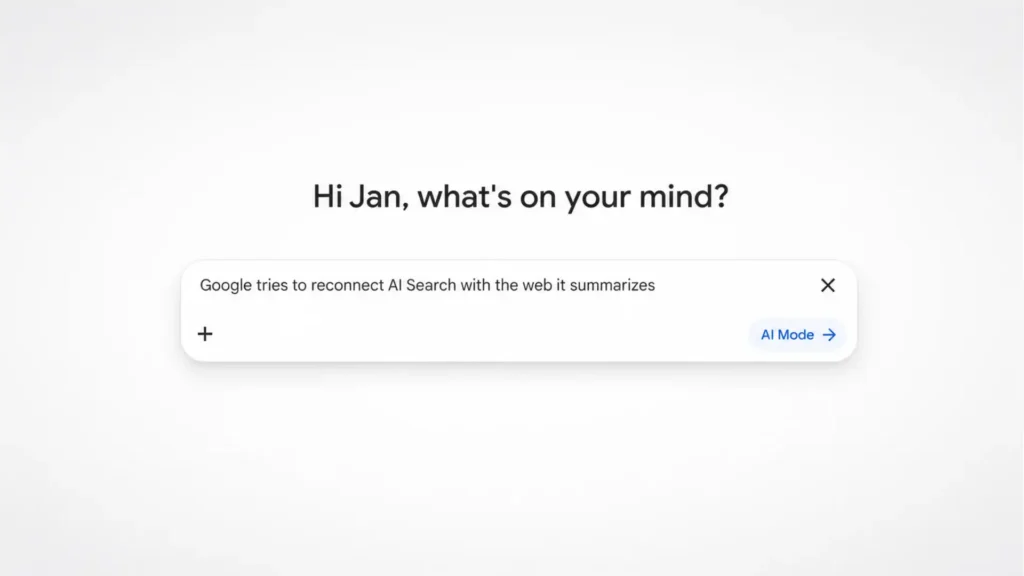
At Google I/O 2026, Google said AI Mode had surpassed one billion monthly users one year after debut, with queries more than doubling every quarter since launch. Google also said it was rolling out a new AI-powered Search box, a global upgrade to AI Mode where available, and easier flows from an AI Overview into AI Mode follow-up conversations.
That matters for Preferred Sources because AI Mode is where search behavior becomes less episodic. A user may start with one question, ask follow-ups, compare options, refine constraints and stay inside the conversation. If publishers are visible only at the first answer, they may lose influence as the session continues. If Preferred Sources and inline links appear throughout the flow, they can remain part of the user’s exploration.
The risk for the open web is that a conversational interface absorbs the user’s next actions. The user may no longer run ten searches and visit five sites. The user may ask one long prompt, receive a synthesis, ask two refinements and leave. Google argues that these experiences include links and deepen discovery. Critics argue that they make source visits optional. Both statements can be true depending on the query, interface and user intent.
AI Overviews are now a mainstream search surface
AI Overviews are no longer a lab experiment. Google’s own AI Overviews page says the feature provides snapshots with links and is available in more than 120 countries and territories and 11 languages. Google’s help documentation says AI Overviews appear when its systems determine generative AI can be especially useful, such as when a user wants to understand information from a range of sources. It also warns that AI responses may include mistakes.
Google’s corporate messaging has tied AI Search to growth. In Alphabet’s Q1 2026 remarks, Sundar Pichai said Search & Other advertising revenue grew 19%, that AI Mode and AI Overviews were driving return visits to Search, and that AI continued to drive search usage with queries at an all-time high.
This is the commercial foundation behind the product changes. Google is not experimenting with AI Search on the margins. It is using AI to defend and expand the core Search business. If AI experiences drive more queries, more engagement and more ad opportunities, Google has strong incentives to keep pushing them deeper into the product.
That makes the publisher question urgent. If AI Search becomes the default experience for more informational queries, link design is not a minor UI issue. It becomes part of the economic structure of the web. A label, carousel or inline citation can influence whether original work receives audience, revenue and recognition.
The publisher traffic debate is now backed by data
Publishers have complained for years about platform dependence, but AI Search sharpened the complaint. The concern is no longer only that Google ranks pages differently. It is that Google can answer the user by synthesizing publisher content and reduce the need to visit the publisher at all.
Pew Research Center found in a March 2025 browsing analysis that Google users who encountered an AI summary clicked a traditional search result in 8% of visits, while users without an AI summary clicked a search result in 15% of visits. Pew also found users clicked links inside the AI summary in only 1% of visits with such a summary, and ended browsing sessions more often after AI-summary pages than after traditional-only result pages.
The Reuters Institute’s 2026 Journalism, Media, and Technology Trends and Predictions report recorded deep industry anxiety. Surveyed publishers expected traffic from search engines to fall by 43% over three years. Chartbeat data cited in the report showed organic Google search traffic to more than 2,500 sites down 33% globally between November 2024 and November 2025, though the report cautioned that it was not clear how much of that decline was caused by AI Overviews.
Academic work also points to structural change. A 2026 study of Google AI Overviews and Wikipedia estimated that AI Overview exposure reduced daily traffic to English Wikipedia articles by about 15% across a large matched sample. Another 2026 study measuring AI Overviews across trending queries found that 11% of atomic claims were unsupported by cited pages and that well over half of AI Overview-cited pages carried display ads, raising publisher revenue questions when summaries reduce clicks.
Google disputes the bleakest version of this story. At Reuters NEXT in December 2025, Google Search vice president Robby Stein described AI Search as an “expansionary moment” for the internet and said Google sends billions of outbound clicks every day, with outbound clicks largely stable. He argued that new search behaviors, including camera-based and complex questions, expand the pie.
The conflict is not only about numbers. It is about distribution of value. Search sessions may grow while clicks per query fall. Some publishers may gain qualified traffic while others lose casual traffic. Some categories may benefit from deeper exploration, while quick-answer categories may be stripped of visits. Preferred Sources is Google’s attempt to add loyalty and identity to a system that otherwise rewards answer completion.
The legal pressure around AI Search keeps rising
The AI Search debate has moved beyond product criticism. It is now a legal and regulatory issue. Reuters reported that Penske Media, publisher of Rolling Stone and other titles, sued Google, claiming the company broke antitrust law by forcing publishers to allow AI Overviews of their content if they want to remain indexed in Google Search. Google responded that AI Overviews are not a separate product from Search and that users can still directly access publishers’ pages through Search results.
In Europe, Reuters reported that the European Publishers Council filed an antitrust complaint against Google over AI Overviews in February 2026. The EPC argued that Google takes publisher content without consent, fair compensation or realistic protection for journalism. Google rejected the claims, saying its AI features surface content across the web and that it provides controls for publishers.
The European Commission also opened an investigation into Google’s use of publishers’ online content and YouTube videos for AI purposes. Reuters reported that the Commission was concerned Google may be using publisher content for AI-generated summaries without adequate compensation or a meaningful option to refuse. The case sits inside a broader debate about gatekeeper power, AI training, search dominance and the economics of original content.
These disputes show why Google’s May 27 update is politically useful as well as product-useful. Labels, carousels and source-preference tools let Google argue that AI Search is not hiding the web. They show visible efforts to connect users back to sources. But they do not settle the compensation question, the opt-out question or the traffic-substitution question.
The update is a personalization move with editorial consequences
Preferred Sources is framed as user choice. A person chooses favorite sites; Google highlights those sites when they appear in AI Search. On its face, that is a personalization feature. Underneath, it has editorial consequences because it shapes which sources a user is more likely to see inside generated answers.
Personalization can improve trust when users deliberately choose sources they know. A local reader may prefer a city newspaper for municipal stories. A sports fan may prefer a team-specific site. A technology buyer may prefer a reviewer with a known testing method. A policy professional may prefer an institution or trade publication. In those cases, Preferred Sources lets the user carry trust into AI Search.
The risk is preference lock-in. If users mostly choose sources that confirm their habits, AI Search may become less exploratory. Google says users will still see content from other sites in Top Stories, and Preferred Sources does not appear to replace ranking systems. Yet preference labels can draw attention, especially in a dense AI interface. A familiar source badge may win the click even when an unfamiliar source has stronger original reporting.
That does not make Preferred Sources bad. It makes it powerful. User control is not neutral once it is embedded in a ranking and synthesis system. It changes the user’s source diet, the publisher’s audience strategy and Google’s responsibility to avoid turning preference into insulation.
The “source” becomes a brand asset inside AI responses
For publishers and creators, the update strengthens a point many already know: source identity is no longer only an on-site brand issue. It has become a machine-discovery asset. A user must recognize the source before they can prefer it, trust it, click it or add it to Google’s source preferences.
This gives established brands an advantage. A major newspaper, well-known magazine, public broadcaster or beloved niche site can ask readers to choose it. A new publisher with strong work but little name recognition faces a harder path. Preferred Sources rewards audience memory. That is not unfair by itself, but it can reinforce incumbency.
Smaller sites still have openings. Google says any site that publishes fresh content is eligible, and the source preferences tool supports domains and subdomains. A niche publication with a loyal community can turn that community into a visible search signal. A local news site can ask subscribers and regular readers to add it. A creator-led site can treat Preferred Sources like a follow button for Search.
The strategic point is straightforward: AI Search makes brand trust portable. In the old model, a reader showed loyalty by visiting directly, subscribing to a newsletter or following on social. In the new model, the reader can also express loyalty inside Google’s AI interface. That expression may influence what they see when they search later.
Source preference will reward direct audience work
The feature gives publishers a practical reason to invest in direct audience relationships. A site cannot rely only on being selected by the algorithm. It needs readers who care enough to choose it. That pushes publishers toward clearer positioning, stronger bylines, better newsletters, subscriber benefits, community products and recognizable editorial voices.
A generic article farm has little to ask for. “Add us as a Preferred Source” works only when the reader has a reason to prefer the publication. That reason might be investigative reporting, local expertise, industry data, practical reviews, trusted explainers, specialist commentary or a distinctive creator voice. The feature therefore favors publications that can answer a hard question: why would a reader choose us by name?
This aligns with Google’s own generative AI guidance, which tells site owners to create non-commodity content, avoid recycling what others have already said, provide unique points of view and publish work based on real experience. Google explicitly warns against content that could easily be produced by a generative AI model.
For publishers, the message is uncomfortable but useful. Commodity search content is the easiest content for AI to summarize and the hardest content for readers to prefer. Original reporting, testing, data, lived experience, expert judgment and community trust are harder to replace. Preferred Sources does not magically save that work, but it gives loyal readers a way to signal that it matters.
The update changes SEO, but not in the way shortcuts promise
Google’s documentation is explicit that there are no special technical requirements to appear in AI Overviews or AI Mode beyond being indexed and eligible to appear in Google Search with a snippet. Google also says there is no special schema markup, no new machine-readable file and no AI-specific markup required.
That matters because the marketing industry has rushed to rebrand search work around AEO, GEO and AI visibility. Google’s own generative AI guide acknowledges those terms, but says that from Google Search’s perspective, improving visibility in generative AI Search is still SEO. The systems rely on Search index content, retrieval-augmented generation and query fan-out.
The practical shift is not a hack. It is a change in what kinds of pages are useful to retrieval and synthesis. A page that clearly explains a unique issue, includes original evidence, answers adjacent questions and uses accessible structure may be useful across many fan-out paths. A page written only to match one keyword phrase may be less durable.
The Preferred Sources update adds a human layer to that technical layer. A publisher now needs crawlable pages, clear content, reliable indexing and a reason for readers to actively choose the site. SEO and audience development become harder to separate.
The old “ten blue links” model is no longer the baseline
The debate around AI Search sometimes assumes Google is replacing a pure link list. That pure model had already been fading for years. Search result pages have long included featured snippets, knowledge panels, maps, shopping modules, videos, Top Stories, People also ask, images, calculators and other direct-answer formats. A 2023 academic study of search result page evolution described the move away from “10 blue links” toward feature-rich pages that provide answers and aggregate content from different verticals.
AI Search accelerates that shift. A featured snippet extracts one answer. An AI Overview synthesizes across sources. AI Mode can sustain a conversation. Search agents can monitor and act. The move is not just from links to answers; it is from results to systems.
Preferred Sources belongs to this longer history. It is another layer on a search page that already mediates attention through modules and labels. The difference is that the label now enters a generated answer environment, where users may never scan a full result page in the old way.
For publishers, nostalgia for ten blue links is not a strategy. The better question is how to make original work visible, attributable and worth visiting in a search system that now summarizes, personalizes, cites and converses.
A compact view of Google’s AI Search source features
Google’s new source and link surfaces in AI Search
| Feature | Where it appears | What it is meant to do | Publisher implication |
|---|---|---|---|
| Preferred Sources labels | AI Overviews, AI Mode and Top Stories | Show links from sources a user selected | Turns reader loyalty into a visible Search signal |
| Timely article carousel | Some developing-topic AI responses | Surface current articles and perspectives | Gives fresh reporting a more prominent path from AI answers |
| Firsthand-perspective carousel | Selected queries involving public discussions | Surface forums, social posts and creator perspectives | Makes experience-led content more visible when relevant |
| Highly Cited badge | More web article links in Search | Flag influential stories cited by other articles | Helps original reporting stand out from aggregation |
| Inline links and hover previews | AI Mode and AI Overviews | Place source links closer to claims and add context before clicks | Raises the importance of clear source identity and page titles |
The pattern is clear. Google is not removing AI answers to restore classic Search. It is adding more source signals inside AI Search. That makes the link more contextual, but it also means publishers must compete for attention within a generated interface rather than only below it.
AI Search forces publishers to separate useful visibility from empty impressions
Traditional SEO reporting relied heavily on rankings, impressions, clicks and click-through rate. AI Search complicates every one of those measurements. Google says sites appearing in AI features are included in Search Console’s overall search traffic under the Web search type. That means publishers do not get a clean, separate AI Overview performance report in standard Search Console reporting.
This creates a measurement gap. A publisher may be cited in an AI Overview without knowing exactly which AI feature drove the impression. It may lose clicks on pages that previously answered simple informational queries. It may gain fewer but more engaged visitors from complex queries. It may see brand searches increase because users encounter the source name without clicking immediately.
Google argues that clicks from AI Overview pages can be higher quality, with users spending more time on sites. Publishers need to test that claim against their own analytics. A drop in clicks may be offset partly by better conversion, but not always. A utility site that monetizes through display ads may suffer when quick answers stay on Google. A subscription publisher may prefer fewer visits if more of them come from loyal or ready-to-subscribe readers.
Preferred Sources adds another measurement need: publishers should track adoption campaigns. If they ask readers to add the site as a Preferred Source, they need to watch branded search, direct traffic, newsletter response, subscriber behavior and AI-era referral patterns. Google does not provide a full loyalty dashboard for this.
The traffic impact will differ sharply by content type
AI Search does not affect all content equally. Short factual content is more vulnerable to answer substitution. A page that answers “how long to boil an egg,” “what time does the event start,” “definition of a term,” or “weather tomorrow” gives the user little reason to click after a summary. Long reporting, original interviews, local accountability, expert analysis, product testing and community experience retain more click value because the user often needs detail, trust or context.
The Reuters Institute report noted that hard news queries had been largely exempted from overviews in some contexts, likely because of hallucination risk, while lifestyle and utility content such as weather, TV guides and horoscopes appeared more exposed.
The Wikipedia traffic study found larger relative declines for Culture articles and smaller effects for STEM, consistent with the idea that synthesized answers substitute more strongly when a short answer satisfies intent.
Google’s own May updates seem designed around this distinction. Deeper exploration links work for complex topics. Subscription labels work for paid journalism. Firsthand perspectives work for experience-heavy searches. Highly Cited badges work for original reporting. The company is not treating all web content as equal. It is building different source surfaces for different search intents.
For publishers, the business lesson is blunt. If a piece has no value beyond an answer that can be summarized in two sentences, AI Search may absorb it. If the piece contains evidence, voice, reporting, data, comparison, judgment or utility that survives the summary, it has a better chance of earning the click.
Firsthand perspectives are useful, but they raise verification problems
Google’s move toward forum, social and creator perspectives reflects real user behavior. People often add “Reddit,” “forum,” “review,” “experience,” or a creator’s name to queries because they do not want only official information. They want lived experience. They want to know what happened when someone tried the product, visited the place, repaired the device, changed the setting or dealt with the institution.
AI Search can make that easier by previewing public discussions and naming communities or handles. Google’s May 6 update described examples such as photography advice from forums, with links back to the full conversation and context about the community.
The value is real. Search has often struggled to balance official authority and practical experience. A government page may be authoritative but not answer the real user problem. A forum thread may answer the problem but include mistakes, outdated advice or unsafe claims. AI Search must decide when experience is evidence and when it is merely anecdote.
A 2026 paper studying Google AI Overviews and Reddit found that AI Overviews increased engagement in safe-for-work Reddit communities, especially experience-based discussions, but that the later introduction of AI Mode largely eliminated those gains for experience-based content. This suggests interface design can strongly change whether AI Search sends users to communities or absorbs their value.
The May 27 perspective carousel may partly reverse that absorption by making links to firsthand content more visible. But the tension remains: AI systems love firsthand content because it fills gaps that official documents do not. Communities need visits, participation and context to stay useful. A summary without the surrounding conversation can strip away nuance.
Preferred Sources will not fix attribution by itself
A visible “Preferred” label solves only one part of attribution: recognition. It tells the user that a source they chose appears in the AI response. It does not answer deeper questions about how much the source contributed, whether the AI answer paraphrased it accurately, whether other sources were used more heavily, or whether the publisher was compensated.
The 2026 measurement study of Google AI Overviews found that source quality and claim fidelity were not the same thing. It reported that AI-cited domains were more credible than co-displayed first-page results, yet 11% of atomic claims were unsupported by cited pages. That distinction matters. A trustworthy source list does not automatically make every generated claim faithful to its sources.
For users, Preferred Sources may create a trust shortcut. Seeing a favorite publication in the source panel or carousel may make the answer feel safer. But users still need to click when the claim matters. A labeled source is not a substitute for reading the original story, especially for developing news, health guidance, financial decisions, legal questions or public affairs.
For publishers, attribution must be judged by outcomes. Does the label drive visits? Does it strengthen subscriptions? Does it help readers identify original work? Does it distinguish reporting from aggregation? Does it reduce misattribution? Those are empirical questions, not branding claims.
The update favors publishers with clear editorial identity
A publication that wants to benefit from Preferred Sources needs more than technical eligibility. It needs a clear reason to be selected. That sounds obvious, but it cuts against years of search-driven publishing that rewarded volume, keyword coverage and generic explainers.
Clear editorial identity can come from many places: local accountability reporting, specialist expertise, original data, product testing, legal analysis, market intelligence, cultural criticism, investigative work, community trust or strong creator-led voice. The point is not that every publisher must become personality-driven. The point is that readers need to know what the source stands for.
The Reuters Institute’s 2026 report said news organizations expect to double down on original investigations, on-the-ground reporting, contextual analysis and human stories in response to AI. That direction fits the Preferred Sources logic. Readers are more likely to choose a source when it offers work they cannot get from a generic summary.
The same applies outside news. A medical institution, university lab, legal publisher, engineering blog, local guide or testing site must make its expertise visible. AI Search can retrieve text, but human preference follows identity. If the source has no distinctive role in the reader’s mind, it is unlikely to be chosen.
User choice changes Google’s responsibility
Google can argue that Preferred Sources gives control to users. That is true, but it also creates responsibility for the design of that choice. Which users discover the feature? Which sources are easy to find in the source preferences tool? How are similar domains displayed? How does Google handle rebrands, subdomains, syndication, local editions, paywalls and multilingual sites? How does it prevent misleading sites from trading on names that resemble trusted publishers?
The official documentation says domain-level and subdomain-level sites are eligible, while subdirectories are not. That keeps the system simpler, but it may create practical issues for publications hosted under larger domains, network structures or platform subdirectories.
The source preferences interface also creates a discovery hierarchy. A user who already knows a publication can search for it. A user who wants “best local climate reporting” or “trusted independent tech reviews” may not know which domains to add. Google has not positioned Preferred Sources as a recommendation engine for sources; it is a preference tool for known sources.
That distinction protects Google from some editorial responsibility, but not all of it. The moment preferred labels appear inside AI answers, they influence credibility. The company must police abuse, maintain clarity and avoid confusing preference with verification.
The competitive threat from AI-native search is still present
Google’s source-focused update also responds to competition. AI-native search products such as Perplexity, ChatGPT Search, Copilot and other answer engines have trained users to expect summarized answers with citations. Google has the scale advantage, but it cannot ignore user expectations shaped outside Google.
The competitive issue is not simply who produces the best answer. It is who produces the most trusted answer flow. Users may tolerate AI summaries if they can inspect sources, click original work and maintain control over preferred publishers. If Google’s AI answers feel closed, opaque or overly synthetic, competitors can frame themselves as more transparent or more user-controlled.
Google’s advantage is that it owns the largest search habit on the web. Its disadvantage is that every AI Search change affects publishers, advertisers, regulators and users at once. A smaller AI search company can experiment with attribution models or interface conventions at lower scale. Google’s changes instantly become web infrastructure.
Preferred Sources therefore serves a defensive role. It lets Google say that AI Search can be personalized, source-aware and web-connected. Whether users experience it that way will determine how convincing that defense becomes.
The economics of AI Search remain unresolved
The May 27 update does not answer the hardest economic question: who pays for original information when fewer users need to visit original pages? Labels and carousels may send some traffic back. They may improve source recognition. They may reward loyal brands. They do not create a revenue-sharing model for every publisher whose work informs AI answers.
Google has explored publisher partnerships, subscription-link features and source visibility improvements. In December 2025, Google described web ecosystem tools and partnerships, including subscription highlights, Preferred Sources and an AI partnership program with news publishers.
But the broader settlement is still missing. Reuters Institute framed the terms of trade around licensing, citations and revenue share as still being “up for grabs.”
The economic problem differs by business model. Subscription publishers want qualified readers and brand recognition. Advertising-supported publishers need pageviews, sessions and ad impressions. Local news outlets need direct community relationships and subscription conversion. Creator-led sites need identity and distribution. Reference sites need recurring utility. A single link-label system cannot solve all of these.
What Preferred Sources can do is shift some leverage back toward publishers that have loyal audiences. If readers actively select a source, Google has a reason to show it. That is not the same as compensation, but it is a bargaining signal: audience preference matters even inside AI Search.
The privacy and personalization trade-off deserves attention
Preferred Sources requires users to express source preferences inside Google’s ecosystem. That is useful, but it also deepens personalization. A user’s chosen sources reveal news habits, interests, politics, local ties, professional needs, hobbies and trust patterns. Google Search personalization settings become another place where media identity is stored.
Google’s announcement focuses on convenience and trust, not privacy trade-offs. Users can manage selections, and the feature is voluntary. Still, source preference is sensitive because information diets are personal. A list of preferred sources can say more about a person than a list of generic interests.
For some users, the benefit will outweigh the concern. They want their local paper, trade journal, favorite sports site or trusted reviewer to stand out. For others, the safer path is to avoid personalization and inspect sources manually.
Publishers should be careful in how they promote the feature. Asking readers to add a publication as a Preferred Source is legitimate. Pressuring them, hiding the privacy dimension or presenting it as the only way to receive coverage would be unwise. Trust is the asset the feature depends on.
The product design reveals Google’s theory of the web
Google’s theory appears to be this: AI Search can provide direct answers while still sending users to the web when sources are clearly labeled, links are contextually placed, preferred publishers are highlighted, and original reporting receives badges. That theory is coherent. It is also unproven at full scale.
The web is not only a database of facts. It is a system of incentives. People and institutions produce work because they receive money, attention, reputation, influence, community or public value. If AI Search extracts too much value from that system without returning enough, the supply of original work weakens. If it returns enough attention to the right sources, AI Search could become a stronger discovery layer for complex topics.
The answer will not be uniform. Some sources will gain visibility. Others will lose casual traffic. Some creators will benefit from being surfaced in perspective carousels. Others will resent having community knowledge summarized. Some publishers will convert Preferred Source campaigns into subscriptions. Others will find that loyal readers already come direct, while Google still absorbs the top of the funnel.
The update is best understood as a repair mechanism, not a settlement. Google is repairing link visibility, source recognition and user control. It is not yet repairing the full economics of AI-mediated publishing.
A compact view of likely winners and losers
Who gains and who remains exposed
| Publisher or creator type | Likely effect of the update | Reason |
|---|---|---|
| Strong subscription publishers | Potential gain | Preferred labels and subscription links can make trusted sources easier to spot |
| Local news organizations with loyal readers | Potential gain | Readers may add known local outlets as Preferred Sources |
| Original investigative publishers | Potential gain | “Highly Cited” labels may surface influential primary reporting |
| Niche expert sites | Mixed but promising | Deep expertise can match fan-out queries, but brand recognition is needed |
| Commodity information sites | Continued pressure | Short answers are easiest for AI to satisfy without a click |
| Forum and community platforms | Mixed | Perspective carousels may drive visits, but AI summaries may still absorb discussion value |
| New publishers without brand awareness | Continued pressure | Preferred Sources rewards sources readers already know by name |
The table points to a strategic divide. Sites with identity, trust and original work have new tools to push. Sites built around interchangeable informational pages remain exposed because AI summaries are strongest where content is easiest to compress.
AI Search makes reader loyalty operational
Reader loyalty used to sit mostly outside Search. It appeared in direct traffic, newsletter opens, app usage, paid subscriptions, podcast follows, social follows and community participation. Preferred Sources moves loyalty into Search itself. That is new.
This operationalizes loyalty in three ways. First, it makes the user’s trust explicit. Second, it gives Google a product reason to mark that trust visually. Third, it gives publishers a campaignable action tied to search visibility.
A publisher can now build a funnel around source preference: explain the benefit, link to the preference tool, ask subscribers to add the site, remind readers during major coverage, and track whether search behavior changes. This should not replace newsletters, apps or subscriptions. It should sit beside them.
The danger is that publishers turn every page into a pop-up asking for preference selection. That would be a mistake. The ask should be earned, not begged. Readers will add a source when they already value it. The best conversion tool is distinctive work.
Original reporting needs more than a badge
“Highly Cited” labels are useful, but original reporting needs a deeper set of protections. A badge may help a reader find the primary story, yet it does not stop summaries from satisfying the user, does not guarantee referral traffic, and does not compensate reporting costs.
A strong source ecosystem needs at least four things: visible attribution, accurate representation, meaningful traffic or compensation, and durable audience relationships. Google’s update speaks mostly to the first and partly to the fourth. The second depends on AI quality and citation fidelity. The third remains contested.
Publishers should welcome the badge without confusing it for a business model. If an investigation takes months, a “Highly Cited” label is recognition, not reimbursement. The same is true for local meeting coverage, court reporting, product testing or scientific analysis. Recognition is useful only when it leads to audience, revenue, reputation or public impact.
The better use of the badge is to strengthen the reader’s path to primary material. Publishers should make original reporting pages clear, bylined, updated, well-structured and easy to cite. If Google is going to identify influential coverage, the original page should be unmistakable.
The update puts more weight on bylines, communities and authorship
Google’s perspective features and link previews increase the value of source-level and person-level identity. If AI Search shows a creator name, handle, community name or publication label, users will make trust judgments quickly. Anonymous, generic or thinly authored pages may struggle to stand out.
This does not mean every article needs a celebrity author. It means authority should be legible. A byline should connect to expertise where appropriate. A review should disclose testing method. A local report should show reporting presence. A technical guide should show maintenance and accuracy. A community answer should be linked to its thread or context.
Authorship has long mattered for user trust. AI Search makes it part of interface competition. A user scanning an AI response may see only a few source cues before deciding whether to click. The publication, byline, community or handle becomes a miniature trust signal.
Google’s guidance around non-commodity content points in the same direction. Work based on real experience, original knowledge and unique viewpoint is more likely to stand apart from generic summaries.
Generative search changes the shape of authority
Traditional search authority relied heavily on links, relevance, freshness, site quality and user signals. Generative search still depends on Google’s index and ranking systems, but it adds synthesis. A source can be authoritative for one subclaim, one comparison dimension or one perspective within a larger answer.
That changes how authority is expressed. A page may not rank first for the original query, but it may be cited because it answers a fan-out subquery well. A niche expert may appear beside a major institution because the system needs a specific experience or detail. A community thread may appear because it captures lived experience no official source offers.
A 2026 study of Google Search, Gemini and AI Overviews found that source sets differed substantially across systems, with very low overlap, and that AIOs were less consistent when processing the same query or minor query edits.
That instability matters. Publishers cannot assume that old rankings map neatly onto AI visibility. Users cannot assume that a single AI answer captures the full source field. Google’s Preferred Sources feature may add some continuity for individual users, but the underlying generative selection process remains more fluid than classic search rankings.
The update could deepen trust for users who already know their sources
For users, the most immediate benefit is simple: favorite sources are easier to spot. If someone trusts a local outlet, a specialist publication or a creator, seeing that source marked in AI Search reduces friction. It can also counter the feeling that AI answers come from nowhere.
This is especially useful for paid subscribers. Google’s earlier May update highlighted links from news subscriptions in AI Mode and AI Overviews, with “Subscribed” labels. A user who pays for a publication should not have to scroll past generic links to find the content they already support.
Preferred Sources extends that logic beyond paid subscriptions. Not every trusted source is paywalled. A user may prefer a public broadcaster, local nonprofit newsroom, open research site, government agency, expert blog or independent critic. The feature gives that preference a place inside AI Search.
The benefit is strongest when the user has deliberate media habits. For casual users who have not selected sources, the update may be less visible. That puts responsibility on both Google and publishers to make the feature discoverable without making it intrusive.
The update may disadvantage users who do not actively personalize
Personalization features often help power users first. People who know how to manage settings, choose sources and refine their search environment get better control. People who do not use those settings remain dependent on default ranking and AI source selection.
This matters for news literacy. A highly informed user may add local, national, specialist and international sources. A less informed user may never open the source preferences tool. If Preferred Sources becomes an important visibility path, publishers with strong, organized audiences may gain while sources serving less engaged communities remain reliant on default systems.
Google can reduce that gap by making the feature understandable and easy to manage. Publishers can reduce it by explaining the feature clearly. Still, the gap will exist. User choice benefits the users who exercise it.
This is not an argument against Preferred Sources. It is a warning against treating it as a universal trust solution. Many users will never curate their source list. AI Search still needs default source quality, diversity, labeling and error handling.
Search quality now includes attribution quality
Search quality used to be judged mainly by relevance, speed, freshness, authority and satisfaction. AI Search adds another dimension: attribution quality. A good answer is not good enough if users cannot see, trust and inspect where it came from.
Attribution quality has several parts. The cited source should support the claim. The link should appear close to the relevant text. The source name should be visible. The user should understand why the source is included. Original reporting should not be buried beneath derivative coverage. Preferred or subscribed sources should be labeled without pretending that preference equals truth.
Google’s May updates touch each of those parts. Inline links improve proximity. Hover previews improve context. Preferred Sources improve recognition. Carousels improve discoverability. Highly Cited labels improve originality signals. None of these is complete alone, but together they show where Search quality is moving.
The strongest version of AI Search will not be the one that hides sources behind a confident answer. It will be the one that makes source inspection natural. Google’s update is a step in that direction, but users and publishers will test it against behavior, not intent.
Publishers need a new AI Search playbook
A practical publisher response should start with fundamentals, not panic. The site must be crawlable, indexable, technically stable and eligible for snippets. Google says the same SEO best practices remain relevant for AI features, with no special AI markup required.
Then comes editorial differentiation. Publishers should audit which content is original enough to deserve preference, citation or subscription conversion. Thin rewrites and commodity explainers should not be the center of an AI-era strategy. Work that contains reporting, analysis, data, testing, interviews, local knowledge, visual evidence or expert judgment should be easier to find and internally linked.
Audience teams should build a measured Preferred Sources campaign. The ask should be clear: adding the publication as a Preferred Source may make its articles easier to spot in Google Search, including AI Overviews and AI Mode where available. The campaign should appear in newsletters, subscriber onboarding, social posts and maybe site CTAs, but it should not degrade reading experience.
Analytics teams should watch for changes in branded search, direct visits, newsletter signups, subscription conversions, referral quality and pages losing click-through to AI summaries. Since Search Console does not provide a clean AI feature breakout, publishers need triangulation rather than one magic metric.
Brands outside news should pay attention too
Although the update is framed around sources, websites and creators, the implications reach beyond news. Brands with editorial content, product education, support libraries, research hubs, expert blogs and local information may also be affected. If users can prefer sources and AI Search highlights trusted content, brand authority becomes more visible in discovery.
A travel brand with original city guides, a healthcare provider with physician-reviewed articles, a software company with strong documentation, a university with research explainers or a financial firm with expert market commentary may benefit if users recognize and trust the source. But the same rules apply: generic content is vulnerable; original, specific and useful content is stronger.
Google’s generative AI guidance for site owners explicitly includes local business and ecommerce details, recommending accurate Merchant Center and Business Profile information where relevant.
For brands, the lesson is not to chase every AI Search buzzword. The lesson is to become a source worth choosing. That requires content with evidence, clarity, authorship and utility. AI systems may retrieve pages, but humans prefer brands they trust.
AI Search may increase the value of local sources
Local news is one of the most interesting cases for Preferred Sources. Local outlets often have strong trust among readers but weak power against national platforms. A city newspaper, nonprofit newsroom, neighborhood site or local radio station may not always win broad search rankings, but it may be the source a resident actually wants.
Preferred Sources gives local publishers a concrete loyalty action. A reader can add the local outlet, and Google can mark it when relevant. That could matter for city council decisions, storms, school closures, transport changes, local elections, crime updates, development projects and cultural events.
The challenge is awareness. Local publishers need to explain the feature without assuming readers know what AI Mode or AI Overviews are. A simple message works better than technical language: choose us as a preferred source in Google so our reporting is easier to find when you search.
For local journalism, the feature is not a rescue plan. Local news still faces subscription, advertising, staffing and trust pressures. But it is one of the few platform changes that gives local readers a direct lever to support visibility.
Source diversity remains the unresolved tension
Preferred Sources helps users see chosen sources, but search systems also need diversity. A reader may prefer three sources, but a good answer may need a source outside that list. A health answer may need official medical guidance. A legal answer may need statutory or court sources. A breaking news answer may need the outlet with the original reporting, not the reader’s favorite commentary site.
Google says users will still see content from other sites in Top Stories, and its AI features surface relevant links from across the web. The balance between preference and diversity will be crucial.
A 2026 study on the rise of AI Search found that AI search can reduce source variety and long-tail exposure compared with traditional search, with implications for information markets and human judgment.
That finding makes source diversity more than an academic concern. If AI answers narrow the source field, Preferred Sources could either help or hurt. It could help by letting users inject trusted niche sources. It could hurt if it reinforces familiar-source loops. The outcome depends on interface design and user behavior.
Google’s update is also a message to regulators
Regulators are asking whether Google can use its search dominance and AI systems in ways that disadvantage publishers, rivals or content owners. A source-focused update gives Google evidence that it is improving attribution and traffic pathways. It can point to Preferred Sources, subscription labels, inline links, carousels and Highly Cited badges as mechanisms that connect users back to the web.
That evidence may matter in public debate, but it will not end investigations. Regulators will ask harder questions. Are publishers meaningfully able to refuse AI use without losing search visibility? Are original sources compensated or merely credited? Does Google favor its own content or partners? Are AI answers faithful to sources? Do interface changes actually produce clicks?
The European Commission’s AI-content investigation and publisher complaints show that the dispute is not solved by labels alone.
Google’s strongest regulatory argument will be empirical. If it can show that AI Search sends qualified traffic, improves source discovery and supports publisher sustainability, its case strengthens. If publishers continue to lose economically while Google’s AI Search grows, labels may look like mitigation rather than remedy.
AI Search makes “original content” a product category
Google’s announcement uses the language of original content, creator insights and unique perspectives. That is not just editorial rhetoric. It reflects a product need. AI systems need raw material that is fresh, specific and trustworthy. If the web fills with derivative AI-generated articles, AI Search gets worse. Google therefore has a self-interest in preserving sources that generate original information.
This is one reason the update emphasizes Highly Cited labels, firsthand perspectives and Preferred Sources. The company needs ways to distinguish originators from repeaters. It needs to show users that the web still contains voices worth visiting. It needs publishers to keep publishing.
For site owners, “original content” should not mean merely avoiding plagiarism. It means producing work that changes the information available on the web. That could be a reported fact, a new dataset, a field test, a local observation, a specialist interpretation, a firsthand account, a useful image, a documented process or a clear explanation based on experience.
AI Search raises the penalty for content that adds nothing. If a page only repackages known material, it competes against a summary machine. If a page adds knowledge, it competes as a source.
The update does not remove the need for media literacy
Source labels can improve trust, but they do not replace judgment. Users still need to ask whether a source is primary, whether the topic is developing, whether the AI answer may be wrong, whether the source supports the claim, and whether a better source exists outside the visible carousel.
Google’s own help page says AI responses may include mistakes. That warning should not be treated as boilerplate. It is especially relevant when AI Search summarizes live news, health information, legal questions, financial decisions or contentious public issues.
Preferred Sources can make Search feel more familiar, but familiar sources can also be wrong, incomplete or slow. A user should not treat a preferred badge as proof. It is a preference marker, not a verification stamp. Highly Cited is also not a fact-check label. It signals citation influence, not correctness.
The best user behavior is to treat AI Search as an entry point. Read the answer, inspect the source cues, click when the topic matters, compare sources when stakes are high and prefer original reporting over derivative summaries.
The update may shift publisher calls to action
Publishers have limited space to ask readers for action. Subscribe. Register. Follow. Download the app. Sign up for the newsletter. Turn on notifications. Donate. Share. Comment. Attend. Now they may add: choose us as a Preferred Source on Google.
Not every publisher should push that equally. For a subscription publisher, the highest-value action may still be paid conversion. For a nonprofit newsroom, donation and newsletter signup may matter more. For a local site, app installs or email alerts may be crucial. Preferred Sources should fit the audience journey, not replace it.
The strongest placement may be subscriber onboarding: “You can also add us as a Preferred Source in Google Search.” It also fits major-event coverage, when readers are actively using Search and may want reliable updates from a known outlet.
The language should be honest. Do not promise that adding a source will make every article appear first. Google’s wording is more limited: selected sources may appear more often or be highlighted when relevant and available. Publishers that overpromise will weaken trust.
Google’s source strategy is still early
The May 27 update should not be treated as the final form of AI Search attribution. It is more likely one stage in a long redesign. Google is testing how users interact with AI answers, how they click links, how they respond to labels, how publishers promote preference tools and how regulators react.
Future changes may include richer source panels, stronger original-source signals, better publisher analytics, more subscription integrations, clearer AI feature reporting in Search Console, additional controls for site owners, or new revenue experiments. Google has already been adding link previews, inline links, subscription labels and context modules in rapid sequence.
The direction is clear even if the details are not. AI Search will become more personalized, more conversational, more agentic and more source-aware. Publishers should prepare for that direction rather than only respond to each feature announcement.
The most durable strategy is to build work that deserves source preference and to make that work technically accessible, visually clear, well structured and directly connected to audience relationships.
The open web bargain is being renegotiated
The old bargain was imperfect but understandable. Search engines crawled the web, indexed pages and sent traffic. Publishers accepted crawling because visibility could lead to audience and revenue. AI Search changes the bargain because the search engine can summarize more of the value before the user clicks.
Google’s new source features are an attempt to preserve the bargain by making links, labels and source identity more visible. Publishers argue that visibility alone may not be enough. Regulators are asking whether the terms are fair when a dominant search engine controls both discovery and synthesis.
There is no clean return to the old model. Users like fast answers. Google has business reasons to provide them. Publishers need discovery. AI systems need original content. The question is not whether AI Search exists. The question is whether it sends enough value back to the sources that sustain it.
Preferred Sources is one lever in that negotiation. It gives users a voice. It gives publishers a campaign. It gives Google a trust feature. It does not solve the whole bargain.
The strategic reading for publishers
Publishers should read Google’s update as a signal, not a rescue. The signal says audience loyalty, source identity, original reporting, creator perspective and technical clarity now matter inside AI Search. The rescue fantasy says Google will restore old traffic patterns through labels and carousels. That is unlikely.
A sober response has four parts. First, protect and expand direct relationships. Second, make original work unmistakable. Third, treat Preferred Sources as a loyalty action worth promoting. Fourth, measure AI-era search behavior with patience and skepticism.
The most vulnerable publishers are those with weak brands and commodity content. The strongest are those that readers choose by name because the work cannot be replaced by a generic answer. Google’s update rewards being preferred, not merely being present.
For users, the update is useful if they take control of it. Choosing sources can make AI Search feel less anonymous and more grounded. But users should still click through when accuracy, context or original reporting matters.
For Google, the test is whether these features generate real visits, not just better optics. If AI Search summarizes the web but visibly supports the people and institutions that produce it, the model may hold. If it turns source labels into decoration while traffic and revenue keep draining away, the conflict will deepen.
The deeper meaning of the May 27 update
The May 27 update looks small because it deals in labels and carousels. It is larger because it shows Google trying to put human source preference back into a machine-generated search experience. That is the right problem to address.
AI Search weakens the boundary between finding information and consuming it. When the answer appears on Google, the source can disappear from the user’s attention. Preferred Sources pushes in the opposite direction. It says the source still matters. Highly Cited labels say origin still matters. Perspective carousels say lived experience still matters. Inline links say claim-level attribution still matters.
Those are good principles. The web will now learn whether the product delivers enough weight behind them.
For publishers, the practical challenge is to become the kind of source readers actively choose. For users, the challenge is to keep source judgment alive in a faster interface. For Google, the challenge is to prove that AI Search can summarize the web without starving it.
Reader questions about Google Preferred Sources in AI Search
Google announced that Preferred Sources would appear in AI Overviews and AI Mode. It also introduced prominent carousels for timely articles and perspectives, and expanded “Highly Cited” labels for articles that many other stories reference.
Preferred Sources are websites a user selects in Google’s source preferences settings. When relevant fresh content is available, Google may show more from those sources and label them as preferred in surfaces such as Top Stories, AI Overviews and AI Mode.
No. Google says selected sources can be highlighted and are more likely to appear in certain contexts, but it does not say preference guarantees placement, ranking or citation in every AI response.
Google says any website that publishes fresh content can be eligible. Its documentation states that domain-level and subdomain-level sites are eligible in the source preferences tool, while subdirectories are not.
Users can visit Google’s source preferences settings or use publisher-provided deeplinks that open the source preferences tool with a specific domain. Publishers can also add buttons or calls to action that guide readers to the tool.
AI Mode is Google’s conversational AI Search experience for complex questions, comparisons and follow-up exploration. Google says it uses query fan-out to search across related subtopics and build responses with supporting links.
AI Overviews are AI-generated snapshots in Google Search that summarize information and include links for further exploration. Google says they appear when its systems determine generative AI is useful for a query.
Google’s new carousel appears for some developing-topic questions and shows timely articles and perspectives after brief AI-generated context. Google says it will also highlight Preferred Sources when relevant.
“Highly Cited” labels identify articles that many other stories have cited. Google says the feature is meant to help users find original or influential reporting that other coverage references.
No. It may improve source visibility and clicks for some publishers, but it does not fully answer concerns about traffic substitution, compensation or AI summaries reducing visits to original articles.
Publishers worry that AI summaries answer users directly, reducing clicks to source pages. Pew Research found users who saw AI summaries clicked traditional search results less often than users who did not see them.
Pew found that users clicked a traditional search result in 8% of visits when an AI summary appeared, compared with 15% of visits without an AI summary. Clicks on links inside AI summaries occurred in only 1% of visits with such summaries.
Query fan-out means Google’s AI system breaks a user’s question into multiple related searches across subtopics, retrieves relevant pages and uses them to build a response. This can surface sources that would not appear for only the exact typed query.
Google says no. Pages need to be indexed and eligible to appear in Google Search with a snippet. Google says there is no special schema, AI text file or machine-readable markup required for AI features.
Google says sites appearing in AI features are included in overall Search traffic in Search Console’s Performance report under the Web search type. Standard reporting does not provide a clean separate AI Overview traffic channel.
No. A Preferred Source label means the user selected that source. It is a preference signal, not a fact-check or verification label.
No. A Highly Cited label indicates that many other articles cited the piece. It can help identify influential or original reporting, but it does not prove every claim is accurate.
Publishers should make sure their sites are crawlable and indexable, strengthen original reporting and expert content, ask loyal readers to add them as Preferred Sources, and measure changes in search quality, direct traffic and conversions.
Users should add publications, websites and creators they genuinely trust, then still inspect sources when the topic matters. Preference improves visibility, but it does not replace reading original reporting.
The update turns audience loyalty into a visible signal inside AI Search. Publishers with strong brands and direct reader relationships may gain more from it than sites built mainly around generic informational content.
Author:
Jan Bielik
CEO & Founder of Webiano Digital & Marketing Agency
This article is an original analysis supported by the sources cited below
New ways to find your favorite sources and original content in AI Search
Google’s official May 27, 2026 announcement about Preferred Sources in AI Overviews and AI Mode, article carousels, firsthand perspectives and Highly Cited labels.
5 new ways to explore the web with generative AI in Search
Google’s May 6, 2026 announcement covering inline links, subscription labels, website previews, exploration links and public-discussion perspectives in AI Search.
Help your readers find your site through preferred sources in Google Search
Google Search Central documentation explaining Preferred Sources eligibility, global availability, deeplinks and publisher guidance.
AI features and your website
Google Search Central documentation explaining how AI Overviews and AI Mode work for site owners, including eligibility, technical requirements and measurement.
Optimizing your website for generative AI features on Google Search
Google’s official guidance on generative AI visibility, query fan-out, retrieval-augmented generation, non-commodity content and myths around special AI markup.
Google AI Overviews
Google’s public product page describing AI Overviews, links to the web and availability across countries, territories and languages.
Google AI Mode
Google’s public product page explaining AI Mode as a deeper AI-powered search experience with links for exploration.
AI Mode in Search, for cutting-edge AI capabilities
Google’s 2025 AI Mode update explaining its rollout, follow-up questions, multimodality and query fan-out.
A new era for AI Search
Google’s I/O 2026 Search announcement covering AI Mode usage, the new AI-powered Search box, agents and follow-up flows from AI Overviews.
Q1 2026 earnings call remarks from Sundar Pichai
Alphabet’s official Q1 2026 remarks linking AI Mode, AI Overviews, Search usage and Search & Other advertising growth.
Google users are less likely to click on links when an AI summary appears in the results
Pew Research Center analysis of browsing behavior showing lower click rates on Google results pages when AI summaries appear.
Journalism, media, and technology trends and predictions 2026
Reuters Institute report covering publisher expectations for search traffic decline, Google referral trends and strategic responses to AI search.
Google executive sees AI search as expansion for web
Reuters report on Google Search executive Robby Stein’s comments about AI Search, outbound clicks, publisher concerns and advertising.
Google defends AI search summaries in Rolling Stone publisher’s lawsuit
Reuters coverage of Penske Media’s lawsuit against Google and Google’s response that AI Overviews are part of Search.
Google highlights links from subscribed publications in new AI Overviews update
Nieman Journalism Lab analysis of Google’s May 2026 AI Search link and subscription updates from a journalism-industry perspective.
Google faces EU antitrust investigation over AI Overviews, YouTube
Reuters coverage of the European Commission investigation into Google’s use of publisher and YouTube content for AI purposes.
Google hit by European publishers’ complaint to EU over AI Overviews
Reuters report on the European Publishers Council complaint concerning Google AI Overviews, AI Mode, publisher content and fair compensation.
Measuring Google AI Overviews
Academic study measuring AI Overview activation, source quality, claim fidelity and publisher impact across trending queries.
Impact of AI Search Summaries on Website Traffic
Academic study estimating the causal effect of Google AI Overviews on Wikipedia traffic using staggered rollout and matched language editions.
How Generative AI Disrupts Search
Academic study comparing Google Search, Gemini and AI Overviews across real-user queries and examining source differences and consistency.
The Rise of AI Search
Academic study examining global AI Search exposure, source variety, credibility and implications for information markets and human judgment.
The Impact of AI Search on the Online Content Ecosystem
Academic study of Google AI Overviews, AI Mode and Reddit engagement showing how interface design affects traffic and participation.
From 10 Blue Links Pages to Feature-Full Search Engine Results Pages
Academic study documenting the shift from classic blue-link result pages to feature-rich search interfaces that provide direct answers.
| Citing this article? Brief excerpts are welcome. Please credit Webiano.digital, name the author where stated, and include a link to https://webiano.digital and to this original article. Full or substantial republication requires prior written permission. Read our Copyright and Content Use Policy. |
This article was prepared with the assistance of artificial intelligence tools. The content underwent expert human review, and Webiano Digital & Marketing Agency assumes editorial responsibility for its final version and publication.