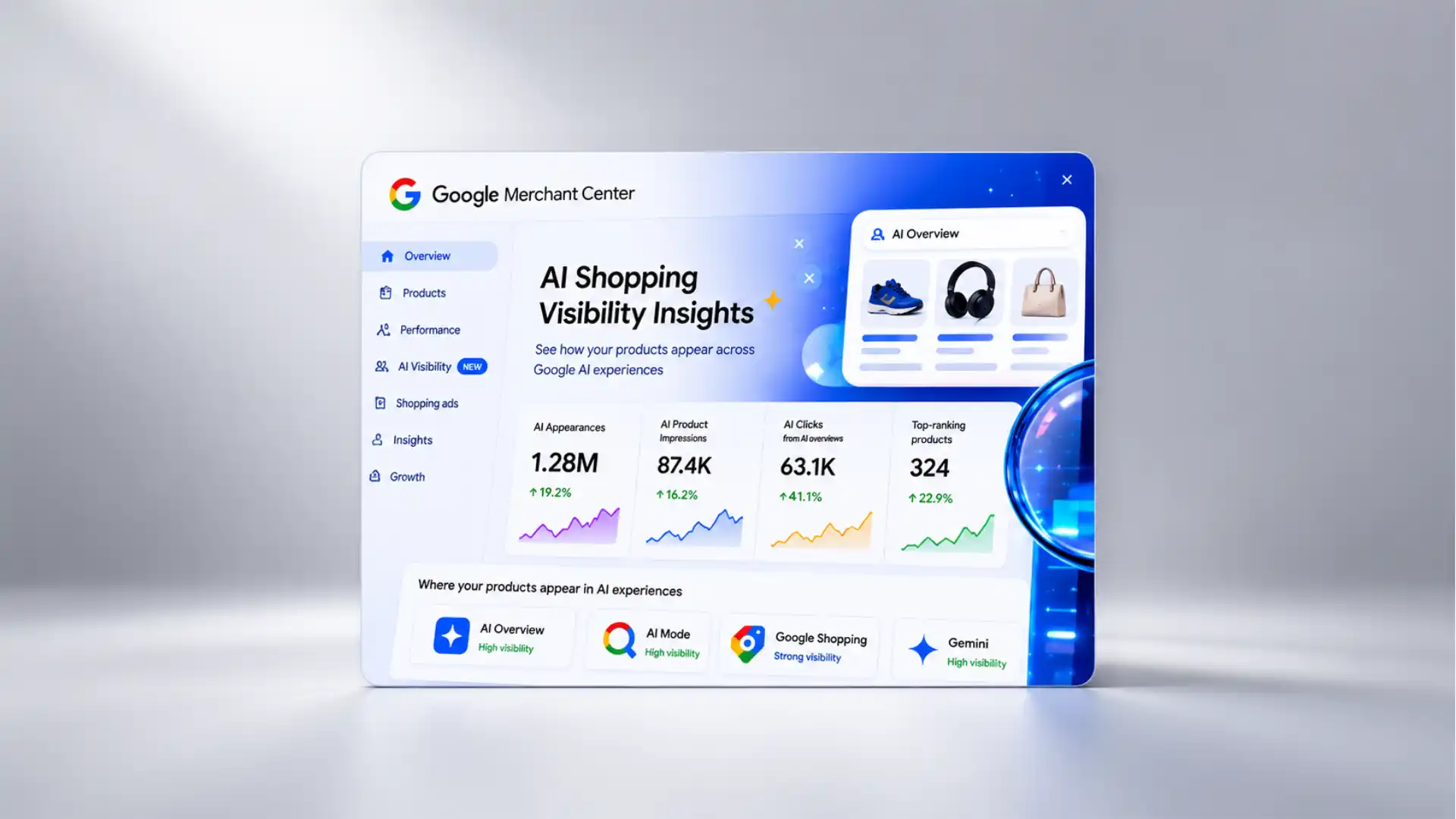
Google is giving retailers a new way to see whether their products and brands appear inside AI-powered shopping journeys. The move is small in interface terms and large in strategic terms: Merchant Center is becoming a measurement layer for AI discovery, not only a place to submit feeds, fix disapprovals, and inspect product performance. Google’s AI Performance Insights are built to show how products are discovered on AI Mode in Search, the Gemini app, and AI Overviews, with share of voice, journey-stage visibility, product-term demand, and structured-attribute gaps as the core signals.
Table of Contents
The update changes what Merchant Center is for
Google’s new AI shopping visibility insights mark a clear shift in Merchant Center’s role. For years, the platform sat near the operational center of ecommerce marketing: product IDs, titles, prices, images, GTINs, shipping settings, disapprovals, free listings, Shopping ads eligibility, and performance reports. It was the part of Google’s commerce system where the catalog became machine-readable. The new reports move that system closer to the retailer’s visibility strategy. They ask a different question: not only “is this product eligible to show?” but “is this product understandable enough to be chosen by AI when shoppers ask detailed questions?”
Google describes AI Performance Insights as a set of Merchant Center insights showing how products are discovered on AI Mode in Search, in Gemini, and in AI Overviews. That framing matters because it ties Merchant Center directly to Google’s conversational shopping surfaces, not only to classic Shopping units or feed-based ads. The feature compares a brand’s share of voice with shopper demand and breaks that visibility into journey stages, product terms, and structured attributes.
The change arrives after Google Marketing Live 2026, where Google announced a broader set of AI commerce tools, including AI-powered Shopping ads, AI Max for Shopping campaigns, Direct Offers, expanded Universal Commerce Protocol work, and new conversational attributes in Merchant Center. Google said the AI performance insights tool would give brands a view of performance on AI surfaces by comparing share of voice against similar brands, with rollout planned for Australia, Canada, India, New Zealand, and the United States in the coming months.
The update also lands in a period when product discovery is moving away from short, keyword-like queries and toward longer prompts. A shopper no longer needs to search only for “running shoes men size 10.” A shopper can ask for “lightweight men’s running shoes for wet city streets, wide feet, and half-marathon training under $140.” The old feed still matters, but it now has to answer more conditions. AI shopping visibility depends on whether Google can map a messy human request to structured product facts with enough confidence.
That is the commercial reason the Merchant Center update matters. It gives retailers a first-party window, however partial, into a part of Google shopping that has been hard to measure. Classic search visibility had rankings, impressions, clicks, product listing reports, auction insights, search terms, and SEO tools. AI shopping visibility has been more opaque because the user experience behaves more like advice, comparison, and recommendation than a familiar list of results. The new reporting layer does not solve all measurement gaps, but it makes Google’s AI commerce system more legible for merchants.
The practical reading is direct: retailers that treat product data as backend plumbing will be at a disadvantage against retailers that treat product data as retrieval infrastructure. The feed is no longer only a delivery file. It is a knowledge source used by search, shopping, ads, and AI systems to decide whether a product deserves to appear in an answer.
The reporting layer Google is adding
The new reporting suite has four main parts. Search Engine Land reported that the reports include share of voice insights against similar retailers, shopping funnel performance across discovery, evaluation, and purchase stages, product term insights for conversational shopping queries, and product attribute insights that highlight missing specifications. Search Engine Roundtable’s coverage points to the same four categories, citing share of voice across Search and Gemini AI-driven experiences, journey-stage performance, product-term visibility, and attribute completeness for specifications such as color, style, and material.
Google’s own Accelerate page describes the tool as a “new set of insights” in Merchant Center showing how products are discovered on AI Mode in Search, Gemini, and AI Overviews. It defines share of voice as how often a brand is linked in relevant results compared with shopper demand and then names the three areas of detail: journey stages, product terms, and structured attributes.
What the new Merchant Center report appears to measure
| Insight area | Retail question it answers | Practical action |
|---|---|---|
| Share of voice | How visible is the brand in relevant AI shopping results compared with similar brands? | Compare category presence and identify weak product groups |
| Journey stages | Does visibility occur during discovery, evaluation, or purchase intent? | Match data work and offers to the stage where visibility drops |
| Product terms | Which conversational product phrases are shoppers using? | Rewrite titles, descriptions, FAQs, and product details around real demand |
| Structured attributes | Which specs are missing or incomplete? | Fill fields such as color, material, dimensions, size, weight, and style |
This table is compact by design because the report’s power sits in the connection between these four lenses. A retailer that sees low share of voice for “long battery life camping lantern” and also sees missing battery-runtime attributes has a much clearer fix than a retailer that only sees falling impressions.
The new report is not just a dashboard. It is a feedback loop. Google is telling merchants which kinds of product facts its AI shopping systems need, where those facts affect the journey, and which conversational terms shoppers are using. That creates a new cycle: product data enters Merchant Center, AI systems use that data across shopping surfaces, visibility appears or does not appear, and Merchant Center returns signals about the gap.
The value of that cycle will depend on how much detail Google exposes. If the report shows only aggregated visibility by broad product area, retailers will get direction but not precision. If it shows enough product-level or attribute-level detail, the reports could become a working tool for catalog teams, paid search managers, SEO teams, merchandisers, and ecommerce product owners. Google’s public language points to actionable recommendations, but the real quality of the feature will be judged in accounts, not announcements.
There is a second layer here: benchmarking. Share of voice against similar brands means Google is defining peer groups inside AI shopping journeys. That will be useful, but it also raises questions. Which brands count as similar? Is similarity based on category, price band, inventory depth, auction competition, user intent, or model-inferred substitution? Does a department store benchmark against other department stores, brand manufacturers, marketplaces, or specialty shops? The benchmark will shape how retailers interpret success, and the methodology will matter as much as the metric.
Retailers should treat the report as a decision support tool rather than a complete truth source. It will show part of the AI shopping system from Google’s perspective. It will not tell a brand everything about why an AI answer surfaced one product over another, how ads interact with organic visibility, whether a user was persuaded by the answer, or how much traffic would have appeared under classic search. It gives a needed view, not a full map.
Share of voice enters AI commerce measurement
Share of voice is familiar in advertising, brand tracking, SEO, and retail media, but its move into AI shopping changes its meaning. In a traditional context, share of voice often means a brand’s portion of impressions, ad spend, ranking presence, media mentions, or visibility across a defined market. In Google’s AI shopping context, it points to how often a brand is linked or shown in relevant AI-driven shopping results compared with shopper demand. Google’s Accelerate page uses exactly that framing: share of voice is tied to relevant results and shopper demand.
This matters because AI shopping results do not behave like a classic search results page. A familiar product listing page gives a user many visible options. A conversational answer may compress the set. It might recommend a few products, compare a handful of attributes, summarize trade-offs, or guide a buyer toward a narrower choice set. When AI reduces the visible shelf, share of voice becomes a proxy for whether a brand is even in the conversation.
That creates both value and danger. The value is obvious. Retailers need to know whether Google’s AI surfaces mention or show them when shoppers express category demand. If a brand is strong in Shopping ads but absent from AI Mode product comparisons, that is a strategic gap. If a retailer has broad catalog depth but low visibility for high-intent terms, the issue might sit in product data, reviews, pricing, availability, shipping, or policy trust. Share of voice gives teams a starting point.
The danger is that share of voice can become a vanity metric if retailers disconnect it from revenue, margin, and customer quality. A brand can win visibility in broad discovery prompts and still lose money if it appears for low-fit shoppers or low-margin products. A retailer can have low share of voice in a noisy category but strong profitability in narrow purchase-intent prompts. A marketplace can dominate visibility but send shoppers into weak conversion paths. AI share of voice is a visibility signal, not a business outcome.
The metric also has a methodological challenge. In AI Mode, Search, Gemini, and AI Overviews, the output depends on the user’s wording, location, device, browsing state, language, inventory freshness, ad eligibility, and Google’s model behavior. A static rank is already hard to reproduce in classic SEO; an AI-generated shopping answer is harder. The same category intent can produce different product panels, explanation styles, and comparison paths. That means share of voice reporting has to aggregate many moments into a readable measure.
Retailers should ask three questions when the metric becomes available in their accounts. First, what is the denominator? Is share of voice based on eligible AI shopping impressions, linked results, prompted journeys, category demand, or some other event definition? Second, what counts as visibility? A product card, a brand mention, a link, a citation, an image, or a recommended option? Third, what is the benchmark group? A share of voice metric against the wrong peer set can create false confidence or unnecessary alarm.
Even with those caveats, the move is useful. Google is signaling that AI shopping visibility will be measured competitively, not just internally. That is a major shift for retail teams. The new question is not only whether a product is feed-complete. The question is whether it is more understandable, more trusted, and more useful to an AI shopping system than competing products answering the same shopper need.
Shopping funnel reporting meets conversational journeys
Google says the new insights break visibility into shopper journey stages: discovery, evaluation, and purchase. Its Accelerate page explains that the journey-stage view shows a shopper’s current stage alongside activities such as understanding product specs or comparing prices. Search Engine Land also reported funnel performance across discovery, evaluation, and purchase stages.
That stage model fits AI shopping better than a keyword-only model. Conversational shopping tends to collapse steps that used to be spread across many searches. A user might begin with inspiration, move to comparison, ask for trade-offs, check price, and inspect availability without leaving the same AI Mode session. Google’s AI shopping experience, described in its Think with Google coverage, uses Gemini capabilities and the Shopping Graph to help shoppers browse for inspiration, think through considerations, and narrow choices. The same article says AI Mode can run several simultaneous searches to identify criteria and then update product suggestions.
That experience changes what funnel reporting has to capture. In classic ecommerce analytics, discovery might be a broad query, evaluation might be a category page or product comparison, and purchase might be a shopping cart or checkout. In AI Mode, those stages can appear as conversational turns. “I need a carry-on bag for rainy weather” is discovery. “Compare waterproof weekender bags under $150 with easy-access laptop pockets” is evaluation. “Track this one and buy when it drops below $120” moves toward purchase intent. Google’s agentic checkout feature, described for product listings in the United States, lets shoppers set options such as size, color, and target price, then confirm purchase details when the price fits.
Merchant Center reporting has to follow that behavioral shift. A retailer needs to know whether it is visible when users are still shaping the need, when they are comparing specifications, and when they are near checkout. Each stage has different data requirements. Discovery visibility often needs descriptive richness: use cases, style, compatibility, problem solved, and category fit. Evaluation visibility needs precise details: dimensions, materials, battery life, warranty, reviews, shipping, returns, accessories, variants, and price comparisons. Purchase visibility needs current availability, accurate price, shipping cost, delivery speed, returns, payment readiness, and merchant trust.
A product feed that wins discovery but fails evaluation is not ready for AI commerce. That failure can happen when descriptions sound attractive but structured attributes are incomplete. It can also happen when the product has data but not enough evidence: thin reviews, unclear return policies, vague dimensions, missing manuals, or inconsistent landing page content. The new funnel reporting should expose these breaks if the stage data is detailed enough.
The purchase stage is especially sensitive because AI shopping compresses hesitation. When a shopper trusts the system enough to let it narrow options, the product shown near the end of the journey has to be correct. Price, stock, variants, shipping, and return data become promises. Google’s support documentation for AI Mode purchases says eligible products can show a Buy button after a user selects options, and that the merchant handles payment, shipping, returns, and customer support. That means the retailer still owns the operational consequences even when Google mediates the shopping path.
This is where measurement will become uncomfortable. AI shopping visibility is not just a marketing score. It reveals how much friction the retailer has hidden in its catalog, operations, and site experience. A high discovery score with weak purchase-stage visibility could mean the product is attractive but not reliable enough for an AI-mediated recommendation. A weak discovery score with solid purchase-stage signals could mean the product is operationally sound but poorly described. Both problems require different teams.
Product term insights turn prompts into retail demand signals
Product term insights may become one of the most useful parts of the update. Google’s AI Performance Insights page says product terms show details that matter to shoppers, giving examples such as “easy setup” for tents and “long battery life” for portable lamps. Search Engine Land reported that the reports will show popular conversational shopping queries, while Search Engine Roundtable described product term insights as a way to identify popular product terms searched by users across Search conversations and see share of voice for them.
This is different from a classic keyword report. A keyword report often shows the exact or near-exact language that triggered an ad or listing. A product term insight in conversational shopping is closer to an intent fragment. It might not be the whole prompt. It might be the shopping requirement that Google’s systems extracted from prompts. “Easy setup,” “long battery life,” “machine washable,” “fits small apartments,” “safe for induction cooktops,” “good for sensitive skin,” or “compatible with MagSafe” are not only keywords. They are selection criteria.
That distinction matters because AI shopping systems must translate natural language into product constraints. A shopper rarely says every attribute in a clean feed format. They describe a situation. “I need a stroller that folds with one hand and fits in a small car trunk” becomes a set of product attributes and claims: folding mechanism, dimensions, weight, car compatibility, portability, maybe reviews mentioning easy folding. Product term insights should show retailers which selection criteria are rising in demand and whether the brand appears when those criteria matter.
The best use of product term insights is not stuffing phrases into titles. It is finding the missing evidence behind a shopper’s requirement. If shoppers ask for “easy setup,” a retailer should not only add those words to a product title. It should inspect whether the product page has assembly time, manual links, images, setup video, customer review evidence, and Q&A content. If shoppers ask for “long battery life,” the retailer should verify the battery-hour field, product description, testing context, warranty, charger details, and comparison claims. In AI shopping, a phrase without evidence is weak.
This also changes how merchandising teams read demand. Search demand used to be broken into head terms and long-tail terms. AI shopping demand will be richer, but it may be harder to organize. A category manager could find that shoppers care less about a broad category label and more about usage conditions. Outdoor shoppers might ask about rain, wind, packability, weight, setup, and compatibility. Beauty shoppers might ask about skin sensitivity, undertones, ingredients, finish, staying power, cruelty-free status, and shade matching. Electronics shoppers might ask about ports, charging, interoperability, battery life, repairability, warranty, and heat.
For retailers, product term insights could become a bridge between search marketing and product operations. If Merchant Center shows repeated demand for an attribute the retailer cannot supply, the issue might sit with suppliers, PIM governance, content teams, or product design. A missing product term may not be a marketing problem. It may reveal that the retailer does not know enough about the products it sells.
The insight is also a competitive signal. When a brand has low share of voice for a product term that matches its actual product strength, the gap is likely data quality, not product quality. If a brand sells tents that truly are easy to set up but Google cannot see setup time, instructions, or review language, the AI system may favor a competitor with clearer evidence. AI shopping rewards the product whose strengths are machine-readable, not necessarily the product whose strengths are real but hidden.
Attribute gaps become visibility gaps
The attribute insight is the most operational part of the update. Google says structured attributes in AI Performance Insights pinpoint specs customers search for, including dimensions, weight, materials, colors, and more, as those specs relate to products. Search Engine Land reported that advertisers will be able to identify incomplete structured product attributes such as color, material, or style.
This is where Merchant Center’s old discipline becomes central to AI commerce. Google’s product data specification says Google uses product information to match products to the right queries and warns that incorrect, inaccurate, or missing product information can cause disapprovals, limited eligibility, incorrect displays, or prevent ads and free listings from showing. The same page names common issues such as incorrect Google product category or GTIN values, missing or incorrect variant attributes such as item group ID, color, and size, low-quality images, and conflicts between feed data and website data.
The AI visibility layer raises the cost of those gaps. In a classic product listing, a missing attribute might reduce eligibility, weaken matching, or create a poor display. In conversational shopping, a missing attribute can remove the product from consideration for a specific need. If the user asks for a “solid oak dining table under 180 cm wide,” a product without material or width data is a weak candidate. If the user asks for “a black linen blazer for summer,” a product missing material or color data is harder to match. If the user asks for “a lightweight stroller under 7 kg,” missing weight can push the product out of the answer.
Attribute completeness is becoming a visibility requirement, not only a feed-quality score. That does not mean every product needs every possible field. It means the fields that matter to the shopper’s decision have to be present, accurate, and consistent across Merchant Center, structured data, product pages, and inventory systems.
The challenge is that many ecommerce catalogs were not built for this level of detail. Product information often enters through suppliers, ERP exports, marketplace templates, manual content work, automated enrichment, and site scraping. Values can be inconsistent. “Navy,” “dark blue,” “midnight,” and “blue” may describe the same color family. Materials can be mixed or incomplete. Dimensions can use inconsistent units. Variant relationships can break. GTINs can be absent. Product titles can be overloaded because teams tried to compensate for missing fields with keyword-heavy naming.
AI shopping exposes that debt because the model needs structured clarity. A conversational query turns product data into filters, comparisons, and recommendations. When the data is incomplete, the model either ignores the product, guesses from unstructured text, relies on other web signals, or surfaces a competitor. None of those outcomes is ideal for the merchant.
This does not make unstructured content irrelevant. Product descriptions, reviews, guides, Q&A, images, videos, and manuals still matter because they give context. But structured attributes are the spine. They give Google’s systems a clean way to understand the product’s factual properties. The new Merchant Center attribute insights should push retailers to prioritize the fields shoppers ask for, not just the fields the feed template requires.
Conversational attributes make feeds speak in shopper language
AI Performance Insights should be read together with Conversational Attributes, because the reporting and data-entry sides of the update fit together. Google’s Merchant Center Help page says conversational attributes help AI systems and conversational agents better understand product nuances. They are optional and designed to complement the primary product data specification. Google says they can support discovery across AI-driven surfaces such as AI Mode in Search while also improving traditional search experiences.
Google lists several conversational attributes: question and answer, document link, related product, item group title, variant option, and popularity rank. The help page says retailers can add these attributes through a supplemental data source or primary data source, and can also submit them through the Merchant API. It also says including them will not affect approval status for existing products.
The point is not that Google invented product FAQs or related-product data. Retailers have used Q&A modules, manuals, compatibility charts, variant labels, and accessory recommendations for years. The change is that Google is giving that material a structured path into Merchant Center for conversational commerce. The questions customers ask on the product page can now become feed-level context for AI retrieval.
That is powerful because many shopping questions do not map neatly to old feed attributes. A user might ask whether a phone supports a specific charger, whether a suitcase fits airline carry-on rules, whether a rug works on heated floors, whether a skincare product contains fragrance, whether a replacement filter fits a particular model, or whether a lamp includes the bulb. Some of that information may exist in descriptions, reviews, or PDFs, but not in fields that Google can confidently parse. Conversational attributes create a place for such answers.
Google’s Accelerate page for Conversational Attributes says the attributes are designed for easy discovery in the conversational commerce era on surfaces such as AI Mode. It says people are searching with more detail and nuance, and that extra information supports answers to more questions. It also says the attributes build on existing feeds and allow common questions and complementary products to be expressed more clearly.
The operational risk is quality control. If merchants rush to populate Q&A fields with thin, generic, or inaccurate answers, they may create more noise. An AI system using bad product answers can mislead shoppers, weaken trust, or increase returns. The safest path is to build conversational attributes from real customer questions, support tickets, review themes, sales calls, product manuals, and supplier facts. Retailers should treat these fields as product knowledge, not copywriting filler.
The most useful conversational attributes will often be boring. Compatibility, exclusions, package contents, setup requirements, replacement parts, maintenance, sizing, warranty boundaries, and safety instructions matter because they answer purchase-blocking questions. In a conversational shopping flow, those details can decide whether the AI recommends the product or moves on.
Merchant Center moves from catalog hygiene to retrieval readiness
Merchant Center has always forced retailers to keep product data clean enough for Google to use. The new AI visibility reports raise the standard from catalog hygiene to retrieval readiness. Catalog hygiene means the product is approved, correctly formatted, and eligible. Retrieval readiness means the product has enough structured and contextual information to be selected for a detailed human need.
That difference is not academic. A product can be eligible and still invisible for valuable AI queries. It can have a title, price, image, GTIN, brand, and availability but lack the attributes that decide the shopper’s prompt. A dining chair may be eligible but not retrievable for “kid-friendly wipe-clean dining chairs for small apartments.” A backpack may be eligible but not retrievable for “fits a 16-inch MacBook and slides under an airline seat.” A moisturizer may be eligible but not retrievable for “fragrance-free gel moisturizer for oily skin.”
Eligibility is the floor. Retrieval readiness is the contest. The Merchant Center update makes that contest easier to see because the new insights connect AI visibility to product terms and structured attributes.
This shift will force retailers to revisit long-standing feed habits. Many feeds were tuned for short-query matching and Shopping ad formats. Titles carried brand, product type, gender, size, color, and maybe a keyword. Descriptions were often imported from suppliers. Product type taxonomies were built for bidding and reporting. Attribute completeness varied by category. Supplemental feeds patched gaps. The new AI shopping layer demands a richer model of the product.
Retrieval readiness has several parts. The product must be identifiable: brand, GTIN, MPN, item group, variant structure, category, and canonical page must be clear. It must be describable: titles, descriptions, highlights, and details must explain use cases and differentiators without exaggeration. It must be filterable: color, size, dimensions, material, weight, capacity, compatibility, age range, ingredients, care instructions, and other category-specific fields must be present. It must be verifiable: landing page data, structured data, reviews, manuals, policies, and inventory must align. It must be current: price, availability, delivery, and returns need to update quickly.
Google’s Shopping Graph helps explain the need. Google has described the Shopping Graph as a machine-learning-powered, real-time dataset of products and sellers, with product listings, availability, reviews, pros and cons, materials, colors, and sizes. Google said in 2023 that it housed more than 35 billion product listings, with listings updated through retailer data in Merchant Center and information from the web.
Google later said the Shopping Graph had more than 50 billion product listings and that more than 2 billion listings are refreshed every hour. That volume makes clean, current product data a competitive asset. A retailer’s feed is not being inspected in isolation. It is entering a massive product knowledge system where similar products compete on clarity, freshness, and fit.
The Shopping Graph is the hidden foundation
Google’s AI shopping push sits on the Shopping Graph. That is the data layer behind many Google shopping features. It connects products, sellers, prices, availability, reviews, images, attributes, and web signals. Google has compared it to the Knowledge Graph, but for shopping information.
For retailers, the Shopping Graph matters because AI shopping does not start from a blank model. It starts from structured product data, Merchant Center feeds, website content, reviews, product pages, inventory signals, and Google’s systems for understanding them. When a user asks a complex shopping question, the AI does not merely generate an answer from language memory. It has to retrieve, compare, and present products from live or near-live commerce data. That is why Google keeps stressing product data quality.
Google’s Ads Decoded retail discussion put the point bluntly: AI-driven shopping experiences such as conversational shopping in AI Mode, virtual try-ons, and shoppable CTV are powered by the product data retailers provide to Google, and messy or incomplete Merchant Center feeds make products harder for customers to find.
That statement should change how retail teams frame the feed. A feed is not an export. It is an input into Google’s product understanding. It gives the system facts that affect whether an item appears for a prompt, how it is described, whether it is compared fairly, and whether the retailer gets visibility during the right stage of the journey.
The Shopping Graph also explains why product data conflicts are so damaging. If Merchant Center says one price, the page says another, structured data says a third, and the retailer’s local inventory feed says the product is unavailable, Google has to decide what to trust. That uncertainty can reduce eligibility, weaken visibility, or create user-facing mistakes. AI shopping raises the stakes because the answer may present a recommendation with higher perceived authority than a standard listing.
The Shopping Graph rewards consistency across systems. Merchant Center, structured data, product pages, reviews, Google Business Profile, local inventory, shipping settings, return policies, and checkout availability all feed the same trust problem. The AI shopping answer has to decide not only what product fits the prompt, but whether the merchant can deliver it as promised.
The scale of the Shopping Graph also means small differences can matter. If many retailers sell similar products, the system needs signals to separate them. Attributes, reviews, shipping, price, availability, brand strength, product page clarity, and policy transparency all become tie-breakers. The new AI Performance Insights may show where those tie-breakers are hurting a retailer, but fixing them will require data governance outside the marketing team.
AI Mode and Gemini change the product discovery path
Google’s AI shopping surfaces are not a cosmetic layer over old search. AI Mode and Gemini change the path from question to product. The user can describe a need, ask follow-up questions, compare products, refine constraints, and move toward purchase inside a guided flow. Google’s Think with Google article says AI Mode shopping brings Gemini capabilities together with the Shopping Graph to help shoppers browse for inspiration, think through considerations, and narrow product choices. It also says the system can fan out queries, run simultaneous searches, and use criteria to suggest products.
This breaks the old mental model of one query, one results page, one click. A shopper might now begin with a situation: “I need a gift for a new parent who lives in a small apartment.” The AI system has to infer categories, constraints, budgets, safety concerns, delivery timing, and possibly recipient preferences. Product discovery becomes a dialogue. That dialogue can produce a product panel, a comparison, a suggested set, a buying guide, or a purchase path.
For retailers, this means product visibility is no longer tied only to exact category and keyword matches. It is tied to the model’s ability to understand product fit. A baby monitor, compact sterilizer, foldable changing pad, white-noise machine, or meal delivery gift card could all fit the “new parent in small apartment” prompt. The retailer’s data has to explain why.
That is why product terms and structured attributes sit at the center of the new reports. AI Mode needs to resolve prompts into product criteria. Gemini-powered shopping experiences need to compare products on those criteria. Merchant Center now gives retailers feedback on where that mapping succeeds or fails.
The purchase path is changing too. Google’s AI Mode purchase help page says eligible products can show a Buy button after the user chooses options, with Google asking users to confirm payment details and shipping address. It also states that purchases are made directly with the merchant and that the merchant handles payment, shipping, returns, and customer support.
That keeps the merchant commercially responsible even if Google owns more of the discovery interface. A bad feed, wrong price, stale availability, or unclear return path will not be experienced by the shopper as a “feed issue.” It will be experienced as a broken purchase. AI shopping shifts more user trust to the recommendation layer, but it leaves execution risk with the retailer.
Gemini adds another strategic wrinkle. Google said AI Performance Insights cover discovery in the Gemini app as well as AI Mode and AI Overviews. That matters because Gemini is not only a search interface. It is an assistant environment. If shopping journeys occur inside an assistant, product visibility may blend with planning, task completion, reminders, price tracking, and checkout support. Retailers will need to think beyond search results and toward product presence inside task flows.
Google is making AI shopping measurable before it becomes normal
Google’s timing is not accidental. The company is building AI shopping surfaces, agentic checkout, AI-powered Shopping ads, AI Max for Shopping campaigns, Direct Offers, Universal Cart, Business Agent, and UCP-powered checkout features. At the same time, it is adding reporting that tells retailers how they appear in AI shopping journeys. That pairing is strategic. Google is giving merchants a measurement language before AI shopping becomes a default behavior.
At Google Marketing Live 2026, Google’s product announcements grouped commerce features with AI-driven ads and agentic tools. The Accelerate recap listed AI-powered Shopping ads that use AI summaries, AI Max for Shopping campaigns that use Merchant Center feeds to answer conversational queries, and Direct Offers to reduce checkout friction and support promotions.
Google’s separate commerce announcement said Universal Cart works across retailers and services such as Search and Gemini, with UCP supporting checkout. It said shoppers could try select checkout features with brands and retailers including Nike, Sephora, Target, Ulta Beauty, Walmart, Wayfair, and Shopify merchants, while the retailer remains the merchant of record.
Measurement is needed because these features blur old channel boundaries. If a shopper sees an AI-generated product explanation, clicks a product panel, receives a direct offer, uses Google Pay, and completes a purchase with the merchant as seller of record, which team gets credit? Paid search? Merchant Center operations? SEO? Retail media? CRM? Marketplace? Product content? The answer will vary by journey, but the old reporting model will not be enough.
AI Performance Insights begin to answer the visibility part of that question. They do not replace conversion tracking or attribution. They do not prove incremental revenue. They do show whether the brand appears in relevant AI shopping contexts. That matters because absence from discovery can prevent every later metric from existing.
The deeper business move is that Google is trying to keep retailers invested in its commerce infrastructure as shopping behavior changes. Retailers will not invest in new product data fields, AI-ready feeds, UCP integrations, or AI shopping campaigns if they cannot see any feedback. AI Performance Insights are part of that trust-building. They tell retailers: your data work has measurable visibility effects.
There will still be skepticism. Retailers will ask whether Google’s AI surfaces favor paid placements, large merchants, fast-shipping sellers, or brands with better data. They will ask whether share of voice can be independently checked. They will ask how AI Overviews, AI Mode, Gemini, ads, organic results, and Shopping Graph signals interact. Those questions are fair. But the arrival of a first-party report is still a turning point. The conversation moves from “AI shopping is opaque” to “which parts of AI shopping visibility will Google reveal, and which parts remain hidden?”
Retailers now need two kinds of product truth
AI shopping visibility depends on two kinds of product truth: factual truth and contextual truth. Factual truth covers the measurable product properties: price, stock, color, material, dimensions, weight, size, brand, GTIN, energy rating, compatibility, ingredients, warranty, shipping cost, return window, and delivery speed. Contextual truth covers the product’s usefulness in a situation: good for a small kitchen, suitable for sensitive skin, easy to assemble, quiet enough for a nursery, durable for daily commuting, compatible with older accessories, or appropriate for a gift.
Classic feeds were stronger on factual truth. Product pages, reviews, FAQs, buying guides, and customer support teams often carried contextual truth. AI shopping requires both. A user rarely asks only for a data sheet. They ask for a match between a product and a life situation.
Google’s conversational attributes push in this direction. Question and answer fields, document links, related products, item group titles, variant options, and popularity rank create more ways to represent product context in Merchant Center. Google says these attributes complement the primary product data specification and help AI systems understand product nuances.
The risk for retailers is confusing context with marketing claims. “Perfect for every adventure” tells an AI system very little. “Waterproof to IPX7, weighs 310 grams, runs up to 18 hours, includes USB-C charging cable, fits standard bike mounts, replacement strap sold separately” gives the system facts it can use. Context should be grounded in attributes, evidence, and specific use cases.
The strongest product data will read like a knowledgeable sales associate and behave like a clean database. It will answer the customer’s real questions while staying structured enough for machines. That combination is hard. It requires product teams to know what buyers ask, content teams to write accurate answers, data teams to map fields cleanly, and ecommerce systems to keep everything current.
This is also where reviews matter. Reviews are not a replacement for structured data, but they supply evidence for contextual claims. If the product description says “easy to assemble” and reviews repeatedly confirm setup in ten minutes, the claim is stronger. If reviews mention sizing issues, battery problems, or misleading materials, AI systems may pick up those signals too. Retailers should assume that Google’s product understanding pulls from more than the feed, because the Shopping Graph uses retailer data and web content.
The practical task is to align factual and contextual truth. If a product is marketed for camping, the feed should include weight, dimensions, material, temperature rating where relevant, water resistance, pack size, accessory compatibility, setup time, and documents. If a product is marketed for skincare, the feed and page should cover ingredients, skin type, fragrance, finish, usage instructions, size, safety, certifications, and shade or variant details. Context without facts is weak; facts without context can be invisible for conversational demand.
Feed operations will need editorial judgment
The Merchant Center update will make product feed work more editorial. That does not mean poetic. It means decisions about which details matter, which buyer questions deserve structured answers, and which claims need proof. A purely technical feed team can fix formatting, but it cannot decide which product nuance wins a conversational shopping comparison without category knowledge.
Retailers already have many sources of product truth: supplier data, PIM systems, ERP records, warehouse systems, reviews, returns reasons, customer service logs, on-site search queries, product manuals, marketplace listings, SEO pages, merchandising notes, and paid search terms. AI shopping visibility work requires stitching those sources into a product knowledge layer. Merchant Center is one output, not the whole system.
The new product term insights should sharpen this work. If Merchant Center shows that shoppers ask for “easy setup,” “long battery life,” or similar criteria, a retailer has to decide which products truly satisfy those criteria and how to prove it. The answer may involve rewriting descriptions, adding structured product details, attaching manuals, improving images, adding Q&A, updating variant data, or asking suppliers for missing specs.
Good AI shopping data will need restraint. Retailers should not claim every product fits every conversational term. A system filled with exaggerated attributes becomes less trustworthy. Over-tagging products as “lightweight,” “durable,” “premium,” “eco,” or “compatible” without evidence will create bad matches and returns. The best feed work will be selective, specific, and defensible.
Editorial judgment also matters in product titles. AI Max for Shopping campaigns, according to Google’s Marketing Live recap, use Merchant Center feeds to create Shopping ads that answer conversational queries. That puts more pressure on titles and feed data. If titles are too thin, Google lacks context. If titles are stuffed, they become unreadable and can misrepresent the product.
The same applies to Q&A. A product-level question field should answer questions real shoppers ask. It should not repeat the description. The best source material will come from customer service, reviews, comparison pages, and sales objections. For example, a camera listing might answer whether the model supports external microphones, which memory cards it accepts, whether the kit includes a charger, and whether it records without overheating under common settings. Those answers create retrieval value because they match actual buying concerns.
Retailers should also watch internal ownership. Product feed work often sits inside performance marketing or ecommerce operations. Conversational product content may sit inside SEO or content. Supplier data may sit with merchandising. Technical structured data may sit with engineering. Reviews may sit with CRM or customer experience. AI shopping visibility crosses all of these. A retailer that leaves Merchant Center to one isolated team will move slowly.
Paid search teams lose some keyword certainty
Paid search teams have lived through several waves of control loss: broad match changes, Performance Max, automation in bidding, reduced search term visibility, creative assembly, and cross-channel campaign types. AI shopping adds another shift. The user’s query becomes more conversational, the ad or product unit may appear inside a generated answer or guided shopping flow, and the retailer may not be able to map every impression back to a tidy keyword.
Google’s Marketing Live 2026 announcements point in that direction. The company highlighted AI-powered Search tools, ads in AI Mode, AI-powered Shopping ads, AI Max for Shopping campaigns, and other automated campaign features. AI Max for Shopping campaigns use Merchant Center feeds to turn product data into dynamic Shopping ads that answer conversational queries.
For paid search teams, AI Performance Insights are partly a response to this loss of certainty. If the search term is less clean, the product term insight becomes more useful. If the ad surface is more conversational, share of voice becomes more important. If the funnel is compressed, journey-stage reporting matters. The measurement object is shifting from the keyword to the shopping need.
This does not make paid search skills obsolete. It makes them less isolated. Bidding, budget allocation, promo strategy, campaign structure, audience signals, and creative testing still matter. But paid search teams will need closer ties to feed quality, product content, category strategy, and conversion operations. If AI shopping visibility is weak because the feed lacks material or compatibility data, no bidding strategy can fully fix that.
The tension will appear in reporting meetings. A paid search manager may see weaker visibility for product terms that matter. A merchandising team may say the product is strong. A feed team may say required fields are complete. The new discipline will be diagnosing the gap between product truth and machine-readable product evidence. The paid team will increasingly ask for product data changes, not just budget changes.
There is also a campaign-learning issue. AI-powered shopping journeys may create new forms of demand that do not show up neatly in old keyword reports. A user asking for “quiet dishwasher for an open-plan apartment” might be more valuable than a user searching “dishwasher sale,” even if the volume is lower. Product term insights could reveal such demand. Paid search teams should use those insights to inform product grouping, creative claims, landing page content, and promotional strategy.
The biggest risk is treating AI visibility reports as another automated black box to accept passively. Paid teams should test. If Merchant Center reports missing attributes, fill them and measure visibility changes. If product term share of voice is low, improve data and landing pages for that need, then monitor. If visibility rises without conversion, inspect price, reviews, shipping, and fit. AI shopping measurement will reward teams that connect data fixes to commercial outcomes, not teams that only watch new charts.
SEO teams inherit more of the product feed
The Merchant Center update blurs the line between SEO and product feed work. Search Engine Land’s coverage makes the point that retailers may need to treat product feeds more like SEO content, with completeness, context, and natural language discoverability becoming more important as search, Gemini, and AI Overviews grow more conversational.
That does not mean product feeds should become blog posts. It means SEO teams understand questions, entities, attributes, semantic relationships, internal linking, structured data, crawlable content, and query intent. Those skills now belong in product data strategy. A product feed that only mirrors supplier data may miss how shoppers describe needs. SEO teams can help translate query and content research into structured product facts.
Google Search Central already connects ecommerce visibility to structured data. Its product structured data documentation says product snippets and merchant listings support product variants, and it recommends structured data for ecommerce business policies under Organization markup. Its merchant listing documentation focuses on Product structured data requirements for merchant listings.
Structured data on the site and product data in Merchant Center should not compete. They should agree. Merchant Center feeds are often the primary data channel for ads and listings. Structured data helps Google retrieve current product and offer information from the website. Google’s Merchant Center help page on supported structured data says structured data markup on product landing pages helps Google retrieve up-to-date information about products and offers directly from a website, and that supported structured data maps to product data specification attributes.
SEO teams should treat Merchant Center as part of search infrastructure. Product pages, schema markup, internal category logic, Merchant Center feeds, image data, reviews, and FAQs all contribute to product understanding. If the site says one thing and the feed says another, Google gets mixed signals. If the site has rich answers but the feed lacks structured attributes, AI retrieval may still be weak. If the feed is rich but the page is thin, users may click through and lose confidence.
This also affects content strategy. Buying guides and category pages should not exist as generic SEO assets disconnected from product data. If a guide says shoppers should compare tent setup time, waterproof rating, weight, and packed size, the retailer’s product data should include those fields. If a category page teaches how to choose a laptop for video editing, product feeds should contain GPU, RAM, display, storage, ports, battery, and thermal details where available. AI shopping rewards alignment between advice and catalog.
SEO teams will also need to adapt measurement. Classic rankings and organic clicks will not fully capture AI shopping visibility. AI Performance Insights may become a first-party source for product visibility inside Google’s generated shopping experiences. Search Console, Merchant Center, analytics, and paid reports will need to be read together. A decline in classic organic clicks might coincide with more AI answer exposure, but without revenue growth it may not be a win. A rise in AI share of voice might not show in SEO tools but could affect brand consideration.
The right SEO posture is sober: product feeds are not replacing content, and content is not replacing feeds. The two have to reinforce each other.
Measurement will be useful but incomplete
AI Performance Insights give retailers a needed view, but they will not answer every measurement question. Google can show share of voice, journey-stage visibility, product terms, and attribute gaps because those signals sit inside its systems. It cannot by itself prove every downstream business effect. A retailer still has to connect visibility to clicks, sessions, assisted conversions, revenue, margin, new customers, return rates, and lifetime value.
Merchant Center already offers performance reporting for product trends, and Google’s Merchant Center help says performance reporting shows metrics such as how products and brands trend over time. The Merchant API documentation says performance reports can query metrics such as clicks and impressions with date filters.
AI visibility reporting extends that measurement stack but does not replace it. The new reports show whether the brand appears in AI shopping contexts. They do not necessarily show why a shopper trusted one recommendation, whether a competitor appeared above or beside it, whether the user saw an ad or organic mention, or whether the user would have clicked a classic listing. These are hard questions because AI answers compress and reshape the journey.
Researchers are already examining the broader effect of Google’s AI Overviews on visibility and source selection. A 2026 arXiv study measured AI Overview activation and source behavior across trending queries and found that AI Overview source selection can differ from classic first-page ranking, while also identifying unsupported claims in a subset of atomic claims. That study is not about Merchant Center shopping reports, but it underlines a broader point: AI search systems need separate measurement because they do not behave exactly like classic search.
For retailers, the practical limitation is attribution. AI shopping may produce fewer page visits for some comparison tasks and more qualified visits for purchase tasks. A shopper might get enough information in AI Mode to skip several category pages, then click only near the end. That could lower upper-funnel traffic while improving conversion rate, or it could reduce brand engagement without enough revenue gain. Without careful analysis, both outcomes can be misread.
AI share of voice should be paired with business metrics before teams declare success. A retailer should segment by product group, margin, availability, price competitiveness, and stage. High discovery visibility for low-stock products may hurt user experience. Low evaluation visibility for high-margin products may reveal a data gap worth fixing. Strong purchase visibility for discounted products may drive revenue but compress margin. The report becomes useful when read against commercial reality.
Retailers should also watch time lag. Data changes may not affect visibility instantly. The Shopping Graph refreshes large volumes of listings, but AI systems may still use multiple sources, eligibility checks, and confidence thresholds. A feed fix today might show clearer effects after crawls, approvals, page updates, and model-side usage. Teams need a testing cadence that avoids both impatience and drift.
Share of voice is not the same as revenue
Share of voice is seductive because it turns visibility into a simple competitive number. Retail leaders like competitive numbers. They are easy to put in slides, targets, and agency scorecards. But a higher AI shopping share of voice is not automatically better if it appears in the wrong context.
A brand could have strong share of voice for broad prompts where shoppers are still exploring and weak visibility for purchase-ready prompts. That might inflate perceived presence while failing to drive revenue. A retailer could win visibility for terms where it has poor stock, slow delivery, or weak pricing. That could create clicks but not sales. A premium brand could lose share of voice in price-led prompts and still perform well with shoppers asking for quality, warranty, design, or brand trust.
The new journey-stage reporting should reduce this problem by showing discovery, evaluation, and purchase stages. Still, teams will need to define what good visibility means for each category. A grocery retailer, fashion brand, electronics seller, home improvement merchant, marketplace, and luxury retailer have different margins, consideration cycles, and return risks. The right share of voice is profitable visibility, not maximum visibility.
This is especially true for AI shopping because recommendations can carry more perceived authority than ordinary listings. If Google’s AI presents a product as a good match, the user may trust that framing. A bad match can produce disappointment and returns. Winning visibility for weak-fit prompts is not a win; it is a future customer service cost.
Retailers should build guardrails around the metric. First, separate branded, category, attribute-led, and problem-led terms. A brand should usually dominate its own branded AI shopping journeys. Category prompts are more competitive. Attribute-led prompts require proof. Problem-led prompts require careful mapping between product and use case. Second, connect share of voice to conversion and return rate. A term that drives many sales but high returns may indicate poor fit or overclaiming. Third, examine margin. AI shopping visibility that steers users to low-margin items may need offer and assortment work.
Share of voice can also reveal brand perception gaps. If a retailer sells a product category but has weak visibility for the category’s defining attributes, it may mean Google does not associate the brand with that need. That can be a feed issue, a content issue, a review issue, or a genuine market-positioning issue. The response should depend on diagnosis.
A cautious interpretation will serve retailers better than chasing the number. AI shopping reports should prompt questions: Which products are visible? For what terms? At which stage? Against which competitors? With what stock? At what margin? With what customer outcome? A single score cannot answer those questions.
The update favors retailers with clean catalogs
Google’s new Merchant Center insights will benefit retailers that already have disciplined product data. Clean catalogs, stable identifiers, rich variant mapping, current stock, reliable structured data, strong reviews, clear policies, and well-maintained product pages give AI systems more to work with. Retailers with poor data will see gaps, but closing those gaps may require serious operational work.
This is not only a matter of budget. Large retailers often have messy catalogs because of scale, supplier variation, acquisitions, legacy systems, marketplace sellers, inconsistent taxonomies, and local inventory complexity. Smaller retailers may have fewer products but thinner data teams. Marketplaces may have broad assortment but uneven seller data. Brands may know their products deeply but lack retailer-side availability signals. Each model has a different weakness.
AI visibility will favor the retailer that can express product truth consistently at scale. That is harder than writing better descriptions. It means mapping attributes by category, standardizing units, normalizing color and material values, validating identifiers, managing variant relationships, improving images, syncing inventory, and keeping landing pages aligned.
Google’s product data specification is explicit that incorrect, inaccurate, or missing information can cause display and eligibility issues. The AI layer broadens the effect from eligibility to competitive visibility. A product with incomplete attributes may technically show on Google but lose AI selection for detailed prompts.
Catalog cleanliness also affects speed. Trends move quickly. If product term insights show rising demand for “quiet blender,” “PFAS-free cookware,” “linen blend,” “USB-C charging,” or “wide toe box,” the retailer needs to update data quickly. A catalog system that takes weeks to add or validate attributes will lose ground. A better system can ingest the signal, map affected products, fill fields, update pages, and monitor share of voice.
The hard part is governance. Product data often has no single owner. Marketing wants better visibility. Merchandising owns assortment. Suppliers provide specs. IT owns systems. Ecommerce owns product pages. Performance teams own feeds. SEO owns structured data recommendations. Customer service owns questions and complaints. Without governance, AI shopping work becomes a series of patches. With governance, it becomes a product knowledge program.
The retailers most likely to benefit early are those with strong PIM systems, clean Merchant Center feeds, rich on-site product content, good schema hygiene, connected inventory, and teams used to feed testing. The ones most likely to struggle are those that rely on supplier descriptions, treat feed errors as one-off fixes, or separate marketing from catalog operations.
Marketplaces and multi-brand retailers face a different problem
Marketplaces and multi-brand retailers have a tougher AI visibility problem than single-brand merchants. They may sell thousands or millions of products from many suppliers, each with different data quality. They may also compete with the brands they carry, other marketplaces, and direct-to-consumer sellers. Share of voice reporting against “similar brands” may be hard to interpret for them.
A marketplace might appear for broad category prompts because it has selection depth. But AI shopping may favor a specialist retailer or manufacturer when the user asks for a specific attribute, use case, or compatibility question. A marketplace with thin seller data may lose high-intent prompts even when it has the product in stock. A brand with rich product data may outperform a marketplace listing for the same item if Google trusts the brand page more.
For marketplaces, the central challenge is seller data normalization. They need to collect richer attributes from sellers, validate them, map them to Google’s product data specification, and prevent spam or exaggeration. That is difficult because seller incentives vary. Some sellers may overstate compatibility, material quality, or use cases. Others may leave fields blank. Marketplace quality systems will need to check attributes against images, descriptions, reviews, manuals, and manufacturer data.
Multi-brand retailers face a similar but slightly more controlled version. They can often enrich supplier data themselves, but doing so across categories is expensive. The new Merchant Center attribute insights may help them prioritize. If shoppers search heavily for dimensions and material in home furniture, enrich those fields first. If they search for compatibility in electronics accessories, focus there. If they search for ingredients and skin type in beauty, start there.
The reporting may also expose assortment positioning. A department store may discover that it is visible during discovery for fashion categories but absent during evaluation because product pages lack fit, fabric, care, and review signals. An electronics retailer may appear in purchase-stage prompts because it has strong price and availability but lose discovery prompts because content does not explain use cases. A marketplace may win product breadth but lose trust.
Benchmarking will be tricky. If a marketplace is compared with other marketplaces, it may look strong. If it is compared with category specialists, it may look weak in specific prompts. If it is compared with brands, the metric may mix retailer visibility and manufacturer brand demand. Retailers should push Google and their account teams for clarity on peer grouping once the feature appears.
Marketplaces should also treat conversational attributes carefully. Product-level Q&A can scale poorly if each seller writes its own answers without standards. A bad answer in an AI shopping journey can create return risk or policy risk. The best marketplace response may be category templates, validated attribute requirements, manufacturer data matching, and seller education tied to visibility incentives.
Smaller retailers get a path but not a guarantee
The new Merchant Center reports could be useful for smaller retailers because they turn AI visibility into a more concrete worklist. A small merchant may not have enterprise SEO tools, data science teams, or massive feed operations. Merchant Center showing product term demand and missing attributes gives a clearer path: improve the fields that matter to shoppers.
Google’s free listings documentation says eligible products can appear at no cost across surfaces including Search, Images, Lens, YouTube, Gemini, the Shopping tab, and product modules on Business Profile. That makes Merchant Center relevant beyond advertisers with large budgets.
Still, visibility is not guaranteed. AI shopping systems compare many products. A small retailer with clean data can be considered, but it still competes on price, availability, shipping, reviews, brand trust, return policies, and product fit. If the retailer has better data than larger competitors in a niche, it can gain visibility. If it has thin reviews, slow shipping, or weak price competitiveness, data alone will not solve the problem.
For small retailers, the best opportunity is narrow authority. A small store probably cannot win every broad category prompt. It can win detailed prompts where it has strong product knowledge and clean data. A specialty cycling shop can describe compatibility, terrain, fit, maintenance, and accessories better than a general retailer. A boutique cookware store can explain materials, induction compatibility, care, and use cases. A niche outdoor retailer can enrich technical specs and real-world usage.
The new reports may also reveal where small retailers are wasting effort. If a product group has little AI demand or weak commercial value, fixing every attribute may not be the best use of time. If Merchant Center shows product terms with clear demand and low share of voice, those terms should guide data work. Small teams need prioritization more than perfection.
The risk is overdependence on Google. A small retailer that invests heavily in AI shopping visibility still needs direct brand demand, email, retention, social proof, marketplace strategy, and on-site conversion. AI visibility can send demand, but it can also change quickly. Google’s systems, reporting definitions, and surface availability will evolve. Smaller retailers should use Merchant Center insights to improve product data everywhere, not only for Google. A cleaner catalog improves on-site search, product pages, marketplace listings, customer service, and paid campaigns.
The reporting also gives smaller retailers a vocabulary for agency work. Instead of asking for vague “AI SEO,” they can ask for a product data audit tied to Merchant Center AI Performance Insights: which product terms matter, which attributes are missing, which pages conflict with feeds, which Q&As answer real buyer concerns, and which product groups deserve first attention.
Product attributes will expose internal data debt
AI Performance Insights will make invisible data debt visible. Missing material, color, style, dimensions, weight, compatibility, capacity, ingredients, care instructions, warranty, and variant data are not new problems. Retailers have lived with them for years. The new issue is that AI shopping prompts will expose those gaps at the point of demand.
Data debt usually accumulates quietly. Supplier feeds arrive with inconsistent fields. Teams create temporary mappings. Manual edits fix top sellers. New categories launch before taxonomy work is complete. Product pages get copy but not structured fields. Schema markup is added once and rarely audited. Inventory systems update stock but not product facts. Returns data never reaches product content. Customer questions stay in support software. Over time, the catalog works well enough for basic listings but not well enough for rich retrieval.
AI shopping makes “good enough” less safe. When shoppers ask detailed questions, missing attributes become lost impressions. When AI compares products, vague values become weak evidence. When the purchase path compresses, stale data creates trust failures.
The hard part is that data debt is category-specific. Apparel needs fit, fabric, care, size, color, gender, style, occasion, season, and variant clarity. Electronics need specs, ports, compatibility, model numbers, warranty, power, dimensions, operating system, and included accessories. Home goods need material, measurements, care, room fit, assembly, weight, finish, and shipping constraints. Beauty needs ingredients, shade, skin type, fragrance, texture, finish, certifications, usage, and allergens. Auto parts need compatibility, fitment, model years, part numbers, and exclusions.
A generic feed audit will miss many of these. Retailers need category playbooks. Merchant Center’s new attribute insights can point to shopper demand, but teams must convert that demand into category-specific data requirements.
One useful approach is to build an attribute matrix by category. For each category, define required fields, recommended fields, AI shopping fields, trust fields, and purchase-blocking questions. Required fields keep products eligible. Recommended fields improve classic matching. AI shopping fields answer conversational prompts. Trust fields include reviews, policies, warranties, documents, certifications, and return information. Purchase-blocking questions come from support tickets and on-site search.
The new reports can then prioritize gaps. If Merchant Center shows that shoppers care about “machine washable” in a category, that field moves up the matrix. If “long battery life” appears often, battery runtime becomes a priority. If “easy setup” appears, manuals, setup time, videos, and Q&A become part of the feed and page work.
This is slow, practical work. It is also the work most likely to produce durable advantage because competitors cannot copy a clean internal product knowledge system overnight.
Reviews, returns and policies matter more than product copy
Product data is not only attributes and descriptions. AI shopping systems need to decide whether a recommendation is safe, useful, and likely to satisfy the shopper. Reviews, return policies, shipping details, merchant reputation, product availability, and post-purchase support all matter because they affect trust.
Google’s Shopping Graph description includes reviews, pros and cons, availability, materials, colors, and sizes. Google’s AI Mode purchase help page says merchants handle payment, shipping, returns, and customer support for purchases made directly with merchants through AI Mode flows.
That means retailers should not read AI Performance Insights as a copywriting challenge only. If a product has weak visibility at evaluation or purchase stages, the reason may be beyond the feed. Reviews might be thin or negative. Return policy data might be unclear. Shipping speed might be poor. Inventory may be stale. Product pages might lack trust signals. Prices may be uncompetitive. Variant pages might confuse users. AI systems may avoid recommending products where the purchase outcome seems uncertain.
A clean product feed cannot fully compensate for a weak retail promise. If competitors offer clearer returns, faster delivery, better review volume, or more complete compatibility evidence, they may win AI visibility even if the product specs look similar.
Returns deserve special attention. AI shopping can increase confidence before purchase, but it can also create returns if the AI match is based on incomplete or misleading data. Apparel fit, furniture dimensions, beauty shades, electronics compatibility, and accessory fit are high-risk areas. Retailers should use return reason codes to improve product data. If many returns cite “too small,” “wrong color,” “not compatible,” “different material than expected,” or “hard to assemble,” those issues should become feed and page fixes.
Reviews can also reveal missing attributes. Customers often describe practical realities better than suppliers. They mention whether a chair scratches floors, a bag fits under airline seats, a jacket runs small, a pan warps, a lamp is brighter than expected, or a device overheats. Retailers should mine reviews for recurring product terms, then validate and structure the facts where appropriate.
Policies matter because AI-mediated checkout can reduce direct brand interaction before purchase. If the user buys after seeing a Google-mediated recommendation, the retailer’s return, shipping, and support experience still shapes satisfaction. Clear policy data lowers risk. Google Search Central recommends structured data for ecommerce business policies under Organization markup, which reflects the wider need for machine-readable merchant trust signals.
For practical teams, the workflow is clear. Do not only ask, “What attributes are missing?” Ask, “What would make Google confident enough to recommend this product for this prompt?” The answer will include attributes, but also reviews, policies, stock, shipping, price, and proof.
The international rollout reveals Google’s priorities
Google said AI Performance Insights would roll out in Australia, Canada, India, New Zealand, and the United States in the coming months. Conversational attributes, by contrast, are rolling out globally, according to Google’s commerce announcement and Search Engine Land coverage.
That split is telling. Data-entry features can go global faster because they prepare the feed layer. Reporting features tied to AI surfaces, benchmarking, and shopping journeys may depend on market readiness, legal constraints, product availability, language support, and commercial maturity. The first-wave countries are English-heavy markets plus India, where Google has large search and commerce ambitions. The absence of many European countries from the first wave is notable, especially given Europe’s regulatory environment.
Retailers outside the initial rollout should not ignore the update. Conversational attributes are global, and product data improvements have value beyond the report. Merchant Center data, structured data, product pages, and reviews will still matter for Google’s shopping ecosystem. The absence of the report in a market does not mean AI shopping visibility work can wait.
For global retailers, the rollout creates coordination challenges. A brand with stores in the U.S., Canada, Europe, and Asia may get AI Performance Insights in some markets but not others. Product data teams should avoid building a U.S.-only data standard if the catalog is global. The better approach is to use available reports as learning labs, then apply validated improvements across markets where relevant.
Localization will matter. Conversational shopping terms vary by country, language, units, seasonality, cultural habits, and regulation. A “lightweight jacket” means different things in Toronto, Mumbai, Auckland, and London. Size systems vary. Materials and sustainability claims face different standards. Shipping and returns expectations differ. Product terms from one market should not be blindly copied into another.
India deserves special attention because language and commerce behavior are complex. If AI shopping expands across more languages and regional contexts, product data will need better localization. A global feed translated from English may not capture how shoppers actually describe needs. Attribute completeness is necessary, but local phrasing and category expectations still matter.
The international rollout also gives agencies and retailers a testing sequence. Markets with reporting access can be used to identify which feed changes correlate with visibility improvement. Markets without reporting can still receive the same structural improvements, then measure through classic performance reports, free listing data, paid campaigns, and site analytics.
Europe is missing from the first wave
Europe’s absence from the first AI Performance Insights rollout deserves a separate look. Google’s announcement names Australia, Canada, India, New Zealand, and the United States, but not the United Kingdom or European Union countries. The company did say UCP-powered checkout would expand to Canada and Australia, later to the U.K., while the AI performance insights rollout list remained narrower.
The EU is a sensitive market for Google shopping and search. The European Commission designated Alphabet as a gatekeeper under the Digital Markets Act, and the DMA covers core platform services such as online search engines and intermediation services. The Commission has also pursued Google under DMA compliance processes, including preliminary findings related to Alphabet services.
That regulatory backdrop matters because AI shopping raises familiar questions in a new form. If Google’s AI surfaces recommend, compare, rank, summarize, or transact products, regulators may ask how those surfaces treat Google’s own services, advertisers, merchants, comparison services, and rivals. AI-generated shopping answers can change visibility patterns in ways that are harder to inspect than classic ranked lists. The more Google becomes a shopping assistant, the more scrutiny it will face over how that assistant chooses winners.
Retailers should be careful not to overstate the cause of Europe’s exclusion. Google has not publicly said the first-wave list is due to EU regulation. Product readiness, language, legal review, ads systems, and market strategy could all play a role. But the omission is commercially meaningful. European retailers may have to prepare product data without the same first-party AI visibility reports available to retailers in the United States or Canada.
The UK is also outside the named AI Performance Insights first wave, even though Google said UCP-powered checkout would later expand there. That suggests rollout decisions are feature-specific. A market may get checkout expansion before it gets AI visibility reporting, or conversational attributes before both.
For European retailers, the practical response is to focus on foundations: Merchant Center feed quality, structured data, policy markup, product pages, reviews, local inventory, and category-specific attributes. These will matter whether the report arrives soon or later. They also matter for other answer engines and shopping assistants. Google is not the only AI interface shaping product discovery.
Regulators will likely care about transparency, fairness, and contestability. Retailers will care about whether they can measure visibility and compete. Those concerns are not identical, but they overlap. A world where AI shopping recommendations are commercially powerful and hard to audit will create pressure for more reporting, more explanation, and possibly more regulatory rules.
Competitive and regulatory questions will follow
AI Performance Insights give retailers more transparency, but they also make Google’s power in AI commerce more visible. Google sits across search, ads, Merchant Center, Shopping Graph, Gemini, AI Overviews, AI Mode, Google Pay, product listings, measurement, and checkout-related experiments. That breadth gives the company a strong position. It also invites questions about neutrality, competition, and data access.
The Universal Commerce Protocol is presented by Google as an open standard for agentic commerce across discovery, buying, and post-purchase support. Google said UCP was co-developed with retailers and platforms including Shopify, Etsy, Wayfair, Target, and Walmart, and endorsed by more than 20 ecosystem players including payment companies and retailers.
Open standards can reduce integration friction, but commercial power still depends on distribution. If AI Mode, Gemini, Search, and YouTube become major shopping entry points, merchants will want visibility there. The new Merchant Center reports make that visibility measurable, but the marketplace still belongs to Google. Retailers get insight into the system; they do not control the system.
Regulators may focus on several questions. Does Google give equal opportunity to merchants, comparison services, and rivals? Are paid and organic AI shopping recommendations clearly distinguished? Does Google favor merchants integrated with its checkout tools? How are similar brands defined for benchmarking? Are advertisers given enough data to verify share of voice? Are smaller merchants disadvantaged by data requirements they cannot easily meet? Does AI-generated shopping reduce traffic to publishers, affiliates, review sites, or comparison platforms?
These questions are not theoretical. AI Overviews have already raised concerns among publishers and search analysts about traffic, source selection, and claim accuracy. The 2026 arXiv study on Google AI Overviews found that cited sources can differ from classic first-page results and that some claims were unsupported by cited pages. Shopping is a different domain, but the measurement issue is related: generated answers can reshape visibility while making the selection process harder to inspect.
For retailers, the regulatory debate matters because transparency rules could shape the data they receive. More reporting, clearer ad labels, better visibility definitions, or peer-group disclosures would help merchants interpret AI Performance Insights. Less transparency would leave retailers dependent on Google’s summaries.
Competition will also come from other AI shopping paths. OpenAI, Microsoft, Perplexity, Amazon, marketplaces, retailer apps, browser agents, and affiliate tools are all trying to mediate product discovery. Google’s advantage is search intent plus shopping infrastructure. Its challenge is maintaining trust while monetizing and intermediating more of the journey. Merchant Center AI visibility reports are part of that trust strategy.
Retailers should avoid building an AI commerce strategy that depends on one platform. The same product data improvements that support Google should support internal site search, marketplaces, ChatGPT-style answer engines, paid social catalogs, affiliate feeds, and customer service agents. Google’s report is a useful signal, not the only signal.
The ecommerce stack needs to connect faster
AI shopping visibility is not a single-tool problem. It requires fast connections between product information management, feed management, ecommerce platforms, inventory systems, pricing tools, reviews, analytics, CRM, customer service, structured data, and advertising platforms. A product data fix that takes a month to reach Merchant Center is too slow for a market where conversational demand changes quickly.
Google’s AI Mode shopping experience depends on fresh product data. Google has said the Shopping Graph includes more than 50 billion product listings and refreshes more than 2 billion listings every hour. That sets user expectations for current prices, availability, and options.
Retailers do not need Google-scale infrastructure, but they need internal speed. If a product goes out of stock, the feed should reflect it quickly. If a price changes, Merchant Center, structured data, and the page should agree. If a supplier updates a material or dimension, the PIM should push it to feeds and pages. If customer support identifies a repeated compatibility question, the answer should reach product content and conversational attributes.
The new competitive advantage is product data latency. How long does it take a real product truth to become a machine-readable truth across all channels? For many retailers, the answer is too long.
The ecommerce stack must also support testing. Suppose Merchant Center shows low share of voice for a product term tied to missing attributes. The retailer fills the fields, updates pages, adds Q&A, and improves structured data. Teams then need to track changes in AI share of voice, product performance, click quality, conversion, return rate, and margin. Without clean data pipelines, they will not know whether the work mattered.
Agencies and software vendors will likely turn this update into a new service category: AI shopping feed audits, AI visibility dashboards, conversational attribute enrichment, Merchant Center AI readiness, product knowledge graphs, and feed-to-schema consistency checks. Some will be useful. Some will be rebranded feed work. Retailers should judge vendors by whether they can connect Merchant Center insights to actual product data fixes and commercial outcomes.
The most mature retailers will build a product knowledge layer that serves many channels. That layer will store normalized attributes, verified claims, Q&A, documents, compatibility, reviews summaries, policy data, variants, and media. Merchant Center becomes one destination. Site search, customer support agents, marketplace feeds, ad platforms, and answer engines become other destinations.
This is a better long-term approach than manually patching Google fields. Google’s requirements will change. Other platforms will ask for different formats. A durable product knowledge layer lets retailers adapt without rebuilding from scratch.
The first 90 days should focus on data cleanup
Retailers with access to AI Performance Insights should not start by chasing every visible metric. The first 90 days should focus on diagnosing the product data gaps that the reports expose and building a repeatable fix cycle. Even retailers without access can prepare by improving Merchant Center foundations and adding conversational attributes where useful.
Retail workstreams affected by AI shopping visibility
| Workstream | First action | Success signal |
|---|---|---|
| Feed quality | Audit missing and inconsistent category attributes | Fewer product groups with attribute gaps |
| Product content | Add grounded Q&A and specific use-case details | Better visibility for product terms tied to those facts |
| Structured data | Align schema, page content, and Merchant Center values | Fewer conflicts between site and feed |
| Commercial operations | Check stock, shipping, returns, and price accuracy | Stronger purchase-stage visibility and fewer broken journeys |
| Measurement | Pair AI share of voice with revenue and margin | Visibility gains tied to business outcomes |
This table should not be read as a one-time checklist. It is a loop. AI visibility reports identify weak spots, teams fix data and proof, performance is measured, and the next product group enters the cycle.
The first step is to segment the catalog. Do not attempt to enrich every product at once. Start with product groups that combine commercial value, inventory depth, margin, and AI demand. Merchant Center product term insights should guide this once available. Until then, use on-site search, paid search terms, customer support questions, reviews, category demand, and return reasons.
Second, map required and decision-making attributes by category. Required feed fields keep products eligible. Decision-making attributes help AI systems match prompts. For a sofa, dimensions, material, color, assembly, room fit, delivery constraints, and care matter. For headphones, battery life, noise cancellation, codec support, device compatibility, microphone quality, weight, and warranty matter. For skincare, ingredients, skin type, texture, finish, fragrance, usage, shade, certifications, and allergens matter.
Third, audit conflicts. Merchant Center, product pages, structured data, inventory systems, reviews, and images should not contradict each other. Google’s product data specification warns that conflicting data between feed and website is a common issue. AI shopping makes consistency even more valuable because answers may draw confidence from multiple signals.
Fourth, add conversational attributes where they answer real questions. Do not flood every product with generic FAQs. Use customer language. Pull questions from support logs, reviews, marketplace Q&A, sales chat, and on-site search. Validate answers against product documents and supplier facts.
Fifth, measure business outcomes. A visibility gain is useful only if it improves the right commercial metrics. Track revenue, margin, conversion, return rate, customer quality, and stock effects. Some AI visibility wins may reveal operational weaknesses. If purchase-stage visibility rises but conversion stays weak, the issue may be price, trust, delivery, or landing page experience.
The first 90 days should produce a system, not a deck. Retailers need a repeatable way to turn AI shopping signals into product data improvements.
Agencies need a new audit model
Agencies that serve ecommerce clients will need to move beyond generic “AI visibility” language. The Merchant Center update gives them a more concrete audit model: feed readiness, conversational attribute readiness, product-term alignment, structured data consistency, Shopping Graph trust signals, and commercial measurement.
A credible audit should begin with Merchant Center basics. Are products approved? Are identifiers correct? Are variants mapped properly? Are prices and availability current? Are images strong? Are shipping and returns configured? Are feed and site values consistent? Google’s product data specification already names these as core quality areas.
Then the audit should move to AI retrieval. Which product groups answer which conversational needs? Which decision-making attributes are present? Which are missing? Which customer questions are not represented in structured form? Which documents, compatibility tables, manuals, or guides could be submitted or linked? Which product pages have rich context but poor feed mapping?
Agencies should also compare Merchant Center feeds with structured data. Google Search Central’s product and merchant listing documentation gives SEO teams a clear reason to inspect schema. If schema says one thing and Merchant Center says another, trust suffers.
The best agency work will combine feed engineering with category expertise. A technical audit can identify blank fields. A category audit can identify missing buyer criteria. For example, “material” may be filled for furniture, but the real missing criteria might be seat height, assembly time, stain resistance, or whether the fabric is pet-friendly. A spreadsheet cannot infer that without category knowledge.
Agencies also need a measurement model. AI share of voice should be linked to product groups, terms, stages, and business outcomes. Reports should avoid presenting visibility without context. A client needs to know whether visibility increased for profitable products, whether purchase-stage visibility improved, whether return rates changed, and whether feed work contributed to revenue.
There will be pressure to sell AI shopping visibility as a magic service. Retailers should be wary. The actual work is unglamorous: data cleanup, field mapping, content specificity, review mining, schema fixes, inventory sync, policy clarity, and testing. Agencies that embrace that work will be useful. Agencies that only rewrite product copy around AI terms will not.
This is not AI SEO as a gimmick
The phrase “AI SEO” is already overused. Google’s Merchant Center update should not be reduced to a new label. It is better understood as commerce retrieval work. The task is to make products understandable, verifiable, and competitive when AI systems match shopper prompts to product options.
Classic SEO still matters. Pages must be crawlable. Structured data must be valid. Category content must answer buyer questions. Internal linking should help discovery. Reviews and merchant policies should be accessible. But AI shopping visibility is more feed-centered than many SEO discussions admit. Merchant Center is where Google receives product data at scale. Conversational attributes make that data richer. AI Performance Insights report on how it performs in AI shopping surfaces.
AI shopping visibility is not won by writing longer product descriptions. It is won by making the right product facts available in the right structure, with enough evidence to trust them.
This distinction protects retailers from bad tactics. Keyword stuffing product titles with conversational phrases will not solve missing attributes. Adding generic FAQs will not prove compatibility. Publishing AI-written category copy will not fix stale availability. Buying backlinks will not fill dimensions or material fields. The real work is closer to product knowledge management.
That does not mean language is irrelevant. Human phrasing matters because shoppers ask questions in human terms. Product term insights will show which terms matter. But language has to map to facts. If shoppers ask for “quiet,” retailers need decibel ratings, review evidence, motor specs, or credible product details. If shoppers ask for “easy to clean,” retailers need materials, care instructions, dishwasher-safe fields, removable parts, and review support. If shoppers ask for “fits under airplane seat,” retailers need dimensions and airline context.
The update also reminds retailers that Google is not the only AI consumer of product data. Chatbots, shopping agents, marketplaces, social commerce systems, retailer site search, and customer service AI all need structured product knowledge. Work done well for Merchant Center should improve the wider commerce stack. Work done only to satisfy one Google report will be less durable.
The sober view is better than hype: AI shopping makes old product data problems more visible and more commercially important. Retailers that fix those problems will be better prepared. Retailers that chase labels will waste time.
The strategic meaning for retailers
The strategic meaning of Google’s update is simple and demanding: product data is becoming a growth channel. Not a support task. Not a feed export. Not a compliance chore. A growth channel.
That does not mean data alone creates demand. Brands still need products people want, competitive pricing, strong supply, trust, creative, service, and retention. But in AI shopping, data decides whether those strengths are visible at the moment of need. If the AI system cannot see the strength, the shopper may not see it either.
Merchant Center is becoming the place where that visibility is measured and improved. AI Performance Insights show where brands appear in AI Mode, Gemini, and AI Overviews. Conversational attributes give retailers more ways to express product nuance. Product data specifications still set the baseline. Shopping Graph scale explains why structured clarity matters. AI Mode and agentic checkout show where the experience is heading.
The retailers that move first should not expect overnight dominance. The reports are new, rollout is limited, and measurement will have blind spots. But early movers can build habits before AI shopping becomes routine: category attribute matrices, product Q&A governance, feed-to-page consistency checks, review mining, structured data audits, and stage-based visibility measurement.
The biggest internal change will be ownership. Product data must become a shared asset across merchandising, marketing, ecommerce, SEO, paid media, IT, analytics, and customer experience. The team that owns Merchant Center cannot be left alone to solve AI shopping. The feed reflects the organization’s product knowledge. If that knowledge is scattered, the feed will show it.
There is also a brand lesson. AI shopping may favor facts, but brand still matters. A known brand with trusted reviews, clear policies, and rich product data has an advantage. A lesser-known brand can compete in specific prompts if its data is clear and its retail promise is strong. A strong brand with poor data can lose visibility to a weaker brand with clearer evidence. The new battleground is not brand versus data. It is brand expressed through data.
For leaders, the decision is whether to treat the update as another Merchant Center feature or as an early signal of how commerce discovery is being rebuilt. The second reading is more useful. Google is turning AI shopping into a measurable surface, and Merchant Center is becoming the retailer’s first dashboard for that shift.
The business impact will be uneven by category
The business impact of AI shopping visibility will not be equal across retail categories. Some categories rely heavily on simple replenishment or brand loyalty. Others require research, comparison, fit, compatibility, safety, or confidence. AI shopping visibility will matter most where shoppers ask questions before buying.
Electronics, home goods, outdoor gear, beauty, apparel, baby products, appliances, furniture, auto parts, sporting goods, and health-adjacent consumer products are likely to feel the effect early because they involve specifications and trade-offs. A shopper buying a phone case needs compatibility. A shopper buying a stroller needs weight, folding, safety, dimensions, and terrain fit. A shopper buying foundation needs shade, undertone, skin type, finish, and reviews. A shopper buying a washing machine needs capacity, dimensions, energy, noise, delivery, installation, and warranty.
Categories with high return rates should pay attention. AI shopping can reduce returns when it answers fit and compatibility questions accurately. It can increase returns when product data is wrong or incomplete. The outcome depends on data quality. For complex categories, better AI visibility should be paired with fewer mismatches, not only more exposure.
Low-consideration categories will still be affected, but in different ways. Grocery, household staples, and commodity products may rely more on availability, price, delivery, substitutions, pack size, dietary attributes, and brand preference. AI shopping prompts may look like “cheap dishwasher tablets that work with hard water” or “gluten-free snacks for school lunches.” Here, structured attributes and policies still matter, but brand habits and replenishment behavior may reduce the role of broad discovery.
Luxury and premium categories face another tension. AI shopping systems can compare features, prices, and availability, but luxury value is often emotional, cultural, and brand-led. A luxury brand may not want to win visibility for every price-led prompt. It may care more about controlled presentation, authorized sellers, craftsmanship, availability, and brand safety. Merchant Center AI insights could still show where products appear, but the success metric will differ from mass retail.
B2B and industrial products present a harder version of the same problem. Shoppers often ask highly specific compatibility, certification, material, and use-case questions. Product data depth matters a lot. But purchase paths may involve quotes, account pricing, technical documents, and sales reps. If Google’s AI shopping surfaces expand deeper into such categories, document links, Q&A, and structured specs could become critical.
Retailers should prioritize categories based on three factors: decision complexity, commercial value, and data gap size. A high-margin category with complex buyer questions and poor attributes deserves attention before a low-margin category with simple choices and strong data. The new Merchant Center reports should help make that prioritization less subjective.
Brand manufacturers need to support their retail partners
Brand manufacturers should not see this as only a retailer problem. Many brands sell through retailers, marketplaces, distributors, and their own direct sites. If retail partners carry poor product data, the brand’s AI shopping visibility suffers. Google’s AI systems do not care who failed to provide the missing material, compatibility, or variant detail. They only see an incomplete product record.
Manufacturers are often the best source of product truth. They know specifications, materials, compatibility, safety details, manuals, replacement parts, warranty, package contents, and intended use. Yet that information does not always reach retailers in structured form. It may sit in PDFs, sales sheets, DAM systems, packaging files, or internal databases. AI shopping makes that fragmentation more costly.
Brands should distribute AI-ready product data to every retail partner. That means clean identifiers, category-specific attributes, product Q&A, document links, compatibility data, rich media, variant mapping, policy details, and claim evidence. The same data should support Merchant Center feeds, retailer product pages, marketplaces, and customer service.
This is also a channel-control issue. If one retailer enriches a brand’s product better than another, Google may favor that retailer for AI shopping prompts. The brand may prefer certain sellers, but the AI system will respond to available evidence. Brands that want consistent presentation need to supply consistent data.
Direct-to-consumer sites matter too. Google’s Shopping Graph pulls from retailer-submitted data and web content. A manufacturer’s own product page can serve as a strong source of truth if it is structured, detailed, and crawlable. If the manufacturer’s page is thin while retailers add their own uneven descriptions, the product’s representation becomes inconsistent.
Brand teams should also monitor the product terms that retailers report back. If shoppers repeatedly ask for attributes the brand does not provide, that is market intelligence. It can inform packaging, product design, FAQ content, manuals, and retailer enablement. A product term like “compatible with older model X” or “safe for sensitive skin” can reveal a sales barrier.
The best manufacturer-retailer relationships will share AI visibility work. Brands provide validated product knowledge. Retailers add price, availability, shipping, reviews, policy, local inventory, and merchandising context. Together they create a stronger product record than either side could alone.
Data quality will affect creative and ads
Google’s AI shopping updates connect feed data to creative output. AI-powered Shopping ads and AI Max for Shopping campaigns use product data to create more context-aware ad experiences. Google’s Marketing Live recap says AI-powered Shopping ads use AI summaries explaining why a product is a match, and AI Max for Shopping campaigns use Merchant Center feeds to turn product data into dynamic Shopping ads that answer conversational queries.
That means poor product data can weaken not only organic-style AI visibility but also paid ad quality. If Google’s ad systems generate summaries or dynamic titles from feed data, the feed becomes creative raw material. Missing or vague attributes can produce generic ad experiences. Accurate, specific attributes give the system more to say.
The product feed is becoming a creative source file. This is a major change for retail advertising teams. Historically, creative teams made banners, videos, copy, and landing pages, while feed teams handled product data. In AI-powered shopping ads, that separation weakens. Product attributes, descriptions, and Q&A can influence how the ad explains fit.
This raises brand safety questions. If AI summarizes why a product matches a shopper’s query, retailers need confidence that the underlying data is correct. A bad material field, wrong compatibility claim, or outdated variant detail can lead to misleading ad text. Retailers should audit feed fields not only for eligibility but for claim safety.
The same applies to promotions. Google’s Direct Offers and UCP-powered checkout features aim to reduce friction and support purchase paths. If an AI shopping journey combines product recommendation, ad summary, promotion, and checkout, any inconsistency becomes more visible. A discount shown on one surface must match the site. Stock must be real. Variant availability must be accurate. Shipping and return expectations must be clear.
Creative teams should participate in product data governance. They know which claims are brand-safe, which differentiators matter, and which phrases require legal or regulatory review. Feed teams know how to structure the data. Performance teams know which terms convert. Together they can build data that is both machine-readable and commercially safe.
Retailers should also test whether richer product data improves ad performance. The test should not be vague. Choose a product group, fill missing attributes, add grounded Q&A, align structured data, and measure changes in AI visibility, Shopping ad performance, click-through, conversion, and return rate. Over time, this creates evidence for product data investment.
Retail media teams should pay attention
Retail media teams may be tempted to see Google’s update as a search or feed issue, but it belongs in their world too. Retail media is built around shopper intent, product visibility, sponsored placements, closed-loop measurement, and retailer-controlled data. Google’s AI shopping surfaces are not retail media networks in the usual sense, but they compete for the same commercial budgets and influence the same purchase decisions.
AI shopping visibility reports may become part of brand-retailer negotiations. A manufacturer might ask a retail partner why its products have low AI share of voice in Merchant Center. A retailer might ask a brand to provide richer attributes to improve visibility. Agencies may compare Google AI visibility with Amazon search share, retailer media performance, and marketplace ranking.
Retail media and Google shopping will increasingly share the same product data foundation. A product that lacks material, compatibility, or variant clarity will perform poorly across many channels, not only Google. Retail media networks also need rich attributes for targeting, search matching, recommendations, and sponsored listings. Product knowledge becomes cross-channel infrastructure.
Retailers with their own media networks have an opportunity. They can use internal search queries, product views, add-to-cart data, reviews, and returns to enrich product data before sending it to Google. If they know shoppers frequently filter for “pet-safe,” “small space,” “wide fit,” or “fragrance-free,” they can turn that knowledge into attributes and content. Google’s product term insights then become another signal, not the only signal.
There is also a measurement comparison. Retail media networks often promise closed-loop sales attribution. Google AI Performance Insights promise visibility into AI shopping surfaces. These are different metrics. Brands will want to understand how upper-funnel AI visibility relates to lower-funnel retail media sales. The answer will vary, but product-level data alignment will be necessary to connect the dots.
Retail media teams should also watch ad load and user trust. If AI shopping results become crowded with sponsored summaries, offers, and retailer integrations, shoppers may become skeptical. Clear product data and real evidence will matter more in that environment. The brands that win will not only buy placement; they will give the AI system reliable reasons to show them.
AI shopping will change merchandising decisions
Merchandising has always shaped what products are featured, promoted, bundled, and stocked. AI shopping adds a new input: which product attributes and terms are visible in conversational demand. Product term insights can reveal not just what people search, but what selection criteria they express when they ask AI for help.
A category manager might discover that shoppers care more about “easy setup” than brand in tents, more about “quiet motor” than wattage in blenders, or more about “does not pill” than fabric blend in knitwear. Those insights can influence product assortment, supplier negotiations, private-label development, and content priorities.
AI shopping reports can turn search behavior into merchandising intelligence. The value is not only marketing. If shopper prompts repeatedly ask for features the assortment lacks, the retailer may need new products. If prompts ask for features that exist but are not visible, the retailer needs better data. If prompts ask for features that drive high returns, the retailer needs clearer expectation-setting.
This is especially useful for private-label brands. Retailers that design their own products can use product term demand to improve specifications and packaging. If shoppers ask for “machine washable,” “small apartment,” “travel-friendly,” “low noise,” or “refillable,” those are not just keywords. They are product design signals.
Merchandising teams should also use AI visibility reports to decide which products deserve enrichment. Not every SKU needs a deep content investment. Core products, high-margin items, strategic categories, private-label lines, and products with strong stock depth should come first. Long-tail products can receive template-based enrichment where category attributes are standardized.
Bundles and related products also matter. Google’s conversational attributes include related product fields. That is useful because AI shopping often involves systems of products: camera plus lens, printer plus ink, tent plus footprint, sofa plus care kit, laptop plus dock, skincare product plus sunscreen. Retailers that express complementary products clearly may gain visibility in prompts where shoppers ask for complete solutions.
The merchandising role will become more data-literate. Teams will need to understand how product facts travel into Merchant Center and how AI visibility reflects assortment clarity. The old separation between merchandising art and feed mechanics will weaken.
Customer service becomes a product data source
Customer service teams sit on one of the richest sources of conversational product data: the questions shoppers ask before and after buying. Those questions are exactly the kind of material AI shopping systems need. If hundreds of customers ask whether a table is solid wood or veneer, whether a jacket runs small, whether a filter fits a model, or whether a toy includes batteries, the answer should not remain trapped in support tickets.
Google’s conversational attributes include question and answer fields and document links. That gives retailers a structured way to move recurring customer questions into Merchant Center.
Support tickets should become feed intelligence. This is one of the simplest practical shifts retailers can make. Review the top pre-purchase questions by category. Identify questions that affect purchase confidence or returns. Validate answers. Add them to product pages, Q&A modules, schema where relevant, and Merchant Center conversational attributes.
Post-purchase questions matter too. If customers repeatedly ask how to assemble, clean, register, pair, install, or return a product, the product page and feed may be missing guidance. Document links can point to manuals or assembly instructions. Related product attributes can clarify required parts or accessories. Variant option fields can make differences clearer.
The same applies to live chat and sales associate data. Store associates often know which details close a sale. They know that customers ask whether a stroller fits a trunk, whether a sofa fabric survives pets, whether a laptop fan is loud, or whether a cookware set works on induction. That knowledge should inform product data.
Retailers should build a monthly process. Customer service exports top product questions and return reasons. Merchandising validates answers. Content writes clear language. Data teams map fields. Feed teams submit updates. Analytics monitors visibility and returns. This turns frontline friction into product intelligence.
The risk is accuracy. Support answers can be inconsistent. Before adding them to feed-level data, retailers must validate against supplier specs, manuals, legal rules, and product tests. AI shopping can amplify a wrong answer. A single inaccurate compatibility claim can create many bad purchases.
Local inventory adds another layer
For retailers with stores, local inventory makes AI shopping visibility more complex. Shoppers do not only ask what to buy. They ask what is nearby, available today, eligible for pickup, on sale, or open now. Google’s free listings documentation says eligible products can show across surfaces including Search, Maps, Lens, YouTube, Gemini, the Shopping tab, and Business Profile product modules.
AI shopping can blend product discovery with local intent. A user might ask, “Where can I buy a rain jacket near me today?” or “Find a store open now with a 24-inch carry-on under $100.” That requires product attributes, store inventory, price, hours, location, pickup options, and merchant trust to align. If local inventory is stale, AI recommendations can fail in a very visible way.
Local AI shopping raises the cost of inventory inaccuracy. A wrong product availability signal is not just an internal stock issue; it becomes a broken customer promise mediated by Google. The customer may blame the retailer even if the discovery happened in AI Mode or Maps.
Retailers should audit local inventory feeds with the same seriousness as product attributes. Store-level stock, pickup eligibility, price, promotions, and variant availability should update as quickly as possible. Product titles and attributes should be consistent between online and local listings. Store policies and returns should be clear.
Local stores also supply product context. Store associates know local demand: weather, school seasons, regional sizes, popular use cases, and common questions. That knowledge can improve product data. A sporting goods retailer in a ski region may need different AI shopping terms than the same chain in a coastal city. A home improvement retailer may see different prompt patterns by climate.
Google’s AI Mode shopping examples include real-time and localized shopping contexts in broader coverage, and the Shopping Graph uses availability as part of product understanding. Retailers should expect local signals to matter more as AI shopping becomes task-oriented.
The operational fix is cross-functional. Store operations, inventory systems, ecommerce, Merchant Center, Google Business Profile, and paid media must agree on product availability and store facts. Local AI visibility will expose any gap between the digital shelf and the physical shelf.
Product identifiers remain the boring foundation
AI shopping may sound new, but the boring foundation still matters: identifiers. GTINs, MPNs, brands, item group IDs, variant IDs, and category mapping help Google understand what product is being sold and how it relates to other products. Without them, richer conversational attributes sit on shaky ground.
Google’s product data specification names incorrect GTIN values, incorrect Google product category values, and missing or incorrect variant attributes as common problems that can cause issues. It also says product data helps Google match products to the right queries.
AI systems need identity before they can judge fit. If Google cannot confidently identify a product, match variants, or connect offers to the same product entity, it will struggle to compare and recommend. This is especially true for products sold by many merchants. The system needs to know that multiple offers refer to the same underlying item, then compare sellers, prices, availability, shipping, and trust.
Private-label and custom products need careful handling because they may lack widely recognized identifiers. Retailers should still provide stable IDs, clear brand data, variant relationships, and detailed attributes. For bundles, multipacks, refurbished goods, and custom products, clarity is even more important. AI shopping prompts may ask for exact conditions, and ambiguous identity creates risk.
Variant mapping matters in apparel, furniture, electronics, beauty, and many other categories. If colors, sizes, capacities, and styles are not grouped correctly, AI systems may show the wrong option or fail to answer specific prompts. Conversational attributes include item group title and variant option fields, which shows Google is paying attention to variant understanding in AI commerce.
Product identifiers are also needed for measurement. Share of voice, product term visibility, and funnel-stage reporting are more useful when tied to stable product and group IDs. If product IDs change often, historical analysis breaks. If variants are fragmented, visibility looks scattered. If item groups are wrong, teams may fix the wrong products.
Retailers should resist the urge to jump straight to AI-specific fields before fixing identifiers. The correct order is identity, eligibility, consistency, attribute completeness, contextual detail, then advanced testing. Skipping the foundation will produce noisy reporting and weak results.
The new reports will reshape product content priorities
Product content teams often work from seasonal calendars, brand campaigns, supplier launches, SEO targets, and merchandising requests. AI Performance Insights add a new input: visibility gaps tied to shopper terms and attributes. That should reshape priorities.
If Merchant Center shows that a product group has low share of voice for high-demand terms, content teams need to inspect whether the pages and feeds answer those terms. If the issue is missing structured attributes, content alone is not enough. If the issue is weak contextual detail, product descriptions, highlights, Q&A, buying guides, and documents may need work.
Content priority should follow shopper decision friction. A detail deserves content investment when it affects whether the shopper can choose confidently. That includes fit, compatibility, material, setup, dimensions, care, warranty, safety, ingredients, delivery, returns, and use cases. Fluffy adjectives do not help. Specific answers do.
The best product pages will be built from the buyer’s questions. For a tent, that might mean setup time, packed size, season rating, waterproof rating, floor dimensions, peak height, weight, poles, stakes, ventilation, repair kit, and compatible footprint. For a coffee grinder, it might mean burr type, grind settings, espresso suitability, noise, cleaning, hopper capacity, retention, and replacement parts. For a sofa, it might mean seat depth, fabric durability, cushion fill, modular options, delivery box dimensions, assembly, care, and pet suitability.
Content teams should also align page structure with feed fields. If a field exists in Merchant Center, the page should support it. If a page answers a common question, consider whether the answer should be in a conversational attribute or product detail field. If a guide explains key comparison criteria, the product catalog should contain those criteria.
AI shopping may reduce some top-of-funnel page visits because the AI answer does more comparison work. That makes product pages even more important when users do click. The click may come later in the journey, with higher expectations. A thin page after a rich AI recommendation creates a trust gap.
Product content should also be maintained, not only launched. AI visibility reports may show new product terms over time. Customer questions change. Product specs change. Reviews reveal new issues. A static product page is less useful in a conversational commerce system that responds to current demand.
Retailers should prepare for new internal KPIs
AI Performance Insights will create new KPIs whether retailers want them or not. Share of voice across AI shopping surfaces, journey-stage visibility, product-term share, and attribute completeness will appear in dashboards, agency reports, and executive discussions. The challenge is choosing KPIs that guide good behavior.
Bad KPIs will push teams toward broad visibility without commercial discipline. Good KPIs will connect AI visibility to product groups, stages, and outcomes. The right KPI is not “increase AI share of voice everywhere.” It is “increase qualified AI visibility for profitable products where we can fulfill the promise.”
Possible KPIs include AI share of voice for strategic categories, product-term visibility for high-margin product groups, attribute completeness for priority categories, reduction in feed-page conflicts, purchase-stage visibility for in-stock products, visibility-to-conversion ratio, and return rate for products with AI visibility gains.
Teams should also track negative indicators. Rising visibility with rising returns may mean poor fit. High discovery visibility with low evaluation visibility may mean vague product context. High purchase visibility with low conversion may mean price, trust, stock, or page friction. Low share of voice despite strong attributes may mean competitor strength or weak brand authority.
Attribute completeness should be measured carefully. A simple percentage can mislead. Completing irrelevant fields does not matter. Completing decision-making fields does. A sofa does not need battery life; a lantern does. A category-weighted attribute completeness score is better than a generic one.
Executive dashboards should show the relationship between product data work and business outcomes. For example: “We improved material, dimension, and care attributes for 1,200 furniture SKUs; AI product-term visibility rose for small-space and pet-friendly terms; conversion improved on affected products; return rate for size-related reasons fell.” That is a useful story. “AI share of voice rose 8%” is not enough.
Retailers should expect KPI definitions to change as Google updates the reports. Early metrics should be treated as directional until teams understand how they behave. Still, starting now builds learning.
Google is turning product data into a competitive auction of meaning
Classic shopping ads are often discussed as auctions of bids, budgets, and relevance. AI shopping adds an auction of meaning. Products compete to satisfy a user’s described need. The winner is not only the highest bidder or the best-known brand. It is the product that Google can understand, trust, compare, and present as a good match.
Bids will still matter in paid surfaces. Brand strength will still matter. Price and availability will matter. But meaning becomes more structured. A product either has the facts needed for the prompt or it does not. It either has credible evidence for a claim or it does not. It either fits the stage of the journey or it does not.
The AI shopping shelf is shaped by interpretability. If a product’s value is hidden in an image, a vague paragraph, or a PDF that Google cannot use well, it may not surface. If the value is expressed through structured attributes, clear answers, reviews, and consistent page data, it has a better chance.
This is why product term insights are so important. They show the language of demand. Attribute insights show whether the catalog can answer that demand. Share of voice shows the competitive result. Journey-stage reporting shows where the match breaks down. Together, the four report areas form a system of meaning, not just a traffic report.
Retailers should not treat this as a purely technical shift. It changes how products are positioned. If shoppers increasingly ask AI for the “best” product under constraints, retailers need to decide which constraints they want to own. A brand can compete on durability, fit, price, style, compatibility, safety, local availability, sustainability claims, warranty, or convenience. But the chosen position has to be supported by data.
Private-label retailers may use this to sharpen product development. If a category lacks products that answer a recurring prompt, that is an assortment opportunity. If competitors win share of voice because they have better specs, that is a product and data challenge. If a retailer wins visibility on a term but cannot convert, that is a pricing or trust challenge.
The phrase “auction of meaning” is not meant to be poetic. It is practical. AI shopping systems allocate visibility based on their interpretation of user needs and product evidence. Retailers need to compete inside that interpretation layer.
Practical risks for retailers
The update brings several practical risks. The first is overcorrection. Retailers may rush to add conversational attributes, rewrite descriptions, and chase every product term without validating whether the product truly fits. That can create bad matches, returns, and trust loss.
The second risk is fragmented ownership. If paid search, SEO, feed operations, merchandising, and ecommerce all respond separately, the catalog may become inconsistent. One team adds Q&A. Another changes schema. A supplier updates specs. The feed manager patches titles. The result can be more data, not better data.
The third risk is measurement confusion. AI share of voice will be new, and executives may overread it. Retailers should avoid tying incentives to raw visibility before they understand how the metric correlates with business outcomes.
The fourth risk is dependency. Google’s reports are useful, but they are platform-defined. Retailers should use them to improve product data broadly, not only to satisfy one platform. The same product knowledge should support site search, customer service, marketplaces, ads, and other AI assistants.
The fifth risk is compliance. Product claims in structured fields and Q&A must be accurate. Categories such as health, beauty, children’s products, electronics, food, sustainability, finance-adjacent goods, and regulated items may carry legal or policy constraints. An AI-readable false claim is not safer than a visible false claim. It may be more dangerous because it can be reused across surfaces.
The safest strategy is disciplined specificity. Say what is true. Structure what matters. Prove claims where possible. Avoid generic enhancement. Watch returns and complaints. Keep feed, page, and policy data aligned.
Retailers should also watch privacy and personalization questions. AI shopping may use user context, preferences, and past behavior in some experiences. Merchants will need to understand what data they receive, what they do not receive, and how attribution works. The new Merchant Center reports will not answer every privacy or customer ownership question.
A final risk is ignoring the update because rollout is limited. That would be a mistake. The direction is clear even if the feature is not yet in every account. Product data is moving closer to AI discovery. Retailers that prepare now will have cleaner systems when reporting expands.
A realistic roadmap for retailers
A realistic roadmap begins with the basics. Audit Merchant Center for disapprovals, limited eligibility, missing identifiers, variant errors, image issues, price and availability mismatches, shipping settings, return settings, and product-page conflicts. These are not glamorous tasks, but AI visibility sits on top of them.
Next, build category attribute maps. Choose priority categories and define the decision-making fields shoppers use. Use Merchant Center reports where available, plus on-site search, support tickets, reviews, paid search data, marketplace Q&A, and category expertise. Do not create one universal list. Each category needs its own model.
Then, fill data gaps with validated facts. Supplier data should be checked. Manuals should be linked. Compatibility should be structured. Q&A should answer real questions. Product descriptions should be rewritten only where they add specific detail. Structured data should align with the feed.
After that, test product groups. Choose a category, improve attributes and conversational fields, then monitor AI Performance Insights, Merchant Center performance, ad performance, SEO data, analytics, conversion, and returns. Compare with similar product groups not yet improved. The goal is to learn which data changes affect visibility and revenue.
The roadmap should move from cleanup to enrichment to testing to governance. Cleanup fixes eligibility and trust. Enrichment improves retrieval. Testing proves value. Governance keeps the system alive.
Retailers should also create a product data council or working group. It does not need to be bureaucratic. It needs the right people: feed operations, ecommerce, merchandising, SEO, paid media, analytics, customer service, legal or compliance where needed, and IT. Meet regularly around priority product groups and measurable issues.
Documentation matters. Teams should record which fields are required by category, where values come from, who approves claims, how conflicts are resolved, and how updates reach Merchant Center and structured data. Without documentation, improvements decay.
Finally, use AI Performance Insights as a learning tool, not a scorecard alone. The report’s value is not the number; it is the diagnosis. What are shoppers asking? Which products are visible? Which attributes are missing? Which stage is weak? Which fixes change the outcome? That learning will compound.
The likely next steps from Google
Google’s current update is unlikely to be the final form of AI shopping measurement. If AI Performance Insights become useful, retailers will ask for more granularity: product-level visibility, term-level trends, competitor context, stage-by-stage conversion links, ad versus organic splits, regional breakdowns, device differences, and clearer peer definitions.
Google may not provide all of that. Some data may be limited by privacy, modeling complexity, competition concerns, or business strategy. But pressure will rise as AI shopping surfaces drive more commercial decisions. Retailers will want the same kind of measurement maturity they expect from paid search and Shopping ads.
The next likely development is tighter integration between insights and recommendations. Google’s earlier Merchant Center AI growth page described AI-powered insights and recommendations that analyze products and performance data, suggest promotions, recommend discounts, forecast impact, pre-fill promotions, and automate feed tasks with merchant approval.
Google’s commerce announcement also mentioned Ask Advisor, a collaborator in Merchant Center that would share insights tied to business goals, complete tasks, and connect across Google Ads and Google Analytics.
That points toward a Merchant Center where AI does not only report gaps but proposes fixes: add missing material attributes, update descriptions for conversational demand, create promotion offers, adjust product data, or connect product groups to campaigns. Retailers will need governance to review those suggestions. Automation can reduce manual work, but product claims and commercial decisions still need oversight.
Google may also expand reporting to more surfaces and countries. If AI Mode and Gemini shopping usage grows, reporting will have to keep pace. Retailers in Europe, the UK, and other markets will expect access. Language and localization will become more important.
Another likely step is closer linkage with AI Max for Shopping campaigns. If campaign systems use Merchant Center feeds to answer conversational queries, insights about product terms and attributes could feed campaign setup, bidding, creative generation, and budget allocation. That creates a tighter loop between product data and paid media.
The strategic direction is clear: Google wants Merchant Center to become the command center for AI commerce readiness. It will still manage products, but it will also guide discovery, creative, measurement, and agentic shopping integrations.
The final read for retailers
Google’s AI shopping visibility insights are not just another report. They are an early measurement system for a new kind of commerce shelf. That shelf is conversational, personalized in some contexts, structured by AI interpretation, and tied to live product data. It can compress discovery, evaluation, and purchase into fewer steps. It can make product data more powerful and product data failures more costly.
Retailers should act without panic. The right response is not to chase “AI SEO” buzzwords or rewrite every product page overnight. The right response is to make products more knowable. Clean the feed. Fix identifiers. Map variants. Fill category-specific attributes. Align structured data. Add real Q&A. Link documents. Mine reviews and support tickets. Improve policy clarity. Sync inventory. Measure visibility against revenue and returns.
The winners in AI shopping will not be the retailers with the loudest descriptions. They will be the retailers whose products are easiest for AI systems to understand, trust, compare, and recommend.
Google’s update gives merchants a first-party view into that contest. It does not reveal everything. It does not remove the need for independent analysis. It does not guarantee fairness or sales. But it gives retailers a clearer signal than they had before.
The old Merchant Center question was whether products could show. The new question is whether products deserve to be selected when a shopper asks for something specific. That is a harder question. It is also the question that will define retail visibility in Google’s AI shopping era.
Questions retailers are asking about Google’s AI shopping visibility reports
Google added AI Performance Insights, a reporting feature designed to show how products and brands are discovered on AI Mode in Search, the Gemini app, and AI Overviews. The reports include share of voice, journey-stage visibility, product term insights, and structured attribute insights.
Google said AI Performance Insights will roll out in Australia, Canada, India, New Zealand, and the United States in the coming months.
No. AI Performance Insights are reports showing AI shopping visibility. Conversational attributes are optional product data fields that help Google’s AI systems understand product nuance, such as Q&A, document links, related products, item group titles, variant options, and popularity rank.
Google says adding conversational attributes will not affect the approval status of existing products. They are optional and complement the primary product data specification.
Google’s AI Performance Insights page names AI Mode in Search, the Gemini app, and AI Overviews.
Google describes share of voice as how often a brand is linked in relevant results compared with shopper demand. In practice, it is a visibility benchmark for AI shopping journeys.
No. Higher share of voice means stronger visibility, not guaranteed sales. Retailers still need to connect visibility to clicks, conversion, margin, stock, return rates, and customer value.
The answer depends on the category. Google mentions dimensions, weight, materials, colors, and similar structured specifications. Retailers should also prioritize category-specific decision fields such as compatibility, size, battery life, ingredients, care, assembly, warranty, and delivery constraints.
Product terms show the details shoppers use in conversational shopping requests, such as “easy setup” or “long battery life.” They help retailers see what product facts need to be clearer in feeds and pages.
Sometimes, but title rewrites alone are not enough. Retailers should first fix missing identifiers, variants, attributes, page conflicts, Q&A, and structured data. A better title cannot replace missing product facts.
The Shopping Graph is Google’s large product and seller dataset. Google says it stores product listings and details such as availability, reviews, pros and cons, materials, colors, and sizes, using Merchant Center data and web content.
Yes. Google says eligible products can show for free across surfaces including Search, Images, Lens, YouTube, Gemini, the Shopping tab, and Business Profile product modules. Better product data can support discovery beyond paid ads.
No. It adds another layer. SEO teams still need crawlable product pages, structured data, useful category content, and search intent research. Merchant Center feed quality now belongs closer to search strategy because AI shopping relies on structured product knowledge.
No. Paid search and Shopping campaigns still matter. The difference is that AI shopping journeys rely more heavily on product data, conversational intent, and dynamic matching. Paid teams will need closer ties to feed and content teams.
Start with Merchant Center basics: product approvals, identifiers, variants, prices, availability, images, shipping, returns, and feed-page consistency. Then map category-specific attributes and add conversational fields based on real customer questions.
Yes. Smaller retailers may benefit if they have strong niche expertise and clean product data. They should focus on narrow, high-fit product terms and attributes rather than trying to win every broad category prompt.
Google named Australia, Canada, India, New Zealand, and the United States for the initial AI Performance Insights rollout. It did not publicly state why Europe is absent. Regulatory, product, market, and rollout factors could all play a role.
Yes. Missing or inconsistent data can weaken matching, eligibility, user trust, and product selection. Google’s product data specification already warns that incorrect or missing product information can cause disapprovals, limited eligibility, incorrect displays, or prevent products from showing.
Not fully, based on Google’s public description. The reports show visibility, product terms, journey stages, and structured attribute gaps. They do not promise a full explanation of every ranking or recommendation decision.
Author:
Jan Bielik
CEO & Founder of Webiano Digital & Marketing Agency
This article is an original analysis supported by the sources cited below
AI Performance Insights
Google’s official Accelerate announcement page for the new Merchant Center AI Performance Insights feature, including share of voice, journey stages, product terms, and structured attributes.
How to use conversational attributes
Google Merchant Center Help documentation explaining optional conversational attributes such as question and answer, document link, related product, item group title, variant option, and popularity rank.
Conversational Attributes
Google’s official Accelerate page describing conversational attributes as product data designed for discovery in AI Mode and conversational commerce.
Google helps retailers thrive with new UCP and AI tools
Google’s commerce announcement from Google Marketing Live 2026 covering AI Performance Insights, conversational attributes, UCP-powered features, Universal Cart, and rollout notes.
Google Marketing Live 2026 key highlights and product news
Google’s official recap of Google Marketing Live 2026 product announcements, including AI-powered Shopping ads, AI Max for Shopping campaigns, and Direct Offers.
Google Marketing Live 2026
Google’s Ads & Commerce collection page for Marketing Live 2026 announcements and AI commerce updates.
New tech and tools for retailers to succeed in an agentic shopping era
Google’s January 2026 announcement introducing the Universal Commerce Protocol and agentic commerce tools for retailers and platforms.
Driving retail sales in the age of AI
Google Ads blog coverage emphasizing that AI-driven shopping experiences depend on accurate and complete Merchant Center product data.
4 ways Google’s Shopping Graph helps you find what you want
Google’s explanation of the Shopping Graph, its product data role, and how Merchant Center and web information feed product discovery.
AI transforms shopping in Search
Think with Google coverage explaining AI Mode shopping, Gemini, the Shopping Graph, agentic checkout, virtual try-on, product listings, and hourly listing refreshes.
Make purchases and manage orders directly from AI Mode in Google Search
Google Search Help documentation explaining how AI Mode purchases work, including merchant responsibility for payment, shipping, returns, and support.
Product data specification
Google Merchant Center Help documentation covering required and recommended product data fields and the risks of inaccurate or missing product information.
Free listings for products
Google Merchant Center Help documentation explaining free product listings across Google surfaces, including Search, Images, Lens, YouTube, Gemini, Shopping, and Business Profile modules.
Track your product performance in Merchant Center
Google Merchant Center Help documentation describing performance reporting for product and brand trends.
Intro to product structured data on Google
Google Search Central documentation explaining Product structured data, variants, product snippets, merchant listings, and ecommerce policy markup.
Merchant listing structured data
Google Search Central guidance on Product structured data requirements for merchant listings.
Performance reports in the Merchant API
Google Merchant API documentation explaining how performance reports can query metrics such as clicks and impressions.
Supported structured data attributes and values
Google Merchant Center Help documentation explaining how product landing page structured data helps Google retrieve current product and offer information.
Google adds AI shopping visibility insights to Merchant Center
Search Engine Land’s May 2026 report on Google’s new Merchant Center AI shopping insights, including share of voice, funnel performance, product terms, and attribute gaps.
Google launches AI Performance Insights and Conversational Attributes in Merchant Center
Search Engine Land’s coverage of the Google Marketing Live 2026 Merchant Center announcements.
Google adds AI shopping insights to Merchant Center
MarTech’s report on the new Merchant Center AI visibility metrics and their implications for conversational shopping.
Google Merchant Center AI Performance Insights
Search Engine Roundtable’s coverage of the AI Performance Insights report fields and examples.
DMA designated gatekeepers
European Commission page listing designated Digital Markets Act gatekeepers, including Alphabet.
Commission sends preliminary findings to Alphabet under the Digital Markets Act
European Commission press release covering preliminary findings involving Alphabet under the DMA.
Measuring Google AI Overviews
Academic preprint examining AI Overviews activation, source selection, claim support, and publisher impact.
| Citing this article? Brief excerpts are welcome. Please credit Webiano.digital, name the author where stated, and include a link to https://webiano.digital and to this original article. Full or substantial republication requires prior written permission. Read our Copyright and Content Use Policy. |
This article was prepared with the assistance of artificial intelligence tools. The content underwent expert human review, and Webiano Digital & Marketing Agency assumes editorial responsibility for its final version and publication.