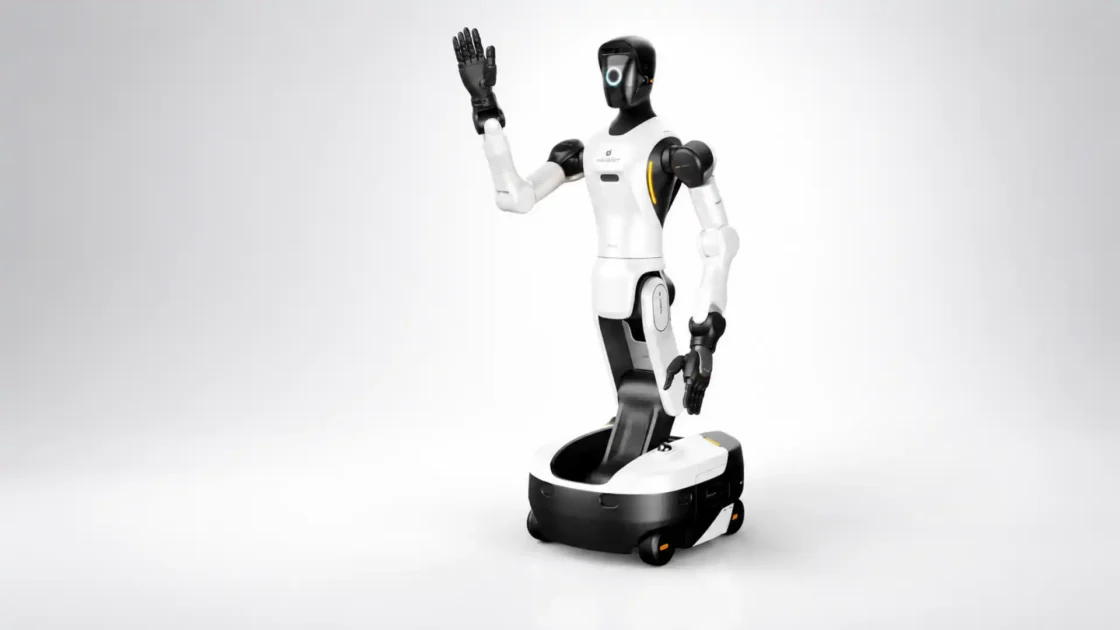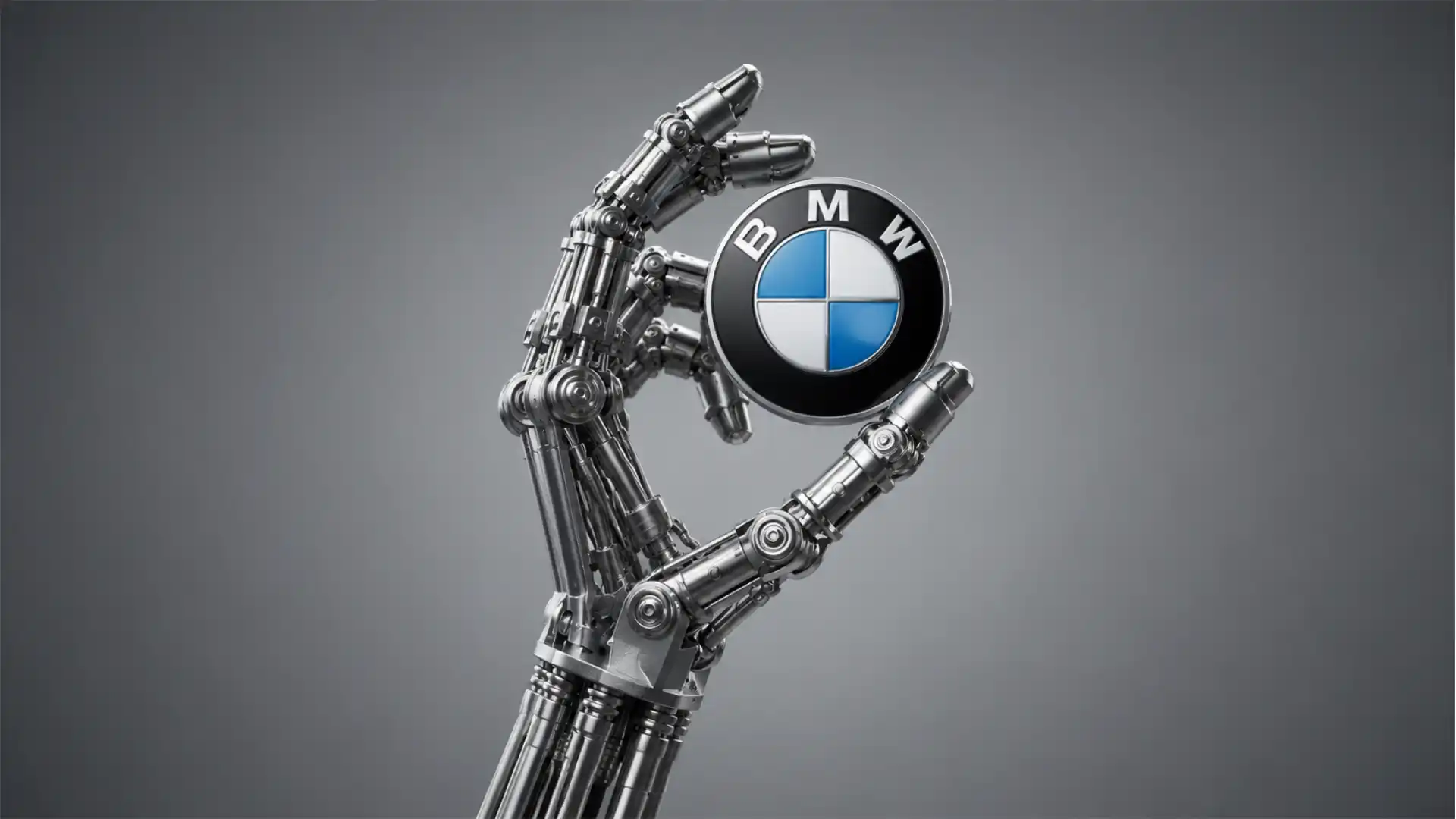
BMW’s next production experiment is no longer hidden in a lab or staged for a technology video. The company is putting humanoid robots into a real German factory for the first time, starting at Plant Leipzig, where the AEON robot from Hexagon will be tested in high-voltage battery assembly and component production. BMW calls the broader concept Physical AI, meaning artificial intelligence that does not only classify images or write text, but moves through industrial space, handles parts, follows production logic and learns from a working factory. The move follows BMW’s earlier Spartanburg deployment with Figure 02, where a humanoid robot helped support production of more than 30,000 BMW X3 vehicles.
Table of Contents
BMW’s Leipzig pilot moves humanoid robots from spectacle to production discipline
BMW’s announcement matters because it places a humanoid robot in the part of industry where claims are hardest to fake: series vehicle production. A car plant is not a demo stage. It is noisy, timed, audited, crowded with legacy systems, governed by safety rules and measured by uptime. A robot that works there must deal with fixtures, tools, parts, edge cases, human traffic, digital instructions, maintenance windows and quality gates. It cannot be impressive only once. It must be boringly repeatable.
At Plant Leipzig, BMW is launching its first humanoid robot pilot in German production with Hexagon’s AEON. The company says the project follows theoretical evaluation, lab testing and an initial test deployment at Leipzig in December 2025. A further test deployment was planned from April 2026, with the actual pilot phase set for summer 2026. The planned work is concentrated on high-voltage battery assembly and component manufacturing, not customer-facing interaction or general showroom theatre.
That distinction matters. The most credible humanoid robot deployments are not the ones promising a robot for every home next year. They are the ones that pick a dull, difficult, bounded industrial task and prove that a humanoid machine can perform it hour after hour. BMW is taking that route. The Leipzig pilot is framed as a factory integration project, not a robot publicity stunt.
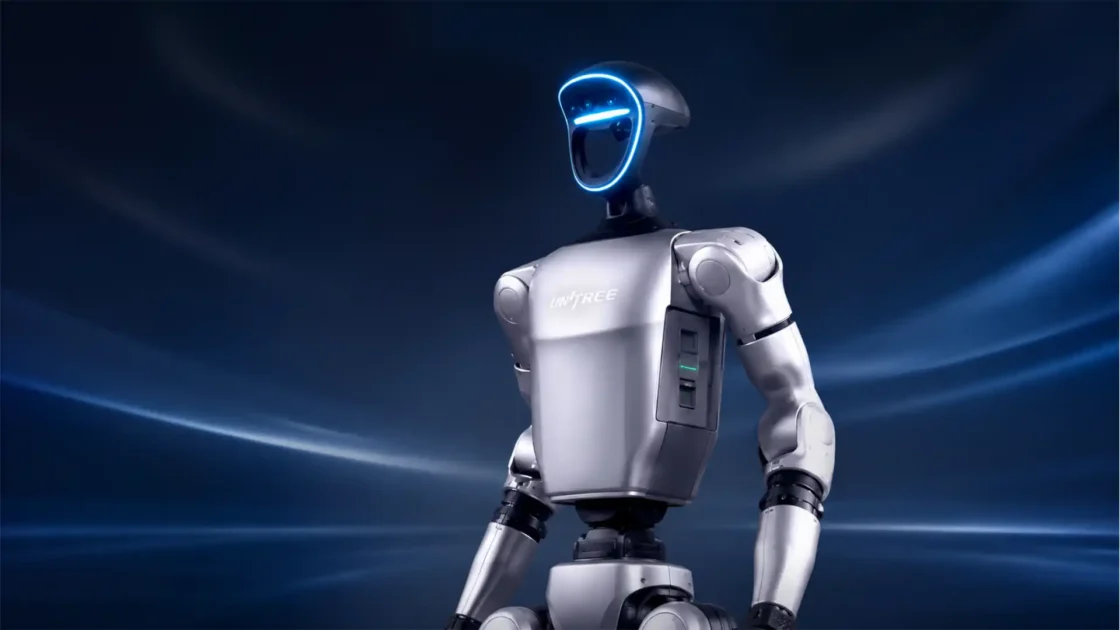
The AEON robot is also not a walking mascot. BMW’s own feature describes a wheeled humanoid form, 1.65 metres tall and 60 kilograms in weight, capable of moving through the hall at up to 2.5 metres per second. The machine is designed with a human-like body so different hand tools, grippers or scanning devices can be attached. That makes the design less about imitating a person and more about using a human-compatible envelope inside workplaces built for human reach, human fixtures and human workflows.
BMW is not replacing fixed industrial robots with humanoids. It is trying to fill the space between traditional automation and human manual work. Robotic arms already dominate welding, bonding, painting, handling and other controlled operations in automotive manufacturing. They are fast, accurate and cost-effective when the task is stable. Humanoids enter the discussion because modern factories still contain many tasks that are too changeable, too fragmented or too awkward to justify a custom automated cell.
The Leipzig project is therefore a test of economic fit. Can a mobile, tool-changing humanoid robot perform enough work across enough tasks to justify its cost, support, training, safety case and integration burden? BMW does not yet claim a full answer. The company is treating the deployment as a pilot, and that word should be taken seriously. A pilot is not a rollout. It is a controlled attempt to prove where the technology is useful, where it fails and what the factory has to change before scale is possible.
BMW’s decision also shows how quickly the humanoid robot debate has shifted. Two years ago, the strongest question was whether humanoids could leave the robotics lab at all. Now a serious question is whether they can survive a production shift in a premium vehicle plant without becoming a maintenance burden. The gap between those questions is large. It explains why this BMW story deserves close attention without hype.
Physical AI gives BMW a name for machines that think and act
BMW’s use of the term Physical AI is not cosmetic. It describes the practical connection between AI systems and machines that act in the real world. A digital AI model can process data, infer patterns and produce decisions. A robot must turn those decisions into motion, contact, force, balance, path planning, tool use and recovery when something goes wrong. In a factory, that final step is where most of the risk lives.
BMW describes Physical AI as the combination of digital artificial intelligence with real machines and robots. In its production system, the company already uses AI in digital twins, quality controls and intralogistics. The new stage is putting AI-enabled robots into real production processes so they learn and act under industrial conditions.
The word “physical” does heavy work here. Physical systems face constraints that software-only systems do not. A chatbot can produce a wrong answer and be corrected. A factory robot can scratch a component, block a passage, fail to grip a part, collide with a fixture, stop a production sequence or create a safety incident. Physical AI therefore has a harsher burden of proof. It must be accurate, but it must also be safe, traceable, maintainable and predictable enough for production.
BMW’s approach starts with data architecture. The company says a unified IT and data model across production is a prerequisite for using AI effectively on the shop floor. That phrase might sound abstract, but it is central. A humanoid robot cannot work well if plant data sits in disconnected systems with inconsistent definitions, outdated interfaces and partial visibility. It needs reliable information about tasks, parts, quality requirements, locations, routes, system status and constraints.
The robot is only the visible end of the system. The less visible layers are production data, safety logic, standard interfaces, task instructions, simulation, maintenance records and change management. A humanoid robot without those layers is an expensive machine waiting for instructions. A humanoid robot inside a connected production system becomes a candidate for work.
BMW’s new Center of Competence for Physical AI in Production also belongs in this story. The centre is meant to consolidate expertise, evaluate partners and structure pilot projects from theory to laboratory testing, plant deployment and pilot operation. That structure reveals a sober point: BMW is not buying humanoids like it buys office equipment. It is building an internal method for deciding which robots deserve plant access and which use cases deserve engineering time.
The use of AI agents in the production system also changes the division between automation and decision-making. A conventional automated cell performs a known task within a fixed envelope. Physical AI aims at machines that can adapt within boundaries. They may interpret sensor data, correct movements, use learned motion sequences and support tasks where exact conditions vary. That is useful only if the boundaries are clear. A car plant cannot allow open-ended experimentation during live production.
The strongest version of BMW’s Physical AI strategy is therefore not “robots doing human jobs.” It is a production architecture where AI, robotics and factory data are engineered as one system. That is a harder story to sell, but a more credible one.
The Spartanburg trial gave BMW numbers, not just impressions
BMW’s Leipzig deployment is easier to judge because it follows a measurable trial at Plant Spartanburg in South Carolina. There, BMW worked with Figure AI and used the Figure 02 humanoid robot in a production environment. According to BMW, the 2025 deployment supported production of more than 30,000 BMW X3 vehicles, moved more than 90,000 components, covered around 1.2 million steps and logged roughly 1,250 operating hours. The robot worked ten-hour shifts from Monday to Friday.
Those numbers are valuable because humanoid robotics is crowded with vague language. Phrases such as “general-purpose automation” and “human-level dexterity” are easy to say and difficult to measure. BMW’s Spartanburg data turns the debate toward factory questions: operating hours, parts moved, shift pattern, task type, recovery, safety, interface quality and employee acceptance.
The specific Spartanburg task was not glamorous. Figure 02 handled the precise removal and positioning of sheet metal parts for welding. BMW described the work as demanding in speed and accuracy and physically exhausting for people. The robot had to place components with millimetre precision. That is a serious manufacturing challenge because error tolerance is low, cycle expectations matter and parts must fit into downstream processes.
BMW’s 2024 description of Figure 02 listed a height of about 170 centimetres, weight of 70 kilograms and load capacity of 20 kilograms. The robot’s hands had 16 active degrees of freedom per hand, and BMW highlighted its tactile capability for sheet-metal insertion. Those details help explain why BMW tested humanoids in body-shop work rather than using them first for a symbolic low-risk task.
The Spartanburg pilot also produced less glamorous but more important lessons. BMW said early involvement of production IT, occupational safety, process management and logistics was essential. The company also highlighted the need for standardised interfaces into the BMW Smart Robotics ecosystem. In the Leipzig feature, BMW pointed to revised safety concepts, additional barriers and partitions, and improved 5G coverage as part of what the Spartanburg deployment taught.
That is the heart of the story. Humanoid robots do not enter factories alone. They drag the factory’s digital, safety and process systems into the pilot with them. A robot that looks autonomous may still depend on plant connectivity, task scheduling, tooling standards, trained operators, safety zoning and maintenance support. BMW appears to understand that the integration burden is not a side issue. It is the project.
Figure AI’s own account of the deployment says Figure 02 reached full deployment on an active assembly line within 10 months and ran every working day. Figure also said the work informed Figure 03 operational readiness. That confirms the two-sided value of the pilot: BMW learned about production integration, while Figure learned what its robot must withstand outside a lab.
The Spartanburg trial does not prove that humanoids are ready for mass adoption. It proves something narrower and more useful: a humanoid robot can perform a bounded, repetitive, precision task in an existing BMW production environment for a meaningful number of hours. That is not a revolution. It is a credible industrial milestone.
Leipzig is the right plant for a hard test
Plant Leipzig is not an arbitrary choice. It already combines vehicle production with high-voltage battery production and component work. BMW says car production at Leipzig runs through press shop, body shop, paint shop and final assembly, while the plant also makes painted plastic components and high-voltage batteries. The official plant page lists around 6,800 employees, 259,430 units of annual output in 2025 and more than €5.6 billion invested at the site.
That mix creates a useful environment for humanoid robotics. Vehicle assembly offers repetitive handling and logistics tasks. Battery assembly introduces heavier quality control, protective procedures and sensitive components. Component production brings variability and tool use. A robot that works across those domains does not have to be “general purpose” in a science-fiction sense. It only has to prove that one mobile platform can serve multiple carefully engineered production tasks.
Leipzig also has a history in BMW’s electrification shift. BMW started battery module production there in 2021, and the company later said the plant would run all three stages of high-voltage battery production: cell coating, module production and high-voltage battery assembly.
That matters because battery production has a different labour and automation profile from traditional combustion-engine assembly. It uses clean processes, traceability, protection steps, testing, material flow and careful handling. Many tasks are automatable, but not all are obvious candidates for fixed automation. A mobile humanoid with scanning tools or grippers may be useful where a plant needs flexibility without rebuilding the whole line around a single operation.
Plant Leipzig is also located inside Germany’s automotive heartland, where industrial labour, production cost and competitiveness are politically sensitive. Deploying humanoids there is not the same as running a test in a remote research facility. BMW is putting the technology into a place where employees, unions, regulators, suppliers and competitors will watch closely.
BMW’s public messaging tries to manage that sensitivity. It says humanoid robots are meant to support people, not replace them, and to take on repetitive, ergonomically demanding or safety-critical work. That framing is not unique to BMW. Every major industrial automation wave has used similar language. The real test is not the phrase. It is whether the deployment changes work design in a way employees can trust.
Leipzig gives BMW a chance to test humanoid robots where the business case, worker acceptance and safety case all matter at once. A success there would carry more weight than a polished lab demonstration because it would show that Physical AI can be integrated into a live European production system.
The plant’s battery work also aligns with BMW’s broader need to keep electric-vehicle manufacturing competitive in Europe. Battery assembly is cost-sensitive and process-heavy. If humanoid robots can reduce strain, fill awkward automation gaps and increase flexibility without lowering quality, they could become part of the productivity story for European EV production. If they cannot, the Leipzig pilot will reveal that quickly.
AEON shows why humanoid design is becoming more industrial and less theatrical
Hexagon introduced AEON in June 2025 as a humanoid robot built for industry. The company says the robot combines sensors, locomotion, AI-driven mission control and spatial intelligence, and Hexagon’s robotics division positions it for industrial applications including manufacturing, logistics, inspection and operator support.
AEON’s design choices are worth reading carefully. It is humanoid in body and upper-limb configuration, but it moves on wheels rather than feet in BMW’s Leipzig deployment description. That is not a compromise to dismiss. It may be one of the reasons the robot is viable in a factory. Bipedal walking is impressive, but wheels are often safer, more energy-efficient and easier to integrate on flat industrial floors.
The industrial logic is simple. A factory does not reward a robot for looking human. It rewards a robot for moving safely, arriving on time, holding position, handling tools, avoiding people, passing risk assessment and completing work with low maintenance. If wheels solve locomotion better than legs for a given plant, wheels win. The humanoid question is not whether the robot copies a person. It is whether the robot fits human-built workstations while avoiding unnecessary engineering risk.
Hexagon also brings a particular background to the BMW pilot. The company is known for measurement technology, sensors, software and industrial digital systems. Its AEON announcement stresses sensor fusion, 3D spatial intelligence, actuators and AI-based motion control. That aligns with BMW’s needs because automotive production already depends on measurement discipline. A humanoid robot that cannot understand spatial tolerance, part position and process variation will not be useful in battery or component production.
The BMW-Hexagon relationship also differs from the BMW-Figure relationship. Figure is a humanoid robotics startup focused on general-purpose humanoids. Hexagon is an established industrial technology supplier entering robotics from measurement, software and sensors. BMW appears to be using both types of partner. That gives it exposure to different approaches: startup speed and robot-first design on one side, industrial systems experience and sensor-first design on the other.
AEON also embodies a trend in humanoid robotics: the move from pure mobility demos to task tooling. BMW says AEON can accept different hand and gripper elements or scanning tools. That suggests the robot’s value may come less from five-finger imitation and more from tool modularity. A humanoid torso with swappable end-effectors may be useful in plants where one robot platform must perform handling, inspection, delivery and scanning tasks across adjacent processes.
The emphasis on spatial intelligence is also practical. Industrial robots do not only need to know “what” an object is. They need to know where it is in three-dimensional space, how it is oriented, whether it has shifted, what surface can be gripped, how much force is safe and how the next process depends on the object’s position. In automotive production, millimetres matter.
AEON’s real test will not be whether it looks convincing in photos. It will be whether it can maintain a safe, repeatable relationship with BMW’s production assets. That means tool calibration, battery management, sensor reliability, software updates, human override, downtime handling, shift scheduling and cleaning. Industrial adoption will be decided by those details.
The humanoid form factor solves some factory problems and creates others
The case for humanoid robots in factories starts with a simple observation: factories are built around human bodies. Workbenches, carts, racks, handles, tools, walkways, inspection points and part containers often assume human reach, height, arm movement and visual perspective. A robot with a roughly human upper body may use existing infrastructure that would otherwise need redesign.
That does not mean humanoids are always the best answer. Conventional robot arms, gantry systems, conveyors, automated guided vehicles, autonomous mobile robots and dedicated fixtures remain better for many tasks. They are cheaper, faster and easier to validate when the job is stable. Humanoids deserve a place only when flexibility, reach, mobility and human-compatible tooling outweigh cost and complexity.
BMW’s use cases point toward that middle ground. Sheet metal positioning in Spartanburg demanded tactile handling and precision. Battery and component work in Leipzig may involve repetitive handling, scanning, material movement, tool use and ergonomic relief. These are not random household tasks. They are bounded industrial operations with known parts, known areas and known quality requirements.
The humanoid form factor also has economic appeal where production lines change. Automotive plants are under pressure from powertrain variation, mixed models, regional regulations, shorter product cycles and electric-vehicle ramp uncertainty. A fixed cell that makes sense for a stable high-volume process may be unattractive when volume, variant or task sequence changes. A mobile humanoid is a bet that one platform can be redeployed more often.
The problem is that flexibility is not free. A humanoid robot must carry its own sensing, compute, actuation and power. It must navigate safely. It must manipulate objects reliably. It must be trained for each task. It must be maintained by technicians who understand both robotics and production. It may need more supervision than its marketing suggests. It may run slower than a fixed robot. Its uptime may be lower. Its safety envelope may reduce speed around people.
That is why BMW’s structured evaluation is important. A plant cannot adopt humanoids because they are fashionable. It must ask whether the machine reduces injury risk, protects quality, raises throughput, cuts rework, fills labour gaps or makes changeovers easier. Each claimed benefit needs evidence. Spartanburg gives BMW early numbers. Leipzig will test a different robot, a different plant and different work.
The form factor also affects employee trust. A robotic arm behind guarding is familiar. A humanoid moving through a work area feels different. The machine’s shape may make it easier for workers to understand its reach and intention, or it may make people uneasy because it appears more agent-like than it is. Human factors matter in a plant because acceptance affects reporting, cooperation, near-miss awareness and willingness to use the system.
BMW’s Leipzig feature says AEON’s mission is to support people and not replace them. That statement is necessary, but not enough. Workers will judge the robot by what happens on the floor: whether it reduces strain, whether it causes stoppages, whether it creates surveillance concerns, whether training is clear, whether the safety zones make sense and whether management uses automation savings responsibly.
Humanoids therefore solve one problem and expose another. They fit into human-shaped spaces, but they also enter human social space. Automotive manufacturers will need to manage both.
BMW is testing a complement to automation, not the end of human work
The most careless reading of BMW’s announcement is that humanoid robots are about to build entire cars on their own. BMW is not saying that. The company says humanoid robotics will complement existing automation, particularly for monotonous, ergonomically demanding or safety-critical tasks.
That point matters because car production is already one of the most automated manufacturing domains. Body shops can contain large numbers of fixed robots for welding and handling. Paint shops depend on controlled automated systems. Intralogistics already uses automated transport. Quality control increasingly uses cameras and AI. The question is not whether BMW believes in automation. It already does. The question is whether humanoids create a new automation layer for work that has resisted traditional automation.
The likely answer is partial. Some tasks currently done by people may shift to humanoid robots where the work is repetitive, awkward or physically taxing. Some tasks will remain human because they require judgement, adaptation, troubleshooting, team coordination or rapid interpretation of unusual conditions. Some tasks will be redesigned so people supervise, maintain and improve automated systems rather than performing every manual step.
BMW’s own framing places employees in roles such as understanding processes, steering workflows, checking quality and integrating new technologies. That is a plausible direction, but it is not automatic. It requires training, job design and worker participation. A plant cannot simply drop humanoids into production and expect human work to become better by itself.
The strongest labour argument for humanoid robots is ergonomic, not futuristic. If a robot can handle repetitive lifting, awkward bending, heavy positioning or protective-clothing tasks while people move into quality, setup, maintenance and problem-solving work, the deployment has a credible worker-benefit case. If the robot is mainly a cost-cutting device dressed in worker-support language, trust will erode quickly.
Germany’s labour context complicates the story. Skilled labour shortages remain a concern in parts of the economy, while the automotive sector also faces restructuring pressure. DIHK’s 2025/2026 Skilled Labour Report said around one quarter of automotive manufacturing and supplier firms with recruitment needs reported shortages, while the Ifo Institute reported that shortages in industry had eased, with automotive and electrical equipment below 10%. Those data points show a mixed picture: labour scarcity exists, but automation is unfolding inside a sector also dealing with cost pressure and employment anxiety.
BMW will have to navigate that tension. Humanoid robots may relieve hard tasks and fill roles that are difficult to staff. They may also reduce demand for certain manual operations as capability improves. Both can be true. A serious analysis should not pretend automation has no labour effect. It should ask where the effect lands, how quickly, and whether workers are moved into better jobs or simply out of the process.
In heavily regulated, unionised and skill-intensive manufacturing, large-scale labour replacement is rarely immediate. Integration takes time, safety approvals matter, and production know-how is hard to automate. The near-term story at BMW is more likely task substitution than wholesale job substitution. The long-term story depends on cost curves, reliability, training speed and how many use cases one robot platform can cover.
BMW’s data platform may matter more than the robot itself
A humanoid robot on a factory floor attracts the camera. BMW’s unified data platform may be the larger strategic asset. The company says it has transformed isolated data silos into a unified production data platform where information is consistent, standardised and available at all times. That is the kind of infrastructure Physical AI needs.
Factory automation has always depended on data, but humanoid robotics raises the bar. A robot must understand its task, environment, constraints and state. It may need to know which vehicle variant is arriving, which part bin is correct, which tool is attached, what quality check applies, where humans are located, whether a system is down, whether the next station is ready and whether a planned motion is safe.
If that information is fragmented, the robot becomes brittle. If the data model is coherent, the robot can be integrated into plant logic. Physical AI is less a single robot and more a loop between perception, production data, decision logic and controlled motion. BMW’s data model is therefore part of the machine.
Standardised interfaces are another piece. BMW said the Spartanburg deployment required integration into the BMW Smart Robotics ecosystem via standardised interfaces. That reduces the risk of every robot pilot becoming a bespoke engineering project. If BMW can create reusable interfaces for task assignment, status reporting, safety signals, route planning and quality data, future pilots become easier.
This is where carmakers may have an advantage over many robot startups. A startup can build impressive hardware and AI models. A manufacturer owns the production process, the data, the standards, the maintenance teams and the pain points. The most useful deployment knowledge sits inside the factory. BMW’s Center of Competence is a way of capturing that knowledge so it does not remain trapped in one pilot team.
Data also matters for learning. Robots need examples of successful and failed motions, edge cases, part variations, recovery routines and environmental changes. But automotive plants cannot allow uncontrolled learning during safety-critical operations. BMW will need a disciplined method for deciding what the robot learns in simulation, what is validated in the lab, what is allowed in a fenced test, and what reaches production.
That creates a governance question. Who approves new robot behaviours? How are software updates tested? How does BMW record changes? How are near misses investigated? How is human override logged? How are AI-related risks documented under European rules? A unified data platform may support these answers, but it does not replace the need for formal process control.
The BMW example also points to a broader industrial divide. Companies with strong digital production systems will be better positioned to adopt Physical AI. Companies with fragmented IT, weak data quality and inconsistent processes may buy robots and discover that the hard work sits elsewhere. The humanoid race may therefore reward not only the best robot maker, but the best factory integrator.
The economics depend on hours, uptime and redeployment
The business case for a humanoid robot is not settled by a headline number about parts moved. It depends on total cost and useful work over time. A factory manager will ask hard questions: purchase or lease cost, integration cost, uptime, maintenance, spare parts, technician training, safety systems, software support, task training, energy use, supervision, floor-space impact and depreciation.
The machine must then justify itself through output, quality, injury reduction, labour flexibility, reduced rework, lower ergonomic burden or faster changeovers. A humanoid robot that performs one task well but needs heavy engineering for every new task may lose to cheaper fixed automation. A humanoid robot that can be redeployed across many tasks with modest engineering may become economically compelling.
BMW’s Spartanburg numbers suggest one early way to assess value. Figure 02 logged about 1,250 operating hours and moved more than 90,000 components. That implies meaningful industrial use, but it does not reveal all costs. We do not know the full integration spend, number of support staff, downtime profile, rejected moves, recovery events, maintenance burden or cost per part. BMW did not publish a return-on-investment calculation.
That is normal for a pilot. Early deployments are about learning, not polished economics. But the economics will matter quickly if BMW considers scaling. Automotive plants run on margins, cycle times and capital discipline. A robot that looks exciting but cannot compete with existing methods will remain a niche experiment.
Uptime is especially important. Manufacturing values stable operation more than peak capability. A robot that works impressively for 90 minutes and fails unpredictably is not industrially useful. A robot that works at moderate speed for a full shift with predictable maintenance windows may be valuable. BMW’s focus on ten-hour shift operation at Spartanburg is therefore meaningful. It points to endurance rather than isolated performance.
Redeployment is the second economic lever. If AEON can move between battery assembly and component manufacturing with different grippers or scanning tools, BMW may spread the robot’s cost across multiple processes. That does not mean a single robot roams freely doing anything. It means a controlled platform might be trained and validated for a catalogue of tasks. The larger that catalogue becomes, the stronger the economic case.
The cost curve also depends on the humanoid industry’s own scaling. Startups and industrial suppliers are racing to reduce actuator cost, improve battery life, raise reliability and simplify manufacturing. Hexagon, Figure, Apptronik, Boston Dynamics, Tesla and others are all approaching the problem from different directions. BMW does not need to pick one universal winner today. It needs a method for testing credible platforms under plant conditions.
The economic question also includes opportunity cost. Every humanoid pilot consumes engineering attention that could go to conventional automation, line redesign, software, quality systems or worker training. BMW’s Center of Competence may help avoid scattered experiments that do not build reusable knowledge. In a capital-constrained auto market, that discipline will matter.
Europe’s auto industry needs productivity stories that are not only about wage cuts
BMW’s humanoid robot pilot lands at a difficult moment for European automotive manufacturing. The sector faces electric-vehicle transition costs, software investment, Chinese competition, tariff uncertainty, energy costs and pressure to protect industrial employment. Automation is not new in this environment, but Physical AI gives manufacturers a new productivity lever to test.
The International Federation of Robotics reported that 542,000 industrial robots were installed globally in 2024, more than double the number installed ten years earlier. Asia accounted for 74% of new deployments, while Europe accounted for 16% and the Americas for 9%. The same IFR data show automotive robot demand declined globally in 2024, and separate IFR reporting said the EU automotive industry installed 30,650 industrial robots in 2024, down 5% year on year.
That combination is revealing. The world is automating, but Europe’s automotive sector is not expanding robot adoption at the same pace as the global centre of gravity. Germany remains a robotics-heavy manufacturing country, yet European carmakers face pressure to raise productivity while protecting quality and industrial know-how. Humanoid robots are one answer being tested, not a complete answer.
IFR also reported that Western Europe reached a record 267 robots per 10,000 manufacturing employees in 2024, ahead of North America and Asia in regional density. Germany remained among the highest-density countries. High density, however, does not mean the automation problem is solved. It means the easy fixed-automation opportunities in mature factories may already be captured. The remaining tasks are often messier.
That is where humanoids enter. They are not competing with the first wave of industrial robots. They are competing for the leftover work that has stayed manual because it is flexible, awkward, low-volume, changeable or embedded in human workflows. In Europe, where labour is skilled and expensive and plants must handle model complexity, those leftovers matter.
BMW’s iFACTORY strategy also frames production around lean, green and digital principles. The company described iFACTORY in 2022 as a master plan for future production, with digitalisation including data science, AI and virtual planning. Humanoid robotics fits under that digital pillar only if it improves production discipline rather than creating a parallel technology showcase.
Europe does not need humanoid robots because robots are fashionable. It needs credible ways to keep high-value manufacturing competitive without reducing factories to low-wage cost battles. BMW’s Leipzig pilot should be judged against that industrial question.
The risk is that humanoid robotics becomes a distraction from deeper issues: battery supply chains, software capability, energy prices, platform complexity and slow decision-making. The opportunity is that Physical AI becomes part of a wider production upgrade that improves flexibility, ergonomics and resilience. BMW’s challenge is to keep the pilot tied to measurable plant outcomes.
Humanoids fit the battery era because EV manufacturing changes the task mix
Electric vehicles do not remove manufacturing complexity. They move it. High-voltage battery assembly, module handling, cell preparation, thermal systems, power electronics and software-linked quality controls alter the work profile inside plants. Some manual tasks become more ergonomic burdens because parts are heavy or handling rules are strict. Some tasks require protective gear. Some require more scanning, traceability and process discipline.
BMW’s decision to test AEON in high-voltage battery assembly is therefore important. Battery work is not a side experiment. It is central to the competitive structure of modern vehicle manufacturing. BMW has been expanding battery production capabilities in Leipzig and elsewhere, and Reuters reported in 2024 that the company planned five sixth-generation high-voltage battery assembly sites across Germany, Hungary, the United States, Mexico and China as part of a local-for-local approach.
Battery assembly is also an area where flexibility matters. Cell formats, module designs, cooling structures, safety procedures and vehicle platforms can evolve. The Neue Klasse era and wider EV transition require plants to absorb change without rebuilding every process from scratch. A humanoid robot with flexible tooling may be useful if it supports tasks during ramp-up, variant change or low-volume periods.
The word “may” is doing real work. Humanoids must prove they can handle battery-related tasks safely and cleanly. High-voltage battery assembly includes strict requirements for handling, traceability, contamination control, electrical safety and quality. A robot that drops a part or misreads a process step is not merely inefficient. It threatens quality and safety.
AEON’s scanning-tool capability could be particularly relevant. A mobile robot that handles parts and captures spatial or inspection data might combine physical work with data collection. That would fit Hexagon’s measurement heritage. In battery manufacturing, the ability to document process states, part positions or component identity may become as valuable as the handling itself.
The EV transition also changes labour demand. Battery operations may require different skills from traditional engine or transmission work. Plants must retrain workers, redesign flows and protect quality during industrial change. If humanoid robots take over the most repetitive or uncomfortable battery tasks while workers move into control, inspection and maintenance, BMW gains a worker-support narrative with practical content.
But battery manufacturing also creates the strongest caution. High-voltage systems are unforgiving. Safety approvals, containment, fault handling and human oversight will decide whether humanoids can move beyond simple support tasks. BMW’s staged approach at Leipzig suggests the company knows the difference between a useful pilot and premature deployment.
Traditional industrial robots still set the benchmark
Humanoid robots enter a factory with a burden: they must outperform or complement proven automation. Fixed industrial robots have decades of refinement behind them. They weld, paint, glue, lift and assemble with speed and repeatability that humanoids cannot match in many tasks. They are supported by mature safety standards, supplier ecosystems, spare parts networks and integrator expertise.
The IFR data remind us that industrial robotics is already a huge global market, with more than 500,000 annual installations for four straight years through 2024. The installed base is not waiting for humanoids to validate robotics. It is the baseline against which humanoids must compete.
A humanoid robot is rarely the right tool for a stable, high-speed, high-volume operation. If a robotic arm can do the job faster, cheaper and safer, the arm wins. If an autonomous mobile robot can move a cart better than a humanoid, the mobile robot wins. If a fixture can remove variation, the fixture wins. Industrial engineering does not reward theatrical universality.
Humanoids become interesting where traditional automation breaks down. That includes tasks with irregular part presentation, human-designed tools, mixed workstations, low-volume changeovers, awkward ergonomics, partial manual legacy processes and operations spread across different locations. The business case is not “humanoid versus robot arm.” It is humanoid versus no automation, or humanoid plus conventional automation.
BMW’s Spartanburg body-shop choice fits that logic. The body shop already has high automation, but the tested task involved precise sheet-metal placement into fixtures. A humanoid could be integrated into an automated environment without taking over the entire body shop. BMW used an area where employees were already familiar with new technologies and automated transport robots.
Leipzig may follow the same pattern. A humanoid robot could serve pockets of production where fixed automation is too expensive or inflexible. It could also work as a mobile manipulator between established systems, feeding, checking or supporting them. That role is modest but valuable.
The benchmark also includes reliability. Traditional robots are not accepted because they are intelligent. They are accepted because plants know how to make them safe, service them and predict their behaviour. Humanoids must earn that same trust. The more AI-based and adaptive they become, the more careful validation becomes.
This is why BMW’s pilots may influence the whole humanoid industry. Factory users will not accept vague claims. They will demand evidence on uptime, cycle time, recovery, safe speed, tool life, maintenance, error rates and integration. Suppliers that can answer those questions will survive industrial procurement. Suppliers that rely on stage demos will struggle.
Safety will decide the pace of adoption
Safety is the gatekeeper for humanoid robotics in production. A humanoid robot combines mobility, manipulation, mass, power, software autonomy and human proximity. That makes it more complex than a fixed robot behind a fence. It also makes it harder to assess with one simple rule.
BMW’s Spartanburg lessons point to this reality. The company cited the need to involve occupational safety early and noted revised safety concepts with additional barriers and partitions in the Leipzig feature. That is not a minor operational footnote. It is how industrial robotics becomes acceptable.
International standards are also evolving. ISO 10218-1:2025 addresses safety requirements for industrial robots as partly completed machinery, including inherently safe design, risk reduction and information for use. ISO 10218-2:2025 addresses integration of industrial robot applications and robot cells. For mobile systems, ISO 3691-4 covers driverless industrial trucks and related systems, including automated guided vehicles and autonomous mobile robots.
Humanoid robots can sit across categories. They may be industrial robots, mobile robots, collaborative systems, AI-enabled machinery and digital products at once. That means risk assessment cannot rely only on old mental models. It must cover manipulation hazards, collision hazards, unexpected motion, software failure, connectivity loss, tool-change failure, battery events, sensor blind spots, cybersecurity and human behaviour around the machine.
The safest humanoid robot is not the one that looks gentle. It is the one whose hazards have been identified, reduced, monitored and governed across its full life cycle. A rounded design or slow movement may reduce risk, but it does not replace formal safety engineering.
BMW’s choice of controlled pilot phases is therefore responsible. The company can test the robot’s movements, safety zones, interfaces, emergency stops, operator training and maintenance routines before broad deployment. It can observe worker behaviour near the robot. It can record near misses. It can validate whether lab-trained motion sequences remain stable in production.
Safety also intersects with productivity. Robots near humans often have speed limits or separation requirements. If a humanoid must slow down too much around people, its economic value falls. If it is fenced away from people, some of the human-compatible advantage may shrink. The practical solution may be hybrid: some tasks in separated zones, some shared-space operations under strict speed and force limits, some supervised mobile movement.
The next phase of industrial humanoids will likely be shaped by safety engineering more than by viral videos. BMW, Hexagon and other manufacturers will have to prove not only that robots can perform tasks, but that they can be stopped, updated, audited and maintained without creating hidden risk.
European regulation will make Physical AI a compliance issue, not only an engineering issue
BMW’s German humanoid pilot arrives as Europe is tightening the legal framework around AI, robotics, machinery and cybersecurity. The EU Machinery Regulation 2023/1230, the EU AI Act and the Cyber Resilience Act all matter for AI-enabled machines placed on the European market or used in industrial settings.
The Machinery Regulation 2023/1230 was adopted to replace the older Machinery Directive and address newer risks linked to advanced machines, including autonomous machines and collaborative robots. The European Commission said the new rules aim to make sure advanced machines such as autonomous machines and collaborative robots can be safely placed on the EU market.
The EU AI Act, Regulation 2024/1689, entered into force on 1 August 2024. The Commission’s AI Act policy page says most rules become fully applicable after a staged timeline, with specific obligations for high-risk systems and general-purpose AI models. The page also notes that high-risk AI systems embedded into regulated products have an extended transition period until 2 August 2028 under the current timeline.
The Cyber Resilience Act, Regulation 2024/2847, adds horizontal cybersecurity requirements for products with digital elements. A humanoid robot used in production is not only a mechanical system. It is a networked, software-driven product that may receive updates, transmit data and connect to production systems. Cybersecurity becomes part of the safety case.
This regulatory stack matters because Physical AI blurs boundaries. If an AI function influences safe motion, object handling or human interaction, the question becomes more than “does it work?” It becomes “how is it classified, documented, tested, monitored and updated?” That is especially relevant for robots that learn from data or adapt behaviours over time.
BMW’s internal Center of Competence may help here. A company deploying AI-enabled robots across global plants needs consistent criteria for partner evaluation, risk assessment, documentation, software change control and incident reporting. Without that structure, each plant could interpret risks differently. That would be unsafe and inefficient.
Regulation will not decide whether humanoid robots are useful. It will decide how quickly useful robots can be deployed at industrial scale in Europe. Companies that build compliance into pilot design will move faster later. Companies that treat compliance as paperwork after the fact will slow down.
The European framework may also influence supplier selection. Robot makers able to provide safety documentation, cybersecurity evidence, lifecycle support, training data governance and clear update procedures will have an advantage. Automotive customers will not accept black-box autonomy without auditability.
For BMW, the Leipzig pilot is therefore a technology project and a governance rehearsal. The company is learning how to bring Physical AI into production under European rules. That experience may become as important as the robot’s mechanical performance.
Worker acceptance depends on transparency and job design
BMW says humanoid robots are intended to relieve employees and improve working conditions. That claim will be judged on the shop floor. Workers are not passive observers of automation. They see which tasks disappear, which new tasks arrive, which managers gain data, which safety rules change and who is asked to fix the robot at the end of a shift.
The Spartanburg pilot reportedly gained interest among employees and became a natural part of daily work during the project. BMW credits early communication for transparency and acceptance. That is a useful signal, but acceptance in one plant does not guarantee acceptance elsewhere.
Human acceptance of robots in factories often depends on visible purpose. A robot that removes a painful lift, a repetitive bend or a risky handling step is easier to accept than one whose role is vague. Workers want to know what the robot does, what it does not do, when it moves, how to stop it, who maintains it, whether it records them and how errors are handled.
Humanoid design intensifies those questions. A mobile machine with arms and a head-like sensor area can feel more present than an industrial arm. Some workers may find it intuitive. Others may find it intrusive. The machine’s behaviour must be legible. If workers cannot predict when it will move, where it will go or what it will do next, trust will erode.
The best worker-support case is specific: this robot handles this awkward component, reduces this repeated strain, follows this route, operates under these safety rules and leaves these decisions to trained employees. Vague reassurance will not be enough.
Job design also matters. If humanoids remove manual tasks, BMW must decide whether workers become robot operators, quality specialists, maintenance technicians, process improvers or displaced labour. Those outcomes are not determined by technology alone. They depend on training budgets, works council dialogue, production planning and management incentives.
Germany’s system of worker representation makes this especially important. Any broad adoption of humanoid robots in German plants will require careful engagement with employees and representatives. BMW’s public messaging is aligned with that reality, but the hard work sits in implementation.
There is also a data concern. AI-enabled robots may collect sensor data, video-like spatial information, operational logs and performance metrics. Even if data is intended for safety and process control, workers may worry about surveillance. BMW will need clear rules on what is captured, how it is stored, who can access it and whether it is used to evaluate individuals.
Employee acceptance is therefore not a soft issue. It is an operational requirement. A robot that workers do not trust will be avoided, worked around, over-reported, under-reported or treated as management’s project rather than part of the production system. A robot that visibly reduces strain and works predictably can become part of the team’s routine.
The supply chain effect could reach beyond BMW’s own plants
If humanoid robots prove useful, the impact will not stop at BMW’s assembly plants. Automotive production is a network. Suppliers handle components, subassemblies, logistics, packaging, quality checks and specialised manufacturing. A robot that can support battery work, component handling or inspection inside BMW may also be useful at suppliers making parts for BMW and other automakers.
The supplier angle matters because BMW’s production system depends on timing and quality across many companies. If humanoids reduce bottlenecks only inside final assembly but supplier constraints remain, the gain is limited. If the technology becomes mature enough for tier suppliers, logistics centres and parts makers, the productivity effect spreads.
There are signs that the wider supplier market is already moving. Reuters reported in May 2026 that British technology company Humanoid planned to deploy between 1,000 and 2,000 robots at German industrial supplier Schaeffler’s global manufacturing sites by 2032, starting with initial deployments in Germany from December 2026 to June 2027. Schaeffler also signed a supply agreement for robot joint actuators.
That story shows a second dimension: suppliers are not only potential users of humanoid robots. They may become suppliers to the humanoid industry. Actuators, bearings, gears, sensors, castings, electronics, safety systems and software services are all part of the robot value chain. Automotive suppliers under pressure from powertrain transition may see robotics as a new market.
BMW could therefore benefit indirectly from a European robotics supplier base. If German and European industrial companies build components, integration services and safety expertise for humanoids, local adoption becomes easier. If the technology remains dependent on a narrow group of foreign suppliers, strategic risk rises.
The in-house versus outsourced production question also appears in the debate. Financial Times reporting on BMW’s Leipzig plan cited comments that humanoids could give BMW opportunities to do more production in-house. That point is strategic. If flexible robots reduce the labour or capital penalty of internal work, automakers may reconsider which tasks belong inside their own plants.
Humanoid robots could change make-or-buy decisions only if they lower the cost of flexible internal production. That is a high bar. Suppliers often have scale, specialisation and cost advantages. BMW will not bring work in-house merely because a robot exists. But Physical AI may shift calculations for tasks where quality, responsiveness, intellectual property or logistics risk matter.
The supply chain question also includes standardisation. If every OEM uses different robot interfaces and safety practices, suppliers face complexity. If automotive firms converge on common standards for mobile manipulation, safety signalling and production data exchange, adoption becomes faster. BMW’s Smart Robotics ecosystem could contribute to that if it interfaces cleanly with broader standards.
Competitors are testing the same idea from different angles
BMW is not alone. Mercedes-Benz has tested Apptronik’s Apollo humanoid robot in manufacturing contexts, with Apptronik announcing a commercial agreement in March 2024 to pilot Apollo in Mercedes-Benz facilities. Mercedes-Benz later described testing Apollo at its Digital Factory Campus in Berlin.
Hyundai is moving through Boston Dynamics. Boston Dynamics said in January 2026 that it would begin manufacturing the product version of Atlas, with deployments scheduled at Hyundai and Google DeepMind. Hyundai and Boston Dynamics had also announced an expanded collaboration in April 2025 around mobility and manufacturing.
Tesla has pursued Optimus as an internal robotics bet, though public reporting has often mixed ambitious targets with delays and uncertainty. Tesla’s public AI page identifies Optimus as part of its AI and robotics work, while independent coverage has tracked shifting timelines. The lesson for BMW is clear: humanoid robots draw attention quickly, but industrial proof requires more than bold production promises.
These approaches differ. BMW has used Figure in the United States and Hexagon in Germany. Mercedes-Benz is working with Apptronik. Hyundai owns Boston Dynamics and can integrate robotics strategy more directly into its group structure. Tesla is trying to build robot hardware, software and production internally. Each model has advantages and weaknesses.
BMW’s multi-partner approach gives it optionality. It can compare robot architectures, supplier maturity, integration burden and task performance. It avoids betting the entire strategy on one platform. It also puts pressure on suppliers to prove themselves in BMW’s system.
The competition also validates the category. Major automakers do not all test humanoids because they enjoy science fiction. They test them because automotive production has stubborn automation gaps, labour pressure and model complexity. If several OEMs converge on similar use cases—parts handling, logistics, inspection, battery work, ergonomically difficult operations—the industry will learn faster.
But there is a danger of herd behaviour. Automakers may feel compelled to announce humanoid pilots because rivals do. A pilot built for headlines can waste resources. The serious players will be the ones publishing operational evidence, integrating safety and building repeatable use-case catalogues.
BMW’s strongest differentiator so far is not being first to show a humanoid. It is connecting the pilot to measurable Spartanburg results and a structured Physical AI competence centre. That makes the Leipzig project more credible than a one-off robot appearance.
Two compact views of the BMW humanoid robot story
Confirmed BMW humanoid robot deployments
| Location | Robot partner | Main production focus | Confirmed status |
|---|---|---|---|
| Spartanburg, United States | Figure AI | Sheet-metal part handling for BMW X3 body production | 2025 deployment supported more than 30,000 vehicles |
| Leipzig, Germany | Hexagon Robotics | High-voltage battery assembly and component manufacturing | Test deployment began in December 2025; pilot planned for summer 2026 |
| Munich and global BMW network | BMW Center of Competence | Evaluation, integration and scaling method for Physical AI | Expertise hub created to assess partners and pilots |
The table shows the pattern behind the headlines: BMW is not starting from one isolated German experiment. Leipzig builds on Spartanburg’s production evidence and adds a European regulatory, worker and battery-manufacturing test.
The BMW use case is narrow, and that is why it is credible
Humanoid robot companies often sell a broad dream: a general-purpose machine that can work anywhere. BMW is doing something more credible. It is narrowing the robot’s job until it becomes testable. Sheet-metal positioning. Battery assembly support. Component manufacturing. Tool attachment. Scanning. Material delivery. Those are real tasks with measurable outcomes.
This narrowness should not be mistaken for lack of ambition. Industrial technology often scales from narrow success. The first useful factory humanoids will not replace all manual labour. They will solve enough repeatable problems to earn trust. Once trust exists, task catalogues expand.
BMW’s language about exploring “further applications” is careful. It does not claim AEON will build an entire vehicle. It says the project aims to integrate humanoid robotics into existing series production and explore battery and component applications. That is the right level of claim for the evidence available.
The narrow use case also protects quality. Automotive production has no patience for broad autonomy that cannot be validated. A robot assigned to a known fixture, part family and motion sequence can be tested thoroughly. Its error modes can be catalogued. Its safety zones can be designed. Its recovery procedure can be trained. Generality can then be added in controlled increments.
The credible path to general-purpose factory robots runs through many specific, boring, validated tasks. BMW appears to be following that path.
There is also a learning advantage. A robot trained on one well-defined task can produce data useful for the next related task. Sheet-metal handling teaches lessons about grip, force, alignment and cycle discipline. Battery assembly teaches lessons about delicate handling, traceability and clean process behaviour. Component manufacturing teaches tool use and variation. Together, they build a body of deployment knowledge.
The risk is that each use case remains too custom. If every new task requires months of engineering, humanoids will struggle economically. The whole promise depends on reducing task setup time. BMW’s Center of Competence may become the place where lessons are converted into reusable templates.
The narrow use case also gives workers something concrete to judge. Employees can see whether the robot removes a painful task or creates new burdens. They can report practical issues. They can compare promised support with lived experience. That feedback is more valuable than abstract debate.
BMW’s pilot therefore deserves attention precisely because it is not too broad. It is a controlled test of whether humanoid robotics can become factory discipline. If it succeeds, broader claims become more believable. If it fails, the failure will produce useful evidence about where the technology is not ready.
The robot must master production rhythm, not only movement
A factory is a rhythm machine. Parts arrive in sequence. Stations expect timing. Operators work to cycles. Quality checks have order. Logistics flows must avoid congestion. Maintenance windows are planned. A humanoid robot that can move an object but cannot respect production rhythm is not ready.
The Spartanburg trial’s ten-hour shifts matter because they point to rhythm. The robot worked Monday to Friday, not only in isolated bursts. It supported production of more than 30,000 vehicles, moved more than 90,000 components and logged around 1,250 hours. Those metrics indicate repeated integration into plant tempo.
Leipzig will test a different rhythm. Battery and component work may involve different cycle times, cleanliness expectations, handling constraints and logistics routes. AEON must fit those rhythms without becoming a bottleneck. A mobile robot moving at up to 2.5 metres per second is only useful if route planning, safety zones and task scheduling keep it from slowing the line.
Production rhythm also includes exception handling. What happens when a part is missing? What if a bin is shifted? What if a gripper attachment is wrong? What if a human enters the robot’s path? What if connectivity drops? What if a quality system rejects a step? A useful robot must either handle these cases or escalate them cleanly.
This is where AI and production engineering meet. A robot does not need unrestricted autonomy. It needs the right level of autonomy for bounded exceptions. Too little autonomy and humans babysit the machine. Too much autonomy and the safety case becomes difficult. BMW’s challenge is to define the middle.
A humanoid robot in production is successful when it becomes part of the plant’s rhythm without drawing attention to itself. The goal is not applause. It is stable work.
The factory rhythm also affects training. A robot may learn motion in simulation or lab conditions, but the plant will expose timing pressures and small variations. BMW said one Spartanburg lesson was that lab-trained motion sequences could transfer into stable shift operation faster than expected. That is encouraging, but it must be tested across more tasks.
In the long term, the best humanoid systems may be those that combine pre-trained capabilities with plant-specific fine-tuning. They will not arrive knowing BMW’s exact processes. They will arrive with manipulation, perception and motion skills that BMW can adapt quickly. The economic value will depend on how fast that adaptation happens.
Quality control is the hidden test
Automotive production is a quality system before it is an assembly system. Every new machine must protect the product. A humanoid robot that completes a task but increases defects is a failure. A robot that reduces ergonomic strain but creates hidden quality variation is also a failure.
The Spartanburg sheet-metal use case was tied to welding preparation. That means the robot’s positioning accuracy affected downstream body assembly. BMW said Figure 02 could position components with millimetre precision. This is a meaningful claim because poor placement can propagate into welding errors, rework or fit issues.
At Leipzig, battery assembly raises quality stakes in a different way. Battery systems require traceability, correct part handling, reliable assembly steps and controlled conditions. If AEON is used for handling, scanning or support work, BMW must validate not just movement accuracy but process compliance. Did the robot select the correct part? Did it handle it within limits? Did it record the right data? Did it leave the part in the required state for the next step?
Hexagon’s background in measurement and spatial intelligence may help here. A robot that can combine manipulation with scanning or reality capture could support quality documentation. But this is not automatic. Measurement systems need calibration, validation and integration with BMW’s quality records.
The real quality question is whether humanoids can reduce variation rather than adding a new source of variation. People are adaptable but inconsistent. Fixed robots are consistent but inflexible. Humanoids must offer enough adaptability without sacrificing repeatability.
Quality control also affects trust. If employees must constantly check the robot’s work, the system may not save time. If the robot provides trustworthy data and performs within validated tolerance, it may reduce inspection burden. The difference lies in evidence.
BMW’s unified data platform could be important because it allows robot actions to be linked to production records. A humanoid task should not be a black box. It should leave a trace: task assigned, tool used, part handled, motion completed, sensor confirmation, exception if any. That trace supports quality assurance, root-cause analysis and regulatory documentation.
In premium automotive manufacturing, quality is brand value. BMW cannot let a robotics pilot compromise that. This may slow deployment, but it also makes successful deployment more meaningful. A humanoid robot that passes BMW’s quality discipline will be more credible to the wider manufacturing market.
The AI model is only one layer of industrial autonomy
Public discussion often treats humanoid robots as if the AI model is the whole story. It is not. Industrial autonomy is layered. It includes perception, task planning, motion control, safety systems, force control, localisation, human-machine interfaces, tool management, network integration, data logging and maintenance software.
The AI model may help the robot interpret scenes, plan actions or learn from examples. But a factory robot also needs deterministic safety functions and validated control logic. BMW cannot rely on a probabilistic system alone for safe production behaviour. The robot must have guardrails at the mechanical, electrical, software and operational levels.
This is why standards and integration matter so much. ISO safety requirements, machinery rules and plant-specific risk assessment create boundaries around AI capability. The robot may learn, but the production system must decide what learned behaviours are permitted. The robot may adapt, but the safety system must constrain motion. The robot may use vision, but the plant must validate what happens when vision fails.
Physical AI in a BMW plant is not free-form intelligence. It is engineered autonomy inside strict industrial boundaries. That makes it less magical and more useful.
AI also depends on data quality. A model trained on clean lab examples may fail when lighting changes, parts are scratched, bins are misaligned or human workers move unexpectedly. A model trained on plant data may perform better, but collecting that data raises governance and privacy questions. BMW must balance learning with control.
Simulation will likely play a large role. Before a robot performs a task in production, BMW can test motions, collisions, reach, cycle times and exceptions virtually. Digital twins already form part of BMW’s production strategy. The stronger the simulation-to-real transfer becomes, the faster robot tasks can be validated.
But simulation has limits. Contact-rich manipulation, flexible materials, worn fixtures and human behaviour can surprise models. That is why BMW’s staged process—assessment, lab, test deployment, pilot—makes sense. It prevents the company from confusing simulated capability with plant readiness.
The future of humanoid robotics in manufacturing will likely depend on integration between foundation models and traditional robotics control. General AI may make robots easier to train and more adaptable, while industrial control keeps them safe and repeatable. BMW’s pilots are early tests of that hybrid model.
The strongest near-term tasks are dirty, dull, difficult and documented
The best early humanoid robot tasks share four qualities: they are physically demanding, repetitive, process-defined and measurable. BMW’s Spartanburg use case fits. Sheet-metal positioning for welding is tiring, precise, repeated and linked to production records. Leipzig’s planned battery and component work may fit as well if BMW selects the right operations.
A poor early use case is too open-ended. Asking a humanoid to “help around the factory” sounds flexible but creates ambiguity. Asking it to pick a defined component from a known location, scan it, place it into a fixture and report completion is much stronger. The task has start and end conditions. It has tolerances. It has safety logic. It can be measured.
Early factory humanoids should do work that people understand well enough to validate. The purpose is not to replace human understanding. It is to move a known task into a machine system while preserving control.
This is also how employees gain confidence. A worker can assess whether a robot handles a familiar task correctly. They can see if it reduces strain. They can identify edge cases engineers missed. Their knowledge becomes part of deployment success.
The “dirty, dull, difficult” framing is often used in robotics, but BMW’s case adds “documented.” In automotive manufacturing, undocumented work is hard to automate safely. The robot needs formal task definitions, quality checks and process records. A task that lives only in experienced workers’ tacit knowledge may need process engineering before automation.
That does not mean tacit knowledge disappears. It must be captured. Workers know which parts stick, which fixtures drift, which bins cause errors, which shifts see congestion, and which “simple” tasks hide judgement. A serious humanoid rollout uses that knowledge. A superficial one ignores it and fails.
For BMW, the near-term task catalogue might include repeated part positioning, material delivery, scanning, simple inspection support, ergonomic lifting, protective-clothing work and component handling in controlled zones. More complex assembly may come later. Fully autonomous, multi-step, mixed-environment work remains a harder challenge.
The correct question is not whether a humanoid robot can do “a human job.” It is whether it can do one documented task well enough to earn the next task. BMW’s pilot strategy appears built around that incremental logic.
Humanoid robots will reshape maintenance and plant skills
A humanoid robot introduces a new skill burden. It is not just another fixture. It combines mechanical actuators, batteries, sensors, AI software, networking, safety systems, tooling and production interfaces. Plants will need people who can diagnose faults across all of those layers.
This may create new roles. Robot maintenance technicians, Physical AI integrators, safety validation specialists, task-training engineers, data-quality analysts and human-robot interaction trainers may become part of the production workforce. BMW’s Center of Competence can centralise some expertise, but plant-level capability will still matter.
The maintenance challenge is practical. Actuators wear. Grippers need calibration. Sensors get dirty. Batteries age. Software updates can change behaviour. Network performance affects operations. Tool attachments may fail. A humanoid robot that needs specialist intervention for every minor issue will frustrate production teams.
The robots that win factories will be the ones maintenance teams can keep running. That includes modular parts, clear diagnostics, predictable service intervals, easy tool changes, safe manual handling and strong supplier support.
BMW’s experience with industrial automation gives it a foundation. Car plants already maintain complex robots, conveyors, vision systems, transport robots and digital infrastructure. But humanoids add mobility and dexterous manipulation in one package. Troubleshooting becomes less compartmentalised.
Training also has a human side. Workers who share space with humanoids need to know what the robot’s lights, sounds, paths and pauses mean. They need stop procedures. They need to know when to intervene and when not to. They need clear reporting channels for odd behaviour. If training is poor, small issues become safety risks.
The maintenance burden also affects cost. A robot’s sticker price may be less important than total support cost across years. BMW will likely track spare parts, downtime, technician hours, supplier visits, software incidents and task retraining. Those numbers will shape scale decisions.
For workers, this could be an opportunity. Automation often removes some manual tasks while creating technical roles. The quality of that transition depends on whether companies invest in training incumbent employees or rely only on external specialists. BMW’s worker-support narrative will be stronger if employees can move into robot-related roles.
The factory of Physical AI will not be workerless. It will need different workers. BMW’s strategic task is to make that transition credible.
The public imagination is ahead of the factory reality
Humanoid robots invite exaggerated reactions. Some people see them as the start of fully automated factories. Others dismiss them as expensive toys. BMW’s story sits between those extremes. The robots are no longer toys, but they are not about to replace the production workforce.
The public imagination jumps to the human shape. Factories care about performance. A robot with arms and a torso feels dramatic, but its usefulness depends on mundane facts: grip reliability, motion planning, safety zones, uptime, tool changes, cleaning, software stability and cost per task. Those details rarely appear in viral clips. They decide adoption.
BMW’s Spartanburg data helps anchor the discussion. More than 30,000 vehicles supported, more than 90,000 components moved, 1.2 million steps and 1,250 operating hours are not fantasy numbers. They are also not proof of universal capability. They show bounded usefulness.
Leipzig now tests whether bounded usefulness transfers to Germany, to AEON and to battery and component work. That is a meaningful next step. It is not a guarantee.
The right mental model is not a robot replacing a worker. It is a new class of mobile automation trying to earn its place task by task. Some tasks will make sense. Some will not. Some will be better served by a cobot, a fixture, an AMR or a process redesign. Humanoid robots will have to compete inside the engineering toolbox.
The hype problem can hurt adoption. If executives expect too much too soon, pilots may be judged unfairly or pushed into unsafe speed. If workers fear exaggerated job replacement, acceptance may fall. If investors inflate market expectations, robot suppliers may prioritise announcements over reliability.
BMW’s public tone is relatively grounded. It speaks about pilot projects, integration, working conditions and existing production processes. The company uses ambitious language around Physical AI, but it also gives process details and staged deployment steps. That balance is useful.
A mature humanoid robotics market will be less entertaining than today’s demos. It will look like procurement specifications, risk assessments, uptime charts, maintenance logs and validated task libraries. BMW’s Leipzig pilot is a move toward that less glamorous future.
The strategic value is learning faster than competitors
The first humanoid pilots may not save much money. Their strategic value may lie in learning. BMW is building experience with partner evaluation, robot integration, task selection, safety design, data interfaces, worker acceptance and production economics. That knowledge compounds.
A competitor that waits until humanoids are cheap and polished may avoid early costs but miss organisational learning. A competitor that pilots too aggressively may waste money or create safety problems. BMW’s staged approach tries to occupy the middle: early enough to learn, controlled enough to avoid reckless deployment.
The Center of Competence for Physical AI in Production is central here. It means BMW wants to turn each pilot into reusable knowledge. Without such a centre, lessons from Spartanburg might remain local. With it, BMW can compare Spartanburg and Leipzig, identify common integration patterns, define supplier criteria and build internal standards.
In early Physical AI, the learning curve may matter more than the robot curve. Hardware will improve across the market. Suppliers will sell better models. But manufacturers with practical deployment knowledge will know which tasks to automate first and how to avoid costly mistakes.
Learning also includes negative results. BMW may discover that certain tasks are poor humanoid candidates. That is valuable. Knowing where not to use humanoids prevents waste. A disciplined pilot should produce both go and no-go criteria.
The strategic value also includes talent. Engineers want to work on advanced production systems. A visible Physical AI programme can attract robotics, AI, safety and manufacturing talent. It can also give existing employees a development path. In a competitive industrial labour market, that matters.
Supplier relationships are another learning channel. By working with Figure and Hexagon, BMW sees different technical philosophies. It can evaluate what startup robotics does well and where established industrial suppliers have advantages. That knowledge helps future procurement.
The Leipzig pilot may therefore shape BMW’s automation strategy beyond AEON. Even if this specific robot does not scale widely, the integration lessons may influence future mobile manipulators, cobots, inspection robots and AI-driven logistics systems.
The limits are real and should shape expectations
Several limits should temper expectations. First, humanoid robots remain expensive and complex. Hardware costs are likely to fall, but industrial-grade reliability is not cheap. Factories need machines that survive dust, vibration, temperature changes, shift work and imperfect human environments.
Second, manipulation remains difficult. Humans handle objects with a mix of vision, touch, judgement and experience that robots still struggle to match across varied conditions. A robot may perform one handling task well and fail on a slightly different object. General-purpose dexterity remains a hard robotics problem.
Third, batteries limit operating patterns. Mobile robots must manage power, charging or battery swaps. A factory can plan around this, but energy management affects scheduling and cost. AEON’s wheeled design may reduce energy use compared with bipedal walking, but power remains a practical constraint.
Fourth, safety slows deployment. That is good. Moving machines with arms near people require careful validation. Fast deployment without safety maturity would damage trust and invite incidents.
Fifth, AI governance is not optional. Software-driven robots must be auditable, secure and controlled. Updates cannot be treated like consumer app updates. A small software change could alter motion, perception or decision behaviour.
The most likely failure mode is not that humanoid robots cannot do anything. It is that they can do some things, but not enough things cheaply enough to scale quickly. BMW’s pilots will test that boundary.
There is also a task saturation problem. Once the best ergonomic and repetitive tasks are automated, the remaining tasks may be harder, rarer or less economically attractive. Scaling from one good task to many good tasks is the central challenge.
Humanoid robots may also face competition from cheaper alternatives. A better fixture, a redesigned cart, a cobot arm, an AMR with a lift module or a process change may solve the same problem at lower cost. A disciplined manufacturer will compare all options.
These limits do not make BMW’s move unimportant. They make it more interesting. The company is not proving that humanoids will take over factories. It is proving whether they can earn a defined place inside modern production.
BMW’s pilot may influence how investors value humanoid robotics
Humanoid robotics has attracted strong investor interest because it suggests a huge labour market addressable by machines. Yet financial markets need evidence. BMW’s Spartanburg and Leipzig pilots provide evidence of industrial demand, but also reveal the slow, demanding nature of deployment.
A robot startup can raise money on a compelling demo. Industrial customers buy on performance, safety, support and economics. BMW’s published metrics from Spartanburg give investors a more concrete lens: operating hours, parts moved, vehicles supported and production environment.
The investment implication is mixed. On one hand, BMW’s pilots validate that top-tier manufacturers are serious about humanoids. On the other hand, they show that adoption will likely be phased, task-specific and integration-heavy. That may disappoint investors expecting consumer-electronics speed.
The winners in humanoid robotics may not be the companies with the flashiest demos. They may be the companies that survive procurement reviews, safety audits, maintenance demands and factory economics. BMW’s supplier choices will therefore be watched.
Hexagon’s entry is especially notable because it comes from an industrial technology base. If established measurement, automation and software companies become strong humanoid suppliers, startups face tougher competition. If startups move faster on AI and dexterity, established suppliers may need partnerships. The market is still open.
BMW itself is unlikely to become a humanoid robot maker in the near term, but it could influence product direction. Demanding customers shape suppliers. BMW’s feedback on tool interfaces, safety, production data, battery tasks and component handling may feed into future robot designs. The automaker becomes not only a buyer, but a co-designer of industrial requirements.
The supplier ecosystem also includes chipmakers, actuator companies, battery suppliers, cloud providers, simulation platforms and safety specialists. NVIDIA’s blog on Hexagon’s AEON highlighted collaboration around robotics and AI software, pointing to the broader technology stack behind the robot.
Investors should therefore resist treating humanoid robots as a single-product market. It is a stack market: hardware, AI, sensors, safety systems, simulation, integration, maintenance and data infrastructure. BMW’s pilots touch all of those layers.
The Germany deployment carries symbolic weight
BMW has already tested humanoids in the United States. The Germany deployment matters because it brings Physical AI into the company’s home industrial base and into Europe’s regulatory and labour environment. A pilot at Plant Leipzig will be interpreted as a signal about the future of German manufacturing.
Germany’s manufacturing identity rests on engineering quality, skilled labour, Mittelstand suppliers and strong industrial processes. Humanoid robots can be read in two ways: as a threat to that model or as a tool to preserve it under new competitive pressure. BMW clearly wants the second interpretation.
The timing is sensitive. European automakers are under pressure from Chinese EV competitors, software shifts, battery investment and global trade uncertainty. Reuters reported in May 2026 that BMW kept its 2026 guidance despite tariff threats and a drop in first-quarter profit, while focusing on factory efficiencies and reduced investment rather than job cuts.
In that setting, automation becomes a competitiveness instrument. But in Germany, automation cannot be separated from social legitimacy. A robot deployment that appears to bypass workers would face resistance. A robot deployment that visibly improves ergonomics and protects high-value production has a stronger case.
The Leipzig pilot is therefore not only technical. It is a test of whether Germany can adopt advanced AI-driven production tools while keeping worker trust and industrial quality at the centre.
Plant Leipzig also has symbolic relevance because it has been tied to BMW’s electrification story. Testing humanoids there links two major industrial shifts: EV manufacturing and Physical AI. That combination may become common. As battery plants and EV lines scale, manufacturers will look for flexible automation that can adapt to changing processes.
The German deployment may also influence policymakers. If Physical AI appears useful, policymakers may support robotics training, safety standards, AI infrastructure and industrial investment. If it appears threatening or poorly governed, regulation may tighten or public resistance may grow.
BMW’s communication will matter. The company should continue publishing concrete evidence rather than broad claims. The more specific the tasks, safety steps and worker benefits, the easier it becomes to evaluate the pilot fairly.
Compact risk map for BMW’s humanoid robot pilot
Deployment questions BMW still has to prove
| Question | Why it matters | Evidence to watch |
|---|---|---|
| Can AEON work across more than one task? | Multifunctionality is the core economic claim | Number of validated Leipzig use cases |
| Can uptime match production needs? | Factories value reliability over demos | Shift hours, stoppages and maintenance logs |
| Can safety remain practical? | Overly restrictive zones reduce value | Speed, separation rules and incident data |
| Can workers trust the system? | Acceptance affects daily operation | Training, feedback and reported near misses |
| Can costs beat alternatives? | Humanoids compete with fixtures, cobots and AMRs | Cost per task and redeployment time |
This risk map keeps the story grounded. BMW’s pilot will be successful only if the robot proves useful under production constraints, not because humanoid robotics is an attractive idea.
The most important benchmark is not human likeness
The term “humanoid” can mislead. It draws attention to human likeness, but human likeness is not the benchmark. Factory usefulness is. A robot can be humanoid enough to use human tools and workstations without copying human locomotion, expression or social behaviour.
AEON’s wheeled base is a good example. It reduces the drama of humanoid walking but may improve industrial practicality. The robot’s upper body and tooling flexibility matter more for BMW’s use cases than whether it walks like a person.
Figure 02 took a different approach with bipedal movement and human-like hands. BMW’s experience with both Figure and AEON may help answer an important question: which humanoid features actually matter in automotive production? Is bipedal walking useful on flat factory floors? Are five-fingered hands necessary, or are task-specific grippers better? Does a human-like height improve workstation access? Does social appearance help or hurt acceptance?
A factory will gradually strip humanoid robotics of unnecessary imitation. What remains will be the parts of the human form that solve industrial problems.
This is healthy. Industrial design should not worship the human body. The human body is versatile but not built for factory efficiency. It gets tired, injured and distracted. Robots should borrow only the useful features: reach, tool compatibility, dexterity, spatial presence and the ability to work in human-designed environments.
That means future factory humanoids may look less human than today’s marketing suggests. They may have wheels, modular arms, interchangeable hands, sensor masts, docking systems and industrial shells. They may be humanoid by geometry rather than by personality.
BMW’s naming of Physical AI also helps shift focus from appearance to function. The point is AI embodied in machines, not robots pretending to be people. If the machine performs useful physical work under control, its degree of human resemblance is secondary.
The public may still fixate on the image of a humanoid robot building a BMW. The factory will care about cycle time and quality. The factory is the better judge.
AI safety and cybersecurity will become plant-level production issues
Connected humanoid robots create a new production risk surface. They depend on sensors, software, wireless communication, updates, task models and data exchange. That makes cybersecurity part of physical safety. If a robot’s software, network or update channel is compromised, the risk is not only data theft. It can become operational disruption or unsafe motion.
The EU Cyber Resilience Act’s focus on products with digital elements is relevant here. Humanoid robots fit squarely into the category of connected digital machinery. They need secure development, vulnerability handling, update control and lifecycle support.
BMW’s production network also increases the stakes. A vulnerability in a robot platform used across multiple plants could become a systemic risk. Standardised interfaces are useful, but they must be secured. A common robotics ecosystem should not become a common attack surface.
AI-specific risks add another layer. Models may misclassify objects, fail under unusual lighting, respond poorly to out-of-distribution cases or behave differently after updates. These are not traditional mechanical failures. They require monitoring, validation data and fallback behaviours.
The safety case for Physical AI must include cybersecurity, software governance and model behaviour, not only mechanical guarding. That is a major shift for factory automation teams that historically separated IT security from machine safety.
BMW likely has strong internal competence in production IT, but humanoid robots force closer collaboration between IT, operational technology, cybersecurity, safety engineering and manufacturing. The Spartanburg lesson about involving production IT early points in that direction.
Cybersecurity also affects suppliers. BMW must know how Hexagon, Figure or any future robot partner handles updates, remote access, logs, credentials, incident response and vulnerability disclosure. A robot supplier that cannot meet automotive cybersecurity expectations will not scale.
This issue will grow as robots learn from shared data. If robot makers use fleet learning across customers, questions arise about data ownership, confidentiality and model contamination. BMW will need clear boundaries around production data and proprietary processes.
The factory robot of the AI era is not merely a machine asset. It is a cyber-physical node inside a production network. BMW’s Leipzig pilot is an early example of how that reality enters mainstream automotive manufacturing.
Customers may never notice, and that is the point
Will a future BMW buyer know whether a humanoid robot touched a battery module, scanned a component or positioned a body part? Probably not. Customers care about quality, delivery, price, safety, brand trust and product experience. The best production technology is often invisible.
If humanoid robots matter to customers, it will be indirectly. They may support more stable quality, reduce production bottlenecks, protect workers, improve flexibility during model changes or support local manufacturing. Those outcomes can affect availability, cost and reliability. The robot itself is not the customer benefit.
BMW’s brand risk is also indirect. A poorly managed robot deployment could create concerns about quality or jobs. A well-managed deployment reinforces BMW’s image as an engineering-led manufacturer. The story must therefore be handled with precision. Too much hype could make customers expect fully robotic car building. Too little transparency could let labour fears dominate.
The ideal outcome is a customer who receives a well-built car and never needs to think about the robot. Production technology should serve the product, not overshadow it.
For premium brands, craft and automation have always coexisted. BMW vehicles are already built with extensive robotics, digital systems and human expertise. Humanoid robots do not erase the human role. They add another production tool. The brand story should not pretend every vehicle is handmade, nor should it celebrate automation as a replacement for human skill.
The more interesting customer angle is quality traceability. If Physical AI systems can record handling and inspection data more consistently, they may support better production records. That could matter for warranty analysis, defect prevention and process improvement. Customers may benefit without seeing the system.
Another angle is resilience. Flexible automation may help plants adapt to variant changes or supply disruptions. If BMW can reassign humanoid robots to different support tasks faster than it can redesign fixed automation, production may become more resilient. That is valuable in a volatile automotive market.
Still, customers should be spared futuristic exaggeration. A humanoid robot in Leipzig does not mean a robot built your entire BMW. It means BMW is testing whether a specific class of robot can perform specific production support tasks inside a controlled system.
The next milestones to watch
Several milestones will determine whether BMW’s humanoid robotics programme moves from pilot to scalable production tool. The first is the summer 2026 Leipzig pilot itself. BMW has said AEON will be used in high-voltage battery assembly and component manufacturing during testing and pilot phases. The number of robots, number of tasks and operating hours will matter.
The second milestone is task expansion. If AEON stays limited to one narrow operation, the pilot may still be useful but economically limited. If BMW validates multiple tasks with one platform, the case improves. The most important number may not be units handled. It may be validated use cases per robot.
The third milestone is uptime. BMW should eventually disclose whether humanoids can run full shifts with predictable maintenance. Without uptime evidence, the technology remains difficult to judge.
The fourth milestone is safety maturity. Watch for details about barriers, human-robot shared zones, safety-rated perception, emergency stops, speed limits and incident rates. These details will show whether humanoids are becoming practical or remain heavily constrained.
The fifth milestone is worker response. Employee acceptance at Leipzig will matter more than public reaction. If workers see the robots as useful, predictable and safe, deployment prospects improve. If they see them as disruptive or poorly explained, scaling becomes harder.
The sixth milestone is supplier competition. BMW is evaluating Figure 03 for further use cases and working with Hexagon’s AEON in Germany. Future decisions will show which robot architectures fit BMW’s needs.
The seventh milestone is regulation. As the EU AI Act, Machinery Regulation and Cyber Resilience Act timelines unfold, BMW and suppliers will need to show compliance readiness. This may slow some deployments but improve trust.
The most important signal will be BMW publishing operational data, not promotional footage. Hours, tasks, faults, safety lessons and worker feedback will tell the story.
The strategic interpretation
BMW’s first German humanoid robot deployment should be read as an industrial learning project with real strategic weight. It is not a gimmick, because it builds on Spartanburg’s measurable production experience. It is not a mass rollout, because the Leipzig work remains a controlled pilot. It is not proof that humanoids will dominate factories, because the economics and safety case still need evidence. It is a serious step toward testing Physical AI where it matters: in production.
The best interpretation is that BMW is building a new layer in its automation portfolio. Traditional robots stay where they work best. Human workers stay central to judgement, quality, problem-solving and process knowledge. Humanoid robots are being tested for the uncomfortable middle: physical tasks too changeable or awkward for fixed automation, but too repetitive or strenuous to remain ideal human work.
That middle is valuable. Modern car plants are full of it. Battery assembly, component manufacturing, logistics support, scanning, material handling and fixture work contain many tasks that may suit mobile manipulation. If BMW can create a reliable method for identifying and validating those tasks, the robot platform becomes less important than the deployment discipline.
BMW’s real advantage may come from integration, not invention. The company does not need to build the world’s best humanoid robot. It needs to know how to select, test, integrate and scale useful robots inside a complex production network. That is a manufacturer’s skill.
The Leipzig pilot will also test Europe’s readiness for AI-driven machinery. The technical challenge is large, but the governance challenge is just as large. Safety, worker trust, cybersecurity, regulatory compliance and data control must be solved together. BMW’s Center of Competence suggests the company sees that.
For the humanoid robotics industry, BMW’s message is demanding: bring machines that can work, not only impress. For employees, the promise is that robots take on strenuous and repetitive tasks while people move toward higher-skill production roles. For competitors, the warning is that Physical AI is moving from concept to plant trials. For customers, the practical meaning is simpler: the factory behind the car is changing.
The headline says your next BMW could be built by a humanoid robot. The precise version is more interesting. Your next BMW may be built in a factory where humans, fixed automation, mobile robots, AI systems and humanoid machines each handle the work they are best suited to do. That is not science fiction. It is the next phase of industrial engineering.
Search intent and reader questions about BMW’s humanoid robots
Yes. BMW is launching its first German production pilot with humanoid robots at Plant Leipzig, using Hexagon’s AEON robot for high-voltage battery assembly and component manufacturing.
BMW is working with Hexagon Robotics and its AEON humanoid robot. AEON uses a human-like upper body, flexible tool attachment and wheeled mobility for industrial use.
Yes. BMW previously worked with Figure AI at Plant Spartanburg in the United States, where Figure 02 supported production of more than 30,000 BMW X3 vehicles.
Figure 02 handled sheet-metal parts for welding preparation, including precise removal and positioning of components in a body-shop production environment.
BMW said the Figure 02 deployment moved more than 90,000 components and logged around 1,250 operating hours.
BMW frames humanoid robots as a complement to existing automation and says the goal is to relieve employees from repetitive, ergonomically demanding or safety-critical tasks.
Physical AI means AI connected to real machines and robots so software intelligence can act in the physical factory environment through movement, handling, sensing and decision support.
High-voltage battery assembly includes repetitive handling, strict quality requirements, protective procedures and changing process needs. BMW is testing whether flexible mobile robots can support that work.
A humanoid robot may fit human-designed workstations and tools more easily than a fixed robot. It is useful only where flexibility and mobility matter more than speed and simplicity.
In BMW’s Leipzig description, AEON uses a humanoid body and moves on wheels. That design may be more practical for flat industrial floors than bipedal walking.
BMW said an initial test deployment took place in December 2025, further testing was planned from April 2026 and the actual pilot phase was planned for summer 2026.
It is BMW’s internal hub for evaluating partners, testing robot use cases, consolidating AI and robotics expertise and supporting deployment across the production network.
No evidence supports that. BMW is testing specific production support tasks, not fully autonomous vehicle assembly by humanoid robots.
Mercedes-Benz has tested Apptronik’s Apollo, Hyundai is working through Boston Dynamics and Atlas, and Tesla is developing Optimus.
Industrial robot safety standards such as ISO 10218, mobile robot standards such as ISO 3691-4, and European machinery, AI and cybersecurity rules all matter for deployment.
They could reduce costs only if they deliver reliable uptime, support multiple tasks, reduce strain or rework and compete economically with fixtures, cobots, AMRs and conventional robots.
They could support quality if they handle parts consistently and record reliable process data. They could hurt quality if they introduce new variation, so validation is critical.
BMW said it and Figure are evaluating additional use cases for deploying Figure 03. No broad rollout has been confirmed.
The next useful signals are Leipzig operating hours, number of validated tasks, safety performance, worker feedback, maintenance burden and whether BMW expands beyond pilot scale.
Author:
Jan Bielik
CEO & Founder of Webiano Digital & Marketing Agency
This article is an original analysis supported by the sources cited below
BMW Group to deploy humanoid robots in production in Germany for the first time
Official BMW Group press release detailing the Leipzig humanoid robot pilot, the Physical AI strategy, the Center of Competence and Spartanburg deployment results.
BMW Group introduces humanoid robots at Plant Leipzig
BMW Group feature article explaining AEON’s role at Leipzig, the robot’s physical characteristics and the wider production context.
Humanoid robots for BMW Group Plant Spartanburg
BMW Group article on the Figure 02 trial at Spartanburg, including robot dimensions, load capacity and production use case.
F.02 contributed to the production of 30,000 cars at BMW
Figure AI’s account of its BMW Spartanburg deployment, including operating hours, parts handled and production lessons.
Figure announces commercial agreement with BMW Manufacturing
Figure AI announcement of the original commercial agreement with BMW Manufacturing for humanoid robot deployment in automotive production.
Hexagon launches AEON, a humanoid built for industry
Hexagon press release introducing AEON and describing its industrial robotics positioning, sensors and AI-driven mission control.
AEON product page
Hexagon Robotics product page describing AEON’s industrial humanoid concept, sensor suite, spatial intelligence and motion capabilities.
Hexagon taps NVIDIA robotics and AI software to build AEON humanoid
NVIDIA article describing the robotics and AI software stack behind Hexagon’s AEON humanoid robot.
Global robot demand in factories doubles over 10 years
International Federation of Robotics release on World Robotics 2025, global industrial robot installations and regional deployment shares.
Robot density surges in Europe, Asia, and Americas
International Federation of Robotics release on robot density trends and Germany’s position among highly automated manufacturing economies.
EU’s auto sector sees sharp drop in robot adoption
International Federation of Robotics PDF on EU automotive robot installations and the 2024 year-on-year decline.
ISO 10218-1:2025 robotics safety requirements
ISO standard page for industrial robot safety requirements, risk reduction and information for use.
ISO 3691-4:2020 industrial trucks safety requirements
ISO standard page covering driverless industrial trucks, automated guided vehicles and autonomous mobile robot safety requirements.
Regulation (EU) 2023/1230 on machinery
Official EUR-Lex text of the EU Machinery Regulation, relevant to advanced machinery and robotic systems.
Regulation (EU) 2024/1689 laying down harmonised rules on artificial intelligence
Official EUR-Lex text of the EU AI Act, relevant to AI systems and high-risk AI governance.
AI Act regulatory framework
European Commission policy page explaining the AI Act timeline, staged application and high-risk AI system rules.
Regulation (EU) 2024/2847 on cyber resilience
Official EUR-Lex text of the Cyber Resilience Act, relevant to products with digital elements and connected robotic systems.
BMW iFACTORY master plan for future production
BMW Group press release explaining the iFACTORY production strategy and its lean, green and digital pillars.
BMW Group Plant Leipzig
Official Plant Leipzig page with production stages, employee figures, output and investment data.
BMW Group to build logistics centre for high-voltage batteries north of Leipzig
BMW Group release describing Leipzig’s role in high-voltage battery production, including cell coating, module production and battery assembly.
BMW Group Report 2025 management report
BMW Group management report page with production network and business context for the 2025 financial year.
BMW taps humanoid startup Figure to take on Tesla’s robot
Reuters coverage of Figure AI’s BMW Manufacturing agreement and the broader industrial humanoid robotics context.
Apptronik and Mercedes-Benz enter commercial agreement
Apptronik announcement of its Apollo humanoid robot pilot with Mercedes-Benz manufacturing facilities.
AI and humanoid robots at Mercedes-Benz
Mercedes-Benz page describing humanoid robot testing at its Digital Factory Campus Berlin.
Boston Dynamics unveils new Atlas robot to revolutionize industry
Boston Dynamics announcement of the product version of Atlas and planned industrial deployments.
Boston Dynamics and Hyundai Motor Group expand collaboration
Boston Dynamics announcement on expanded Hyundai collaboration for mobility, manufacturing and robotics innovation.
OECD Economic Surveys Germany 2025 on skilled labour shortages
OECD analysis of skilled labour shortages in Germany and their relevance to growth, digitalisation and the green transition.
| Citing this article? Brief excerpts are welcome. Please credit Webiano.digital, name the author where stated, and include a link to https://webiano.digital and to this original article. Full or substantial republication requires prior written permission. Read our Copyright and Content Use Policy. |
This article was prepared with the assistance of artificial intelligence tools. The content underwent expert human review, and Webiano Digital & Marketing Agency assumes editorial responsibility for its final version and publication.