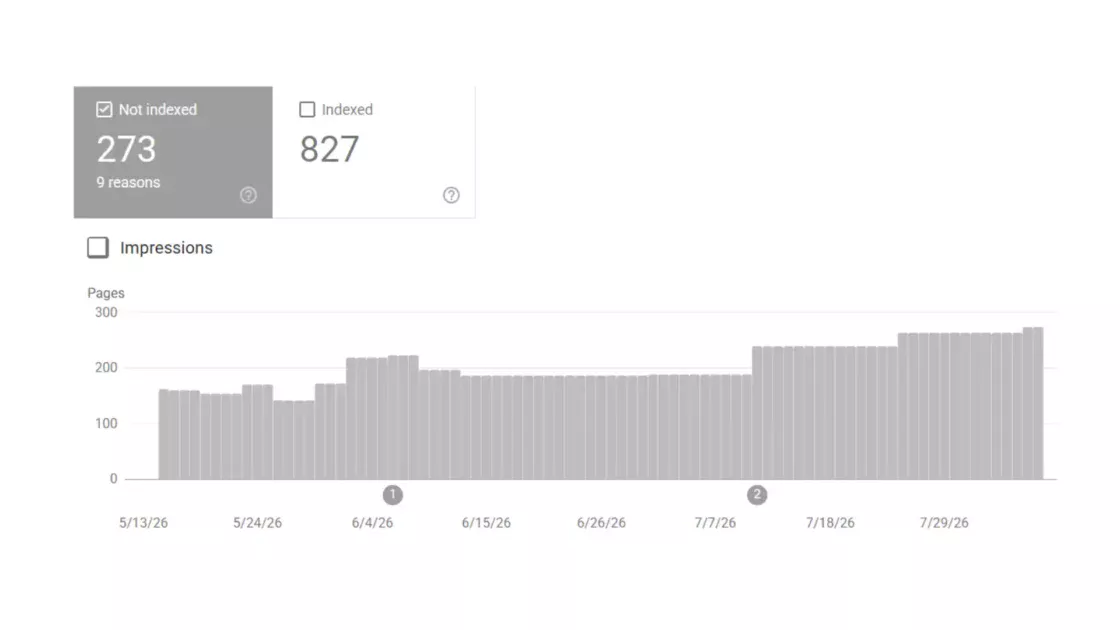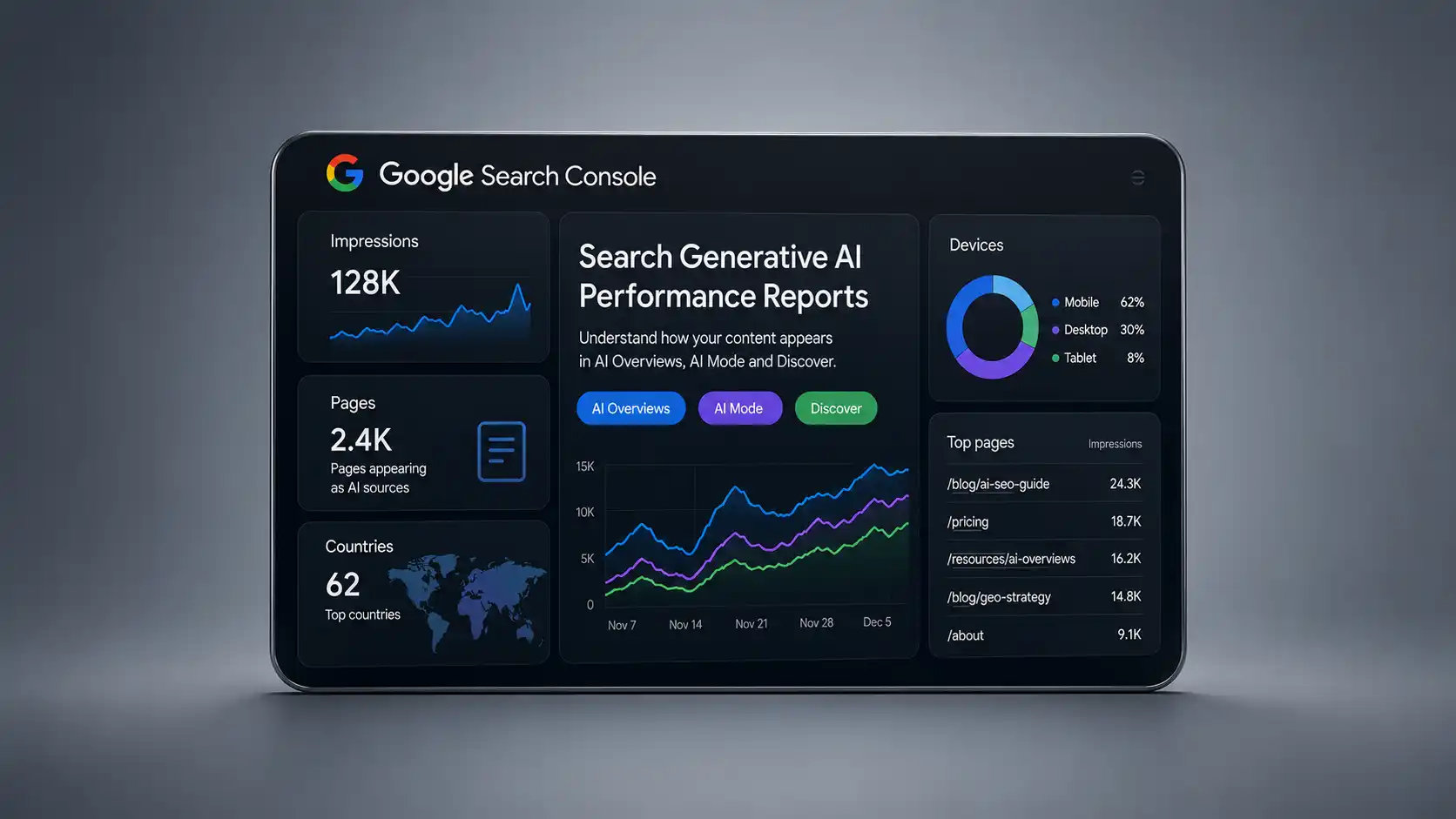
Google has made a move publishers, SEO teams, and GEO specialists have been demanding since AI Overviews became a standard part of Search. On June 3, 2026, the company announced Search Generative AI performance reports in Google Search Console, with separate reporting views for Search and Discover. The reports show how often URLs from a verified site appeared inside Google’s generative AI features, including AI Overviews and AI Mode in Search, plus generative AI features in Discover. They are rolling out first to a subset of sites while Google tests the feature and collects feedback.
Table of Contents
A report that changes the argument, not the whole answer
The announcement matters because it turns AI search visibility from a screenshot-based guessing game into an official Search Console data category. Until now, many teams could see evidence that their pages appeared in AI Overviews or AI Mode, but the data was mixed into wider Search performance reporting. Google’s new report separates a slice of that visibility into a dedicated view. For GEO and AI SEO, this is the first official sign from Google that generative search visibility has become a measurable layer of organic search work.
The problem is just as clear. Google’s first version gives site owners impressions, pages, countries, devices for Search, and date granularity, but it does not give dedicated clicks, CTR, conversion value, or query-level revenue context inside the new generative AI report. Search Console’s help pages describe the new Search report as impression-based and explain dimensions such as pages, countries, dates, and devices. The Discover version is also framed around impressions and pages, with countries and dates, but no click or CTR metric in the dedicated generative AI view.
That makes this announcement both a breakthrough and a compromise. It gives marketers proof that Google’s AI systems displayed their URLs. It does not show whether a human clicked through, subscribed, bought, requested a quote, read the article, joined a newsletter, or became a lead. The new report measures exposure inside AI answers, not business impact from AI answers. That distinction will define how useful the report is in boardrooms, publisher strategy meetings, SEO retainers, and GEO budget discussions.
Google’s timing also matters. The rollout arrived alongside a wider set of controls and publisher-facing changes tied closely to UK regulatory pressure. Google said it is testing a new Search Console toggle that lets website owners decide whether their content appears in and grounds generative AI Search features such as AI Overviews, AI Mode, and AI Overviews in Discover. Sites that opt out, Google says, will not receive traffic or impressions from those generative AI features, while the control will not be used as a ranking signal outside those AI features.
So the story is not only a Search Console story. It is a visibility story, a measurement story, a publisher bargaining story, and a regulation story. It also shows the central tension of AI search in 2026: Google wants to prove that AI Search still sends people to the web, while publishers and site owners want the data needed to verify that claim for their own properties.
The official announcement and the exact rollout
Google’s Search Central post says the new reports are designed to provide “dedicated views” of impressions within generative AI features on Search and Discover. The Search version includes AI Overviews and AI Mode. The Discover version covers generative AI features inside Discover. Google also says this data remains included in the overall performance report, but the new view isolates visibility from generative AI features.
The first rollout is limited. Google says the reports are being made available to a subset of websites so the company can test them and receive feedback before making them widely available. The help center repeats that not all properties have access, and that a site might not see the report if it has not received enough generative AI impressions or has excluded itself from Search generative AI features.
The available dimensions are straightforward. Google lists impressions, meaning how often URLs from the site appeared in generative AI features in Search and Discover; pages, meaning the URLs that appeared within AI features; countries, showing where visibility originated; devices, available for Search results; and dates, with hourly, daily, weekly, and monthly granularity.
The Search help page adds technical texture. It says impressions are counted when links to a site are shown to a user in a generative AI feature on Google Search. The page dimension groups data by the final URL linked by the generative AI feature after redirects, with most performance data assigned to the canonical URL. Country, device, and date dimensions follow Search Console’s usual logic, with dates in Pacific Time.
The Discover help page uses a slightly different impression definition. It says the default report shows impression data in Google Discover and defines impressions as links to a site that a user saw in generative AI features in Discover. The link must be scrolled into view, and only one impression is counted per result per session. The Discover report is aggregated by page, and if two generative AI results from the same property appear in the same Discover list, each impression is counted separately.
These details sound technical, but they will decide whether the report becomes trusted. An AI citation that appears inside a generated response is not the same thing as a classic organic listing. A Discover AI result is not the same thing as a ranked Search result. A page-level impression aggregated by canonical URL is not the same thing as a confirmed human visit. Search Console is giving marketers a new visibility layer, but the interpretation rules are still bound to Search Console’s older measurement model.
The report also carries Search Console’s ordinary data limits. Google’s help page says the usual limitations for the Search performance report, including row limits and time-period limits, also apply to the generative AI performance report. The export button downloads chart and table data, while unavailable or not-a-number values shown as symbols are exported as zeros.
That creates the first operational warning for serious SEO teams. The report will be useful inside Search Console, but large publishers, enterprise sites, marketplaces, and programmatic content operations will quickly run into questions about sampling, exports, row caps, API access, segmentation, and Looker Studio blending. Google has not yet turned this into a full commercial analytics layer. It has released a first official visibility report.
The missing metric at the center of the reaction
The strongest criticism is not that Google shipped too little data. It is that Google shipped the one metric least able to answer the commercial question. Impressions show that a URL appeared inside a generative AI experience. They do not show whether that visibility produced a visit. For publishers and businesses, an AI impression without a click is brand exposure at best and unpaid content extraction at worst.
That is why the lack of dedicated clicks and CTR matters. In classic Search Console analysis, impressions, clicks, CTR, and average position form a working diagnostic set. A page with rising impressions and falling CTR might be losing SERP appeal. A page with stable position and lower clicks might be affected by SERP feature expansion, ads, changed intent, or seasonality. A query with strong impressions and weak clicks can still guide title rewriting, snippet work, internal linking, or conversion targeting.
The new AI report cuts that loop in half. It tells teams the URL appeared in AI search, but it does not prove that the appearance sent traffic. It tells them which pages are being used, but not whether users found those citations compelling. It tells them which countries generated visibility, but not whether users in those countries entered a monetizable journey. It tells them the pattern over time, but not the traffic value of that pattern.
Search Engine Land reported the omission directly, saying the new reporting includes impressions, pages, countries, devices, and dates, but does not include click data. Barry Schwartz also said a Google spokesperson responded to his question about click data by pointing to Google’s statement that it is still working with website owners and may introduce more metrics over time.
That response will not satisfy many publishers. “More metrics over time” leaves open several possibilities: clicks could arrive later, click data could remain bundled elsewhere, CTR could stay absent, or Google could provide some engagement metric that is not comparable with organic Search Console clicks. The uncertainty is the problem. If the report becomes the official AI visibility layer but omits AI traffic accountability, it risks normalizing a metric that flatters Google’s AI ecosystem while leaving site owners unable to calculate return.
There is also a definitional complication. Google already counts AI Mode and AI Overview activity inside broader Search Console totals in some contexts. Google’s own AI features guidance says AI Overviews and AI Mode are included in overall Search Console performance reporting under the Web search type. It also says site owners can track conversions and time spent on site in Google Analytics after the click.
That means dedicated clicks may exist in broader Search Console totals without being isolated inside the new report. For analysts, this creates a difficult reconciliation task. If total organic clicks rise or fall, and AI impressions rise, the relationship is still inferential unless Google provides a direct AI-click dimension. The new report improves attribution of visibility, not attribution of traffic.
This is the sentence many teams will have to repeat to clients: the report proves AI search inclusion, but it does not prove AI search value. Value still has to be inferred through blended reporting, controlled comparisons, Search Console exports, analytics sessions, landing-page behavior, and business outcomes.
The new data points and their real use
The report’s data is incomplete, but it is not useless. It gives marketers a factual starting point for questions that were previously answered with scraping tools, manual SERP checks, screenshots, and third-party estimates. The pages report alone has high value. It shows which canonical URLs Google’s generative AI systems are willing to surface as supporting sources, and that can reshape content audits.
A URL that receives many generative AI impressions but few classic organic visits may be serving as a source more than as a destination. That matters for publisher strategy. Such a page may be semantically strong, structurally clear, and trusted by Google, but it may not be designed to win the click after being cited. A URL that appears in AI Mode or AI Overviews across many countries may also signal durable topical authority, even before traffic is visible.
Country segmentation gives international SEO teams a cleaner way to inspect regional AI adoption. A site might be surfaced heavily in the UK but barely in the United States, or it might appear in AI results for English content across markets where classic rankings are weaker. For multinational brands, country-level AI impressions may become an early signal of entity recognition and content reuse across markets.
Device segmentation in the Search report is also useful. AI interfaces behave differently on desktop and mobile. Link panels, carousels, cards, inline citations, and scroll depth create different click paths. If a site receives large desktop AI impressions but weak inferred sessions, the explanation may differ from a mobile-heavy pattern. Google’s report does not solve CTR, but device data gives analysts a stronger clue about interface friction.
Date granularity adds another layer. Hourly, daily, weekly, and monthly views can help detect rollout effects, UI changes, content freshness effects, topical spikes, and Google test windows. A news publisher might see Discover AI impressions rise during a breaking story. A SaaS site might see AI Mode impressions increase after publishing a detailed comparison page. An ecommerce site might see AI Search visibility change around product launches or seasonal shopping behavior.
The report will also expose pages that Google’s AI systems ignore. That matters as much as visibility. If a brand has built a topic cluster and only one or two pages ever appear in generative AI features, the issue may be depth, clarity, crawlability, internal linking, originality, trust, or source suitability. The absence of impressions does not prove a content problem, because AI features do not trigger for every query. Still, absence at scale can guide better audits.
Google’s AI features documentation says the same SEO fundamentals remain relevant for AI Overviews and AI Mode, and that there are no special technical requirements beyond being indexed and eligible to appear in Search with a snippet. It also says AI Overviews and AI Mode may use query fan-out, issuing multiple related searches across subtopics and data sources to build a response.
That makes the pages report especially interesting. If AI Mode uses query fan-out, a page can appear because it answers a sub-question inside a broader search journey, not because it directly matches the user’s first query. GEO work therefore becomes less about matching one keyword and more about making a page useful as a source inside a multi-step reasoning chain.
A report designed around visibility rather than visits
The report’s structure reveals Google’s view of AI search measurement. Google is starting with visibility inside generated experiences, not with traffic attribution. That choice fits the company’s public framing. Google argues that generative AI features help users explore the web and discover more sources. The new report lets site owners see where their sources appear. It does not force Google to expose whether AI answers keep users on Google.
This difference is not cosmetic. In classic SEO, visibility and traffic have always been connected but separate. A page can rank and fail to win clicks. A page can rank lower and win qualified clicks because of a stronger snippet. A search feature can boost impressions while reducing traffic. AI Search stretches that gap further because the generated answer may satisfy the query before the user reaches the citation.
In a traditional SERP, the source is usually the answer path. In an AI Overview, the source may become supporting material for an answer that Google presents directly. In AI Mode, the user may continue the conversation without leaving Google. In Discover, a generated element may introduce a story or topic in a more personalized feed. These interfaces change the value of a source link.
That is why the new report should not be read like a classic Search Console performance report. A high-impression page inside generative AI features may be a trusted input into Google’s answer. It may not be a traffic asset in the same way. The metric is closer to citation exposure than to organic acquisition. That pushes SEO toward brand visibility, authority, entity coverage, and source inclusion, but it does not erase the need for traffic and revenue reporting.
This also affects internal reporting language. Teams should avoid calling AI impressions “AI traffic.” They are not traffic. They are impressions. Calling them traffic will inflate reports, confuse clients, and weaken trust when sessions do not match. The more accurate term is “generative AI visibility.” The business layer still needs clicks, sessions, conversions, pipeline, assisted conversions, retention, or subscriber value.
The report may still create a new KPI family. For example, a publisher might track generative AI impressions per article category, per author desk, per country, and per freshness window. A B2B SaaS company might track AI impressions for comparison pages, integration pages, problem-solution guides, pricing explainers, and glossary entries. An ecommerce site might track product guide visibility inside AI Mode and AI Overviews.
These KPIs can be useful if they are labeled honestly. AI visibility is a leading indicator, not a revenue metric. It can support decisions about topical authority, content format, structured depth, and source trust. It cannot alone justify GEO spend unless it is connected to business outcomes through other systems.
Search Generative AI report signals and what they do not prove
| Report signal | What it shows | What it does not prove |
|---|---|---|
| Impressions | A URL appeared in a Google generative AI feature | A user clicked, read, converted, or valued the source |
| Pages | Canonical URLs surfaced in AI features | The query, answer context, or exact citation placement |
| Countries | Geographic origin of AI visibility | Revenue, demand quality, or market intent |
| Devices | Device type for Search AI visibility | Whether the interface produced a usable click path |
| Dates | Visibility patterns over time | Causal impact without comparison data |
This table is the practical reading frame for the new report. Each metric has diagnostic value, but none of them completes the commercial chain from AI answer to business result. The report is strongest when used to discover which URLs Google’s AI systems trust and weakest when used as proof that AI visibility is replacing lost organic traffic.
AI SEO gets official data but not official validation
The announcement gives Generative Engine Optimization a kind of official recognition, even if Google does not use the term the way the SEO industry does. When Google creates a dedicated report for generative AI visibility in Search Console, it acknowledges that AI surfaces now require separate measurement. That is enough to change agency decks, client reporting, SEO roadmaps, and internal budget arguments.
For months, GEO and AI SEO have lived in a messy space. Some practitioners treated them as a new discipline. Others saw them as rebranded SEO. Many vendors sold dashboards that monitored prompts across ChatGPT, Perplexity, Gemini, Copilot, AI Overviews, and AI Mode. Traditional SEOs pushed back against speculative tactics that sounded more like model superstition than search strategy.
Google’s AI features documentation lands closer to the conservative view. It says the best practices for SEO remain relevant for AI features, that there are no extra requirements to appear in AI Overviews or AI Mode, and that no special schema.org structured data is required. It points to crawlability, internal links, page experience, visible text, strong images and video when applicable, and structured data that matches visible content.
That does not mean GEO is fake. It means GEO should be grounded in source quality, topical clarity, entity trust, evidence, accessible content, and information architecture rather than hacks. The new Search Console report will reward teams that treat AI visibility as a measurement layer on top of serious SEO, not as a shortcut around it.
The practical work changes in several ways. Content teams will need to inspect pages that appear in AI features and ask why those pages were selected. Was the answer direct? Was the page well-structured? Did it include original evidence? Did it have clear authorship? Did it explain a process better than competitors? Did it cite primary data? Did it use language that maps to subtopics in a query fan-out pattern?
Technical SEO teams will need to check whether pages eligible for AI visibility are crawlable, indexable, canonicalized, internally linked, fast enough, and available in textual form. Google says a page must be indexed and eligible to be shown in Google Search with a snippet to be eligible as a supporting link in AI Overviews or AI Mode. That turns snippet eligibility into an AI visibility gate.
Brand teams will need to stop treating AI visibility only as organic traffic. A brand can be present in an answer through its own URL, through a third-party review page, through a Reddit thread, through a news article, through a comparison page, or through a marketplace listing. Search Console only reports the owner’s verified pages. It will not show brand mentions on other domains. That is a large blind spot for reputation and demand work.
This is where GEO becomes broader than Search Console. Search Console can show owned-site AI visibility inside Google. It cannot show the full answer space across other engines, LLMs, social discussions, forums, review sites, and earned media. The new report is a foundation, not the whole GEO stack.
The zero-click fear now has a cleaner scoreboard
The reaction from SEO communities was predictable because the zero-click fear has been building for years. Search professionals have long watched Google add features that answer more on the results page: featured snippets, knowledge panels, local packs, calculators, weather boxes, product modules, flights, jobs, recipes, sports, and other vertical experiences. AI Overviews and AI Mode add a different layer because they can synthesize content from many sources and present a composed answer.
Third-party research has fueled the concern. Pew Research Center found that Google users who encountered an AI summary clicked a traditional search result link in 8% of visits, compared with 15% of visits when no AI summary appeared. Pew also found that users clicked a link in the AI summary itself in only 1% of visits to pages with such a summary.
Ahrefs published a separate analysis using aggregated Search Console data and reported that, as of December 2025, AI Overviews correlated with a 58% lower average CTR for the top-ranking page in its study. Ahrefs compared keywords with AI Overviews against informational keywords without AI Overviews and estimated the difference after accounting for wider CTR declines.
SparkToro and Datos found in 2024 that 59.7% of EU Google searches and 58.5% of U.S. Google searches resulted in zero clicks, meaning the searcher either ended the session or performed another search rather than clicking out to the open web. SparkToro’s report was not solely about AI Overviews, and its author cautioned against over-attributing changes in May 2024 to AI Overviews, but the study gives the wider backdrop: Google Search already had a large zero-click base before AI Search matured.
Academic research is moving in the same direction, though with mixed findings and different methods. One 2026 arXiv paper on Google AI Overviews and Wikipedia estimated that AIO exposure reduced daily traffic to exposed English Wikipedia articles by about 15% in its matched article-language design. Another large-scale measurement study of AI Overviews reported that AIO activation varied sharply by query type, cited pages often differed from classic first-page organic results, and unsupported claims remained a measurable issue.
These studies differ in methods, sample sizes, markets, interfaces, and time windows. They should not be collapsed into one universal number. Still, they explain why SEO practitioners are not satisfied with impression-only reporting. If AI answers reduce clicks, a report that shows only AI impressions can make the problem look like success.
That is the core trust issue. A publisher could see millions of AI impressions and still lose traffic. A SaaS company could see AI visibility rise while organic leads decline. A news site could be cited inside Discover’s AI layer but see lower direct article sessions. The new report may make the gap visible indirectly, but it does not close the loop.
Google’s counterargument and the quality-click claim
Google has consistently argued that AI Search can benefit the web by helping users ask richer questions and discover a broader set of sources. Its AI features documentation says AI Overviews and AI Mode surface relevant links and may display a wider and more diverse set of helpful links than classic web search because of query fan-out. Google also says that when people click from search results pages with AI Overviews, the clicks may be higher quality, meaning users are more likely to spend more time on the site.
The company has also leaned on user growth. In a May 2026 post, Google said AI Mode had surpassed one billion monthly active users globally and that AI Mode queries had more than doubled every quarter since launch. The same post said the average AI Mode search is triple the length of a traditional Search query and that planning-related AI Mode queries had grown faster than AI Mode queries as a whole over the prior six months.
Google’s business argument is clear: AI Search expands the search market, creates new query types, and sends users to more fitting sources when they need depth. If that is true for a given site, the new reports should eventually help prove it. But the first version does not yet show the evidence most site owners need. Higher-quality clicks cannot be evaluated from impressions alone. A quality-click claim needs click counts, landing-page engagement, conversion data, and comparison against classic Search traffic.
Google is not wrong that a click from a more complex AI-assisted query could be valuable. Someone who asks a multi-part planning query in AI Mode and clicks a source after reading context may be further along in intent than someone clicking a short head-term result. A user who clicks a technical source from an AI answer may be more motivated than a casual scanner. A buyer who clicks a product comparison after AI Mode narrows options may have stronger commercial intent.
But those are hypotheses until measured. Search Console’s new report can show the exposure side of the story. Google Analytics can show what happens after arrival. The missing piece is the bridge between the two. Without dedicated AI clicks, marketers must build that bridge themselves through landing-page analysis, time series comparisons, query proxy groups, and conversion segmentation.
The risk for Google is reputational. When a platform says it is sending high-quality traffic but withholds the report that would let publishers check the claim directly, suspicion grows. That suspicion is not limited to independent publishers. Enterprise brands, retailers, travel sites, SaaS firms, and affiliates will all ask the same question: if AI Search is a healthy discovery channel, why not expose the channel’s click-through data clearly?
There may be technical reasons. AI Mode interactions are multi-turn. AI Overviews have complex link placements. Discover impressions follow feed rules. A single AI response may include inline links, panels, carousels, images, cards, and follow-up journeys. Click attribution may be harder than classic blue links. Yet Google already has systems for counting clicks and impressions in complex Search elements. The issue is not whether counting is possible; it is what Google chooses to make isolatable.
The UK regulatory backdrop
The rollout cannot be separated from the UK’s digital markets regime. On June 3, 2026, the Competition and Markets Authority said it had imposed a publisher conduct requirement on Google. The CMA described the requirement as a world-first move that gives publishers effective tools to prevent their content being used to power AI features in search, such as AI Overviews. It also said Google must ensure publisher content is properly attributed with clear links in AI-generated search results.
The CMA’s publisher conduct requirement page says Google must provide publishers with effective controls over the use of search content in generative AI, publish clear information explaining how publishers’ search content is used in Google’s generative AI, provide publishers with clear and detailed metrics on user engagement with their search content in search generative AI features, and take reasonable steps to ensure content is attributed clearly and accurately.
This matters because it adds a regulatory lens to the missing-click debate. The CMA is not only asking for controls. It is also asking for user engagement metrics. Google’s first report gives impressions and page-level visibility. Whether that satisfies regulators over time will depend on how the CMA interprets “user engagement” and whether Google expands metrics beyond impressions.
The wider case began earlier. The CMA confirmed in October 2025 that Google had strategic market status in general search and search advertising. It said AI Overviews and AI Mode were in scope, while Gemini as a separate AI assistant was not in scope at that stage. The CMA also noted that Google handled more than 90% of UK searches.
Reuters reported on June 3, 2026, that Britain imposed new conduct requirements on Google’s search services, including allowing publishers to stop their content being used to power AI features. Reuters also noted publisher concerns about lower click-through rates as users rely on AI-generated overviews, and said Google was testing controls that would not affect traditional search results.
Google’s own product post on June 3 ties the controls and insights to engagement with regulators such as the CMA. It says Google is beginning to test the new control in Search Console and roll out new Search Console insights for website owners, starting with a subset of website owners in the UK before broader global rollout.
This is a crucial detail. The first version is not only a product launch. It is part of a negotiated, regulated shift in the relationship between Google, publishers, and AI Search. The Search Console report is a product feature, but it is also an answer to pressure. That pressure will not end with impressions.
The opt-out toggle and the difficult bargain
Google’s new control creates a stark choice. Site owners can decide whether their content appears in and helps ground Google’s generative AI Search features. Sites that opt out will not receive traffic or impressions from AI Overviews, AI Mode, or AI Overviews in Discover, but Google says the control will not be used as a ranking signal for search results outside those generative AI features.
For publishers, this is both power and risk. Opting out may protect content from being summarized inside AI answers, but it may also remove the site from a growing discovery surface. If AI Overviews and AI Mode become central to user behavior, exclusion could mean losing brand visibility where users are making decisions. If AI Search does not send meaningful traffic, opting in could mean contributing content to a system that captures user attention without fair return.
That is why metrics matter. A rational opt-out decision requires knowing the value of being included. Impressions alone do not answer that. A publisher needs to know whether AI inclusion leads to clicks, subscriptions, ad impressions, registrations, repeat users, newsletter signups, affiliate revenue, or licensing leverage. A brand needs to know whether AI inclusion improves assisted conversions, brand search demand, product consideration, or support deflection. A public-information site needs to know whether AI answers improve access to accurate information.
The opt-out question also varies by content type. Commodity informational pages may suffer most if an AI answer satisfies the query on Google. Original reporting may still benefit if Google’s interface makes the source clearly visible and the user wants depth. Product pages may benefit if AI Mode narrows a purchase journey and sends qualified buyers. Forums may gain or lose depending on whether the AI answer summarizes the discussion or pushes users into it.
The CMA’s requirement for attribution with clear links gives publishers a regulatory tool to push for better presentation. Google’s Preferred Sources and Highly Cited updates also suggest the company is experimenting with stronger source surfacing. Google said in May 2026 that Preferred Sources were coming to AI Overviews and AI Mode, and that people were twice as likely to click through to a Preferred Source. It also announced a more prominent carousel for developing topics and broader use of Highly Cited labels.
Those design changes may help. They do not replace reporting. A publisher cannot base strategy on Google’s aggregate statement that preferred sources get stronger clicks if the publisher cannot see its own AI click data clearly. The opt-out toggle gives site owners choice, but the report does not yet give them the evidence needed to price that choice.
Discover becomes the surprising part of the story
The Discover integration is the most intriguing part of the announcement because it extends AI reporting beyond classic search intent. Search is pull-based. Users ask. Discover is push-based and personalized. Users browse a feed shaped by their interests. AI inside Discover may therefore affect content distribution differently from AI Overviews on a search results page.
Google’s Discover generative AI report shows impressions from generative AI features in Discover, pages receiving the highest or lowest impressions, and where those impressions originate. The help page defines Discover AI impressions through viewability: a link must be scrolled into view, and only one impression is counted per result per session.
That definition matters because Discover is already an impression-heavy environment. A user may scroll past cards, pause, return, or tap based on headline, image, topic, familiarity, and freshness. A generative AI element inside Discover could act like a summary, a topic cluster, a carousel, or a personalized bridge to a set of sources. The commercial effect could differ sharply from AI Overviews in Search.
Discover also carries a different set of publisher hopes. Search users often want a specific answer. Discover users may be more open to a story, a perspective, a trend, or a product they were not actively searching for. If AI in Discover introduces topics and sources rather than fully answering a narrow query, click behavior could be healthier. That is the optimistic case.
The pessimistic case is that AI Discover becomes another layer of summarization inside Google’s owned environment. A user may get enough context from the AI-generated element and never tap through. The source page may receive an impression but not a visit. The publisher may gain visibility but lose the session in which it could show ads, build loyalty, or convert the reader.
At launch, the report cannot settle the debate. It can show which pages appear inside Discover’s AI features and how impressions move over time. It cannot show whether Discover AI visibility sends visitors or whether those visitors are more engaged than classic Discover traffic. Discover has always been volatile; AI Discover may be even harder to forecast.
For editorial teams, the first useful application is page mapping. Which story types appear in Discover AI? Breaking news? Evergreen explainers? Reviews? Local guides? Opinion? Service journalism? First-person expertise? Once teams map this, they can compare against normal Discover performance and decide whether AI Discover favors different content formats.
For ecommerce and affiliate publishers, Discover AI could become a new testing ground for category-level content. A buying guide might appear inside an AI-generated Discover unit around a user’s interest. A travel article might surface in a planning-themed feed. A recipe or health article might show in a seasonal cluster. But without clicks, these remain visibility clues rather than acquisition proof.
Microsoft moved first and set the comparison point
Google’s report also lands in a competitive context. Microsoft introduced AI Performance in Bing Webmaster Tools in public preview in February 2026. Bing’s report shows how publisher content appears across Microsoft Copilot, AI-generated summaries in Bing, and select partner integrations. Microsoft described the dashboard as showing total citations, average cited pages, grounding queries, page-level citation activity, and visibility trends over time.
That means Microsoft reached the dedicated AI visibility reporting milestone before Google. Bing’s terminology is also telling. It uses citation language more explicitly. Total citations show how often content is displayed as a source in AI-generated answers. Grounding queries show phrases used when retrieving content referenced in AI-generated answers. Page-level citation activity shows which URLs are referenced.
Google’s first version is narrower in some areas and stronger in others. Google has far greater Search market impact. Its report sits inside Search Console, the default SEO source of truth for most site owners. It includes Search and Discover, and Search dimensions include devices. But Google’s first report does not appear to provide grounding queries in the way Bing’s public preview describes them. It also does not provide click data in the dedicated AI view.
Neither platform fully solves the commercial measurement problem. Bing’s AI Performance report, based on the official announcement and industry reporting, also focuses on citations and visibility rather than clicks and CTR. Search Engine Land noted that Bing’s new AI report did not include click data. Google now follows with a report that also starts with visibility.
Still, Microsoft changed expectations. Once one major search platform gives a dedicated AI report, the absence of such reporting from Google became harder to defend. Google’s June 3 launch closes that gap in principle. The debate now shifts from “Will Google report AI visibility?” to “Will Google report AI value?”
For SEO teams, the comparison suggests a future dashboard pattern. Teams will likely track Google generative AI impressions, Bing AI citations, third-party AI answer mentions, owned-page citation share, earned-media citation share, and conversion outcomes from identifiable AI referrers. Search Console becomes one piece of a cross-engine AI visibility model.
The strategic shift is simple: AI search reporting is moving from vendor scraping into platform-native analytics, but platform-native analytics is still selective. Marketers will need both official data and independent measurement.
Google and Bing AI visibility reports at launch
| Platform report | Core visibility metric | Page-level data | Query or grounding context | Dedicated clicks or CTR |
|---|---|---|---|---|
| Google Search Generative AI performance reports | Impressions | Yes | Not in the first public help docs | No |
| Google Discover Generative AI performance report | Impressions | Yes | Not in the first public help docs | No |
| Bing Webmaster Tools AI Performance | Citations | Yes | Grounding queries sample | No |
The comparison shows the market direction. Search engines are willing to disclose when content is used or surfaced in AI answers, but they are still cautious about isolating the downstream traffic impact. That makes visibility reporting official while preserving uncertainty around click loss, CTR, and commercial value.
The reporting model agencies should use now
Agencies and in-house SEO teams should treat the new report as a dedicated input into a larger measurement model. The mistake will be building a GEO dashboard that celebrates AI impressions without tying them to site behavior. The better model separates four layers: AI visibility, organic traffic, on-site engagement, and business outcomes.
The first layer is Search Console’s generative AI visibility. Track impressions by page, country, device, and date. Group pages by content type, topic, funnel stage, author, product, template, language, and market. Watch which pages emerge as AI sources. Do not treat every impression as equal. A legal guide, a product support page, a breaking-news article, and a comparison page may have different business value.
The second layer is classic Search Console performance. Compare the same URLs across total Web impressions, clicks, CTR, and average position. Watch for pages where AI impressions rise while Web clicks fall. Also watch for pages where AI impressions rise and Web clicks stay stable or increase. The direction of the relationship will differ by query type.
The third layer is analytics behavior. Use GA4, server logs, CRM data, ecommerce analytics, subscription systems, and BI tools to inspect organic landing-page behavior. Google’s own documentation recommends combining Search Console and Analytics to understand how users discover and experience a website, and GA4’s Search Console integration helps connect organic search data with user behavior after the click.
The fourth layer is business impact. For ecommerce, measure revenue, add-to-cart, product views, assisted conversions, and returning-user value by landing page. For publishers, measure pageviews, ad revenue, subscriber conversion, recirculation, newsletter signup, and engaged time. For B2B, measure form fills, demo requests, qualified pipeline, trial starts, and influenced accounts. For local businesses, measure calls, bookings, directions, and contact forms.
This model prevents false positives. A page with rising AI impressions but no traffic may be a brand visibility asset, not a lead asset. A page with modest AI impressions but high conversion after click may be a priority for better source presentation and internal linking. A page with declining clicks and rising AI impressions may need a stronger reason to click: original data, tools, downloadable assets, calculators, visuals, proprietary examples, or deeper analysis.
Agencies should also revise client language. Instead of “we got you 200,000 AI impressions,” say: “Your pages appeared 200,000 times inside Google generative AI features. We have not yet received dedicated click data from Google, so we are comparing this visibility against organic sessions and conversions for the same URLs.” That sentence is less glamorous, but it is honest.
The best GEO reporting in 2026 will not be the report with the largest AI impression number. It will be the report that shows which AI-visible pages create business movement and which merely feed the answer engine.
Page-level analysis becomes the new audit layer
The pages report will become the first place serious teams look. It answers a question that third-party tools often approximated: which URLs is Google actually surfacing inside AI features? The answer may surprise many sites.
A page does not need to be the homepage, the highest-traffic blog post, or the top-ranking commercial URL to be useful inside an AI answer. AI Mode’s query fan-out can select sources for subtopics. AI Overviews can cite pages that answer one part of a question. Discover AI can surface pages tied to a user’s interests. This means source pages may look different from classic SEO winners.
The audit should begin with clustering. Put AI-visible URLs into groups: definitions, comparisons, tutorials, reviews, news, product pages, category pages, data studies, FAQs, support articles, opinion pieces, local pages, and evergreen explainers. Then compare those clusters against traffic and conversion. Some clusters will produce visibility but little revenue. Others may show a smaller impression base but stronger intent.
Next, inspect the actual page. Does it answer a narrow question clearly? Does it include original information? Does it cite primary sources? Is the author credible? Is the content fresh? Is the structure easy to extract? Does it use descriptive headings? Are facts separated from opinion? Are tables readable? Are images and videos contextually useful? Is the visible text complete, or is critical information hidden in scripts, images, accordions, or unsupported formats?
Google’s AI features documentation says that important content should be available in textual form and that structured data should match visible text. It also says strong images and videos can support textual content when applicable.
The audit should then compare AI-visible pages with non-visible pages in the same topic cluster. If one guide appears in AI features and another does not, the difference may reveal the pattern. Maybe the visible guide has a concise answer section, better internal links, fresher data, stronger author profile, more original examples, clearer definitions, or better topical coverage. Maybe the non-visible page is too thin, too promotional, too generic, or too buried.
This does not mean writing for machines at the expense of readers. It means making expert content easier to evaluate. AI visibility rewards pages that can be trusted, parsed, and cited without forcing the system to infer too much. Human readers benefit from the same qualities.
A page-level AI audit should also include business design. If a page is being surfaced inside AI Search, make the click worthwhile. Add original charts, tools, templates, calculators, comparison frameworks, downloadable checklists, case examples, expert commentary, updated data, product fit guidance, or deeper analysis. If the AI answer can summarize the whole page, users have less reason to visit. If the page contains what the AI answer cannot fully deliver, the citation has a stronger click incentive.
Query fan-out changes content planning
Google’s query fan-out explanation is one of the most consequential parts of its AI features documentation. AI Overviews and AI Mode may issue multiple related searches across subtopics and data sources to build a response. That means a user’s visible query is not necessarily the only retrieval path.
Classic SEO often starts with a keyword, a page, a ranking target, and a SERP. AI Search shifts planning toward task coverage. A user might ask AI Mode for “the best CRM setup for a 12-person B2B agency with HubSpot, Slack, and paid search leads.” Google may fan that out into sub-questions about CRM setup, lead routing, HubSpot workflows, agency sales process, Slack notifications, attribution, and pipeline stages. A site can be cited for one of those subtopics even if it does not rank for the full visible query.
This affects content architecture. Topic clusters need to cover sub-problems that support complex user journeys. A single broad guide may not be enough. Sites need precise pages that answer parts of a workflow and connect those parts through internal links. A B2B software site might need pages for onboarding, integrations, pricing logic, comparison criteria, compliance, implementation timelines, and common mistakes. A publisher might need explainers, timelines, profiles, data pages, local context, and primary documents.
The report’s pages data will help validate these clusters. If only top-level guides appear, subtopic pages may be too weak. If support pages appear often, the site may have practical authority that marketing pages lack. If comparison pages appear but product pages do not, the AI system may prefer neutral context over sales pages. If third-party pages mention the brand more than owned pages do, the brand may need stronger entity reinforcement on its own site.
Query fan-out also weakens the obsession with one ranking position. AI systems can assemble answers from sources across the web. Academic research has found that AI Overview cited domains can differ from co-displayed first-page results, with one 2026 study reporting that nearly 30% of AIO-cited domains did not appear in those first-page results.
For GEO, this creates both hope and uncertainty. Smaller sites with excellent pages may gain AI visibility even without classic top rankings. Large sites may lose assumed dominance if their pages do not answer subtopics well. But the opacity of fan-out means teams cannot fully reverse engineer the path. They can only build stronger source coverage and measure what appears.
Content planning must move from keyword coverage to answer-chain coverage. The page has to serve a role in the chain of reasoning: define, compare, prove, calculate, explain, warn, localize, update, or verify.
The business case will be harder before it gets easier
For agencies selling GEO, the new report is a gift and a trap. It creates an official metric that can be shown in monthly reports. It also exposes the gap between visibility and value. The first agencies to oversell AI impressions as success will face hard questions when clients ask about leads, sales, and revenue.
The stronger business case starts with risk management. Brands cannot ignore AI Search because users are adopting it and Google is integrating it into core Search experiences. Google says AI Mode has passed one billion monthly active users globally, and AI Overviews reached billions of monthly users by 2026 through earlier expansion.
The second part of the case is opportunity mapping. AI Search can reveal where a site is trusted as a source. That helps content teams decide where to deepen authority. It helps PR teams identify categories where earned media is needed. It helps product teams see which documentation or support pages influence user decisions. It helps executives understand that search visibility now includes answer inclusion, not only rankings.
The third part is defensive measurement. If organic clicks fall while AI impressions rise, the company needs to know which pages and topics are most exposed to answer substitution. That can guide content upgrades, paywall strategy, licensing discussions, product-led content, newsletter capture, and channel diversification.
The fourth part is conversion design. A page that is likely to be summarized by AI needs to offer something beyond the summary. That might be a calculator, dataset, interactive comparison, template, community discussion, video demonstration, product configurator, or expert consultation. The click has to promise depth, utility, or trust that the AI answer cannot fully reproduce.
Budget conversations should be reframed around this. GEO is not a separate magic channel. It is a measurement and adaptation layer for search behavior that is shifting toward generated answers. The work includes technical SEO, editorial quality, entity authority, structured information, analytics integration, brand monitoring, earned media, and conversion strategy.
The client question should not be “Did we appear in AI?” The better question is “Which AI appearances support our business, and which ones show that Google is answering with our work without sending enough value back?” The new Search Console report helps begin that conversation. It does not finish it.
Publishers face a sharper revenue dilemma
Publishers carry the highest risk because their business model often depends on the pageview itself. A SaaS company can benefit from a highly qualified lead even if total clicks fall. A publisher loses ad inventory, subscription paths, and habit formation when a user gets the answer on Google and leaves.
The issue is not only traffic volume. It is control over the reader relationship. If Google summarizes a news article or explanatory piece inside an AI answer, the publisher may receive attribution but lose the session. Without the session, it cannot show a subscription offer, collect a first-party signal, recommend related work, build loyalty, or fund reporting through ads.
The CMA’s intervention recognizes that bargaining issue. Its June 2026 press release says publishers will have tools to prevent content being used to power AI features in search and that Google must properly attribute publisher content using clear links in AI-generated search results. The conduct requirement also includes controls over fine-tuning and metrics on user engagement.
The new report gives publishers one piece of leverage: proof of appearance. A publisher can now show that its pages are being used or surfaced in Google generative AI features, at least for owned pages within the report’s limits. That matters for internal decisions and regulatory discussions. But if the report omits clicks, it may also create a weaker form of evidence than publishers need.
Publishers should use the report to classify content by AI substitution risk. High-risk content includes short factual explainers, basic definitions, evergreen service pieces, commodity recaps, simple how-to answers, and backgrounders that can be fully summarized. Lower-risk content includes original investigations, local reporting, exclusive interviews, live updates, data projects, opinion with distinctive voice, interactive tools, and community-driven coverage.
The strategic response should not be to abandon SEO. Search is still a major discovery channel. But publishers need to reduce dependence on pages that can be summarized without loss. They need stronger direct relationships, newsletters, apps, memberships, events, podcasts, video, communities, and repeat-use tools. AI Search punishes publishing that is merely answer-shaped. It increases the value of work that is original, local, experiential, or hard to compress.
The Discover AI report could be especially relevant for publishers because Discover has been a major traffic source for some news and lifestyle sites. If generative AI appears in Discover and reshapes feed behavior, publishers will need separate strategies for Search AI and Discover AI. A story that loses clicks in Search AI might gain discovery in a feed carousel. Another might be summarized away in both.
Ecommerce and affiliate sites get a different signal
Ecommerce sites should not read the report the same way publishers do. For many retailers and affiliate operations, AI visibility may sit earlier in the buying journey. A user may ask AI Mode to compare product categories, understand trade-offs, plan a purchase, or narrow options. A cited buying guide might not get every click, but the clicks it does receive may be closer to decision-making.
Still, the missing click data is a problem. Ecommerce teams need to know whether AI visibility leads to product views, add-to-cart events, revenue, store visits, or assisted conversions. Without dedicated AI clicks, they must infer this from URL-level organic landing-page behavior and time-based changes.
The pages report may reveal which content types Google’s AI systems trust during purchase research. Independent guides, comparison pages, review pages, product education hubs, category explainers, and support content may surface more than standard category pages. If so, ecommerce SEO needs to invest more in decision-support content and less in thin keyword pages.
Affiliate sites face a sharper challenge. AI answers can summarize affiliate content and reduce the need to visit. Product recommendation pages are highly vulnerable if they lack original testing, data, pricing context, user experience, or tools. If a page contains only generic pros and cons, AI can reproduce its value. If it contains real testing, original photos, category expertise, update history, and clear methodology, users have a stronger reason to click.
Google’s Preferred Sources update may also affect ecommerce media and review publishers. If users can mark preferred sources and see them highlighted in AI Overviews and AI Mode, trusted review brands may gain stronger click paths. Google said people are twice as likely to click through to a Preferred Source, and that any website publishing fresh content is eligible.
For retailers, AI visibility should be tied to entity completeness. Product feeds, Merchant Center, Business Profile, structured data, clear return policies, shipping information, reviews, availability, and helpful product content all matter in the broader search ecosystem. Google’s AI features guidance specifically mentions keeping Merchant Center and Business Profile information up to date as part of the continuing SEO fundamentals relevant to AI features.
Ecommerce GEO should focus on becoming the source AI trusts during comparison, not only the store that ranks for a product keyword. The new report can show which URLs are being selected for that role.
B2B search strategy moves closer to sales enablement
For B2B brands, the new report may become a strong signal of content influence even without clicks. B2B buying journeys are long, multi-touch, and research-heavy. AI Mode is well suited to complex comparisons, implementation questions, vendor shortlists, and internal decision support. Google says AI Mode is used for longer questions and planning-related queries, which maps closely to B2B discovery and evaluation behavior.
A B2B site might appear in AI answers for integration questions, pricing logic, category definitions, compliance concerns, best-practice frameworks, competitor comparisons, migration guides, and operational workflows. Those appearances may not always produce immediate clicks, but they can influence brand consideration. Search Console’s pages report can identify which assets are becoming source material in those AI-assisted journeys.
The risk is that B2B teams will report AI impressions as pipeline. They are not pipeline. They are source exposure. The right reporting joins AI-visible pages with CRM influence where possible. If a page receives many AI impressions and also appears in the journey of closed-won accounts through analytics or first-party tracking, that page deserves investment. If it receives AI impressions but no downstream engagement, it may need stronger calls to action, tools, or differentiated content.
B2B teams should also inspect whether AI-visible pages are aligned with sales messaging. A support article may be the main source AI uses to explain a product capability. A comparison page may shape how the brand is positioned against competitors. A glossary page may define the category in a way sales teams would not choose. The pages report can uncover this hidden influence.
This is where SEO and sales enablement merge. Pages that AI systems cite should be accurate, current, strategically framed, and useful. They should not exaggerate claims. They should provide evidence. They should explain trade-offs honestly. If AI Search becomes an early advisor in buying decisions, source pages become part of the sales conversation even before a prospect visits.
For B2B, GEO is less about winning anonymous traffic and more about shaping the information layer buyers use before they contact sales. The new report gives the first official clue about where that shaping happens on Google.
Local SEO and service businesses need caution
Local businesses may feel left out of the first reaction, but AI Search has strong local implications. Users increasingly ask complex local questions: where to go, which service to choose, how to compare providers, what to do in a city, which clinic or contractor fits a situation, and which restaurant meets constraints. AI Mode and AI Overviews can synthesize local results, business profiles, reviews, web pages, maps, and third-party content.
Search Console’s generative AI report only covers verified site URLs. It will not fully represent local pack visibility, Google Business Profile exposure, reviews, maps behavior, or third-party mentions. A local brand could be recommended in an AI answer because of reviews, directories, local articles, or map data without its website appearing as a cited source. Conversely, a service page could appear as a source without the business receiving calls or bookings.
That means local SEO teams need to combine Search Console AI visibility with Business Profile performance, call tracking, booking data, review monitoring, local rank tracking, and referral analysis. The new report is useful for local content pages, such as service explainers, city guides, FAQs, and location pages. It is not a complete AI local visibility report.
Local content strategy should focus on information that AI needs to answer real questions: service areas, credentials, pricing ranges where possible, before-and-after examples, process explanations, insurance, warranties, opening hours, staff expertise, local regulations, neighborhood context, and practical photos. Thin location pages with boilerplate text are unlikely to be strong sources.
The missing-click issue is especially awkward in local. A user may see a source, then call from a Business Profile, get directions, or complete a booking without visiting the website. Search Console will not capture those outcomes. AI impressions could assist a conversion that happens elsewhere. Or they could replace a website visit entirely. Both are possible.
Local GEO requires a wider measurement map than Search Console can provide. The report is useful for owned-page inclusion, but local demand often converts through Google-owned surfaces.
Technical SEO remains the entry ticket
Google’s documentation is clear that there are no extra technical requirements for appearing in AI Overviews or AI Mode beyond being indexed and eligible to appear in Search with a snippet. That should calm teams tempted to chase fake AI markup schemes or new machine-readable files. Google says there is no special schema.org structured data needed and no new AI text file required for these features.
That does not make technical SEO less relevant. It makes it more foundational. If a page is blocked, poorly canonicalized, hard to crawl, hidden behind client-side rendering failures, lacking visible text, slow, duplicated, or excluded from snippets, it may never become a reliable AI source. The basics still decide eligibility.
Crawlability comes first. Google must access the content. Internal linking comes next. Google needs to discover the page and understand its relationship to other pages. Canonicalization matters because Search Console assigns most page-level performance data to canonical URLs. If canonical signals are messy, AI impression reporting may become harder to interpret.
Snippet controls now matter strategically. Google’s AI features documentation says that to limit information shown from pages in Search, site owners can use controls such as nosnippet, data-nosnippet, max-snippet, or noindex. These controls affect how much content Google can show and can affect AI feature eligibility.
Google-Extended is a separate issue. Google’s crawler documentation says Google-Extended lets publishers manage whether content Google crawls may be used for training future Gemini models and for grounding in certain Gemini and Vertex AI contexts, but it does not affect a site’s inclusion in Google Search and is not used as a ranking signal in Google Search.
The new Search Console toggle for generative AI Search features adds another control path. That could reduce confusion, but it also adds governance work. Site owners need to know which control affects which product: snippets, Search indexing, AI Search grounding, Gemini training, Vertex AI grounding, Discover, and classic Search. Legal, SEO, editorial, and product teams should align before changing these controls.
The wrong control can cut off visibility the business still needs. The right control can protect content without damaging classic Search presence. This is now a governance issue, not just a robots.txt issue.
Content quality becomes easier to test and harder to fake
The pages report may expose a truth many teams already suspect: generic content is not a durable AI source strategy. AI systems need sources, but they do not need every rewritten explainer. They need pages that provide reliable, clear, original, or useful information. If ten sites publish the same generic guide, the AI system can choose the one with stronger authority, better structure, clearer evidence, or broader trust signals.
Google’s guidance for AI features points back to helpful, reliable, people-first content and standard SEO fundamentals. Its May 2026 updates around Preferred Sources, original content, and Highly Cited labels also point toward source trust and distinctive contribution.
This means GEO content should be written for extractability without becoming sterile. Clear definitions, direct answers, tables, examples, author expertise, citations, and updated facts help AI systems and readers. But pages also need a reason to exist beyond answering the obvious. Original data, field experience, product testing, interviews, local reporting, case studies, and expert judgment create that reason.
The new report can help test which qualities matter on a given site. Compare AI-visible pages with non-visible pages. Look for patterns: pages with original data, pages with clear methodology, pages with author bios, pages with recent updates, pages with better internal links, pages with stronger media, pages with external citations, pages with concise summaries, pages with fewer ads, pages with richer examples.
Do not overfit too quickly. AI feature inclusion can vary by query, market, user context, device, time, and Google experiments. A page appearing today may not appear tomorrow. Academic work on AI Overviews has found variability across query runs and differences between AI sources and classic Search results.
Still, page-level AI impressions offer a better feedback loop than guesswork. Teams can now publish, improve, wait, and inspect whether the page gains AI visibility. That does not prove causation, but repeated patterns across many pages can guide editorial standards.
The content lesson is not “write for AI.” The lesson is “write so a human and a retrieval system can both see why this page deserves to be cited.”
Brand visibility remains partly invisible
Search Console only reports data for URLs in verified properties. That is natural for a webmaster tool, but AI answer visibility is not limited to owned URLs. A brand can be mentioned in AI answers through news coverage, Reddit discussions, YouTube videos, review sites, directories, Wikipedia, government data, partner pages, customer stories, marketplace listings, and competitor comparisons.
This creates a blind spot. A brand might have strong AI presence but weak owned-site AI impressions. Or it might have strong owned-site impressions while third-party sources frame it negatively. Search Console will not show sentiment, third-party citations, competitor co-mentions, or answer wording. It also will not show whether the AI answer recommends the brand, merely cites it, criticizes it, or lists it alongside alternatives.
GEO therefore needs brand monitoring beyond Search Console. Teams need to inspect AI answers across Google AI Mode, AI Overviews, Bing/Copilot, ChatGPT Search, Perplexity, Gemini, and vertical AI tools. They need to track the sources used, the claims made, the competitors mentioned, the attributes associated with the brand, and whether owned pages are included.
The new Google report is still useful in that broader model. Owned-source visibility matters. If Google’s AI features cite a brand’s own documentation or guide, the brand has more control over accuracy. If Google cites third-party pages instead, the brand’s story is filtered through others. That may be fine when the third-party source is reputable and favorable. It is risky when the source is outdated, thin, biased, or wrong.
Brand teams should use the pages report to ask: Which of our pages does Google trust? Which critical topics do we not own? Which product claims are being explained by third parties instead of us? Which comparison pages are absent? Which support pages appear more than marketing pages? Which markets show weak owned-source visibility?
The new Search Console report measures owned-page inclusion, not brand authority as users experience it in AI answers. Treat it as one lens.
The Reddit reaction reflects a real analytics gap
The user reaction across SEO forums and Reddit-style discussions has centered on a blunt point: impressions do not pay bills. That reaction is not only sarcasm. It reflects the lived experience of teams that have watched impressions rise while clicks flatten or fall. Search communities have long shared examples of high AI Overview exposure with poor click-through, and Reddit threads often frame the issue as a gap between being used as a source and receiving business value.
Reddit examples are anecdotal, and not every claim should be treated as representative. But the sentiment aligns with broader research and industry reporting. Pew found lower link-click behavior when AI summaries appear. Ahrefs found lower CTR for top-ranking pages with AI Overviews. Search Engine Land reported that Google’s dedicated AI report does not include clicks.
The frustration has another cause: Search Console has always been the closest thing SEO has to a platform-native truth source. When Google omits a metric there, it shapes what the industry can prove. Third-party tools can estimate AI presence, scrape prompts, track citations, and infer CTR. But clients trust Google data more. If Google shows only impressions, agencies must either overstate visibility or spend time explaining why the official report is incomplete.
This is why the missing-click issue will keep surfacing. It is not a request for vanity data. It is a request for accountability. A website owner wants to know whether Google’s AI feature used a page in a way that led to a visit. A publisher wants to know whether the AI answer replaced a visit. A marketer wants to know whether GEO work produced revenue. A regulator wants to know whether content use has a fair exchange of value.
Google may argue that click data remains available in broader Search Console totals or that additional metrics may come later. But that does not answer the segmentation need. The industry does not only want clicks counted. It wants AI clicks separated.
Executive reporting needs new language
The new report will reach executives quickly because it is easy to understand at the surface level. “We appeared in Google AI answers 500,000 times” is a clean sentence. It is also dangerous if left alone. Executives may assume those impressions equal brand impact, traffic recovery, or successful AI SEO.
A better executive report should include three statements. First, generative AI impressions show that Google’s AI features surfaced the site’s URLs. Second, Google’s dedicated report does not currently show clicks or CTR, so traffic impact must be inferred. Third, the business value of AI visibility depends on whether the same pages drive sessions, conversions, or measurable brand demand.
The report should show AI-visible pages by business category. For a SaaS company, categories might be product pages, integration pages, comparison pages, support docs, blog guides, and glossary pages. For a publisher, categories might be news, evergreen explainers, reviews, lifestyle, opinion, and local. For ecommerce, categories might be buying guides, category pages, product pages, reviews, and support.
The report should also include a “visibility versus value” grid. High AI impressions and high conversions: invest. High AI impressions and low conversions: improve click reason or treat as brand exposure. Low AI impressions and high conversions: improve source eligibility and topical authority. Low AI impressions and low conversions: deprioritize unless strategically needed.
Executives should also see risks. AI visibility can grow while traffic falls. Opting out can protect content but reduce presence in AI experiences. Google may change the report, UI, metrics, and rollout scope. The current data is early and limited to properties with access. Search Labs experiments are excluded.
The board-level interpretation is simple: Google has made AI search visibility measurable, but not yet financially accountable. That sentence is the cleanest way to explain both the value and the limitation.
The data governance problem no one can ignore
Once Google offers an AI Search toggle and AI performance reporting, ownership becomes a serious question. Who decides whether a site opts into generative AI Search features? SEO? Legal? Editorial? Product? Executive leadership? Compliance? The answer depends on the business model and risk profile.
A news publisher may treat the toggle as a strategic bargaining tool. A government information site may prioritize public access and accuracy. An ecommerce site may prioritize visibility and buyer assistance. A SaaS company may want inclusion for support and category education but worry about summarization of proprietary research. A healthcare or finance site may need stricter review because AI summaries can affect high-stakes decisions.
Data governance also applies to reporting. Teams need to define who can access the new reports, how data is exported, how it is blended with analytics, and how it is described externally. If AI impressions are included in client performance bonuses or internal KPIs, definitions must be documented. If reports are used in regulatory or licensing negotiations, precision matters even more.
The control ecosystem is fragmented. Snippet controls affect what Google can show. Google-Extended affects certain non-Search AI training and grounding contexts. The new Search Console toggle affects inclusion in generative AI Search features. Noindex affects Search eligibility. Robots.txt affects crawling. Paywall controls, subscription labels, and structured data affect presentation. Preferred Sources affect user-selected prominence.
A written policy is now sensible for larger sites. It should say which content types are eligible for AI Search inclusion, which are restricted, which controls are used, who approves changes, how risks are monitored, and how business impact is measured. It should cover owned content, licensed content, user-generated content, paywalled content, syndicated content, and regulated content.
AI Search visibility is no longer only an SEO setting. It is a content governance decision with revenue, legal, and reputation consequences.
The limits of third-party AI visibility tools
The new report does not kill third-party AI visibility tools. It changes their role. Official Search Console data is stronger for Google-owned-page impressions, but it does not show everything marketers need. Third-party tools can still monitor prompts, answer text, citations across engines, competitor visibility, brand mentions, sentiment, source overlap, and entity associations.
But third-party tools also need scrutiny. Many use synthetic prompts, scraped results, limited geographies, unstable personalization assumptions, and small sample sets. AI answers vary by time, location, account state, interface, language, and follow-up context. A vendor dashboard that claims exact “AI ranking” should be treated carefully.
The new Google report can serve as a calibration point. If a third-party tool says a site appears often in Google AI Overviews but Search Console shows little generative AI visibility, investigate the difference. It could be because the tool tracks queries where your site appears but your property has no report access, because Google’s report has thresholds, because the tool sees different markets, because the prompts differ, or because the tool is wrong.
Third-party tools will also remain useful for what Search Console cannot show: competitor comparisons. Google will not tell a brand which competitors appear in the same AI answer unless those pages belong to the verified property. It will not report whether Reddit, Wikipedia, YouTube, or a review site is outranking the brand as an AI source. It will not show answer wording or brand sentiment.
The best stack will combine official platform data with independent observation. Search Console tells you what Google reports for your URLs. Bing Webmaster Tools tells you how Microsoft reports your citations. Third-party tools tell you how answers look from the outside. Analytics tells you what users do after they arrive. CRM and revenue systems tell you whether any of this produces business value.
No single tool owns the truth in AI search. The truth sits between exposure, interface, click behavior, and business outcome.
The future metrics Google will be pressured to add
Google’s first version leaves obvious gaps. The most requested additions will be dedicated clicks and CTR. Without them, the report remains a visibility report, not a performance report in the classic Search Console sense. If Google adds clicks, CTR becomes mathematically natural. If Google adds neither, the report’s name will continue to feel overstated to many practitioners.
Query data is another likely demand. Site owners want to know which searches generated AI impressions. Search Console’s classic value lies partly in query reporting. Without query context, page-level AI impressions are harder to act on. Google may resist because AI Mode fan-out, personalization, and multi-turn conversations complicate query disclosure. But even aggregated or privacy-safe query categories would help.
Placement data would also matter. A URL cited inline in the visible answer is not equivalent to a link hidden behind an expansion, a carousel card below the fold, a side panel, or a Discover item. Google’s existing Search Console position concepts struggle with rich AI interfaces. Still, some form of citation prominence would make the report more useful.
Engagement metrics are another pressure point, especially under the CMA requirement. Regulators may care whether users can access source content clearly. Publishers may care whether attribution produces visits. Metrics such as AI source clicks, link panel opens, carousel interactions, hover previews, follow-up queries after exposure, or dwell time after AI clicks could all become part of the debate.
Conversion linkage is less likely inside Search Console, but integration with GA4 could help. Google already supports Search Console and Analytics linking. A future AI dimension in GA4 or Looker Studio could let site owners compare AI-assisted organic sessions with classic organic sessions.
Export and API access will also be requested. Large sites cannot operate from the UI alone. They need data pipelines, BigQuery, Looker Studio, dashboards, alerts, and historical archives. If the report stays export-only with familiar limitations, enterprise adoption will be constrained.
The metric roadmap is obvious from the industry’s reaction: clicks, CTR, queries, placement, API access, and engagement quality. Google may add some over time. The amount it adds will reveal how far it is willing to go in making AI Search accountable to the sites that supply its answers.
Practical actions for SEO and GEO teams this month
Teams with access should start by exporting the new report and building a baseline. Do not wait for perfect metrics. Record AI impressions by page, country, device, and date. Save snapshots because early reports can change, thresholds may apply, and rollout behavior may shift.
Next, map AI-visible pages to site taxonomy. Create groups by content type, topic, funnel stage, business unit, language, market, and owner. This turns the report from a list of URLs into a strategic view. A flat URL list will not help executives. A taxonomy view will show whether AI visibility supports the right parts of the business.
Then compare AI-visible pages with classic Search Console clicks and CTR. Look for gaps. Pages with rising AI impressions and falling organic clicks deserve review. Pages with AI visibility and stable or rising conversions deserve investment. Pages with no AI visibility but strong business value deserve source-eligibility work.
Use analytics to inspect landing-page behavior. Compare organic sessions, engaged sessions, conversions, revenue, and returning users for AI-visible pages. Do not claim causation from correlation, but do look for patterns. If a page gained AI impressions after a content upgrade and later improved assisted conversions, that is worth deeper analysis.
Review content quality on top AI-visible pages. Strengthen original value, source clarity, author credibility, update signals, visuals, internal links, and conversion paths. Do not strip pages down into answer blocks only. Make the page more worth visiting.
Check controls. Confirm snippet settings, canonical signals, robots.txt, noindex rules, paywall handling, and Google-Extended policy. Decide who owns the new AI Search toggle when it becomes available. Document the decision.
Set a reporting disclaimer. Every monthly GEO report should state that Google’s dedicated generative AI report does not currently include dedicated click or CTR data. This protects trust and prevents inflated claims.
The immediate play is not to chase an AI impression spike. The immediate play is to learn which parts of your site Google’s AI systems already trust, then connect that trust to measurable business behavior.
The strategic interpretation for 2026
The launch marks a turning point because Google has conceded that AI Search visibility needs its own report. That alone changes the SEO market. GEO is no longer just a vendor term, a Twitter argument, or a speculative service line. It now has a native Google data surface, however incomplete.
But Google’s first version also defines the fight ahead. Visibility is disclosed. Click accountability is withheld. Controls are emerging. Regulators are watching. Publishers are weighing opt-out choices. Microsoft has set a comparison point. Third-party tools are filling the blind spots. Search behavior is shifting toward longer, more conversational, more task-based journeys.
The winners will not be the teams that rename SEO as GEO and sell impressions. The winners will be teams that build content and technical systems strong enough to be cited, then measure whether citation supports business goals. They will use Search Console’s AI reports as one source, not the whole truth. They will invest in original content that users still want after an AI summary. They will track brand presence beyond owned URLs. They will build direct audiences so Google is not the only path to demand.
The losers will be teams that treat AI visibility as a vanity metric. A chart that goes up will feel good until organic revenue goes down. A page that appears in AI answers may be useful to Google and useless to the business if it never earns a click or a conversion. A report that celebrates impressions without explaining missing clicks will damage trust.
Google’s announcement is still big news. It creates the first official view of owned-page AI visibility across Search and Discover. It gives SEO and GEO teams a shared data point. It helps site owners see which URLs appear in generative AI features. It also confirms, by omission, that the most sensitive data remains unresolved.
Google has opened the AI search black box enough to show which pages are inside it. It has not opened it enough to show whether the box is sending value back to the web.
Google’s announcement gives GEO a seat at the table
GEO and AI SEO have often suffered from vague definitions. Some practitioners use GEO to mean visibility in AI-generated answers. Others use it to mean content design for LLM retrieval. Others use it as a broader discipline covering answer engines, AI search, entity authority, and brand mentions. The term is still messy, but the business need behind it is real.
Google’s new report gives that business need a platform-native anchor. A marketer can now say: our pages appeared in Google’s generative AI features, and here is Search Console data showing it. That is different from saying a third-party tool saw a prompt result. It carries more weight with executives and clients.
This does not mean every company needs a separate GEO department. For many, GEO should be folded into SEO, content strategy, PR, analytics, and conversion work. For large brands, a dedicated AI visibility function may make sense because the answer ecosystem spans many platforms and source types. The scope depends on risk and opportunity.
The discipline should focus on five questions. Which answers should our brand be part of? Which sources do AI systems use for those answers? Which owned pages are cited? Which third-party sources shape our presence? Which appearances lead to measurable business outcomes? Search Console helps with the third question for Google. It does not answer the other four alone.
The new report may also improve internal cooperation. Content teams care about pages. SEO teams care about visibility. Analytics teams care about sessions and conversions. PR teams care about citations and authority. Product teams care about accurate representation. Legal teams care about control and content use. The report gives all of them a common artifact to discuss.
GEO becomes serious when it stops being a tactic and starts being a measurement framework for AI-mediated discovery. Google’s report pushes the market in that direction.
The unresolved trust question
Trust is the undercurrent of the entire launch. Site owners have to trust Google’s impression definitions. Publishers have to trust that opt-out controls do not harm classic Search. Regulators have to trust that engagement metrics will be clear enough. Users have to trust AI answers and source attribution. Marketers have to trust that the report does not turn extraction into a success metric.
Google has tried to strengthen source visibility through link design, Preferred Sources, Highly Cited labels, subscription labels, and new reporting. It has also said it will add more metrics over time based on feedback.
Those are meaningful steps. They do not eliminate the central tension. Google controls the interface, the answer, the citation placement, the measurement, and the largest search audience. Publishers and businesses supply much of the content that makes the answer useful. The fairness of that exchange cannot be judged from impressions alone.
The best possible version of this product would let site owners see AI impressions, AI clicks, CTR, query context, page context, source placement, country, device, date, Discover versus Search behavior, and downstream engagement. It would preserve user privacy while allowing businesses to make rational content decisions. It would let publishers evaluate opt-in and opt-out choices based on evidence.
The first version is not that. It is a first disclosure layer. That is progress. It is also why the criticism is justified.
Search Console has always been trusted because it connects visibility to clicks. The AI report breaks that familiar contract. Until Google restores the link between appearance and action inside generative AI reporting, the report will remain useful but incomplete.
A disciplined way to read the news
The right reaction is neither celebration nor cynicism. Celebration ignores the missing commercial metrics. Cynicism ignores the fact that official AI visibility data is genuinely useful. The disciplined reading is that Google has created a new measurement layer for AI Search while avoiding the metric that would reveal the strongest evidence of traffic cannibalization or traffic quality.
For SEO teams, the report is a new diagnostic tool. For GEO teams, it is an official foothold. For publishers, it is a partial bargaining asset. For regulators, it is a first step to examine. For Google, it is a way to show responsiveness without fully exposing AI click dynamics.
The next few months will decide how the market uses it. If teams treat AI impressions as a vanity KPI, the report will pollute performance conversations. If teams connect it to page audits, content quality, market coverage, and conversion data, it will improve decision-making. If Google adds clicks and CTR, the report could become one of the most important Search Console updates in years. If it does not, the pressure will grow.
The report also gives businesses a reason to stop debating whether AI Search matters. Google would not build a dedicated Search Console view for a surface that did not matter. Microsoft would not build Bing AI Performance for a surface that did not matter. Regulators would not intervene if the content-value exchange did not matter. The question has moved from whether AI Search matters to how it should be measured, governed, and monetized.
The news of the year for SEO is not that Google finally reports AI impressions. The real news is that Google’s first official AI Search report proves GEO is measurable while also proving that the hardest measurement fight is still ahead.
Reader questions about Google’s new AI Search Console reports
Google announced Search Generative AI performance reports in Google Search Console. The reports provide dedicated visibility data for generative AI features in Search, including AI Overviews and AI Mode, and for generative AI features in Discover.
No. Google says the reports are rolling out to a subset of websites first so it can test them and gather feedback before wider availability. Some properties may also lack enough generative AI impressions to show the report.
The Search report includes impressions from AI Overviews and AI Mode. Google says the list may change as Search develops.
Yes. Google launched a separate generative AI performance report for Discover. It shows impression data for generative AI features in Google Discover, including pages, countries, and dates.
The dedicated generative AI reports described at launch focus on impressions and related dimensions. Google’s public help pages for these reports do not list dedicated clicks or CTR as report metrics.
No dedicated CTR metric is described in the first public help documents for the new generative AI performance reports. CTR cannot be calculated inside the report without dedicated click data.
No. An impression means a URL or link from your site was shown in a generative AI feature under Google’s counting rules. It does not mean the user clicked.
The main criticism is that impressions alone do not prove traffic, leads, revenue, subscriptions, or conversions. Marketers need dedicated clicks and CTR to evaluate whether AI visibility creates business value.
You can use it to prove owned-page visibility inside Google’s generative AI features. You cannot use it alone to prove traffic or revenue from GEO.
Google’s AI features guidance says AI Overviews and AI Mode are included in overall Search Console performance reporting under the Web search type. The new report creates a dedicated view of generative AI visibility.
AI visibility means your page appeared in an AI feature. AI traffic means a user clicked through to your site from that feature. The new report is mainly an AI visibility report.
Agencies should label the metric clearly as generative AI impressions or AI visibility, then compare those pages with organic sessions, conversions, and revenue in analytics tools. They should not call impressions traffic.
Start with pages receiving the most AI impressions. Group them by topic, business value, funnel stage, and content type. Then compare their organic clicks and conversion behavior.
It gives GEO official measurement inside Google Search Console, at least for owned-page visibility. GEO still needs broader measurement across brand mentions, third-party citations, other AI engines, and business outcomes.
Bing Webmaster Tools introduced AI Performance in public preview in February 2026. It reports AI citations, cited pages, grounding queries, page-level citation activity, and trends, but it also does not solve dedicated click and CTR reporting.
The rollout is tied to UK regulatory pressure. The CMA imposed a publisher conduct requirement on Google requiring controls, attribution, and engagement metrics for publisher content used in generative AI search features.
Google says it is testing a Search Console toggle that lets site owners decide whether their site appears in and grounds generative AI Search features such as AI Overviews, AI Mode, and AI Overviews in Discover.
Google says the new generative AI opt-out control will not be used as a ranking signal outside those generative AI Search features.
Publishers should watch whether high AI impressions coincide with lower organic clicks, weaker Discover traffic, reduced ad inventory, or lower subscription starts. The new report helps identify exposure, not the full revenue effect.
The most needed additions are dedicated clicks, CTR, query context, source placement, API access, and engagement metrics that show whether AI citations send users to source sites.
Author:
Jan Bielik
CEO & Founder of Webiano Digital & Marketing Agency
This article is an original analysis supported by the sources cited below
Introducing Search Generative AI performance reports in Search Console
Google Search Central’s official June 3, 2026 announcement of the new generative AI performance reports in Search Console.
New opportunities, control and insights for website owners
Google’s product post explaining the new Search Console AI controls, publisher insights, rollout scope, and Search generative AI opt-out toggle.
Generative AI performance report for Search
Google Search Console Help documentation for the Search generative AI performance report, including included features and available dimensions.
Generative AI performance report for Discover
Google Search Console Help documentation for the Discover generative AI performance report and Discover-specific impression rules.
AI features and your website
Google Search Central documentation explaining AI Overviews, AI Mode, query fan-out, eligibility, measurement, and content controls.
How AI Mode is changing the way people search in the U.S.
Google’s May 2026 post with AI Mode usage details, query behavior, and user adoption claims.
New ways to find your favorite sources and original content in AI Search
Google’s May 2026 post on Preferred Sources in AI Overviews and AI Mode, link carousels, and Highly Cited labels.
AI in Search going beyond information to intelligence
Google’s 2025 announcement expanding AI Mode and describing its role as a deeper AI Search experience.
Generative AI in Search let Google do the searching for you
Google’s May 2024 launch post for AI Overviews in the United States and its early rollout goals.
AI Overviews in Search are coming to more places around the world
Google’s October 2024 announcement about wider AI Overviews expansion across countries and languages.
What are impressions, position, and clicks
Google Search Console Help documentation explaining Search Console metrics used across performance reports.
Using Search Console and Google Analytics data for SEO
Google Search Central guidance on combining Search Console and Google Analytics data for SEO analysis.
Connect Search Console to Google Analytics
Google Analytics Help documentation for linking GA4 and Search Console to compare organic search data with user behavior.
Introducing AI Performance in Bing Webmaster Tools public preview
Microsoft Bing’s official announcement of AI Performance reporting for Copilot, Bing AI summaries, and partner integrations.
AI Performance in Bing Webmaster Tools
Bing Webmaster Tools documentation describing AI Performance and citation activity across supported AI experiences.
CMA secures fairer deal for publishers and improves Google search services in UK
UK Competition and Markets Authority press release announcing the publisher conduct requirement for Google Search.
Google search publisher conduct requirement
CMA page describing the imposed conduct requirement, publisher controls, attribution, and engagement metrics obligations.
Google’s general search and search advertising services
CMA case page for Google’s strategic market status designation and related conduct requirements.
CMA confirms Google has strategic market status in search services
CMA announcement confirming Google’s strategic market status in general search and search advertising services.
Google must let UK publishers opt out of AI search under new rules
Reuters report on the UK conduct requirements, publisher opt-out rules, attribution, and Google’s response.
Google Search Console AI performance reports and controls to block your content in AI responses
Search Engine Land coverage of Google’s new AI performance reports, missing click data, and AI Search controls.
Google tests dedicated AI Search reports in Search Console
Search Engine Journal coverage of the Search Console rollout, AI visibility toggle, and reporting limitations.
Google users are less likely to click on links when an AI summary appears in the results
Pew Research Center analysis of user click behavior on Google results pages with AI summaries.
Update AI Overviews reduce clicks by 58 percent
Ahrefs analysis estimating the click-through impact of AI Overviews on top-ranking informational pages.
2024 zero-click search study
SparkToro and Datos study on zero-click Google searches in the United States and European Union.
Measuring Google AI Overviews activation, source quality, claim fidelity, and publisher impact
Academic preprint measuring AI Overview activation, cited sources, claim support, and publisher implications.
How generative AI disrupts search
Academic preprint comparing Google Search, Gemini, and AI Overviews across queries, sources, and retrieval behavior.
Impact of AI search summaries on website traffic
Academic preprint estimating the traffic effect of Google AI Overviews on Wikipedia articles.
The impact of AI search on the online content ecosystem
Academic preprint studying Google AI Overviews, Reddit communities, engagement, and AI Mode effects.
Do AI Overviews benefit search engines
Academic preprint modeling AI Overview incentives, creator traffic diversion, citation mechanisms, and compensation mechanisms.
| Citing this article? Brief excerpts are welcome. Please credit Webiano.digital, name the author where stated, and include a link to https://webiano.digital and to this original article. Full or substantial republication requires prior written permission. Read our Copyright and Content Use Policy. |
This article was prepared with the assistance of artificial intelligence tools. The content underwent expert human review, and Webiano Digital & Marketing Agency assumes editorial responsibility for its final version and publication.