
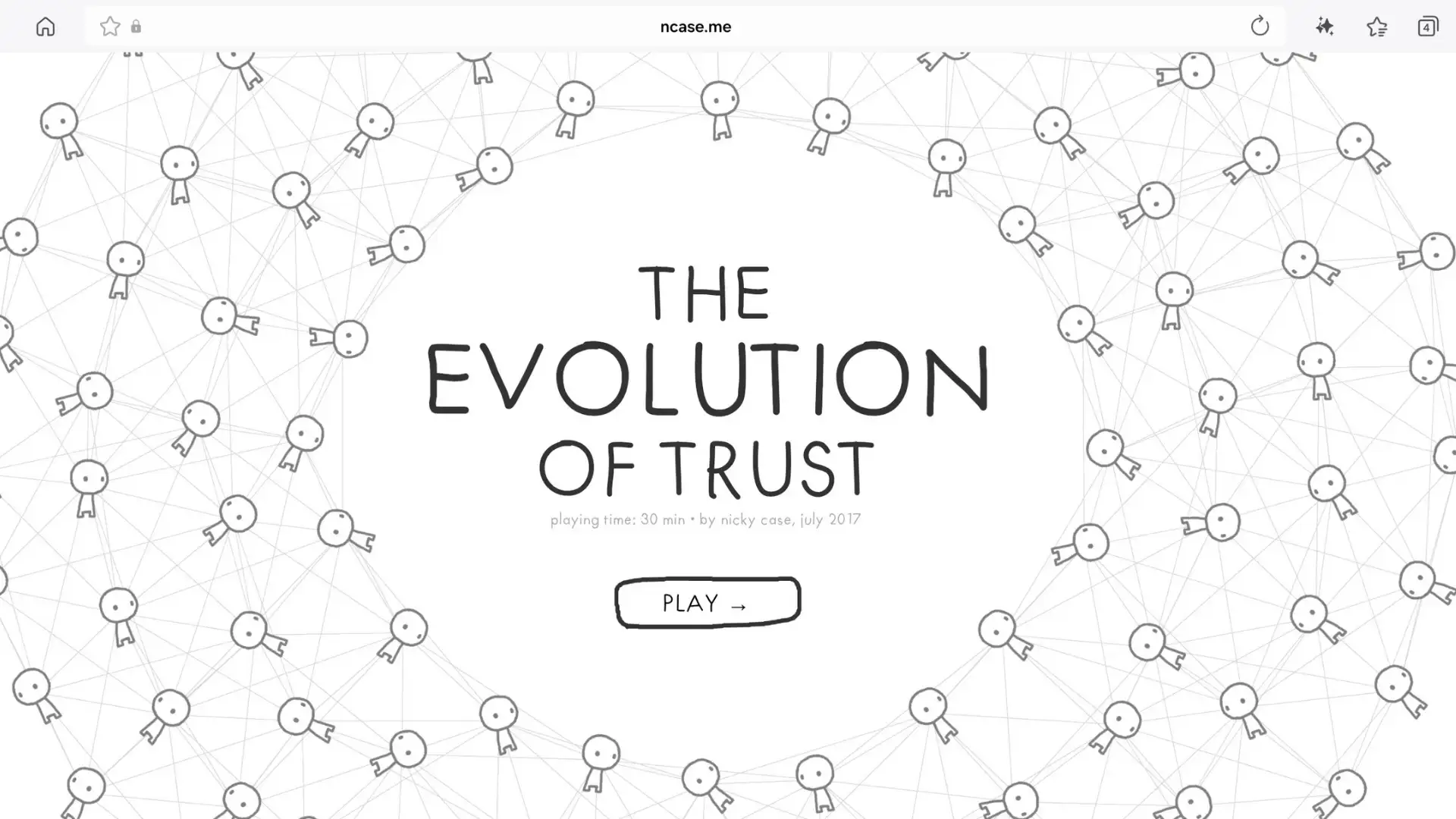
You can do everything fairly and still end up in a feud. That is the uncomfortable pleasure of The Evolution of Trust, a small browser game that gives you two choices, a handful of cartoon opponents, and enough freedom to discover how cooperation falls apart. Its most memorable lesson arrives when two perfectly reciprocal players become trapped in retaliation. Neither has decided to become cruel. Their rules simply keep answering yesterday’s injury.
Table of Contents
Created by Nicky Case and released in July 2017, the project introduces the game theory of cooperation through an experience advertised at roughly thirty minutes. You make decisions, predict winners, watch populations change, and adjust the conditions under which people meet. The explanation happens through consequences. A strategy that initially looks sensible becomes disappointing; a character you dismissed starts doing well; a modest change to the rules unsettles an apparently happy world.
The subject sounds academic until the first exchange. Put something into a shared arrangement and another person benefits. Hold back while they contribute and you benefit more. Both hold back and the arrangement produces nothing. That tension is recognisable without any specialist vocabulary. It appears wherever people must decide whether to contribute before they know whether somebody else will reciprocate.
The website’s achievement is giving that tension a shape you can inspect. It makes trust feel less like a personality badge and more like something maintained through repeated decisions, incentives, and imperfect information. The reason to open it is the experience of changing your mind: first about the opponents, then about the scoring, and eventually about the environment that makes certain behaviour pay.
The first coin makes the argument
The opening mechanism is wonderfully small. Each player can contribute a coin, giving the other player three, or withhold their contribution. When both contribute, both finish two coins ahead. When only one contributes, the contributor loses one and the other gains three. An entire social dilemma fits inside that little machine. There is no fictional economy to learn and no complicated inventory separating a decision from its result.
The uncomfortable part is that withholding produces a better individual result in either immediate situation. If the other player contributes, you collect three rather than two. If they withhold, you keep your position rather than lose a coin. The individually tempting choice produces a collectively disappointing outcome when both players follow it. The arithmetic is easy; accepting what it means takes longer.
The first exchange at a glance
| Your choice | Their choice | Your net result | Their net result |
|---|---|---|---|
| Cooperate | Cooperate | +2 | +2 |
| Cooperate | Cheat | −1 | +3 |
| Cheat | Cooperate | +3 | −1 |
| Cheat | Cheat | 0 | 0 |
These are the opening game’s payoffs. The gap between the best personal move and the best shared outcome is the reason the experiment has somewhere to go. Two players can agree that mutual cooperation is preferable and still have an immediate incentive to withhold their own contribution.
Read the table vertically and cooperation looks vulnerable. Read it as a relationship and mutual withholding looks wasteful. The same four numbers support both reactions because individual advantage and shared prosperity are different measurements. The game becomes interesting when you realise that choosing which measurement matters cannot be separated from how often the players will meet.
That is a better introduction than a definition alone. A textbook can describe the Prisoner’s Dilemma, the structure underlying this exchange, and leave the reader able to repeat its terminology. Here, you are invited to make the choice that causes the difficulty. Understanding comes with a small amount of responsibility. You did not merely observe the tempting move; you considered taking it.
The coin machine also avoids a distraction carried by the familiar story of prisoners deciding whether to betray each other. Readers can become absorbed in policing, punishment, or whether either prisoner deserves sympathy. The machine keeps attention on the exchange itself. You can judge the incentives without first accepting a larger narrative about crime, loyalty, or innocence.
The words used for the choices still carry moral weight. Cooperation sounds generous; cheating sounds shameful. That framing is part of the experience, and it deserves attention. A score-maximising decision inside a stipulated game is not automatically a moral verdict on an equivalent-looking action outside it. The numbers explain what the rules reward, while the labels influence how the choice feels.
Imagine a hypothetical shared task in which one person prepares materials and another presents the work. Preparation costs time; both benefit when the presentation succeeds. If either person can quietly avoid their contribution while taking the credit, the arrangement contains a temptation resembling the machine. The useful comparison concerns incentives, not a claim that every missed task is a deliberate betrayal.
The resemblance becomes weaker if the people have unequal workloads, different abilities, or competing understandings of the agreement. Perhaps the presenter cannot prepare the materials because they are doing something else equally necessary. Perhaps neither person knows what the other expects. The opening game deliberately removes those complications so the exchange is visible. Bringing them back later is the reader’s job.
For the first few minutes, that reduction is a strength. You do not need to decide what fairness means across an entire organisation. You only need to notice that contributing is costly and that somebody else can benefit from your contribution. The smallness of the decision gives the explanation traction. An argument about society becomes an event you can follow from one move to the next.
Then the game introduces time. You meet opponents over successive rounds, and your current choice can influence how they respond later. A move becomes part of a history. The benefit of taking the larger immediate reward must now be weighed against what happens to the next exchange and the one after that.
This changes the emotional texture. In a single encounter, withholding might feel like protecting yourself from an unknown stranger. Across repeated encounters, the same choice might mean damaging a relationship that was producing a reliable return. The action has not changed, but its consequences have acquired a future. That is the first substantial revision the website asks you to make.
The game initially lets you face its opponents without giving away all their rules. You must infer behaviour from what happens. Uncertainty makes the experiment feel like a relationship rather than an answer sheet. You can suspect that somebody is copying you, holding a grudge, or taking advantage, but you have to decide before your interpretation is complete.
A player who starts cautiously can encounter a different pattern from somebody who starts generously. The opponent may be following the same rule in both cases, yet the interaction develops differently because you supplied a different first move. You are part of the evidence you are interpreting. The website makes that easy to miss at first and difficult to ignore later.
That is a particularly sharp feature for a game about trust. We tend to describe another person’s behaviour as though it arrived independently of our own. Sometimes it does. Sometimes it is a response to the situation we helped create. The experiment gives the second possibility a visible mechanism, without requiring you to accept that every unpleasant interaction is your fault.
There is also a difference between making a good decision and receiving a good result. You can cooperate with someone who withholds, take the loss, and still have made a defensible choice given what you knew. One outcome cannot settle the quality of the decision. A game that reveals rules gradually gives readers room to feel that distinction rather than merely acknowledge it.
Conversely, a profitable move can be a poor foundation for future exchanges. Taking three coins from a cooperative opponent looks successful on the current score display. If that opponent then stops contributing, the gain has changed the conditions under which further gains were possible. The score records the reward before the relationship records the damage.
This is where the opening earns its simplicity. Every extra variable would offer another explanation for an unhappy result. The machine leaves you with an unusually clean view of how individual choices affect the next interaction. You can follow the causal chain without pretending that the chain describes all human life.
By the time the cast is revealed, the website has already done its hardest work. You understand why cooperation is attractive, why exploitation is tempting, and why repetition changes the calculation. The theory has a personal foothold. You are ready to meet the rules behind the faces because you have already felt what those rules do.
The cast makes strategy feel personal
The characters are memorable because their names behave like editorial shorthand. Always Cooperate and Always Cheat announce their policies. Copycat suggests reciprocity. Grudger suggests an injury that will never be forgotten. Detective suggests a player who tests you before choosing how to proceed. A rule becomes easier to remember when it has a recognisable temperament, even if the temperament is only a drawing and a name.
The anthropomorphism is useful, but it should not be mistaken for a personality test. These characters execute policies; they do not become tired, reconsider their priorities, or explain themselves. They are behavioural rules wearing costumes. Recognising a colleague in one of them might start a conversation, but the game gives you no basis for diagnosing that colleague.
Always Cooperate exposes the attraction and vulnerability of unconditional generosity. Among equally cooperative players, the rule produces pleasant exchanges without negotiation. Against an exploiter, it keeps paying the cost. Its weakness is the absence of a response to evidence. The problem is not that contributing is foolish; the problem is that contribution continues regardless of what the other player does.
That makes the character more interesting than a simple joke about gullibility. A cooperative arrangement needs somebody to contribute, and unconditional contributors make such arrangements immediately productive. Yet a population can become vulnerable when enough participants expect contributions without offering their own. A behaviour that creates shared value can also provide an exploiter’s opportunity.
Always Cheat has the opposite attraction. It does not risk being the person who contributes while the other withholds. Against Always Cooperate, it collects an advantage repeatedly. Against another player using the same policy, it produces nothing. The strategy’s success depends on finding behaviour it refuses to supply itself. That dependency is easy to overlook when looking only at its profitable encounters.
Imagine a hypothetical group where people gain recognition by using work others have generously shared. A person who takes without contributing might initially accumulate an impressive record. If everyone copies that approach, the supply of shared work shrinks. The habit can spread faster than the conditions supporting it survive. The game gives that contradiction a cleaner form than an office anecdote could.
Copycat is initially more reassuring. It begins cooperatively and then follows the other player’s previous move. Its reputation in the experience comes from a combination of openness and responsiveness. It offers a productive relationship and answers exploitation. The rule is simple enough that another player can understand what a changed response means.
Case’s notes connect Copycat to Tit for Tat, the strategy submitted by Anatol Rapoport to Robert Axelrod’s cooperation tournaments. That historical connection matters because the charming character represents an established research idea. The website is introducing a particular way of modelling repeated interaction, not inventing a folk saying and dressing it in mathematical language.
Copycat also separates retaliation from permanent condemnation. When the other player cooperates again, the rule can return to cooperation on the following round. There is a route back into the relationship. A response to harm does not have to become an irreversible judgment about what the other player will do forever.
Grudger closes that route. It cooperates until it encounters cheating, then withholds for the rest of the encounter. The rule feels familiar because permanent memory can resemble strong self-protection. One bad move becomes the entire future. Under some conditions, that deters exploitation; under others, it makes a recoverable error far more expensive than it needed to be.
The contrast is valuable because both characters can look fair at the moment of retaliation. Each responds to something the opponent actually did. Their difference appears later, when the opponent’s behaviour changes. The cost of a policy often becomes visible after its original justification has passed. The game lets you watch that delayed cost without needing an elaborate story.
Detective adds a more calculating approach. It begins with a short sequence that includes both cooperation and cheating, then responds according to whether the opponent resisted. Its early moves are probes. The character illustrates a player who treats your reaction as information about what they can get away with.
That makes unconditional cooperation vulnerable in a different way. The weakness is not merely failing to answer one harmful action. It is allowing an opponent to learn that harmful actions carry no response. Behaviour communicates the boundaries of the arrangement, whether or not the person following the behaviour intended to communicate them.
There is an uncomfortable temptation to admire Detective because it appears more sophisticated. It gathers evidence and changes its approach, while simpler players follow blunt policies. Yet sophistication is not the same as superior performance. A clever rule still has to earn its score against the actual field. That distinction becomes central when the characters enter a tournament.
The shift from personal play to watching matches changes your role. You now predict which strategy will perform best across encounters with different opponents. Your judgment becomes a hypothesis the game can contradict. Choosing a winner before the results arrive creates a stronger reason to inspect those results than passively watching an animation would.
The temptation is to choose the character whose attitude you admire. A generous reader might support Always Cooperate; a wary reader might favour Grudger; someone impressed by calculation might back Detective. The tournament refuses to make taste sufficient evidence. What matters is what each policy produces against the other policies under the current rules.
Another temptation is to confuse winning the tournament with defeating every opponent. Copycat need not collect more than the other player in each individual relationship to build a strong total. Two reciprocal players can accumulate good returns together. A high score can come from maintaining productive encounters, rather than making every encounter an unequal contest.
This is a useful disturbance to the usual picture of competitive intelligence. The most visibly aggressive strategy may look dominant in the match where it exploits a contributor. The quieter strategy may collect more across the whole set. A dramatic victory can be less profitable than a sequence of ordinary exchanges. The game makes the comparison numerical, which strips away some of aggression’s theatrical appeal.
The drawings and names make all this easier to retain, but the best way to read the cast is through counterfactuals. Change the opponent, extend the encounter, or introduce an error, and ask whether the same policy still looks sensible. Each character is a compact experiment you can carry into a new setting. Their charm is the handle; their rules are the substance.
A winning strategy needs the right world
A tournament produces a ranking. An evolving population produces a story about how that ranking changes the field. The website moves from one to the other by allowing successful policies to become more common and unsuccessful ones to disappear. Success starts altering the environment in which success is measured. That is the point where a reassuring answer becomes a more interesting problem.
The experience represents this through repeated tournaments, removal of low scorers, and reproduction of high scorers. The players retain their policies while the mixture of policies changes. The population adapts through composition, rather than through each character gaining wisdom. That distinction keeps the mechanism understandable and gives the title’s idea of evolution a specific meaning.
For the reader, the most useful feature is the delay between an early advantage and a later reversal. A cheating policy can flourish while unconditional cooperators are plentiful. As those contributors disappear, the cheaters encounter more opponents who withhold or retaliate. The strategy changes its own diet. What initially made it successful becomes less available precisely because it was successful.
The metaphor is vivid, but the underlying observation is about dependency. A player extracting rewards from others may depend on a pattern of contribution that the extraction weakens. An advantage can consume its supporting conditions. You do not need to believe that every exploiter eventually fails to find that mechanism worth inspecting.
Indeed, the game earns more trust when its apparent moral ending is treated conditionally. Under one setup, responsive cooperation comes to dominate. Under another, withholding does better. The outcome belongs to the rules and starting population. Turning a successful demonstration into a universal promise that fairness always wins would discard the most revealing part of the experiment.
The arithmetic helps explain why repeated encounters matter. Two Copycats cooperating for ten rounds gain twenty coins each. Always Cheat facing Copycat gains three on the opening round, while Copycat loses one; subsequent mutual withholding adds nothing. The exploiter wins that pairwise comparison but misses the cooperative stream available to players who keep contributing to one another.
That example is a calculation from the opening payoffs, not a prediction about a particular human relationship. Its value is showing why two different meanings of winning must be kept separate. Being ahead of your opponent and earning a large return are different achievements. The first can occur inside a relationship that leaves both parties poorer than they might have been.
A population rich in reciprocal players gives reciprocal behaviour more opportunities to earn that stream. A population rich in unconditional contributors gives cheating more opportunities to collect its larger one-sided payoff. The field is part of the strategy’s performance. Ranking policies without describing their opponents leaves out information that can change the ranking.
This has a direct bearing on how to use the website’s sandbox. If a character wins, inspect who it is meeting. Perhaps it thrives on exploitation; perhaps it maintains cooperation; perhaps its rivals are unusually vulnerable to errors. The score is the beginning of the explanation. It tells you which behaviour succeeded, while the encounters tell you how.
The game also lets you reduce the number of rounds in an encounter. The resulting changes make the future tangible. A relationship with little time remaining offers fewer opportunities for cooperative returns to compensate for an initial cost. A shorter horizon changes the value of restraint. The same policy enters a different calculation even when its character and motives appear unchanged.
The numerical boundary demonstrated in a particular setup should remain inside that setup. It is not a universal count of meetings required before people become trustworthy. A slider’s threshold is a property of the model. Human encounters vary in stakes, information, expectations, and outside consequences, so a number that is instructive on screen cannot be carried directly into an office or friendship.
What does travel well is the question of whether people expect to deal with one another again. Consider a hypothetical service provider choosing between a small immediate gain and a durable customer relationship. Future work gives the provider something to lose by behaving badly. Continuity supplies a reason to protect the next exchange. The game makes that reason visible without claiming it is the only reason people behave decently.
The reverse example is equally useful. Imagine a reward system that measures this week’s output while ignoring the effort required to repair damaged relationships next month. A person who pushes costs onto others might look successful in the reporting period. The measurement horizon can hide the aftermath of the behaviour it rewards. This is an interpretation prompted by the game, rather than a claim the simulation tests about real organisations.
Repeated contact alone does not guarantee cooperation. People can repeatedly meet inside an arrangement that offers little benefit from mutual contribution. The website therefore lets you alter payoffs as well as duration. The future must contain something worth preserving. An endless series of bad exchanges is still a bad arrangement.
This is where the phrase shared benefit needs care. A possible gain for both parties does not mean every cooperative gesture is equally rewarding or that the distribution is fair. The opening machine gives both sides the same costs and benefits, but actual arrangements often do not. A productive relationship and an equitable relationship are related questions, not identical ones.
Suppose two hypothetical collaborators gain from working together, but one receives almost all the recognition while the other absorbs most of the effort. The arrangement might create total value while remaining unattractive to the second person. Shared gain does not settle who carries the cost. The game’s symmetric machine makes the first issue clear and leaves the second largely outside the frame.
Changing payoffs also changes what the experiment can legitimately represent. If you move the numbers far enough, the exchange may cease to have the same strategic structure as the opening dilemma. A sandbox is an invitation to inspect assumptions, not merely to decorate the original lesson with alternative settings. The relationship among the numbers matters as much as their size.
That is a useful discipline for anyone who finds a convenient moral in the initial result. Run the world where your preferred strategy struggles. Notice which assumption you changed and what new opportunity it created for another policy. A convincing explanation should survive contact with an inconvenient setup, or become more precise about where it applies.
Axelrod and Hamilton’s original cooperation research gives this question a longer history: repeated encounters can support reciprocal cooperation under specified conditions. The website’s contribution is making those conditions available to ordinary attention. You can see the difference between praising cooperation and constructing a world where it pays. The latter is the more demanding idea.
The population view leaves you with a harder, better thought than simply choosing Copycat. If people imitate whatever looks successful, the way success is counted matters. If the profitable behaviour erodes the conditions for future profit, the timing matters. The rules behind the ranking deserve as much scrutiny as the winner. That is where the game starts to feel useful beyond its own little tournament.
One mistake can poison a fair relationship
The most unsettling demonstration concerns a relationship that was working. Two reciprocal players begin by cooperating and can continue doing so without conflict. Then an accidental wrong move interrupts the pattern. A fair response to the last action becomes a poor response to the whole situation. The policy sees what happened but cannot distinguish why it happened.
The word mistake covers something specific in the simulation: a player’s intended action can be flipped. A cooperative intention may produce cheating, and a cheating intention may produce cooperation. Noise enters the execution of the rule. That is a useful stand-in for imperfect interaction, but it is narrower than everything people mean by misunderstanding.
The distinction matters because human communication fails in different places. A message might be expressed badly, delivered late, read out of context, or understood perfectly and still disliked. An action error is not the same as an interpretation error. The game compresses such complications into something manageable enough to manipulate with a control.
Within that simplified world, the consequences are stark. Imagine two Copycats cooperating in the first round. In the second, one accidentally cheats while the other cooperates. In the third, the first returns to cooperation while the second answers the previous cheat. The retaliation arrives one move behind the repair. The two policies begin taking turns injuring one another.
This alternating pattern follows directly from copying the opponent’s previous move. Each player is answering an actual defection, so each has a locally defensible reason to withhold. Yet neither response restores the former pattern. Both can feel justified while both keep losing cooperative opportunities. That is the human resonance of the demonstration, even though the characters themselves have no feelings.
The original injury need not remain large for the pattern to continue. Once the policies are out of step, the memory of the previous move supplies a fresh reason for the next retaliation. The relationship manufactures new evidence for its own hostility. You can trace that mechanism without inventing an evil intention at either end.
Using the opening payoffs, two uninterrupted cooperators collect four coins between them each round. An alternating cooperative and cheating pair collects two between them: one gains three while the other loses one. The conflict reduces the shared return even when somebody keeps winning locally. Taking turns being ahead does not recover the value they were producing together.
That arithmetic makes the emotional analogy sharper. An argument can contain moments when one person appears to have successfully answered the other, while the arrangement as a whole becomes more costly. The game cannot measure a real argument, but it offers a useful lens: a satisfying response may sustain an unsatisfying pattern. The response and the pattern deserve separate attention.
Copykitten enters as a forgiving variation. It does not retaliate after a single cheat; it waits for two consecutive cheats. Case’s notes connect this policy to Tit for Two Tats. The extra tolerance creates room for an isolated error. A wrong move can pass without immediately pulling the relationship into reciprocal punishment.
That rule is memorable because it gives forgiveness a precise shape. It is neither endless contribution nor an emotional declaration that everything is fine. It delays retaliation under a stated condition. The boundary remains, but the evidence requirement changes. The game shows that responding more slowly can be a strategy rather than an absence of self-protection.
The delay also carries a cost. An opponent who intentionally exploits the grace period might gain from it. Forgiving one wrong move is sensible against some mixtures of behaviour and vulnerable against others. Tolerance has to be evaluated against the environment. The website’s later experiments are strongest when you keep that dependency in view.
It would be a mistake to turn Copykitten’s rule into advice that people should accept exactly one harmful incident before acting. The machine’s losses are bounded and identical from round to round; human harms are not. The transferable lesson concerns distinguishing error from a persistent pattern. The character’s precise counting rule belongs to its artificial world.
Another later character, Simpleton, changes its behaviour according to the previous exchange rather than following simple permanent generosity or permanent hostility. The notes identify it with Pavlov, or Win-Stay-Lose-Shift. It represents a different way of learning from outcomes. Its presence prevents the later experiments from becoming a contest between only strict reciprocity and greater forgiveness.
The name is a neat editorial trap. Simpleton sounds like a character you should dismiss, but the outcomes depend on what its rule does against the current population. The website asks you to look past the label twice: first when a friendly-looking player proves vulnerable, and again when an apparently foolish player performs better than expected.
Random contributes a different difficulty. An opponent whose moves are unpredictable makes past behaviour less useful as a guide to the next exchange. Reciprocity needs a signal worth responding to. When action increasingly resembles a coin flip, the connection between your contribution and their future contribution becomes harder to use.
This gives the error control more weight than a decorative difficulty setting. At a low level, occasional mistakes expose the weakness of rigid retaliation. At a much higher level, behaviour becomes unreliable enough to undermine cooperative patterns themselves. Forgiveness cannot recover information that has largely disappeared. The problem shifts from handling a rare accident to operating in a world where intention is difficult to detect.
The percentages displayed in the experiment are settings for that world. They do not establish how much misunderstanding a family, business, or public platform can tolerate. The model’s numerical precision should not be borrowed as social precision. Its useful contribution is the shape of the relationship between error, response, and continued cooperation.
A hypothetical work example makes that shape concrete. Two colleagues exchange draft materials every week. One delivery fails because of a technical problem; the other interprets the absence as refusal and stops sending their own work. The first then reads that withdrawal as evidence of bad faith. Each response can become the other person’s next apparent betrayal. The analogy illustrates the mechanism without proving the colleagues are playing the same game.
A conversation could interrupt that pattern in a way the characters cannot. Someone might explain the failed delivery, apologise, verify receipt, or agree on a backup method. Humans can communicate about the rule as well as act within it. This is one reason the website is best treated as a prompt for interpretation rather than a complete social manual.
The research context supports the importance of error without making one policy universally best. Martin Nowak’s review discusses the weakness of strict Tit for Tat under mistaken moves and the role of more forgiving or adaptive policies. The website’s surprise has a serious theoretical background. The memorable cartoon sequence is carrying a real modelling issue.
What stays with the reader is the possibility that a bad relationship contains people applying reasonable local rules to incomplete evidence. That does not excuse exploitation or make every conflict accidental. It does widen the inspection. Look for the mechanism that keeps producing the next injury, rather than assuming the latest injury explains the whole history.
The model earns attention by showing its limits
The title is expansive: trust. The mechanism is deliberately smaller: players choose actions, receive payoffs, and meet again under controlled conditions. Keeping those two scales separate is part of reading the website well. A simulation can reveal a mechanism relevant to trust without containing everything people trust each other to do.
Trust might concern competence, honesty, confidentiality, judgment, or reliability under pressure. You may trust someone’s intentions while doubting their ability to finish a task, or trust their expertise while withholding sensitive information. The coin exchange folds these distinctions into a contribution decision. That compression makes the experiment playable, while limiting the kinds of conclusion it supports.
The players also know the payoffs in a way people often do not. They operate inside a stable numerical arrangement. In ordinary collaboration, the benefit may arrive months later, and the cost may be uncertain when the decision is made. A known payoff table is already a major simplifying assumption. The game’s clarity partly comes from supplying information reality often withholds.
Consider a hypothetical favour that takes one person ten minutes and saves another an entire day. Reverse their circumstances and the same favour might cost far more than it saves. The benefit-to-cost relationship can change between people and between occasions. A uniform coin machine is useful for isolating incentives, but it does not settle what a contribution means in a specific relationship.
The characters are also limited to a small set of policies. A winner is a winner against the available field under the chosen conditions. There could be other policies the experience never includes. A tournament result does not search every conceivable way of behaving. Readers should resist treating the cast as an exhaustive catalogue of cooperation.
Human participants can change their policies during a relationship. They can become more trusting after an explanation, more cautious after new evidence, or more generous because they now value the other person differently. A fixed rule is easier to study than a revising person. The game’s character-based presentation trades that complexity for an intelligible experiment.
Its evolutionary sequence makes a related trade. Successful policies become more numerous and unsuccessful policies become less numerous. In real groups, imitation can follow status, visibility, belonging, habit, or misunderstanding as well as payoff. People do not necessarily copy the behaviour producing the best return. A visible winner might be benefiting from something observers cannot see.
There is no need to reject the simulation because it leaves these factors out. Leaving things out is what lets a model isolate a mechanism. The question is whether a reader remembers what was excluded when interpreting the result. A good use of the model adds clarity without claiming completeness. The website’s own acknowledgment of factors beyond its simplified world encourages that reading.
The missing options matter
One important missing option is refusing the encounter. Real people may leave an arrangement, choose another partner, postpone a decision, or limit their exposure. The coin machine asks for cooperation or cheating within a match. Exit changes the strategic situation. A person who can choose whom to meet faces a different world from a character obliged to keep playing.
That difference affects how we interpret retaliation. Withholding inside an ongoing match is one response to exploitation; ending the arrangement is another. The game concentrates on the first. A relationship cannot be understood solely through the next move if leaving is possible. This is especially relevant when a reader tries to translate the experiment into practical advice.
Another missing option is negotiation. Two people might discover that they understood the task differently and change the agreement before the next exchange. They can redistribute work or agree on clearer evidence of completion. The payoff structure itself can become a subject of discussion. In the guided game, the reader adjusts that structure from outside the match.
That outside position is useful because it makes design visible. You see what changes when the conditions change. Yet it also gives you more authority than participants in many actual arrangements possess. Having a slider is different from having the power to change a workplace or platform. The analogy becomes stronger when you identify who could actually alter the relevant condition.
Power is another complication the symmetric machine suppresses. One person might be able to absorb repeated losses while another cannot afford a single loss. Both can receive the same numerical payoff and experience very different consequences. Equal scores do not imply equal exposure. A model without those differences cannot tell you how a particular risk should be shared.
Reputation extends the frame in a different direction. People sometimes cooperate with strangers because others will hear about their behaviour, or because past conduct has already created expectations. Nowak’s review distinguishes direct reciprocity from mechanisms involving reputation. A future consequence need not arrive through meeting the same partner again. The website’s emphasis on repeated pairs gives one mechanism unusual visibility, rather than excluding the others from existence.
Institutions can also provide records, mediation, enforcement, and ways to repair disputes. Those possibilities matter because a person may have reasons to cooperate beyond the opponent’s next response. The two-player exchange is not an entire social order. Its simplicity invites inspection of how institutions might change the incentives, but it does not simulate those institutions by itself.
The same caution applies to the game’s historical framing. The project begins with wartime cooperation and uses it to introduce a puzzle about enemies finding ways to coexist. That opening gives the experiment emotional stakes. A small strategic model cannot explain an entire war or peace, and the article need not make it carry that burden to appreciate the design choice.
The website was also written in 2017. Its observations about declining trust and the communication habits of that moment should be read as part of its original argument. An older interactive remains useful without every contextual claim becoming a current measurement. The experience’s lasting appeal comes from the mechanisms you can explore, rather than a need to accept every accompanying social diagnosis unchanged.
The distinction between model and measurement is especially important around error rates. A slider controls a simulated probability; a social diagnosis requires evidence about actual people, circumstances, and interpretation. An adjustable percentage does not quantify the state of public conversation. It gives you a way to test how a particular artificial population responds to unreliable actions.
None of these limits makes the project less worth opening. They change the best reason to open it. You are there to notice mechanisms, test intuitions, and sharpen questions about an arrangement you know. The experiment is most useful when it improves observation. It becomes weaker when its cartoon policies are used to classify people or its outcomes are presented as guarantees.
The enduring lesson is a habit of conditional thinking. Before accepting that generosity fails, inspect who receives it. Before declaring retaliation fair, inspect whether it restores a productive pattern. Before praising the winner, inspect what the score counts. The website teaches you to attach a claim to its conditions. That habit survives even where its particular machine does not.
A small website with unusually good editorial instincts
The Evolution of Trust is worth studying as a piece of web publishing as much as a lesson in cooperation. It takes an idea that could become an article, lecture, or diagram and gives the reader a role in producing the explanation. The format serves the argument at every stage. Interaction is not an extra placed beside the text; it is how the text earns its claims.
The sequence starts with a manageable choice, adds repeated encounters, reveals policies, compares them, changes the population, and then unsettles the results through altered conditions. Each new element arrives after you have a reason to need it. The website does not ask you to absorb the whole machinery before you have felt the original dilemma.
That pacing matters. A simulation opened with every control exposed could become a wall of unfamiliar settings. A purely linear explanation could leave the reader unable to test its conclusions. The project combines guidance with experimentation. You learn enough to form an expectation before receiving the freedom to challenge it. The sequence makes that freedom more useful.
Its predictions are particularly good editorial devices. You choose a likely winner and then see what happens. The task gives the next animation a specific purpose: resolve your expectation. A prediction creates attention with a stake attached. Even a wrong guess improves the experience if you inspect why the result differed from what you imagined.
This also changes the relationship between author and reader. The author still selects the characters, rules, and demonstrations, so the argument is carefully constructed. Yet the reader’s choice has room to be wrong. The lesson meets resistance inside the experience. You are allowed to bring an intuition that the following sequence will complicate.
The important interaction is intellectual rather than merely physical. Clicking a button matters because it expresses a hypothesis or advances a decision with consequences. Moving a control matters because it changes an assumption you now understand. Activity becomes inquiry when the action has a reason. That is why the project remains more interesting than an explanation with decorative motion.
Its visual style helps by keeping the pieces distinct and readable. The cartoon characters give policies identities; the exchanges give payoffs a visible rhythm; the population view gives changing proportions a shape. The pictures organise the argument. Their charm matters, but their job is to reduce the effort required to follow who did what and what followed.
The homemade tone is part of the appeal. Case uses playful names and an informal voice around a subject that could easily become forbidding. The effect is not to make the reader careless. It lowers the social pressure to arrive already knowledgeable. The website permits an intelligent person to start from uncertainty. That is a generous editorial stance.
The informality also makes the project feel authored. Someone chose these characters, this pacing, this joke, this route through the subject. There is a point of view behind the interface. You may disagree with parts of the framing, but you are engaging with an argument rather than an anonymous collection of definitions.
That distinction is central to its place in Web Radar. The discovery is a memorable web experience built around one strong question. It has a finite shape and a recognisable voice. The reader comes away having encountered a particular work, rather than simply consumed another interchangeable explanation of an established topic.
The advertised half-hour duration is a sensible expectation for that work. It asks for more attention than a passing glance but does not present itself as a course you must commit to completing over weeks. The size of the promise matches the size of the experience. Readers can decide whether they have time to give the experiment proper attention.
The optional sandbox extends the experience without requiring everybody to become a modeller. A reader satisfied by the guided sequence can finish there. A reader bothered by a result can inspect altered conditions. Different levels of curiosity receive different amounts of work to do. The project respects both without flattening the guided path into an endless collection of controls.
The sandbox is also a form of editorial accountability. It lets you interfere with the conditions supporting the story you have just followed. That does not eliminate the author’s framing or reveal every possible model, but it gives the reader a way to find exceptions within the available world. The argument is open to adjustment rather than sealed behind its narration.
The explanation has an inspectable underside
The public repository gives the project another form of openness. Readers with the relevant technical skills can inspect how the experience is assembled, and the repository identifies a CC0 public-domain dedication. The work has a life beyond the hosted page. Its public structure supports study and adaptation as well as ordinary reading.
The repository also credits the resources used in making the experience. That matters editorially because a distinctive work need not pretend to have created every component from scratch. Visible credits place authorship within a chain of contributions. They let the reader see the project as a made object, with decisions and dependencies behind its apparent simplicity.
The project dedication and the credits should be read together. Individual credited resources may carry their own terms, so the existence of a public-domain dedication should not be casually extended to every external asset. Openness is clearest when the parts remain identifiable. The repository provides that separation rather than requiring a reader to infer it from the finished game.
Fan translations listed on the main page offer another sign of that openness. The experience has been carried into many languages through community work. Translation gives the explanation routes beyond its original audience. It also fits the subject: an argument about cooperation becomes more accessible through people contributing work that others can use.
The presence of translations does not establish identical quality or identical behaviour across every version. A careful publisher or teacher should inspect the version they plan to share. Availability and verification are different tasks. The relevant attraction is that the project’s words and structure are sufficiently open to invite those adaptations.
The text of the experience and its supporting notes are also available as readable pages. They give someone a way to inspect the argument apart from the animated sequence. The reasoning does not disappear into the interaction. That is useful for revisiting a passage, checking a reference, or deciding which part of the game deserves further discussion.
Those textual materials should not be mistaken for proof of complete accessibility. An interactive experience can create barriers that ordinary text does not, and an alternate page does not settle every question about navigation or assistive technology. A specific reader’s access needs require a specific check. The existence of inspectable text is a practical advantage, while a broad accessibility claim would need more evidence.
The design lesson is that clarity comes from selecting what the reader needs at each moment. A coin, a policy, a match, a population, an error: the website gives each element a job before adding the next. The work is small because its argument is well selected. Its influence on a reader can be large without requiring a large product.
Take the experiment into a conversation
The most satisfying way to use The Evolution of Trust is to play the guided experience before trying to extract advice from it. Let the opponents remain partially mysterious, make the predictions, and notice where your expectations fail. The surprise is part of the teaching. Knowing the names of the strategies in advance is less useful than seeing why one of your own judgments needs revision.
Give the early exchanges enough attention to distinguish a player’s policy from your reaction to it. If you begin by withholding and the opponent then withholds, you have learned something about the interaction, but perhaps not everything you think you have learned about the opponent. Your opening move belongs in the interpretation. The game makes that a useful habit before revealing the full rules.
When the cast becomes visible, compare the policies rather than deciding which character resembles you. Ask what evidence each rule uses, what it remembers, and what would permit it to return to cooperation. The interesting difference is in the decision procedure. That keeps the experience productive instead of turning it into a lighthearted personality quiz.
The tournament then offers a reason to separate local advantage from total return. An opponent can take more from you in a particular match while performing worse across the field. The score you care about changes the story you tell. Noticing that distinction is useful even if you never remember another technical term from the game.
The population experiments deserve a slower look. Watch which behaviour becomes common and how that changes the encounters still available. If a policy initially prospers and then declines, inspect its dependency on the disappearing players. A changing field can reverse the meaning of an early lead. That is one of the website’s richest ideas and one of the easiest to rush past.
In the sandbox, changing one condition at a time is a sensible reading method. Hold the population steady while varying duration; then restore duration and vary errors. A controlled comparison gives a result an identifiable cause. Changing everything at once might produce a striking outcome, but it makes that outcome harder to explain.
A single noisy run should also be treated carefully. When the experience includes random mistakes or random behaviour, chance participates in the result. One run is one realised sequence, not proof that every repetition will look identical. Repeating an experiment is useful when the question concerns a pattern rather than the particular events of one animated tournament.
The same discipline makes the website useful in a classroom. Learners can predict an outcome, state why they expect it, run the demonstration, and revise the explanation. The game supplies a shared object for disagreement. A discussion can return to a move or setting everyone has seen, rather than dissolve into competing intuitions about what people are usually like.
For a teacher, the important follow-up is to distinguish what the model demonstrates from what an analogy suggests. The coin exchange has specified rules; a school, friendship, or community does not arrive with the same table attached. The comparison improves when its mismatches are named. Students can learn as much from identifying those mismatches as from recognising the original resemblance.
A design team could use the experiment in a similar spirit. Consider a hypothetical service where customers and providers repeatedly decide whether to fulfil small commitments. The game prompts inspection of continuity, shared gains, and responses to failure. The useful output is a clearer description of the arrangement, rather than a claim that adding a rating or apology feature will automatically produce trust.
A practical design discussion might begin with how a user distinguishes a failed delivery from a deliberate refusal. Perhaps the service gives no receipt, no status information, and no way to correct an error. In that hypothetical case, the uncertainty is partly designed into the interaction. The game directs attention toward the missing evidence, while actual user research would be needed to establish how people interpret it.
Another discussion could concern which behaviour the service rewards. Suppose a provider benefits immediately from avoiding work while the customer carries the cost of discovering that failure later. A promise to encourage good conduct is vague; describing that incentive is concrete. The payoff structure deserves inspection before the messaging does. This is an editorial application of the model, not a tested product prescription.
For a small working group, the most useful conversation may be about repair. If a commitment fails, what happens next? Does the group have a way to discover the cause, restore the exchange, or revise the agreement? A relationship needs a procedure for returning to productive work. The Copycat error sequence gives that otherwise abstract concern an image people can remember.
The conversation should leave room for persistent bad behaviour as well as accidents. A repair path can be exploited if it repeatedly excuses the same pattern without changing anything. Forgiveness and evidence need to coexist. The website’s cast makes that tension discussable by separating unconditional contribution, strict response, permanent retaliation, and greater tolerance.
Its usefulness for editors and communicators is different but equally concrete. The project demonstrates how to lead an audience into an idea through a decision they understand, then make each further explanation answer a problem they have encountered. Structure creates curiosity by making the next question earned. The reader does not need a promise that the subject is important; the previous move has already made it interesting.
That is a lesson about restraint as well as creativity. The website does not need a complicated fictional world to make cooperation worth thinking about. The coin machine is enough because its consequences are visible. A strong explanatory mechanism can carry more than elaborate packaging. Designers studying the project should pay attention to what it leaves out as well as what it includes.
There is also a useful lesson for readers encountering persuasive interactive work. A simulation can feel authoritative because the results move before your eyes. Yet the movement follows selected rules. Visual conviction should lead to inspection of assumptions. The Evolution of Trust is especially worth opening because it provides opportunities for that inspection within the experience itself.
The strongest response is neither complete acceptance nor dismissal. Play the argument on its terms, examine the boundaries, and bring back the questions that remain useful. You may leave more attentive to an unexplained failure, a short reward horizon, or a pattern of reciprocal punishment. The website earns its place by changing what you notice. That is a substantial achievement for a half-hour encounter with cartoon players.
Open it when you have enough time to let a simple idea become uncomfortable. Begin with the coin, follow the opponents, and stay for the moment when fairness stops repairing the relationship. The memorable human lesson is that good intentions still need workable conditions. The game gives those conditions a form you can question, adjust, and remember.
Author:
Jan Bielik
CEO & Founder of Webiano Digital & Marketing Agency
This article is an original analysis supported by the sources cited below
The Evolution of Trust
Nicky Case’s original interactive project and its listed fan translations. (ncase.me)
The Evolution of Trust game text
The project’s narrative, opening payoffs, character policies, guided experiments, and sandbox instructions. (ncase.me)
The Evolution of Trust notes
Case’s explanations of the research background, strategy names, and assumptions behind the experience. (ncase.me)
The Evolution of Trust source repository
The public project repository, public-domain dedication, resource credits, and translation guidance. (GitHub)
The evolution of cooperation
Robert Axelrod and William D. Hamilton’s 1981 research paper on reciprocal cooperation, tournaments, and repeated encounters. (www-personal.umich.edu)
Five rules for the evolution of cooperation
Martin A. Nowak’s 2006 review of cooperation mechanisms, including direct reciprocity, mistaken moves, forgiveness, and reputation. (people.bu.edu)
| Citing this article? Brief excerpts are welcome. Please credit Webiano.digital, name the author where stated, and include a link to https://webiano.digital and to this original article. Full or substantial republication requires prior written permission. Read our Copyright and Content Use Policy. |
This article was prepared with the assistance of artificial intelligence tools. The content underwent expert human review, and Webiano Digital & Marketing Agency assumes editorial responsibility for its final version and publication.