

Somewhere on the internet, somebody has built a website about an obscure hobby, a forgotten computer, a strange collection, or a subject that interests perhaps fifty people in the entire world. It probably has a plain background, a few photographs, several pages of handwritten explanations, and a navigation menu that hasn’t changed in fifteen years.
Table of Contents
That website might be more interesting than the first hundred results from a conventional search engine. Finding it is the difficult part.
Modern search engines have become remarkably good at answering questions. They can locate businesses, summarize information, identify products, and deliver relevant results almost instantly. Yet something has disappeared along the way. Searching increasingly feels like making a request to a system that already knows what kind of answer it wants to provide.
Wiby has a different idea.
The small, independent search engine deliberately favors the kind of websites that once made the World Wide Web feel personal. Simple HTML pages. Hobby projects. Amateur research. Hand-built directories. Individual collections. Sites that exist because somebody wanted to share something rather than because an organization identified a profitable search query.
Wiby is less interested in helping the internet sell you something and more interested in helping you find something you didn’t know existed.
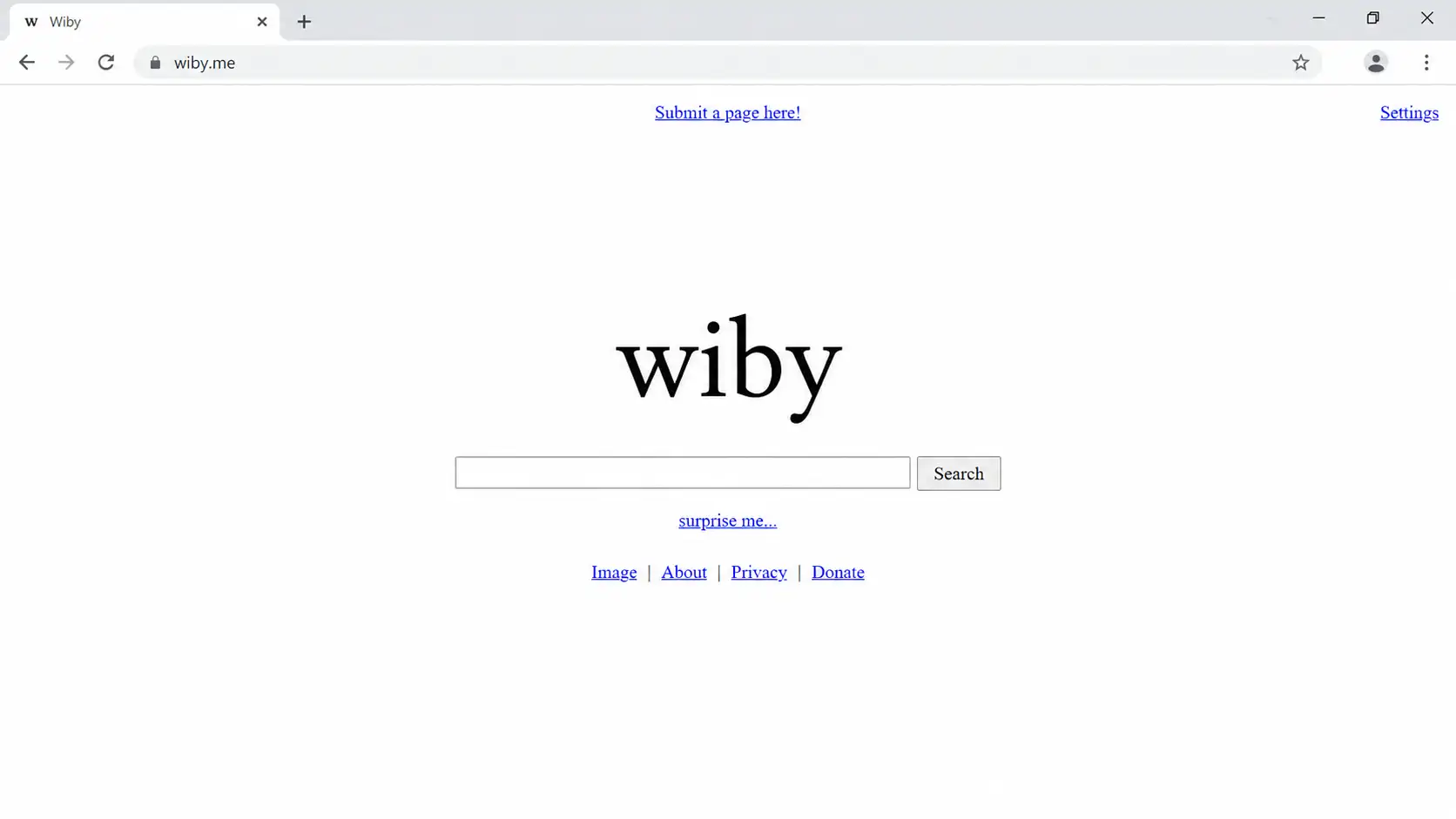
Its homepage is almost comically modest. There is a search field, a button, and a link labeled “surprise me…” Very little else competes for attention. There is no stream of recommended content, no promotional carousel, and no elaborate presentation of the search engine’s intelligence.
What makes Wiby unusual, however, is not its appearance. It is the philosophy behind the index.
The project does not attempt to catalogue the entire web and compete with Google through a larger database or a more sophisticated ranking system. Instead, it builds a smaller collection of pages that reflect a particular understanding of what makes the internet interesting.
People can submit websites for consideration. Human reviewers decide whether those pages belong. The crawler can be instructed to explore more deeply, but automatic expansion is deliberately limited.
This combination of searching, submission, and editorial selection creates something between a conventional search engine and a carefully maintained collection of internet discoveries.
Wiby treats the web as a place worth exploring, not merely a database waiting to be queried.
That distinction is enough to make an apparently old-fashioned search box feel surprisingly fresh.
The search box that refuses to behave like the rest
The quickest way to understand Wiby is to open its homepage and resist the temptation to search for something useful.
Forget the name of a restaurant, a weather forecast, or the answer to a technical problem. Search for something that invites curiosity instead. Old computers. Amateur astronomy. Radio equipment. Personal collections. Railway history. Homemade electronics. Unusual animals. A programming language that hardly anybody uses anymore.
Wiby rewards the kind of search that begins with interest rather than necessity.
The distinction matters because most people have learned to approach search engines with fairly precise intentions. We want an answer, a destination, a service, or a product. The search engine’s job is to shorten the distance between our question and the result.
This is an extraordinary achievement, but it changes how we encounter information.
A search engine that constantly identifies the most likely answer leaves fewer reasons to inspect the unexpected ones. Its success is measured largely by relevance, convenience, and the speed with which a searcher can accomplish a particular task.
Wiby offers another experience.
A search for a broad subject can lead to an individual website whose author has spent years assembling information that would never justify a professional publishing operation. A page might have an awkward layout, an outdated color scheme, or a collection of hyperlinks arranged according to the author’s personal logic.
The page may be imperfect. It may also contain exactly the kind of detail that makes independent publishing interesting.
The absence of commercial polish is not necessarily a sign that a website has little to offer.
That is one of Wiby’s central assumptions.
A different definition of relevance
Conventional search results are shaped by complex systems that must weigh many competing signals. They need to determine which pages are authoritative, useful, recent, and appropriate for a particular query. They also operate within enormous commercial ecosystems, even when individual organic results are not advertisements.
Wiby’s selection happens much earlier in the process.
Rather than attempting to make every available website searchable, the project favors pages that meet its editorial preferences. Its submission guidelines explicitly encourage simple HTML, non-commercial content, limited decorative scripting, and an absence of intrusive advertising.
The result is a search index built around a particular kind of website, not a neutral sample of everything published online.
This approach has obvious limitations. Many useful websites are complex. A beautifully designed modern publication may offer better information than a simple page built decades ago. Commercial websites sometimes contain excellent original research, while amateur pages can be inaccurate or poorly maintained.
Wiby does not solve these problems by identifying simplicity with truth.
Its real contribution is providing a place where simpler independent sites have a better chance of being found.
The difference resembles visiting a specialist bookshop rather than a warehouse containing nearly every book currently available. The specialist shop has fewer titles, and its choices reflect somebody’s judgment. You cannot expect it to supply everything. But you might encounter something unusual precisely because its shelves were selected differently.
A smaller collection becomes interesting when its limitations are intentional.
Wiby’s limitations are part of its identity.
The importance of an uncomplicated homepage
A search engine’s homepage reveals how it expects people to behave.
Wiby’s interface says very little. It does not ask visitors to select interests, create a profile, or explain what they hope to accomplish. The search field occupies the center of the experience.
That restraint gives the searcher unusual freedom.
There is no obvious promise that every query will produce the best possible answer. No attempt to turn the search experience into a conversation. No prominent explanation of how the engine will interpret your intentions.
You type something, inspect the results, and decide where to go next.
The apparent simplicity recalls an earlier period of web searching, but nostalgia alone does not explain its appeal.
Minimal interfaces make fewer demands on attention. They also leave the user responsible for more decisions. Wiby does not attempt to guide every stage of exploration through recommendations or personalized content.
A result becomes an invitation to visit the actual website.
This distinction is particularly noticeable in an era when information is frequently extracted from webpages and displayed directly inside search products. Answer panels, summaries, previews, and conversational interfaces can satisfy a request without requiring the visitor to engage with the original publisher.
Wiby follows a more direct relationship.
The search engine finds a page. The user visits it. The website gets to present its information on its own terms.
The destination remains the point of the journey.
That sounds ordinary, but it is an increasingly distinctive approach to online discovery.
Searching without expecting a perfect answer
Wiby’s value becomes clearer when expectations change.
It is not sensible to approach a curated index of simple websites as a replacement for every function of a general-purpose search engine. Someone looking for current flight information, a specific government form, or an immediately updated news report will probably use a broader source.
Wiby is particularly attractive when the subject allows room for exploration.
A query about vintage computing might lead to personal restoration notes rather than a shopping guide. An interest in gardening might uncover a modest site maintained by someone documenting years of experiments. A search for old technology might reveal photographs and detailed observations that exist nowhere else in that particular form.
These are possibilities, not promises about which pages will appear for a given query.
The pleasure comes from encountering an unfamiliar perspective on a familiar subject.
There is a difference between obtaining information and discovering a person who cares about that information.
A conventional search can give you a useful answer to a question about a mechanical keyboard. A personal website might introduce you to someone who has spent years repairing obscure switches, documenting unusual layouts, and collecting forgotten manufacturing details.
The first answers the question. The second may change what you are interested in.
Wiby is built for the second experience.
A smaller index with different instincts
Search engines traditionally face a difficult scaling problem. The web contains an enormous quantity of material, much of it duplicated, outdated, inaccessible, or deliberately constructed to attract search traffic.
Building a comprehensive search index requires extensive crawling, storage, processing, and ranking infrastructure. It also creates pressure to develop systems that determine which results deserve attention.
Wiby starts with a smaller ambition.
According to its own documentation, the engine is not intended to index the entire web and sort everything through a conventional ranking algorithm. Its index is seeded primarily through website submissions from visitors and people maintaining the search engine.
This decision changes the project’s character.
Instead of treating coverage as the primary measure of success, Wiby accepts that selection is part of the product. The websites it includes are supposed to resemble an older, more personal version of the web.
That preference shapes everything from the submission process to the crawler’s behavior.
Human submissions before unlimited crawling
Wiby accepts website submissions through a public form.
The process is deliberately straightforward. A visitor provides a URL and indicates whether the page is suitable for work. The form uses a CAPTCHA, and Wiby’s submission guidelines explain which kinds of sites are likely to be accepted.
Simple HTML websites are preferred. Heavy decorative scripts and CSS are discouraged. Intrusive advertisements count against inclusion. Pages that primarily redirect visitors toward larger, more complicated portals are discouraged.
A submission is a request for consideration, not a guarantee of inclusion.
That distinction is fundamental.
A conventional crawler might discover thousands of URLs by following links across a domain. Wiby’s standard review workflow can restrict crawling to the specific page submitted. Its documentation explicitly states that automatic link crawling is disabled by default within the review interface.
A human reviewer can choose to go further.
The crawler can be instructed to follow links to a particular depth, examine a limited number of pages, or restrict exploration to a website’s own domain. It can also follow external links when that behavior has been permitted.
In this system, the act of submitting a page has editorial importance.
Someone has identified the page as potentially worth including. A reviewer decides how much of it deserves attention. The crawler carries out a controlled technical process rather than independently attempting to absorb the entire surrounding website.
Human curiosity influences what the search engine knows.
This method cannot match the coverage of large-scale automated search. Nor is that its purpose.
It creates a different set of conditions for discovery.
What gets included and what gets overlooked
Wiby’s guidelines reveal a preference for independence, simplicity, and content that does not exist primarily to serve commercial objectives.
That preference immediately raises an interesting question about web quality.
A website with sophisticated typography, responsive navigation, interactive charts, and advanced scripting is not necessarily shallow. The technology used to construct a page tells us very little about the originality of its ideas.
Conversely, a simple HTML page can be inaccurate, outdated, or completely uninteresting.
Minimal design is an editorial filter, not a measure of factual reliability.
Wiby’s distinctive strength lies in the kinds of websites that its preferences bring together.
Many small personal sites would struggle to compete for visibility in a conventional commercial search environment. Their authors may have no interest in keyword research, publishing schedules, backlinks, conversion rates, or search analytics.
The site exists because the author wanted it to exist.
That motivation can produce extraordinary material. Someone might document a collection of mechanical calculators in unusual detail. Another person may maintain a page explaining an obscure local historical event. Someone else may publish decades of notes about a hobby without ever considering whether the material could attract a paying audience.
The same independence can produce disorganization, missing references, abandoned projects, and pages that are difficult to understand.
Wiby’s selection criteria do not eliminate those weaknesses.
Instead, they create an environment where the commercial performance of a webpage is less central to its discoverability within that particular index.
A site can be interesting without being commercially successful.
That principle feels obvious until one considers how much contemporary publishing is shaped by measurable attention.
Why indexing a page is different from indexing a website
Wiby’s documentation makes another important distinction.
In its default review workflow, a submitted page does not automatically authorize extensive crawling of everything connected to it. The reviewer controls whether and how far the crawler follows links.
For a conventional search engine, indexing more pages generally increases potential coverage. For Wiby, restraint protects the character of the collection.
Imagine a small personal website containing a detailed account of restoring an unusual computer. It might also contain links to commercial stores, social media platforms, large forums, and unrelated services.
Automatically following every connection could quickly move the crawler away from the original material.
A useful starting page does not make every linked destination equally useful.
The ability to limit crawling preserves that distinction.
Reviewers can adjust the number of pages examined at each depth. They can decide whether the crawler should stay inside the website or explore external links. They can also choose whether link exploration should repeat during later updates.
This degree of control would be cumbersome for a system whose principal objective was to index as much of the web as possible.
For a selective search engine, it is logical.
It makes the index a product of deliberate boundaries rather than a collection that expands indiscriminately.
The approach also places responsibility on reviewers. Their choices determine which parts of a site become visible, and which related pages remain undiscovered.
There is no escaping editorial judgment. Wiby simply makes that judgment part of its design.
The discovery advantage of a deliberate blind spot
A smaller search index will miss material. Wiby makes no credible claim to universal coverage, and readers should not interpret an absent result as evidence that the content does not exist.
Yet selective coverage creates a curious advantage.
When the search space is restricted to pages chosen according to different principles, familiar subjects can produce unfamiliar results.
The most popular page is not automatically the most interesting page for every reader.
A collector researching vintage radio equipment may value a detailed amateur restoration diary over a recent commercial comparison. A student interested in computing history may prefer an original enthusiast’s notes to a modern article summarizing the same machine.
Neither preference makes the other sources worthless.
They reflect different reasons for searching.
A large engine must satisfy enormous volumes of diverse queries. Its systems have to work for people seeking urgent answers, directions, businesses, entertainment, technical documentation, and current events.
Wiby can concern itself with a narrower question.
Which simple webpages might be enjoyable or informative for somebody willing to explore?
That limited ambition gives it room to behave differently.
It does not need to claim that the selected web is better in every respect. It only needs to make the selected web accessible enough for interested people to find.
The point is to create another route through the internet, not replace every existing route.
The internet of pages that still feel handmade
The phrase “old internet” usually brings a predictable collection of visual memories to mind. Animated GIFs, bright backgrounds, visitor counters, tiled images, colorful hyperlinks, and websites designed for monitors that would now seem painfully small.
Those details are entertaining, but the most interesting difference between the old web and the contemporary one was who could afford to participate.
Publishing a simple personal website did not require a content management system, a subscription to a publishing platform, or an elaborate technical stack.
A basic understanding of HTML was enough to create something recognizable as a website. A person could write a few pages, upload them to a server, and share the address with other people.
Of course, hosting still required infrastructure, technical knowledge, or access to a service willing to provide space. The early web was not universally accessible, and its communities reflected the social and technological inequalities of their time.
But the underlying format encouraged a particularly direct relationship between creator and reader.
You made a page. Someone visited it.
A website could be the finished expression of a personal interest rather than one component of an ongoing publishing business.
Wiby deliberately searches for the kinds of pages associated with that culture.
When a homepage had a personality
A personal homepage once served as a peculiar form of self-portrait.
It might combine photographs of a family pet with technical tutorials, a list of favorite music, links to friends’ websites, and a detailed explanation of an obscure hobby.
The organization often made perfect sense to its creator and almost nobody else.
Commercial publishers generally avoid that kind of disorder. They want visitors to understand a website quickly, recognize its purpose, and find relevant material without unnecessary effort.
Those are reasonable goals.
Still, a carefully standardized interface can conceal much of the person behind the content.
A handmade website often reveals its author’s preferences through decisions that a professional designer would eliminate.
Perhaps the navigation is arranged according to a collection’s chronology rather than conventional categories. Perhaps the homepage contains a note about the latest update, even though the update occurred years ago. Perhaps a long explanation begins with a personal anecdote that would never survive commercial editing.
These details can make the page harder to use. They can also make it memorable.
The visitor is encountering an individual rather than a carefully maintained publishing identity.
Some pages display tremendous expertise alongside very little interest in presentation. Others display enthusiastic creativity without much technical sophistication.
The contrast is part of their character.
Wiby’s selection criteria give this kind of publishing a place to be discovered without first being redesigned to meet contemporary expectations.
The personality of a website remains visible because the page has not been forced into a familiar template.
The pleasure of information nobody commissioned
Much of the most interesting independent web material was created without an obvious financial reason.
Someone may document the history of a particular railway station because they are fascinated by it. An electronics enthusiast may write detailed repair instructions for a machine that few people still own. A gardener may record experiments with different growing methods over several seasons.
Nobody necessarily commissioned the material.
The author does not need to demonstrate that enough people search for the topic to justify the effort.
The existence of the page is evidence that somebody cared about the subject.
This does not make every personal website original or authoritative. Amateur enthusiasm can produce poor research, unreliable advice, and misunderstandings that are repeated for years.
But it encourages material that would be difficult to justify under a publication model driven entirely by audience demand.
Consider the economics of creating a detailed website about a discontinued computer peripheral.
A commercial publisher would need to estimate potential traffic, production costs, and opportunities to recover its investment. The subject might be too obscure to justify the work.
An enthusiast who already owns the equipment faces a different calculation.
The process of researching, photographing, repairing, and describing the object may be rewarding in itself.
The resulting website can exist even if its audience remains tiny.
That is a special quality of independent publishing.
The internet allows valuable information to exist without first proving that enough people want to buy, subscribe to, or advertise against it.
Search engines that make such material discoverable preserve part of that possibility.
Old-fashioned does not have to mean old
It would be a mistake to assume that Wiby is simply a directory of websites created in the 1990s.
Its stated preferences concern the characteristics of webpages, not a requirement that they come from a particular historical period.
A website created this year can be deliberately simple. An old website can be redesigned into something far more complicated. Some modern personal projects use plain HTML because their authors value portability, small file sizes, or direct control over presentation.
Wiby represents a style of publishing more than a frozen moment in internet history.
That distinction matters for the future of independent websites.
Nostalgia can preserve appreciation for old material, but it rarely provides a complete plan for new work. If simpler web publishing is to remain relevant, people need to continue creating pages that follow its principles.
A contemporary researcher could publish a plain HTML archive of specialized information. A photographer could build a compact website documenting a long-term project. A local historian could assemble records and commentary without relying on a commercial publishing platform.
These websites might have little in common visually beyond their restraint.
What connects them is a willingness to place the material itself ahead of extensive decorative or promotional machinery.
Wiby gives that choice a search environment where it is less unusual.
A current website does not need to imitate an early GeoCities page to qualify for the spirit of the project.
The defining characteristic is independence of purpose, not nostalgia for obsolete design.
Why simplicity matters to accessibility
There is another reason Wiby favors lightweight pages.
The project explicitly mentions supporting vintage computers and older web browsers.
Modern websites frequently depend on substantial amounts of JavaScript, complicated stylesheets, external resources, and browser capabilities that older hardware cannot provide.
Even a page that appears visually simple may rely on a large collection of scripts before it becomes usable.
For a modern computer and browser, this complexity may be largely invisible. For older systems, it can make a website slow, incomplete, or entirely inaccessible.
A page composed mainly of HTML and ordinary text remains useful across an unusually broad range of computing environments.
This is especially relevant to enthusiasts maintaining historical hardware.
A computer from the 1990s may still function perfectly well for tasks appropriate to its era. Yet accessing contemporary websites can be frustrating because the surrounding web has changed so dramatically.
Wiby’s preference for simpler pages increases the likelihood that search results will lead to destinations such machines can handle.
Its own settings include controls related to HTTPS filtering, and its documentation describes behavior intended to accommodate older browsers that lack certain modern compatibility features.
These are unusual considerations for a contemporary search engine.
They demonstrate that Wiby’s design preferences are not exclusively aesthetic.
Simplicity can have practical consequences for performance and compatibility.
This does not mean every Wiby result is guaranteed to work on every old computer. Network configuration, encryption support, character encoding, browser limitations, and changes to external websites can all create problems.
The project improves the odds of finding compatible pages without pretending that the modern web’s technical barriers have disappeared.
A website as a durable object
Independent websites also invite a different relationship with time.
A social media post is usually encountered inside a stream. Its visibility often depends on when it was published, who interacted with it, and how the platform distributes it.
A personal website can have a less urgent existence.
Its author may update it regularly, occasionally, or almost never. The page can still be worth visiting years after its last revision.
An old technical guide may remain useful because the equipment it describes has not changed. A personal account of a historical event may retain interest long after the original discussion has ended.
A useful webpage does not automatically expire because it stops receiving updates.
That does not excuse neglect when facts, safety requirements, or technical instructions change. Outdated information needs to be recognized for what it is.
But the assumption that newer information is always preferable can be misleading.
A firsthand description written when a particular technology was widely used may contain details missing from later summaries. A hobbyist’s long-running archive may preserve observations that were never collected elsewhere.
Wiby’s attention to simple, independent pages makes these kinds of records easier to encounter.
The search engine is not an archival service, and inclusion in its index does not preserve the underlying website. Pages can still vanish when hosting accounts close, domains expire, or authors abandon projects.
Yet discoverability is one part of keeping material culturally alive.
A forgotten webpage that nobody can find has little opportunity to influence new readers.
Wiby gives some of these overlooked pages another chance to be visited.
Why the Surprise Me button is more than a novelty
The most revealing feature on Wiby’s homepage is not the search field.
It is the small link that says “surprise me…”
Clicking it sends the visitor to a randomly selected website from the pages designated for that feature.
There is no keyword to enter and no subject to define. The user gives up control over the destination and accepts whatever the selection produces.
A single click turns searching into wandering.
This is a rather strange feature when measured against the conventions of contemporary web products.
Most online services invest considerable effort in predicting what people want. Recommendation systems study behavior, infer interests, and attempt to present material likely to keep the user engaged.
Wiby’s random discovery feature asks for almost no such information.
The visitor’s intention is simply to be surprised.
Discovery without a destination
Random browsing works because it removes a common restriction on curiosity.
When people search deliberately, they usually begin with something they already know enough to name.
Someone interested in astronomy can search for telescopes, planets, observatories, or astrophotography. Someone interested in vintage computing can search for a particular manufacturer, operating system, or machine.
But how does a person discover an interest they have never considered?
Recommendations from friends provide one route. Books, museums, conversations, and accidental encounters provide others.
Wiby’s Surprise Me feature creates a digital version of that experience.
It allows unfamiliar subjects to compete for attention before the visitor has formed a preference for them.
The destination might be an enthusiast’s page about a specialized collection. It might be a technical explanation, an unusual personal project, or something too eccentric to categorize comfortably.
The results will not all be captivating.
Some pages will be dull. Others may be difficult to understand, written for a very small audience, or filled with references that require additional research.
That inconsistency is part of the attraction.
The visitor is not receiving a carefully personalized sequence of content. The next destination may have almost no relationship to the previous one.
This encourages a different form of attention.
Instead of asking whether a recommendation matches existing interests, the visitor can ask whether an unfamiliar subject deserves a few minutes.
Curiosity begins before relevance has been established.
Randomness inside a curated collection
Wiby’s random discovery is not the same as choosing any arbitrary URL from the entire web.
Its technical documentation describes a review option called “Surprise.” Reviewers can designate pages for the feature, and pages marked as not safe for work are excluded from that selection.
The randomness therefore operates within a curated set.
That detail is important.
Unrestricted random selection from the open web could easily lead to inaccessible pages, commercial landing pages, malicious material, or content that provides little reason to remain.
Wiby narrows the field before leaving the final choice to chance.
The surprise concerns which selected page appears, not whether the entire internet has suddenly become equally discoverable.
The distinction resembles opening a random book from a thoughtfully assembled library.
The selection remains unpredictable, but somebody has already made decisions about what belongs on the shelves.
This combination of editorial judgment and chance is central to the experience.
It provides enough structure to make exploration appealing without turning the result into a conventional recommendation.
There is no need to establish a detailed interest profile before entering.
The user can encounter material outside familiar categories precisely because the selection does not begin with an expressed subject.
Three ways to explore Wiby
Wiby offers several routes into its collection, each encouraging a slightly different kind of behavior.
Choosing between search, surprise, and submission
| Method | What you do | What makes it interesting |
|---|---|---|
| Search | Enter a subject or phrase | Discover independent pages related to an existing interest |
| Surprise Me | Follow a randomly selected destination | Encounter subjects you may never have searched for |
| Submit a page | Suggest a website for review | Contribute to what other visitors may discover |
These three approaches create a relationship between finding websites and helping other people find them. The search box serves a known interest, random discovery encourages exploration, and submissions allow visitors to participate in shaping the collection.
The submission option also changes the relationship between the search engine and its audience.
A visitor who finds a worthwhile independent page elsewhere can suggest it for inclusion. The project still applies its own selection criteria, but discovery is not entirely confined to the people maintaining the index.
This creates a small contribution loop.
People discover pages. Some decide that those pages deserve wider attention. They submit them for consideration. Other people may eventually encounter them through search or random browsing.
The audience is invited to contribute to the search engine’s memory of the web.
Why chance still matters online
The internet has made deliberate information retrieval extremely powerful.
If someone knows the title of a document, the name of an organization, or a sufficiently precise technical term, finding the relevant material is often straightforward.
The harder problem is discovering something that lies outside existing interests.
Recommendation systems attempt to address this by suggesting related material, but recommendations frequently depend on similarities to previous behavior.
That can be useful. It also creates a natural tendency to remain near subjects the system already associates with the user.
Random selection introduces a different possibility.
A visitor interested in retro computers might suddenly encounter a website about hand-drawn maps. A reader fascinated by architecture could find an amateur natural history collection. Someone looking for nothing in particular might arrive at a deeply specialized technical archive.
The value of the encounter is not always apparent from the destination’s title.
Sometimes a page becomes interesting only after several minutes of reading.
The randomness gives unusual material a chance to receive that attention without first satisfying a prediction about audience interest.
This does not mean random discovery is superior to recommendation systems for every purpose.
A carefully chosen recommendation may be more useful, more enjoyable, and more closely connected to a person’s needs.
But randomness preserves one form of experience that prediction cannot fully reproduce.
It allows the destination to surprise the visitor rather than merely confirm an existing pattern.
Browsing for its own sake
There was once a common activity described simply as surfing the web.
The expression suggested movement without a predetermined route. A person could follow one hyperlink to another, discover an unfamiliar topic, inspect somebody’s homepage, and continue without a particular goal.
That activity still exists, but much contemporary browsing takes place inside large platforms with carefully structured feeds.
The visitor moves through material that the platform has assembled, prioritized, and presented within a consistent interface.
Wiby’s Surprise Me feature revives a more fragmented experience.
Each destination has its own structure, its own visual style, and its own idea of how information should be presented.
The web becomes a collection of places rather than a continuous feed of content.
The distinction is subtle but important.
Moving between independent websites can require more effort. Navigation changes. Pages have different conventions. Some authors provide clear explanations while others assume substantial background knowledge.
This inconsistency can be irritating.
It can also prevent the strange flattening effect that occurs when every piece of online material appears inside the same surrounding interface.
The personality of the destination is difficult to ignore.
Wiby does not place a common presentation layer around the pages it discovers. It sends visitors outward, allowing each website to remain itself.
This creates opportunities for encounters that are not particularly productive in the conventional sense.
You might spend ten minutes reading about something you never intended to research.
There may be no practical result.
The experience can still be worth having.
The difference between discovery and endless scrolling
Random browsing and endless scrolling may appear similar because both allow people to consume unexpected material.
Their underlying structures are different.
A continuous feed generally tries to keep visitors inside the same product. New content appears without requiring a change of environment. The transition between items is designed to be effortless.
Wiby’s random link sends the visitor away from the search engine.
The destination belongs to somebody else.
There is no guarantee that the next page will encourage further browsing or offer an immediate way back to the discovery process.
Wiby does not need every discovered website to behave like another item in its own feed.
This makes exploration less continuous, but also gives individual destinations more room to establish their identity.
A visitor might bookmark a page, explore its internal links, or become interested enough to return later.
The relationship moves from the discovery service to the creator’s website.
That is a different model of online attention.
Instead of treating every page as material to be consumed within one central environment, Wiby allows the encounter to develop elsewhere.
Its own contribution is the introduction.
For independent publishers, that difference matters. A new visitor arrives at the actual site rather than encountering a fragment of its content inside another company’s interface.
For readers, it preserves the possibility of exploring a website beyond the specific item that first attracted attention.
The surprising destination can become the beginning of another journey.
A search engine with human gatekeepers
The word “curated” can sound pleasantly reassuring.
It suggests that someone has taken responsibility for selecting material, removing irrelevant results, and maintaining a recognizable standard.
But curation involves decisions about inclusion and exclusion.
Every selective search engine expresses somebody’s judgment about what deserves to be found.
Wiby makes that process unusually visible in its published documentation.
The software includes accounts for administrators and guardians. Guardians are responsible for reviewing submissions and controlling parts of the index.
Submitted pages can be accepted for indexing, rejected, temporarily skipped, or placed in a holding area. Reviewers can decide how extensively the crawler follows links and how frequently individual submitted pages should be updated.
These controls reveal how much of Wiby’s identity depends on active human maintenance.
The technical system performs the crawling and retrieval. People help determine the boundaries within which it operates.
The reviewer as editor
Consider what happens when someone submits a personal website.
A reviewer can inspect the page and determine whether it fits the search engine’s preferences. The decision is not merely whether the URL works.
The reviewer may consider the design, content, commercial character, and suitability of the page.
The indexing process includes an editorial decision that a visitor may never see.
If the page is accepted, the reviewer can determine how the crawler should treat it.
Perhaps the submitted page is sufficient. Perhaps several linked pages contain material worth indexing. Perhaps external links should be ignored because they lead away from the subject.
Each choice influences what future users can find.
This approach trades some automation for direct oversight.
It can be especially useful when building a search experience around criteria that are difficult to express as a single numerical ranking signal.
Whether a webpage feels genuinely personal, excessively commercial, or unnecessarily complicated can depend on context.
A rigid technical rule may incorrectly reject worthwhile pages.
Wiby’s documentation acknowledges some of this complexity. It describes an optional rule that examines the number of scripts and CSS files on a page, while also noting the limitations of using such a blunt test.
That admission matters.
A site can contain multiple scripts for perfectly reasonable purposes. Counting files is not a reliable measure of intellectual quality or commercial intention.
Human review allows exceptions, although it also introduces subjectivity.
The limits of human judgment
A curated collection cannot escape the preferences of its curators.
Reviewers bring their own interests, assumptions, levels of technical knowledge, and expectations about what the web should look like.
A webpage considered unnecessarily complicated by one reviewer might be viewed as perfectly reasonable by another.
Commercial content presents similar difficulties.
An enthusiast who sells a small number of handmade objects may still maintain a wonderful independent website. A nonprofit organization may rely on donations and external services. A personal publisher may include advertising simply to cover hosting expenses.
The boundary between independent publishing and commercial activity is rarely absolute.
Wiby’s guidelines indicate preferences rather than a universal theory of which websites deserve visibility.
That is an appropriate way to understand them.
The project represents one interpretation of a worthwhile corner of the web.
It is not an impartial authority determining the permanent value of every page it encounters.
The same caution applies to accuracy.
A reviewer who recognizes a page as interesting or visually appropriate is not necessarily qualified to verify every factual claim it contains.
A site about medicine, engineering, law, or public safety requires scrutiny beyond its appearance and independent character.
Readers should distinguish between a search engine’s selection standards and the reliability of the content it indexes.
Being chosen for Wiby is not an endorsement of every statement on a website.
Curated discovery remains a starting point for evaluation, not a substitute for it.
What happens when a website disappears
The independent web is fragile.
A site may be maintained by one person using inexpensive hosting. The author may lose interest, change providers, forget to renew a domain, or encounter technical problems.
Pages can disappear without warning.
Wiby’s software includes a particularly interesting mechanism for handling this uncertainty.
Its review tools contain a holding area called the graveyard.
The crawler can detect failures or certain changes in submitted pages and return them for human review after repeated update cycles. Reviewers may decide to remove a page from the active index or place it in the graveyard rather than discard it completely.
A missing webpage is treated as something that might return, not necessarily something that has ceased to matter.
The process is more limited than a full historical archive.
According to the documentation, this special review treatment applies to pages submitted directly by people. Automatically discovered pages that fail repeated update checks are handled differently and may be removed.
The distinction again emphasizes the role of deliberate human submissions.
Someone selected that page for consideration. The system therefore provides a way to reconsider its status when the website changes or becomes unavailable.
The graveyard is a practical maintenance feature, but it also captures a recognizable truth about independent publishing.
Personal websites often have irregular lives.
An author may disappear for years before returning to update a project. A server might be offline temporarily. An old address may eventually lead to a restored version of the same collection.
An abandoned page and a permanently lost page are not always the same thing.
A patient search index has reasons to distinguish between them.
Keeping the collection current without chasing novelty
A search engine faces two competing needs.
It must refresh indexed material so results do not become hopelessly inaccurate. At the same time, constant crawling consumes resources and can place unnecessary demands on the websites being visited.
Wiby’s software allows reviewers to assign update intervals to submitted pages.
Its refresh scheduler is designed to revisit indexed pages on a recurring basis. The installation guide describes a system intended to refresh pages at least weekly, or sooner when configured accordingly.
This does not guarantee that every result on the public service is always current.
Crawling can fail, servers can reject requests, and websites can change between visits.
Refreshing an index is a maintenance process, not proof that every indexed page remains accurate.
Still, the presence of these controls matters.
The project is not simply an old-fashioned list of URLs assembled once and left untouched.
It has technical mechanisms for revisiting pages, detecting problems, and involving human reviewers when particular submissions need attention.
That makes Wiby different from a static collection of bookmarks.
It functions as a search system, complete with the operational responsibilities that search systems create.
The cost of maintaining a deliberately small web
Human review is expensive in a way that has little to do with hardware.
Each submission requires attention. Someone must inspect the site, make a decision, and occasionally reconsider that decision when circumstances change.
As the number of submissions grows, the work grows with it.
The limiting resource in a curated search engine may be editorial attention rather than computing capacity.
Automated systems can examine vast quantities of material without becoming bored. Human reviewers cannot.
This creates an unavoidable tension.
A more permissive review process might allow the index to grow faster, but it could weaken the character that makes Wiby distinctive.
A stricter process might preserve a more consistent collection, but worthwhile sites could remain undiscovered or wait longer for review.
Neither choice is automatically correct.
The interesting feature is that Wiby’s software gives maintainers controls for making these decisions explicitly.
They can reject pages, restrict crawling, or revisit uncertain material. They can also accept submissions and allow the index to grow in directions suggested by its visitors.
The resulting collection reflects the interaction between contributors, maintainers, and automated crawlers.
It is not purely democratic, purely algorithmic, or entirely static.
Wiby is a search engine with an editorial process built into its machinery.
That makes it less universal than conventional search, but more recognizable as a project with a point of view.
The open-source blueprint behind a different kind of search
Wiby would be a worthwhile curiosity even if it were only a public search engine. Its decision to release the underlying software makes the project considerably more interesting.
On July 8, 2022, Wiby announced that its source code was available as free software under the GNU General Public License version 2.
Anyone with the necessary technical knowledge can study the code and build a search engine using the same underlying approach.
The release moves Wiby beyond the category of websites that people can visit but cannot reproduce.
Its creator has published installation instructions covering the search interface, database, crawler, review tools, and supporting services.
The documentation is technical rather than polished for casual users. It assumes familiarity with server administration, databases, web servers, and software compilation.
But it contains enough architectural detail to make the project’s ambitions unusually concrete.
Wiby is not asking the public to accept its philosophy while keeping the machinery secret.
The methods used to build a selective search engine are available for other people to examine and adapt.
A search engine that does not require a technology empire
Building a modern internet-scale search engine is an extraordinarily demanding undertaking.
It involves discovering material across enormous numbers of websites, processing documents, storing indexes, responding to queries, and keeping information reasonably current.
The infrastructure required to compete with the largest general-purpose engines is far beyond what most independent developers could maintain.
Wiby works with a more attainable assumption.
Its installation guide describes software intended for people with spare computing resources, including modest machines, who want to operate search engines focused on particular interests.
The objective is not to recreate Google on a smaller server. It is to make independently operated search useful at a smaller scale.
The architecture uses familiar technologies.
MySQL or MariaDB stores the index. The project uses full-text indexing within InnoDB. A crawler examines webpages, while a refresh scheduler handles repeated visits.
There are implementations of the search core in Go, along with a PHP-based version primarily associated with prototyping and simpler deployments.
An nginx web server can serve as the public-facing reverse proxy.
The complete architecture can become more complicated when an index grows, but the basic concepts are recognizable to administrators accustomed to running web applications.
This matters because technological independence is partly a question of accessibility.
A system that requires enormous infrastructure cannot realistically become the foundation for thousands of small specialist search engines.
A system designed to operate with modest resources invites experimentation.
Wiby makes the idea of owning a search index technically imaginable for people outside the major search companies.
That does not mean installing it is effortless.
The project’s own documentation calls for manual installation and describes the software as beta. Operators must configure services carefully, protect databases, and isolate potentially risky crawling infrastructure from other systems.
Running a search engine also involves ongoing responsibilities that a demonstration cannot remove.
But the code provides a practical starting point.
A database of pages, not a black box
Wiby’s technical documentation explains several aspects of how its index works.
The crawler retrieves webpage content and stores searchable text. The full-text index is maintained in the database, and the system supports searching sections of the index concurrently.
For larger installations, the architecture can use database replication and multiple search connections.
A replication tracker coordinates which resources are available, allowing the application to distribute search work and combine the results.
The engineering choices are relatively conventional, but their accessibility is part of the appeal.
Wiby is not built around a mysterious proprietary model that must be rented from a distant provider.
Its documentation describes tangible components that an experienced developer can inspect, modify, and operate.
This creates opportunities for specialized projects.
A small technical community might want an index of independently maintained documentation. A group of enthusiasts could assemble a searchable collection of websites about historical computing. Another project might focus on personal blogs, electronic music archives, or experimental literature.
These examples are possibilities for someone running the software, not claims that Wiby itself operates such collections.
The common principle is that a search engine does not need to serve every possible audience.
It can be built around an identifiable subject and maintained according to rules appropriate to that subject.
A specialized search engine can succeed at its own purpose without becoming a universal gateway to the web.
The overlooked value of controlling the index
When people discuss independent search, attention often goes immediately to the interface.
A different homepage, a different privacy policy, or a different ranking presentation can make a service feel distinct.
But ownership of the index is a deeper issue.
A search application that merely forwards queries to an established search provider remains dependent on that provider’s coverage, availability, and operating conditions.
Building an independent index requires much more work. It also allows the operator to decide which documents are collected and how they are maintained.
Wiby’s architecture includes tools for this control.
Administrators and guardians can review submissions, manage indexing decisions, and direct crawler behavior.
The operators can decide whether a collection should remain small, expand into particular areas, or reject material that does not match its purpose.
Independent search becomes a matter of deciding what information belongs in the collection, not merely deciding how existing results should look.
This is particularly relevant for communities whose interests are poorly represented by broad commercial discovery systems.
Consider a field where important information is scattered across personal pages, small institutions, and specialist archives.
An independent index could prioritize those sources rather than rely on their ability to compete against much larger publishers.
Such a project would still need to solve questions of accuracy, maintenance, and governance.
Its index would reflect choices, and those choices could be wrong.
But it would provide a degree of control that a front end connected to somebody else’s search database cannot offer.
Search as infrastructure other people can build upon
Wiby also provides a JSON search interface.
Developers can request results programmatically and incorporate them into compatible applications, subject to the service’s published terms.
The API documentation describes querying the index, requesting additional result pages, and including material marked as not safe for work when explicitly requested.
Its stated terms require applications displaying results to link back to Wiby.
This means the search engine can serve as a source of results for other software rather than existing only as a website people visit manually.
The possibilities include lightweight search clients, experiments with alternative presentations, and projects concerned with older computing environments.
The API also makes Wiby more interesting to developers investigating independent search infrastructure.
They can examine the public results without operating an entire instance, although use of the public service remains subject to its conditions and availability.
There is an important distinction between using Wiby’s public API and running the open-source software.
The former depends on the existing public service.
The latter gives an operator control over an independent installation and its own index.
These are different degrees of independence.
A useful open-source release allows developers to go further than changing the appearance of an existing search product.
They can build, operate, and maintain a separate collection of searchable webpages.
The relevance of old hardware
The project’s support for vintage computers deserves more attention than a passing nostalgic reference.
Wiby’s settings include the ability to filter HTTPS results, which can matter when using older browsers that struggle with modern encryption requirements.
Its homepage and basic interface also avoid much of the complexity common in contemporary web applications.
The project notes that browsers without certain modern compatibility characteristics are not automatically forced into HTTPS.
These decisions make search accessibility an explicit design concern rather than an accidental consequence of visual minimalism.
A vintage computer might still be able to display simple HTML perfectly well. Yet accessing the modern web often requires technology beyond the computer’s original capabilities.
Wiby’s approach cannot remove every difficulty. External sites may enforce modern encryption, require newer browsers, or load resources that older machines cannot process.
Still, its focus on simple destinations addresses part of the problem.
An index of lightweight pages is naturally more suitable for older clients than an index that prioritizes elaborate applications.
This is one of the more practical arguments for maintaining different kinds of search engines.
People use the internet through different devices, under different technical constraints, and for different reasons.
The infrastructure that works best for a new smartphone is not necessarily appropriate for a thirty-year-old computer.
Supporting a small audience with unusual requirements is a legitimate reason to build a separate search service.
Independence still requires maintenance
Publishing code does not automatically create a healthy ecosystem.
Someone must operate the server, maintain the database, review submissions, resolve security problems, and keep the crawler from creating unnecessary load on other websites.
These responsibilities are especially important for software that downloads and processes external content.
Wiby’s installation guide includes warnings about isolating deployments from sensitive services and using network separation when appropriate.
The guidance is candid about the technical work involved.
Open-source availability makes a project reproducible; it does not make the operational responsibilities disappear.
Operators also need to consider the security implications of running older code, maintaining dependencies, and exposing administrative interfaces.
The ability to inspect source code is useful, but it should not be confused with a guarantee that the software is secure.
The same distinction applies to sustainability.
An independent search engine can avoid dependence on a large commercial platform while still requiring money, time, hardware, and people willing to maintain it.
Wiby offers a concrete illustration of what smaller search infrastructure can look like.
It does not prove that every community could maintain such a system indefinitely.
What it establishes is the possibility of a different ownership model.
Search does not have to be treated exclusively as infrastructure that a handful of enormous organizations can provide.
The trade-offs that make Wiby worth understanding
Wiby is easy to romanticize.
Its spare homepage, preference for old-fashioned websites, and unpredictable discoveries seem like an antidote to an increasingly commercial internet.
But treating it as a perfect alternative to modern search would misunderstand the project.
Wiby is interesting because it makes different choices, not because those choices eliminate every problem associated with searching the web.
Its index is intentionally selective. Its preferred pages may be outdated. Its reviewers necessarily make subjective decisions. Its infrastructure requires maintenance, and its results cannot be expected to answer every contemporary information need.
These limitations deserve attention because they explain what Wiby is actually good at.
A smaller web is not automatically a better web
The commercial web contains enormous amounts of useful material.
Businesses publish technical documentation. Universities maintain complicated research platforms. News organizations invest in professional reporting. Public institutions operate services that would be impossible to deliver through simple personal homepages.
Sophisticated websites can provide accessibility features, interactive tools, and complex information displays that plain HTML alone may struggle to reproduce.
Rejecting commercial influence does not require rejecting every product of professional web publishing.
The problem Wiby addresses is narrower.
Some independent websites are difficult to discover when search results are dominated by larger, more visible, or more commercially active publishers.
A search engine that deliberately favors simple personal pages gives that material another path to an audience.
The result is not a comprehensive replacement for the general web.
It is an alternative collection.
Someone using Wiby should be prepared for incomplete coverage, eccentric organization, and occasional dead ends.
Those characteristics would be serious weaknesses in a search engine expected to handle every task.
For open-ended exploration, they can be acceptable.
The experience depends on choosing the right tool for the right intention.
Privacy without exaggerated promises
Wiby’s privacy policy is unusually brief.
It states that raw access logs are retained for up to 48 hours and automatically deleted afterward. It also says logs retained during that period are private and not shared with third parties.
These are specific, understandable commitments about access-log retention.
They should not be stretched into claims the policy does not establish.
The statement alone does not provide a complete technical description of every possible form of data processing, browser behavior, or interaction with external websites.
For example, Wiby’s submission form requires cookies for its CAPTCHA.
Visiting a search result also involves leaving Wiby and connecting directly to another website, whose own privacy practices may differ considerably.
The appropriate conclusion is that Wiby publishes a short, explicit access-log policy, not that every aspect of the browsing experience is guaranteed to be anonymous.
Precision matters when discussing privacy.
A modest documented commitment is more useful than an ambitious claim unsupported by the available information.
A search engine should be judged by what its published practices actually establish.
The challenge of trusting unfamiliar websites
Wiby’s emphasis on individual publishers creates wonderful opportunities for discovery, but unfamiliar sources require judgment.
A detailed personal page may be accurate because its author has spent years studying a subject. Another page may contain sincere but serious mistakes.
Professional presentation is not proof of reliability, and an old-fashioned design is not proof of independence or expertise.
Readers should pay attention to authorship, original evidence, references, dates, and whether important claims can be confirmed elsewhere.
Discovery and verification are separate activities.
This becomes particularly important when pages contain instructions related to health, safety, electrical systems, security, or other subjects where errors can have practical consequences.
The pleasure of finding an obscure resource should not prevent careful evaluation of its contents.
Wiby’s selection process is concerned with the character of webpages and the maintenance of its search collection. It cannot reasonably be expected to certify every piece of information appearing within that collection.
That limitation is shared, in different forms, by other discovery systems.
No search engine removes the reader’s responsibility to assess evidence.
What Wiby does provide is access to material that might otherwise remain outside familiar discovery routes.
The reader decides what to make of it.
What Wiby reveals about search and AI
The arrival of AI-generated answers makes Wiby’s approach especially interesting.
Search products increasingly attempt to interpret questions, summarize information, and present responses without requiring users to examine every original source.
For practical questions, this can be extremely convenient.
A person who needs to understand a technical term or compare basic specifications may prefer a concise synthesized answer over visiting several websites.
But answering a question and discovering a website are different activities.
An AI-generated summary cannot fully substitute for encountering the person, structure, and peculiarities of an original independent website.
Imagine finding an amateur archive dedicated to a forgotten piece of technology.
A summary might extract the machine’s specifications, manufacturing history, and technical limitations.
That information could be useful.
But the archive itself might contain photographs of repairs, handwritten diagrams, accounts of failed experiments, personal observations, and links to related collections.
The author may have organized the material according to years of experience rather than a conventional editorial hierarchy.
Those decisions contribute to the value of the website.
They also explain why somebody might want to visit it rather than simply receive an answer based on its contents.
The page is more than a container of facts. It is a particular person’s way of understanding a subject.
Wiby gives this difference a prominent place in the discovery experience.
It does not ask users to accept a synthesized interpretation as the final destination.
It directs them toward the original material.
The question of who gets discovered
Search visibility is often treated as a technical achievement.
Publishers study ranking systems, improve website structure, measure search performance, and adjust content to attract visitors.
Those activities can be legitimate and useful.
They also favor people and organizations with the knowledge, money, and time to participate.
A small personal website may contain extraordinary material while having no organized strategy for acquiring traffic.
Its author may not even know what search optimization involves.
The ability to publish a webpage is not the same as the ability to make it discoverable.
That gap is the central reason Wiby deserves attention.
It creates a discovery system in which a different set of characteristics matters.
Instead of requiring every publisher to compete according to the same commercial visibility practices, it selects material based on an alternative conception of the web.
The result is necessarily incomplete and subjective.
But the existence of a different route is important.
The web becomes more interesting when discovery is not controlled by a single set of assumptions about which pages deserve attention.
A specialist archive, a personal recommendation, a community directory, and a large search engine can all reveal different material.
Wiby belongs to that collection of alternative routes.
The web still has room for eccentricity
There is a particular satisfaction in finding a webpage that appears to exist for no reason other than its creator’s enthusiasm.
It might be unattractive by contemporary design standards. The photographs might be small. The navigation may require patience.
Yet the material can be wonderfully specific.
Perhaps the author has meticulously documented a collection that nobody else seems interested in. Perhaps the page contains an unusually clear explanation of something difficult. Perhaps it reveals a corner of culture, science, technology, or history that has attracted almost no professional coverage.
The internet would be poorer if every publisher had to justify that work through audience size or revenue.
Wiby provides a modest defense of that independence.
Its contribution is not to restore an imagined golden age when every website was sincere and every visitor was curious.
The early internet had its own commercial interests, technical limitations, inequalities, and problems with unreliable information.
Nor does Wiby prove that simple pages are superior to contemporary web applications.
What it offers is a reminder that the web can support radically different publishing cultures.
A professionally produced publication and an eccentric personal homepage do not need to compete for the same reason to exist.
Both can deserve attention.
And both benefit when people have several ways to discover what they publish.
Why this little search engine matters
Wiby’s greatest achievement may be that it makes a different version of internet discovery feel immediately understandable.
There is no complicated concept to learn.
Search for something unusual. Open a result. Follow the author’s links. Return and try another subject. Or press Surprise Me and see where the next click leads.
The search engine succeeds when you forget about the search engine and become interested in the website it found.
That is an unusually clear ambition.
It also explains why the project feels distinct from many contemporary digital products.
Wiby does not need to become a universal assistant, a shopping destination, or an endless source of personalized content to justify its existence.
It serves people who want to encounter parts of the internet that rarely appear in their normal browsing routines.
Its open-source release extends that philosophy by allowing other developers to build search collections according to their own interests and rules.
The project remains small in ambition compared with global search infrastructure, but small does not mean trivial.
A search engine dedicated to helping curious people find independent websites addresses a real cultural problem: the growing distance between being able to publish something online and having a reasonable chance of being discovered.
The most compelling argument for Wiby is found in the websites it leads people toward.
Each successful discovery demonstrates that interesting material can exist outside familiar publishing platforms, commercial search strategies, and professionally standardized design.
The web has not run out of strange, personal, wonderful places. We have become less accustomed to looking for them.
Wiby gives us another way to start.
And sometimes, the most rewarding search is the one that takes us somewhere we never intended to go.
Author: Jan Bielik CEO & Founder of Webiano Digital & Marketing Agency
This article is an original analysis supported by the sources cited below
Wiby — Search Engine for the Classic Web The official search engine, including its minimalist interface and Surprise Me discovery feature.
About Wiby The project’s explanation of its purpose, its preference for independent personal websites, and its support for vintage computers.
Submit to the Wiby Web Official submission guidelines describing the kinds of webpages Wiby prefers and the criteria used to evaluate submissions.
Wiby Settings Search configuration and documentation of supported query operators, filtering options, and compatibility features.
Build Your Own Search Engine — Wiby Install Guide Primary technical documentation covering Wiby’s architecture, open-source release, crawler, human review system, indexing process, and administration.
Wiby JSON API Official information about accessing Wiby search results programmatically and the conditions for using the public API.
Wiby Privacy Policy The project’s published commitments concerning raw access-log retention and third-party sharing.
Wiby Search Engine Source Code on GitHub The public source-code repository containing the GPLv2-licensed search engine implementation and related project files.
| Citing this article? Brief excerpts are welcome. Please credit Webiano.digital, name the author where stated, and include a link to https://webiano.digital and to this original article. Full or substantial republication requires prior written permission. Read our Copyright and Content Use Policy. |
This article was prepared with the assistance of artificial intelligence tools. The content underwent expert human review, and Webiano Digital & Marketing Agency assumes editorial responsibility for its final version and publication.