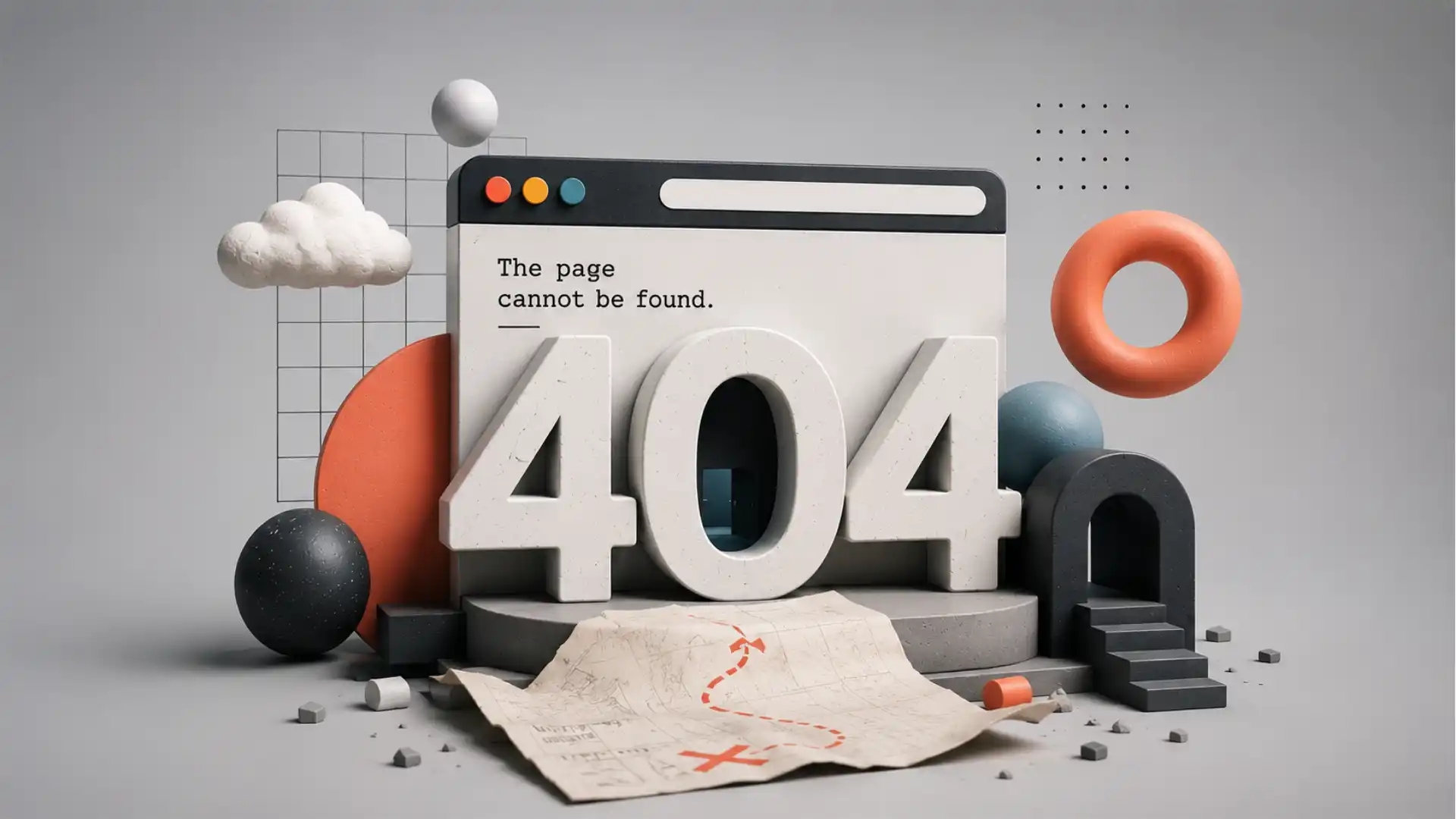
The most famous error on the web did not come from a dramatic locked door, a lost office, or a secret CERN room where tired engineers manually rejected failed requests. 404 became famous because it was boring first. It was a short machine signal, plain enough for a server, short enough for old constraints, and vague enough to fit nearly every kind of missing page the web could invent. The better place to begin is not the myth, but a small old W3C page called “Status codes in HTTP,” where the entry for 404 is almost comically bare: “The server has not found anything matching the URI given.”
Table of Contents
That old page is the kind of web artifact Web Radar exists to notice. It looks too plain to matter, yet it quietly explains why 404 became the number everyone remembers. There is no mascot, no origin fable, no heroic anecdote. There is only a small list of response codes, a few dry descriptions, and the early web’s taste for practical labels. The 4xx group is for client-side trouble, the 5xx group is for server-side trouble, and 404 is the answer when the server cannot match the requested URI. The page feels like a fossil from a time when the web was still being named as it was being built.
The folklore version is much easier to retell. Someone asks where 404 came from, someone else says “Room 404 at CERN,” and the story walks away wearing a lab coat. In that version, the first web servers were supposedly housed in a room numbered 404, or Tim Berners-Lee’s office was there, or a team in that room handled missing files and sent back a “not found” message. The details change because myths like this are less like records and more like sticky notes passed across decades. They work because they give a cold number a place, a corridor, and a human silhouette. Wired’s 2017 history of the error traces that myth and quotes Robert Cailliau, one of the web’s early figures, dismissing it sharply: 404 was not tied to a room or physical place at CERN.
The true origin is less cinematic, but it says more about the web. 404 stuck because it sat at the exact crossing point between protocol design and human feeling. The browser had found the server. The server had heard the request. The requested thing was just not there, or not available, or not something the server wanted to admit existed. That is a tiny technical distinction, yet every ordinary person who has clicked a broken link has felt the emotional version of it. You arrived. The address was real enough to fail properly. The page was gone.
There is something almost perfect about that. 404 is not total failure. A DNS error feels like calling a number that does not exist. A 500 error feels like the building caught fire. A 403 says someone is stopping you at the door. A 404 says the door is there, the building answered, and the room you were promised is empty. That makes it technically useful and emotionally legible at the same time. Most status codes speak to developers. 404 accidentally learned to speak to everyone.
The official definition has become more exact since the early lists, but the shape is the same. RFC 9110, the current HTTP semantics specification, defines 404 as the case where the origin server has not found a current representation for the target resource or is not willing to disclose that one exists. It also says 404 does not say whether the absence is temporary or permanent; when the server knows a resource is permanently gone, 410 is the better status. The everyday page-not-found screen is built on that careful ambiguity. The server shrugs in code.
This is why the old W3C page is worth opening. It strips 404 back to its pre-meme state. Before joke pages, cute illustrations, “Oops!” copywriting, branded dead ends, or museum pieces about internet culture, 404 was a compact answer in a list. It did not yet know it would become a punchline, a design playground, a Halloween costume, a conference slide, a tattoo-level nerd joke, or a phrase people use outside the browser. That old page shows the number before it got famous.
It also shows how much of the web’s culture comes from leftover infrastructure. The web remembers its plumbing when the plumbing leaks in public. Most people do not know 301, 302, 304, 405, 410, 429, or 503 unless they work near the machinery. They know 404 because the web exposed it in a moment of disappointment. The failure happened often, the message was short, and the number appeared on screen at exactly the moment the user needed a name for what had gone wrong. A code became a noun because the interface did not hide it.
A tiny page that still explains the web
The old W3C “Status codes in HTTP” page is not beautiful. That is part of its charm. It sits there in plain HTML, with headings that feel almost handwritten by the early standards web: “Bad request 400,” “Unauthorized 401,” “PaymentRequired 402,” “Forbidden 403,” “Not found 404.” No polished design system rescues it. No content team adds warmth. No product manager asks whether “not found” sounds too negative. The page just names what can happen when a client asks a server for something.
The entry for 404 is only one sentence. The server has not found anything matching the URI given. That is the whole drama. The sentence matters because it frames the error as a mismatch between request and resource, not as a grand collapse of the web. The browser did its part. The network did enough. The server responded. The target was absent. If this sounds dry, that dryness is the point. The early web needed shared behavior more than it needed mood.
The same page explains the family around it. The 4xx class was meant for cases where the client “seems to have erred,” while 5xx was for cases where the server knows it has erred. The page even admits the line cannot always be perfectly drawn. That little caveat feels unusually honest for a technical document. The difference is “only informational,” it says, because real web failures rarely fit clean moral categories. A broken link might be the user’s typo, the publisher’s deletion, a migration mistake, a permissions trick, or a vanished archive. The number has to survive all of those.
That is one reason 404 became durable. It is specific enough to diagnose a missing target and vague enough to avoid overpromising certainty. A permanent deletion should use 410. A forbidden page should use 403. A moved page should use a redirect. Yet servers often use 404 when they do not know, do not care, or do not want to reveal more. MDN’s current documentation makes the same point for working developers: 404 means the server cannot find the requested resource, but it does not tell the user whether the missing state is temporary or permanent.
The old page also reveals the naming pattern that made the code easy to remember. 404 is not random in the way a password is random. The first digit places it in the client-error neighborhood. The last two digits mark a particular slot in that neighborhood. It lives beside 400 Bad Request, 401 Unauthorized, 402 Payment Required, and 403 Forbidden. The number carries a small amount of structure, even if the final assignment had some programmer whim behind it. Wired’s history, citing Cailliau, describes the ranges as a practical design choice and the exact placement of 404 as relatively arbitrary.
That mix matters. Total randomness does not stick; rigid meaning does not become folklore. 404 lives in the middle. The “4” gives it a category. The “04” gives it a shape. It is short enough to say, symmetric enough to see, and just odd enough to feel like a thing. “Page not found” explains the event, but “404” names the feeling. That is the difference between a message and a cultural token.
The old W3C page is also a reminder that the early web had to make failure visible because it could not assume the environment would be polished. Links were always going to break. Pages would move. Servers would disappear. People would type addresses wrong. Universities would reorganize directories. Personal websites would be abandoned. Companies would redesign everything and forget half the old URLs. The web’s architecture needed a cheap way to say: the request reached something, but the thing named by this address is not here.
The trick is that a cheap way of saying “not here” became one of the web’s richest shared experiences. The page nobody wanted became one of the pages everyone knew. It did not need promotion. It rode along with every broken bookmark, mistyped path, deleted article, dead image, and vanished forum thread. No campaign could have made 404 as familiar as bad maintenance did.
The old page deserves attention because it refuses the romantic explanation. It points to the web’s real personality: pragmatic, messy, lightly standardized, and always one directory rename away from embarrassment. The famous number did not need a secret origin. It needed millions of small disappointments, all labeled the same way.
The Room 404 myth is too neat to be true
The Room 404 story is a perfect internet myth because it solves a problem the truth leaves open. People hate arbitrary numbers. Give them a famous number and they will look for a room, a date, an acronym, a founder’s joke, or a hidden message. A room is especially attractive because it turns protocol history into office folklore. It lets people imagine the web beginning not as a set of design decisions, but as a physical place where missing files were once handled by humans.
The story usually goes something like this: at CERN, where the web began, there was a room numbered 404. That room supposedly housed the first web servers or the people handling early file requests. When a file could not be found, the request was returned from Room 404 with a “file not found” message. The idea is clean, cinematic, and false in the way many durable internet tales are false: it is not just wrong, it is satisfying.
Robert Cailliau’s response to the myth is useful because he sounds tired of it. Wired quotes him calling the mythology “hogwash” and saying 404 was never linked to any room or physical place at CERN. He also describes the error-code ranges as practical programming work, not lore. When you are writing a new system, you do not spend your time crafting long messages for every error case. Memory mattered. Short codes did the job.
That memory detail is easy to miss. The early web was not born inside today’s abundance. The style of the protocol reflects constraints: short lines, compact messages, minimal assumptions, clear classes of response. A number like 404 feels blunt because bluntness was useful. Computers did not need a prose apology. Developers needed predictable behavior. Users needed some sign that the request had failed. The number sat in the middle, doing just enough.
The myth survives because the actual design process feels too ordinary for the cultural weight 404 later gained. A famous symbol demands a better origin story than “the programmer needed a slot in a status-code range.” We want the web’s most famous error to come from a human mistake, a missing engineer, a locked lab, a dusty corridor. Instead, it came from the dull brilliance of shared conventions. That is less charming at a dinner table, but much more revealing.
The myth also fits the emotional content of 404. A missing room is a poetic image for a missing page. The browser arrives at an address, and the address points to nothing. The user expects presence and gets absence. A story about a room that cannot be found feels like the error explaining itself. It is folklore by analogy. The truth has no hallway, so the internet invented one.
There is another reason the myth works: CERN itself is real web mythology. The birthplace of the web already has enough factual magic around it that people are willing to accept one more anecdote. Tim Berners-Lee, early hypertext work, physics labs, European corridors, shared machines, old terminals: the setting is almost too good. “Room 404” sounds plausible because the larger scene is true. A false detail can hide inside a true atmosphere for decades.
The old W3C page punctures that atmosphere by being boring in public. It does not stage the code as a souvenir from CERN architecture. It places 404 in a list, between 403 and 500, with a one-line explanation. That is where the number belongs: not in a room, but in a taxonomy of failure. The romance comes later, after millions of people have seen the number often enough to wonder whether it must mean something else.
The room story also reveals a habit of internet culture: we prefer origin stories with characters over origin stories with committees, drafts, and constraints. A room has a door. A protocol has sections. A room has people wandering in and out. A protocol has categories and edge cases. The room story travels because it compresses the web into a scene. The actual record asks the reader to care about status-code classes. No contest.
Still, debunking the myth should not flatten the story. The false tale is part of why 404 feels alive. It shows that people did not accept the error as pure machinery. They tried to humanize it, even by accident. They gave the number a room because the number had already become a character. A weak error code would not attract folklore. A forgettable one would not need a myth.
The better lesson is not “people are foolish for believing Room 404.” It is sharper than that. The web is so full of visible machinery that users keep trying to turn its exposed parts into stories. They see a code and ask where it came from. They see a failure and ask who failed. They see “not found” and imagine a person searching. 404 became famous because the web left a little technical label on the table, and everyone had to look at it.
What 404 actually means
The cleanest technical version is not difficult, but it is often blurred. A 404 does not mean the internet is down. It does not mean the browser failed to connect. It does not mean the domain name is fake. It means the server was reached and the requested resource could not be supplied under that address, or the server is choosing not to admit that it could. MDN says the same in working language: the server cannot find the requested resource, and links that lead there are broken or dead links.
That distinction explains why 404 feels different from other failures. A 404 is a successful failure. The request made it far enough to get a proper answer. The server did not vanish. The protocol did not collapse. The system produced a neat little refusal. That is why 404 pages often load beautifully while announcing that the thing you wanted cannot load at all. The frame works. The content is missing.
RFC 1945, the 1996 HTTP/1.0 specification, already contains the familiar definition. The server has not found anything matching the Request-URI, and the code gives no indication of whether the condition is temporary or permanent. That phrasing is important because it explains why 404 became a catch-all for absence. It says what the server did not find, but it does not claim to know the future.
The current RFC 9110 keeps that spirit while sharpening the language. 404 means the origin server did not find a current representation for the target resource or is not willing to disclose that one exists. That second clause matters. It means a server may answer 404 not only when something is missing, but when revealing more would disclose information. A private or forbidden resource might be hidden behind “not found.”
That small privacy/security wrinkle gives 404 a strange social role. Sometimes “not found” means missing; sometimes it means “I am not telling you.” A locked page could say 403 Forbidden, but a server may choose 404 to avoid confirming that the page exists. To the user, the surface is the same. To the server, the reason can be different. The code becomes a polite mask.
The difference between 404 and 410 is another part of the story. 410 Gone is the more final answer. It says the resource is no longer available and the condition is likely permanent. RFC 9110 says 410 is preferred when the origin server knows the absence is likely permanent, while 404 is used when that permanence is not known or not declared. In practice, many sites use 404 for everything because it is simple, familiar, and often good enough.
That “good enough” quality helped 404 dominate public memory. 410 is more expressive, but 404 is more useful as a default. Most site owners do not maintain perfect historical knowledge about every deleted page. Most content-management systems are happy to route missing paths to a generic not-found template. Most users do not need a legal statement of permanence. They need to know that the page they tried is not there. The blunt answer wins.
404 also differs from a redirect. A redirect says the thing moved; 404 says the server is not sending you to a new place. If a site handles migration well, old URLs return 301 or 302 and the user barely notices. If it handles migration badly, those old URLs return 404 and the user meets the web’s ghost layer. The presence of 404 often marks the failure of care after publishing: no redirect, no map, no memory.
That is why 404 is closely tied to link rot. The web is made of promises, and a URL is a promise that often ages badly. MDN points out that links leading to 404 pages are often called broken or dead links and are subject to link rot. The phrase is ugly and accurate. The web decays not by turning brown, but by returning codes.
Research on web references has measured this decay in specific collections. A D-Lib Magazine study of 4,387 unique URLs from articles published between July 1995 and August 2004 found that about 28 percent failed to resolve initially and 30 percent failed at the final check; unresolved URLs were mostly 404 and 500 errors. The authors estimated a URL half-life of around ten years in that dataset. That gives the humble 404 a larger meaning. It is not only an annoyance. It is the visible unit of digital erosion.
The technical definition also explains why 404 became an API problem, not just a browser problem. In APIs, 404 can mean the endpoint path is wrong, or that a specific object under a valid endpoint does not exist. MDN’s response-status overview notes this distinction in current developer language: in a browser, the URL is not recognized; in an API, the endpoint may be valid while the resource itself is missing. The code survived because it travels well across contexts. A missing article, a missing image, a missing user record, a missing JSON object: all can wear the same number.
This portability is one reason 404 did not remain a minor detail. It names a basic condition of networked systems: addressable absence. The web lets everything have an address. Once everything has an address, absence needs an address too. 404 became that address. It is the web saying, “I understood the shape of your request, but I cannot give you the thing.”
How 404 differs from nearby failures
| Code | Plain meaning | What the user feels |
|---|---|---|
| 400 | Bad request | The request itself is malformed |
| 403 | Forbidden | The page may exist, but access is blocked |
| 404 | Not found | The address answered, but the thing is absent |
| 410 | Gone | The thing is known to be permanently removed |
| 500 | Internal server error | The server broke while trying |
The table matters because 404 sits in a narrow emotional lane. It is not the harshness of 403, the finality of 410, or the chaos of 500. It is the softest common failure: enough of the web worked to tell you the page did not.
The nearby codes also show why 404 became the memorable one. It is the failure ordinary users caused and encountered constantly. People mistype URLs. Publishers delete pages. Search results go stale. Blog posts change slugs. Shops remove products. Image paths break. 403 and 500 may be scarier, but 404 is more intimate. It usually appears at the exact place where expectation meets neglect.
The IANA HTTP Status Code Registry keeps 404 in the official list as “Not Found,” referenced to RFC 9110 section 15.5.5. That registry is the dull ledger behind one of the web’s most recognizable symbols. There is something funny about that contrast: the code that became a joke page, a cultural marker, and a shorthand for disappearance still lives as one row in an administrative table.
Why this dull number became memorable
404 had an unfair advantage over other status codes: it appeared in front of nontechnical people at the exact moment they were annoyed. Most protocol details stay hidden inside developer tools, logs, server configs, and monitoring dashboards. 404 escaped. It became browser-facing. It showed up in the main window, sometimes in a default server page so ugly that the number looked like the headline. Once a code becomes visible at scale, it stops being only a code.
The number is also easy to say. Four-oh-four has rhythm. It is balanced, clipped, and visually neat. 403 feels stern but less musical. 500 is common but too generic, and “internal server error” points blame at machinery rather than at a missing object. 404 sounds like a label you can reuse. People say “that page is a 404,” “I got a 404,” “our old campaign URLs are 404ing,” or even “my brain is 404.” The number became a verb-ish noun because English likes compact labels with a beat.
The phrase “not found” carries no blame, which also helped. It is gentler than “forbidden” and less alarming than “error.” A missing page may be your typo, the publisher’s mistake, a stale search index, a bad migration, or a deliberate deletion. “Not found” does not accuse anyone. It leaves room for every explanation. That ambiguity makes it socially reusable. It can be funny, sad, irritating, or neutral.
The code also became familiar during the web’s most chaotic growth. Early websites were fragile by nature. People hand-coded pages, renamed directories, moved hosts, changed file extensions, and published without the safety nets now built into large platforms. A single capital letter could break a path on a case-sensitive server. A tilde homepage could disappear after someone left a university. A company redesign could erase thousands of old links overnight. 404 was not rare; it was texture.
That texture taught users that the web was not a library with permanent shelves. The web was a living set of pointers maintained by distracted humans. The 404 page made that visible. Every broken link said: someone promised an address and then failed to keep it alive. The failure might be small, but at web scale small failures become weather.
Custom 404 pages changed the code’s reputation. Once sites realized the error page was a user-facing moment, they started decorating the dead end. Some added jokes. Some added search boxes. Some added brand mascots. Some turned the not-found page into a tiny design portfolio. MDN’s documentation even advises that custom 404 pages can be humorous and human as long as they do not confuse visitors about why they are there. The error became a stage because it was guaranteed to receive traffic.
That stage created a strange design genre. A good 404 page apologizes without begging, redirects without lying, and gives the user a way out. It might link to the homepage, search, popular articles, support, or a sitemap. A bad 404 page is either too cute to be useful or too dead to be humane. The best ones understand the emotional state of the visitor: they wanted something specific and did not get it. Humor only works after the page admits that.
This is where 404 became more than a technical response. It became a small test of product taste. Does the site treat a failed request as the user’s problem, or as a moment to recover from gracefully? Does it hide the code, explain it, joke about it, or use it as a brand postcard? The not-found page reveals whether a team thinks about the edge cases where real users actually land. Broken links are not rare edge cases. They are one of the web’s main entrances.
Wired’s history notes the “meme-like status” of 404 and the creativity poured into custom error pages. That creativity may be frivolous, but it shows how humans domesticate machine failure. A plain code appears where a page should be; people draw a character, write a joke, add a search box, and turn the failure into a tiny performance. The code remains the same, but the social meaning changes.
404 also benefits from being negative without being catastrophic. The best internet symbols are usable outside their original domain. A “404” can describe a missing thought, a person not showing up, a joke about absence, a store shelf with no product, or a lost file. It escaped the protocol because the metaphor is clean. Something was requested. Something was not found.
There is also a memory effect. Once people know one HTTP status code, new encounters reinforce the same one. Seeing 404 again feels like recognizing a face. Seeing 406 or 409 may still require a search. The more recognizable 404 became, the more sites kept displaying it, and the more users treated it as the default name for a broken web page. Fame fed visibility, and visibility fed fame.
The number’s dull origin may even have helped. Because 404 did not carry a built-in joke, everyone could project onto it. If it had started as a clever pun, the pun would have aged. If it had been too descriptive, it might have stayed technical. If it had come with a true official anecdote, the story would have ended there. Its emptiness made room for culture.
The not-found page as a mirror
A 404 page is not only an error page. It is a small mirror held up to a website’s maintenance habits. The user sees the surface, but the cause sits behind it: a missing redirect, an old campaign, a deleted product, a renamed article, a broken internal link, a bad deploy, a careless CMS migration. A site with many 404s feels like a shop where half the signs point to locked closets.
The web’s obsession with growth often hides this. Publishing gets attention; preserving addresses does not. New pages are celebrated. Old URLs are abandoned. Marketing launches get budgets. Redirect maps get spreadsheets. Yet the long-term experience of a site depends on whether its old promises still work. A URL is not only a pointer to content; it is a contract with everyone who linked, bookmarked, cited, archived, indexed, or shared it.
404 exposes the contract breach. The code is a receipt for vanished context. A reader may not remember the title of an article, but they have the link. A researcher may cite a page that later disappears. A shopper may follow an old product link from a forum. A developer may click documentation from a GitHub issue. When the link returns 404, the page is not the only thing missing. The trail is broken too.
This is why link rot is not a tiny housekeeping issue. It weakens the memory of the web. The D-Lib Magazine study is useful here because it turns a familiar annoyance into numbers: thousands of cited URLs checked repeatedly, with about 30 percent unresolved by the final check and many of the failures caused by 404 or 500 responses. A broken link in a paper, a blog, or a repository is not just an inconvenience. It can sever evidence from the claim that depends on it.
The not-found page also shows the difference between deletion and disappearance. Deletion can be honest when it is marked well. A 410 response, an archive link, a redirect to a successor page, or a clear notice can preserve meaning. A bare 404 often erases the reason. Was the page removed because it was wrong? Moved? Replaced? Hidden? Forgotten? The code does not say. That silence is sometimes useful for security, but often it is just neglect.
For publishers, the lesson is practical. A 404 page should be treated as part of the site, not as a default server leftover. It should explain the problem plainly, offer search, point to likely destinations, and avoid pretending nothing happened. The best not-found pages do not over-apologize. They respect the user’s intent. They turn an empty address into a recovery path.
For designers, 404 is a rare moment where personality belongs in infrastructure. People forgive a small joke when the page also helps them leave. The mistake is thinking the joke is the feature. The feature is recovery. The joke is seasoning. A page that says “Oops, our bad!” in giant type but gives no search box is worse than a plain Apache error. At least the plain error does not waste time trying to charm you.
For developers, 404 is a reminder to choose codes carefully. Not every failed lookup deserves the same response. A missing resource is 404. A permanently removed resource may be 410. A forbidden resource may be 403, unless hiding existence is the safer answer. A malformed request is 400. A server-side failure is 500. These distinctions matter because clients, crawlers, caches, archives, and users respond to them differently.
For archivists, 404 is part of the preservation problem. A missing page is sometimes recoverable only because another system captured it earlier. The Internet Archive, search caches, mirrored repositories, and institutional archives all live around the reality that the live web forgets. The more JavaScript-heavy and API-dependent pages become, the messier that preservation work gets. A 404 may now describe not just a missing HTML document, but a missing script, JSON endpoint, image asset, font, or tracking call that keeps a saved page from behaving as it once did.
That is why a recent archival paper about caching HTTP 404 responses is more interesting than it sounds. It describes archived pages whose JavaScript keeps requesting missing resources, generating repeated 404 traffic during replay. The authors found cases where cached 404 responses could prevent unnecessary requests from hammering a web archive. In a live browser, 404 feels like a one-time dead end. Inside a modern web page, missing resources can become a loop.
The not-found page also reveals the web’s attitude toward time. Most web systems are better at serving the current version than explaining where older versions went. A site may know exactly how to publish the new page while having no good memory of the old one. This is why old links often fail during redesigns. The architecture of freshness is stronger than the architecture of continuity.
404 is the sign that continuity failed. It is the web’s smallest memorial marker. It does not preserve the missing page, but it marks the place where the page should have been. That may sound dramatic for an error code, yet anyone who has chased an old article, a vanished fan site, a deleted government document, or a missing manual knows the feeling. The 404 page is not empty. It is full of the shape of what is absent.
Why the old record is better than the legend
The Room 404 story gives us a cute origin. The old record gives us a better understanding of the web. It shows that the famous number emerged from classification, constraint, and common use. It became folklore only after the web made it visible to ordinary people. The myth is fun, but it hides the more interesting truth: the web’s culture often grows from boring technical seams.
Those seams are everywhere. URLs expose file structures, status codes expose protocol behavior, view-source exposed markup, and error pages exposed server defaults. The early web was full of visible edges. People learned by bumping into them. The culture of the web did not grow only from homepages, forums, blogs, and social networks. It also grew from the little moments where the machinery showed through.
404 is the cleanest example because it sits at the boundary between a human desire and a machine answer. The user asks for a named thing; the server replies with absence. That is a deeply web-native experience. Books can be out of print, phone numbers can disconnect, buildings can be demolished, but a URL returning 404 is a special kind of absence: a precise address that leads to no current representation. The address remains, but the object has slipped away.
The number stuck because it became the label for that experience. Not “failure” in general, but addressable absence. A missing file on your own computer is frustrating. A missing web page is public. It may be linked from search, cited in a paper, posted in a forum, embedded in a newsletter, or preserved in someone’s notes. The 404 page is the visible moment when a public pointer loses its target.
That makes 404 a strange kind of internet literacy. Knowing 404 teaches users that the web is made of requests and responses, not magic pages floating in a cloud. The user may not know HTTP, but they learn that servers answer, pages have addresses, and addresses can go stale. The code is a tiny lesson in architecture. It is more educational than a polished “Something went wrong” message because it leaves a clue.
There is a trade-off here. Modern interfaces often hide technical detail in the name of friendliness, and sometimes that is right. Nobody needs raw stack traces in a consumer app. But 404 shows the benefit of a visible, stable, shared error. Because the code was exposed, people could learn it, search it, joke about it, and build conventions around it. A generic friendly failure might be softer, but it would not become common language.
The old W3C page preserves the code before that social life. It is a tiny museum label for a creature that escaped the museum. The sentence “The server has not found anything matching the URI given” is not written for cultural memory, but it accidentally supports one. It tells us what the number meant before people needed it to mean more.
The RFCs then show how the meaning matured without losing its core. RFC 1945 describes 404 as a server finding nothing matching the Request-URI, with no claim about permanence. RFC 9110 updates the phrasing for today’s HTTP semantics and adds the idea that the server may be unwilling to disclose that a representation exists. The code remained recognizable because its job remained common.
The IANA registry adds the administrative layer. 404 is still just one row in the official HTTP status-code registry. That row will never capture the cultural weight of the number, but it does prove something useful: the meme did not detach completely from the standard. The joke is still sitting on top of real infrastructure.
The MDN documentation adds the working-developer layer. It explains 404 in the language people use now: broken links, link rot, custom error pages, temporary versus permanent absence, and the difference between 404 and 410. MDN’s page is less romantic than a folklore article and less ancient than the W3C fossil. It shows how the code remains alive in daily web work.
Together, these sources make the boring origin stronger, not weaker. A myth gives 404 a birthplace; the record gives it an ecosystem. The old W3C page, the HTTP/1.0 specification, the current RFC, the registry, and practical documentation all show the same thing from different distances. 404 is a designed response that became a social object because the web kept breaking in public.
That is the part worth sitting with. The web’s most famous error is famous because the web is both standardized and fragile. If there were no standard, every missing page would fail differently. If the web were not fragile, nobody would see the code often enough to remember it. 404 needed both: shared protocol and endless decay.
The Room 404 myth is too neat because it gives the number a single origin. The real origin is distributed, like the web itself. A category range, a code slot, a terse message, early memory constraints, visible browser pages, broken links, site redesigns, custom templates, jokes, search results, and decades of user frustration all helped make 404 famous. No room could have done that alone.
Reader notes
The strongest available record says no. Robert Cailliau, who worked with Tim Berners-Lee on early web hypertext efforts, told Wired that 404 was never linked to a room or physical place at CERN, and described the room story as a myth.
The “4” places it in the client-error range, while the exact “04” slot appears to have been a practical assignment inside the status-code set rather than a symbolic reference. Wired’s account, based on Cailliau’s explanation, describes the category ranges as practical and the exact code choice as relatively arbitrary.
No. The official meaning does not say whether the absence is temporary or permanent. RFC 9110 says 410 Gone is preferred when the server knows the condition is likely permanent.
A server may use 404 when it does not want to disclose that a forbidden resource exists. RFC 9110 explicitly allows an origin server that wants to hide the current existence of a forbidden target resource to respond with 404 instead.
It became visible to normal users, appeared often through broken links and mistyped URLs, and described a failure everyone understood: the server answered, but the thing requested was not there. MDN also notes that 404 is probably the best-known response code because it occurs so often on the web.
The old status-code page is worth opening because it is almost aggressively plain. It lets you see 404 before it became personality. No myth, no branding, no softened UX copy, no illustrated astronaut floating through a dead link. Just a protocol list doing its job.
That plainness is the discovery. The web’s most famous error number did not start as internet culture, but internet culture found it anyway. It found it because the number was short, exposed, repeated, and emotionally exact. People do not remember 404 because it was designed to be memorable. They remember it because it kept arriving at the moment a promise broke.
There is a lesson for anyone who builds or publishes on the web. The forgotten edges of a product often become the places users understand it most clearly. Error pages, redirects, empty states, expired links, missing images, failed searches: these are not side rooms. They are part of the experience. 404 became a legend because the side room was visited by everyone.
The better origin story, then, is not the one about Room 404. It is the one about a small standard label that survived contact with billions of broken expectations. The server did not find anything matching the URI given. A dry sentence. A small number. A dead end with perfect timing.
Author:
Jan Bielik
CEO & Founder of Webiano Digital & Marketing Agency
This article is an original analysis supported by the sources cited below
Status codes in HTTP
An early W3C page listing HTTP status codes, including the terse “Not found 404” entry and the 4xx/5xx classification.
RFC 1945 Hypertext Transfer Protocol HTTP/1.0
The 1996 HTTP/1.0 specification that defines 404 Not Found as a server finding nothing matching the Request-URI, without saying whether the condition is temporary or permanent.
RFC 9110 HTTP Semantics
The current HTTP semantics specification, including the modern definition of 404 Not Found and its distinction from 410 Gone.
HTTP Status Code Registry
The IANA registry that lists 404 as “Not Found” and references RFC 9110 as the current specification source.
404 Not Found
MDN’s practical developer reference for the 404 status code, broken links, link rot, 410 Gone, and custom 404 pages.
HTTP response status codes
MDN’s overview of response-code classes and everyday meanings, including why 404 is likely the most widely recognized HTTP status code.
Page Not Found: A Brief History of the 404 Error
Wired’s cultural history of the 404 error, including Robert Cailliau’s rejection of the Room 404 myth and comments on the practical origin of error-code ranges.
The Availability and Persistence of Web References in D-Lib Magazine
A study of link persistence that measured failed URLs in a scholarly web corpus and found many unresolved links returning 404 or 500 errors.
| Citing this article? Brief excerpts are welcome. Please credit Webiano.digital, name the author where stated, and include a link to https://webiano.digital and to this original article. Full or substantial republication requires prior written permission. Read our Copyright and Content Use Policy. |
This article was prepared with the assistance of artificial intelligence tools. The content underwent expert human review, and Webiano Digital & Marketing Agency assumes editorial responsibility for its final version and publication.