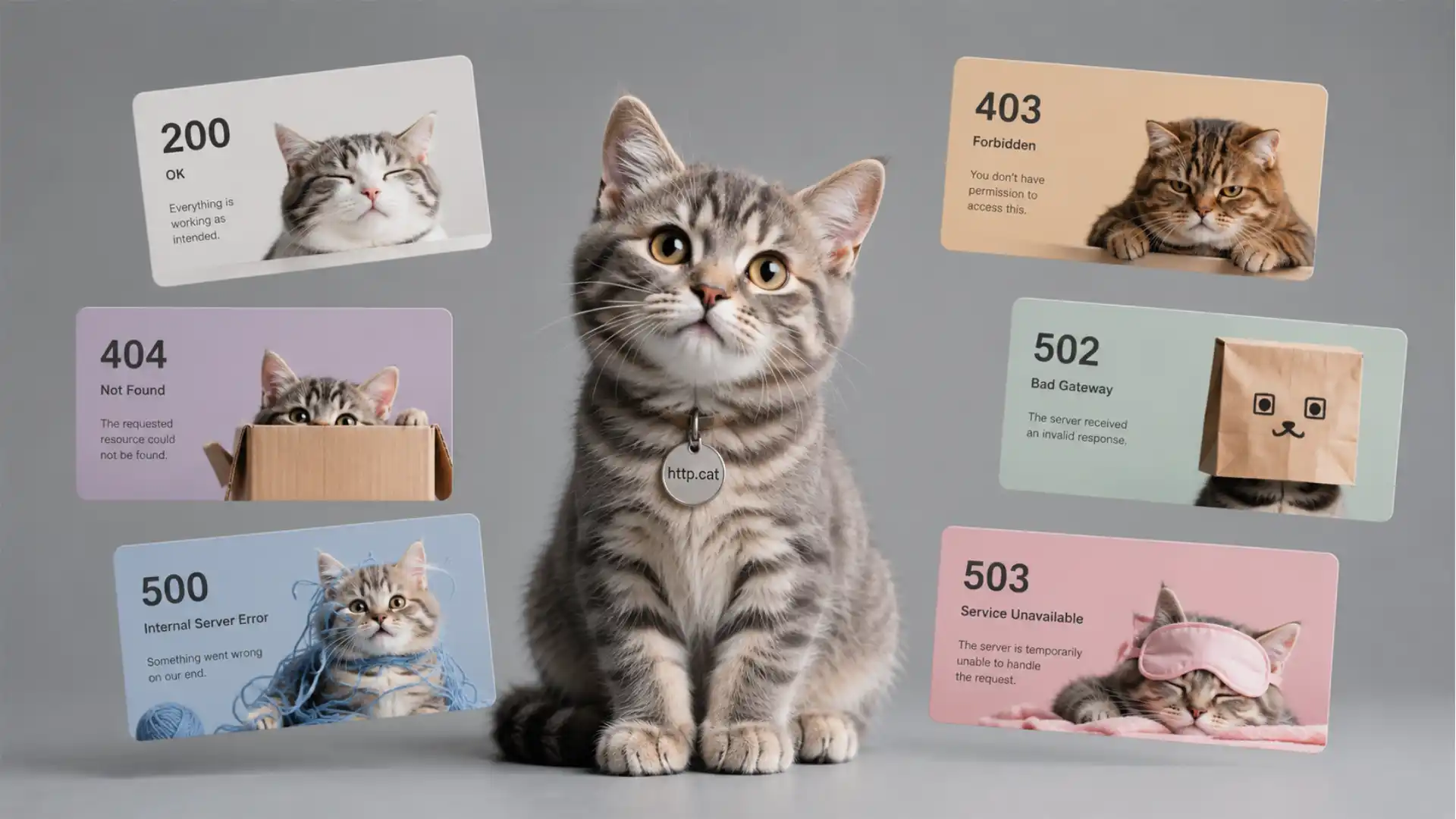
Open HTTP Cats on status code 404 and you do not get a definition first. You get a cat swallowed by papers, with “404 Not Found” beneath it. The choice is almost aggressively simple. There is no explainer video, no dashboard, no sign-up gate, no animated mascot asking for permission to become your productivity companion. A three-digit number goes into the URL. A cat image comes out. Somewhere between the number and the photo, a dry bit of web infrastructure becomes easier to remember.
Table of Contents
A small site with unusually good instincts
That sounds like a novelty, and it is a novelty. It is also a very good interface. HTTP Cats does not pretend the web’s response codes are thrilling. It accepts that they are useful, often confusing, and hard to hold in the mind when they arrive as a dense log line at the end of an already bad day. A photo gives the code a face. Not a literal face, usually. More like a posture, a mess, a visual mood. The result is a tiny translation layer between machines and the people trying to understand them.
The website is almost too modest to invite analysis. Its home page is a long index of codes, each linked to a corresponding image and explanation. The pattern is direct: use the code in the address, get the cat. That is the whole trick. 404 is a cat buried under a failed search. 429 is a crowd of cats pressing together until the image itself feels rate-limited. 503 is a cat inside an iron, which is more unsettling than it should be and somehow a better picture of an unavailable service than a floating red error banner.
The reason it has endured is not that developers are unusually susceptible to cat photos, although that certainly does not hurt. It endures because the site respects a fact that technical writing often misses: people remember meaning through associations, not just definitions. “A 404 means the server cannot find the requested resource” is accurate. It is also the sort of sentence that leaves the head the moment a tutorial tab closes. A cat under a pile of documents, however, survives. Later, when a broken link appears in a browser console, the image returns first and the explanation follows.
That small act of memory design matters more than it sounds. The web is full of codes that are clear to software and slippery to humans. A browser, a CDN, an API gateway, a load balancer, a server framework, and an application can all return an HTTP response. The number is meant to carry a compact statement about what happened. Three digits must stand in for a chain of events. The code tells a client whether to continue, retry, authenticate, redirect, wait, change its request, or give up. The person reading it still has to work out what to do next.
HTTP Cats does not solve that entire problem. It does something more modest and more useful. It gives a developer, designer, support agent, teacher, or curious non-technical colleague a shared visual reference. A cat is a social object. You can paste it into a chat without sounding as though you have opened a support ticket. You can send it after a deployment breaks a staging environment. You can use it in a slide, an internal guide, a postmortem, a code review, or a message that says, with less tension than usual, “The server is not the part that failed. The request is.”
The project’s origin gives it a little more weight than a random meme page. HTTP Status Cats began as a photo series by Tomomi Imura, and the current HTTP Cats project credits her for creating the images. The old web had many one-off visual jokes, but this one kept being useful after the joke landed. It moved from image series to addressable web resource, then to a small open-source project with an endpoint convention that could be used wherever an image URL could be used. That transition is the reason it became a fixture rather than a fondly remembered Tumblr-era artifact.
The site also lives in a surprisingly healthy corner of internet culture: the corner where people make small things because the small thing is enough. There is no hidden business model implied by its shape. It does not need a feed. It does not need recommendations. It does one job cleanly, then gets out of the way. That feels almost old-fashioned in 2026, when even a calculator may insist on a user profile, a newsletter prompt, and an AI assistant that wants to narrate addition.
For developers, the appeal is partly relief. Error codes tend to appear when someone is tired, rushed, or trying to explain a failure across a gap in expertise. A colleague says “the API returned a 422,” and the room splits immediately. One person knows that means the server understood the request but could not process the supplied content. Another thinks it means the endpoint is down. A third is afraid to ask. HTTP Cats lowers the social temperature around that gap. The image does not replace the explanation, but it gives the explanation an easier opening.
The project is not a comprehensive HTTP authority, and it should not be treated as one. The IANA registry and the RFCs define and register status codes; serious production decisions require the relevant protocol semantics, application context, headers, logs, and documentation. A cat is not an incident response plan. It is a memory hook and a communication aid. The fact that this boundary is obvious is part of the site’s charm. It never tries to turn itself into an all-purpose developer platform.
Still, the difference between a reference and a companion is worth noticing. Documentation tells you what a status code means. HTTP Cats helps you remember that it exists, makes the code feel less abstract, and gives you something light enough to share. That is not a lesser role. In a field stuffed with information, the tools that help knowledge travel between people are often the ones that last.
The image is doing real cognitive work
Status codes are deceptively compact. The first digit gives you a broad family: informational, successful, redirect, client error, or server error. The remaining digits point to a particular situation. That system is elegant at protocol scale, but elegance at protocol scale is not the same as memorability at human scale. A person may know that 4xx means the request side needs attention and still fail to distinguish 400 from 401, 403 from 404, or 409 from 422 when the moment arrives.
A good image turns a category into a scene. The HTTP Cats images rarely try to diagram a network transaction. They do something looser. They create an emotional or situational rhyme. A pile of paper suggests absence, loss, or failed retrieval. A crowded cluster of cats suggests excessive demand. A cat shoved into an appliance suggests the wrong conditions for normal operation. The picture does not need to be literal to be useful. It needs to give the brain a shape it can retrieve later.
This is why the project avoids the trap of most corporate error illustration. Corporate error art often looks carefully commissioned and emotionally empty. A person with a floating geometric object, a potted plant, and a vague expression of manageable concern says almost nothing about a broken request. It says the company hired an illustrator. HTTP Cats says something sharper with less. The photos are messy, funny, occasionally absurd, and immediately legible as scenes rather than branding exercises.
The internet has always understood this kind of compression. A reaction image is not a full argument, but it can carry a social stance in a fraction of a second. A meme does not provide a policy, but it can make a shared frustration visible. HTTP Cats sits near that tradition without becoming disposable. Each image has a fixed technical anchor. The code prevents the joke from drifting. The joke prevents the code from becoming forgettable.
That pairing creates an unusually durable mnemonic system. If you learn only the labels, you retain a list. If you learn only the images, you retain a set of cat photographs. When the number, the phrase, the photo, and a real experience arrive together, they become one unit of recall. A 429 is no longer just “Too Many Requests.” It is the experience of something being overwhelmed. A 503 becomes a service that cannot currently do the thing you asked it to do, not a vague declaration that “the website is broken.”
The distinction matters when people communicate across roles. Engineers are trained to read code families quickly. Product managers may deal with their consequences without knowing their exact names. Customer support teams see symptoms rather than logs. Designers see the interface a person encountered. A shared image creates a bridge across those partial views. It gives each person a common starting point before the technical detail starts branching.
The site’s clean URL pattern carries its own lesson. The endpoint is almost a sentence: status number in, visual explanation out. There is no search field because the code itself is the search term. There is no taxonomy to browse before you get to the point. The address is the interface. This is a small design decision, but it treats the web as a medium rather than a container for app-like panels. A URL can be an understandable object. It can be copied, remembered, shared, and embedded.
That is also why HTTP Cats works so well in chat. The link does not need a preamble. A message containing the image for 502 Bad Gateway is a compact way of saying that an intermediary received a bad response from an upstream service. A teammate who already knows the site may laugh first and then understand. A teammate who does not know the site will still see a visual prompt to ask what the number means. Both reactions are better than a bare “it’s down.”
The images have enough personality to invite attention but not so much personality that they overwhelm the code. This balance is harder than it looks. A mascot-heavy system can make the mascot the point. A sterile reference makes the number the point and leaves the person cold. HTTP Cats lets the cat do its work and then hands the reader back to the status phrase. The comedy is attached to the information, not pasted over it.
The project is particularly good at capturing the emotional difference between nearby errors. A 404 feels lost. A 403 feels blocked. A 429 feels crowded. A 503 feels unavailable rather than absent. Those are distinct states, and people often collapse them into the same sentence: “The site gave me an error.” HTTP Cats restores some texture to failure. It does not make every code precise by itself, but it invites a person to see that the kind of failure matters.
That texture has practical consequences. When a team treats every non-200 response as the same red alert, diagnosis gets sloppy. The wrong owner gets paged. The wrong fix gets attempted. A frontend developer may adjust a route when the real problem is credentials. A client may retry a request that should be corrected rather than repeated. A support agent may promise a service restoration when the customer is actually being rate-limited. The code is a clue about the next move. Making it memorable helps people use the clue instead of stepping over it.
Four cats that explain more than their names suggest
| Status code | The visual mood | The practical reading |
|---|---|---|
| 404 Not Found | Lost among papers | The requested route or resource is not available at that address |
| 429 Too Many Requests | Too many cats in one place | Slow down or wait because the service is limiting request volume |
| 502 Bad Gateway | A bad handoff in the middle | A proxy or gateway did not receive a usable response from an upstream service |
| 503 Service Unavailable | Temporarily unable to operate | The service is not ready to handle the request right now |
The table is not a substitute for context. A 404 might come from a deleted page, a typo, a bad rewrite rule, a missing API route, or an access pattern deliberately hidden behind a not-found response. A 503 may reflect maintenance, overload, a health-check decision, or a deployment state. The point is simpler: the cat gets people to stop treating the code as wallpaper and start asking the right follow-up question.
A useful visual reference is strongest when it preserves room for nuance. HTTP Cats does not tell you that every 404 is a broken link or every 502 is the fault of a reverse proxy. It prompts the right category of thought. “Not found” is different from “not allowed.” “Too many requests” is different from “not ready.” That distinction is where a real diagnosis begins.
The project also benefits from photos rather than illustrations. Photos are imperfect in a way that keeps them from becoming generic. The cats are not cleanly staged symbols. They are animals in strange domestic situations, caught in clutter, curiosity, inconvenience, or chaos. Their specificity makes them memorable. A perfect vector cat would probably be easier to brand and easier to forget.
There is a minor counterpoint here. Some people will find the images distracting, inaccessible without alt text, or too informal for a customer-facing page. Those criticisms are fair. HTTP Cats is not the universal answer to explaining errors. Its strength is context. Inside a developer chat, internal wiki, training session, or team slide, the informality is an advantage. On a public financial service’s account recovery screen, it may be exactly the wrong tone.
The smarter lesson is not “put cats on your error pages.” The smarter lesson is “give abstract states a concrete shape.” A product team may use plain language and no image at all. A documentation team may use diagrams. A support system may use consistent labels and examples. HTTP Cats is memorable because it understands the underlying job, not because cats are a magic ingredient.
The habits that made it part of developer culture
The best evidence that a small site has found a real niche is not an impressive mission statement. It is the odd ways people start using it. HTTP Cats has been used as a teaching aid, a linkable reference, a chat shorthand, and an image source inside developer experiments. Postman has published a tutorial that uses the site as the basis for a beginner exercise in HTTP status codes and API requests. That is a telling use case. A joke page becomes instructional material when it makes a dry concept easier to explore.
The teaching use is especially natural. New developers often meet status codes through failure, not through a well-paced lesson. They submit a form, call an API, fetch a resource, or follow a tutorial, and a number appears. The immediate instinct is to search the exact code and copy the first answer. HTTP Cats gives that search a less intimidating front door. It turns the lookup into a small ritual: find the number, see the cat, read the status phrase, then move to the technical documentation.
For instructors, the images create a way to ask low-stakes questions. Instead of saying “Define 409 Conflict,” which can make a learner freeze, an instructor can show the relevant HTTP Cat and ask what sort of situation the image suggests. The room has something to react to. A visual object loosens the conversation. From there, the teacher can move into the actual semantics: competing state, version conflict, duplicate operations, edits that cannot be reconciled without a decision.
That does not make the project childish. It makes it humane. Technical learning often mistakes seriousness for dryness. A topic can be precise and still be taught with humor. Precision survives humor when the humor points at the thing being learned. HTTP Cats is better than a random cat break in a coding lesson because the visual is tied to the material. The laughter has a location.
The site also works in teams because it avoids private language. Every company develops internal phrases for recurring failures. “The usual gateway thing.” “That cursed cache issue.” “The auth gremlin.” Those terms build camaraderie, but they can also become opaque to new people. HTTP Cats is external shorthand. It belongs to no one team, so it gives people a common reference that feels familiar without being proprietary.
A link to the 429 image can be a gentle way to notify someone that they have hit an API rate limit. It lands differently from a blunt note that says “Stop sending requests.” A 503 cat can appear in a deployment channel after a health check fails. A 401 cat can introduce an explanation that credentials are missing or invalid. The picture softens the opening, not the truth. The next message still needs to say what happened, what is being checked, and what the recipient should do.
This matters because the language around errors is often more hostile than teams realize. “Bad request” sounds accusatory when shown to a non-technical user. “Unauthorized” is famously misleading because the practical issue is usually authentication. “Forbidden” can feel punitive. “Internal server error” gives a customer no useful instruction and gives a support agent almost no narrative. Good error communication has to correct the emotional tone as well as the technical gap.
HTTP Cats is not a customer-support language system, but it models a useful instinct: do not let the number do all the talking. A raw status code is compact, but compactness is not compassion. A human-facing error state needs context, next steps, and a tone proportionate to the situation. A cat image cannot supply those pieces by itself. It can remind the team that failure states are part of the product, not an embarrassing back room that only engineers should see.
The site’s utility is amplified by its portability. A direct image URL is easy to embed in Markdown, paste into a bug report, include in a Slack message, link from an internal runbook, or use as a thumbnail in a presentation. There is no need to screen-capture a page, crop an image, upload it somewhere else, and wonder later whether the link will rot. The format respects the ordinary habits of the web.
That sounds mundane, but friction decides whether a reference becomes part of daily life. Plenty of useful resources go unused because they require a login, a plugin, a desktop app, a proprietary workspace, or five clicks through a navigation system. HTTP Cats asks for one thing: the number. That low friction is the product. The joke is merely the pleasant wrapping.
The project’s open-source presence also gives it a different kind of credibility. The current website repository explains that the site is served without server-side application logic for the endpoint behavior, using Nginx configuration, and it invites contributions for images that do not yet have coverage. The site is small enough to inspect. That remains a powerful quality on the web. A person can see how the public-facing object is assembled rather than treating it as an unexplained service.
There is an important distinction between using HTTP Cats as a teaching device and using it as a production dependency. For a workshop, prototype, internal dashboard, or team bot, the direct image endpoint is a delightful extra. For a customer-critical flow, a product team should think about availability, licensing, privacy, accessibility, content delivery, and whether an external image request is appropriate. A charming public resource should not quietly become a single point of failure.
This is not a complaint about the site. It is basic engineering hygiene. An external asset can disappear, change, become unavailable, or fail to meet a company’s compliance requirements. A regulated product should not load a third-party cat image on an error screen without understanding the consequences. The right move is often to borrow the idea, not the dependency. Use an internal asset pipeline, create original illustrations, or keep the public link for internal communication where the stakes are lower.
Where HTTP Cats shines most is the place between formal documentation and casual conversation. It is too playful to be the final authority and too structured to be a throwaway meme. That middle territory is often where real work happens. People learn in pull requests, chat channels, incident rooms, handover notes, workshops, and hurried explanations between meetings. A small visual shorthand fits those spaces better than a seventy-page protocol document.
The site has also survived because it does not demand constant novelty. Many internet projects burn out trying to become a destination people visit every day. HTTP Cats does not need daily engagement. You visit when a code appears. You revisit when you have forgotten which cat belongs to which error. You share it when the timing is right. Its cadence follows the work rather than competing with it.
That restraint is worth appreciating. The web has become crowded with products that measure their worth by how long they can keep a person inside. HTTP Cats has the opposite instinct. It wants to be useful for thirty seconds. Then it is happy to disappear again. A site that does not need your attention may earn more trust than one that endlessly asks for it.
The project also has a mild archival quality. The images preserve a particular early-web sensibility: real photographs, simple text overlays, an idea so obvious it feels inevitable after you see it, and no apparent fear of being silly. Yet the site itself has continued to evolve, with a modern front end and active public repository. It is not frozen in nostalgia. It remains a live example of a web pattern that still works.
There is room for skepticism, of course. Not every developer needs a mnemonic for HTTP codes. Experienced engineers may prefer a protocol reference or a browser network inspector. Some will regard the site as an amusing distraction. That is fine. HTTP Cats does not need to convince every person. Its worth appears when it helps a code cross from one head to another with less friction than usual.
The status codes worth knowing after the cats have done their job
The first thing to remember about HTTP status codes is that they are not moral judgments. A 4xx response does not mean a user has done something foolish. A 5xx response does not mean an operations team is incompetent. The code describes the result of one request from one point of view. It is a signal inside a system, not a verdict on a person.
The code families give the rough map. 1xx responses are informational, 2xx responses signal success, 3xx responses deal with redirection, 4xx responses identify a request-side issue, and 5xx responses point to a server-side failure or inability to complete the request. That is a good first approximation. It is not a complete diagnostic model. A status code does not tell you which service emitted it, what headers were present, whether a proxy changed it, or what the logs will reveal.
The 2xx family deserves more attention than it gets because success is not a single state. A 200 OK commonly means the request succeeded and the response contains the result. A 201 Created means the request led to a new resource. A 202 Accepted means the request was received for processing but has not yet been completed. A 204 No Content means the request succeeded but there is no body to return. Those differences shape the client experience. A frontend that expects a JSON document after a 204 will fail in a different way from one that receives a 200.
The cat for a 200 is not a technical lesson, but it can still do something useful: it reminds people that a successful request is a state worth naming correctly. Teams sometimes return 200 for everything, including errors embedded inside a JSON payload. That choice may seem convenient, but it makes clients, monitoring, caching, and debugging harder. A status code should carry its share of the truth. A response body is not a reason to abandon the language HTTP already gives you.
The 201 and 202 distinction is especially worth keeping straight in systems that create jobs, uploads, payments, reports, or long-running tasks. A 201 says the resource has been created. A 202 says the request has entered a process whose final outcome is still unresolved. Those are different promises. Confusing them creates brittle interfaces because clients act as though an eventual result already exists when the server has only agreed to try.
The 204 response is one of the quietest codes and one of the most useful. It is often appropriate after an action that succeeded but does not need to redraw a page or send a full representation back. The danger is not the status itself. The danger is forgetting that “no content” really means no content. A server should not send a body and hope clients ignore it. A client should not parse a body that the protocol says will not be there.
The 3xx family is where many people first discover that “redirect” has more personality than expected. A 301 says a resource has moved permanently. A 302 says the requested resource is temporarily available elsewhere, though historical browser behavior around methods has made it less precise than many developers assume. A 303 directs a client to retrieve another resource with GET. A 307 and 308 preserve the request method, with temporary and permanent meanings respectively. The method-preservation detail matters when a request is not just a page view.
A redirect is easy to treat as a trivial web mechanic until it breaks a form submission, an OAuth callback, a webhook, a payment flow, a cached asset, or a browser’s understanding of canonical location. The cat images are not going to explain all of that. They can remind a person that a redirect is an instruction with consequences, not a decorative detour. A client must decide what to request next and how to request it.
The 400 family is the one most likely to be misunderstood because its codes sit close together while describing different states. A 400 Bad Request means the server cannot or will not process the request because of a client-side issue such as malformed syntax or invalid framing. A 401 Unauthorized, despite the traditional phrase, is usually about missing or invalid authentication credentials. A 403 Forbidden means the server understood the request but refuses to authorize it. A 404 Not Found means it cannot find the target resource at that address. These are not interchangeable labels.
The difference between 401 and 403 is one of the most useful distinctions to teach early. A 401 says, roughly, “show me acceptable credentials.” A 403 says, roughly, “I know who you are or I have enough information to judge, and you still do not have access.” Authentication and authorization are separate steps. One proves identity or session validity; the other decides permission. Many user-facing products blur this distinction, which is why support conversations about access become so frustrating.
A 404 is the status code most non-developers recognize, but recognition has not made it simple. A missing page may come from a typo, a stale link, a deleted resource, a broken route, a migration error, a case-sensitivity mismatch, an incorrect base URL, or a deliberately obscured private endpoint. “Not found” explains the surface, not the cause. The strength of the HTTP Cat is that it gives people a memorable surface before the deeper investigation begins.
A 405 Method Not Allowed can be especially instructive because it tells you the resource exists in some sense, but the method being used is not supported there. A person may be calling POST where only GET is allowed, or sending DELETE to a route built only for retrieval. The endpoint and the action have fallen out of agreement. That is often a contract problem between client and server, not a general outage.
A 409 Conflict deserves more public attention. It is a useful response when a request cannot be completed because it conflicts with the target resource’s current state. Think of editing a record someone else has changed, creating a username that already exists, or applying an update against an outdated version. Conflict is not necessarily error in the ordinary sense. It may be the system telling the client that a decision, merge, refresh, or retry with current state is required.
The 422 status has become familiar in API work, though its exact use should be chosen carefully. It generally conveys that the server understood the content type and syntax of the request but could not process the instructions because the supplied content failed semantic validation. A field may be present but invalid; a date may be well-formed but impossible for the business rule; a relationship may violate a domain constraint. The request is structurally legible and still unusable.
The distinction between 400 and 422 is useful when it gives clients better information and less useful when it turns into a theological argument. A malformed JSON payload fits 400. A well-formed JSON object with an impossible value may fit 422. The practical question is whether your API’s documentation, validation behavior, and client expectations make the difference clear. Consistency beats cleverness. An API that uses a narrower status code should explain it and apply it predictably.
The 429 response is one of the few status codes that feels more relevant each year because rate limiting is now part of the ordinary shape of public APIs, AI services, security controls, crawlers, and abuse prevention. A 429 says the client has sent too many requests in a given amount of time. It is a request to slow down, not a mysterious collapse. Good implementations often include information that helps the client decide when to retry.
The cat crowding into the 429 image lands because rate limiting is often experienced as pressure. A script is eager, a queue is misconfigured, a browser tab is polling too often, or a bot is scraping without restraint. The service draws a boundary. The next move is usually backoff, not brute force. Clients should respect retry guidance, spread requests out, and avoid turning a temporary refusal into a larger incident.
The 451 response has a different emotional charge. It means a resource is unavailable for legal reasons. This code makes visible a part of the web that status-code charts can otherwise hide: access is not only a technical question. Law, jurisdiction, rights claims, court orders, and platform policy can become part of a response. A code can be both protocol-semantic and politically charged.
Then come the 5xx responses, the codes people often summarize as “server error” and then leave there. A 500 Internal Server Error is the generic catch-all: the server encountered an unexpected condition that prevented it from fulfilling the request. It is useful precisely because software cannot enumerate every failure in advance. It is also a sign that the details must move into logs, tracing, monitoring, and safe error reporting. A public 500 should not expose a stack trace or private system information.
A 501 Not Implemented is not the same as a broken service. It says the server does not support the functionality needed to fulfill the request. A 502 Bad Gateway often appears when a server acting as a gateway or proxy receives an invalid response from an upstream server. A 503 Service Unavailable says the server is currently unable to handle the request, often because of overload or maintenance. A 504 Gateway Timeout means a gateway or proxy did not receive a timely response from upstream. These codes tell different outage stories.
The difference between 502 and 504 can save time in a debugging conversation. A 502 points toward an upstream response that was invalid, incomplete, or otherwise unusable. A 504 points toward waiting too long for a response that did not arrive in time. One is a bad handoff; the other is a failed wait. Both might involve the same services, but they give a team different places to look: response validity, network paths, application crashes, timeouts, dependency latency, load, or connection management.
A 503 is also not a confession of permanent failure. It may be a deliberate status during maintenance, an overload control, a health-check result, or a temporary capacity issue. When paired with a Retry-After header, it can be a clear statement that the client should wait. The most helpful failures are honest about temporariness. A service that knows it cannot safely serve a request should say so rather than pretending everything is fine and producing corrupt or incomplete work.
The status code is only one layer. Headers matter. A Location header makes redirects actionable. A WWW-Authenticate header helps a 401 explain the required authentication scheme. A Retry-After header helps with 429 or 503 handling. Cache headers affect how clients and intermediaries treat responses. The code gives the headline; the headers supply operating instructions. This is where the playful reference must hand the reader back to the formal material.
That handoff is not a weakness. It is the reason HTTP Cats works. It does not try to replace the protocol reference. It creates the moment of attention that makes the protocol reference more likely to be read. The cat gets you to care about the number; the documentation tells you what to do with it.
The web design lesson hiding behind the joke
HTTP Cats is a useful antidote to the idea that a good website must solve a giant problem. It solves a narrow problem with unusual clarity: make HTTP status codes easier to remember and easier to share. The narrowness gives the project its force. Every page, image, URL, and interaction supports the same proposition.
Many small web projects fail because they try to become platforms before they prove they are objects worth returning to. They add accounts, collections, favorites, communities, analytics panels, extensions, merchandise, and social layers before the core experience has earned the complexity. HTTP Cats begins from the opposite end. It asks whether the smallest version of the idea is already enough. In this case, it is.
The absence of friction is part of the design. There is no introduction that must be dismissed. There is no “getting started” flow. There is no personality quiz to choose a cat type. You do not have to remember a feature name; you only need the number you already have. The user arrives with a problem, and the site meets them at the exact point of the problem.
This pattern is common in the best old web utilities. Think of a page that converts one thing into another, a reference that has a stable URL for each concept, a generator that produces its output without making you perform a ceremony, or a public database that does not hide its content behind an account wall. The web at its best can be pleasantly literal. The address, the interface, and the purpose all line up.
HTTP Cats also shows that a visual identity does not require a design system with twenty tokens and a pitch deck. The identity is simply the pairing of cats with codes. It repeats without becoming bland because each pairing has its own scene. The repetition is the brand. A person does not need to see a logo in the corner to know where they are.
There is a lesson here for product teams that overvalue novelty in the interface. People do not remember a site only because it behaves in a way they have never seen. They remember it when the behavior fits the idea so tightly that it feels obvious. HTTP Cats feels inevitable after the first visit. Of course a status code could be an image URL. Of course the image could be a cat. The best small concepts often produce that delayed feeling of inevitability.
The site’s directness also protects it from a common failure of developer tools: treating every user as an expert. A protocol reference can assume familiarity with terminology. A framework documentation site may be organized around concepts a beginner does not yet have. HTTP Cats does not assume much. You do not need to understand RFC language to find the code that just appeared on your screen.
That accessibility is not the same thing as oversimplification. The site does not lie about the codes. Its individual pages include status names and explanatory text. The cat is the invitation, not the whole lesson. Good simplification preserves the route to complexity. Bad simplification removes complexity and leaves people with a false model. HTTP Cats has enough structure to point users toward the real meaning.
The balance between charm and precision is delicate. A joke can make information easier to approach, but it can also cause people to treat the information as less serious. HTTP Cats avoids much of that risk because the underlying codes are already conventional and externally defined. The humor does not change the semantics. It only changes the emotional experience of encountering them.
That is also why the project has not become embarrassing with age. Plenty of internet humor ages badly because it depends on a fleeting reference, an outdated social posture, or a frantic attempt to be current. Cats and error states are more durable than trend language. The site’s absurdity is structural, not topical. A cat is still a cat. A 404 is still a 404.
There is a broader product principle in that durability. The more a feature depends on being “of the moment,” the more often it needs to refresh itself. The more it depends on a stable human truth, the longer it can sit quietly and remain useful. People dislike being confused by systems. People enjoy a small joke when they are confused. HTTP Cats is built on that stable combination.
The project also understands the value of a clean boundary. It is not trying to become a monitoring tool, an API client, a course platform, a community, or a full visual language for all software states. Its refusal to expand is part of its quality. A web project can remain small because its creator lacks ambition, or because the creator understands the shape of the idea. HTTP Cats feels like the second case.
For people building internal tools, that point is worth taking seriously. A lot of internal software is disliked not because it lacks features, but because it has too many features without a clear center. A tool that provides one reliable answer quickly may earn more daily affection than a sprawling portal with dashboards nobody trusts. Brevity in product scope is a form of respect.
There is another lesson in the site’s plain visual delivery. The cat images do not need to be individually optimized for every context to do their job. They do not need live personalization. They do not need to adapt their mood based on the user’s organizational role. The same image works because the status code supplies the context. The system gets its flexibility from the protocol, not from complexity in the page.
That is a useful inversion. Modern product design often tries to infer context through data collection, behavioral tracking, and intricate state models. HTTP Cats puts the context in the URL. A code is already an explicit statement of the situation. The site does not need to guess what you mean because you have told it. This is a modest example of a larger web ideal: use the information that is already available before collecting more.
The project is also an argument for making references pleasant. People often treat reference material as inherently dry, as though usefulness requires neutral gray surfaces and impersonal prose. That is not true. A reference can have taste. It can be practical and visually memorable without becoming a distraction. The trick is to keep the personality in service of retrieval.
For a public-facing product, that may mean giving error states honest language instead of boilerplate. For a developer portal, it may mean examples that are memorable and realistic rather than copied from a generic template. For a school, it may mean diagrams that students can recall under pressure. The principle is not “make everything cute.” It is “make the important thing easier to recognize when it returns.”
The limits are part of the charm
It would be easy to praise HTTP Cats into a category it does not belong in. It is not an exhaustive guide to HTTP semantics. It is not a substitute for reading framework documentation, inspecting response bodies, checking browser network panels, tracing requests through infrastructure, or understanding application behavior. Its value begins where formal diagnosis has not yet started.
The site’s coverage is also not identical to the living official registry. HTTP status code registrations and specifications evolve, and some status values are temporary, experimental, deprecated, or unevenly supported across software. The current IANA registry is the place to check which codes are registered and what specifications govern them. A memorable code catalogue should never be mistaken for the authority that defines the protocol.
The project’s use of real cat photos also raises ordinary questions about accessibility and tone. An image should have useful alternative text where it is embedded in a product. A visual joke should not be the only explanation of an error state. A person using a screen reader, a low-bandwidth connection, or a translated interface should not receive less information because the image failed to load or the reference did not travel. The cat should enrich the message, not carry it alone.
There is a licensing and attribution issue as well. The HTTP Cats project has its own repository and stated license for its code, but images and their origins deserve the same care as any asset. A developer who wants to use a cat image in a public product should not assume that a public URL makes every downstream use consequence-free. Internal sharing is one thing; commercial reuse is another. Check the relevant project terms and asset provenance before building a feature around it.
The humor can also misfire. A person who has lost work, been locked out of an account, missed a payment, or encountered an urgent outage may not welcome a cute image. The right tone depends on the moment. A production error message has obligations that an internal developer chat does not. It should explain the problem in plain language, say what the user can do, avoid blame, and preserve trust.
This is why copying the surface of HTTP Cats is less interesting than borrowing its underlying instinct. Do not put a random animal on every error page and call the work done. Find the real point of confusion in your system. Decide what a person needs to understand first. Give that state a clear name, a useful explanation, and a sensible next action. Then add personality only if it serves the message.
The project is strongest when treated as a companion to serious technical practice. Use it to teach the broad categories. Use it to make a support message less forbidding. Use it to add color to an internal status page. Use it to help a new teammate remember the difference between a 502 and a 503. Then reach for logs, documentation, and observability tools when the work requires answers rather than associations.
That division of labor is refreshingly healthy. The web does not need every site to become a comprehensive command center. It needs more sites that know what they are for. HTTP Cats knows exactly what it is for. It is a wonderfully specific piece of internet furniture: small, funny, portable, and more useful than it has any right to be.
The questions people ask after meeting HTTP Cats
No. HTTP Cats is a friendly reference and visual mnemonic, not the standards body. The IANA registry and the RFCs are the authoritative sources for registration and protocol semantics. Use HTTP Cats to remember or communicate the code; use the formal references when an implementation decision, security rule, cache behavior, or client contract depends on exact wording.
Not necessarily. The project’s own repository notes that not every HTTP status code is covered. That is sensible rather than disappointing. The official registry includes registered, unassigned, deprecated, and temporary entries, while the site is a curated visual project. A missing image does not mean the code is invalid, and an image’s presence does not mean the code is common in your stack.
Because the jobs are different. A normal reference page explains; HTTP Cats helps the explanation stick and travel. When someone sends a 429 cat in chat, the message is faster to parse than a paragraph and less curt than “you are rate-limited.” The recipient can then follow the link or open a proper reference for the implementation details.
You can technically embed an image, but you should judge the context before you do. A playful visual may suit a hobby product, game, internal tool, or developer portal. It may be wrong for account access, healthcare, payments, legal notices, emergencies, or any moment where a person needs calm, direct instructions more than personality.
For many developers, 429 Too Many Requests is the next code worth understanding because it teaches good client behavior. A 429 often means the service is protecting itself or its users from excessive traffic. The response should lead to waiting, backoff, rate-limit awareness, and better request discipline, not a faster retry loop.
The traditional phrase is confusing. A 401 response is usually about authentication credentials, while 403 is about permission. A 401 tells the client that valid authentication is required or was not accepted. A 403 says the server refuses the request even though it has enough basis to make an authorization decision.
No. They point to different failure shapes. A 502 often involves a bad response from an upstream service. A 503 means the service is currently unavailable or unable to handle the request. A 504 usually means an intermediary waited too long for an upstream response. The right fix depends on architecture, logs, timeouts, and dependency behavior.
No. A 404 only says the target resource was not found at the requested address. The reason may be a typo, a stale link, a routing issue, a deployment mismatch, a missing API path, a removed resource, or a deliberate choice to conceal a protected route. The status is a starting clue, not the full story.
Author:
Jan Bielik
CEO & Founder of Webiano Digital & Marketing Agency
This article is an original analysis supported by the sources cited below
HTTP Cats
The live catalogue, direct URL pattern for status-code images, and status-specific explanatory pages used to assess the project as it currently operates.
HTTP Cats on GitHub
The project repository documents the current site implementation, its shift to Next.js, contribution process for uncovered codes, and credit to Tomomi Imura for the original images.
Tomomi Imura’s GitHub profile
The creator’s public project list links HTTP Status Cats alongside her other technical and visual-explanation work.
HTTP response status codes on MDN
A practical reference for the five status-code classes and the intended behavior of common response codes used throughout the article.
IANA HTTP Status Code Registry
The official registry used to distinguish registered, unassigned, obsolete, and temporary status-code entries.
Learn HTTP Status Codes with HTTP Cats
Postman’s tutorial shows HTTP Cats used as a practical teaching device for exploring API responses and status codes.
HTTP Status Cats, HTTP Status Codes Displayed Using Cat Photos
A contemporaneous 2011 account of Tomomi Imura’s original HTTP Status Cats photo series and its early cultural reception.
| Citing this article? Brief excerpts are welcome. Please credit Webiano.digital, name the author where stated, and include a link to https://webiano.digital and to this original article. Full or substantial republication requires prior written permission. Read our Copyright and Content Use Policy. |
This article was prepared with the assistance of artificial intelligence tools. The content underwent expert human review, and Webiano Digital & Marketing Agency assumes editorial responsibility for its final version and publication.