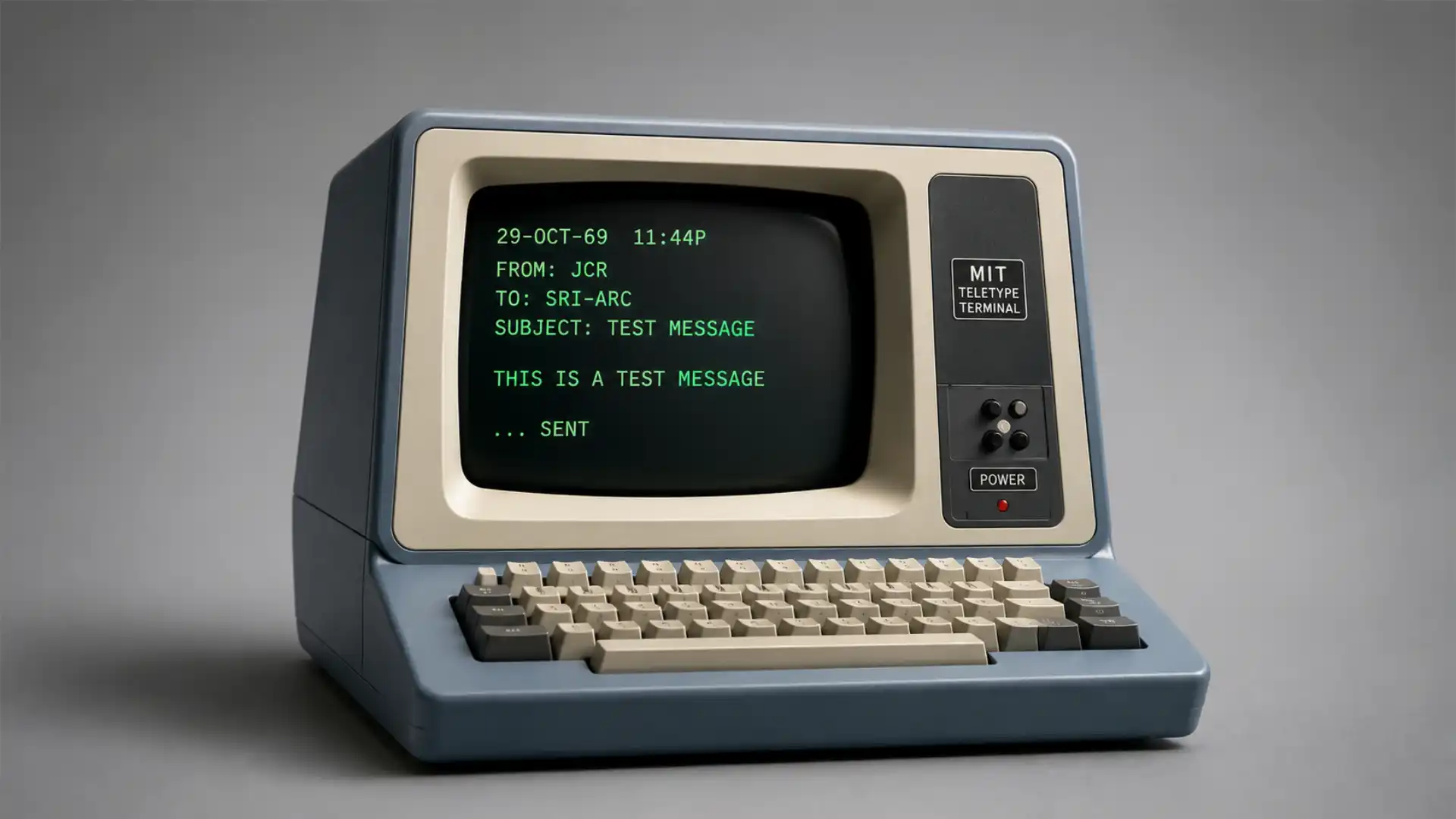
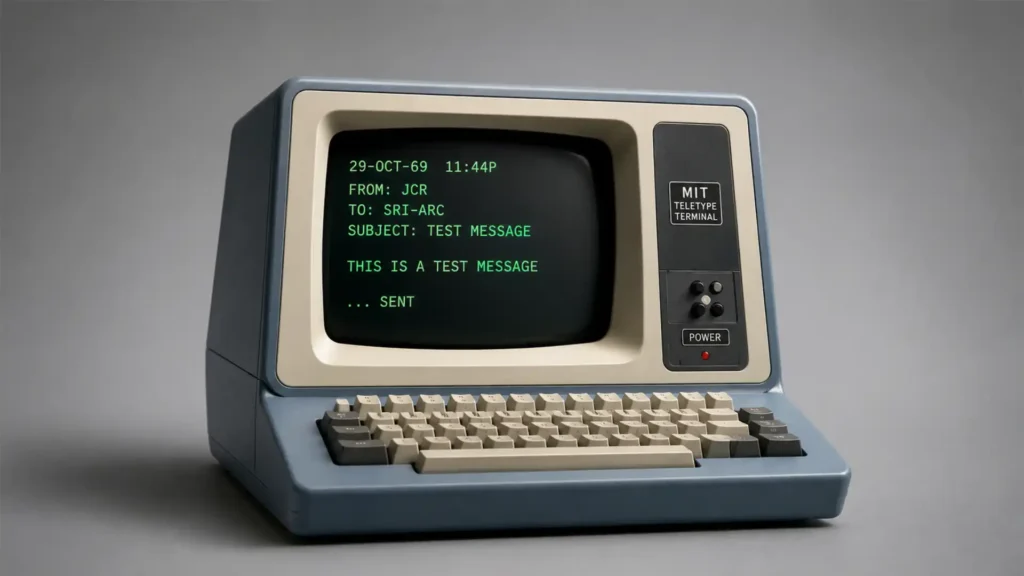
The first email did not arrive with a grand sentence, a manifesto, or even a preserved screenshot. It was probably a disposable test string sent between two nearby machines, and the person who sent it later admitted he did not remember what it said. That missing message is the best part of the story. The thing that changed communication did not announce itself. It worked, then disappeared.
Table of Contents
The Web Radar-worthy discovery here is not only Ray Tomlinson’s famous choice of the @ sign. It is the strange little online trail around the first network email: the Internet Hall of Fame profile, the old Wired interview, the RFC documents where email slowly becomes a formal object, and the repeated warning that the famous “QWERTYUIOP” line is more legend than evidence. The first email survives less as content and more as a design decision.
Open the story today and it feels almost rude in its simplicity. Tomlinson, working at Bolt Beranek and Newman, joined an existing local message program with a file-transfer program and made mail travel between different ARPANET-connected computers. The Internet Hall of Fame says he combined SNDMSG and CPYNET in 1971 and chose @ to separate the user from the host, producing the now-familiar user@host pattern.
That is the hinge. Before the first network email, electronic messages could exist without really going anywhere. People could leave messages for users of the same computer. Tomlinson’s move made the address point outside the local machine. A person was no longer just a name inside one box. A person had a name at a place.
The artifact is the absence
The first email is often treated as if it were a quote. It is better understood as a lost artifact. The message was not preserved, and Tomlinson did not treat it like history while sending it. In a 2012 Wired profile, he said the early messages were all tests, whatever came to hand while typing, and that the first one could have said almost anything.
That makes the story feel more honest than most tech origin myths. A lot of the internet began as plumbing, not performance. Nobody posed for the launch. Nobody named the category for consumers. Nobody wrote a launch post with a feature grid. A small working improvement moved through a technical community because it solved a real annoyance.
The famous “QWERTYUIOP” version remains useful as a mood, not as a transcript. It gives the right flavor but the wrong certainty. The stronger historical point is that the first message was likely a throwaway test and that its exact wording was forgotten. A 2001 Wired/Reuters piece is even rougher: Tomlinson said he had no idea what the first one was and only remembered that it was uppercase.
That missing sentence changes the way the story lands. The first email is not memorable because of what it said. It is memorable because it created a new kind of destination. The message could vanish because the address survived.
The page worth opening first
The cleanest entry point is the Internet Hall of Fame biography. It is short, plain, and unusually dense with the facts that matter. It places Tomlinson at BBN, connects him to TENEX, ARPANET, and TELNET work, then gives the key 1971 move: SNDMSG plus CPYNET, network email, and the @ sign.
What stands out is how little drama the official version needs. The page does not need to inflate the invention because the address format still speaks for itself. user@host is not nostalgic trivia. It is a structure that billions of people recognize without thinking. Even people who barely use email understand the symbol as a sign of digital reach.
The Wired profile adds the human texture the official biography lacks. Tomlinson looked at the keyboard and wanted a character that would not be confused with a username. Commas, slashes, and brackets were already risky. The @ sign was rare enough and semantically neat enough. Wired quotes him describing it as the symbol that denoted where the user was “at.”
That choice is beautiful because it was not over-designed. The @ sign was not invented for email. It was rescued by email. The symbol already existed, sitting on the keyboard like a spare part. Tomlinson gave it a modern job. The internet did not need a new glyph. It needed a boring separator that people and machines could both tolerate.
The small address decision that swallowed the keyboard
The first email story keeps pulling attention back to the address. The message is gone, but the address pattern became cultural furniture. You can see it in every login prompt, every business card, every newsletter footer, every password reset email, every old personal address that now feels like a fossil from a previous self.
The @ sign also solved a product problem before product people had a name for it. It separated identity from location in one compact gesture. A username alone was too local. A machine name alone was not a person. Put the two together and you get a reachable human inside a networked system.
That sounds obvious only because it won. Good infrastructure often becomes invisible by becoming grammatical. Nobody explains the @ sign each time they write an address. It behaves like punctuation now, not invention. Tomlinson’s decision became part of the default mental model for where a person can be found online.
The 1970s technical documents show the slow hardening of that idea. By 1973, network mail needed agreed headers because different systems were formatting author, title, and date information differently. RFC 561, co-authored by Abhay Bhushan, Ken Pogran, Ray Tomlinson, and Jim White, says the lack of standardization made incoming mail hard for programs and users to process intelligently.
That is a different kind of internet history from the heroic first. Once people start using a tool, the next problem is not invention but interpretation. Who sent this? When? What is the subject? What part is metadata and what part is the message? Email became powerful only after the network learned how to read its own mail.
The quick reading map
| Place to open | What it gives you | Why it matters |
|---|---|---|
| Internet Hall of Fame biography | The clean origin story | Establishes Tomlinson, BBN, SNDMSG, CPYNET, and @ |
| Wired 2012 profile | The human choice of @ | Shows the keyboard-level design thinking |
| Wired 2001 piece | The forgotten first message | Pushes back against a neat fake transcript |
| RFC 561 | Early mail headers | Shows email turning from trick into shared format |
| RFC 5322 | Modern message syntax | Shows the long afterlife of structured email |
The table is useful because the first email is not one page or one quote. It is a small reading trail. The official biography gives the spine, the interviews give the texture, and the RFCs show the tool becoming a common language.
The first email was older than the web by design
The first network email belongs to ARPANET, not the web. That distinction matters because email is not a web feature. It is older, more stubborn, and less visually glamorous. Browsers made the internet feel like a place. Email made the network feel like a route.
This is why the story still feels fresh. A modern reader expects the first internet object to be a page, a post, or a public file. Instead, the first email is private, terminal-based, and almost aggressively unphotogenic. It was a message sent through infrastructure before the internet had the consumer surface most people now associate with being online.
The Eduard Rhein Foundation’s account gives the old hardware texture: Tomlinson sent network email between two BBN-TENEXA machines, described as PDP-10 computers with magnetic core memory. The scene is not sleek. It is heavy, local, and experimental. The machines were close together, but the message traveled through ARPANET logic rather than a direct local shortcut.
That detail is delightful. The first network email did not need distance to prove distance. Two computers in the same room could still demonstrate the idea: a message addressed from one host to another across the network. The geography was small. The concept was not.
By 1977, RFC 733 described a syntax for text messages passed between computer users within the framework of electronic mail, superseding earlier informal standards including RFC 561 and RFC 680. The wording is dry, but the shift is huge. Email had moved from experiment to a format that needed a shared grammar.
Modern RFC 5322 still carries that inheritance. It specifies the Internet Message Format for text messages within electronic mail and says it updates earlier RFCs, including the chain that runs through RFC 822. The current document is not the first email, but it shows how long the original problem has lasted: how to make messages intelligible across systems.
The part the legend usually flattens
The simplest version says Ray Tomlinson invented email. The more careful version says he created the first network email system on ARPANET and gave email its defining address form. Wired’s 2012 profile is useful because it does not pretend there were no earlier electronic messaging systems. It notes older machine-local mail, including work on MIT’s Compatible Time-Sharing System, while drawing the line at messages that did not travel across a network.
That distinction makes the story better, not weaker. The invention was not “people send messages with computers.” The invention was “people send messages to people on other computers.” The second phrase is the one that made email feel like a network-native medium rather than a shared-machine convenience.
This is where the first email becomes a design lesson. Tomlinson did not need to invent every ingredient. He connected existing pieces in a way that changed what the pieces meant. SNDMSG already handled local messages. CPYNET handled file transfer. The new value came from joining them with a workable address scheme.
A lot of durable internet tools begin like that. They are not pure acts of creation. They are clever acts of recombination. The web did not invent text, links, documents, servers, or networks from nothing. RSS did not invent publishing or subscriptions. Email did not invent messages. The breakthrough was making a familiar act travel across a new technical boundary.
That is why this story belongs in Web Radar. It reminds you that the web’s deepest artifacts are sometimes too ordinary to notice. The @ sign is everywhere, so it stops looking designed. Email is old, so it stops looking radical. The first message is missing, so the story loses its prop. Yet the mechanism still sits underneath work, banking, accounts, receipts, alerts, newsletters, cold pitches, family updates, and password resets.
The web trail is small but rewarding
The best way to read this online is to resist the urge to find a single definitive “first email” page. There is no preserved inbox to open. There is a cluster of sources, and each one adds a different layer. The Internet Hall of Fame gives institutional recognition. Wired gives Tomlinson’s voice. The RFCs show the administrative afterlife of the idea. The Eduard Rhein Foundation gives a compact hardware-and-system description.
That reading trail has a rare quality. It does not make the past feel polished. The sources disagree in tone, not in the core fact. One page honors. One interviews. One standardizes. One remembers hardware. Together, they show how internet history actually looks when it has not been squeezed into a museum caption.
The first email story also punctures the romance of “content.” The most famous thing about the first email is not the content. The content was disposable. The addressing system was the durable object. That is a useful correction for anyone who works online now, where so much attention goes to the visible post, launch, subject line, headline, or screenshot.
Infrastructure wins quietly. A forgettable message can matter more than a memorable sentence if it proves a new route. The first email was not a great piece of writing. It was a proof that a person on one host could address a person on another. That was enough.
The story also makes the @ sign feel freshly strange. A symbol that once looked like keyboard clutter became a global locator. It crossed from accounting notation and typewriter residue into personal identity. It now lives in email addresses, social handles, and everyday speech. People say “at” as if it had always belonged to online identity.
What makes Tomlinson’s choice so sticky is that it is half technical and half human. The character had to be rare in usernames, present on keyboards, readable by people, and meaningful enough to remember. It was not branding. It was fit. That is much harder to achieve than it sounds.
The RFC documents give the story its final twist. Email became less magical as it became more usable. Headers, dates, subjects, address fields, syntax, line breaks, and parsing rules are not romantic, but they are what let independent systems treat a message as a message. The first email proved the route. The standards made the route dependable.
For readers who like hidden internet gems, this is the pleasure of opening the sources. You are not just reading about a first. You are watching a casual experiment become a convention. The movement from “I typed something and sent it to myself” to RFC-defined message structure is the internet’s whole personality in miniature.
There is also something almost comic in the scale mismatch. The first email was sent between machines near each other, and now email can cross the planet before a person finishes regretting the wording. The early test did not need a profound sentence because the system itself was the sentence.
The first email is still worth clicking because it refuses to behave like a clean origin myth. It has no preserved text, no perfect launch date, no single uncontested definition of “email,” and no grand reveal. What it has is better: a small engineering decision that became ordinary enough to disappear into daily life.
The next time an address asks for your email, the old shape is still there. Name at machine. Person at place. User at host. The first message is gone, but the grammar remains.
Author:
Jan Bielik
CEO & Founder of Webiano Digital & Marketing Agency
This article is an original analysis supported by the sources cited below
Official Biography: Raymond Tomlinson
Internet Hall of Fame profile covering Ray Tomlinson’s work at BBN, the 1971 ARPANET network email application, the combination of SNDMSG and CPYNET, and the choice of the @ sign.
Meet the Man Who Put the @ in Your E-Mail
Wired profile with Tomlinson’s own explanation of why he chose the @ sign, how the first test messages behaved, and how network email differed from earlier single-machine mail.
Don’t Trust Any E-Mail Over 30
Wired/Reuters article useful for the historical caveat that Tomlinson did not remember the first message’s exact wording and saw the first email as a modest technical beginning.
RFC 561: Standardizing Network Mail Headers
Early ARPANET mail document from 1973, co-authored by Ray Tomlinson, showing how network mail needed shared header conventions for author, date, subject, and related metadata.
RFC 733: Standard for the Format of ARPA Network Text Messages
1977 ARPANET message format standard that formalized text-message syntax for electronic mail and superseded earlier informal standards including RFC 561.
RFC 5322: Internet Message Format
Modern Internet Message Format specification showing the long standards lineage from early ARPANET email formats to the structure used by contemporary email messages.
Invention of the today so-called e-mail
Eduard Rhein Foundation article summarizing Tomlinson’s 1971 network email work, the BBN-TENEXA machines, PDP-10 context, CPYNET, SNDMSG, and the user@remote addressing idea.
| Citing this article? Brief excerpts are welcome. Please credit Webiano.digital, name the author where stated, and include a link to https://webiano.digital and to this original article. Full or substantial republication requires prior written permission. Read our Copyright and Content Use Policy. |
This article was prepared with the assistance of artificial intelligence tools. The content underwent expert human review, and Webiano Digital & Marketing Agency assumes editorial responsibility for its final version and publication.