Tetris did not begin as a brand, a franchise, a museum object, a research prompt, or a global nostalgia machine. It began as a brutally clear little idea on a Soviet computer with no real graphics, a falling-block puzzle made in Moscow by Alexey Pajitnov while he was working at the Academy of Sciences. The official Tetris timeline places the birth in Moscow in 1984 on an Electronika 60, and The Tetris Company marks June 6 as World Tetris Day, the date fans now treat as the game’s birthday.
Table of Contents
That origin is already strange enough, but the web makes it stranger. Open the right pages and Tetris stops being a familiar game and becomes a trail of early software culture, with first-person memories, licensing chaos, museum labels, psychological studies, competitive clips, and official brand machinery all stacked around one small rule set. It is the rare internet rabbit hole where every tab feels connected: the official polished timeline, Vadim Gerasimov’s personal archive, MoMA’s collection entry, The Strong’s Hall of Fame page, and modern research notes about intrusive memories.
The best reason to revisit Tetris today is not nostalgia. The best reason is that Tetris is one of the cleanest demonstrations of software escaping its original container. It moved from a research computer to floppy disks, from Moscow offices to global distribution, from Game Boy cartridges to mobile apps, from casual play to art museums, from speedrunning culture to clinical research. Very few digital objects travel that widely while keeping their central behavior almost untouched.
There is a neat trap in writing about Tetris. The game is so famous that it feels already explained. Seven shapes fall, you rotate them, lines vanish, speed rises, panic arrives. Yet fame has flattened the weirdness. Tetris is not merely a successful puzzle game. It is a tiny piece of interaction design that survived hardware shifts, state ownership, copyright confusion, platform wars, museum classification, scientific reinterpretation, and four decades of cloning. That is why it fits Web Radar so well: the web still holds the seams.
This piece follows the supplied editorial standard for human, direct, discovery-led writing. The point is not to write another ceremonial anniversary note, but to point readers toward the Tetris pages that make the old game feel newly odd.
A tiny program with suspicious staying power
The official story starts with Pajitnov, a programmer with a love of puzzles, working in Moscow in the 1980s. Tetris came from the pleasure of arranging geometric shapes, especially pentomino-style puzzles, then stripping the idea down to pieces made from four squares. The Strong’s World Video Game Hall of Fame describes the name as a blend of “tetra,” because each piece uses four squares, and “tennis,” Pajitnov’s chosen sport reference.
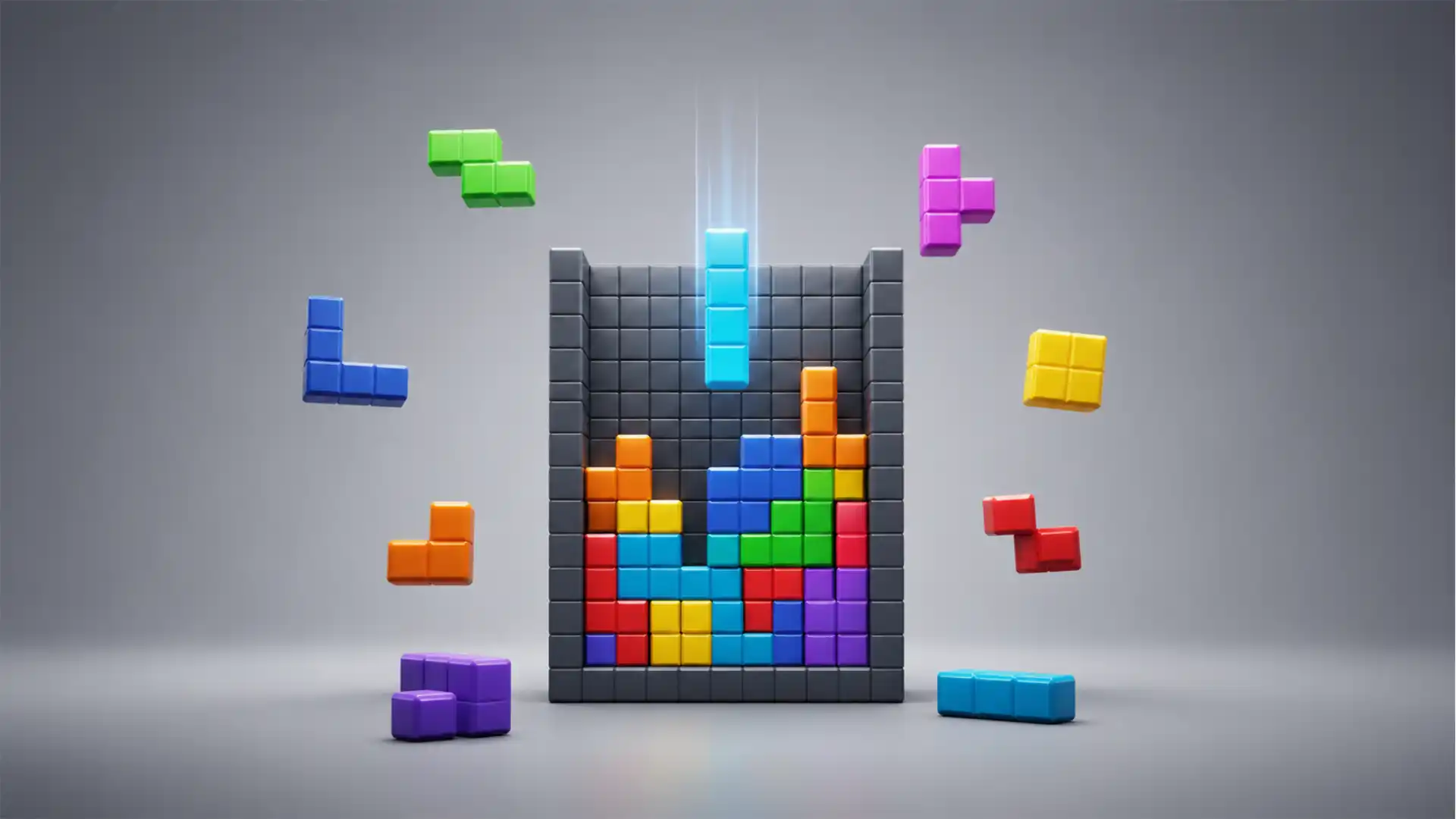
That small reduction matters. Pentominoes have twelve possible shapes, but tetrominoes have only seven, which is just enough variety to create suspense without making the game feel like homework. Tetris became legible at a glance because it did not need a fantasy world, a character sheet, a plot, or even representational graphics. The player sees a falling shape and instantly understands the problem.
The first version ran on the Electronika 60, a Soviet computer that did not give Pajitnov the visual luxury people now associate with Tetris. The early game used textual characters rather than glossy blocks, and Gerasimov remembers the Electronika draft as a monochrome alphanumeric display where the squares were drawn with bracket characters. That detail is lovely because it proves the idea did not need polish to work.
Most games lose force when stripped down. Tetris becomes more convincing when stripped down. The brackets, the empty field, the falling shape, the disappearing line: that was already enough. The game’s spell came from structure, not decoration. This is why even ugly clones often remain playable. The design does not beg for production value. It asks for timing, rotation, and regret.
Gerasimov’s page is one of the best Tetris tabs to open because it has the slightly messy texture of memory. He describes himself as a sixteen-year-old high school student pulled into the Computer Center, where he worked with Dmitry Pavlovsky and later met Pajitnov. His account is not corporate-smooth. It gives the origin story edges: young programmers, borrowed machines, informal collaboration, projects made for fun, and a Soviet environment where selling software privately felt unusual.
The page also makes clear that Tetris did not arrive as a finished monument. Gerasimov says Pajitnov made a prototype on the Electronika 60, then Gerasimov ported it to the PC, after which features continued to be added. That is a different feeling from the myth of a single lightning strike. Tetris had a core idea, then a migration path. The PC version helped it move through Moscow because floppy disks were much better carriers than memory alone.
The official Tetris history gives the cleaner public timeline: 1984 in Moscow, 1985 PC port, 1987 launch on PCs in North America and Europe, 1989 Game Boy, 1996 The Tetris Company. The pleasure of comparing that timeline with Gerasimov’s personal page is that you see the same game from two angles: brand history and workshop memory. One is polished. One is human. Both are useful.
That comparison is exactly where Tetris becomes internet-worthy again. The web preserves both the official version and the stray witness account, and the tension between them is more revealing than a neat single-source story. Tetris was a game, but it was also a file, a port, a copied disk, a workplace obsession, an export problem, a rights puzzle, and later a controlled brand.
The web trail worth opening
The first page to open is the official Tetris history, not because it is the most surprising, but because it gives the public skeleton of the whole saga. It places the first version in Moscow on an Electronika 60, notes the IBM PC port, tracks the move beyond the Soviet Union, and gives the Game Boy moment its deserved weight. The timeline is clean enough to scan in minutes.
The second page is Gerasimov’s “Original Tetris” story. This is the page that makes the game feel handmade again. It has the awkwardness and specificity of an old personal web page: memories of Turbo Pascal, PC graphics, speed problems on newer machines, early versions, friendship, credit, frustration, and the uncomfortable split between a fun project and a commercial monster. It is not just a source; it is part of the artifact.
The third page is the official playable version at play.tetris.com. It is not the most historically rich tab, but it proves the central trick still works in a browser. You open it, and the old ritual returns. The buttons, the visuals, and the scoring frame have changed, but the mental contract is almost the same: manage the falling future before it becomes an immovable past.
The fourth page is MoMA’s collection entry for Tetris. This is where the game stops looking like a pastime and starts looking like an object of design history. MoMA lists Tetris as video game software in its Architecture & Design department, with a collection entry tied to Alexey Pajitnov and the year 1984. The museum label describes the game as a geometric spatial puzzle and stresses how the Tetriminos fall into the Matrix while the player clears lines.
The fifth page is The Strong’s World Video Game Hall of Fame entry. It makes the case for Tetris as a game of global persistence rather than short-lived popularity. The Strong notes its simple rules, the rising speed, the Game Boy launch, and the way the game spread across platforms and devices. It also captures the key emotional loop: the challenge looks straightforward until the pile starts to harden against you.
The sixth page is Oxford’s research note on Tetris and intrusive memories after trauma. This is the tab that gives Tetris its strangest second life. Oxford describes a study in which a brief intervention involving Tetris was tested with motor-vehicle accident survivors within six hours of admission, with the researchers reporting fewer intrusive memories in the week after the accident among those who received the intervention. The game’s visual demand was central to the hypothesis.
None of these pages alone explains why Tetris still matters. Together they show the unusual shape of its afterlife. The official site says brand. Gerasimov says workshop. MoMA says design. The Strong says play history. Oxford says cognition. The browser turns them into one constellation.
Where the Tetris trail leads
| Page to open | What stands out | Why it matters |
|---|---|---|
| Official Tetris history | Clean timeline | Shows the public arc from Moscow to global platforms |
| Gerasimov’s archive | First-person messiness | Restores the handmade, collaborative PC-era texture |
| Play Tetris online | Immediate proof | Lets the design argue for itself in seconds |
| MoMA collection entry | Design framing | Treats Tetris as interactive software worth preserving |
| The Strong Hall of Fame | Play culture framing | Places Tetris inside a long public history of games |
| Oxford research note | Cognitive afterlife | Shows how the game became a visual task in trauma research |
The table matters because Tetris is too familiar to see from one angle. Open only the official page and it becomes a brand story. Open only the playable site and it becomes a quick distraction. Open the whole trail and the game becomes a rare case study in how a software idea moves through culture without losing its shape.
The first version is the real discovery
The most interesting thing about early Tetris is how little it needed. The first playable form did not need visual charm to become sticky. Gerasimov’s recollection of bracket-drawn blocks on a monochrome display sounds almost comic now, but it cuts to the core. Before colors, mascots, menus, and licensed packaging, the game already had the pressure system that made people stay.
That pressure system is simple but merciless. Every falling piece is both opportunity and damage. Place it well and the board opens. Place it badly and the mistake becomes architecture. A poor decision does not vanish; it waits, blocks, narrows, and shapes the next decision. Few games make past errors feel so physically present.
The field is the real antagonist. Tetris gives the player a box and lets time slowly ruin it. There is no enemy with intent. The next piece is not angry. The game does not punish in a theatrical way. It simply continues. That calmness is part of the dread. The fall speed rises, your choices shrink, and the screen becomes a record of your compromises.
The early Soviet setting adds a second layer because Tetris did not emerge from a consumer entertainment factory. It came from a research environment where programming, puzzles, and office play overlapped. Pajitnov was not building a mascot franchise. Gerasimov’s account describes a team interested in games, PC tools, conversions, and a “computer funfair” idea, all under conditions where private software sales were deeply awkward.
That is what makes the origin feel so unlike the later brand. Tetris began in a place where software could travel socially before it traveled commercially. Friends copied it. Colleagues played it. The PC port made it easier to move. The file spread before the paperwork caught up. This is a very internet-shaped pattern before the public internet enters the story.
The official timeline says the 1985 IBM PC port spread quickly through the Soviet Union. That sentence hides a whole world of informal distribution. A game that works on office computers and can be copied without physical manufacturing has a different kind of mobility from a boxed product. The object is light. The addiction is portable. The rights are messy.
Tetris is sometimes described as universal, but that word can become lazy. The stronger claim is that Tetris was mechanically portable before it was commercially global. Its rules survived weak displays, different machines, different controllers, different languages, different business systems, and later different screen sizes. The idea was not attached to one hardware identity.
The name is part of that portability. “Tetris” sounds slightly invented, slightly mathematical, and easy to remember. Gerasimov says the name was Pajitnov’s idea, a mix of tetramino and tennis, and that he thought it sounded strange in Russian. That tiny disagreement is charming because the name now feels inevitable, the way old brand names often do after decades of repetition.
Tetris also has the rare quality of being explainable without losing mystery. A person can understand the game in one sentence and still spend years getting better. Most software products lean one way: either instantly legible and shallow, or deep but hard to enter. Tetris found a cruel middle path. The rules are clean. The mastery is not.
The first version is worth caring about because it shows the shape of the idea before the surrounding culture hardened. The original Tetris was closer to a thought experiment than a media product. What happens if shapes fall forever? What happens if order can be created only temporarily? What happens if every fix creates the next problem? The answers were already there in text mode.
The design is almost annoyingly clean
Tetris has one of the great interfaces because almost everything on screen is a decision or the consequence of a decision. There is very little decorative waste in the core game. The well, the current piece, the next piece in many later versions, the score, the level, the lines. A player does not have to ask what matters. The game points with gravity.
The pieces are memorable because they sit between geometry and personality. The long I-piece feels like rescue, the square feels stubborn, the S and Z pieces feel like small betrayals. Players develop emotional relationships with shapes that have no faces, voices, or lore. That is a design miracle. The piece does not need to be animated as a character; its shape creates its temperament.
The line clear is the game’s perfect reward. It removes clutter rather than adding spectacle. Many games reward players with more: more points, more items, more visual noise. Tetris rewards by making space. The pleasure is not accumulation. It is deletion. The board breathes again.
That deletion has a tiny philosophical sting. You build only to erase what you built. A successful row vanishes. The cleaner your work, the less of it remains. Tetris turns good play into disappearance, which is why the game feels so different from construction games. It is not about making a stable object. It is about surviving the next shape.
Speed gives the game its moral pressure. At low speed, Tetris feels like planning; at high speed, it becomes recognition. The player stops calmly considering and starts seeing patterns before language catches up. Good players appear to think less, not more. The game has trained their eyes and hands into a private rhythm.
The official game vocabulary is also unusually crisp. Tetrimino, Matrix, line clear, level, hold, ghost piece in later versions. The words feel technical enough to belong to software, but not so dense that they push away casual players. Tetris has always lived between formal system and kitchen-table puzzle.
MoMA’s framing of Tetris as a two-dimensional geometric spatial puzzle is apt because the game is a design object before it is a story object. The museum label explains the Matrix, the falling Tetriminos, the ten-block horizontal line, the increasing speed, and the loss condition. That description sounds almost dry, but the dry description is the magic: nothing needs to be embellished.
The Strong’s Hall of Fame entry gets at the same point from a play-history angle. The rules are simple, but the possible play is not. The challenge begins as rotation and placement, then becomes speed management, risk appetite, recovery skill, and emotional control. The screen never changes much. The player does.
Tetris also has a rare kind of fairness. The game can feel cruel, but rarely dishonest. Yes, the next pieces can be awkward. Yes, the drought of a long I-piece can feel personal. But the player usually sees how the failure formed. The board is evidence. The stack tells the story without a replay.
That evidence is why Tetris is so watchable. A viewer can understand a player’s trouble instantly. The pile is too high. The gap is covered. The well is open. The piece is wrong. The speed is terrifying. Modern competitive Tetris works because spectators do not need a rulebook to feel the danger.
The game’s core design also resists aging because it is not tied to audiovisual fashion. A shooter from 1984 has to answer for its era’s graphics and controls; Tetris mostly does not. Make the blocks sharper, add music, adjust the scoring, create multiplayer, put it on VR, put it on a car screen, and the center remains recognizable.
That durability creates a strange problem for every official version. The more a version adds, the more carefully it must avoid smothering the original pressure. Tetris Effect works because it wraps the game in sound and light without breaking the fundamental loop. Some mobile versions feel worse when monetization or missions interrupt the clean fall-place-clear rhythm. Tetris is easy to decorate and hard to improve.
The official browser version is useful because it reminds you how quickly the loop takes over. The first minute feels casual, then the field starts collecting your personality. You see whether you are cautious, greedy, tidy, impulsive, patient, or easily baited by the promise of a four-line clear. Tetris is not a personality test, but it often behaves like one.
The rights story turned software into geopolitics
The business history of Tetris is famously tangled because the game came from a system that did not map neatly onto Western software licensing. Gerasimov’s account is especially sharp here. He writes that in the Soviet Union, private business was outlawed and the concept of intellectual property was not defined in the same way, while the Computer Center owned what was made there.
That context is not trivia. It explains why Tetris could be copied freely in one setting and fought over fiercely in another. Inside the early Moscow circle, it behaved like a shared program. Outside the Soviet Union, it became a commercial object that publishers wanted to own, package, and sell. The file crossed a border, and the meaning of the file changed.
The official Tetris timeline compresses this into a clean march: Henk Rogers discovers the game in 1988, secures handheld rights in 1989, licenses those rights to Nintendo, and the Game Boy version sells in enormous numbers. The clean timeline is true enough as brand history, but the human drama lives in the mismatch between copying culture and licensing culture.
The Game Boy moment deserves its reputation. Nintendo did not merely publish Tetris on a handheld; it made the handheld feel necessary. MoMA’s label notes that many people bought the Game Boy specifically to play Tetris, which was included with the device at release in 1989. That pairing was one of the great software-hardware matches: a portable machine with a portable puzzle.
The fit was almost too perfect. Tetris did not ask the Game Boy to be cinematic. The monochrome screen was fine. The controls were enough. Short sessions worked. Long sessions worked. The game could be played by children, parents, commuters, office workers, and people who did not think of themselves as game players. The hardware made Tetris intimate.
The rights story also changed Pajitnov’s public life. The official corporate bio says Rogers helped bring Tetris out of the Soviet Union in 1989 through a licensing agreement with Nintendo, and that Pajitnov and Rogers later formed the business relationship that became part of The Tetris Company. The company was formed in 1996 and became the exclusive source for Tetris licenses.
There is a clean brand lesson here, but it is not the usual one. Tetris became a global property after proving it could survive without centralized brand control. The uncontrolled spread came first. The licensing structure came later. This is almost the reverse of many modern digital products, which arrive with trademarks, accounts, analytics, launch campaigns, and platform agreements before the public has any attachment.
That reversal is why the Tetris story still feels alive online. You can sense the friction between the folk object and the owned object. The game belongs emotionally to everyone who has played it, but legally to a controlled rights system. That tension appears anywhere a simple digital format becomes cultural memory.
Gerasimov’s page adds discomfort to that neatness. He describes signing a paper, losing credit visibility in later documents, and having no connection to The Tetris Company. His account should be read carefully, as one person’s memory and position, but it matters because early software history often has uneven credit. A finished game can look singular while the route to that game was collaborative, improvised, and politically shaped.
The better view is not to replace one myth with another. Pajitnov is the core creator of the idea; Gerasimov’s PC port and early work helped the idea travel. The distinction matters. In software, invention and diffusion are often separate acts. Tetris needed the falling-block idea, but it also needed a version that could move through machines people had access to.
That is one reason the Tetris story belongs on the web rather than only in books or films. The web can hold contradictory textures without forcing them into one heroic arc. An official page can sit beside a personal archive. A museum note can sit beside a playable game. A research article can sit beside competitive footage. Tetris benefits from that messy adjacency.
The museum piece that still behaves like a toy
MoMA’s Tetris entry is funny in the best way because the museum has to describe a living reflex as a collection object. The page lists the work as video game software, credits The Tetris Company gift, and places it in Architecture & Design. It describes the game with the calm vocabulary of a gallery label, even though the object itself is famous for making people forget the room they are in.
The museum framing is not pretentious. Tetris belongs in design history because its interface changed how people understood games as systems. It did not win attention through simulation or narrative. It made abstraction popular. It proved that an interactive object could be emotionally gripping with almost no representational content.
MoMA’s label calls the game almost meditative when played for extended periods. That phrase lands because Tetris can feel like concentration without serenity. The player enters a loop where the outside world falls away, but the inner state is not always calm. The mind is busy, patterned, reactive, hungry for clean space. It is meditation with a rising fail state.
The Strong’s Hall of Fame entry places Tetris in public play culture rather than museum design. Its description stresses simple rules, endless play possibilities, and broad platform reach. This is the other half of the story. A design museum can explain why the object is elegant. A play museum can explain why people kept returning.
The distinction matters because Tetris is not frozen. A painting in a collection remains materially stable; Tetris keeps being reimplemented. The version in a museum entry is not the same experience as the Game Boy pack-in, the NES version used in classic competition, Tetris Effect, mobile Tetris, or the browser version. The work is partly the rules and partly the ongoing act of translation.
That makes preservation tricky. To preserve Tetris is not only to store code; it is to preserve timing, input feel, display behavior, sound, scoring rules, and player expectations. The same shapes on a sluggish touchscreen do not feel like the same game as a crisp handheld version. Software preservation is full of these small betrayals.
The museum entry also reminds us that Tetris became a design reference because it did not look like most cultural exports. It was Soviet-born, abstract, nonviolent, and instantly understandable across language barriers. The game did not need translation in the usual sense. The falling piece translated itself.
That portability explains why Tetris is so often used as a metaphor. People say they are playing Tetris with luggage, furniture, calendars, warehouse shelves, city apartments, and browser tabs. The metaphor works because the game gave people a shared mental model for fitting awkward things into limited space under time pressure. Few games enter ordinary language that cleanly.
It also explains why brands keep reaching for Tetris collaborations. The shapes are more than game pieces; they are a visual grammar for order under constraint. Put Tetriminos on bags, sneakers, fridges, stamps, puzzles, drones, or delivery trucks, and the reference is immediate. The official 2026 World Tetris Day note even points to brand partnerships, new play formats, competitions, and a La Poste campaign tied to truck-packing capacity.
Some of that modern licensing world feels far from the bracket blocks of the Electronika 60. Yet the reason those collaborations work is still the same old recognition. A Tetrimino does not need explanation. It carries the game’s logic in its silhouette.
Tetris is one of the few games that can be both deeply commercial and oddly pure. The brand around it can become loud, but the grid still resets everything. Once the piece starts falling, the player is back inside a strict little room where marketing cannot help. The stack either works or it does not.
The browser still proves the point
The official playable Tetris page is sparse as a source, but as an experience it is the quickest demonstration of the game’s survival. A reader can open the page, play for a minute, and understand why a Soviet office experiment became a global habit. The game does not require ceremony. It begins as soon as the shapes fall.
Browser Tetris also feels right because Tetris has always been a game of migration. It moved from Electronika to PC, from PC to consoles, from cartridge to phone, from standalone software to web page. Running it in a tab is not a betrayal of its origin. It is another port in a lifetime of ports.
The browser version turns Tetris into a small act of resistance against bloated software. So much of the web now asks for accounts, permissions, onboarding, notifications, subscriptions, and patience. Tetris asks whether you can place the L-piece without ruining the well. The contrast is refreshing. A complete interactive system appears without explaining itself for five screens.
The game also reminds us how strong a single mechanic can be. Modern digital products often confuse depth with feature count. Tetris does the opposite. Its depth comes from repeat exposure to a narrow problem. The seven pieces do not expand into hundreds. The field does not become a map. The core problem tightens.
That tightness is why the game has become useful outside entertainment. Oxford’s trauma-memory research note is striking because it treats Tetris as a visually demanding task, not as a nostalgic toy. The study described by Oxford involved accident survivors who briefly recalled the traumatic memory and then played Tetris as part of an intervention, with fewer intrusive memories reported over the following week than controls.
This should not be misread as “play Tetris and trauma is solved.” The Oxford page itself says the work was early and needed further research. The point for Web Radar is narrower and more interesting: Tetris has a cognitive profile strong enough that researchers keep finding reasons to test it. A falling-block puzzle became a tool for studying memory, attention, and visual processing.
That second life makes sense. Tetris occupies the visual mind aggressively. The player rotates shapes before they land, imagines fits, anticipates gaps, and keeps scanning the field. Anyone who has played too long knows the afterimage effect: shapes seem to fall behind the eyes after the session ends. The game lingers because it trains perception into a temporary habit.
The web is full of games that are easier to forget than to close. Tetris has the opposite problem: it is easy to close and hard to stop thinking about. The browser tab may disappear, but the mental grid remains. That quality links the original office addiction to the Game Boy boom and to modern research interest.
The official 2026 World Tetris Day post shows how far the brand has expanded: competitions, mobile events, streaming documentaries, partnerships, and new ways to play. The odd part is that the center still does not move very much. The current ecosystem is enormous, but it keeps orbiting a narrow mechanic from the 1980s.
This is why Tetris remains a better web discovery than many new sites. It lets the reader rediscover something known by opening the right supporting pages. The game itself is familiar. The trail is not. The archive layer, museum layer, brand layer, research layer, and playable layer make the familiar object strange again.
Why it still feels like the web at its best
Tetris feels web-native even though it predates the web because its story is about copying, porting, remixing, arguing, preserving, and replaying. Those are web behaviors. A small file moves. People adapt it. Credit gets disputed. Communities form. Institutions classify it. Fans compete. Researchers reinterpret it. The artifact keeps loading.
The game also proves that a digital object can be tiny and culturally huge. Tetris does not need a cinematic universe because it is a complete universe of constraint. The board is narrow. The shapes are few. The rules are fixed. Yet the emotional range is broad: relief, panic, greed, regret, focus, flow, collapse.
That is why Tetris still cuts through. It makes the player care about empty space. Most interfaces push content into every gap. Tetris teaches the opposite lesson: leave room, protect the well, do not create holes you cannot reach. A good Tetris board is not full. It is prepared.
There is a product lesson hiding there, but it should not be overstated. Tetris is a reminder that constraints can make software clearer. The game’s power comes from what it refuses: no avatar, no story, no map, no inventory, no dialogue tree, no lore wall. It trusts the player to find drama in geometry.
The web could use more of that trust. Many sites explain themselves until nothing is left to discover. Tetris gives you the system and lets your hands learn. You do not need a motivational onboarding sequence to understand the cost of a covered gap. The feedback is immediate and unsentimental.
The historical trail gives the game another kind of depth. The official page shows how institutions narrate success; Gerasimov’s page shows how success feels from inside a messy origin. MoMA gives the design language. The Strong gives play culture. Oxford gives the cognitive angle. Each page reframes the same falling pieces.
That makes Tetris a perfect Web Radar subject. It is not a hidden site, but it is a hidden web experience when approached as a set of tabs. The discovery is in the arrangement. Like the game itself, the pieces matter because of how they fit.
The June 6 anniversary is a clean hook, but the better reason to open these pages is that Tetris still explains the internet’s favorite kind of object: small enough to spread, strong enough to mutate, simple enough to imitate, deep enough to endure. It is software as a shape that keeps falling through culture and somehow keeps landing.
Author:
Jan Bielik
CEO & Founder of Webiano Digital & Marketing Agency
This article is an original analysis supported by the sources cited below
The History of Tetris
Official Tetris timeline covering the game’s Moscow origin, IBM PC port, global release, Game Boy breakthrough, and later brand milestones.
Corporate Bios
Official biographical page for Alexey Pajitnov and Henk Rogers, used for creator background, the 1984 creation context, and the later business structure around The Tetris Company.
Original Tetris Story and Download
Vadim Gerasimov’s first-person account of the early PC version, the Computer Center setting, the Electronika 60 prototype, Turbo Pascal work, and credit disputes.
Play the Official Tetris Game for Free
Official browser-based Tetris page, used as the current playable web reference for the article’s discovery angle.
Alexey Pajitnov. Tetris. 1984
MoMA collection entry framing Tetris as video game software and interactive design, with notes on the Matrix, Tetriminos, Game Boy release, and broad adaptation.
Tetris
The Strong National Museum of Play’s World Video Game Hall of Fame entry, used for public play-history context and the explanation of Tetris’s enduring rules.
Tetris used to prevent post-traumatic stress symptoms
University of Oxford research news page on Tetris as part of a brief visual intervention tested with motor-vehicle accident survivors.
The Tetris Company Celebrates World Tetris Day with New Ways to Play, Global Fan Activations and Award-Winning Partnerships
Official 2026 World Tetris Day announcement, used for current brand context, sales/platform claims, competitions, partnerships, and modern play formats.
| Citing this article? Brief excerpts are welcome. Please credit Webiano.digital, name the author where stated, and include a link to https://webiano.digital and to this original article. Full or substantial republication requires prior written permission. Read our Copyright and Content Use Policy. |
This article was prepared with the assistance of artificial intelligence tools. The content underwent expert human review, and Webiano Digital & Marketing Agency assumes editorial responsibility for its final version and publication.