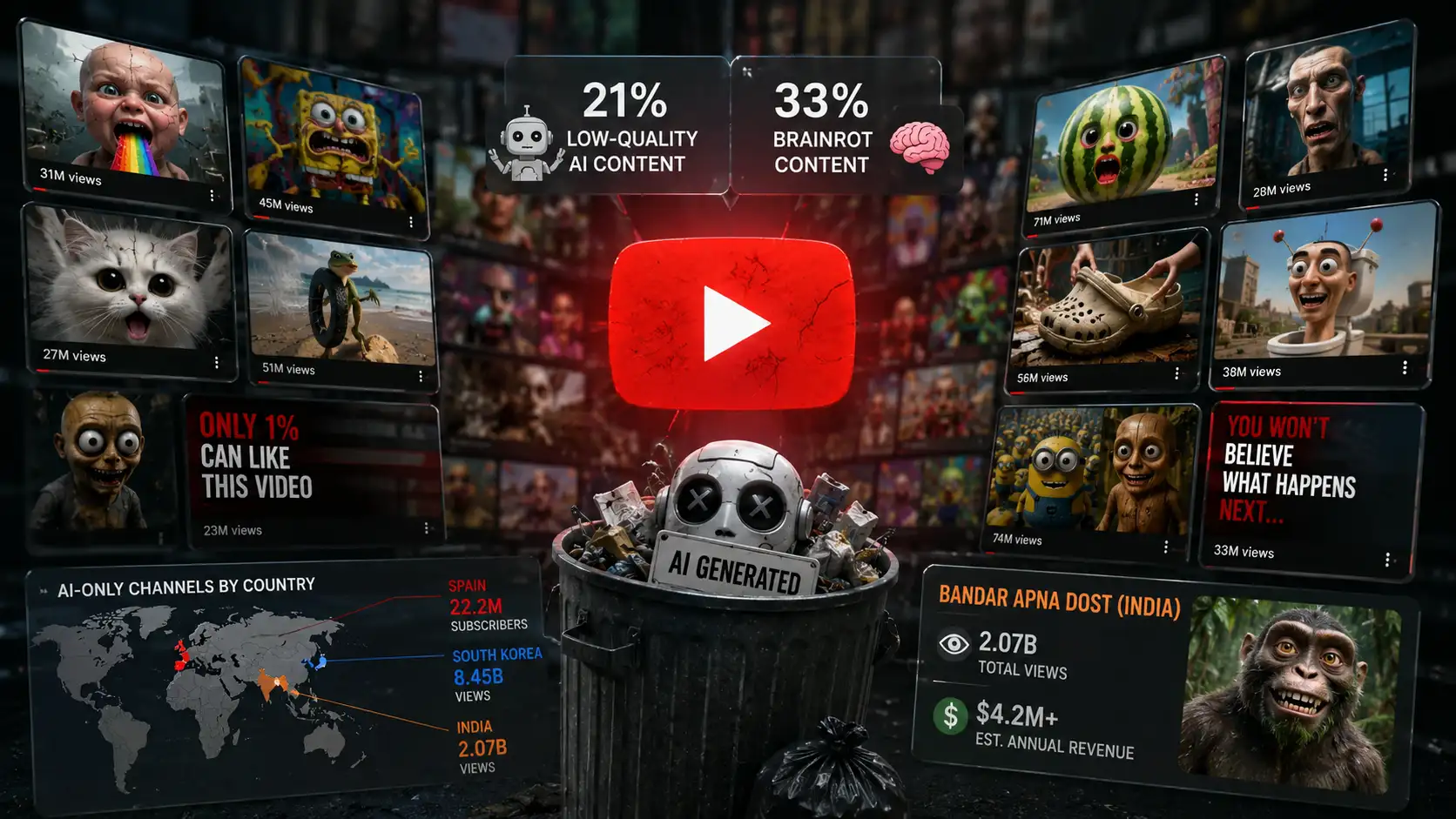
Kapwing’s report landed because it gave a number to something many YouTube viewers had already felt in the feed: the creeping presence of videos that look manufactured, sound synthetic, and feel designed less to communicate than to hold a thumb in place. In its test, Kapwing created a new YouTube account and cycled through the first 500 Shorts. It classified 104 videos, or 21 percent, as AI slop, and 165 videos, or 33 percent, as brainrot. The company also analyzed the top 100 trending YouTube channels in every country, identified channels it considered AI slop, and used Social Blade estimates to approximate subscribers, views, and annual revenue. Kapwing says its data was correct as of October 2025.
Table of Contents
The figure that should worry YouTube is not only 21 percent
That does not prove that 21 percent of all YouTube videos are low-quality AI content. It proves something narrower and still serious: in one new-user Shorts feed, a large share of early recommendations came from a category of content whose production cost has collapsed and whose business model depends on repetition, speed, and feed placement. The distinction matters. A platform-wide claim would require a much larger, independently audited sample across countries, languages, devices, time windows, account states, and user behaviors. Kapwing’s result is a snapshot, not a census.
The snapshot is still powerful because new-user recommendations are the front door of YouTube. A new account has no deep watch history. It has not trained the system through months of subscriptions, searches, likes, dislikes, skips, long watches, and abandoned videos. The recommender has to work with weak signals, broad popularity patterns, local trends, and early session behavior. If low-quality AI videos show up heavily in that stage, the issue is not just taste. It is onboarding. It is the first impression of the largest video platform in the world.
The larger finding is not that AI exists on YouTube. AI has legitimate uses in script drafting, dubbing, translation, accessibility, editing, visual experimentation, background generation, and production planning. YouTube itself is building AI into its creator tools and says Shorts now averages 200 billion daily views. The problem is the industrialization of low-effort output. A creator with taste and accountability uses AI as one part of a creative process. A slop operation uses AI as the process.
The platform’s dilemma is sharp. YouTube wants to support creators using new tools. It also wants advertisers, families, regulators, and serious creators to believe the feed is not turning into a machine-filled attention dump. Those goals now collide inside Shorts, where the cost of production is low, the reward for rapid testing is high, and recommendation systems measure behavior faster than editorial judgment can catch up.
AI slop is an economic category before it is an artistic insult
The term “AI slop” is emotionally loaded, but the strongest definition is not aesthetic. It is economic. AI slop is content produced at scale with minimal human judgment, minimal original value, and a primary purpose of harvesting attention, subscribers, traffic, or ad revenue. Some AI slop looks surreal and funny. Some looks childish. Some looks vaguely inspirational. Some imitates news, history, religion, animal rescue clips, disaster footage, motivational shorts, children’s cartoons, or dramatic moral tales. The common feature is not the genre. It is the production logic.
Kapwing defines AI slop as careless, low-quality content generated with automated applications and distributed to farm views or subscriptions or influence opinion. It defines brainrot as compulsive, nonsensical, low-quality video content that corrodes attention while watching, often generated with AI. Those definitions are broad, but they point to the same mechanism: a feed optimized for repeated micro-engagement can reward content that is cheap to produce and easy to consume even when it adds little value.
Calling this an economic category avoids a weak argument. The issue is not whether a video was made with AI. A thoughtful animated history explainer built with AI assistance may carry research, structure, editing, correction, narration, and human accountability. A musician may use AI for stems, drafts, or visual experiments without producing slop. A small educator may use synthetic voice because they cannot afford studio narration. A disability advocate may use AI tools for accessibility. A non-English creator may use AI dubbing to reach new audiences. None of that is the same as a channel that mass-produces dozens of nearly interchangeable shorts with recycled prompts, repeated characters, fake stakes, and minimal oversight.
YouTube’s own policies already reflect this distinction, even if they do not use the cultural term “slop” as the main regulatory unit. The platform’s monetization rules say channels should not rely on similar repetitive content with low educational value, commentary, narratives, or minimal variation, nor on mass-produced content using a repeated template. YouTube also says reused content must add original commentary, substantive modification, or educational or entertainment value.
That language matters because it places the core problem outside the AI label. A non-AI channel could violate those rules by uploading recycled clips or repetitive slideshow videos. An AI-assisted channel could comply if each video is genuinely original, varied, transparent, and useful. The distinction is quality, originality, and viewer value, not the presence of software.
Yet generative AI changes the scale. Before text-to-video, image generation, synthetic voice, automated editing, and batch prompt workflows, low-effort video still required more manual assembly. Cheap content existed, but the friction was higher. Now a slop operator can generate hundreds of variants around one proven formula: heroic monkey rescues a child, tiny dog defeats a monster, fake flood tragedy, supernatural football star, religious quiz, baby in space, cartoon animal court drama, fake medieval fact, or AI historical witness. The pattern is simple: find a high-retention emotional shape, generate endless skins around it, and let the feed test the winners.
That is why “slop” is not only an insult. It is a description of a market failure. When production cost falls near zero and distribution is algorithmic, the feed becomes a testing ground for attention arbitrage. The winning content does not need to be good in the editorial sense. It only needs to be good enough to delay the next swipe.
Kapwing’s study is useful because its limits are visible
The Kapwing report should be read with care. The company is not a neutral public agency. It is a video-editing business with an obvious commercial interest in the creator economy. Its definitions require human judgment. Its new-account feed test used one account and one run of 500 Shorts. Its global channel analysis relied on the top 100 trending channels in each country and third-party revenue estimates. These limits do not make the report useless. They make it interpretable.
The most useful part of the report is that Kapwing discloses its basic method. It says researchers manually identified top trending YouTube channels by country, isolated AI slop channels, retrieved view, subscriber, and revenue estimates from Social Blade, aggregated figures by country, and created a new account to examine the first 500 Shorts. It also states that its data was correct as of October 2025.
A cautious reading should separate three claims. The first is directly observed within the test: 104 of 500 Shorts shown to one new account were classified as AI-generated slop, and 165 of 500 were brainrot. The second is a derived channel-level claim: Kapwing identified AI slop channels among trending channels and aggregated their audience metrics. The third is a broader social claim: low-quality AI content is becoming a major feature of video platforms. The first claim is the strongest. The second is useful but depends on classification and third-party estimates. The third is plausible and supported by other reporting, but still needs broader platform data.
The Guardian’s later reporting gave the study more reach and added context. It reported that Kapwing surveyed 15,000 popular channels, found 278 that contained only AI slop, and estimated that those channels had more than 63 billion views, 221 million subscribers, and about $117 million in annual revenue. It also reported that YouTube said it had terminated one AI slop channel identified in the study and removed others from monetization programs.
The stronger editorial conclusion is not “Kapwing has measured YouTube exactly.” It is “Kapwing has produced a credible warning signal that deserves independent testing.” The platform itself has the data needed to answer the question cleanly. YouTube can measure synthetic-content labels, upload patterns, view velocity, retention curves, originality signals, monetization status, user reports, repeat-template clustering, and recommendation exposure by account type. Outside researchers cannot see that full picture.
That opacity is central to the debate. Researchers can sample feeds, scrape public data, inspect channels, and compare visible metrics. They cannot easily observe internal ranking scores, removal decisions, label enforcement, monetization reviews, or the denominator of total exposure. Kapwing’s study becomes news because platforms do not routinely publish clear, independently auditable AI-content exposure data.
A mature response from YouTube would not be a vague denial or a narrow enforcement anecdote. It would be a dashboard-quality answer: exposure rates for synthetic videos by format, age setting, country, account maturity, topic, monetization status, and label status; the share of AI-only channels in fast-growing cohorts; the share of recommended watch time attached to repetitive AI templates; and the rate at which such channels lose monetization. Without that, every external study remains a flashlight in a warehouse.
The new-user feed is the most sensitive test
A new YouTube user is not a blank human being, but the account is close to a blank recommendation profile. The system may have region, device, language, broad popularity signals, app context, and immediate session behavior. It does not yet have a rich history of personal satisfaction. That makes the first few hundred Shorts a revealing place to look for default incentives.
YouTube says recommendations work by comparing a viewer’s habits with those of similar viewers and by using signals such as clicks, watch time, survey responses, shares, likes, and dislikes. The company has also said recommendations drive more viewership than subscriptions or search. When those signals are thin, the system must lean more heavily on what performs broadly, what is rising fast, what similar early sessions suggest, and what keeps people watching.
That is exactly where AI slop can win. Many slop videos are engineered for first-second capture. They begin with a strong visual contradiction: a monkey in human clothes, a tiny pet facing a monster, a baby in danger, a fake disaster, a religious figure in a game-like moral test, an impossible animal rescue, or a grotesque scene that feels wrong enough to inspect. The viewer may not value the video, but value is not always visible in the first seconds. The first action is often not appreciation. It is hesitation.
In short-form feeds, hesitation is data. A user pauses for two seconds instead of swiping immediately. The video survives. A user watches until the bizarre outcome. The video gains completion. A user replays because the scene makes no sense. The video gains a stronger signal. A user comments “what did I just watch?” The video gains engagement. A user shares it ironically. The video gains distribution. None of these behaviors prove satisfaction in a deep sense. They prove that the content produced measurable friction in the attention stream.
YouTube has long said it moved beyond raw clicks and watch time toward satisfaction and “valued watchtime,” including surveys. The company said in 2019 that it had changed recommendation systems to reduce clickbait and was working to reduce borderline content that comes close to violating policies. The AI slop problem is a new version of an old challenge: the behavior that is easiest to measure is not always the behavior that reflects user welfare.
New-user feeds also matter because they shape future personalization. A fresh account exposed to low-quality AI content may interact accidentally, ironically, or briefly, then receive more of it. The feed can learn the wrong lesson. The user did not ask for AI animal melodrama; they just failed to swipe fast enough. A system built to infer preference from behavior may mistake confusion for demand.
That risk is higher with children, older adults, casual users, and people using YouTube for passive relaxation. These viewers may not actively tune their recommendations. They may not use “not interested,” history controls, channel blocking, or report tools. The feed becomes less a chosen media diet than an ambient stream. If the default stream contains a heavy dose of synthetic junk, the platform’s claim to be a creator economy starts to weaken.
Shorts gives slop the perfect habitat
Shorts is not the only place AI slop appears, but it is the format where slop’s advantages become strongest. A long video asks for structure. It needs pacing, argument, continuity, voice, retention over minutes, and a reason to stay. A Short can succeed with a single visual hook and a primitive payoff. It does not need a deep premise. It needs interruption.
The format rewards speed. A creator can test dozens of hooks in a week, keep the winners, and copy their structure. AI tools are well-suited to that rhythm. Prompt, generate, edit, caption, post, repeat. If a generated character works, keep it. If a sound works, reuse it. If a plot shape works, swap the animal, disaster, location, color palette, or moral frame. The channel becomes a lab for template mutation.
YouTube says monetizing partners can earn revenue from ads viewed between videos in the Shorts Feed, and that Shorts monetization is governed by channel monetization rules, Community Guidelines, advertiser-friendly guidelines, copyright rules, and AdSense policies. It also lists non-original Shorts, fake views, and views inconsistent with advertiser-friendly rules as ineligible for Shorts payment calculations.
The challenge is that slop is not always clearly non-original in the old sense. It may not steal a clip from a movie. It may not reupload a TikTok. It may not violate copyright in an obvious way. It may be technically new output produced by a model from a prompt. The repetition is conceptual, not file-based. The sameness lives in the workflow, the template, the narrative skeleton, the visual grammar, and the channel’s production behavior.
That makes enforcement harder. A human reviewer can see that a channel is repetitive. An automated system can cluster patterns, detect near-identical scripts, identify synthetic voices, compare scene structures, and measure upload velocity. Yet slop producers can mutate details enough to avoid simple duplication detection. The platform must distinguish between a legitimate series and a factory. A cooking channel also uses repeated format. A language-learning channel also uses templates. A children’s educator may use recurring characters. The line cannot be “repetition exists.” The line has to be whether repetition serves a viewer need or merely masks mass production.
Shorts also makes weak disclosure less useful. In a long video, a label in the description might be noticed by a viewer who opens details. In Shorts, the consumption mode is faster, more immersive, and less reflective. YouTube’s May 2026 update moves AI labels for Shorts onto the video itself as an overlay for photorealistic and meaningfully altered or generated content. That is a better placement. It still does not answer whether the video is worth recommending.
The deepest issue is not that Shorts contains AI. It is that Shorts lowers the minimum viable unit of content to something that machines can flood. When the feed accepts tiny units, production automation can overwhelm human-scale creation. A person can make one thoughtful video. A factory can make 500 variants.
The global map points to arbitrage, not only taste
Kapwing’s country-level findings are striking because they show a global attention market, not a narrow U.S. culture story. It reported that Spain’s trending AI slop channels had a combined 20.22 million subscribers, the highest subscriber total among countries in its analysis. South Korea’s trending AI slop channels had 8.45 billion views, the highest view total. India’s Bandar Apna Dost had 2.07 billion views and estimated annual earnings of $4.25 million, making it the most-viewed AI slop channel in Kapwing’s dataset.
Those numbers are not only about national taste. They reveal how language, monetization, local content gaps, platform payout differences, production labor costs, and viral formats interact. A channel based in one country can target viewers in another. A Spanish-language channel may operate from the United States. A nonverbal animal video can travel across borders because it does not require translation. A children-oriented animation can reach many markets without linguistic complexity. A bizarre visual story can work anywhere because the premise is visible in the thumbnail and first frame.
The economics are especially attractive in lower-cost production environments. If a creator or small operation can produce videos cheaply and earn revenue tied to global views, the upside is enormous. Even if most videos fail, the cost of failure is low. One viral template can carry the channel. The business starts to resemble search arbitrage, content farming, and programmatic media buying more than traditional video creation.
The Guardian described a semi-organized ecosystem in which people exchange tips through Telegram, WhatsApp, Discord, and message boards, sell courses, and teach others to produce slop that earns money. This detail matters. Once a tactic becomes teachable, it spreads. A creator does not need to invent a format. They can buy a workflow. That workflow may include prompt packs, AI voice tools, thumbnail formulas, upload schedules, keyword advice, and monetization tricks. The factory model becomes franchisable.
Global slop also complicates enforcement. A platform policy written in English has to be applied across languages, cultural references, religious themes, children’s genres, parody forms, synthetic voices, and local political contexts. A reviewer may not understand whether a video is harmless nonsense, manipulated news, targeted misinformation, religious exploitation, children’s bait, or a local meme. Automation helps at scale, but it can miss context or overreach.
A nonverbal AI animal video may look harmless compared with political deepfakes or medical misinformation. Yet a platform filled with harmless-looking junk still has costs. It consumes attention. It crowds out original creators. It changes user expectations. It teaches children that media does not need coherence. It trains creators to chase machine-readable hooks instead of human substance. It pushes advertisers into environments where the surrounding content may feel cheap, uncanny, or brand-unsafe.
The country map is a warning that AI slop is not a fringe English-language meme. It is a distributed business model. It moves wherever the cost of production, the hunger for income, the availability of tools, and the recommender’s appetite meet.
The first compact view of the evidence
Kapwing’s main reported findings
| Finding | Reported figure | Why it matters |
|---|---|---|
| AI slop in first 500 Shorts for a new account | 104 videos, 21% | Shows heavy exposure in one new-user test feed |
| Brainrot in first 500 Shorts | 165 videos, 33% | Captures the wider category of low-value attention content |
| Spain’s trending AI slop subscribers | 20.22 million | Suggests large subscriber concentration in Spanish-language or Spain-ranked channels |
| South Korea’s trending AI slop views | 8.45 billion | Shows extreme view concentration in one national trending sample |
| Bandar Apna Dost views | 2.07 billion | Illustrates the scale possible for one AI-heavy channel |
| Bandar Apna Dost estimated annual revenue | $4.25 million | Shows why creators copy the model |
This table does not make Kapwing’s sample a complete platform audit. It shows the size of the warning signal: a new-user feed sample, global trending-channel analysis, and revenue estimates all point in the same direction.
Monetization turns bad media into rational behavior
The phrase “trash AI content” makes the problem sound like bad taste. The stronger interpretation is colder: bad media becomes rational when the platform pays for attention and the cost of production collapses. A channel operator does not need to love the content. They need the spreadsheet to work.
Short-form monetization is not the same as long-form pre-roll advertising, but it still creates a pool of money attached to eligible Shorts engagement. YouTube’s Shorts monetization policy says monetizing partners can earn from ads viewed between videos in the Shorts Feed. It also says eligible Shorts views are filtered, and non-original Shorts or fake views are examples of views that may be ineligible. Even with filtering, a channel that generates massive legitimate views can become lucrative.
That creates a feedback loop. A slop operator tests many videos. The videos that hold attention are replicated. Replication yields more uploads. More uploads create more chances for a viral hit. Viral hits create subscriber growth. Subscriber growth improves early distribution. Revenue funds more tools, outsourcing, and experimentation. Other operators copy the format. The feed receives more of the same. Users engage because the content is strange, emotionally blunt, or easy to watch. The system sees engagement.
This is the familiar structure of content farming, but AI changes the unit economics. In the old web, low-quality articles were produced cheaply for search traffic. In social video, low-quality clips were scraped, remixed, or edited. With generative AI, the operator can produce synthetic material that is new enough to pass simple duplication checks, visually arresting enough to get a pause, and cheap enough to discard if it fails.
For honest creators, this is not a fair contest. A wildlife artist filming real nest boxes, a science educator testing a demonstration, a local journalist verifying a story, or a small animator hand-building scenes faces time, cost, skill, and accountability. A slop channel faces prompt throughput. The platform may claim the best work rises, but discovery is scarce. Every low-effort video shown is one slot not shown to someone else.
The advertiser problem is also real. YouTube’s business depends on brands trusting the environment. The platform can place ads between Shorts rather than directly beside every individual clip, but users experience the feed as one environment. If the surrounding feed feels synthetic, repetitive, or childish in the wrong way, brand perception suffers. Advertisers do not want their budgets funding a race to the bottom, even indirectly.
YouTube has already built monetization rules that point in the right direction. The difficulty is applying them with enough precision. A blanket crackdown risks hurting legitimate AI-assisted creators. A weak crackdown invites more factories. The ideal enforcement target is not “AI video.” It is industrialized, low-variation, low-value, template-driven output that exploits the feed.
Repetition is the real fingerprint
Low-quality AI channels often reveal themselves less through one video than through the channel archive. One clip may look like a quirky animation. Fifty clips show a factory. The same character. The same emotional beats. The same camera language. The same moral setup. The same rescue. The same enemy. The same fake stakes. The same synthetic laugh track. The same title grammar. The same upload cadence. The same thumbnail composition.
YouTube’s monetization policy already names this pattern. It warns against channels whose content is only slightly different from video to video, says the substance of each video should be relatively varied, and lists mass-produced template content as not allowed for monetization. That is the strongest policy hook against AI slop.
The hard part is operational. Repetition can be useful. News channels follow formats. Educational channels use templates. Children’s shows use recurring characters. Comedy sketches repeat premises. Language-learning channels repeat drills. Sports channels repeat match breakdown structures. A rule against repetition alone would punish creators who build recognizable formats.
The better test is a combination of variation, authorship, and purpose. Does the channel add new research, commentary, performance, reporting, explanation, craft, or narrative development? Does the creator appear to make editorial decisions? Does the viewer gain something beyond the sensory hook? Are the videos meaningfully different in substance? Is the AI output checked, corrected, and framed? Does the channel disclose synthetic media where required? Does it avoid misleading thumbnails and metadata? Does it target children with manipulative or incoherent content? Does it mass upload at a rate that suggests minimal review?
A slop channel often fails these tests. Its variation is superficial. Its authorship is invisible. Its purpose is retention. Its disclosure may be absent or buried. Its titles may overpromise. Its scenes may be nonsensical. Its upload rate may be extreme. Its comments may show confusion rather than appreciation. Its appeal may rest on absurdity, shock, pseudo-cuteness, or fake emotional urgency.
Detection can use these fingerprints. Platforms can cluster videos by narrative structure, generated character identity, synthetic voice, repeated prompts, upload velocity, and retention curve anomalies. They can compare channel-level sameness instead of treating every video as isolated. They can build review queues for channels whose archives show low variation and high synthetic probability. They can reduce recommendation exposure while reviews occur, rather than waiting for full removal decisions.
This matters because slop is adaptive. If the rule is “label AI,” slop labels. If the rule is “avoid exact duplicate scripts,” slop changes words. If the rule is “no reused clips,” slop generates new scenes. The more stable fingerprint is the business model: large-scale production of minimally varied synthetic videos designed to exploit attention signals.
Labels are transparency tools, not quality controls
YouTube’s AI-label policy is a transparency step, not a cure for low-quality AI. In March 2024, YouTube introduced a Creator Studio disclosure tool requiring creators to disclose realistic altered or synthetic content that viewers could mistake for a real person, place, scene, or event. YouTube said it would not require disclosure for clearly unrealistic, animated, special-effects content, or AI used for production assistance such as scripts, ideas, or captions.
On May 27, 2026, YouTube announced more visible AI labels. For long-form videos, labels for photorealistic and meaningfully AI altered or generated content move directly below the video player, above the description. For Shorts, the label appears as an overlay on the video itself. YouTube also said that starting in May 2026 it is rolling out internal signals to identify AI-generated content and automatically apply labels when a creator does not specify AI use but the systems detect major photorealistic AI use. It said disclosure labels alone do not change how a video is recommended or whether it is eligible to earn money.
That last point is crucial. A label answers “how was this made?” It does not answer “is this worth watching?” A synthetic disaster clip that is labeled may still be low-value fear bait. A labeled AI animal drama may still be repetitive children’s junk. A disclosed AI history video may still be historically false. A non-labeled animated slop video may avoid prominent disclosure because it is not realistic. The label is about synthetic status, not editorial value.
The policy also creates a gap around non-realistic AI content. Many brainrot videos are fantastical, animated, or visibly impossible. A monkey in absurd human situations, a baby floating in space, or a dog fighting a monster may not be realistic enough to require the most visible disclosure. Yet those videos may still be mass-produced AI slop. If a large share of the slop economy is animated or absurd, disclosure rules aimed at realistic synthetic media will only touch part of the problem.
YouTube’s Help Center says creators must disclose AI-generated or meaningfully altered content when it appears realistic, and that YouTube may automatically apply labels for content made with its own AI tools, content containing C2PA metadata, or content its internal systems detect as AI-generated or altered. It also warns that repeated failure to disclose may lead to penalties, including content removal or suspension from the YouTube Partner Program.
The platform is right to separate disclosure from reach. A labeled video should not automatically be punished if it is original, useful, entertaining, or artistic. But the inverse is also true: a disclosed video should not automatically be treated as acceptable for broad recommendation. Transparency is a minimum. Feed quality requires ranking decisions, monetization decisions, and channel-level accountability.
The recommendation system faces an old problem in a new costume
YouTube has spent more than a decade trying to move beyond crude popularity metrics. The company says its recommendation system uses many signals, including clicks, watch time, survey responses, shares, likes, and dislikes. It has described valued watchtime as watch time that viewers consider worth their time, based partly on survey prediction models.
This architecture was built because raw clicks and raw watch time are flawed. Clickbait gets clicks. Outrage gets watch time. Confusion gets replays. Low-effort videos may keep tired viewers watching late at night. A recommendation system has to infer not only whether a user watched, but whether the user was glad they watched. That is hard even with normal human-created content. AI slop makes it harder because the content is optimized for shallow behavioral signals.
The feed does not see a soul. It sees events. A pause. A swipe. A like. A completion. A replay. A comment. A share. A subscription. A report. A survey response, if one is shown and answered. The system can estimate satisfaction, but it cannot directly experience regret, irritation, numbness, or the feeling of having wasted time. A person may watch ten strange AI shorts and later feel worse. The model may see ten completed videos.
YouTube has acknowledged this kind of issue before. In 2019, it said it changed recommendations to focus on satisfaction rather than views and would reduce recommendations of borderline content that did not quite violate Community Guidelines. AI slop is not necessarily borderline in the same way as medical misinformation or extremist content. It is often policy-compliant junk. That makes the intervention more politically and operationally delicate.
A platform can reduce harmful borderline content by linking it to clear risk categories. Reducing low-value content requires a quality judgment. Platforms avoid such judgments because they are subjective, costly, and vulnerable to accusations of bias. Yet recommendation is already a quality judgment. Every ranking decision says one video deserves a chance over another. The only question is whether YouTube’s quality model can recognize the difference between human value and automated attention bait.
The AI slop problem exposes a weakness in the language of “what users want.” If a user keeps watching because the feed is frictionless, that is not the same as wanting more in a considered sense. If a child watches endless synthetic animal rescues, that is not proof the content is good for them. If a viewer watches AI disasters because they are emotionally arresting, that is not proof the feed should supply more.
The recommendation question is therefore not only technical. It is editorial. Does YouTube want Shorts to be a place where any measurable retention is treated as sufficient, or a place where originality, variation, accountability, and viewer benefit carry weight?
Children are the hardest audience to protect from synthetic junk
Many AI slop formats appear child-friendly even when they are not made with children’s welfare in mind. Cute animals, bright colors, cartoon conflicts, simplified emotions, repetitive music, slapstick danger, exaggerated rescue scenes, candy worlds, and moral binaries all fit children’s media grammar. A video does not need to be officially “made for kids” to attract children. It only needs to look like play.
The Guardian reported examples of AI-heavy channels that appear to target children, including Pouty Frenchie from Singapore and Cuentos Facinantes from the U.S. It described videos with candy forests, crystal sushi, childlike laughter tracks, and cartoon storylines. These examples matter because children are less able to judge origin, intent, coherence, and manipulation. They may not care whether a video has plot logic. The feed supplies sensation; the child keeps watching.
YouTube’s policies include special concern for minors. The Community Guidelines group sensitive content around protecting viewers, creators, and especially minors. The monetization policy also points to quality principles for kids and family content, saying YouTube aims to provide a safe and enriching experience for kids and families while rewarding creators contributing strong content.
AI slop creates a grey zone. It may not contain sex, gore, hate, scams, or explicit danger. It may not be illegal. It may not impersonate a real person. It may not be realistic enough to trigger synthetic-media disclosure. It may not violate copyright. Yet it may be poor media for children: chaotic, incoherent, repetitive, manipulative, emotionally crude, and produced without developmental care.
Parents are already worried about social platforms. Pew Research Center found in 2025 that YouTube is used by nearly all U.S. teens, and about one in five U.S. teens said they were on TikTok and YouTube almost constantly. Pew’s survey ran from September 25 to October 9, 2025, with 1,458 U.S. teens ages 13 to 17. Pew also found in a 2024 teen-parent survey that 45 percent of teens said social media hurt the amount of sleep they get, and 40 percent said it hurt their productivity.
These findings do not prove that AI slop causes harm. They do show that the audience most exposed to video feeds includes minors already negotiating heavy social media use, sleep pressure, attention pressure, and algorithmic entertainment. In that setting, synthetic junk is not harmless simply because it is cartoonish.
The practical standard should be stricter for child-attractive formats. A platform should ask whether a channel using AI animation, animal characters, nursery-like audio, or childlike storylines demonstrates clear educational, narrative, artistic, or entertainment value beyond mere retention. A factory of incoherent synthetic cartoons should not get the benefit of the doubt because each clip is technically new.
Brainrot is not a medical diagnosis, but the behavior pattern is real
“Brainrot” is slang, not a clinical label. It should not be used as fake science. Yet the behavior people describe with the word is recognizable: prolonged consumption of low-effort, high-stimulus, rapidly changing videos that leave the viewer feeling foggy, restless, or dissatisfied. The term is crude, but it names an experience many users understand.
Kapwing uses brainrot as a broader category that includes AI slop and other compulsive, nonsensical, low-quality video content. In its new-account Shorts test, brainrot accounted for 165 of 500 videos, or 33 percent. The platform question is not whether “brainrot” is a formal diagnosis. It is whether feeds reward content that people watch compulsively but do not value.
Academic work on short-form video is still developing, and the evidence should be handled carefully. A 2024 Frontiers in Human Neuroscience EEG study of 48 participants found that greater tendency toward mobile short-video addiction was negatively associated with self-control scores and with an EEG measure linked to executive control in the prefrontal region. The authors warned about limits, including sample size and the need for longitudinal research.
That study does not show that a single YouTube Short damages attention. It does not show that every short-form viewer is addicted. It does not isolate AI content. It does support a more modest claim: problematic short-video use is plausibly linked to attention and self-control concerns, and researchers are measuring those concerns rather than treating them as moral panic.
The design of short-form feeds amplifies the risk. The next video is always ready. There is no natural stopping point. The friction of choice is low. Each swipe promises novelty. AI slop fits this design because it produces endless novelty without deeper complexity. It is not the same story repeated exactly; it is the same stimulation pattern in a new costume.
For adults, this may mean wasted time, reduced trust, and a poorer feed. For teens, it intersects with sleep, schoolwork, social comparison, and mental health. Pew found that nearly half of U.S. teens in its 2024 survey said social media had a mostly negative effect on people their age, up from 32 percent in 2022. This does not isolate YouTube, Shorts, or AI, but it frames the environment into which slop is arriving.
The goal should not be paternalistic panic. Short videos can teach, entertain, document, and connect. The issue is that the worst short-form content now has machine-scale supply. When a platform already struggles to align engagement with welfare, synthetic mass production worsens the gap.
The difference between AI creativity and automated landfill
The debate around AI video often collapses two very different worlds. In one world, artists, educators, filmmakers, journalists, hobbyists, and small teams use AI tools to do work they could not otherwise afford. They draft scenes, test ideas, generate backgrounds, restore audio, translate speech, create accessibility features, or experiment with impossible visuals. In the other world, operators use AI to mass-produce disposable content whose only job is to survive the feed.
The first world deserves room. The second deserves scrutiny. The problem is not synthetic media; the problem is synthetic media without responsibility, originality, or care.
YouTube’s own AI messaging tries to defend the first world. In its 2026 CEO letter, Neal Mohan described AI as part of YouTube’s future for creators and viewers, including tools for understanding content and auto-dubbing. He also said YouTube averaged more than 6 million daily viewers in December who watched at least 10 minutes of auto-dubbed content. Auto-dubbing is a good example of AI serving access. A video made in one language becomes more reachable in another. The creator’s underlying work remains the anchor.
AI slop reverses the relationship. The model becomes the anchor. Human judgment becomes optional. The creator is not extending a voice; the creator is operating a feed machine. That distinction matters for policy, ranking, monetization, and public debate.
A useful platform rule would not punish AI use. It would ask for evidence of human contribution and viewer value. Did the creator write, research, edit, verify, narrate, perform, curate, or explain? Does the channel have a clear identity beyond prompt output? Are errors corrected? Are sources given when facts are claimed? Are synthetic scenes framed honestly? Is the content varied enough to show thought? Does the viewer leave with knowledge, pleasure, emotion, or craft rather than only sensory residue?
The “synthesizer” analogy often appears in AI debates. A synthesizer did not remove music; it gave musicians new sounds. But a synthesizer operated by a musician is not the same as a bot generating millions of background tracks to flood a marketplace. The tool does not settle the question. Use does.
For serious creators, the right to use AI should come with a stronger standard of authorship. A viewer should be able to tell who made the work, what was synthetic, what was checked, what was invented, and what value the human creator added. If those questions have no answer, the content is closer to landfill than art.
YouTube’s own rules already contain the seeds of a crackdown
The public debate sometimes treats AI slop as if platforms lack rules for it. That is only half true. Platforms may lack AI-specific labels for every slop format, but YouTube already has rules that touch many of the worst behaviors.
The spam policy says YouTube does not allow spam, scams, or deceptive practices. It explicitly includes video spam, misleading metadata or thumbnails, incentivized engagement, repetitive comments, and, under video spam, auto-generated content that computers post without regard for quality or viewer experience. It also bars posting the same content repeatedly across channels and massively uploading scraped content.
The monetization policy bars repetitious content when channels produce similar content with little variation, low educational value, minimal commentary, or mass-produced templates. It also bars reused content that lacks original commentary, substantive changes, or value.
The Community Guidelines bar content intended to scam, mislead, spam, or defraud, and they apply across videos, comments, links, posts, thumbnails, unlisted content, and private content. They also contain rules for misinformation and manipulated content with serious risk of egregious harm.
The AI disclosure policy requires creators to disclose realistic altered or synthetic content and allows YouTube to apply labels in some cases.
Taken together, these policies suggest YouTube does not need to invent an entirely new category from scratch. It needs to connect existing categories into a channel-level enforcement model for AI-era mass production. The phrase “auto-generated content posted without regard for quality or viewer experience” is especially relevant. It directly describes the worst version of slop.
The enforcement gap may come from proof. A creator can claim they review every output. A channel can argue its videos are entertainment. A slop operator can avoid misleading real-world claims. AI animation can be legal, nonsexual, nonviolent, and technically original. A platform may hesitate to demonetize or suppress content based on subjective quality.
Yet monetization is a privilege, not a speech right. YouTube can set a higher bar for earning money and broad recommendation than for mere hosting. It can leave some videos online while refusing to pay or amplify channels that operate as slop factories. YouTube’s 2019 recommendation update made a similar distinction for borderline content: content could remain available but receive fewer recommendations.
The most practical policy path is layered. Label synthetic media when realistic. Remove content that violates safety rules. Demonetize repetitive low-value AI factories. Reduce recommendation exposure for channels that show mass-production signals. Preserve appeal paths for creators using AI responsibly. Publish aggregate metrics so users and regulators can judge progress.
The second compact view of YouTube’s policy levers
Policy levers for low-quality AI video
| Lever | Best use | Main weakness |
|---|---|---|
| AI disclosure labels | Telling viewers when realistic media is synthetic or altered | Does not judge quality or originality |
| Monetization review | Removing revenue from repetitive, low-value, template channels | Requires channel-level judgment and appeal |
| Recommendation reduction | Limiting feed exposure without deleting legal content | Can be opaque unless reporting improves |
| Spam enforcement | Acting against auto-generated content posted without quality regard | Must distinguish slop from legitimate automation |
| Provenance metadata | Carrying creation history through C2PA or similar systems | Metadata can be absent, stripped, or misunderstood |
| Researcher access | Letting vetted researchers audit exposure and systemic risks | Data access is slow, contested, and legally complex |
The strongest approach is not one lever. AI slop is a production, distribution, and monetization problem, so the response has to operate across all three.
Provenance helps, but it cannot carry the whole burden
Technical provenance is becoming central to synthetic-media governance. C2PA, the Coalition for Content Provenance and Authenticity, describes Content Credentials as an open standard for establishing the origin and edits of digital content. It compares the credentials to a kind of nutrition label for digital media. The C2PA specification project addresses online misleading information through standards for certifying media source and history.
YouTube has begun tying its disclosure systems to Content Credentials. Its Help Center says “How this content was made” disclosures may appear when creators disclose altered or synthetic content, when YouTube’s own generative AI tools are used, or when the content contains valid Content Credentials indicating the entire video was made with AI. It also says YouTube can carry forward C2PA 2.1 or higher disclosures.
This is useful infrastructure. Provenance can tell platforms and viewers that a video was made by a camera, generated by AI, edited in a certain way, or signed by a tool. It can support journalism, law, moderation, and public trust. NIST’s 2024 synthetic-content report says digital content transparency approaches include provenance tracking, labeling, detection, testing, and auditing, but also stresses that technical methods alone are not complete answers.
The weakness is obvious: slop does not need to hide that it is synthetic. A channel producing absurd AI dog dramas may not suffer from disclosure. Viewers may not care. Children may not understand. The video may not be realistic enough to require prominent labeling. A metadata system does not say whether the content is repetitive, manipulative, low-value, or worth recommending.
Provenance also depends on adoption. If a generator, editor, uploader, platform, and viewer interface all preserve and display credentials, the system works better. If metadata is stripped, absent, unsupported, or hidden, it works less well. Even when provenance survives, viewers need to know what the label means. A tiny disclosure cannot replace media literacy or platform accountability.
The best role for provenance in the slop problem is backstage and frontstage. Backstage, it gives platforms stronger signals for automated labeling, clustering, and enforcement. Frontstage, it gives viewers context when realism matters. But for low-quality AI content, provenance must be paired with ranking and monetization standards. The platform should know whether media is synthetic; it should also decide whether synthetic mass production deserves reach.
A provenance label is like an ingredient list. A snack can list its ingredients and still be junk food. A video can disclose AI and still be slop.
Regulation is moving toward transparency, but feed quality remains harder
Europe is the most relevant regulatory pressure point for YouTube because of the Digital Services Act and the AI Act. Under the DSA, platforms with more than 45 million monthly users in the EU can be designated as very large online platforms or very large online search engines, which carry stricter obligations. The European Commission’s list of designated VLOPs and VLOSEs is updated publicly and includes major services under Commission supervision.
The DSA does not ban AI slop as a cultural category. Its relevance is systemic risk, transparency, advertising accountability, recommender systems, and researcher access. If low-quality AI content becomes a measurable systemic issue, especially for minors, deception, public discourse, or consumer protection, regulators will ask platforms to show risk assessments and mitigation. The question becomes less “Is this one video illegal?” and more “What does the system amplify, to whom, and with what safeguards?”
The EU AI Act adds another layer. The Commission says the AI Act includes marking AI-generated content and disclosing the artificial nature of images, audio, and text, including deepfakes. The Commission’s code of practice on marking and labeling AI-generated content says Article 50 transparency obligations address deception and manipulation risks and complement other AI Act rules.
Transparency obligations will matter for synthetic media, especially realistic video and audio. Yet the slop problem again runs beyond deception. A video of a cartoon dog eating crystal sushi may not deceive anyone about reality. It may still degrade feed quality if produced in huge volumes and pushed to children. A fake disaster video may deceive; a surreal animal comedy may simply waste attention. Both can be part of the slop economy, but regulation is better equipped to address the first than the second.
This leaves platforms with responsibility that law cannot fully specify. Regulators can demand transparency, risk assessment, data access, ad repositories, and child protections. They can punish deception, illegal content, dark patterns, or failures to manage systemic risks. They cannot easily write an editorial standard for every short-form feed. A law that tries to define “low-quality” content risks overreach.
That means YouTube must act before regulators force blunt tools. The platform has more context than lawmakers. It can distinguish monetization eligibility from hosting. It can identify channel-level repetition. It can build age-sensitive ranking rules. It can give users more feed controls. It can publish aggregate AI-content exposure data. It can provide vetted researchers with structured access. Those steps are more precise than a legal ban on synthetic content.
If YouTube does not act, the policy debate will harden. Parents will frame the issue as child protection. Creators will frame it as unfair competition. Advertisers will frame it as brand safety. Regulators will frame it as systemic risk. At that point, “AI innovation” will be a weak defense.
The data access problem keeps the public argument stuck
YouTube is one of the most important media systems on earth, yet outside researchers still struggle to measure it with the precision available to the platform itself. Public data shows views, subscribers, uploads, titles, descriptions, and comments in limited ways. It does not show recommendation exposure, impression-level targeting, watch histories, label enforcement, monetization status, or internal quality scores.
A 2026 paper introducing TubeCensus argues that the YouTube API does not provide access to the full set of creators or creator metadata, which makes it difficult to study how recommendation changes shape creator incentives and mass media on the platform. The authors use Internet Archive captures to build a large longitudinal dataset of YouTube creators and subscriber counts, validating that their resource includes creators responsible for at least 30 to 36 percent of all YouTube content.
That research direction is telling. Scholars are reconstructing public YouTube history because the platform does not provide enough basic visibility. This matters for AI slop because the core question is not just what gets uploaded. It is what gets shown. A platform can be flooded with junk, but if the recommender suppresses it, the user impact is smaller. A platform can host a small amount of junk, but if the recommender pushes it hard, the impact is larger. Upload prevalence and exposure prevalence are different.
Kapwing measured one form of exposure through a new-account feed test. That is useful but limited. A stronger public audit would need many accounts, locations, languages, time windows, devices, and interaction patterns. It would need age-state comparisons, logged-out versus logged-in sessions, fresh accounts versus mature accounts, and topic-seeded accounts. It would need a reproducible classification protocol for AI slop, brainrot, AI-assisted content, and normal synthetic art.
Researchers can build some of this from the outside. They cannot verify everything without platform cooperation. The DSA may improve data access for vetted researchers in Europe, but even that process is complex. It requires defining systemic risk, requesting specific data, handling privacy and trade secrets, and dealing with platform gatekeeping.
YouTube could reduce suspicion by publishing its own aggregate data. Not individual channel secrets. Not proprietary model weights. Just enough to answer public questions: What share of Shorts impressions are attached to content disclosed as synthetic? What share is detected as synthetic but undisclosed? What share of monetized Shorts channels upload at industrial rates? How many channels lose monetization for repetitious AI-like production? How does exposure differ for teen accounts? How often do AI labels appear on Shorts? How often do users open or notice them?
Without such data, the debate remains anecdote against corporate reassurance. The feed is too important for that.
Creators are competing against infinite cheap variation
For creators, the danger is not that one AI monkey channel becomes famous. It is that thousands of channels learn to produce infinite cheap variation around whatever the feed rewards. The supply shock changes expectations for output volume, testing speed, and visual novelty.
A real creator faces time. A researcher checks facts. A filmmaker plans shots. A teacher writes examples. A comedian tests timing. A musician practices. A wildlife channel waits for an animal to appear. A journalist verifies. A craftsperson builds. These constraints create quality, but they also slow production. AI slop treats constraint as a bug.
If slop takes too much recommendation space, human creators face two bad choices. They can maintain standards and risk losing reach, or they can imitate the slop rhythm. That second choice is corrosive. A platform does not need to ban creators to change them. It only needs to reward the wrong behavior until the creator economy adapts.
YouTube likes to describe creators as the new studios. Its 2026 CEO letter says creators are building media companies and that YouTube has paid more than $100 billion to creators, artists, and media companies over the past four years. That claim sits uneasily beside a feed where low-cost AI factories can win attention with synthetic repetition. A creator economy cannot be healthy if creators conclude that originality is inefficient.
The threat is strongest for mid-tier creators. Large creators have brands, teams, subscriptions, sponsors, and loyal audiences. Tiny creators may still experiment freely. Mid-tier educational, entertainment, and niche creators depend heavily on recommendation distribution. They are vulnerable when the feed fills with cheaper competitors that mimic the outer shape of entertainment without the labor.
There is also a trust cost. Viewers who encounter too much slop may become more skeptical of all small channels. They may assume narration is fake, footage is generated, stories are invented, thumbnails are bait, and comments are manipulated. That hurts legitimate creators who use AI responsibly, too. When the platform fails to separate careful AI-assisted work from slop, everyone using AI becomes suspect.
The platform’s long-term advantage is not infinite content supply. The internet already has more content than any person can watch. YouTube’s advantage is matching people with creators they trust and value. AI slop attacks that advantage from inside the feed. It increases supply while reducing average trust.
Advertisers do not buy only impressions
Advertisers care about reach, targeting, performance, and price. They also care about context. YouTube’s ad system may not always attach a brand to a specific Short in the way a pre-roll ad attaches to a long-form video, but the user experience is still contextual. Ads sit inside a feed. The feed has a feel. If that feel becomes cheap, chaotic, synthetic, or child-baiting, brands notice.
YouTube’s advertiser-friendly content guidelines apply to videos, Shorts, livestreams, thumbnails, titles, descriptions, and tags. The platform says content that violates Community Guidelines may be removed and that monetizing content must satisfy advertiser standards. This structure is designed for brand safety. AI slop tests whether brand safety is only about avoiding obvious harm or also about avoiding low-trust environments.
A brand may not object to appearing near a clever AI animation. It may object to subsidizing a feed full of incoherent generated clips targeting tired adults and children. The issue is not offense. It is cheapness, confusion, and lack of accountability. Premium advertisers do not want to feel that their budgets underwrite automated junk.
The commercial risk is broader. If users begin to associate Shorts with low-value AI content, time spent may remain high while trust declines. That is a dangerous combination for a media company. It looks good in engagement metrics until advertisers and users start applying a quality discount. A platform can be huge and still feel polluted.
Alphabet’s February 2026 investor update linked to its Q4 2025 results, and the earnings release noted that YouTube revenue across ads and subscriptions exceeded $60 billion for the full year 2025. At that scale, even a modest brand-safety concern matters. YouTube is no longer a scrappy video site. It is a giant media and advertising system. The standards expected of it are closer to television, streaming, search, and social infrastructure combined.
The irony is that YouTube has spent years persuading advertisers that creator media is premium. It has argued that YouTube is not merely user-generated content but a professional entertainment ecosystem. Its 2026 CEO letter says creators are the new stars and studios. AI slop pushes in the opposite direction, reminding advertisers of the old fear that open platforms are messy, low-quality, and hard to control.
Advertisers can tolerate some weirdness. They cannot tolerate a sense that the platform’s growth depends on automated filler. If YouTube wants high-value advertising, it must defend high-value attention.
YouTube cannot simply ban AI video
A blanket ban on AI-generated video would be both unrealistic and undesirable. It would punish useful accessibility tools, small creators, artists, educators, translators, animators, and experimental filmmakers. It would also be technically hard to enforce and easy to evade. AI is already embedded in editing, dubbing, captions, restoration, thumbnails, scripts, search, and recommendations.
The better question is not “Was AI used?” but “What role did AI play, and did the human creator add enough value?” YouTube’s disclosure policy reflects this reality. It requires disclosure for realistic altered or synthetic content but does not require disclosure for productivity uses such as script ideas, captions, or minor edits.
A ban would also create perverse incentives. Creators would hide AI use. Detection systems would produce false positives. Human-made animation that looks synthetic could be penalized. Synthetic media used for satire, education, accessibility, or fiction could be chilled. Bad actors would still adapt. Good creators would suffer.
The more defensible framework is tiered. Host most legal AI content. Label realistic synthetic media. Require stronger disclosure for sensitive topics. Demonetize repetitious low-value AI factories. Reduce recommendation exposure for channels whose archives show slop patterns. Enforce stricter standards for child-attractive synthetic content. Demand verifiable sourcing for AI-generated news, history, science, health, finance, or public-affairs claims. Build appeal paths for creators who can show original work.
This approach treats AI like a production method, not a moral status. A camera can film journalism or harassment. A synthesizer can make art or spam. A text generator can assist research or produce junk. A video model can support creativity or flood feeds. Policy should regulate behavior and risk.
The hardest part is recommendation. Hosting and labeling are visible decisions. Ranking is less visible. A platform can say it supports AI creativity while quietly reducing low-value synthetic repetition. It can do this without banning AI. But it should publish enough information to make the intervention accountable. Otherwise creators will suspect arbitrary suppression, and users will not know whether the feed is improving.
YouTube’s stated goal is to balance transparency with creator control. Its May 2026 label update says labels do not alter recommendation or monetization by themselves. That is reasonable for labels. It is not a full answer to slop. The platform needs separate quality controls that target the production model rather than the AI label.
The platform’s most useful test is channel-level intent
Individual-video review is too narrow for AI slop. A single video may be harmless. A channel archive may reveal the harm. YouTube already reviews channels for monetization and says reviewers may check videos, channel descriptions, titles, and descriptions to understand how content was created, participated in, or produced. That channel-level approach should become central.
The test should look at intent as shown by behavior, not private motives. Upload velocity, synthetic probability, title similarity, thumbnail similarity, script similarity, character recurrence, topic repetition, disclosure patterns, error correction, channel identity, audience targeting, external links, and monetization patterns all reveal how a channel operates. A human may claim artistic purpose, but a factory leaves tracks.
A slop channel tends to use shallow emotional templates. The details change, the pattern does not. A child is endangered. An animal rescues. A monster attacks. A miracle happens. A fake tragedy resolves. A celebrity-like figure appears in an impossible situation. A religious figure chooses the correct answer. A disaster becomes ambience. The viewer is not invited to think; they are invited to watch the pattern complete.
YouTube should not need to prove that every video is bad. It should ask whether the channel, as a whole, contributes original value. This aligns with monetization policy, which says the reused-content policy applies to the channel as a whole and monetization can be removed from the entire channel when the platform cannot clearly tell that the content is the creator’s.
The channel-level approach also protects legitimate creators. A documentary animator using AI in one project would not resemble a factory. A teacher using an AI voice because of a speech disability would not upload hundreds of repeated animal dramas. A historian using generated visuals with citations would show research. A comedy creator using AI for satire would show writing and performance. The archive separates craft from throughput.
For borderline cases, YouTube can use graduated penalties. Request disclosure. Limit monetization on specific videos. Pause monetization pending review. Reduce recommendations for repeated low-value patterns. Require evidence of production process for monetization reinstatement. Offer clear appeal instructions. Publish examples. Avoid sudden opaque bans unless there is severe abuse.
This is not only enforcement. It is market shaping. If YouTube tells creators that mass-produced low-value AI templates will not earn money or distribution, the incentive changes. If the platform keeps paying, the factory model expands.
Search and answer engines will inherit the sludge
YouTube is not isolated from the wider information ecosystem. Videos surface in Google Search, Google Discover, social sharing, AI answer systems, embedded pages, educational queries, and news contexts. As AI assistants become gateways to web information, low-quality video content can leak into summaries, recommendations, and source discovery.
The problem is not limited to entertainment. AI slop techniques can be applied to health advice, finance myths, political narratives, local news imitation, history explainers, religious claims, disaster footage, and product reviews. Some of this content will be obviously fake. Some will be plausible enough to confuse. Some will be labeled synthetic. Some will not. Some will not make factual claims but will still shape perception through repetition.
Kapwing warned about the illusory truth effect and the ability of repeated imagery to influence belief. The risk is especially acute when synthetic media presents repeated moral or political frames. A viewer may not believe one fake scene. After dozens of similar scenes, the emotional association can stick. A platform filled with synthetic floods, crimes, rescues, villains, saints, enemies, or conspiratorial imagery becomes a training ground for intuition.
Search systems and AI answer engines tend to prefer sources with authority, structure, and relevance. Yet video is harder to index for quality than text. A slop video can have a keyword-rich title, high views, and comments. If transcripts are generated, the content becomes more searchable. If engagement is high, the video appears socially validated. If many channels copy a claim, the claim gains apparent consensus.
This is where YouTube’s internal quality decisions matter outside YouTube. A video that gets recommended heavily may gain enough views to appear credible elsewhere. A channel that grows through slop may later pivot to more sensitive topics. Research on repurposed YouTube channels has found that bought or repurposed channels can be used for deception and profit, with markets for second-hand social media accounts and channels later used for policy-sensitive content.
The slop economy should be treated as infrastructure for future manipulation. Today’s AI animal drama factory may be tomorrow’s political influence channel. A channel with millions of subscribers, monetization history, and algorithmic familiarity has value. That value can be sold, repurposed, or redirected.
This is another reason platform response cannot focus only on individual harmful videos. The audience asset itself matters. When low-quality automation builds large audiences, the risk compounds.
Media literacy cannot substitute for platform responsibility
Viewers should learn to recognize AI slop. Parents should co-watch with children when possible. Schools should teach synthetic-media literacy. Users should understand labels, check sources, avoid passive doomscrolling, and use recommendation controls. These habits matter. They are not enough.
The burden cannot sit mainly on the viewer because the platform controls the feed architecture. YouTube decides autoplay behavior, ranking signals, default recommendations, labels, monetization rules, age settings, report flows, and creator incentives. A viewer can swipe away, but the system chooses what appears next. A child cannot audit a channel archive. An adult relaxing after work will not inspect C2PA metadata. A teacher cannot individually review every video a student sees.
Media literacy is also uneven. More educated, more attentive, more digitally skilled users will manage the feed better. Less experienced users will be more exposed. That widens the harm. A platform that relies on user vigilance benefits from the fact that many users are tired, young, distracted, or trusting.
Pew’s 2025 adult social media survey found that 84 percent of U.S. adults report using YouTube, making it the most widely used online platform among adults in that survey. Pew’s teen work shows YouTube is used by nearly all teens. A platform with that reach is not a niche entertainment app. It is a default media environment.
A responsible feed should reduce the need for constant defensive viewing. Labels should be visible. Low-value synthetic repetition should be less rewarded. Child-attractive content should face stricter review. Users should have simple controls such as “show me less AI-generated content,” “show me fewer repetitive Shorts,” or “prioritize subscribed creators.” Researchers should be able to test whether these controls work.
The user also needs better language. “AI-generated” is not enough. A video might be AI-assisted, AI-animated, AI-narrated, AI-dubbed, AI-edited, fully AI-generated, synthetically altered, or provenance-verified. A label that simply says “AI” can blur useful distinctions. YouTube’s move toward visible labels is welcome, but the viewer needs to know whether the label signals realism, synthetic origin, platform tool use, C2PA metadata, or automated detection.
Media literacy works best when platforms provide clear signals. Without platform-side quality controls, it becomes a polite way to blame users for being trapped in a machine built to hold them.
The business risk is a trust recession
A trust recession does not happen overnight. Users keep watching. Creators keep uploading. Advertisers keep buying. Revenue keeps rising. Yet a quiet discount forms in the mind of the audience. The platform feels less reliable, less human, less worth searching, less worth recommending to children, less worth building a career on. The numbers look strong until the brand weakens.
YouTube has survived many content-quality crises: clickbait, extremist recommendations, misinformation, Elsagate-style children’s content, copyright abuse, demonetization disputes, scam ads, reused content, and spam. Each crisis forced the platform to refine policies and ranking systems. AI slop is the next version, but it is more scalable because the supply is machine-generated.
The platform’s strength has always been abundance. Anyone can upload. That openness built YouTube’s culture. The weakness is that abundance can become pollution. When every niche is filled with genuine creators, abundance feels magical. When every niche is flooded with automated imitation, abundance feels like noise.
YouTube’s 2026 scale makes the problem more urgent. The company says Shorts averages 200 billion daily views, and YouTube has been a leading streaming presence on TV screens. Nielsen’s Gauge describes streaming as 47 percent of U.S. TV usage in January 2026 and provides industry measurement of viewing behavior across platforms and distributors. YouTube is competing not only with TikTok and Instagram but also with television, podcasts, streaming, games, and search. It cannot afford to let Shorts become synonymous with junk.
Trust is also central to AI adoption. YouTube wants creators and viewers to embrace AI tools. If users associate AI video with slop, creators using AI responsibly will face suspicion. The platform’s own AI products will be judged through the feed’s worst examples. That is a strategic risk for Google, which is investing heavily in generative AI across products.
The best defense of AI creativity is not hype. It is quality control. Show that AI tools can expand expression without flooding the public square with cheap filler. Reward work where AI is guided by human taste. Suppress work where AI replaces taste.
A platform that fails to draw that line will teach the public to distrust the entire category.
The “people watch it” defense is too weak
The most common defense of low-quality feed content is simple: if people watch it, they must want it. That argument sounds democratic, but it ignores the difference between revealed behavior and reflective preference. People also eat when bored, click when irritated, gamble when hooked, and scroll when tired. Behavior is evidence, not a moral certificate.
YouTube’s own recommendation history rejects the pure “people clicked” view. The company added watch time because clicks were misleading, then added satisfaction signals because watch time was incomplete. If every watch proved value, those changes would not have been needed.
AI slop exploits the gap between attention and approval. A viewer may watch because the scene is bizarre. They may watch because the video is short. They may watch because they are too tired to choose. They may watch because the feed leaves no natural pause. They may watch because a child asked for one more video. They may watch ironically. The platform records watch behavior; the user experiences waste.
The better question is not “Did viewers watch?” but “Did viewers value the time?” YouTube claims to measure valued watchtime through surveys and prediction models. The platform should apply that logic directly to AI slop. Do viewers rate these videos as satisfying after the fact? Do they regret sessions heavy with brainrot? Do parents approve of child exposure? Do users who receive many AI slop recommendations return with higher satisfaction or just longer passive sessions? Do users who click “not interested” on one slop video get less of the category?
The answer may vary. Some viewers enjoy absurd AI humor. Some adults may knowingly choose surreal synthetic entertainment. Some AI slop may function like junk food: not nourishing, but occasionally fun. A platform does not need to eliminate all junk food. It does need to avoid making junk the default meal.
The “people watch it” defense also ignores external costs. A viewer’s watch does not account for the creator displaced from the feed, the child whose media diet gets worse, the advertiser whose brand sits in a low-trust environment, or the information system polluted by synthetic repetition. Platforms aggregate private behavior into public outcomes. That creates responsibility.
YouTube can respect user choice while refusing to over-reward manipulative supply. It can host weird synthetic entertainment without letting it dominate first-session recommendations. It can pay creators who add value while withholding money from factories. It can let adults choose AI surrealism while protecting children from endless synthetic junk.
The children’s feed requires a higher bar than the adult feed
Age-sensitive design is not censorship. It is product responsibility. A platform already treats children differently across advertising, privacy, comments, recommendations, and content settings. AI slop should be part of that framework.
A child-attractive AI video can avoid adult-policy triggers while still being poor for children. It can be bright, repetitive, and safe in the narrow sense. It can also be confusing, emotionally manipulative, and endless. Children do not need every video to be educational, but they deserve content made with care. A machine-generated flood of candy animals and fake danger does not meet that standard.
YouTube has made changes around parental controls. In January 2026, the company announced updates for supervised teen accounts, including controls to set time spent scrolling Shorts and, soon, an option to set that timer to zero. That feature is relevant because it recognizes that Shorts itself can be a special concern. Time controls are useful. Content-quality controls are still needed.
A stronger approach would classify child-attractive synthetic content more carefully. If a channel uses cartoon animals, childlike audio, nursery-style music, bright toy-like visuals, or simple moral plots, it should face review for quality and age suitability when upload volume is high and AI signals are strong. The platform should not wait for explicit harm.
Creators of legitimate children’s content should be able to pass such review. They can show scripts, educational goals, storyboards, human narration, child-development awareness, consistency, and production care. Slop factories will struggle because the content is not built around children’s needs. It is built around retention.
YouTube’s monetization system already has “made for kids” distinctions and family quality principles. The next step is applying those principles to AI-heavy channels that attract children whether or not they self-designate honestly. The platform’s own machine learning systems are capable of inferring child-attractive content; those inferences should trigger more scrutiny when synthetic mass production is present.
This is not about banning fantasy. Children’s media has always been surreal. It is about human responsibility. Sesame Street, Bluey, Studio Ghibli, Pixar, children’s book illustrators, and small educational creators all use fantasy with intent. AI slop uses fantasy as bait. A platform should know the difference.
AI slop is a quality problem and a labor problem
The creator economy is also a labor market. YouTube has paid enormous sums to creators, artists, and media companies. It supports jobs, production teams, editors, writers, educators, translators, designers, and small businesses. AI slop competes in that same market with radically lower labor input.
Automation does not automatically harm labor. Tools can make creators more productive. A small team can do work previously requiring a studio. A creator can translate, caption, clean audio, draft thumbnails, or make visual concepts faster. The harm appears when the platform rewards output that replaces labor with low-value volume rather than raising the ceiling for human work.
The labor issue is not only wages. It is skill formation. If young creators learn that the path to success is prompt spam, they do not build reporting, editing, animation, performance, research, or storytelling skills. The platform becomes a school for arbitrage. A generation of creators learns the mechanics of feeding the feed rather than making work people value.
This also affects audiences. Human-made media carries traces of place, effort, personality, error, and accountability. Slop erases those traces. It feels placeless. It is content from nowhere, made by no one in particular, for everyone and no one. That is why users often describe it as soulless. The word may be imprecise, but the perception is real.
YouTube’s long-term value depends on human creators who build relationships with audiences. Subscribers return because they trust a person, team, institution, craft, or voice. Slop channels may gather subscribers, but the bond is weak. Viewers follow the stimulus, not the maker. That can generate views, but it does not build culture in the same way.
The platform should favor durable creator-audience relationships over disposable feed throughput. That does not mean small creators need studio polish. A raw personal video can be rich. A simple explainer can be useful. A one-person animation can be charming. Low budget is not low quality. Low human contribution is the issue.
The line between parody and deception is getting messier
Some AI slop is absurd enough to be read as fiction. Some is not. Fake disasters, fake rescues, fake historical scenes, fake public figures, fake news-like clips, and synthetic voiceovers can blur reality. YouTube’s synthetic-media rules target this problem by requiring disclosure when content realistically depicts people, places, scenes, or events that did not occur or were altered in a way viewers could mistake for reality.
The difficulty is that realism is a moving target. Generative video improves. Viewers vary. A young child may treat an obviously synthetic clip as real. An older adult may misread a fake flood scene. A tired viewer may not inspect details. A video that looks artificial on a large screen may feel plausible on a phone. A clip that begins as fantasy can include real places or public figures.
The EU AI Act debate around deepfakes reflects this difficulty. Legal scholars have warned that defining “deep fake” and distinguishing legitimate editing from manipulation can be difficult, especially as digital images pass through many processing steps. Platforms face the same problem operationally. They cannot rely only on an intuitive line between real and fake.
AI slop often avoids direct deception by staying bizarre. But the production methods used for bizarre content can easily be redirected toward plausible content. A channel that learns to generate emotionally compelling fake scenes can apply the same skills to disasters, crime, politics, health, or finance. The pipeline is transferable.
This is where labels, provenance, and ranking must work together. Realistic synthetic content needs visible labels. Sensitive synthetic content needs stronger labels and possibly reduced recommendation unless context is clear. Repeated undisclosed synthetic realism should trigger penalties. Channels that mix absurd slop with plausible public-interest claims should face higher review.
Parody and satire deserve protection. A satirical AI clip of a public figure may be legitimate if clearly framed. A documentary using synthetic reconstruction may be legitimate if disclosed and sourced. A history creator using AI visuals may be legitimate if the script is accurate and the synthetic nature is clear. The platform’s task is not to eliminate synthetic fiction. It is to prevent synthetic ambiguity from becoming a growth hack.
The feed is becoming the editor
In older media systems, editors made explicit judgments. A newspaper front page, TV schedule, magazine cover, or radio playlist reflected human decisions. YouTube’s feed is different, but it still performs an editorial function. It selects, orders, and distributes attention. It may do so through models rather than editors, but the outcome is editorial.
This matters because YouTube often speaks as a platform, not a publisher. Legally and culturally, that distinction has weight. Yet for users, the feed is the media product. A viewer does not experience all uploaded videos. They experience what the system chooses to show. If a new user sees 21 percent AI slop in a 500-Short sample, the user’s YouTube is partly a slop feed. The fact that many better videos exist elsewhere on the platform does not change that session.
Recommendation systems are sometimes described as neutral reflections of user preference. They are not neutral. They define what counts as a signal, how much weight to give it, when to explore, when to exploit, when to diversify, when to suppress, when to promote trusted sources, and when to protect minors. Those are value choices translated into code.
YouTube’s 2021 recommendation explainer says the system does not operate from a recipe book and learns from more than 80 billion signals. That scale is impressive, but it can also hide accountability. A platform can say the system is complex. Users still need outcomes they can trust.
AI slop forces the editorial question into the open. If the feed chooses slop because users pause, is that acceptable? If the feed chooses slop because there is so much of it, is that acceptable? If the feed chooses slop because new users have no history, is that acceptable? If the feed chooses slop for children because bright animals retain attention, is that acceptable?
An editor would be judged for filling a children’s TV block with cheap synthetic filler. A recommender should be judged too. The technology differs; the responsibility does not disappear.
A serious response would measure exposure, not only removals
Platforms often respond to content-quality criticism by announcing removals. Removed channels make good headlines, but exposure is the deeper metric. A channel can be removed after billions of views. A video can violate no rule but still receive too much recommendation. A category can remain online while becoming less visible. Without exposure data, removals tell only part of the story.
YouTube should report on AI slop-like content in several buckets. Upload volume. Recommendation impressions. Watch time. Valued watchtime. Monetized views. Demonetized views. Label status. User reports. Teen exposure. Child-attractive exposure. Repeat-template channel counts. Appeals and reinstatements. These metrics would not require revealing every ranking secret. They would show whether the platform is reducing the problem users experience.
The report should distinguish AI-assisted content from AI-only factory content. If YouTube reports only “AI-labeled content,” it may mislead. A high-quality AI-assisted educational video and a mass-produced synthetic animal drama would be counted together. The platform needs a quality taxonomy that includes synthetic status, originality, repetition, topic sensitivity, audience age, and monetization status.
A good audit would also include new-user feeds. The first-session experience should become a standard platform-health test. Create clean accounts across regions and languages. Measure the first 500 Shorts. Repeat monthly. Classify content. Report the share of low-value synthetic content, brainrot, misinformation, adult themes, child-attractive content, and trusted creator content. This would be a public accountability measure, not a perfect science.
Kapwing’s study shows why such a test matters. A new user does not care what the average across the whole platform is. They care what appears in front of them. If YouTube believes the Kapwing result is unrepresentative, it can publish broader evidence. If it cannot, the burden of doubt remains.
A platform of YouTube’s scale should not rely on outside companies and newspapers to define the debate. It should lead with transparent measurement.
The creator playbook should change before enforcement arrives
Creators using AI responsibly should not wait for a crackdown. The safest path is to make human value visible. That means documenting process, disclosing synthetic media when required, adding original commentary, avoiding repetitive templates, citing sources for factual claims, varying substance across videos, and building a recognizable human identity around the work.
A creator making AI-assisted history videos should state what is reconstructed, what is sourced, and what is speculative. A science creator should not use generated footage that misrepresents experiments. A children’s creator should show developmental care and avoid chaotic bait. A comedy creator should make the writing and satire clear. A narrator using synthetic voice should make the channel’s authorship clear. A channel using AI visuals should avoid fake realism unless labeled.
This is not only ethics. It is risk management. YouTube’s monetization policy already warns that channels with mass-produced templates or low-value repetition may lose monetization. Creators who build around thin templates may earn quickly and then face sudden demonetization when enforcement tightens. Those who build durable human value are safer.
The temptation to copy slop is understandable. A small creator sees an AI animal channel with billions of views and wonders why they should spend days making one careful video. But the slop model is fragile. It depends on platform tolerance, novelty, and weak enforcement. Once the platform changes incentives, many such channels will have little brand value to fall back on.
Creators should treat AI as an amplifier, not a substitute. If AI lets a creator translate videos, test visual ideas, edit faster, or produce accessible versions, it strengthens the channel. If AI becomes the whole channel and the human role is only prompt throughput, the channel is exposed.
The best defense against being mistaken for slop is specificity. Specific expertise. Specific voice. Specific sources. Specific examples. Specific audience relationship. Slop is generic under its weird surface. Human work becomes more valuable when it cannot be easily templated.
Viewers need better controls than “not interested”
YouTube gives users some recommendation controls: watch history, search history, likes, dislikes, “not interested,” “don’t recommend channel,” subscriptions, and supervised settings. These are useful but too blunt for AI slop. A viewer may not want to block all animal videos. They may want fewer AI-generated animal videos. A viewer may like animation but not synthetic factory animation. A parent may allow educational Shorts but not endless brainrot.
The platform should offer category-level controls. “Show less AI-generated content.” “Show less repetitive Shorts.” “Show fewer videos like this from channels that upload at high volume.” “Prefer channels I subscribe to.” “Prefer videos with visible human creators.” “Reduce synthetic content for this supervised account.” These controls would let users express preferences that current feedback tools cannot capture.
Controls should also have visible effects. When a user selects “show less AI-generated content,” the platform should explain what may change. After a period, it could ask whether recommendations improved. This would create better satisfaction signals and build trust.
YouTube may worry that exposing such controls forces it to define AI content more clearly than detection allows. But imperfect controls are better than pretending the category does not exist. The platform already applies labels and internal detection. It can use those signals to support user agency.
For children and teens, controls should default toward caution. Parents should be able to reduce or disable Shorts, limit AI-generated content, and prioritize subscribed or educational channels. YouTube’s 2026 teen control update around Shorts time limits is a useful step. Content-type controls would make it stronger.
The current system asks users to train the feed one video at a time. That is exhausting. Slop factories produce at scale; user defenses should operate at category scale too.
The next slop wave will be more realistic
Today’s AI slop is often uncanny, surreal, or low-resolution enough to be mocked. That will not last. Generative video quality is improving. Models will produce more coherent motion, better faces, stronger scene continuity, more natural voices, and faster editing. The current slop wave is a preview, not the ceiling.
As quality rises, the distinction between low-quality AI and polished AI manipulation will blur. Slop operators will produce more convincing fake news packages, pseudo-documentaries, product demos, historical reconstructions, medical testimonials, financial advice, religious visions, and disaster footage. Some will remain entertainment. Some will deceive. Some will be political. Some will target children. Some will target older adults. Some will target advertisers.
YouTube’s May 2026 automatic labeling update is partly designed for this future. The company says it is rolling out internal signals to detect AI-generated content and automatically apply labels for major photorealistic AI use when creators fail to disclose. That is necessary. It is not sufficient.
Detection systems will face adversarial pressure. Creators who want labels can use platform tools or C2PA metadata. Creators who want to hide AI use can strip metadata, edit outputs, record screens, crop watermarks, mix real and synthetic footage, or use models without provenance. NIST warns that digital content transparency techniques are building blocks, not complete solutions.
This means platform governance must assume imperfect detection. It should combine provenance, model-based detection, channel behavior, user reports, topic sensitivity, fact-checking, and monetization review. No single signal will solve the problem.
The future wave will also be more personalized. AI tools may generate videos tailored to local languages, trends, subcultures, and emotional triggers. A slop factory could produce thousands of versions of a narrative for different countries or communities. The feed would no longer distribute one viral video to everyone; it would distribute infinite local variants. That makes exposure measurement and channel-level enforcement more urgent.
The platform that waits for perfect detection will lose. The platform that builds layered defenses now will be better positioned when synthetic media becomes harder to identify visually.
The public should not confuse weirdness with harmlessness
A lot of AI slop is funny at first. The monkey is dramatic. The dog drives through candy. The fake Hulk fights demons. The baby floats in space. The absurdity invites laughter. That is part of the defense: it is just nonsense, why care?
Nonsense has always been part of internet culture. Memes, surreal humor, remix videos, absurd animation, and low-budget weirdness can be creative and joyful. The issue is not weirdness. It is industrial weirdness built for extraction. A human-made surreal video can be art. A mass-generated stream of near-identical surreal videos can be pollution.
Harmlessness also depends on volume. One candy-dog clip is not a social crisis. Hundreds of billions of low-value impressions across feeds become a media environment. The user’s attention, the creator’s reach, the advertiser’s context, and the child’s viewing habits are shaped cumulatively.
The same is true of truth. One fake-looking disaster clip may not fool many people. Thousands of synthetic disaster clips can make reality feel less stable. Viewers may become either too credulous or too cynical. They may believe fake things, or they may stop trusting real footage. Both outcomes are bad.
The slop economy also normalizes low standards. If viewers get used to incoherent synthetic stories, creators may lower effort. If children get used to endless generated cartoons, real story structure may feel slower. If advertisers accept cheap synthetic environments, platforms may tolerate more. If platforms reward factories, creators copy factories.
Weird internet culture thrives when it feels human. It becomes depressing when it feels automated. That difference is hard to quantify, but users sense it. The platform should not dismiss that perception as nostalgia. It is a signal about trust.
The strongest YouTube response would be boring and measurable
A theatrical crackdown would be less useful than a boring, measurable one. YouTube should not make grand claims about ending AI slop. It should publish definitions, metrics, enforcement categories, and progress.
First, define low-value synthetic mass production. Use factors such as repeated templates, low variation, high upload velocity, minimal human contribution, misleading metadata, child-attractive design, undisclosed realism, and low satisfaction. Make clear that AI-assisted original work is allowed.
Second, report exposure. Monthly or quarterly, publish the share of Shorts recommendations that are AI-labeled, AI-detected, synthetic but non-realistic, demonetized for repetition, removed for spam, and reduced in recommendation due to low-value repetition. Break out teen or supervised-account exposure where privacy allows.
Third, strengthen monetization review. Channels with industrial upload patterns and synthetic signals should face extra review before earning at scale. Monetization should require evidence of original human contribution, especially for child-attractive content.
Fourth, improve user controls. Let viewers reduce AI-generated or repetitive Shorts by category. Let parents apply stricter controls to supervised accounts.
Fifth, support researchers. Create privacy-preserving data access for vetted studies on AI content exposure, recommendation pathways, and child-attractive synthetic media. The DSA already pushes in this direction in Europe; YouTube should make it a global trust practice where legally possible.
Sixth, protect appeals. False positives will happen. A creator using AI responsibly should have a clear way to provide production evidence, correct labels, and regain monetization if wrongly classified.
Seventh, separate label from reach. Labels inform. Reach decisions should depend on quality, originality, sensitivity, and satisfaction. A disclosed AI video can be recommended widely if it is good. An undisclosed or disclosed slop factory should not.
This response would not satisfy everyone. Some AI critics want bans. Some AI boosters dislike quality enforcement. Some creators will accuse YouTube of arbitrariness. Some users enjoy weird slop. Still, a measured framework is better than denial or panic.
The platform should act because its own interests align with the public interest. A feed drowning in slop is bad for users, creators, advertisers, regulators, and YouTube’s AI ambitions.
The real question is whether YouTube values attention or judgment
Kapwing’s 21 percent figure is not the final measurement of YouTube’s AI slop problem. It is a warning flare. The exact percentage may rise or fall under broader auditing. The deeper question will remain: what does YouTube choose to reward when machines can produce infinite watchable junk?
If the platform rewards mere retention, the slop economy will grow. If it rewards originality, viewer satisfaction, human contribution, and trust, AI can become a tool rather than a pollutant. YouTube does not need to reject AI. It needs to reject the idea that attention alone is enough.
The strongest platforms of the next decade will not be those with the most content. They will be those with the best filters. Not filters in the crude sense of censorship, but filters that protect human time from automated waste. YouTube already has the scale, data, policies, and machine-learning systems to do this better than almost anyone. The missing piece is willingness to treat low-quality synthetic mass production as a product problem, not only a moderation edge case.
AI slop is cheap because it externalizes costs. The creator pays little. The viewer pays attention. The serious creator pays with lost reach. The advertiser pays with weaker context. The platform pays later, in trust. That cost is now becoming visible.
Kapwing’s test account saw a feed where one in five Shorts was classified as AI slop and one in three as brainrot. Even if the true platform average is lower, that is too high for the front door of a major media system. YouTube can argue about definitions. It can challenge samples. It can point to labels. It can remove some channels. The more convincing answer would be a better feed.
Questions readers are asking about AI slop on YouTube
No. Kapwing’s strongest claim is that, in its new-account test, 104 of the first 500 Shorts shown were classified as AI slop. That is an exposure snapshot for one test feed, not a full census of all YouTube videos.
AI slop is low-value content made partly or entirely with generative AI, usually produced at scale with little human judgment. The defining traits are repetition, low originality, weak viewer value, and a business model built around farming attention.
Brainrot is slang for compulsive, low-value, often nonsensical feed content that keeps people watching without giving much back. It is not a medical diagnosis, but it describes a real media pattern: high-stimulus, low-effort videos optimized for passive scrolling.
They often start with visually strange, emotionally blunt, or confusing scenes that make viewers pause. In short-form feeds, a pause, replay, completion, or comment can become a ranking signal even when the viewer does not deeply value the video.
No. YouTube allows AI-assisted and AI-generated content when it follows platform rules. The platform requires disclosure for realistic altered or synthetic content and applies separate rules for spam, reused content, repetitious content, advertiser suitability, and safety.
YouTube said in May 2026 that disclosure labels alone do not change whether a video is recommended or eligible to earn money. Labels inform viewers about synthetic or altered media; quality and monetization decisions are separate policy questions.
Shorts reward fast hooks and quick retention. AI tools can produce many variants cheaply, so creators can test repeated formats at high speed. The shorter the format, the easier it is for a low-effort synthetic video to survive on one striking premise.
No. AI can support translation, dubbing, accessibility, editing, animation, education, and creative experimentation. The problem is not AI use by itself. The problem is mass-produced content with little originality, weak disclosure, minimal human contribution, and repetitive feed bait.
A new account has little watch history, so the recommendation system works with weaker personal signals. If low-quality AI content appears heavily in the early feed, it shapes first impressions and may train future recommendations around accidental engagement.
That would be too blunt. It would punish creators using AI responsibly. A better approach is to demonetize repetitive, low-value, template-driven channels while allowing AI-assisted work that shows clear human contribution and viewer value.
YouTube’s existing rules on repetitious content, reused content, spam, misleading metadata, auto-generated content posted without regard for quality, advertiser-friendly content, and synthetic-media disclosure can all apply depending on the channel and video.
Many AI slop videos use bright colors, cute animals, cartoon danger, simple emotions, and childlike audio. They may attract children even if they are not officially labeled as made for kids. Child-attractive synthetic content should face a higher quality bar.
Labels help, but they are not enough. Young children may not understand labels, and many AI slop videos are unrealistic or animated, which may receive less prominent disclosure. Ranking, monetization, and parental controls matter more for child protection.
YouTube should publish aggregate exposure data: AI-labeled Shorts impressions, AI-detected but undisclosed content, demonetized repetitive channels, recommendation reductions, teen-account exposure, and user satisfaction trends. Upload counts alone are not enough.
Viewers can use “not interested,” “don’t recommend channel,” watch-history controls, subscriptions, and reporting tools. YouTube should add stronger category controls, such as “show less AI-generated content” and “show fewer repetitive Shorts.”
They should disclose synthetic realism when required, show human authorship, vary the substance of their videos, cite sources for factual claims, avoid mass templates, and use AI as a production aid rather than as the entire creative process.
No. Provenance can show how content was made and whether it carries trusted metadata, but it cannot judge whether a video is repetitive, manipulative, or worth recommending. It is one layer of a larger system.
The EU Digital Services Act pressures large platforms to manage systemic risks and provide transparency, while the EU AI Act moves toward marking and disclosure of AI-generated content. These rules may push platforms to document how synthetic media affects users.
The strongest fix is to reduce the rewards for low-value synthetic mass production. That means stricter monetization review, better recommendation quality signals, visible labels, age-sensitive controls, researcher access, and transparent public reporting.
Author:
Jan Bielik
CEO & Founder of Webiano Digital & Marketing Agency
This article is an original analysis supported by the sources cited below
AI slop report, the global rise of low-quality AI videos
Kapwing’s original research report on AI slop and brainrot exposure in a new YouTube Shorts feed, with channel-level findings by country and estimated revenue.
More than 20% of videos shown to new YouTube users are AI slop, study finds
The Guardian’s report on Kapwing’s findings, including broader context on AI-only channels, revenue estimates, and YouTube’s response.
Improving AI labels for viewers and creators
YouTube’s May 2026 announcement on more visible AI labels for long-form videos and Shorts, plus automatic AI-content detection signals.
Disclosing use of GenAI content
YouTube Help Center guidance explaining when creators must disclose realistic AI-generated or meaningfully altered content.
How we’re helping creators disclose altered or synthetic content
YouTube’s March 2024 blog post introducing Creator Studio disclosure tools for realistic altered or synthetic media.
Our approach to responsible AI innovation
YouTube’s November 2023 statement on synthetic-media labels, privacy requests, AI moderation, and responsible AI product design.
On YouTube’s recommendation system
YouTube’s explainer on recommendation signals, including clicks, watch time, survey responses, shares, likes, dislikes, and valued watchtime.
Continuing our work to improve recommendations on YouTube
YouTube’s 2019 update on reducing recommendations of borderline content and focusing recommendation systems on viewer satisfaction.
YouTube channel monetization policies
YouTube’s policy page covering repetitious content, reused content, originality expectations, and channel-level monetization review.
YouTube Shorts monetization policies
YouTube’s policy page explaining Shorts ad revenue sharing, eligible engaged views, and ineligible non-original or fake Shorts views.
YouTube’s Community Guidelines
YouTube’s main Community Guidelines page covering spam, deceptive practices, sensitive content, harmful content, misinformation, and enforcement.
Spam, deceptive practices and scams policies
YouTube’s spam policy page, including rules against repetitive uploads, misleading metadata, and auto-generated content posted without regard for quality or viewer experience.
C2PA
The Coalition for Content Provenance and Authenticity’s official site describing Content Credentials and digital media provenance.
C2PA specifications
The C2PA technical specification hub for content provenance, attestations, and implementation guidance.
Reducing risks posed by synthetic content
NIST’s publication page for its report on technical approaches to synthetic-content transparency, provenance, detection, labeling, testing, and auditing.
Teens, social media and AI chatbots 2025
Pew Research Center’s 2025 survey on U.S. teens’ use of social media platforms, YouTube, TikTok, and AI chatbots.
Americans’ social media use 2025
Pew Research Center’s 2025 survey showing YouTube’s reach among U.S. adults and comparing major online platforms.
Teens, social media and mental health
Pew Research Center’s survey on U.S. teens’ and parents’ views of social media, mental health, sleep, productivity, and screen time.
Mobile phone short video use negatively impacts attention functions
A Frontiers in Human Neuroscience EEG study examining links between short-video addiction tendency, self-control, and executive attention measures.
DSA, very large online platforms and search engines
European Commission guidance on the Digital Services Act category for very large online platforms and search engines.
Supervision of designated very large online platforms and search engines
European Commission page listing designated VLOPs and VLOSEs and related supervision information under the Digital Services Act.
AI Act
European Commission overview of the EU AI Act, including transparency measures for AI-generated content and deepfakes.
Code of practice on marking and labelling of AI-generated content
European Commission page on Article 50 transparency obligations and the code of practice for marking and labeling AI-generated content.
From the CEO, what’s coming to YouTube in 2026
Neal Mohan’s 2026 YouTube CEO letter covering Shorts scale, AI features, creator economy metrics, parental controls, and YouTube’s strategic direction.
TV viewing hits 12-month high in Nielsen’s January report of The Gauge
Nielsen’s January 2026 Gauge report on U.S. TV and streaming usage, cited for the broader media context in which YouTube competes.
| Citing this article? Brief excerpts are welcome. Please credit Webiano.digital, name the author where stated, and include a link to https://webiano.digital and to this original article. Full or substantial republication requires prior written permission. Read our Copyright and Content Use Policy. |
This article was prepared with the assistance of artificial intelligence tools. The content underwent expert human review, and Webiano Digital & Marketing Agency assumes editorial responsibility for its final version and publication.