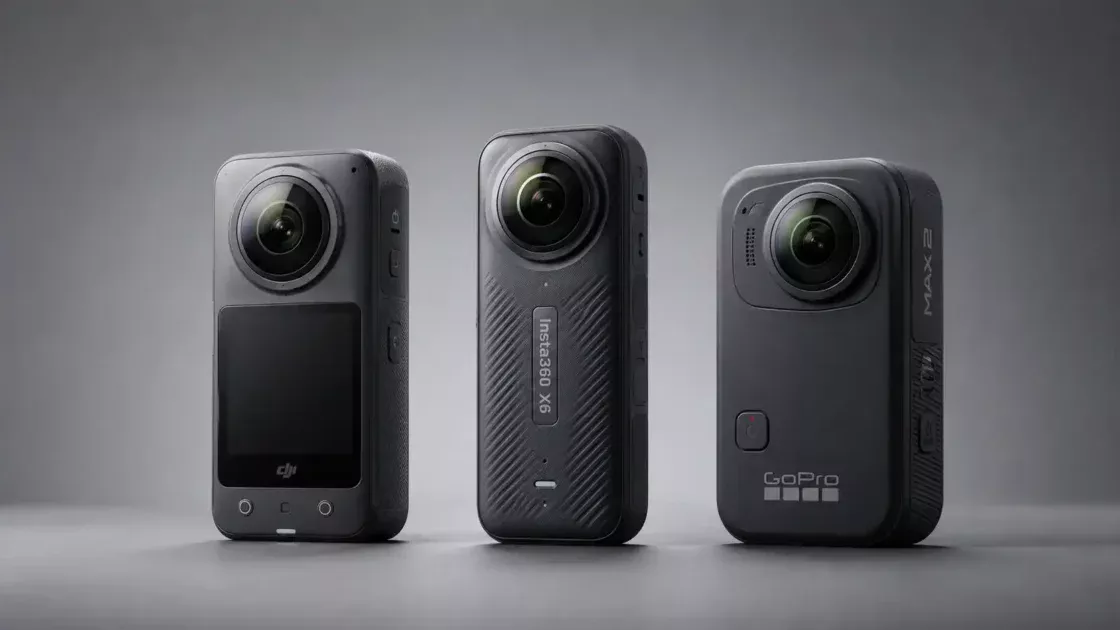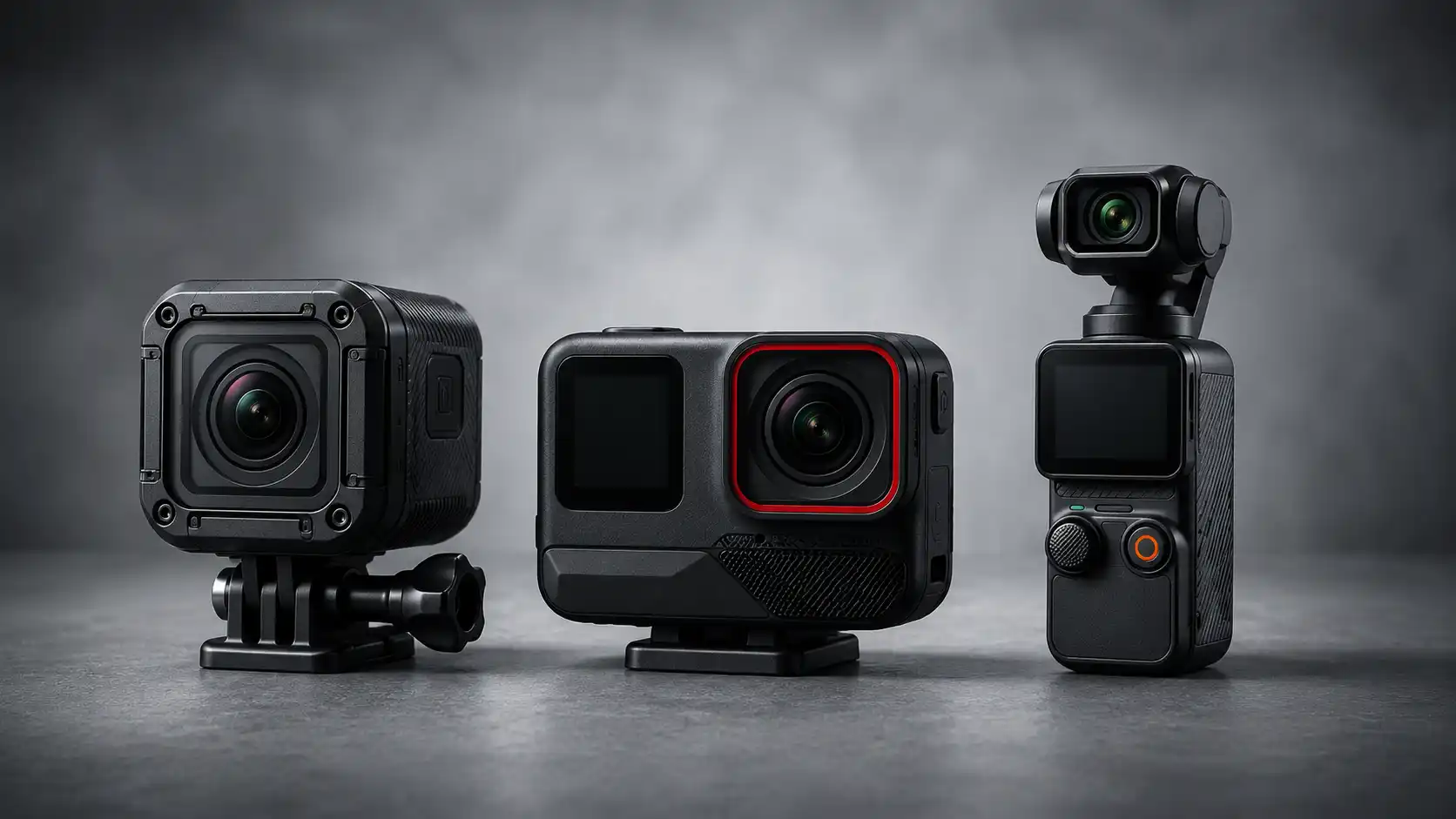
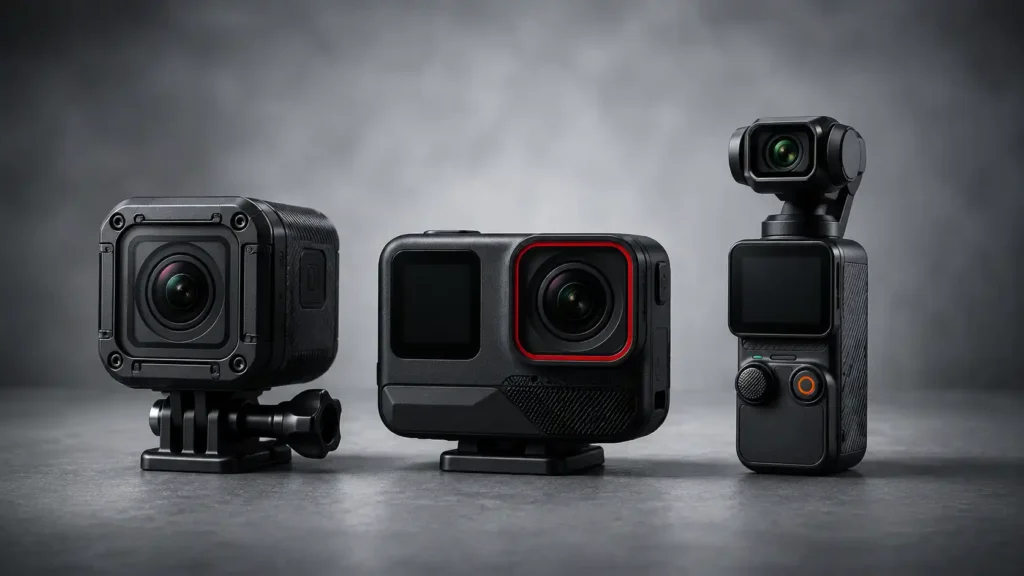
GoPro MISSION 1, Insta360 Ace Pro 2 and DJI Osmo Pocket 4 look comparable only if the comparison stops at size, resolution and brand name. They are all small cameras aimed at creators, but they solve different filming problems. GoPro MISSION 1 is a compact cinema-action camera built around a 1-inch sensor and GoPro’s new GP3 processor. Insta360 Ace Pro 2 is a rugged action camera with a 1/1.3-inch sensor, a Leica-branded lens system and strong software tools. DJI Osmo Pocket 4 is a pocket gimbal camera, built for stabilized handheld shooting, walking shots, solo vlogging and controlled framing.
Table of Contents
The plain comparison starts with camera type, not specs
That difference matters more than the headline numbers. A camera mounted to a helmet, bike, chest rig or car faces a different job than a camera held in the hand while walking through a city. A gimbal camera can make slow handheld movement look calm without forcing the sensor to crop heavily for electronic stabilization. An action camera can survive mounting positions and abuse that a gimbal head should not be asked to handle. A compact cinema-style GoPro can push resolution, bit depth and low-light ambition further than a standard action camera, but it still keeps the limitations of a fixed ultra-wide lens and a tiny body.
The honest reading is simple. GoPro MISSION 1 is the most ambitious image-quality move. Insta360 Ace Pro 2 is the practical action-camera middle ground. DJI Osmo Pocket 4 is the most natural handheld creator camera. A buyer who treats the three as direct substitutes risks buying the strongest specification sheet for the wrong use case.
This comparison is also time-sensitive. As of 2 June 2026, GoPro has announced and priced the MISSION 1 line, DJI lists Osmo Pocket 4 on its official site with full product and specification pages, and Insta360 Ace Pro 2 remains a current action-camera product with official support and specification pages.
GoPro MISSION 1 is GoPro’s move beyond the usual Hero fight
GoPro did not frame MISSION 1 as a simple Hero replacement. Its announcement calls the MISSION 1 series a line of “8K and 4K Open Gate” compact cinema cameras, with three models: MISSION 1 PRO, MISSION 1 and MISSION 1 PRO ILS. The base MISSION 1 shares the 1-inch sensor and GP3 processor with the Pro version, but it is limited to 8K30 in 16:9, 4K120 open gate and lower slow-motion ceilings than MISSION 1 PRO.
That positioning changes the usual GoPro comparison. The company is not only answering Insta360 and DJI action cameras. MISSION 1 is aimed at creators who want a small rugged camera that can sit closer to a production camera than a casual action cam. It keeps GoPro’s mounting DNA, waterproofing and electronic stabilization, but it adds a larger sensor, 10-bit capture, GP-Log2, high bitrates and open-gate recording options. GoPro’s product page lists GP3 processing, a 1-inch sensor, F2.8 aperture, 50MP stills, H.265 recording and a maximum video bitrate of 240 Mbps across the MISSION 1 family.
The most relevant MISSION 1 fact is not 8K by itself. Many users will never deliver in 8K. The useful part is oversampling, reframing room, cleaner 4K outputs, stronger detail retention and more flexible vertical or horizontal crops. That matters for creators who shoot one event and need multiple formats afterward. It also matters for small crews who place cameras in cars, on boats, in workshops, on tripods or inside tight sets where larger cinema cameras are too awkward.
The limit is just as clear. MISSION 1 still has a fixed wide-angle camera character unless the buyer moves into the ILS version later. Wide fixed lenses are strong for action, POV and environmental context. They are weaker for close portraits, product shots, selective background compression and anything that needs optical zoom. GoPro’s own product language separates the coming MISSION 1 PRO ILS because Micro Four Thirds lens support changes the creative job; the base MISSION 1 does not do that.
The launch also carries business weight. GoPro has spent years defending a mature action-camera category while competitors pushed harder into software, gimbals, modular systems and social-video workflows. MISSION 1 is a bet that GoPro can claim a higher tier without abandoning the durability and mountability that made the brand known.
Insta360 Ace Pro 2 stays closer to the action-camera mainstream
Insta360 Ace Pro 2 is less radical than MISSION 1, but it may be easier to justify for many buyers. It uses a 1/1.3-inch sensor, a Leica Summarit-branded lens, 8K30 video, 50MP stills, 4K120 slow motion, FlowState stabilization, 360-degree horizon lock, a flip touchscreen and waterproofing to 12 meters without a dive case. Insta360’s official materials also highlight a dual-chip design, PureVideo low-light mode and a 2.5-inch flip touchscreen.
The Ace Pro 2’s strength is not that it beats MISSION 1 on raw imaging hardware. It does not have a 1-inch sensor. It does not match GoPro’s 240 Mbps ceiling. It does not offer 8K60. Its strength is that it combines action-camera durability with a more approachable screen, strong low-light processing, good battery life and a broad app-led workflow. For many creators, those traits matter more than a higher-grade codec or a headline dynamic-range claim.
Insta360’s product page lists 13.5 stops of dynamic range, 8K30 video, 4K60 Active HDR, 4K60 PureVideo and 50MP photo capture. Its specification page lists 180 Mbps maximum bitrate, H.264 and H.265 encoding, I-Log, 182g weight, no built-in storage and microSD support up to 1TB.
Ace Pro 2 also makes sense for users who film themselves in demanding places. The flip screen is not a small detail. A front-facing preview on an action camera changes framing confidence for solo creators. GoPro has screens, but the Ace Pro 2’s flip-screen design is closer to a mini creator camera than a traditional action cube. That gives Insta360 a clear lane for riders, hikers, travelers, gym creators, runners, cyclists and vloggers who still need a rugged body.
The trade-off is that Ace Pro 2 leans heavily on processing and software. That is not a flaw by itself. Small cameras survive through processing. The question is whether the user prefers the sharper, more processed action-camera look or a flatter file meant for heavier color work. MISSION 1 is more attractive for creators who plan to grade, match cameras and build an edit around a wider color workflow. Ace Pro 2 is stronger for people who want the camera and app to do more of the work.
DJI Osmo Pocket 4 is a different object with a different logic
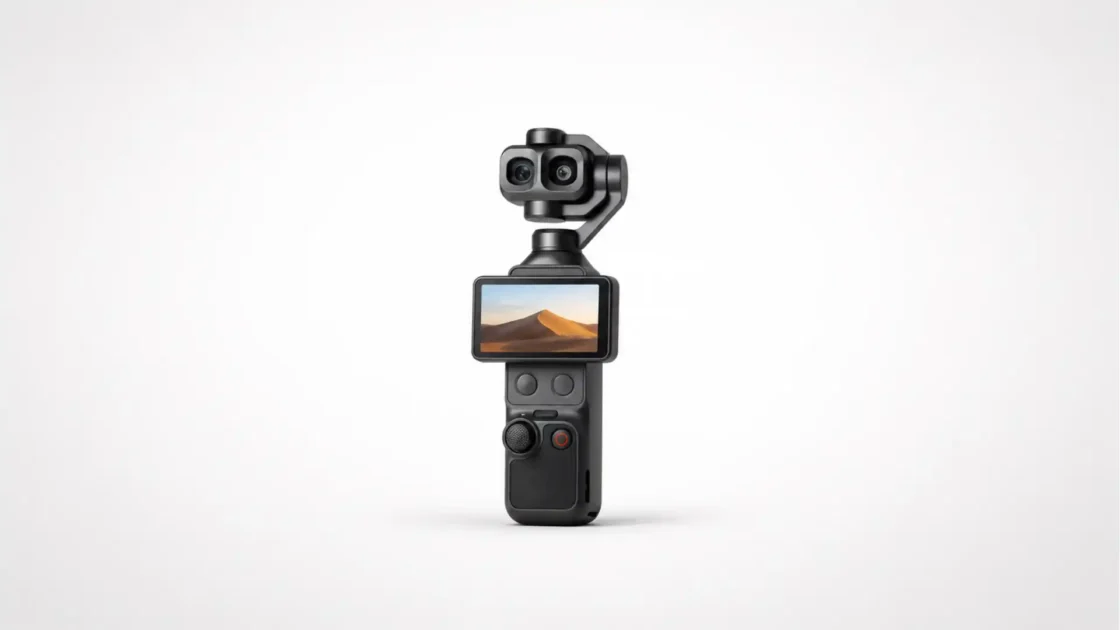
DJI Osmo Pocket 4 should not be judged as if it were an action camera with a handle. It is a stabilized pocket gimbal camera with a 1-inch CMOS sensor, 20mm-equivalent lens, f/2.0 aperture, 3-axis mechanical stabilization, 4K video up to 240 fps in slow motion, 10-bit D-Log, 107GB of built-in storage, a 2-inch touchscreen and a stated 240-minute runtime under DJI’s 1080p/24 fps lab conditions.
The distinction is mechanical. Osmo Pocket 4 stabilizes by physically moving the camera head, while GoPro MISSION 1 and Insta360 Ace Pro 2 rely on electronic stabilization from a fixed body. Electronic stabilization works well for action cameras, but it often needs crop, sensor readout and aggressive correction. A small gimbal can preserve a more natural field of view and cleaner motion for walking, talking, panning and following a person through a space.
DJI’s official product page emphasizes 4K/240 fps, 14 stops of dynamic range, 10-bit D-Log, 2x lossless zoom and 3-axis stabilization. The specification page lists 180 Mbps maximum video bitrate, MP4 HEVC recording, 37MP still capture, 107GB internal storage, 3 built-in microphones, Wi-Fi 6, BLE 5.4 and fast charging to 80 percent in 18 minutes under DJI’s stated lab test conditions.
Those traits point toward a clear buyer: the person who films handheld most of the time. Osmo Pocket 4 is the least suitable for impact, water, helmet mounting or rough sports. It is the most suitable for calm handheld video without carrying a phone gimbal or mirrorless setup. Travel creators, food creators, journalists, real-estate shooters, event creators and solo presenters are the natural audience.
The limitation is obvious from the shape. A gimbal head is more delicate than a sealed action-camera body. A pocket gimbal is also harder to mount in high-impact places. If the camera will be strapped to a snowboard, motorcycle, surfboard, mountain-bike chest mount or roll cage, Osmo Pocket 4 is the wrong starting point. If the camera will be held in the hand while walking through a market, filming a restaurant, shooting a street interview or following a subject, it is the most direct tool in this comparison.
The sensor comparison favors GoPro and DJI, but the result is not automatic
Sensor size matters because larger sensors usually collect more light, carry more tonal information and make cleaner files possible at a given exposure. In this group, GoPro MISSION 1 and DJI Osmo Pocket 4 both use 1-inch sensors, while Insta360 Ace Pro 2 uses a 1/1.3-inch sensor. GoPro pairs that sensor with a 50MP design and GP3 processing; DJI pairs its 1-inch sensor with an f/2.0 lens and a gimbal-stabilized camera head; Insta360 pairs the smaller sensor with a Leica-branded lens system and dual-chip processing.
The cleanest technical ranking for sensor potential is GoPro and DJI ahead of Insta360. Yet the camera that produces the better shot in the field can still depend on movement and exposure. A larger sensor does not save shaky handheld footage, poor framing or a lens that does not suit the subject. DJI’s mechanical stabilization may give it a better real-world handheld result at walking pace than either action camera, even if GoPro has stronger recording specs. GoPro may give the stronger mounted shot when the camera is fixed to a fast-moving object. Insta360 may give the most reliable action-camera result for a user who values the flip screen, app flow and processing more than deeper grading.
Aperture also complicates the comparison. DJI lists f/2.0, Insta360 lists f/2.6, and GoPro lists f/2.8 for MISSION 1. A lower f-number allows more light to hit the sensor at a given shutter and ISO, though real-world brightness also depends on lens design, processing and stabilization choices.
The more useful interpretation is practical. GoPro MISSION 1 is the most convincing choice if the goal is a high-detail, rugged, wide-angle file for production. DJI Osmo Pocket 4 is the stronger choice if the goal is a stable handheld scene. Insta360 Ace Pro 2 is the safer action-camera buy if ruggedness, screen design and app features matter more than maximum recording depth.
Resolution numbers need context, especially around 8K
GoPro MISSION 1 records 8K 16:9 up to 30 fps, while MISSION 1 PRO reaches 8K60 and 8K Open Gate at 30 fps. Insta360 Ace Pro 2 records 8K30. DJI Osmo Pocket 4 does not compete in 8K; it records standard video up to 4K60 and slow motion up to 4K240.
That comparison looks like a simple win for GoPro and Insta360 until the use case is added. 8K is most useful when the creator needs cropping room, reframing, oversampled 4K, stabilizing room, still extraction or delivery flexibility. It is less useful for users who shoot long casual clips, edit on phones, post mainly to social platforms or care more about file size and speed than maximum detail.
The Ace Pro 2’s 8K30 should be read as a strong spec for an action camera, but not as proof that it is a better video tool than Osmo Pocket 4 for handheld work. A 4K gimbal shot with controlled motion, proper exposure and strong subject tracking will often look more useful than an 8K action-camera shot that needs cropping, horizon correction and heavy post. DJI’s choice not to chase 8K in Pocket 4 is consistent with the product type: its job is stable, fast, practical 4K capture, not maximum pixel count.
GoPro’s 8K is more strategically important because MISSION 1 is not presented as a normal action camera. It is GoPro’s attempt to move into compact cinema territory. The base MISSION 1 stops at 8K30, which is less extreme than the Pro model, but it still gives more resolution headroom than most action-camera workflows need. That is exactly the point: GoPro is trying to sell the camera to people who do more than record a ski run or a bike ride.
The warning is storage and editing. 8K files cost space, battery and computer time. Higher bitrates also force better cards and better storage habits. A buyer who will export 1080p vertical clips every day may get more from Osmo Pocket 4’s gimbal and built-in storage or Ace Pro 2’s app workflow than from MISSION 1’s 8K ceiling.
Slow motion separates the cameras more than resolution does
Slow motion is one of the clearest split points. DJI Osmo Pocket 4 records 4K slow motion at up to 240 fps. GoPro MISSION 1 records 4K up to 120 fps and 1080p up to 240 fps, while MISSION 1 PRO goes higher with 4K240 and burst 1080p960. Insta360 Ace Pro 2 records 4K up to 120 fps and 1080p up to 240 fps.
This makes DJI Pocket 4 unusually strong for a gimbal camera. A handheld pocket gimbal with 4K240 opens a different style of slow motion: coffee pours, street detail, travel movement, product motion, dance, food, pets, cars passing, fabric, rain, sport from the sidelines. It is not the same as mounting an action camera inside danger, but it is useful for creator footage.
For pure action, the base MISSION 1 and Ace Pro 2 look closer. Both offer 4K120 and 1080p240. The GoPro has the larger sensor and higher bitrate ceiling; Insta360 has the flip screen and action-camera processing. If slow motion is the main purchase reason and the buyer wants GoPro, the Pro version may be the more logical MISSION model, because it unlocks 4K240 and 1080p480, plus burst 1080p960. The base MISSION 1 is strong, but its slow-motion advantage over Ace Pro 2 is not as dramatic as the MISSION name may suggest.
The slow-motion decision is therefore not “which has the biggest number?” It is where the slow-motion camera will be placed. For handheld slow motion, DJI has a serious claim. For mounted slow motion, GoPro and Insta360 remain more suitable. For the most extreme GoPro slow-motion modes, MISSION 1 PRO is the relevant product, not the base MISSION 1.
Stabilization is the deepest practical difference
Stabilization is where the comparison stops being a spec-sheet contest. GoPro MISSION 1 uses HyperSmooth with 360-degree horizon lock. Insta360 Ace Pro 2 uses FlowState stabilization with 360-degree horizon lock. DJI Osmo Pocket 4 uses 3-axis mechanical stabilization.
Electronic stabilization is built for action-camera chaos. It works by analyzing motion and correcting the image using sensor data and crop. It is strong when a sealed camera is mounted to a body, vehicle or object. The camera can be tiny, rugged and waterproof because there is no external moving gimbal mechanism. The cost is that aggressive stabilization can crop the image, change the feel of motion and sometimes create artifacts around complex movement.
Mechanical stabilization produces a different look. Osmo Pocket 4’s gimbal physically holds the camera head steady. That makes pans, walking shots and subject-following shots feel smoother without the same action-camera crop logic. A mechanical gimbal also allows the user to direct the camera with more intention. It is not only stabilizing; it is helping frame.
The practical rule is blunt. Choose electronic stabilization for mounted action and abuse. Choose the gimbal for handheld movement and controlled camera work. GoPro and Insta360 are safer for mountain biking, skiing, watersports, motorcycles, helmets, chest rigs, bars, boats and car mounts. DJI is safer for walking commentary, room tours, quiet travel shots, street footage and solo creator framing.
There is no universal winner. A gimbal camera is not better if the camera must survive impact. An action camera is not better if the shot needs natural handheld motion with a subject kept in frame. The choice comes down to the physical filming job.
Low-light performance depends on more than one claim
All three cameras make low-light claims, but low light is where small cameras are easiest to overrate. GoPro says the MISSION 1 family uses a 50MP 1-inch sensor with larger native pixels and fused-pixel modes, with up to 14 stops of dynamic range at the sensor. DJI says Pocket 4 uses a 1-inch sensor, f/2.0 lens, 14 stops of dynamic range and 10-bit D-Log. Insta360 says Ace Pro 2 has a 1/1.3-inch sensor with 13.5 stops of dynamic range, 2.4μm equivalent pixel size and PureVideo up to 4K60.
The plain reading is that GoPro and DJI have the sensor-size advantage. DJI also has the aperture advantage. Insta360 has a processing-led low-light pitch. Wired’s review of Ace Pro 2 described its low-light performance as a major strength against contemporary action-camera rivals, while also noting that 8K was less practical than strong 4K60 footage for many real uses.
The field result depends on motion. Low light often forces slower shutter speeds or higher ISO. A moving subject, moving camera or fast vibration can ruin the benefit of a larger sensor. DJI’s gimbal can protect handheld static or walking shots, but it cannot stop a moving subject from blurring if the shutter is too slow. Action cameras need higher shutter speeds in fast movement, which increases the need for light and raises noise.
For low-light handheld vlogging, DJI Pocket 4 has the most natural advantage. For low-light mounted action, GoPro MISSION 1 has the stronger hardware argument. For quick low-light action-camera clips with less grading, Ace Pro 2 remains credible because Insta360 has made low-light processing one of its central selling points.
The user should still manage expectations. None of these cameras replaces a full-frame mirrorless camera with a fast lens in dark interiors. The gain is portability and speed, not magic.
Color and grading reveal the intended user
GoPro MISSION 1 lists 8-bit and 10-bit color, GP-Log2 with LUT, HLG HDR and a 240 Mbps maximum bitrate. DJI Osmo Pocket 4 lists 10-bit D-Log, MP4 HEVC and 180 Mbps maximum bitrate. Insta360 Ace Pro 2 lists I-Log, Flat, Leica profiles, H.264/H.265 and 180 Mbps maximum bitrate.
Those numbers matter because they show who each brand is trying to satisfy. GoPro MISSION 1 is the most deliberate production-oriented file in this comparison. GP-Log2, 10-bit capture, HLG HDR, high bitrate and open-gate options point toward users who edit seriously, match cameras and want more room in post. The base MISSION 1 is not the full Pro model, but it still carries the same core image pipeline.
DJI’s D-Log is also serious. Pocket 4 is not a toy camera. Its 10-bit D-Log makes sense for creators who want consistent color in travel videos, interviews, product scenes and documentary-style work. The difference is that DJI’s file sits inside a gimbal-first workflow. It is for controlled handheld scenes more than camera-rig experimentation.
Insta360’s color offer is broader and more consumer-friendly. Leica Natural, Leica Vivid, Flat, I-Log and many in-camera looks give users a mix of instant output and grading routes. Ace Pro 2 is strong for creators who want a result straight from the camera or app, but still want a flatter option when the scene deserves it.
The best file is not always the best workflow. A small business owner filming social clips may prefer Insta360 or DJI because the edit is faster. A filmmaker hiding cameras around a set may prefer GoPro because the file fits a larger post-production process. A travel creator may choose DJI because the gimbal reduces rescue work in the edit.
Audio is practical, not glamorous
Audio rarely sells cameras in this category, but it decides whether footage is usable. GoPro is building a broader MISSION 1 accessory system that includes a wireless mic system and media mod options. Insta360 Ace Pro 2 has two microphones, a removable wind guard, wind reduction, voice enhancement and stereo audio. DJI Osmo Pocket 4 has three built-in microphones and OsmoAudio integration, with product materials pointing to four-channel output in the Pocket 4 system.
DJI has the cleanest path for solo talk-to-camera work because the product is designed around vlogging and handheld speech. The camera points at the user, tracks subjects and integrates with DJI’s audio system. The microphones are not a replacement for controlled external audio, but the design is friendly to interviews, street commentary and travel narration.
Insta360’s wind guard is useful for action. The Ace Pro 2 is likely to be used in exposed places: cycling, skiing, running, hiking, beaches, cars and motorcycles. Wind is the natural enemy there. A simple physical wind solution can matter more than an impressive software claim.
GoPro’s MISSION 1 audio story depends more on system expansion. For a compact cinema camera, that makes sense. Users placing cameras in difficult spots often do not rely on the camera mic as the final audio source. They sync external audio, wireless mics or separate recorders. GoPro’s timecode sync and accessory direction support that production logic.
The practical verdict is direct. DJI is the strongest starting point for spoken handheld content. Insta360 is strong for action audio with wind. GoPro is strongest when audio is treated as part of a larger rig or edit.
Battery and heat claims need real shooting habits
Battery figures across small cameras are always conditional. Insta360 lists 180 minutes for Ace Pro 2 under 1080p24 endurance-mode lab testing with Active HDR off. DJI lists 240 minutes for Osmo Pocket 4 at 1080p24 with Wi-Fi off and the screen off, plus charging to 80 percent in 18 minutes and full charge in 32 minutes under DJI’s stated lab conditions. GoPro emphasizes better runtime and thermal performance from the GP3 processor, and third-party reviews of MISSION 1 PRO have focused on improved heat behavior against older GoPros.
Those lab figures are not everyday runtime promises. 4K, 8K, high frame rates, screens, Wi-Fi, low-light processing and hot weather change the result. A camera that records four hours in a low-power 1080p test may run much less in high-bitrate 4K or 8K. Users should treat lab numbers as a way to compare efficiency, not as a guaranteed field runtime.
DJI’s built-in gimbal adds another battery job: it powers movement. Yet Pocket 4’s claimed runtime is strong because the camera is not recording 8K and because DJI has tuned the system for creator use. Insta360’s 180 minutes is useful for an action camera, especially with the flip-screen design and 1800mAh battery. GoPro’s GP3 claim is more strategic because GoPro users have long cared about heat and runtime in small sealed bodies.
The decision should be based on the heaviest shooting mode the buyer will use. A cyclist recording 4K60 with stabilization and screen use will not see the same endurance as a lab test. A filmmaker recording 8K on MISSION 1 will need stronger storage and battery planning. A vlogger using DJI at 4K30 may get more predictable results than someone pushing 4K240 slow motion often.
Durability puts DJI at a disadvantage by design
GoPro MISSION 1 and MISSION 1 PRO are waterproof to 20 meters without housing, while the coming MISSION 1 PRO ILS is weatherproof rather than fully waterproof because of its interchangeable-lens design. Insta360 Ace Pro 2 is waterproof to 12 meters without a dive case and 60 meters with a dive case. DJI Osmo Pocket 4 is not built as an impact-ready waterproof action camera; it is a pocket gimbal camera.
This is not a criticism of DJI. It is the price of a gimbal. A tiny mechanical head gives beautiful handheld movement, but it is not meant for crash-prone mounting. The buyer must accept that trade. The more violent the filming environment, the less sense Osmo Pocket 4 makes.
GoPro has the strongest ruggedness claim in this group. MISSION 1 keeps GoPro’s core promise: take the camera into places where fragile cameras are not practical. The 20-meter waterproof rating is a real advantage for divers, surfers, kayakers, boat crews and any creator near rain, spray, mud or snow. The camera still needs care, but the product type is built for rough use.
Ace Pro 2 sits close to GoPro for many action users. Its 12-meter waterproofing is enough for common swimming, rain, snow and surface-water use. The removable lens guard and rugged flip-screen design give it a practical action-camera profile. GoPro’s deeper waterproof rating and MISSION 1’s larger imaging system may appeal to more demanding users, but Insta360 remains strong for everyday action.
The short version for durability is simple: GoPro first, Insta360 close behind for most action use, DJI only when the camera is protected and handheld.
Handling and screens matter because small cameras are easy to misuse
Small cameras often fail because the user cannot frame, adjust or monitor them well enough. Specs do not fix missed framing. GoPro MISSION 1 has a redesigned body, larger OLED rear display and raised buttons intended for gloves and field use. Insta360 Ace Pro 2 uses a 2.5-inch flip touchscreen, and DJI Pocket 4 has a 2-inch rotating touchscreen with added physical controls and a 5D-style control layout described in early reviews and DJI’s specification pages.
Ace Pro 2 has the easiest action-camera screen for self-framing. The flip screen makes solo filming obvious. For creators who often talk to camera while holding or mounting the camera nearby, that may be worth more than a larger sensor. A shot that is framed correctly beats a technically better shot that cuts off the face or misses the product.
DJI Pocket 4 has the strongest handling for handheld video. A gimbal camera with a rotating screen, joystick, subject tracking and physical orientation control is a camera you actively direct. It invites slower, more deliberate shooting. That is why it works for creators who think in scenes, not only clips.
GoPro’s handling is more production and mounting oriented. The rear display, buttons and accessories support field operation, but the camera’s strength is often that it can be placed somewhere and trusted. If the buyer wants a tiny camera to become part of a multi-camera setup, GoPro’s timecode and log workflow matter more than selfie framing.
The lesson is blunt. Buy the camera whose controls match the way it will be held, mounted and checked. A great sensor does not matter if the user cannot compose the shot.
Built-in storage gives DJI a rare practical win
DJI Osmo Pocket 4 has 107GB of built-in storage and supports microSD cards up to 1TB. Insta360 Ace Pro 2 has no built-in storage and supports microSD cards up to 1TB. GoPro MISSION 1 uses removable media in the traditional action-camera pattern, while its page emphasizes faster transfers via Wi-Fi 6 and wired USB-C transfers.
Built-in storage is easy to underrate. It prevents a ruined shoot when a card is missing, full or faulty. For travel creators and solo vloggers, 107GB gives a safety net. It also supports fast transfer workflows when the user needs to move footage quickly. The Verge noted built-in storage as one of Pocket 4’s key changes from Pocket 3, alongside faster slow motion and higher still-photo resolution.
Action-camera users tend to accept removable cards because they swap cards in the field, run multiple batteries and separate footage by activity. For GoPro MISSION 1, high-bitrate 8K files make removable, high-quality media the natural route. Insta360 Ace Pro 2 also fits that action-camera pattern.
DJI’s internal storage fits its target user. A handheld creator may leave the house for a quick shoot, record a restaurant, event, office, street walk or interview, then transfer quickly. That user may not want a card-management routine every time. The built-in storage is not enough for endless 4K240 or long travel days, but it is a practical advantage for unplanned shooting.
The first compact table makes the real split visible
Core specification split
| Camera | Core type | Sensor | Top headline video | Stabilization | Built-in storage | Best fit |
|---|---|---|---|---|---|---|
| GoPro MISSION 1 | Compact cinema-action camera | 1-inch | 8K30, 4K120 | HyperSmooth | Not listed as internal | Rugged production and mounted shots |
| Insta360 Ace Pro 2 | Action camera | 1/1.3-inch | 8K30, 4K120 | FlowState | No | Action, travel and app-led creation |
| DJI Osmo Pocket 4 | Pocket gimbal camera | 1-inch | 4K60, 4K240 slow motion | 3-axis gimbal | 107GB | Handheld vlogging and controlled movement |
The table shows why a straight winner would be misleading. GoPro has the strongest production-action specification, Insta360 has the most rounded action-camera workflow, and DJI has the clearest handheld advantage. The right answer depends on the filming job, not the highest number in one column.
Price changes the value question but not the category split
GoPro’s investor release states that MISSION 1 series pricing starts at $499 for existing GoPro subscribers. Reporting from Digital Camera World put the base MISSION 1 at $599 in the U.S., with a $100 subscriber discount, while MISSION 1 PRO and MISSION 1 PRO ILS were priced at $699. GoPro’s UK store listing showed MISSION 1 at £529.99 and MISSION 1 PRO at £599.99.
DJI Osmo Pocket 4 launched internationally with UK pricing reported from £429 to £549 depending on bundle, while U.S. availability was described as affected by DJI’s regulatory situation. The Verge and Tom’s Guide both reported that the camera was not immediately released in the U.S. market.
Insta360 Ace Pro 2 pricing varies by bundle and region, and its product has already moved through discounts and accessory bundles since launch. Amazon listings and regional retailers show Ace Pro 2 bundles below the launch level in some markets, while Insta360 has also added new Xplorer and printer-oriented bundles.
Price does not erase the category split. A cheaper gimbal camera is not a better action camera. A discounted action camera is not a better handheld gimbal. A higher-priced GoPro is not automatically a better vlogging camera. The buyer must first choose the form factor, then judge the price.
A useful value rule is this: if the camera will be used mostly handheld, DJI gives the most immediate value. If it will be mounted in rough places, Insta360 may give the broadest value unless GoPro’s larger sensor and production files are needed. If the buyer is building a compact multi-camera or rugged production kit, GoPro’s price is easier to justify.
GoPro has the strongest file for production-minded creators
GoPro MISSION 1’s appeal becomes clearer when the camera is viewed as a small production tool. The 1-inch 50MP sensor, GP3 processor, 10-bit capture, GP-Log2, HLG HDR, open-gate options, 240 Mbps bitrate and HyperSmooth with horizon lock create a package that can be mounted in places where a mirrorless body, cinema box camera or phone-gimbal setup would be impractical.
The user who benefits most is not necessarily a casual GoPro owner. It is someone who understands why a high-bitrate log file matters. That user may shoot automotive scenes, sports documentaries, travel films, behind-the-scenes footage, underwater sequences, climbing, cycling, event coverage or commercial cutaways. MISSION 1’s job is to provide a tougher, smaller camera with more post-production room than a conventional action cam.
There is also a strategic reason GoPro needs this camera. The Hero line has long competed on durability, stabilization and ease. Competitors have narrowed that gap. Insta360 has pushed hard into software and creator tools. DJI has dominated gimbal convenience. MISSION 1 gives GoPro a clearer identity above the crowded action-camera tier.
The weakness is that many buyers do not need a production file. A person posting daily clips may not want to color grade GP-Log2 or manage 8K storage. They may prefer Ace Pro 2 for quicker action edits or DJI for smoother handheld shooting. GoPro MISSION 1 is strongest when its extra technical depth is used, not when it sits unused.
The base MISSION 1 is the camera to buy when the user wants GoPro’s new sensor and processor but does not need the Pro model’s 8K60 or 4K240 modes. Buyers who care mainly about extreme slow motion should compare MISSION 1 PRO instead.
Insta360 has the strongest all-round action-camera argument
Insta360 Ace Pro 2 is the least dramatic product in this comparison, but that can be a strength. It is already a mature, known action camera. It records 8K30, shoots 50MP stills, uses 4K60 PureVideo, supports 4K120 slow motion, has a 157-degree field of view, offers FlowState and horizon lock, and runs for up to 180 minutes under Insta360’s stated lab test.
The camera also has practical creator details: a flip touchscreen, removable lens guard, wind guard, I-Log, Leica color profiles, app features, Bluetooth audio support and many accessories. The Verge reported that Insta360 expanded the Ace Pro 2 ecosystem with new bundles, an Xplorer Grip Pro, printer kit and attachable lens options, showing that Insta360 is turning the camera into a broader capture system rather than only a rugged cube.
That makes Ace Pro 2 the easiest recommendation for many action-camera users who want one camera for sports, travel, family, outdoors and social clips. It is not the most production-focused camera here. It is not the most stable handheld tool. But it sits in the center: rugged, capable, approachable and supported by strong software.
The caveat is that it now faces pressure from both sides. GoPro MISSION 1 attacks from above with a larger sensor and stronger production language. DJI Osmo Pocket 4 attacks from the side with better handheld motion. Ace Pro 2 remains convincing because many people need neither a compact cinema camera nor a gimbal camera. They need a tough camera with a screen, strong app flow, good low-light processing and simple sharing.
For most action users who do not plan to color grade heavily, Ace Pro 2 is the least complicated choice.
DJI has the strongest solo creator argument
DJI Osmo Pocket 4 is built around the solo creator. Its 1-inch sensor, f/2.0 lens, 3-axis gimbal, ActiveTrack 7.0, 2-inch touchscreen, 107GB built-in storage, 3 microphones and D-Log file all support one person filming without an operator.
That matters because solo content is not only about image quality. The camera must start fast, frame the subject, track movement, keep footage stable, record usable audio and not demand a large rig. Osmo Pocket 4 is shaped around that job. A creator can hold it at arm’s length, walk, pan, follow a person, shoot a detail, turn the screen and move between horizontal and vertical formats with less friction than a mirrorless camera or an action camera.
Third-party reviews have largely interpreted Pocket 4 as a refinement of the highly popular Pocket 3 idea rather than a category reset. TechRadar described it as a polished successor with better slow motion, 10-bit color, built-in storage and stronger tracking, while Tom’s Guide called it a strong creator tool but noted that existing Pocket 3 owners may not all need to upgrade.
The limitation is durability. Pocket 4 belongs in a hand, on a small tripod or in a controlled mount. It should not be treated like GoPro or Insta360. That makes it less universal, but better at its lane.
For vlogging, travel narration, food video, room tours, walking shots and small business content, DJI Osmo Pocket 4 is the cleanest answer in this comparison. The user gives up ruggedness to gain controlled movement.
Sports and outdoor use still favor action cameras
For sports and outdoor use, the first question is whether the camera will be mounted on the body, gear or vehicle. If yes, the real comparison is between GoPro MISSION 1 and Insta360 Ace Pro 2. DJI Osmo Pocket 4 exits most rough-action scenarios because the gimbal head is not built for impact and water exposure in the same way.
GoPro’s advantage is sensor size, bitrate, waterproof rating, production workflow and the brand’s mount culture. MISSION 1 makes sense for skiing, surfing, motorsport, cycling, climbing, kayaking or documentary-style sports shooting when the user wants a higher-grade file than a normal action camera.
Insta360’s advantage is action-camera ease. The flip screen, FlowState stabilization, PureVideo, broad field of view and accessory system make it strong for creators who want to shoot, edit and post with less production overhead. It also costs less in some market conditions, though prices move by bundle and region.
For outdoor creators who shoot mixed scenes, the answer can shift. A hiker filming both trail POV and spoken travel narration may prefer Ace Pro 2 because it covers both jobs well enough. A filmmaker documenting an expedition with multiple mounted cameras may prefer MISSION 1. A travel vlogger walking through towns, interiors and food markets may prefer DJI and accept that it is not the camera for rough mounting.
The most direct sports verdict is this: GoPro MISSION 1 is the higher-end rugged production choice; Insta360 Ace Pro 2 is the more accessible rugged action choice; DJI Osmo Pocket 4 is not the main sports camera.
Travel use depends on whether the trip is active or observational
Travel is too broad for one recommendation. A trip can mean hiking, skiing, diving and cycling. It can also mean streets, hotels, restaurants, trains, museums, markets and family footage. These cameras divide travel into two types: active travel and observational travel.
For active travel, Ace Pro 2 and MISSION 1 are safer. They can be mounted, exposed to weather and used around water. They are less fragile. Ace Pro 2 is more convenient for quick self-framing and app-led edits. MISSION 1 is stronger if the travel footage will become part of a serious film or commercial project.
For observational travel, Osmo Pocket 4 becomes hard to beat. A gimbal camera is comfortable for walking shots, architecture, food, street performances, hotel rooms and quiet handheld scenes. Its internal storage also protects casual travel shooting when a card is forgotten. DJI’s 1-inch sensor, f/2.0 aperture and 10-bit D-Log give it enough image depth for more than casual clips.
The choice also depends on social format. GoPro and Insta360 both support flexible aspect ratios and horizon correction. DJI’s rotating screen and gimbal control are more deliberate for vertical creator work. Insta360’s FreeFrame mode is built around later export in multiple formats, while GoPro’s open-gate modes give more crop flexibility in post.
Travel creators should pick by movement type. Rough travel points to GoPro or Insta360. Walking travel points to DJI. Mixed travel points to Ace Pro 2 unless the user wants GoPro’s production file or DJI’s gimbal look.
Vlogging puts DJI first unless the scene is rough
Vlogging rewards stable framing, usable audio, face tracking, quick startup and a screen that makes self-recording easy. DJI Osmo Pocket 4 is built for that set of needs. Its 3-axis gimbal, rotating touchscreen, ActiveTrack 7.0, 3 built-in microphones, D-Log and internal storage match the solo creator pattern better than a conventional action camera.
Insta360 Ace Pro 2 is the better rugged vlogging option. The flip touchscreen is more practical for self-framing than many action-camera screens, and the wind guard matters outdoors. It is stronger than DJI when the vlogger is skiing, riding, swimming, running, hiking in rain or filming from a mounted perspective. It is weaker when the vlogger wants smooth handheld walking with natural pans.
GoPro MISSION 1 is not the first choice for ordinary vlogging unless the user specifically wants the GoPro look, ruggedness or production file. It can vlog, but it is not the easiest of the three for the everyday solo creator. Its appeal grows when the vlog is more like a produced mini-documentary with mounted shots, action scenes and color grading.
The direct vlogging verdict is this: DJI for handheld talking and walking, Insta360 for rugged self-filming, GoPro for production-style creator work.
A buyer who wants one pocketable camera for YouTube, TikTok, Instagram Reels and travel commentary should start with DJI if rough use is not part of the plan. If the camera will get wet, shaken, mounted or dropped, start with Insta360 or GoPro.
Small business video favors DJI for speed and GoPro for production
Small businesses need video that looks steady, clear and credible without creating a huge workflow. Restaurants, gyms, salons, workshops, estate agents, retail stores and local services often need quick footage: room tours, staff intros, product clips, menus, behind-the-scenes scenes and short promotional videos. For that job, DJI Osmo Pocket 4 is often the most useful of the three.
The reason is not only image quality. A small business camera has to be easy to hold, easy to frame and quick to repeat. Pocket 4’s gimbal, screen, tracking and internal storage fit that need. A staff member can walk through a space, follow a person or show a product without learning a full camera rig. The files can still be graded if needed because DJI includes 10-bit D-Log.
GoPro MISSION 1 makes sense for businesses that need rugged, mounted or production-oriented shots. A car detailer, boat company, adventure tourism brand, bike shop, gym, outdoor brand or construction company may benefit from GoPro’s rugged body and stronger file. The camera can be placed in unusual positions and cut into a more professional edit.
Ace Pro 2 fits businesses with action, lifestyle and social content needs. It is simpler than GoPro’s production approach and tougher than DJI. A fitness studio, outdoor guide, cycling brand, ski school or travel operator may prefer Insta360’s workflow.
The business answer depends on staff skills. If no one will grade or manage 8K, DJI or Insta360 will usually beat GoPro in day-to-day output. If the business works with an editor or agency, GoPro’s file becomes more attractive.
The creator workflow decides more than the camera body
A camera is not only the capture device. It is a workflow: shooting, transferring, editing, color, sound, captions, exporting and publishing. GoPro, Insta360 and DJI each push users toward a different workflow.
GoPro MISSION 1 points toward a production workflow. The camera gives room for log capture, high-bitrate files, timecode sync and accessory expansion. That is excellent when the user has a post-production process. It is less helpful for quick daily clips.
Insta360 Ace Pro 2 points toward an app-led action workflow. The camera and app support AI highlights, FreeFrame export, PureVideo, in-camera filters, accessory control and direct social formats.
DJI Osmo Pocket 4 points toward a solo handheld workflow. The user gets a gimbal, tracking, built-in storage, D-Log and DJI’s creator ecosystem. It reduces the need for extra stabilization gear and makes controlled movement easier.
The best camera is often the one that removes the most steps from the user’s real workflow. A professional editor may prefer MISSION 1. A social creator may prefer Ace Pro 2. A solo vlogger may prefer Osmo Pocket 4. A creator who hates editing will not be saved by a higher bitrate. A filmmaker who grades everything will not be satisfied by a camera that hides too much processing.
The second compact table gives a buying answer by job
Buyer fit by filming job
| Filming job | Best first choice | Second choice | Camera to avoid first |
|---|---|---|---|
| Helmet, bike, surf or ski mounting | GoPro MISSION 1 | Insta360 Ace Pro 2 | DJI Osmo Pocket 4 |
| Everyday rugged action and travel | Insta360 Ace Pro 2 | GoPro MISSION 1 | DJI Osmo Pocket 4 |
| Walking vlog and handheld travel | DJI Osmo Pocket 4 | Insta360 Ace Pro 2 | GoPro MISSION 1 |
| Production cutaways in harsh places | GoPro MISSION 1 | Insta360 Ace Pro 2 | DJI Osmo Pocket 4 |
| Food, retail, room tours and interviews | DJI Osmo Pocket 4 | Insta360 Ace Pro 2 | GoPro MISSION 1 |
| Fast social clips with less grading | Insta360 Ace Pro 2 | DJI Osmo Pocket 4 | GoPro MISSION 1 |
This is a buyer-fit table, not a quality ranking. The weakest choice in one job may be the strongest choice in another. DJI is not weak because it avoids rough mounting; it is specialized for handheld control. GoPro is not weak because it is less convenient for casual vlogging; it is built for rugged production. Insta360 is not weak because it lacks a 1-inch sensor; it has the broadest action-camera workflow.
The MISSION 1 base model is not the same as MISSION 1 PRO
The phrase “GoPro MISSION 1” can create confusion because GoPro launched a family, not one camera. The base MISSION 1 shares the 1-inch sensor and GP3 processor, but it records 8K 16:9 up to 30 fps and 4K up to 120 fps. MISSION 1 PRO adds higher frame rates, including 8K60 and 4K240, plus higher slow-motion modes. The MISSION 1 PRO ILS adds Micro Four Thirds lens compatibility and is listed as coming later.
That distinction matters in this comparison. If the buyer wants to beat DJI Pocket 4’s 4K240 slow motion with a GoPro, the base MISSION 1 does not do it. The Pro model does. If the buyer only needs the larger sensor, 8K30, 4K120, 10-bit capture and GoPro ruggedness, the base MISSION 1 may make more sense.
The base model is therefore best read as a cost-controlled entry into the new MISSION system. It gives much of the image platform without the highest frame-rate features. That is a reasonable split, but buyers must not confuse MISSION 1 with every MISSION 1 PRO spec.
The fairest comparison against Insta360 Ace Pro 2 and DJI Osmo Pocket 4 is the base MISSION 1 if the buyer names MISSION 1, and MISSION 1 PRO only when the buyer needs the extra slow-motion and frame-rate ceiling.
The Osmo Pocket 4 upgrade question is separate from this comparison
DJI Pocket 4 also has to be judged against Pocket 3, not only against GoPro and Insta360. Reviews have described Pocket 4 as a refined successor rather than a total break. The Verge highlighted 4K240 slow motion, higher still resolution, 107GB internal storage, extra physical controls and delayed U.S. availability. TechRadar and Tom’s Guide both noted that Pocket 3 owners may not all need to upgrade unless they want the new high-speed, storage, tracking or color features.
That means a buyer who already owns Pocket 3 should ask a different question. The issue is not whether Pocket 4 beats Ace Pro 2 at vlogging; it probably does for handheld use. The issue is whether the upgrade changes the owner’s actual work. If Pocket 3 already delivers stable 4K footage for social and YouTube, Pocket 4’s value depends on 4K240, internal storage, D-Log workflow, battery behavior and improved controls.
For a new buyer, Pocket 4 is the cleaner choice if the price is acceptable. For an existing Pocket 3 user, the upgrade is not automatic. That distinction matters because comparison articles often treat every new camera as a necessary replacement. This one is not that simple.
Pocket 4 is easier to recommend to first-time buyers than to satisfied Pocket 3 owners. The latter group should upgrade only for a specific missing feature.
The Ace Pro 2 upgrade question depends on discounts and accessories
Ace Pro 2 launched before the 2026 MISSION 1 and Pocket 4 moment, so its value has shifted. It now benefits from a more mature accessory ecosystem, reviews, price movement and bundle options. The Verge reported new Ace Pro 2 accessory bundles that push the camera toward instant-print, grip and lens workflows.
That maturity is useful. A mature camera has known strengths, known weaknesses and more accessories. It may also be cheaper than launch. For buyers who do not need GoPro’s 1-inch sensor or DJI’s gimbal, Ace Pro 2 remains highly practical.
The risk is that Ace Pro 2 now sits between two more specialized cameras. GoPro MISSION 1 has a stronger sensor and production file. DJI Osmo Pocket 4 has better handheld motion. Ace Pro 2 must win on balance, not on one spectacular advantage. It does that well for action-camera users, but not for every creator.
Ace Pro 2 is the value choice when the buyer needs one rugged camera that can cover many jobs without building a heavier production workflow. Its discounts and bundles can make that value stronger, but the camera should still be chosen for the right physical use case.
The GoPro business angle is unusually important
GoPro’s MISSION 1 launch is more than another camera release. It is a repositioning attempt. The action-camera market is crowded, phones are stronger, DJI and Insta360 have strong ecosystems, and GoPro needed a clearer story beyond incremental Hero upgrades. MISSION 1 gives GoPro a higher-end lane with compact cinema language, 1-inch sensor hardware, GP3 processing and a new accessory system.
That does not guarantee commercial success. A higher-end GoPro risks narrowing the audience. Casual buyers may find it expensive or unnecessary. Professional buyers may still want larger sensors, interchangeable lenses, internal ND filters, better audio inputs or more controlled color science. GoPro is trying to land between those groups: creators who need rugged compact cameras with better files than standard action cams.
The MISSION 1 PRO ILS is the more radical part of the strategy because interchangeable Micro Four Thirds lenses move GoPro further from its fixed-lens action-camera roots. But the base MISSION 1 is the volume bridge. It keeps a familiar GoPro form while asking users to accept a more serious creative role.
For this comparison, the business angle matters because it explains why MISSION 1 feels different. GoPro is not trying to make a Pocket 4 clone or an Ace Pro 2 clone. It is trying to create a higher tier above standard action cameras. Whether the market wants that tier will be the real test.
DJI’s regulatory situation affects availability, not product fit
DJI Osmo Pocket 4’s product fit is clear, but availability is not equal everywhere. The Verge reported that Pocket 4 was launching in Europe and the UK, while U.S. release was not immediate because of pending authorization. Tom’s Guide also noted that U.S. availability was affected by regulatory issues.
That affects buying advice. A camera that is best on paper may not be the best purchase if it is unavailable, delayed, overpriced through import channels or unsupported locally. Buyers in Europe and the UK can judge Pocket 4 more directly. U.S. buyers may have to compare what is officially available, what warranty support looks like and whether buying through third-party channels creates risk.
The same applies less dramatically to GoPro and Insta360, which have broader action-camera availability in many regions. But all camera pricing remains regional. Subscription discounts, bundles, VAT, retailer stock and accessory packs can change the value calculation quickly.
Availability should be treated as part of the comparison, not an afterthought. For an agency, business or creator who needs a camera now, stock and support may matter more than a feature that is unavailable in their country.
DJI’s gimbal advantage also creates a learning curve
A gimbal camera is easier in some ways and less automatic in others. Osmo Pocket 4 makes handheld motion smoother, but users still need to learn gimbal modes, pan behavior, subject tracking, exposure, focus, horizon choices and movement. A bad gimbal move can look just as amateur as shaky action-camera footage, only in a different way.
The benefit is that the learning curve is useful. Once the user understands how the head reacts, Pocket 4 becomes a tiny camera operator. It can follow, pan, tilt and hold framing in ways an action camera cannot. This is why it is strong for controlled creator work.
GoPro and Insta360 are easier when the goal is “mount and capture.” The user places the camera, chooses a field of view and trusts stabilization. That is better for sports and rough scenes. It is weaker for subtle camera movement and subject framing.
A buyer who wants active camera movement should learn DJI. A buyer who wants camera placement should choose GoPro or Insta360. This is one of the cleanest dividing lines in the whole comparison.
The fixed-lens problem affects all three in different ways
All three cameras have lens limitations. GoPro MISSION 1 has a wide fixed lens on the base and Pro models. Insta360 Ace Pro 2 has a wide fixed action-camera lens. DJI Osmo Pocket 4 has a 20mm-equivalent f/2.0 lens with digital zoom and a 2x lossless-zoom claim in product materials.
Wide lenses are useful for action and vlogging because they include more of the scene and reduce framing pressure. They are weak for distant subjects. They also distort faces if held too close, make backgrounds look farther away and limit subject separation compared with longer lenses.
DJI’s gimbal and 20mm equivalent lens make the wide look more controlled, but it is still wide. Insta360’s 157-degree field of view is useful for POV and action but not for every subject. GoPro MISSION 1’s 15mm to 27mm equivalent digital-lens range gives framing options, but it is still not optical zoom in the classic sense.
The future MISSION 1 PRO ILS is relevant because it solves this problem differently by allowing Micro Four Thirds lenses. But that is not the base MISSION 1. Buyers who need real lens choice should not pretend that digital crop is the same thing.
None of these three is ideal for wildlife, stage events, distant sports from the stands or portrait compression. They are small wide cameras first.
Editing hardware and storage costs favor DJI and Insta360 for casual users
8K and high-bitrate capture create hidden costs. GoPro MISSION 1’s 8K30 and 240 Mbps ceiling are powerful, but they require fast media, storage discipline and editing hardware that can handle heavy files. Insta360 Ace Pro 2 also records 8K30 and 180 Mbps, but its app workflow encourages more direct use. DJI Osmo Pocket 4 stays in 4K, with 180 Mbps maximum bitrate and built-in storage.
A creator editing on a phone or mid-range laptop should not ignore that difference. The strongest file can become a burden if every edit takes longer, storage fills quickly or playback stutters. The camera purchase is only part of the cost. Cards, SSDs, cloud backup, batteries and editing time all matter.
DJI’s 4K-first approach may be more practical for many users. The files are still serious enough for quality output, but they avoid the constant weight of 8K. Insta360 gives the option of 8K while still being useful at 4K60 and 4K120. GoPro is most attractive when the user already has the edit process to benefit from its file depth.
Buyers should choose the heaviest file they will actually use every week, not the heaviest file the camera can record once.
Smartphone competition changes the purpose of these cameras
Phones have made casual video better, which forces small cameras to justify themselves. A modern flagship phone offers strong video, large screens, quick editing and direct publishing. These three cameras survive only where phones are physically or creatively weaker.
GoPro MISSION 1 survives because phones cannot be mounted and abused the same way, and because a rugged production-style file in a tiny body has value. Insta360 Ace Pro 2 survives because phones are poor helmet, chest, bike, surf and ski cameras. DJI Osmo Pocket 4 survives because a built-in gimbal gives smoother handheld movement than most phone-only setups without attaching a separate stabilizer.
The phone question helps clarify the purchase. If the camera will only be used for ordinary handheld clips in safe conditions, a phone may already be enough. The upgrade makes sense when the user needs rugged mounting, gimbal movement, long creator sessions, dedicated storage, better ergonomics or a camera that can be placed where a phone should not go.
This is especially relevant to DJI. Pocket 4 is competing not only against GoPro and Insta360, but against phones on small gimbals. Its advantage is compact integration. No balancing, no phone notifications, no phone battery drain, no large rig. For GoPro and Insta360, the advantage is physical toughness and mounting.
The verdict is different for professionals, creators and casual buyers
Professional users should start with GoPro MISSION 1 if they need rugged compact cameras for serious post-production. The file, sensor, bitrate, log profile, timecode direction and accessory system are the most production-minded parts of the comparison. DJI Pocket 4 can still be a professional tool for handheld scenes, but it is less useful in rough mounted positions. Insta360 Ace Pro 2 is strong for action cutaways when speed matters more than maximum grading headroom.
Creators who publish frequently should start with DJI or Insta360. DJI is better for handheld vlogs, travel narration, interiors, food and small business content. Insta360 is better for rugged lifestyle, sports, outdoor and fast social content. GoPro becomes the better creator choice when the content is more cinematic, more rugged or more edit-heavy.
Casual buyers should be cautious with MISSION 1. It may be more camera than they need. Ace Pro 2 is easier to justify as a general action camera. DJI is easier to justify if the buyer wants better family travel footage, walking videos or talking-head clips.
The most honest winner is conditional: GoPro MISSION 1 for rugged production, Insta360 Ace Pro 2 for all-round action, DJI Osmo Pocket 4 for handheld creator video.
The purchase answer without decoration
Buy GoPro MISSION 1 if the camera will be mounted in rough places, used in water or weather, cut into a serious edit, shot in log, matched with other cameras or used where a stronger compact production file matters. Do not buy it only because it has 8K. Buy it because its ruggedness and file quality solve a real problem.
Buy Insta360 Ace Pro 2 if the camera will be used as a daily action camera for sports, travel, outdoors, social clips and mixed self-filming. It is the most balanced action-camera choice here, especially for users who value the flip screen, PureVideo, app tools and a mature accessory ecosystem. Do not buy it if the main job is smooth handheld walking video.
Buy DJI Osmo Pocket 4 if the camera will be held in the hand for vlogging, travel narration, room tours, interviews, food content, business videos and controlled walking shots. It has the strongest handheld design and the most useful gimbal advantage. Do not buy it as an action camera.
The cleanest one-camera choice for most people is probably Insta360 Ace Pro 2 because it covers the most situations without being fragile. The cleanest creator camera is DJI Osmo Pocket 4. The cleanest production-action camera is GoPro MISSION 1. The best choice is not the camera with the most impressive spec. It is the camera that matches the physical job.
Practical questions before choosing between these three cameras
For production-oriented rugged shooting, yes. GoPro MISSION 1 has a 1-inch sensor, GP3 processor, 10-bit capture, GP-Log2, 240 Mbps maximum bitrate and stronger production positioning. For everyday action-camera use, Insta360 Ace Pro 2 may be easier and better value because of its flip screen, PureVideo mode, FlowState stabilization and app workflow.
Only for rugged, mounted or production-action work. DJI Osmo Pocket 4 is better for handheld walking shots, vlogging, tracking and controlled movement because it uses a 3-axis mechanical gimbal.
For handheld video, yes. For action, no. Pocket 4’s gimbal gives it a strong advantage for walking, panning and solo creator framing. Ace Pro 2 is tougher, waterproof, easier to mount and better for rough use.
GoPro MISSION 1 and DJI Osmo Pocket 4 both use 1-inch sensors, while Insta360 Ace Pro 2 uses a 1/1.3-inch sensor. Sensor size favors GoPro and DJI, but movement, lens, stabilization and processing still affect the final shot.
DJI Osmo Pocket 4 is the best first choice for handheld vlogging because it combines a 1-inch sensor, 3-axis gimbal, rotating touchscreen, tracking, microphones and internal storage. Insta360 Ace Pro 2 is better for rugged outdoor vlogging.
GoPro MISSION 1 is the strongest option for high-grade rugged sports footage. Insta360 Ace Pro 2 is the easier all-round action-camera option. DJI Osmo Pocket 4 is not the right first camera for impact-heavy sports.
GoPro MISSION 1 and DJI Osmo Pocket 4 have the sensor-size advantage. DJI also has an f/2.0 lens and gimbal stabilization, which helps handheld scenes. Insta360 Ace Pro 2 remains strong for an action camera because of PureVideo and its low-light processing.
It is worth it if the user needs reframing, oversampled 4K, high-detail capture or post-production flexibility. It is less useful for casual social video because 8K creates larger files and heavier editing.
It can be useful for detail and cropping, but many users will get more practical value from strong 4K modes, PureVideo and the camera’s workflow. Wired’s review also suggested 4K60 is the more useful mode for many everyday users.
No. DJI Osmo Pocket 4 is a 4K camera. It records standard 4K up to 60 fps and slow motion up to 4K240 according to DJI’s specifications.
DJI Osmo Pocket 4 offers 4K240 slow motion. The base GoPro MISSION 1 offers 4K120 and 1080p240, while MISSION 1 PRO reaches higher modes. Insta360 Ace Pro 2 offers 4K120 and 1080p240.
DJI Osmo Pocket 4 is easiest for handheld creator work. Insta360 Ace Pro 2 is easiest for action-camera users who want rugged shooting and quick app features. GoPro MISSION 1 is better for users who understand file settings, mounts and post-production.
GoPro MISSION 1 has the strongest rugged claim, with waterproofing to 20 meters without housing. Insta360 Ace Pro 2 is waterproof to 12 meters without a dive case. DJI Osmo Pocket 4 is a gimbal camera and should not be treated as an action camera.
For talking-head, travel and walking YouTube content, DJI Osmo Pocket 4 is the strongest choice. For adventure YouTube, Insta360 Ace Pro 2 or GoPro MISSION 1 makes more sense. For documentary-style action, GoPro MISSION 1 is the better production tool.
Insta360 Ace Pro 2 and DJI Osmo Pocket 4 are the most direct choices. Insta360’s FreeFrame workflow supports later export in multiple aspect ratios, while DJI’s gimbal and rotating screen suit handheld vertical creator work.
DJI Osmo Pocket 4 is the safest first choice for room tours, food, staff clips, interviews and handheld social video. GoPro MISSION 1 is better for rugged business footage such as vehicles, construction, outdoor tourism or sport. Insta360 Ace Pro 2 fits lifestyle and action-led businesses.
Not automatically. Reviews describe Pocket 4 as a refined upgrade with stronger slow motion, internal storage, 10-bit D-Log and better controls, but many satisfied Pocket 3 users may not need to replace it unless those features matter in their work.
Only if they need a larger sensor, higher bitrate, GP-Log2, stronger production files or GoPro’s MISSION system. For normal action-camera use, Ace Pro 2 remains practical and may be cheaper depending on bundles and region.
Buy MISSION 1 if 8K30, 4K120, 10-bit capture and the 1-inch sensor are enough. Buy MISSION 1 PRO if 8K60, 4K240 or higher slow-motion modes are central to the work.
Most general action users should start with Insta360 Ace Pro 2. Most handheld creators should start with DJI Osmo Pocket 4. Most production-minded rugged shooters should start with GoPro MISSION 1. There is no single winner because the three cameras are built for different filming jobs.
Author:
Jan Bielik
CEO & Founder of Webiano Digital & Marketing Agency
This article is an original analysis supported by the sources cited below
GoPro announces new MISSION 1 line of professional 8K and 4K open gate compact cinema cameras
Official GoPro announcement for the MISSION 1 camera family, including model positioning, sensor claims, GP3 processor details and lineup structure.
GoPro MISSION 1 camera system
Official GoPro product page with MISSION 1, MISSION 1 PRO and MISSION 1 PRO ILS specifications, video modes, imaging details, waterproofing and accessory ecosystem.
GoPro announces pricing for new MISSION 1 series
Official investor release used for pricing context and GoPro’s market positioning of the MISSION 1 line.
GoPro MISSION 1 and MISSION 1 PRO product manual page
Official GoPro support page for product manuals and setup resources related to the MISSION 1 series.
DJI Osmo Pocket 4 product page
Official DJI product page for Osmo Pocket 4, including the 1-inch sensor, 4K/240 fps, 14-stop dynamic range, D-Log, 2x lossless zoom and 3-axis stabilization claims.
DJI Osmo Pocket 4 specifications
Official DJI specification page used for dimensions, sensor, lens, video modes, slow motion, bitrate, internal storage, battery and wireless protocol details.
DJI Osmo Pocket 4 download center
Official DJI download page for manuals, safety documents, release notes and LUT resources for Osmo Pocket 4.
DJI Osmo Pocket 4 user manual
Official DJI manual used for activation, storage and operating context.
Insta360 Ace Pro 2 product page
Official Insta360 product page covering Ace Pro 2’s sensor, Leica lens, PureVideo, waterproofing, stabilization, battery and screen features.
Insta360 Ace Pro 2 hardware specifications
Official Insta360 manual page used for dimensions, weight, sensor size, aperture and minimum focus distance.
Insta360 Ace Pro 2 photo and video specifications
Official Insta360 manual page used for video modes, slow motion, bitrate, encoding, ISO, shutter and audio specification details.
Insta360 Ace Pro 2 user manual
Official Insta360 user manual used for setup and operating context.
Insta360 Ace Pro 2 support page
Official Insta360 support page for tutorials, manuals and FAQs related to Ace Pro 2.
The Verge on DJI Osmo Pocket 4 launch
Reputable technology coverage used for launch context, feature summary, pricing range and U.S. availability discussion.
TechRadar review of DJI Osmo Pocket 4
Hands-on review source used for interpretation of Osmo Pocket 4’s creator workflow, upgrade value and practical shooting strengths.
Tom’s Guide review of DJI Osmo Pocket 4
Review source used for creator-focused evaluation, U.S. availability context and upgrade discussion.
T3 review of DJI Osmo Pocket 4
Review source used for independent perspective on Pocket 4’s handheld use, controls, battery claims and gimbal value.
Digital Camera World on DJI Pocket 4 and Pocket 3 value
Camera-industry coverage used for the Pocket 3 versus Pocket 4 upgrade context.
Digital Camera World on GoPro MISSION 1 pricing
Camera-industry coverage used for MISSION 1 pricing, subscriber discount context and market positioning.
Tom’s Guide review of GoPro MISSION 1 PRO
Review source used for interpretation of GoPro’s new MISSION platform, thermal behavior and production-oriented features.
Digital Camera World review of GoPro MISSION 1 PRO
Review source used for independent evaluation of GoPro’s high-end MISSION direction and comparison with action-camera rivals.
YM Cinema on GoPro MISSION 1 action cinema cameras
Cinema-industry coverage used for context on GoPro’s compact cinema positioning and MISSION 1 family announcement.
Wired review of Insta360 Ace Pro 2
Independent review source used for practical assessment of Ace Pro 2’s low-light performance, 8K usefulness and everyday 4K value.
The Verge on Insta360 Ace Pro 2 accessories
Technology news source used for Ace Pro 2 ecosystem context, accessory bundles and expanded creator use cases.
| Citing this article? Brief excerpts are welcome. Please credit Webiano.digital, name the author where stated, and include a link to https://webiano.digital and to this original article. Full or substantial republication requires prior written permission. Read our Copyright and Content Use Policy. |
This article was prepared with the assistance of artificial intelligence tools. The content underwent expert human review, and Webiano Digital & Marketing Agency assumes editorial responsibility for its final version and publication.