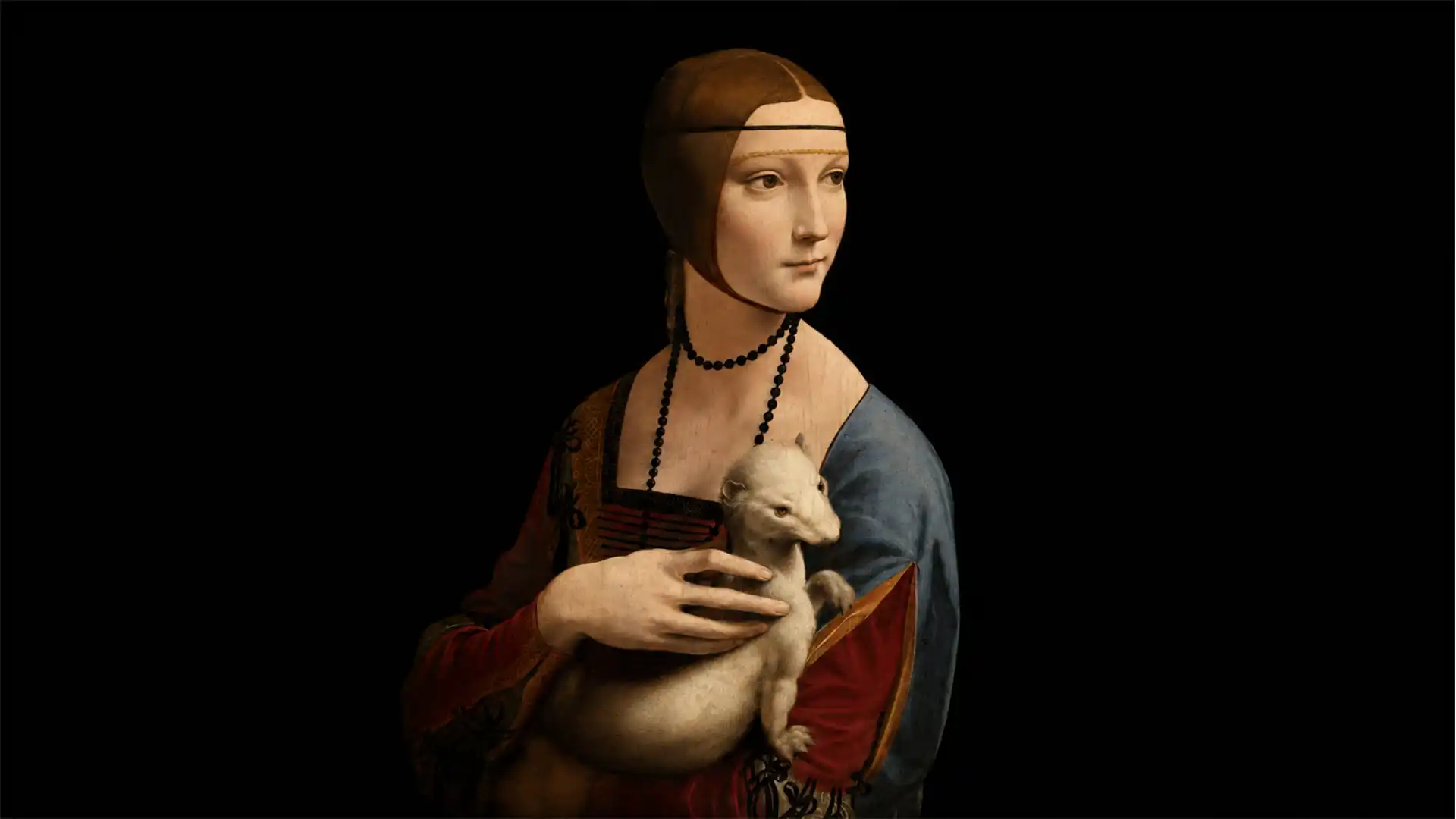
Leonardo da Vinci’s Lady with an Ermine is no longer encountered only as a small oil painting behind museum glass in Kraków. It is also a high-resolution image, a conservation object, a metadata record, a rights question, a teaching asset, a search result, a possible input for machine vision, and a test case for the uneasy future of cultural memory. The National Museum in Krakow identifies it as one of the masterpieces displayed in the Princes Czartoryski Museum, while Google Arts & Culture presents the work online as a circa 1489 painting by Leonardo, with Cecilia Gallerani, Ludovico Sforza and the ermine’s symbolic role built into the object story.
Table of Contents
A Leonardo portrait becomes a digital object
The digitization of art begins with a deceptively simple act: a physical work is recorded. In the case of Lady with an Ermine, that act is not simple at all. A walnut panel painted more than five centuries ago cannot be treated like a poster on a scanner bed. The surface is fragile. The varnish, overpaint, panel structure, pigment layers and environmental conditions matter. The painting is also a national treasure in Poland, displayed in a museum context where security, conservation and public access must be balanced.
The online version of Lady with an Ermine turns the portrait into a digital object with several layers. The public sees the image. Scholars read the description. Search engines parse the title, creator, date, medium and place. Educators reuse the story. Museum visitors may first meet the painting on a phone and later travel to Kraków. For many people, the digital object becomes the main encounter. Digitization does not merely reproduce the artwork; it creates a second public life around the artwork.
The Google Arts & Culture entry gives the painting a concise digital identity: title, creator, date, medium, current institutional context and a narrative explaining its purchase around 1800, its earlier misidentification, its current attribution to Cecilia Gallerani and the black overpainted background. That information is not decoration. It is what lets the work travel through search, education platforms, museum websites and AI answer systems without becoming an anonymous Renaissance image.
The same object now has two forms of presence. The first is physical: small, vulnerable, materially specific, located in Kraków. The second is digital: distributed, searchable, zoomable and context-rich. The tension between them defines the digital future of art. A digital file cannot replace the scale, surface, atmosphere and historical gravity of the original. Yet the file can reveal details that a crowded gallery visit often hides. It can connect a student in Bratislava, a conservator in London and a designer in Tokyo to the same image and metadata.
The useful question is not whether digital art access is “real.” It is real in a different way. A screen cannot reproduce the way light sits on an aged painted surface, but it can turn a single museum object into a global research and learning infrastructure. The physical painting remains the source of authority; the digital version becomes the means by which that authority circulates.
Digitization means more than photographing paintings
Art digitization often sounds like a photographic workflow, but museum practice is broader. It includes high-resolution photography, color management, technical imaging, 3D scanning, metadata creation, rights labeling, online publishing, long-term preservation, API access, linked data, accessibility work and public interpretation. UNESCO describes digitizing cultural heritage as converting analogue material into digital form and links it to research, equal access and secure collection management.
A museum that digitizes a painting must decide what it is trying to preserve. Is it preserving the image? The material condition? The historical record? The catalogue data? The visitor experience? The work’s place in a network of artists, owners, exhibitions, repairs and interpretations? The answer is usually all of these, but each requires a different method.
A standard digital photograph records visible appearance. Infrared reflectography can reveal underdrawing. X-radiography can show structural changes and dense pigments. Macro X-ray fluorescence can map chemical elements in and below paint layers. Reflectance Transformation Imaging can help researchers inspect surface relief under changing virtual light. 3D scanning can record object geometry. Metadata connects the object to names, dates, materials, provenance, rights and vocabularies.
This is where the old language of “a digital copy” fails. A serious museum digitization project produces not one copy but a structured set of records, images, measurements and meanings. A painting becomes a bundle of interoperable evidence. A sculpture becomes a mesh, a texture, a rights statement and an interpretive record. An archive becomes a searchable body of images and text. A historic site becomes a point cloud, a 3D model and a risk-management tool.
The public usually meets the polished result: the beautiful image on a museum page. Behind that image is a chain of decisions. What lighting was used? Was the file color-calibrated? What resolution is enough? Which metadata standard applies? Which terms describe the subject? Does the institution own the rights to the photograph? Is the work in the public domain? Can the file be downloaded? Can it be used commercially? Can it be used to train AI?
Those questions now shape the value of digital collections. A low-resolution image with weak metadata and unclear rights may satisfy casual browsing, but it is poor infrastructure. A high-resolution image with open rights, rich metadata and standard interfaces can support scholarship, education, publishing, design, conservation and computational analysis. The difference between a digital display and a digital cultural asset lies in resolution, context, rights and interoperability.
The small scale of Lady with an Ermine matters online
The physical size of Lady with an Ermine changes the logic of digitization. The portrait is intimate. It does not overwhelm the viewer like a chapel fresco or a monumental history painting. Its power comes from the turn of Cecilia’s head, the twisting animal, the modelled hands, the controlled light and Leonardo’s ability to give psychological motion to a still image. The Google Arts & Culture description stresses Leonardo’s handling of anatomy and lighting and notes that the original background was overpainted with black in the 19th century.
A digital interface can serve this painting well because the work rewards close attention. The viewer can inspect the ermine’s fur, the contours of Cecilia’s hand, the line of the sleeve and the painted transitions around the face. A museum visitor may get seconds in front of the object, especially in a busy room. A digital viewer permits slower looking. It does not recreate standing before Leonardo’s panel, but it gives time back to the eye.
The portrait also shows why metadata matters. Without a reliable description, the image can slip into a general online pool of “Leonardo painting,” “Renaissance woman,” “woman with animal,” or worse, decorative content detached from history. The digital record must preserve the identification of Cecilia Gallerani, the Sforza context, the Czartoryski collection history and the later change to the background. It must also avoid pretending that every interpretive question is settled.
Digitization makes ambiguity visible at scale. The portrait has a current scholarly identity, but its history includes misidentification. Google Arts & Culture notes that in Puławy it was once mistakenly considered to allude to a beloved mistress of King Francis I of France, while the modern reading identifies Cecilia Gallerani. A good digital record does not flatten that history. It shows that artworks have biographies, not just labels.
For Leonardo’s work, digitalization also changes access to comparison. A reader can move from Lady with an Ermine to the Mona Lisa, Ginevra de’ Benci, La Belle Ferronnière, drawings, studies and other Renaissance portraits. This comparative access matters because art history depends on relationships. A single image online is useful. A network of authenticated, well-described, interoperable images is much more powerful.
The digital version of Lady with an Ermine makes the painting both more visible and more vulnerable to simplification. It can attract a global audience, but it can also be stripped into a meme, training image, decorative asset or generic “Leonardo content.” The task for museums is to make the digital object rich enough that the painting’s meaning travels with the image.
High-resolution viewing changes the public eye
The most visible breakthrough in art digitization is zoom. Google’s Art Camera project described gigapixel images as images made of more than one billion pixels, allowing viewers to see details invisible to the naked eye. Google said its robotic camera captures hundreds of high-resolution close-ups, uses distance measurement to keep focus, and stitches the images into a single ultra-high-resolution file.
Zoom changed the audience’s relationship to masterpieces. Before large-scale digital imaging, close inspection belonged mostly to conservators, curators, scholars and privileged visitors. The public saw reproductions in books, slides, posters or standard web images. Those reproductions taught composition, iconography and general appearance, but they rarely conveyed brushwork, craquelure, repair marks, pigment particles or the material strangeness of paint.
A gigapixel viewer makes the surface democratic, at least visually. A schoolchild can move across a Rembrandt sleeve. A painter can study Van Gogh’s impasto. A designer can inspect a textile pattern. A conservator can use a public image as a teaching reference. The public gains access to details that were once guarded by proximity, equipment and expertise.
The Rijksmuseum’s ultra-high-resolution photograph of Rembrandt’s The Night Watch pushed this logic to an extreme. The museum says the image is 717 gigapixels, or 717 billion pixels, with a five-micrometre distance between pixels; it was made from 8,439 individual photographs using a 100-megapixel Hasselblad camera, with artificial intelligence used to stitch the final 5.6-terabyte image. That is not normal online viewing. It is a public-facing research instrument.
High resolution also changes trust. When a museum publishes a large, stable image, it competes with poor copies, altered files and unattributed image scraping. The official digital image becomes a reference point. It anchors color, cropping, details and description. In an online environment full of low-quality duplicates, this matters. The better the museum image, the less the public has to rely on degraded copies floating through search engines and social media.
Yet high resolution creates new pressure. Museums worry about unauthorized commercial reuse, fake merchandise, AI training, forgery research, security implications and loss of licensing revenue. Some institutions embrace open access. Others hold back download size or place contractual limits on use. The public sees a simple question: “Can I download the image?” Museums see a much harder one: “What kind of cultural economy are we building around digital surrogates of public heritage?”
Conservation imaging turns paintings into evidence
A visible-light photograph records the surface that the eye sees. Conservation imaging goes below and around that surface. The National Gallery in London explains that x-radiography can reveal pentimenti, the traces of an artist changing direction while painting, and notes that X-ray examination of Raphael’s Portrait of Pope Julius II revealed a major revision of the background, helping confirm the work as Raphael’s original version after earlier doubts.
For museums, this kind of imaging is not a spectacle. It is evidence. It helps decide whether a work is original, altered, damaged, repainted or structurally unstable. It records the condition of a work before treatment. It can show where earlier restorers intervened. It can reveal an artist’s working method. It can separate a later surface from an earlier composition.
Macro X-ray fluorescence adds chemical mapping. Northwestern University’s Center for Scientific Studies in the Arts describes MA-XRF as a non-destructive imaging technique for elemental mapping of large, mostly flat surfaces, useful for studying pigments, inks, previous conservation treatments, pentimenti and reused canvases. The word “non-destructive” is central. Museums need knowledge without sacrificing material. A painting is not a lab sample that can be consumed by analysis.
Reflectance Transformation Imaging serves a different need. The Smithsonian Museum Conservation Institute describes RTI as a method that creates interactive digital surrogates from multiple images taken from a fixed camera position with varying light positions, allowing researchers to inspect surface interactions with light at the pixel level. For inscriptions, coins, textured surfaces, reliefs and fragile objects, this can reveal information that flat photography misses.
The public conversation often treats digitization as access, but conservation professionals treat it as diagnosis. A museum that digitizes responsibly creates a condition baseline. Future researchers can compare images across years and detect change. Cracks, varnish changes, pigment shifts, deformation and earlier repairs can be studied without relying only on written memory.
The most important digital image of a painting may never be the one that looks best on a website. It may be an infrared image showing underdrawing, an X-ray showing construction, an elemental map showing pigment distribution, or a 3D surface scan showing deformation. These files may be hard for the public to read, but they form the technical memory of the object.
For Lady with an Ermine, the visible digital image gives global access to Leonardo’s portrait. Conservation imaging would ask different questions: how the panel has aged, how the black background relates to earlier layers, how the paint structure confirms Leonardo’s process, and how the object can be kept stable. The artwork becomes both cultural image and material patient.
Metadata decides whether digital art can be found
An artwork without metadata is nearly invisible to serious digital systems. A file named “image_01.jpg” may show Leonardo, Rembrandt or an unknown workshop copy, but machines and people cannot reliably know what it is. Metadata is the structured information that lets a digital object be found, cited, compared, reused and preserved.
Good metadata identifies title, artist, date, medium, dimensions, subject, collection, inventory number, rights, provenance, geography, language, technical data and related works. It can also link to authority records such as artist identifiers, place identifiers and controlled vocabularies. This is the difference between a picture on the web and an object in a digital collection.
Europeana’s Publishing Framework makes this point directly. Europeana says the quality of metadata and content affects how digital cultural material can be surfaced, showcased, promoted, viewed, shared and reused, while higher-quality information creates more benefit for audiences, education, research and creative industries. That is a policy statement with practical consequences.
Metadata is not neutral paperwork. It contains historical judgments. Is a work “by Leonardo,” “attributed to Leonardo,” “studio of Leonardo,” or “after Leonardo”? Is the subject “Cecilia Gallerani,” “portrait of a woman,” or “mistress of Ludovico Sforza”? Does the record include earlier titles and mistaken identifications? Does it name colonial collectors? Does it identify materials in modern terms or historical terms? Does it mark uncertainty?
Search engines reward clarity, but scholarship often requires uncertainty. Museums must write metadata that is structured enough for machines and honest enough for history. A false precision in metadata can become a global error when copied by aggregators, AI systems and educational platforms. The digital catalogue label is now a source of cultural authority far beyond the museum website.
Metadata also powers semantic search. A user may not search for “Cecilia Gallerani.” They may search “Leonardo painting woman holding animal,” “Dama s hranostajom,” “Lady with ermine Krakow,” or “Renaissance portrait with white animal.” A strong record connects these paths. Multilingual metadata becomes critical because masterpieces are not owned by one language. A Slovak reader, Polish visitor, English student and Italian scholar may all be seeking the same work through different words.
Standards keep digital collections from becoming isolated islands
A digitized collection has limited value if it cannot connect to other systems. This is why standards matter. IIIF, the International Image Interoperability Framework, describes itself as a set of open standards for delivering high-quality, attributed digital objects online at scale, backed by a consortium of leading cultural institutions.
IIIF solves a practical problem that sounds technical but has cultural consequences. Museums, libraries and archives hold millions of images. Researchers want to compare images across institutions. Educators want to embed them. Developers want to build viewers. Scholars want stable links and citation. Without common standards, every institution becomes a separate island with its own image delivery rules and tools.
A IIIF-enabled image can be viewed, zoomed, cited and sometimes annotated across compatible platforms. A manuscript leaf in one library can be compared to another leaf elsewhere. A painting detail can be referenced precisely. A scholar can build a virtual exhibition without downloading and rehosting every file. This is infrastructure, not branding.
For art, the standard changes what comparison means. Art history has always depended on comparison: one hand against another, one copy against an original, one workshop practice against another, one pigment choice against another. Digital standards allow comparison at larger scale and with better precision. The future of digital art history depends less on spectacular websites than on boring-sounding standards that let collections talk to each other.
Standards also protect institutions from platform dependency. A museum that locks its collection into one commercial interface may get short-term reach but long-term fragility. If the platform changes policy, pricing or visibility, the museum’s public access strategy suffers. Open standards reduce that risk. They allow different viewers, tools and archives to work with the same objects.
This matters for smaller museums. The world’s largest institutions can build their own platforms. Regional museums often cannot. Shared standards give them a route into global visibility without surrendering control to a single commercial gatekeeper. The digital future of art should not belong only to the Louvre, the Met, the Rijksmuseum and Google. It should also serve municipal museums, church collections, university archives and conservation labs.
Open access changed the museum bargain
The most radical museum digitization policy is not high resolution. It is permission. Open access means that users can download and reuse images and data, often under Creative Commons Zero or public-domain terms. The Metropolitan Museum of Art says its Open Access program includes more than 492,000 works in the online collection and that its API gives access to Open Access data and corresponding high-resolution public-domain images.
The Smithsonian says its Open Access platform provides access to more than 5.1 million 2D and 3D digital items from across its museums, research centers, libraries, archives and the National Zoo. The Smithsonian FAQ explains that CC0-designated digital assets can be used, transformed and shared without asking permission from the institution.
Getty’s Open Content Program says it makes high-resolution images of public-domain artworks freely available without restrictions and reports more than 160,000 images of public-domain art and archives made freely available since 2013. The National Gallery of Art in Washington says it releases a dataset of factual object information for more than 130,000 artworks and artists under CC0.
These policies changed the museum bargain. Under the older model, public-domain art was often visible online but restricted in practice. Users could look, but download rights were limited. Commercial reuse required licensing. High-resolution files might be hidden behind request forms. Open access says that a faithful digital reproduction of a public-domain work should circulate freely, especially when held by public or mission-driven institutions.
The shift has business consequences. Museums historically earned revenue from image licensing, especially for books, merchandise and media. Open access reduces some direct licensing income, though institutions often report broader gains in visibility, scholarship, education and public relevance. The calculation is not identical for every museum. A large institution with donors, ticket revenue and digital staff can absorb open access differently from a small museum that depends on every income stream.
Still, the direction is clear. When museums release public-domain images under clear open terms, they turn collections into shared cultural infrastructure. They also reduce friction for teachers, publishers, researchers, artists, designers and AI developers. The harder question is whether every form of reuse deserves equal support, especially when commercial AI companies can ingest open cultural data at a scale far beyond the classroom or the art-history seminar.
The public domain is now a cultural policy battlefield
Digitization exposes a long-running conflict: who controls images of public-domain art? Leonardo died in 1519. Rembrandt died in 1669. Van Gogh died in 1890. In most jurisdictions, their works are no longer protected by copyright. Yet digital photographs of those works have often been treated as controlled assets by museums, image agencies or rights departments.
Creative Commons defines public-domain works as works not restricted by copyright because rights expired or never applied, and says they can be freely used, shared, adapted and built upon without permission. Creative Commons also describes CC0 as a legal tool that allows creators and rightsholders to waive copyright and related rights as fully as possible.
Europe’s legal framework has moved toward protecting the public domain in visual art. Article 14 of the EU Copyright in the Digital Single Market Directive addresses works of visual art in the public domain and says that, when the term of protection has expired, material resulting from reproduction of that work is not subject to copyright or related rights unless the material is original in the sense of the author’s own intellectual creation.
The practical meaning is significant: a faithful scan or photograph of a public-domain painting should not automatically create a new proprietary layer in the EU unless it contains original creative choices. Implementation still varies, and museums may apply contract terms, platform limits or separate rules. Yet the principle matters. The public domain is not meant to be rebuilt as a toll road through digitization.
This does not make every question easy. A museum may create a highly technical, expensive digital file through skill, equipment and conservation labor. It may need funds to maintain storage, servers, staff and documentation. It may also hold works with complex cultural, ethical or community sensitivities. “Open everything” can be too blunt, especially for sacred objects, human remains, Indigenous heritage or works still under copyright.
The public-domain debate around Leonardo and Rembrandt is different from the debate around contemporary artists. A living artist or recent estate may hold copyright. Museums must respect that. MoMA’s public collection page says more than 106,000 works are available online, but its GitHub collection dataset notes that images are not included and are not part of the dataset; the datasets themselves are CC0, while image licensing is separate.
The legal status of the artwork, the digital image, the metadata and the platform terms can all differ. That complexity is now part of digital literacy. A user who can see an image online does not automatically have the right to reuse it. A museum that owns an object does not automatically own the copyright in a living artist’s work. A public-domain painting may still be wrapped in confusing website terms. The digitized museum is also a rights map.
The two layers of digital art access
Digital access models used by major institutions
| Access model | Typical user experience | Cultural value | Main risk |
|---|---|---|---|
| View-only online image | Users can browse but not reuse freely | Basic public visibility | Weak educational and creative reuse |
| High-resolution zoom | Users inspect surface details closely | Strong learning and connoisseurship | Can hide rights uncertainty |
| Open download | Users can download files under clear terms | Broad public, scholarly and creative use | Lost licensing revenue or misuse concerns |
| API and dataset access | Developers and researchers work at scale | Search, AI, visualization and linked data | Requires maintenance and governance |
| Technical imaging access | Specialists study X-ray, infrared, MA-XRF or 3D data | Conservation and authentication | Misinterpretation without expertise |
This table shows that “online access” is not one thing. A museum can be generous at the viewing layer and restrictive at the reuse layer, or open with metadata while holding back images. The most mature digital strategies make these layers clear instead of letting users guess.
AI entered the museum through conservation before it entered debate
Artificial intelligence in art often triggers arguments about image generation, copyright and artist livelihoods. Yet in museum digitization, AI has also entered through quieter tasks: stitching images, reconstructing missing parts, classifying records, improving search, aligning metadata, detecting patterns and assisting conservation analysis.
The Rijksmuseum provides a concrete example. In its ultra-high-resolution Night Watch project, AI was used to stitch thousands of photographs into a 717-gigapixel image. In a separate reconstruction, the museum said the Operation Night Watch team recreated missing sections of Rembrandt’s painting, based on a 17th-century copy attributed to Gerrit Lundens, with the help of artificial intelligence.
This use of AI differs from typing a prompt into an image generator. The Rijksmuseum’s project was anchored in a known artwork, historical copy, conservation research and institutional transparency. The reconstructed sections were not presented as newly discovered Rembrandt paint. They were a research-based visual reconstruction of lost composition. The distinction matters. AI in museums is defensible when it is documented, reversible, clearly labeled and subordinate to evidence.
AI can also help with scale. Large museums hold hundreds of thousands or millions of records. Many have incomplete metadata, inconsistent subject terms, legacy cataloguing language and image backlogs. Machine-learning tools can suggest tags, cluster images, detect duplicates, improve OCR, translate records or support visual search. These systems are not replacements for curators. They are triage tools for collections too large to process manually at the desired depth.
The danger is misplaced authority. AI can confidently misidentify iconography, misread material culture, flatten regional terms, reproduce bias and invent connections. In art, small differences matter. “After Leonardo” is not “Leonardo.” “Workshop of Rembrandt” is not “Rembrandt.” “Possibly” is not “confirmed.” If machine-generated metadata enters public catalogues without review, errors can scale faster than corrections.
Europeana’s 2025 Impulse Paper announcement frames the issue as a sector-wide dilemma: cultural heritage institutions must consider whether and under what conditions to make collection data available for AI training, balancing open access and public information with new forms of large-scale reuse. That is the current fault line. Museums spent years arguing that culture should be more open. AI companies made openness feel risky again.
The Night Watch shows the power and limits of digital reconstruction
Rembrandt’s The Night Watch is one of the clearest examples of digitization becoming interpretation. The painting was cut down in 1715, losing sections of the original composition. The Rijksmuseum’s 2021 reconstruction used a 17th-century copy attributed to Gerrit Lundens and AI to recreate missing sections for public display.
The project was powerful because it let viewers see the painting’s composition differently. The cropped version had become canonical through history. The reconstruction reminded audiences that what survives is not always what the artist made. Physical damage, relocation, taste, institutional need and past handling shape masterpieces. Digital tools can expose those changes.
Yet the same project also shows the limit. A reconstructed edge is not a recovered original. It is a scholarly hypothesis made visible. It depends on the copy, the algorithm, the researchers’ choices and the museum’s interpretation. The public may experience it emotionally as completion, but ethically it must remain labeled as reconstruction.
This distinction applies to any digital restoration. Removing cracks, restoring color, filling losses, reconstructing frames, simulating original lighting or rebuilding missing architecture can teach viewers. It can also deceive them. A digital restoration should not erase the work’s history of damage and survival. The crack, stain, repaint and cut edge may be part of the object’s biography.
Digital reconstruction is strongest when it shows its own uncertainty. A viewer should be able to know what is original, what is later, what is reconstructed, what is hypothetical and what evidence supports the claim. The better the visualization, the more carefully it must be labeled. Beauty can make a hypothesis feel like fact.
For Lady with an Ermine, a digital reconstruction could theoretically explore the overpainted background noted in the Google Arts & Culture description. Such a reconstruction might help audiences imagine Leonardo’s lighting effects before the black background changed the painting’s atmosphere. But it would need careful framing. A digital “original background” would not be the original. It would be an interpretation of evidence.
Van Gogh shows the research value of connected records
Vincent van Gogh’s work shows another model of art digitization: the scholarly platform. The Van Gogh Museum describes Van Gogh Worldwide as a digital platform for scientific knowledge and information about Van Gogh’s work, aimed at scholarly audiences but presented accessibly. It brings together object data, letter references, provenance, exhibition and literature data, and material-technical information, with linked data principles connecting sources.
This matters because Van Gogh’s art is dispersed. His paintings and drawings are held by many institutions and private collections. His letters form a key evidence base for understanding his work. His materials and techniques require technical study. His market fame has produced myths, reproductions and forgeries. A simple image gallery cannot handle that complexity.
A connected platform can place a painting in relation to letters, exhibitions, provenance, technical examination and other works. This changes research speed. A scholar can trace relationships without traveling first to every archive. A conservator can compare materials. A student can test claims against better records. A museum can update knowledge when attribution, provenance or technical findings change.
The Van Gogh model also shows why digitization is not only for the public. Public access is important, but many digital platforms are built for expert work. They may include technical vocabulary, dataset structures and documentation that casual users never read. That is not a failure. Museums serve multiple audiences, and serious scholarship needs infrastructure deeper than a polished story page.
Van Gogh is especially suited to digital comparison because his style is visually famous but materially varied. Brushwork, pigment, support, date, location and letter evidence all matter. Digital images invite the public to zoom into impasto. Technical records help researchers understand what the image cannot explain alone. The digitized Van Gogh is not just a picture; it is a research network around a short, intensely documented artistic life.
The broader lesson applies to Leonardo, Rembrandt, Monet, Picasso, Warhol and contemporary artists. The larger the artist’s global reputation, the greater the need for authoritative digital records. Fame produces misinformation. Digitization can either amplify it or correct it.
Contemporary art exposes the limits of open access
Old Master digitization often benefits from public-domain status. Contemporary art is different. Many leading artists of the 20th and 21st centuries remain under copyright. Museums can catalogue and display works online, but image reuse may require permission from artists, estates, galleries, collecting societies or image agencies.
MoMA’s digital collection illustrates the split. The museum says its evolving collection contains almost 200,000 works and that more than 106,000 are available online. Its GitHub dataset includes metadata records and places the data under CC0, but it explicitly excludes images and directs users elsewhere for image licensing. That structure is not accidental. It reflects the legal difference between factual data and copyrighted artistic expression.
This is the hard edge of “art becomes data.” The title, artist name, date, medium and acquisition information may be reusable as data. The image of a painting by a living or recently deceased artist may not be. Museums must respect artists’ rights while still fulfilling public education missions. The result is uneven access. A user may download a 17th-century painting freely but face restrictions on a 1960s painting or a contemporary installation.
The issue affects leading world artists differently. Van Gogh is public domain, but the Van Gogh Museum still manages image use policies and credits. Warhol’s works involve estate and licensing structures. Picasso’s works remain controlled in many contexts. Banksy’s images involve copyright, anonymity and street-art complications. Digital art and software-based works introduce dependencies on code, hardware, platforms and emulation.
The digitization of contemporary art is not just an imaging problem; it is a rights, documentation and preservation problem. A museum may need to preserve source code, installation instructions, artist interviews, hardware specifications, audiovisual files, web dependencies and performance documentation. The “image” may be the least important part.
For search engines and AI systems, this creates a distorted public culture. Public-domain art is more available for reuse and training, so it becomes overrepresented in datasets. Copyrighted contemporary art may be visible but harder to reuse legally. That can make the machine-readable history of art skew toward older, Western, public-domain collections unless institutions and rights holders build better access models.
3D scanning gives heritage a measurable body
Not all art is flat. Sculpture, architecture, archaeological sites, decorative objects, installations, frames, tools and entire historic environments require dimensional recording. 3D scanning, photogrammetry and LiDAR create spatial records that can be measured, rotated, annotated, printed, studied and sometimes used for conservation or reconstruction.
The Smithsonian’s Open Access program includes 2D and 3D digital items, while its 3D platform provides access to Smithsonian 3D content across subject areas. CyArk describes its mission as using 3D technology to make cultural heritage accessible and says it creates accurate, photo-realistic digital twins to support management, conservation and public engagement.
3D records are powerful because they capture geometry, not just appearance. A sculpture’s profile, a tool mark, erosion, deformation, missing fragment or architectural alignment can be measured. A conservator can compare scans over time. A researcher can study an object remotely. A museum can create tactile replicas for accessibility. A threatened site can be documented before damage.
The technology also raises expectations that need restraint. A 3D model is not the object. It may lack weight, material density, smell, temperature, scale, surface behavior or ritual context. A photogrammetry model may look convincing while being metrically weak. A precise LiDAR scan may be geometrically strong but visually poor without texture. Different methods serve different needs.
Digital twins are especially attractive to policymakers because they sound like preservation. But a digital twin does not preserve the original; it preserves information about the original at a moment in time. That information may become invaluable after fire, flood, war, vandalism or decay, but it is not a substitute for protecting the physical site. A scan is an insurance policy for knowledge, not an excuse to neglect the object.
For paintings such as Lady with an Ermine, 3D surface recording can still matter. Panel deformation, surface relief, craquelure and paint texture can be documented. For sculptures by Michelangelo, Rodin, Brâncuși or contemporary artists, geometry becomes central. For architecture by Gaudí or historic sites damaged by conflict, 3D documentation can become part of emergency heritage response.
Facsimiles reopen the authenticity argument
Digital recording becomes even more controversial when it leads to physical facsimiles. Factum Foundation, founded in Madrid in 2009 by Adam Lowe, describes its mission as documenting cultural heritage sites and objects to the highest possible standards and working with Factum Arte on digital mediation and facsimile production.
The European Heritage Awards / Europa Nostra page says Factum’s work spans more than 30 countries and over 300 cultural institutions, and notes that precise facsimiles can protect fragile originals from human and natural disasters while allowing wider access. This is one of the most provocative claims in digital heritage. If a facsimile is precise enough, where should it be shown? Can it stand in for an original in a vulnerable tomb, chapel or site? Does it democratize access or dilute aura?
The answer depends on honesty and context. A facsimile of a fragile tomb can reduce tourist pressure on the original while giving visitors a strong experience. A facsimile installed without clear labeling would be deceptive. A facsimile used for education can be generous. A facsimile used to avoid restitution claims would be politically explosive. Digital precision does not settle ethical questions.
Facsimiles also challenge the idea that authenticity lives only in material originality. The original object carries historical matter: the paint, stone, fibers, cracks and changes that passed through time. The facsimile carries recorded information and craft translation. It may preserve visual and surface data with astonishing accuracy, but it does not carry the same historical continuity. Still, for many viewers, a good facsimile may communicate more than a distant, dark, inaccessible original.
The future museum may contain more declared facsimiles, replicas, digital reconstructions and immersive surrogates, but its credibility will depend on labeling. Visitors can accept copies when they are treated as copies. They lose trust when institutions blur the line.
For Leonardo, no facsimile can replace Lady with an Ermine. Yet high-fidelity copies could support education, accessibility, conservation planning and exhibitions where loaning the original would be unsafe. The more fragile and famous the work, the more attractive the surrogate becomes. That is not a defeat for authenticity. It is a recognition that physical masterpieces cannot absorb infinite demand.
Google Arts and Culture made the museum searchable at consumer scale
Google Arts & Culture helped normalize the idea that museum collections belong in the same digital habits as maps, search, video and social media. Google says the platform includes content from more than 2,000 leading museums and archives, and its Art Camera project brought ultra-high-resolution imaging to museums that could not easily produce gigapixel files on their own.
For institutions, the benefit is reach. A museum page may attract visitors already interested in that museum. A large cultural platform can place artworks before users who search by artist, subject, country, color, movement or curiosity. It can package exhibitions, stories and playful features. It can make a small museum visible alongside global giants.
For users, the experience is smooth. Lady with an Ermine appears with a zoomable image, basic facts and contextual writing. The friction is low. This matters because public culture now competes with entertainment platforms engineered for attention. If cultural heritage is too hard to access, many users will never reach it.
The trade-off is dependence. A commercial platform has its own interface, ranking logic, product goals and data environment. Museums gain audience but may lose some control over how works are encountered. A painting becomes part of a platform experience that may encourage browsing, remixing and algorithmic recommendation more than slow study.
This does not make the platform harmful. It makes it incomplete. The strongest digital art ecosystem needs both public-interest museum infrastructure and high-reach platforms. Official museum records supply authority. Shared standards supply interoperability. Large platforms supply discovery. Open data supplies reuse. No single layer should control the whole encounter.
Google’s role also reveals a resource gap. Leading institutions may build sophisticated digital teams. Smaller institutions often need external support for imaging, hosting and storytelling. The digital divide in museums is real. If digitization depends only on institutional wealth, cultural visibility will reproduce existing power. Partnerships can help, but the terms matter.
Museum APIs turned artworks into working data
The public often thinks of a museum website as a destination. Developers and researchers think of a museum API as a supply line. An API allows software to query collection records, images and metadata automatically. This turns a collection from a browsable website into a resource for apps, visualizations, research tools, teaching platforms and computational analysis.
The Met’s Open Access page says its API gives access to Open Access data and corresponding high-resolution images in the public domain. MoMA’s GitHub dataset offers collection records in CSV and JSON, while noting that the datasets are public domain under CC0 and images are excluded. The Rijksmuseum’s data policy says much of its collection information and data can be used freely, including for commercial purposes, though restrictions apply in some cases.
APIs matter because modern knowledge is assembled. A researcher might connect museum data to Wikidata, Getty vocabularies, auction records, conservation publications, exhibition history and geographic mapping. A designer might build a color-search tool. A teacher might generate custom timelines. A digital humanist might analyze gender representation, acquisition histories or subject patterns.
Yet APIs also expose institutional weaknesses. Incomplete records become visible. Inconsistent artist names cause errors. Missing dates complicate timelines. Old terminology can be offensive or misleading. Duplicate records confuse analysis. Rights fields may be hard to parse. An API does not make museum data clean; it makes museum data accountable.
This accountability is healthy. It invites correction, collaboration and external research. It also requires museums to treat data maintenance as a core function, not a one-time publishing task. A digital collection is never finished. Records change as scholarship changes. Provenance research may add difficult histories. Technical imaging may revise attribution. Rights may expire. New standards may emerge.
For leading artists, APIs can reshape public knowledge. A complete, open, structured dataset around Rembrandt, Van Gogh or Monet allows new forms of research that are impossible through manual browsing. The danger is that computational analysis may privilege what is digitized and ignore what is not. “The dataset” is never “art history.” It is a partial map.
Search engines and AI answer systems reward structured authority
Art digitization now serves not only human visitors but also search engines, AI answer systems and semantic retrieval tools. Google Search, Google Discover, AI Overviews, ChatGPT Search, Perplexity, Gemini and Copilot all depend on extractable facts, trusted sources and structured relationships. A museum record with clear title, creator, date, location, rights and explanatory text has a much better chance of being surfaced accurately.
This changes museum writing. A traditional wall label can rely on the visitor already standing before the object. A digital record must answer remote questions: Who made it? Where is it? What does it depict? What is the medium? Is it public domain? Can I reuse the image? What changed during conservation? What is uncertain? What sources support the claim?
The best records now combine scholarly caution with answer-ready clarity. A sentence such as “Lady with an Ermine is a circa 1489 oil painting by Leonardo da Vinci in the National Museum in Krakow’s Czartoryski Museum” is useful because it is compact, factual and machine-readable. The Google Arts & Culture page supplies that basic structure while adding interpretive context.
AI systems make source authority more important. If a museum does not publish strong records, weaker sources will fill the gap. Search results may pull from image-sharing sites, copied labels, outdated blogs or AI-generated summaries. The museum loses control not because someone stole the painting, but because it failed to publish the most usable version of knowledge about it.
The digital museum must write for people and machines at the same time. That does not mean keyword stuffing. It means clear entities, stable facts, structured metadata, accessible prose, multilingual support, rights clarity and citations where useful. A record that is beautiful but vague may fail in search. A record that is structured but dry may fail readers. The best digital catalogues do both.
For smaller institutions, this is a strategic opportunity. A regional museum with strong metadata and open images can appear in global answer systems. A poorly described masterpiece in a famous museum may be less retrievable than a well-described minor work elsewhere. Digital authority is not identical to institutional fame.
Digital access changes the business of museums
Digitization costs money before it creates value. Museums need cameras, scanners, lighting, color targets, storage, backup, servers, digital asset management systems, rights review, cataloguers, conservators, developers, writers, translators and long-term preservation plans. A one-time grant can produce files, but files decay without maintenance. Formats change. Links break. Staff leave. Rights data becomes outdated.
The business case is therefore complicated. Open access may reduce licensing income. High-resolution imaging may require expensive equipment. APIs require technical support. 3D models require large storage and specialized workflows. Conservation imaging may need scientists and lab partnerships. The return may appear as public value rather than direct revenue.
Museums still gain in measurable ways. Digital collections increase global reach. They support education and publishing. They attract researchers. They improve institutional reputation. They help visitors plan trips. They can drive ticket sales, memberships, donations and partnerships. They reduce staff time spent responding to basic image requests when open downloads are available. They create assets for exhibitions, apps and learning.
The strongest business argument is risk reduction. A digitized collection is better documented. After theft, disaster or damage, records matter. For insurance, conservation, provenance, restitution and emergency planning, digital records are not optional luxuries. They are part of responsible stewardship.
Museums should treat digitization as infrastructure, not campaign content. A social media post lasts hours. A well-made digital object record may serve for decades. A high-quality scan may support conservation decisions long after the original imaging team has gone. An open API may produce uses the museum never predicted.
Yet the funding model remains unstable. Governments often fund buildings more readily than metadata. Donors like visible galleries more than backend systems. Digital teams are sometimes treated as marketing units, not collection stewards. That hierarchy is outdated. A museum without digital infrastructure is increasingly unable to fulfill its public mission.
The visitor experience is becoming hybrid
Digitization does not end the museum visit. It changes it. Many visitors now encounter an artwork online before seeing it physically. They search the artist, watch a video, zoom into details, save images, read reviews and buy tickets. During the visit, they use phones, audio guides, AR layers, QR codes or social media. After the visit, they return to the digital record.
This hybrid journey can deepen attention or fracture it. A visitor who has already explored Lady with an Ermine digitally may stand before the painting with sharper eyes. They may know to look at the hands, the animal’s twist, the black background and the sitter’s identity. Digital preparation can make the physical encounter richer.
But phones can also turn galleries into content capture zones. The visitor photographs the famous object without looking. The image becomes proof of presence. The museum becomes a backdrop. This is not caused by digitization alone, but digital culture intensifies it. The Mona Lisa’s crowd problem is the most famous example: a masterpiece can become physically less visible because it is digitally over-famous.
Museums are responding with timed entry, better interpretation, separate viewing spaces, digital previews and online materials that reduce pressure on the gallery. The Louvre’s VR experience Mona Lisa: Beyond the Glass offered a virtual way to engage with the painting beyond the normal crowded viewing condition. The point is not to replace the painting. It is to give interpretation room that the physical gallery cannot provide.
The best hybrid museum does not ask digital tools to compete with the original. It uses digital tools to prepare, extend and explain the original. A high-resolution image before the visit, a clear label during the visit and a deep technical record after the visit all serve different moments of attention.
For fragile works, hybrid access may also reduce harmful demand. If a drawing, manuscript or panel cannot be displayed often, a digital surrogate can provide access while protecting the object. The museum visit then becomes less about seeing everything physically and more about understanding why some things must remain protected.
Digitization makes art more accessible, but not automatically equal
Digital access is often described as democratizing. That claim is partly true. A user with an internet connection can view works held thousands of kilometres away. Teachers can bring masterpieces into classrooms. Researchers can preview collections before travel. People with mobility limits can explore museum objects remotely. High-resolution images can serve regions without major museums.
But access is not equal just because something is online. Users need devices, bandwidth, language support, visual accessibility, clear rights, usable interfaces and cultural context. A high-resolution viewer that fails on a low-cost phone does not serve everyone. A record only in English excludes many audiences. An image without alt text excludes blind and low-vision users from meaningful access. A rights page written in legal jargon discourages reuse.
Digitization can also reproduce cultural imbalance. Wealthy institutions digitize more. Western public-domain collections are overrepresented. Objects from colonized regions may appear online without adequate community context. Sacred or sensitive materials may be made visible to audiences for whom they were never intended. The ethics of access cannot be reduced to file availability.
Museums must ask who benefits. Does digitization serve the communities connected to the object, or mainly global audiences and commercial platforms? Are Indigenous, local or source communities involved in decisions about description, access and reuse? Does metadata preserve original names and languages? Are harmful historical terms contextualized rather than simply repeated?
Digital openness without ethical governance can become extraction. It can take images, names and knowledge from communities and place them in global circulation without consent, context or benefit. This is especially important for cultural heritage that is not merely art in the Western museum sense but part of living identity, ritual or memory.
For Lady with an Ermine, the cultural sensitivity is different from sacred community heritage, but national identity still matters. The painting’s location in Kraków and its place in Polish cultural history are part of its digital meaning. A global platform should not detach Leonardo from the Czartoryski collection, Polish stewardship and the painting’s long journey.
The file must survive longer than the platform
Digital preservation is less glamorous than digitization, but it is more important. Taking a beautiful image is only the beginning. The institution must preserve the master file, derivatives, metadata, rights records, technical documentation, checksums, storage locations, backups and migration plans. Otherwise the digital asset will decay quietly.
Digital decay does not look like a cracked panel. It looks like obsolete formats, missing metadata, broken links, corrupted files, expired licenses, unsupported viewers and institutional memory loss. A museum may still “have” a scan but no longer know how it was made, what color profile it uses, which version is authoritative or whether it can be shared.
3D data intensifies the problem. Models may depend on file formats, texture maps, software environments and rendering assumptions. A point cloud without metadata may be hard to interpret. A mesh without scale is less useful. A beautiful web model may be unusable for measurement. A compressed public model may differ greatly from the archival master.
UNESCO’s digital preservation concerns are relevant here because digital heritage requires management from creation onward. The practical lesson for museums is straightforward: preservation begins before capture. File naming, metadata, format choice, rights documentation and storage strategy must be planned at the start, not patched afterward.
A digital file is not preserved because it exists on a server. It is preserved when an institution can find it, verify it, interpret it, migrate it and explain it years later. This is a professional discipline, not an IT afterthought.
The same principle applies to public links. Scholars cite museum pages. Teachers build lessons around them. Search engines index them. If URLs break during redesigns, digital culture becomes unstable. Persistent identifiers and stable APIs are part of trust. A museum that changes its website without preserving object links damages the research ecosystem around its own collection.
Authenticity moves from the object to the chain of custody
The physical original has material authenticity. The digital surrogate needs a different kind: provenance of data. Users need to know who made the file, when, how, from what object, under which conditions, with which processing, and whether the file has been altered. This is the digital chain of custody.
For a public-facing image, basic trust may come from the museum domain. For conservation science, that is not enough. Researchers need capture specifications, calibration data, imaging method, processing steps and version control. If a file was color-corrected, stitched, sharpened or reconstructed, those steps matter. If AI was used, that should be recorded.
The Rijksmuseum’s Night Watch ultra-high-resolution page models part of this transparency by stating the image size, pixel distance, camera, number of photos, AI stitching and final file size. Those details help users understand that the image is not just “a big photo.” It is a constructed technical object.
Digital authenticity also matters for the public. AI-generated images and synthetic reconstructions are now easy to create. A fake “restored Leonardo” can circulate widely. A manipulated color version can become more popular than the museum file. Watermarks are a crude answer. Better answers include authoritative sources, content credentials, clear metadata, public education and stable official files.
The digital museum must become a trust publisher. It should not only display images; it should publish evidence about images. That includes rights, source object, capture date, processing, attribution status and revision history where relevant. Trust is not guaranteed by prestige. It is built through documentation.
This will become more important as generative AI improves. Users will need to distinguish a museum scan from a synthetic imitation, a scholarly reconstruction from a fantasy restoration, and an open-access image from a copyrighted contemporary work. The museum label once sat beside the object. Now the label must travel inside the data.
Leading artists are becoming data ecosystems
Leonardo, Rembrandt, Van Gogh, Vermeer, Monet, Picasso, Warhol, Frida Kahlo, Yayoi Kusama and Banksy are not just artists in digital culture. They are data ecosystems. Their works appear in museum databases, image platforms, auction catalogues, academic publications, social media, merchandise, immersive exhibitions, school materials, AI datasets and search results.
This creates opportunity and distortion. Famous artists attract digitization because demand is high. Their records become richer. Their images circulate more. Their names become easier for AI systems to recognize. Lesser-known artists, especially women, non-Western artists and regional makers, may remain poorly digitized and therefore less visible. The digital canon can harden the old canon unless institutions actively counterbalance it.
Digitization can also diversify attention. The same tools that promote Leonardo can surface overlooked artists if metadata is strong and platforms are fair. Open collections allow users to search by material, subject, region, gender, technique or period, not only by famous names. A student looking for 17th-century women printmakers or African textiles can discover works outside the standard survey textbook.
MoMA’s dataset shows how modern and contemporary collections become analyzable at scale, with records for artists, nationalities, dates, media and acquisitions. Such data can reveal institutional collecting patterns, gaps and changes. It can support critique as well as celebration.
The question is not whether great artists should be digitized. They should. The question is whether digitization will broaden art history or simply make the same famous names more dominant. A healthy digital museum strategy uses the magnetism of masterpieces to guide users toward deeper, wider collections.
Lady with an Ermine can anchor a story about Leonardo, but it can also lead to Cecilia Gallerani, women at the Sforza court, Polish collecting history, Renaissance animal symbolism, conservation of panel paintings and the Czartoryski family. Digitization is strongest when a famous image becomes a doorway rather than a dead end.
The digital image changes artistic practice
Artists have always learned by copying, studying and reinterpreting. Digital collections accelerate that process. A painter can zoom into Rembrandt. A textile designer can study historical patterns. A game artist can examine armor and furniture. A filmmaker can research period objects. A generative artist can work with public-domain datasets. Open access turns museums into studios.
This is not a side effect. It is part of the public value of cultural heritage. Getty says its Open Content images appear in academic and commercial publications, products, merchandise, movies and TV. That kind of reuse keeps collections alive outside the museum. A public-domain botanical illustration can become a fabric pattern. A Renaissance detail can become a teaching slide. A sculpture scan can become a tactile model.
Some critics worry that reuse trivializes art. Sometimes it does. Masterpieces can be reduced to mugs, memes and decorative wallpaper. But restriction is a poor cure. Public culture has always involved reproduction, quotation and adaptation. The better task is to provide context, credit norms and high-quality files so reuse starts from knowledge rather than scraping.
The AI era complicates this. Training a model on millions of images is not the same as an artist studying one painting. Scale changes the ethics. Open-access public-domain images may be legally usable, but institutions are asking whether commercial AI training should be governed differently from education or research. Europeana’s AI paper announcement reflects precisely this concern.
Art digitization feeds human creativity and machine creativity at the same time. Museums cannot ignore either. They need rights statements that distinguish public-domain status, institutional preferences, culturally sensitive limits and machine-scale reuse where law and policy allow. They also need to avoid panic. Not every reuse is exploitation. Not every restriction protects artists.
For living artists, consent and licensing remain central. For public-domain art, the stronger argument is governance: transparency about datasets, attribution norms, public benefit, and safeguards against misleading synthetic outputs.
Digital restoration can educate or mislead
Digital restoration is seductive. A faded fresco can regain color. A broken sculpture can regain limbs. A damaged manuscript can become legible. A cut painting can regain lost edges. A blackened background can be simulated. The viewer experiences a thrilling before-and-after.
The educational value is real. People often struggle to imagine that old art looked different when new. Pigments fade. Varnish yellows. Panels warp. Frames change. Works are cut, cleaned, repainted, stolen, recovered and reframed. Digital restoration can show art as a changing material history rather than a frozen icon.
The risk is false recovery. A digital restoration may be based on partial evidence, analogy or aesthetic preference. If presented too confidently, it can replace the damaged original in public imagination. A cleaned-up image may circulate more widely than the object’s actual condition. Viewers may come to prefer the speculative version.
Museums can solve much of this through interface design. Show layers. Label uncertainty. Let users toggle between current condition, technical image and reconstruction. Explain the evidence. Use color coding. Provide dates. Avoid marketing language that implies the past has been fully restored. A digital restoration should behave like an argument, not a miracle.
The Night Watch reconstruction worked as public scholarship because it was tied to a known historical loss and clearly presented as a reconstruction based on Lundens’s copy and AI. Similar care should apply to any Leonardo reconstruction. A hypothetical version of Lady with an Ermine with a different background could help viewers understand the effect of overpainting, but only if the interface makes clear where evidence ends and interpretation begins.
Digital restoration also affects conservation ethics. Physical restoration is constrained by reversibility, material compatibility and respect for age. Digital restoration can be more experimental because it does not touch the object. That freedom is useful, but it can also encourage fantasy. The safest rule is simple: experiment digitally, conserve physically with restraint, and label both.
The museum wall label is becoming a knowledge graph
A traditional wall label might say: Leonardo da Vinci, Lady with an Ermine, c. 1489, oil on wood panel. A digital record can say much more, and it can say it in structured relationships. Leonardo connects to Florence, Milan, Ludovico Sforza, Cecilia Gallerani, Renaissance portraiture, oil painting, walnut panel, the Czartoryski collection, Kraków, conservation history, related works and authority identifiers.
This networked structure is a knowledge graph. It allows machines to understand relationships rather than just strings of text. Van Gogh Worldwide explicitly uses linked data principles, connecting information from different sources into a whole and retrieving information from source systems so it remains reliable and current.
Knowledge graphs matter for art because objects are relational. A painting is connected to people, places, materials, events, owners, exhibitions, publications, technical studies and iconography. A flat record can list those facts. A linked record can connect them to other records. That makes discovery more intelligent.
For example, a user studying ermine symbolism could move from Leonardo to Sforza emblems, Renaissance court culture and animal symbolism. A provenance researcher could follow ownership history. A conservation scientist could compare panel supports. An educator could build a lesson around women in Renaissance courts. A search engine could answer more precise questions without guessing.
The future digital catalogue is less like a book and more like a structured map of cultural relationships. This does not replace narrative writing. It supports it. Humans still need interpretation, judgment and story. Machines need structure. The best digital collections provide both.
The risk is overconfidence in structure. Not every relationship is certain. Historical identities can be disputed. Dates may be approximate. Attributions shift. Provenance can have gaps. Knowledge graphs must encode uncertainty, not hide it. A clean graph built from messy history can become misleading if it treats every link as equally firm.
Language decides who owns the story
A painting with a global reputation needs more than English metadata. Lady with an Ermine is also Dáma s hranostajom in Slovak, Dama z gronostajem in Polish, Dama con l’ermellino in Italian and known through many other languages. If digital records serve only one language, they narrow the public.
Multilingual access is not only translation. Names, titles, historical terms and cultural associations vary. A Polish museum record may carry national context that an English platform trims. A Slovak reader may search for “Dáma s hranostajom” rather than the English title. A machine that cannot connect those titles fragments the object’s identity.
Search systems increasingly handle multilingual queries, but they depend on good data. Alternative titles, local names, transliterations and authority identifiers help. So do multilingual descriptions written by humans who understand the subject, not only automated translations. For major artworks, translation quality is part of cultural stewardship.
Language also shapes interpretation. English-language art history can dominate global digital culture. That may make works more visible internationally, but it can flatten local scholarship. The Czartoryski Museum’s context matters. Polish cultural history matters. Slovak and Central European audiences may approach the painting through different educational and historical frames than American or British audiences.
Digitization should make art multilingual by design, not as an afterthought. This is especially important for Europe, where cultural heritage crosses borders but public funding, education and identity remain strongly national and regional.
AI translation will help, but museums should not abdicate language to machines. A poor translation of medium, attribution or rights can mislead. A mistranslated cultural term can erase meaning. Human review remains important for high-value works and sensitive collections.
Data quality is now part of cultural care
Museums have long cared for objects. They now also need to care for data. A wrong date, broken link, unclear rights statement or outdated attribution can harm public knowledge. Data errors spread through aggregators, Wikipedia, search engines, AI systems, school materials and commercial products.
The British Museum says its Collection online gives access to almost five million objects in more than two million records, with high-definition images that can be enlarged and examined. At that scale, perfection is impossible. Large collections contain legacy records, old language, uncertain identifications and uneven image quality. The challenge is not to pretend otherwise. It is to build systems for correction and transparency.
MoMA’s dataset explicitly warns that some records have incomplete information and are not curator approved, and that the data is provided for research with limitations. That kind of honesty is useful. It tells users not to treat every record as final truth. It also protects the institution from the false expectation that digital publication equals scholarly completion.
Data care requires staffing. Cataloguers, rights specialists, imaging technicians, conservators and digital preservation experts are as important as front-end designers. Their work may be invisible, but it determines whether a digital collection can be trusted. A museum that invests in beautiful interfaces but neglects data quality builds a polished doorway into confusion.
The AI era raises the stakes. Machine-learning systems ingest large datasets and amplify patterns. If museum metadata contains colonial classifications, gender omissions, outdated artist names or uncertain attributions presented as facts, those problems become computational inputs. Data cleaning is no longer only internal housekeeping. It is cultural responsibility.
For leading artists, data quality affects market and scholarship. A misattributed work in a dataset can mislead analysis. A missing provenance field can hide a contested history. A low-quality image can distort stylistic study. The digital record does not need to be perfect, but it must be corrigible.
The ethics of digitizing contested heritage
Digitization is sometimes presented as neutral preservation, but contested heritage proves otherwise. Objects taken through colonial violence, war, forced sale, excavation imbalance or unequal collecting do not become ethically simpler when scanned. A digital model of a contested object may increase access, but it may also extend the authority of the holding institution.
The key question is governance. Who decides whether the object is digitized? Who writes the metadata? Who controls the images? Are source communities consulted? Can they add language, names, restrictions or alternative interpretations? Are digital files shared with communities of origin? Could digitization support restitution, or is it being used as a substitute for return?
Facsimiles and 3D scans sharpen this issue. A museum might argue that a high-quality digital copy allows access even if the original is returned. That may be true in some cases, but it cannot become a moral loophole. The right to keep data about an object may itself be contested. Digital restitution is not the same as physical restitution.
This does not mean contested heritage should not be digitized. It means digitization should be part of a transparent relationship. Shared authority, community metadata, access controls for sensitive material and reciprocal digital archives can make digitization more ethical. The best projects train local specialists and build capacity rather than extracting files.
Digital heritage can repair relationships only when control and benefit are shared. Otherwise it repeats the old museum pattern: take the object, describe it from afar, display it to outsiders, and call access a public good.
The debate is less intense for canonical European paintings, but it still applies to collection histories. Lady with an Ermine has moved through Italy, the Czartoryski collection, wartime Europe and Polish state ownership. Its digital record should preserve that biography. No masterpiece is just an image.
Digitization and the market for art images
The commercial image market around art has changed. For decades, publishers, broadcasters and product makers licensed images from museums or agencies. Fees varied by use, size, territory and print run. Digital open access disrupted that model. A publisher can now use many public-domain museum images without paying fees if the institution has released them under open terms.
This has lowered barriers for small publishers, educators, independent researchers and creators. It has also reduced one revenue line for institutions. The scale of the loss varies. For many museums, licensing revenue was smaller than assumed and costly to administer. For others, especially institutions with famous works, image licensing mattered more.
Open access can create indirect value. The Met, Getty, Smithsonian and National Gallery of Art gain global visibility when their images circulate. Their works appear in books, apps, videos, design projects and classrooms with fewer barriers. The museum’s name travels with the credit line when users follow best practice. A restrictive policy may protect fees but reduce relevance.
The market has not disappeared. Contemporary art images, commercial photography, film rights, brand partnerships, exhibition media and high-end production still involve licensing. Museums may also sell prints and products based on open images through quality, curation and trust rather than exclusivity.
The old scarcity model is weak for public-domain digital images. The stronger museum economy is built on authority, experience, membership, philanthropy, scholarship, events, retail quality and public trust. Open files do not eliminate those assets. They can enlarge them.
AI companies add a new commercial actor. They can use open images at vast scale to train systems that may generate economic value far from the museum. This makes some institutions reconsider openness. The challenge is to address AI-scale extraction without rebuilding barriers that hurt education, research and ordinary creativity. Conditional access models may become more common, but they will need legal clarity and technical feasibility.
Education is the biggest winner of open digital art
Teachers benefit immediately from digitized art. A history lesson can use high-resolution images of Renaissance portraits. A science class can discuss pigments and X-rays. A literature course can connect visual culture with court poetry. A design class can study ornament. A media studies course can examine AI and authenticity. The museum becomes a classroom resource without requiring travel.
Open access makes this easier. Teachers can download images, crop details, build slides, create assignments and share materials without waiting for permission. Students can compare works across institutions. A class in Slovakia can study Lady with an Ermine before a trip to Kraków or as part of a broader Renaissance module. A student who cannot visit a major museum still gains access to primary visual material.
High-resolution images also improve visual literacy. Students can learn that paintings are objects, not just compositions. They can see cracks, brushwork, pentimenti, supports and repairs. Technical images show that art history uses science. Metadata shows that knowledge is structured. Rights statements teach digital citizenship.
The educational value of digitized art is strongest when images, context and permissions align. A beautiful image with unclear rights is less useful. A downloadable image without context risks shallow use. A detailed record without a good image frustrates learning. The best educational asset combines all three.
Museums can support teachers by offering thematic sets, open licenses, alt text, multilingual summaries, classroom questions and links to technical resources. These do not need to simplify art into trivia. They can invite slow looking and evidence-based interpretation.
For leading artists, education also needs myth correction. Van Gogh was not only the tortured genius of popular culture. Leonardo was not only a universal genius. Rembrandt was not only a master of light. Digital collections can complicate these myths by showing materials, documents, workshop practices, patrons, markets and conservation evidence.
Immersive exhibitions are not the same as digitization
The public often confuses immersive art shows with museum digitization. They are related but different. Immersive exhibitions project enlarged images, animations and soundscapes to create an experience around artists such as Van Gogh, Monet or Klimt. Museum digitization creates records and access to objects. One is a cultural product. The other is collection infrastructure.
Immersive shows can introduce audiences to art, especially people who feel intimidated by museums. They can dramatize color, scale and biography. They can be commercially successful. They may lead some visitors toward museums and books. But they often detach images from material reality. Brushwork becomes moving wallpaper. Scale becomes spectacle. Historical context can become mood.
Digitization should not be judged by immersive entertainment standards. A high-resolution scan of a Van Gogh painting is not trying to surround the viewer with animated sunflowers. It is trying to record and transmit a specific object. The slower, more exact experience may be less spectacular but more faithful to art.
That does not mean museums should reject immersion. VR, AR and projection can be useful when they explain inaccessible places, reconstruct lost settings or visualize technical findings. The Louvre’s Mona Lisa: Beyond the Glass was tied to a specific work and interpretive problem: a famous painting that many visitors struggle to see closely in the gallery.
The test is whether immersion returns the viewer to the artwork with more understanding or replaces the artwork with sensation. A digital tool that helps a visitor see Leonardo better serves the museum mission. A spectacle that uses Leonardo as atmosphere may serve entertainment more than art.
Museums should make this distinction clear. Digital access, conservation imaging, online catalogues, open data, virtual tours and immersive shows are different formats with different standards. Calling them all “digital art” blurs the conversation.
The environmental cost of digital heritage cannot be ignored
Digitization feels clean because it reduces travel and paper, but digital infrastructure has environmental costs. High-resolution imaging produces large files. The Rijksmuseum’s Night Watch image alone is described as a 5.6-terabyte file. Large collections require storage, backup, cloud services, servers, cooling, network traffic and repeated migrations.
3D data can be even heavier. Point clouds, textures, meshes and derivatives multiply quickly. AI workflows add computation. Public access platforms serve images globally. Digital preservation requires redundancy. None of this is free in energy or money.
This does not argue against digitization. It argues for disciplined digitization. Museums should decide which resolution serves which purpose, preserve master files carefully, generate derivatives intelligently, avoid duplicative workflows, document retention policies and consider sustainable storage. Not every social media crop needs archival treatment. Not every object needs a full 3D scan. Not every dataset needs to be served through the heaviest interface.
Sustainable digital heritage means matching capture quality to cultural need. A fragile masterpiece may justify extreme imaging. A routine documentation record may not. A conservation scan may need high technical precision. A public thumbnail does not. The point is not to digitize less, but to digitize with lifecycle costs in mind.
Environmental thinking also supports access planning. If high-resolution files are open for download, institutions can reduce repeated custom requests. If images are delivered through efficient standards, duplication may decrease. If preservation plans are clear, wasteful rescanning can be avoided.
The greenest digital file is not always the smallest. It is the one captured once at the right quality, documented well, stored responsibly and reused many times.
Security and preservation sit behind the public image
Famous artworks require security. Digitization can help and complicate it. Detailed records support insurance, condition monitoring and recovery after theft or damage. High-resolution images can document cracks, repairs and unique features. 3D scans can record geometry. These files are useful for conservation and law enforcement.
At the same time, museums may hesitate to publish certain details. Security-sensitive floor plans, installation mechanics, storage information or vulnerability data should not be public. For some objects, ultra-detailed images could assist counterfeiters, though the relationship between image access and forgery is not straightforward. Skilled forgers need material knowledge, not just images, and open scholarship can also improve detection.
Public digitization therefore involves classification. Some files are public. Some are restricted to researchers. Some are internal. Some are sensitive. Rights status is only one factor. Conservation status, cultural sensitivity, security and donor agreements may also shape access.
A mature digital collection is not one giant open folder. It is a governed system with access levels. Open access works best when paired with clear reasons for the material that is not open.
For masterpieces like Lady with an Ermine, the public image can be generous while technical, security and conservation files remain controlled. The key is transparency about categories. Users do not need every internal file, but they benefit from knowing why access differs.
Security also includes cyber risk. Museum systems can be attacked. Collection databases may include sensitive valuations, donor records, locations and personal information. Digital stewardship therefore requires cybersecurity, backups and disaster recovery. The museum vault now has a digital counterpart.
Small museums face the hardest digital choices
Large museums dominate the conversation because they publish impressive numbers: millions of objects, hundreds of thousands of open images, APIs, 3D platforms, gigapixel scans. Smaller museums face a different reality. They may have one curator, limited IT support, old cataloguing systems, uncertain rights records and no dedicated imaging studio.
Yet small museums often hold distinctive collections that broaden cultural history. Regional art, local crafts, archives, church objects, industrial heritage, minority cultures and community memory may be underrepresented online precisely because the institutions caring for them lack resources. Digitization policy must address this imbalance.
Shared infrastructure can help. National portals, Europeana-style aggregation, open-source collection systems, IIIF-compatible tools, training programs and cooperative imaging labs can lower barriers. Standards matter because small institutions cannot afford custom reinvention. Funding should support metadata and maintenance, not only flashy launches.
The Europeana Publishing Framework acknowledges that institutions differ in agendas and capabilities while using tiers to guide content and metadata quality. That tiered thinking is useful. Not every museum can reach the highest standard immediately. A practical path upward is better than an all-or-nothing demand.
The digital future of art will be poorer if only the richest museums can participate fully. A search engine filled with the same major collections gives users access to masterpieces but not to cultural depth. Regional digitization is not a local luxury. It is how the global record becomes less repetitive.
For Central Europe, this matters acutely. Collections in Slovakia, Poland, Czechia, Hungary and Austria hold works and archives that can complicate Western-centered art narratives. Digitizing them with strong metadata and multilingual access can shift what the world sees as art history.
The digital museum needs editors, not only engineers
Digitization is often assigned to technical teams, but the public experience depends on editorial judgment. Someone must decide the title, summary, hierarchy, related works, explanatory angle, rights language and uncertainty wording. Someone must write for non-specialists without insulting experts. Someone must connect a file to a story.
For Lady with an Ermine, the digital story works because it does not stop at “Leonardo da Vinci, oil on panel.” It includes Cecilia Gallerani, Ludovico Sforza, the ermine, the painting’s purchase around 1800, its time in Puławy, its earlier misidentification and the 19th-century black overpainting of the background. Those details give the image cultural weight.
Editorial work also prevents the museum website from becoming a database dump. A record needs structured fields, but users need orientation. Why does the painting matter? What should they look at? What is debated? What changed? What can the digital image reveal? What can only the original show?
The best digital museum writing is clear enough for search, precise enough for scholars and alive enough for readers. It avoids vague praise. It names evidence. It respects uncertainty. It gives the user a reason to keep looking.
This editorial layer is especially important for AI search. Answer systems may extract sentences directly. If museum text is evasive or incomplete, the extracted answer will be weak. If it is clear and well-sourced, the museum’s authority travels farther.
Museums should therefore treat digital editors as collection interpreters. They sit between curators, conservators, technologists, rights specialists and the public. In the age of machine-readable culture, that role is strategic.
Two futures for digitized art
Open questions shaping the next stage of digital art
| Question | Likely direction | Stake for museums |
|---|---|---|
| Will public-domain images remain open? | More open access, but more AI-specific debate | Trust, reuse and public mission |
| Will AI write metadata? | AI assistance with human review | Speed versus accuracy |
| Will 3D become standard? | Growth for sculpture, sites and fragile objects | Storage, skills and preservation |
| Will digital facsimiles gain legitimacy? | Wider use with clearer labeling | Authenticity and visitor trust |
| Will smaller museums keep up? | Only with shared funding and standards | Diversity of cultural memory |
These questions show that art digitization is moving from experimentation to governance. The next stage will be less about proving that art can go online and more about deciding what kind of online cultural commons society wants.
The strongest digital strategy starts with the object
A serious digital strategy does not begin with a platform. It begins with the object and its needs. A Leonardo panel requires conservation-led imaging, careful handling, authoritative metadata and rights clarity. A Rembrandt history painting may justify gigapixel imaging and public conservation storytelling. A Van Gogh corpus benefits from linked scholarly records. A contemporary installation may require artist interviews, code preservation and rights negotiation. A sculpture may need 3D scanning. A contested sacred object may need community governance before publication.
This object-led approach prevents digital fashion from driving museum decisions. Not every work needs AR. Not every collection needs AI tagging immediately. Not every scan should be public. Not every public-domain image should be trapped behind licensing. The method should serve the cultural problem.
For Lady with an Ermine, the cultural problem is layered. The painting is globally famous, physically delicate, historically rich and visually subtle. Its digitization should serve access, close looking, scholarship, conservation awareness and Polish institutional context. It should not reduce the painting to a decorative Leonardo image detached from Kraków.
The object-led rule is simple: digitize in the way that protects the work, explains the work and lets the right audiences use the work responsibly. That rule can guide institutions through technical change. Cameras will improve. AI systems will change. Platforms will rise and fall. The duty to the object remains.
This also guards against hype. Digitization is not inherently progressive. A poor scan, bad metadata or misleading reconstruction can harm understanding. A modest but accurate record can be more valuable than a flashy interface. Museums should measure digital success by trust, use, preservation and learning, not only traffic.
Leonardo’s aura survives the scan
The old fear was that reproduction would drain aura from art. The digital record shows a more complicated truth. Poor reproduction can cheapen a work. Strong digitization can intensify respect for it. When users zoom into a painting and see the discipline of the hand, the age of the surface and the density of history, the original may become more precious, not less.
A digital image of Lady with an Ermine cannot reproduce standing before the small panel in Kraków. It cannot create the same awareness that Leonardo’s material surface is a few steps away. It cannot substitute for the museum room, the scale, the silence or the guarded vulnerability of the object. But it can prepare the viewer. It can teach the eye. It can preserve details. It can let people who may never travel to Kraków encounter the painting with seriousness.
The aura does not disappear. It moves into a new relationship. The original remains singular. The digital version multiplies pathways toward it. The scan does not make Leonardo ordinary; it makes the route to Leonardo less exclusive.
This is the central promise of art digitization. Not that every masterpiece becomes a file. Not that museums become websites. Not that AI can replace scholars. The promise is that cultural memory can be recorded, connected, studied and shared with more people while the physical object is cared for with greater precision.
The danger is that digitization becomes extraction: images without context, data without rights clarity, AI training without governance, platforms without accountability, access without preservation. The opportunity is that digitization becomes stewardship: better records, broader access, deeper scholarship, safer conservation and more honest public knowledge.
Lady with an Ermine is a useful anchor because it is both intimate and world-famous. Its digital life reminds us that art can become data without becoming only data. The portrait remains a painting: oil on wood, a young woman turning, an animal alert in her arms, light shaped by Leonardo’s intelligence. Around it now stands another structure: pixels, metadata, platforms, standards, rights, search systems and conservation files. The future of art depends on whether that structure serves the painting or consumes it.
Practical meaning for museums, artists and audiences
For museums, digitization is now a core duty. It supports preservation, access, research, education and institutional relevance. A museum that delays digitization risks becoming invisible to younger audiences and answer systems. A museum that digitizes carelessly risks spreading weak knowledge. The priority should be high-value workflows: object selection, imaging standards, metadata quality, rights clarity, preservation planning and audience use.
For artists, the picture is mixed. Public-domain artists gain renewed visibility and reuse. Living artists gain discoverability but face copyright, licensing and AI concerns. Contemporary artists should document their work carefully and negotiate digital rights with museums early. Installation instructions, source files, preferred display conditions and statements about AI reuse may become part of artistic legacy planning.
For audiences, digital access creates new responsibility. Users should learn to read rights statements, credit sources, distinguish museum files from random copies, and understand that reconstructions are interpretations. Digital art literacy means knowing the difference between viewing, downloading, remixing, citing and training a model.
For educators and publishers, open collections are a gift. They allow richer visual culture with less legal friction. But good practice still matters: cite the institution, link to the object record, preserve context, avoid misleading crops and explain when an image is digitally restored or reconstructed.
For policymakers, digitization should be funded as public infrastructure. Grants that pay only for capture but not metadata, preservation or maintenance create brittle projects. Cultural data spaces, shared standards and training programs can help smaller institutions. Public-domain law should remain clear enough that heritage does not return to enclosure through digital contracts.
The next decade will separate institutions that merely upload images from institutions that publish trustworthy cultural data. The difference will shape what AI systems know, what students learn, what artists reuse and what the public can see.
The coming fight over AI training and cultural commons
AI training is the unresolved pressure point. Museums, archives and libraries spent years moving toward openness. They argued that public-domain heritage should be visible, downloadable and reusable. Then generative AI changed the scale of reuse. A teacher downloading a Leonardo image is not the same as a company ingesting millions of museum records to train a commercial model. The law may treat some uses similarly, depending on jurisdiction, but cultural institutions feel the difference.
Europeana’s 2025 AI paper announcement points toward differentiated access: a framework that helps institutions decide whether and under what conditions to make collection data available for AI training. That phrase, “under what conditions,” is likely to define the next phase. Museums may seek ways to keep public access open while asking more from AI-scale users: transparency, attribution, opt-out mechanisms, public-interest commitments, revenue sharing, or limits for sensitive collections.
The technical challenge is hard. Once an image is openly downloadable, controlling downstream AI use is difficult. Robots.txt, licenses, watermarking, dataset registries and content credentials each solve only part of the problem. Restrictive access can block good users more easily than powerful scrapers. Museums must avoid policies that punish teachers while failing to constrain large companies.
The ethical challenge is harder. Public-domain heritage belongs to everyone, but “everyone” now includes machines built by private firms. If AI models trained on public collections produce new educational tools, restoration support or accessibility features, public value may increase. If they produce misleading synthetic art, spam, style imitation or commercial products disconnected from sources, public trust may erode.
The cultural commons needs governance that protects openness from becoming a free raw-material pipeline for unaccountable systems. That governance cannot be solved by museums alone. It requires law, platform norms, funder policies, technical standards and public pressure.
For now, the best institutional response is clarity. Publish rights statements. Separate public-domain works from copyrighted works. Label sensitive material. Record provenance. Use standards. Join sector-wide AI discussions. Keep access open where the case is strong. Restrict thoughtfully where ethics require it. Do not let fear of AI undo decades of work toward public access.
Central Europe has a stake in the digitized art map
The user’s example, Dáma s hranostajom, points to a broader Central European issue. The global digital art map is still dominated by English-language records and major Western institutions. Yet Central Europe holds major works, complex archives and important cultural crossings. Kraków, Bratislava, Prague, Vienna, Budapest and regional collections all contain materials that deserve stronger digital visibility.
The National Museum in Krakow’s presentation of the Czartoryski Museum and the Google Arts & Culture entry for Lady with an Ermine show how a Central European-held masterpiece can circulate globally when institutional context and platform reach meet. The next step is to ensure that less famous works gain similar care.
Central European digitization should not merely imitate the largest museums. It can lead in multilingual access, cross-border provenance research, wartime history, restoration documentation, and connections between local collections and global art history. The region’s layered political history makes provenance and context especially important. Digital records can expose rather than hide those layers.
For Slovakia and neighboring countries, digitization is also an economic and educational opportunity. Strong digital collections support tourism, schools, creative industries, research partnerships and cultural diplomacy. They help local artists and designers draw from heritage legally and responsibly. They give smaller institutions visibility beyond national borders.
A country’s digital cultural presence is now part of its soft power. Masterpieces attract attention, but the long-term value lies in the depth and reliability of the whole digital collection. A single Leonardo can bring users to Kraków. A strong digital heritage strategy can keep them exploring the region.
A responsible digital artwork has five qualities
A responsible digital artwork is not just a file. It has five qualities: image quality, metadata quality, rights clarity, preservation planning and interpretive honesty. If one is missing, the digital object weakens.
Image quality means the file suits its purpose. A thumbnail is enough for search results. A teaching image needs clarity. A conservation record needs technical accuracy. A gigapixel image needs documentation. Metadata quality means the object can be found and understood. Rights clarity tells users what they may do. Preservation planning keeps the asset alive. Interpretive honesty separates fact, uncertainty, reconstruction and opinion.
These qualities apply at different levels. A small museum may not produce 717-gigapixel files, but it can still write accurate metadata and clear rights statements. A major museum may have superb images but weak reuse terms. A platform may have reach but insufficient context. Each weakness matters.
Digitization should be judged by the usefulness and trustworthiness of the whole record, not by the beauty of the image alone. This is the standard that museums, funders and users should apply.
For Lady with an Ermine, the public digital record should answer basic questions quickly while giving pathways into deeper research. It should identify Leonardo, Cecilia Gallerani, the date, medium, Kraków location, collection history, symbolism, overpainted background and rights status. It should connect to high-quality images and institutional authority. It should avoid turning a complex object into a flattened icon.
For Rembrandt’s Night Watch, the responsible record includes ultra-high-resolution imaging, conservation updates, AI reconstruction explanation and technical transparency. For Van Gogh, it includes linked scholarly data. For contemporary art, it includes rights and artist intent. The principle is stable even when the method changes.
The digital future of art is a trust test
Art digitization is entering its second phase. The first phase asked whether museums could put collections online. The answer is yes. The second phase asks whether they can make digital culture trustworthy at scale. That is harder.
Trust requires accurate records, clear rights, careful AI use, honest reconstruction, long-term preservation, ethical governance and public explanation. It also requires humility. Museums do not know everything about their objects. Digital systems should allow correction. AI tools should assist, not overrule. Public users should be invited into knowledge, not treated only as traffic.
The stakes are high because digital records increasingly mediate cultural memory. Search engines will answer questions from museum data. AI systems will summarize art history. Students will learn from online images. Artists will reuse open collections. Policymakers will fund what appears visible. If the data is poor, the public memory becomes poor.
The digitized masterpiece is therefore a test of institutional character. Does the museum use technology to deepen access and care, or to chase attention? Does it share public-domain heritage generously, or rebuild artificial scarcity? Does it label uncertainty, or polish it away? Does it include smaller and marginalized collections, or amplify fame alone? Does it prepare for AI, or react after extraction?
Lady with an Ermine survives this test because the original remains stronger than any platform. Leonardo’s portrait does not need the internet to be important. But the public now needs the internet to encounter art widely, and the internet needs better cultural records to avoid becoming a swamp of copies, errors and synthetic images.
The future of art digitization will not be decided by a single technology. It will be decided by choices: open or closed, documented or vague, ethical or extractive, preserved or temporary, human-led or machine-driven. The scan is only the beginning. The real work is building a digital culture worthy of the objects it claims to share.
Reader questions on digital art, museums and masterpieces
Digitizing art means recording a physical or born-digital artwork in digital form and adding the information needed to find, understand, preserve and use it. For a painting, this may include high-resolution photography, technical imaging, metadata, rights statements and online publication.
No. A digital image can show details, support research and widen access, but it cannot replace the material presence, scale, surface, history and physical authority of the original artwork.
Lady with an Ermine is a strong example because it is a fragile, famous Leonardo painting with a rich history and global audience. Its digital record must preserve both the image and the context: Cecilia Gallerani, Leonardo, Kraków, the Czartoryski collection and later changes to the painting.
The painting is displayed in the Princes Czartoryski Museum, part of the National Museum in Krakow, Poland. The museum describes the Czartoryski collection as one of Poland’s most valuable art collections.
High-resolution imaging can reveal brushwork, cracks, pigment texture, repairs, surface changes and small details that are difficult to see in a gallery. Gigapixel imaging lets users zoom far beyond ordinary web images.
A gigapixel image contains more than one billion pixels. Google’s Art Camera and the Rijksmuseum’s Night Watch project show how museums use robotic capture and stitching to make extremely detailed digital records.
IIIF is a set of open standards for delivering high-quality, attributed digital objects online at scale. It lets institutions share images in interoperable ways so users and tools can view, compare and cite them across platforms.
Metadata is structured information about an artwork, such as title, artist, date, medium, dimensions, subject, collection, rights and provenance. Without metadata, digital images are hard to find and easy to misinterpret.
Technical imaging helps conservators and scholars see below the visible surface. X-rays can reveal structural changes, dense pigments and pentimenti, while infrared imaging can show underdrawing and earlier compositional decisions.
MA-XRF, or macro X-ray fluorescence scanning, is a non-destructive technique that maps chemical elements in and below the surface of paintings. It helps identify pigments, hidden changes and earlier conservation treatments.
Reflectance Transformation Imaging, or RTI, uses multiple photographs taken under changing light positions to create an interactive digital surrogate. It helps researchers study surface texture and details that flat photography may miss.
AI can stitch large images, assist metadata work, support visual search, detect patterns and help reconstruct missing parts when evidence exists. The Rijksmuseum used AI both in stitching its huge Night Watch image and in reconstructing lost sections based on a historical copy.
No. AI reconstruction creates an interpretation based on evidence. It can help audiences understand lost or altered parts, but it should be clearly labeled and should not be confused with recovered original material.
Sometimes. Public-domain artworks are not restricted by copyright, but museums may apply different policies to digital images. Open-access institutions such as the Met, Smithsonian, Getty and National Gallery of Art release many public-domain images or datasets under open terms.
CC0 is a Creative Commons legal tool that lets rightsholders waive copyright and related rights as fully as possible. Museums use it to make digital assets or data reusable without permission requests.
Many contemporary artworks are still protected by copyright. A museum may own the physical object but not the copyright in the image of the work. That is why some collections publish metadata openly while restricting images.
A digital twin is a detailed digital counterpart of a physical object, site or environment. In cultural heritage, it may combine 3D geometry, images, metadata and documentation for research, conservation and public access.
Yes. Digital records can document condition, geometry, surface details and context before damage occurs. They cannot replace the original, but they can preserve knowledge that may be vital after fire, flood, war, vandalism or decay.
Not necessarily. Strong digital access often prepares visitors, increases interest and extends the museum experience after the visit. It can also serve people who cannot travel.
The biggest challenge is trust. Museums must publish accurate images, strong metadata, clear rights, ethical access rules, durable files and transparent AI use while protecting sensitive material and respecting artists and communities.
Author:
Jan Bielik
CEO & Founder of Webiano Digital & Marketing Agency
This article is an original analysis supported by the sources cited below
The Princes Czartoryski Museum
Official National Museum in Krakow page describing the Czartoryski Museum exhibition and identifying Leonardo da Vinci’s Lady with an Ermine among its major works.
Lady with an Ermine on Google Arts & Culture
Digital object page for Leonardo da Vinci’s Lady with an Ermine, with core metadata and contextual information about Cecilia Gallerani, the Czartoryski collection and the painting’s history.
International Image Interoperability Framework
Official IIIF site explaining the open standards used for delivering high-quality, attributed digital objects online at scale.
Google Art Camera
Google’s explanation of its robotic Art Camera, gigapixel imaging workflow and role in bringing ultra-high-resolution artwork images online.
Operation Night Watch
Rijksmuseum project page for the research and restoration of Rembrandt’s The Night Watch in public view.
Ultra high resolution photo of The Night Watch
Rijksmuseum page describing the 717-gigapixel image of The Night Watch, including capture method, pixel scale, AI stitching and file size.
For the first time in 300 years The Night Watch is complete again
Rijksmuseum press release explaining the AI-assisted reconstruction of missing sections of The Night Watch based on the 17th-century Lundens copy.
Rijksmuseum Information and Data Policy
Rijksmuseum policy page explaining the institution’s approach to sharing collection information and data, open formats, public-domain material and CC0.
Open Access at The Met
The Metropolitan Museum of Art page outlining its Open Access works, API access and public-domain high-resolution images.
Smithsonian Open Access
Smithsonian page describing access to millions of 2D and 3D digital items from its museums, research centers, libraries, archives and the National Zoo.
Smithsonian Open Access FAQ
Smithsonian explanation of CC0, open access reuse and the public-domain status of its released digital assets.
Getty Open Content Program
Getty project page describing its unrestricted high-resolution images of public-domain artworks and archives.
National Gallery of Art free images and open access
National Gallery of Art page explaining its CC0 public-domain dataset and access to collection information.
British Museum Collection online
British Museum page describing its online access to millions of objects and records, with high-definition images for detailed viewing.
Europeana Publishing Framework
Europeana guidance explaining how content and metadata quality affect discovery, reuse, education, research and creative-sector value.
Publishing cultural heritage data in the age of AI
Europeana announcement of its Impulse Paper on generative AI, cultural heritage data sharing and differentiated access models.
Creative Commons public domain tools
Creative Commons page explaining the public domain, CC0 and the Public Domain Mark.
Directive 2019/790 on copyright and related rights in the Digital Single Market
EU legal text containing Article 14 on reproductions of works of visual art in the public domain.
Van Gogh Museum collection
Van Gogh Museum collection page for exploring artworks by Vincent van Gogh and related museum resources.
Van Gogh Worldwide
Van Gogh Museum page describing the linked scholarly platform for art-historical, provenance and material-technical information about Van Gogh’s works.
MoMA collection
Museum of Modern Art collection page describing its modern and contemporary art holdings and the number of works available online.
MoMA collection data
MoMA GitHub repository for public collection metadata, including dataset scope, CC0 status and image-use limitations.
CyArk
CyArk official site describing its use of 3D technology and digital twins for cultural heritage documentation, conservation and public access.
Factum Foundation
Factum Foundation official site describing its work in high-resolution recording, digital mediation and facsimile production for cultural heritage preservation.
Factum Foundation for Digital Technology in Preservation
European Heritage Awards / Europa Nostra page describing Factum Foundation’s international preservation work and the role of precise facsimiles.
MA-XRF scanning at Northwestern University
Center for Scientific Studies in the Arts page explaining macro X-ray fluorescence scanning as a non-destructive technique for elemental mapping of artworks.
Reflectance Transformation Imaging at the Smithsonian Museum Conservation Institute
Smithsonian Museum Conservation Institute page explaining RTI as an imaging method for interactive study of surface detail.
Studying Raphael with X-ray examination
National Gallery, London research page showing how X-ray examination revealed pentimenti and helped reassess Raphael’s Portrait of Pope Julius II.
Digitisation of cultural heritage
UNESCO policy monitoring page connecting digitization of cultural heritage with research, equal access and secure collection management.
| Citing this article? Brief excerpts are welcome. Please credit Webiano.digital, name the author where stated, and include a link to https://webiano.digital and to this original article. Full or substantial republication requires prior written permission. Read our Copyright and Content Use Policy. |
This article was prepared with the assistance of artificial intelligence tools. The content underwent expert human review, and Webiano Digital & Marketing Agency assumes editorial responsibility for its final version and publication.