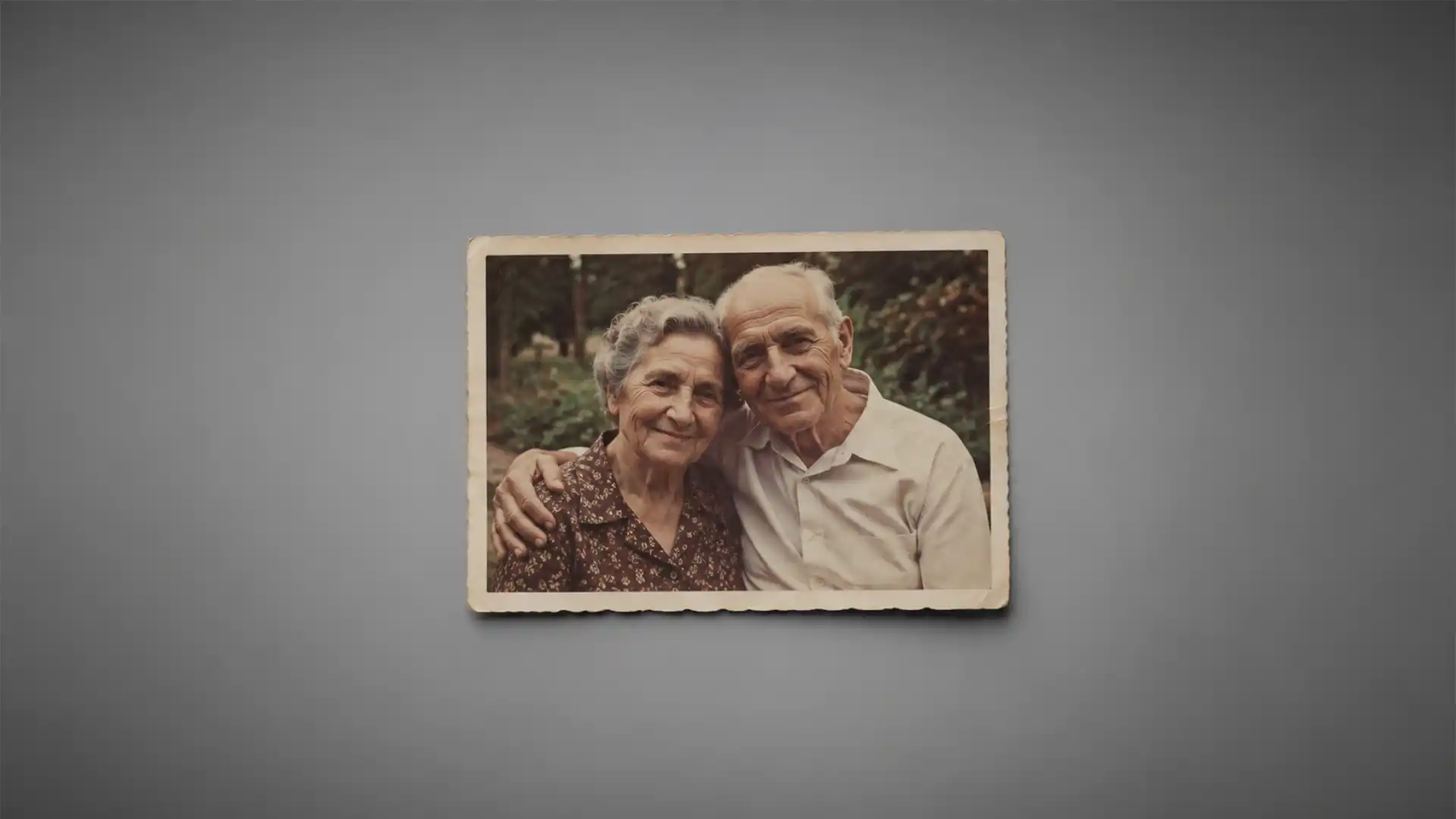
A family photo is not precious because it looks perfect. It is precious because someone was there. The child had food on their shirt. The hallway light was ugly. Someone laughed too early. The person behind the camera chose that second, not a cleaner one. That is the part artificial intelligence cannot replace: the lived event behind the image. AI can recreate faces, polish backgrounds, sharpen old recordings, animate the dead, and generate scenes that never existed. It can make convincing media. It cannot turn invention into evidence.
Table of Contents
A real family photo is not only an image
A family photo has two lives. The first life is visual: color, light, bodies, rooms, weather, clothes, gestures. The second life is evidentiary: this happened, these people were together, this was the table, this was the year, this was the voice, this was the dog that would not sit still, this was the grandmother before the illness changed her face.
The first life is now exposed to competition from AI. OpenAI’s Sora 2 was presented as a more realistic and controllable video-and-audio generation model, while Google’s Veo 3.1 family has been marketed around realism, richer audio, and more control over generated clips. Both announcements point in the same direction: synthetic media is moving from experimental novelty into ordinary creative production.
The second life of a family photo is different. It does not depend on technical polish. It depends on contact with reality. A badly framed image from a birthday in 2009 may have more force than a perfect AI reconstruction because the bad framing is part of the human record. It says someone held the camera poorly. It says the moment was not staged for a model. It says the family did not know what the future would make of that image.
This is the central distinction. AI can produce resemblance. A family photo carries witness. One is a visual output. The other is a trace of time.
That difference matters more now because generative media has entered the same emotional territory where family photography lives: children growing up, parents aging, absent relatives, reunions, weddings, illness, grief, and ordinary days that later become priceless. The tools are not limited to fantasy art or advertising. They now reach into the private archive.
The risk is not that families will stop taking pictures tomorrow. Phones are still everywhere. The risk is more subtle: people may begin to treat generated substitutes as equivalent to captured moments. A synthetic scene of a child with a deceased grandparent may feel comforting. A restored photo may look cleaner. A generated family portrait may fill a gap in the wall. But emotional usefulness is not the same as historical truth.
A family archive is not only a collection of pleasing images. It is a chain of proof, memory, consent, and care. The better AI becomes at making images that seem emotionally plausible, the more important this distinction becomes.
Synthetic media has entered the family album
AI image and video systems no longer sit outside everyday photography. They are inside the devices, apps, and cloud libraries where families already store their memories. Google Photos promotes AI editing tools that remove distractions, fix blur, change backgrounds, and reimagine photos through plain-language requests. Apple’s Clean Up feature in Photos removes distracting objects through Apple Intelligence. Samsung’s Galaxy AI tools let users move, remove, and regenerate parts of images.
These tools are not automatically harmful. A parent removing a stranger from the background of a beach photo is not destroying civilization. An old scan with better contrast may be easier for grandchildren to enjoy. A blurry picture of a person who later died may deserve careful rescue. AI-assisted repair can serve memory when the family understands what was changed and why.
The problem begins when repair becomes replacement. A tool that fixes blur respects the existence of the original frame. A tool that invents a missing person at the table crosses into a different category. It may still have emotional value, but it should not be confused with a record. The family album begins to lose its authority when invented scenes sit beside captured scenes without labels, notes, or context.
This will become common because AI editing is becoming frictionless. People do not need a professional retoucher. They do not need a desktop program. They do not even need the vocabulary of photography. They can ask the software to remove, extend, brighten, open eyes, change expressions, or generate a more flattering version. When tools become invisible, the ethical burden shifts to the user.
The family album used to contain many signs of human limitation: underexposure, motion blur, closed eyes, bad hair, cluttered rooms, awkward smiles. Some of those flaws were frustrating at the time. Later, they become evidence. They tell the viewer that life was not arranged for presentation. They preserve the texture of reality.
AI editing tempts people to sand down that texture. It gives families the power to make images more acceptable but less truthful. A family record made only of corrected faces, removed mess, and invented harmony becomes a strange document. It looks loving, but it may be less honest than the drawer of crooked prints it replaced.
The fact of presence is the irreplaceable core
The deepest value of a family photo is not that it shows what someone looked like. It shows that someone was present. Presence is hard to define because it is not a visual feature. It is a claim about reality. The person stood there. The child leaned into the parent. The uncle looked away at the wrong second. The room held those people at that time.
AI can simulate visual presence. It can place a person in a chair, infer lighting, animate a mouth, and render a plausible hug. But simulated presence does not create shared time. A generated image of four generations around a table may be beautiful. It may even comfort someone. It does not prove that the four generations ever sat together.
This is not a small philosophical distinction. Families use photographs to settle memory. Who came to the wedding? Who held the baby? What did the old kitchen look like? Which holiday was the last one before the move? The photo answers because it points back to an event. Its imperfections are tolerated because the image has authority.
Synthetic family media has no such authority unless it is clearly framed as art, tribute, or reconstruction. Without that framing, it can pollute memory. A child who grows up seeing an AI-generated scene may later remember the scene as if it happened. A future relative sorting through files may not know whether a video was captured, edited, restored, or invented. The archive becomes emotionally persuasive but historically unstable.
That instability will not remain private. Family photos are used in genealogy, inheritance disputes, memoirs, social history, identity work, school projects, memorial services, and community archives. Personal media becomes public evidence more often than people expect. The small family file can become part of a larger record.
This is why provenance matters. It is not a technical obsession. It is a way of protecting the boundary between lived memory and generated image. A synthetic portrait can belong in the archive, but it needs a clear label. A restored video can be cherished, but the original should be preserved. An AI-animated grandparent may move people at a funeral, but the family should not pretend the recording is real.
The most honest family archive of the AI era will not reject AI. It will distinguish capture, repair, interpretation, and invention.
The family album has always been a record of identity
Family photography has never been neutral. People choose what to photograph, what to print, what to hide, what to frame, and what to throw away. The family album is part record, part performance, part memory work. Research on digital photography has described a shift from photography mainly as family memory toward photography as communication and identity formation.
That shift matters because AI arrives after the family album has already changed. The private album became the camera roll. The camera roll became the cloud library. The cloud library became a social feed, backup system, search index, and editing workspace. Families no longer keep only a few prints from a roll of film. They keep thousands of images, many of them never viewed again.
AI enters this crowded archive as both assistant and intruder. It can sort, search, recognize faces, group events, suggest memories, and revive forgotten pictures. It can also flatten the difference between the candid and the composed, the captured and the generated, the private and the shareable.
The old family album had limits that protected it. Film cost money. Printing took effort. Albums took space. Someone had to decide what deserved a page. Digital abundance removed much of that pressure. AI abundance removes another layer: the image no longer needs to come from an event at all.
The result is a new curatorial problem. Families need to decide not only which memories to keep, but which kind of media each item is. A photo from a phone, a scanned print, a repaired scan, a colorized portrait, a face-swapped scene, an AI-generated tribute, and an animated avatar may all appear in the same folder. Without labels, the folder becomes a trap for future memory.
Family identity is built through repetition. Children hear stories while looking at pictures. Relatives point and correct one another. “That was not Easter, that was your cousin’s confirmation.” “That was before the accident.” “Your grandfather hated that sweater.” These exchanges turn images into shared memory. AI-generated family media interrupts that process when it looks like proof but lacks the event that proof requires.
The album survives when families keep telling the truth around the image.
Imperfection is part of the evidence
A perfect family photo can feel strangely empty. The most loved images are often technically weak: a blur of a toddler running, a parent half outside the frame, a dinner table covered in plastic bottles, a flash reflection in a window, a face caught between laughter and speech. These details matter because they were not optimized for later display. They were accidental evidence.
AI systems are trained to produce visual coherence. They tend toward pleasing composition, clean light, readable faces, and smooth surfaces unless prompted otherwise. Even when they mimic imperfection, the imperfection is selected. It is not the same as a camera failing inside a real moment.
Families should defend imperfection because it carries information. The mess on the floor says children lived there. The cheap wallpaper says something about money, taste, and time. The out-of-date television in the corner places the scene. The cake that collapsed matters more than the ideal cake generated later.
This is also a class issue. Polished memory often favors families with resources: professional photographers, beautiful homes, styled clothes, destination events, and time to curate. Ordinary family photos resist that hierarchy. They preserve life as it was lived, not only as it was presented.
AI can accidentally intensify the pressure to look better than life. A family may begin replacing clutter with clean interiors, tired faces with smiling ones, local rooms with aspirational rooms. The archive then becomes less a memory record than a wish record. Wishes have value, but they should not erase evidence.
The most human family images often include friction. Someone does not want to be photographed. Someone is bored. A child is crying. A grandparent is distracted. A teenager is embarrassed. AI can turn these into harmony, but harmony was not the event. The right to remember awkwardness is part of the right to remember honestly.
This is why families should not rush to improve every image. The question is not “Can this look better?” The better question is “What truth would be lost if this were cleaned up?”
Video carries time, not just appearance
Family video has a different emotional force from still photography. A photo freezes presence. A video preserves duration. It catches the voice before it changed, the gait before illness, the accent that softened after migration, the rhythm of a kitchen, the silence after a joke, the way someone looked at someone else when they thought nobody noticed.
Synthetic video can imitate motion, but recorded family video carries sequence. It shows what happened before and after the still frame. It preserves hesitation. It includes sounds nobody would think to generate: a spoon hitting a bowl, wind against a phone microphone, a child repeating the same word, a dog barking at the wrong time, a parent saying “Stop filming” and smiling anyway.
The arrival of AI video with synchronized audio raises the emotional stakes. Sora 2 and Veo 3.1-style systems point toward generated scenes that may feel less like illustrations and more like recordings. OpenAI says Sora outputs include visible and invisible provenance signals, including C2PA metadata, because synthetic video now needs signals that help viewers understand origin.
That tells us something. When tools become good enough to fool memory at a glance, labels become part of the media itself. The family archive cannot depend on intuition alone. A future viewer will not always know whether a video of a deceased relative speaking at a family table was recorded, restored, prompted, or assembled from training data.
Video also intensifies consent. A still image of a deceased relative is one thing. A moving, speaking version is another. A photo keeps silence unless the family narrates around it. An AI video may appear to speak for the person. The danger is not only deception. It is appropriation of personality.
A family may decide to create such a tribute. The ethical line depends on consent, context, labeling, and restraint. But no tribute should be treated as a substitute for recorded video. The real clip of a grandfather saying three ordinary words in bad light may be more precious than a generated monologue because the real clip contains time, not just likeness.
Provenance is becoming a family skill
Provenance used to sound like a museum word. Now it belongs at the kitchen table. It means knowing where a piece of media came from, how it was made, and what happened to it after capture. In the age of AI, provenance is the difference between “this is a scan of a photo from 1984,” “this is a repaired version of that scan,” and “this is a generated scene based on old family images.”
C2PA and Content Credentials have emerged as attempts to give digital content a verifiable history. The C2PA specification deals with provenance information for media assets, while Content Credentials describes itself as a way to provide media transparency through metadata about creation and editing.
These systems matter, but families should not mistake them for magic. Metadata can be stripped by platforms. Files can be copied, resized, compressed, and re-exported. Screenshots lose context. Prints separate image from file history. A family archive still needs human notes.
The best system is layered. Keep originals. Keep edited versions separately. Use filenames that say what the file is. Add dates and names where possible. Write a plain text note for important folders. For printed albums, write on archival-safe labels or keep a note sheet. None of this is glamorous. It is the ordinary work that saves future families from confusion.
AI companies are also building provenance systems because trust is becoming part of the product. OpenAI announced work on Content Credentials, SynthID, and a public verification tool for OpenAI-generated content in May 2026. Google has said SynthID has been integrated into its generative media models and products, with watermarks applied across vast amounts of generated images, videos, and audio.
Still, family trust cannot be outsourced entirely to platforms. A family archive may outlive apps, accounts, phones, companies, and file standards. A note written by a parent may be more useful in 2070 than a proprietary badge that no longer opens.
Provenance is not only a technical mark. It is a family promise not to lie to the future.
Real family media and AI-made family media
| Media type | What it gives the family | What it cannot honestly claim |
|---|---|---|
| Captured photo or video | Evidence that people, place, and time met in one event | Perfection, completeness, or neutral memory |
| Restored old photo | A clearer view of an existing record | That the restored version is untouched |
| AI-edited family image | A cleaned or altered version for sharing, display, or repair | That every visible detail was present |
| AI-generated tribute | A symbolic scene, memorial, or imaginative reconstruction | That the scene happened |
| AI avatar or voice clone | A simulated interaction based on traces of a person | The living consent, agency, or presence of that person |
This distinction should sit near every family archive. It does not forbid AI. It gives families a language for using AI without weakening the truth value of their real photographs and videos.
AI editing has crossed from specialist work into ordinary memory
For decades, photographic manipulation required skill, software, and intent. People understood that a heavily edited image had passed through a specialist process. The smartphone changed that. AI editing goes further by making complex changes feel casual.
This matters because family media depends on habit. People do not hold ethics meetings before fixing a photo. They tap. They swipe. They accept the suggestion. If the app says it can remove a distracting object, many users will do it. If it suggests a better smile, some will accept. If it builds a memory montage, users may watch without asking how it chose the clips.
The AI layer changes the camera roll from storage into an interpretive system. It does not merely hold images. It sorts them, searches them, edits them, recommends them, and sometimes generates new versions. The archive becomes active.
That can be useful. A parent with 80,000 photos may need AI search to find a child’s first bike ride. Face grouping may recover images that would otherwise disappear into digital noise. Automatic restoration may make old scans visible to elders with poor eyesight. These are real gains.
But the same convenience weakens friction. Friction often protects care. When printing a photo took effort, people made decisions. When editing required skill, people thought before changing. AI reduces the cost of alteration so sharply that families need new habits of restraint.
A useful rule is simple: do not overwrite originals. Keep the captured file as the root. Store edited versions as branches. Label synthetic versions as synthetic. This may sound excessive for casual snapshots, but it becomes valuable when grief arrives. Nobody knows which photo will matter later.
The photo you almost delete may become the last image of someone healthy. The shaky video may hold the only recording of a voice. The blurry shot may contain the background detail that unlocks a family story. A generated replacement cannot recover those accidental details because it never witnessed them.
AI editing belongs in the family archive only when it works in service of the original, not against it.
The emotional contract of family media
Every family photo carries an emotional contract. The person taking the photo asks for a tiny form of trust. The person being photographed accepts being remembered in that form, or at least tolerates it. The people who later view the image trust that the image is what the family says it is.
AI complicates that contract because the subject may no longer be a participant. A person can be placed into a scene they never entered. Their face can be made to smile. Their body can be aged, de-aged, animated, or made to hug someone. Their voice can be cloned from old recordings.
The family may do this with love. Love does not remove the ethical problem. A person’s likeness is not only material for family expression. It is tied to dignity. A dead relative cannot correct the record. A child cannot fully understand how a synthetic version of their face may circulate later. A relative who disliked being filmed may not have wanted to become an AI avatar.
This does not mean every AI tribute is wrong. It means family media needs consent norms stronger than platform settings. A good family rule is to separate private remembrance from public posting. A generated image made for a small family memorial is one context. Uploading the same image to social platforms without explanation is another.
The emotional contract also applies to viewers. If an image is synthetic, tell them. Do not make grandparents guess. Do not let children believe a generated reunion happened. Do not present a simulated voice as a newly found recording. People deserve to know whether they are encountering memory or invention.
Trust is hard to rebuild after it breaks. Once a family learns that some images were invented without labels, the archive becomes suspect. Even real photos may feel uncertain. The cost of unlabeled synthetic media is not only confusion about one file. It is distrust toward the whole collection.
The family album works because people believe it. Protecting that belief is an act of care.
Children deserve more than photogenic records
Children are at the center of family photography, and they are also the least able to control it. Parents photograph first steps, school plays, holidays, injuries, tantrums, birthdays, and quiet moments. Those images become the child’s history before the child has any real say in the matter.
AI raises the stakes. A child’s face is not only a memory now. It is data that may be edited, searched, recognized, repurposed, or manipulated. UNICEF has argued for child-centered AI principles that treat privacy as a right, not a preference, and warns that children cannot meaningfully consent to extensive data collection.
Family photos of children should therefore be handled with more care than adult nostalgia might suggest. The question is not only whether a parent has the right to take a picture. The question is whether the child will later be glad that the image exists, where it was stored, how it was shared, and whether it was altered.
Children also need honest records. A childhood album that has been heavily corrected may quietly teach a child that only the polished version of life deserved preservation. AI can remove messy rooms, fix awkward expressions, reshape bodies, and generate ideal scenes. That may look harmless, but it changes the message of memory.
A child deserves evidence of real affection, not only curated proof of parental success. The bad haircut matters. The cluttered bedroom matters. The photo where nobody looks ready matters. These are not failures. They are signs of actual life.
Parents should also be careful with AI-generated images of children in situations that never occurred. A fantasy portrait is fine when clearly framed as play. A generated image of a child at a milestone they missed may be emotionally complicated. It may comfort a parent but confuse the child’s own memory. It may create pressure to accept a fictional version of personal history.
The safest family practice is consent by growth. Young children cannot decide much, so parents act conservatively. Older children should be asked before sharing images. Teenagers should have real veto power over public posting and synthetic edits. Family memory should not become a permanent record built over a child’s objections.
Consent becomes harder when faces become reusable material
In older photography, a photo was a fixed object. It could be copied, enlarged, cut, or retouched, but its reuse required physical or technical work. In AI systems, faces and voices become reusable patterns. A few images may be enough to generate many more. A short audio clip may feed a voice simulation. A family archive becomes raw material.
This changes consent. Someone may have agreed to a birthday photo in 2016. They did not necessarily agree to have their face used in a generated 2035 memorial video. A grandparent may have allowed casual filming at a table. They did not necessarily consent to a speaking avatar. A child may accept a photo in a private album. That does not mean they agree to AI-edited public posts.
The law is still uneven. The EU AI Act creates transparency duties for certain AI systems and synthetic content, and the European Commission has been working on marking and labeling practices for AI-generated content. But family ethics cannot wait for perfect regulation. Home archives move faster than law.
Consent in family media should be treated as relational, not merely legal. Ask when possible. Label when altered. Keep sensitive material private. Avoid making synthetic versions of people who disliked cameras, who did not consent before death, or whose close relatives object.
Consent also applies to group images. A family reunion photo may include cousins, friends, neighbors, and children from other families. Using that group photo to generate new scenes pulls many people into the synthetic archive. A single person’s creative urge can override the privacy expectations of everyone else in the frame.
The safest policy is not dramatic. Use AI on family images with the same caution you would use with private letters. A letter from a deceased parent is not yours to rewrite and publish as if it were original. A face deserves similar restraint.
Digital afterlife tools test the boundary between love and simulation
AI grief tools have moved from speculation into real services and reported personal use. Reuters described people using voice clones and digital avatars to preserve loved ones, while also raising concerns around consent, data, and mourning. Academic work on griefbots and postmortem avatars has warned that simulations of the deceased involve risks for data donors, recipients, and people who interact with the resulting systems.
Family photos and videos are central to this market because they supply the raw material of presence. A still image can become an animated face. A voice note can become a voice model. Messages can become a chatbot. The family archive becomes the seed of a simulated person.
This is emotionally powerful territory. A grieving child may want to hear a parent’s voice. A widow may want one more conversation. A family may want a memorial video for a funeral. It would be cruel to dismiss these desires as foolish. Grief searches for contact.
The danger lies in confusing contact with simulation. A recording of a deceased person is a preserved trace. An AI system that speaks new words in that person’s style is a fictional extension. It may feel intimate, but it is not the person returning. The more realistic it becomes, the more carefully it should be framed.
Photographs have always been part of mourning. People keep portraits, kiss prints, replay videos, and speak to images. The difference is that the photo does not answer back. Its silence protects the boundary between memory and life. AI grief systems cross that boundary by producing new behavior.
Some families may choose that path. If they do, they should set limits: clear labels, private access, consent where possible, no commercialization of the deceased, no use with young children without professional guidance, and a way to stop. A digital memorial should not become a subscription that turns mourning into recurring revenue.
A real family video lets the dead remain themselves. A griefbot risks making them perform.
Nostalgia is powerful, but it needs truth
Nostalgia is not just sentimentality. The American Psychological Association has discussed research showing that nostalgia may support social belonging, reduce loneliness, and strengthen a sense of meaning. Family photos often trigger that effect because they connect private feeling to visible proof.
AI can create nostalgic imagery easily. It can generate a childhood room that looks like the 1990s, a holiday dinner with warm light, a retro film texture, a lost relative’s face, a town street that feels familiar but never existed. These images may stir emotion even when they are invented.
That emotional power is exactly why honesty matters. The human mind does not store memory as a perfect recording. It reconstructs. Photos can guide that reconstruction. They can also bias it. Research on photographs and autobiographical memory has examined how photos influence the visual perspective of remembered events. When synthetic images enter the archive, they may become memory cues for events that never happened.
A family should not treat this lightly. Children are especially vulnerable to repeated visual stories. If a generated image is placed in an album without explanation, it may become part of family memory through repetition. The phrase “we were all together that day” can attach itself to a picture even if the togetherness was invented years later.
Nostalgia needs anchors. A real photo is an anchor even when memory around it shifts. A synthetic image is more like a painting. It may express longing, but it should not impersonate evidence.
There is room in family life for both. A generated tribute can sit beside a real photo if the label is clear: “AI tribute made in 2026 from old family pictures.” That sentence protects the family from false memory. It also honors the tribute as tribute, not fraud.
Truth does not make nostalgia colder. It makes it safer.
Old albums are scarce because someone chose to keep them
The printed family album was never complete. It left out arguments, ordinary fatigue, financial stress, illness, and many people who stood outside the photographer’s attention. Yet its incompleteness gave it shape. Someone selected, arranged, captioned, stored, and carried it through moves.
Digital media weakened that selection. A family may now have more photos from one holiday than an earlier generation had from ten years. This abundance feels safe, but it creates a different kind of loss. Files vanish in forgotten accounts, broken phones, dead drives, corrupted cards, and subscriptions nobody renews. The volume itself becomes hostile to memory.
The Library of Congress provides guidance on personal digital archiving because personal and family memories now require active preservation. The U.S. National Archives warns that digitizing originals allows viewing and sharing with less handling, but also says originals should be kept because digital files have their own preservation risks.
That warning is practical and philosophical. A scan is useful. It is not the same as the original print. A cloud backup is useful. It is not the same as a family archive. A phone library is useful. It is not a plan.
AI does not solve this. It may make the mess easier to search, but it may also add more generated material to an already crowded collection. Families need deletion, selection, captioning, printing, and backup. They need fewer mystery files and more context.
Keeping is an active verb. The family that wants its real photos to survive must act like a small archive. That means choosing the pictures that matter, saving them in more than one place, preserving original files, and recording names before the people who know them are gone.
The future will not remember everything. It will remember what someone cared enough to preserve.
The cloud is convenient but not an archive
Cloud photo services are useful. They sync phones, reduce the risk of losing images when a device breaks, and make sharing easy. But a cloud account is not the same as a family archive. It is a service governed by storage limits, account access, product policies, business decisions, and user activity.
Google Photos tells users that every Google Account includes 15 GB of storage shared across Photos, Gmail, and Drive, and its earlier storage policy change ended unlimited free backup for many uploads after June 1, 2021. That does not make Google Photos bad. It means families should understand that convenience has conditions.
The same logic applies across platforms. A family archive cannot live only inside one company account tied to one person’s password. Death, divorce, migration, lost devices, hacked accounts, unpaid subscriptions, and forgotten recovery emails can all cut off access.
AI makes cloud dependence more tempting because cloud services offer the best search and editing tools. The archive feels alive inside the app. It knows faces, locations, events, and dates. It creates memory videos. It suggests what to revisit. But the more the family depends on the app’s intelligence, the less independent the archive becomes.
The answer is not to abandon cloud services. It is to stop treating them as the only copy. Keep local backups. Export important albums. Store original scans outside the photo app. Share archive access with more than one trusted person. Keep a simple inventory document that explains where important files are.
A family archive should survive the failure of any one device, account, company, or relative’s memory. AI can assist that work, but it cannot replace it.
Metadata is the quiet spine of memory
A photo without context becomes fragile. The face may be familiar for one generation and unknown to the next. The place may seem obvious until the house is sold. The date may live in someone’s head until that person dies. Metadata and captions keep memory attached to files.
Digital photos often include technical metadata: date, device, sometimes location. Scans may not. Screenshots may carry misleading dates. AI-edited exports may change file information. Social platforms may strip metadata. A family that relies only on automatic metadata will leave gaps.
Plain human description still matters. “Anna’s fifth birthday, Košice, March 2018, apartment on Hlavná, cake made by Marta.” That line may be worth more than any AI tag. It names people, place, date, relationship, and story. It gives future viewers a way in.
AI can assist captioning, but it should not invent facts. If the system guesses “summer vacation” and nobody checks, error enters the archive. A wrong name repeated across albums can become a false genealogy. A wrong location can mislead future research. The archive needs verification from living people while they are available.
Families should create a habit around major events. After a wedding, reunion, holiday, or funeral, gather names. Save a text file in the folder. Ask elders to identify people in old scans. Record short audio descriptions. Print a few images and write notes. These small acts turn pictures into durable memory.
The face is not enough. The story attached to the face is what future relatives will need.
Printed photos still matter
Printing photos may look old-fashioned until a password fails. A printed photo does not require a charger, operating system, file format, subscription, or biometric login. It can burn, fade, tear, or get lost, but it remains visible without permission from a platform.
Prints also slow memory down. A phone library encourages rapid swiping. A print asks to be held, placed, framed, mailed, tucked into a book, or passed across a table. That physical handling changes the social life of the image. It gives the photo a location in the home.
Printed albums also create a natural limit. Nobody prints every screenshot. Selection returns. A family that prints fifty photos a year is forced to decide what mattered. That decision is not a weakness. It is how memory gains shape.
AI-era families should print more, not because digital is worthless, but because mixed archives are stronger. Keep originals in digital form. Keep backups. But print the images that define a year: not only the staged portraits, also the real kitchen table, the ordinary walk, the hospital visit, the birthday chaos, the last photo with someone, the first photo in a new home.
Printing also protects against synthetic confusion. A print made near the time of capture, with a date and note, becomes a strong memory object. It is not impossible to fake prints, of course. But the social chain around a print — who made it, who wrote on it, where it sat — adds context.
A family archive should have both speed and weight. Digital gives speed. Prints give weight.
A practical family archive rulebook for the AI era
| Rule | Family habit | Reason |
|---|---|---|
| Keep the original | Never overwrite captured files or scans | The original is the evidence base |
| Label AI changes | Put “restored,” “edited,” or “AI-generated” in filenames or notes | Future viewers need origin context |
| Save stories with files | Add names, dates, places, and short notes | Faces lose meaning without context |
| Print yearly selections | Make a small annual album or box of prints | Physical memory survives platform failure |
| Ask before sharing | Give older children and relatives real say | Family memory should not override dignity |
| Use AI for access | Search, organize, restore, transcribe, and caption carefully | AI is strongest as an assistant, not a substitute |
This rulebook is deliberately plain. Families do not need museum software to protect memory. They need habits that survive phones, trends, grief, and the pressure to make everything look perfect.
Private sharing beats public performance
Family photos once circulated in living rooms, wallets, albums, and envelopes. Social media turned many family images into public performance. AI raises the cost of that habit. Publicly posted images can be scraped, copied, edited, impersonated, and reused far beyond the original audience.
This is especially serious with children. Organizations such as the NSPCC advise care around taking, using, sharing, and storing photos and videos of children, including awareness of misuse risks and data protection concerns. The AI era sharpens those warnings because an image is no longer only an image. It may become source material.
Families should separate taking photos from posting photos. The right response to AI risk is not to stop documenting children. It is to stop treating every sweet moment as public content. The private archive should be richer than the public feed.
This distinction protects memory. A parent taking a candid photo for the family archive may capture truth. A parent taking a photo for public approval may unconsciously stage the moment. The child learns the difference. One says “we want to remember you.” The other may feel like “we want others to react to you.”
Private sharing tools, family groups, printed albums, shared drives with access controls, and direct messages all have flaws, but they reduce exposure compared with open platforms. Families should also agree on rules for extended relatives. Grandparents, aunts, uncles, and cousins may post with love but without understanding the child’s future digital footprint.
Public sharing is not always wrong. A graduation photo, wedding portrait, or family announcement may belong in public. But the default should shift. The most intimate images deserve the smallest audience.
AI makes this shift urgent because the internet no longer only stores the image. It can remix the image.
Family media has legal and ethical weight
People often treat family photos as casual property: I took it, so I can use it. That view is too narrow. Family media includes privacy, dignity, copyright, likeness, child protection, school rules, platform terms, and sometimes medical or location information.
A photo of a child in a school uniform may reveal location. A hospital video may reveal health data. A reunion photo may reveal relationships someone preferred private. A timestamp may show travel patterns. An AI-edited version may create a false impression of attendance, behavior, or consent.
Schools and organizations increasingly treat photos and videos as data protection issues. UK government guidance for schools, for example, discusses taking and using photos and videos of pupils, staff, and others across uses such as educational activities, marketing, newsletters, social media, trips, and performances.
Families do not need to become lawyers, but they should adopt a stronger privacy instinct. Ask before posting group photos. Avoid sharing images that reveal addresses, school names, routines, or vulnerable moments. Do not upload sensitive family archives into unknown AI tools without understanding where the data goes. Do not create synthetic media of relatives for jokes that may embarrass them later.
The legal system may eventually catch up with synthetic family harms, but personal restraint is faster. The archive should not become a place where family members lose control over their own faces.
Ethics also means allowing absence. Not everyone wants to be photographed. Not every event needs documentation. Not every deceased person needs digital revival. Respecting the unrecorded is part of respecting the family.
AI search makes archives easier to use
The strongest case for AI in family media is not replacement. It is access. Most families already have too many files to manage manually. AI search can find “red bicycle,” “grandma in the garden,” “first apartment,” or “dog at the lake” when nobody remembers the filename. Face recognition can gather scattered images of a relative. Speech-to-text can make old videos searchable. Restoration can make faded scans legible.
These uses honor the archive when they point back to real media. They make captured memories easier to find, share, and understand. They reduce the chance that meaningful files remain buried.
The same is true for accessibility. AI-generated captions may help deaf relatives understand old videos. Image descriptions may help blind relatives participate in family albums. Translation may let younger generations understand handwritten notes or spoken stories in another language. Used well, AI can widen the circle of memory.
The danger is dependency without verification. AI may misidentify people, invent captions, mistranscribe names, or group similar faces incorrectly. Families should treat AI search results as suggestions, not final truth. The archive becomes stronger when human knowledge corrects machine guesses.
One useful practice is “archive sessions.” Put old photos on a screen with older relatives. Use AI to group and surface images, then record the human corrections. The tool finds. The family knows. Together, they can rescue names and stories that would otherwise vanish.
AI is best when it kneels beside the archive rather than standing in for it.
Restoration is an act of care when it stays honest
Restoring old family photos can be beautiful. A torn portrait repaired carefully may let grandchildren see a face for the first time. Color correction may recover detail from a faded print. Noise reduction may reveal a person in the background. AI can make this work faster and cheaper.
But restoration needs humility. Old photos are historical objects. The crack, stain, border, paper texture, and handwriting on the back are part of the record. A clean restored copy is useful, but the damaged original still matters. The National Archives advises keeping originals after digitization because digital files have their own risks. The same logic applies after restoration.
Families should save three layers when possible: the physical original, the raw scan, and the restored version. The restored version is for viewing. The scan is for evidence. The physical original is the object that traveled through time.
Colorization deserves special care. Adding color to a black-and-white image may make it feel closer, but the colors are often guesses. A generated color may be plausible but false. If a family knows the dress was blue, add that note. If not, label the colorized version as interpretation.
The same applies to face reconstruction. Some tools “restore” faces by generating likely features. That may produce a pleasing portrait, but it may also replace the person’s actual face with an algorithmic average. For ancestors with few surviving images, this can distort memory.
A good restoration should make the original easier to see, not pretend to become the original.
Brands will sell synthetic nostalgia
Synthetic nostalgia will become a market. Families will be offered AI wedding films assembled from photos, baby videos generated from stills, birthday messages from deceased relatives, “missing memory” reconstructions, automatic anniversary scenes, and personalized family-history animations. Some services will be tasteful. Some will be manipulative.
The business incentive is obvious. Family memory is emotionally charged. People pay for comfort, tribute, repair, and belonging. AI makes the production cheap. The margin may be high. The marketing will not say “we are fabricating scenes.” It will say “bring memories back to life.”
That phrase should make families pause. Memories can be preserved, organized, repaired, shared, and interpreted. They cannot literally be brought back. A generated scene may express grief or imagination, but it does not recover the event. Companies may blur that line because blurred lines sell.
Families should ask direct questions before using such services. What data is uploaded? Is it used for training? Who owns the output? Can files be deleted? Are synthetic outputs labeled? Can the service create new speech from a deceased person? Are minors involved? Is there a private mode? What happens if the account is closed?
If the answers are vague, the family archive should not be the test material. Use copies, not originals. Avoid sensitive images. Never upload private family media to unknown tools merely because the demo looks emotional.
The best memory services will respect boundaries: clear labels, data minimization, export options, deletion controls, consent workflows, and no deceptive claims. The worst will treat grief as content supply.
Trust is moving from public news into private life
Deepfakes are often discussed through politics, war, scams, and public misinformation. Those risks are real. But the same trust crisis is moving into private life. A family may soon face questions that once belonged to newsrooms: Is this real? Who made it? Was it edited? Is the voice authentic? Did the platform strip the metadata? Was the image generated by a model?
Content authenticity systems are trying to address this problem. Adobe describes Content Credentials as a durable metadata type that works like a digital nutrition label for content, including details about whether content was captured, generated by AI, or edited. Google’s SynthID and OpenAI’s provenance efforts show that major AI firms understand the need for origin signals.
Yet private life cannot wait for universal adoption. Families will receive images through messaging apps, screenshots, downloads, shared albums, and old drives. The origin trail will often be incomplete. The family’s own practices will matter as much as industry standards.
A simple family norm can help: real captured media should be called real captured media; edited media should be called edited; generated media should be called generated. Do not rely on the eye. Do not rely on “everyone knows.” Future viewers will not know.
Trust also depends on restraint in jokes. A funny AI image of a cousin may feel harmless, but it trains the family to accept synthetic images as casual truth. A fake video of a grandparent saying something absurd may make real videos feel less stable. Humor has a cost when it uses a real person’s likeness without consent.
The private archive deserves the same seriousness society is beginning to demand from public media.
The news value of this debate is cultural, not only technical
The claim that no AI will replace family photos is not anti-technology. It is a newsworthy cultural claim because the technology has reached the emotional core of domestic life. The story is not “AI can make images.” The story is “AI can now compete with the forms through which families remember who they are.”
This changes the public conversation. AI is not only about jobs, copyright, education, elections, or entertainment. It is also about the home archive: the camera roll, the baby video, the memorial slideshow, the scanned album, the parent’s voice memo, the group chat.
Pew Research Center has reported that many Americans remain wary of AI’s impact on daily life, with concern often outweighing excitement. Its 2026 summary noted that half of U.S. adults in a June 2025 survey said increased AI use in daily life made them more concerned than excited. That public mood makes sense when AI moves into intimate domains. People may accept AI for weather forecasting or medicine while feeling uneasy about AI touching memory, creativity, children, and relationships.
The family photo debate condenses that unease. It asks what society still wants from reality when artificial media becomes plentiful. Do people want the prettiest version of memory, or the truest surviving trace? Do they want deceased relatives simulated, or preserved through the real recordings they left? Do they want children represented as flawless, or remembered as human?
These are not nostalgic questions. They are governance questions, product questions, design questions, and family questions. The answers will shape how platforms build tools, how regulators define disclosure, how archives teach personal preservation, and how families talk about images.
The family album is becoming a frontline institution of media literacy.
Real photos carry social proof inside the family
A family photo rarely works alone. Its authority comes from a network of people who can confirm, dispute, and narrate it. One aunt remembers who took it. A cousin remembers the argument before it. A parent remembers the road trip. A sibling remembers being annoyed. The photo is a prompt for collective verification.
AI-generated family media lacks that social proof unless it is transparently introduced as a creation. Nobody remembers the generated event because nobody lived it. People may remember making the AI image, but that is a different story.
This distinction matters in families with conflict. Photos are sometimes used to claim closeness that did not exist, erase someone who was present, or idealize a relationship. AI gives people more power to revise the visual record in their favor. A parent could generate images of harmony. An estranged relative could insert themselves into scenes. A memorial could smooth over harm by creating affectionate imagery the living person never offered.
Family archives are already selective. AI can make them manipulative. That is why labeling is not enough by itself. Families also need ethical judgment about what should be made at all.
A synthetic image that expresses “I wish we had taken a photo together” may be honest if labeled. A synthetic image used to imply “we had this relationship” may be false even with technical disclosure. The emotional claim matters.
Real photos are not morally pure. They can be staged, selective, and misleading. But they are constrained by events. AI loosens that constraint. The family must replace it with honesty.
The archive should protect ordinary days
Milestones dominate family photography: births, birthdays, graduations, weddings, holidays, funerals. These matter. But ordinary days often become more precious because nobody thought they were historic at the time.
AI is weak at ordinary specificity. It can generate a generic kitchen. It cannot know the exact chipped mug unless the mug appears in the archive. It can produce a child running through a hallway. It cannot witness the sound of that hallway, the neighbor’s music, the broken lamp, the shoes by the door. It can imitate the type of memory, not the lived detail.
Families should photograph ordinary days deliberately. Not excessively. Not for posting. For the archive. The breakfast table. The walk to school. The old car. The view from the bedroom window. The handwriting on the shopping list. The parent cooking badly. The grandparent’s chair. The pet asleep in the laundry.
These images resist synthetic replacement because their value lies in specific evidence. A generated “family breakfast” has no real cereal brand, no real argument, no real light from that window on that date. It may look like memory, but it lacks the stubborn detail of life.
Ordinary media also protects against the myth that family history is only ceremony. Most love is repetitive. It lives in pickups, meals, repairs, errands, waiting rooms, chores, and jokes repeated too often. The archive should show that.
A family that documents ordinary days gives future generations something AI cannot invent after the fact: contact with the actual texture of a household.
The camera is still a promise to future people
Taking a family photo is a small promise to people not yet ready to care. Children often dislike being photographed. Teenagers roll their eyes. Adults are busy. Elders may say not to bother. Years later, those images become gifts.
The promise is not “this picture will be beautiful.” The promise is “you may need this later.” Nobody knows which image will become the one people search for after loss. This uncertainty is why replacement logic fails. You cannot generate the exact accidental moment after it has passed.
AI may create a convincing substitute, but the substitute arrives after knowledge. It is made with hindsight. Real family photos are made before meaning fully forms. That is why they matter. They carry innocence about the future. The last ordinary photo before a diagnosis did not know it was the last ordinary photo. The birthday video before a migration did not know the family would split across countries. The image before a breakup did not know it would become evidence of a vanished configuration.
Hindsight is emotionally strong, but it is not the same as witness. AI is usually a hindsight machine. It produces the image someone now wants. The camera captures what existed before anyone knew what would later be wanted.
This is a profound difference. The family archive must include unplanned evidence because life does not announce which moments will matter.
AI cannot replace the person behind the camera
A family photo records the subject, but it also records the photographer’s attention. The person behind the camera chose where to stand, when to press, what to include, and what to ignore. Sometimes that choice is clumsy. It still matters.
A mother’s photo of her child differs from a stranger’s photo because the mother sees differently. A sibling catches mockery and affection in one frame. A grandparent photographs too late but includes the table everyone remembers. These choices reveal relationships. The archive preserves not only faces but the gaze of family members toward one another.
AI-generated images have no such gaze unless a human directs them after the fact. The model does not love the child. It does not know the father’s habit of standing by the door. It does not understand that the empty chair should remain empty because someone died. It can be prompted, but prompting is not the same as witnessing.
This matters for authorship. A real family photo says, “Someone in this family cared enough to notice.” An AI-generated family image says, “Someone later wanted an image like this.” Both statements may have emotional value. They are not interchangeable.
Families should preserve photographer context when they can. Who took the photo? Was it a self-timer? Was it taken by a neighbor? Was the photographer absent from the frame because they were always the one documenting everyone else? These details reveal family roles.
Many mothers, in particular, are missing from family albums because they took the photos. AI could generate images placing them into scenes, but the absence itself tells a truth about care, labor, and visibility. A synthetic correction may soothe the wall display. It should not erase the story of who held the camera.
Synthetic images may become family myths
Families live by myths. Some are harmless: the legendary ruined cake, the trip nobody prepared for, the child who supposedly said something funny. Some are painful: the perfect marriage that was not perfect, the absent parent recast as devoted, the conflict nobody names.
Photos can challenge myths or reinforce them. AI can manufacture visual support for myths. That is new.
Imagine a family that lacks photos of a deceased father with his children because he was often absent. AI can produce tender scenes. Those images may comfort the children or deceive them. The ethical answer depends on framing, age, consent, and motive. A labeled artwork that says “a wish image” is one thing. An album image presented as family history is another.
The same applies to migration and distance. A family separated by borders may generate a reunion that never happened. As symbolic art, it may express longing. As documentary memory, it is false.
This is where families need emotional honesty. Some gaps should remain visible. The absence of a photo can be painful, but it may also be truthful. Filling every gap with synthetic imagery can turn the archive into denial.
A mature family archive can hold loss, absence, estrangement, and regret. It does not need to repair every wound visually. Sometimes the missing photo tells the story.
The market for perfection threatens memory
Consumer technology often sells improvement. Better cameras, sharper portraits, cleaner low light, automatic smiles, object removal, background replacement, AI filters. Each feature is reasonable in isolation. Together, they create a cultural pressure: memory should look good.
Family memory does not need to look good all the time. It needs to remain faithful enough to be trusted. There is a difference between improving a photo and improving the past. AI blurs that line because it can alter the scene itself.
The pressure will be strongest on parents. They already face social comparison through posts, milestones, and visual proof of good parenting. AI editing may make it easier to present a tidy, happy, well-lit family life. But children do not need a perfect visual brand. They need a truthful record of being loved.
Perfection can also erase economic reality. A generated clean home, upgraded holiday, or better outfit may hide the real conditions of a family’s life. Future descendants may lose sight of how people lived, struggled, saved, improvised, and made do. Social history depends on these details.
The imperfect archive is not a failure. It is a democratic record. It says ordinary life deserved preservation without aesthetic permission.
Family photos teach media literacy
Children learn what images are by watching adults use them. If adults constantly alter photos without explanation, children learn that images are flexible surfaces. If adults label edits and preserve originals, children learn that media has origin and context.
The AI era makes this lesson necessary. Families should talk openly about real photos, edited photos, restored photos, and generated images. A child can understand the difference earlier than many adults think. “This is a real photo from your birthday.” “This one was edited because the scan was damaged.” “This one is pretend, made by AI because we imagined grandma with us.”
Those sentences build trust. They also prepare children for a media environment where not every image online should be believed. Family practice becomes civic practice. The child who learns provenance at home is better equipped to question synthetic news, scams, and manipulated posts.
This does not require fear. AI can be playful. Families can make fantasy scenes, joke portraits, and imaginative art. The rule is disclosure. Play becomes harmful when it masquerades as record.
Parents should also let children see originals beside edits. Show the messy room before the cleaned version. Show the torn scan before restoration. Explain why the original remains. This teaches respect for evidence.
Media literacy does not begin with lectures about deepfakes. It begins when a child asks, “Was this real?” and the adult answers honestly.
Scams will exploit family trust
Synthetic voice, image, and video do not only threaten public truth. They threaten family trust directly. Fraudsters already use impersonation tactics, and AI voice cloning has drawn concern from consumer protection agencies. The U.S. Federal Trade Commission has warned about AI-enabled voice cloning harms and has challenged deceptive AI claims and schemes.
Family archives can supply scammers with material. Public videos reveal voices. Social posts reveal relationships, travel, school names, and emotional vulnerabilities. AI can turn scattered information into convincing messages.
Families should create verification habits. A private family code word may sound old-fashioned, but it is useful. Sensitive requests for money, documents, location, or secrecy should be verified through a second channel. A video or voice note is no longer proof by itself.
This practical risk strengthens the case for private sharing. The fewer public recordings of children, elders, and family routines, the less raw material strangers have. It also strengthens the case for educating older relatives, who may be targeted by emotionally manipulative synthetic media.
The family archive should be a source of memory, not a supply chain for fraud.
Regulation will not settle the private archive
The EU AI Act, C2PA, SynthID, platform labels, and provenance tools all matter. They create pressure for transparency. They give responsible companies a path. They may reduce some confusion. They will not solve family memory.
Regulation works at the level of providers, deployers, platforms, and markets. Family archives work at the level of relationships. A cousin can still generate an image. A parent can still upload photos to a dubious tool. A memorial service can still show an unlabeled AI video. A cloud folder can still mix originals with fabrications.
The law may say some synthetic media needs marking. It may punish certain abuses. It may guide platforms. But the family still decides what to create, keep, label, and believe.
This is not a reason for pessimism. It is a reason to treat family archiving as a skill. People learned to write dates on the backs of prints. They learned to keep negatives. They learned to make copies. Now they must learn to mark synthetic media and preserve originals.
The private archive has always required care. AI changes the kind of care required.
Historical memory depends on private evidence
Historians often rely on private materials: letters, diaries, snapshots, home movies, receipts, school photos, immigration documents, funeral cards. Family archives become social history when aggregated across time. They show clothing, housing, work, gender roles, migration, celebrations, illness, neighborhood change, and everyday technology.
If future family archives are flooded with unlabeled synthetic media, historians will face a contaminated record. This does not mean every AI tribute is dangerous. It means undisclosed synthetic media weakens evidence.
The IMAGO family photo album dataset, for instance, was created to support socio-historical analysis of family photographs across time. Such work depends on the assumption that family albums contain images connected to real periods, practices, and people.
A generated family scene may still become historically interesting as evidence of 2020s or 2030s synthetic memory culture. But it must be identifiable as generated. Otherwise, it may mislead later viewers about clothing, interiors, family structure, events, and social life.
Private truth has public afterlives. The small choices families make today will shape what future people can know.
The best use of AI is to protect the real
AI should be judged by whether it protects the real archive or replaces it. Good uses include finding buried photos, transcribing videos, improving access for disabled relatives, restoring damaged scans while preserving originals, translating captions, identifying duplicate files, and helping families create inventories.
Risky uses include generating events that never happened, creating speech for the dead without consent, changing children’s bodies or expressions for display, erasing socially or historically relevant details, uploading sensitive archives to opaque services, and mixing synthetic outputs with real captures without labels.
This is not a purist position. Family photography has always involved choices and edits. The ethical test is whether the edit respects the event. Cropping may respect the event. Exposure correction may respect it. Removing a person may not. Adding a person almost never does if the result is presented as documentary.
AI is strongest when it returns attention to real material. The tool should send families back to the original video, the old print, the voice note, the handwritten caption, the living relative who remembers. When it becomes a substitute for those things, it weakens the archive.
The goal is not anti-AI memory. The goal is pro-truth memory.
A new family etiquette is forming
Families need etiquette for AI media just as they developed etiquette for tagging, posting, and group chats. The rules should be plain enough to remember.
Ask before making synthetic images of living relatives. Do not generate images of children for public sharing without parental and, when old enough, child consent. Do not create AI speech from a deceased person unless the family has discussed it carefully. Keep originals. Label edits. Use private sharing by default. Never use AI to settle family conflict through fabricated evidence. Do not surprise grieving people with simulations of the dead.
These rules may sound strict, but they protect emotional safety. A person should not open a family chat and unexpectedly see a dead parent animated. A teenager should not discover their face in a fake scene. A relative should not be made to say words they never said.
Etiquette also includes positive duties. Print photos for elders who do not use cloud apps. Share archive access before a death makes passwords impossible. Ask grandparents to name people in old albums. Record voices while people are alive and willing. Make real videos, not only AI tributes after loss.
The most loving technology practice may be very simple: film the person now, with permission, while they are here.
Real family videos should be recorded before they are needed
Many families have thousands of photos and very few good recordings of voices. They realize this too late. AI voice tools may tempt them to fill the gap after death, but a real recording made during life is better in every way.
Families should record short, ordinary videos of elders and parents speaking naturally. Not staged speeches only. Everyday stories. Recipes. Names of relatives. Songs. Jokes. The way someone says goodnight. The way someone describes where they grew up. These recordings do not need professional quality. They need reality.
Consent matters. Ask. Explain. Keep the recordings private unless agreed otherwise. Store them carefully. Add dates and names. Back them up. Transcribe them if possible.
AI may later help clean audio or transcribe speech, but it should not become the first moment a family decides a voice matters. The ethical answer to AI resurrection is not only caution after death. It is attention before death.
A real two-minute video of a grandmother describing a childhood street may become a treasure. No synthetic monologue can replace it because the value is not the information alone. It is the person choosing words in time.
The future camera roll will need labels
The camera roll of the future will contain captured photos, computational photos, AI-edited photos, generated images, screenshots, memes, documents, scans, and videos. The visual grid will not be enough. Labels will become part of memory.
Some labels will be automatic. Some may use Content Credentials or other provenance systems. Some will need to be manual. Families should normalize labels that feel unromantic but save trust: “original,” “scan,” “restored,” “AI colorized,” “AI background removed,” “AI tribute,” “generated from prompt,” “voice cleaned,” “auto-caption checked by Marta.”
The wording does not need to be technical. It needs to be understandable. A future teenager sorting family files should know what they are seeing.
Labels also protect the emotional value of AI creations. When a tribute is clearly labeled, it can be appreciated without suspicion. When it is hidden, it becomes a possible lie. Transparency lets symbolic media keep its place.
The family album of the AI era may look more annotated than the old album. That is not a loss. The handwritten caption is returning in digital form.
The irreplaceable family image is often boring at first
Many family photos become valuable slowly. At the moment of capture, they look boring. A child on a sofa. A parent near a sink. A street outside an apartment. A car before a trip. A group waiting in winter coats. Years later, the boring image becomes dense with meaning.
AI struggles with this because generated images are usually made to satisfy present desire. They are made because someone already has a concept. Real family photos often become meaningful despite lacking a concept. They carry surplus detail.
This is why families should resist deleting too aggressively based only on beauty. Delete duplicates, accidental screenshots, and unusable clutter, yes. But keep representative images of rooms, routines, people, and places. The future may care about details the present ignores.
A synthetic image can be made later to show an idealized version of a home. It cannot recover the exact magnets on the refrigerator if nobody photographed them. It cannot know the blanket pattern, the calendar, the chair, the broken tile, the view from the balcony, the cheap plastic toy on the floor.
The boring photo is often the one that defeats AI because it contains unplanned truth.
Memory needs boundaries as much as access
The modern instinct is to make everything searchable, shareable, and editable. Family memory also needs privacy, silence, and limits. Not every image should be tagged. Not every video should be searchable by every relative. Not every grief object should become interactive.
Boundaries protect dignity. A family archive may include illness, addiction, disability, poverty, conflict, funerals, and vulnerability. AI tools trained for engagement may not understand the emotional weight of surfacing such images at the wrong time. Automated memory reminders can be painful. Generated tributes can intrude on grief.
Families should curate access. Some folders may be private to one person. Some may be shared after death. Some may be deleted. Some may be printed but not uploaded. Some may be described without being widely shown.
AI product design often favors more: more memories, more resurfacing, more edits, more sharing. Families are allowed to choose less. Less exposure. Less alteration. Less performance. More care.
The archive is not only a database. It is a moral space.
The strongest family archive is mixed, honest, and human
The best family archive in the AI era will not be purely analog or purely digital. It will be mixed. Original files, cloud backup, local backup, printed selections, scanned albums, captions, audio stories, restored copies, and clearly labeled AI tributes may all have a place.
The standard is honesty. A family can use AI to repair a torn photo and still honor the original. It can create a generated memorial artwork and still tell children it is symbolic. It can use face recognition to find pictures and still correct wrong names. It can enjoy technology without surrendering memory to it.
The human work remains central. Someone must decide what matters. Someone must ask elders for names. Someone must print. Someone must label. Someone must protect children’s privacy. Someone must say no to a synthetic image that feels wrong. Someone must keep the real video even when the AI version looks cleaner.
AI can make images. Families make memory.
The real photo will keep its power because life only happens once
The reason no AI will replace family photos and videos is not that AI will remain technically inferior. It may become extraordinary. It may generate faces, voices, rooms, light, gestures, and emotion with disturbing accuracy. The stronger it becomes, the clearer the distinction must be.
A family photo is not merely a picture of a person. It is a surviving encounter between light, time, body, place, and attention. A family video is not merely moving likeness. It is duration rescued from disappearance. These things cannot be generated after the fact because the fact is the point.
Families should use the new tools carefully. Restore what is damaged. Search what is buried. Describe what is unnamed. Translate what is inaccessible. Label what is synthetic. Preserve what is real. Print what matters. Ask consent. Protect children. Record voices while people are alive. Keep the ordinary days.
AI may imitate the surface of family memory. It cannot replace the moment that actually happened.
Reader questions about family photos, videos, and AI
No. AI may create convincing images, but it cannot replace the evidentiary value of a real captured moment. A family photo matters because the event happened.
Not always. AI restoration, search, transcription, and careful cleanup can support a family archive. The ethical problem begins when synthetic changes are hidden or presented as real.
Yes. Keep originals and save edited copies separately. The original file is the strongest evidence of what the camera captured.
It can be useful if the raw scan and physical original are preserved. Restoration should be labeled, especially if the tool reconstructs faces or adds guessed color.
Yes, if clearly labeled as AI-generated tributes. They should not be placed among real photos in a way that makes future viewers think the scene happened.
They are ethically sensitive. Consent, family agreement, private use, clear disclosure, and emotional safety matter. A real recording is always different from new AI-generated speech.
Parents should be cautious. Private sharing is safer for intimate images, especially because children cannot fully consent to long-term digital exposure.
They can contribute to confusion, especially when repeated in family storytelling without labels. Synthetic images should be identified so children and future relatives know what was real.
Use plain labels in filenames, folder names, captions, or notes: “AI restored,” “AI colorized,” “background removed,” or “AI-generated tribute.”
They help, but they do not solve everything. Metadata can be stripped or lost, so families still need human-readable labels and preserved originals.
Yes. Printed selections give memory a physical form and reduce dependence on accounts, subscriptions, and devices.
Record ordinary voices, stories, rooms, routines, birthdays, recipes, songs, and everyday gestures. These details become irreplaceable later.
No. Cloud services are convenient, but families should also keep local backups, exported albums, printed selections, and access plans.
Yes. AI search and face grouping can make large archives usable. Human verification is still needed because names, dates, and context can be wrong.
No. Keep important originals when possible. A scan is useful, but the physical object may contain paper, writing, and context not captured in the file.
The biggest risk is unlabeled substitution: synthetic scenes that future relatives mistake for real events.
Yes. AI can create symbolic family art, memorial illustrations, and imaginative tributes. The work should be presented as art, not documentary evidence.
Limit public posting, remove location clues, use private sharing, ask older children before sharing, and avoid uploading children’s images to unknown AI services.
Keep the real, label the edited, and never let a generated image pretend to be a captured memory.
Author:
Jan Bielik
CEO & Founder of Webiano Digital & Marketing Agency
This article is an original analysis supported by the sources cited below
Sora 2 is here
OpenAI’s official announcement of Sora 2, used for context on the state of AI video and audio generation.
Launching Sora responsibly
OpenAI’s explanation of provenance signals, visible watermarking, C2PA metadata, and safeguards for Sora-generated video.
Advancing content provenance for a safer, more transparent AI ecosystem
OpenAI’s 2026 update on Content Credentials, SynthID, and verification tools for AI-generated content.
Veo 3.1
Google DeepMind’s official model page for Veo, used for current context on AI video generation with audio and realism.
Introducing Veo 3.1 and advanced capabilities in Flow
Google’s announcement of Veo 3.1 capabilities, including narrative control, richer audio, and refined video editing.
Edit photos with AI
Google Photos’ official page describing AI editing functions such as object removal, blur improvement, and reimagining photos.
Use Apple Intelligence in Photos on iPhone
Apple’s official support guide for AI-powered Photos features, including Clean Up for removing distractions.
Use AI editing tools in Gallery on your Galaxy phone or tablet
Samsung’s official guidance for Galaxy AI photo editing tools such as Generative edit and Edit suggestions.
Content Credentials
Official Content Credentials site explaining media transparency and provenance work connected with C2PA.
C2PA technical specification
The technical specification for C2PA provenance metadata, used for the article’s discussion of media origin and authenticity.
Content Credentials overview
Adobe’s explanation of Content Credentials as metadata for creator recognition, creation history, and AI transparency.
SynthID
Google DeepMind’s official page for SynthID, used for context on watermarking and identifying AI-generated content.
Tools to understand how content was created and edited
Google’s 2026 update on SynthID and content-origin tools across AI-generated media.
Key findings about how Americans view artificial intelligence
Pew Research Center’s 2026 summary of U.S. public attitudes toward AI and concern about its role in daily life.
How Americans view AI and its impact on people and society
Pew Research Center’s 2025 report on AI, creativity, control, relationships, and public concern.
AI Index
Stanford HAI’s AI Index, used for wider context on AI development, adoption, governance, and social impact.
Artificial Intelligence Risk Management Framework: Generative Artificial Intelligence Profile
NIST’s generative AI risk profile, used for context on AI trustworthiness, risk management, and responsible deployment.
AI Act
The European Commission’s official AI Act page, used for regulatory context on trustworthy AI and transparency rules.
Code of practice on marking and labelling of AI-generated content
European Commission information on marking and labeling AI-generated content under the AI Act transparency framework.
Personal archiving: Preserving your digital memories
Library of Congress guidance on preserving personal and family memories in digital form.
Digitizing family papers and photographs
U.S. National Archives guidance on digitizing family photos while keeping originals because digital files have preservation risks.
How to preserve family archives
U.S. National Archives guidance on preserving family papers, photographs, and other heirlooms.
Updating Google Photos’ storage policy to build for the future
Google’s explanation of storage-policy changes affecting Google Photos uploads and long-term storage expectations.
Google Photos
Google Photos’ official product page, used for current context on storage, backup, and photo management.
Digital photography: Communication, identity, memory
José van Dijck’s research on digital photography, memory, identity, communication, and family pictorial heritage.
Feeling nostalgic this holiday season? It might help boost your mental health
American Psychological Association article on nostalgia, belonging, loneliness, and meaning.
When having photographs of events influences the visual perspective of autobiographical memories
Academic research on how photographs can influence autobiographical memory retrieval and visual perspective.
‘It feels like, almost, he’s here’: How AI is changing the way we grieve
Reuters report on AI grief tools, voice clones, digital avatars, consent, data, and mourning.
Griefbots, deadbots, postmortem avatars: On responsible applications of generative AI in the digital afterlife industry
Academic analysis of AI simulations of the deceased and the ethical risks facing data donors, recipients, and users.
Child centric AI
UNICEF guidance on child-centered AI, privacy, data minimization, and children’s rights in AI systems.
Photographing and filming children
NSPCC guidance on taking, using, sharing, and storing photos and videos of children while reducing misuse risks.
| Citing this article? Brief excerpts are welcome. Please credit Webiano.digital, name the author where stated, and include a link to https://webiano.digital and to this original article. Full or substantial republication requires prior written permission. Read our Copyright and Content Use Policy. |
This article was prepared with the assistance of artificial intelligence tools. The content underwent expert human review, and Webiano Digital & Marketing Agency assumes editorial responsibility for its final version and publication.