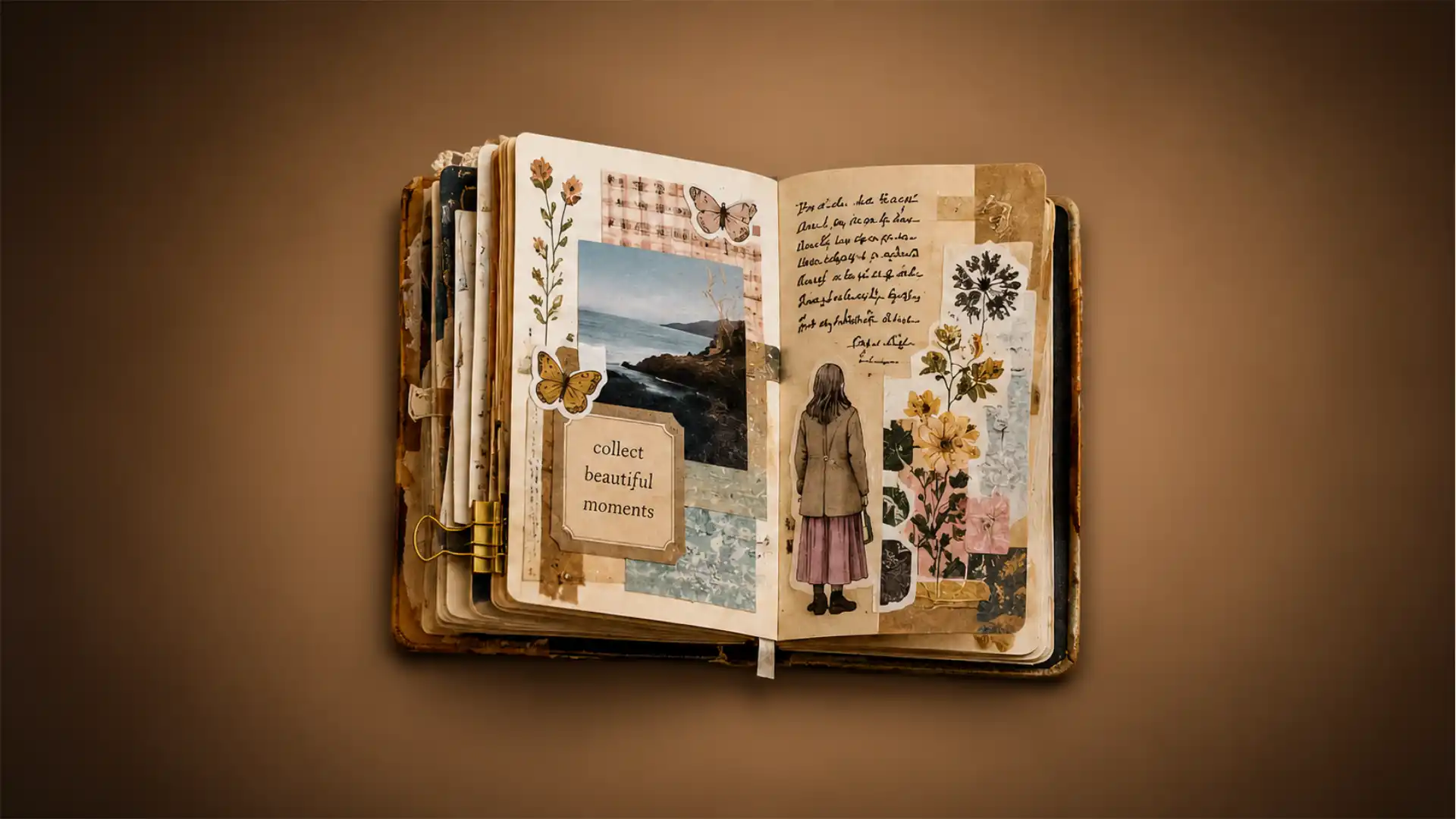
Journaling used to signal a private practice: a pen, a blank page, a few thoughts written before bed, perhaps a planner habit built around tasks and dates. The 2026 Google Trends signals point to a different centre of gravity. People are searching for journaling as a physical, visual, collage-based way to document life, and the sharpest evidence is the rise of “junk journal,” a term that the trend brief says reached a 15-year high this year.
Table of Contents
Junk journals are changing the meaning of journaling
The phrase matters because it carries a different emotional promise from older productivity-led journaling language. A bullet journal asks a person to capture, organize and review. A scrapbooking page often asks for a finished layout around a photograph or event. A junk journal gives permission to keep the small, imperfect fragments that rarely earn a place in a formal album: receipts, coffee sleeves, transport tickets, food labels, packaging scraps, handwritten lists, pressed flowers, cinema stubs, photo stickers, old paper, tape, ribbon, labels and found textures. The “junk” is not the point. The point is proof of life.
That is why the trend is not just a craft story. It sits at the meeting point of search behaviour, digital fatigue, memory-keeping, self-expression, affordable creative commerce and the rising status of analogue rituals. Google Trends is especially useful for reading that kind of movement because it measures relative search interest by time and geography rather than simply counting mentions on a platform. Google explains that Trends data is normalized and scaled from 0 to 100 according to a term’s share of all searches in the selected time and location, which means a rise does not equal raw search volume, but it does show changing attention with unusual clarity.
The journaling data supplied for this analysis is striking on several levels. “Junk journal” hit a 15-year high in 2026. Five U.S. states searched for it more than “bullet journal” this year. “DIY journal kit” spiked 285% over the past month. “DIY pouch journal” is a breakout search so far this year. “Journaling” passed “scrapbooking” for the first time in 2016 and is now searched four times more. Searches containing “for journaling” have more than quadrupled in 2026 so far, with “people stickers for journaling” and “small sticker printer for journaling” appearing as breakout related searches. The top trending pen and printer “for journaling” this year so far are “Pilot G2” and “Canon Ivy.”
Those terms do not describe a single hobby. They describe a buying path, a content format, a search category and a cultural preference. Journaling is moving from text-only reflection toward mixed-media documentation, where writing, printing, collecting, cutting, gluing, decorating and saving all become part of the same ritual.
The shift is also visible outside the supplied Google Trends brief. Michaels’ 2026 Creativity Trend Report says junk journaling searches on its site are up 63% year over year and vision board searches are up 61%, framing the movement as tactile memory keeping and identity-building rather than a narrow paper craft. The same report says searches for analogue hobbies such as knitting, crocheting, embroidery, journaling and painting surged 136% over six months, while craft night searches rose 103% year over year.
Retailers are not merely watching. They are reorganizing around it. Etsy’s 2026 seller trend language points sellers toward personal keepsakes, handwritten notes, journal accessories, tactile paper texture and products described around daily journaling, memory keeping and heirloom quality. Canon’s IVY 2 mini photo printer, meanwhile, is built around 2-by-3-inch ZINK prints, Bluetooth connection and sticky-back paper, a product architecture almost perfectly matched to the “small sticker printer for journaling” search behaviour identified in the trend brief.
The deeper story is not that people suddenly discovered notebooks. It is that journaling has become a format for making life visible without surrendering it completely to a feed. A junk journal page is personal media without the performance pressure of public media. It can be shown, filmed, shared or posted, but it does not have to be. Its value exists even when nobody else sees it.
Search behaviour points to a tactile turn
Search data is rarely a complete cultural map, but it often catches changes before they become obvious in retail shelves or mainstream commentary. The 2026 journaling trend signals are unusually coherent because they move in the same direction across several related phrases. “Junk journal” is rising. “DIY journal kit” is rising. “DIY pouch journal” is breaking out. Searches ending in “for journaling” are rising. Sticker and printer searches are rising. The pattern is not merely interest in writing. It is interest in materials.
That distinction matters for publishers, retailers, craft brands and search strategists. A user searching “journaling prompts” may want ideas. A user searching “junk journal ideas” may want examples. A user searching “DIY journal kit” is closer to a project. A user searching “small sticker printer for journaling” is closer to a purchase. A user searching “people stickers for journaling” is signalling aesthetic preference, not abstract curiosity. In search terms, the category is no longer one broad keyword. It has split into a full semantic field: journal setup, journal kit, sticker printer, ephemera, stationery pouch, visual journaling, scrapbooking journal, memory journal, planner stickers, paper collage, aesthetic spreads, printable journal pages and photo stickers.
Google Trends related queries help explain why those changes matter. Google says rising searches are terms with the largest growth in the selected period, and “Breakout” means a search term grew by more than 5,000% compared with the previous period. When a phrase like “DIY pouch journal” appears as breakout, the safe reading is not that it is suddenly bigger than journaling itself. The safe reading is that a specific, previously small or niche behaviour is accelerating quickly enough to become visible in related demand.
The same applies to “people stickers for journaling.” The phrase sounds minor at first. It is not. It shows how deep the visual grammar of journaling has become. People are not only looking for blank notebooks; they are looking for human figures, scenes, moods and character-like elements that let a page feel inhabited. In visual journaling culture, a sticker is not decoration alone. It often functions like a cast member, a mood signal or a miniature self-portrait.
The “for journaling” construction is especially revealing. It turns general products into journaling-specific tools. A pen becomes “best pen for journaling.” A portable printer becomes “small sticker printer for journaling.” A pouch becomes a journaling pouch. Stickers become journaling stickers. This is the language of a market maturing from activity to ecosystem. Once users begin appending “for journaling” to ordinary tools, the hobby has become a shopping lens.
The trend also suggests a move away from purely productivity-coded journaling. The bullet journal method, as defined by its official site, relies on rapid logging, short entries and bullets that distinguish tasks, events and notes. That system still has value, and the trend brief does not imply it is disappearing. The comparison is about cultural emphasis. In 2026, five states searched “junk journal” more than “bullet journal,” according to the supplied trend data. That is a meaningful directional signal: the visual, expressive, messy form is strong enough in some places to outrank the structured productivity form.
The shift from “bullet journal” to “junk journal” also mirrors a broader user mood. The last decade rewarded optimization language: routines, systems, trackers, habit loops, productivity spreads, morning pages, goal maps. The new search signals reward texture: stickers, kits, pouches, printed photos, scraps, themes, collage, pocket-sized tools. People are still documenting themselves, but the emotional centre has moved from managing the self to collecting the self.
Junk journaling sits between diary, scrapbook and collage
A junk journal is not a diary with messier handwriting. It is not a scrapbook with fewer rules. It is not only collage. A junk journal is a handmade or decorated journal that uses found paper, everyday objects, writing, images and layered materials to record experience. That definition is broad because the practice is broad. Some pages are filled with writing; some contain no writing at all. Some look vintage and sepia-toned; others are bright, cute, chaotic or minimalist. Some are built from recycled packaging; others use purchased ephemera packs and sticker sheets.
People’s magazine described junk journaling as a trend that blends scrapbooking and diary-keeping by repurposing everyday items such as receipts, packaging and ticket stubs into expressive records of daily life. It also noted that online communities and social video helped the practice grow after earlier community formation around platforms such as Reddit. Better Homes & Gardens framed the practice through author and journaling enthusiast Martina Calvi, emphasizing mundane keepsakes such as fruit stickers, wrappers and receipts as material for creative entries.
The power of junk journaling comes from its refusal to separate text from object. A conventional journal records an event after it happened. A scrapbook often preserves an event through photographs. A junk journal may preserve the receipt from the café, the paper sleeve from the pastry, a train ticket from the journey, a photo sticker from a pocket printer and a short note about the weather. The result is not only a memory; it is a physical trace of the day.
That physicality changes the relationship between memory and proof. Phone photos create abundance, but abundance can flatten meaning. A camera roll may contain 8,000 images, many of them nearly identical. A junk journal asks the person to choose. The act of choosing gives weight to an ordinary object. The receipt becomes memory because the journaler decides it belongs.
This also explains why junk journaling appeals to people who dislike the pressure of “good” art. The materials arrive from life rather than from a formal art supply list. The entry can be messy. A page can include crooked tape, torn paper, overlapping labels, half-visible handwriting and mismatched colours. The visual imperfection is not a defect; it is the style.
The practice carries a quiet archival logic. Archivists have long understood that scrapbooks are rich historical objects precisely because they mix personal selection, public print, handwriting, ephemera and material arrangement. The Smithsonian’s National Museum of American History has called scrapbooks both “troublemakers and treasures” in archives because they are physically complex yet historically revealing. Junk journals bring that archival instinct into a daily, personal scale.
The difference from traditional scrapbooking is speed and permission. A scrapbook often suggests a themed album, a family record or a polished layout. Junk journaling often suggests small-scale immediacy. You can make a page after lunch. You can keep a wrapper because the typography is nice. You can paste in a note because it made you smile. You can include a mistake because it belonged to the day. The practice lowers the threshold for memory-making.
That lower threshold is commercially powerful. A user does not need a full scrapbooking studio to begin. A notebook, glue, scissors, a pen and scraps are enough. Yet the same user can keep buying: washi tape, sticker books, vintage paper packs, photo printers, gel pens, label makers, paper trimmers, storage pouches, stamps, inks, corner rounders, mini envelopes, clips and themed kits. The entry point is cheap; the accessory path is deep.
The 2016 crossover with scrapbooking marked a category shift
The trend brief says “journaling” surpassed “scrapbooking” for the first time in 2016 and is searched four times more this year. That crossover is not just a keyword event. It marks a shift in how people name the act of preserving personal life. Scrapbooking still carries the language of albums, milestones and finished layouts. Journaling carries the language of habit, identity, reflection and daily practice.
The difference is partly generational, partly platform-driven and partly practical. Scrapbooking was built around a culture of printed photos, albums, family events and craft stores. It flourished when physical photographs were the default memory object. Digital photography weakened that default. People took more pictures but printed fewer of them. The album became optional. Memory moved into folders, feeds and cloud services.
Journaling adapted more easily to the digital era because it did not depend on printing every photograph. It could be private or public, text-based or visual, analog or digital, daily or occasional. It could absorb planner culture, mental health culture, self-care culture, stationery culture and creator culture. Journaling became a container broad enough to hold scrapbooking inside it.
The junk journal boom sharpens that point. It does not reject scrapbooking; it borrows from it. It uses paper layering, embellishment, photographs, captions and page composition. But it changes the rhythm. Instead of “I will make an album for this event,” the logic becomes “I will keep a trace of this day.” That smaller time unit suits modern life, where people document constantly but often lack the time or emotional energy to build formal archives.
The 2016 crossover also aligns with the rise of visual social platforms and the growth of bullet journaling online. Bullet journal spreads became highly shareable because they turned notebooks into visual systems. Instagram, Pinterest and YouTube made page layouts searchable, collectible and imitable. A person no longer had to invent a journal structure alone; they could copy weekly spreads, habit trackers, mood boards, reading logs, budget pages, study trackers and decoration styles from creators.
Junk journaling follows the same discovery mechanism but with different values. Bullet journaling content often rewards neatness, consistency and elegant systems. Junk journaling content rewards layering, abundance and personality. Both are visual. Both create strong supply demand. But the emotional signal differs. Bullet journaling says, “Here is how I organize my life.” Junk journaling says, “Here is what my life felt like.”
That difference explains why “journaling” can now be searched far more than “scrapbooking.” Journaling has become the umbrella term for self-documentation across formats. Scrapbooking remains a recognizable craft, but journaling absorbs more use cases: mental health journaling, gratitude journaling, art journaling, travel journaling, reading journaling, junk journaling, Bible journaling, manifestation journaling, commonplace books, planner journaling, visual journaling and daily memory keeping.
The four-times search gap reported in the brief should not be read as the death of scrapbooking. It is better read as a naming shift. Many people who once might have said they scrapbook now search for journal ideas, memory journal prompts, scrapbook journal layouts or junk journal supplies. The activity survives, but the category language has moved.
For brands, that distinction is not cosmetic. A product titled “scrapbooking stickers” may miss a buyer searching “stickers for journaling.” A kit framed as “scrapbooking paper” may perform differently from one framed as a “junk journal starter kit.” A printer marketed only as a photo printer may miss users looking for a “sticker printer for journaling.” Search language tells the retailer how the customer imagines the product’s role.
Bullet journaling is not fading, but its dominance is less complete
The supplied Google Trends data says five states searched “junk journal” more than “bullet journal” in 2026. The absence of state names in the brief means the claim should be treated as a directional national signal rather than a regional map. Still, the comparison is useful because “bullet journal” has been one of the strongest journaling formats of the last decade. If “junk journal” can exceed it in several states, the visual memory-keeping side of journaling is no longer fringe.
Bullet journaling earned its prominence by solving a specific problem: scattered tasks, notes and plans. Ryder Carroll’s system gave users an analogue method for capturing the present, tracking the past and planning the future through rapid logging. The official Bullet Journal site describes rapid logging as short, structured entries using bullets to identify tasks, events and notes. That architecture made the method flexible, teachable and easy to adapt.
The online version of bullet journaling, however, often became more decorative than the original minimalist method. A productivity system turned into a visual culture of spreads, stationery hauls, monthly themes and elaborate layouts. That visual expansion helped the format grow, but it also created a tension. Some users loved the beauty. Others felt burdened by the implied need to make every page attractive.
Junk journaling releases that pressure by making imperfection part of the promise. A torn page is not failure. A pasted wrapper is not clutter. A crooked sticker is not a ruined layout. The junk journal absorbs mess instead of hiding it. For users tired of polished feeds and perfect planner spreads, that mess can feel more honest.
This does not mean the bullet journal audience and junk journal audience are separate. Many people use both. A single notebook may contain rapid logs, calendars, collage pages, printed photos, reading notes and taped-in receipts. The interesting change is semantic. People are searching for the visual, tactile side with enough force that it can compete with the productivity label.
The comparison also reveals a deeper shift in the purpose of journaling. Bullet journaling is strongly tied to control: remember tasks, migrate unfinished work, build habits, review priorities. Junk journaling is tied to presence: notice details, preserve scraps, build a page around mood and texture. One is not better than the other. But they answer different psychological needs.
After years of digital tools promising frictionless planning, many people have discovered that friction is part of the appeal. Writing by hand slows attention. Cutting paper takes time. Printing a small photo requires a choice. Pasting a ticket fixes an event into place. The slowness is not inefficiency; it is the emotional function of the practice.
The bullet journal method still matters because it shaped the modern expectation that a notebook can be a customizable system. Junk journaling inherits that expectation but changes the output. It asks less of the notebook as a task manager and more of it as a personal archive. In search behaviour, that looks like fewer abstract searches for “productivity system” and more product-rich searches for “journal kit,” “stickers,” “pouch,” “pen” and “printer.”
DIY journal kits show the beginner market is expanding
“DIY journal kit” spiking 285% over the past month is one of the clearest commercial signals in the trend brief. A kit search is different from an inspiration search. It usually means the user wants a packaged path into the activity. The buyer may not yet know what paper, stickers, glue, tape, prompts or tools to choose, so the kit becomes the shortcut.
That matters because kits convert an open-ended craft into a manageable first project. Junk journaling can look intimidating to beginners because the best examples online are visually dense. A kit reduces decision fatigue by providing coordinated materials: a small notebook, patterned paper, washi tape, stickers, tags, ephemera, clips, glue dots, prompts, envelopes or a pouch. The buyer is not only purchasing supplies; they are buying permission to start without understanding the whole craft taxonomy.
The kit spike also fits the broader beginner-friendly craft economy. Michaels’ 2026 report identifies craft nights, guided kits and analogue hobbies as part of the same movement. The report says guided craft kit sales increased 86% year over year, while craft night searches rose 103%. That is relevant because journaling kits are not only solo products. They also work as group products: sleepovers, friend nights, birthday parties, summer projects, dorm activities, classroom projects, family memory nights and travel documentation sets.
The search phrase “DIY journal kit” also has strong gifting logic. It is less personal than buying someone a finished journal and more useful than buying random stickers. It says, “Here is something you can make.” For younger buyers, the kit can be content-friendly. For parents, it can be screen-light. For adult buyers, it can be a low-pressure creative ritual. For sellers, it offers bundling margin and storytelling space.
Etsy is well positioned for that kind of product because its marketplace already combines handmade, vintage, craft supplies, paper goods and personalization. Etsy’s 2025 annual report identifies craft supplies and paper and party among the relevant retail categories it uses to estimate its market opportunity, and says the Etsy marketplace represented about 2% of that online opportunity in 2025. That does not prove journaling kits alone are driving growth, but it shows why this category sits inside a large commercial frame.
The challenge for sellers is that kits can quickly become generic. A bundle of random paper and stickers is easy to copy. A strong kit has a point of view. It might be built around a travel pouch, a café diary theme, a vintage botanical style, a reading journal, a concert memory kit, a summer archive, a grief journal, a friendship scrapbook, a school-year record or a “first junk journal” beginner format. Specificity turns a kit from supplies into a story.
The 285% monthly spike also suggests timing sensitivity. Some journal kit searches cluster around back-to-school, holidays, New Year setups, summer breaks, graduation, travel periods and gift seasons. Sellers and publishers should not treat demand as flat. A journal kit can be merchandised differently in January than in June. January language may focus on “new journal setup.” June language may focus on “summer memories.” September language may focus on “school year journal.” December language may focus on gifting and year-in-review pages.
The pouch search reveals journaling as portable identity
“DIY pouch journal” appearing as a breakout search this year is one of the most revealing details in the trend brief because it shifts attention from the page to the carry system. A pouch journal is not only a notebook. It is a portable kit, an object that contains the supplies needed to make pages elsewhere. The pouch turns journaling into a mobile identity practice.
That matters because analogue hobbies increasingly compete with phones in the small gaps of daily life. A person can scroll while waiting for a train. A pouch journal suggests a different default: open a small case, pull out a pen, add a sticker, paste a ticket, write a line, save a wrapper. The pouch makes the hobby ready. Readiness matters because the friction of gathering supplies often kills a creative habit before it begins.
The pouch also fits the “analog bag” mood now visible in youth culture, where people carry books, notebooks, cameras, pens, embroidery, crochet or small art supplies as intentional alternatives to phone-first boredom. Cosmopolitan recently connected young people’s interest in analogue hobbies to Michaels’ 136% search increase for off-screen activities such as knitting, embroidery, journaling, painting and needlework. The pouch journal is the journaling version of that behaviour.
A pouch is practical, but it is also aesthetic. It lets users curate a small world: favourite pen, mini glue tape, sticker flakes, paper scraps, label stickers, a tiny ruler, clips, stamps, photo prints, washi samples. The pouch can appear in social content as part of a desk setup, travel kit or “what’s in my bag” video. In that sense, it extends the journal’s visual identity beyond the notebook.
There is also a sustainability angle, though it should not be overstated. Junk journaling often uses reused paper and found materials, but it can also drive consumption of new stickers, tapes and imported ephemera. The pouch may support reuse by encouraging people to save scraps rather than throw them out. Yet the market also sells pre-aged paper, faux vintage packs and decorative objects that imitate the look of reuse. The practice can be resourceful, consumerist or both.
For brands, pouch demand suggests product design opportunities. Journaling users need compartments sized for sticker sheets, 2-by-3-inch photo prints, tape rolls, glue sticks, pens and loose ephemera. A generic pencil case may work, but a journaling-specific pouch can win by solving the real storage problem: keeping small paper pieces flat, visible and accessible. The best designs will understand that journalers carry irregular objects, not only pens.
For search strategy, “DIY pouch journal” is a clue that content should move beyond page ideas. Users will search setup guides, packing lists, travel journaling kits, pouch organization, portable junk journal ideas and small-space journaling supplies. The page remains the final output, but the ritual begins with the kit.
Stickers are becoming a visual vocabulary
The breakout phrase “people stickers for journaling” sounds oddly specific until you understand how visual journal pages communicate. A person sticker can represent the journaler, a friend, a mood, an outfit, a scene, a fantasy self or a narrative character. In a collage journal, stickers are not just embellishments. They are visual words.
This is why sticker demand matters more than its low price point might suggest. Stickers give non-artists a way to build scenes without drawing. They let users add emotion, scale, identity and style quickly. A page with a café receipt, brown paper, a printed coffee photo and a small illustrated person sticker communicates a full moment. The sticker turns materials into a scene.
The phrase also shows the influence of character-based visual culture. Digital platforms have trained users to express identity through avatars, emojis, reaction GIFs, profile pictures, Bitmoji-style figures, game characters and aesthetic templates. “People stickers for journaling” transfers that grammar onto paper. The journaler wants bodies, outfits, poses and faces that can stand in for feeling. Even when the actual journal page has no real face photograph, a sticker can give the spread a human presence.
Sticker printers deepen this behaviour. The brief says “small sticker printer for journaling” is a breakout related search and that “Canon Ivy” is the top trending printer “for journaling” this year so far. Canon’s IVY 2 mini photo printer uses ZINK zero-ink technology and sticky-back photo paper, with 2-by-3-inch prints made from smartphone images through Bluetooth. Canon’s ZINK paper product page describes peel-and-stick photo paper designed for the IVY printer, which makes the connection to journaling and scrapbooking obvious even when the product is marketed as a general photo printer.
A sticker printer changes the economics of visual journaling. Instead of buying pre-made images, users can turn their own photos into adhesive objects. That makes the journal more personal and gives phone photos a physical route into a notebook. It also solves one of the core problems of modern memory keeping: people take too many photos to print formally, but they still want a few images to hold.
The appeal is not perfect image quality. Many ZINK and instant-style printers trade fidelity for portability, speed and fun. Digital Camera World’s 2026 portable printer guide describes Canon Ivy 2, known as Zoemini 2 in some markets, as an affordable ZINK printer using adhesive backs and suited to fun, casual uses such as scrapbooking, while noting that ZINK image quality is not at the level of stronger photo processes. That trade-off is acceptable for many journalers because the print is part of a page, not a framed photograph.
The sticker boom also creates a content loop. Journalers buy stickers, use them in pages, film the pages, link supplies, inspire searches, then trigger more demand. The page becomes both personal archive and product demonstration. The strongest journaling products are the ones that look good while being used.
Pens still matter because writing anchors the page
The trend brief identifies “Pilot G2” as the top trending pen “for journaling” this year so far. That may seem old-fashioned next to sticker printers and visual kits, but it is a reminder that writing still anchors the practice. A junk journal with no writing can be beautiful. A junk journal with a sentence, date, place, thought or list becomes a personal record. The pen makes the page accountable to a specific life.
Pilot’s G-2 gel ink pen is marketed around smooth writing, a 0.7mm tip, long writing autonomy and an ergonomic grip in Pilot’s European product information. Its rise in “for journaling” searches likely reflects a mix of availability, familiarity, comfort, price and creator recommendation. Journalers often care deeply about ink flow, smudging, paper compatibility and hand fatigue. A pen that feels reliable becomes part of the ritual.
The top pen signal also shows the difference between journaling and pure collage. The market may be visual, but the words matter. People still want to label pages, write captions, add dates, make lists, record overheard lines, describe a feeling, write a prayer, track a meal, copy a quote, sketch a route or mark a place. The more visual the page becomes, the more a few handwritten words can carry emotional weight.
Handwriting has a different authority from typed text. It records speed, pressure, mood and imperfection. A shaky line, crossed-out word or rushed note can say more than a polished caption. Junk journaling benefits from that because the page is already built from imperfect fragments. A handwritten line does not need to perform; it needs to belong.
Pens also have strong repeat-purchase economics. A printer is a larger one-time purchase with consumables. Stickers are collectible and thematic. Pens are daily-use, low-cost, easy to compare and easy to recommend. That makes “best pens for journaling” a durable search category and a likely entry point for affiliate content, stationery retailers and creator recommendations.
The Pilot G2 signal should not be read as a universal best-pen verdict. Different journalers prefer fountain pens, fineliners, brush pens, archival ink, ballpoints, gel pens, paint markers or coloured pencils depending on paper and style. But the fact that a mass-market gel pen is trending “for journaling” suggests mainstream accessibility. The journaling boom is not only for specialist stationery collectors. It is reaching people who want a pen they can find easily and trust quickly.
For publishers, this opens practical content opportunities: smudge tests, paper tests, left-handed journaling pen guides, budget pen comparisons, pens for glossy stickers, pens for washi tape, pens for recycled paper, pens for photo captions and archival ink explainers. These are not minor service pieces. They answer real friction in a practice where materials meet.
Portable photo printers bridge the phone and the notebook
The Canon Ivy signal is especially important because it shows that journaling demand is not anti-technology. It is selective technology. Users are not abandoning phones; they are extracting images from phones and fixing them onto paper. The portable printer is a bridge between digital capture and analogue memory.
This is the central paradox of the journaling trend. People want less passive screen time, but they still use phones to photograph life, discover ideas, shop supplies and share finished pages. The difference is the final destination. Instead of leaving every image in a camera roll or platform archive, the journaler chooses a few to print, cut, annotate and keep.
Canon’s IVY 2 fits that behaviour because it produces small, sticky-back prints from a smartphone. Canon lists Bluetooth 5.0 connectivity, print speed of 50 seconds or less and 2-by-3-inch ZINK paper compatibility for the device. The Canon Mini Print app is built around personalizing 2-by-3-inch prints from a smartphone or tablet and printing on ZINK photo paper. Those specifications align directly with the “small sticker printer for journaling” search phrase in the brief.
The printer trend also connects journaling to the broader revival of physical photos. Younger users have shown renewed interest in instant cameras, point-and-shoot digital cameras, film-style aesthetics and printed artifacts. A recent Financial Times report described a Gen Z-driven revival of digital cameras, noting that standalone camera shipments doubled to $5.5 billion by 2025 and that Fujifilm’s instax line has become a major force in tactile image culture.
Journaling gives those physical images a home. A printed photo without context can become clutter. A printed photo in a journal becomes part of a sequence: date, place, ticket, note, colour, page. That sequence is what phone albums often lack. They store images by time, but not always by meaning. A journal page edits meaning by hand.
This is why printer companies should pay attention to journaling language. A portable photo printer can be marketed around parties, travel and family snapshots, but the 2026 search data suggests journaling is now a strong use case. Product pages that mention journaling, scrapbooking, memory keeping, sticker prints, mini albums, planners and school projects may match demand more closely than generic “print your memories” copy.
There are limitations. Sticky-back photo paper is consumable and can be costly. ZINK prints may fade or shift differently from traditional photo prints. Small printers often have battery and quality trade-offs. But for journaling, immediacy may matter more than archival perfection. A small print made today and pasted into a page may be more meaningful than a perfect print never made.
The trend is partly a response to digital fatigue
The rise of tactile journaling cannot be separated from the intensity of digital life. Teens and young adults are surrounded by platforms that turn attention into an endless sequence of feeds, videos, recommendations, notifications and searchable identities. Pew Research Center’s 2025 report says roughly one in five U.S. teens are on TikTok and YouTube almost constantly, while 64% use AI chatbots and about three in ten use chatbots daily. DataReportal’s Digital 2026 overview says the average global user spends 18 hours and 36 minutes per week using social media when video-centric platforms are included.
That does not mean journaling is a wholesale rejection of digital culture. Many journalers discover the practice through TikTok, Pinterest, Instagram, YouTube or search. They use apps to edit photos before printing them. They buy supplies online. They may film flip-throughs of finished journals. But the act itself changes the user’s posture. The body sits at a desk or on a bed. The hands cut, paste, write and arrange. The page does not refresh itself.
The appeal lies in that change of pace. Digital platforms reward reaction. Junk journaling rewards selection. A feed gives the next thing. A journal asks, “Which thing from today is worth keeping?” That question is quiet, but it is powerful. The journal gives the user a private editorial role over their own life.
Michaels’ language around the “analog era” captures the retail version of this mood. Its 2026 report says consumers are using tactile, analogue activities to reclaim creative living, with searches for analogue hobbies surging and craft nights rising sharply. The exact causes vary: burnout, screen saturation, loneliness, desire for hobbies, nostalgia, economic pressure, school stress, work stress or a wish to make something physical. The search pattern does not identify one cause. It shows that enough people are seeking hands-on forms to move the data.
Junk journaling is well suited to digital fatigue because it does not require mastery. A person exhausted by screens may not want to learn oil painting or invest in a ceramics studio. A junk journal can begin with yesterday’s receipt and a glue stick. The practice feels accessible because the materials are already near the user. The low barrier is a strength.
There is also a privacy dimension. Public platforms invite comparison. A private journal does not. Even when the finished page is shared, the original practice can remain personal. The journaler chooses what to show. That control feels different from platforms where every post is measured by views, likes, saves, comments or algorithmic reach.
For younger users, the private-public flexibility is especially relevant. They live in visual culture but may not want every memory to become content. A journal page can satisfy the desire to make something visual without requiring public performance. It is media with an off switch.
The handmade page has become a soft status object
Status in digital culture often comes from visibility: followers, production quality, aesthetic consistency, travel, taste, access. Junk journaling creates a softer form of status. It rewards attention, curation and material sensitivity. A beautiful page says the maker noticed things. It says they had a ritual. It says they made time. The status is not luxury alone; it is the appearance of a life carefully held.
This is why the practice can feel both humble and aspirational. The materials may be cheap, but the result can look rich because it layers texture, colour, handwriting and memory. A brown paper bag, a café sticker and a gel pen can produce an image with more emotional density than an expensive planner left blank.
Etsy’s 2026 seller trend framing around personal keepsakes, handwritten notes, journal accessories, tactile qualities and longevity fits this soft-status economy. The buyer is often looking for products that feel personal, aged, durable or meaningful. “Heirloom quality” language can work in this market because the object is not merely decorative; it is used to preserve personal life.
The soft-status logic also explains the interest in pouches, pens and printers. A journaling pouch is not only storage; it signals readiness. A good pen signals care. A small printer signals the ability to turn phone memories into physical artifacts. Sticker collections signal taste. None of these items needs to be expensive, but each contributes to a visible personal system.
The risk is that a hobby built on low-pressure memory keeping can become another comparison arena. Social media often rewards the most visually polished pages, the largest supply collections and the most satisfying desk setups. Beginners may feel that their own pages are too plain. The original appeal of junk journaling—permission, mess, reuse—can be weakened by a market that sells an idealized version of mess.
That tension is not new. Scrapbooking, bullet journaling, knitting, photography and home cooking have all experienced the same cycle: a personal practice becomes visually shareable, then productized, then compared. The healthiest version of the junk journal trend will keep the threshold low. A page made with one receipt and one honest sentence still belongs to the practice.
Brands that understand this will avoid making the hobby feel too precious. The best commercial language will support experimentation rather than perfection. Kits should invite use. Supplies should show imperfect examples. Product photography should include beginner pages, not only professional-grade layouts. Creator partnerships should include process, not only final reveals.
The handmade page is desirable because it carries evidence of touch. If the market removes that touch by over-styling every object, it risks flattening the very quality people came for.
Search data needs careful reading
Google Trends data is powerful, but it must be read carefully. A 15-year high for “junk journal” is a relative search-interest statement, not a raw volume statement. A 285% spike for “DIY journal kit” is growth compared with a previous period, not proof that the query is larger than all established journal terms. A breakout query means growth above a high threshold, often from a lower base. The direction is meaningful; the exact commercial size requires other data.
Google’s own documentation is clear on this point. Trends data is normalized by time and location and scaled to 0 to 100, with 100 representing peak search interest for the selected query context. Google also says different regions with the same search-interest number do not necessarily have the same total search volumes, because Trends measures relative popularity within the selected context.
This matters for the state comparison in the trend brief. If five states searched “junk journal” more than “bullet journal” in 2026, that tells us the relative relationship between those two queries inside those states. It does not tell us that those states have the most journaling searches in raw terms. Google’s region tools allow users to compare interest by subregion, but the colour or ranking reflects relative interest, not population-adjusted retail demand in a simple sense.
Researchers also warn that Google Trends data can be affected by sampling variability, thresholds, zeros, rounding and changing data-generation processes. A 2025 paper on preprocessing Google Trends data notes missing values, sampling variations, noise and algorithm updates as issues researchers must handle carefully. A separate paper on Google Trends calibration describes how data are normalized to a 0-to-100 range and rounded, which can create problems for unpopular queries when compared with more popular ones.
For journalism and business analysis, the practical rule is straightforward: do not treat one Google Trends line as a sales report. Combine it with other signals. In this case, the journaling signal is stronger because it appears across search terms, retail reports, product behaviour, creator coverage and marketplace language. The Trends brief says junk journal, DIY journal kit, pouch journal, sticker printer and “for journaling” are all moving. Michaels reports craft and junk journaling increases. Etsy is telling sellers to emphasize tactile journal accessories. Canon’s product architecture matches the printer search use case. That cross-signal consistency gives the analysis weight.
Still, limits remain. Google Trends does not tell us why a user searched. A spike in “DIY journal kit” could include buyers, gift-givers, teachers, parents, creators, sellers researching competition or people casually browsing. “Canon Ivy for journaling” could signal purchase intent, comparison shopping or post-purchase help. Search interest is attention, not conversion.
The safest conclusion is that journaling has become a high-intent cultural and retail cluster. Its growth is not only a mental wellness story and not only a stationery story. It is a search ecosystem where emotional need, visual style and product specificity now reinforce each other.
Search signals and likely market meaning
| Search signal from the 2026 brief | Likely meaning for the journaling category |
|---|---|
| “Junk journal” hit a 15-year high | Visual, tactile memory keeping has moved into mainstream curiosity |
| Five states searched “junk journal” more than “bullet journal” | Expressive formats are competing with productivity-led formats in parts of the U.S. |
| “DIY journal kit” spiked 285% over the past month | Beginners and gift buyers want bundled entry points |
| “DIY pouch journal” is breakout | Journaling is becoming portable, kit-based and lifestyle-coded |
| “For journaling” searches more than quadrupled | General products are being reclassified by journaling use case |
| “Pilot G2” and “Canon Ivy” lead pen and printer trends | Everyday writing tools and phone-to-paper printers are central to the practice |
This table treats the search terms as behavioural clues, not raw sales numbers. The pattern is strongest because the terms point to the same underlying behaviour: people want tools that turn daily life into a physical, visual record.
Journaling research supports the habit, but not every claim made about it
Journaling is often marketed as a mental health tool, and there is evidence behind some of that language. But the evidence is more specific than social media captions suggest. Journaling is not therapy by default, and junk journaling is not a clinical treatment. It can support reflection, mood awareness, gratitude, self-expression and stress reduction for some people, depending on how it is used and what the person needs.
A 2022 BMJ Family Medicine and Community Health review described journaling as a low-cost, low-side-effect adjunctive intervention in mental illness management, while noting the need for clearer evidence-based guidance. A randomized controlled trial of online positive affect journaling found improvements in mental distress and well-being among general medical patients with elevated anxiety symptoms, suggesting that structured positive writing can be useful in some contexts.
The evidence is not uniform across every form of writing. Expressive writing research has found benefits in some populations and mixed or limited effects in others. A paper on expressive writing for psychological and physical health notes that earlier meta-analytic findings included many null results among healthy college students, reminding readers that writing interventions do not work the same way for every group.
Junk journaling adds a craft dimension to writing. A 2025 systematic review of crafts-based interventions found some evidence that craft interventions may benefit mental health and well-being, while calling for more high-quality research. A 2024 Frontiers in Public Health study, reported by Frontiers, linked arts and crafts participation with well-being, again pointing to creative activity as a public-health-relevant behaviour without turning every craft into medical treatment.
The most grounded claim is this: journaling gives people a structured way to notice, select and record experience. Junk journaling adds sensory engagement and visual play. For some users, that combination may reduce rumination, support gratitude, create calm, mark time, externalize emotion or provide a satisfying sense of completion. For others, it may simply be fun. Fun is not a trivial outcome. It is one reason people keep doing it.
The mental health framing should avoid exaggeration. A person dealing with depression, trauma, anxiety or severe stress may benefit from journaling, but they may also need professional support. Some writing practices can intensify distress if they become repetitive rumination. Some visual journaling communities can create comparison pressure. Some users may overspend on supplies. The habit is healthiest when it remains a tool for expression, not another standard to fail.
This nuance matters for brands and publishers. Articles promising that junk journaling will “heal” a reader are not only irresponsible; they miss the real appeal. The appeal is smaller and more durable: a person can sit down, touch paper, arrange fragments, write a few words and make a record of a day that might otherwise disappear.
Analog journaling is an ecosystem, not a single habit
A 2025 study on analog journaling describes paper-based journaling as a range of practices shaped by materials, personal context and community, including planning, habit tracking and reflection. That finding aligns closely with the 2026 search pattern. People are not searching for journaling as one habit. They are building ecosystems around tools, spaces, routines, identities and communities.
The ecosystem starts with materials: notebooks, paper, pens, tape, glue, stickers, photos, pouches, printers, stamps, rulers, storage boxes. It then expands into contexts: travel, school, work, grief, friendship, faith, reading, parenting, wellness, creativity, memory keeping. It expands again into communities: YouTube flip-throughs, TikTok process videos, Pinterest boards, Etsy sellers, Reddit threads, Discord groups, workshops and craft nights.
That ecosystem matters because it changes retention. A person who buys one notebook may stop after a week. A person who builds a small journaling ecosystem has more reasons to return. The pouch is ready. The stickers are waiting. The printer has paper. The friend group has a craft night. The Pinterest board has ideas. The journal becomes part of daily identity.
This is also why the market can keep expanding without relying on one dominant format. Some users will write long diary entries. Some will make art journals. Some will build junk journals from found paper. Some will use a bullet journal for planning and add a collage page once a week. Some will create themed memory pages after trips. Some will keep a reading journal with printed book covers and quotes. Journaling grows because it accepts hybrid use.
The hybrid nature also protects the category from simple replacement by apps. Digital journaling apps are useful, searchable and portable, and AI journaling tools are emerging. But paper journaling offers different affordances: texture, scarcity, handwriting, visible accumulation, physical storage, material play and the satisfaction of completed pages. The two formats may coexist. Many users will use phones to capture, paper to process and social platforms to share.
AI may even push more users toward paper. When digital text and images become easier to generate, handmade traces may feel more valuable. A torn receipt, a handwriting line and a printed photo from a real outing carry a kind of indexical proof that synthetic media lacks. The handmade page says, “I was here,” in a way an auto-generated memory recap cannot fully imitate.
For product teams, the ecosystem view suggests that the winning products will integrate with existing behaviours rather than forcing new ones. A printer that works smoothly with phone photos. A pouch that fits common sticker sizes. A kit that includes prompts without over-directing the user. A notebook that handles gel ink and glue. A sticker pack that matches common themes. A retail shelf that groups tools by project rather than by legacy category.
Pinterest and visual search accelerate the aesthetic loop
Pinterest remains a major discovery engine for visual hobbies, and its relevance to journaling is obvious. Users search for ideas, save examples, compare styles and build mood boards before they buy or make. Pinterest’s 2026 trend report covers many categories, but its larger value here is methodological: Pinterest frames trends around search and visual planning behaviour.
Journaling fits Pinterest because it is modular. A user can search a narrow idea and save it: “junk journal cover,” “vintage journal page,” “travel journal spread,” “coffee journal page,” “scrapbook journal aesthetic,” “people stickers,” “journal pouch setup,” “Canon Ivy journaling ideas.” Each saved image becomes a template, not a finished article. The platform rewards the kind of visual specificity that search engines then reflect in rising queries.
This visual loop works across platforms. A TikTok creator films a junk journal process. Viewers search for the materials. Pinterest users save similar layouts. Etsy sellers tag products around the aesthetic. Google users search “DIY journal kit.” Retailers build trend reports around rising demand. Creators then make new content using those kits. The hobby grows through imitation, but each page still feels personal because the source materials vary.
Pinterest also changes the timescale of memory keeping. Traditional scrapbooking might happen after an event. Visual journaling inspiration often happens before the event. A user may prepare a travel journal kit before a trip, save spread ideas before school starts, buy stickers before a concert or plan a monthly theme before the month begins. The journal becomes anticipatory, not only retrospective.
This is relevant for retailers because it shifts merchandising earlier in the customer journey. A person searching for “summer junk journal ideas” in May may buy supplies before June. A person searching “2026 journal setup” in November may buy a notebook and stickers before January. A person searching “travel journal pouch” may buy before vacation season. Search demand often appears before the life event the journal will document.
The aesthetic loop also explains why “people stickers for journaling” can break out. Visual platforms teach users to notice page elements as separable units. A saved spread may inspire the search not only for “journal idea,” but for the exact ingredient: figure stickers, mini photo printer, lace tape, kraft paper, transparent notes, brown washi, vintage labels, botanical ephemera. The page is deconstructed into shoppable components.
There is a risk of sameness. When platforms recommend the same visual motifs, many journals begin to look alike: beige paper, vintage tickets, brown tape, botanical labels, coffee stains, muted stickers. But user-specific materials push back. A receipt from a local shop, a personal photo or a handwritten line makes the page less generic. The strongest journaling culture will combine aesthetic borrowing with lived detail.
Etsy, Michaels and craft retail are reading the same signal
Retail reports are never neutral; they are also marketing. Still, when several retail signals point toward the same behaviour as search data, the pattern deserves attention. Michaels is naming 2026 around creative living and analogue activities. Etsy is pushing sellers toward tactile keepsakes and journal accessories. Canon’s printer demand aligns with journaling searches. These are separate commercial actors responding to the same consumer mood.
Michaels’ 2026 report is particularly direct. It says consumers are curating “personal lore” in physical form through junk journals, vision boards and personalized keepsakes, with junk journaling searches up 63% year over year and vision boards up 61%. That phrase, “personal lore,” is retail language, but it captures something real: people are treating ordinary life as material worth archiving.
Etsy’s relevance is different. It is a marketplace for many sellers, so it reflects micro-niche demand more quickly than a large retailer can. Journal accessories, handmade papers, sticker packs, vintage ephemera, printable kits, personalized journals, charms, stamps and pouches all fit Etsy’s seller base. Etsy’s 2025 results also show the company still operating at large marketplace scale, with its own materials and craft-related categories positioned inside a broad retail opportunity.
Large craft retailers and marketplaces serve different parts of the trend. Michaels can make the category accessible to mainstream shoppers through kits, classes, in-store displays and beginner-friendly assortments. Etsy can serve taste fragmentation: gothic junk journals, fairycore ephemera, botanical packs, Korean-style sticker sheets, vintage ledger paper, travel folios, handmade leather covers, printable pages and niche themes. The more personal the journal, the more fragmented the supply market becomes.
This fragmentation is an opportunity for small sellers. A mass retailer may stock a general junk journal kit. An Etsy seller can build a kit for “Paris café memory keeping,” “dark academia reading journal,” “grandma’s recipe junk journal,” “concert ticket archive,” “grief memory book,” “summer camp journal” or “first year of college pouch journal.” Niche specificity works because journalers are not only buying materials; they are buying an aesthetic self.
For retailers, the category also offers cross-aisle value. A journaling shopper may buy notebooks, pens, adhesives, stickers, paper, storage, cutting tools, printers, photo paper, stamps, charms, ribbons and bags. That makes journaling commercially richer than a single-item trend. It is a basket-builder.
The risk is over-merchandising. If retailers turn junk journaling into a pre-packaged look, they can reduce the sense of discovery. The practice’s charm partly comes from using odd, personal and found materials. Retailers should sell tools and inspiration while leaving room for the user’s own scraps. A good junk journal aisle should not make every page look bought.
The category has strong seasonal rhythms
Journaling is a year-round habit, but its search and buying behaviour likely clusters around moments of reset, travel, gifting and identity transition. The 2026 trend brief captures “this year so far,” which includes New Year setup behaviour, spring craft demand and early-year searches. The “DIY journal kit” spike over the past month may be tied to short-term seasonal needs, creator cycles or retail campaigns. The category should be planned as seasonal, not static.
January is the obvious peak for journal setup. Users search for new planners, bullet journal spreads, yearly goals, reading logs, habit trackers, vision boards and fresh notebooks. Junk journaling also benefits from the New Year because people want to start an archive. A “2026 junk journal setup” is less about productivity and more about beginning a personal record.
Spring brings school projects, Easter crafts, graduation preparation, wedding planning and travel anticipation. Summer brings travel journals, camp journals, festival memory pages, road trip kits, beach ephemera, friendship journals and screen-free hobbies for children and teens. The recent Better Homes & Gardens coverage of Michaels’ summer craft kits framed hands-on kits as screen-free activities for summer 2026, which fits the seasonal demand for portable and beginner-friendly projects.
Autumn creates back-to-school journaling, dorm journaling, study spreads, reading journals, cozy craft nights and fall aesthetic pages. Winter creates gift kits, year-in-review pages, holiday memory keeping, family archives and New Year preparation. Retailers can build product drops around these rhythms without inventing artificial urgency.
The seasonal lens also matters for content strategy. Evergreen pages such as “What is a junk journal?” should exist, but seasonal pages can capture high-intent demand. Examples include “summer junk journal ideas,” “travel junk journal kit,” “back-to-school journaling pouch,” “holiday memory journal,” “year-in-review junk journal prompts,” “spring ephemera ideas” and “2026 journal setup supplies.”
Search engines and answer engines reward freshness for trend queries, but they also reward durable topical authority. A publisher that covers journaling only once will miss the category’s cycles. A stronger strategy builds a hub: definitions, beginner guides, supply guides, product comparisons, seasonal prompts, mental health nuance, visual examples, sustainability notes, printer comparisons and kit reviews. The search opportunity is not one article; it is a living editorial category.
For brands, seasonal planning should also recognize that many journalers prepare before the season. A travel journal kit must be visible before travel. A school-year journal must be available before the first week of classes. A holiday memory kit must be merchandised before December events fill the calendar. The journal is often bought in anticipation of memory, not after memory.
The business opportunity is larger than notebooks
It would be easy to treat the journaling boom as a notebook trend. That would understate the category. The notebook is the base, but the money often sits around the base. Journaling demand spreads across consumables, accessories, tools, storage, printing and instruction.
Consumables include paper, stickers, tape, adhesive, photo paper, ink refills, sticker sheets, labels, printable pages and ephemera packs. Accessories include pouches, charms, clips, tabs, bookmarks, covers and storage boxes. Tools include printers, cutters, rulers, corner punches, stamps, ink pads, label makers and pens. Instruction includes books, workshops, digital templates, printable prompts, creator subscriptions and kits.
This is why “for journaling” search growth is so commercially meaningful. It pulls unrelated products into one use case. A Canon Ivy is not only a mini printer. In this context, it becomes a journaling printer. Pilot G2 is not only a gel pen. It becomes a journaling pen. A pouch becomes a journaling pouch. A sticker pack becomes journaling stickers. A product category becomes a habit category.
Retailers can respond by merchandising around projects rather than legacy departments. Instead of separating pens, paper, stickers and printers, they can build “start a junk journal” assortments. Search landing pages can do the same. A page titled “Junk journaling supplies” can group notebooks, adhesives, stickers, photo printers, paper packs and storage in one journey. This matches the way beginners think.
Publishers and affiliates have a strong role because users need guidance. Searchers want to know which glue wrinkles paper, which pen dries fast, which printer paper is sticky, which notebook handles collage, which pouch fits supplies, which stickers work for people-themed pages and which kits are worth buying. These are practical questions with commercial intent. Good editorial content can reduce the anxiety of starting.
Brands should also recognize the difference between beginner and advanced buyers. Beginners need kits, simple supply lists and reassurance. Advanced journalers need refill packs, niche materials, archival advice, unusual papers, better storage and higher-quality tools. A one-size assortment will miss both ends.
There is also a creator-commerce opportunity. Journaling content is highly demonstrable. A creator can show the exact use of a pen, printer, sticker or glue tape inside a page. That is stronger than a static product shot. The product is seen solving a creative problem in real time. The finished page becomes proof.
Yet the business opportunity depends on trust. Journalers quickly learn which products fail: pens that smear, paper that tears, adhesives that yellow, printers with expensive consumables, stickers that peel, kits padded with low-use items. The category may be aesthetic, but product performance matters. A journal is handled repeatedly. Bad materials reveal themselves.
Product groups gaining from visual journaling
| Product group | Demand driver | Strategic note |
|---|---|---|
| Gel pens and fineliners | Handwritten captions, dates, notes and page labels | Smudge resistance and paper compatibility matter |
| Sticker packs | Fast visual storytelling and identity cues | Character, people and mood-based stickers are gaining search value |
| Mini photo printers | Phone photos becoming sticky journal images | Consumable paper cost and print quality shape repeat use |
| DIY journal kits | Beginner entry, gifting and group craft nights | Themed kits outperform generic supply bundles |
| Pouches and storage | Portable journaling and organized small supplies | Compartments should fit stickers, prints, tape and pens |
| Adhesives and cutting tools | Collage construction and paper layering | Practical reliability matters more than aesthetic packaging |
The commercial lesson is simple: journaling is a system of repeat needs. A user may buy one notebook, but they keep needing paper, adhesive, stickers, prints, pens and storage as long as the habit continues.
The creator economy turns pages into searchable formats
Junk journaling is visually satisfying to watch. A blank page becomes layered. Paper tears. Tape rolls. Stickers peel. Photos print. Pens glide. The process has built-in rhythm. That makes it ideal for short video, long-form tutorials, Pinterest pins and image search. The page is not only the output; the making of the page is content.
This changes the speed of trend diffusion. A creator does not need to explain junk journaling in abstract terms. They can show a page forming from materials. Viewers understand instantly. The material list is visible. The aesthetic is visible. The result feels attainable because the steps are small.
The same process drives search. A viewer sees a mini printer and searches “small sticker printer for journaling.” They see an illustrated figure and search “people stickers for journaling.” They see a portable kit and search “DIY pouch journal.” They see a bundle and search “DIY journal kit.” Social discovery and search demand feed each other.
TikTok’s search behaviour is part of this loop, though the platform itself is less transparent than Google Trends. A 2025 paper on TikTok search recommendations argues that TikTok is increasingly used as a search engine and that preformulated search queries on videos create governance and transparency questions. For journaling, the practical effect is that a video can create a search phrase by showing users what to ask next.
Creators also shape product names. A seller may call a product “paper dolls,” but creators using it in journal spreads may drive searches for “people stickers.” A printer company may say “mini photo printer,” but users say “sticker printer for journaling.” Search data often captures consumer language faster than brand language. Brands that ignore that language lose relevance.
The creator economy also favours repeat rituals. A single “how to start” video can perform well, but recurring series are stronger: daily junk journal pages, weekly memory spreads, monthly setups, travel journal with me, use my scraps, one receipt one page, journal pouch restock, printer test, sticker haul, no-buy junk journal, beginner kit challenge. Each format creates fresh search hooks.
For publishers, this means article structure should match the way users learn. Definitions are needed, but so are examples, supply explanations, mistakes, comparisons, safety notes, sustainability questions and buying guidance. Search engines increasingly surface direct answers, and AI answer systems prefer clear extractable definitions. A strong journaling article should answer “what is it,” “what do I need,” “why is it trending,” “what should I buy,” and “how do I avoid overbuying.”
The best creator content also protects the hobby from pure consumption. Videos that use found materials, packaging, receipts and old paper remind viewers that they do not need a large haul. This matters because the word “junk” loses meaning if every page is made from purchased faux-junk.
The aesthetics of imperfection fit the post-polished internet
The visual style of junk journaling sits comfortably inside a wider move away from spotless minimalism. Visible tape, torn edges, layered scraps, handwriting, uneven placement and mixed textures all resist the polished surface of template culture. The page looks made, not rendered.
This is one reason the trend feels contemporary despite its old materials. It answers a very current fatigue: the sameness of digital aesthetics. When design tools, filters and AI image generators make polished visuals easier, evidence of handwork becomes more valuable. A crooked cut can feel more human than a perfect template. A coffee stain can feel more intimate than a beige background.
Michaels’ 2026 report includes “Wabi-Sabi Spaces,” pointing to consumer interest in visible brushstrokes, uneven stitching, layered finishes and imperfection in home décor. That same sensibility appears in junk journaling. The journal page becomes a small domestic space where imperfection is not hidden.
The aesthetic also connects to vintage and nostalgia trends. Old ledger paper, library cards, brown labels, ticket stubs, postage stamps, lace, typewriter fonts and botanical drawings appear often in junk journal content. Some of these materials are genuinely old; others are newly produced to look old. The appeal is less about historical accuracy than about texture and time. People want pages that feel lived-in.
There is a tension here. Purchased vintage-style packs can create beautiful pages, but too much faux-age can make journals feel generic. The most resonant pages usually include at least one real artifact: a receipt from the day, a note in the journaler’s handwriting, a photo they took, a label from something they used, a map from a place they visited. Authenticity in junk journaling comes from contact with life, not from the colour brown.
The post-polished mood also helps explain why young users are interested. Gen Z and younger millennials grew up with edited images and platform metrics. Many have a refined visual sense but are tired of perfection. Junk journaling lets them be visually fluent without being slick. It uses style, but it does not require professional design.
For brands, the lesson is not to make everything look distressed. The stronger lesson is to leave room for user mark-making. Products should be adaptable, layerable and personalizable. Blank labels, writable stickers, neutral paper, transparent tape, refillable pouches and mixable kits may outperform overly finished designs because they let users complete the page themselves.
Memory keeping has moved from milestone albums to daily archives
Traditional scrapbooking often centred on milestones: weddings, babies, holidays, graduations, vacations, birthdays. Junk journaling widens the archive to ordinary days. A page can be about a grocery trip, a walk, a study session, a bus ride, a café table, a bookstore receipt, a bad mood, a good snack, a rainy morning. The ordinary is the point.
This matters because digital life produces too many records and too few rituals for choosing among them. Phone photos capture everything, but many people rarely revisit them. Cloud archives preserve, but they do not necessarily process. A junk journal asks for selection. Selection turns daily life into memory.
The act is editorial. The journaler decides what deserves paper. That decision can change how the day is remembered. A receipt that would have been trash becomes an anchor. A printed photo becomes a scene. A short note becomes interpretation. The page becomes a curated memory, not a neutral record.
This daily archive logic also explains why journaling is outrunning scrapbooking in search language. Journaling implies recurrence. Scrapbooking implies projects. Many users want both, but the daily rhythm is better captured by “journaling.” The phrase can hold a five-minute entry as easily as a decorated spread.
For families, this may change memory culture. Instead of waiting to assemble annual photo books, parents and children can build small pages together. Instead of preserving only birthdays and vacations, they can preserve school notes, drawings, lunch labels, ticket stubs and ordinary routines. That kind of archive may become more emotionally valuable with time because it captures texture that formal photos miss.
For individuals, the daily archive can support identity continuity. A person can look back and see not only major events, but tastes, handwriting, moods, friendships, meals, routes, brands, jokes and small obsessions. A junk journal records the atmosphere of a life.
This is also why the “pouch journal” idea is powerful. Ordinary life happens away from the desk. If the archive is daily, the tools must travel. A pouch lets the journaler collect and process fragments before they vanish. It turns the day itself into a supply source.
The sustainability story is real but complicated
Junk journaling has an appealing sustainability narrative because it uses materials that might otherwise be thrown away. Receipts, envelopes, packaging, old book pages, fabric scraps, paper bags, tags and labels can all become journal material. At its best, the practice teaches people to see reuse as creative rather than second-best.
That does not make the entire trend sustainable by default. Many journalers also buy new supplies: imported sticker packs, plastic washi tape, photo paper, printers, glue, storage pouches and themed kits. Some products imitate vintage waste rather than using actual reclaimed materials. The result can be a craft about reuse that still generates consumption.
A fair analysis needs both sides. The practice can reduce waste at the individual level when people use existing materials. It can also increase awareness of packaging, paper quality and everyday design. But the market around the practice can encourage overbuying. Sticker hauls, paper packs and endless “must-have supplies” can turn a low-cost hobby into a shopping habit.
The healthiest sustainability message is practical: start with what you have. Use mail, packaging, old stationery, leftover wrapping paper, school papers, maps, magazines, paper bags, receipts, used envelopes, fabric scraps and printed photos already on hand. Buy tools slowly after you know what you actually use. Refill pens when possible. Share supplies with friends. Build pages before building inventory.
Brands can support this without pretending every product is eco-friendly. They can sell refill packs, recycled paper, plastic-light packaging, durable pouches, replacement blades, archival adhesives and clear information about materials. They can also create prompts around saving everyday paper rather than only buying new decorative paper.
There is also an archival sustainability issue. Some receipts fade. Some adhesives yellow. Some thermal paper darkens. Some cheap papers become brittle. If a journaler wants a page to last for decades, material choices matter. If the goal is short-term creative expression, those risks may matter less. Junk journals sit between art, diary and archive, so users need to decide how permanent they want the object to be.
Publishers can help by explaining which materials are likely to last, which may fade and how to photograph or scan finished pages. That advice respects both the low-pressure nature of the hobby and the emotional importance of memory.
The strongest emotional driver is control over personal narrative
The phrase “personal lore,” used in Michaels’ trend framing, sounds playful, but it identifies a serious emotional driver. People want control over how their lives are remembered. Social platforms offer one kind of narrative: public, algorithmic, comparative and often fragmented. A journal offers another: private, chosen, tactile and sequential. Junk journaling lets people edit their own story without needing an audience.
This control matters in a culture where people are constantly documented by systems they do not control: platform histories, camera rolls, search histories, location logs, recommendation profiles, payment records. A junk journal is different. It is not automated. It is not comprehensive. It is intentionally partial. The gaps are human.
The practice also lets people preserve moods that platforms do not handle well. Not every day is announcement-worthy. Not every memory needs a caption. A journal can hold ambiguity: a ticket from a strange evening, a wrapper from a comfort meal, a note from a difficult week, a photo with no public explanation. The page can be meaningful without being legible to strangers.
This is why visual journaling often feels intimate even when shared online. Viewers see enough to understand the aesthetic, but not always enough to know the full story. The page protects its maker. That partial privacy is rare in online life.
For younger users, personal narrative control may be especially attractive because identity formation now happens under constant digital observation. A notebook gives space to try selves without metrics. A person can be romantic, messy, nostalgic, angry, silly or sentimental on paper. They can change styles page by page. They can destroy a page. They can keep it hidden.
For older users, junk journaling may appeal as a way to process time. It can preserve family history, grief, travel, recipes, letters, medical journeys, caregiving, retirement, friendships or ordinary rituals. The materials may differ, but the narrative need is similar. The journal says the small things counted.
This emotional driver explains why the category can survive beyond trend cycles. Tools change. Aesthetics change. Search phrases change. But the desire to hold a personal record in one’s own hands is old and durable.
Regional search competition with bullet journals deserves closer analysis
The brief’s claim that five states searched “junk journal” more than “bullet journal” in 2026 is one of the most newsworthy details, but it should be handled without overclaiming. Since the states are not named in the provided data, the analysis cannot responsibly identify them. The meaningful point is the comparison itself: in several U.S. state-level search contexts, the expressive memory-keeping term outperformed the productivity journaling term.
State-level differences can arise from many causes: local creator communities, retail availability, demographic mix, craft culture, school projects, regional events, social video diffusion, seasonal weather, income patterns, religious or family-history practices, or simple search-base size. Google Trends’ regional interest tools show relative interest by area, not raw search counts, so a smaller state can rank higher in relative interest than a larger state with more total searches.
This does not weaken the finding. It clarifies it. A term does not need to dominate the largest population centres to become culturally significant. A niche often breaks through region by region, community by community, platform by platform. In craft categories, local workshops, school assignments, regional retailers and community groups can matter.
The comparison with “bullet journal” is useful because bullet journaling has strong baseline recognition. It is not an obscure term. A state where “junk journal” surpasses it is showing a meaningful preference for visual memory keeping or at least heightened curiosity around it. That may reveal where retailers should test workshops, local content, in-store displays or paid search campaigns.
For search strategists, state-level data can guide content localization, but only with care. A retailer should not assume the same products will sell in every high-interest state. The search term may mean different things. In one place, it may be driven by vintage craft culture. In another, by teen sticker journaling. In another, by homeschool projects or memory-keeping groups. Regional search data tells you where to ask better questions, not where to stop thinking.
Local creators may also play a role. A few influential accounts, workshops or small businesses can shape search behaviour in specific areas. Because junk journaling is highly visual and community-friendly, it can spread through local craft nights, libraries, schools and maker spaces. Michaels’ report showing strong craft-night growth makes that local-social angle more plausible.
The next step for anyone using this trend commercially would be to combine state-level Google Trends data with retailer search logs, store sales, social listening and local event activity. That would separate curiosity from purchase intent and identify which substyles are driving demand.
The role of schools, teens and family craft culture
Journaling has always had a place in schools, but the 2026 trend has a stronger craft and identity layer. A DIY journal kit or pouch journal can work as a school project, summer activity, classroom reflection tool, art assignment, reading log, travel diary or friendship archive. The format is flexible enough for children, teens and adults without feeling childish by default.
This flexibility matters for family adoption. Parents looking for screen-light activities may see journaling kits as safer and more constructive than another app. Teens may see the same kit as aesthetic self-expression. Teachers may see it as a literacy and art bridge. Craft retailers may see it as a seasonal product. The same object serves multiple buyers.
The teen connection is especially relevant because young people are heavy users of visual platforms but also show signs of wanting offline activities. Pew’s 2025 data shows high levels of teen engagement with TikTok, YouTube and AI chatbots. That digital intensity does not eliminate interest in paper; it may fuel it. A teen who learns visual taste from platforms may want to apply that taste offline.
Junk journaling also suits identity exploration. Teens can build pages around music, friendships, outfits, books, moods, school days, fandoms, sports, faith, family or future plans. The page can be private or shareable. It does not require polished drawing skills. Stickers, printed photos and found materials make visual expression accessible.
For younger children, the practice can develop fine motor skills, sequencing, storytelling, memory and material awareness. For families, it can turn everyday outings into small archives. A ticket, leaf, receipt or printed photo becomes a prompt for conversation. The journal can preserve not only the event but the child’s handwriting and choices at that age.
There are risks if adults turn journaling into another performance task. A child or teen should not be made to produce perfect pages. The strongest educational use is open-ended: record something, choose materials, write a line, explain the page if you want. The page should remain a place of agency.
For brands, the family and school market creates demand for safer materials, washable adhesives, age-clear kits, classroom packs, bulk sticker sets and simple storage. For publishers, it creates content opportunities around journal prompts for kids, teen memory journals, family junk journals, school-year archives and screen-free summer journaling.
The revival of printed photos changes the memory workflow
The phone made photography constant. Portable printers are making selected photos physical again. That does not reverse the smartphone era; it adds a new workflow. Capture digitally, choose selectively, print small, paste physically, annotate by hand. This hybrid workflow is central to the journaling boom.
Small prints solve a practical problem. Standard photo printing can feel too formal for daily journaling. A 4-by-6 print may overwhelm a notebook page. A 2-by-3 sticky print fits easily into a spread with receipts, labels and writing. It can be cut, layered or placed like a sticker. That scale matters.
Canon’s IVY 2 product specifications make it clear why the device fits this behaviour: small ZINK media, Bluetooth connection, no ink cartridge system and sticky-back paper. The product is not the only printer in the category, but its search prominence in the brief suggests it has become a shorthand for phone-to-journal printing.
The physical photo also changes memory value. A phone image can be duplicated endlessly. A small printed sticker has scarcity. The user chooses which image deserves paper. That selection may make the memory more salient. A printed image also invites annotation. A caption beside it can record context that a camera roll often loses.
There is a broader visual culture connection. Interest in instant film, retro cameras and point-and-shoot aesthetics shows that many users are drawn to imperfect physical or physical-feeling images. The Guardian has reported on Gen Z’s revival of point-and-shoot cameras, linking the appeal to nostalgia, imperfection and a break from polished digital images. Junk journaling gives that imperfect image culture a storage format.
For printer brands, the opportunity is to speak directly to journalers. They need examples showing prints inside notebooks, not only on walls or phone cases. They need paper-cost transparency, battery guidance, print-quality expectations and creative use cases. For retailers, bundling printers with journal kits, paper refills and adhesives may match search behaviour.
For users, the main caution is cost. Consumable photo paper can become the expensive part of the habit. A smart journaling practice might reserve printed photos for pages that need them and use found paper or handwriting for the rest. The printer is a tool, not the whole journal.
The trend changes SEO strategy for publishers and retailers
The journaling boom is a strong example of how search categories evolve from head terms into intent clusters. A publisher targeting only “journaling” will miss the commercial and practical depth of the 2026 demand. The growth is in modifiers: junk, DIY, kit, pouch, stickers, printer, pen, for journaling, people stickers, small sticker printer.
A modern journaling content strategy should separate informational, inspirational and transactional intent. Informational users ask what a junk journal is, how it differs from a scrapbook, whether it is good for mental health and how to start. Inspirational users want page ideas, themes, examples, prompts, aesthetic styles and seasonal spreads. Transactional users want kits, printers, pens, stickers, pouches, adhesives and paper.
Search engines increasingly reward pages that answer related questions clearly, but they also reward topical authority. A single long article can rank for many long-tail terms, but a site that builds interconnected pages will do better over time. The hub might include:
Junk journal definition and examples. Beginner supply guide. Best pens for journaling. Small photo printer comparison. Sticker guide. DIY journal kit guide. Pouch organization guide. Scrapbooking versus junk journaling comparison. Seasonal prompts. Mental health evidence. Sustainability guide. Mistakes to avoid. Gift guide.
This structure also works for answer engines. AI Overviews, Perplexity, ChatGPT Search and other systems need clear definitions, source-backed facts and extractable comparisons. A sentence such as “A junk journal is a handmade visual journal that uses found paper, photos, writing and everyday ephemera to record life” is more useful than poetic vagueness.
Retailers should optimize category pages around use cases, not only product names. “Sticker printer for journaling” may be more valuable than “mini photo printer” for a specific audience. “People stickers for journaling” may deserve its own landing page if demand holds. “DIY pouch journal” may require content explaining what it means, because breakout queries often lack stable definitions.
The “for journaling” construction deserves special attention. It lets brands connect general products to a specific task. A pen page can include a journaling section. A printer page can show journal spreads. A pouch page can list journal supplies it fits. A sticker page can show use in planners and junk journals. Use-case language closes the gap between product taxonomy and customer imagination.
Publishers should be careful not to keyword-stuff. Journaling readers are sensitive to tone. They want useful, visual, practical guidance. Repeating “best junk journal DIY journal kit for journaling” will read badly and may not help. Semantic breadth matters more: materials, ephemera, adhesive, ZINK prints, gel ink, memory keeping, bullet journal, scrapbook, pouch, stickers, prompts, visual diary, analogue hobby.
Google News and Discover angles depend on fresh evidence
For Google News and Discover, the journaling topic needs a news peg. The 2026 Google Trends brief provides that peg: “junk journal” at a 15-year high, DIY journal kit spikes, breakout pouch and sticker-printer searches, and the shift from scrapbooking to journaling. Michaels’ March 2026 Creativity Trend Report strengthens the freshness angle with current retail data. Etsy’s 2026 seller trend report and recent marketplace filings provide business context.
A Discover-friendly article should lead with the human behaviour, not with abstract trend language. Readers understand “people are keeping receipts, stickers and mini photos in handmade journals” faster than they understand “analogue creative living is rising.” The article can then support that observation with search data, retailer reports and research.
Newsworthiness also comes from contrast. The trend is happening while teens and adults remain deeply online. It is not a simple return to the past. It is a hybrid practice: phone photos, portable printers, social discovery, Etsy supplies, Google searches, physical pages. That tension makes the story more interesting than a nostalgia piece.
Another news angle is retail adaptation. Craft stores, marketplaces and device brands are serving the same demand from different sides. Michaels sells supplies and kits. Etsy sellers create niche ephemera and journal accessories. Canon sells phone-to-paper printing. Pilot benefits from renewed pen demand. The journaling boom is a small but clear example of how analogue hobbies create modern commerce.
A third angle is mental health nuance. Journaling is often presented as wellness, but the evidence supports a more careful story. Writing and craft can support well-being for some users, but the research is mixed by method and population. That nuance improves trust and E-E-A-T because it avoids turning a trend into medical advice.
A fourth angle is culture. Junk journaling reflects the post-polished internet, the desire for private creative space, the appeal of imperfection and the value of handmade evidence in an AI-saturated visual world. These are not speculative leaps if clearly framed as analysis and grounded in the observed search and retail signals.
For Google News eligibility, sourcing matters. Use primary sources for Trends methodology, retailer reports, product specifications and research. Use reputable lifestyle reporting to illustrate the social trend. Avoid inventing state names, raw search volumes or sales figures that are not available. The article’s credibility rests on distinguishing confirmed trend claims from interpretation.
Brands should avoid flattening the practice into a trend aesthetic
The fastest way to weaken the junk journal opportunity is to treat it as one look: beige paper, vintage tickets, botanical stickers, brown tape. That look is popular, but the practice is broader. There are bright junk journals, gothic journals, kawaii journals, travel journals, grief journals, prayer journals, reading journals, fandom journals, recipe journals, school journals, nature journals, minimalist journals and chaotic scrap journals.
Brands that flatten the category will compete on sameness. Brands that understand subcultures can build stronger loyalty. The future of journaling commerce is not one master aesthetic; it is many micro-aesthetics tied to life contexts.
A good kit should name its use case clearly. “Beginner junk journal kit” is useful. “Cottage garden memory kit” is more specific. “Concert ticket journal kit” solves a real archive problem. “Travel pouch journal kit” connects portability with use. “Reading journal sticker kit” speaks to book culture. “People stickers for café journaling” may sound niche, but niche is often where search intent is strongest.
Brands should also respect the difference between supplies and identity. A user is not only buying paper; they are buying a way to see their life. Heavy-handed branding can disrupt that. Logos, loud packaging and overly coordinated kits may feel less personal. Neutral, adaptable and layerable supplies often work better because they let the user’s materials lead.
The same applies to technology. A printer brand should not position itself as replacing the journal’s handmade quality. It should position itself as helping users bring real photos into handmade pages. The technology is strongest when it disappears into the ritual.
Overspending is another risk. Brands may be tempted to frame every tool as necessary. That may drive short-term baskets but can create guilt and burnout. A trust-building approach says what beginners truly need, what is optional and what to buy later. In a hobby built around personal meaning, honest guidance is a commercial advantage.
Creators can help by showing low-supply pages, found-material challenges and “use what you have” spreads alongside product reviews. Retailers can support refill and reuse. Publishers can include budget paths. These choices keep the category accessible and protect it from becoming another expensive aesthetic race.
The difference between junk journaling and scrapbooking is becoming strategic
Readers often ask whether junk journaling is just scrapbooking with a different name. The answer matters because search, products and content differ. Scrapbooking usually centres on preserving photos and memories in designed layouts, while junk journaling centres on assembling found materials, writing, ephemera and visual fragments into a more flexible journal form. The overlap is large, but the starting point differs.
Scrapbooking often begins with photos or events. Junk journaling often begins with materials or moments. A scrapbook page might be built around a birthday photo. A junk journal page might be built around the napkin, receipt and mood of the café where the birthday conversation happened. One is not superior; they preserve different layers of memory.
The distinction also affects supply demand. Scrapbooking may emphasize albums, 12-by-12 papers, photo-safe adhesives, page protectors, die cuts and themed collections. Junk journaling may emphasize notebooks, found paper, smaller stickers, washi tape, pockets, mini prints, pouches, tags, vintage-style ephemera and glue suitable for layered pages. A retailer that lumps everything under scrapbooking may miss the journal-specific basket.
Search language confirms the shift. The brief says “journaling” has been searched more than “scrapbooking” since 2016 and is now four times higher. That does not mean scrapbooking is irrelevant. It means users are more often naming the broader practice as journaling. Many searchers who want scrapbook-like pages now use journaling language because it feels more daily, personal and flexible.
Content should respect both audiences. Scrapbookers may see junk journaling as less archival or less photo-centred. Journalers may see scrapbooking as too formal. The strongest editorial approach explains the overlap and helps users choose based on intent: photos, daily scraps, writing, portability, archival life, cost, time and desired finish.
The distinction also matters for AI and semantic retrieval. Answer engines need clear entity relationships. Junk journaling is related to scrapbooking, art journaling, bullet journaling, collage, diary writing, memory keeping and planner decoration, but it is not identical to any one of them. Precise definitions make the topic easier for machines to retrieve and for humans to understand.
The rise of “for journaling” searches shows category reframing
The phrase “for journaling” is one of the strongest clues in the brief because it shows users reframing products through a specific activity. When search interest in “…for journaling” more than quadruples, the market is not merely asking about journaling. It is asking which objects belong to it. A hobby becomes commercially mature when shoppers start evaluating unrelated products by their fit for that hobby.
This is common in established categories. “Best camera for travel,” “chair for gaming,” “printer for stickers,” “tablet for drawing,” “bag for crochet,” “pen for left-handed writers.” The modifier defines the purchase criteria. For journaling, those criteria are distinct: paper feel, ink drying, sticker adhesion, page size, portability, print size, aesthetic compatibility, storage and ease of use.
This creates SEO openings for brands that may not think of themselves as journaling brands. A printer company, pen company, pouch maker, paper brand, adhesive maker or sticker seller can build journaling-specific content. But the content must answer actual use questions. A generic product page with the word “journaling” added will not satisfy users.
For example, a printer page should answer: Does it print sticky photos? What size are the prints? How long does it take? Does it need ink? How much does paper cost? Does the app work with iOS and Android? Are prints smudge-resistant? Can prints fit in common notebooks? Canon’s official pages answer several of these product-level questions through specifications and ZINK paper information.
A pen page should answer: Does it smear on coated stickers? Does it bleed through notebook paper? Is it comfortable for long entries? Are refills available? Which tip size works for small captions? Pilot’s G-2 product information gives a baseline around smooth writing, tip size and grip, but journaling-specific testing would add value.
A pouch page should answer: Does it fit sticker sheets? Does it keep paper flat? Are there compartments for tape and glue? Does it fit a mini printer? Can it travel in a backpack? These are not standard pencil-case questions. They come from the journaling workflow.
The “for journaling” surge also suggests an affiliate-commerce trend. Buyers are likely comparing tools. Publishers that test products honestly will have an advantage. Thin listicles will be easy to produce but less useful. The winning content will combine trend awareness with material knowledge.
The low barrier to entry is central to the trend’s growth
Junk journaling spreads because people can begin before they feel ready. A beginner does not need a perfect notebook, expensive printer or large sticker collection. The first page can use a receipt, a pen and a scrap of packaging. The activity’s low barrier is not incidental; it is the growth engine.
This matters because many modern hobbies have high perceived entry costs. Photography requires gear. Ceramics requires space or classes. Sewing requires a machine for many projects. Painting requires materials and confidence. Even bullet journaling can feel intimidating when social feeds show precise layouts. Junk journaling says the opposite: start with the paper around you.
The beginner path often looks like this. A user sees a video. They search what a junk journal is. They try a page with found materials. They buy a few stickers or a kit. They organize supplies in a pouch. They print small photos. They develop a style. They join a community or share pages. Each step is optional. That optionality keeps the hobby from feeling like a rigid system.
The low barrier also broadens demographics. Children can do it. Teens can do it. Adults can do it. Older people can use it for family history. People with limited budgets can use found materials. People with more disposable income can buy specialty supplies. The same practice scales up or down.
Retailers sometimes misunderstand low-barrier hobbies by trying to sell too much too early. The better strategy is staged. First-page kit. Beginner adhesive and pen. Sticker sampler. Pouch upgrade. Printer guide. Advanced paper pack. Archival supplies. This path matches user development.
Publishers can mirror that path. A beginner article should not list 40 supplies. It should list five: notebook, pen, adhesive, scissors, saved paper. Then it can explain optional upgrades: stickers, washi tape, mini printer, stamps, pouch, paper cutter. A clear “start with what you have” message builds trust.
The low barrier also gives junk journaling resilience in uncertain economic periods. People may cut back on expensive hobbies, but a paper-based practice can continue cheaply. At the same time, small affordable treats such as sticker packs and pens remain accessible. This creates a “little luxury” dynamic without requiring luxury pricing.
The archive may outlast the trend label
Trend language changes faster than human habits. “Junk journal” may rise, peak, fragment or be replaced by another term. The underlying practice—using paper, images, writing and objects to preserve personal life—will last. The label is trendy; the impulse is old.
Commonplace books, scrapbooks, diaries, travel journals, field notebooks, recipe books, family albums and sketchbooks all sit in the ancestry of modern journaling. The materials change, but the desire to collect and interpret experience remains. The Smithsonian’s discussion of scrapbooks as archival treasures shows that mixed personal records have long-term historical value.
The digital era did not remove that desire. It complicated it. People now have more records than ever but often less intimacy with those records. A phone can store every image, but it rarely asks which image matters. A journal forces that decision. That is why the practice can feel so satisfying.
The physical archive also has a future-facing value. A journal made today may be read later by the maker, a child, a friend or nobody. It may sit on a shelf as a private object. It may be photographed and shared. It may become part of a family archive. The uncertainty is part of the appeal. Not every artifact needs a defined audience.
For businesses, this means the category should not be chased only as a short-term aesthetic trend. Products that support durable habits will outlast products tied to one visual style. Pens, adhesives, refill paper, storage, practical printers, adaptable stickers and quality notebooks will remain useful even if the dominant aesthetic shifts.
For publishers, evergreen framing should sit beneath trend coverage. An article can report the 2026 search surge, but it should also explain the deeper practice. That gives the piece lasting value after the spike. The best trend analysis identifies what is temporary and what is durable.
In journaling, the temporary elements may be specific sticker styles, printer models, colour palettes and social formats. The durable elements are selection, handwriting, material memory, personal narrative and the pleasure of making a page by hand.
AI makes handmade evidence feel more valuable
The rise of generative AI creates a strange background for the journaling boom. Digital systems can now generate text, images, prompts, summaries, calendars and memory-like artifacts quickly. At the same time, people are searching for paper, stickers, pens, pouches and small printers. These behaviours are not opposites. They are connected by scarcity. When digital production becomes abundant, handmade evidence gains emotional value.
A junk journal page is difficult to fake in the same way a generated image can be faked. Yes, a person can imitate the look digitally, but the physical page contains real pressure, adhesive, thickness, folds, fading, stains and objects. It has dimensional proof. It records contact.
This does not make analogue journaling anti-AI. AI journaling tools are also emerging. Research projects have explored AI-augmented journaling and personalized visual journaling. One 2025 paper on AI-augmented journaling found that using past memories to suggest future activities improved certain mental health outcomes in a small randomized study, while another explored visual storytelling systems for younger users. These tools may serve people who prefer digital reflection or need prompts.
But the paper trend shows that many users want at least part of their memory practice outside automated systems. A prompt can be useful. A generated summary can be useful. Yet a receipt from a day out, a photo sticker and a handwritten line carry a different kind of authority. They are not suggestions about life. They are traces from life.
AI may also intensify the desire for imperfection. Generated visuals often look smooth. Junk journals often look uneven. Generated text can sound polished. Handwritten notes can be abrupt, funny, misspelled or unfinished. The human irregularity becomes part of the value.
For brands, the AI backdrop creates an opportunity to emphasize tactile authenticity without using alarmist language. “Print your real moments.” “Keep the paper from the day.” “Write it in your own hand.” “Make a page no algorithm can arrange for you.” These ideas speak to the moment because they recognize what digital tools cannot fully replace.
For search strategy, AI answer engines may actually increase the value of clear expert content about analogue hobbies. Users may ask AI systems what to buy, how to start or what terms mean. Sites with precise definitions, credible sources and practical guidance are more likely to be retrieved. Analogue hobbies still need digital discoverability.
The mental wellness market should keep the claims modest
Journaling sits comfortably inside wellness culture, but the category should resist overmedicalization. A junk journal can be calming, expressive and emotionally useful. It can also be just a craft. Turning every page into a therapeutic intervention risks making the hobby heavier than it needs to be.
The research supports measured claims. Journaling has evidence as an adjunctive practice for some mental health symptoms, but not a universal cure. Positive affect journaling has shown benefits in specific study contexts. Craft-based interventions show promise but need stronger evidence.
The practical takeaway is that journaling can support well-being through several plausible mechanisms: slowing attention, externalizing thoughts, marking time, creating a sense of agency, expressing emotion, building gratitude, reducing passive screen time, and giving the hands something absorbing to do. Those mechanisms are believable and supported by adjacent research, but individual outcomes vary.
Junk journaling may be especially helpful for people who struggle with blank-page writing. A traditional diary can feel demanding: “Write how you feel.” A junk journal offers entry through objects. A person can begin by pasting a ticket, arranging colours or printing a photo. The words can come later, or not at all. The visual route lowers emotional pressure.
That said, journaling can become avoidance if it replaces needed action or support. It can become rumination if someone repeatedly revisits distress without resolution. It can become comparison if social sharing dominates. It can become spending if supplies replace practice. These risks do not negate the benefits. They simply argue for honesty.
Publishers should frame journaling as a supportive practice, not a substitute for professional care. Brands should avoid medical claims unless they have evidence and regulatory clearance. Creators should be careful with trauma language and “healing” promises. A grounded message is better: journaling is a low-cost, flexible practice many people use for reflection, creativity and memory keeping.
The most successful content will combine inspiration with instruction
Journaling content often leans too far in one direction. Pure inspiration looks beautiful but leaves beginners unsure how to start. Pure instruction can feel dry and fail to capture the aesthetic appeal. The strongest content combines “look at this” with “here is how to make your own version.”
For junk journaling, a useful article or video should explain the purpose, show the materials, demonstrate a page, name the choices and offer alternatives. For example: use a receipt as the anchor, choose one photo, add one colour family, write the date, add one sticker, leave space for a sentence. That teaches composition without making rules.
Instruction should also include mistakes. Beginners need to know that glue can wrinkle thin paper, thermal receipts can fade, glossy stickers may resist some pens, too many layers can make a notebook bulky, and perfectionism can stop the habit. These details build trust because they come from actual practice.
Product comparisons should be specific. “Best printer for journaling” should compare print size, sticky paper, consumable cost, app usability, battery life and image quality. “Best pen for journaling” should compare drying time, bleed-through, comfort and tip size. “Best journal pouch” should compare compartments, dimensions, stiffness and portability. Journaling buyers search emotionally, but they decide practically.
Inspiration should be diverse. Show a one-supply page, a no-buy page, a maximalist page, a travel page, a grief page, a reading page, a school page, a bright page, a vintage page, a minimalist page. This prevents the category from narrowing into one look.
FAQ content matters because searchers ask basic questions. Is junk journaling expensive? Do I need a printer? Is it the same as scrapbooking? What do I put in it? Are receipts safe? Which pen works? Can kids do it? Should I write every day? Clear answers can win snippets and answer-engine retrieval.
The content should also respect privacy. Not every example needs personal trauma, faces or intimate details. The article can show how to document life without exposing life. That is aligned with the practice’s appeal.
The product risks are real
The journaling boom creates opportunity, but it also creates predictable product risks. The first risk is clutter. Junk journaling invites collecting scraps, and scraps can quickly overwhelm a desk. Beginners may save everything, then feel buried by materials. Pouches, folders and small boxes help, but the deeper solution is a rule: keep only what you expect to use soon or what carries real meaning.
The second risk is bulk. Collage pages get thick. A notebook that works for writing may not handle layers of paper, photos and tape. Users may need rings, traveler’s notebooks, stitched signatures, expandable spines or fewer layered pages. Product designers should understand this. A junk journal is physically different from a diary.
The third risk is adhesive failure. Cheap glue may wrinkle paper, dry out, yellow or fail. Tape may lift. Stickers may peel. Photo paper may resist some adhesives. For a page meant to last, adhesive choice matters. For a playful page, less so. But users should know the trade-off.
The fourth risk is fading. Thermal receipts often fade over time. Some inks are not archival. Some photo papers may shift. Users who want long-term preservation should scan pages or use photo-safe and archival materials where possible. The Smithsonian’s archival caution around scrapbooks is relevant because mixed materials are historically rich but physically difficult.
The fifth risk is overspending. Sticker packs and small supplies are easy impulse buys. A “cheap” hobby can become expensive through repeated micro-purchases. This is especially true when creator content normalizes large hauls. Budget-conscious guidance should encourage using found materials first.
The sixth risk is comparison. A beginner page may look simple next to social media spreads. If the user begins to treat every page as content, the private benefit can shrink. The remedy is to keep some pages unshared. A journal that exists only for the algorithm has lost part of its purpose.
These risks do not weaken the trend. They show the category is real enough to need mature guidance. Every serious hobby develops best practices once enough people enter it.
The old craft store aisle no longer matches the user journey
Traditional retail categories separate products by type: pens in one aisle, stickers in another, paper elsewhere, printers in electronics, pouches in accessories, adhesives in crafts. A journaling buyer thinks by project. They need a page-making system. The old aisle logic can make the hobby harder to start.
This is why kits and themed displays are so powerful. A beginner does not want to decode the whole store. They want to know what belongs together. A “junk journal starter” display can include a notebook, pen, glue tape, paper scraps, stickers, washi tape, mini envelopes, scissors and a storage pouch. A “print your journal photos” display can include a mini printer, sticker paper, photo-safe pens and example pages.
Online retail has the same problem. Product taxonomy often hides use cases. A user searching “journal pouch” may land on pencil cases. A user searching “sticker printer for journaling” may land on office label printers. Retailers need landing pages and filters that match the customer’s language.
Etsy sellers have an advantage because they can title products with niche use cases. A seller can write “junk journal ephemera kit,” “people stickers for journaling” or “travel journal pouch” directly. Large retailers often rely on standardized taxonomy, which can lag behind consumer language. The 2026 search data suggests they should update faster.
In-store events can also reduce barriers. Michaels’ report showing craft night search growth supports the idea that people want social making experiences. Junk journaling workshops are well suited to retail because they drive supply purchase, teach technique and create community. They also make the hobby less intimidating.
For brands, packaging should show finished use. A sticker pack should include journal-page examples. A pouch should show supplies inside. A printer should show a photo pasted into a journal, not only held in the air. The product should answer the question, “Where does this fit in my page?”
The analog boom is not anti-digital commerce
A common mistake is to frame analogue hobbies as a retreat from technology. The reality is more interesting. The journaling boom is analogue in output but digital in discovery, shopping and sharing. The notebook may be offline, but the category is deeply shaped by search, social video, marketplaces and mobile printing.
Google Trends identifies demand. Pinterest organizes visual inspiration. TikTok and Instagram spread process formats. Etsy supplies niche materials. Canon connects phone photos to paper. Search engines help users compare tools. AI answer systems may increasingly recommend supplies. The hobby’s cultural value comes from touch; its growth comes through digital networks.
This hybrid structure gives brands many entry points. Search advertising can capture high-intent terms. Creator partnerships can demonstrate use. Pinterest can support visual discovery. SEO can build evergreen authority. Retail workshops can convert interest into practice. Email can support seasonal prompts. Product pages can answer use-case questions.
The hybrid structure also explains why the trend is measurable. A purely offline hobby might spread through local groups without leaving clear search traces. Junk journaling leaves traces because users search for examples, buy supplies online and share pages. The digital footprint does not make the practice less analogue; it makes it visible.
For Google Discover, this hybrid quality is a strong editorial hook. Readers recognize the desire to put the phone down, but they also recognize that the phone is still involved. The story is not “people abandon digital life.” It is “people are using digital tools to make physical records feel personal again.”
For businesses, this means there is no contradiction in selling analogue products through digital channels. The key is to preserve the emotional logic of the practice. Do not reduce it to a content trend. Show how the digital tool helps the user make something private, tactile and lasting.
The creator’s desk is becoming a commerce interface
Journaling content often happens at a desk, and the desk itself becomes part of the story. The viewer sees the notebook, lamp, scissors, tape, stickers, pen, printer, pouch and storage. This makes the desk a commerce interface. Every object in frame can become a search query.
That is why the “Pilot G2” and “Canon Ivy” signals are important. A user may discover those products not through an ad, but through repeated appearances in journaling videos or supply lists. The more often a tool appears in credible creator workflows, the more likely it becomes shorthand for the category.
Creators influence not only demand but standards. If many creators use sticky photo printers, viewers begin to see printed photo stickers as part of journaling. If creators use people stickers, viewers search for people stickers. If creators carry pouch kits, viewers search for DIY pouch journals. The content defines the kit.
This creates responsibility for creators. A promoted product should actually work in the context shown. A pen that smears, a printer with high hidden costs or a kit padded with low-use items will damage trust. Journaling communities are detail-oriented. They notice.
For brands, creator partnerships should prioritize real use over scripted praise. The best demonstration is a page made with the product. A 20-second clip showing a printed photo peeled and placed into a journal may sell the printer better than a feature list. A pen test on layered paper may sell the pen better than a slogan.
For publishers, desk-level details create article depth. Mentioning that a printer uses 2-by-3-inch sticky paper is more useful than saying it is “good for memories.” Mentioning that a pouch should hold flat sticker sheets is more useful than saying it is “cute.” Specificity is the difference between trend commentary and practical authority.
The rise of visual journaling changes what “writing” means
Journaling has long been associated with written reflection. The 2026 trend broadens the definition. A page can communicate through images, objects, arrangement, texture and colour as much as through sentences. Writing remains central, but it no longer carries the whole meaning of the journal.
This is not a decline in literacy. It is a multimodal literacy. People are learning to combine visual and textual elements to record experience. A sticker can set mood. A ticket can establish place. A photo can anchor memory. A colour palette can suggest season. A handwritten phrase can interpret the page. The meaning comes from the combination.
This multimodal approach may appeal to people who find traditional journaling difficult. Some people do not want to write long entries. Some do not know what they feel until they start arranging materials. Some prefer visual memory. Some are bored by blank pages. Junk journaling offers several entry points.
The analog journaling study cited earlier supports the idea that paper journaling practices are shaped by materials, context and community rather than one fixed method. That helps explain why visual journaling can grow under the broader “journaling” term. Users are not abandoning reflection; they are using more forms to do it.
For educators, this broad definition opens interesting possibilities. Students can respond to reading with images and words. They can document field trips through objects and captions. They can build history journals with reproduced documents. They can combine creative writing with collage. The page becomes a site of synthesis.
For mental wellness, multimodal journaling may lower pressure. A person can process a day by choosing colours or arranging scraps before writing. The body’s involvement matters. Touch, motion and visual choice can make reflection less abstract.
For brands, it means writing tools should be marketed alongside visual tools, not separately. The pen, sticker and printer are not competing; they perform different parts of the same language. The modern journal page is a sentence written in materials.
The trend rewards small rituals over grand projects
A major reason junk journaling is spreading is that it works in small units. A page does not need a full afternoon. A pocket does not need an album plan. A line does not need a polished essay. The practice fits into life because it can be done in fragments.
This is crucial in a busy, distracted culture. Many people want hobbies but feel short on time. Junk journaling offers micro-completion. Save one object. Paste one photo. Write one date. Decorate one corner. Finish one page. The reward is visible and immediate.
Small rituals are also easier to repeat. A person may not scrapbook every week, but they might add one item to a junk journal after a meaningful day. They may not write three pages every morning, but they might print one photo and add a sentence. Repetition builds attachment.
The pouch trend supports this micro-ritual structure. A portable kit reduces setup time. The user does not need to clear a craft table. They can work from a small case. This makes journaling compatible with travel, school, cafés, dorms and shared living spaces.
Small rituals also create social content. A short video can show one page, one supply restock, one printer test, one pouch setup. The content format mirrors the habit format. This is one reason the trend spreads well online.
For product design, small rituals imply small packs, portable tools, quick adhesives, compact printers, sample sticker sheets and notebooks that lay flat. For content, they imply “five-minute junk journal page,” “one receipt page,” “journal with me after work,” “tiny travel spread” and “one photo one memory” formats.
For users, the small-ritual frame protects the hobby from perfectionism. The goal is not a masterpiece. The goal is contact with memory. A page that took seven minutes can still preserve a day.
Brands need to understand the difference between aesthetic and evidence
Visual journaling has an aesthetic market, but its emotional power comes from evidence. The difference matters. A purchased vintage ticket sticker may look beautiful. A real ticket from a night out carries evidence. A printed stock image may match the theme. A phone photo taken by the journaler carries evidence. A faux receipt paper may add texture. An actual receipt marks a place and time.
The strongest pages often mix aesthetic and evidence. A journaler might use decorative paper to frame a real receipt. They might add people stickers to a real photo. They might use washi tape and labels to organize a ticket. The bought materials support the lived materials. When purchased supplies overpower personal evidence, the page can become decorative but less memorable.
This distinction should guide product marketing. Supplies should be shown as frames, supports and prompts for personal life, not replacements for it. A kit should leave blank space. Stickers should invite customization. Pouches should help users collect real scraps. Printers should emphasize personal photos.
The evidence angle also helps explain why journaling is searched more than scrapbooking. Journaling implies subjective presence. It is not only about preserving what happened, but how it felt to the person recording it. Evidence in a journal is filtered through the maker’s hand.
For AI-era culture, evidence becomes even more valuable. Digital images can be generated; text can be generated; templates can be copied. A taped-in receipt and handwriting are harder to standardize. They carry the grain of actual life.
This does not mean every page must include private artifacts. Some pages are mood boards, creative experiments or fictional aesthetics. But for the trend’s memory-keeping core, evidence is the emotional engine.
Publishers can use this distinction to write better guides. Instead of “buy these 20 supplies,” a guide can say: choose one real item from your day, one image, one writing line and one decorative layer. That teaches the hierarchy. Life first, supplies second.
Journaling’s commercial growth will depend on retention
A trend can spike on curiosity and still fade if users do not keep practicing. The 2026 journaling boom has several retention advantages: low entry cost, repeatable rituals, social inspiration, product variety, emotional reward and seasonal use. It also has retention risks: clutter, perfectionism, overspending, time pressure and lack of storage.
Retention depends on making the habit easy to return to. A pouch helps. A designated box for scraps helps. A simple page formula helps. A weekly ritual helps. A friend craft night helps. A printer that works without friction helps. A pen that does not smear helps. The habit survives when the setup is easier than scrolling.
Brands can support retention through post-purchase content. A kit should come with prompts. A printer should come with journaling templates or examples. A sticker pack could include page ideas. A pouch could include a packing checklist. A notebook could include guidance on handling bulky pages. These small supports reduce abandonment.
Retailers can support retention through replenishment cycles. Adhesive refills, photo paper packs, seasonal sticker drops, monthly prompt sheets, workshop calendars and community challenges keep users engaged. Etsy sellers can build repeat buyers through themed monthly ephemera packs.
Publishers can support retention by addressing common drop-off points. “What to do when you fall behind.” “How to journal with only five minutes.” “How to use scraps without clutter.” “How to make a page when you have no photos.” “How to stop comparing your journal.” These pieces serve real needs.
The category’s long-term health will not be determined by the prettiest social posts. It will be determined by whether ordinary users keep making pages after the first kit. The signs are promising because journaling connects to recurring life events. Every day creates material. Every season creates themes. Every trip creates scraps. Every year invites a new volume.
The strongest market is not nostalgia, but agency
Nostalgia is part of the trend. Vintage papers, old cameras, handwritten letters, instant prints and scrapbooks all carry nostalgic appeal. But nostalgia alone does not explain the search pattern. The stronger driver is agency. People want to choose what to keep, how to arrange it and what meaning to give it.
Digital platforms often automate memory: “On this day,” photo collages, algorithmic recaps, suggested albums, generated videos. These features can be pleasant, but they choose for the user. Junk journaling reverses that. The user selects the object, cuts the paper, places the image and writes the note. The memory is made through action.
That agency is why imperfections feel satisfying. A generated recap may be smooth, but it is not chosen in the same way. A handmade page carries the time spent deciding. The page is not only a record of the event; it is a record of the maker’s attention.
This agency also makes the practice flexible across emotional tones. A journal can preserve joy, boredom, sadness, stress, gratitude, humour, anger or confusion. It does not need to fit a platform’s expected mood. The user decides what the page is for.
For brands, agency means customization is not a bonus; it is central. Products should let users alter, combine, write, layer and personalize. Fixed designs may sell, but adaptable elements build deeper attachment. For publishers, agency means guides should offer options rather than rigid rules.
For search strategy, agency shows up in DIY language. “DIY journal kit” and “DIY pouch journal” are not passive consumption phrases. They say the user wants to make. The market is buying supplies for self-authored memory.
The 2026 trend is likely to keep fragmenting
A category grows first through broad labels, then through sublabels. “Journaling” became broad. “Bullet journal” became a format. “Junk journal” is now rising. The next stage is fragmentation. Expect more searches around specific styles, use cases and tools: travel junk journal, reading junk journal, concert journal, café journal, school memory journal, sticker journal, photo journal, pouch journal, mini junk journal, no-buy junk journal, digital-to-analog journal.
This fragmentation is already visible in the brief’s long-tail phrases. “People stickers for journaling” and “small sticker printer for journaling” are not broad awareness terms. They are component-level queries. “DIY pouch journal” is a format-level query. The market is moving from discovery to specification.
Fragmentation benefits small sellers, creators and publishers who can address niches quickly. It challenges large brands that need broader assortments. The answer is modularity. A large retailer can offer core tools while letting users choose style packs. A marketplace seller can specialize deeply. A publisher can build clusters.
Fragmentation also affects forecasting. “Junk journal” may not keep rising forever, but related terms may keep growing as users branch into subformats. A decline in one head term would not necessarily mean the habit is fading. Analysts should track the cluster: journaling, visual journaling, art journaling, junk journal, scrapbook journal, sticker journal, mini printer for journaling, journal kit, ephemera, pouch journal.
Google Trends comparison tools allow up to five groups of search terms, and analysts can compare grouped terms to avoid overreading a single phrase. For a category like journaling, grouping is useful because users use many names for overlapping behaviour.
Retailers should also track internal search. If shoppers search “journal stickers,” “planner stickers,” “people stickers” and “scrapbook stickers,” those terms may represent overlapping demand. The taxonomy should connect them without forcing one label.
The likely future is not one dominant journaling format. It is a network of formats. Bullet journaling will remain for productivity. Junk journaling will remain for tactile memory. Art journaling will remain for visual expression. Digital journaling will remain for convenience. AI journaling will grow in prompt-based reflection. The user will mix formats freely.
Practical meaning for stationery and craft brands
For stationery and craft brands, the journaling trend requires more than adding “journaling” to product descriptions. It requires understanding workflows. A user does not experience the category as isolated products. They experience it as a sequence: collect, store, choose, arrange, attach, write, print, decorate, review. Products win when they fit cleanly into that sequence.
A notebook brand should test how its pages handle glue, tape, photo stickers, gel ink and page bulk. A pen brand should show writing on common journal papers and sticker surfaces. A sticker brand should organize packs by theme and use case. A pouch brand should show real supply layouts. A printer brand should provide journaling examples, paper-cost guidance and troubleshooting.
Packaging can become educational. A beginner kit should include a simple page formula. A printer box can show a photo pasted into a journal. A pen package can mention drying and paper behaviour. A pouch tag can list what fits. These details reduce user uncertainty at the shelf.
Brands should also avoid overclaiming wellness. It is safer and stronger to say the practice supports reflection, creativity and memory keeping. Medical or therapeutic claims need evidence. Users are increasingly sensitive to exaggerated wellness language.
For premium brands, materials matter. Archival paper, refillable pens, durable pouches, high-quality adhesives and well-made notebooks can justify higher prices if the product clearly solves journaling problems. For budget brands, accessibility matters. Affordable starter kits, sticker samplers and simple tools can bring in beginners.
For marketplaces, trust signals matter: clear photos, supply dimensions, paper counts, material notes, shipping times and examples of use. The journaling buyer often needs to know scale. A sticker that looks large in a product photo may be too big for a pocket journal. A paper pack may be too thin for heavy glue. Specificity prevents disappointment.
The category’s commercial promise is strong because it combines emotional attachment with repeat buying. But the brands that last will treat journalers as makers, not just shoppers. The product should disappear into the user’s story.
Practical meaning for publishers and newsrooms
For publishers, the journaling boom is a useful culture-business-wellness story. It can be covered from several angles: Google Trends, craft retail, Etsy sellers, youth culture, mental health nuance, digital fatigue, analogue hobbies, portable printers, stationery products and memory keeping. The topic is broad enough for long-form analysis and specific enough for search demand.
A newsroom should lead with the data: “junk journal” at a 15-year high, DIY journal kit up 285% over the past month, “for journaling” queries more than quadrupled, and top trending tools such as Pilot G2 and Canon Ivy. Then it should explain the mechanism: visual journaling turns everyday scraps and phone photos into physical memory pages.
The story also benefits from reported examples: local craft stores, Etsy sellers, teachers, teen journalers, parents, therapists who use journaling carefully, creators who film pages, and retailers building kits. The more concrete the reporting, the less the piece feels like trend aggregation.
Service journalism can branch from the analysis. A publisher can create guides to starting a junk journal, choosing a mini printer, organizing a journal pouch, avoiding overspending, making pages with found materials and understanding archival issues. These guides can rank and serve readers beyond the news cycle.
For Google News, the article should avoid unsupported “everyone is doing this” language. Use search data, retail reports and named sources. For Google Discover, the headline should be human and specific. For AI Overviews and answer engines, include clear definitions and concise comparisons. For evergreen SEO, build topic clusters.
The article should also be visually rich if published on a website. Examples of journal pages, product photos, diagrams of a pouch setup, comparison tables and short video embeds can improve engagement. But privacy and rights matter. Use original images, licensed images or creator permissions.
The strongest editorial stance is balanced but not bland. The trend is real, but not magic. It is commercially promising, but not free of overconsumption. It can support well-being, but it is not therapy. It is analogue, but digitally amplified. That tension is the story.
Practical meaning for Google Discover and AI answer visibility
Search and AI visibility now reward structure, clarity and evidence. A journaling article should make direct claims that answer likely user questions. A junk journal is a tactile visual journal that combines found materials, writing, photos and decorative supplies to document daily life. That sentence is useful for snippets, AI summaries and readers.
The article should also define related entities: bullet journal, scrapbook, art journal, ephemera, ZINK printer, journal kit, sticker printer, memory keeping. Each definition helps semantic retrieval. Search engines understand topics through relationships. The more clearly those relationships are explained, the more retrievable the article becomes.
For Discover, the article needs emotional immediacy. A reader should understand the behaviour in the first lines. A headline such as “Junk journals move journaling from private habit to visual culture” works because it names the change. A generic headline such as “Journaling trends to watch” would be weaker.
For AI answer systems, source quality matters. Google’s official Trends documentation supports methodology. Michaels supports retail trend data. Etsy supports marketplace context. Canon and Pilot support product facts. Peer-reviewed or academic sources support mental health nuance. Reputable lifestyle reporting illustrates public uptake. A source mix like this gives answer engines multiple verification paths.
FAQ sections are especially useful because they mirror natural questions. Users ask whether junk journaling is the same as scrapbooking, what supplies are needed, whether a printer is necessary, whether receipts fade, which pen is best and why the trend is rising. Direct answers improve retrieval.
Tables can also help. The search-signal table connects query behaviour to market meaning. The product table connects demand drivers to strategy. These are not decorative; they compress analysis into structured data humans and machines can parse.
Avoid keyword stuffing. Search systems have grown better at semantic matching. Repeating “junk journal” unnaturally will hurt readability. Use related language naturally: visual diary, paper collage, memory keeping, ephemera, photo stickers, gel pens, portable printer, DIY kit, pouch, scrapbooking, bullet journal, analogue hobby.
The future of journaling will be hybrid, visual and deeply personal
The 2026 Google Trends signals point to a clear change: journaling is no longer defined mainly by private writing or productivity systems. It is becoming a visual, tactile, product-rich, digitally amplified way to preserve life. The fastest-growing energy is around making memory physical.
“Junk journal” reaching a 15-year high matters because it names a practice built from ordinary fragments. “DIY journal kit” spiking 285% matters because beginners want packaged entry points. “DIY pouch journal” breaking out matters because journaling is becoming portable. “People stickers for journaling” and “small sticker printer for journaling” matter because the page has become a visual language. “Pilot G2” and “Canon Ivy” matter because the core tools now include both handwriting and phone-to-paper printing.
The shift from scrapbooking to journaling language shows that people want a daily, flexible container for memory. The state-level competition with bullet journaling shows that expressive formats can rival productivity formats in some places. Michaels and Etsy show that retailers see the same movement. Research on journaling and craft shows plausible well-being benefits, but also the need for careful claims. Google Trends methodology reminds analysts not to confuse relative search interest with raw sales.
The most durable insight is simple. People are overloaded with digital records but still afraid of losing the texture of life. Junk journaling gives them a way to choose, touch and arrange that texture. A receipt, a printed photo, a sticker, a pen line and a torn scrap of paper can hold a day more personally than a folder of unsorted images.
The trend will likely fragment into many styles, tools and subcategories. Some users will remain minimal. Some will become maximalist. Some will use printers. Some will refuse new supplies. Some will share every page. Some will keep the journal private. The market should make room for all of them.
Journaling’s next chapter is not about returning to the past. It is about giving memory a body again.
Questions readers are asking about the journaling boom
A junk journal is a handmade or decorated visual journal that uses found paper, everyday objects, photos, writing, stickers and collage materials to document life. The “junk” may include receipts, tickets, packaging, labels, envelopes, paper scraps and other ephemera.
The trend is rising because people want tactile, visual and personal ways to record their lives. The supplied Google Trends data says “junk journal” reached a 15-year high this year, while related searches for kits, pouches, stickers and printers also rose sharply.
No. The two practices overlap, but scrapbooking usually centres on designed layouts around photos and milestones, while junk journaling is more flexible and often uses found materials, writing and daily fragments.
No. Bullet journaling remains useful for planning, tasks and rapid logging. Junk journaling is gaining ground because it serves a different need: visual memory keeping, self-expression and tactile documentation.
A DIY journal kit is a packaged set of supplies for making or decorating a journal. It may include a notebook, stickers, patterned paper, ephemera, tape, prompts, glue or a pouch.
A spike that large suggests strong beginner and gift demand. People are looking for a simple way to enter the hobby without choosing every material separately.
A pouch journal usually refers to a portable journaling setup built around a pouch that carries a notebook and supplies such as pens, stickers, tape, glue, photo prints and paper scraps.
People stickers help journalers build scenes, represent moods and add human presence to visual pages. They work like visual vocabulary for people who want expressive pages without drawing every element.
No. A mini printer is optional. It is useful if you want to print phone photos as small stickers, but many strong junk journal pages use only found paper, handwriting and simple supplies.
Canon Ivy fits the journaling workflow because it prints small 2-by-3-inch sticky-back photos from a phone. That makes it easy to move selected digital photos into a physical notebook.
Pilot G2 is widely available and known as a smooth gel pen. For journalers, a reliable everyday pen matters because handwriting, captions and dates give visual pages personal context.
Yes, according to the supplied trend brief. It says “journaling” surpassed “scrapbooking” for the first time in 2016 and is searched four times more this year.
No. Google Trends uses normalized relative search interest on a 0-to-100 scale. It shows how interest changes over time or by region, not exact raw search counts.
Google says a breakout related search has grown by more than 5,000% compared with the previous period. It usually signals fast acceleration from a smaller base.
It can support reflection, creativity, calm and memory keeping for some people, but it is not a medical treatment by itself. Research on journaling and crafts supports careful, modest wellness claims.
Yes. A beginner can start with a notebook, pen, glue and scraps from daily life. Receipts, envelopes, packaging, labels and old paper are enough for a first page.
Use anything that carries memory or texture: photos, tickets, receipts, notes, maps, wrappers, stickers, paper scraps, pressed leaves, labels, lists and short written reflections.
Many thermal receipts can fade over time. If the memory is important, photograph or scan the page, copy the receipt information by hand or use a printed photo of the receipt.
It does not have to be. The hobby can be low-cost if you use found materials. It becomes expensive when users buy many sticker packs, kits, printers and specialty supplies.
Author:
Jan Bielik
CEO & Founder of Webiano Digital & Marketing Agency
This article is an original analysis supported by the sources cited below
FAQ about Google Trends data
Google’s official explanation of how Trends data is normalized, scaled and interpreted.
Find related searches in Google Trends
Google’s official definition of rising searches and breakout related queries.
Compare Trends search terms
Google’s guide to comparing groups of search terms in Trends.
Explore results by region in Google Trends
Google’s official guide to viewing regional and subregional search interest.
Google Trends understanding the data
Google News Initiative training on interpreting Trends data and subregional comparisons.
Google Trends
Google’s public Trends platform for exploring search interest by term, time and region.
Michaels unveils 2026 Creativity Trend Report
Michaels’ 2026 report identifying junk journaling, analogue hobbies and craft nights as rising creative behaviours.
Michaels unveils 2026 Creativity Trend Report on PR Newswire
Syndicated release with detailed statistics from Michaels’ 2026 craft trend report.
Seller Trend Report Spring and Summer 2026
Etsy seller guidance referencing personal keepsakes, handwritten notes, journal accessories and tactile product storytelling.
Etsy 2025 annual report
Etsy’s 2025 Form 10-K discussing marketplace categories including craft supplies, paper and party.
Etsy reports fourth quarter and full year 2025 results
Etsy’s 2026 investor release covering 2025 marketplace performance and 2026 expectations.
IVY 2 Mini Photo Printer
Canon’s official product page for the IVY 2 mini photo printer, including ZINK printing and device specifications.
Canon IVY Mini Print app
Canon’s official app page explaining smartphone-to-print personalization for IVY devices.
Canon ZINK Photo Paper Pack
Canon’s official product page for peel-and-stick ZINK photo paper compatible with IVY printers.
Pilot gel ink pens
Pilot’s product information for gel ink pens including the G-2 rollerball pen.
How to Bullet Journal
The official Bullet Journal guide explaining rapid logging and the method’s core structure.
What is the Bullet Journal method
Official Bullet Journal FAQ describing the method’s use of rapid logging for tasks, events and thoughts.
Crafting a personal journaling practice
Academic research on analog journaling as an ecosystem shaped by materials, personal context and community.
Efficacy of journaling in the management of mental illness
BMJ Family Medicine and Community Health review of journaling as an adjunctive mental health practice.
Online positive affect journaling in the improvement of mental distress and well-being
Randomized controlled trial of online positive affect journaling among medical patients with elevated anxiety symptoms.
The effects of crafts-based interventions on mental health and well-being
Systematic review examining evidence on craft-based interventions and mental health outcomes.
Arts and crafts improves your mental health as much as having a job
Frontiers report on research linking arts and crafts participation with subjective well-being.
Why is everyone keeping their trash? Junk journaling explained
People’s explanation of junk journaling as a blend of scrapbooking, diary-keeping and everyday ephemera.
5 simple ways to start junk journaling to spark your creativity
Better Homes & Gardens guide describing beginner junk journaling materials and practice.
Teens, social media and AI chatbots 2025
Pew Research Center report on teen use of TikTok, YouTube, social media and AI chatbots.
Digital 2026 Global Overview Report
DataReportal report with global social media usage and time-spent context.
Pinterest Predicts 2026
Pinterest’s annual trend forecast based on platform search and planning behaviour.
Scrapbooks troublemakers and treasures in the archives
Smithsonian discussion of scrapbooks as complex but historically valuable archival objects.
The best portable printers in 2026
Digital Camera World guide to portable printers including Canon Ivy 2 and journaling-relevant print formats.
GoogleTrendArchive
Research paper on archiving real-time Google Trending Now data and studying collective attention.
Restoring the forecasting power of Google Trends with statistical preprocessing
Academic paper discussing sampling variability, noise and methodological limits in Google Trends data.
| Citing this article? Brief excerpts are welcome. Please credit Webiano.digital, name the author where stated, and include a link to https://webiano.digital and to this original article. Full or substantial republication requires prior written permission. Read our Copyright and Content Use Policy. |
This article was prepared with the assistance of artificial intelligence tools. The content underwent expert human review, and Webiano Digital & Marketing Agency assumes editorial responsibility for its final version and publication.