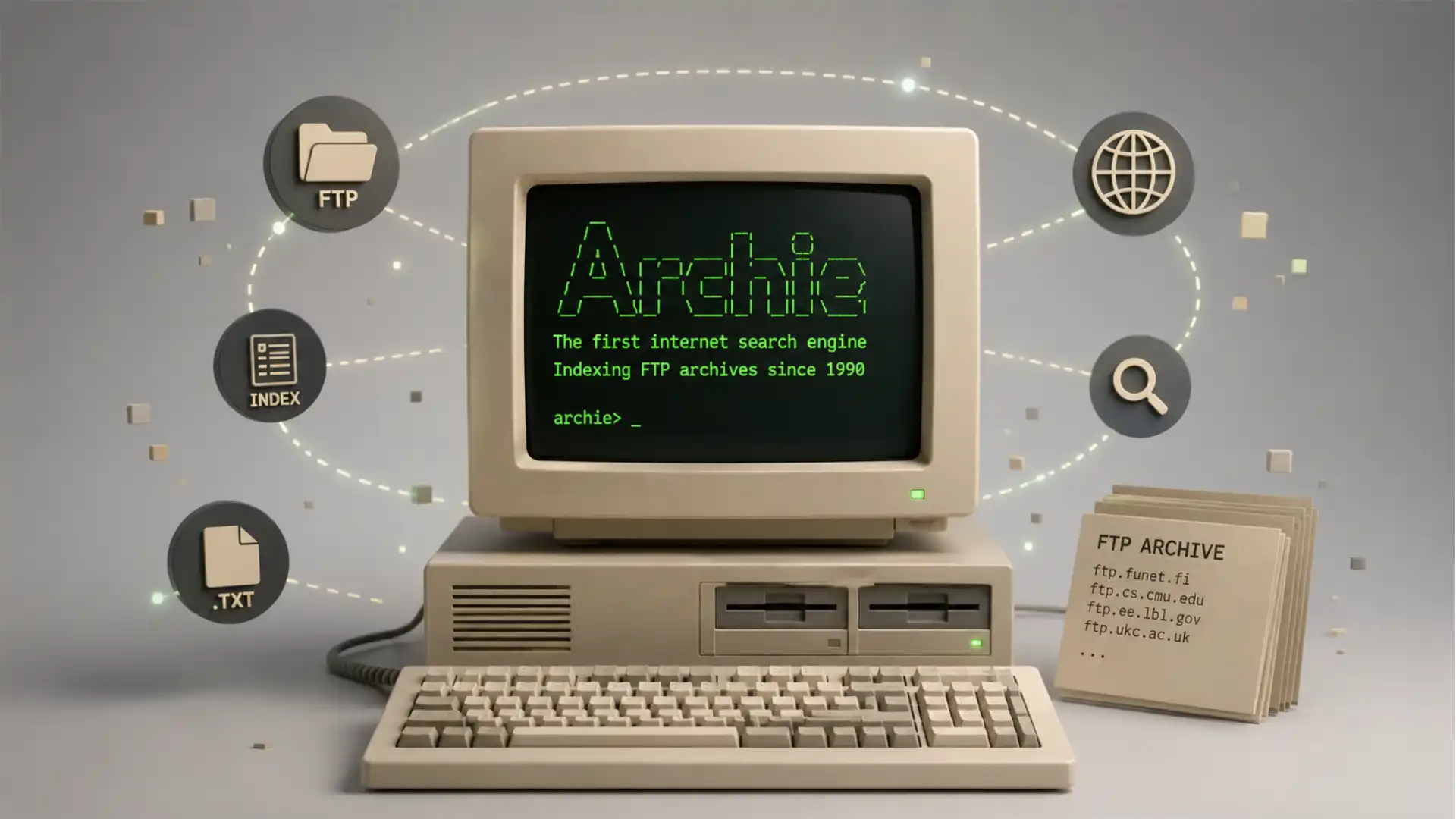
Archie is strange because it looks almost too small to deserve its place in internet history. A text box, a few search modes, a server selector, and the ghost of anonymous FTP behind it. No ranking theater. No autocomplete trying to guess your half-formed thought. No panel pretending to know the thing better than the source. It was built for a harsher internet, one where you did not “search the web” because the web had not yet become the daily surface of the internet. You searched for a filename, hoped it lived on some public FTP server, then fetched it yourself. Alan Emtage conceived and implemented Archie at McGill in 1989, and the Internet Hall of Fame calls it the world’s first Internet search engine.
Table of Contents
The funny part is that Archie now feels harder to explain than Google, even though Archie was mechanically simpler. It did not pretend to understand language. It did not summarize a page, rank reputation, infer intent, sell a sponsored answer, or profile the searcher. It gathered lists of files from anonymous FTP archives and made those lists searchable. A filename was enough. Sometimes it was all you had. The old Archie FAQ described the service as a way to locate files and directories on anonymous FTP servers across the internet, scanning registered FTP servers once a month and merging their directory listings into the Archie database.
That is why Archie is worth opening today, even when the restored service is not behaving like a tidy museum exhibit. It is a search engine with almost no mythology attached to the user. You bring a string. The database answers with paths. The rest is your problem. That sounds primitive until you remember how much of current search has become a negotiation with systems that want to complete, rewrite, monetize, summarize, or over-explain the query before showing the path.
There is also a correction hiding in Archie. The internet and the web are not the same thing. Archie belongs to the internet before most people experienced it as webpages. CERN’s own history says Tim Berners-Lee invented the World Wide Web in 1989, had the first web server and browser running by the end of 1990, and released WWW software in 1991. Archie’s relevance sits right at that hinge point: not before every idea of the web existed, but before the web became the front door through which ordinary users found things.
The restored Archie interface at The Serial Port makes the oddness visible. As checked on June 15, 2026, the site says the Archie search service is currently offline, explaining that the server had been running inside a Sun SPARC virtual machine and that the VM is offline. The page still presents the ArchiePlex-style form, links to the Archie 3.5 beta source and binary files, and describes itself as a web frontend for searching The Serial Port’s Archie server.
That offline notice is not a failure of the story. It is part of the story. Archie is not a dead brand someone revived as nostalgia merch. It is brittle old network software, public FTP culture, university infrastructure, commercial internet archaeology, missing code, restored code, and a search form that now depends on someone keeping a weird old thing alive. That fragility makes it more interesting than a perfect retro demo. The early internet was full of systems that worked because a few people cared enough to run them.
For this piece, the useful stance is concrete rather than ceremonial. Archie deserves to be treated as a web object you can open, not as a museum label you politely read and forget. That editorial approach follows the supplied human-style standard for direct, grounded writing rather than padded explainer prose.
The search box that arrived before webpages
Archie began with a job that sounds mundane until you try to imagine doing it without a web browser. Emtage was responsible for finding free software for students and staff at McGill’s School of Computer Science. In the late 1980s, that meant poking around anonymous FTP archives over a slow connection, looking at filenames, downloading lists, and building local knowledge of where things lived. The Internet Hall of Fame recounts Emtage describing how he wrote scripts to do this automatically at night, when the link was least crowded.
The origin matters because Archie was not born as a grand consumer product. It was a labor-saving device for a person who was tired of doing the same search by hand. That is often how durable internet tools start. Someone has an annoying recurring task. They write a script. Someone else asks to use it. The script becomes infrastructure before anyone has written a business story around it. Archie’s first appeal was not beauty. It removed a specific kind of friction from a specific network culture.
McGill’s bicentennial history gives the clean institutional version: while working as a system administrator at McGill, Emtage wrote an open-source program to automate the search for free software and called it Archie. McGill says that, in his mid-twenties, he had created the first Internet search engine. The same page says Archie made a large impact through the mid-1990s, when the non-proprietary system drew a striking share of Canadian web traffic.
The name has the kind of minor charm early internet tools often had. Archie comes from “archive” without the v. It did not start as a comic-book joke, even though later resource-discovery tools such as Veronica and Jughead made the association irresistible. The name fits the tool better than most brand names fit their products. Archie searched archives. It did not “organize the world’s information.” It looked through filenames in places where people stored files.
The early user experience also asks for a shift in imagination. Search was not a page of blue links. You might telnet into an Archie server, send a query by email, or use a local client. A 1994 Free Archie guide listed those three paths: telnet, email, or a local client. Its telnet example shows a user logging in as “archie,” typing a find command, waiting in a queue, and getting results that named the FTP host, update time, location, and file.
That queue matters. Early search had physical weight. A query consumed scarce server time, bandwidth, and attention from machines that did not feel infinite. Even The Serial Port’s restored interface preserves a comic trace of this etiquette: it lets the user choose the “impact on other users,” from “Not Nice At All” through “Nicest.” The joke lands because it comes from a world where network manners were not decorative. Bad behavior could make the shared tool worse for everyone.
Archie’s shape also explains why it was so powerful in its moment. The internet was already too big for memory but not yet big enough for the web’s link economy. You could know that a package existed. You could know someone mentioned it on Usenet. You might have a partial filename. What you lacked was the host and path. Archie turned that gap into a searchable index. It did not make the internet easy, but it made it less dependent on rumor.
Anonymous FTP itself was closer to a public library shelf than a website. RFC 1635 describes an archive site as a host that keeps information for users to transfer to their own machines. Anonymous FTP gave general access through a special “anonymous” account, often limiting users to logging in, listing certain directories, and retrieving files. To fetch a file, the user needed to know the host and pathname. Archie’s gift was to answer exactly that kind of question.
That is the first reason Archie still feels alive as an idea. It was search before search became content consumption. The result was not the destination. The result was a map coordinate. You still had to go there, understand the directory, fetch the file, decompress it, read the documentation, and hope it matched your machine. Search was a beginning, not an answer product.
The current restored page at The Serial Port captures this beautifully because it refuses, by nature, to feel polished. It shows a form that asks for a string, match type, result order, limit, politeness level, and server. That is almost the whole ideology of early search in one box. Tell the machine what you know. Tell it how strict to be. Tell it how much work to do. Then wait.
The interface also gives away the kind of user Archie expected. It assumed the searcher was comfortable with fragments. A partial program name, a version number, a compression suffix, a project acronym, a directory clue: these were not secondary hints. They were the query. The searcher did not ask for “something to compress files.” The searcher asked for gzip, or maybe gzip-1.2.4, or maybe just zip and then sorted through the mess.
That difference matters because current search trains people to express uncertainty in ordinary language. Archie trained people to sharpen the clue. The machine did not rescue a vague wish. It rewarded a good string. This made Archie demanding, but it also made it honest. It did not pretend to be your assistant. It was a catalog that returned matches.
A user who found a promising result still had work to do. The host and path were directions, not a finished download experience. You might connect to the FTP host, log in as anonymous, use your email address as the password, change directories, set binary mode if needed, get the file, then handle the archive on your own machine. Each step had room for error. Each step also gave the user a mental map of the network.
The old internet often gets remembered through aesthetics: green screens, monospace prompts, beige machines, university labs, modems, and command lines. Archie is more interesting as a habit than as an aesthetic. It shows a way of finding things where the user’s mental model and the network’s structure were close together. You knew you were searching remote file listings because the result looked like remote file listings.
That closeness has mostly disappeared from consumer search. The current user usually sees an interpreted surface, not the indexed object. Pages are ranked, summarized, clustered, decorated, and sometimes replaced by generated answers. Archie’s starkness feels like a window before the glass got tinted. It is not friendly in the polished sense, but it is readable.
The early story also explains why the phrase “first search engine” can be misleading if left bare. Archie was not a tiny Google. It did not crawl a web of pages and rank them by links. It did not understand prose. It did not index every word inside every file. It searched known holdings from public FTP archives. That narrower claim is stronger because it is real.
A restored doorway into a vanished FTP internet
The Serial Port’s Archie page is not just another retro website. It is a doorway into a network habit that has mostly disappeared from ordinary life. The page says it is a web frontend for searching the Archie server at The Serial Port, based on ArchiePlex, with links to the revived Archie videos and to the Archie 3.5 beta source and binary files. It also says, at the moment of checking, that the actual search service is offline because the Sun SPARC VM is offline.
This makes the site oddly better as Web Radar material. A normal article would prefer a perfectly working demo, but Archie’s half-working state tells the truth. The internet forgets tools in layers. First the protocol leaves daily use. Then the client disappears from default software. Then the servers go away. Then the source code becomes hard to find. Then the story shrinks to a trivia sentence: “the first search engine was Archie.” The Serial Port page fights that shrinkage by exposing the artifact, not just naming it.
The restored files are part of the appeal. The Serial Port’s file server hosts Archie 3.5 documentation pages, including the system overview, database notes, configuration files, and operational pieces. This is not a screenshot archive. It is closer to a workbench. You can read how the thing was meant to run, what catalogs meant, how the update cycle worked, and why a search engine needed both information-gathering and information-serving components.
The documentation has a plain engineering voice that feels refreshing now. It calls Archie a straightforward tool for resource discovery in the internet environment. Then it describes a server maintaining information about anonymous FTP archives, checking known data hosts periodically, updating catalogs, and letting users query those catalogs before accessing the remote FTP archive itself. That sentence could pass as a diagram caption, but it contains a whole philosophy of search: collect the holdings, let people ask, return the address.
What stands out is not only that Archie searched FTP. It searched a known universe of registered or discovered sites. The old FAQ says administrators registered anonymous FTP servers with Archie, and the service scanned directories and filenames once a month to create a merged list. More than 1,000 anonymous FTP sites and more than 2.1 million filenames were represented in the FAQ’s snapshot of the database.
Those numbers are tiny by current search standards, but they are not tiny in human terms. Two million filenames are already too many for memory, gossip, and bookmarks. That is the hinge where search becomes necessary. You do not need Google-scale chaos before you need an index. You need enough distributed material that no single person can remember where the useful thing lives.
What the restored Archie page reveals
| Detail | Why it matters |
|---|---|
| Search service offline | Shows how fragile revived internet artifacts remain |
| ArchiePlex-style form | Preserves the old query logic instead of hiding it |
| Match type options | Makes exact, substring, case-sensitive, and regex search visible |
| User impact setting | Carries early network etiquette into the interface |
| Source and binary files link | Turns nostalgia into recoverable software history |
The table is small because Archie is small in the best way. Its restored page does not need a product tour. The interesting parts are right there: the search form, the limits, the politeness, the offline notice, and the path to the code. That is enough to make the site feel less like a memorial and more like a half-open service door.
The offline status also keeps the article honest. You may not be able to run a live Archie search from the page today. The page’s status line says the search service is currently offline, while still offering the code for people who want to inspect the software. For a Web Radar recommendation, that changes the pitch. Open it not because it will replace a search engine, but because it shows what search looked like before the browser became the natural frame for finding things.
This is where the old FTP world comes back into view. FTP has not vanished as a protocol, but it has vanished from ordinary browser memory. Chrome removed support for FTP URLs in Chrome 88, with Google saying the legacy FTP implementation lacked encrypted connection support and proxy support, and that use was too low to justify improving the built-in client. A user who grew up after that removal may see ftp:// as an archaeological marker rather than a normal way to fetch something.
That browser removal matters for Archie’s cultural feel. A tool built to search FTP archives now points at a kind of public shelf that most browsers no longer invite you to browse. The network paths may still exist in places. Specialist clients still exist. Mirrors, repositories, and institutional archives still exist. But the casual act of clicking an FTP link in a mainstream browser has faded. Archie’s hunting ground is not gone in one clean event; it has retreated from default visibility.
The Serial Port’s rescue therefore feels less like “retro computing” and more like “lost interface studies.” It gives shape to a mode of internet use that was file-first, directory-first, and path-first. Current search often begins with a desire phrased in ordinary language. Archie began with a clue. The clue might be gcc, tcpip, xarchie, emacs, doom, rfc, or any other fragment someone heard about through a mailing list, a newsgroup, a colleague, or a README. The engine did not widen the query. It matched it.
The restoration also raises a quiet preservation problem. Search engines are not just indexes; they are social records of where a community stored its work. When Archie indexed an FTP site, it captured the fact that a host mattered, that a directory had a naming convention, that software and documents were distributed through public file shelves, and that geography and bandwidth shaped how people fetched files. A search result was also a map of institutional memory.
That is why the source and binary files matter. A screenshot of Archie would preserve the look, but the files preserve the behavior. The Serial Port documentation and code links let technically curious readers move beyond the legend. You can inspect how a resource-discovery system thought about catalogs, host information files, update cycles, parsing, database indexes, and exchange between Archie servers.
The best thing about the site is that it does not sand down the awkwardness. It leaves the old affordances visible. “Exact match” means exact match. “Regular expression match” is not hidden behind a friendly label. Sorting by host or date is there because the result set is not pretending to be a ranked answer. The politeness dropdown survives because this was a shared tool in a shared environment. The old internet often looked unfriendly, but some of that unfriendly texture was really an exposed social contract.
There is a second layer of strangeness in seeing Archie through a web page. The web is now hosting a relic of the pre-web search habit. The browser becomes a glass case around a system that once belonged to telnet sessions, email commands, and local clients. That tension makes the page memorable. It is not a pure restoration of the original experience. It is a translation, and the seams are visible.
Those seams are useful. They keep the reader from mistaking nostalgia for access. A restored form is not the same as the network Archie originally searched. A link to the software is not the same as the social world that gave the software meaning. The page gives you enough to feel the shape of the lost thing, while reminding you that the surrounding ecosystem has changed beyond recognition.
The restored page also makes one underrated point about preservation. A working service is more persuasive than a paragraph about a service. Even when the search backend is offline, the interface and files create a stronger encounter than a history article alone. You see the options. You see the old naming. You see the current status. You sense the distance between “the first search engine” and the living labor of keeping it reachable.
The Serial Port’s page is therefore not a polished destination. It is a trailhead. Start with the web frontend. Follow the files. Read the system overview. Compare the old search modes with current search defaults. Think about how much the user once had to know. The pleasure is not only in the artifact itself. It is in how quickly the artifact makes the present look less inevitable.
How Archie searched without understanding anything
Archie’s intelligence was deliberately narrow. It knew filenames and paths, not meaning. It did not crawl HTML pages because the everyday web was not yet there. It did not index the contents of every file because that would have been too costly and, for many uses, unnecessary. It created searchable catalogs of holdings. If the string matched, the user got locations. If the string did not match, the machine did not sympathize.
That narrowness is not a defect in the historical sense. Archie solved the exact discovery problem of anonymous FTP. RFC 1635 explains the user’s old burden neatly: to retrieve a specific file, a user needed to know the host and pathname. Archie filled that missing host-and-path gap. It did not need to read the file to tell you where a file with that name lived.
The Archie system overview makes the architecture feel surprisingly current. It describes an information mediator that both seeks out information from internet sites and gives users access to the resulting catalogs. The update cycle includes retrieval, data acquisition, parsing, exchange between Archie servers, and updating the local catalog. Change the protocol and scale, and you can recognize the family resemblance to later search systems.
The difference is that Archie did not hide the supply chain. The search result was obviously downstream of a scan, a parse, and a catalog update. The FAQ says scans happened once a month. Freshness was not a magical promise. It was a schedule. If a file moved after the last scan, the result could be stale. If a description was manually entered and not maintained, it might mislead. The old Free Archie documentation even warns that a whatis description might remain after the related program had been removed from FTP sites.
That is a useful mental reset. Search was once visibly approximate. Today’s search products often perform confidence even when the underlying index, retrieval, or generated answer is uncertain. Archie’s uncertainty was mechanical and honest: the database had a last-updated rhythm, hosts could be unreachable, descriptions could age, results could vanish. You understood that the map was not the territory because you still had to connect to the territory.
The output also trained a different kind of user. You read paths. A result naming ftp.cs.umn.edu and /pub/doc/published/books tells you a lot if you know how institutions organize files. Domain names, country codes, and directory names become signals. Search literacy was closer to filesystem literacy than media literacy. You had to infer whether a file looked relevant from its name, location, size, date, and host.
There is a beauty in that restraint. A filename is a brutally compressed promise. gcc-2.5.7.tar.gz tells a fluent user an entire story: project, version, archive type, compression format. stevens.tcpipiv1.tar.Z tells another: Stevens, TCP/IP Illustrated, volume 1, tar archive, old Unix compression. Archie lived in that compressed naming culture. The machine did not need semantic search because the filenames were already carrying the social grammar of software distribution.
This is also why Archie feels alien to people trained by full-text web search. You had to know what you were looking for before the search began. Partial knowledge was acceptable; vague desire was not. If you searched for “a tool for editing images,” Archie would not infer Photoshop alternatives or show a listicle. If you searched for xv, you might find the image viewer. If you searched for the wrong string, you got the wrong universe.
The system’s documentation also shows that Archie was not only one database. Its catalogs could represent anonymous FTP listings, technical papers, status information, and, later, web indexing. The system overview mentions an anonftp catalog and a webindex catalog, while explaining that catalogs are the collections users search. The famous story is FTP, but the architecture was more general: collect distributed holdings, parse them, index them, serve queries.
Still, FTP is the soul of the thing. Anonymous FTP was the medium where Archie became culturally legible. A public FTP archive exposed directories and files without the design layer of the web. It was not trying to persuade or entertain. It was a remote shelf. Archie did not turn that shelf into a publication. It turned thousands of shelves into a searchable card catalog.
The card-catalog comparison is useful but incomplete. A library catalog usually points to curated holdings, while Archie pointed to whatever participating archive sites exposed. Software releases, patches, documentation, mailing-list archives, public datasets, utilities, research papers, compressed tarballs, strange leftovers: the internet’s public FTP space was part library, part warehouse, part university basement, part software bazaar. Archie made the mess searchable without pretending it was clean.
The monthly scan cadence also created a softer, slower search culture. The database did not claim instant awareness. If a package was uploaded today, Archie might not know until a later update. That delay shaped expectations. Search was not a live nervous system. It was a periodically refreshed directory. People still relied on announcements, mailing lists, Usenet posts, and human recommendations. Archie did not replace the social internet; it gave the social internet a memory aid.
That makes Archie feel oddly relevant now. The strongest current search complaints are often complaints about mediation. Too many summaries, too much ranking manipulation, too much commercial intent, too many pages written to satisfy the engine rather than the reader. Archie sits at the opposite end of the spectrum. It barely mediates. It records names and locations. It leaves judgment to the user.
Of course, nobody should romanticize the pain. Archie was not pleasant by current standards. It was text-heavy, exacting, dependent on technical habits, and limited by the naming practices of remote hosts. It helped people who already had enough knowledge to ask a usable question. For beginners, it may have felt like a locked cabinet with a tiny keyhole. But its limits are part of what makes it worth studying: you can see exactly where the machine stops.
The old documentation’s database notes add another small surprise. Archie’s back end already cared about speed, indexing, and result order. The database page describes an index structure for faster searches, site files, and domain-based ordering so results could be returned in a preferred geographic or network order. Even this supposedly primitive tool had to think about latency, replication, closeness, and user burden.
That domain-ordering detail is a lovely piece of lost common sense. A nearby FTP mirror mattered because network distance mattered. If a North American Archie server returned North American hosts first and New Zealand or Australian hosts later, it was not being parochial. It was trying to spare long-distance transfers when a closer copy might exist. Search was shaped by geography, network cost, and etiquette.
The current web has not erased geography, but it has hidden it better. CDNs, cloud regions, caches, and platform infrastructure make distance feel less visible to the user. Archie’s old result ordering reminds us that the internet was never placeless. Files lived on machines. Machines lived in institutions. Institutions lived in countries and networks. Search results carried that geography in their hostnames.
Archie also had a relationship with failure that feels healthier than many current interfaces. A failed retrieval or parse was part of the update cycle, not an unthinkable exception. The system overview describes data acquisition failure, parsing failure, and headers updated to reflect what happened. The tool expected the internet to be messy. It did not act shocked when a host failed.
That failure model is another reason the restored site’s offline notice feels appropriate. The page is not betraying Archie by being temporarily unavailable. It is reenacting a truth Archie always had to manage: servers go down, hosts move, data fails to parse, old software gets cranky, and search is only as alive as the network under it. A flawless simulation would be easier to demo, but less faithful to the spirit.
The social rules hidden inside the interface
The most charming field on the restored Archie form is not the search box. It is the “impact on other users” selector. Current interfaces rarely ask users to think about the burden of a query. They hide resource use behind a smooth page and a spinner. Archie’s world was less abundant. A search could create work on shared machines. A greedy query could slow a service that other people needed.
The wording is funny because it is blunt. “Not Nice At All” is a tiny moral lesson disguised as a dropdown option. It assumes the user understands that speed and courtesy are in tension. Maybe you want the search quickly. Maybe the server is busy. Maybe being “Nicest” means waiting longer so the shared tool stays usable. The interface treats patience as part of network citizenship.
That may sound quaint, but it touches a live problem. Most current platforms hide the social cost of interaction. A search query, a generated answer, a video autoplay, a cloud sync, or a high-resolution image request all cost something somewhere, but the interface is built to make the cost feel absent. Archie’s politeness control does the opposite. It makes cost part of the action.
The same ethic appears in the monthly scan rhythm. Archie avoided constantly hammering remote FTP servers. The old FAQ says the service scanned registered directories and filenames once a month, building a merged list. That monthly schedule was a compromise between freshness and burden. It respected the fact that remote hosts were not infinite content mines. They were other people’s machines.
This is one of the quietest differences between the early internet and the platform web. The early tool often exposed dependency on other sites. Archie could not pretend the remote FTP host belonged to Archie. It pointed elsewhere. It updated from elsewhere. It could fail because elsewhere changed. Current platforms often absorb outside material into feeds, cards, previews, and summaries until the source becomes secondary.
That outward-pointing habit shaped user behavior. A successful Archie search led to another machine. You learned hostnames. You noticed institutions. You saw directories named by humans. You dealt with the remote server’s rules. Search did not flatten all sources into the same visual template. It revealed that the internet was a federation of places with different habits.
The difference also shows up in access methods. Archie was reachable through telnet, email, and clients because users reached the internet through uneven paths. The Free Archie guide’s email example is especially revealing: a user could send a simple message with a find command and receive results back by email. Search did not assume a browser, a fast line, or an always-on session.
Email-based search now feels almost absurd, but it was a brilliant fit for the time. If your connectivity was limited, asynchronous search still worked. You could send a query, receive results later, and then decide what to fetch. That rhythm belongs to an internet where connection time, bandwidth, and access routes were uneven. It was slower, but in some ways more tolerant of imperfect access.
The restored web frontend cannot reproduce that whole world, but it hints at it. The interface is a translation from many access paths into one familiar surface. A current reader sees a browser form. Underneath that form is the memory of telnet prompts, email commands, and local clients. The web page is not the original territory. It is a map of a machine that once lived across several modes of access.
Those modes make Archie feel less centralized than current search, even though the database itself could be centralized by server. There were multiple Archie servers, exchanged data, and local choices about catalogs and hosts. The system overview describes remote Archie hosts and data exchange between cooperating Archie systems. Search was distributed not only in what it indexed, but in how the service could be run and shared.
This was not frictionless decentralization. Running an Archie server took skill, hardware, bandwidth, and patience. The restored documentation exists precisely because the system was complex enough to need manuals. But the model still feels different from the current default of a few giant search platforms. Archie’s architecture leaves room for local hosts, catalogs, exchange, and operational choices.
That room mattered socially. An internet tool did not have to be one global brand to matter globally. Archie spread through servers, clients, word of mouth, documentation, and institutional adoption. The fact that it could draw serious traffic without looking like a consumer product says something about the network culture around it. Usefulness traveled faster than polish.
The old result format also carried social signals. A hostname could tell you whether a result came from a university, a research network, a company, or a national mirror. Today’s search result pages often bury infrastructure behind page titles and snippets. Archie put the infrastructure in your face. That made the internet feel less abstract, and maybe less magical. It was not a cloud. It was named machines.
There is a kind of respect in that exposure. The source remained visible because the source was necessary. If the FTP host was down, the result was useless. If the path changed, the result aged. If the site was far away, the transfer might be slow. Archie’s interface and output kept reminding users that the network was made of other people’s systems.
Current search often tries to erase that reminder. It gives the user a smooth surface over unstable material. That smoothness is convenient, but it makes the underlying web easier to neglect. Archie’s roughness keeps the source alive as a place. That is one reason it still feels worth opening: it teaches source awareness without lecturing.
The social lesson is not that every current tool should revive command-line awkwardness. The lesson is that interfaces can reveal enough of their cost and structure to make users wiser. Archie did this because it had no choice. We can value it now because current tools often choose the opposite.
Why the limits are the point
Archie is interesting because it does less than every search product now tries to do. It does not answer; it locates. That difference sounds small until you open the restored page and stare at the available controls. Match a string. Sort results. Limit the number. Choose how much burden you place on other users. Pick an Archie server. The interface assumes the searcher is an actor, not a passive recipient of a finished answer.
That assumption changes the emotional temperature of search. The user carries responsibility. You need to choose a search mode. You need to interpret the result. You need to decide whether the host is close enough, current enough, trustworthy enough, or worth the transfer. Archie returns evidence, not a verdict. That makes it less convenient, but it also makes the mechanics easier to inspect.
The limits also reveal what search engines became by adding layers. Ranking was not the default soul of search. Archie’s results were not trying to model collective authority through links, behavior, freshness signals, or commercial placement. They were matches from a catalog. That does not make Archie better. It makes it cleaner to think with. A clean primitive is often more useful for understanding a category than the mature product.
Archie’s lack of content indexing also feels instructive. The system trusted names more than contents. In a file-distribution culture, that was not absurd. Names had discipline because names were how people found, mirrored, announced, and installed things. The more the web grew into prose pages, images, scripts, databases, feeds, and apps, the less filename search could carry. But in the FTP archive world, filenames were meaningful metadata.
There is a small tragedy in that shift. The web made information richer and harder to name. A webpage can be updated without changing its URL. A product page can be rewritten daily. A forum thread can drift. A script can render content after load. A file archive, by contrast, often leaves its meaning in stable names, versions, and directories. Archie belonged to a world where the object being searched was more object-like.
The restored page also reminds us that search used to have visible cost. The “impact on other users” field is almost comic now because current infrastructure hides cost from the user. Search feels instant, so it feels weightless. Archie’s old etiquette exposed a different truth: every query happened somewhere, used resources somewhere, and might slow someone else down. That is not nostalgia. It is design honesty.
The same honesty appears in the old update cycle documentation. The system had to retrieve, parse, update, and sometimes fail. The overview says failures could occur if a data host was unreachable or parsing failed, and that failed data would still move through the update cycle with headers updated to reflect what happened. That is refreshingly concrete. The machine is not a magic box. It is a chain of brittle operations.
The limits also make Archie a better museum object than many early web pages. A static homepage can show old design, but Archie shows old dependency. It depended on FTP archives, registered hosts, parsers, update schedules, clients, telnet sessions, email access, and users who knew what a compressed archive looked like. To understand Archie, you have to understand a network of habits around it.
That is why the restored source and docs are so much more interesting than a commemorative screenshot. They let the reader see the operational shape of the tool. The system overview’s language about catalogs, data hosts, host information files, retrieval components, parse components, exchange components, and update components turns “first search engine” into a real machine. You stop seeing Archie as a trivia answer and start seeing it as infrastructure.
The current offline status also prevents a cheap kind of retro triumph. The artifact is not fully domesticated. It has not been turned into a smooth educational toy with fake results and a clean narrative. It is a restored service that can go down, points to code, and asks for patience. That instability suits the subject. Archie belonged to an internet where services were often run by institutions, labs, students, volunteers, and people with just enough access to keep something useful alive.
There is another limit worth naming: Archie searched a public file culture that already excluded much of the internet’s human texture. It was excellent for locating software, documents, and archives. It was not a search engine for conversation, identity, images, commerce, or everyday curiosity. It did not know the living web because the living web had not yet arrived in recognizable form. Its greatness is precise, not universal.
That precision is the antidote to lazy “before Google” nostalgia. Archie did not lead directly to Google as a baby version of the same product. It solved a different problem with different assumptions. The family resemblance is there: crawling, retrieval, indexing, querying. The culture is different: filenames, FTP servers, slow links, shared etiquette, institutional hosts, command-line clients. When people say Archie was the first search engine, the phrase needs that texture.
The web’s early history makes this distinction sharper. CERN says that by late 1993 there were over 500 known web servers and the web accounted for 1 percent of internet traffic. The rest was remote access, email, and file transfer. That statistic is perfect for understanding Archie. For a while, the web was a promising new layer on an internet still dominated by older modes. Archie was not waiting for web pages. It served the internet that already existed.
That also explains why Archie became less central. Once the web made documents linkable, browsable, and easier to publish, search had a richer object to index. Web search engines could crawl pages, follow links, read text, and later rank by link structure and many other signals. Archie’s FTP-first model did not disappear because it was foolish. It faded because the internet’s main public surface changed.
But fading is not the same as losing meaning. Old tools preserve decisions that mature platforms hide. Archie asks a blunt design question: what is the smallest machine that makes distributed resources findable? Its answer is still elegant. Gather directory listings. Build a searchable database. Return hosts and paths. Let users fetch what they need. In a world drowning in “smart” layers, that minimal answer feels almost provocative.
The limit that may matter most is conceptual. Archie does not confuse discovery with consumption. It helps you find a thing, but it does not package the thing into an experience. That line is almost gone in many current products. Search results become previews. Previews become answers. Answers become substitutes. Archie stops before that chain begins.
A stopped machine can teach. By refusing to cross the line from location into interpretation, Archie makes the line visible. It asks a question current search rarely asks aloud: do you want help finding the source, or do you want the system to stand between you and the source? The answer changes with the task, but the distinction should not disappear.
What Archie says about search culture now
Opening Archie in 2026 is like touching the exposed wire of search. It strips search back to location, naming, and retrieval. That is not where most people live anymore. Current search often sits between advertising markets, AI answer systems, SEO factories, platform lock-in, browser defaults, and user behavior modeling. Archie reminds us that search began, in one strong branch, as a public utility for finding files.
The contrast is not only technical. Archie assumed the user wanted to leave. A successful query sent you to another host. The search engine’s job was to give you the location of the file so you could retrieve it. Current search and answer systems often want to keep the user inside the interface: snippets, summaries, widgets, generated answers, shopping modules, maps, video previews. Archie’s result was a door, not a room.
That old door-like quality is worth thinking about. A search engine that points outward has a different moral shape from a search engine that absorbs the destination. Archie did not have the bandwidth, business model, or interface to swallow the file archive into itself. It returned coordinates. The user and the remote host completed the act. This made search feel less like a media product and more like a directory service.
The shift from directory service to answer machine changes the user’s posture. Archie rewards knowing. You know a filename fragment, a package name, a convention, a host, a version. You query from that knowledge. Current systems often reward asking from ignorance, which is useful, but also changes the pressure on sources. Pages get rewritten to be interpreted by search systems. Content becomes bait for answer extraction. Archie’s world had its own problems, but it did not create an industry of pages pretending to be answers.
There is a lesson here for product designers. When a tool is narrow, the interface can be honest. Archie’s form exposes exact match, substring match, case sensitivity, regex, host/date sorting, result limits, and user impact. No invisible “relevance” score pretends to know better than the searcher. The tradeoff is obvious: more burden on the user, less interpretive power from the machine. A product does not always need to hide its model to be usable by the right people.
There is also a lesson for archivists. Preserving the web is not enough if earlier internet services fall through the cracks. The Wayback Machine is brilliant for web pages, but Archie’s story points to public FTP archives, telnet interfaces, email query services, client software, server binaries, documentation, and institutional operating knowledge. The pre-web internet did not always leave browser-friendly artifacts. It left code, paths, tapes, manuals, and memories.
The Serial Port page makes that preservation gap tangible. The search service being offline is a reminder that running old network software is not the same as saving a screenshot. Old systems need compatible environments, reconstructed dependencies, working protocols, and people willing to debug weird failures. The page’s mention of a Sun SPARC VM is a whole preservation drama in one line.
The FTP angle deepens the loss. Public FTP once functioned as a shared distribution layer for software and documents. RFC 1635’s description of archive sites as repositories users could access and transfer from gives a neat snapshot of that culture. The browser’s retreat from FTP support did not erase FTP, but it pushed that culture farther away from casual users. Archie now feels like a search box for a public shelf hidden behind a wall.
This is why Archie is not only for computer historians. It gives non-specialists a sharper way to see what changed. Search was once closer to inventory. The web made search closer to publishing. Social platforms made discovery closer to feeds. App stores made it closer to marketplaces. AI answer products make it closer to synthesis. Archie sits at the inventory end of that chain: plain, strict, and indifferent to your vibes.
That inventory mindset has fresh appeal. There are moments when users do not want interpretation; they want a list. Developers searching package names, researchers searching archives, archivists searching filenames, investigators searching leaked directories, sysadmins searching mirrors: the old path-and-file mental model still appears wherever the object matters more than the surrounding page. Archie is outdated as a daily tool, but not outdated as a mental pattern.
It also reveals a different relationship between scarcity and design. Archie’s constraints came from bandwidth, storage, processing, and network load. Current interfaces often pretend those constraints are gone. They are not gone; they moved into energy use, cloud costs, data-center scale, model training, environmental load, and attention cost. Archie’s politeness setting may look quaint, but it points to a design ethic worth recovering: make cost visible enough that users understand the shared system.
There is a human story here too. Emtage did not patent Archie in the way a later startup founder might have been urged to patent and defend everything. The Internet Hall of Fame article quotes him describing the internet at the time as non-commercial and shaped by people fighting the good fight, with no clear certainty about what would happen. That is not a moral fairy tale; the early internet had power structures, access limits, and institutional privilege. But the quote captures a real difference in default imagination.
Archie’s later commercialization through Bunyip complicates the story in a useful way. The tool moved from university workaround to licensed commercial search engine. The Internet Hall of Fame says Emtage and Peter Deutsch founded Bunyip Information Systems in 1992, distributing a licensed commercial version of Archie. The lesson is not “everything was pure before business arrived.” The lesson is that the boundary between commons, research infrastructure, and commercial internet services was being drawn in real time.
That boundary is part of why Archie feels like a fossil from a more legible moment. The machine’s purpose was obvious. It existed because people needed to find files. The system gathered listings and returned locations. The business and governance questions came later, but the core action stayed simple enough to explain. Compare that to current search ecosystems, where the visible query triggers layers of ranking, ads, personalization, AI extraction, spam defense, and policy decisions. The user sees a page; the actual system is hidden behind it.
Archie should not make us want to live in 1990. It should make us more demanding about the clarity of the tools we use now. A search product can be powerful without being opaque by default. A discovery tool can expose controls without humiliating the user. A public index can point outward instead of trapping attention. A restored artifact can teach product thinking better than a hundred startup manifestos.
The current web often treats search as a solved problem whose only remaining question is which system gives the fastest answer. Archie reminds us that search is a cultural choice before it is an interface choice. Do results point outward or inward? Are sources visible or absorbed? Are costs hidden or disclosed? Is the user trusted with controls or shielded from them? These questions are older than AI answers and newer than card catalogs. Archie gives them a clean shape.
The fact that Archie was built for filenames does not weaken that lesson. A narrow artifact can illuminate a broad category. Because Archie is so limited, the moving parts are legible. You do not need a theory of trillion-page indexes to understand why it mattered. You need to understand a person with a repeated task, scattered FTP servers, filenames, scripts, and a shared database. From that, the whole idea of internet search becomes less abstract.
It also helps puncture the fantasy that search engines arrived fully formed. Search evolved through many tools, protocols, compromises, and dead ends. Archie belongs beside Gopher search, WAIS, early web directories, web crawlers, and later ranking systems, not as a primitive joke but as a real answer to a real network. If you care about the internet as culture, those intermediate forms matter because they show roads not taken.
The road Archie took was file discovery. That sounds humble, but humility is the source of its staying power. The tool knew what it was. It did not try to become a homepage, a portal, a social feed, or a shopping interface. It was a way to ask, “Where is this file?” and get back something usable. That clarity makes it feel almost radical now.
The missing FTP shelves
The phrase “anonymous FTP” may now sound like a security warning, but it once described an ordinary public access pattern. A server could make a directory tree available to outsiders who logged in with the username anonymous. RFC 1635 describes this as a way archive sites gave general access to their holdings, with users usually limited to listing directories and retrieving files. That is the world Archie indexed.
The word “archive” matters here. These were not websites with homepages designed around user journeys. They were repositories. A university might host software mirrors. A research group might publish documents. A community might distribute utilities. A vendor might offer patches. Directories grew by convention, institutional habit, and administrator decisions. The system was rough, but it was direct.
Archie made sense because those shelves multiplied. Once enough public FTP archives existed, discovery became harder than transfer. Getting a file from a known path was straightforward enough for the technically literate user. Knowing the path was the problem. Archie did not make FTP prettier. It made the shelves findable.
The old FAQ’s more-than-1,000-site snapshot is powerful because it lands between tiny and enormous. A thousand public archive sites are enough to create a map problem. No person wants to log into each one looking for a package. No mailing list can hold the whole picture. No bookmark file can stay current. A periodic merged index becomes a public good.
The FTP world also had a different relationship to duplication. Mirrors were normal because distance and load mattered. A file might exist on several hosts, and the best result might not be the first alphabetically or the most “authoritative” by some abstract rank. It might be the server closest to you, least busy, or most recently updated. Archie’s database documentation about ordering results by domain shows that these practical concerns were built into the system.
That mirror culture has not vanished, but most users meet it less directly. Package managers, CDNs, app stores, Git hosting, and cloud storage hide much of the mirror logic. The user asks for a file; the infrastructure chooses where it comes from. Archie lived before that smoothness. It showed the host, the path, and often the date. That exposure taught users how distribution worked.
The disappearance of FTP from default browser behavior sharpened the divide. When Chrome removed FTP URL support, it marked the end of a casual browser path into the old archive world. Google’s Chrome 88 note says FTP support was removed because the legacy implementation lacked encrypted connection and proxy support, and because use was too low to justify further work. That is an understandable engineering decision, but it also changes cultural memory.
A protocol can survive after it leaves the interface. FTP still exists for people who know where to look and what client to use. But when a mainstream browser stops treating ftp:// as a normal address, a huge part of the public’s intuitive access disappears. Archie’s world becomes less like an old neighborhood and more like a technical subbasement.
This is why the user’s phrase “FTP servers nobody can find anymore” feels right even when it is not literally universal. Some FTP servers remain findable; the habit of finding them has decayed. Many old hosts are gone. Many mirrors moved to HTTP or HTTPS. Some directories survive as dusty corners. Others exist only in documentation, Usenet posts, old README files, and archived pages. The search problem returned, but now it is a preservation problem.
Archie could locate files only when the ecosystem cooperated. It needed hosts to exist, listings to be accessible, scans to run, and filenames to retain meaning. Once the surrounding FTP culture eroded, Archie’s index became harder to sustain as a living search engine. A restored Archie service without the old FTP world is like a revived card catalog after the library has been moved, sold, burned, and partly scanned.
That comparison sounds sad, but there is still joy in it. Old catalogs reveal how people once arranged knowledge. The directory names, file names, version strings, hostnames, and update times form a portrait of a working culture. Even if many files are gone, the pattern is worth seeing. Archie is less a doorway to all those files now than a doorway to the way people thought files should be found.
The missing shelves also tell a broader story about internet loss. We often talk about link rot on the web, but pre-web rot is harder to mourn because fewer people know what disappeared. A vanished webpage at least has a URL someone might paste into the Wayback Machine. A vanished FTP directory may be remembered only by a filename in an old Archie result, a README, or a mailing-list post. The record is thinner.
That thinness makes projects like The Serial Port’s restoration feel unusually generous. They are not only saving a famous name; they are saving a mode of use. Even if the search backend is offline right now, the interface and docs let people understand how the mode worked. The reader gets a taste of filename search, match options, server etiquette, and the labor of making distributed resources searchable.
For anyone building digital archives, Archie’s ghost carries a warning. Preserve the access method, not only the content. A directory tree without the client habits around it is harder to understand. A search index without its query conventions loses meaning. A protocol without its social etiquette becomes a technical fact, not a culture. Archie was all of those things at once.
Small answers before you open it
Is Archie the first search engine or the first web search engine? It is best described as the first Internet search engine, not the first web search engine. The distinction matters because Archie searched public anonymous FTP archives, while the web as a browsable document system was only emerging at CERN around the same period. The Internet Hall of Fame and McGill both identify Archie as the first Internet search engine.
Can you use the restored Archie search right now? As checked on June 15, 2026, The Serial Port page says its Archie search service is currently offline, with the Sun SPARC VM offline. The page still exists, the form is visible, and the Archie 3.5 beta source and binary files are linked for people who want to inspect the software.
What did Archie actually index? Archie indexed directory and filename listings from anonymous FTP sites. The old Archie FAQ says administrators registered FTP servers, Archie scanned directories and filenames about once a month, and the merged database contained paths and filenames. It was not a natural-language answer engine and not a full-text search engine for the contents of files.
Why does it feel so different from search today? Archie was built around exact objects: files, directories, hosts, paths, and update schedules. Current search usually works on pages, entities, snippets, user intent, ranking signals, ads, and generated summaries. Archie asks you to think like someone looking for a file, not someone asking a machine to interpret the world.
Why should a non-technical reader care? Archie makes the internet’s earlier shape visible. It shows that “search” did not begin as a glossy page of ranked answers. It began, in one famous case, as a practical way to find software and documents on machines scattered around universities, institutions, and public archives. That changes how you understand the web you use now.
Why does the restored page matter if the search backend is offline? The page still exposes the old interface logic and points to the restored software files. A live search would be better, but the page already teaches the shape of the system. The offline notice also makes the preservation issue concrete: old internet tools need working environments, old assumptions, and active maintenance.
What should you look at first on the page? Start with the search form, especially the match type and user impact controls. Those two parts say more about Archie than a long timeline does. One shows that the system searched strings with visible rules. The other shows that early internet tools often expected users to care about shared load.
What makes Archie a Web Radar subject rather than just a history fact? Archie is a website-shaped encounter with a pre-web search culture. It is obscure, opening it teaches you something quickly, and the thing itself is more revealing than a summary of it. That is the sweet spot: a link that changes your mental picture of the internet.
A small search engine with a long shadow
Archie’s long shadow comes from a simple act: it made distributed stuff findable. That is still the deep job of search, even when search products bury it under interfaces, summaries, ads, and ranking systems. The web grew, browsers spread, search engines changed shape, and Archie faded from use. Yet the core pattern remains recognizable: crawl or collect, parse, index, query, return something that helps the user move.
The best way to approach the restored Archie page is not as a replacement for anything. Open it as a piece of working memory. Notice the form. Notice the match types. Notice the politeness setting. Notice the offline warning. Click toward the files. Read a little of the system overview. Let the old architecture feel small and physical. The value is not only in seeing “the first search engine.” The value is in seeing how little machinery was needed before the internet became searchable enough to feel different.
Archie also corrects the myth that search began with consumer convenience. It began with people already deep inside the network trying to reduce repeated labor. Emtage needed to find software. Scripts handled the boring part. Others wanted access. The tool spread. A service became infrastructure. The web had not yet trained everyone to expect every answer from a single box.
That origin gives Archie its lasting charm. It is not sleek. It is not friendly in the current sense. It does not flatter the user. It is a work tool from a file-and-path internet, restored imperfectly into a browser-based world that has largely forgotten how FTP archives felt. It is one of those rare web discoveries where the link is interesting even before it works. The interface, the status message, and the files behind it all tell the same story: the internet had search before it had the web as we know it.
The stronger discovery is not “look, old search was ugly.” The stronger discovery is that old search was legible. Archie’s roughness makes its model visible. You can understand the object being indexed, the schedule of collection, the limits of the query, and the work left to the user. That legibility is not a minor aesthetic point. It is what makes the site memorable after you close the tab.
A modern search page may give you more power, but often less comprehension. Archie gives you less power and more comprehension. That trade is not suitable for everyday life, but it is perfect for reflection. The restored page is a small demonstration of how design, protocol, culture, and infrastructure once sat much closer together.
The story also carries a quiet challenge for the current web. If search keeps moving toward closed answers, source awareness will need deliberate protection. Archie points outward by default. It tells you where the thing lives. It does not try to become the thing. That may be its most current lesson, even though the software belongs to another age.
For Web Radar, that is enough. Archie is worth opening because it collapses a giant history into one modest search box. Before “search” meant asking a global advertising-and-answer machine, it could mean looking for a filename on anonymous FTP servers and getting back a host and path. That is not a lesser version of search. It is the clean original gesture: find the thing, show me where it lives.
Author:
Jan Bielik
CEO & Founder of Webiano Digital & Marketing Agency
This article is an original analysis supported by the sources cited below
Archie Search
The restored Archie web frontend from The Serial Port, used for the current status of the revived service, its visible interface, and its links to the Archie software files.
Archie 3.5 system overview
The restored Archie documentation describing catalogs, data hosts, update cycles, parsing, database updates, and how Archie functioned as an information mediator.
Archie 3.5 database documentation
The restored database documentation used for details on indexing, site files, result ordering, and the practical concerns behind Archie’s search behavior.
Alan Emtage inductee biography
The Internet Hall of Fame profile identifying Alan Emtage and Archie’s role as the world’s first Internet search engine.
Alan Emtage and the birth of the first Internet search engine
The Internet Hall of Fame article used for Emtage’s account of writing scripts to find software, Archie’s spread, and the later creation of Bunyip Information Systems.
The first internet search engine
McGill University’s bicentennial history page on Emtage’s work at McGill and Archie’s place in early search history.
RFC 1635 How to Use Anonymous FTP
The IETF document used to ground the explanation of anonymous FTP, archive sites, hostnames, paths, and file retrieval.
A short history of the Web
CERN’s history of the World Wide Web, used to place Archie beside the early timeline of the web, the first server and browser, and the public release of WWW software.
| Citing this article? Brief excerpts are welcome. Please credit Webiano.digital, name the author where stated, and include a link to https://webiano.digital and to this original article. Full or substantial republication requires prior written permission. Read our Copyright and Content Use Policy. |
This article was prepared with the assistance of artificial intelligence tools. The content underwent expert human review, and Webiano Digital & Marketing Agency assumes editorial responsibility for its final version and publication.