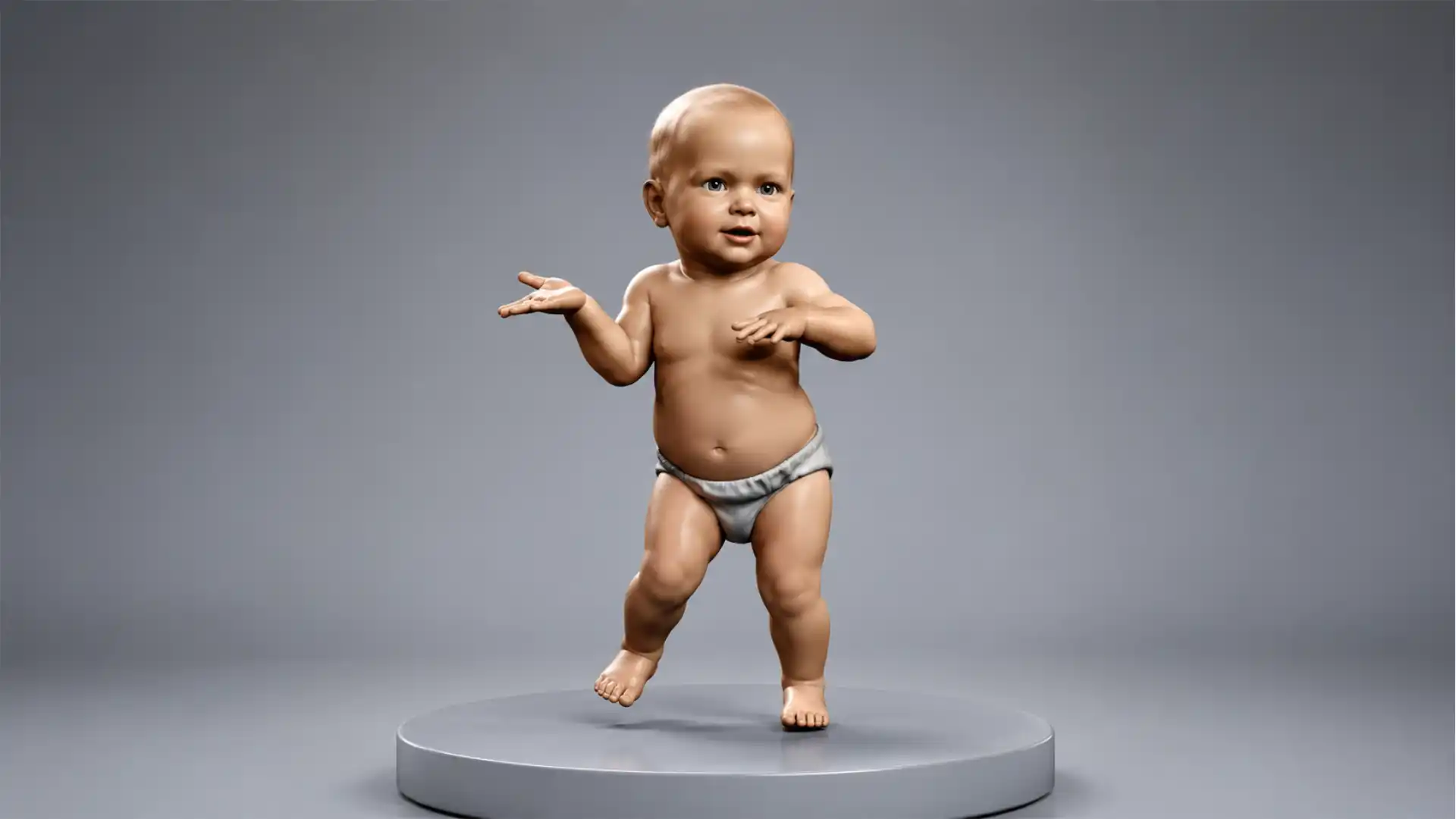
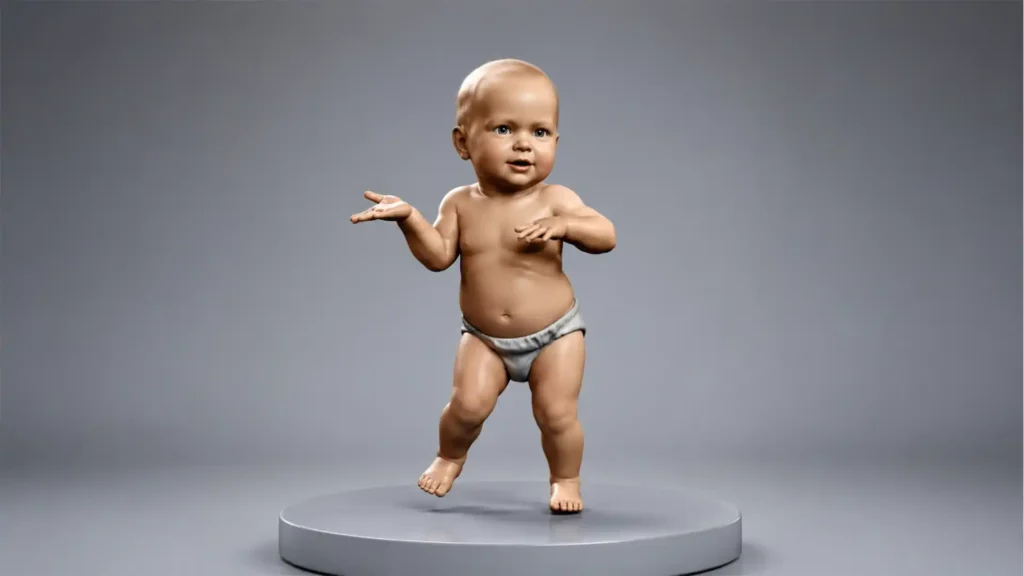
The Dancing Baby was not trying to be funny. That is the first reason it still feels strange. It was not born as a sketch, a commercial, a TV gag, or a knowingly absurd internet joke. It was a software demo file: a tiny 3D infant in a diaper, mapped onto a human dance motion, moving with a confidence no baby should possess. The joke arrived later, when people started forwarding it because nobody had a better language for the feeling it produced.
Table of Contents
The clip looks primitive now, but its awkwardness is part of the artifact. The baby’s skin has that waxy early-CGI shine. The limbs move too cleanly. The face barely participates. The hips, somehow, know exactly what they are doing. It is funny because the movement is too adult for the body, too smooth for the model, and too purposeless for the attention it received. It gives the impression of a computer proudly showing you it has learned a human trick, then choosing the worst possible body to perform it.
The name shifted as it moved: Dancing Baby, Baby Cha-Cha, Baby Cha, Oogachacka Baby. The most familiar version was tied to Blue Swede’s “Hooked on a Feeling,” especially the “Ooga Chaka” intro, though the baby itself did not need music to be uncanny. The official Dancing Baby project credits Michael Girard, Robert Lurye, and John Chadwick as the original creator team and dates the piece to 1996, when the web was still young enough that a single weird file could feel like a sighting.
What makes it worth opening now is not nostalgia alone. The Dancing Baby is a fossil from the pre-platform internet. It traveled before YouTube, before TikTok, before algorithmic feeds, before “share” buttons, before creator dashboards, before meme pages knew how to monetize a punchline. Its distribution method was almost embarrassingly manual. Someone saw it, laughed or recoiled, attached it to an email, sent it to colleagues, and waited for the next person to do the same.
That slow, clumsy movement gave the baby a different kind of power. It spread through choice, not recommendation systems. Nobody was nudged by a feed. Nobody was targeted by a graph. Offices passed it around because it felt like a private discovery, even when thousands of other people were making the same discovery at the same time. The Washington Post reported in April 1998 that the file had moved through email, inspired web pages, and even slowed some computer systems because employees kept sending it around.
Dancing Baby also marks a moment when the web sent culture upward instead of receiving it from television. Much early web culture borrowed from TV, film, newspapers, comics, ads, and celebrity. This was different. A computer animation file moved from software demo to email joke to web pages to mainstream television. By the time it appeared on Ally McBeal, the baby had already been culturally tested in offices and online spaces. TV was not inventing the gag. TV was catching up.
That is why the official restored project is more interesting than a simple nostalgia page. It reframes the clip as internet history, not just a goofy relic. The Dancing Baby is easy to mock, but it predicted a large part of the next three decades: short loops, remix culture, context collapse, reaction media, strange cuteness, uncanny digital bodies, and the feeling that the internet’s biggest objects often arrive sideways.
The baby was a demo file before it was a joke
The baby’s origin story is better than most meme origin stories because it begins inside professional animation software. Character Studio, connected to Kinetix and Autodesk’s 3D Studio Max world, used sample files to show what character animation tools could do. The Dancing Baby was one of those samples. The official project says Girard co-founded Unreal Pictures, developed and licensed Character Studio to Autodesk, and became a major architect behind 3ds Max systems including Biped.
That matters because the animation was not a random doodle. It was a demonstration of a toolchain. A skeleton could move. A mesh could be bound to it. A character could inherit motion. The novelty was not the baby as a character; it was the believable transfer of motion onto a digital body. The software wanted to prove that digital characters could be rigged, animated, and made to perform with a kind of reusable bodily logic.
The official project’s creator notes explain that Robert Lurye joined Michael Girard and John Chadwick in 1995 to co-create animation and rigging samples for research-and-development software called Biped and Physique. Those samples became part of Autodesk Character Studio, and the Dancing Baby was included with that world of sample material.
A visual history of 3ds Max published by befores & afters places the Baby Cha-Cha moment in 1996, noting that it was released as a product sample source file called sk_baby.max with Kinetix’s Character Studio. That detail is small but revealing: the viral object began as a working file, not as a polished entertainment asset.
The Washington Post wrote in 1998 that Kinetix had included the baby as a sample file in Character Studio, a 3D animation package, and that it was one of several characters meant to show off the software. The baby’s job was to prove capability. It accidentally proved something else: that a demo could become a character if it felt wrong enough, memorable enough, and easy enough to pass along.
There is something almost perfect about that accident. Most viral culture looks intentional only after it spreads. The Dancing Baby did not have a content plan. It did not have a caption strategy. It did not chase a format. It emerged from a practical need: show animators what a system can do. The baby’s later fame came from the gap between that technical purpose and the surreal finished image.
The model also arrived at the right stage of CGI’s public life. Computer animation was no longer a laboratory curiosity, but it still felt unnatural enough to be startling. Pixar had released Toy Story in 1995, so audiences had seen full computer animation, but the average office worker was not casually encountering looping 3D figures in email. Dancing Baby brought CGI down from the cinema screen and into the inbox.
The scale shift mattered. A big animated feature asks for admiration; a tiny email attachment asks for forwarding. The baby was small enough to feel cheap, odd enough to feel rare, and visually novel enough to seem like evidence of the future arriving in miniature. It did not need narrative. The entire story was: look at this thing a computer made.
The uncanny quality also came from mismatch. A toddler body performed adult rhythm. That mismatch is still the core joke. A baby should stagger, crawl, wobble, or fall. This baby shifts weight, swings arms, dips hips, and holds timing like a nightclub regular. The movement is not simply “wrong.” It is too right, applied to the wrong object.
The official creator page notes that Girard’s work drew on robotics algorithms for animating human characters and that his patent on step-driven character animation was used to animate the Dancing Baby. That technical root explains why the movement feels more sophisticated than the body. The joke was not that the software failed. The joke was that the software succeeded in an unsettling place.
A weaker animation would have died. If the baby had moved badly, it would have been just another broken demo. The memorable part is that the motion carries a strange authority. The baby seems to know the routine. The face does not. The body does. That split made people replay it, then send it onward.
The Dancing Baby also benefited from being incomplete in the right way. It did not explain itself. No one knew whether it was cute, cursed, impressive, irritating, or hilarious. That ambiguity left room for people to supply their own reaction. Early internet artifacts often worked this way. They were not fully packaged. They asked the viewer to finish the joke socially by showing it to someone else.
That is why the clip still works as a discovery object. It is not just “the first meme” in a trivia-card sense. It is a reminder that internet culture often begins with a thing escaping its intended use. A file meant for animators turned into office folklore. A technical demo became a personality. A tiny loop became a shared reference before the culture had stable language for shared references.
The weirdness came from software, not comedy
The baby is funny because it does not wink. There is no visible comedian inside it. Later internet comedy often announces itself through captions, edits, audio choices, cuts, irony, or performance. Dancing Baby is blanker. The face stays oddly neutral. The model has no personality except the one created by movement. It looks less like a character telling a joke and more like software accidentally generating a joke by obeying instructions too faithfully.
Vulture’s oral history gives the best version of that production-level weirdness. Robert Lurye had been working as an animator when Michael Girard and John Chadwick asked him to work on Biped, and Girard had already made a dancing skeleton demo. The team needed skins that could be mapped onto the moving structure. Lurye made examples including an alien, a chicken, a Tyrannosaurus rex, and a baby.
That list explains the charm. The baby was one option among creatures. It was not chosen because babies were inherently comic. It was chosen because a baby body made the movement feel newly strange. An alien dancing is expected to be strange. A dinosaur dancing is a joke before it starts. A baby dancing with adult control sits closer to the body’s taboo zone. It is human, cute, vulnerable, and wrong.
The Washington Post captured this feeling in 1998 through Ron Lussier’s explanation that the baby was disturbing because it was coordinated beyond its years. That is the cleanest description of the effect. The baby is funny because it is more competent than it should be.
The deadpan face sharpens it. The body performs, but the expression refuses to sell the performance. Modern memes often rely on exaggerated faces. Dancing Baby does the opposite. The movement is wild by comparison, and the face sits there like an unamused mask. That emotional flatness helped people project whatever they wanted onto it: office boredom, absurd joy, biological panic, technological weirdness, a cursed mascot from the early web.
It also lands in a pre-HD register that now feels specific. The low-resolution CGI is not just technical limitation; it is part of the mood. The baby’s body has enough realism to be recognizable, but not enough to feel alive. It belongs to the same mental shelf as old screensavers, early 3D logos, pre-rendered game cutscenes, and corporate demo reels with chrome spheres. It looks like the future as imagined by a beige desktop computer.
The loop is central. A single dance becomes hypnotic because it refuses to end. Once compressed into GIF form, the baby had no beginning and no punchline. It just kept going. That loop logic is now normal online. Reaction GIFs, looping clips, TikTok sounds, and short-form video trends all depend on recurrence. Dancing Baby arrived when a looping digital body still felt novel enough to be watched for its own sake.
Vox’s GIF history points to this hinge: Baby Cha-Cha began as a video in 1996, then developer John Woodell released it as a GIF later that year, helping its popularity spread. The format changed the cultural behavior of the object. A video is watched; a GIF loops, embeds, repeats, and becomes ambient.
That is part of why the baby outlived many technically better animations from the same period. A polished demo asks you to evaluate craft; a weird loop asks you to share a feeling. The Dancing Baby was not the best-looking artifact of early CGI, but it had a social texture. People did not forward it to prove software power. They forwarded it to force someone else into the same confused reaction.
Its music pairing made the confusion even stickier. The “Ooga Chaka” version turned the loop into a chant. The baby’s movement already had rhythm, but the Blue Swede association gave it a hook people could remember, imitate, and reference. The result was not quite a music video and not quite a joke. It was closer to a tiny haunted screensaver with a soundtrack.
The official Dancing Baby project acknowledges the “Hooked on a Feeling” association through the Oogachacka name and frames the original as a restored loop by the creators. That restoration matters because the baby’s fame often detached the clip from the people and software that produced it. The NFT-era framing is not the most interesting part. The provenance is.
Dancing Baby also arrived before the modern split between “creator” and “viewer” hardened. People could modify it, rescore it, place it on fan pages, and treat it as raw material. The Washington Post noted that customized versions included Rasta Baby, Kung Fu Baby, and Drunken Baby. The baby was less a fixed text than a portable template.
That template quality feels familiar now. A meme is often not a single object but a behavior pattern. Take the thing, change the context, keep the recognizable core, send it back into circulation. Dancing Baby had that before image macros and reaction formats made the pattern ordinary. The baby’s body stayed mostly the same. The surrounding meaning kept changing.
The funny part is that the original still wins. Most variations are historically interesting, but the plain baby remains the durable object. It did not need a costume or a punchline because the concept was already pure: a synthetic infant dancing with adult rhythm in an empty digital void. Extra jokes can make the premise smaller. The original leaves the discomfort open.
That openness explains why different communities could claim it. Animators saw a demo. Office workers saw a joke. TV producers saw a metaphor. Web users saw something worth archiving. It could be goofy, creepy, impressive, annoying, or weirdly joyful depending on where it landed. That flexibility made it travel.
The baby’s most durable lesson is uncomfortable for anyone who tries to engineer virality. Memorable digital culture often comes from unintended friction. The file was not smooth in the social-media sense. It had no brand voice. It had no clear audience. It had no official joke structure. Its power came from a precise kind of wrongness that people wanted to test on one another.
Email was the engine, not a side note
The Dancing Baby belongs to email culture as much as web culture. That distinction matters. When people call it one of the first viral videos, they often imagine an early version of YouTube behavior: people finding a clip online and sharing a link. The real movement was messier. Attachments, office networks, CompuServe forums, personal pages, fan sites, and forwarded messages all mattered.
Email gave the baby intimacy. A forwarded file felt like a small event from someone you knew. Today a viral post arrives surrounded by metrics: view counts, likes, comments, reposts, algorithmic placement. A Dancing Baby attachment arrived as a little package of strangeness. The sender was part of the joke. “Have you seen this?” mattered because seeing it meant joining a chain.
The Washington Post’s 1998 report is useful because it comes from the moment itself, not from later nostalgia. It describes the baby floating around the country through email by the summer before its April 1998 article. It also reports that some offices found systems slowed by employees sending the file around.
That detail is wonderfully physical. Virality had weight. The file could clog systems. It could consume bandwidth. It could irritate IT departments. A viral object was not a weightless signal moving through invisible cloud infrastructure. It was an attachment large enough to be noticed. A joke could make the office network groan.
The file’s size also shaped its social life. People did not casually forward everything. Sending a big animation took more intent than tapping a share icon. That friction made the baby feel chosen. A person had to decide the weirdness was worth the nuisance. This is one reason the spread feels culturally meaningful: the forwarding chain required repeated human endorsement.
There was also no universal destination for it. The web did not yet have a single stage. The baby appeared on homepages, fan pages, forums, software circles, and inboxes. That scattering gave it mystery. People could encounter it from different directions and still feel it had appeared from nowhere. The absence of one canonical platform made the baby seem more like a rumor than a product.
Vox’s account of the GIF’s rise helps explain the technical sweet spot. Netscape Navigator 2.0 supported animated GIFs in 1995, and early GIFs were small compared with many other formats. The GIF made motion easier to place on web pages and pass around.
When John Woodell released Baby Cha-Cha as a GIF, the baby gained the kind of portability that early web culture rewarded. The object became easier to copy, embed, loop, and encounter without special context. That does not erase the role of email or forums; it explains why the baby could move across them.
A GIF is also socially slippery. It is not only a video format; it is a gesture. A looping GIF can sit on a page like decoration, appear in a message like a reaction, or become an object of fascination in itself. Dancing Baby lived in all three modes. It decorated early pages, amused email recipients, and became the subject of articles, TV segments, and office chatter.
The baby’s spread also depended on the culture of workplace internet. The late-1990s office was one of the first mass theaters for online distraction. Many people encountered the web through work machines and office email long before home broadband made constant personal browsing normal. That gave a dancing CGI baby a captive audience: bored workers, shared computers, cubicle humor, and the small thrill of misusing professional infrastructure.
That office setting matters because it shaped the joke’s tone. Dancing Baby was safe enough to send at work and weird enough to break the day. It was not obscene. It was not political. It was not too complicated. It did not require fandom knowledge. Anyone could understand that a diapered 3D infant doing a cha-cha was ridiculous.
This bland portability made it powerful. The baby crossed age groups, workplaces, and media spaces because it asked very little from the viewer. You did not need to know the software. You did not need to understand animation. You did not need a browser account, a username, or a social platform identity. You only needed a machine capable of playing the file and someone willing to pass it along.
The phrase “viral” had not yet become the default grammar for such events. That absence is part of the charm. People knew the baby was spreading, but the culture did not yet have the polished vocabulary of viral marketing, meme cycles, engagement farming, or trend hijacking. The baby moved before everyone had learned to describe, exploit, and imitate that movement.
Once virality became a business goal, the internet changed. Dancing Baby comes from the earlier, stranger stage when virality was still a surprise. It was proof that a network could produce fame without a studio, publisher, or broadcaster making the first move. A file could become famous because enough people found it too odd not to pass on.
That discovery is now buried under layers of platform behavior. Today we often know something is viral before we know whether we like it. The number arrives first. The trend label arrives first. The influencer framing arrives first. Dancing Baby, by contrast, arrived as a thing. The social proof was the fact that someone sent it.
That is why the clip deserves more respect than it usually gets. It was not only an early meme; it was an early demonstration of networked taste. People became distributors because the object created a reaction they wanted to reproduce. That mechanism still powers online culture. The tools changed. The impulse did not.
The loop escaped into television
The Dancing Baby became unavoidable when it moved from inbox culture into mainstream television. The crossover did not flatten the weirdness; it amplified it. On Ally McBeal, the baby became a hallucination tied to anxiety, adulthood, desire, and the pressure of family expectations. The show did not treat it as a random visual gag only. It used the baby’s uncanniness as emotional shorthand.
Vulture’s oral history identifies the key scene from the season-one episode “Cro-Magnon,” where Ally’s anxieties about her biological clock appear as an animated diaper-clad baby, with the scene playing to Blue Swede’s “Hooked on a Feeling.” The baby’s pre-existing internet weirdness became television symbolism.
That was a clever use because the baby already felt like an intrusion. It did not belong in the room, on the screen, or inside a realistic emotional scene. Its presence broke the texture of live-action television. That break matched Ally’s internal disturbance. The CGI body looked like a thought that had escaped into the visual world.
The Washington Post called the baby one of the first web-spawned icons to cross into mainstream media, noting its appearances on Ally McBeal, the American Comedy Awards, The Rosie O’Donnell Show, and even commercials. That passage from software sample to mass-media mascot happened quickly.
The speed still feels surprising. A 1996 demo file was mainstream television material by early 1998. In modern terms, that might sound slow. In the pre-social platform era, it was fast. The baby had to pass through software users, animators, email chains, web pages, TV assistants, producers, and rights assumptions before it reached prime-time audiences.
The Ally McBeal moment also changed who could recognize the baby. Before television, it belonged to people with enough internet access to receive it. After television, it belonged to pop culture. Viewers who had never opened the file or visited a fan page suddenly knew the image. The baby became one of the first mass cases where web culture gave television a ready-made symbol.
That reversal mattered. The web was usually treated as a secondary channel for mainstream material. TV shows, movies, celebrities, and ads were copied into online spaces. Dancing Baby moved the other way. It was web-native enough to feel discovered there, then mainstream enough to appear on shows and products. That path later became common. At the time, it felt like a leak in the old media hierarchy.
The baby’s television life also cleaned up some of its ambiguity. On Ally McBeal, it meant something. It represented pressure around motherhood and adulthood. That meaning helped mainstream audiences accept it, but it also narrowed the object. The original email version did not need to symbolize anything. Its lack of purpose was part of its charge.
Still, the show chose well. The Dancing Baby made sense as a biological-clock hallucination because it was both cute and threatening. A normal baby image might have been sentimental. A horror image might have been too blunt. A dancing CGI infant was ridiculous, unsettling, and strangely memorable. It gave the anxiety a shape people could joke about the next day.
The scene’s music helped fix the baby in public memory. For many viewers, the baby and “Ooga Chaka” became inseparable. That pairing made the meme easier to recall than a silent animation would have been. The sound gave it a verbal handle. People could hum or chant it. The meme left the screen and entered conversation.
The commercial uses that followed were less interesting than the Ally McBeal use but just as revealing. Once brands saw the baby’s recognition power, it became merchandise language. The Washington Post noted a merchandising push and commercial appearances. The baby’s migration from weird file to sellable character showed how fast internet oddities could be harvested once mainstream industries noticed them.
That harvesting now feels familiar, almost automatic. A meme becomes a shirt, a brand tweet, a mascot, a Super Bowl joke, a corporate costume, a licensed asset. Dancing Baby was early enough that the process still looked experimental. Nobody knew exactly how long a web-born figure could stay culturally useful. The answer was: long enough to become a shorthand for the era.
The Ally McBeal crossover also helped freeze the baby in late-1990s memory. Some artifacts stay online; others become timestamps. Dancing Baby is both. It is still watchable as a loop, but it also immediately summons a period: office email, early CGI, network television, novelty websites, dial-up patience, and the peculiar optimism of ugly digital culture.
That is why the baby appears in histories of animation, GIFs, memes, and internet culture. It sits at a busy intersection. Animation historians see early character software. Meme historians see viral circulation. Television historians see web culture entering prime time. Design historians see the strange charm of low-resolution digital bodies. None of those readings cancels the others.
The baby’s mainstream phase also reveals the risk of successful weirdness. Once a strange object becomes famous, it becomes less strange. Repetition turns the uncanny into the familiar. By the time a meme appears on talk shows and in commercials, the original shock has already softened. The Dancing Baby’s later overexposure probably made some people tired of it, but that fatigue is also proof of its reach.
Its current charm depends on distance. The baby is weird again because the world that normalized it has disappeared. The offices, email clients, fan pages, CRT monitors, and TV schedules that carried it are mostly gone. Watching it now, the viewer sees not only a digital infant but the old machinery of attention around it.
That old machinery is the real story. The baby danced, but the network performed. Email users forwarded. Web users archived. Animators remixed. TV producers adapted. Journalists explained. Viewers imitated. Brands borrowed. A tiny file became a test case for the way internet culture would escape its containers.
A small artifact with a long shadow
The Dancing Baby’s influence is easy to overstate if we treat it as the single origin point of all memes. The web did not begin with one dancing infant. Earlier online jokes, ASCII art, Usenet culture, image swaps, viral emails, and community in-jokes all mattered. Yet the baby deserves its place because it combined motion, portability, remixability, mainstream crossover, and mass recognition at a moment when those traits had not yet hardened into a formula.
The official project’s claim that Dancing Baby is widely recognized as the internet’s first meme should be read as cultural shorthand rather than courtroom language. It was one of the first internet-native moving images to reach broad public recognition. That is the stronger, more useful claim.
Its long shadow falls across the modern internet in several directions. First, it predicted the reaction loop. A short moving image no longer needed plot. It could function as a mood, a punchline, or an interruption. That is now the grammar of GIF replies, short video loops, and meme clips. Dancing Baby was not a reaction GIF in the modern sense, but it helped establish the pleasure of looping motion as a social object.
Second, it predicted remix culture. The baby became material. People altered it, dressed it, rescored it, placed it on pages, and attached different contexts to it. That behavior later became central to memes. An object’s success online often depends less on preservation than on modification. Dancing Baby survived because it was recognizable even when changed.
Third, it predicted the mainstream chase for online strangeness. Television and brands learned that web weirdness could carry recognition. This did not always produce good work. In fact, mainstream use often drains the energy from memes. But the pattern became permanent. The internet makes a thing feel alive, then bigger media arrives to capture some of that aliveness.
Fourth, it showed that technical novelty and emotional ambiguity travel well together. People did not forward the baby because it was only funny. They forwarded it because it was funny and unsettling and impressive and dumb. That mixed reaction is still powerful online. The most shareable objects often resist clean classification. They create an itch that forwarding temporarily scratches.
Fifth, it revealed the attention power of the uncanny cute. The internet loves things that are adorable and wrong. Dancing Baby sits near the beginning of a long line of strange digital mascots, cursed cute images, glitchy characters, odd animations, and unsettlingly wholesome objects. The web has always liked cuteness better when something is off.
The compact anatomy of the loop
| Element | What it did | Why it mattered |
|---|---|---|
| 3D baby model | Made the clip feel new and slightly unnatural | Early CGI still carried visual novelty |
| Adult dance motion | Created the core mismatch | The body looked too young for the rhythm |
| Short loop | Removed plot and made replay automatic | The file became a mood, not a story |
| Email sharing | Turned viewers into distributors | Spread depended on personal forwarding |
| GIF portability | Made the animation easier to copy and embed | The baby could live across pages and messages |
| TV crossover | Gave the meme mass recognition | Web culture entered prime-time television |
The table shows why the baby worked as more than a novelty. Its fame came from a stack of small conditions, not one magic ingredient. The model, motion, loop, file format, email behavior, and TV adoption all pushed the same strange object into wider circulation.
The artifact also carries a design lesson. The baby was legible at tiny size. It had a clear silhouette, a simple body, strong motion, and no dense background. That made it perfect for bad screens and impatient viewers. Modern designers often rediscover the same principle: the smaller and faster the context, the more the object needs a recognizable gesture.
The motion was also open-ended. A dance loop has no required before or after. The baby does not enter a scene, solve a problem, or react to another character. It exists in the eternal present of the loop. That made it adaptable. It could accompany music, appear as hallucination, sit on a webpage, or stand alone as a file.
The baby’s blankness also gave it range. A more expressive character might have been less reusable. Because the face does not clearly signal joy, fear, satire, or embarrassment, the viewer can choose the emotional reading. It can be cheerful, creepy, stupid, or menacing. The internet likes objects with that kind of emotional looseness.
Its early fame also foreshadowed a recurring problem: ownership. Viral distribution often detaches a work from its makers. Millions may recognize an object while few know who made it, what tool produced it, or what rights surround it. The official restored Dancing Baby project tries to correct that by centering Girard, Lurye, Chadwick, Autodesk permission, and provenance.
That correction matters because meme history often gets lazy. The object becomes famous while the production story gets flattened. “The internet made it” is not enough. People made it. Software shaped it. File formats carried it. Workplaces circulated it. TV reframed it. Each layer changed the baby without erasing the previous one.
The meme also complicates the idea that internet culture is always bottom-up. Dancing Baby was both professional and grassroots. It came from skilled animation software work, then spread through informal networks. That hybrid identity is common now. A meme might begin in a studio, a game, an ad, a user edit, a leak, or a fan community. What matters is not where it starts but whether people can make it socially theirs.
The baby’s fame was also partly a timing accident. It arrived when digital motion was rare enough to impress but common enough to circulate. Too early, and too few people could view it. Too late, and it would drown in a feed full of better animations. The mid-to-late 1990s gave it the right balance: novelty, access, and scarcity.
That scarcity is gone. A strange CGI baby posted today would be one odd clip among millions. It might get a day of attention, become a reaction sound, vanish, return as irony, then disappear into archives. Dancing Baby had room to occupy. The internet’s cultural shelf was smaller then, so an object could sit there longer.
Yet the baby’s oldness does not make it quaint only. It still explains how online objects move from “look at this” to “everyone knows this.” The mechanism is social contagion, but not in a mystical sense. The object produces a reaction. The reaction feels shareable. The receiver becomes a sender. After enough loops, media institutions notice the pattern and feed it back to larger audiences.
The baby’s body is the joke, but the network is the plot. That plot became the plot of the social web. Everything after—the viral video, the reaction GIF, the meme template, the platform trend, the brand hijack—can be seen in rough outline here. Not because the baby invented everything, but because it arrived when those behaviors were becoming visible.
The restored project turns a joke back into an artifact
The modern Dancing Baby project is strange in its own way. It takes a clip remembered as disposable and treats it as collectible internet history. The official site frames the original as a restored high-definition artwork released by the original creators, with Autodesk permission noted on the page. It also places the baby among later internet-era remix and NFT culture.
The NFT angle may not interest every reader. The stronger reason to open the project is provenance. The page names the creators, explains their backgrounds, gives the baby a production lineage, and treats the loop as an artifact with authorship rather than anonymous web debris. For a meme as copied and detached as Dancing Baby, that context is the real restoration.
The project also reveals how internet history is being reclassified. The early web’s jokes are becoming museum pieces, investment objects, research subjects, and design references. Some of that process is awkward. Some of it feels like culture trying to build a display case around things that were funnier when they were loose. Yet without some form of preservation, early digital culture disappears into dead links, broken formats, and half-remembered anecdotes.
Dancing Baby is especially vulnerable to that loss because its original life was distributed. There was no single canonical post. It moved through copies, attachments, personal pages, variants, and television uses. The original experience was not just watching the baby; it was receiving it from someone. That social layer is hard to preserve. A restored loop can preserve the image, but not the inbox thrill.
Still, the restoration has value. It lets modern viewers see the object without the noise of degraded copies. The baby’s official presentation reminds us that the loop was not merely a crude accident. It came from real animation research, character rigging work, and early 3D software ambition. The comedy sits on top of a serious technical base.
That double nature makes the baby richer than many later memes. It can be silly and historically useful at the same time. A cultural artifact does not need dignity to deserve attention. Sometimes the least dignified objects tell the clearest stories because they were touched by many people, moved through many spaces, and survived without institutional protection.
The official project also places the baby beside later digital art culture. That comparison cuts both ways. On one hand, the baby really is a precursor to shareable digital images, remixable artifacts, and online-native fame. On the other, its original power came from being uncollected, unmanaged, and half-out-of-control. Turning it into a polished collectible changes the mood.
That tension is worth sitting with. Internet culture often becomes less alive when it becomes more official. A meme’s appeal depends partly on circulation without permission, or at least without visible management. Once the object gets a provenance page, a press kit, and a market frame, the wildness becomes historical rather than active.
Yet the same officialness helps correct a common cultural insult. People remember the baby as tacky, but tacky is not the same as trivial. Its tackiness tells us what early digital taste looked like before high-resolution smoothness became the default. The baby belongs to a web where awkward images were not only tolerated but loved because they felt handmade, discovered, or technologically fresh.
The restored project also makes the baby easier to discuss with younger viewers. A person who did not live through email-chain culture may see only an ugly old CGI clip. The official context explains why that ugliness once felt electric. It was portable motion. It was 3D in the inbox. It was a joke nobody had scripted. It was a tiny proof that the web could make its own celebrities.
That last point is still the sharpest. Dancing Baby was famous before it had a platform identity. No handle, no channel, no subscriber base, no verified creator page, no upload date that everyone points to. It belonged to the distributed web. Its fame was made from copies. That makes it hard to fit into current ideas of digital success, where everything is measured through accounts and metrics.
The baby’s modern afterlife is also a reminder that internet objects age differently from films, songs, or books. A digital loop can feel both ancient and instantly accessible. Watch it once and you understand the premise. Learn the history and it becomes a map of old networks. The object is short; the context is deep.
For Web Radar, that is exactly the appeal. The Dancing Baby is a tiny door into a larger internet. Open the restored project, then read the old reporting, and the loop stops being a random relic. It becomes a case study in how files, tools, formats, offices, and television built the first grammar of online fame.
The baby also asks an uncomfortable question about our current web. Would a comparable accident be allowed to remain accidental now? Today, the moment a strange clip starts moving, someone claims it, brands it, reposts it, explains it, monetizes it, argues over it, remixes it, and buries it under discourse. The early baby had time to be mysterious. That mystery is harder to keep.
This does not mean the old web was purer. It was slower, clunkier, less accessible, and often badly archived. But its friction gave objects different shapes. Dancing Baby did not explode because a platform selected it. It spread because one person after another chose to pass on the feeling of seeing it. That chain is less visible now, but it remains the emotional core of sharing.
The restored project is best approached with that in mind. Do not open it expecting the clip itself to shock you. Open it to see how small the object is compared with the cultural machinery it activated. The baby is only a few seconds of motion. The story around it is a blueprint.
Common reader curiosities
The clean answer is no single object deserves that title without argument. Online jokes, community references, ASCII art, forwarded emails, and image swaps existed earlier. The better claim is that Dancing Baby was one of the first internet-native moving-image memes to gain broad mainstream recognition, and official and archival sources often describe it as one of the earliest viral videos or the first widely recognized meme.
The official Dancing Baby project credits Michael Girard, Robert Lurye, and John Chadwick as the original creator team. Its creator biography section connects the work to Unreal Pictures, Biped, Physique, and Autodesk Character Studio.
No. It began as animation software demo material, not as an Ally McBeal gag. The show later used it brilliantly, but television adopted an object that had already circulated online and through email.
It had the rare mix of novelty, portability, and emotional confusion. People could not easily decide whether it was cute, creepy, impressive, stupid, or funny, so they forwarded it to make someone else decide. Email chains, web pages, GIF portability, and later TV exposure all extended its reach.
The baby became strongly associated with Blue Swede’s version of “Hooked on a Feeling,” especially the “Ooga Chaka” intro, through popular variants and its Ally McBeal appearance. That sound gave the visual a memory hook.
The movement is too adult for the body. A baby shape performs with rhythmic confidence, while the face remains almost blank. That mismatch produces the uncanny effect. It is not a failed animation. It is a successful animation mapped onto a body that makes success feel wrong.
Because the clip is a compact piece of internet archaeology. It shows how a file became culture before platforms trained us to expect culture to arrive in feeds. It is short, odd, historically dense, and still better at explaining early virality than many long essays about the topic.
Author:
Jan Bielik
CEO & Founder of Webiano Digital & Marketing Agency
This article is an original analysis supported by the sources cited below
The Original Dancing Baby Project — About
Official project page for the restored Dancing Baby release, with creator credits, background on Michael Girard, Robert Lurye and John Chadwick, and context on the loop’s 1996 origin and email-era spread.
The Original Dancing Baby Project — The Original Dancing Baby
Official page presenting the original Dancing Baby as a restored digital artifact and framing it as one of the earliest viral videos in internet history.
The Washington Post — The Dancing Baby’s Mainstream Boogie
A 1998 contemporary report on the baby’s movement from web and email culture into mainstream media, including its use on Ally McBeal and its spread through office email.
Vulture — Ally McBeal Dancing Baby Scene: The Story Behind It
Oral-history style account of how the Dancing Baby reached Ally McBeal, with production context from people connected to the animation and the show.
Vox — The GIF is 30 years old. It didn’t just shape the internet — it grew up with the internet
History of the GIF format that explains how early animated GIFs, including Baby Cha-Cha, helped shape web culture and looping visual communication.
Befores & afters — A visual history of 3ds Max
Timeline of 3ds Max history noting the 1996 Baby Cha-Cha release as a Character Studio sample source file and its later resurgence through Ally McBeal.
Internet Archive — Kinetix Character Studio 1.0
Archive entry for Kinetix Character Studio 1.0, documenting the software environment associated with Character Studio, Biped, Physique and the Dancing Baby source material.
| Citing this article? Brief excerpts are welcome. Please credit Webiano.digital, name the author where stated, and include a link to https://webiano.digital and to this original article. Full or substantial republication requires prior written permission. Read our Copyright and Content Use Policy. |
This article was prepared with the assistance of artificial intelligence tools. The content underwent expert human review, and Webiano Digital & Marketing Agency assumes editorial responsibility for its final version and publication.