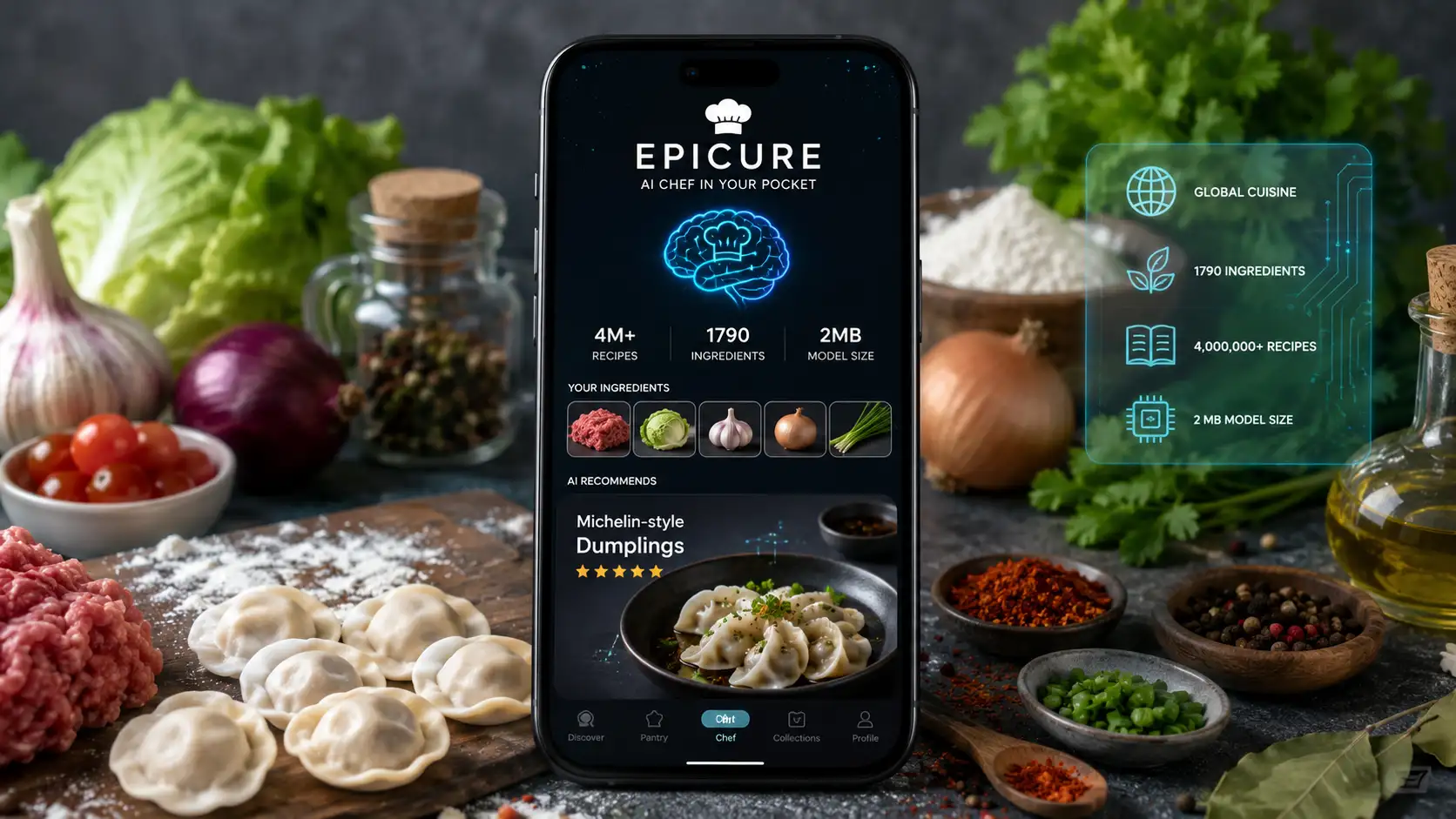
Epicure is not a talking recipe bot squeezed into two megabytes. The more interesting story is stranger and more useful. Researchers Jakub Radzikowski and Josef Chen have released Epicure, a family of compact ingredient-embedding models that turn millions of recipes into a mathematical map of food relationships. The model does not memorize four million recipes. It learns where ingredients sit near one another when recipe culture, co-occurrence, flavor chemistry, cuisine signals, and nutritional probes are projected into a 300-dimensional space. That distinction matters because it separates a serious computational gastronomy project from the social-media slogan that “all human cooking” now fits inside a file smaller than a phone photo. Epicure’s paper says the corpus contains 4.14 million recipes from 11 public sources, normalized into a 1,790-ingredient vocabulary, and trained into three sibling embeddings named Cooc, Core, and Chem.
Table of Contents
Epicure arrives as an ingredient map, not a recipe robot
The first correction is the most useful one: Epicure is an ingredient model, not a full chef model in the ChatGPT sense. It does not contain cooking instructions, plated images, pantry memory, user preferences, safety checks, dietary reasoning, or a restaurant-grade recipe generator by itself. Its core object is a matrix: 1,790 ingredients, each represented by 300 numbers. That is why the file is tiny. A 1,790-by-300 float matrix is not a compressed cookbook; it is a compressed geometry of relationships between food entities. The technical achievement is not that a miniature chatbot now “knows” cooking. The achievement is that recipe culture and flavor chemistry appear to leave enough statistical structure in ingredient relationships to support retrieval, pairing, and directional movement inside a compact model.
The viral reading of Epicure is understandable. “Four million recipes in two megabytes” sounds like a miracle product. The research framing is more restrained. The paper presents Epicure as three sibling skip-gram ingredient embeddings trained from scratch on a multilingual recipe corpus. The recipe data is used to build graphs, the graphs feed random walks, and the skip-gram objective learns which ingredient nodes should sit close together. A person does not open the model and read a recipe for pelmeni, biryani, pho, mole, okonomiyaki, or kimchi jjigae. A developer queries a food vector space and retrieves ingredients that behave as neighbors under the selected signal.
That makes the “pocket chef” description both partly fair and technically loose. It is fair because a small model can act as a culinary retrieval engine inside a larger product. It is loose because the intelligence comes from several layers: the Epicure embedding, an interface that lets the user select or describe ingredients, and, in the public Epicure Flavour Explorer, separate generative AI services used for recipe and image generation. The Epicure site says it uses Google AI services, including Gemini and Imagen, to generate recipes, analyze images, and produce food imagery. That means the consumer demo is not simply the two-megabyte embedding doing all the work.
The serious news is still large. Food AI has often been trapped between shallow recipe search and overconfident generative text. Epicure points to a third layer: a small, inspectable food representation that could sit underneath apps, product development tools, restaurant R&D systems, and pantry assistants. For a user, that might feel like asking, “I have cabbage, pork, garlic, sour cream, and dill. What direction should I go?” For a chef, it might mean asking for ingredients that move a familiar dish toward a South Asian, East Asian, Mediterranean, or Latin American pole without merely copying another dish. For a food company, it might mean finding substitutions that preserve a desired chemistry signal while altering cost, allergens, processing level, or cultural profile. Those use cases are not all solved by Epicure. They become easier to frame because the model represents food as navigable space rather than as a pile of keyword-matched recipes.
The two-megabyte claim is real, but narrow
The public claim that Epicure compresses cooking into roughly two megabytes comes from the scale mismatch between the training data and the learned artifact. Decrypt reported on May 28, 2026, that KAIKAKU.AI published Epicure as a family of three ingredient models trained on 4.14 million multilingual recipes, with each ingredient mapped into 300 dimensions. The model card for Epicure-Core describes a 300-dimensional skip-gram ingredient embedding over the same 1,790-ingredient canonical vocabulary. The small size is believable because embeddings are compact by design: they store learned coordinates, not source documents.
A two-megabyte embedding is not trivial. It means a useful food-retrieval layer could run locally, ship inside a mobile app, sit in a browser cache, or serve as a low-cost component in a kitchen tool. A large language model may generate fluent recipe prose, but it is heavy, expensive to run at scale, and prone to inventing details. A food embedding does less. It answers narrower questions: Which ingredient is near this ingredient? Which cluster does this ingredient belong to? Which direction moves a seed ingredient toward a regional or sensory pole? Which model variant gives a chemistry-like answer and which gives a recipe-context answer? For many food tasks, a narrow model that answers one question cleanly is more useful than a general model that speaks confidently about everything.
The limit is equally plain. An embedding cannot verify food safety, cooking time, allergen traces, local labeling rules, dietary suitability, or whether a suggested pairing is appetizing after heat, fermentation, emulsification, freezing, or storage. Food is not only a graph. Heat changes flavor compounds. Water activity affects texture and microbial safety. Cultural meaning can outweigh chemical similarity. A pairing that is close in vector space might still fail because the cooking technique is wrong, the balance is off, the ingredient form is mismatched, or the dish violates expectations for a specific cuisine. Epicure encodes ingredient relationships, not the full embodied craft of cooking.
The slogan also hides the role of curation. Epicure’s paper says raw ingredient strings from multilingual recipe data were normalized into 1,790 canonical entries through an LLM-augmented pipeline. That is not a minor cleanup step. Recipe data is messy: “spring onion,” “scallion,” “green onion,” “葱,” “green onions, chopped,” and brand- or preparation-specific strings need consolidation. The model’s final map depends on those normalization choices. The researchers say the embeddings themselves are LLM-free after the canonical node set is built, but the vocabulary and labels depend on deterministic LLM-assisted processing and human inspection.
The two-megabyte claim is strongest when read as a statement about representation density. It is weakest when read as a claim that the model contains “all human cooking.” Human cooking includes technique, memory, improvisation, scarcity, ritual, tradition, climate, tools, household economics, taboo, migration, taste training, and sensory judgment. Epicure does not contain all that. It contains a learned map derived from a large public recipe corpus and flavor-chemistry links. That is still useful. It is just not magic.
The research lineage runs from food pairing to food geometry
Epicure did not appear from nowhere. It belongs to a line of computational gastronomy research that has tried to make food relationships measurable without pretending that cooking is only chemistry. A widely cited starting point is the 2011 Scientific Reports paper “Flavor network and the principles of food pairing,” which built a network of shared flavor compounds and found different compound-sharing patterns across cuisines. The study reported that Western cuisines tended to combine ingredients sharing many flavor compounds, while East Asian cuisines tended to avoid such overlap.
That finding mattered because it pushed food pairing away from pure chef folklore and into data. It also warned against a universal rule. If one culinary tradition likes compound-sharing and another often avoids it, then “foods that share compounds taste good together” is not a complete theory. It may describe some patterns in some cuisines, but it does not explain why contrast, fermentation, heat, texture, acidity, fat, and cultural expectation produce successful dishes. Epicure inherits that lesson: the map must support more than one kind of culinary similarity. Chemistry alone is not enough. Recipe co-occurrence alone is also not enough.
FlavorDB and FooDB supplied another part of the lineage. FlavorDB catalogued flavor molecules and linked them to ingredients, giving researchers a structured way to connect food entities to volatile and non-volatile compounds. FooDB, maintained by The Metabolomics Innovation Centre ecosystem, provides a large database of food constituents and chemistry. These sources are not recipe collections; they are chemical knowledge bases. They let a model see that ingredients may be related even when they do not frequently appear together in a recipe.
FlavorGraph, published in Scientific Reports in 2021, joined these worlds by building a large food-chemical graph from recipes and flavor molecules. Its authors described a graph based on relations extracted from roughly a million recipes and data on 1,561 flavor molecules, then used graph embeddings to represent foods and recommend pairings. Epicure’s paper explicitly positions FlavorGraph as the most complete public food embedding before its own work, while arguing that FlavorGraph was English-centric and fused chemistry with recipe context as a fixed design choice.
Epicure’s contribution is to make the mixture itself adjustable. Instead of one embedding that blends signals once, it trains sibling embeddings with the same architecture and vocabulary but different walk schemas. Cooc listens to recipe co-occurrence. Chem listens to FlavorDB-mediated compound walks. Core blends both. That design turns the old argument between “what is cooked together” and “what shares flavor chemistry” into a model selection problem. A chef can ask for companions in recipe culture, chemical neighbors, or a middle path.
The corpus is large, multilingual, and uneven
Epicure’s paper reports 4,135,189 recipes from 11 public datasets. The corpus is dominated by English RecipeNLG at 53.9% and Chinese XiaChuFang at 37.4%, with Russian Povarenok contributing 3.5% and smaller sources covering Vietnamese, Spanish, Turkish, Indian recipes in English, Indonesian, and German. That distribution is a strength because it moves beyond a single English recipe universe. It is also a limit because the model still sees the world through available public recipe data, not through equal culinary representation.
The imbalance matters. If half the recipes come from one broad source family and more than a third from Chinese recipe data, then some ingredient relationships will be better sampled than others. The Epicure paper itself acknowledges corpus imbalance, noting that confidence intervals widen for smaller regions even when cross-region ranking stays stable. A model trained on food data is not a neutral atlas. It is a record of what was scraped, published, translated, licensed, normalized, and retained after cleaning. Culinary underrepresentation becomes geometric underrepresentation.
This does not invalidate Epicure. Every large food dataset has coverage bias. Recipe1M+ introduced a large structured corpus of over one million recipes and 13 million food images, but it was still shaped by web availability, language, publishing norms, image access, and the habits of recipe sites. RecipeNLG made semi-structured recipe generation easier to study, but scraped recipe text carries its own conventions. XiaChuFang brought a much larger Chinese recipe corpus into research, yet one site’s archive cannot stand for every Chinese regional tradition, home kitchen, minority cuisine, seasonal practice, or oral recipe lineage.
The sharper question is how Epicure handles that bias. The paper’s answer is partly architectural and partly transparent. It defines eight macro-regional cuisine clusters for evaluation, reports backing recipe counts for each, and distinguishes universal ingredients from cuisine-specific markers. It also ships companion resources with vocabulary, mode atlases, direction arithmetic results, linear probe tables, cross-modal validation, WEAT bias checks, and Procrustes robustness checks. That does not remove bias. It gives researchers artifacts to inspect and challenge.
For food companies and app developers, corpus bias is not an academic footnote. A pantry app that recommends substitutions across cultures must avoid turning one cuisine into an exotic “direction” and another into the default. A product R&D system must know when an ingredient is under-sampled. A restaurant tool must not flatten regional cuisines into a few token ingredients. A food embedding becomes safer and more useful when its makers expose the data imbalance, not when they market the map as universal.
Ingredient normalization is where much of the intelligence lives
Before Epicure can learn, it must decide what counts as the same ingredient. That step sounds dull until one considers the data. Public recipes contain misspellings, plural forms, brand names, cut sizes, temperatures, preparation states, quantities, regional synonyms, translation artifacts, and multi-ingredient phrases. “Tomato paste,” “tomatoes,” “sun-dried tomato,” “tomato sauce,” and “ketchup” should not collapse into the same node. “Cilantro” and “coriander leaf” often should. “Coriander seed” should not. For multilingual corpora, these decisions multiply.
Epicure’s authors report a pipeline that machine-translates non-English ingredient terms, merges and deduplicates strings, intersects recipes with a final canonical vocabulary, and matches nutrient and sensory labels against USDA FoodData Central and FlavorDB. Production deduplication used Google’s gemini-embedding-001, followed by manual curation, and the final set was reduced to 1,790 canonical ingredients. After matching, the authors report that 4,103,118 recipes, or 99.2% of the corpus, contain at least one matched ingredient.
This is why the 1,790 number should not be read as “only 1,790 foods exist.” It is a design choice. A smaller vocabulary gives a cleaner graph. A larger vocabulary might capture more local specificity but would increase sparsity, spelling noise, and thinly sampled nodes. The canonical vocabulary is a compression layer before the model compression layer. It decides whether the final geometry treats ingredients as broad culinary concepts or as detailed product-like entities.
That choice has consequences for chefs. If “chili pepper” is too broad, a model misses the difference between guajillo, gochugaru, Kashmiri chili, bird’s eye chili, Aleppo pepper, and chipotle. If the vocabulary is too fine, the model may split related signals across many rare nodes. Good culinary intelligence often lives at the exact granularity of the question. A home cook might need “chili.” A chef developing a regional dish might need “gochugaru.” A food manufacturer might need a compound profile tied to a specific paprika cultivar or smoked chili powder. Epicure’s current vocabulary is a strong research compromise, not a final ontology of food.
Normalization also interacts with culture. Translated ingredient names can erase local categories. A term that looks equivalent in English may carry different cut, age, preparation, fermentation state, or culinary role in another language. The model can learn only from the node labels it receives. That is why human inspection remains central. Epicure’s pipeline uses LLMs, but the hardest food decisions are not only semantic; they are culinary.
Cooc, Core, and Chem answer different kitchen questions
Epicure’s three sibling models are the central design choice. Cooc is trained on recipe-context co-occurrence. It answers the practical question, “What else do people cook with this?” Chem is trained on typed FlavorDB ingredient-compound metapath walks. It answers the chemistry-oriented question, “What shares a flavor-profile neighborhood with this?” Core blends the two by injecting ingredient-ingredient walks into a chemistry-linked graph. It answers a middle question: “What sits near this ingredient when recipe use and compound structure both matter?”
The distinction shows up in model-card examples. For chicken, the Cooc model’s nearest neighbors include garlic, onion, black pepper, turkey, and carrot — ingredients that behave like recipe companions. The Chem model’s chicken neighbors include beef, pork, cream of chicken soup, buffalo wing sauce, and peanut — a more chemistry-like or profile-adjacent answer. Core places chicken near pork, beef, chicken broth, peanut, and cream of chicken soup, reflecting the middle position. These examples are small, but they explain the whole product idea. Similarity depends on what kind of relationship the user wants.
Epicure model variants at a glance
| Variant | Main signal | Best read as | Example use |
|---|---|---|---|
| Cooc | Recipe co-occurrence over 4.14M recipes | A map of cooking companions | Pantry pairing, familiar recipe expansion |
| Chem | FlavorDB-mediated compound paths | A map of chemistry-adjacent ingredients | Flavor substitution, product R&D, aroma-driven search |
| Core | Blended co-occurrence and chemistry | A compromise map | Chef exploration, guided ideation, cross-signal retrieval |
This table simplifies the models without reducing them to brand names. The practical point is that Epicure is not one chef brain; it is three coordinate systems over the same ingredient vocabulary. Choosing the wrong sibling changes the culinary answer.
That matters in a kitchen. Suppose a chef starts with miso. A co-occurrence model may pull toward ingredients that commonly appear with miso in soups, marinades, dressings, and Japanese-inflected dishes. A chemistry model may surface ingredients with related flavor compounds that do not appear together as often. A blended model may find ideas that feel both plausible and less obvious. None of those answers is “correct” by itself. A chef chooses based on intent: comfort, novelty, substitution, regional movement, or sensory target.
This is also where generative recipe tools often fail. A large language model may produce a plausible recipe from a list of pantry ingredients, but it rarely exposes what kind of similarity it used. It might mix cultural cues, nutritional claims, and visual stereotypes without telling the user. Epicure’s sibling design is plainer. It says: here is a recipe-context model; here is a chemistry model; here is a blended model. Explicit knobs are better than invisible vibes.
Skip-gram makes food behave a little like language
Epicure borrows from the same family of ideas that made word embeddings famous. Word2vec showed that words could be represented as dense vectors learned from context, with semantic relationships appearing in the geometry. The skip-gram model learns to predict context around a token; in food, the token is an ingredient and the “context” comes from graph walks rather than raw sentences. Metapath2Vec extends this idea to heterogeneous networks with different types of nodes and links, using meta-path-based random walks to construct neighborhoods before learning embeddings.
The analogy is useful but not perfect. Language has order, syntax, discourse, and phrase meaning. Food has co-presence, technique, physical transformation, sensory thresholds, and culture. If garlic and onion co-occur often, their relation is not the same as two words appearing near each other in a sentence. It is a relation among ingredients that may be chopped, browned, emulsified, fermented, diluted, strained, or hidden in a sauce. Epicure does not make food equal to language. It uses a language-derived representation method to map food relationships.
Metapath design is where the method becomes culinary. In a graph with ingredients and compounds, a walk might move from one ingredient to a compound and then to another ingredient. In a co-occurrence graph, a walk might move from ingredient to ingredient based on how strongly they appear together in recipes. The paper reports a 203,508-edge ingredient-ingredient NPMI graph and an 80,019-edge typed FlavorDB ingredient-compound graph with 2,247 typed compound nodes across 15 categories. The three sibling models differ only in the random-walk schema.
NPMI, or normalized pointwise mutual information, is a way to weight associations by more than raw frequency. Salt appears everywhere, so raw co-occurrence would overstate its meaning. NPMI asks whether two ingredients appear together more than expected given their individual frequencies. That distinction is vital in recipe data. Otherwise, universal ingredients dominate every recommendation. Epicure’s paper says ingredients appearing in fewer than 20 recipes are dropped before NPMI computation, and only positive-NPMI pairs remain in the graph.
For cooks, the technical takeaway is plain: Epicure is not guessing from a list. It has learned a coordinate system from millions of ingredient contexts and chemical links. For developers, the model is attractive because this coordinate system is compact, queryable, and fast. For researchers, the interesting part is that culinary axes appear in the geometry even when the model is not trained as a conventional classifier.
Direction arithmetic turns cuisine into movement, with limits
One of Epicure’s more striking claims is not nearest-neighbor search but directional movement. The paper describes SLERP direction arithmetic, where a seed ingredient can be rotated toward a supervised pole vector or an emergent factor-mode pole. The model-card examples show rice rotated toward a South Asian pole retrieving turmeric, mustard seed, fenugreek seed, coriander, and cumin in Core, while corn rotated toward Latin American in Cooc retrieves salsa verde, red onion, chorizo, and related ingredients.
This is where the “AI chef” label becomes less silly. A recipe search engine returns documents. An ingredient embedding can return a trajectory. A chef does not only ask, “What goes with rice?” The chef asks, “What happens if I move rice toward a South Asian pantry without making a cliché?” A food scientist might ask, “What ingredient moves this dairy base toward a fermented note?” A brand developer might ask, “What lower-cost ingredient sits near the flavor chemistry of this premium component?” The practical value of a food embedding is not only finding neighbors; it is controlled movement through a culinary space.
The danger is treating those directions as cuisine itself. “South Asian” is not a vector. It is many cuisines, languages, religions, castes, climates, histories, techniques, trade routes, and regional ingredient ecologies. A model direction built from ingredient labels can capture statistical signals associated with a macro-region. It cannot represent the full meaning of Tamil, Punjabi, Bengali, Pakistani, Sri Lankan, Goan, Nepali, or Bangladeshi cooking. The paper uses macro-regions for evaluation; product teams should avoid turning those macro-regions into flattening stereotypes.
The better use is exploratory. A direction can suggest a pantry movement, not define authenticity. If rice rotated toward a South Asian pole returns turmeric, mustard seed, fenugreek, coriander, and cumin, the output resembles a plausible spice direction. It does not say that adding those five items creates an authentic dish. Technique still matters: tempering spices in fat, blooming aromatics, managing starch, balancing acid, choosing dal or yogurt, and respecting regional contexts all sit outside the vector output. The model proposes ingredients; cooking turns them into food.
SLERP also gives a continuum rather than a jump. A small angle keeps the seed dominant. A larger angle shifts harder toward the target. This matters creatively. A chef may want a subtle regional echo, not a full conversion. A home cook may want to make pantry ingredients more interesting without buying ten specialty items. A product team may want to tune flavor direction without alienating customers. Direction arithmetic gives a handle for that kind of controlled ideation.
The online demo is a larger AI system around the embedding
The user-facing Epicure site presents a broad promise: select ingredients, explore science-backed flavor pairings, generate recipes, analyze images, and produce recipe imagery. Its “How it works” page connects the product story to the 2011 flavor network, FlavorGraph, pattern recognition, AI-assisted pairings, recipe generation, nutritional analysis, and professional-photography-style image generation. It also states that the site uses Google AI services, including Gemini and Imagen, for recipe generation, image analysis, and generated content.
That distinction should be front and center in coverage. The Epicure embedding is the food-intelligence substrate; the demo experience is a product stack. A user may upload or describe ingredients and receive a recipe-like output, but a separate generative model likely writes the prose, interprets images, and formats the final dish idea. The embedding may guide pairings or ingredient suggestions. The language model turns those suggestions into a readable recipe.
This is not a criticism. Most useful AI products are stacks. A camera app may use one model to detect objects, another to segment an image, another to caption it, and another to edit. A cooking app might use an ingredient embedding for retrieval, an LLM for instruction, a nutrition database for macro estimates, a safety rules engine for allergens, and a user profile for taste. The issue is transparency. Users should know which part of the system is grounded in a compact food representation and which part is generated text.
The public Hugging Face Space called Epicure Explorer appears to focus on ingredient exploration, letting users input ingredient names, recipe descriptions, or a basket of foods and see similar or complementary ingredients. The Hugging Face model cards also include quick-start code for loading the embeddings and running neighbor search, SLERP, or closest-mode lookup. That developer-facing version is cleaner than the consumer story because it exposes the actual artifact: vectors, vocabulary, modes, poles, and operators.
For publishers and readers, the clean headline is not “a 2MB AI makes Michelin recipes from your fridge.” It is: a 2MB ingredient map can guide a larger cooking assistant toward better pairings and substitutions. That is less spectacular and more credible.
The Hugging Face release changes the paper’s status
There is a small but revealing mismatch in the public materials. The arXiv HTML page for “Epicure: Navigating the Emergent Geometry of Food Ingredient Embeddings” says code and trained artifacts are not released at that time. Yet the Hugging Face repositories for epicure-core, epicure-cooc, and epicure-chem are live, show CC BY 4.0 licensing, include quick-start examples, and point to the paper. The dataset companion page lists model resources, vocabulary, mode atlases, probe tables, WEAT checks, cross-modal validation, and raw embedding CSVs.
The most likely reading is that the paper text and the release state moved at different speeds. That happens often around research launches. The practical status as of May 30, 2026, is that the Hugging Face model cards and companion dataset are public-facing artifacts, while the arXiv paper remains the technical description. Anyone using Epicure should cite the paper and inspect the model cards rather than relying on viral screenshots or reposts.
The open release matters because food AI needs inspection. A closed recipe generator can make impressive outputs, but outsiders cannot tell whether it is grounded, culturally biased, nutritionally careless, or merely remixing popular English-language recipe tropes. A small embedding release does not solve those issues, but it makes them easier to audit. Researchers can inspect vocabulary coverage. Developers can compare siblings. Critics can test whether cultural poles behave sensibly. Food scientists can ask whether chemistry-linked results line up with domain knowledge.
The license also matters. The Hugging Face model cards list CC BY 4.0. That is permissive in the research and developer world, though commercial use still demands attention to the underlying data licenses, app terms, and any data-source restrictions. The companion dataset page includes source-data licensing notes. Food startups should not treat an embedding license as a blanket clearance for every training corpus behind it. Open model files reduce friction; they do not erase provenance duties.
For Google News and search readers, this is a better signal than a press-only announcement. There is a paper, model cards, dataset resources, and a demo. That combination gives Epicure more substance than a vaporware AI cooking launch. It also gives experts enough material to push back on exaggerated claims.
Four million recipes do not equal all human cooking
The phrase “all human cooking” is memorable because it is false in a productive way. It draws attention to the compression feat, then forces the reader to ask what is actually compressed. Four million recipes is large for computational cooking. It is tiny compared with all cooking practice. Most human cooking is not written down. Much of it is oral, domestic, improvised, seasonal, regional, and transmitted by watching rather than reading. Many recipes online are adapted for search engines, ads, ingredient availability, and platform style. A recipe corpus is not human cooking; it is the publishable residue of cooking.
This matters because AI food tools tend to overfit what the web writes down. Web recipes favor ingredients with searchable names, standardized units, and audience-friendly instructions. They underrepresent household economies, minority languages, subsistence cooking, ritual foods, and dishes taught without formal recipes. They also overrepresent certain formats: blog recipes, SEO-friendly ingredient lists, Western-style measurement, and visually appealing dishes. Epicure improves the language spread compared with older English-centric work, but it cannot escape the basic fact that its source is public recipe data.
The model’s ingredient vocabulary also compresses away dish-level and technique-level detail. Pelmeni are not just dough, meat, onion, salt, pepper, and sour cream. They are dough thickness, filling texture, folding method, freezing behavior, boiling time, broth or butter, regional serving habits, family memory, and a tactile skill. A model may suggest dill, vinegar, mushroom, or buckwheat based on nearby Russian or Eastern European signals, but it does not understand how dough feels under a rolling pin. The user may get a decent idea. The human cook still carries the craft.
The same caution applies to “Michelin recipe” claims. Michelin-level cooking is not only unusual pairing. It involves sourcing, technique, consistency, service, plating, menu logic, thermal control, sauce work, and judgment under pressure. Epicure might suggest a surprising companion; it will not confer professional discipline. The right promise is better ideation, not instant mastery.
This more modest view does not diminish Epicure. It makes it more credible. Food AI does not need to replace chefs to be useful. It needs to reduce blank-page friction, reveal non-obvious pairings, help with substitution, and expose relationships that are hard to see in a recipe list. A two-megabyte food map can do that without claiming to contain grandma, the street vendor, the monastery kitchen, and the tasting menu at once.
The model’s smallness is strategically important
Small AI models are often discussed as cheaper versions of large models. Epicure shows a different kind of smallness. It is not a tiny general model trying to imitate a large general model. It is a domain-specific representation trained for a narrow food task. That makes the size part of the design, not a compromise. A compact embedding is useful because it can sit close to the user, respond quickly, and expose interpretable operators.
For consumer apps, this means lower latency and lower serving cost. An app that only needs ingredient neighbor search should not call a massive model for every step. It can run a local vector lookup, then use a language model only when it needs prose. This separation reduces cost and gives product teams more control. It also makes offline or privacy-sensitive pantry features more realistic, since ingredient vectors do not require sending every query to a remote general model.
For developers, the small file supports experimentation. A chef-tech prototype can load the model, query neighbors, compare Cooc and Chem, and build a substitution interface without a huge infrastructure bill. The quick-start examples on Hugging Face show simple calls for neighbors, SLERP, and closest modes. That matters because food innovation often happens outside large AI labs: restaurant groups, culinary schools, product kitchens, nutrition startups, and independent researchers.
For enterprise food R&D, smallness also supports governance. Large language models can be hard to validate because their output surface is enormous. An ingredient embedding has fewer moving parts. A company can benchmark specific tasks: substitution accuracy, allergen-aware filtering after retrieval, sensory-panel alignment, cost substitution, regional appropriateness, or nutrition-preserving swaps. The embedding does not solve those tasks alone, but it creates a stable base for testing.
The downside is that small embeddings do not carry rich context. They may know that two ingredients are close, but not why a specific user should avoid one, whether a dish will curdle, or whether the output violates a dietary rule. A serious product will pair Epicure with constraint systems. The model’s power is retrieval; the product’s responsibility is judgment.
Food pairing needs both culture and chemistry
Food pairing has always been too complex for one rule. The 2011 flavor network paper showed that compound-sharing patterns differ by cuisine. FlavorDB and FlavorGraph made chemistry more usable. Recipe-based datasets showed that co-occurrence often beats pure compound logic for practical recommendation. Epicure’s sibling design accepts the split rather than trying to bury it.
Chemistry matters because aroma compounds, taste molecules, fat solubility, fermentation products, and volatile profiles shape perception. Basil and tomato are not paired only because recipes say so. Beef and browned onions do not work only because of culture. Fermentation links miso, soy sauce, fish sauce, cheese, kimchi, and sourdough through sensory families that cross recipe boundaries. A chemistry-aware model may reveal substitutions or companions that recipe co-occurrence misses.
Culture matters because people do not eat molecules. They eat dishes, memories, constraints, categories, and expectations. Peanut may be a sweet ingredient in one context, a savory sauce base in another, an allergen in a school setting, and a textural garnish elsewhere. Cinnamon may signal dessert in one cuisine and meat stew in another. Yogurt can be breakfast, marinade, sauce, drink, or fermentation culture. An ingredient’s meaning changes with cuisine, technique, and role.
Epicure’s three models create room for this. Cooc captures what recipes have already done. Chem captures compound-mediated kinship. Core tries to hold both. A chef ideating a new dish might begin with Cooc to stay plausible, check Chem for less obvious aromatic companions, then use Core to avoid suggestions that are chemically interesting but culturally or practically awkward. That workflow resembles human culinary reasoning more than a single recommendation list.
There is still a blind spot: technique. Two ingredients may be chemically close but behave differently under heat. Fresh garlic, roasted garlic, black garlic, garlic powder, and garlic oil do not act the same. Raw onion and caramelized onion belong to different sensory worlds. Recipe datasets often contain the ingredient name but not a reliable transformation state. A future Epicure-like model that adds preparation states, cooking techniques, or process embeddings would be far closer to how chefs think.
Practical pantry use starts with constraints
For ordinary users, the appealing use case is pantry cooking. A person has a few ingredients in the fridge, takes a photo or enters a list, and asks for something good. Epicure can contribute by suggesting ingredient relationships, but a real pantry assistant needs constraints. It must know what is available, what is missing, what substitutions are acceptable, how much time the user has, what equipment is present, which allergens matter, whether the user wants comfort food or novelty, and whether the meal must be cheap, high-protein, vegetarian, halal, kosher, low-sodium, or child-friendly.
Epicure’s embedding layer does not answer all that. It can turn “cabbage, pork, flour, sour cream” into a richer set of possible neighbors. It might suggest dill, mushroom, onion, buckwheat, fermented dairy, mustard, or broth depending on the model and direction. A generative layer can then write instructions. A rules layer should check safety and diet. The best version of an AI pantry chef is modular: embedding for food relationships, language model for explanation, nutrition database for estimates, safety logic for warnings, and user profile for fit.
The public demo’s ability to analyze images is useful but should be treated carefully. Food photos are ambiguous. A model may confuse parsley and cilantro, cream and yogurt, pork and chicken, gluten-free noodles and wheat noodles, or cooked mushrooms and eggplant. If the user has allergies, dietary restrictions, or health needs, photo-based inference should never be the sole source of truth. The Epicure site’s disclosure that inputs may be processed by Google AI services also matters for privacy-conscious users.
For a fridge-photo product, the user experience should ask for confirmation. The model sees possible ingredients; the user confirms them; the system retrieves pairings; the recipe generator writes a dish; the safety layer flags risks. Skipping confirmation creates false confidence. A wrong ingredient is not like a wrong movie recommendation. In food, it can affect allergies, religion, health, cost, or waste.
Epicure’s compactness helps here because retrieval can be fast enough for interactive refinement. The user can swap “dill” for “parsley,” move the flavor direction toward Mediterranean instead of Eastern European, or ask for a chemistry-driven substitute when an ingredient is missing. That is a better pantry tool than a one-shot recipe generator.
Restaurant kitchens need ideation, not autopilot
Professional kitchens already have creativity systems. They are called chefs, cooks, prep lists, tastings, supplier visits, staff meals, fermentation shelves, old notebooks, and trial plates. AI earns a place only if it respects that workflow. Epicure’s best restaurant use is not automatic recipe writing. It is fast ingredient ideation with explicit controls.
A chef could use Cooc to see conventional companions, Chem to surface aromatic neighbors, and Core to find a middle path. For menu development, this might speed up early-stage exploration. A chef building a spring lamb dish could query herbs, acids, grains, and ferments that sit near the target flavor family. A pastry chef could inspect chocolate’s closest modes and rotate toward a cuisine or sensory pole. A bar program could search for ingredient bridges between fruit, spice, herbs, dairy, and fermented notes.
The model may also help junior cooks learn ingredient neighborhoods. A culinary student often memorizes pairings by cuisine: tomato-basil, miso-sesame, pork-apple, lamb-rosemary, beet-dill. A vector map lets the student see the neighborhood structure behind those pairings. It can show why some substitutions feel close and others feel disruptive. Used this way, Epicure is an educational map rather than a chef replacement.
The risk in professional settings is sameness. If many restaurants query the same public model and accept the top results, menus could converge around statistically safe pairings. The antidote is to use the model against itself: compare siblings, force cross-pole movement, filter obvious neighbors, add house constraints, and validate through tasting. A model should widen a chef’s search, not narrow it to the most common answer.
Restaurants also need provenance. If a tool suggests a “Japanese” direction, a chef should know whether the signal comes from Japanese corpus data, East Asian macro labels, ingredient chemistry, or model-generated cultural inference. Culinary appropriation debates are not solved by math. A vector direction is a suggestion, not permission to market a dish as belonging to a tradition one has not studied.
Food companies may care more than home cooks
The most commercially serious use cases may sit in product development rather than consumer recipe apps. Food companies constantly search for substitutions: lower-cost ingredients, allergen replacements, cleaner labels, sodium reduction, sugar reduction, plant-based analogs, flavor masks, texture improvements, regional variants, and supply-chain alternatives. These tasks are expensive because they require sensory testing, ingredient knowledge, supplier data, regulatory review, and repeated formulation trials.
Epicure-like embeddings could become a first-pass search tool. A product developer might ask for ingredients near a target in Chem to preserve aromatic character, then filter by cost, allergen status, availability, labeling category, and processing constraints. A snack company might search for spice blends that move a familiar base toward a regional flavor without overfitting to stereotypes. A sauce maker might find acidity or fermentation-adjacent components that sit near an existing product’s sensory space. The model does not replace bench work; it reduces the search space before bench work starts.
FlavorGraph already pointed in this direction by combining recipe and chemical graphs for food representation and pairing recommendations. Epicure’s novelty is that it exposes a cleaner choice among co-occurrence, chemistry, and blended signals. For industry, that is attractive because product questions differ. A seasoning company may care heavily about chemistry. A meal-kit company may care more about recipe familiarity. A restaurant-tech tool may want both.
Food companies will also demand deeper data than Epicure currently provides. Formulation depends on ingredient form, supplier variation, legal name, allergen status, processing tolerance, solubility, shelf life, cost, carbon footprint, and consumer perception. A vector neighbor that looks clever may be useless if it browns badly, separates in storage, triggers a labeling issue, or tastes metallic after pasteurization. The embedding is a starting point for ideation, not a formulation engine.
Still, a small public embedding may influence private food-tech systems. Teams can test Epicure as a baseline, then build internal layers on top: proprietary sensory panels, supplier catalogs, complaint data, sales data, and regional consumer research. The public model becomes the seed; private data supplies the commercial edge.
Nutritional signals are present but not a dietitian
Epicure’s paper says supervised directions for USDA macronutrients, NOVA processing class, food groups, cuisine macro-regions, and 19 sensory categories are linearly recoverable from the embeddings. The companion dataset includes linear probe tables and cross-modal validation against external USDA and FlavorDB labels. That is impressive because it means the learned geometry contains signals beyond simple pairing.
It does not mean Epicure is a nutrition advisor. Nutritional suitability depends on quantities, preparation, serving size, total diet, health status, medication, clinical needs, and local guidelines. An ingredient embedding can know that oats and barley sit in a high-fiber grain neighborhood. It cannot tell a diabetic patient how to manage carbohydrate intake, or a kidney-disease patient how to manage potassium, without a much more controlled medical nutrition system.
NOVA signals should also be handled carefully. NOVA classifies food by the extent and purpose of processing, and FAO materials describe its use in discussions of ultra-processed foods and diet quality. Epicure uses NOVA-related labels as probes, not as a consumer health verdict. Processing level may correlate with diet concerns at population level, but individual foods still differ in nutrients, additives, portion size, and dietary role.
USDA FoodData Central is a stronger anchor for nutrient composition than free-text recipe claims. The database publishes food and nutrient data in the public domain and supports search and downloadable datasets. If an Epicure-powered app estimates nutrition, it should connect retrieved ingredients and quantities to a nutrient database rather than asking a generative model to invent macros.
The practical line is simple: Epicure can support nutrition-aware exploration, but it should not be presented as personalized dietary advice. Food apps that cross into health guidance need tighter validation, clearer disclaimers, and often professional oversight. For most users, Epicure is safer as a culinary idea engine than as a diet coach.
Safety remains the hard boundary
Food AI becomes risky when it moves from “try this pairing” to “follow these instructions.” Recipe generators have made unsafe suggestions before: undercooked meat, toxic foraged plants, bad preservation advice, unsafe canning, dangerous fermentation, allergen mistakes, and medically unsuitable diets. Epicure’s embedding layer does not remove these risks because the risks often arise in the generative and instructional layer.
A model might suggest kidney beans in a recipe, but the safety issue is whether the instructions boil them hard enough after soaking. A model might suggest wild mushrooms, but the danger is identification. A model might suggest infused oil, but the safety issue is botulism risk if garlic or herbs are stored improperly. A model might suggest fermented vegetables, but the risk is salt concentration, temperature, contamination, and pH. Ingredient similarity is not food safety.
The public Epicure site’s use of Gemini and Imagen means recipe text and images can be generated around the embedding. That makes disclosure and guardrails necessary. Generated images may show impossible textures or misleading doneness. Generated recipes may sound confident even when they omit safety steps. A serious cooking assistant should carry hard-coded safety patterns for poultry, pork, eggs, beans, canning, fermentation, mushrooms, alcohol burning, allergens, and infant feeding.
Regulation will enter unevenly. A general cooking recommender is usually not a high-risk AI system by default, but AI used as a safety component or in health-related contexts can trigger stricter duties depending on jurisdiction and use. The EU AI Act is a risk-based framework for AI, and the European Commission has separate materials for general-purpose AI obligations, transparency, copyright, safety, and security. A consumer recipe toy and a hospital diet-planning system are not the same product.
For food brands, the reputational boundary may be stricter than the legal one. If an AI system suggests a recipe that harms someone, “the model learned a vector” will not be an acceptable explanation. The product owner is responsible for the end-to-end experience. Epicure can make suggestions smarter; it does not absorb liability.
Cultural intelligence needs more than macro-regions
Epicure evaluates cuisine signals across eight macro-regions: East Asian, Western Atlantic, Mediterranean, Eastern European, Southeast Asian, South Asian, Latin American, and Japanese, with backing recipe counts listed in the paper. This is a reasonable research device. It is not a culinary worldview. Macro-regions help measure separability in embedding space, but they flatten differences that matter to cooks and eaters.
Consider “Mediterranean.” The category may include Italian, French, Iberian, Greek, Levantine, North African, and Turkish traditions in the paper’s taxonomy. Those cuisines share some ingredients and historical connections, yet they differ sharply in technique, religious food rules, staple patterns, spice use, sauces, and dining context. “South Asian” and “East Asian” are even broader. “Japanese” is separated as its own macro-region, which may make sense statistically because it has a distinct source and culinary signal, but the taxonomy itself is a modeling choice.
Cultural direction arithmetic should be used as a creative prompt, not a label generator. If a model moves rice toward South Asian and returns turmeric, mustard seed, fenugreek, coriander, and cumin, it has found a recognizable pantry cluster. It has not authored a South Asian dish. The difference matters because cultural cuisines are not ingredient bags. They are technique, sequence, proportion, occasion, and meaning.
The best product language would say “South Asian-inspired ingredient direction” or “ingredients associated with this regional signal in the training data,” not “make this South Asian.” It should also expose why an ingredient appears: co-occurrence, chemistry, macro-region pole, or mode membership. Cultural AI becomes less crude when it admits that its categories are approximations.
There is also opportunity here. If future versions use richer regional datasets, local-language taxonomies, preparation states, and expert review, food embeddings could help preserve underrepresented ingredient relationships. They could reveal links across diasporic cuisines, trace substitutions after migration, or teach students how pantry structures differ. The path to that future requires collaboration with culinary experts, not only larger scraping.
The model is small because it ignores many real variables
Epicure’s compactness is a feature, but it comes from exclusion. It ignores quantities, order, heat, time, cookware, texture transformations, cost, seasonality, agricultural variety, brand, freshness, ripeness, storage, and plating. It also abstracts away dish structure. A recipe is not a bag of ingredients; it is a process. Flour, water, yeast, salt, and time can become bread, pizza dough, pita, noodles, dumpling wrappers, or batter depending on ratios and handling.
This does not make ingredient embeddings weak. It defines their layer. Ingredient relationships are a foundation for cooking intelligence, not the whole building. A strong food AI stack would add process models: frying, steaming, fermenting, baking, emulsifying, pressure cooking, pickling, dehydrating, smoking, and freezing. It would distinguish raw onion from browned onion, fresh milk from evaporated milk, raw garlic from black garlic, whole spices from toasted ground spices, and raw cabbage from sauerkraut. Technique changes the ingredient’s identity.
Some data sources already point toward richer structures. Recipe1M+ connects recipes and images. RecipeNLG focuses on semi-structured recipe text. FoodKG connects recipes, nutrition, taxonomies, and provenance in a knowledge graph. Future systems could join Epicure-like embeddings with process graphs, image embeddings, nutrition databases, and structured cooking actions.
The challenge is data quality. Recipe instructions are inconsistent. One writer says “cook until done.” Another gives time but not temperature. Another omits salt. Many recipes are optimized for readability rather than machine interpretation. Images show final presentation, not intermediate transformations. Sensors in professional kitchens could generate better process data, but that data is private and costly.
Epicure is strongest because it avoids pretending to solve all this. It gives the food AI field a clean ingredient representation. The next technical wave will likely focus on connecting that representation to process and outcome.
Explainability is better when the model has named modes
The companion dataset lists mode atlases for the three Epicure variants: 150 modes for Cooc, 193 for Core, and 200 for Chem, with properties, labels, member lists, and coherence values. Mode atlases matter because vector search without explanation is hard to trust. A model that says “try tarragon” is less useful than a model that says “tarragon belongs to this herb-aroma cluster near basil, oregano, rosemary, pasta, and fennel under the chemistry variant.”
Named modes also help product design. A user can browse ingredient families rather than type one seed at a time. A chef can inspect clusters and reject ones that feel too obvious. A researcher can test whether mode labels are stable across seeds. A critic can identify labels that encode cultural bias. Mode labels turn a black-box coordinate space into a map with landmarks.
There is a caveat. The paper says factor and mode label generation uses Claude under deterministic decoding, while embeddings themselves are LLM-free after the node set is built. That means labels are interpretations of geometry, not direct ground truth. A cluster label may be useful, but it should not be treated as a scientific category unless validated. The ingredients in the mode matter more than the label attached to them.
This is normal for embeddings. Human-readable names often come after the geometry. In word embeddings, researchers may name an axis “gender,” “royalty,” or “geography” after inspecting examples. In food embeddings, labels like “fermented savory,” “Italian herb,” or “sweet spice” are useful guides but can overstate neatness. Good interfaces should let users see both the label and the member ingredients.
Epicure’s resources appear to support that inspection. The companion dataset includes not only modes but also direction arithmetic tables, factor alignments, linear probes, cross-modal validation, WEAT checks, and Procrustes sensory checks. That is a richer release than a single demo page.
Bias checks are necessary because food encodes culture
Food embeddings can encode stereotypes because food data encodes stereotypes. If a dataset over-associates certain ingredients with poverty, luxury, ethnicity, health, gendered diet culture, or Western default norms, a model may reproduce those associations. The Word Embedding Association Test was originally developed to measure human-like biases in language embeddings; Epicure’s companion dataset lists WEAT checks for cultural bias across the three siblings.
The food domain makes bias both subtler and more visible. Ingredient associations can shape what a model recommends as “normal,” “exotic,” “healthy,” “comforting,” or “authentic.” A model trained heavily on English recipe blogs might treat certain spices as adventurous add-ons rather than everyday staples. A model trained on restaurant menus might overrepresent premium ingredients. A model trained on diet sites might encode moralized food categories. When food AI makes suggestions, it can quietly rank cultures, classes, and bodies.
Epicure’s use of macro-regions and bias checks is a start. It does not settle the issue. Bias testing for food should include regional experts, multilingual users, allergen communities, religious dietary communities, and people whose cuisines are often simplified in mainstream recipe databases. Statistical tests can reveal geometry; they cannot judge cultural respect by themselves.
The product layer also matters. A search interface can reduce harm by avoiding exoticizing language, exposing source signals, letting users choose regions with specificity, and giving disclaimers when a category is broad. It can also let users correct ingredient names or reject suggestions. Food AI should learn from the humility of good recipe writing: name influences clearly, respect origins, and do not claim authenticity from a shortcut.
This is especially relevant for news coverage. Calling Epicure “all human cooking” may be fun, but it erases whose cooking is missing. A more accurate phrase would be “a compact map learned from millions of public recipes and flavor-chemistry data.” It is less viral. It is truer.
The business story is about middleware
Epicure’s consumer demo will attract attention because people like the idea of photographing the fridge and getting dinner. The deeper business story is middleware. A compact ingredient embedding can become a food-intelligence component used by many products: meal planning apps, grocery apps, restaurant menu tools, food R&D platforms, nutrition trackers, smart appliances, culinary education software, and content publishers.
Middleware wins when it solves a repeated technical problem. Ingredient relationship retrieval is such a problem. Every food app needs to know that tomato relates to basil, mozzarella, garlic, olive oil, pasta, and acidity; that miso relates to dashi, sesame, eggplant, butter, fish, and mushrooms; that cardamom behaves differently in sweet and savory contexts; that chickpeas can move through Mediterranean, South Asian, and plant-protein contexts. Building that map from scratch is expensive. A public 2MB embedding gives developers a baseline food brain.
The business limit is defensibility. If the model files are open, the raw embedding alone is not a moat. Companies will compete on proprietary data, workflow, brand trust, integrations, user profiles, sensory validation, supplier catalogs, and safety systems. The embedding is infrastructure. The product value comes from the layer around it.
KAIKAKU.AI may still benefit from being early. It can build the public demo, sell enterprise tools, refine the corpus, add proprietary labels, or create chef-facing workflows. The public release creates credibility and developer adoption. It also invites competitors to benchmark against the same artifact. That is a normal open-source tradeoff.
For investors, Epicure is a reminder that food AI may not follow the same path as generic chat. The winning systems may be smaller, domain-specific, and deeply integrated into workflows. The food industry does not need a chatbot that sounds like a chef. It needs systems that understand ingredients, constraints, formulation, sourcing, regulation, sensory panels, and consumer demand.
Search and publishing platforms will reward the grounded version
The Epicure story is tailor-made for viral posts: “4 million recipes,” “2MB,” “AI chef,” “all human cooking,” “photograph your fridge.” Those phrases will drive clicks, but they also create a quality problem. Google News, Discover, AI Overviews, Perplexity, Gemini, Copilot, and ChatGPT Search increasingly reward content that distinguishes confirmed facts from hype. Epicure coverage that simply repeats the slogan will age poorly.
A grounded article should state the core facts: the arXiv paper was published in May 2026; the authors are Jakub Radzikowski and Josef Chen; the corpus has about 4.14 million recipes from 11 public sources; the final vocabulary has 1,790 canonical ingredients; the models are 300-dimensional skip-gram embeddings; the three variants are Cooc, Core, and Chem; Hugging Face model cards and companion resources are available; the public web app uses separate Google AI services for recipe and image generation.
Those facts support better search visibility than exaggerated prose. They match user intent across several query types: “What is Epicure AI?”, “Is Epicure really 2MB?”, “How does Epicure work?”, “What are Cooc Core Chem?”, “Can Epicure generate recipes from my fridge?”, “Is Epicure open source?”, “What is the Hugging Face Epicure model?”, and “Does Epicure store recipes?” Each answer should be extractable without being simplistic.
The best semantic framing is ingredient embeddings for computational gastronomy. That phrase connects Epicure to FlavorGraph, FlavorDB, Recipe1M+, FoodKG, word2vec, Metapath2Vec, food pairing, recipe generation, nutrition databases, and AI cooking assistants. It gives search systems a rich entity graph rather than a one-off novelty post.
For publishers, the editorial angle is not “AI finally becomes useful.” AI has been useful in many narrow domains for years. The angle is that a tiny food-specific representation may be more practical than a giant general model for the part of cooking that involves ingredient relationships. That is a more durable story.
The “Michelin pelmeni” joke hides a real substitution problem
The social promise that users can show the AI their fridge and get a “Michelin” version of pelmeni is comic exaggeration, but it points to a real need: substitution. Most home cooking is not recipe execution from a perfect shopping list. It is compromise. The user has cabbage but not dill, sour cream but no yogurt, mushrooms but no meat, rice vinegar but no lemon, buckwheat but no wheat flour. A useful cooking AI should answer: what can I make without wasting food?
Epicure’s nearest-neighbor and direction tools are well suited to substitution ideation. If an ingredient is missing, the model can surface nearby candidates. If a user wants to shift a dish toward another pantry, SLERP can suggest directional ingredients. If a user wants less common pairings, Chem may find profile-based neighbors that Cooc would not. Substitution is where a compact ingredient map becomes practical in daily life.
Still, substitution is not just closeness. Replacing sour cream with yogurt affects fat, acidity, protein, texture, heat stability, and cultural signal. Replacing pork with mushrooms changes umami, water content, chew, browning, and protein. Replacing wheat flour with buckwheat changes gluten structure. A good AI chef must explain what changes and adjust technique. Epicure alone cannot do that, but it can provide candidates that a recipe layer then reasons through.
This is also where user feedback is powerful. A home cook can reject ingredients for taste, budget, religion, allergy, or availability. Over time, a product can learn personal preferences while keeping the public embedding as the base map. Someone who hates cilantro should not keep receiving cilantro because the vector map likes it. Someone cooking for a nut-allergic child should have nuts removed before generation, not merely warned after the recipe is written.
Pelmeni specifically show the limit of ingredient maps. A good pelmeni recipe depends on dough elasticity, filling juiciness, sealing, boiling, and serving. Epicure might suggest a clever filling direction. It will not feel the dough. The result could be good. Michelin is still a human benchmark.
Open artifacts make independent testing possible
The Hugging Face release is valuable because it gives outsiders something to test. Model cards provide quick-start code, file inventories, reported numbers, limitations, licensing, and usage examples. The companion dataset gives vocabulary and analysis resources. This matters in AI because demos can be misleading. Open artifacts let researchers ask whether the model behaves consistently outside the launch examples.
Independent tests should start with simple tasks. Do nearest neighbors match culinary intuition across many ingredients? Do Cooc and Chem differ in the expected way? Do cuisine directions overproduce stereotyped ingredients? Do underrepresented cuisines produce thinner or noisier neighborhoods? Are allergen-heavy ingredients too frequently suggested as substitutes? Do universal ingredients like salt, onion, egg, rice, and flour dominate results despite NPMI filtering? Do model outputs change sensibly when a seed moves through different angles?
Researchers can also test practical recipes. Give the model a basket and compare its suggestions with chef panels. Ask food scientists whether Chem neighbors align with known aroma profiles. Ask home cooks whether suggestions are useful with local grocery constraints. Compare Epicure against FlavorGraph baselines, Recipe1M-derived systems, and ordinary keyword search. The model’s success should be measured in decisions, not launch metrics.
The public model cards include reported numbers such as participation ratio, average pairwise cosine bands, direction-quality probes, cuisine separability, and mode coherence. Those metrics are meaningful for representation research, but they are not the same as user satisfaction or taste. A model can score well on probe recovery and still suggest a dull dinner. It can suggest a delicious pairing that looks odd statistically. Food is an empirical domain; tasting remains the final evaluation.
Open release also invites adaptation. Developers can build visualization tools, pantry apps, educational maps, substitution checkers, and chef-facing browsers. Some of those experiments will be gimmicks. Some may reveal the model’s strengths better than the original demo.
Data licensing and provenance remain unresolved questions
Epicure’s paper says it aggregates public datasets, and the companion resource includes source-data licensing notes. That is better than vague “trained on recipes from the web” language. Still, downstream users should treat provenance as an active concern. Recipe datasets vary in license, scraping terms, redistribution rights, and attribution expectations. The model may be CC BY 4.0, but the training sources carry their own histories.
This issue is not unique to Epicure. Recipe1M+, RecipeNLG, XiaChuFang, Kaggle recipe datasets, and scraped food corpora have long raised questions about web data, author consent, dataset reuse, and commercial products built from public recipe culture. Recipes occupy a strange space: ingredient lists may be treated differently from expressive instructions in copyright law in some jurisdictions, but full recipe text, photos, headnotes, and site databases can involve rights. AI adds another layer because models may learn from collections at scale.
Epicure’s embedding design reduces some risk because it does not store recipe text or generate from memorized instructions. The model contains coordinates learned from aggregate relationships. That is meaningfully different from a system that reproduces recipe prose. It does not eliminate questions about whether source data was gathered under terms compatible with model training, especially for commercial use. A small embedding is not a legal invisibility cloak.
The EU AI Act’s general-purpose AI materials emphasize transparency and copyright obligations for providers of general-purpose AI models, while Epicure is a domain-specific ingredient embedding rather than a frontier GPAI model. Still, the direction of travel is clear: AI products will face more pressure to document data sources, training methods, safety practices, and downstream uses. Food AI companies should prepare for that expectation even when strict legal obligations are uncertain.
For publishers, this is a useful angle to include. The presence of Hugging Face model cards and a companion dataset is a strength. The long-term commercial question is whether model users can trace, audit, and defend the data lineage behind their products.
The earlier Epicure paper explains the flavor-structure ambition
The May 2026 paper is not the first Epicure-related work from the authors. An April 2026 arXiv paper, “Epicure: Multidimensional Flavor Structure in Food Ingredient Embeddings,” analyzed FlavorGraph’s 300-dimensional embeddings and reported recoverable culinary dimensions spanning taste, texture, geography, food processing, and culture after LLM-augmented vocabulary consolidation. The newer Epicure paper builds on that idea but retrains embeddings from scratch on a larger multilingual corpus and separates chemistry from recipe context through sibling models.
That sequence matters because it shows the project’s intellectual move. The April paper asks whether existing food embeddings already contain interpretable culinary structure. The May paper asks whether new embeddings can be trained to expose that structure more deliberately across languages and signal mixtures. This is more than a demo. It is a research program around recoverable culinary geometry.
The phrase sounds abstract, but the idea is practical. If taste, texture, processing level, geography, and culture create directions in a food embedding, then software can navigate them. A user does not need a flat list of 100 pairings. The user needs handles: more fermented, less sweet, closer to Mediterranean, more herbaceous, chemistry-like rather than recipe-like, high-protein, less processed, or near a particular mode. Directional controls turn culinary search into an adjustable instrument.
This is also where Epicure may inspire other domains. Many fields have messy human expertise encoded in co-occurrence: perfumery, materials, herbal formulations, cocktails, cosmetics, and agriculture. A compact embedding that separates context from chemistry could serve as a template. The food domain is especially vivid because people understand flavor intuitively, but the modeling idea is broader.
Still, food is unforgiving. A vector may look elegant on a UMAP projection and still taste bad. The project’s strength is not that it replaces tasting; it gives tasting a better set of candidates.
Compact models fit the edge-AI moment
AI development has swung between huge general models and smaller task-specific models. Epicure lands on the smaller side for a reason. Food recommendation often does not require a trillion-parameter model. It requires a fast, stable representation of ingredients and a way to query it. That makes Epicure aligned with edge AI, local inference, and task-specific retrieval.
A smartphone pantry app could keep ingredient vectors locally. A smart fridge could match detected ingredients against a local embedding before asking a cloud model to write a recipe. A grocery app could suggest substitutions without sending every query to a central LLM. A restaurant group could run internal menu ideation tools on a laptop. The two-megabyte size changes deployment imagination.
The model’s smallness also supports transparency. Users and developers can understand a 1,790-node vocabulary more easily than a huge opaque model. They can inspect missing ingredients, weird neighbors, and cultural clusters. They can build filters on top. The product can show evidence: “this suggestion came from the Cooc model,” or “this suggestion is chemistry-near but uncommon in recipes.” That kind of explanation is harder with a general chat model.
There is a tradeoff. Edge-friendly embeddings need updates. Food culture changes. Ingredients trend. New products appear. Regional availability shifts. Viral recipes create new co-occurrence patterns. Climate pressure changes crops. A static embedding may age, especially if deployed in consumer apps. Future releases will need versioning, changelogs, and backward compatibility.
Epicure’s current value is as a research and developer artifact. Its future value depends on whether it becomes a maintained food-intelligence layer with transparent updates and richer data.
Generative recipes still need grounding
Recipe generation has been a research topic for years. RecipeNLG introduced a dataset and task for semi-structured text generation. RecipeGPT and other systems explored generating ingredients and instructions from titles or partial inputs. Large language models made recipe generation feel mainstream because they can write fluent instructions from almost any prompt. The problem is that fluency is not grounding.
Epicure can improve grounding at the ingredient-choice layer. Instead of asking an LLM to invent pairings from its training memory, a product can retrieve ingredient candidates from Epicure, apply constraints, and then ask an LLM to write instructions around selected ingredients. This creates a cleaner separation between what to combine and how to explain it. The model that writes text is not solely responsible for culinary search.
The recipe layer still needs checks. It should verify cooking times, temperatures, substitutions, allergen warnings, and quantity logic. It should avoid impossible instructions such as browning watery ingredients without evaporation time, emulsifying without enough fat or stabilizer, or baking gluten-free dough as if it were wheat dough. It should also avoid fake nutrition precision. If ingredient quantities are missing or inferred, nutrition estimates should be framed as estimates.
A grounded system might work like this: parse fridge ingredients; confirm user constraints; retrieve pairings from Cooc, Chem, or Core; filter by allergens and diet; select a dish structure from a recipe knowledge base; generate instructions; validate safety; estimate nutrition from FoodData Central; ask the user to confirm missing items; then produce the final recipe. Epicure supplies only one part, but it is a part that current LLM-only recipe tools often lack.
This is the real promise. AI cooking gets better when generative text is constrained by structured food knowledge. Epicure is one candidate for that structured layer.
The public demo’s privacy disclosure deserves attention
Epicure’s website says it uses Google AI services, including Gemini and Imagen, to generate recipes and analyze images, and that user inputs and generated content may be processed by Google to improve AI services, with a link to Google’s Privacy Policy. That disclosure is easy to skip because the product is playful. It matters because fridge photos and diet preferences can reveal personal information: household composition, religion, health goals, income, location clues, brand choices, medical restrictions, and eating habits.
A responsible food AI product should separate low-risk ingredient exploration from sensitive personalization. Typing “tomato, onion, rice” is one thing. Uploading repeated fridge photos, medical diet goals, child preferences, weight-loss targets, allergy histories, or grocery receipts is another. Users should know what is stored, what is sent to third-party AI services, whether images are retained, and how to delete data.
The compact embedding itself could reduce privacy exposure if used locally. A device can run ingredient neighbor search without sending the query to a cloud model. The cloud may still be needed for image recognition or rich recipe prose, but the architecture can minimize what leaves the device. Small food models are privacy-relevant because they allow more work to happen near the user.
Regulators may not treat a casual recipe app as high-risk, but consumer trust will depend on clarity. Food is intimate. People may tolerate ads in a recipe blog; they may be less comfortable with AI systems analyzing their pantry and dietary habits without plain disclosure. The Epicure site’s disclosure is a necessary start. Product teams building on the embedding should go further.
Epicure’s limitations are useful signals for future food AI
The paper’s limitations section is unusually useful because it names the next problems. Corpus imbalance limits regional resolution. FlavorDB hub coverage means only some canonical ingredients have direct typed ingredient-compound edges, with non-hub ingredients reaching chemistry context indirectly. LLMs are used for canonicalization, cuisine tagging, and label generation, even though the final embeddings are trained without LLM judgments in the skip-gram objective.
Those limitations point to three likely research paths. First, broader and better-balanced multilingual corpora. More local-language recipe sources, oral-history projects, regional cookbooks, and expert-curated ingredient lists would reduce the dominance of a few large datasets. Second, richer compound coverage. The Chem model’s own card notes that only 523 of the 1,790 ingredients are chemistry hubs with direct typed ingredient-compound edges, while 1,267 reach compound context through longer paths; broader compound coverage from sources such as FooDB could improve that.
Third, process-aware modeling. Food embeddings need cooking states: raw, roasted, fermented, smoked, dried, pickled, fried, steamed, caramelized, sprouted, aged, ground, infused. An ingredient’s vector could change by transformation. That is hard because public data rarely labels transformations consistently. But it is the direction needed for chef-grade tools.
A fourth path is outcome data. Recipes tell us what people publish, not what people like, cook repeatedly, buy, or rate in controlled tasting. Product R&D teams have sensory panels; restaurants have sales and plate-waste data; apps have user ratings. Combining public recipe structure with outcome data would make recommendations more practical, but it raises privacy and proprietary-data issues.
Epicure’s limitations do not weaken the release. They define a research agenda. The next food AI frontier is not bigger chat; it is better food data.
The right comparison is a map, not a chef
The strongest metaphor for Epicure is not a chef in your pocket. It is a map. A map is powerful because it compresses territory into navigable form. It omits almost everything: smells, weather, street noise, terrain underfoot, social meaning. Yet it lets users move. Epicure compresses food relationships into coordinates. It omits cooking reality, but it lets users move through ingredient space.
This metaphor also prevents overclaiming. A map of Paris is not Paris. A map of ingredients is not cooking. It helps with direction, distance, neighborhoods, and possible routes. The human still decides where to go, what feels right, and what to do when the road is closed. Epicure’s value is orientation.
The map metaphor explains why the three siblings matter. Cooc is a map of routes people already take in recipes. Chem is a map of aromatic terrain. Core overlays them. A user might need the road map, the geological map, or the combined map. No single layer is the truth.
It also explains why cultural humility is needed. Old maps often distorted the world according to the mapper’s position. Food maps can do the same. A recipe corpus centered on certain languages and platforms makes some regions larger, clearer, or more detailed than others. Good mapmakers publish scales, projections, missing areas, and update history. Food AI should do the same.
If Epicure is covered and used as a map, it becomes a credible tool. If it is marketed as a miniature Michelin chef, it becomes another AI novelty story that disappoints after the first few demos.
A developer’s view of the release
From a developer perspective, Epicure is attractive because it exposes concrete operations. The Hugging Face cards show loading via an Epicure class, retrieving neighbors, running SLERP toward a cuisine pole, and finding closest modes. The model repositories include embedding files, vocabulary mappings, configuration metadata, supervised poles, factor poles, and mode files. The companion dataset supplies Parquet and CSV resources for deeper analysis.
This makes prototyping easy. A simple app can start with a text box and return nearest neighbors from Cooc. A more advanced app can compare Cooc and Chem side by side. A chef-facing tool can let users choose a seed, a direction, and an angle. A visualization can project the 300-dimensional space into 2D for browsing. A nutrition-aware app can join ingredient IDs to FoodData Central where possible. A research notebook can test mode coherence or bias.
Signals and limits behind the 2MB claim
| Layer | What Epicure captures | What it does not capture |
|---|---|---|
| Ingredient vocabulary | 1,790 canonical food nodes | Fine-grained regional names, brands, many preparation states |
| Recipe co-occurrence | Ingredients that appear together in millions of recipes | Quantities, sequence, heat, technique, success |
| Flavor chemistry | FlavorDB-mediated compound relationships | Full compound coverage for every ingredient |
| Cuisine directions | Macro-regional ingredient signals | Authenticity, ritual, local variation, lived practice |
The table shows why the model is both useful and bounded. Epicure is compact because it captures relationships at selected layers, not because it preserves the whole culinary world.
Developers should also note versioning. If the vocabulary changes, stored user preferences or ingredient IDs may break. If mode labels change, product explanations may drift. If the corpus is rebalanced, recommendations may change. Any commercial product built on Epicure should pin a model version, log outputs, and test updates before shipping them.
The Hugging Face release lowers the barrier to experimentation, but serious apps need extra layers: ingredient parsing, unit conversion, allergen filters, dietary constraints, recipe validation, localization, and user feedback. The embedding is a library, not a product by itself.
A chef’s view of the model
A chef is unlikely to be impressed by “AI knows 1,790 ingredients” in isolation. Professional kitchens already know ingredients. The useful question is whether the model produces suggestions that break routine without becoming random. Good creativity tools live between obvious and absurd. If every output is garlic, onion, black pepper, and lemon, the tool is boring. If every output is fermented shrimp paste with chocolate and dill, the tool is chaos. Epicure’s sibling models give chefs a way to control that range.
A chef might begin with Cooc to confirm the familiar neighborhood, then switch to Chem to find less common aromatic relatives. Core can test whether the idea remains plausible. Direction arithmetic can move a seed toward a region or sensory mode. Closest-mode lookup can reveal a named cluster. This workflow resembles brainstorming with a smart commis who has read millions of recipes but still needs guidance.
The value is highest during early ideation. Once a dish enters development, the model fades. The chef tests proportions, heat, texture, plating, aroma release, service timing, and cost. A pairing that looked good in the embedding may fail because it muddies the sauce, oxidizes badly, or feels culturally confused. A pairing that looked distant may work after roasting, pickling, or smoking. The model suggests; the kitchen judges.
Culinary schools could use Epicure more directly. Students could compare model suggestions with classic pairing charts, build exercises around cuisine directions, and learn why chemistry and tradition disagree. That is educational because it makes hidden ingredient neighborhoods visible. Students would also learn the limits: the map is not the meal.
For chefs skeptical of AI, Epicure is less threatening than a recipe-writing bot. It does not pretend to own taste. It gives a new way to search.
A home cook’s view of the model
Home cooks do not care about Metapath2Vec. They care about dinner. For them, Epicure’s value depends on the interface. A good app would ask what is in the kitchen, what the user refuses to eat, how much time they have, and how adventurous they feel. It would then suggest a few paths: familiar, low-effort, more aromatic, regionally inspired, or using up perishables first.
The two-megabyte model matters only if it makes the app fast and practical. Users do not want a lecture on embeddings while onions burn. They want a clear answer: “Use the cabbage with pork, onion, and dill; make a quick dumpling-style skillet; add sour cream at the end; skip boiling dough tonight.” Or: “You are missing dill; parsley will work, but caraway shifts the dish more strongly toward Eastern European flavors.” The food map should appear as better judgment, not as visible math.
Home cooks also need honesty about confidence. If the system is guessing from a photo, it should say so. If it suggests a substitute that changes texture, it should say so. If a recipe requires an ingredient not in the pantry, it should explain why. If the user enters a dietary restriction, it should filter before generating.
The “Michelin” framing is fun, but home cooking usually benefits from reliability over spectacle. An AI that saves wilted herbs, prevents food waste, and turns leftovers into a decent meal may be more useful than one that invents a fancy foam. Epicure’s compact retrieval layer fits that humble need.
The real test will be repeat use. Novel pairings are exciting once. A kitchen assistant becomes useful when it helps on tired weeknights, respects habits, remembers dislikes, and does not create extra shopping. Epicure can be a component in that system, but the product experience will decide.
Regulation will follow use cases, not slogans
Epicure as an open ingredient embedding is not the same regulatory object as a medical nutrition recommender, a food safety system, or an AI-controlled industrial kitchen device. Regulation tends to follow risk and context. The EU AI Act defines a risk-based framework, with high-risk categories tied to safety, rights, and specified use cases. The European Commission’s general-purpose AI materials address obligations around transparency, copyright, safety, and security for GPAI models. Epicure’s status depends on how it is used and integrated.
A playful recipe explorer will face ordinary consumer protection, privacy, advertising, and platform obligations. A nutrition app that gives personalized health advice may face health, medical-device, or dietetics rules depending on jurisdiction and claims. An industrial food formulation system may face food safety, labeling, allergen, and quality requirements. A smart appliance that controls heat may raise product safety concerns. The same embedding can sit inside low-risk and higher-risk products.
This matters for startups. Marketing a tool as “science-backed” invites scrutiny. If a recipe app says “nutrition analysis,” it should use reliable nutrient data and explain estimates. If it says “safe for allergies,” it needs rigorous filtering and liability-aware design. If it says “AI-generated food images,” it should avoid misleading product representation. If it uses user photos, it needs clear privacy terms.
Regulation may not mention ingredient embeddings by name, but the duties are familiar: document data, test outputs, manage risk, disclose AI use where required, respect privacy, and avoid misleading claims. Food products already live in a regulated environment. AI adds another accountability layer.
Epicure’s open technical artifacts give product teams a head start on documentation. They still need end-to-end governance.
The model’s strongest claim is retrieval quality, not creativity
Creativity is hard to measure. Retrieval is easier. Epicure should be judged first on whether it retrieves sensible, diverse, controllable ingredient relationships. Does Cooc return companions that cooks recognize? Does Chem return plausible aromatic or flavor-profile neighbors? Does Core balance the two? Do direction operations move seeds in consistent ways? Do modes contain coherent ingredient sets? These are testable questions.
The model cards report direction-quality probes and mode coherence. Chem leads on many supervised direction-quality measures, while Cooc is described as the cleanest recipe-context model and weaker supervised-direction extractor. Core’s participation ratio is lower, meaning its geometry is more concentrated, and the model card says this concentration coincides with the tightest emergent modes among the three.
Those metrics support the release, but culinary validation should go beyond them. A chef panel could rank suggestions for novelty and usefulness. Home cooks could test whether pantry suggestions reduce waste. Product developers could test whether Chem improves substitution search. Nutrition researchers could test whether ingredient neighbors preserve macro profiles when filtered. Cultural experts could evaluate regional direction outputs.
Only after retrieval quality is established should we talk about creativity. A model is not creative because it outputs surprising ingredients. It is useful when its surprises are usable. The best AI cooking tools will make humans more discriminating, not less.
Epicure’s design is promising because it lets users choose the kind of retrieval they want. That choice is more important than any single flashy example.
Food media should avoid the “finally useful AI” trap
The Russian prompt that sparked this article jokes, “Finally, useful AI.” That sentiment is common because many consumer AI demos feel abstract, manipulative, or pointless. Food feels different. Everyone eats. A tool that helps make dinner from the fridge feels concrete. Epicure benefits from that emotional contrast.
Still, “finally useful AI” is too easy. Machine learning has long been useful in translation, search, logistics, medical imaging, fraud detection, agriculture, and accessibility. The real point is narrower: Epicure is useful-looking because it applies AI to a familiar daily bottleneck with a small, inspectable model rather than a giant opaque assistant. That is the lesson.
Food media should also avoid treating chefs as obsolete. The best story is not AI versus chefs. It is AI as a new map for ingredient relationships, built from the traces of millions of recipes and chemical databases, with all the limits those traces imply. Chefs, home cooks, and product developers remain the evaluators. The model expands the search field; humans decide what belongs on the plate.
The “Michelin pelmeni” joke should be framed as humor, not product truth. A user might get an inventive dumpling idea. They will not get Michelin technique from a fridge photo. Promising too much will only make the tool look worse when it produces a normal recipe. Honest positioning gives Epicure a better chance.
Good coverage should also name the people and artifacts: Jakub Radzikowski, Josef Chen, KAIKAKU.AI, arXiv, Hugging Face, Epicure-Core, Epicure-Cooc, Epicure-Chem, the companion dataset, and the Epicure Flavour Explorer. That specificity separates reporting from reposting.
The future of AI cooking looks modular
Epicure hints at a modular future for AI cooking. One module maps ingredients. One recognizes pantry photos. One parses recipes. One estimates nutrition. One checks allergens. One knows cooking safety. One writes instructions. One personalizes taste. One connects to grocery inventory. One handles cultural notes. A single giant model may participate, but it should not carry every responsibility.
This modular architecture has three advantages. First, it is easier to test. Ingredient retrieval can be evaluated separately from recipe prose. Safety rules can be audited separately from creative suggestions. Nutrition estimates can be tied to databases. Second, it is easier to explain. Users can see why a pairing was suggested. Third, it is easier to update. A new food safety rule or ingredient dataset can be added without retraining the whole system.
Epicure’s small embedding fits this architecture. It is a food-relationship module. It does not need to be the whole chef. The most credible AI kitchens will be built from specialized parts that know their limits.
This is also the path toward professional trust. Chefs do not need a model that lectures them. They need tools that fit the way kitchens already make decisions. Food companies do not need poetic recipes. They need searchable ingredient spaces, constraint filters, and validation loops. Home cooks do not need “AI cuisine.” They need dinner that works.
Epicure is early, limited, and slightly overhyped in public retellings. It is also one of the more concrete AI food releases because the artifact is small, named, documented, and testable. That combination is rare enough to matter.
The durable takeaway is smaller than the headline and stronger than the hype
Epicure should not be remembered as the model that put “all human cooking” into two megabytes. That phrase will travel because it is catchy. It will also mislead. The better reading is this: researchers have released a compact, open ingredient-embedding family that maps food relationships across millions of multilingual recipes and flavor-chemistry data, with separate models for recipe context, chemistry, and a blend of both.
That is a real advance for food AI. It gives developers a baseline. It gives chefs a search tool. It gives researchers a new object to test. It gives product teams a possible middleware layer. It gives home cooks the possibility of better pantry assistance once a responsible product wraps the embedding with safety, privacy, and recipe logic.
The limits are not side notes. The model does not store recipes. It does not understand technique. It does not solve nutrition. It does not guarantee safety. It does not represent every cuisine equally. It depends on canonicalization choices and public recipe data. It is a map, not the territory.
That is enough. Many useful technologies begin as maps. Epicure’s map is small enough to carry, open enough to inspect, and structured enough to build on. The next question is not whether AI has become a chef. It is whether food technologists, chefs, and researchers can use this new map without mistaking it for the meal.
Practical questions about Epicure and AI cooking
Epicure is a family of compact ingredient-embedding models from Jakub Radzikowski and Josef Chen. It maps 1,790 canonical ingredients into 300-dimensional vector spaces trained from millions of recipes and flavor-chemistry data.
The public claim refers to the compact learned embedding artifact, not the full recipe corpus. The model stores ingredient coordinates, not millions of full recipes.
No. Epicure was trained using a corpus of about 4.14 million recipes, but it does not store those recipes as readable text. It stores learned relationships between ingredients.
The arXiv paper lists Jakub Radzikowski and Josef Chen as authors. Public reporting connects the release to KAIKAKU.AI.
Cooc is the recipe co-occurrence model, Chem is the flavor-chemistry model, and Core blends recipe co-occurrence with compound-mediated chemistry.
The embedding itself is not a full recipe generator. The public Epicure site uses separate Google AI services, including Gemini and Imagen, for recipe generation and image-related functions.
Yes. Hugging Face hosts Epicure-Core, Epicure-Cooc, Epicure-Chem, a companion dataset, and an Epicure Explorer Space.
It knows statistical and graph-based relationships among 1,790 canonical ingredients. Those relationships come from recipe co-occurrence, FlavorDB-linked chemistry, and the model’s trained geometry.
It contains cuisine-related signals and supports macro-regional direction operations, but it does not understand cuisine in the human cultural sense. Macro-regions are modeling categories, not full culinary traditions.
Not by itself. Any allergy-aware product built on Epicure must add strict allergen filtering, user confirmation, ingredient verification, and safety rules before recipe generation.
Yes, substitution ideation is one of the most practical uses. It can retrieve nearby ingredients under recipe-context, chemistry, or blended signals, but final substitutions still need texture, quantity, allergen, and technique checks.
It is small because it stores vectors for 1,790 ingredients rather than recipe text, images, user data, or cooking instructions.
No. It can support ingredient ideation and exploration, but chefs still handle technique, taste, proportion, sourcing, plating, and judgment.
Yes. The Chem and Core sides of the project use FlavorDB-linked compound information as part of the ingredient-compound graph structure.
FlavorGraph is a prior food-chemical graph embedding system. Epicure builds on the research lineage but retrains sibling models from a larger multilingual recipe corpus and separates recipe-context from chemistry signals.
The biggest limitation is that it maps ingredients but not full cooking process. It does not model technique, heat, ratios, texture transformations, safety, or complete cultural practice.
The embedding is small enough to make local or edge use plausible, though a full cooking app may still use cloud services for image recognition, recipe writing, or personalization.
The Hugging Face model cards list the model repositories under CC BY 4.0. Users should still review source-data licensing and downstream product obligations.
The best first projects are ingredient explorers, substitution tools, pantry pairing systems, chef ideation browsers, and educational maps that compare Cooc, Core, and Chem outputs.
Epicure is a compact food-relationship map learned from millions of public recipes and flavor-chemistry data. It is not a complete chef, but it is a useful substrate for better AI cooking tools.
Author:
Jan Bielik
CEO & Founder of Webiano Digital & Marketing Agency
This article is an original analysis supported by the sources cited below
Epicure: Navigating the Emergent Geometry of Food Ingredient Embeddings
The main arXiv paper describing Epicure’s corpus, model family, graph construction, embedding methods, probes, operators, and limitations.
Navigating the Emergent Geometry of Food Ingredient Embeddings
Hugging Face paper page summarizing the Epicure release and its technical abstract.
Kaikaku/epicure-core
Hugging Face model card for the blended Core sibling, including quick-start examples, model description, reported numbers, and license details.
Kaikaku/epicure-cooc
Hugging Face model card for the recipe-context Cooc sibling, including nearest-neighbor examples and file inventory.
Kaikaku/epicure-chem
Hugging Face model card for the chemistry-oriented Chem sibling, including compound-walk description, reported numbers, and limitations.
Kaikaku/epicure-corpus-resources
Companion dataset for Epicure, including canonical vocabulary, mode atlases, probe results, direction arithmetic data, and validation resources.
Epicure Explorer
Public Hugging Face Space for exploring Epicure ingredient relationships.
Epicure AI
Public Epicure web app for ingredient selection, flavor pairing exploration, and AI-assisted recipe generation.
Epicure Flavour Explorer
Technology and disclosure page explaining the public app’s flavor graph framing, recipe generation features, image generation, nutritional analysis, and Google AI service use.
This AI Compressed ‘All Human Cooking’ Into 2 Megabytes
News report covering the public launch, the 2MB framing, the model family, and comments around the release.
Epicure: Multidimensional Flavor Structure in Food Ingredient Embeddings
Earlier arXiv paper from the same authors analyzing interpretable culinary dimensions in FlavorGraph embeddings.
Flavor network and the principles of food pairing
Scientific Reports paper that introduced a flavor network based on shared flavor compounds and compared food-pairing patterns across cuisines.
FlavorDB: a database of flavor molecules
Nucleic Acids Research paper describing FlavorDB and its flavor molecule and ingredient resource.
FlavorDB
Official FlavorDB interface for exploring flavor molecules, food entities, natural sources, and flavor pairing.
FlavorGraph: a large-scale food-chemical graph for generating food representations and recommending food pairings
Scientific Reports paper introducing FlavorGraph, a food-chemical graph using recipe relations and flavor molecule data.
FlavorGraph GitHub repository
Implementation repository for FlavorGraph2Vec and related food-chemical graph embedding resources.
Recipe1M+
MIT project page for Recipe1M+, a large-scale recipe and food-image dataset for cross-modal food research.
Recipe1M+: A Dataset for Learning Cross-Modal Embeddings for Cooking Recipes and Food Images
arXiv page for the Recipe1M+ dataset paper describing more than one million recipes and 13 million food images.
RecipeNLG: A Cooking Recipes Dataset for Semi-Structured Text Generation
ACL Anthology paper introducing RecipeNLG, a cooking recipe dataset for semi-structured text generation.
XiaChuFang Recipe Corpus
Dataset page describing the XiaChuFang Chinese recipe corpus used in recipe-generation research.
metapath2vec: Scalable Representation Learning for Heterogeneous Networks
KDD paper page for Metapath2Vec, the heterogeneous-network representation learning method relevant to Epicure’s graph-walk design.
Efficient Estimation of Word Representations in Vector Space
Foundational arXiv paper introducing efficient continuous word-vector architectures, including the skip-gram lineage behind embedding methods.
Distributed Representations of Words and Phrases and their Compositionality
Foundational word2vec paper describing skip-gram improvements, negative sampling, and vector relationships.
FoodKG: A Semantics-Driven Knowledge Graph for Food Recommendation
Paper describing FoodKG, a semantics-driven knowledge graph for food recommendation and provenance-aware food data integration.
FoodKG
Project page for FoodKG and its food knowledge graph toolkit.
USDA FoodData Central
Official USDA food composition database used as a nutrient-data reference point in food AI and nutrition applications.
FoodData Central Food Search
USDA FoodData Central search interface for food components, nutrients, and data types.
FooDB
Food constituent and chemistry database relevant to future expansion of flavor and compound coverage.
Ultra-processed foods, diet quality and human health
FAO publication discussing ultra-processed foods and the NOVA food classification system.
AI Act
European Commission overview of the EU AI Act and its risk-based regulatory framework.
The General-Purpose AI Code of Practice
European Commission page describing the General-Purpose AI Code of Practice under the EU AI Act.
| Citing this article? Brief excerpts are welcome. Please credit Webiano.digital, name the author where stated, and include a link to https://webiano.digital and to this original article. Full or substantial republication requires prior written permission. Read our Copyright and Content Use Policy. |
This article was prepared with the assistance of artificial intelligence tools. The content underwent expert human review, and Webiano Digital & Marketing Agency assumes editorial responsibility for its final version and publication.