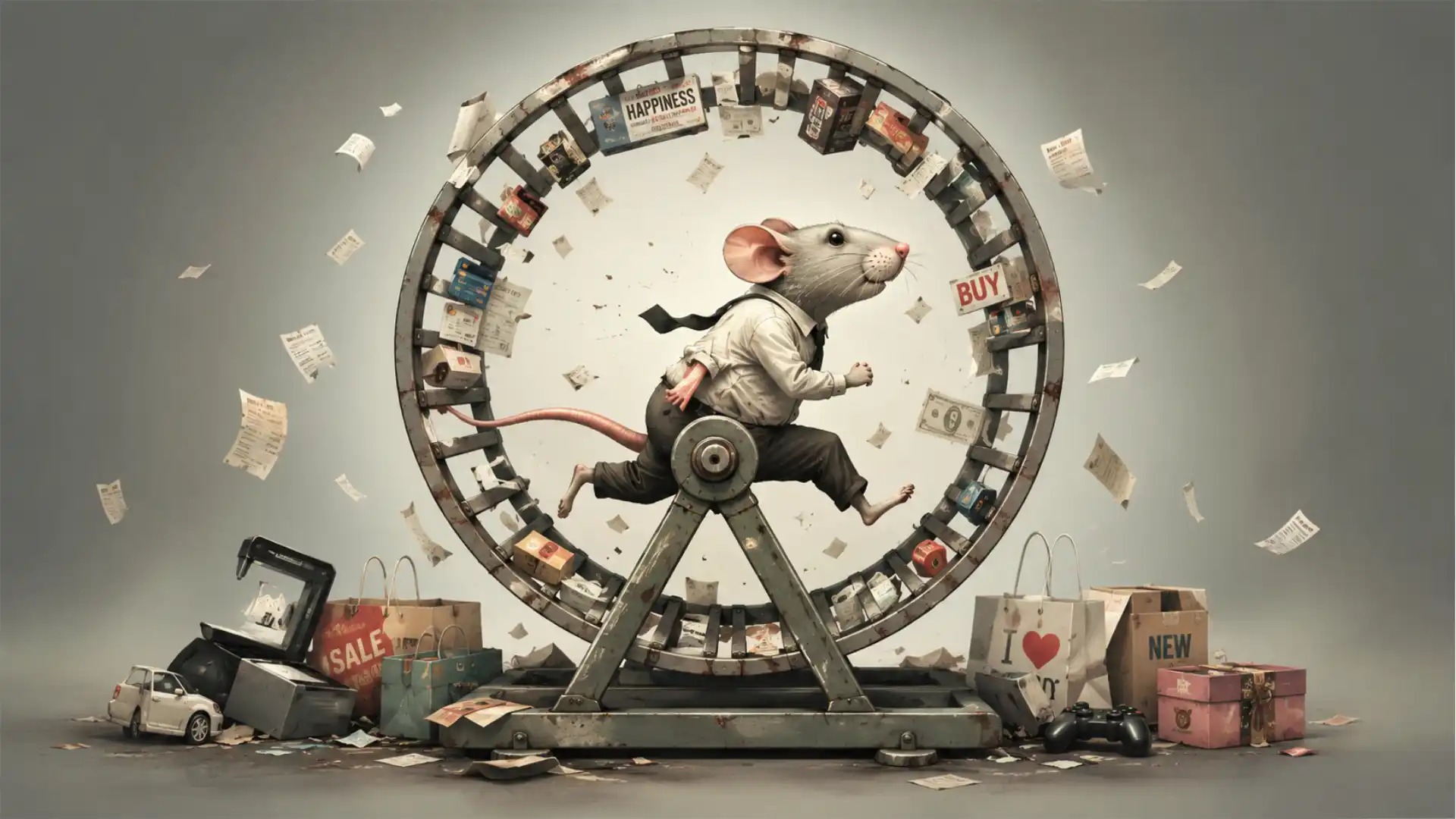
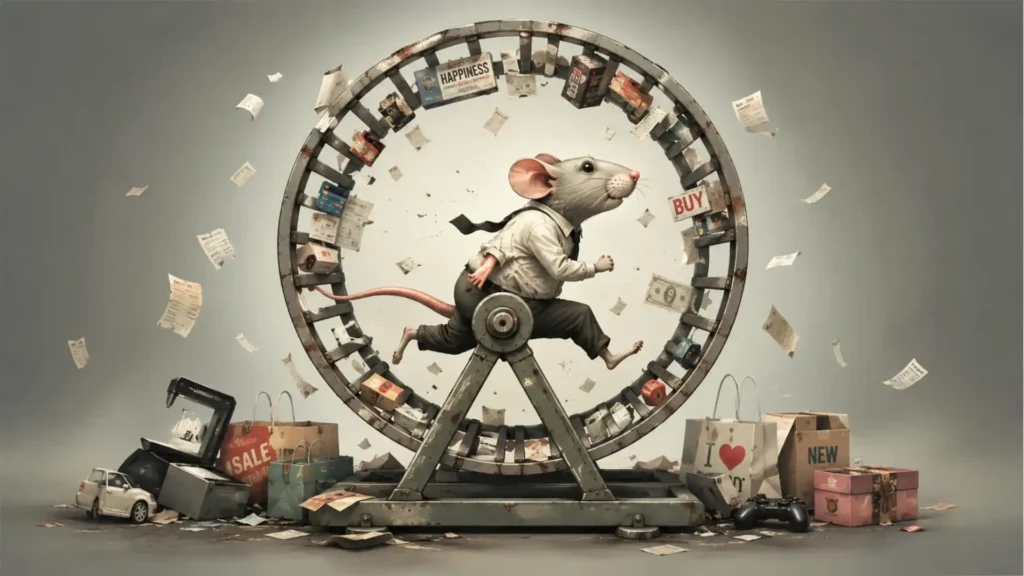
Happiness is one of those internet shorts that does not need much time to ruin your mood. A rat runs, buys, drinks, stares, panics, swallows another promise, and keeps moving. The joke lands before the film finishes because the rat is not really a rat. It is the viewer with a basket, a card, a browser tab, a commute, a phone, a discount code, and a thin suspicion that the next thing will not fix the last thing.
Table of Contents
Steve Cutts uploaded Happiness to YouTube in November 2017, framing it as “the story of a rodent’s unrelenting quest for happiness and fulfillment.” The same description appears on Vimeo, where the film is also listed as directed and animated by Steve Cutts, with music credited to Bizet’s “Habanera” and Grieg’s “Morning Mood.”
The numbers attached to the YouTube upload are part of the story. The snapshot you shared shows 2.02 million subscribers, 3.1 million likes, and 58,857,774 views. Even allowing for the usual movement of platform statistics, that scale matters. Happiness is not a tiny art-school artifact discovered by accident. It is a short, brutal, wordless animation that escaped into the main bloodstream of the web and stayed there.
What makes it a Web Radar object is not only that it is popular. Popular videos are everywhere. Happiness is interesting because it behaves like a website you want to send to someone with no explanation. Open it, watch the rat, then see whether the room gets quieter. It is four or five minutes of animated satire that does what many long essays fail to do: it turns a familiar social complaint into a memorable interface of images.
Steve Cutts’ own about page describes him as a UK-based illustrator and animator specialising in 2D animation, with work for clients such as The Simpsons, Moby, HBO, UNESCO, Alok, and Tchami feat. Gunna. His page also says he works mainly with After Effects, Clip Studio, Photoshop, and Cinema 4D. That technical mix fits the film’s feel. Happiness looks handmade enough to bite, digital enough to swarm.
The Webby Awards later named Happiness a 2018 Webby Winner in Film & Video Animation, with Steve Cutts listed as entrant. The British Council’s UK Films Database lists the film as a 2017 short, notes its Annecy Film Festival 2018 short-film competition selection, and records the CANAL+ Creative Aid Award. Awards do not make a web object interesting by themselves, but in this case they confirm something visible from the comments, shares, and reuploads: the film crossed the gap between festival animation and mass internet circulation.
This article follows the uploaded human-writing standard: concrete wording, direct sentences, and real judgment instead of padded, generic phrasing. That matters here because Happiness does not reward polite vagueness. It is a vicious little machine.te about it is to stay close to what it actually does.
A tiny film with the force of a web page you cannot unsee
Happiness opens with motion, not argument. The rat does not stand still and wonder what fulfillment means. It is already inside the system, pushed forward by a crowd of other rats. The film does not ask permission to be symbolic. It uses the oldest possible metaphor for modern work and consumption — the rat race — then draws it so literally that the phrase becomes strange again.
The choice of a rat is almost too easy, which is why it works. A rat can be cute, disgusting, desperate, social, frantic, and anonymous in the same shot. Cutts uses that flexibility well. His creature is not a heroic outsider trapped in a bad society. It is one body in a flood of bodies, all shaped by the same reflexes. When the rat sees a product, it wants. When it sees another rat moving faster, it follows. When it gets a prize, the prize evaporates into the need for another one.
The film’s plot is thin by design. The rat seeks happiness by obeying every signal around it. Shopping promises happiness. Food promises happiness. Alcohol promises happiness. Sex promises happiness. Pills promise happiness. Work promises happiness. Screens promise happiness. Money promises happiness. None of it lasts long enough to become peace. That blunt repetition is the structure.
What keeps the film from becoming a poster is its pace. Cutts makes consumption feel like a panic attack with packaging. The rat does not leisurely browse a store. It is dragged through a choreography of signs, shelves, hands, lights, and movement. Every frame feels crowded. The city seems to have no empty corner where thought could happen. Even stillness is commercialized. A pause becomes another chance to sell the rat something.
The wordless format gives the film one of its sharpest powers. No character explains the joke, so the viewer supplies the shame. You recognize the Black Friday crush without needing a label. You recognize the office maze. You recognize the dopamine spark of buying. You recognize the hollow second after a thing is acquired and the next desire arrives. Dialogue would only weaken it.
The soundtrack does another kind of work. The classical cues make the chase feel both grand and ridiculous. Bizet and Grieg bring a theatrical polish to scenes of rats stampeding through malls and offices. The mismatch is funny for a second, then sour. The music does not soften the satire. It turns the whole system into a pompous opera about tiny appetites.
Happiness also feels web-native because it does not ask for patience. It hits quickly, loops visually, and compresses its argument into images that survive as screenshots. Many online films depend on spoken lines, celebrity, confession, or twist endings. Cutts’ film depends on instant legibility. A rat chasing a glowing idea of happiness through capitalism is understandable in any language with shopping malls.
That is one reason it keeps circulating. Happiness is not tied to a news cycle. It does not require knowledge of a politician, product launch, meme format, or scandal. Its target is older and more durable: the machinery that teaches people to confuse activity with fulfillment. The film looked current in 2017 because of Black Friday, smartphones, and internet culture. It still looks current because those systems did not slow down.
The film is also short enough to survive the web’s impatience. The British Council lists its running time as five minutes, while Short of the Week tags it at four minutes; that discrepancy is normal across listings, but the felt duration is what matters. Happiness is brief enough to share as a nudge, not an assignment. Someone can send it in a message with “watch this” and still expect the other person to finish.
That smallness is part of its cunning. The film does not behave like homework about capitalism. It behaves like a nasty cartoon that keeps getting worse. You start by enjoying the craft. Then you laugh at the rats. Then you notice the rats are doing ordinary human things. Then the laugh curdles. By the end, the film has not persuaded you through evidence. It has trapped you inside recognition.
Steve Cutts makes satire that looks cheap until it starts cutting
Cutts’ style has always belonged to the grimier side of internet animation. It is not smooth in the expensive studio sense. It often feels crowded, abrasive, and deliberately overstuffed. That texture matters. The world of Happiness is not clean enough to admire from a distance. It is sticky with signs, products, mouths, screens, and panic.
His about page gives the practical facts: 2D animation, illustration, viral shorts, and a working toolkit that includes After Effects, Clip Studio, Photoshop, and Cinema 4D. Those tools show in the film’s hybrid feel. It has drawn bodies, digital compositing, repetitive crowd movement, hard graphic staging, and occasional scale shifts that make the city feel like a machine pressing down on one soft animal.
The animation is not trying to mimic reality. It is trying to make reality feel more honest by making it uglier. The rats are elastic and grotesque. Their eyes pop, their mouths gape, their bodies tumble into crowds. Backgrounds feel dense with visual noise. Stores and streets are not neutral places. They are traps designed to produce one more movement, one more purchase, one more surrender.
Short of the Week described the film as satire about society and animation, calling it a literal “rat race” and framing it as a fast-paced montage of one rat’s quest for happiness through modern society’s traps. That description is useful because it catches the film’s central design decision: Cutts does not hide the metaphor; he overloads it until it becomes funny again.
A weaker version of Happiness would have chosen humans and given them sad faces. Cutts chooses rats and lets the audience do the translation. The animal distance gives the film permission to be cruel. Viewers can laugh at the rodents without feeling attacked in the first minute. Then the film quietly removes that distance. The rats want what people want. They queue, compete, buy, binge, perform, and collapse.
The visual density also changes the way the film rewards replaying. The first watch gives you the argument; the second watch gives you the debris. Look at the signs, the crowds, the background motion, the way bodies are packed into every system. The film’s world seems to have been built from clutter on purpose. It has no air. The rat is not merely chasing the wrong thing. It is living in a place designed to make the chase feel natural.
Cutts’ recurring strength is that he understands web attention without flattering it. His films are blunt because the internet is blunt. A clever metaphor buried under slow exposition would die online. A rat running toward happiness through an absurd marketplace survives because it makes its point at thumbnail speed. The artistry is not hidden behind the obviousness. It sits inside the obviousness.
That matters because obvious satire is often bad. It can feel like a slogan with drawings attached. Happiness avoids that trap by turning every beat into a physical gag. The rat does not “experience consumer alienation” in abstract terms. It gets crushed, tempted, drugged, chased, and processed. The satire is not just stated. It is animated through pressure on a body.
Cutts’ use of old cartoon energy is also important. The rat’s suffering is staged with the bounce of slapstick. That creates a nasty tension. You watch a creature get fooled by the world, and the staging makes the fooling entertaining. The film understands that consumer culture often works the same way. The trap is funny, bright, rhythmic, and social. It does not look like misery at first. It looks like motion.
The film’s online success suggests that Cutts found a tone the web is especially good at spreading: recognition wrapped in disgust. People share things that make them feel seen, but they also share things that let them accuse the world. Happiness does both. It tells the viewer, “Yes, you are in this,” and also, “Look how insane this is.” That double position is comfortable enough to click and uncomfortable enough to remember.
The Webby recognition fits the film’s native habitat. Film & Video Animation at the Webby Awards is not just a festival shelf; it is a category for work born to travel online. The Webby page lists Happiness as a 2018 winner in that category and links the work through Vimeo. The film’s prestige and its virality are not separate stories. They met inside the same distribution path.
The genius of making happiness look like a product defect
The funniest thing about Happiness is that happiness itself barely appears. The rat is surrounded by substitutes: goods, intoxication, status, screens, stimulation, sex, money, slogans, and crowds. The actual feeling remains off-screen, always implied by the next object. The film’s title becomes a trap. You click for happiness and get a creature being trained to chase it.
That choice gives the short its cleanest insult. Happiness, in the film, is not a feeling; it is a marketing claim. It is what every system sells while quietly withholding the condition that would make it real. The rat is not stupid. It is obedient. It follows the instructions given by the environment. Buy this. Drink this. Work here. Watch that. Swallow this. Repeat.
The film’s central rhythm is a cycle of promise and disposal. Each new answer expires almost instantly. The rat reaches for a product, and the film moves on before satisfaction can become stable. That speed is not a flaw in the rat’s psychology. It is the business model around it. Desire must renew quickly. A content rat would stop being useful.
What makes the film more painful now is how normal its world feels. The rat’s life is algorithmic before the film needs to show an algorithm. It follows cues. It reacts to stimuli. It is pushed from one environment to the next by signals stronger than thought. The mall, the office, the street, and the screen all operate like recommendation engines. The rat does not choose so much as respond.
Happiness also understands that the modern chase is not only about luxury. Much of the rat’s movement looks desperate rather than decadent. It is not floating through a boutique life of curated pleasures. It is jammed into transport, work, queues, crowds, and financial pressure. The film’s anger is not aimed only at people who buy too much. It is aimed at a system that makes buying feel like one of the few available forms of relief.
This is where Cutts’ satire becomes stronger than a familiar anti-shopping rant. The rat is both consumer and product. It buys, but it is also processed. It chases money, but money also chases it down. It moves through urban systems that treat its body as an input. Work extracts it. Advertising steers it. Entertainment pacifies it. The film is less interested in moral scolding than in showing a loop that feeds on participation.
The Black Friday imagery matters because it turns individual desire into crowd behavior. A sale is not only a price event; it is a social permission structure. Rats crash into stores not because one rat has made a reflective decision, but because the pack moves. The scene is funny because the behavior is absurd. It is uncomfortable because humans have supplied the reference footage many times.
There is a brutal little truth in the film’s treatment of bargains. Discounts make desire look rational. The rat is not simply grabbing objects. It is responding to the language of opportunity, scarcity, urgency, and loss avoidance. The price tag becomes a command. The film does not need to show a marketing department. The store itself becomes the marketer.
Food and drink in the film follow the same pattern. Consumption becomes anesthesia with branding. The rat reaches for pleasure, but the images do not linger on pleasure. They linger on excess, collapse, and the grim mechanics of wanting another hit. Cutts is not subtle here, and subtlety would not improve it. The body is being managed by appetite.
The pills and intoxication sequences turn the title even darker. When happiness becomes a purchasable state, sadness becomes a product opportunity. The rat’s failure to feel fulfilled does not interrupt the market. It creates another aisle. That is one of the film’s strongest observations. The system does not need its promises to work permanently. It only needs failure to lead back to another promise.
Money appears as both goal and hallucination. The rat chases it as if the symbol itself contains rescue. The film knows that money is not imaginary; poverty and pressure are real. Yet it also shows how money can become a moving image of salvation, always close enough to pursue and far enough to keep the body running. That is a sharper point than a simple “money cannot buy happiness” sermon.
The office scenes cut differently from the shopping scenes. Work is presented as another machine of repetition, not a noble counterweight to empty consumption. The rat’s labor does not liberate it from the mall. It feeds the same chase. Work produces the means to buy the relief that work makes necessary. That loop may be the film’s bleakest joke.
Screen culture sits inside the film as one more surface of wanting. The screen is not treated as a separate digital evil; it is part of the same hunger system. That feels right. Online life did not invent the desire to compare, acquire, perform, and escape. It made those desires faster, cheaper, and more measurable. Cutts’ rat would be at home in a mall, feed, app store, dating platform, or office dashboard.
The genius of the film is that none of this needs verbal explanation while watching. The images arrive as gags, then settle as accusations. You do not pause the video to parse its theory. You watch a rat lose itself in a city of offers. The meaning is immediate because the behaviors are already installed in the viewer’s memory.
Why this short still belongs in the internet’s permanent drawer
Some viral films expire because their context expires. A joke tied to a platform feature, celebrity scandal, or political moment may become a fossil fast. Happiness has aged differently. Its world has not become quaint. If anything, the film’s central complaint has become easier to recognize and harder to dismiss.
The obvious reason is that the chase has moved deeper into daily life. Shopping no longer waits for the shop. It rides in the pocket. Entertainment, work, communication, status, and consumption now overlap so heavily that the rat’s movement between spaces feels almost too tidy. In real life, the mall, office, cinema, bar, bank, and billboard can all fit into the same glowing rectangle.
Yet Happiness is not only “about phones” or “about capitalism” or “about Black Friday.” It is about the design of desire under pressure. That phrasing matters because the film does not depend on one villain. It shows a whole environment where cues are arranged to keep the body moving. You could remove one product category and the machine would still function.
The film also belongs in the permanent drawer because it carries a rare kind of online clarity. It is instantly readable but not shallow. Many web artifacts are one or the other. They are either clear enough to travel but thin after the first glance, or deep enough to reward attention but too slow to circulate widely. Happiness sits in the narrow overlap. It is blunt at the surface and nasty underneath.
The shareability of the film is not accidental. A silent animation about a rat bypasses many of the usual barriers to global circulation. It does not require subtitles. It does not depend on cultural knowledge beyond modern consumer life. It does not need a charismatic presenter. It does not ask viewers to agree with a spoken argument. It lets the viewer accuse themselves.
That makes it useful as a small cultural diagnostic. When someone reacts strongly to Happiness, they are often reacting to what they already know. The film does not reveal a hidden conspiracy. It exaggerates common routines until they look insane. The discomfort comes from seeing ordinary habits stripped of their excuses.
The fact that the film became award-recognized and widely viewed also tells us something about the web’s appetite for anti-web feeling. People use platforms to share critiques of the systems that platforms intensify. A YouTube audience watches a film about attention, desire, and mass behavior, then expresses recognition through likes, comments, and shares. The contradiction is not a gotcha. It is part of why the film feels true.
Cutts’ work often travels through that contradiction. His films criticize the machinery that makes them visible. The internet rewards clean emotional signals, and his animation supplies them: disgust, recognition, dread, grim laughter. The system spreads the critique because the critique is packaged with speed and clarity. That is not hypocrisy. It is web culture behaving exactly as the film says it behaves.
There is also a reason the rat remains more memorable than a human protagonist would. Animals in satire make social systems look mechanical. A human character brings personal biography into the frame: class, gender, family, taste, choice, psychology. A rat cuts through that. It becomes a body under stimulus. That reduction is cruel, but it makes the film’s point sharper.
The rodent also gives the film its most durable visual shorthand. A rat chasing happiness is the whole piece in one image. That matters on the internet, where the preview image often decides whether an object lives. Cutts’ film has the advantage of being reducible without being emptied. Describe it in one sentence and it still sounds worth clicking.
Short of the Week’s 2017 review placed Cutts among independent animators who built audiences online, noting his viral hits and the unusual position of an internet-native creator gaining both audience loyalty and artistic credibility. Happiness is a clear example of that internet-native power. It does not look like a studio calling card uploaded after the fact. It looks made for the strange distribution logic of the web itself.
That is why reopening it now still makes sense. The film has not been replaced by newer discourse. There are longer essays about burnout, better books about consumer psychology, stronger academic language for alienation, and endless posts about dopamine loops. Happiness does something else. It gives the idea a body and makes it run.
What makes Happiness worth opening
| Element | What it does | Why it sticks |
|---|---|---|
| Rat protagonist | Turns people into instinctive crowd animals | The metaphor is immediate |
| Wordless storytelling | Removes the need for explanation | It travels across languages |
| Fast montage | Mimics the pressure of modern life | The pace feels like the point |
| Consumer imagery | Uses shops, work, screens, pills, money | The target stays recognizable |
| Classical music | Makes the chase theatrical and absurd | The contrast adds bite |
| Short runtime | Fits web attention without feeling slight | Sharing it feels easy |
The table matters because Happiness works through compression. Cutts does not build a complicated narrative world; he builds a dense symbolic machine. Each part is simple on its own, but together they make a film that feels bigger than its runtime.
The film is a recommendation, not a lecture
The best way to treat Happiness is as a recommendation with teeth. It is not a calm explainer about modern life. It is not a fair debate about markets, labor, medicine, advertising, and entertainment. It is a pointed cartoon. Its job is to push one idea until it squeals: people are being trained to chase fulfillment through systems that profit from their dissatisfaction.
That narrowness is a strength. Satire does not need to be complete; it needs to hit cleanly. Happiness hits cleanly because Cutts chooses a target broad enough to recognize and specific enough to visualize. Consumer culture is a huge phrase. A rat being smashed through a sale crowd is a picture. The picture wins.
The film’s lack of dialogue also gives it an odd kind of politeness. It never tells the viewer what kind of person they are. It just shows behavior. That lets the viewer enter through whichever door hurts most. For one person, the mall scenes sting. For another, the office scenes. For another, the drinking, pills, screens, or money chase. The film does not need to know your weakness. It lays out a buffet of weaknesses and lets you pick yourself out.
There is a danger in work this blunt. A viewer can turn it into superiority too easily. “Look at those consumers,” someone might think, while watching on a device built to monetize attention. Cutts seems aware of that trap, even if the film does not spell it out. The rat is not drawn as a uniquely foolish creature. It is ordinary. The joke lands best when the viewer does not stand above the rat, but beside it.
That is why the film feels less like moral purity and more like disgusted recognition. Happiness is not saying that wanting things is evil. It is saying that wanting can be shaped, sped up, packaged, exhausted, and resold. The film’s world is not bad because objects exist. It is bad because every object arrives as an answer to a question the system keeps reopening.
The emotional arc is also sharper than it first appears. The rat keeps moving because stopping would mean feeling the emptiness. The chase is painful, but it gives structure. Each promise creates a next step. A sale, a drink, a promotion, a pill, a fantasy, a pile of money: all of them organize the rat’s attention. The absence of fulfillment does not stop the routine. It keeps the routine necessary.
The film’s title makes that routine tragic. Happiness is the word used to justify everything the rat endures. That is the darkest joke in the film. It is not called Consumption, Capitalism, Addiction, Work, or Desire. It is called Happiness because the whole machine borrows the language of the thing it prevents. Every trap in the film pretends to be a path out.
For web readers, that makes the video more than a clever short. It is a tiny diagnostic tool for your own attention. Watch it after scrolling through deals. Watch it after comparing your life to strangers. Watch it after opening a cart you did not plan to fill. The film will not cure anything, and it is not trying to. It makes the pattern visible for a few minutes.
The film also works well because it does not ask the viewer to admire Steve Cutts too much. The craft is strong, but the subject remains the center. Some animated shorts feel like portfolios first and stories second. Happiness has plenty of visual skill, but it never drifts into ornamental display. The images serve the pressure. The rat keeps running.
There is a useful lesson here for anyone making things for the web. A strong web object does not need to say everything; it needs to make one thing unforgettable. Happiness chooses one metaphor and commits. It does not dilute itself with side arguments. It does not soften the ending to reassure the viewer. It trusts the image of the rat race and follows it until the metaphor becomes a trap.
That single-mindedness is one reason the film has survived the churn of online culture. The web forgets most things because most things ask to be remembered only as content. Happiness asks to be remembered as a feeling: the awful comedy of chasing relief inside a system that feeds on the chase. That feeling is portable. It attaches itself to the next ad, the next queue, the next open tab.
What it reveals about the web that shared it
Happiness became popular on platforms built from the same incentives it criticizes. That is not a side note. It is the engine of the whole story. YouTube distributes the film through attention. Viewers reward it with likes, comments, embeds, and shares. The critique of compulsive seeking becomes another object in the compulsive seeking stream.
This does not make the film false. It makes the film more interesting. The web is full of artifacts that attack the web, consumer culture, attention markets, or modern work while relying on those same structures for reach. Some feel fake because the critique is shallow branding. Happiness feels sturdier because the contradiction is already inside the piece. The rat cannot leave the maze by noticing the maze. It can only see it for a moment.
The film’s popularity also shows that online audiences do not only want comfort. They also want compact forms of shared unease. A video like Happiness lets viewers say, “This is what it feels like,” without writing a confession. Sharing it becomes a social gesture: part complaint, part joke, part warning, part self-own. That is a powerful mix.
The comment section and the like count are not the film, but they belong to its afterlife. A short with tens of millions of views turns private recognition into public confirmation. You may watch alone, but the platform tells you that many others saw the same rat and felt something worth clicking. That public scale changes the experience. The film becomes less like a message from one artist and more like a small shared diagnosis.
The web also rewards images that turn into shorthand, and Happiness is full of them. The rat in the crowd, the rat in the store, the rat chasing money, the rat numbing itself: each could stand alone as a meme of modern exhaustion. Cutts’ work is not meme culture in the cheap sense, but it understands memetic clarity. It creates scenes that can detach from the film and still carry the charge.
That kind of clarity is easy to underestimate. Making a complex complaint simple without making it stupid is hard. Happiness manages it by avoiding policy language, lifestyle advice, and explanatory narration. It does not tell viewers how to live. It dramatizes a trap so familiar that the viewer begins supplying their own examples.
There is no clean escape hatch in the film, and that is part of its honesty. Many web essays end by offering a small prescription: log off, buy less, be mindful, slow down. Happiness does not perform that comfort. The rat’s world is built too tightly for a cute remedy. The film’s refusal to solve the problem may frustrate some viewers, but it also keeps the satire from turning into self-help.
That refusal is especially important online, where critique often gets converted into personal habit advice. The film resists the idea that the problem is only individual weakness. The rat is weak, yes. It is impulsive, hungry, and easily led. But the environment is engineered to exploit exactly those traits. A creature can be responsible for its actions and still be shaped by the maze.
The web, as a distribution machine, loves that ambiguity. Viewers can read the film as anti-capitalist, anti-consumerist, anti-work, anti-advertising, anti-addiction, anti-social-media, or simply anti-rat-race. That looseness widens the audience without making the film vague. It gives different viewers different handles while keeping one central image intact.
The British Council synopsis calls it “a brilliant analogy to ‘Life on Earth’”, which is almost too grand and almost exactly right. The film is not a complete analogy for life, of course. It is too bitter for that. But as an analogy for a specific modern arrangement — labor, consumption, stimulation, disappointment, repetition — it is painfully efficient.
That efficiency is what Web Radar is for. Some internet objects are worth opening because they compress a whole mood of the web into one encounter. Happiness is one of them. It does not need a redesign, a signup flow, a dashboard, or a clever interactive layer. It is a page with a play button and a rat running toward a word no product can hold.
The click is still worth it
The reason to watch Happiness now is not nostalgia. It is not a “remember this viral short?” exercise. It is worth opening because its images have not lost their pressure. The rat still moves like a creature trained by promises. The world still looks like a marketplace pretending to be a cure. The joke still lands because the viewer still knows the routine.
A less generous reader might say the film is too obvious. Yes, it is obvious in the way a bruise is obvious when pressed. Nobody needs a secret decoder to understand that the rat race is bad or that consumer culture sells false comfort. The point is not novelty of thesis. The point is force of expression. Cutts takes a familiar complaint and gives it a body that runs, crashes, wants, and fails.
That is why the short has outlived many slicker online projects. It has a stubborn visual center. The rat is unforgettable because it is not designed to be admired. It is designed to be recognized. The film does not flatter the viewer’s intelligence with hidden complexity. It trusts the viewer’s discomfort.
The official listings give the factual shell: a 2017 short by Steve Cutts, directed and animated by him, later recognized by the Webbys and listed by the British Council with Annecy and CANAL+ notes. The actual reason to click is harder and simpler: Happiness turns the modern promise of fulfillment into a chase scene, and the chase still looks familiar.
For designers, marketers, animators, editors, and anyone who cares about internet culture, the film is a useful object lesson. Sharpness beats scale when the image is right. Cutts did not need a feature-length argument to make the rat race visible. He needed one creature, one title, a dense sequence of traps, and the nerve to end without comfort.
For ordinary viewers, it works even better. You do not need to study animation to feel the punch. Open the video, watch the rat, and notice which scene feels least like a joke. That scene is probably the reason the film still has a life. It finds the part of the system you already live inside and makes it move faster than you want it to.
The web is crowded with things that ask for attention and vanish the moment they get it. Happiness asks for attention and leaves a stain. That is rare enough. It belongs in the small drawer of internet artifacts that remain useful after the platform cycle moves on: not because they predict the future, but because they keep describing the present too well.
Author:
Jan Bielik
CEO & Founder of Webiano Digital & Marketing Agency
This article is an original analysis supported by the sources cited below
Happiness
The official YouTube upload of Steve Cutts’ animated short, used for the title, description, publication context, and audience-scale reference.
Happiness
The Vimeo listing for the film, used for the official description, director and animator credit, music notes, and Webby update.
About
Steve Cutts’ official about page, used for biographical and professional context about his animation practice, clients, and tools.
Happiness
The Webby Awards winner page, used to verify the film’s 2018 Webby Winner recognition in Film & Video Animation.
Happiness
The British Council UK Films Database entry, used for the film’s synopsis, year, running time, production details, Annecy selection, and CANAL+ Creative Aid Award note.
Happiness
Short of the Week’s editorial page on the film, used for reception context, genre framing, and independent criticism of the short’s visual and satirical force.
| Citing this article? Brief excerpts are welcome. Please credit Webiano.digital, name the author where stated, and include a link to https://webiano.digital and to this original article. Full or substantial republication requires prior written permission. Read our Copyright and Content Use Policy. |
This article was prepared with the assistance of artificial intelligence tools. The content underwent expert human review, and Webiano Digital & Marketing Agency assumes editorial responsibility for its final version and publication.