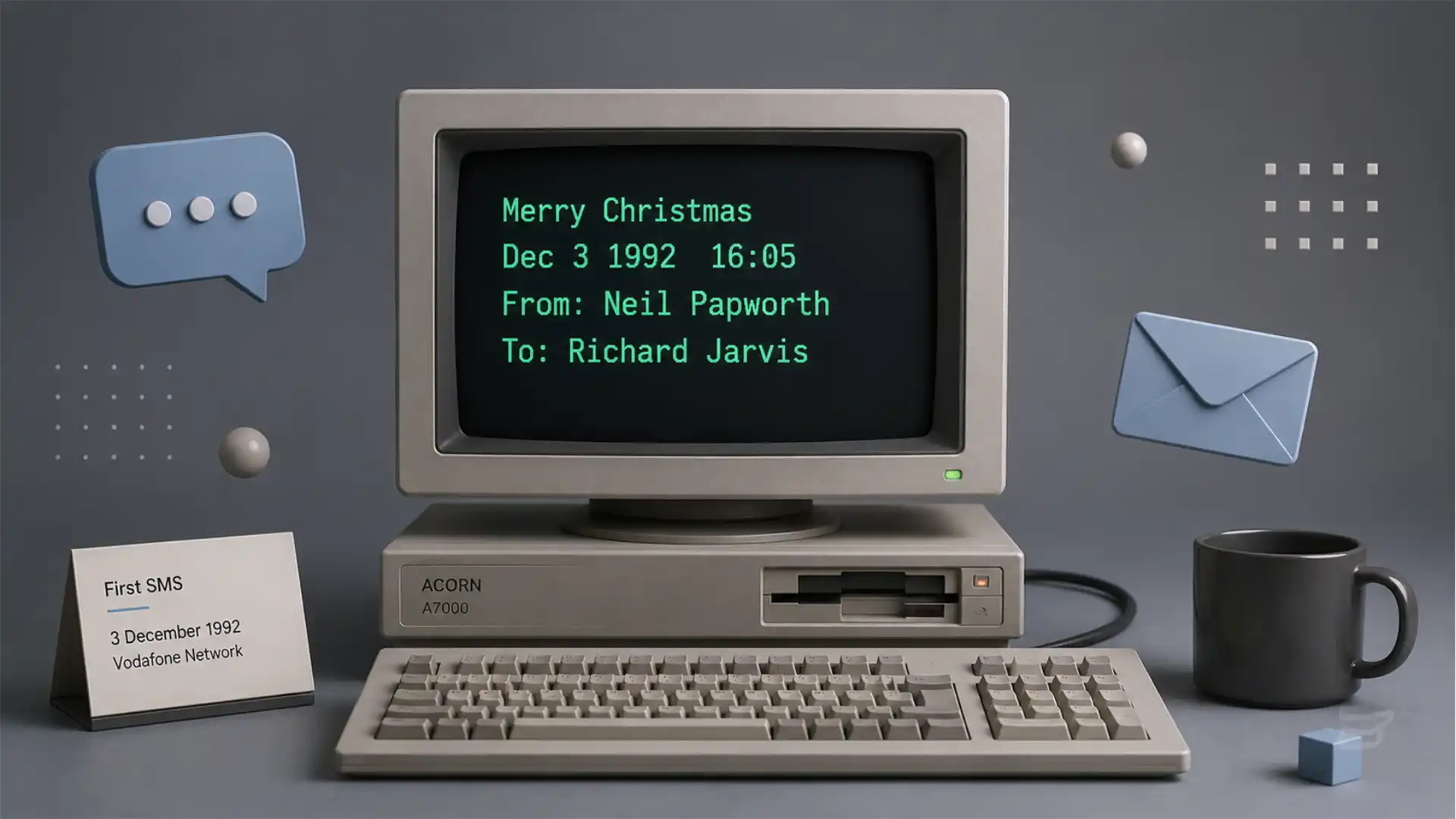
Neil Papworth did not tap the first text message into a phone. He typed it on a PC, because the mobile phone on the receiving end could read the message but could not yet answer like the phones we know now. The message itself was not dramatic, technical, or even especially clever. It said “Merry Christmas.” That is the charm of it. A global habit began not with a manifesto, a launch event, or a product video, but with a seasonal greeting sent across Vodafone’s network to Richard Jarvis on 3 December 1992.
Table of Contents
The story is often repeated as a clean piece of trivia, but the detail that makes it worth opening again is stranger: the first SMS was a message from the future sent through a machine from the past. Papworth was testing a Short Message Service Centre for Vodafone UK while working with Sema Group Telecoms, and the receiving device was an Orbitel 901, a heavy “portable” telephone that Vodafone UK later described as weighing 2.1 kg.
The receiving context was almost too perfect. Richard Jarvis was at an office Christmas party, and Vodafone’s later retelling places the message in the hands of a business audience that did not yet have a social language for texting. A phone receiving written words still sounded like science fiction to people inside the industry, according to Vodafone UK’s anniversary account and its quoted recollections from people around the early service.
That is why this tiny artifact has aged better than most “firsts” in tech history. It is not only the first SMS; it is a fossil of awkward product timing. The network could carry the idea before the handset culture was ready. The protocol existed before people had the habit. The receiving phone could show the message before the person holding it had any normal way to reply. A huge social behavior arrived half-built, as if someone had opened a door and found a staircase still being poured.
A subject this small asks for concrete wording, specific observation, and a little restraint, which is exactly the kind of writing discipline this Web Radar format needs. The first SMS does not need heroic myth-making. It gets better when it is kept human-sized: a young software programmer, a PC, a bulky phone, a customer installation, a Christmas party, and a greeting that looked almost too ordinary to deserve a place in history.
The tiny message that made the phone personal
The best internet discoveries are not always new. Some are old pages, old facts, or old technical incidents that suddenly explain the present better than a fresh launch does. The first text message belongs in that category. It is easy to treat it as a museum label, but the scene still feels current because it catches a communication habit at the exact moment before it had etiquette, muscle memory, anxiety, romance, spam, screenshots, blue bubbles, read receipts, two-factor codes, and family group chats.
Papworth’s own account is unusually plain, which makes it more interesting. He says he was part of a team developing a Short Message Service Centre for Vodafone UK, went to Vodafone’s Newbury site to install and test the software, and typed the message on a PC because mobile phones did not yet have keyboards. That is a beautifully clumsy birth story for something later sold as effortless communication.
The phrase “Merry Christmas” also matters because it is not a test string. It is not “hello world.” It is not a command. It is not a serial number. It carries a little social warmth into a system that was being built as infrastructure. A holiday greeting is soft, but it also proves the whole point of SMS: a short message could carry timing, mood, and presence without requiring a voice call.
The receiver matters too. Richard Jarvis was not a random consumer discovering a feature in the wild. He was inside Vodafone’s world, reportedly showing the message to senior leadership at a Christmas event. Vodafone UK’s 30th anniversary article says the message was sent to Jarvis, then Vodafone’s chief engineer, who was to show it to Gerry Whent, Vodafone’s chief executive at the time. This was both a technical test and a tiny internal demo.
That setting strips away the polished mythology of modern launches. No one was standing onstage saying messaging would reshape daily life. The story reads more like a side-room proof, a thing passed around because it worked. Later, the world would build whole emotional grammars around tiny written fragments: “where are you,” “running late,” “call me,” “safe home,” “miss you,” “send code,” “seen.” In 1992, the artifact was still just a phone doing something odd.
The first SMS also exposes how much product culture depends on input. A communication medium is not real to ordinary people until they have an easy way to speak back. The Vodafone network could deliver a message; the PC could originate it; the handset could receive it. But the loop was incomplete. Papworth’s line about typing from a PC because phones did not yet have keyboards is the crack in the whole myth. The future had arrived as a read-only experience.
This is where the story becomes more than nostalgia. Texting’s early magic was not speed alone; it was asymmetry. A message could arrive without requiring the receiver to answer immediately. A phone could become a quiet surface rather than a ringing demand. That small shift changed the social weight of communication. Voice calls interrupt. Texts wait. Voice calls ask for attention now. Texts create a little pocket of negotiable time.
The first message did not yet deliver that full social contract, but it pointed toward it. “Merry Christmas” was polite, brief, and non-urgent, which is almost the perfect SMS prototype. It did not need a long reply. It did not need emotional decoding. It could sit on a screen as proof that a phone could carry a sentence. The first text message was not only a technical event; it was a little demonstration of low-pressure presence.
The oldness of the equipment sharpens the effect. The Orbitel 901 was closer to luggage than to the modern phone silhouette, and Vodafone UK’s anniversary piece describes it as a 2.1 kg “portable” telephone. That detail is funny, but it also grounds the moment. The first text did not arrive on a slim personal device in a pocket. It arrived on a heavy business machine from an era when mobile still meant “movable,” not intimate.
That contrast makes the story worth clicking today. The message feels tiny because the hardware was not. A two-word greeting traveling to a 2 kg phone is a perfect internet-era image: light content moving through heavy infrastructure. We are used to that now. A tap sends a location, a payment approval, a breakup, a passkey, a photo, a joke. In 1992, even two words needed specialized systems, office installations, and someone like Papworth sitting at a computer to make the test happen.
The lesson is not that everything starts small. That line is too neat. The better lesson is that new behaviors often begin in forms that do not yet look like themselves. The first text message was not thumb-typed. It was not peer-to-peer in the human sense. It was not part of a subscription bundle, a dating ritual, a teenager’s secret channel, a banking alert, or a delivery update. It was a glimpse, and glimpses are messy.
A greeting sent from the wrong kind of machine
The PC in the story is the detail that refuses to become boring. The first text message was mobile communication without mobile composition. Papworth typed it from a computer because the handsets of the moment were not built for the writing habit SMS would later create. His own account says the phones did not yet have keyboards, so the PC became the sender.
That sounds like a small workaround until you think about what it says. The network layer and the human layer were out of sync. Engineers could create a path for messages. Operators could test delivery. A receiving device could display the result. But the everyday body language of texting had not been designed. There was no thumb dance. No predictive text. No T9 rhythm. No little pause while someone rewrote a sentence three times and sent a shorter one.
SMS had to wait for hardware habits to catch up. Vodafone’s 25th anniversary piece notes that Nokia introduced an SMS feature with a distinctive beep one year later, in 1993, and that texts could finally be exchanged across multiple networks in 1999. That gap matters. A technology can exist years before it feels socially available. The first SMS was real in 1992, but texting as a mass behavior needed handsets, billing, interoperability, pricing habits, and people willing to write on number pads.
The “wrong machine” detail also turns the first SMS into a neat product-design riddle. What matters more, the network that makes an action possible or the interface that makes it natural? The first text proves that possibility is not enough. A feature can be technically alive and socially asleep. It becomes ordinary only when the action fits the body, the cost, the context, and the moment.
Early SMS did not arrive as a rich expressive space. It was short, plain, and constrained by design. Vodafone’s anniversary account says early text messages had a 160-character limit, and ETSI’s technical specification describes SMS user data through compact payload limits, with text messages transferred in up to 140 octets. The constraint was not a branding choice. It was built into the service’s technical bones.
The 160-character ceiling later became cultural. People learned to make shortness feel alive. They clipped words, bent punctuation into faces, accepted abbreviations, and packed tone into fragments. The old limit gave texting a nervous, compressed style that still survives in chats even when no one is counting characters. A message can now run for paragraphs, but the social instinct of texting remains brief: a line, a pause, a second line, a reaction, a correction, a dot-dot-dot.
There is a hidden elegance in that. SMS was limited enough to become intimate. Email often carried subject lines, signatures, paragraphs, work habits, and the weight of a desktop. Voice calls carried interruption. SMS slipped between them. It was light enough for logistics and personal enough for affection. The first “Merry Christmas” sits right at that crossing point: part notification, part greeting, part proof.
The PC also reminds us that the boundary between computers and phones was never clean. The first SMS was born from a computer-to-phone relationship, not from the self-contained phone world that later marketing would celebrate. That matters because mobile culture has always depended on larger systems hidden behind the device: service centers, billing records, routing rules, base stations, standards bodies, software teams, operator agreements. The handset gets the glamour because it sits in the hand. The message depends on everything else.
Papworth’s role makes that invisible layer visible. He was not a celebrity founder selling a dream; he was a developer and test engineer making a system work. Vodafone’s official account identifies him as a 22-year-old software programmer from the UK, working on SMS for Vodafone, and Papworth’s own page places him at Sema Group Telecoms, chosen to go to Newbury to install, integrate, and test the system.
That type of story is rare online because the internet often rewards the dramatic founder version of technology history. Here, the person who made the memorable action was doing the unglamorous work of integration. The system needed to be installed. It needed to be tested. It needed to pass through a service center. The first message was not a pitch. It was a working check with a holiday greeting attached.
The lack of a phone keyboard also explains why early texting took time to become obvious. Writing on a phone had to be invented as a behavior, not merely enabled as a feature. Later users learned multi-tap input, where one letter could require several presses of a number key. Vodafone UK’s 30th anniversary article includes a recollection from Ben Wood about explaining how even typing the name “Ben” required multiple presses across number keys. That is not effortless. It is learned friction.
Yet friction sometimes gives a medium character. Texting became expressive partly because it was awkward. People developed shortcuts because the device was slow. They used tone markers because the format was thin. They sent fragments because full sentences took work. When smartphones removed much of that friction, the habits did not vanish; they mutated into emoji, stickers, reactions, voice notes, GIFs, and quick replies. The impulse stayed the same: get a small feeling across without making a call.
The first SMS is therefore not just a first message. It is a snapshot of an interface before the interface existed. A message was possible, but the natural human posture around it had not been built. The hand did not know what to do yet. The phone did not invite the action yet. The market did not know how to bill it at scale yet. The networks did not all exchange it yet. The future was present as a test, not a habit.
What stands out at a glance
| Detail | What makes it interesting |
|---|---|
| Sender | Neil Papworth typed it from a PC, not from a phone |
| Recipient | Richard Jarvis received it on Vodafone’s network during a Christmas event |
| Message | “Merry Christmas” made the test feel social, not merely technical |
| Device | The Orbitel 901 was heavy, far from the pocket phone image |
| System | The SMSC was the quiet hero, routing the short message through the network |
| Afterlife | The message later became a collectible digital artifact, not just telecom trivia |
The table works because the first SMS is easy to flatten into a single fun fact. The more interesting version is a small collision of people, hardware, protocol, office culture, and timing, which is why the story still feels clickable decades later.
The quiet web pages behind the famous fact
The best page to open is Papworth’s own site. It is charmingly under-designed in a way that suits the event better than a glossy corporate archive would. The page calls him the sender of the world’s first SMS, gives his Reading and Sema Group background, explains the Vodafone UK SMSC project, and states plainly that he typed the message on a PC because mobile phones did not yet have keyboards.
That page is part of the appeal. The web artifact and the telecom artifact rhyme. Papworth’s site looks like an older web where a person could place a small biography, a hit counter, a few links, and a story without drowning it in interactive furniture. It feels like the opposite of a modern brand page. The event was small and functional; the page is small and functional. Both resist spectacle.
Vodafone’s official anniversary pages serve a different role. They make the story legible as company history, placing Papworth, Jarvis, Vodafone, Nokia’s later SMS feature, interoperability, and the later popularity of texting into a tidy timeline. Vodafone’s 2017 piece marks 25 years since the first text and gives the core account; Vodafone UK’s 2022 piece adds the Orbitel 901, the 2.1 kg weight, and more color around the office event.
Between those sources, the story becomes a useful case study in how technology memory is assembled online. The personal page gives the engineer’s clean recollection; the corporate page gives the institutional version; the news article gives the afterlife. None of them alone is the whole texture. Together, they form a small archive of how a minor test became a famous origin story.
Reuters adds the strangest afterlife. In 2021, a digital replica tied to the first SMS sold for 107,000 euros as an NFT at a Paris auction, with Vodafone putting it up for sale and the buyer receiving a replica of the original communication protocol that transmitted the message. The same two words that once needed a PC, an SMSC, and a heavy phone later became a blockchain-era collectible. That jump is almost too neat.
The auction angle risks making the story feel like a gimmick, but it also reveals something real. Digital culture keeps trying to give physical scarcity to moments that were never physical in the first place. A text message is not a letter in a drawer. It is a transmitted event, a record, a protocol trace, a memory. Packaging it for auction shows how badly we want digital beginnings to have objects attached to them.
That desire is understandable. The web is full of experiences that shaped daily life but left almost nothing you can hold. The first SMS was not a phone you typed on. It was not a paper note. It was not a screenshot in the modern sense. It was a network event between systems. Turning it into a saleable artifact may feel absurd, but the absurdity is part of its accuracy. We keep trying to frame the unframeable.
The official sources also carry a subtle disagreement in tone. Papworth’s version feels like a worker’s memory; Vodafone’s versions feel like anniversary storytelling; Reuters treats the same moment as marketable cultural property. That shift tells you how internet history matures. First it is a job. Then it is a brand story. Then it is a collectible. Later it becomes trivia, meme, source note, lesson, and nostalgia loop.
A Web Radar piece should not pretend that every old page is a hidden masterpiece. The value here is not visual polish but density. Papworth’s page contains the exact detail that makes the story sing: he typed the first message on a PC because phones did not yet have keyboards. Vodafone’s archive supplies the public timestamp and network setting. ETSI’s specification reveals the service architecture underneath. Reuters shows the later cultural pricing of the artifact.
That combination is what makes this discovery web-native. The first SMS is not only something that happened; it is something you can reconstruct through a few open pages. You can read the sender’s own summary, compare it with the operator’s anniversary retelling, glance at the standard that describes how SMS works, and then see the message resurface in a 2021 NFT auction. The web becomes the reading room for a communication habit most people now treat as background noise.
The technical specification is not a page most casual readers will enjoy, but it is worth knowing what it says. ETSI’s SMS specification describes SMS as a system for transferring short messages between a mobile station and a short message entity via a service centre, with the service centre relaying and storing messages between sender and receiver. That service-centre idea is a key to the whole story.
SMS was not built as a tiny live chat in the way people now imagine messaging. It was built around relay, storage, delivery, and reports. ETSI’s document defines mobile-terminated and mobile-originated services and describes SMS-DELIVER and SMS-SUBMIT as protocol units moving user data between service centre and mobile station. The language is dry, but the social result was huge: messages could wait, travel, confirm, fail, retry, and arrive outside a voice call.
That machinery made texting feel reliable enough to become casual. Casual behavior often depends on serious infrastructure. A friend sends “here” because the network, routing, storage, handset display, billing system, and sender interface make “here” feel almost weightless. The less people think about the system, the more successful the system has become. The first SMS is one of those rare moments when the hidden system is still visible.
Reading the story through sources also protects it from becoming too clean. Vodafone UK’s article notes that there was testing behind the scenes, including recollections of more ordinary test messages during development. That does not ruin the “Merry Christmas” story. It makes it more believable. Public firsts often sit on top of private tests. The famous artifact is rarely the first keystroke; it is the first remembered public crossing.
That distinction matters because technology history is full of simplified anniversaries. We choose a moment because people need a handle. 3 December 1992 is the handle for SMS. “Merry Christmas” is the handle for mobile messaging becoming socially legible. Papworth is the handle for the engineering work. Jarvis and the Orbitel 901 are the handle for the receiving side. A messy system becomes memorable through a tiny scene.
Why the first SMS still feels oddly modern
The first SMS feels modern because it introduces a behavior that still runs underneath newer apps. A short written interruption arrives on a personal device, waits silently, and changes what the receiver does next. That pattern survived the jump from SMS to WhatsApp, iMessage, Signal, Telegram, Instagram DMs, Slack, Teams, delivery alerts, banking codes, and authentication prompts. The surfaces changed. The social mechanic stayed.
The message was also short enough to be glanced at. Glanceability is one of the hidden powers of mobile communication. A call demands a decision: answer or reject. A long email demands reading time. A short message offers a smaller unit of attention. “Merry Christmas” is readable before the mind has time to resist. That is why SMS became useful for affection and logistics alike.
The holiday greeting captures the emotional side, but SMS quickly became practical. Vodafone UK’s 30th anniversary piece points to parcel updates, appointment confirmations, and numeric login codes as modern uses that keep text messaging alive. Those examples are less romantic than the first greeting, but they may be closer to SMS’s durable role. Texting became a social habit; SMS itself became a trust channel, a fallback, and a delivery mechanism for small confirmations.
That dual identity is part of its longevity. SMS is both intimate and bureaucratic. It can say “I love you,” but it can also say “your prescription is ready.” It can end a relationship or confirm a dentist appointment. It carries emergency alerts, spam, bank notices, shipping updates, school messages, political campaigns, restaurant waitlists, and security codes. Few media formats can move so easily between tenderness and paperwork.
The first message sits on the tender side, which may be why it remains memorable. A purely technical first would have faded faster. “Test message 001” would be historically cleaner and emotionally dead. “Merry Christmas” gives the origin story a tiny bit of warmth. It sounds like a person reaching through a machine, even though the sender was testing a system for a client.
The fact that Jarvis could not respond in the familiar phone-to-phone way makes the moment more poignant. Texting began as a one-way demonstration before it became a two-way social reflex. Modern messaging is obsessed with reciprocity: reply times, read states, typing indicators, reactions, silence as signal. The first SMS did not yet carry that burden. It was delivered, seen, and admired or shrugged at. The social anxiety came later.
That is a nice reminder that features change people after people change features. A new communication tool does not arrive with its etiquette fully formed. People invent the rules through use, annoyance, convenience, flirtation, avoidance, work pressure, teenage creativity, and family habits. SMS moved from technical possibility to social grammar. “Merry Christmas” was not a grammar yet. It was a word fragment at the start of one.
It also reveals how little a medium needs to become culturally powerful. SMS had no images, no read receipts, no stickers, no profiles, no algorithmic feed, no status indicator, no identity layer beyond the number. It still changed how people coordinated daily life. That should embarrass some modern product design. Many tools now arrive swollen with features before proving they deserve a place in the pocket. SMS earned its place through one hard job: send a short message that arrives.
The constraints were not only technical; they were economic. People used SMS because it was cheaper or more convenient than calling in many situations, especially once plans, handsets, and network interoperability made it accessible. Vodafone’s timeline notes that texts could be exchanged across multiple networks by 1999, a milestone that pushed adoption beyond early technical circles. A communication tool becomes more powerful when it escapes its first island.
Interoperability is not glamorous, but it is one of the heroes of the story. A message that only works inside one operator’s world is a feature; a message that crosses networks becomes a medium. That is why 1999 matters almost as much as 1992 for the lived history of texting. The first SMS proved the idea. Cross-network exchange helped make the idea socially useful.
The early phone input problem created another cultural effect: people wrote differently because the device punished length. The 160-character limit and number-pad input pushed users toward compression. Abbreviations, clipped spellings, emoticons, and later emoji were not just playful inventions; they were responses to friction. Vodafone’s 25th anniversary article connects early character limits with “txt spk,” LOL, emoticons, and later emoji culture.
That line from SMS to emoji is not direct in a strict technical sense, but it is culturally persuasive. When a medium narrows expression, people invent side channels for tone. A smiley made of punctuation is a little repair kit for missing facial expression. An emoji is a richer repair kit. A reaction button is a faster one. The same pressure keeps returning: how do you make a small message feel less flat?
The first SMS did not have to solve that. “Merry Christmas” already contains its tone. It is seasonal, friendly, and socially safe. No one needs a wink after it. That makes it an unusually lucky first phrase. It is neutral enough for a corporate demo and human enough for memory. It sits exactly between system test and greeting card.
The odd modernity also comes from the PC-to-phone path. We still live inside mixed-device messaging, even if it feels normal now. People send iMessages from laptops, WhatsApp from browsers, Slack from desktops, two-factor codes from servers to phones, and push notifications from cloud systems to watches. The first SMS already had that cross-device DNA. A computer spoke to a phone, and that is now ordinary.
So the first SMS is not simply a relic of mobile history. It is an early version of the device-fluid communication world we now inhabit. The phone is a screen among screens. Messages cross from server to handset, laptop to phone, phone to watch, app to email, bot to chat, bank to number. Papworth’s PC was not an accident outside the story. It was a preview of how communication would become distributed across devices.
The design lesson hidden in a two-word greeting
The design lesson of the first SMS is almost rude in its simplicity: make the smallest useful communication possible, then let people find their own uses. SMS did not need to predict every later behavior. It needed to move a short message reliably. Once that worked, the social uses multiplied in directions no planning document could fully map.
Papworth says that initially the idea was essentially to use the system as a paging service, and that no one had any idea how large texting would become. That sentence should be pinned above many product roadmaps. Some tools begin as one thing and become another because users discover the emotional or practical surplus inside them. Paging is information delivery. Texting became conversation, coordination, flirting, refusal, apology, proof, evidence, and memory.
The surprise is not that engineers underestimated the future. Everyone does. The sharper point is that SMS had enough openness to be repurposed by ordinary people. A pager-like system can tell you something. A text system lets you tell someone something. That shift from alert to expression is small in wording and massive in behavior.
A good communication tool leaves room for misuse, play, and drift. SMS was not culturally interesting because it enforced one perfect workflow. It was interesting because people bent it. They used it to avoid calls, to flirt without speaking, to coordinate in noisy places, to send private notes from public rooms, to make plans while already late, to maintain weak ties, and to create written evidence of things once said only by voice.
That written evidence changed relationships with memory. A phone call vanishes unless recorded; a text remains. Even early SMS inboxes were small, but the idea of portable written conversation was powerful. Messages could be saved, forwarded, shown, deleted, regretted, misread, reread. A casual sentence gained a trace. That trace later became central to digital life, from screenshots to legal evidence to sentimental archives.
The first “Merry Christmas” was not intimate in that heavy way, but it opened the door to written presence on a phone. Before texting, the phone was mostly a voice instrument; after texting, it became a pocket writing surface. That transformation is bigger than the phrase itself. A phone that displays words asks to become a diary, a mailbox, a ticket, a receipt, a map, a wallet, a feed, and eventually a full personal computer.
SMS also teaches a strong lesson about constraints. The 160-character limit did not kill expression; it gave expression a shape. Users accepted the limit because the trade was worth it: immediacy, reach, lower social pressure, and portability. Every medium has a shape. The mistake is assuming richer always means better. A short message often beats a richer format because the sender actually sends it and the receiver actually reads it.
Modern messaging products sometimes forget that. They keep adding layers while the core need remains painfully small. Tell someone where you are. Ask whether they are free. Send a code. Confirm a time. Say sorry. Say thanks. Say you arrived. Say you are leaving now, even if you are not. The daily life of messaging is not grand communication; it is a thousand small adjustments to shared time.
That is why the first SMS is so satisfying as an origin story. “Merry Christmas” is not too big for the medium. It fits perfectly. It does not strain the channel. It does not pretend to be more important than it is. It proves that the format can carry a whole social gesture in two words. Some technologies are born with a promise that sounds inflated. SMS was born with a greeting that sounded normal.
The PC origin also makes SMS a quiet ancestor of no-code and automation culture. A computer generated a message into a mobile network before ordinary users could compose one from the receiving device. Today, many texts are not typed by people at all. They are sent by systems: appointment platforms, banks, delivery services, pharmacies, airlines, restaurants, schools, governments, security tools. The first SMS already belonged partly to that system-to-human world.
That may be why SMS remains alive even after social messaging apps took over personal conversation. It is too plain to be fashionable and too useful to disappear. It does not require a shared app identity in the same way. It reaches a number. It works as a lowest-common-denominator channel. It is abused because it is reachable, but it is used because it is reachable. Those are two sides of the same design fact.
The simplicity also made SMS culturally legible across age groups and markets. A short text did not require the full social commitment of joining a platform. You had a number; you could receive a message. Later smartphone apps created richer worlds, but they also created walls. SMS was thinner and more universal. Thinness, in communication, can be a strength.
The service-centre architecture reinforces that thinness. The SMSC was not a glamorous object but a quiet mediator, storing and forwarding short messages through the network. ETSI’s specification describes the service centre as the function responsible for relaying and store-and-forwarding a short message between short message entities and mobile stations. That architecture helped make messages feel less fragile than a live voice call.
Store-and-forward sounds dull until you translate it into social life. It means a message can wait for the network and still matter. It can arrive when the receiver becomes reachable. It can function outside the exact simultaneity of a call. That is a deep change in the emotional timing of phones. The mobile phone stopped being only a demand for live attention and became a container for pending contact.
That pending quality has become one of the defining pressures of digital life. Unread messages create a queue of social obligations. A phone full of notifications is a pocket full of people, companies, systems, bots, and institutions waiting to be acknowledged. The first SMS did not create notification overload by itself, but it belongs to the lineage. “Merry Christmas” is the polite ancestor of the red badge.
The design lesson is therefore double-edged. Small messages are humane when they reduce friction, but exhausting when every system learns to send them. SMS gave people a quieter alternative to calling. It also gave businesses and services a direct path to the pocket. Every communication tool that feels light to one sender can feel heavy when multiplied across hundreds of senders.
That tension is visible in the first message’s afterlife. The same medium that began with a holiday greeting now carries security codes and scams, family affection and delivery windows, emergency alerts and marketing blasts. The first SMS is sweet because it predates the flood. But its sweetness should not make us forget the flood was made possible by the same reach, brevity, and reliability.
The best product histories hold both sides. Texting made mobile life more flexible, and it made people more reachable than they might have wanted. It reduced the need for calls, then created new pressures to answer. It made private written communication portable, then made portable written communication impossible to escape. It gave silence a channel, then made silence interpretable.
“Merry Christmas” contains none of that burden, which is why it remains clean. It is the innocent first postcard from a system that would later carry almost everything. The message is still worth opening because it lets us see the medium before it became ordinary, before it became annoying, before it became evidence, before it became infrastructure for identity, banking, logistics, and social life.
A small protocol that became culture
SMS began inside telecom standards, not inside youth culture, but youth culture helped make it famous. That is one of the nice reversals in the story. A carrier-grade service, built through engineering and operator work, became a medium for slang, crushes, jokes, evasions, and private coordination. The system did not need to be playful; users made it playful.
Vodafone’s 25th anniversary article connects early texting with “txt spk,” LOL, emoticons, and the path toward emoji-like expression. That evolution is the cultural revenge of users against a narrow channel. When a format is too small for normal speech, people do not stop speaking. They compress. They invent. They signal tone through marks, timing, omission, and deliberate misspelling.
The 160-character limit was a technical constraint, but it became a style constraint. Style often grows out of inconvenience. The number pad made writing slower. The character limit made messages shorter. Costs made people careful. Those pressures created a lean, coded, socially specific writing style. Some of it now looks dated. Some of it never left.
Even modern chat, with no real SMS-length discipline, still borrows the fragment style. People send one thought per bubble because the medium taught them that rhythm. They break a sentence into beats. They use a reaction instead of a reply. They send a face instead of a paragraph. They let silence do work. Texting trained people to treat written communication as timed performance, not just written record.
That change is bigger than any single app. SMS helped make writing feel conversational at mass scale. Email had already brought written exchange into everyday work and personal life, but email carried the habits of letters and offices. SMS brought writing into the tempo of streets, buses, kitchens, bars, classrooms, bedrooms, queues, and offices where speaking was inconvenient. It made writing quick and bodily.
The first SMS, from a PC, did not have that bodily quality yet. It became bodily only when phones became input devices. Once people learned to write with thumbs, texting gained a physical identity. The phone was no longer held only to the ear. It was held below the face, in the palm, on the lap, under a desk, beside a plate, inside a coat pocket. Communication moved from the mouth and ear to the fingers and eyes.
That shift changed public space. Texting gave people a private channel inside shared rooms. A person could be physically present and socially elsewhere without making noise. That behavior now feels ordinary, but it was a deep social change. The first SMS contains the seed of that split attention, even if the receiving moment happened at a corporate event rather than on a bus.
It also changed how people handle awkwardness. A text lets the sender avoid the full exposure of voice. That can be kind, cowardly, convenient, evasive, efficient, intimate, or cruel. The medium does not decide. It makes the option available. The first message was not awkward; it was cheerful. But the medium it opened became a shelter for every kind of half-spoken feeling.
The role of timing may be SMS’s deepest cultural effect. A text message creates a pause between expression and response. That pause gives people control. It also creates anxiety. The receiver can answer quickly, later, too late, never. The sender reads meaning into the delay. A technical feature becomes a social drama. That drama now powers half the emotional grammar of digital life.
Delivery reports, status, and later read receipts turned this timing into a visible system. ETSI’s SMS specification already treats reports as part of the service logic, with the network or receiving side able to confirm reception or report failure. Modern platforms expanded that into the emotional surveillance of “delivered,” “seen,” and “typing.” SMS started with reliability. Later messaging turned reliability into social signal.
The first SMS also helped detach written communication from place. A desktop message assumed a desk; a mobile message assumed a person. That sounds simple, but it rewired expectations. Messages stopped being tied to where someone worked or lived. They followed the body. A phone number became a portable address for written contact. That portability made messages feel more personal than email, even when the content was mundane.
The message’s brevity also made it easy to ignore formality. “Merry Christmas” is complete without a greeting line, signature, subject, or closing. It is all content and no ceremony. Texting kept that spirit. A message could begin mid-thought. It could be lowercase. It could contain one word. It could be a punctuation mark. Formal writing did not vanish, but a faster written vernacular became normal.
That vernacular shaped internet culture beyond telecom. Social posts, comments, captions, and chat messages all learned from the quick informality of SMS-era writing. The short, reactive, fragmentary style of the web did not come from SMS alone, but texting trained millions to trust brief written signals. A tiny written message could be enough.
The cross-network milestone in 1999 was crucial because culture needs density. A medium becomes interesting when enough people are reachable through it. Vodafone’s 25th anniversary account says texts could finally be exchanged on multiple networks seven years after the first message, which helped push SMS into wider popularity. Before that, SMS was a promising technical feature. After that, it could become a shared social channel.
The industry did not instantly understand the size of the shift. Vodafone UK’s 30th anniversary article describes early skepticism around short messages, with some telcos thinking texts would mainly notify people about recorded voice messages. That skepticism is easy to mock now, but it was not irrational. People knew phones as voice tools. Predicting a written mobile culture required imagining new behavior, not just a new feature.
Technology companies still make that mistake. They evaluate a new medium by the old medium’s standards. A short written phone message looked inferior to a call if the question was “how well does it replace voice?” But that was the wrong question. SMS did not replace voice by being richer. It created a different social lane: less demanding, more private, more asynchronous, easier to use in public, and cheap enough to become habitual.
The first SMS is a reminder to look for the new lane. The first version of a behavior may look weaker because it is being compared with the wrong thing. Early texting was not a bad phone call. It was a new kind of presence. Early web pages were not bad magazines. Podcasts were not bad radio. Short videos were not bad television. Each format finds its power when people stop judging it as a broken version of the previous one.
The story also exposes the role of ceremony in technology memory. We remember “Merry Christmas” because it has the shape of a tiny ceremony. A seasonal greeting, a company party, a strange device, an engineer at a PC: it feels like a scene. Most technical progress does not offer scenes. It happens through builds, tickets, meetings, tests, failures, and fixes. A scene gives the public something to hold.
That may be why the NFT sale, however odd, found attention. The market was not only buying a text; it was buying the scene around a beginning. Reuters reported that the digital replica of the first SMS sold for 107,000 euros, packaged around the communication protocol that transmitted it. A protocol trace became collectible because the original medium left no tidy object behind.
The irony is rich. SMS became powerful by making messages light, but cultural memory wants them heavy again. We want a certificate, a frame, a file, a provenance trail. We want the first message to behave like a painting, even though its original power was being almost nothing: two words traveling through a network to a phone at a party.
What it reveals about the web now
The first SMS is a good Web Radar subject because it is not trapped in the past. It explains the current web’s obsession with tiny signals. Likes, reactions, typing dots, push alerts, badges, short comments, emojis, OTP codes, quick replies, notification previews: they all belong to the same universe of compressed attention. SMS helped normalize the idea that a small written signal could carry enough meaning to interrupt a person.
Modern platforms widened the channel, then rediscovered the power of smallness. A phone can stream a film, but a two-word message still changes behavior faster. “You up?” “Code sent.” “Gate changed.” “Call me.” “I’m outside.” These are not rich media experiences. They are tiny operational commands for life. SMS proved that small messages could coordinate people at scale.
It also reveals how communication tools become invisible. People rarely think about SMS until it fails, annoys them, or asks for a security code. That invisibility is a form of success. A medium that once felt like science fiction became plumbing. The first message gives the plumbing a birth scene. It lets us notice the pipe before the pipe disappears again.
The web pages around the story also remind us how fragile technology memory can be. Papworth’s personal site, Vodafone’s anniversary posts, ETSI’s PDF, and Reuters’ auction report each hold a different piece of the artifact. Remove one, and the story loses texture. The sender’s voice disappears. The operator context fades. The technical architecture becomes vague. The later cultural afterlife looks unconnected.
This is why old web pages matter. They preserve the weird proportion of history better than polished summaries do. A tiny personal page may contain the one sentence that makes the whole story click. A standards PDF may contain the dry noun that explains the behavior. A corporate anniversary post may contain the device weight. A news wire may capture the moment when a communication event becomes a saleable digital object.
The first SMS also casts a useful shadow over current debates about messaging control. Who owns the channel to your pocket? In 1992, the question looked like operator infrastructure. Later it became phone numbers, app ecosystems, platform lock-in, encryption, spam control, identity, and authentication. The ordinary text message is now part of a much larger fight over reachability.
SMS is both open and vulnerable because the phone number is reachable. That reach made it useful for everyone and attractive to abuse. Scams, spam, SIM swapping, spoofed messages, and insecure authentication all grew around the same basic promise: a short message can reach a person directly. The first SMS is innocent, but the channel it opened could not stay innocent once it became useful.
There is a design warning there. Any communication path that becomes universal becomes a target. Email learned this. SMS learned this. Messaging apps learn this as soon as they scale. A new channel starts as convenience, then becomes infrastructure, then becomes a place where trust, abuse, identity, and attention must be managed. The first Christmas greeting is the before picture.
It also reveals how much digital behavior depends on “good enough.” SMS did not need to be the richest messaging system to win a place in daily life. It needed to be available, cheap enough, short, reliable enough, and tied to a device people carried. The web often overvalues feature depth and undervalues reach. SMS is a brutal counterexample: a narrow channel with high reach can beat a richer channel with low reach.
That same logic still applies. The most used digital behaviors are often embarrassingly plain. Search box. Password reset. Share link. Copy. Paste. Send. Screenshot. Save. Forward. The first SMS sits in that family. It is not a grand interface; it is an action that fits into life. The simpler the action, the more room it has to spread.
The story also makes current messaging fragmentation look a little absurd. A medium that once needed cross-network exchange to become truly useful now lives in a world of competing app silos. We gained richer messaging but lost some universality. SMS remains as a fallback partly because everyone still understands the value of a channel tied to a number. It is old, imperfect, and still difficult to replace completely.
That is why the first text message has not faded into pure nostalgia. It points to a product principle the web keeps relearning: reach beats elegance when the job is urgent or universal. The prettiest app is useless if the other person is not there. A plain text is powerful because the number is reachable. The first SMS was born inside one network, but the broader medium became powerful when reach expanded.
There is also a tonal lesson. The first message was friendly without being needy. It did not demand an immediate reply. It did not perform importance. It did not explain itself. The best notifications today still follow that spirit: short, clear, useful, respectful of attention. The worst notifications abuse the same access with false urgency. “Merry Christmas” is the good ancestor; spam is the bad descendant.
The cover image for a story like this should resist literalism. A premium grey background, a central glowing message, and no text would say more than a fake retro phone with words pasted on it. The point is the invisible passage of a small signal through a heavy system. The main subject belongs in the center: a compact digital pulse, a hint of an old computer, a hint of a bulky mobile receiver, and enough clean space to survive cropping.
The current web also makes the first SMS newly clickable because people are tired of bloated interfaces. There is relief in seeing a world-changing interaction reduced to two words. No onboarding, no social graph, no profile badge, no creator economy, no recommendation engine. Just a message. That simplicity feels almost radical from the viewpoint of modern apps.
Yet the simplicity was not magic. It took standards, service centers, operator work, handset changes, billing systems, network agreements, and user adoption. The visible result was tiny because the invisible work was not. That is the oldest trick in good technology: make the action small by moving the complexity somewhere the user does not have to see.
The first SMS also explains why digital firsts are hard to preserve. A message is an event, not an object. It happens between systems, and what remains may be logs, memories, documentation, screenshots, marketing pages, protocol records, or auction replicas. The artifact is distributed. That makes it more fragile than a first camera, first console, or first printed book. You preserve it by preserving accounts around it.
Maybe that is why Papworth’s own sentence matters so much. “Since mobile phones didn’t yet have keyboards, I typed the message out on a PC” is the hinge of the whole story. It prevents the past from being flattened into a modern mental picture. Without that detail, people imagine someone thumb-typing on a primitive handset. With it, they see the real awkwardness: a PC reaching into a mobile future.
That awkwardness is the soul of the discovery. The first text message was not sleek; it was lopsided. It had a sender interface from one world and a receiver device from another. It had a protocol before a culture. It had a message before a reply habit. It had a seasonal greeting before the medium had a language. That is why it is still interesting.
Small questions people still ask
The official Vodafone account says Neil Papworth sent the first text on 3 December 1992 and that it said “Merry Christmas.” Papworth’s own page says the same, with the detail that he typed it on a PC and sent it to Richard Jarvis of Vodafone.
No, not in the way people usually imagine texting. Papworth says he typed it from a PC because mobile phones did not yet have keyboards, and the message went to Jarvis’s Vodafone phone. That is the detail that keeps the story fresh.
Vodafone UK’s anniversary piece says the SMS arrived on an Orbitel 901 “portable” telephone weighing 2.1 kg. The word “portable” does a lot of comic work there, because the device belongs to a very different idea of mobility.
Vodafone describes him as a 22-year-old software programmer from the UK, while Papworth’s site says he was working with Sema Group Telecoms on an SMSC project for Vodafone UK. The story is less founder myth and more integration work, which makes it better.
The receiver was Richard Jarvis of Vodafone. Vodafone’s 25th anniversary piece calls him Papworth’s colleague, while Vodafone UK’s 30th anniversary article identifies him as a Vodafone chief engineer involved in showing the message internally.
The reply habit was not ready because the handset side had not yet become a writing surface. Papworth’s own explanation is direct: phones did not yet have keyboards, so he used a PC. He also notes that texting took off only later, once handsets could both send and receive and people could message friends on different networks.
Vodafone’s timeline points to Nokia introducing an SMS feature in 1993 and to cross-network text exchange arriving in 1999. The gap between first test and mass habit is the quiet part of the story.
The everyday memory is the 160-character text message, which Vodafone notes in its anniversary account. The technical layer is compact too: ETSI’s SMS specification describes text messages transferred through SMS mobile-terminated and mobile-originated services with up to 140 octets of user data.
It matters because the social pattern survived the platform shift. A short written message on a personal device still coordinates daily life. The channel changed; the behavior did not.
A digital replica tied to the first SMS was sold as an NFT for 107,000 euros in 2021, according to Reuters. The auction is odd, but it proves the message became more than a telecom footnote.
What is the most interesting thing to open first? Start with Neil Papworth’s own page, because it contains the plainest and most human version of the story. Then open Vodafone’s anniversary posts for company context and the Reuters piece for the artifact’s strange second life as a collectible.
The first SMS deserves attention because it catches a medium before it knew its own manners. The network worked. The sender had to use a PC. The phone received but did not yet invite normal reply. The words were friendly and tiny. The hardware was heavy. The culture was missing. From that lopsided beginning came one of the most common gestures of digital life: write a little, send it now, let the other person answer later.
Author:
Jan Bielik
CEO & Founder of Webiano Digital & Marketing Agency
This article is an original analysis supported by the sources cited below
25 years since the world’s first text message
Vodafone’s official anniversary article giving the core account of Neil Papworth sending the first SMS to Richard Jarvis on 3 December 1992, plus later milestones around Nokia, the 160-character limit, and cross-network texting.
Merry Christmas The 30th anniversary of the first text message
Vodafone UK’s 30th anniversary feature adding detail on the Orbitel 901 handset, Richard Jarvis, the Newbury Christmas setting, early skepticism, and later uses of SMS.
Neil Papworth
Neil Papworth’s personal site, with his own account of working on the Vodafone UK SMSC project, typing the first message from a PC, and sending “Merry Christmas” to Richard Jarvis.
TS 123 040 V5.8.1
ETSI’s technical specification for the Short Message Service, used here for the service-centre model, SMS-DELIVER and SMS-SUBMIT concepts, and compact message payload details.
Merry Christmas First SMS sells for over 100000 euros in Paris auction
Reuters’ report on Vodafone’s 2021 auction of a digital replica tied to the first SMS, including the sale price and the way the message was packaged as a collectible digital artifact.
| Citing this article? Brief excerpts are welcome. Please credit Webiano.digital, name the author where stated, and include a link to https://webiano.digital and to this original article. Full or substantial republication requires prior written permission. Read our Copyright and Content Use Policy. |
This article was prepared with the assistance of artificial intelligence tools. The content underwent expert human review, and Webiano Digital & Marketing Agency assumes editorial responsibility for its final version and publication.