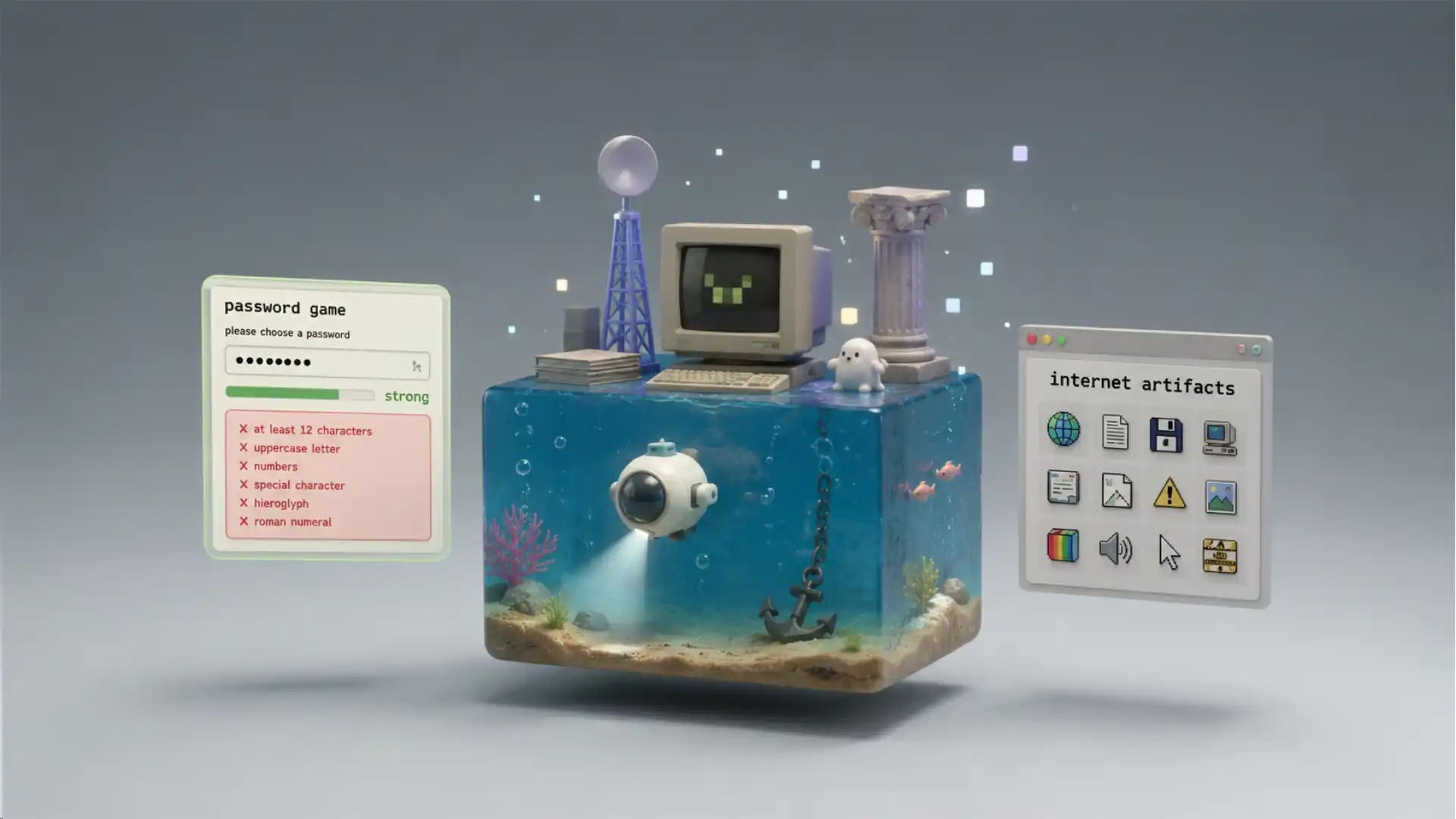
Open Neal.fun and the first strange thing is what is missing. There is no onboarding ceremony, no account wall, no productivity promise, no “book a demo”, no forced feed, no artificial scarcity timer blinking at you from the corner. There is just a grid of odd little doors: Internet Roadtrip, Stimulation Clicker, Infinite Craft, Internet Artifacts, The Password Game, The Deep Sea, The Size of Space, Spend Bill Gates’ Money, Baby Map. Neal Agarwal’s own home page describes it in the plainest possible way: “This is where I make stuff on the web.” The site currently presents itself exactly like that, as a place where one person keeps placing experiments on a shelf and letting strangers wander in.
Table of Contents
That plainness matters because neal.fun feels like a site made before the web became ashamed of being a site. It is not embarrassed to be clicked. It does not pretend that every interaction must become a subscription, a dashboard, a funnel, a social graph, or a personal brand flywheel. It behaves like a box of objects found in someone’s room: some funny, some smart, some useless in the best sense, some surprisingly careful, some built around a single joke that goes further than it has any right to go. The effect is not nostalgia, exactly. It is sharper than that. It reminds you that the browser is still a weirdly powerful toy.
Neal.fun’s best trick is that it rarely asks you to admire the idea from a distance. It asks you to do something small immediately. Scroll down into the ocean. Combine water and fire. Try to draw a perfect circle. Launch an asteroid into a city. Touch old internet artifacts. Build a password so overburdened with rules that it becomes a tragicomic endurance test. These pages do not announce themselves as “interactive experiences,” even though that is what they are. They feel more like a friend saying, “Try this,” then stepping back while you lose eight minutes.
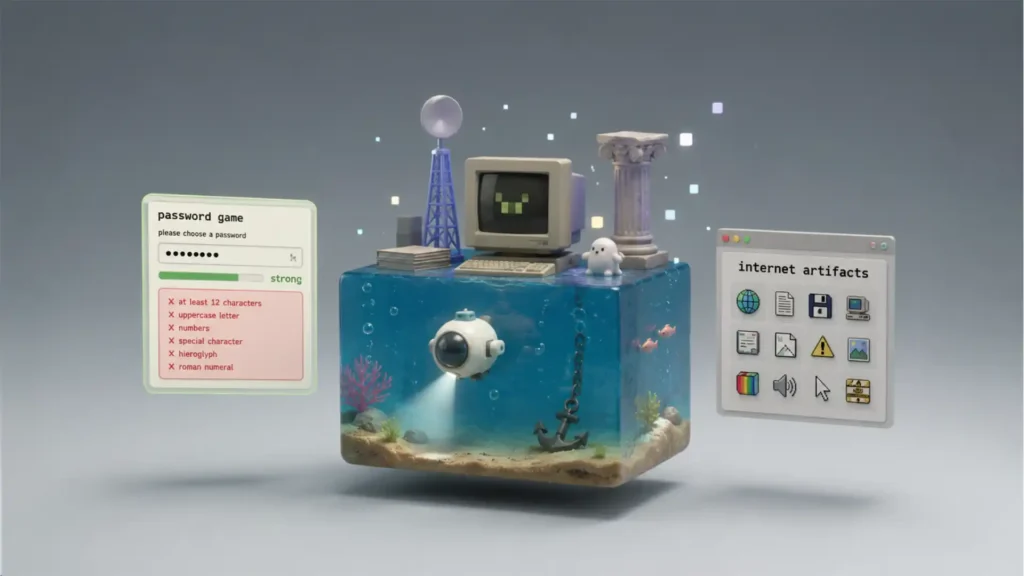
The user’s instinctive description is right: the whole site is a gold mine. Not because every page is equally grand, or because each experiment is polished in the same way, but because the collection has a recognizable taste. Neal.fun is built around curiosity as a behavior, not curiosity as a slogan. The reward is the act of opening things. The site is full of little invitations that look unserious until you notice how much design judgment sits behind them. A project like The Deep Sea is educational without sounding like homework. A project like Internet Artifacts is a museum without the museum voice. A project like The Password Game is a joke that turns into a mirror.
There is a business-shaped shadow around almost every modern web product. Neal.fun is interesting because it feels allergic to that shadow, even when the site itself has practical support links and exists in the real economy. The home page includes a newsletter, contact address, privacy policy, social link, and a “Buy me a coffee” link. Past reporting has also described neal.fun as a project that became Neal Agarwal’s full-time work. None of that ruins the feeling. The important thing is that the site does not make the visitor feel like inventory. It does not open by asking what role you have at your company. It opens with toys.
Neal Agarwal’s own portfolio page calls him “a developer with a passion for creative coding” and says he loves pushing the limits of the web while making fun digital experiences. That phrase could sound bland on a résumé, but neal.fun gives it teeth. The proof is not a statement of intent. The proof is the body of work: dozens of pages that treat HTML, CSS, JavaScript, animation, scrolling, game logic, maps, scale, absurdity, and memory as material. The web is the canvas, but also the joke, the stage, the measuring tape, the museum case, the stress test, and the punchline.
A site that behaves like a toy shelf
The Neal.fun home page has one of the rarest moods on the internet: it trusts thumbnails. It does not drown the visitor in explanation. It does not rank the projects with aggressive badges. It does not force a recommendation engine to guess your mood. It shows a large cabinet of things and lets the names do enough work: Internet Artifacts, The Password Game, Asteroid Launcher, Absurd Trolley Problems, Printing Money, Where does the day go?, Draw Logos From Memory. The titles are short, readable, and often funny before the page even loads.
That toy-shelf feeling is not random. Each project has a clean promise that can be understood in one glance. The Deep Sea lets you scroll down through the ocean. The Size of Space shows scale in the cosmos. Spend Bill Gates’ Money turns billionaire wealth into an absurd shopping interface. The Password Game makes password rules mutate into madness. Internet Artifacts turns web history into objects you can touch. Even when the execution becomes complex, the doorway remains simple. That simplicity is part of the craft.
The site also has a rare respect for the browser as a physical space. Scrolling is not treated as a boring navigation leftover; it becomes the mechanic. In The Deep Sea, scrolling downward is not a metaphor for depth. It is depth. The page uses the most ordinary gesture on the web and makes it feel bodily again. The deeper you go, the more the screen becomes a pressure chamber. The tiny action of moving your finger or mouse wheel becomes the whole point.
That is why neal.fun often works better than slicker, more expensive web productions. The projects usually begin with one strong interaction and refuse to bury it. A large studio might turn The Deep Sea into a cinematic microsite with menu overlays, loading copy, ambient voiceover, share prompts, and branded chapter cards. Neal.fun lets the scroll do its job. You keep descending. Creatures appear. Human markers appear. The ocean becomes stranger. The page understands that restraint can make a cheap interaction feel expensive.
The same shelf contains jokes that are less educational but just as revealing. Absurd Trolley Problems understands that a meme can become a design system. The premise is old: would you pull the lever? Neal’s version keeps escalating until moral reasoning collapses into comic exhaustion. The pleasure is not only the question. It is the rhythm of repetition, the way a serious philosophical format becomes a slot machine of awful trade-offs. The page does not need an essay attached. It makes the argument by making you click.
The toy shelf also avoids the self-importance that often ruins “creative coding” showcases. Neal.fun does not frame every sketch as art with a capital A. Some projects are silly. Some are tiny. Some are blunt. Some are made around a single visual gag. That range protects the site from becoming precious. You are allowed to like a page because it made you laugh, not because it “interrogates” something. The work has intelligence, but it does not demand that the visitor kneel before it.
This is where the site’s design taste becomes visible. Neal.fun understands the difference between low-friction and low-effort. The pages are easy to enter, but they are not careless. The best ones contain research, edge-case thinking, pacing, illustration, sound, animation, copy, and an ending. They feel loose because the interface does not lecture. Under the surface, the structure is often tight. The visitor receives the fun before noticing the labor.
The official index also shows how wide the field has become. Neal.fun is not one viral game with a few leftovers attached; it is a long-running cabinet of web experiments. The home page lists dozens of projects, from older entries like Spend Bill Gates’ Money and Baby Map to newer and heavily circulated works like Infinite Craft, Internet Artifacts, Stimulation Clicker, and Internet Roadtrip. The collection matters because the site’s identity comes from accumulation. One page can go viral. A shelf becomes a worldview.
That worldview is simple but not shallow: the web is still a place where a single page can be enough. A single-page project does not need a login system to justify itself. It does not need daily active users to be worth making. It does not need a roadmap. It can arrive, do one thing, and become a memory. Neal.fun keeps proving that the web’s smallest unit of delight is not the platform. It is the page.
The trick is patience, not polish
The Deep Sea may be the cleanest example of Neal Agarwal’s design patience. The concept sounds almost too obvious: scroll down through the ocean and see what lives at different depths. Many creators would ruin it by trying to add too much. Neal’s version understands that the idea already has gravity. The page begins at the surface and turns depth into distance. You move through swimmers, divers, animals, shipwrecks, zones, facts, and finally the deep trenches where the ocean feels less like scenery and more like another planet.
The page’s emotional power comes from pacing. It lets the visitor feel scale rather than merely read scale. Numbers on their own flatten the imagination. Saying that the Titanic rests at about 3,800 meters is one kind of fact; making the visitor scroll past ordinary marine life, past the average ocean depth, past increasingly hostile conditions, then arrive at that marker is another experience entirely. The information becomes spatial. You do not just know the distance. You have traveled it with your hand.
The Deep Sea also shows Neal’s ability to mix wonder with a little dread. The page is cute enough to invite children and eerie enough to unsettle adults. There are illustrated creatures with charming names, but the deeper facts become colder: near-freezing temperatures, extreme pressure, sparse life, lost probes, submarines, the Hadal Zone, and the Trieste descent into Challenger Deep. The official page notes that Don Walsh and Jacques Piccard reached the deepest point in the ocean on January 23, 1960, after a cramped and dangerous descent. It is a children’s poster that slowly becomes a survival story.
That mix is hard to fake. Educational web pages often mistake clarity for cheerfulness. Neal.fun does not. It can be readable without sanding away strangeness. The deep ocean is not made friendly; it is made legible. The visitor learns because the page lets the subject keep its alien quality. The creatures are presented with enough charm to keep you scrolling, but the darkness keeps coming. By the time the page mentions that more people have been to the Moon than the Hadal Zone, the comparison feels earned.
The Password Game works through the opposite emotional curve. It begins as a joke about bad password rules and becomes a tiny horror story about systems that forget humans exist. The official page describes it as a game that tests password strength, patience, and “your will to live.” That line is funny because the game’s cruelty is procedural, not loud. Rule follows rule. Each condition collides with the old ones. Your password becomes a nest of contradictions. The joke is that every requirement seems reasonable when isolated, then monstrous in a stack.
The Password Game became widely discussed because it turns a familiar annoyance into escalating theater. Anyone who has created an account has met the dull cousin of this game: a form that demands uppercase letters, symbols, numbers, length, maybe a forbidden substring, maybe a rotation policy invented by someone who no longer works there. Neal exaggerates the pattern until the absurdity becomes visible. The page is not merely “about passwords.” It is about the small violence of interfaces that keep adding rules without asking what the total experience becomes.
Business Insider reported that The Password Game had passed 10 million page views after its June launch, a useful clue to why the project spread so quickly. The joke required no niche literacy. Everyone knows the feeling. The page also had the quality of a dare. You did not just share it because it was funny. You shared it because you wanted someone else to suffer elegantly. That is a powerful distribution engine, but it does not feel like growth hacking. It feels like schoolyard folklore with JavaScript attached.
Internet Artifacts is quieter, but it may be the most editorially interesting of the three. It turns old web history into a museum where the glass is deliberately thin. The official page opens with the instruction “You may touch the artifacts,” then presents a catalog that begins with a 1977 ARPANET map and moves through the first spam email, the first recorded internet smiley, The Hacker’s Dictionary, Usenet, the Morris Worm, early memes, web communities, games, and platform landmarks.
The brilliance of Internet Artifacts is that it treats the early internet as material culture, not just trivia. A map, a spam email, a smiley, a dictionary, a browser window, a Flash game, an old homepage: these are not only facts in a timeline. They are artifacts because they carry behavior. People were learning how to joke, annoy each other, build status, make identity, share files, waste time, gather in forums, perform talent, and break machines. Neal’s framing turns internet history into a series of objects you can almost hold.
Internet Artifacts also has a sly respect for bad ideas. It understands that web history is made of breakthroughs and nuisances tangled together. The first spam email belongs next to the first smiley because both are part of the same messy medium. Million Dollar Homepage belongs next to “Me at the Zoo” because both show the web learning how attention works. The Impossible Quiz belongs next to Line Rider because play was not decoration on the old web; it was infrastructure for memory.
The page does not flatten everything into celebration. Its best entries have the mood of a curator who still remembers clicking stupid links for fun. That is a rare combination. Many internet-history projects become either reverent archives or sneering nostalgia tours. Internet Artifacts has affection without becoming syrupy. It knows old web culture was brilliant, ugly, annoying, handmade, crude, generous, exploitative, funny, and fragile. The format gives those contradictions room without forcing a thesis onto every object.
What to open first
| Project | First feeling | Why it works |
|---|---|---|
| The Deep Sea | Quiet wonder | Scrolling becomes distance |
| Internet Artifacts | Playable memory | History becomes touchable |
| The Password Game | Comic suffering | Bad interface logic becomes a game |
| Infinite Craft | Open-ended tinkering | Combination becomes discovery |
| Asteroid Launcher | Dark curiosity | Scale becomes consequence |
The table matters because neal.fun is not best understood by genre. Some pages are games, some are visualizations, some are jokes, some are museums, and some are toys with no neat label. The stronger pattern is how each page converts a familiar web action into a feeling: scrolling, clicking, typing, dragging, choosing, combining, comparing, waiting.
Three doors into the maze
The Deep Sea, Internet Artifacts, and The Password Game make a useful triangle because they show the three strongest modes of neal.fun: wonder, memory, and frustration turned into play. Wonder is the easiest to admire. Memory is the most culturally rich. Frustration is the funniest because it steals energy from bad software and gives it back to the visitor as comedy. Together they explain why the site does not feel like a random heap of browser toys. It feels like one person testing what a webpage can still do.
The Deep Sea is the purest “open this now” recommendation. It works because it respects the reader’s curiosity before asking for attention. The page does not front-load an explanation of ocean zones. It lets you descend. It introduces facts at the moment when they become spatially interesting. An animal appears where it belongs. A shipwreck appears where the depth begins to feel impossible. A historical note appears after the visitor has earned enough distance to care. Good interactive education often depends on this timing: the fact arrives exactly when the body wants it.
A weaker version of the idea would show a diagram. Neal’s version makes the diagram happen over time. That shift sounds small, but it changes everything. The visitor is not looking at scale from outside. The visitor participates in scale through a repetitive action. The experience has a beginning, middle, and bottom. It is linear, but not dead. You control the descent, yet the page controls the pacing of discovery. That balance gives the site its calm power.
Internet Artifacts works differently because the material already carries cultural charge. People bring memories to old web objects. Even visitors too young to remember ARPANET, Usenet, early Flash, Newgrounds, or dial-up still recognize the feeling of discovering that the internet once had different rules. The page’s instruction that you may touch the artifacts is more than cute copy. It announces a curatorial philosophy. A static screenshot says, “Look what existed.” A touchable artifact says, “Try to understand the behavior this thing produced.”
That behavior is the real subject. Internet Artifacts is less about old websites than old permissions. The old web was not innocent, but it did give individual weirdness more visible room. A strange page could sit alone. A game could spread through computer labs. A homepage could be ugly and still alive. A joke could become a destination. A sound file, a fake portal, a quiz, a crude animation, or a pointless web toy could become part of a shared memory without first becoming content for a platform’s retention machine.
The Password Game, by contrast, lives in the present tense. It does not mourn an old web; it makes the current web look ridiculous. Password rules are a perfect target because they are both serious and absurd. Security matters. Bad password habits matter. But the user experience around account creation has long been full of arbitrary demands, hostile wording, and rules that seem built by committee. Neal does not write a complaint. He builds the complaint as a trap. You enter willingly, then the rules multiply.
The game’s comedy depends on escalation, but its deeper joke is administrative. Each new rule behaves like a tiny policy decision. None of them apologizes. None of them cares that the old rules are still active. The interface becomes a miniature institution, and the player becomes a tired citizen trying to comply. That is why the game feels bigger than passwords. It captures the emotional texture of dealing with systems that reward obedience while constantly changing the conditions of obedience.
This is where Neal.fun becomes more than a collection of amusing links. The site often uses play to reveal the hidden shape of ordinary internet behavior. The Deep Sea reveals scale by making the scroll heavy. Internet Artifacts reveals history by making old objects interactive. The Password Game reveals interface cruelty by making compliance impossible enough to become funny. These are not lectures. They are felt arguments.
A good neal.fun page usually has a clean verb. Scroll, touch, type, launch, draw, spend, combine, choose. That verb does more than drive the interface. It defines the thinking. Spend Bill Gates’ Money works because spending is the verb. Asteroid Launcher works because launching is the verb. Draw a Perfect Circle works because drawing is the verb. The user does not need to study instructions because the page has already compressed its promise into an action.
The verbs are also why the site travels so well. Neal.fun pages are easy to describe aloud. “There’s a site where you scroll to the bottom of the ocean.” “There’s a game where password rules keep getting insane.” “There’s a museum of old internet artifacts you can touch.” “There’s a game where you combine elements into anything.” That sentence-level portability is underrated. The web’s great rabbit holes often spread because one person can summarize them to another in ten seconds without killing the magic.
That portability does not mean the pages are shallow. A simple pitch can hide careful sequencing. The Deep Sea has to decide which creatures, facts, and markers appear when. Internet Artifacts has to choose which fragments of web history deserve artifact status. The Password Game has to tune the cruelty so that failure stays funny instead of merely annoying. Infinite Craft has to make combination feel endless without immediately becoming mush. A playful page is often most fragile at the point where it seems easiest.
Why this still feels rare
Neal Agarwal wrote in 2020 about a “Weird Web” that had been shaped by Flash, games, interactive visualizations, and strange personal creations, then weakened as social platforms absorbed attention. That argument still explains why neal.fun feels like a relief. The web did not stop being technically capable. The browser became more powerful. What narrowed was the common imagination of what a public-facing web page should be. Too many pages became delivery mechanisms for conversion, extraction, or feed behavior.
The old Flash web had plenty of junk, but it made room for projects whose only obvious purpose was delight. Neal has spoken about growing up with that era, when Flash games and odd animations made the internet feel like a strange public playground. In a 2019 interview with It’s Nice That, he described the decline of Flash and the rise of social media and mobile apps as part of why the web felt less weird. His stated goal was to explore what the modern web could do.
That last part is important. Neal.fun is not asking to go back to 2006. It uses modern web capabilities, modern distribution, modern browser performance, and modern cultural references. Infinite Craft could not be mistaken for a preserved Flash game. The Password Game belongs to the age of account fatigue, captchas, online security rituals, and viral puzzle sharing. Internet Artifacts is explicitly historical, but its interface is contemporary. The site’s nostalgia is selective. It wants the permission structure of the old web, not the technical limits.
The permission structure is the real loss. A person used to be able to make a weird page and let the page be the thing. The page did not have to become a content strategy. It could sit at its own address. It could be ugly, funny, confusing, tiny, personal, unfinished, or excessive. It could spread through blogs, email, forums, chats, classrooms, and sheer word of mouth. It could be discovered rather than served. Neal.fun preserves that pattern inside a modern, polished shell.
Many people now meet the web through platforms that punish wandering. Feeds are built to hold attention, not reward curiosity. The difference sounds subtle until you feel it. A feed gives you endless novelty while keeping you in the same room. Neal.fun gives you finite doors and lets each one lead somewhere with its own rules. A feed makes discovery passive. Neal.fun makes discovery voluntary. You click because a title catches you, not because an algorithm has already sorted your weakness.
The site also refuses the careerist stiffness that clings to so much independent creative work online. Neal.fun is not busy proving that Neal Agarwal is a thought leader. It is not wrapped in threads about process, lessons, metrics, or founder wisdom. The projects do the talking. Neal’s personal portfolio is brief. His Uses This interview from 2019 calls neal.fun a site where each page is “a different creative exploration,” which remains one of the most accurate descriptions available.
That restraint is part of the charm. The site does not over-explain its own cultural value. It could. There is a serious argument to make about the independent web, creative coding, education, interface satire, post-Flash culture, and browser-native play. But the site keeps those arguments mostly embedded in the work. It behaves like someone who knows the best case for play is play itself.
At the same time, neal.fun is not naïve. It understands shareability without becoming cynical. The projects are crisp, legible, and often viral by design in the honest sense: they produce moments that people want to pass along. The Password Game is shareable because it is ridiculous to suffer alone. The Deep Sea is shareable because awe is social. Internet Artifacts is shareable because memory wants company. Infinite Craft is shareable because discoveries feel like trophies. This is distribution through human impulse, not dark-pattern plumbing.
That difference gives the site an ethical texture. Neal.fun wants your attention, but it does not seem to resent your leaving. Most pages are finite or self-contained. You can play, learn, laugh, fail, share, and go. There are no streaks demanding loyalty. No guilt copy. No manipulative countdown. No artificially wounded mascot asking why you have not returned. The site is sticky because it is good, not because it punishes absence.
The irony is that this generosity may be exactly why the site keeps spreading. People remember places that do not make them feel used. A web toy that gives you a clean laugh or a real sense of scale can earn more affection than a platform that spends millions tuning engagement loops. Neal.fun benefits from being memorable rather than merely retentive. It leaves residue. Someone who played The Deep Sea years ago can still describe it. Someone who fought The Password Game can still feel the irritation in their fingers.
The taste of a one-person web
Calling Neal.fun a one-person project is not just biographical trivia. It explains the site’s coherence. The pages vary wildly in subject, but they tend to share a sense of proportion, humor, and pacing. A committee can make interactive content. A company can make polished microsites. But Neal.fun has the feel of a private idea list slowly made public. The range is too odd to be a strategy deck. The consistency is too strong to be accident.
Neal Agarwal has described neal.fun as his main work, and his older Uses This interview says he spent most of his time working on it even in 2019. That long attention gives the site a diary-like quality without becoming personal writing. You are not reading Neal’s private thoughts. You are watching a particular curiosity move from topic to topic: money, scale, maps, logos, time, moral dilemmas, web history, password rules, street views, space, ocean depth, random facts, and the absurd rituals of online life.
The one-person quality also shows in what the site does not include. There is no house style forced onto every idea. Some projects are flat and simple. Some are lush. Some lean into illustration. Some are almost spreadsheet-like. Some feel like games. Some feel like interactive posters. This looseness would be hard to justify inside a brand system, but it makes perfect sense inside a personal workshop. The idea chooses its clothes.
A useful comparison is a good independent record label. You may not like every release, but you trust the ear. Neal.fun earns that kind of trust. When a new project appears, the question is not “Will this be useful?” The question is “What did he notice this time?” That is a rarer relationship than ordinary fandom. It turns the creator into a guide through possible uses of the browser.
The site’s humor also feels one-person in the best way. It has recurring instincts without becoming a formula. Neal likes scale gaps: billionaire money against normal spending, ocean depth against human bodies, space objects against everyday intuition, asteroid damage against maps. He likes absurd bureaucracy: password rules, trolley choices, internet debates, fake product design logic. He likes tactile history: artifacts, old interfaces, remembered web objects. He likes simple premises that grow teeth. These are not random viral hooks. They are taste patterns.
Taste is the word worth using because Neal.fun succeeds through selection as much as execution. Internet Artifacts could have included hundreds of entries, but the power comes from picking objects that tell a compressed story. The Deep Sea could have buried the visitor in marine biology, but it chooses facts that carry feeling. The Password Game could have become pure chaos too quickly, but it stages its cruelty. Good taste is knowing what not to include before the joke collapses.
That editorial restraint separates Neal.fun from many “fun websites” lists. The site is not a landfill of distractions. It is a collection of finished web objects with recognizable premises. Even the silly pages usually have a clean internal logic. The visitor does not feel dumped into content. The visitor feels invited into a small room where one rule has been made strange.
This is also why the site appeals to designers, developers, writers, teachers, bored office workers, students, and people who simply miss being surprised online. Neal.fun offers different pleasures without asking visitors to identify as a niche. A developer may admire the implementation. A designer may admire the pacing. A teacher may use The Deep Sea to make scale legible. A writer may admire the titles and jokes. A normal tired person may just want to launch an asteroid. The site does not care which door you use.
There is a lesson here for anyone making things on the web, but it is not the usual “be more playful” advice. The sharper lesson is to make the premise carry the weight. A strong neal.fun page does not need a long pitch because the premise already contains the action, the audience, and the emotion. “Scroll down the ocean” contains wonder. “Make a password under absurd rules” contains frustration. “Touch internet artifacts” contains memory. “Spend Bill Gates’ money” contains inequality and comedy. The project starts working before the first click.
The site’s refusal to become a platform also matters. Neal.fun has community around it, but the pages themselves are not trying to turn users into unpaid moderators or content suppliers. Infinite Craft has discovery culture, The Password Game has shared suffering, and Internet Roadtrip suggests collective wandering, but the site’s center remains authored. That authorship gives the pages shape. The visitor is not asked to produce endless content to keep the machine alive. The visitor is asked to play with a crafted object.
That authored quality feels almost radical now because so much of the internet has become an argument for scale over shape. Bigger networks, larger content pools, more posts, more creators, more metrics, more automation. Neal.fun makes the opposite case by example: one well-shaped page can still travel farther than a warehouse of filler. A single interaction with a clear soul can beat a thousand generic posts fighting for scraps of attention.
The web museum that lets you touch the glass
Internet Artifacts deserves special attention because it explains the emotional foundation under the whole site. Neal.fun does not only make playful web objects; it remembers the web as a place where playful web objects mattered. Internet Artifacts is a museum of that memory, but it avoids the deadening tone of a timeline. It does not say, “The internet used to be interesting.” It lets old pieces of online culture flicker again.
The official catalog starts in 1977 with a map of ARPANET, then moves into spam, smileys, hacker language, Usenet, worms, chain letters, early culture, homepages, viral clips, Flash games, early platforms, and social web moments. The range is broad enough to show that the internet was never one thing. It was infrastructure, research network, prank machine, social club, sales channel, playground, archive, performance venue, and rumor mill. The artifacts make that mess visible.
The most interesting curatorial choice is that Internet Artifacts treats annoyance as history. Spam gets a pedestal. Chain letters get attention. Broken logic, viral nonsense, and time-wasting games belong in the same story as technical breakthroughs. That is right. A history of the web that only honors noble inventions would miss the medium’s actual texture. People did not fall in love with the internet only because it connected information. They fell in love with it because it connected weirdness.
The old web was full of rough edges, and Internet Artifacts keeps enough of that roughness to avoid turning memory into décor. The entries are not all beautiful. Some are crude. Some are embarrassing. Some are funny because they are ancient by internet standards. The point is not that everything was better. The point is that the web once made more room for artifacts that looked like they came from a specific person, group, joke, accident, subculture, or moment.
That point connects directly to Neal.fun’s broader body of work. The site is both a product of the modern web and an argument against the flattening of the modern web. It uses clean design, responsive pages, current browser tech, and viral circulation. But it fights the feeling that every page must look like software-as-a-service marketing or feed-native content. It keeps making objects. A neal.fun page is not a post about an idea. It is the idea.
Business Insider’s 2023 profile framed Agarwal’s work as an attempt to revive a messier, more unpredictable internet, and the article singled out Internet Artifacts as a project that made early web relics experiential again. That framing fits because Neal.fun’s nostalgia is active, not decorative. It does not merely mourn the old weird web. It builds new weird web pages that can stand beside the artifacts rather than simply admire them.
Agarwal’s own 2020 essay for It’s Nice That argued that modern web technology had become powerful enough for a new wave of strange, interactive work. Neal.fun is persuasive because it behaves like the answer to that essay. Instead of treating the weird web as a lost era, it treats it as a medium still available to anyone willing to make something specific. The browser did not die. The cultural permission weakened. Neal.fun keeps borrowing it back.
Internet Artifacts also helps explain why The Password Game does not feel like a random viral gag. Both projects are about online rituals. One preserves the rituals of early internet culture: the first spam, the first smiley, the early games, the strange pages that trained people how to behave online. The other satirizes a current ritual: account creation under hostile password rules. The timeline has moved, but Neal’s interest remains similar. What do people do on the web because the web taught them to do it?
The Deep Sea may seem unrelated, but it shares the same respect for the page as an object. It could exist only as a page, and that is its strength. A video of the same journey would be less intimate because the scroll would disappear. A static poster would be less dramatic because the pacing would collapse. An app would be too heavy for the idea. The browser is not merely the container. The browser gesture is the work.
That is why neal.fun is such a clean Web Radar subject. It is not just worth opening; it changes the reader’s memory of what “opening a website” can feel like. Many recommendations are useful because they solve a problem. Neal.fun is useful in a different way: it repairs a small expectation. It reminds the visitor that the open web can still surprise without demanding commitment. You can still type a URL and find a room someone made because the room was worth making.
The quiet rebellion of not needing a reason
The most generous thing about Neal.fun is that many of its pages do not need a practical defense. This should not feel rebellious, but it does. So much of the internet now arrives wrapped in justification. A tool saves time. A platform builds audience. A newsletter makes you smarter. A service improves workflow. A creator teaches you how to grow. Neal.fun often gives you a stranger proposition: here is a thing that exists because someone followed an interesting idea to the end.
That does not mean the pages lack use. Their use is often emotional, educational, or cultural rather than transactional. The Deep Sea teaches scale. The Size of Space teaches scale in the other direction. Internet Artifacts teaches memory. The Password Game teaches irritation as critique. Printing Money makes money flows visible. Life Stats personalizes statistical imagination. Wonders of Street View turns maps into wandering. These are real uses, but they do not feel like chores.
The site’s language supports that mood. The titles sound like invitations, not features. The Deep Sea. The Size of Space. Draw a Perfect Circle. Spend Bill Gates’ Money. Who Was Alive? Where does the day go? Let’s Settle This. These names are not stuffed with keywords. They are not trying to win a search result with awkward phrasing. They sound like pages you would find through a friend, which is partly why they become pages people share with friends.
A page like Draw a Perfect Circle shows how small the premise can be. Try to draw a circle, receive a score, try again. That is enough. The appeal is immediate because the task is both childish and impossible to perfect. It turns a universal gesture into a personal challenge. You do not need lore. You do not need a tutorial. You know what a circle is. Your hand betrays you. The page becomes funny through precision.
Asteroid Launcher uses a darker version of the same clarity. Pick an asteroid, aim it at a place, see the consequences. The premise is morbid, but it also gives scale a brutal interface. Abstract disaster becomes local. Size, speed, angle, and material stop being numbers in a vacuum. The page understands that simulation can create seriousness without solemnity. It lets curiosity approach the awful, then makes the numbers harder to ignore.
Spend Bill Gates’ Money is one of Neal’s older and most legible hits because it turns wealth inequality into interface comedy. A shopping cart is familiar. A billionaire budget is not. The gap between those two things becomes the joke. You click through absurd purchases and discover that even extravagant spending barely dents the number. The page does not need to scold. The interface produces the discomfort. That is often Neal.fun at its best: the page lets you reach the point yourself.
The same design instinct appears in Printing Money. Money becomes visible by becoming motion. Instead of asking the visitor to compare giant figures in a table, the page turns earnings and spending rates into a flow. It gives abstraction a tempo. A normal hourly wage and a corporate or government-scale flow no longer sit in the same mental category. The visitor feels the mismatch because the page has made time carry the comparison.
These projects show why “pure playfulness” is not the same as triviality. Play is often how Neal.fun sneaks difficult scale into the body. Money, time, depth, space, risk, mortality, history, bureaucracy: these subjects can become stiff quickly. Neal’s pages give them handles. A visitor can grab the idea through an action before the seriousness hardens into homework.
There is also a craft lesson in the site’s endings. Many neal.fun pages know when to stop. The Deep Sea has a bottom. The Password Game has a victory condition, even if most players may never see it. Internet Artifacts has a catalog. A perfect circle has a score. Spend Bill Gates’ Money has the exhaustion of the budget. The pages do not always try to become infinite systems. Even Infinite Craft, which leans into endless combination, begins from a clear foundation and a simple act.
This respect for endings makes the site feel healthier than most entertainment feeds. Finite play leaves a cleaner aftertaste. You may stay longer than planned, but the page is not built as a bottomless pit. It is built as an object with rules. When you leave, you leave with a memory rather than a fog. That difference is small but real. It is the difference between eating something strange at a market and realizing you have been chewing algorithmic gum for an hour.
The site is also funny because it respects the visitor’s intelligence. It does not explain every joke until the joke dies. A page like Share This Page, which invents absurd ways to share the page through services and situations, works because it commits to the bit. Let’s Settle This works because it treats dumb internet arguments with mock civic gravity. The Password Game works because the rules arrive with straight-faced authority. Neal.fun’s humor often comes from taking a stupid premise seriously enough.
That seriousness is where the polish hides. A joke page fails if the timing is sloppy. The copy must be short. The interface must respond quickly. The visuals must not distract from the bit. The reveal must land before patience runs out. The escalation must continue but not blur. Neal.fun’s best pages look easy because the visitor never has to think about the scaffolding. The scaffolding is doing its job by staying out of the way.
Small questions worth asking
The cleanest answer is that it is a site of web toys, and that phrase is stronger than it sounds. A toy can teach, joke, test, simulate, preserve, or provoke without needing to fit a software category. Neal.fun’s official home page lists games, visualizations, interactive jokes, museums, maps, and experiments side by side, which is exactly why the site feels alive.
Anyone tired of the web behaving like a set of chores should start with The Deep Sea, Internet Artifacts, or The Password Game. Designers and developers will notice the economy of the interactions. Writers will notice the sharpness of the premises. Teachers may find The Deep Sea and The Size of Space useful for scale. People with no professional interest in the web may simply enjoy the feeling of stumbling into something odd and well made.
Not literally, and that is good. The old web came with dead plugins, broken accessibility, security messes, ugly hacks, and plenty of garbage. Neal.fun points toward something better than revivalism: a modern web that recovers the old permission to make strange standalone things. Agarwal’s own writing about the Weird Web argues for a new wave of web creativity built with modern tools rather than a museum-only return to Flash-era culture.
Because a page with a strong premise creates a different kind of attention. A platform gives you endless material with weak edges. Neal.fun gives you specific objects with memorable shapes. You do not remember every minute you spend in a feed. You do remember the first time you scrolled to Challenger Deep, watched password rules become deranged, or touched a recreated piece of early internet culture.
It has taste, timing, and a willingness to stop before everything becomes a platform. Neal’s own descriptions of his work are modest: a developer interested in creative coding, a site where each page is a different creative exploration. The work stays close to that modesty. It does not beg for seriousness. It earns attention through the pleasures of clicking, scrolling, typing, and discovering.
Neal.fun is not the only place where the web is still playful, but it is one of the clearest arguments that play still belongs at the center of the medium. The site rewards the old behavior that made the web feel huge before platforms made it feel endless: following a link because the link looks odd. That small act used to be enough to find a world. On Neal.fun, it still is.
Author:
Jan Bielik
CEO & Founder of Webiano Digital & Marketing Agency
This article is an original analysis supported by the sources cited below
Neal.fun
The official home page for Neal Agarwal’s collection of web games, visualizations, toys, and interactive experiments.
Neal Agarwal
Neal Agarwal’s personal portfolio page, used for his own description of his creative coding work and selected projects.
The Deep Sea
Official project page for Neal Agarwal’s scrolling ocean-depth experience, including the deep-sea facts and credits cited in the article.
Internet Artifacts
Official project page for Neal Agarwal’s interactive museum of early internet culture and web history.
The Password Game
Official project page for Neal Agarwal’s password-rule puzzle game and its central premise.
Uses This interview with Neal Agarwal
A 2019 interview where Agarwal describes neal.fun as a site where each page is a different creative exploration.
Can the Weird Web make a comeback in 2020
Neal Agarwal’s essay for It’s Nice That about Flash, the Weird Web, and the possibility of a new wave of strange web creativity.
Creative coder Neal Agarwal on bringing the internet back to its weird days
It’s Nice That interview covering Agarwal’s early relationship with the web, Flash-era culture, and his goal of exploring what the modern web can do.
Can anyone save the internet? Neal Agarwal is trying, one Hampster Dance at a time
Business Insider profile used for context on Neal Agarwal’s public reception, Internet Artifacts, and The Password Game’s reach.
| Citing this article? Brief excerpts are welcome. Please credit Webiano.digital, name the author where stated, and include a link to https://webiano.digital and to this original article. Full or substantial republication requires prior written permission. Read our Copyright and Content Use Policy. |
This article was prepared with the assistance of artificial intelligence tools. The content underwent expert human review, and Webiano Digital & Marketing Agency assumes editorial responsibility for its final version and publication.