The strange charm of Pala Note is that it looks almost too quiet for the job it wants. It is a pocket-sized E Ink voice recorder that turns spoken thoughts into saved notes, but its real appeal is not the transcription alone. Plenty of apps already promise that. What makes this little object worth opening is the way it treats capture as a physical act again: press, speak, stop, move on. No glass rectangle. No app drawer. No notification stack waiting to eat the next ten minutes.
Table of Contents
Pala Note comes from Paul Lagier, a maker and designer whose recent work has circled around small, single-purpose E Ink objects. His earlier Pala One e-reader already showed a taste for tiny hardware with strict limits, and Pala Note pushes the same thinking into voice capture: a small thing in your pocket, built around the moment before an idea disappears.
The headline version is simple: Pala Note records your voice, stores audio locally, then transcribes it during Wi-Fi sync using AI. The less obvious version is more interesting. It is a small rebellion against the idea that every creative tool must become an app, and every app must become a platform, and every platform must become another place where your attention gets rearranged for someone else’s benefit.
That is why it belongs in Web Radar. Pala Note is not merely a gadget story; it is a taste story about the web and the devices around it. The project sits between maker culture, E Ink minimalism, personal knowledge management, and the new wave of AI transcription tools. It is not slick in the usual way. It is a designed object with a maker’s visible fingerprints still on it.
There is also a useful correction to make at the start. Pala Note does not appear to be sold as a finished mass-market recorder in the way a Plaud device or a normal dictaphone is sold. Lagier sells the 3D files, firmware, and build guide through Ko-fi, while the builder sources the hardware separately. Hackster reports the design files and guide at about $6.50, with the hardware costing roughly $30 more.
That matters because it changes the kind of object we are looking at. This is not a consumer product pretending to be simple; it is a DIY project trying to prove a simpler product should exist. The difference is important. A product asks whether you would buy it. A project asks whether the idea is strong enough that people might build it, copy it, improve it, or wish someone would manufacture it properly.
The best internet discoveries often live in that gap. They are not polished enough to be boring, and not rough enough to be invisible. Pala Note has that slightly dangerous energy. You can see the seams, the 3D-printed enclosure, the board choice, the maker logic. You can also see a product category forming around it: small tools for people who want AI assistance without dragging a phone into every thought.
The writing here follows a human, editor-led standard rather than a generic product-summary template. That matters for a project like Pala Note, because the interesting part is not a spec sheet. The interesting part is why a deliberately limited recorder feels fresh at the exact moment when general-purpose devices have become exhausting.
The recorder as a small act of refusal
A phone is technically the best voice recorder most people own. It has microphones, storage, cloud sync, apps, search, transcription, sharing, reminders, and every other digital convenience packed into one slab. Yet the same abundance is the problem. The phone is not a neutral capture device. It is a noisy room with a microphone in it.
Pala Note begins from a more honest observation: the best note-taking tool is often the one that does not ask you to enter another environment. Unlocking a phone feels small until you are trying to catch a line of thought that is still half-formed. Then the steps become absurd. Pick up the phone. Wake it. Authenticate. Find the right app. Decide whether to type or record. Notice a message. Dismiss it. See a badge. Remember another task. Lose the sentence.
This is the tiny disaster Pala Note tries to solve. A thought often needs capture before it needs organization. Too many tools reverse that order. They ask for folders, titles, tags, properties, templates, summaries, workspaces, databases, and destinations before the raw thought has even landed. Pala Note’s design says the first job is not productivity. The first job is not forgetting.
Lagier’s device turns that into a physical ritual. Press a button and speak. The device records to local storage. Later, during sync, the audio can be transcribed and surfaced through a minimal web interface. That division of labor is clean: capture now, process later. It respects the speed of a thought without pretending that every thought deserves a dashboard immediately.
The physical button is not a nostalgic detail. It is the entire interaction model compressed into one gesture. A button does not present alternatives. It does not upsell. It does not rearrange itself after an update. It does not ask whether you want to try the new workspace view. It gives you a known action under your thumb. For creative work, that reliability has real value.
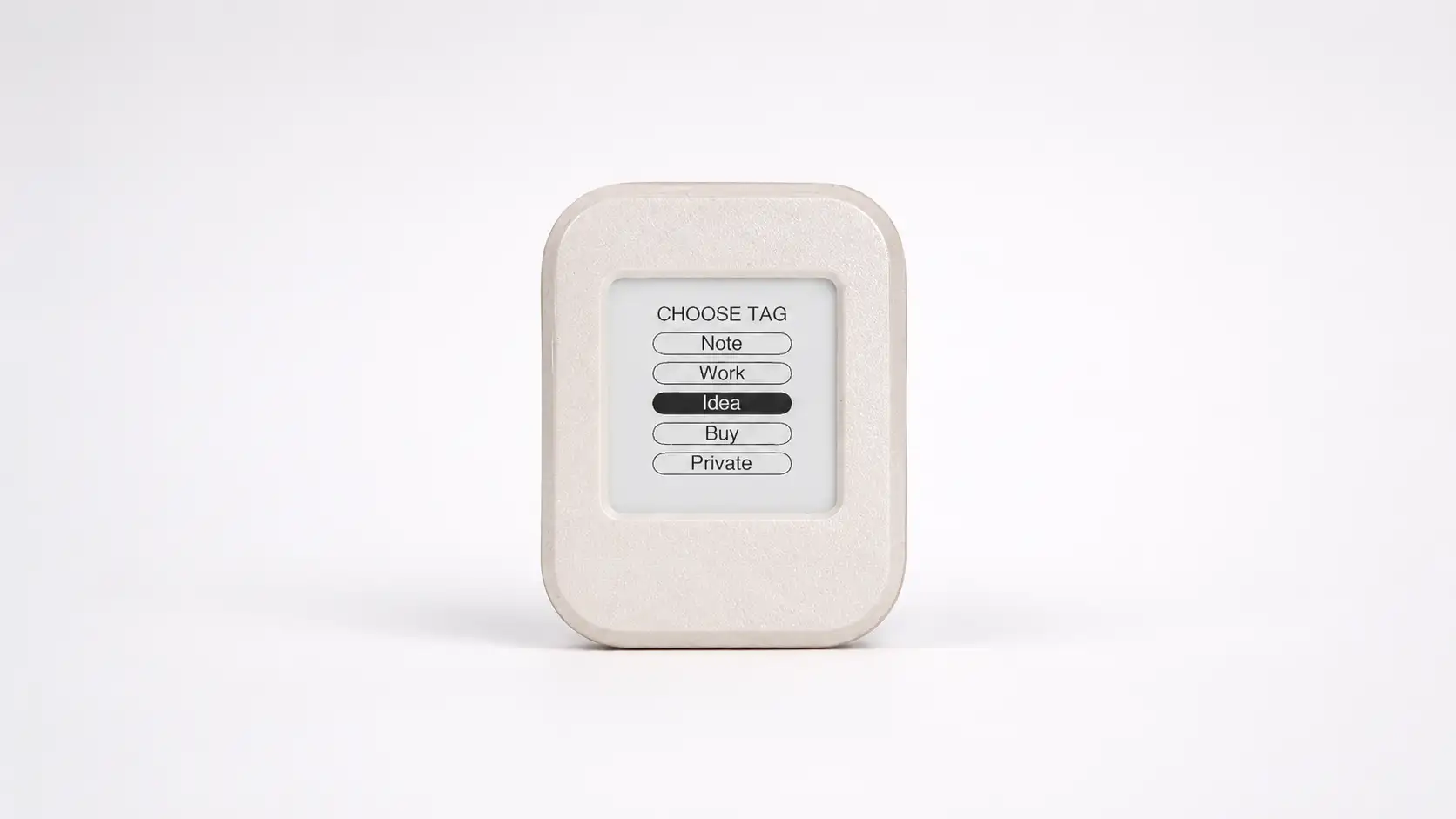
The E Ink display adds another layer of calm. E Ink does not glow, pulse, animate, or behave like a miniature billboard. It sits there. It updates slowly. It feels more like a label than a screen. On a recorder, that slowness is not necessarily a flaw. The device does not need to stream video or show a living feed. It needs to confirm enough state to be trusted: ready, recording, saved, syncing, done.
Hackster notes that the build uses a Waveshare ESP32-S3 1.54-inch e-Paper Development Board, plus a 500 mAh LiPo battery and SD card for mobile use. That board choice is revealing because it keeps the project close to maker reality: a compact development board with the right core parts already present, placed inside a custom printed case rather than hidden behind a supply chain fantasy.
The SD card matters as much as the screen. Local storage gives the recorder a sense of ownership that pure cloud-first tools rarely have. You speak, the file exists, and the device has it. The transcription step can come later. In a category filled with subscription AI note tools, the presence of local WAV files feels reassuringly concrete.
The device still uses cloud transcription, so this is not a privacy purist object. The ESP32 does not have the power to run serious speech recognition locally, so recordings are uploaded over Wi-Fi during sync and transcribed using OpenAI’s Whisper API, according to Hackster. The resulting text files are saved back to the SD card, and the device hosts a lightweight browser dashboard for browsing, organizing, and downloading notes on the same network.
That makes Pala Note more nuanced than the usual “AI gadget” pitch. It does not pretend that AI belongs everywhere on-device, nor does it turn the entire object into a cloud dependency from the first button press. It captures locally, then calls the network when the network is useful. That sequencing feels sensible. It also gives builders room to modify the transcription pipeline if they are comfortable doing so.
Boing Boing caught the cultural appeal neatly, pointing out that the project is built from available components and that people could adapt the transcription path if they prefer something else. That is one of the reasons DIY hardware can feel more honest than locked consumer hardware: the object is not just a product, it is a suggestion.
There is a delightful modesty in Pala Note’s ambition. It does not say it will organize your life, replace your notebook, become your second brain, schedule your week, or turn every mumbled thought into a finished plan. It records. It tags. It syncs. It transcribes. It gives you a way to pull the thought back later. That is already enough.
The refusal is not anti-technology. Pala Note is full of technology: E Ink, ESP32, Wi-Fi, local files, AI transcription, a small web interface. The refusal is against the bloated shape that technology usually takes. It wants the benefit without the whole circus. That is why the project feels current rather than retro.
Why this tiny thing feels made for creative minds
Creative work is often discussed as if the hard part is execution. For many people, the first hard part is capture. Ideas rarely arrive cleanly at a desk with a keyboard open. They arrive while walking, washing dishes, getting out of bed, waiting for coffee, leaving a meeting, avoiding sleep, or trying to do something else. The inconvenient timing is part of their nature.
A phone can catch those ideas, but it also changes the mental temperature around them. The moment you open a phone, the idea must compete with everything else the phone knows about you. That competition is not abstract. It is visible in badges, banners, app icons, search suggestions, unread counts, algorithmic feeds, and muscle memory. Many people unlock the phone to write one sentence and wake up three minutes later inside a completely different intention.
Pala Note’s value is that it lowers the ceremony of capture. It gives the idea a direct path from mouth to file. The act of speaking is messy, but it is fast. For rough ideas, speed is more important than elegance. You do not need a perfect sentence. You need enough of a seed that your future self can find the thought again.
Voice notes also preserve a texture that typed notes often lose. The hesitation, emphasis, pace, and weird phrasing of a spoken thought can reveal why it mattered at the time. A typed note may reduce an idea to a phrase that looks flat later. A voice note keeps the shape of the moment. Transcription then makes it searchable, but the audio remains the richer artifact.
This is why the playback speaker is not a trivial component. A small recorder that can play its notes back feels less like a blind capture box and more like a memory object. Hackster reports that Pala Note includes a microphone, SD card slot, and small speaker, with audio feedback helping compensate for E Ink’s slower refresh behavior.
That detail is easy to miss. Because E Ink refreshes slowly, sound becomes part of the interface. The user needs instant confirmation that a press registered or a recording started. A chirp, click, or tone can be faster than the screen. In a small device, the interface is not just what you see. It is what your hand and ear learn to trust.
The most interesting creative tools often have this quality. They become dependable through small sensory cues rather than through feature density. A notebook opens in a known way. A pen makes a mark instantly. A camera has a shutter. A recorder has a red light, a counter, a click, or a tone. Pala Note belongs to that older family of tools, even though it uses modern transcription behind the scenes.
Its size strengthens the idea. A device that is pocketable has a different relationship to thought than one that lives in a bag or on a desk. Pala One, Lagier’s earlier tiny e-reader, was praised precisely because it could be present when the urge to read appeared. The same logic fits Pala Note. The recorder must be available at the awkward moment, or it is mostly decorative.
The smallness also creates a useful constraint. A tiny E Ink recorder cannot become a laptop replacement without destroying its own point. That is a hidden advantage. The device’s limitations protect the user from the designer’s worst temptation: adding one more thing. In software, “one more thing” is cheap. In hardware, every addition has weight, cost, battery impact, enclosure consequences, interface cost, and new failure modes.
For writers, designers, product people, researchers, founders, students, and chronic idea-hoarders, Pala Note points to a more humane capture pattern. It separates the flash of thought from the later work of sorting it. Speak now. Clean later. That is a healthy division because ideas rarely arrive in database form.
The danger, of course, is that voice capture can become a landfill. A recorder that makes capture easy also makes accumulation easy. Anyone who has hundreds of unlabeled voice memos knows the feeling. The magic is not in recording everything. It is in lowering friction enough to catch what matters, while keeping review simple enough that the saved material does not rot.
Pala Note seems aware of that. The tag step after recording is a small but important concession to future retrieval. Hackster describes a flow where holding a button records audio to the SD card as a WAV file, and once recording ends, users can assign tags before the device returns to low-power sleep. That gives the note a little context without asking the user to perform full organization in the moment.
The web dashboard is also a smart compromise. The device itself remains minimal, while the browser handles browsing, organizing, and downloading. This is good product thinking. Tiny hardware should not become a tiny productivity suite. Let the small object capture. Let the larger screen manage. The user gets focus during capture and space during review.
That browser-based dashboard also places Pala Note in a long lineage of charming local web interfaces. There is something distinctly internet-native about a little object hosting its own tiny page on your network. It feels more personal than a big cloud account, more transparent than a black-box mobile app, and more hackable than a polished subscription service.
This is where Pala Note becomes more than a voice recorder. It is a small argument for tools that live at the edge of the web rather than entirely inside platforms. It uses Wi-Fi and AI, but it does not force the whole experience into a giant account-based ecosystem. The device remains the center of gravity. The web interface is there to serve it.
What Pala Note actually appears to do
| Part of the experience | What it means in practice |
|---|---|
| Physical button recording | Capture starts without opening a phone app |
| E Ink display | Low-power, calm status display rather than a glowing screen |
| SD card storage | Voice files are saved locally as recordings |
| Tagging after capture | Notes get light context before the device sleeps |
| Wi-Fi sync | Recordings can be processed after the capture moment |
| AI transcription | Speech becomes searchable text through cloud processing |
| Browser dashboard | Notes can be browsed and downloaded from a computer |
This compact setup explains the appeal better than a long feature list. Pala Note is not trying to win by doing more than a phone; it wins by asking less of you at the exact moment when attention is fragile.
That fragility is the real subject. Creative minds are not special because they have more thoughts; they are often more frustrated because thoughts appear at the wrong time and vanish quickly. A good capture tool does not need to flatter the user. It needs to respect the fact that useful thoughts are perishable.
The hardware has a maker’s honesty
Pala Note looks polished enough to trigger product desire, but its construction remains pleasantly legible. You can understand what it is made from without pretending it was carved out of a single mysterious industrial process. There is a board. There is a display. There is a battery. There is an SD card. There is a custom 3D-printed case. That plainness is part of the charm.
Hackster says Lagier discarded the stock enclosure and designed a custom 3D-printed case from scratch. The case reportedly snaps together without screws, using clips and alignment pins. That detail carries more personality than a milled aluminum shell would. It tells you someone cared not only about the circuit, but about the object you hold.
A lot of DIY hardware stops at “it works.” Pala Note seems to care about “it belongs in the hand”. The distinction matters. A breadboard prototype can prove a function. A pocket object has to negotiate touch, storage, durability, orientation, button placement, visual hierarchy, and the feeling of being carried. Lagier’s projects tend to understand that a tool is not finished when the code runs.
His earlier Pala One e-reader is useful context. That project also used small E Ink hardware and a 3D-printed enclosure to create a focused object around a single habit. Yanko Design described it as a tiny e-reader built around an ESP32 microcontroller, a small library, a single physical button, and extreme portability. Whether or not one wants to read books on such a small screen, the design logic is consistent.
Pala Note feels like the next move in the same language. Instead of making reading easier to start, it makes thinking easier to catch. Both projects are about cutting the smartphone out of a micro-moment. Read a few pages without opening a feed. Record a thought without opening an app. The devices are different, but the enemy is the same: accidental attention drift.
The Waveshare board choice keeps the project accessible. Waveshare’s E-Paper ESP32 boards are built around wireless ESP32 hardware and E Ink display support, and the company documents Wi-Fi, Bluetooth, Arduino development, and e-paper display refresh use cases across its product pages. That does not make the build effortless, but it places it within reach of the maker audience rather than requiring custom electronics manufacturing.
There is also a quiet beauty in using E Ink for something as ephemeral as voice capture. Voice is fluid, temporary, and human; E Ink is static, dry, and almost stubbornly physical. The combination works because the display does not try to visualize speech in a flashy way. It gives the recorder a face. It turns a file operation into a small object interaction.
The battery story fits the same mood. E Ink uses power differently from LCD or OLED because it does not need constant energy to hold an image, and Hackster points to that as part of the reason the device can keep a calm, paper-like screen without draining itself continuously. For a recorder that spends much of its life waiting, that matters.
Lagier reportedly puts the device into ultra-low-power deep sleep most of the time. That is exactly what a pocket capture tool should do. It should not behave like a needy device. It should disappear until called. When a thought appears, it should wake quickly, save the thought, then go quiet again. The sleep/wake rhythm is almost philosophical.
The case design also makes the project feel more finished than a pure electronics demo. A custom enclosure is where a circuit becomes a personal object. Anyone who has used a 3D-printed tool knows the difference between a rough bracket and a case designed with care. Clips, pins, tolerances, openings, button feel, and battery access all shape trust. If the object feels fragile or awkward, the user will stop carrying it.
That is why Pala Note is worth discussing even if one never builds it. It demonstrates how much product thinking can exist inside a small DIY project. The lesson is not “everyone should buy the files.” The lesson is that a focused tool can be imagined, built, and shared without waiting for a large company to validate the category.
The business model reinforces that. Selling files, firmware, and instructions is a different relationship from selling a sealed gadget. It assumes the user wants to participate. It turns the project into a kit of possibility. Some buyers will build it exactly as shown. Others will modify the case, change the sync logic, replace the transcription service, or borrow the idea for another object.
That openness also changes how flaws feel. A mass-market device with limitations feels restrictive; a DIY project with limitations can feel invitational. If the screen refresh is slow, the community can work around it. If the transcription flow is not right, someone can adapt it. If the enclosure needs a tweak, a printer and CAD file make that imaginable.
This does not mean DIY is automatically better. A finished consumer recorder is easier to recommend to most people. It has support, warranty, refined software, known reliability, and less assembly risk. Pala Note is not trying to compete with that on convenience. Its strength is that it exposes the idea in a way that finished hardware often hides.
The project also reveals a broader hunger. People want devices that are smart without being greedy. They want AI where it helps, but they do not necessarily want every object to become a surveillance-adjacent companion with an account, a feed, a subscription tier, and a growth roadmap. Pala Note’s modesty is part of its intelligence.
The web interface is the hidden trick
The browser dashboard may be the least photogenic part of Pala Note, but it might be the smartest. A tiny recorder with a tiny screen should not force serious management onto the tiny screen. That mistake has ruined many small devices. They win the pocket, then lose the workflow by making every later action painful.
Pala Note avoids that by treating the browser as the review surface. The device captures; the web interface lets you browse, organize, and download notes from a computer on the same network, according to Hackster. That is not glamorous, but it is clean. It lets each surface do what it is good at.
The phrase “hosted directly on the device” is the small delight. A local dashboard turns the recorder into a tiny server for your thoughts. It is not a big cloud product. It is not a mobile app pretending to be a desktop replacement. It is a little page served by the object itself, which feels almost old-web in the best way.
There is a lot of design taste in that choice. Local web interfaces are boring until they are exactly right. They remove app-store dependency. They work across machines. They give the user a familiar surface without requiring the device to become complicated. A browser is already the universal utility drawer of personal computing. Pala Note uses it as such.
The dashboard also makes the AI step feel less magical and more mechanical. Recordings get uploaded for transcription during sync, text files come back, and the user can browse or export them. That is healthier than presenting AI as a mysterious personality inside the device. The machine does a job. The output becomes a file. The user remains in charge of what to do next.
This is where Pala Note differs from many AI note-takers. A lot of AI recorder marketing centers on summaries, meetings, speaker labels, action items, templates, and searchable archives. Those things are useful in business contexts. They are also heavy. Pala Note’s vibe is smaller and more personal. It wants to catch the thought before it becomes an agenda item.
The distinction matters for creative use. A meeting recorder and an idea recorder are not the same object. Meeting recorders are built around other people’s speech, duration, recall, compliance, and structured outputs. Idea recorders are built around speed, privacy feeling, roughness, and repeated tiny moments. A good meeting tool can be too heavy for personal thought capture.
Pala Note’s web interface sounds intentionally minimal. That restraint keeps the project close to the original capture ritual. If the dashboard became a full knowledge-management system, the object would start pulling the user into the same complexity it was meant to avoid. Browse, organize, download: that is enough for the first version of the idea.
The transcription choice is practical rather than ideological. Cloud speech recognition is still the easiest route for a tiny ESP32-based recorder, and Hackster reports that Pala Note uses OpenAI’s Whisper API because the ESP32 lacks the horsepower for local speech recognition. That is a reasonable trade for a DIY build, though it means builders should think clearly about what they record and where transcription happens.
Privacy-sensitive users may prefer a different pipeline. Boing Boing notes that because the project is made from available components, builders could adapt the transcription route, including sending audio to a different service. That is not a small point. The project’s modifiability makes it more flexible than a sealed recorder whose cloud behavior is fixed by the vendor.
The local-first capture also gives the device a graceful failure mode. If Wi-Fi is unavailable, the device still records. A purely cloud-first capture tool that cannot function without a connection is bad at the exact job it claims to solve. Thoughts do not wait for a network. Pala Note’s local recording keeps the capture moment independent from the processing moment.
That makes it a healthier AI object. AI is useful after the thought is captured, not before. The recorder does not need to interpret your idea in real time, encourage you, label your mood, or propose next steps as you speak. It just needs to preserve the raw material. Searchability can arrive later.
The web interface is also an antidote to app fatigue. Not every hardware object needs its own mobile app. The app model often adds accounts, permissions, background behavior, update churn, notification settings, and platform-specific maintenance. A device-hosted browser interface is less fashionable, but it can be cleaner, especially for a niche DIY object.
There is a larger web lesson here. The browser remains one of the best interfaces for small tools because it is already everywhere. A local page can be opened from a laptop, desktop, tablet, or phone without turning the project into a distribution problem. For makers, that matters. For users, it means less software clutter.
Pala Note’s web layer also makes it easier to imagine a community around the project. People can inspect, modify, and improve workflows when the object is not sealed behind a proprietary app stack. Maybe someone adds better export formats. Maybe someone improves tagging. Maybe someone builds a local transcription option. Maybe someone creates a better review interface. The project leaves room.
That room is a big part of the attraction. Pala Note feels like a finished idea, not a finished endpoint. It has enough shape to be desirable, but enough openness to invite tinkering. That is a sweet spot many web-adjacent hardware projects never reach. They are either too rough to inspire non-builders or too closed to inspire builders.
The beauty is in the constraint
Pala Note is beautiful because it does not try to be impressive in the usual gadget way. It is not a spec monster. It does not show off a large display, advanced camera system, app ecosystem, productivity suite, or premium industrial material. It is attractive because the design and purpose are aligned.
A device for capturing fleeting thoughts should be quick, quiet, and available. Everything else is secondary. The more it does, the greater the chance it will interrupt the very mental state it is meant to preserve. This is why the phrase “purpose-built” matters. It is not marketing fluff here. The device has a narrow reason to exist.
Constraint has become rare in personal technology. Most devices expand until they become general-purpose rectangles. Watches run apps. Phones edit video. Tablets become laptops. Laptops become entertainment centers. Earbuds become assistants. Speakers become screens. Screens become stores. Expansion is often useful, but it also erases the dignity of specialized tools.
Pala Note pushes the other way. It says one job is enough if the job is chosen well. That idea feels almost radical because so much modern product design is terrified of being judged as too small. A feature-light tool must be extremely clear about its value. Pala Note is clear: catch spoken ideas before the phone ruins the moment.
Its E Ink face helps because it signals slowness. A slow screen can be a design asset when the product’s purpose is calm capture. E Ink asks the user to expect stillness. It lowers the emotional temperature. It makes the object feel closer to a label maker, pocket notebook, or old recorder than to a smartphone accessory.
The custom enclosure completes the illusion that this could be a real product category. A raw development board would be a project; the case turns it into a tiny companion. That leap from function to form is what makes people share projects like this. The internet is full of working electronics. Fewer of them make people think, “I want that in my pocket.”
This is also why Pala Note’s resemblance to earlier pocket tools matters. It evokes dictaphones, index cards, tape recorders, pagers, label makers, keychain gadgets, and early iPods without directly copying any of them. The past is present as an attitude: a tool should have a job, a shape, and a predictable gesture.
The comparison to notebooks is especially useful. A paper notebook is not powerful because it has features; it is powerful because it is instantly available and socially quiet. You can open it anywhere without signaling that you have left the room mentally. A phone, by contrast, often looks like escape even when used for work. Pala Note tries to give digital capture some of that notebook-like innocence.
It also turns voice notes into something less embarrassing. Recording into a phone can feel like using a public hotline to your own brain. Holding a small dedicated recorder feels more intentional. It says, at least to yourself, that this is what the object is for. The social awkwardness does not disappear, but the ritual becomes cleaner.
There is a hidden emotional benefit here. A dedicated tool gives permission. A camera gives permission to look. A notebook gives permission to observe. A recorder gives permission to speak a rough thought before it is ready. Phones are so multipurpose that they sometimes remove permission by making every action feel like a compromise with distraction.
Pala Note’s limits also protect against premature refinement. Typing often forces thoughts into clean language too early. Speaking lets them remain lumpy. That can be good. Many early ideas are not ready for polish. They need to be caught in the half-state where their energy still exists. Transcription can mishear, flatten, or mangle them, but the original audio remains a fallback.
The tag-after-recording flow is a nice middle ground. It adds just enough structure without demanding that the user become an archivist on the sidewalk. The ideal tag is not a category system. It is a retrieval hook: project name, person, mood, location, theme, urgency. Enough to find the note later.
Of course, constraints can become excuses. A tiny device can be too tiny, a slow screen can be too slow, a minimal interface can be too limited, and a DIY build can be too fiddly. Pala Note is interesting partly because it sits near those edges. The same qualities that make it charming could make it impractical for many people.
That is not a weakness of the concept. It is the honest cost of making an object with a point of view. Bland tools try to avoid alienating anyone and end up exciting nobody. Pala Note will not suit people who need long meeting capture, legal-grade records, instant multi-speaker summaries, or a polished mobile app. It is for the person who wants to grab a thought and leave the internet out of the first move.
The price structure also shapes expectations. Because Lagier sells project files and builders buy the hardware separately, the cost is closer to maker curiosity than consumer-electronics commitment. Hackster’s reported rough cost places it in the range of an affordable weekend build rather than a premium productivity purchase.
That affordability is part of the web-radar appeal. The project feels discoverable and buildable, not merely aspirational. You do not have to admire it through a venture-backed launch page. You can watch the video, buy the guide, source parts, print the case, and see what happens. The internet is better when clever objects can travel that way.
There is also an aesthetic lesson for larger companies. People are tired of tools that behave as if attention is an infinite resource. A beautiful object is not only one with rounded corners and good materials. It is one that understands the emotional cost of using it. Pala Note’s beauty comes from its refusal to add emotional weight.
The people who will care most
Pala Note will not matter equally to everyone. The strongest audience is not “people who take notes” in the broad sense; it is people who have learned that their best thoughts arrive inconveniently. That includes writers, designers, founders, teachers, researchers, musicians, developers, filmmakers, journalists, and anyone whose work depends on catching fragments before they are gone.
Writers may understand it fastest. A line can disappear if you ask it to wait for a text editor. Voice capture is imperfect, but a spoken line with the right rhythm can be more useful than a typed summary. A small recorder also encourages collecting scraps: titles, metaphors, scene ideas, article angles, opening lines, jokes, questions, overheard patterns, and unresolved tensions.
Designers and product people may see another layer. Pala Note is itself a lesson in interaction design. It shows how a tool can become more appealing by removing the generic interface layer. It also reminds product teams that people sometimes want less intelligence at the point of entry and more reliability.
Researchers and journalists may care for field capture, though with caveats. The device’s smallness and local recording are attractive, but the cloud transcription step requires thought. Sensitive interviews, confidential material, or legally constrained recordings demand stricter workflows than a casual creative note. Pala Note is best understood as a personal capture object, not a compliance-ready reporting system.
Students may like the idea, especially for quick reminders after class or while studying. But the tiny DIY nature means it is not the same as buying a supported recorder for lectures. It might be wonderful for personal recall and concept fragments. It is probably not the first choice for recording long classes unless the builder tests battery, storage, audio quality, and sync behavior carefully.
Founders and solo makers may be especially drawn to it because it mirrors their own work habits. Startup ideas often arrive as one-sentence irritations: a thing that should exist, a workflow that feels broken, a customer phrase worth remembering, a competitor insight, a tiny product angle. The faster those get captured, the better the raw material for later thinking.
Artists and musicians might appreciate the ritual. Speaking into a dedicated object can feel like leaving a message for your future self rather than filing a task. That subtle emotional difference matters. A creative note is not always a to-do. Sometimes it is a mood, a sound, a shape, a phrase, or a barely formed instruction.
People trying to reduce phone use may care most of all. Pala Note is not anti-phone in theory; it is anti-phone at a fragile moment. It lets the user avoid opening the device that contains the rest of their life. That may sound minor, but anyone who has tried to change attention habits knows that the entrance point matters. Do not open the door if you know what is behind it.
The device also fits a growing interest in “calm” or “slow” tech, though that language is often abused. Here, calm is not a branding mood; it is a direct result of hardware choices. E Ink, physical buttons, local files, deep sleep, and a narrow function all reduce the sense of being pulled. The calm comes from what the device refuses to do.
There is a maker audience too. Builders who enjoyed Pala One or similar E Ink experiments will likely see Pala Note as a natural next project. The Ko-fi shop frames it as a 3D-printed DIY project, and Lagier’s YouTube channel gives the project a visible build narrative rather than a faceless download page.
For this audience, the finished object may be only half the point. The build itself is part of the pleasure. Sourcing components, printing the enclosure, flashing firmware, adjusting the workflow, and carrying the result creates a relationship with the tool that no shipped gadget can reproduce. You know how it works because your hands helped make it work.
That relationship changes tolerance. People forgive a DIY object for quirks they would hate in a $199 product. A slow refresh becomes character. A rough edge becomes a future print tweak. A missing feature becomes a weekend modification. The object becomes less disposable because the user has a route into its guts.
Still, Pala Note is not for people who dislike friction in setup. If someone wants a polished recorder with warranty, finished app, customer support, and no assembly, they should buy a finished product. That is not an insult. It is clarity. DIY projects reward curiosity and patience. They punish people who only wanted the final convenience.
The strongest non-builder use of Pala Note may be aspirational. Even if you never make one, the project might change what you expect from capture tools. It proves that a voice recorder can be small, attractive, E Ink-based, web-connected, and restrained. Once you have seen that combination, many note apps start to feel strangely overfed.
The limits are part of the signal
The most honest way to recommend Pala Note is to keep the rough edges in view. This is a DIY project, not a mature hardware company’s finished device. That means the buyer is really buying access to an idea, a design, files, firmware, and instructions. The quality of the final object depends on parts, print quality, assembly, patience, and willingness to troubleshoot.
The transcription flow is another obvious limit. Cloud transcription is convenient, but it is not the same as private local transcription. Hackster’s description says Pala Note uploads recordings over Wi-Fi to OpenAI’s Whisper API during sync, then saves transcribed text back to the SD card. For casual personal ideas, that may be acceptable. For sensitive material, it needs scrutiny.
Audio quality is also a real question. A tiny maker board microphone will not automatically match a dedicated professional recorder. The project may be perfect for quick personal memos and less ideal for noisy environments, distant speakers, interviews, or music sketches. The device’s value is speed and availability, not studio capture.
Battery life needs the same practical lens. E Ink and deep sleep are promising, but real-world battery behavior depends on recording length, Wi-Fi sync, battery quality, firmware, and usage patterns. A 500 mAh LiPo battery sounds sensible for a pocket device, but users should test rather than assume.
The E Ink display is both charm and compromise. Slow refresh is acceptable for status and lists, but not for fast interaction. Pala Note appears to compensate with audio feedback, which is a smart choice. Still, anyone expecting smartphone-level responsiveness from a tiny E Ink gadget is looking at the wrong object.
Storage is another area to watch. The SD card gives the project local capacity, but audio files can grow quickly compared with text notes. The exact experience will depend on recording format, card size, firmware behavior, and sync habits. Builders who record constantly will need a cleanup routine. A capture tool without review discipline eventually becomes a drawer full of unlabeled tapes.
The tag system may or may not be enough. Light tags are excellent for quick capture, but serious note archives need search, naming, deletion, export, and review habits. A device can lower capture friction, but it cannot decide what matters. The user still needs a rhythm: weekly review, project export, archive cleanup, or whatever fits the work.
There is also a subtle risk with AI transcription. Searchable text can make rough thoughts look more finished than they are. Transcripts flatten tone, miss nuance, and sometimes turn spoken fragments into awkward pseudo-sentences. The best use is to treat transcription as an index back to the audio, not as the definitive version of the idea.
The device might also encourage too much capture. Not every thought deserves preservation. This is the uncomfortable truth behind every note-taking system. The easier it gets to save, the harder it becomes to choose. Pala Note solves the loss problem, but users must still solve the pile problem.
That does not weaken the project. A focused tool can be excellent and still require good habits. A camera does not teach you taste. A notebook does not teach you editing. A recorder does not teach you what to keep. The tool’s job is to catch the moment cleanly. Judgment comes later.
The DIY nature also raises durability questions. A 3D-printed pocket object lives a harder life than a desk ornament. It will meet keys, dust, pressure, drops, bags, heat, and careless handling. The custom snap-fit case sounds neat, but builders should treat material choice and print quality as part of the design, not decoration.
Support expectations should be realistic. A maker selling a low-cost project file is not the same as a company selling a finished device with a support department. Communities can be generous, but they are not warranties. That trade is fair as long as buyers understand it before buying.
Even with those caveats, Pala Note has a strong signal. A flawed, buildable object can reveal a better product future more clearly than a polished but forgettable commercial gadget. The interesting question is not whether Pala Note is perfect. It is whether its constraints point toward tools people actually want: small, quiet, direct, AI-assisted only where useful, and free from phone gravity.
A small map of the internet it belongs to
Pala Note is part of a wider web pattern: makers building tiny hardware to escape the behavioral traps of large platforms. The projects vary, but the mood is recognizable. E Ink calendars that replace phone checks. Tiny readers that turn waiting time into reading time. Desk displays that show only one piece of information. DIY dashboards that live on local networks. Objects that reconnect digital utility with physical restraint.
Lagier’s own Pala One is a direct sibling. That tiny e-reader was built around the idea that the best reading device might be the one always within reach, even if its screen and library are far smaller than a Kindle’s. The community response around Pala One shows that people are willing to entertain strange hardware when the behavioral promise is clear.
Pala Note applies that lesson to capture. The best recorder may not be the most powerful recorder; it may be the one you actually press before the thought fades. That sounds obvious only after someone builds it. Many good web discoveries have this quality. They reveal a tiny gap in daily life that big products have ignored because it is too specific, too small, or too unfashionable.
The project also overlaps with the AI note-taking boom, but it has a different temperament. Most AI note tools sell intelligence after capture; Pala Note sells quiet before capture. The AI is there, but it is not the personality of the product. The personality is the small E Ink object, the button, the local file, the later sync.
That ordering feels important. AI becomes less obnoxious when it is downstream of a clear human action. Press button. Speak thought. Save file. Sync when ready. Transcribe. Review. There is no need for the device to pretend it is a companion, coach, analyst, or creative partner. It is a recorder with a useful processing step.
This is a healthier design pattern for everyday AI hardware. The most believable AI objects are often the ones that keep the human ritual simple and let the model handle a narrow after-task. Transcribe this. Summarize that. Search those notes. Clean up this rough list. The model should not be the whole product. It should be a tool inside a product with taste.
Pala Note also shows how the web can still distribute hardware ideas without traditional manufacturing. A YouTube build video, a Ko-fi project page, 3D files, firmware, and off-the-shelf components can create a small product ecosystem around one person’s design. That is a very modern kind of craft. It is neither pure open-source hobby nor pure consumer retail.
The model has flaws. Discoverability depends on platforms, support can be uneven, and buyers may underestimate the work involved. Yet the upside is real. Good ideas can travel before they are industrialized. Builders can test demand. Communities can fork and improve. Strange categories can exist without asking a retailer for shelf space.
Pala Note’s appeal also says something about design fatigue. People do not only want faster devices; they want devices with better boundaries. The strongest boundary is not a setting. It is the absence of temptation. A recorder with no social apps is stronger than a phone with Focus Mode. A tiny E Ink reader with no feed is stronger than an e-reading app beside TikTok.
The web has made everything available, which is wonderful and terrible. Single-purpose hardware is one way to make the web useful without making the web ever-present. Pala Note records locally, syncs through Wi-Fi, uses a browser interface, and calls AI transcription. It is web-connected, but not web-shaped. That distinction is the heart of its charm.
This is why the project feels more emotionally precise than many “AI gadgets.” It begins with a real behavior instead of a futuristic posture. People forget ideas. People hate opening their phones. People like physical buttons. People want searchable notes. People do not always want another app. Pala Note connects those facts without inflating them into a grand theory.
The design also has meme potential without being silly. It is photogenic, small, and easy to explain in one sentence. That helps it travel online. A good Web Radar object needs that. The internet likes objects that can be understood quickly but thought about longer. Pala Note has the quick hook and the longer aftertaste.
It is also a reminder that hardware does not need to disappear into invisibility to feel advanced. Sometimes the advanced move is making the tool more obviously present. A dedicated recorder says, “I am doing one thing now.” That clarity can be more valuable than invisible automation. The user knows when capture starts and stops. The object has a boundary.
That boundary is ethical as well as practical. A recorder should feel like a recorder. Devices that record audio should not be ambiguous. Pala Note’s physicality makes the act visible to the user and, potentially, to people nearby. That does not solve consent issues, but it is better than hiding recording inside a background app or wearable with unclear status.
The same is true for AI. When transcription is a sync step, it is easier to think about what is being sent and why. A product that constantly streams, listens, or interprets in the background creates murkier expectations. Pala Note’s apparent model is more discrete: record file, sync file, get text. Discrete steps are easier to trust.
The project is small, but the design questions around it are large. How much intelligence should live in a pocket object? When should a device connect? How visible should recording be? How much interface is enough? How do we preserve ideas without feeding distraction? Pala Note does not answer all of that, but it asks the questions in a form you can hold.
Good things to know before opening it
Not in the usual sense. The available information points to it as a DIY project sold through Paul Lagier’s Ko-fi shop, with design files, firmware, and instructions rather than a ready-to-ship consumer recorder. That makes it more interesting for makers and less straightforward for people who want a plug-and-play product.
The capture idea is built around avoiding the phone at the moment of recording. Pala Note records to local storage, then uses Wi-Fi sync later for transcription and browser-based note access. A computer or browser becomes useful during review, but the first capture gesture is meant to stand alone.
Based on Hackster’s report, no. The ESP32 hardware is not powerful enough for serious local speech recognition, so Pala Note uses OpenAI’s Whisper API during sync. That is practical, but it means users should avoid recording sensitive material unless they are comfortable with their transcription setup or modify it.
The best fit is someone comfortable with small DIY electronics, 3D printing, firmware flashing, or at least patient enough to follow a maker guide. The project is especially appealing to people who like the idea of a purpose-built capture object and are willing to accept quirks in exchange for control.
Anyone who needs guaranteed reliability, polished support, long-form professional recording, enterprise-grade privacy controls, or a finished mobile app should look elsewhere. Pala Note is charming because it is focused and buildable, not because it removes every possible inconvenience.
The project captures a mood that bigger products often miss. It shows that AI hardware does not have to be theatrical. It can be a small recorder, a physical button, a calm display, a local file, a later transcript, and nothing more.
Pala Note’s best quality is its restraint. It treats your attention as something worth protecting before it treats your notes as data to be processed. That is rare. In a product culture obsessed with doing more, this little recorder gets interesting by doing less at exactly the right moment.
Author:
Jan Bielik
CEO & Founder of Webiano Digital & Marketing Agency
This article is an original analysis supported by the sources cited below
Minimalist AI Note Device – 3D Printed DIY Project
Official Ko-fi project page for Paul Lagier’s Pala Note build, describing it as a tiny distraction-free voice note device and the source for the project files and guide.
I Built a Minimalist AI Note Device
Paul Lagier’s project video presenting the Pala Note concept, build, and intended use as a minimalist AI-assisted voice note device.
This Beautiful E Ink Voice Recorder Is Purpose-Built for Creative Minds
Hackster’s report on Pala Note, including the hardware components, recording flow, SD card storage, E Ink behavior, Whisper API transcription, and browser dashboard.
Tiny E-ink note-taking gadget
Boing Boing’s short coverage of the project, useful for the broader maker-culture angle and the idea that builders can adapt the transcription workflow.
Universal e-Paper Raw Panel Driver Board, ESP32 WiFi / Bluetooth Wireless
Waveshare product documentation for ESP32-based e-paper driver hardware, used as background on the kind of E Ink and ESP32 ecosystem that makes projects like Pala Note possible.
World’s Tiniest E-Reader Is The Size Of An AirPods Case – And It Makes You Read More
Yanko Design’s coverage of Paul Lagier’s earlier Pala One project, used as context for Lagier’s broader design language around tiny, single-purpose E Ink devices.
| Citing this article? Brief excerpts are welcome. Please credit Webiano.digital, name the author where stated, and include a link to https://webiano.digital and to this original article. Full or substantial republication requires prior written permission. Read our Copyright and Content Use Policy. |
This article was prepared with the assistance of artificial intelligence tools. The content underwent expert human review, and Webiano Digital & Marketing Agency assumes editorial responsibility for its final version and publication.