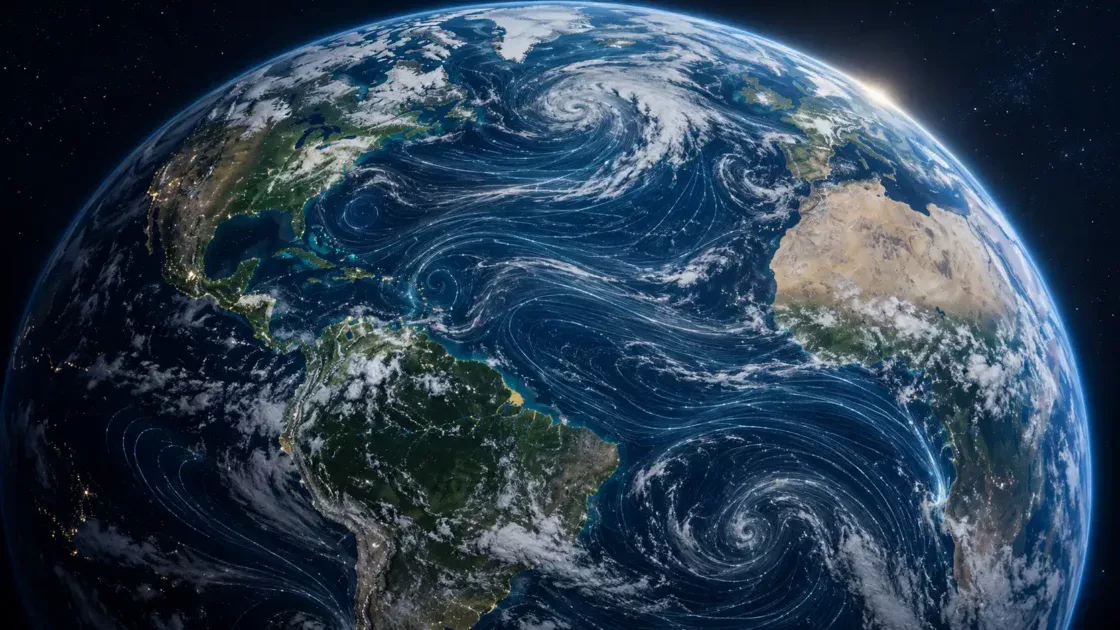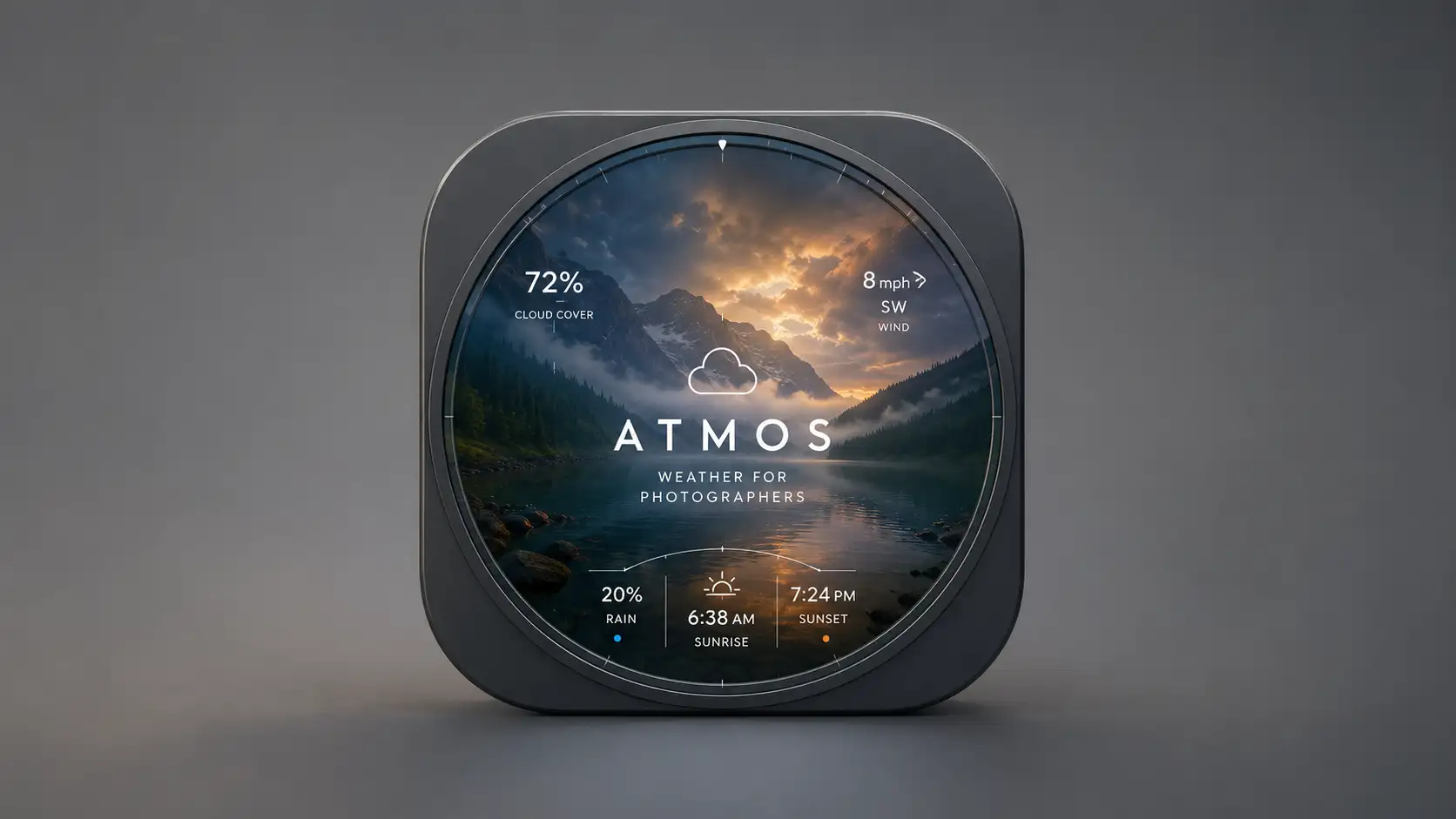
Atmos is not trying to be the weather app you check before leaving the house. It is trying to be the weather app you check before deciding whether the camera bag is worth packing at all. That distinction sounds small until you remember how photographers actually plan. A normal forecast says 62 percent cloud cover, light wind, sunset at 8:21. A photographer hears a completely different question: will the sky split open for ten minutes, will the low clouds block the horizon, will the fog make the scene better, will the moon ruin the Milky Way, will the tide give me a foreground, will I regret staying home?
Table of Contents
The weather app that thinks in shots
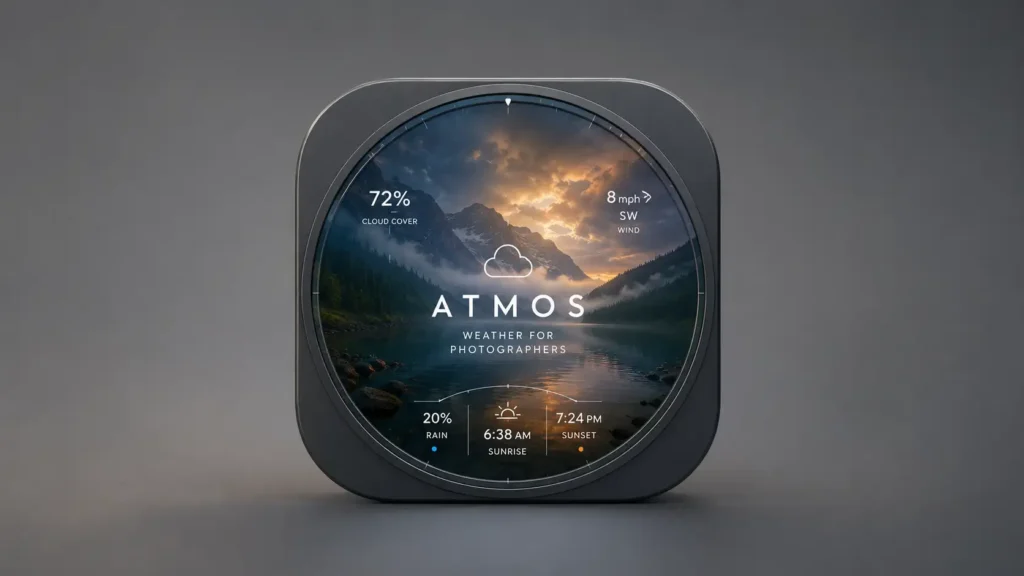
That is the clever opening for Atmos for Weather & Photo, an iPhone app by photographer Matthew Raifman. The App Store listing describes it as “a weather app by photographers,” built around golden hour, sunrise and sunset, moonrise, tides, Milky Way visibility, aurora activity, sunrise color, and genre-specific forecasts. It is listed under Weather, developed by Matthew Raifman, and at the time of checking it shows version 1.1 from May 14, 2026, with free download and in-app purchases.
The app’s best idea is not that photographers need weather data. Photographers already have too much weather data. The better idea is that weather data needs to be translated into the shape of a decision. Go now. Wait two hours. Bring the long lens. Skip sunset. Try macro after rain. Shoot infrared in harsh light. Stay in bed because the sky is dead and the wind is ugly. Atmos is interesting because it treats a forecast less like a report and more like a field note.
PetaPixel’s report frames the app around a familiar pre-shoot ritual. Raifman built Atmos after dealing with the usual mess of jumping between several apps before a shoot: one for clouds, one for tides, one for the moon, one for wind, one for aurora or Milky Way planning, then a final round of guessing. PetaPixel says Atmos tries to pull that scattered planning into one place and score the conditions for different kinds of outdoor photography.
That is why Atmos belongs in Web Radar. It is not another polished weather interface with a dark gradient and a few icons. It is a niche app with a point of view. It looks at a boring category and asks a sharper question: what does this information mean for the person trying to make an image? That is the kind of internet object worth saving, because it comes from lived irritation rather than product-board abstraction.
The app also exposes a funny truth about weather apps. Most of them are built around average daily life, not edge-case obsession. They are fine when you need to know whether to carry an umbrella. They are weaker when the decision depends on cloud layers, horizon gaps, dew point, moon phase, terrain, visibility, and the direction of light. For a photographer, the forecast is not background information. It is part of the subject.
Atmos starts from that obsession and makes it legible. The App Store listing says it gives hour-by-hour shooting quality scores, best time windows for each genre, and forecasts for 15 photography genres including Milky Way, moon, aurora, sunrise, and sunset. Those are not decorative features. They are the app’s whole argument: a good forecast for photography should know what kind of photograph you are trying to make.
There is a small but real editorial lesson here. Good tools often begin by refusing the general audience. Atmos does not ask, “How do we make weather nicer?” It asks, “What does a photographer keep checking before leaving?” That focus gives the app a spine. Even if someone never downloads it, the premise is easy to understand in one sentence. It tells photographers whether the sky is worth chasing.
The small pain Atmos understands
The pain Atmos targets is not bad weather. Photographers can work with bad weather. Some of the best images come from fog, rain, haze, high wind, low cloud, strange light, or a storm clearing at the edge of sunset. The pain is uncertainty without interpretation. You can know the temperature, cloud percentage, wind speed, and sunrise time and still have no useful answer to the only question that matters: will this be visually alive?
Normal weather apps flatten the sky into numbers. Cloud cover becomes a percentage. Rain becomes a probability. Wind becomes a speed. Visibility becomes a distance. These details matter, but they often fail to explain the scene a photographer will face. Sixty-five percent cloud cover could mean a beautiful ceiling of high clouds catching warm light. It could also mean a gray slab sitting on the horizon and killing the sunset before it starts.
Atmos seems built around that missing layer of judgment. PetaPixel reports that the app analyzes cloud cover, humidity, visibility, wind, precipitation, sun angle, and terrain, then turns them into a shootability score for windows like sunrise, sunset, and night sky shooting. The app is less interested in telling users the weather in isolation and more interested in telling them what the sky might look like for a photograph.
That shift is more useful than it first sounds. Photographers do not only need facts. They need facts arranged around timing, direction, risk, and reward. A sunrise forecast is not just sunrise time. It is cloud structure, gap at the horizon, humidity, haze, foreground access, wind, and how much effort it takes to get there before dawn. A weather app that understands the shot has to weigh those details differently from an app built for commuters.
The strongest example is the horizon gap. PetaPixel’s report says Atmos pays attention to the open space between the lowest cloud layer and the land, because that is where a sunset can suddenly ignite in the final minutes. A generic app may report cloud cover correctly and still miss the thing a photographer is hunting: a clear strip near the horizon where the sun can slip under the cloud deck and throw color across the sky.
That one idea tells you why the app has taste. It is not chasing more data for the sake of more data. It is pulling out the details that photographers actually care about but usually have to infer. The app understands that clouds are not just clouds. Their height, position, density, and relationship to the sun decide whether the sky becomes flat or electric.
A normal app might tell you the sunset is at 8:12. Atmos wants to tell you whether 8:03 to 8:19 is worth standing in a cold field with a tripod. That is a better product question. It is more intimate, more specific, and more tied to the real behavior of the people it serves.
The same logic applies to night photography. Atmos includes Milky Way, moon, and aurora planning in its feature set, according to the App Store listing, while PetaPixel reports that it also considers dew point, atmospheric transparency, moon phase, temperature changes, and NOAA space weather data for aurora forecasting. Those are the exact variables that turn night shooting into a planning puzzle rather than a simple weather check.
This is why the app feels closer to a scout than a dashboard. A dashboard shows the user everything and leaves the work to them. A scout comes back with a recommendation. Atmos appears to sit somewhere between the two: still weather-driven, still data-based, but edited around what a photographer might actually do next.
The small genius is that the app treats indecision as the enemy. Photographers lose time to cross-checking, second-guessing, and waiting for certainty that never arrives. No app can guarantee a sky. But an app can reduce the friction between curiosity and action. Atmos seems to understand that a photographer does not need certainty. A photographer needs a strong enough reason to go.
Forecasts become creative judgments
A weather score for photography is risky because it can sound too confident. Anyone who has stood under a dull sunrise after a promising forecast knows the sky does not care about your app. Still, scoring can be useful when it is treated as a decision aid rather than a prophecy. The point is not to replace instinct. The point is to make the first pass faster.
Atmos leans into scores because photographers already score conditions in their heads. A wildlife photographer reads wind and rain differently from someone shooting a city skyline. A macro photographer may get excited about soft overcast light and damp leaves. A sunset shooter wants the right cloud structure, not just any cloud. A Milky Way photographer cares about moonlight, haze, and atmospheric clarity. The same weather can be good, bad, or strange depending on the subject.
The App Store listing says Atmos provides hour-by-hour shooting quality scores and best time windows by genre. That means the app is not just giving one universal “good photo weather” number. It is trying to separate photographic situations that demand different conditions. The listing names Milky Way, moon, aurora, sunrise, and sunset among its genres, and PetaPixel reports independent scoring across 12 genres, including wildlife, macro, long exposure, Milky Way, and infrared.
The slight mismatch between 12 and 15 genres is worth noticing. PetaPixel’s article refers to 12 independently scored genres, while the App Store listing currently says 15 photography genres. That likely reflects an app update or a difference in how categories are counted. For readers, the practical point is clear enough: Atmos is built around multiple shooting modes, not one generic outdoor-photo score.
The best version of this idea could change how photographers plan a day. Instead of asking, “Is the weather good?” the app invites a sharper question: “Good for what?” That matters. A dull midday sky may be hopeless for dramatic sunset work but fine for forest details. Rain may ruin a portrait session and make street reflections better. Heavy fog can destroy long-distance views and make wildlife images feel cinematic.
That genre layer is where Atmos becomes more than a prettier weather screen. It gives the app a reason to exist beside Apple Weather, Windy, PhotoPills, Clear Outside, Astrospheric, tide tables, aurora apps, and local radar. It is not trying to beat every specialist at every specialist task. It is trying to reduce the mental tax of moving between them.
What Atmos appears to care about
| Photographic need | Atmos angle | Why it matters |
|---|---|---|
| Sunrise and sunset color | Scores light windows, cloud layers, and horizon gap | Color often depends on cloud position, not just cloud amount |
| Night sky planning | Tracks moon, Milky Way, visibility, and atmospheric details | A clear forecast can still be poor for astro work |
| Aurora chasing | Uses space weather signals such as Kp-related data | Visibility depends on location and sky conditions, not hype alone |
| Genre choice | Gives scores for different photography types | The same weather may suit one subject and ruin another |
| Field decisions | Shows best time windows hour by hour | Photographers need timing, not just daily summaries |
The table matters because it shows the app’s editorial structure. Atmos is not merely adding photography labels to a standard forecast. Its value, if the scoring works, is in connecting raw conditions to photographic outcomes: light, visibility, timing, subject choice, and the odds that leaving home is worth the effort.
This approach also carries a subtle creative philosophy. It tells photographers that conditions are not universally good or bad. They are useful or useless for a specific intention. That is how experienced shooters think. They stop asking for perfect weather and start asking what the weather is offering.
For newer photographers, that can be quietly educational. A beginner might look at overcast skies and stay home. A more experienced shooter might see soft light for woodland details, macro, portraits, or birds. If Atmos points users toward the genre that fits the conditions, it becomes a teaching tool without turning into a lesson.
For working photographers, the value is different. Time, clients, travel, and physical effort make weather decisions expensive. A professional may not need an app to explain that low stratus can ruin a sunset, but they may still appreciate a fast, organized view that reduces the time spent checking five sources. The App Store reviews quoted on the listing repeatedly mention replacing multiple sources and making scouting easier, though those reviews are early and few in number.
The app’s interface promise matters here. The listing describes a warm, cinematic interface built for quick decisions in the field. That sounds like marketing language, but the underlying need is real. A photographer standing in wind, rain, or low battery does not want a dense meteorological workstation. They want the answer fast enough to change plans.
There is also a reason this category has room for small independent apps. The biggest weather platforms serve giant audiences. They optimize around retention, ads, subscriptions, maps, warnings, and broad utility. A niche app can be stranger and more opinionated. It can prioritize the half hour before sunrise over the 10-day forecast. It can make decisions that look narrow to a mass-market product team and obvious to the people who shoot.
The better idea is interpretation, not more data
Weather apps have spent years trying to show more. More radar layers, more hourly blocks, more charts, more icons, more alerts, more widgets, more long-range predictions. The problem is that more information often means more interpretation work for the user. Atmos moves in the opposite direction. It tries to tell a photographer what the forecast means for making a picture.
That is why the word “interpret” is the key to the app. PetaPixel quotes Raifman describing the app’s core idea as interpreting conditions rather than reporting them. The app feeds details such as cloud cover, humidity, visibility, wind, precipitation, sun angle, and terrain into a model that produces a shootability number.
Interpretation is the part most software avoids. It is safer to show numbers and let users blame themselves. But the most memorable niche tools often take a position. They say “go,” “wait,” “bad for this,” “better for that,” “not worth it,” or “try a different subject.” Those judgments can be wrong, but they create utility because they match the pressure of the moment.
Atmos also points to a bigger product truth. Specialist users do not always want full control first. They often want good defaults, fast triage, and a clear recommendation, with enough supporting detail to judge whether the recommendation makes sense. A photographer may still want to inspect cloud layers or radar, but the first screen should probably answer the practical question.
The app’s privacy policy gives more texture to how it works. It describes Atmos as an independent mobile app developed and operated by Matthew Raifman, designed for photographers and astrophotographers. It says precise GPS coordinates are used while the app is in use and sent over HTTPS to weather and sky-condition APIs, and that location data is not stored on the developer’s servers or sold. It also lists third-party services including Pirate Weather, Open-Meteo, NOAA/National Weather Service, RevenueCat, and Apple App Store billing.
That privacy posture matters because photography planning is location-heavy. A useful app needs to know where you are standing, or where you plan to stand, because a horizon gap, aurora visibility, tide, or moonrise can change with location. A vague city-level forecast is not enough. But location is also sensitive. Atmos’s policy says it does not create user accounts, does not use ad networks, and does not build advertising profiles.
The App Store privacy label is even more blunt. Apple’s listing says the developer indicated that the app does not collect data, though Apple also notes that developer-provided privacy practices are not verified by Apple. That is a useful caveat. The claim is promising, but readers should treat the listing as a developer disclosure rather than an independent audit.
This is another reason Atmos feels like a small-web object rather than a faceless utility. It has an identifiable creator, a narrow audience, a visible irritation behind it, and a privacy policy that reads like it was written for the actual use case. Raifman’s own photography site describes him as a Berkeley, California photographer with wildlife, city, and outdoor work, which fits the app’s origin story better than a generic startup landing page would.
The app’s pricing also reveals its indie nature. The App Store lists in-app purchases of $29.99 annually and $3.99 monthly, while PetaPixel says the app launched with a two-week free trial and a monthly price of $3.99 after that. The App Store version history says the annual subscription option was added in version 1.1.
That price may feel steep if someone only wants a prettier forecast. It feels more reasonable if Atmos saves even one wasted pre-dawn drive, one badly timed coastal trip, or one evening of juggling separate tools. The value depends on how often the user shoots and how much effort their shoots require. A casual phone photographer may not care. A person driving two hours for a moonrise might.
The deeper product lesson is that interpretation can be worth paying for. Data is increasingly abundant, but data that understands a craft is still rare. Atmos is not selling weather in the abstract. It is selling weather with a photographer’s bias baked in. That bias is the product.
Where the app feels sharp and where it may frustrate
Atmos feels sharp because it understands that photographers chase windows, not days. The App Store listing emphasizes clear hourly predictions and best time windows. That is exactly right. A day can look mediocre and still contain 18 minutes of magic. A sunset can look promising all afternoon and collapse at the last moment. The useful unit is often not the day; it is the small window when light, clouds, subject, and access align.
The app also feels sharp because it treats “good weather” as a lazy phrase. Good for portraits is not always good for birds. Good for Milky Way work is not good for moonlit city images. Good for long exposure might be unpleasant for handheld street shooting. By scoring genres separately, Atmos acknowledges the photographer’s real problem: the weather does not need to be good. It needs to be matched.
The strongest use case may be the photographer who shoots several subjects. Someone who only photographs the Milky Way already has specialist tools. Someone who only shoots birds may live inside wind, tide, and migration habits. But the photographer who does wildlife, city scenes, night skies, macro, and sunrise work has a planning mess. Atmos appears built for that hybrid person who wants to choose the best subject for the conditions rather than force one plan onto the day.
That is why one App Store review rings true even through the usual review-page enthusiasm. A reviewer says they used to check tidal charts, aurora forecasts, and Milky Way charts while deciding what gear to pack for day trips and national parks. The exact wording is personal and informal, but the underlying pattern is credible: photographers often plan gear around uncertain conditions, and the wrong bag can shape the whole day.
The app may frustrate people who dislike scores. Some photographers will not want a number telling them what is worth shooting. They may see scoring as reductive, especially because surprise is part of photography. Bad forecasts produce good images all the time. Strange light can come from conditions an app would score poorly. A system trained to recommend safer bets may miss the oddball scene.
That criticism is fair, but it does not kill the idea. A score is useful when treated as a nudge, not a verdict. Photographers already ignore their tools when instinct says otherwise. The real test for Atmos is whether its scores feel grounded enough to earn trust over time. If the app is wrong in boring ways, users will abandon it. If it is wrong in understandable ways, they may keep it.
Another possible frustration is platform narrowness. The App Store listing says Atmos is only for iPhone and requires iOS 15.1 or later. It also lists compatibility with iPod touch, Mac with Apple M1 chip or later, and Apple Vision through Apple’s compatibility system, but the product is presented as an iPhone app. Android users are out for now.
The app is also early. The listing shows version 1.0 on May 12 and version 1.1 on May 14, with fixes for duplicate location search results, temperature display errors, duplicate item errors, and forecast-description alignment. That is normal for a young app, but it is still worth saying plainly: Atmos is a fresh product, not a long-tested institution.
Early reviews look positive but thin. The App Store listing showed six ratings and a 5.0 score at the time of checking. That is encouraging, not conclusive. A niche app can earn intense early love from exactly the people it was built for, then face harder judgment as it spreads to users with different locations, habits, and expectations.
The other question is data reliability. Atmos can interpret conditions beautifully and still depend on forecast inputs that are imperfect. Cloud layers, visibility, fog, and localized weather are notoriously tricky. Photographers know this already. A brilliant interface does not change the atmosphere. The app’s job is not to make weather predictable. Its job is to make planning less blind.
The product will live or die by trust built in the field. A photographer will forgive a cluttered interface if the app repeatedly points them to good light. They will forgive a missed sunrise if the reasoning made sense. They will not forgive a gorgeous app that confidently recommends dead skies. The proof will be screenshots, saved trips, avoided mistakes, and word of mouth from people who actually leave before dawn.
There is also a tension between simplicity and transparency. A single shootability score is fast. But serious photographers may want to know why the score is high or low. Is the app excited about high clouds? Worried about low haze? Penalizing wind? Reading the moon as too bright? The more the app explains its reasoning without becoming crowded, the more useful it becomes.
The best niche tools often expose just enough of their thinking. They do not bury users in raw data, but they do not ask for blind faith either. Atmos has a chance to sit in that middle space: an app that gives a strong recommendation, then lets the photographer inspect the evidence before making the call.
Why this feels like a web gem
Atmos is interesting because it is small, specific, and slightly obsessive. The web needs more tools like that. Not every product has to become a platform. Not every app has to serve everyone. Some of the best digital objects are built by someone who knows a ritual, hates one part of it, and makes the ritual less annoying for the people who share it.
The ritual here is deeply familiar to outdoor photographers. You decide you might shoot sunrise. You check the weather. Then you check a cloud map. Then a fog forecast. Then moon phase. Then tides. Then aurora numbers because why not. Then the local radar. Then a photographer’s forum, maybe. By the time you are done, you have learned many things and answered almost nothing.
Atmos collapses that ritual into a more editorial interface. It says the forecast should be judged against a subject, a time window, and a location. That is not a grand technological breakthrough. It is better: a product decision that feels obvious only after someone makes it.
This kind of specificity is underrated. A general weather app must stay neutral because its audience is huge. A photographer’s weather app can have opinions. It can say that high cloud is different from low cloud. It can care about the moon. It can treat sunrise as an event, not a timestamp. It can give wildlife, macro, long exposure, and night-sky shooters different answers for the same hour.
The app also understands that photography is part planning and part gamble. No tool removes the gamble. The sky will still misbehave. Fog will arrive late. The clouds will break five miles away. The aurora will flare after you go home. But a good tool changes the quality of the gamble. It helps you take better risks.
That is a strong reason to open Atmos even out of curiosity. It shows how much hidden craft sits inside a simple word like weather. For most people, weather means comfort, clothing, commute, and weekend plans. For photographers, it means color, contrast, depth, haze, motion, reflection, texture, and mood. Atmos takes that second definition seriously.
There is a broader internet-culture point here too. Many categories have become boring because the biggest apps aim for the median user. Weather apps are especially crowded with sameness: cards, icons, maps, warnings, subscriptions, ads, and a few personality gimmicks. A niche app like Atmos cuts through because it does not ask how to make weather prettier. It asks how to make weather useful for a person doing a specific thing.
That is why the “by photographers” line matters. It would be easy to dismiss it as branding, but in this case it explains the feature set. Golden hour, tides, Milky Way, aurora, moonrise, cloud layers, horizon gap, genre scoring: these are not random add-ons. They come from the mental checklist of someone who has waited outside with a camera and watched conditions decide the image.
The app’s creator story helps. Matthew Raifman’s photography site presents him as a photographer with wildlife, city, and outdoor work, and PetaPixel identifies him as the photographer behind Atmos. That makes the product feel less like opportunistic category-hopping and more like a tool made from a personal itch.
That does not guarantee quality. Photographers can build bad apps. Developers can misunderstand photography. Weather can embarrass everyone. But the premise has enough lived truth to deserve attention. It starts with a real annoyance, names a real audience, and makes a concrete promise.
The most charming part is that Atmos does not make photography sound effortless. It actually does the opposite. It admits that good outdoor images often require planning, sleep loss, weather literacy, and a willingness to chase tiny windows. The app is not selling magic. It is selling a sharper way to decide when magic is plausible.
There is something refreshingly unglamorous about that. Behind every dramatic sunrise photograph is a pile of boring logistics: alarms, batteries, parking, tides, wind, maps, weather checks, and failed attempts. Atmos lives in that unglamorous pile. It tries to make the boring part less scattered so the beautiful part has a better chance.
The app may also be useful beyond photographers. Hikers, birders, filmmakers, drone pilots, plein-air painters, location scouts, and anyone who cares about light may find the concept appealing. Still, the app should not dilute itself chasing all of them. Its strength is that it knows its first audience. Other users can borrow the tool, but photographers should remain the center of gravity.
That focus is what makes Atmos memorable. A broad tool says, “Here is the weather.” Atmos says, “Here is what the weather might do to your shot.” That is a much better sentence.
Small doubts before installing
No, and it may actually make more sense for serious hobbyists than for full-time professionals. A professional photographer may already have a planning stack and strong instincts. A hobbyist who shoots outdoors on limited free days may get more value from one app that points them toward the best available window. The App Store description speaks to photographers broadly, not only paid shooters.
Not fully. Atmos looks more like a decision layer than a total replacement for every specialist tool. If someone needs deep astronomical planning, detailed tide tables, or advanced radar analysis, they may still keep dedicated apps. Atmos is interesting because it gathers the most photography-relevant signals and turns them into shooting guidance.
It should be treated as a recommendation, not a promise. Weather models miss things. Local conditions change. The sky can surprise everyone. The score is useful if it reduces wasted checking and points users toward better bets. It becomes dangerous only if photographers treat it as permission to stop looking outside.
The difference is interpretation around the image. A normal app may show sunrise, cloud cover, wind, and precipitation. Atmos tries to judge whether those conditions are good for specific kinds of photography, including sunrise, sunset, moon, Milky Way, and aurora planning. The app’s listing also mentions hour-by-hour shooting quality scores and best time windows.
The privacy policy is unusually direct for a small app. It says location is used while the app is open, sent to weather and sky-condition APIs over HTTPS, not stored on the developer’s servers, and not sold. It also says Atmos does not use ad networks, behavioral analytics, or user accounts. Users still need to decide whether they are comfortable sending precise coordinates to weather API providers.
The best audience is the photographer who plans around light but hates the pre-shoot app shuffle. Sunrise chasers, night-sky shooters, wildlife photographers, city shooters, macro photographers, and people who travel for images all have reasons to look. The app is less compelling for someone who only wants a simple daily forecast.
Atmos makes a common hidden workflow visible. It understands that outdoor photography is not just composition and gear. It is weather reading, timing, patience, and educated guessing. Any app that treats those pieces as the actual product is worth a look.
Atmos is still young. The App Store listing shows a May 2026 launch window with version 1.1 shortly after version 1.0, early bug fixes, and a small number of ratings. People who dislike early-stage apps may prefer to watch how it develops before subscribing.The real appeal of Atmos is not that it predicts perfect photos. It is that it respects the strange, specific way photographers read the world. The sky is not just weather. It is a moving subject, a light source, a risk, a texture, and sometimes the entire reason to leave home. Atmos puts that belief into software.
Author:
Jan Bielik
CEO & Founder of Webiano Digital & Marketing Agency
This article is an original analysis supported by the sources cited below
Atmos for Weather & Photo on the App Store
Official App Store listing for Atmos for Weather & Photo, including the app description, developer name, feature list, version history, compatibility, ratings, privacy label, and in-app purchase information.
Atmos Is a Weather App By Photographers, for Photographers
PetaPixel report by Jeremy Gray covering Matthew Raifman’s app, its photography-focused scoring model, cloud-layer logic, horizon-gap analysis, night-sky planning features, and launch pricing.
Privacy Policy — Atmos
Official privacy policy for Atmos, describing the app as a weather forecasting app for photographers and astrophotographers, explaining location handling, third-party weather services, subscription processing, and data practices.
Matthew Raifman Photography
Matthew Raifman’s photography site, used to verify the creator’s public photography work and the context behind an app built around outdoor image-making.
| Citing this article? Brief excerpts are welcome. Please credit Webiano.digital, name the author where stated, and include a link to https://webiano.digital and to this original article. Full or substantial republication requires prior written permission. Read our Copyright and Content Use Policy. |
This article was prepared with the assistance of artificial intelligence tools. The content underwent expert human review, and Webiano Digital & Marketing Agency assumes editorial responsibility for its final version and publication.