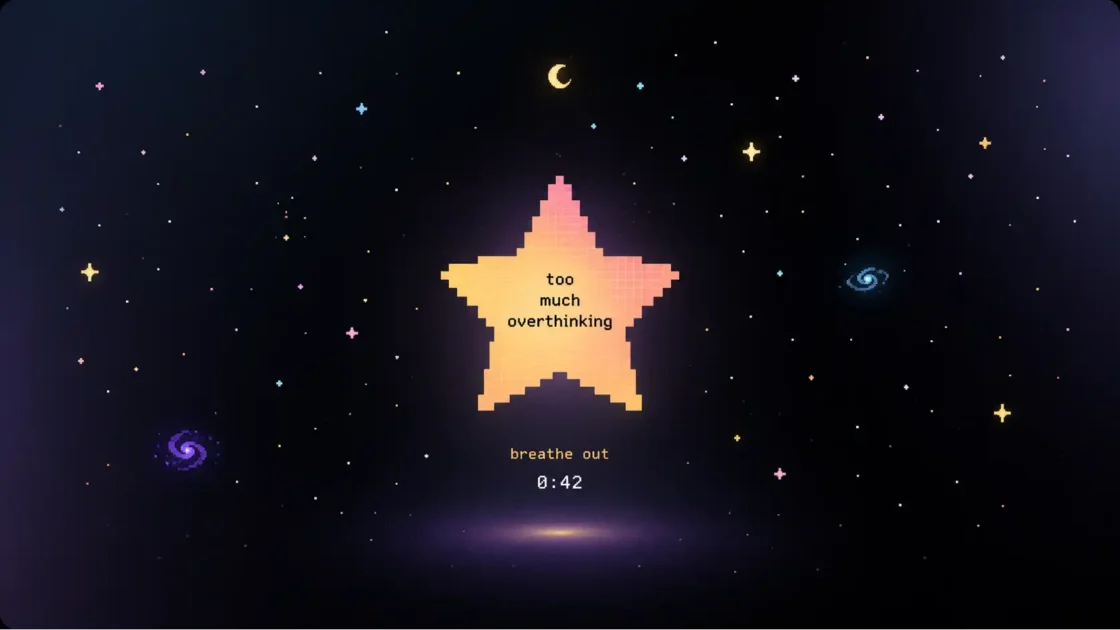
The Quiet Place Project does something almost rude by internet standards. It asks the rest of the web to shut up for a few minutes. No feed. No score. No buttons begging to be touched. No “continue reading” trap. No moral panic dressed as productivity advice. You open it, press the spacebar, and a slow sequence of typed words begins to walk you away from the noise you came from.
Table of Contents
The site is tiny, almost embarrassingly simple, and that is why it still lands. The main experience is a text-led pause, a little guided walk through silence, attention, social platforms, phones, and the strange embarrassment of doing nothing. The current live version sits at The Quiet Place Project’s .xyz domain, where the home page still introduces itself with the line “millions of souls chose quiet,” then points visitors toward “the quiet place” and a “90 seconds relaxation exercise.”
What makes it memorable is not the technology. It is the nerve of the thing. Most websites treat your attention as a surface to cover. The Quiet Place treats attention as a room someone forgot to clean. It does not entertain you out of your anxiety. It does not teach you a method. It does not sell focus as a lifestyle. It sits you down and says, gently but firmly, that the updates can wait.
A pause disguised as a website
The Quiet Place starts with a small instruction that feels almost physical. Communication with the site happens through the spacebar, or through a gentle touch on mobile. It asks you to silence your phone, turn on your speakers, and go full screen. The instruction is practical, but it also acts like a threshold. Before the experience even begins, the site has already changed your posture. You are no longer browsing. You are entering.
That matters because the site is not built like a page. It is built like a room with a door. The design uses forced pacing, black space, music, and lowercase text to slow the visitor down. It does not let you skim in the ordinary way. The words arrive with a kind of soft insistence. You keep pressing space, but the action is not productive. It is closer to breathing, a small ritual gesture that keeps you inside the moment.
The opening trick is disarming. The site promises that it is not one of those old internet jump-scare pages. That line tells you exactly what era shaped it. It comes from a web where mysterious links circulated through friends, where fullscreen pages could still feel like tiny events, where you half-expected the browser to betray you. The Quiet Place borrows that suspense and uses it for kindness. It says, do not worry, nothing ugly is hiding here.
Then the site names the thing it is removing. No Facebook notifications. No Twitter. No Instagram. No WhatsApp. No email. No Messenger. The list reads differently now than it did when the project first spread, because the platforms have shifted and multiplied. Some names feel frozen in the early social web. Others still jab directly at the nervous system. The exact services matter less than the rhythm: ping, ping, ping, ping, ping.
The page then asks whether you have noticed how many things require your attention. That line is the whole project in miniature. It does not accuse you of being weak. It does not turn your phone into a villain. It notices the crowd pressing at the edge of your mind. That noticing is the site’s strongest move. It gives a shape to a feeling many users recognize before they have words for it.
The Quiet Place understands that the modern feed does not only distract. It creates a false sense of emergency. The visitor is told they are probably thinking about the notifications they are missing. The site answers that worry with a dry little summary of what most of those notifications are: a loose acquaintance saying something trivial about something trivial. The joke is sharp because it is affectionate. The project is not anti-human. It is anti-noise.
The experience then turns from satire into intervention. It asks for patience, just for a couple of minutes. That is such a modest demand that refusing it feels almost absurd. The site does not ask you to quit your accounts, rebuild your life, or become a monk. It asks you to sit still long enough to remember that not every incoming signal deserves a response. The scale is small, which is why it works.
The most quoted beat is also the bluntest. The site repeats “meaningless little things” until the phrase stops being polite. It breaks the words apart, stacks them, then lands on the exasperated profanity beneath the calm surface. The sudden roughness is part of the charm. Without it, the page would risk becoming too sweet. With it, The Quiet Place sounds like a friend who has been patient for a long time and finally says what everyone knows.
The climax is almost comic in its humility. For 30 seconds, do nothing else. That is the task. Not meditate correctly. Not journal. Not breathe according to a branded method. Do nothing else. The website admits that it is only 30 seconds and that you will not die. The line is funny because it describes a real withdrawal symptom. Thirty seconds of non-input can feel longer than we want to admit.
By the end, the site does something most digital products avoid. It says goodbye. It lets you return to normal, even tells you it is safe to share. That exit matters. The Quiet Place does not pretend to replace the rest of the internet. It briefly interrupts it, then sends you back with one small piece of advice: stop everything from time to time and go to your quiet place. The advice is gentle, but the design makes it feel earned.
The interface is almost nothing, and that is the trick
The Quiet Place would be easy to dismiss from screenshots. A black screen, centered text, soft music, and a spacebar mechanic do not sound like much. Yet the site’s restraint is exactly what makes it interesting as a piece of web design. It refuses the usual proof of labor. There is no dashboard, no animation parade, no illustrated mascot, no onboarding carousel. It trusts sequence, tone, and timing.
The page has one main interaction. Press to continue. That simple pattern creates a controlled intimacy. You are not passively watching a video, and you are not freely wandering through a page. You are taking tiny steps through a scripted experience. Each press feels like consent to keep listening. It is a clever middle ground between a poem, a guided exercise, and an old web experiment.
The lowercase writing is not a cute decorative choice. It lowers the room temperature. The page even says that in the quiet place there are no capital letters that shout at you. That is funny, but it is also a design philosophy. The absence of caps makes the text feel less like instruction and more like someone speaking quietly beside you. The site’s visual grammar matches its emotional grammar.
The pacing is the real interface. The visitor cannot gulp the whole thing at once. The page stretches simple thoughts across time: notification, patience, attention, meaninglessness, break, return. This is why the experience feels bigger than its content. If the same text were pasted into a blog post, it would be a mildly charming essay. Presented as a slow walk, it becomes a small behavioral interruption.
There is a beautiful stubbornness in the full-screen instruction. The site wants the browser to disappear. It knows that tabs, bookmarks, address bars, and desktop clutter all carry the smell of unfinished business. Fullscreen mode turns the web page into a temporary environment. The effect is not sophisticated in the contemporary product-design sense, but it is psychologically clean. One thing is in front of you. For a few minutes, that is enough.
The sound matters too. The project credits “Life and death” from Lost, composed by Michael Giacchino. That choice gives the page a sentimental weight it would not have in silence. The music is emotionally direct, almost too direct, but the site is not embarrassed by feeling. It lets the score do what old internet pages often did: carry a private little wave of sincerity across a crude technical frame.
The whole thing feels handmade because it is not trying to hide the hand. The page credits Amitay Tweeto by name, linking to his Instagram and Twitter from the experience itself. Forbes’ 2012 profile also identified Tweeto as the creator and described the project as launching in the summer of 2011, after which it drew millions of visitors and volunteer translations.
That handmade quality is not nostalgia for its own sake. It changes the trust relationship. Many wellbeing apps now arrive wrapped in medical language, habit science, subscription tiers, and polished claims. The Quiet Place feels like a person made a room because the internet was too loud. That may be less professional, but it is easier to believe. The visitor does not feel processed. They feel invited.
The site’s roughness also protects it from becoming smug. It does not pretend to be a clinical tool. It is a web experience with a point of view. It may soothe some people and annoy others. It may feel profound on a bad night and corny on a normal afternoon. That unevenness is part of its honesty. It behaves like a small artistic intervention, not a product that has been focus-grouped into harmlessness.
The same restraint appears in the companion “90 seconds relaxation exercise.” That page strips the idea down even further. It asks visitors to silence the phone, turn up the volume, rotate landscape on mobile, and then moves through short prompts: relax, everything is ok, you have zero notifications to read, emails can wait, calm your mind, stretch, smile, breathe, rest your eyes. It is almost comically plain, but plainness is the point.
The Quiet Place is not minimal because minimalism is fashionable. It is minimal because every extra feature would weaken the spell. A timer would make it feel like work. A settings panel would give the visitor another place to hide. A share count would break the quiet. A login would be an insult. The best decision in the whole project may be how little it tries to add.
Why it still feels sharper than most wellness apps
A lot of digital calm now arrives with branding heavy enough to crush the calm itself. The Quiet Place feels sharper because it does not package peace as self-improvement. It does not ask you to become a better worker, a cleaner thinker, or a more disciplined person. It asks you to notice that you are tired of being summoned.
That distinction is not small. Much of the focus industry treats attention as performance. Get more done. Block distractions. Build better habits. Win back your day. The Quiet Place approaches attention as dignity. It suggests that you deserve a few minutes not because they will make you productive later, but because you are a human being and not a notification endpoint.
The site also avoids the competitive mood that ruins so many calm products. There are no streaks, badges, levels, or progress bars. You cannot be good at The Quiet Place. You cannot fall behind. You cannot compare your quiet with someone else’s quiet. The experience ends, and that is that. This makes it strangely generous. It does not capture the very relief it offers.
Its critique of social media is also more precise than it first appears. The problem is not that every online interaction is worthless. The problem is that the web trains trivial interactions to arrive with the same urgency as serious ones. A friend’s comment, a party invitation, a liked link, a check-in, a shared video, an email, a message: each one borrows the nervous energy of importance. The Quiet Place laughs at that borrowing.
The writing does not need new platform names to stay recognizable. Swap in TikTok, Discord, Slack, Threads, Teams, Reddit, YouTube comments, or whatever sits open beside your work, and the structure still holds. The names change. The feeling remains. Someone somewhere has done something vaguely connected to you, and now a red dot wants a piece of your mind.
The project’s age gives it extra bite. It warned about the attention economy before the phrase became conference furniture. The web it describes was already noisy, but not yet as brutally tuned as the one many people live inside now. Looking at The Quiet Place from 2026, the site feels less quaint than prophetic. It saw the shape early: a person unable to take a walk in the mountains because the phone came along too.
The mountain line is one of the site’s best observations. A break is not a break if the same mental crowd follows you there. That is more useful than a thousand vague reminders to unplug. The Quiet Place knows that location is not enough. You can sit in a beautiful place and still carry the entire feed in your pocket. The true escape has to include a refusal, even a brief one.
The refusal is not dramatic. That is why it feels sane. The site does not call for digital purity. It does not ask you to delete your accounts. It does not pretend that online life is fake and offline life is automatically true. It only asks for separation. A few minutes with nothing grabbing at you. A small empty room inside a full day.
Compared with polished wellbeing apps, The Quiet Place also has a less controlling relationship with emotion. It does not measure the user’s mood. It does not ask for a check-in score. It does not translate feeling into data. It lets the visitor feel whatever shows up: irritation, relief, embarrassment, sadness, calm, boredom. That freedom matters. Sometimes the most humane interface is the one that does not ask you to report yourself.
The site’s visitor responses on the home page show why the experience spread. People describe relief, tears, calm, daily returns, and the strange surprise of needing it. The comments are messy, unedited, and sometimes emotionally intense. They make the project feel less like a clever one-off and more like a small public room people used when they did not know where else to put a feeling.
That intensity deserves care. The Quiet Place is not a substitute for support when someone is in danger. Some visitor comments describe serious distress, and the project’s softness may have met people in raw moments. That does not turn it into therapy. It turns it into an internet artifact that, for some users, arrived at the right second. The best reading is neither cynical nor naive: small sites sometimes matter more than their size suggests.
The site’s strongest quality is its refusal to over-explain itself. It trusts the visitor to understand the joke and the ache. That is rare. Many products would surround the same idea with statistics, expert quotes, animated breathing circles, and claims about science. The Quiet Place chooses a direct address. It says the feeds are noisy, the little things are little, and your mind needs a break. The plainness is braver than it looks.
What stands out when you actually use it
The first thing that stands out is how quickly the site changes your speed. You arrive with browser habits and leave, at least briefly, with slower hands. The spacebar mechanic is not novel, but it is effective because it turns reading into a bodily action. The hand participates in the pause. You cannot scroll past the discomfort. You have to press through it.
The second thing is the tone. The Quiet Place is gentle without being bland. It has sweetness, then sarcasm, then profanity, then tenderness again. That mix is hard to copy. Too much softness would turn the site into a greeting card. Too much sarcasm would ruin the quiet. The page balances the two by sounding like someone who cares about people but has lost patience with the machinery around them.
The third thing is how theatrical the page feels despite having almost no stagecraft. It knows when to reveal, when to repeat, when to pause, and when to release. The ellipses do real work. The word stacks do real work. The 30-second silence does real work. The site is not a lecture about calm. It is a small performance of calm with interruptions of wit.
The fourth thing is that the site has an ending. Modern interfaces often avoid endings because endings release users. The Quiet Place releases you on purpose. It does not infinite-scroll your peace. It does not turn quiet into content. It says goodbye, and the goodbye gives the experience shape. You remember it because it closes.
The fifth thing is the project’s old-web sincerity. It belongs to a web that still believed a single page could change the temperature of someone’s day. That belief can feel corny now, but it also feels refreshing. The page does not apologize for wanting to help. It does not hide behind irony. It lets itself be earnest, then uses a few sharp lines to keep the earnestness awake.
The quick read before opening it
| Element | What it does | Why it works |
|---|---|---|
| Spacebar pacing | Moves the visitor through the text one beat at a time | It turns reading into a small ritual |
| Lowercase language | Keeps the voice soft and intimate | It makes the page feel spoken, not announced |
| Notification list | Names the platforms and channels pulling at the user | It turns vague stress into something visible |
| Thirty-second pause | Forces a tiny stretch of doing nothing | It makes the discomfort of stillness obvious |
| Clear ending | Sends the visitor back to normal life | It avoids trapping quiet inside another feed |
The table makes the main point plain: The Quiet Place is not impressive because it has many parts. It is impressive because the few parts agree with each other. The writing, pacing, sound, fullscreen prompt, and ending all point toward the same demand: for a moment, stop feeding the machine.
The project is also a reminder that “interactive” does not have to mean complex. Interactivity can be as small as pressing one key at the right pace. The web has spent years treating interaction as expansion: more options, more personalization, more paths, more dashboards. The Quiet Place uses interaction as narrowing. It takes choices away so that one neglected choice becomes possible: stay.
There is also a clever reversal in the share prompt at the end. The site criticizes social noise, then returns you to sharing. That could look hypocritical, but it feels honest. The Quiet Place lives on the web. It spread through the same systems it gently mocks. It does not stand outside online culture in purity. It makes a quiet pocket inside it, then lets the visitor decide whether to pass the pocket along.
That contradiction is part of the project’s charm. A website telling the internet to wait is still a website. It needs a browser, a device, sound, a key, a link, and often a social recommendation. The Quiet Place is not anti-internet. It is a plea for better manners from the internet and from the people using it. That difference keeps the project from becoming preachy.
The site’s design also exposes how much of the web’s tension comes from pace rather than content. The same words shown instantly would not work the same way. The visitor needs to feel the delay. The forced slowness is not decorative; it is the argument. The Quiet Place says waiting is not empty. Waiting is where your mind catches up with itself.
The project’s limitations are real. Some people will find it sentimental, dated, or too direct. The music may feel manipulative. The social-media critique may feel obvious. The old platform list may make younger visitors smirk. The profanity may bother someone who came for pure softness. None of these objections break the project. They only show that it has a voice, and a voice always risks losing somebody.
A more serious limit is that it depends on willingness. The site cannot quiet a person who refuses to give it two minutes. It has no trick beyond invitation and pacing. That is both weakness and strength. Unlike apps that lock screens, block sites, or gamify restraint, The Quiet Place has no enforcement. Its whole effect depends on a tiny voluntary agreement between visitor and page.
That agreement is where the magic sits. You press the key, and the site trusts you not to run away immediately. It is a small act of cooperation. The page does not shame you if your mind wanders. It gently predicts that your mind will wander toward notifications, then asks you to wait anyway. The result is less like being corrected and more like being caught.
The old web energy under the soft lighting
The Quiet Place belongs to a lineage of small web experiences that were not exactly tools, games, essays, or art projects. They were links you sent with a warning like “just open this.” Some were jokes. Some were pranks. Some were weird technical toys. Some were tiny emotional chambers. The Quiet Place is one of the rare examples where the mystery-box structure was used to calm rather than startle.
That old web context matters because the site’s form is hard to separate from its feeling. It was made for a web where surprise still had room to breathe. A single URL could arrive from a friend and become the next ten minutes of your night. The browser was not yet entirely colonized by giant platforms. Personal projects could still feel like messages in bottles, not portfolio pieces shaped for algorithms.
The Quiet Place also carries the emotional directness of that era. It is not afraid of hearts, tears, soft music, or big claims made quietly. Contemporary taste often punishes this kind of sincerity. People now hedge, meme, quote, detach, and joke before anyone can accuse them of caring too much. The Quiet Place cares too much on purpose. That is why some visitors still remember it years later.
The remembered ecosystem around the project strengthens that feeling. The Thoughts Room, The Dawn Room, and The Comfort Spot became part of its legend for many users. Some of those sibling experiences are no longer present on the current official site, but remakes and posts keep the memory alive. A modern remake of The Thoughts Room describes itself as a free, browser-based tribute to the original, where typed thoughts flow out into the stars.
That afterlife is telling. People do not usually remake disposable web content. They remake things that left a shape in memory. The Thoughts Room especially stuck because it gave anxious writing a visual release: type the thought, send it away, watch it disappear. The Quiet Place did something related with attention. It did not solve the problem. It gave the problem a short ceremony.
The project’s survival at a new domain also says something about fragile internet memory. Small beloved sites disappear easily. Domains lapse, servers fail, scripts break, platforms rot, and links turn into spam. Reddit threads and old blog posts show people searching for pieces of The Quiet Place Project years after losing track of it. That searching is part of the story. The site was not only used; it was missed.
The current live version feels slightly haunted by that history. It is both present and old. The copyright line says 2026. The text still names older platform habits. The design still behaves like an early-2010s fullscreen web experience. The creator credit still points outward to personal social profiles. The result is a site that has not been sanded down to match the present. It feels preserved rather than relaunched.
That preservation is part of its appeal. Not every web project needs modernization. Updating The Quiet Place with contemporary UI polish might damage its mood. A cleaner type system, smoother animation, and fresher platform list could make it look better while making it feel worse. The current version’s slightly time-capsule quality is proof that the page came from a specific internet moment. It should not be scrubbed of that.
The best old-web projects often had a strange ratio of small construction to large emotional effect. The Quiet Place is almost a textbook example. A few pages, a sound cue, a sequence of lines, and a keypress pattern became something people described as calming, tearful, useful, and daily. That gap between the build and the response is what makes the web wonderful at its best. It lets modest things travel far.
It also exposes how bloated many contemporary experiences are. The Quiet Place needs no account because it has nothing to remember about you. It needs no recommendation system because every visitor gets the same room. It needs no push notification because that would betray the point. The project feels lighter not only in design but in ethics. It does not take a souvenir from your visit.
The visitor comments on the home page are messy enough to feel human. They are full of misspellings, hearts, uneven punctuation, and sudden confessions. That mess is better than polished testimonials. It reminds you that the project travelled through ordinary people’s bad days, study stress, loneliness, annoyance, and exhaustion. A slick case-study page would flatten that. The rough comment wall keeps the emotional evidence uncomfortably alive.
There is also an odd beauty in seeing a quiet site with a large crowd around it. Millions of people choosing quiet is a noisy fact. The paradox works. The project offers solitude, but the home page shows that the need for solitude is shared. You are alone inside the experience, then you return to the home page and find traces of many other people who were alone there too.
That shared solitude may be the real reason the project stuck. It lets people feel private without feeling abandoned. The text speaks to one person at a time, but the surrounding project says others have been here. That balance is hard to engineer. Many communities become too loud for the feeling they gather around. The Quiet Place keeps the community at the edge, as testimony, not chatter.
The old web energy also shows in the creator’s premise. One person can still make a small room that changes someone’s evening. That sounds naive until you remember that much of the web’s best culture began exactly there. A person with taste, a feeling, and enough skill to publish can make a place. The Quiet Place is a defense of that possibility.
Small doubts before opening it
Is The Quiet Place Project still online? Yes. The project is live at its .xyz domain, with the main “the quiet place” experience and a “90 seconds relaxation exercise” linked from the home page. The current official pages still carry the project name, the “millions of souls chose quiet” line, and the 2026 copyright mark.
Is it an app or a normal website? It is a website, and that is part of the charm. You do not need to install anything, create an account, or configure a routine. You open the page, follow the prompts, and move through the experience with the spacebar or touch input. The lack of commitment makes it feel closer to a tiny room than a product.
Who made it? The official experience credits Amitay Tweeto by name at the end of the page, and Forbes’ profile of the project also identified Tweeto as its creator, describing the original launch in 2011 and its early reach.
Is it really relaxing? For some people, yes, but not because it performs a miracle. It relaxes by removing choices and slowing the visitor down. The site’s effect depends on whether you give it a few uninterrupted minutes. Open it while half-checking messages and it loses the point. Open it with sound, fullscreen, and the phone silenced, and its smallness starts to work.
Is it dated? Yes, visibly, and that is not a flaw. The platform names, fullscreen prompt, Tumblr sharing link, and old-web tone all carry the project’s age. The datedness gives the page texture. It feels like a preserved internet object that still happens to be useful. A fully modern redesign might make it smoother and less memorable.
Is it a mental health tool? No. It is a calming web experience, not professional care. It may be comforting, especially during a stressful day, but it should not be treated as crisis support or therapy. The safest way to understand it is as a short pause, a digital breathing room, and a reminder that the web does not always need to take.
Why write about such a small site now? Because small sites often reveal the web more clearly than big platforms do. The Quiet Place shows how much can happen when a page respects attention instead of harvesting it. It is tiny, sentimental, imperfect, and still oddly sharp. That combination is rare enough to deserve another look.
The reason to open it is not that it will change your life. The better reason is that it changes the next few minutes. It interrupts the reflex to check. It makes the red dots feel faintly ridiculous. It turns the spacebar into a metronome for attention. It asks you to do almost nothing and makes that almost-nothing feel like an act of resistance.
That is a surprisingly hard trick. The web is excellent at making tiny actions feel urgent. Like, reply, refresh, swipe, accept, dismiss, open, watch, continue. The Quiet Place takes the tiniest action of all, pressing a key, and drains it of urgency. You press not to get more, but to stay with less. It is one of the simplest inversions a website can make.
The site also gives editors, designers, and makers a useful reminder. Tone is a design material. The Quiet Place would fail if the words were colder, grander, or more polished. Its emotional effect comes from the voice as much as the layout. The voice is amused, tired, kind, and lightly fed up. It sounds like a person, not a brand. That is harder to fake than animation.
There is a lesson here about product restraint, too. If the promise is quiet, the interface must not compete with it. Many calm products betray themselves through busy surfaces. The Quiet Place does the opposite. It removes almost everything, then lets the remaining elements carry more weight. The result is not luxurious. It is clear.
A small site like this also makes the internet feel less inevitable. It reminds you that the web can be paced differently. Pages do not have to chase. Links do not have to trap. Text does not have to shout. A site can ask for silence and mean it. That sounds obvious until you open most of the internet.
The Quiet Place is worth opening precisely because it does not look like a major discovery. It looks like a leftover, a soft relic, a little typed-out room still standing after the rest of the web got louder. Then it starts speaking, and for a few minutes the rest of the browser feels rude for existing.
Author:
Jan Bielik
CEO & Founder of Webiano Digital & Marketing Agency

This article is an original analysis supported by the sources cited below
The Quiet Place Project
Official home page for the project, used to verify the current live domain, project framing, linked experiences, copyright line, and visitor responses.
The Quiet Place
Official main experience analyzed in the article, including the spacebar interaction, silence prompts, notification critique, creator credit, and music credit.
90 seconds relaxation exercise
Official companion page from the same project, used for comparison with the main quiet-place experience and its shorter relaxation prompts.
Meet the maker of The Quiet Place
Forbes profile used for historical context about Amitay Tweeto, the project’s 2011 origin, early reach, and volunteer translations.
Thoughts Room
Independent remake and contextual source for the remembered Thoughts Room experience associated with The Quiet Place Project’s wider afterlife.
| Citing this article? Brief excerpts are welcome. Please credit Webiano.digital, name the author where stated, and include a link to https://webiano.digital and to this original article. Full or substantial republication requires prior written permission. Read our Copyright and Content Use Policy. |
This article was prepared with the assistance of artificial intelligence tools. The content underwent expert human review, and Webiano Digital & Marketing Agency assumes editorial responsibility for its final version and publication.