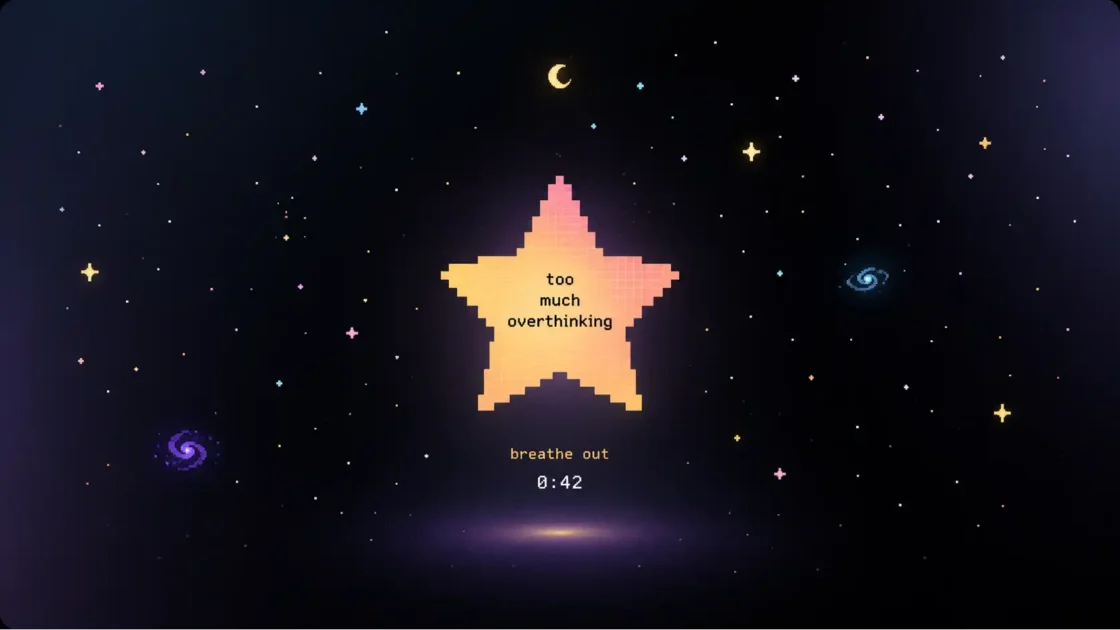
Pixel Thoughts does one thing so cleanly that it almost feels rude to call it a wellness tool. You type a worry into a glowing star, press a button, and watch that star shrink into a dark little universe for sixty seconds. The page does not ask you to create an account. It does not ask what kind of person you are. It does not serve you a seven-day plan, a push notification system, a paid upgrade, or a branded philosophy of inner peace. It gives your worry a visual body, then makes that body smaller. That is the whole trick, and the trick still works because the web rarely allows itself to be this small anymore.
Table of Contents
A tiny ritual pretending to be a website
The surprise is not that Pixel Thoughts is calming. Plenty of soft-blue, soft-purple, soft-everything digital products are built to suggest calm. The surprise is that Pixel Thoughts feels almost unserious at first, like a tiny web toy from a better internet, then becomes more serious once you use it. You do not need to believe in meditation to understand what happens. You give a private thought a place to sit. You stop refreshing, scrolling, checking, comparing, replying, delaying. For one minute, the entire interface agrees to care about only one thing: the thought you just removed from your head and placed into the sky.
That smallness is its taste. Pixel Thoughts was built by Marc Balaban in 2015, according to the current site, and it has stayed close to its original shape: a short browser-based exercise built around typing one stressful thought into an animated star. The official page now describes it as free, ad-free, account-free, and used by more than 10 million people since launch. Those claims matter less as a badge of scale than as a reminder that some projects travel far because they resist becoming bigger than the gesture that made them interesting.
The web version feels like something you stumble onto rather than something you subscribe to. That matters. A lot of mental wellness software has learned the language of retention: streaks, plans, reminders, content libraries, check-ins, metrics, moods, progress arcs. Pixel Thoughts comes from an older, stranger lineage of the web: the single-serving site, the odd interactive page, the object you send someone with a note saying, “try this for a minute.” Product Hunt still lists it as a web app in the meditation category, launched in 2015, with its premise boiled down to a sixty-second meditation space.
The page is not trying to become your operating system for being okay. It is closer to a matchstick. You strike it, it glows, it burns out. That is why it deserves attention in Web Radar. Not because it is the largest, newest, most feature-rich digital mindfulness product, but because it captures something the web used to be unusually good at: a focused interaction that changes your state without demanding ownership of your life.
The trick is not calm, it is scale
Pixel Thoughts works because it borrows the oldest cosmic move in the book: making human trouble feel small against the universe. This can sound glib when stated flatly. Nobody wants to be told that their deadline, breakup, diagnosis, bill, conflict, loneliness, or fear is tiny compared with space. That argument can feel cruel. The website avoids some of that bluntness by turning scale into animation rather than lecture. Your thought does not get dismissed. It gets placed somewhere enormous and allowed to fade.
The central design decision is almost childlike. A worry becomes a star. The star becomes a smaller star. The smaller star becomes a dot. The dot disappears into a field of other dots. This is not complicated interaction design, but it is emotionally legible. A thought that has been filling the skull suddenly has boundaries. It has a color. It has a position. It has a timer. It can be watched. The worry becomes an object, and objects are easier to release than weather inside the mind.
Mindful’s 2016 write-up caught that part of the project early. The article described the site as asking the user to write what is bothering them into a large star in the center of the screen, then slowly fading it while the page prompts breathing and perspective. The same piece quoted Balaban explaining that when he feels stressed, he often thinks about things larger than himself, like the ocean or a clear night sky, because that feeling of smallness can bring inner peace.
That creator explanation is useful because it shows the project is not really about astronomy. Pixel Thoughts uses space the way a person uses a window during a hard phone call. It gives the nervous system a place to look. The universe here is not scientific content; it is emotional architecture. The stars make room. The shrinking motion makes time visible. The dark background gives the whole thing a soft seriousness without turning it into therapy cosplay.
The best part is that the site does not ask you to solve the worry. It does not offer a productivity method, a cognitive worksheet, a journal template, or a breathing protocol with performance feedback. It quietly changes the relationship between you and the thought. That is a different promise. You may still have the problem after the minute ends. The invoice still exists. The conversation still needs to happen. The body still hurts. But the thought has moved from total atmosphere to small object. For many anxious moments, that shift is enough to regain a little agency.
There is a risk inside that move, and the internet noticed it. Some people dislike cosmic perspective because it can slide from “this moment is survivable” into “nothing matters.” The old Reddit thread around Pixel Thoughts includes both appreciation and pushback, with users joking or complaining that the vast-universe framing can land badly for worries about insignificance, illness, or existential dread. That criticism is fair. A tool that miniaturizes thought will not fit every thought. It works best for rumination, spikes of stress, temporary panic, and mental loops that need interruption. It is not the right container for every grief.
That limit does not weaken the project. It makes the project clearer. Pixel Thoughts is not a universal comfort machine. It is a sixty-second reframing ritual. Its strength is narrow, and narrow tools often survive because people know when to reach for them. A hammer that claims to be a full workshop is suspicious. A tiny web page that says “put one worry here and watch it shrink” knows its job.
What happens inside the minute
The first few seconds of Pixel Thoughts are almost embarrassingly direct. The site asks for the thing that is bothering you. This matters because many calming products begin by delaying the hard part. They ask you to choose a category, select a goal, rate your mood, browse a library, or pick a narrator. Pixel Thoughts begins with the object itself. What is the thought? Type it. There is no graceful way around it. The page makes you name the mental noise before it tries to soften it.
Typing is doing more work than it seems. A worry inside the head often arrives as a swarm. It is not one sentence; it is a pulse, a pressure, a half-formed prediction. The text field forces compression. “I am going to fail.” “I said the wrong thing.” “I cannot afford this.” “I feel alone.” “I am scared about the appointment.” A thought does not become harmless because it becomes a sentence, but it becomes graspable. Pixel Thoughts turns a vague interior sensation into a line of language sitting inside a star.
Then the minute begins, and the page becomes deliberately slow. The star shrinks at a pace that resists the user’s normal internet tempo. You cannot speed it up without ruining the point. You cannot scroll for more. You cannot collect achievements. The timer is the product. A minute is short enough to accept and long enough to feel. Pixel Thoughts understands that sixty seconds can be a real unit of attention when nothing else is competing for it.
The copy on the page matters, but it is not the main event. The messages are gentle prompts around breathing and perspective, not a lecture. The visual metaphor does the heavier lifting. A bad version of this tool would drown the user in affirmations. Pixel Thoughts mostly trusts the animation. That restraint is rare in wellness design, where interfaces often become anxious on behalf of the user: too much reassurance, too many pastel instructions, too much soft coercion. Here, the screen mostly says: look, breathe, wait.
What Pixel Thoughts gives you in one minute
| Element | What it does | Why it matters |
|---|---|---|
| A single text field | Turns a vague worry into one written thought | Naming the thought reduces its fog |
| A glowing star | Gives the thought a visible container | The worry becomes separate from you |
| A sixty-second shrink | Makes release visible and timed | The body gets a short ritual, not advice |
| A cosmic background | Places the thought inside a larger frame | Scale replaces argument |
| No account or feed | Ends the interaction cleanly | The site does not try to keep you |
The table makes the site look more systematic than it feels. In use, Pixel Thoughts is softer than a checklist. Its parts blur together into one gesture: write, watch, breathe, release. Still, breaking it down shows why the page has lasted. Each piece supports the same emotional direction. Nothing asks the user to split attention. Nothing drags the experience toward content, commerce, or community.
The absence of features is the feature people underrate. No account means no identity performance. No dashboard means no obligation to return. No long onboarding means the user can arrive during a messy emotional minute and still understand what to do. No ads means the calm is not being rented back to the user in exchange for attention. The official site now states that Pixel Thoughts has no account, no ads, and no paywall, which is not a decorative detail. It is central to why the page still feels clean.
A sixty-second tool also avoids the guilt that often surrounds meditation apps. Many people download meditation software with good intentions, miss a few days, then feel vaguely bad about failing at calm. Pixel Thoughts does not build that loop. There is no streak to break. There is no course to abandon. You either use it for one thought or you do not. That low-pressure design is humane. The page does not turn self-regulation into another task you can fall behind on.
The toy-like quality is not a weakness. It is a way past defensiveness. A person might reject a solemn meditation session because it feels too earnest, too demanding, or too associated with a version of themselves they cannot access during stress. A glowing star is easier to accept. It does not ask for spiritual buy-in. It asks for a minute of play. The disguise works because play can reach places that instruction cannot.
The clinical footnote matters, but not the way marketing wants it to
Pixel Thoughts has an unusually interesting research footnote for such a small page. A 2018 randomized controlled trial published in Clinical Orthopaedics and Related Research studied a sixty-second personalized mindfulness-based video exercise in patients with upper-extremity injury. PubMed lists the study as a randomized controlled trial, published in April 2018, with 125 randomized patients completing pre- and post-intervention measures. The study compared the brief mindfulness exercise with a time-matched educational pamphlet about pain and stress.
The results were statistically favorable to the mindfulness exercise across several momentary measures. Compared with the control group, patients who used the exercise showed improved pain intensity, state anxiety, anxiety symptoms, depression, and anger after controlling for baseline scores. The PubMed abstract reports p-values of 0.008 for pain intensity, 0.001 for state anxiety, 0.024 for anxiety symptoms, 0.004 for depression, and 0.001 for anger.
The careful reading is more interesting than the hype reading. The study did not prove that a one-minute web tool cures anxiety, depression, chronic pain, or anything else. It studied short-term changes in a specific clinical setting: patients in orthopedic hand and upper-extremity practices. The authors themselves noted that the observed pain difference was below a one-point minimal clinically important difference on the pain scale, and that no such threshold was available for the other measures. They also wrote that future studies should examine whether the improvements are clinically important and durable.
That caution should not be treated as a buzzkill. It is exactly what makes the research worth mentioning. The study supports a modest claim: a short, personalized mindfulness exercise was feasible, acceptable, and associated with immediate improvements in several distress measures in that sample. That is already more than most tiny wellness pages can honestly say. Pixel Thoughts does not need inflated medical language. Its real value sits closer to the everyday: a one-minute state shift, not a treatment plan.
The official site now leans into the study, which is understandable but worth reading with care. It says a 2018 randomized controlled trial at Massachusetts General Hospital tested Pixel Thoughts on 125 patients and reports reductions in anxiety symptoms, depression, anger, state anxiety, and pain intensity. The same page says the study was published as Westenberg et al., “Does a Brief Mindfulness Exercise Improve Outcomes in Upper Extremity Patients? A Randomized Controlled Trial,” and identifies PubMed ID 29480886.
For an editor, the interesting thing is not the medical badge itself. It is the mismatch between the object and the credential. Pixel Thoughts still feels like a small internet artifact, yet it crossed into clinical research because its interaction is so easy to standardize. One thought. One minute. One screen. That simplicity makes it measurable. Many richer wellness products are harder to test because they contain too much: teachers, libraries, streaks, reminders, personalization layers, and user histories. Pixel Thoughts is a cleaner specimen.
The clinical angle also reveals why tiny interventions matter. Long, structured practices can be powerful, but they are not always reachable during a busy clinic visit, a work break, a late-night spiral, or the thirty seconds before a difficult email. The 2018 study’s abstract begins from a practical problem: many mindfulness interventions are lengthy, resource-intensive, and hard to fit into busy orthopedic practices. A sixty-second exercise is not a replacement for deeper care, but it fits into the cracks where deeper care is absent.
That is the real Pixel Thoughts argument. Not “this tiny star will fix you,” but “a tiny star may interrupt the moment before it gets worse.” The distinction matters. Good web tools do not need to claim the entire human problem. They can occupy one useful inch of it. Pixel Thoughts occupies the inch between rumination and breath, between the thought and the person who is having it.
Why this old web object still feels current
Pixel Thoughts feels current because the rest of the internet became heavier. In 2015, a single-serving mindfulness page was a neat little discovery. In 2026, it reads almost like resistance. The current consumer web is thick with capture. A recipe wants your email. A calculator wants notification permission. A free PDF wants a funnel. A note app wants a workspace. A mood app wants your streak, your data, your graph, your morning, your evening, your identity. Against that background, a site that gives you one minute and leaves you alone feels almost luxurious.
The luxury is not polish. Pixel Thoughts is polished enough, but not in the expensive subscription-app sense. Its premium quality is restraint. It has a beginning and an ending. It knows when to disappear. A lot of software mistakes attention for loyalty and loyalty for value. Pixel Thoughts makes the opposite bet: the best version of the product is the one that lets the user go.
That is why the page belongs in the lineage of memorable internet objects rather than only mindfulness tools. It has more in common with old web experiences, tiny creative coding experiments, ambient browser toys, and one-purpose emotional utilities than with the major meditation platforms. You do not open Pixel Thoughts to “do wellness content.” You open it to perform a gesture. The gesture is small enough to recommend without making a big speech.
Marc Balaban’s own post about Pixel Thoughts hitting Reddit’s front page adds another layer. He wrote about the project spreading globally, collecting email interest after the spike, and noticing that mobile and desktop sessions were roughly split. He also described press attention and said the Mindful article produced about 15,000 views. The post is rougher and more candid than a launch case study, which fits the object itself: a side project that escaped its maker’s expectations because people understood it immediately.
That virality story matters because Pixel Thoughts did not spread like enterprise software. It spread like a feeling. Someone found it, tried it, and sent it to someone else who might need a minute. Product Hunt’s listing preserves the startup-discovery version of that history, while Reddit preserved the messier cultural version: praise, jokes, skepticism, edge cases, and people testing the premise with thoughts too large or too absurd for the star.
The web needs more tools that can survive mockery. Pixel Thoughts is earnest, and earnest things are easy to puncture. Type “the meaninglessness of everything” into the star and the cosmic framing becomes awkward. Type something tragic and the page may feel too light. Type a joke and the ritual becomes a meme. Yet the tool survives those readings because it never pretends to be armored. It remains open, simple, and slightly vulnerable. That vulnerability is part of its charm.
There is also a quiet product lesson here for people who build software. Pixel Thoughts does not begin with a persona deck. It begins with a felt situation: I have a stressful thought, and I need it to loosen. Everything else follows. The interface is not an attempt to impress the user with capability. It is an attempt to protect the user from distraction long enough for the metaphor to land. That is rare product thinking, even when it looks like a toy.
The official iOS app complicates the story in an interesting way. Apple’s App Store now lists “Pixel Thoughts Official” as a free health and fitness app by Marc B, with the same sixty-second stress-relief premise and a recent version history that mentions custom meditations and account-based syncing. The web object, though, remains the cleaner artifact. The app may suit people who want portability and history. The website is still the sharper recommendation because it preserves the original magic: arrive, type, breathe, leave.
That distinction is not anti-app nostalgia. Apps can be useful. Sync can be useful. Personalization can be useful. But the most memorable form of Pixel Thoughts is still the page that does not need to know you tomorrow. There is something emotionally correct about a worry tool with no memory. You place the thought into the star. The star goes away. The site does not ask whether you want to save the ruins.
A few honest doubts before opening it
Sometimes, but not always. It is better for loops than for emergencies. A work worry, social replay, vague dread, decision spiral, or sudden anxious spike fits the tool well. Acute crisis, unsafe thoughts, serious grief, or problems requiring real-world action deserve more than a shrinking star. The site can offer a pause, not a rescue. A pause can matter, but it should not be mistaken for care.
It can. Some people do not find comfort in being made small. Some feel worse when the universe enters the room. That reaction is not a failure of the user. It is a mismatch between metaphor and moment. Pixel Thoughts uses scale as relief, but scale can also sharpen loneliness. The best use is voluntary and light-handed. Open it when the thought feels inflated, not when you need another person to witness the full weight of the problem.
The web version asks you to type a thought, so a cautious user should avoid entering sensitive personal information. The official site emphasizes no account, no ads, and no paywall for the web experience, but the safest mental model is still simple: do not type anything into a web page that would hurt you if mishandled. The ritual works with plain-language worries, not names, secrets, or identifying details.
It depends how strictly you use the word. Pixel Thoughts is not a full meditation course and does not teach a broad practice. It is closer to a guided micro-ritual with mindfulness flavor: noticing a thought, externalizing it, breathing, watching it pass. Calling it meditation is fine in casual speech. Calling it a complete mindfulness practice would oversell it. The official site itself draws a useful boundary by saying it is not a meditation course or subscription app.
Trust it as a brief exercise, not as medical treatment. The 2018 randomized controlled trial gives the tool a stronger evidence footnote than most web toys, but the study’s own conclusion is careful. It found the sixty-second exercise feasible and acceptable in a specific orthopedic patient population and effective for improving momentary measures, while calling for future work on clinical importance, durability, and subgroups. That is promising, not magical.
You can, and sometimes you should. Pixel Thoughts is useful because the interface holds the minute for you when your attention is too slippery to hold itself. It gives breath a prop. It gives the thought a container. It gives the ending a visible form. The website is not better than breathing; it is a handle for breathing when breathing alone feels too abstract.
It is for people who keep too many tabs open in the browser and the mind. It is for people who like small internet objects more than self-improvement programs. It is for teachers, managers, therapists, students, parents, and late-night overthinkers who want a one-minute reset they can explain in one sentence. It is also for people who miss the web as a place where a stranger could make a tiny thing and send it into the world without wrapping it in a growth machine.
A small page worth keeping open
Pixel Thoughts is memorable because it respects the size of its own idea. Many projects begin as sharp little gestures and then slowly bury themselves under features. Pixel Thoughts has mostly avoided that fate. The web page still revolves around the original action: type the thought, watch it shrink, breathe through the minute. It has accumulated legitimacy, attention, copies, references, and an official app, but the core object remains almost stubbornly simple.
That simplicity gives it a strange shelf life. A meditation article from 2016 can feel dated. A product listing from 2015 can feel frozen. A viral Reddit thread from eleven years ago can feel like internet sediment. Pixel Thoughts still works because the interaction is not tied to a trend. People still worry. People still ruminate. People still need short rituals that do not require them to become a different kind of person first. The site meets the user at the level of a single thought.
There is taste in that refusal. The page does not flatter the user with complexity. It does not perform intelligence. It does not turn the worry into a data point or a content recommendation. It gives the thought a small glowing home and then lets it vanish. That may sound too delicate for a web full of large systems and loud products, but delicacy is the point. A tiny tool can do something a platform cannot: leave no residue.
The best way to understand Pixel Thoughts is not to read too much about it. Open it when a thought is looping. Type the thought without making it poetic. Give the minute its full minute. Watch whether the body changes before the mind has an argument ready. Maybe nothing happens. Maybe the thought feels one shade lighter. Maybe the star trick feels silly and the silliness helps. Maybe the universe framing annoys you, and that tells you something too.
Web Radar is for this kind of object. Not because it is obscure in the strictest sense; millions of people have used it, and it has been written about before. It belongs here because it is the kind of page the web should keep making room for: small, specific, emotionally legible, and free from the usual machinery of capture. Pixel Thoughts is a reminder that a website does not need to become a product ecosystem to be worth remembering.
The internet often treats attention as something to seize. Pixel Thoughts treats attention as something to return. That is its quiet radicalism. You arrive with a worry. The site gives you a star. The star becomes smaller. The minute ends. Nothing follows you out.
Author:
Jan Bielik
CEO & Founder of Webiano Digital & Marketing Agency

This article is an original analysis supported by the sources cited below
PixelThoughts — A 60-second meditation tool to help clear your mind
Official site for Pixel Thoughts, used for the current description of the web experience, its free and account-free positioning, launch context, usage claim, creator note, and research references.
Does a Brief Mindfulness Exercise Improve Outcomes in Upper Extremity Patients? A Randomized Controlled Trial
PubMed record for the 2018 randomized controlled trial cited in the article, used for study design, sample details, outcome measures, results, limitations, and cautious interpretation.
Anxious? This Mindfulness Website Animates Letting Go of Your Negative Thoughts
Mindful.org article from 2016, used for early editorial context, the description of the interaction, and Marc Balaban’s explanation of the night-sky metaphor.
What happens when your app hits the frontpage of reddit
Marc Balaban’s own post about the project’s Reddit surge, global traffic, press attention, mobile usage split, and lessons from the viral moment.
Pixel Thoughts on Product Hunt
Product Hunt listing used for discovery-platform context, launch history, category framing, and the short public description of the product.
Pixel Thoughts Official on the App Store
Apple App Store listing used only for the current official mobile-app context, including the free iOS app, developer listing, version history, and privacy summary.
| Citing this article? Brief excerpts are welcome. Please credit Webiano.digital, name the author where stated, and include a link to https://webiano.digital and to this original article. Full or substantial republication requires prior written permission. Read our Copyright and Content Use Policy. |
This article was prepared with the assistance of artificial intelligence tools. The content underwent expert human review, and Webiano Digital & Marketing Agency assumes editorial responsibility for its final version and publication.