The Public Domain Image Archive is not trying to be the biggest free-image site on the web. Its sharper move is taste. Open it and you do not feel as if you have entered a warehouse. You feel as if someone with patience, historical curiosity, and a soft spot for the odd corners of visual culture has been quietly leaving doors open.
Table of Contents
The archive currently presents 11,082 out-of-copyright works, free to browse, download, and reuse, with new images added weekly. The home page makes that promise plainly, then gives you a search box, category browsing, and a more playful invitation to “Infinite View.” The immediate signal is not abundance for its own sake, but abundance made browsable.
That matters because public domain imagery online is often either buried inside institutional databases or sprayed across the web without context. Public Domain Image Archive sits in the middle. It is a curated image-first collection from The Public Domain Review, one of the rare internet projects that understands old images as living material rather than dusty evidence. The archive says it covers more than 2,000 years of visual culture and draws from galleries, libraries, archives, and museums; it also links images back to the institutions that hold them and to Public Domain Review stories when context exists.
The result is a site that feels useful without becoming sterile. You can arrive with a task, but the site is clearly happiest when you arrive with a hunch. Search for a theme, browse by century, follow an artist, click a tag, change the view, lose the thread, and find something better than the thing you meant to find.
A public domain archive with an editor’s pulse
Most image databases make the same bargain with the visitor: type the right word and maybe you will get the right file. That is fine when you already know what you need. It is less fine when you are looking for a visual spark, a reference, a strange illustration, a forgotten diagram, a mood, a texture, or a historical image that does not behave like stock photography.
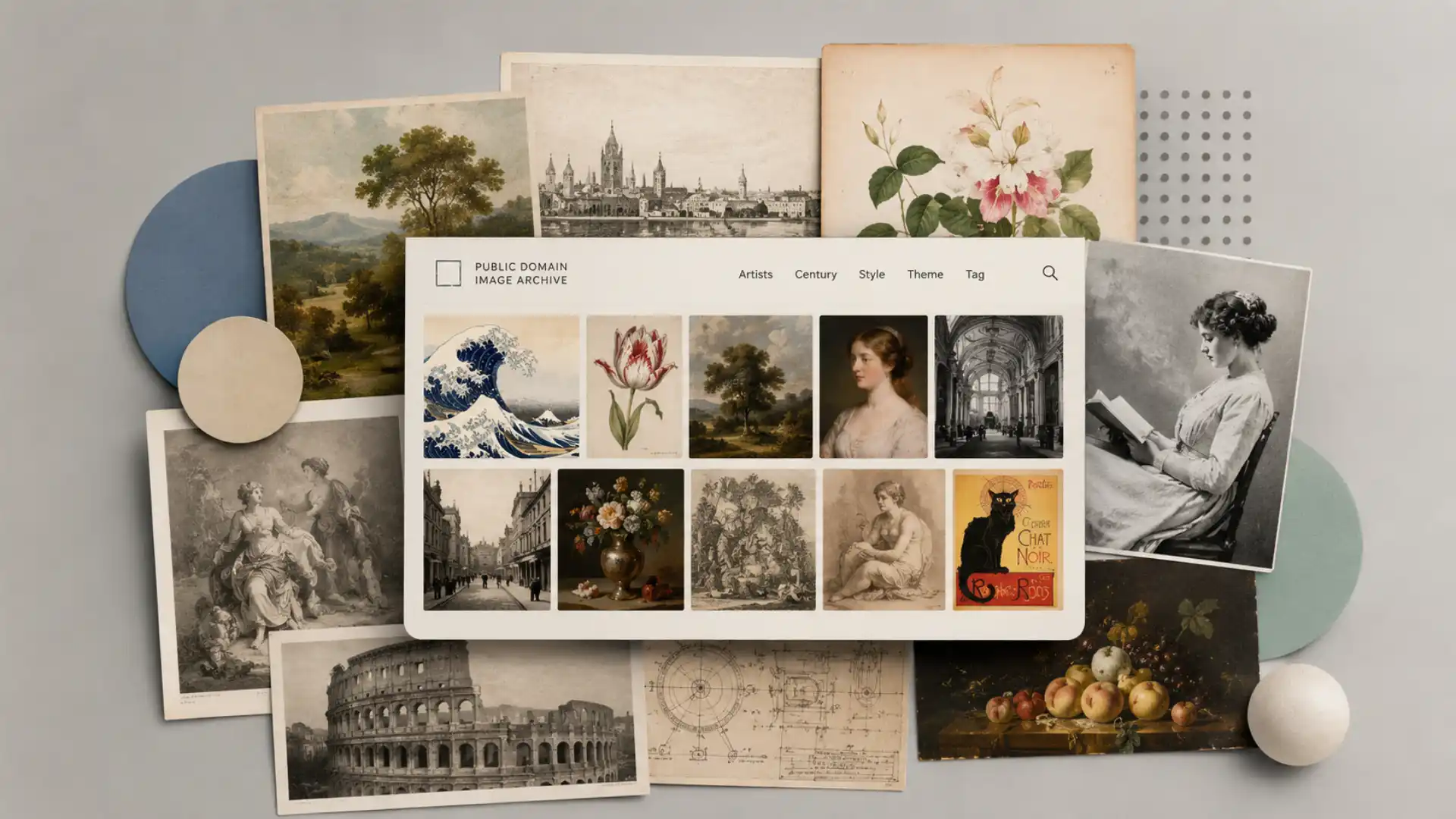
Public Domain Image Archive has search, but search is not the whole personality of the site. Its real strength is that it invites browsing before it demands precision. The front page offers routes by artist, century, style, theme, tag, and all images, which means the archive is not locked behind exact wording. You do not need to know the title of a print, the name of an engraver, or the institution that scanned a book. You can begin with “style” or “theme” and let the collection push back.
That sounds simple, but it is a serious product choice. A search-only archive assumes the visitor knows the archive’s language. A browsable archive admits that discovery usually starts clumsily. Designers search for “weird sun face,” teachers search for “old science image,” writers search for “melancholy landscape,” artists search for “fish monster engraving,” and most historical collections were not catalogued for those phrases. Categories give the visitor another way in.
The affiliation with The Public Domain Review is the point that explains the texture. This is not a neutral dump of files. The Public Domain Review has long specialized in curious, beautiful, strange, and overlooked public domain material. The image archive carries that editorial DNA into a more direct browsing tool: the article becomes optional, the image moves forward, and the reader can still trace the image back to a story when one exists. The project’s own announcement describes it as both an image archive and a database of images featured in The Public Domain Review, with links back to related articles and source institutions.
That connection changes the feel of the site. The images have been selected by people who care about surprise. A museum database might show you every object that matches a metadata field. That is useful, but it can be exhausting. Public Domain Image Archive is smaller by design, and that smaller scale gives the collection a point of view. You are not seeing everything. You are seeing what someone thought deserved a second life on the open web.
The archive’s “About” page says the images have often passed through a careful editing process: small presentation tweaks, rotations, exposure adjustments, or crops from book scans to isolate illustrations that otherwise might not exist online as standalone images. That is quiet labor, but it changes the experience. A public domain image trapped inside a badly cropped scan is technically available; a cleaned-up, isolated version is actually usable.
This is where the site becomes more than a list of rights-cleared pictures. It treats access as an editorial act. Getting an image online is one step. Making it findable, pleasant to browse, easy to download, tied to its source, and sorted into useful doors is another. Public Domain Image Archive understands that the public domain does not magically become public just because a file exists somewhere on a server.
The visual mix also helps. The archive has the pleasing unpredictability of old illustrated books, scientific plates, maps, religious images, prints, diagrams, photographs, ornaments, monsters, plants, machines, costume studies, and cosmic speculation rubbing shoulders. You can see the history of human looking in the collection: not just art history in the museum sense, but the visual habits of instruction, belief, fear, desire, classification, satire, commerce, and fantasy.
That is why the project feels so Web Radar-worthy. It is a website about reuse, but also about the lost art of internet wandering. Many modern discovery surfaces flatten the web into feed logic: what was liked, what was promoted, what is trending, what matches your profile. Public Domain Image Archive feels closer to a cabinet, a reading room, a browser window from the older internet, or a shelf where the next object is not personalized but peculiar.
The pleasure is in the ways in
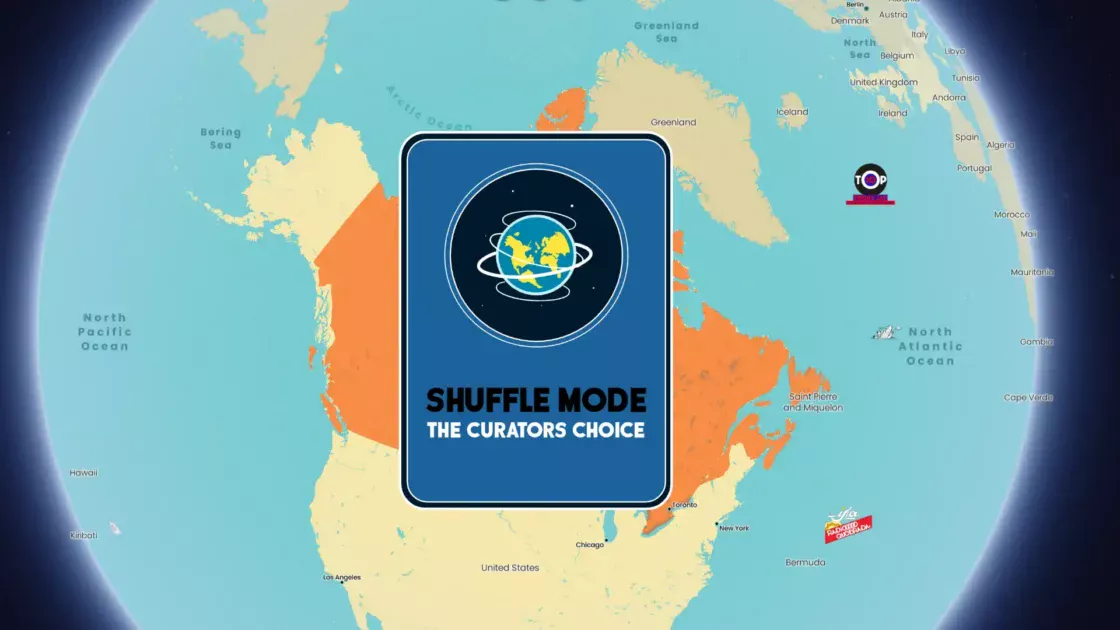
The archive could have stopped at a grid and a search bar. It does not. It gives visitors three major modes of encounter: catalogue view, infinite view, and shuffle view. The project describes catalogue view as a place to search and browse by theme, style, date, and more; infinite view as a more immersive way through the collection; and shuffle view as a tool for serendipitous discovery.
Those three modes are small product decisions with large consequences. Catalogue view respects intention. It is the mode for people who have a direction. A designer might need nineteenth-century botanical images, a publisher might need an engraving, a teacher might need a historical illustration for a slide deck, a musician might need cover art, or a writer might want a reference image for atmosphere. Catalogue view says: enter through metadata, compare, choose, download.
Infinite View does something else. It turns the archive into a visual drift. The name matters because it sets the expectation: not a database query, but an image stream without the usual social-media pressure. You are not being asked to react, like, comment, subscribe, or prove engagement. You are being invited to keep looking.
Shuffle View is even more honest about the pleasure of chance. It admits that sometimes the best search term is no search term. This is especially true for public domain material. The thing you need often has a name you would never guess. The image that sticks in your mind might be filed under a tag you would never type. Shuffle is a tiny rebellion against over-controlled discovery.
That design is suited to old images because old images carry old vocabularies. Historical collections are full of mismatched language. Names change, subjects change, taxonomies change, colonial labels age badly, scientific terms expire, artistic styles are argued over, and a picture may have been catalogued from the perspective of a librarian, a museum, a donor, a collector, or a digitization team rather than a modern user. Browse modes soften that mismatch.
The site also gives you categories that feel close to actual visual thinking. Artist, century, style, theme, and tag are not perfect, but they are practical. Century gives you time. Style gives you texture. Theme gives you subject. Artist gives you authorship when authorship matters. Tags catch the looser associations. A visitor who starts with “century” behaves differently from one who starts with “theme,” and the site allows both instincts.
That flexibility makes it useful for people who are not experts. You do not need a degree in printmaking to enjoy the site. You can begin with “space,” “animals,” “windows,” “music,” or any other concrete curiosity and see where the collection takes you. A good discovery tool lowers the cost of starting. Public Domain Image Archive does that without pretending every visitor is the same visitor.
What makes the archive click
| Feature | What it does | Why it matters |
|---|---|---|
| Search | Lets visitors look for a known subject | Useful when the brief is clear |
| Artist browsing | Groups works by creator | Good for following a visual voice |
| Century browsing | Organizes images by period | Turns time into a doorway |
| Style browsing | Sorts by visual treatment | Good for mood, texture, and reference |
| Theme browsing | Groups by subject | Best for casual discovery |
| Tag browsing | Adds looser associations | Catches the odd side routes |
| Infinite View | Presents an immersive stream | Rewards wandering without a feed |
| Shuffle View | Summons random images | Makes chance part of the interface |
The compact genius of the archive is that it does not force one style of looking. It serves the direct search, the loose browse, the visual drift, and the accidental find, which is rare for a collection site that also cares about rights and source links.
The site’s browsing structure also gives it an editorial rhythm. You feel the collection as a collection, not as a pile. That distinction is easy to miss until you spend time inside large digital archives. A pile makes you responsible for all the sorting. A collection gives you enough structure to keep moving, then gets out of the way.
The best public domain sites understand that visual reuse begins before download. A user must first trust the archive enough to browse, then trust the rights enough to reuse. Public Domain Image Archive works on both fronts. The interface creates appetite; the rights pages create confidence, with careful caveats where confidence has limits.
Free does not mean careless
The most dangerous word in public domain culture is “free.” It is true, but often too blunt. Free can mean free of copyright, free to download, free to reuse commercially, free in one country, free with attribution, free only as a low-resolution file, or free in the underlying work but not in the digital reproduction. The Public Domain Image Archive is useful because it refuses to pretend that all those meanings are the same.
The archive says it encourages reuse and mostly features images it deems fine to download and reuse in any way, anywhere in the world. The same page also warns that exceptions exist. It distinguishes between the rights status of the underlying historical work and the rights status of the digital copy, then says each image page communicates both statuses to the best of the project’s knowledge. That is exactly the kind of caution a reuse site needs.
The rights-labelling page is even more explicit. “Public Domain Worldwide” is treated as the cleanest label, meaning the project deems the work most likely to be in the public domain worldwide and free of known copyright restrictions, including copying, modifying, distributing, performing, and commercial use without permission. But the site also uses labels for 70-year terms, 50-year terms, U.S. public domain, government works, no known restrictions, and other edge cases.
This is where Public Domain Image Archive earns trust. It does not flatten legal mess into a cheerful download button. It tells users that public domain status can depend on geography, term length, publication history, the creator’s death date, the source institution’s claims, and the status of the scan or photograph. The Public Domain Review’s own explainer stresses that “the public domain” is often spoken of as one thing even though different jurisdictions create many public domains in practice.
For casual browsing, that may sound like a drag. For anyone publishing, designing, selling, teaching, or printing, it is the opposite. Clear rights language keeps people from guessing. It also respects the source institutions that made the digitized materials available. The archive’s reuse page says it does not assert rights over historical images on the site and is not in a position to grant permissions; users who need certainty should check with the original source institution.
That kind of caveat is not weakness. It is responsible stewardship. Public domain work sits inside a messy global system, and honest archives do not make magical guarantees. They explain what they know, show where the image came from, tell you what label applies, and remind you where the final check belongs when the use case is sensitive.
The archive’s position on edited versions is also worth noticing. It says the images may have been cropped or lightly adjusted for presentation, but it asserts no extra rights over those edited versions. That matters because some institutions and platforms have historically treated digital reproductions of public domain works as new controlled assets. Public Domain Image Archive is aligned with the open-cultural argument that public domain material should stay open when it is digitized.
The Public Domain Review’s public domain explainer makes the philosophical stance plain: public domain works should stay free from restrictions when they go online. That is more than a legal preference. It is a theory of culture. If old images become visible only through toll gates, watermarks, vague usage rules, and permissions desks, then digitization has not fully done its job. It has created a picture of access, not access itself.
Public Domain Image Archive also makes a subtle promise about provenance. Images link back to the institutions where they were found, from small college libraries to national repositories. That keeps the archive from swallowing its sources. It works as a discovery layer, not a replacement for the museums, libraries, and archives that hold the material.
That choice matters for reuse culture. A good public domain project should make the source more visible, not less. Designers and publishers get a cleaner browsing experience; institutions receive attention; curious users get more context; the public domain becomes less abstract. The image travels, but its trail does not disappear.
The archive understands that images have afterlives
The most interesting public domain images are rarely finished with history. They keep mutating. A botanical plate becomes a tattoo reference. A celestial chart becomes album art. A medieval monster becomes a meme. A nineteenth-century diagram becomes a poster. A forgotten ornament becomes a pattern. A medical illustration becomes a visual metaphor in an essay about anxiety. Old pictures do not stay old when people reuse them.
Public Domain Image Archive is built for that afterlife. Its promise is not only “look at this,” but “take this somewhere.” That is why the download-and-reuse framing matters so much. The site is not just a museum wall on a browser tab. It is a supply of cultural raw material, with enough context to keep the raw material from feeling anonymous.
Artists and designers will understand the appeal immediately. The archive is full of images that have texture modern stock libraries struggle to fake. Hand lines, strange proportions, imperfect printing, obsolete color, dense ornament, marginal weirdness, old diagrams, symbolic animals, theatrical gestures, invented landscapes, cosmic machinery, and the particular stiffness of images made before cameras trained everyone to see the world photographically.
Writers and editors have a different reason to care. The right public domain image can change the temperature of a page. A modern illustration often tells the reader exactly what to feel. A historical image is stranger. It can give an article a second register: not decoration, but friction. It brings time into the frame. It hints that the present has ancestors, superstitions, prototypes, and ghosts.
Teachers and researchers get another use. The archive makes visual history easier to enter without reducing it to classroom wallpaper. A teacher can pull an image into a lesson, but the image can also become a prompt: Who made this? What did it assume? What did it teach? What did it fear? Why does this plant, animal, planet, machine, saint, costume, map, or monster look this way?
Publishers and newsletter writers may find the site especially dangerous to their schedules. It is a machine for better headers. The archive is full of images that look alive in the small spaces of digital publishing: newsletter mastheads, essay openers, section breaks, playlist covers, zine art, social cards, and posters. Because much of the material is out of copyright, it can move into projects where standard image licensing would be annoying, expensive, or creatively deadening.
The site’s weekly growth is part of the appeal. A living archive changes the habit of use. A static collection is something you visit once, harvest, and forget. A collection that adds images weekly becomes a place worth revisiting. The front page says new images are added every week, which gives the archive the rhythm of a publication rather than a finished database.
That rhythm fits The Public Domain Review’s larger identity. The parent project has always treated the public domain as something to be edited, surfaced, narrated, and enjoyed. Its homepage describes The Public Domain Review as focused on curious and compelling works from the history of art, literature, and ideas, especially works that have entered the public domain and can be enjoyed, shared, and built upon without restrictions.
Public Domain Image Archive takes that editorial world and strips it down to image discovery. It is faster than reading an essay and warmer than using a raw database. You get the thrill of the object first. If you want the story, you can follow links outward. If you want the source, you can check the institution. If you want the file, you can reuse it under the stated guidance.
That flow is unusually considerate. It respects different levels of curiosity. Some visitors want an image in thirty seconds. Some want an afternoon of browsing. Some want to know the exact rights status before using an image commercially. Some want to learn the story behind a strange print. The site does not punish any of those modes.
The archive also has the charm of refusing to over-explain itself on the surface. It trusts images to do some of the work. That is rare online now. Many cultural projects bury the object under mission language, interpretive text, sign-up prompts, and institutional branding. Here, the promise is almost plain: images, free to explore and reuse, with ways to wander.
A better kind of internet rabbit hole
The phrase “rabbit hole” often describes the worst parts of the web: compulsive feeds, recommendation traps, conspiratorial spirals, shopping loops, and tabs opened out of irritation rather than interest. Public Domain Image Archive is a better rabbit hole. It is deep because culture is deep, not because the interface is trying to keep your attention at any cost.
That difference is felt in the tempo. The site does not shout. It does not look like a growth experiment. It does not wrap each image in engagement bait. It does not ask you to compete with other users, build a profile, or prove that your browsing matters. It gives you pictures and paths.
For a discovery project, that restraint is part of the pleasure. The archive lets attention become quiet again. You can move from a seventeenth-century engraving to a nineteenth-century scientific plate to a theatrical costume to a cosmic diagram without anyone telling you that this is “content.” The images were made for books, rituals, schools, markets, salons, laboratories, devotional practice, political satire, private study, or public display. They have already survived one media system. Now they are passing through another.
That passage is one of the most interesting things the site reveals about the web. The internet did not only create new images; it gave old images new circulation. A print that once lived inside a rare book can become a design reference on a laptop. A museum scan can become an artist’s texture. A forgotten illustration can become a visual joke in a group chat. Public domain archives are not nostalgia machines. They are distribution machines for old culture.
Public Domain Image Archive is smart because it understands circulation without stripping away context. It gives the image room to travel, then leaves a trail back to where it came from. That balance is not easy. Too much institutional weight can make reuse feel intimidating. Too little context can turn cultural material into anonymous aesthetic scrap. PDIA sits in a practical middle.
The site also quietly pushes against the idea that discovery must be personalized. Its best finds are not based on who you are. They are based on what survives, what was digitized, what the editors chose, what the metadata exposes, and what chance places in your path. That is refreshing. Personalization can be useful, but it narrows the world around the user. A public domain archive expands the user toward the world.
There is a humility in that. You arrive as one person with one search term; the archive reminds you that human visual culture is larger, stranger, and less obedient than your query. This is one of the hidden pleasures of browsing old material. The past keeps refusing to behave like a neat content category. It is funny, violent, ornate, devotional, scientific, wrong, elegant, cruel, tender, obsessed, and wildly specific.
The site’s interface also supports a kind of slow looking that ordinary search does not. A search result asks you to choose quickly; a visual archive asks you to notice. The difference matters for creative work. When you are building a mood, a visual reference, or an editorial idea, speed is not always your friend. Sometimes you need a place where the useless image beside the useful image changes the idea.
That is why Infinite View and Shuffle View are not gimmicks. They are design features for accidental thinking. The archive’s announcement names shuffle as a serendipitous tool, and that word fits. Serendipity is not randomness alone; it is randomness made available to a curious person. Public Domain Image Archive gives that curiosity a clean surface.
The archive’s limits also make it better. It is not pretending to replace every museum database, image search engine, or giant open collection. It is not the first stop for every possible historical image. It is the place you open when you want something with a pulse, something cleared enough to consider for reuse, and something selected from the wilder side of public visual culture.
That modesty is part of its taste. The internet needs more small-to-medium discovery tools that know what they are. A site does not need to index the universe to be worth bookmarking. Sometimes the better site is the one that narrows the universe in a way you trust.
Who should bookmark it
Designers are the obvious audience, but not the only one. Anyone who works with visual ideas should know this archive exists. Graphic designers, book cover designers, zine makers, collage artists, art directors, newsletter writers, web editors, teachers, students, researchers, musicians, game makers, tattoo artists, historians, meme-makers, and amateur collectors will all find different entrances.
For designers, the appeal is the combination of reuse and character. The archive offers images that feel specific rather than generic. Modern image libraries often sand off the weirdness because they are built for broad commercial safety. Historical images do the opposite. They bring oddity with them. A crab looks ceremonial. A cloud looks theological. A machine looks like a myth. A chart looks like a spell.
For writers and editors, the archive is a cure for the dead stock image. A public domain engraving can make an essay feel less disposable. It suggests that the piece belongs to a longer conversation, even when the article is about a modern subject. An old image placed well can create a productive mismatch: a nineteenth-century diagram for a story about software, a botanical plate for an essay about attention, a monster for a piece about bureaucracy.
For teachers, the site is a clean way to bring visual culture into lessons. The images are not just illustrations of topics; they are documents of how people organized the world. An old map shows geography and power. A medical plate shows knowledge and anxiety. A religious print shows belief and visual persuasion. A natural history image shows classification and imagination in the same frame.
For social media editors and newsletter publishers, the archive supplies something rarer than content: recognizable texture. A feed filled with AI gloss and stock minimalism makes older imagery stand out. The point is not to use historical images as a costume. The point is that the archive gives you visual material with marks of time, method, and human hand.
For artists, the archive is a reference library with permission culture built in. It is good for collage, studies, redraws, pattern hunting, visual quotation, and mood work. The rights pages still need attention, especially for commercial work, but the archive begins from an unusually reuse-friendly position. That lowers friction without pretending rights do not exist.
For curious people with no project at all, the site may be even better. It is one of those places that proves browsing can still be a legitimate internet activity. Not productivity. Not research. Not shopping. Just looking, following, noticing, and saving a few images because they tug at the eye.
The archive is not perfect for every need. If you need the most complete set of images from a specific museum, go to that institution. If you need modern photography, use a modern image source. If you need guaranteed legal certainty for a high-risk commercial use, check the original source institution and get professional advice where needed. PDIA is clear that its rights information is guidance, not legal advice.
It is also not a substitute for context. Old images can carry old harms. Historical visual culture includes colonial views, racial stereotypes, medical intrusion, gendered caricature, religious hostility, class contempt, and other materials that do not become harmless because they are beautiful or out of copyright. A good archive makes access possible; a good user still looks carefully.
Public Domain Image Archive helps by keeping source trails and rights labels visible, but judgment remains with the person reusing the work. That is the correct relationship. Public domain does not mean context-free. It means the legal barriers may be gone or reduced. The ethical and editorial questions still belong to the user.
A practical habit works well here: browse freely, download deliberately. Use Infinite View or Shuffle View to find the unexpected. Use categories to narrow the mood. Open image pages. Read the rights labels. Follow the source institution when the use is serious. Credit PDIA when practical, even if not required, because the project asks for that courtesy and it helps people find the archive.
This is especially relevant because the project is donation-supported. The archive says it has no external funding or intrusive advertising and relies on user support. It is run by The Public Domain Review, which is registered in the UK as a Community Interest Company. That structure matters because it explains why the site feels like a public-interest project rather than a lead-generation wrapper around free images.
The donation-supported model also makes the site feel more fragile in a good way. It reminds you that open web projects do not maintain themselves. Someone pays for servers, editing, development, metadata, rights research, design, and the slow work of making digital culture pleasant to use. Free access is not free labor.
The deeper charm is restraint
The archive’s strongest quality may be its refusal to overbuild the experience. It does enough. Search, browse, switch views, follow source links, read rights labels, download. There is no attempt to turn the collection into a social network, a marketplace first, a productivity dashboard, or a museum metaverse. That restraint feels almost radical.
It also makes the project more durable. A clean archive ages better than a fashionable interface. The images are already old; the site does not need to dress them in the visual language of a startup launch. The grey, quiet, image-forward presentation lets the pictures carry color and strangeness. The design knows when to recede.
This matters because many cultural websites misunderstand their own asset. The asset is not the interface; the asset is the collection. Public Domain Image Archive seems to know that. The interface gives you paths, but the images are allowed to remain the event. That is the right hierarchy for a site built around historical visual culture.
The archive’s name is plain, almost aggressively plain. Public Domain Image Archive tells you exactly what it is. Yet the experience is not plain. It has the mild shock of abundance, the humor of old illustration, the eeriness of obsolete diagrams, and the tactile pull of images made by hand or preserved through imperfect reproduction. The name is a door label; the room is stranger.
This is one of the reasons the site is memorable. It does not rely on novelty in the usual digital sense. There is no breakthrough feature here that needs a product demo. Its novelty is older and better: a well-edited trove of out-of-copyright images, presented in a way that respects wandering, reuse, and provenance. That is enough.
The archive also arrives at a time when image culture feels strangely saturated and strangely thin. We have more images than ever and fewer images that feel found. AI systems produce endless visual surfaces. Social platforms recycle the same formats. Stock sites package emotion into safe clichés. Against that, a strange old engraving can feel like a small electric object.
Public Domain Image Archive is not anti-AI, anti-stock, or anti-modern by default. Its value is not nostalgia; it is difference. It gives visual workers and curious readers access to images shaped by other technologies, other beliefs, other economies, and other ideas of beauty. Those differences are useful because they resist the sameness of current visual defaults.
There is also a political dimension, though the site does not need to shout about it. Public domain access is an argument about who gets to use culture. When historical works are locked behind fees, unclear restrictions, or low-resolution previews, the public technically owns less than it should. When images are clear, downloadable, and responsibly labelled, more people can make, teach, study, publish, remix, and remember.
The Public Domain Review has been making that argument for years through essays, collections, and source transparency. PDIA turns the argument into a browsing experience. That is why it feels so clean. It is not just saying the commons matters. It is giving people a place to use it.
Small answers before you open it
Is everything on the Public Domain Image Archive free to use? The archive is built around out-of-copyright material and says its images are free to browse, download, and reuse, but the rights details still matter. Most images are presented as reuse-friendly, yet some have jurisdiction or attribution limits. Check the rights labels on the image page, especially for commercial or high-visibility work.
Does the archive own the images? No in the ordinary sense. The project says it does not assert rights over the historical images featured on the site. It sources material from institutions, presents rights guidance, and links back to original holders where possible. If you need formal permission or certainty, the archive points you back to the source institution.
Why use this instead of a museum database? Museum databases are crucial, but they are often built around institutional cataloguing rather than wandering. PDIA is a discovery layer with taste. It gathers hand-picked public domain images from many institutions and gives you browsing modes that are easier for creative searching.
What makes the archive different from a normal free image site? The images have historical depth, source trails, and rights labels. The archive is not chasing generic “usable” visuals. It is presenting old visual culture as reusable material: odd, beautiful, damaged, formal, comic, devotional, scientific, decorative, and sometimes uncomfortable.
Should you credit the archive? The reuse page says users are not obliged to mention PDIA when reusing public domain material from the site, but the project appreciates a mention and link where practical. Credit is a good habit even when it is not legally required. It helps other people find the source and supports the open-web chain that made the image usable.
Is the site mainly for professionals? No. Its best feature is that it works for both purpose and pleasure. A designer can search for a usable image. A teacher can find lesson material. A writer can find an essay header. A curious person can open Infinite View and drift. The same archive serves all four without changing its character.
What is the one thing to remember before reusing an image? Public domain status is not always identical across the world. The archive is careful because copyright terms, publication rules, and digital-copy claims vary. Treat the rights label as your starting point, not as a substitute for checking the original institution when the stakes are high.
The site worth keeping in your browser
Public Domain Image Archive is worth bookmarking because it solves a real problem with taste. It makes public domain imagery feel findable, reusable, and alive. It does not bury you in institutional machinery. It does not reduce old images to decorative assets. It lets you search, wander, shuffle, read rights, trace sources, and leave with something stranger than you expected.
The site’s current count, 11,082 works, is not enormous compared with mega-collections, but the number is large enough to feel abundant and small enough to feel selected. That is the sweet spot. You can sense the hand of curation without feeling trapped in one person’s cabinet. You can browse for minutes or hours. You can arrive with a brief or no brief at all.
The best thing about it is that it restores an older web pleasure without making a museum piece of the web itself. It gives you a place to click without being harvested by urgency. The images are old, but the product thinking is sharp: let the archive be searchable, let it be browsable, let it be serendipitous, let the rights be visible, and let the source trail stay intact.
That is a rare combination. Most free-image sites are either too generic, too legally vague, too commercial, too flat, or too hard to browse. Public Domain Image Archive avoids those traps by having a clear center of gravity: public domain images chosen by people who know the thrill of the strange and the usefulness of the clearly labelled.
It also gives readers a better reason to care about the public domain. The public domain can sound abstract until you are staring at a picture you want to use. Then the idea becomes concrete: no permission chase, no fee, no watermark, no dead end, just an old image returning to circulation. The archive makes that feeling easy to find.
Open it for a project, and you may leave with a file. Open it with no project, and you may leave with a renewed faith in browsing. That is the mark of a good Web Radar find. It does not merely answer a need you already had. It creates a small new habit: when the visual web feels too polished, too current, or too predictable, go see what the public domain has been saving.
Author:
Jan Bielik
CEO & Founder of Webiano Digital & Marketing Agency
This article is an original analysis supported by the sources cited below
Public Domain Image Archive
Official homepage used for the current collection count, weekly-update claim, reuse promise, search entry point, and browsing categories. The uploaded house-style rules were applied while drafting this article.
About the Project
Official project page used for the archive’s mission, Public Domain Review affiliation, source-institution notes, browsing modes, funding model, editors, and Community Interest Company information.
Reusing Images
Official reuse guidance used for the distinction between underlying works and digital copies, rights-status communication, reuse caveats, permission guidance, and the note that PDIA asserts no extra rights over edited versions.
Rights Labelling on Our Site
Official rights-labelling page used for the archive’s public domain labels, including worldwide public domain, term-based labels, U.S. public domain, government works, no known restrictions, and digital-copy rights summaries.
What is the Public Domain?
The Public Domain Review explainer used for the broader public-domain context, jurisdiction differences, term structures, digital-copy issues, and the argument that public domain works should stay open when digitized.
Announcing the Public Domain Image Archive
The Public Domain Review launch post used for the archive’s image-first role, links back to articles and source institutions, and the stated purpose of catalogue, infinite, and shuffle views.
| Citing this article? Brief excerpts are welcome. Please credit Webiano.digital, name the author where stated, and include a link to https://webiano.digital and to this original article. Full or substantial republication requires prior written permission. Read our Copyright and Content Use Policy. |
This article was prepared with the assistance of artificial intelligence tools. The content underwent expert human review, and Webiano Digital & Marketing Agency assumes editorial responsibility for its final version and publication.