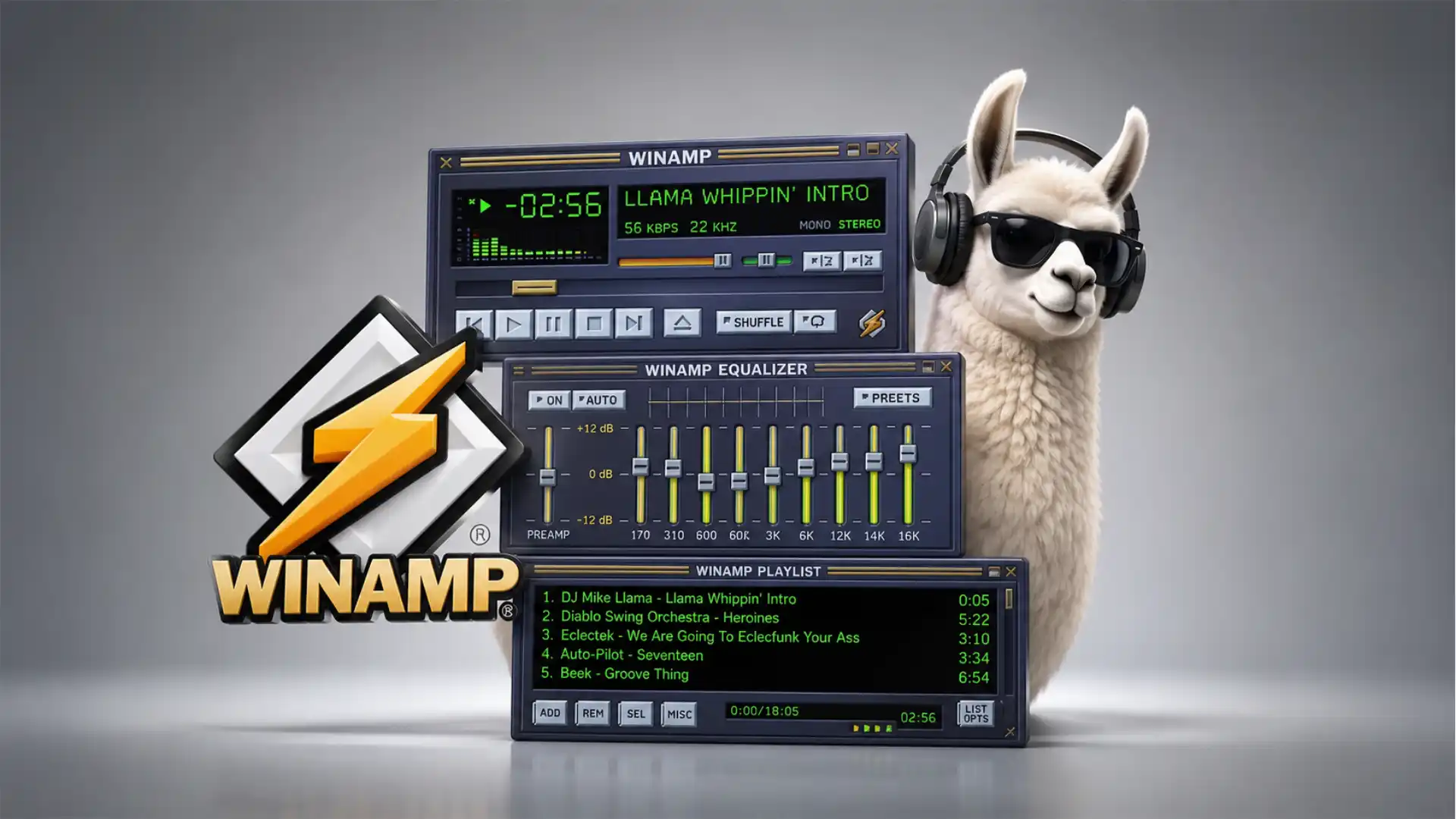
The funniest thing about Winamp is that its most famous line still sounds better than most brand slogans written since. “It really whips the llama’s ass” was stupid, specific, musical, slightly rude, impossible to mistake for anything else, and exactly the kind of sentence that made a tiny MP3 player feel like it had a soul. Justin Frankel later told Wired that the llama line began with someone emailing Nullsoft a version of the phrase, likely as an homage to Wesley Willis, and then it just became part of the thing itself.
Table of Contents
Winamp mattered because it did not behave like a piece of software trying to become a lifestyle platform. It was a small rectangle that played your files, showed your music as green numbers and twitching bars, accepted skins from strangers, and treated your desktop as a room you could decorate. It had attitude without a campaign. It had community without a community strategy. It had customization before personalization became a polite word for surveillance.
Open the current Winamp site now and the situation is stranger than a clean nostalgia trip. Winamp is still alive, but it is no longer just that old Windows player hiding in the corner of a hard drive. The official site presents Winamp as a mix of listener player, creator platform, music distribution toolkit, revenue dashboard, fan monetization layer, and brand revival project. The homepage says Winamp builds tools for artists to manage music and revenue while still offering a player for listeners.
That is why Winamp is worth a Web Radar entry in 2026. It is not merely retro software. It is a messy portal into several versions of the internet at once: the file-sharing internet, the skinning internet, the plugin internet, the personal-computer-as-bedroom internet, the corporate-revival internet, and the archive internet that refuses to let dead interfaces stay dead. Few names carry that much residue in three syllables.
The official Winamp is interesting, but the larger Winamp web is even more interesting. The real discovery is the ecosystem around it: Webamp reimplements Winamp in the browser, the Winamp Skin Museum lets you scroll through a huge archive of user-made skins, and the current Winamp company is trying to turn a legendary player into a creator-services business. The result is not one clean comeback story. It is a knot of memory, taste, ownership, and internet culture.
The player that felt like a tiny room
Winamp’s old magic was not that it played MP3s. Plenty of software played files. Winamp made file playback feel like possession. You had songs, folders, playlists, skins, presets, plugins, visualizers, and a tiny control panel that sat on your desktop like a personal stereo from a parallel world. When you dragged music into it, the files felt less like data and more like a collection. That distinction mattered, especially when people were ripping CDs, swapping tracks, naming folders by hand, and treating a hard drive like a private record shop.
The player’s classic shape was part of the spell. It was small enough to be peripheral but expressive enough to be loved. The main window, equalizer, and playlist could sprawl across a screen or collapse into something narrow and obedient. You could tuck it above a chat client, beside a browser, under an image editor, or into a corner of a Windows desktop crowded with shortcuts. It did not demand full-screen attention. It lived among your other mess.
That sense of local control feels almost exotic now. The old Winamp assumed the music was yours. Your folders were not treated as a legacy problem. Your files were not awkward imports into someone else’s catalog. The current official Winamp Player page still leans on that memory by saying the player lets people listen to locally stored content and manage playback by artist, album, playlist, and folder.
The word “folder” is doing more emotional work than it first appears. A folder is a human compromise with chaos. It says you downloaded, ripped, renamed, sorted, forgot, rediscovered, and maybe made peace with inconsistent metadata. Streaming services replaced much of that with cleaner access, but also flattened the feeling of ownership. Winamp’s old appeal lives in the gap between those experiences. It is a player for people who remember music as something arranged, not merely accessed.
The phrase “personal experience” appears on the current Winamp Player page, but the older version of that idea was sharper. You personalized Winamp by changing the machine, not by teaching a remote service what you liked. Skins changed the metal, plastic, glass, chrome, buttons, shadows, and mood of the thing. Plugins changed what it could do. Visualizers turned songs into little private light shows. The software felt open-ended in a way that was messy but generous.
Winamp arrived when MP3s were becoming a social fact. The format made music portable across computers, but Winamp made that portability feel usable. It was not a grand social network, yet it sat at the center of many social rituals: burning mixes, sharing folders, downloading mislabeled tracks, hoarding live sets, finding rare songs, and letting a playlist run while the rest of the internet crawled through dial-up, forums, IRC, and early broadband.
This is one reason the Winamp memory sticks harder than memories of many bigger products. It was attached to ordinary private nights. A person could be on MSN Messenger, editing a profile, browsing a forum, playing Counter-Strike, downloading a fan translation, or pretending to study while Winamp ran in the corner. The player became part of the room. It was software, but it also became lighting.
The mascot helped. Mike the Llama was absurd enough to be useful. A llama gave the product a joke that did not need to explain itself. Frankel’s Wired interview makes the origin sound casual rather than planned: an email, a phrase, a homage, then a running bit. That looseness is hard to fake. Brands now spend months trying to manufacture exactly the kind of weirdness that early internet software sometimes produced by accident.
Even the name Nullsoft carried the right amount of prank energy. It sounded like a company that might ship something brilliant and mildly disobedient. That atmosphere matters because Winamp did not become beloved through minimal taste. It became beloved through a different taste entirely: dense, playful, user-made, sometimes ugly, sometimes gorgeous, often adolescent, rarely focus-grouped. It belonged to the era when software had buttons you could almost hear click.
The current web makes old Winamp feel even more radical. Not because it was purer, but because it was more obviously yours. It did not hide its machinery. It did not pretend a server somewhere understood your identity. It gave you knobs, sliders, windows, and files. The relationship was tactile. You could wreck the look of it with a terrible skin and still feel satisfied because the terrible choice was yours.
That is the first reason to open Winamp again. It reminds you that software once had edges. It was not all cards, feeds, glassmorphism, and gray panels. It could look like brushed steel, alien resin, a stereo component, a sci-fi prop, a toy, a goth object, a candy wrapper, or a crashed spaceship. Winamp made a player feel like an object, and the web still has not fully replaced that pleasure.
The site is still worth opening
The official Winamp site now has a different job from the old installer page. It has to carry a legendary name into a music market that barely resembles the one that made the name famous. The homepage positions Winamp as both a player and a set of artist tools, which is a sharp pivot for a product remembered by many people as the little thing that played pirated MP3s on Windows.
The current Winamp Player pitch is built around aggregation and personal listening. It promises local files, listening controls, custom button layouts, and skins, which are exactly the elements most likely to wake up old affection. The Player page says users can listen to locally stored content, manage playback modes, customize the player, place buttons where they want, and create skins. That is the right set of signals. Winamp without skins would feel like a band reunion with no original songs.
The more surprising side is Winamp for Creators. This is where the brand stops being a retro player and becomes a music-business dashboard. The Creators page describes a platform for distribution, royalties, fan support, merchandising, marketing, YouTube Content ID, collaborator management, reporting, and paid plans. It says artists can distribute music worldwide, collect royalties, turn fans into paying supporters, sell merch, and promote releases.
That shift is either clever or awkward, depending on what you wanted from Winamp. The clever reading is that Winamp always lived near independent music behavior. It was built for people collecting files outside the polished channels of the music industry. A modern toolset for artists trying to manage distribution, fans, rights, and revenue is not a random move. It points toward the same basic idea: music does not need to pass through one giant gate.
The awkward reading is just as real. The old Winamp was beloved because it stayed out of the way. A dashboard for monetization, promotion, and rights management is the opposite kind of object. It is useful, perhaps, but it is not intimate in the same way. It belongs to the platform age, where every creative act becomes a funnel, every fan becomes a revenue segment, and every artist needs yet another backend to manage the work around the work.
That tension makes the site worth opening. Winamp is trying to turn memory into infrastructure. Some revivals only sell T-shirts, icons, or nostalgia skins. Winamp is aiming at something more complicated: keeping the player alive while using the brand to court artists who need distribution and direct-to-fan tools. The name carries feeling. The business wants that feeling to open doors.
A visitor should not expect the old website with a download button and a chaotic plugin directory. The current site is polished in the way modern music-tech sites are polished. There are clean sections, product cards, creator plans, and platform language. The oddity is that the old llama energy keeps peeking through the surface. Even the contact link on the homepage jokes about “llamas” and “ass whippin’ feedback,” which suggests the company knows the old line is still part of the asset.
The strongest part of the official site is the listener-player page. It understands that Winamp cannot survive only as a memory. The page talks about local content and skins, not just streaming convenience. That matters because a modern Winamp that ignores files would be a contradiction. The people most likely to care about the name are exactly the people who still understand the emotional value of local libraries, weird file names, and a player that feels detachable from a service subscription.
The creator side is harder to judge from the outside, but it makes strategic sense. Music discovery has become brutally crowded. Winamp’s own creator page says distribution makes music available while promotion is what helps people discover it, then pitches tools such as website building, ads, social media management, and links pages. That is not romantic. It is practical. It also shows how far the music internet has moved from the MP3-folder era.
What stands out
| Part of the Winamp web | What makes it worth opening | The honest limit |
|---|---|---|
| Winamp Player | Local files, skins, custom layouts, familiar brand memory | It must compete with entrenched listening habits |
| Winamp for Creators | Distribution, royalties, fan support, merch, promotion | It feels more platform-like than classic Winamp |
| Webamp | Winamp 2 reborn in a browser with skin support | It is a tribute project, not the official player |
| Winamp Skin Museum | A browsable archive of visual internet culture | Browsing can become pure nostalgia drift |
| Source-code story | A rare look at the difficulty of reviving old proprietary software | The release became messy and controversial |
The table shows the core truth of modern Winamp. There is no single Winamp now. There is the official business, the remembered Windows player, the browser recreation, the skin archive, and the developer drama around old code. The name survives because each version feeds the others without fully resolving into one clean product.
For Web Radar, that fractured quality is part of the appeal. A neat comeback would be less interesting. Winamp is worth opening because it reveals how old software lives after its original moment passes. Some of it becomes brand equity. Some becomes code archaeology. Some becomes fan art. Some becomes a museum. Some becomes a product roadmap. Some becomes a joke that refuses to die.
The official site also exposes a strange truth about internet nostalgia. People do not only miss old things because they were better. They miss them because the old things gave them a role. Winamp users were not just listeners. They were arrangers, skinners, plugin hunters, playlist makers, archivists, and taste-signallers. The current site succeeds whenever it remembers that Winamp’s strongest feature was not playback. It was agency.
The skin economy before everybody called it identity
Winamp skins were not decoration in the shallow sense. They were tiny acts of desktop authorship. A skin could make the player look like polished metal, cracked plastic, anime machinery, translucent glass, military hardware, a fake Sony component, a cyberpunk console, or a badly cropped celebrity shrine. Some were elegant. Many were chaotic. A few were nearly unusable. The unusable ones may now be the most revealing.
The point was not only to make the player beautiful. The point was to make it yours. Before social profiles became the main canvas for online identity, the desktop was already a private stage. Wallpaper, icons, cursors, media players, chat clients, and browser themes formed a mood board. Winamp sat in that mood board with unusual confidence because its skin system let amateurs change the player’s visual personality without needing to rebuild the program.
This is why the Winamp Skin Museum feels less like a software archive and more like a cultural excavation. Every skin is a little fossil of somebody’s taste. Search long enough and you find the visual vocabulary of its time: chrome gradients, scanlines, tribal shapes, pixel fonts, brushed aluminum, flames, liquid blobs, sci-fi panels, gothic lettering, pop-star faces, operating-system mimicry, and the intense confidence of people discovering Photoshop filters.
The museum is built on a simple but powerful premise. Scrolling through skins is more revealing than reading a history of skins. You do not need a long explanation to understand the era when you see hundreds of tiny interfaces trying to become spaceships, stereos, charms, weapons, and mood rings. The page itself describes the experience plainly as infinite scrolling through Winamp skins with interactive preview.
Skins mattered because they were made outside official taste. They were not brand systems. They were uploads from people with usernames, obsessions, favorite bands, favorite colors, and varying levels of patience. That mess gave Winamp a visual range no single design team would approve. It also made the player porous. The software could absorb subcultures rather than simply market to them.
A modern interface often aims to disappear. Winamp skins wanted to be seen. That difference is not small. Today, invisibility is treated as polish: fewer controls, fewer edges, fewer surprises, fewer ways to get lost. Winamp’s skin culture did the opposite. It invited surfaces. It said the player could be theatrical, clumsy, moody, metallic, cute, angry, illegible, or completely overdesigned. It made taste visible, even when the taste was questionable.
The best skins were not always the cleanest. Some succeeded because they felt like props from imaginary media devices. They suggested hardware that never existed: future radios, hacker stereos, alien consoles, bedroom DJ modules, tiny command centers for music hoarding. The player became a fictional object on a real desktop. That fictional quality is why screenshots of old Winamp still hit harder than screenshots of many newer apps.
The worst skins are useful too. They show what people do when software gives them too much freedom. They stretch fonts, hide buttons, overuse bevels, flatten contrast, worship chrome, paste faces in strange places, and make the playlist almost impossible to read. Yet those failures are part of the archive’s charm. A culture made only of good taste is usually a culture already filtered by institutions. Winamp preserved the unfiltered middle.
The skin scene also shows how customization used to move through the web. You found things by browsing, linking, downloading, trying, deleting, and keeping private folders. The process was slower than a feed and more intentional than a recommendation carousel. A person could collect skins the way they collected fonts, wallpapers, icons, tracker modules, or forum avatars. The collection might be half-junk, but it was their junk.
The official Winamp Player page now says users can create skins. That is a necessary promise for the brand, because skins are not a side feature in the Winamp story. They are one of the reasons the name still evokes a whole atmosphere. Without skins, Winamp becomes a media player among media players. With skins, it becomes a memory of software as a writable surface.
There is also a deeper lesson for product people. Customization does not always need to be clean to be powerful. Companies often fear user-made aesthetics because users will create ugly things. Winamp proves the opposite can be true. The ugly things become part of the meaning. They show life. They show use. They show that the product escaped the company’s control in a productive way.
That escape is difficult to reproduce now. The current internet is less comfortable with uncontrolled surfaces. App stores, design systems, brand safety, moderation, and growth metrics push products toward controlled presentation. Even when apps allow themes, they often confine users to sanitized palettes. Winamp skins remind us that identity used to include real visual risk. You could make your player look ridiculous, and nobody could stop you.
The Skin Museum works because it restores the act of browsing without demanding a purchase, login, or feed commitment. It lets the old web be weird at its natural speed. You scroll, click, preview, and drift. A skin catches your eye, not because an algorithm decided it should, but because some stranger twenty years ago made a tiny metal-blue interface that still has enough personality to interrupt you.
Winamp’s skin culture also explains why the llama line stuck. Both the skins and the slogan came from the same permission structure. They were specific, unserious, and memorable. They did not smooth themselves into tasteful nothingness. They sounded and looked like people had been allowed into the product. That is why Winamp’s personality still survives, even when the business around it changes.
Webamp made the old player playable again
Webamp is one of the most satisfying preservation projects on the web because it does not treat preservation as a screenshot. It makes the interface move. Built as a reimplementation of Winamp in HTML5 and JavaScript with full skin support, Webamp takes a desktop media player and turns it into something that can run inside a modern browser. The project’s GitHub page describes it exactly that way.
That distinction matters. A screenshot can remind you what something looked like, but an interactive recreation reminds your hand what it felt like. Buttons, windows, dragging, playlists, and skins all carry muscle memory. Webamp understands that the artifact is not only the visual design. It is the behavior. The old Winamp was a set of tiny rituals: drag a window, toggle shade mode, open the equalizer, stack the playlist, load a skin, stare at a visualizer.
Webamp also proves that the browser has become an emulator of almost everything. The web can now host its own ancestors. A media player once tied to Windows can return as JavaScript, not as a joke but as a working object. That is a strange and lovely inversion. The browser, once a place where people downloaded desktop software, now becomes the place where desktop software is reenacted.
The project has technical taste as well as nostalgia. Full skin support is the important phrase. A bare Winamp clone would be cute for a minute. A skin-aware Winamp recreation becomes a portal to thousands of visual identities. The Webamp repository also notes related pieces in its monorepo, including the demo site, documentation, the server component behind the Skin Museum, and a prototype for rendering modern Winamp skins.
That last piece is where the story gets beautifully nerdy. Classic skins were difficult enough, but “modern” Winamp skins were far more interactive. Jordan Eldredge wrote in 2024 about reverse engineering Maki bytecode to render modern Winamp skins in the browser. He explains that Winamp 5’s modern skin engine used XML for interface descriptions and Maki scripts for interaction, somewhat like a custom world of HTML and JavaScript.
That post is worth reading because it shows the labor behind a nostalgic click. The web version of an old interface is not magic. It is parsing, reverse engineering, weird file formats, half-documented behavior, bytecode interpretation, browser constraints, and patient testing against real skins. Nostalgia often looks soft from the outside. Preservation engineering is not soft. It is stubborn, detail-hungry work.
Webamp’s value also comes from restraint. It does not try to modernize Winamp into something frictionless. It keeps the odd scale, the windowed feel, the tiny controls, and the visual density. That makes it more honest. A revival that enlarged everything, flattened the controls, and “updated” the interface into generic cards would miss the point. Webamp knows the weirdness is the artifact.
The project is especially good as a reminder of how much design history lives outside official archives. Many of the best interface memories are not in corporate museums. They are in GitHub repos, personal blogs, Internet Archive items, forums, fan projects, and little sites that someone kept alive because the thing still mattered to them. Webamp is not merely a clone. It is a bridge between software preservation and web craft.
The Winamp Skin Museum extends that bridge. A skin archive without Webamp would be a catalog of frozen costumes. With Webamp, the skins become wearable again. You can preview them, feel their proportions, and understand why a skin that looks ugly in a thumbnail might still have a satisfying little logic once wrapped around the player. The museum turns passive browsing into interface archaeology.
The Webamp GitHub page points to the Internet Archive as a related community and notes that the Internet Archive lets users preview Winamp skins and listen to audio tracks using Webamp. That connection is exactly the kind of web preservation loop that deserves attention: an archive keeps the files, a developer makes them playable, a museum makes them browsable, and old culture becomes newly reachable.
There is a quiet lesson here for anyone building digital archives. Preserving the file is not the same as preserving the experience. A .wsz skin file sitting in storage is important, but most people will never inspect it. A browser preview changes the audience. It makes the archive casual, alive, and shareable. The Skin Museum succeeds because it understands that access is part of preservation, not a layer added after the serious work is done.
Webamp also avoids the sadness that often hangs over old software. It does not ask you to mourn Winamp. It asks you to play with it. That tone feels right. Winamp was never solemn. It was too full of bleeps, skins, jokes, and plug-in clutter to become a sacred object. The best tribute is not a glass case. The best tribute is a draggable little player that still lets a ridiculous skin look ridiculous.
The project’s existence also says something about what people miss from desktop software. They miss software with visible seams. Modern apps often hide state, file location, and system boundaries. Winamp showed pieces. It had windows. It had files. It had controls. Webamp brings those seams into the browser, and the browser suddenly feels less like a glossy service container and more like a workbench.
There is a risk in romanticizing all of this. Old software could be frustrating, crashy, inconsistent, and hostile in its own ways. Winamp’s best memories do not erase the mess of codecs, bad downloads, broken metadata, malware-laced download sites, and Windows instability. Webamp is charming partly because it lets us revisit the interface without returning fully to that environment. It is memory with some of the splinters removed.
Yet the splinters matter too. Winamp’s charm was never purely clean. It came from a culture of small downloads, odd utilities, partial knowledge, and experiments that worked just well enough. Webamp preserves that spirit better than a corporate retrospective could. It shows affection through implementation. It takes the old thing seriously enough to make it usable, but not so seriously that it sands away the grin.
The new Winamp is a tug of war
The official Winamp revival carries a hard problem: how do you build a future for a brand whose strongest emotional value comes from a past user base that distrusts overbuilt futures. That is not an easy brief. Make the product too nostalgic and it becomes a museum shop. Make it too modern and people accuse it of wearing Winamp’s skin without understanding Winamp’s bones.
The company’s current direction suggests it wants both listeners and creators. The player keeps the emotional door open, while Winamp for Creators gives the business a larger market than nostalgic playback. The Creators page offers distribution, royalty collection, YouTube Content ID, fan subscriptions through Fanzone, merchandising, marketing tools, reporting, collaborator features, and plans ranging from free to paid tiers.
This makes sense as a business. Music software alone is hard to monetize at scale, especially when many listeners already live inside Spotify, Apple Music, YouTube, SoundCloud, Bandcamp, local apps, DJ software, or phone-native players. Creator services, by contrast, touch pain points artists already pay to solve: distribution, rights, promotion, fan capture, merch, analytics, and direct revenue.
The risk is that Winamp becomes a brand wrapper for services that could exist under any name. A creator dashboard is not automatically Winamp. To feel earned, the new platform needs to carry forward the old product’s respect for user control, local identity, and outsider music behavior. If Winamp is going to court artists, it should not only sell tools. It should feel like it understands people making and sharing music outside polished industry machinery.
The official copy sometimes leans into broad platform language, but the product mix is telling. Distribution, fan support, merch, and websites all point toward creator independence. That is a plausible continuation of the old ethos, even if the interface and business model look very different. Winamp once served listeners who built private libraries outside the main channels. The new Winamp wants to serve artists trying to survive outside one-channel dependence.
There is also a cynical reading. Nostalgia is a cheap acquisition channel until it is not. A famous old name can get press, clicks, goodwill, and curiosity that a new brand would never receive. But nostalgia also raises expectations. Winamp users do not merely remember a logo. They remember a posture: quick, weird, customizable, slightly anti-corporate, and user-shaped. A revival that forgets that posture spends the inheritance quickly.
The 2024 source-code episode shows how delicate the inheritance is. Winamp announced that it would open the Windows player source code to developers worldwide on 24 September 2024, framing it as a way for the community to participate in the product’s development. The official press release said Winamp would remain the owner of the software and decide which innovations made it into the official version.
The community response was not a simple victory lap. The Register later reported that the owners deleted the entire GitHub repository about a month after uploading it, following questions about included Shoutcast DNAS code and some Microsoft and Intel code. The same report said the initial custom license was not really open source and included a “No Forking” clause before a later revision.
That episode is more than gossip. It shows how hard it is to convert old proprietary software into a community object. Codebases carry history: licensed parts, bundled pieces, inherited assumptions, dead dependencies, rights questions, and decisions made by people who may be long gone. “Open the source” sounds simple until the source contains several decades of legal and technical sediment.
It also shows how sensitive developers are to language. Calling something open invites open-source expectations. If the license restricts forks, modified distribution, or contribution ownership, people will notice immediately. Winamp’s old community included people who loved tinkering, plugins, skins, and software freedom in the loose cultural sense. That does not mean they will accept any “community” framing from a current rights holder.
The source-code mess is not the whole story, but it belongs in the story. A brand like Winamp cannot separate its future from its users’ memory of control. Source access, skins, plugins, local files, and community input all touch the same nerve. The more a company invokes collaboration, the more carefully it has to define who gets power and who merely gets invited to work.
The irony is that Webamp’s unofficial, open web recreation may feel more spiritually Winamp than parts of the official revival. That does not make the official project fake. It means Winamp’s soul is distributed. Some of it sits with the brand owner. Some sits with the people building browser recreations. Some sits with archivists. Some sits with users who still keep old installers. Some sits with the llama joke.
For readers, that distributed soul is the best reason to explore the whole Winamp web rather than stopping at one URL. The official site tells you what Winamp wants to become. Webamp shows you what Winamp felt like. The Skin Museum shows you what users did with it. The source-code story shows you how complicated ownership becomes when software becomes cultural memory.
Winamp’s future will probably be judged on whether it can make new users feel any of that agency. The name alone will not be enough. A nostalgic listener may open the player once for the logo, but they will stay only if the product gives them control that newer music apps withhold. An artist may try the creator platform for tools, but the Winamp name will matter only if the product feels unusually respectful of independence.
The tug of war is productive because it keeps Winamp interesting. Pure nostalgia would be too easy to dismiss, and pure platform ambition would be too easy to ignore. The current Winamp sits between those poles. It is trying to be useful now while carrying the ghosts of a product that became beloved by being small, odd, and user-shaped. That contradiction is the story.
The web around Winamp reveals what we lost
Winamp nostalgia is often treated as a joke for people who remember Napster, beige PCs, and hard drives full of suspiciously named files. The joke is real, but the feeling underneath it is serious. Winamp represents an internet where users touched more of the stack. They handled files, installed plugins, changed skins, joined forums, traded recommendations, and built systems out of mismatched parts.
That internet was not innocent. It was full of piracy, broken links, malware, bad metadata, gatekeeping, slow downloads, and ugly interfaces. The point is not that everything was better. The point is that users had different kinds of power. The web and desktop felt more hackable at the consumer level. You could change the look of a thing. You could keep local copies. You could avoid accounts. You could assemble your own environment from fragments.
Winamp sits at the center of that memory because music was one of the first forms of digital possession many people understood emotionally. An MP3 collection felt like a shelf and a secret at once. It was portable, searchable, shareable, and intensely personal. A streaming library is convenient, but it rarely feels like a room. Winamp gave that room a control panel.
The current web is better at access and worse at attachment. You can hear almost anything now, but much of it arrives through the same few interfaces. Those interfaces are polished, licensed, synchronized, and optimized for retention. They are also oddly placeless. A playlist in a streaming app can be meaningful, but it does not have the same texture as a folder of files with bad capitalization and half-remembered origins.
Winamp’s skins made attachment visual. They turned listening into an aesthetic decision. The player did not just know what you were playing. It looked the way you wanted your listening to feel. A trance playlist could sit behind a glowing sci-fi console. A metal folder could run through black chrome. A pop obsession could live inside a bubblegum interface. The surface participated in the mood.
That is why the Skin Museum can be moving in small doses. It shows identity before identity was standardized into profile fields. The skins are clumsy little self-portraits of an era when people made interfaces to match music, fandom, hardware fantasies, and personal style. Some designs look embarrassing now. That embarrassment is evidence. Real internet culture is always partly embarrassing when preserved honestly.
Webamp adds another layer by making those old surfaces work in the present browser. It collapses the distance between archive and use. A museum object becomes a toy again. That matters because the web has too many dead pages that can only be read, not touched. Webamp restores touch, even if the touch is mouse-driven and symbolic.
There is also a lesson for modern product design. Users remember products that let them leave fingerprints. A clean app may win on ease, but a configurable app can become part of a person’s history. Winamp was not only used; it was adjusted. That difference creates memory. People often forget interfaces that merely served them efficiently. They remember interfaces they altered.
The old player’s compactness is another lost pleasure. Winamp did not ask to become the whole screen. It was a companion object, not an environment. Much of today’s software tries to own the session, capture the page, control the queue, keep the user inside. Winamp belonged to a multitasking desktop where many small tools coexisted. Its size made it feel humble, even when its skin looked ridiculous.
That humbleness is partly why the brand’s modern platform ambitions feel tense. A product remembered for staying small now wants to solve large creator problems. There is nothing wrong with that, but the shift changes the emotional register. The old Winamp said: play your stuff, your way. The new Winamp says: manage, monetize, distribute, promote. Those verbs belong to different psychological worlds.
Yet the connection is not impossible. Independent music culture needs both intimacy and infrastructure. Artists need listeners to feel attached, and they need systems to get paid. Winamp’s challenge is to connect those without sounding like every other music-tech service. The old brand gives it one advantage: people already associate Winamp with music that lives outside polished channels. The company has to earn the rest.
The Webamp and Skin Museum side of the story offers a clue. The most beloved part of Winamp today is not a feature checklist. It is the feeling that users are allowed to play. Skins, browser recreations, archives, and little jokes all create that permission. Any future Winamp that understands this will treat customization as more than an aesthetic setting. It will treat user agency as the product’s core memory.
This is also why the source-code controversy mattered emotionally. Developers heard “community” and expected real room to move. When the license and repository raised questions, the disappointment was not just procedural. It touched the old Winamp promise: that this was software people could extend, bend, and make theirs. Even if the official business had legal reasons for caution, the symbolism was rough.
The web around Winamp is therefore a small map of what digital ownership now means. Files, skins, source, archives, brands, creators, and platforms all collide. The old world said ownership meant local copies and modifiable surfaces. The new world says ownership often means access rights, dashboards, revenue flows, and licensing. Winamp contains both meanings, sometimes uneasily.
That unease is exactly what makes it worth opening. A perfectly resolved Winamp would tell us less. The living contradiction shows how the internet changed. It shows how a beloved utility becomes a brand, how fan projects preserve what companies cannot, how old code resists clean release, and how users keep emotional claims on software long after ownership changes hands.
Notes for first-time visitors
The best way into Winamp now is not to choose one doorway. Open the official site first, because it shows where the brand is headed. Then open the player page to see which parts of the old product language still matter: local files, skins, custom layouts, and personal listening. After that, open Webamp for the immediate sensory hit. Then lose a controlled amount of time in the Skin Museum.
The official site is the most businesslike part of the trip. It is where Winamp talks like a current music company. You will see creator tools, revenue language, distribution services, promotion features, and paid plans. That may feel jarring if your Winamp memory is a tiny gray player and a folder full of MP3s, but it is part of the story. The old name is being asked to work in a very different music economy.
Webamp is the fastest emotional hit. It gives you the old shape without asking you to install the old world. Because it runs in the browser and supports classic skins, it turns Winamp from memory into a manipulable object again. The Webamp GitHub page makes the project sound modest, but the experience lands harder than the description.
The Skin Museum is slower and stranger. It is best treated like a flea market of interface culture. Do not look for only the best skins. Look for the patterns: chrome obsession, sci-fi panels, cartoon fandom, metal textures, illegible type, fake hardware, translucent plastic, moody darkness, and all the places where amateur taste becomes more historically interesting than professional taste.
The source-code episode is worth reading after you have played with the old interface. It adds a cold splash of reality. The Register’s report on the deleted repository, licensing criticism, and possible inclusion of code from other products shows how difficult it is to revive old software responsibly. It also explains why unofficial recreation projects can sometimes feel cleaner than official source releases.
A new visitor should also understand that Winamp’s magic was not merely nostalgia for MP3s. It was nostalgia for user-shaped software. That is a more durable feeling. People still want local control, expressive surfaces, and tools that do not flatten every habit into the same account-driven flow. Winamp’s old interface simply gives that desire a very specific face.
The phrase about the llama remains funny because it is so unmarketable. It sounds like a product made by people before every line had to survive a brand committee. That does not mean the old internet was pure. It means the old product had enough looseness to become memorable. The current Winamp company still nods to llamas on its site, but the real test is whether the product can preserve the looseness behind the joke.
Winamp is a reminder that software can be small and still enormous. The window was tiny, but the culture around it was vast. Skinners, plugin makers, file collectors, archivists, browser recreation developers, music fans, and nostalgic users all keep adding meaning to a product that could have been remembered as only a media player. That is the mark of a real internet object. It escapes its category.
The strongest reason to open Winamp now is not to decide whether the comeback has succeeded. The stronger reason is to feel the layers. Official platform, old player, browser tribute, skin archive, code controversy, llama joke. Each layer says something different about how the web remembers, sells, preserves, and reuses its past. Few sites can do that while still being fun to click.
The old slogan promised ass-whipping. The actual legacy is gentler and weirder. Winamp made music feel personal before personal tech became a business model for extraction. It let users dress software in public taste and private obsession. It made a tiny player feel like a room. The llama survived because the room survived.
Winamp still whips because it points at an internet many people miss but cannot fully return to. Not the slow modems or broken downloads, but the sense that software could be handled, altered, skinned, and owned at human scale. That feeling is scattered now across official pages, fan projects, archives, and little browser miracles. The best Winamp is no longer in one place. That is why it is still worth hunting.
Useful answers
Yes. Winamp is still active, though it now exists as more than the classic desktop player. The official site presents it as both a music player for listeners and a creator platform for artists.
Partly. The current player still leans on local listening, skins, and customization, which are the pieces most tied to the original Winamp identity. The wider nostalgia hit is strongest through Webamp and the Winamp Skin Museum.
Webamp is a browser-based recreation of Winamp 2. It lets people play with the old-style interface and classic skins without installing the original Windows software.
Skins turned Winamp from a utility into a personal object. They let users make the player look like sci-fi hardware, chrome stereo gear, anime panels, goth machinery, plastic toys, or whatever else matched their taste.
Both, but the official business now puts serious weight on artist tools. Winamp for Creators includes distribution, royalties, fan support, merch, promotion, and reporting.
Winamp matters because it remembers a version of software where users had visible control. You could own your files, arrange your library, change the interface, add plugins, and make the player feel like part of your room.
Author:
Jan Bielik
CEO & Founder of Webiano Digital & Marketing Agency
This article is an original analysis supported by the sources cited below
Winamp
Official Winamp homepage used for the current positioning of the brand as both a player and a creator-focused music platform.
Winamp Player
Official player page used for current details on local listening, playback modes, player customization, button layouts, and skin creation.
Winamp for Creators
Official creator-platform page used for details on distribution, royalties, fan monetization, merchandising, marketing tools, reporting, plans, and artist services.
Winamp has announced that it is opening up its source code to enable collaborative development of its legendary player for Windows
Official Winamp press release used for the company’s stated source-code plan, timing, ownership language, and community-collaboration framing.
Opening up the WinAmp source to all goes badly as owners delete entire repo
The Register report used for the deleted GitHub repository, licensing criticism, and reported concerns around included third-party code.
Webamp
Official GitHub repository for Webamp, used for details on the browser reimplementation of Winamp, full skin support, project structure, and related archive connections.
Winamp Skin Museum
Interactive skin archive used as the main discovery object for browsing and previewing Winamp skins on the web.
Justin Frankel rocks on
Wired interview with Justin Frankel used for context on the llama phrase, Nullsoft culture, and Frankel’s view of product-first software.
| Citing this article? Brief excerpts are welcome. Please credit Webiano.digital, name the author where stated, and include a link to https://webiano.digital and to this original article. Full or substantial republication requires prior written permission. Read our Copyright and Content Use Policy. |
This article was prepared with the assistance of artificial intelligence tools. The content underwent expert human review, and Webiano Digital & Marketing Agency assumes editorial responsibility for its final version and publication.